
Block_Zen
24k Posts

Block_Zen
 Square Verified+
Crypto is my pulse | charts are my language | Fearless in the bull | patient in the bear | X : Block_Zen
936 Following
33.2K+ Followers
19.5K+ Liked
Posts
All
Quotes
Live
#dusk $DUSK @Dusk
I kept coming back to one uncomfortable detail in Dusk: compliance may be less about whether you can freeze an asset, and more about whether you can freeze it before finality gets there.
Phoenix makes the distinction sharper. Ownership, authorship, balance validity and double-spend protection are proven inside the transaction itself, without exposing the underlying note. The chain can establish correctness without needing visibility.
But regulated assets introduce a timing problem.
A wallet can still hold the cryptographic key while the legal system has already decided that position must be frozen. Dusk has transfer restrictions, issuer-driven actions and recovery/remediation logic, but there is still a small window between the legal instruction and the rule becoming enforceable.
Instruction received.
Rule updated.
Transaction rejected.
If finality lands somewhere inside that gap, the network may have settled a transaction that the legal layer had already decided should not happen.
That makes “can Dusk freeze assets?” feel like the wrong question.
The harder metric might be freeze propagation time.
Privacy complicates it further. A viewing key can give an authorized party access to information the chain has already verified, while repeated failed transfers might still expose behavioral patterns.
And lost keys create the inverse problem: legal ownership can survive after cryptographic control disappears.
So I keep wondering whether the real compliance boundary isn't privacy or finality alone, but how quickly legal authority can catch up with a deterministic state machine.
@Dusk #dusk $DUSK
I kept coming back to one uncomfortable detail in Dusk: compliance may be less about whether you can freeze an asset, and more about whether you can freeze it before finality gets there.
Phoenix makes the distinction sharper. Ownership, authorship, balance validity and double-spend protection are proven inside the transaction itself, without exposing the underlying note. The chain can establish correctness without needing visibility.
But regulated assets introduce a timing problem.
A wallet can still hold the cryptographic key while the legal system has already decided that position must be frozen. Dusk has transfer restrictions, issuer-driven actions and recovery/remediation logic, but there is still a small window between the legal instruction and the rule becoming enforceable.
Instruction received.
Rule updated.
Transaction rejected.
If finality lands somewhere inside that gap, the network may have settled a transaction that the legal layer had already decided should not happen.
That makes “can Dusk freeze assets?” feel like the wrong question.
The harder metric might be freeze propagation time.
Privacy complicates it further. A viewing key can give an authorized party access to information the chain has already verified, while repeated failed transfers might still expose behavioral patterns.
And lost keys create the inverse problem: legal ownership can survive after cryptographic control disappears.
So I keep wondering whether the real compliance boundary isn't privacy or finality alone, but how quickly legal authority can catch up with a deterministic state machine.
@Dusk #dusk $DUSK
#dusk $DUSK @Dusk
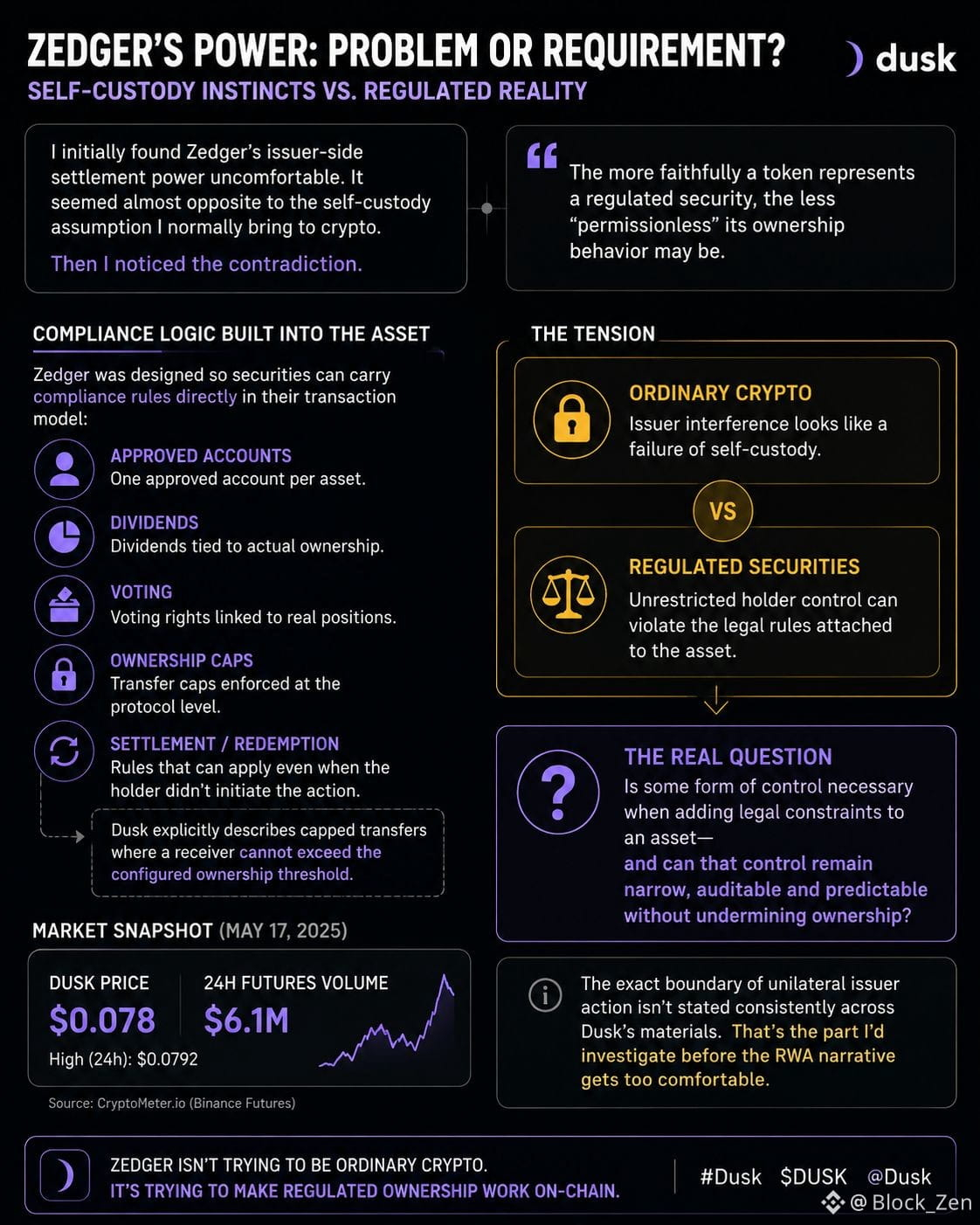
I initially found Zedger’s issuer-side settlement power uncomfortable. It seemed almost opposite to the self-custody assumption I normally bring to crypto.
Then I noticed the contradiction.
DUSK has been trading around $0.078 today, after pushing near $0.0792, with roughly $6.1M in 24h futures volume.
Meanwhile, the protocol detail that interests me has little to do with price.
Zedger was designed so securities can carry compliance rules directly in their transaction model: approved accounts, ownership caps, dividends, voting, and settlement/redemption logic. Dusk explicitly describes capped transfers where a receiver cannot exceed the configured ownership threshold.
That creates an odd tension.
The more faithfully a token represents a regulated security, the less “permissionless” its ownership behavior may be.
For ordinary crypto, issuer interference looks like a failure of self-custody.
For securities, unrestricted holder control can itself violate the rules attached to the asset.
So the interesting question isn't whether Zedger gives issuers control.
It's whether adding legal constraints to an asset makes some form of control necessary — and whether that control can remain narrow, auditable and predictable.
I haven't found the exact boundary of unilateral issuer action stated consistently enough to settle that question.
And honestly, that's the part I'd investigate before the RWA narrative gets too comfortable.
@Dusk #dusk $DUSK
I initially found Zedger’s issuer-side settlement power uncomfortable. It seemed almost opposite to the self-custody assumption I normally bring to crypto.
Then I noticed the contradiction.
DUSK has been trading around $0.078 today, after pushing near $0.0792, with roughly $6.1M in 24h futures volume.
Meanwhile, the protocol detail that interests me has little to do with price.
Zedger was designed so securities can carry compliance rules directly in their transaction model: approved accounts, ownership caps, dividends, voting, and settlement/redemption logic. Dusk explicitly describes capped transfers where a receiver cannot exceed the configured ownership threshold.
That creates an odd tension.
The more faithfully a token represents a regulated security, the less “permissionless” its ownership behavior may be.
For ordinary crypto, issuer interference looks like a failure of self-custody.
For securities, unrestricted holder control can itself violate the rules attached to the asset.
So the interesting question isn't whether Zedger gives issuers control.
It's whether adding legal constraints to an asset makes some form of control necessary — and whether that control can remain narrow, auditable and predictable.
I haven't found the exact boundary of unilateral issuer action stated consistently enough to settle that question.
And honestly, that's the part I'd investigate before the RWA narrative gets too comfortable.
@Dusk #dusk $DUSK
Verified
#dusk $DUSK @Dusk
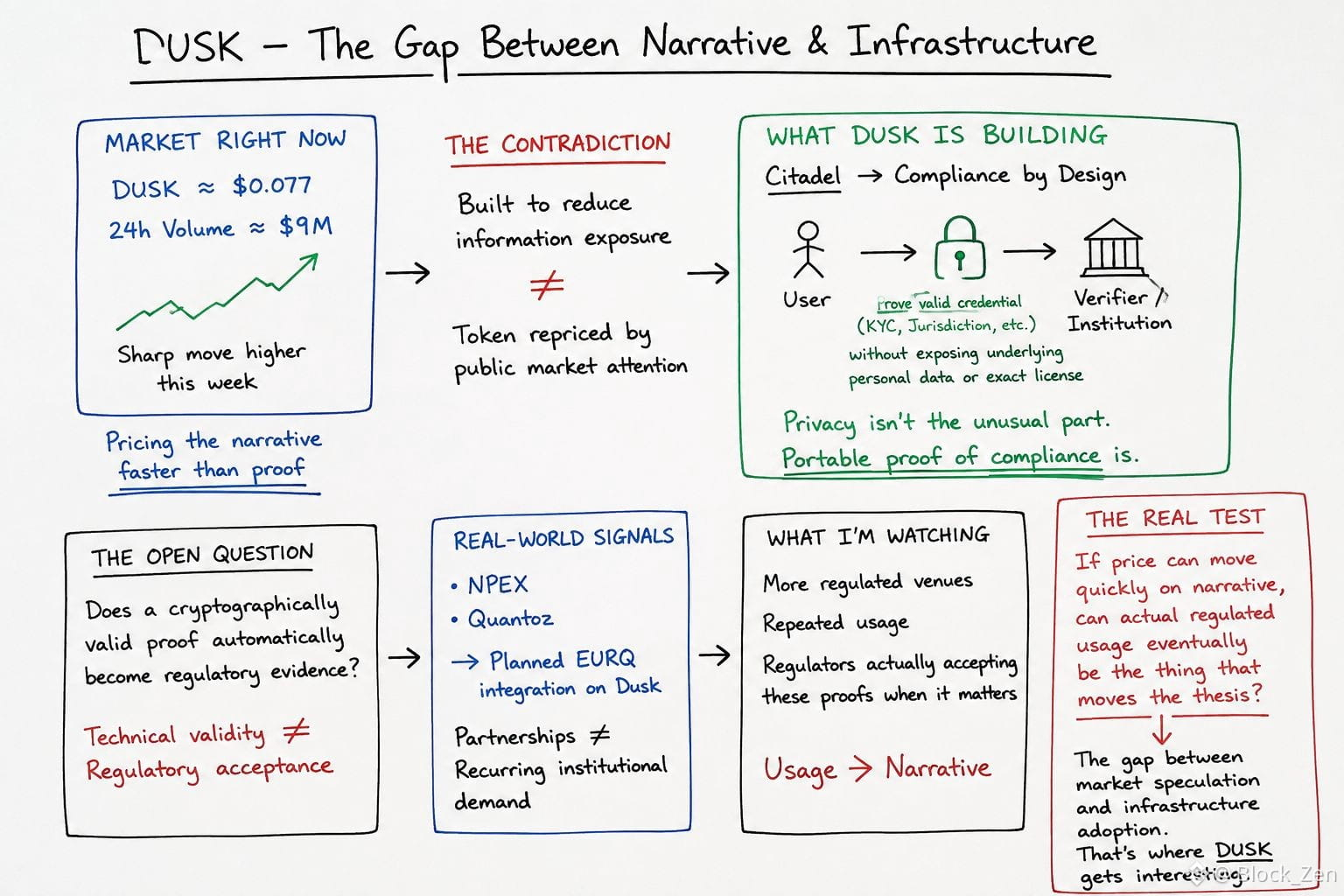
I have heard “this coin is different” enough times to become suspicious of the phrase. Dusk made me look twice because the market seems to be pricing the narrative faster than the infrastructure is being proven.
DUSK is around $0.077 with roughly $9M in 24h volume, after a sharp move higher this week.
That’s where the contradiction gets interesting.
The thing Dusk is building is about reducing information exposure, yet its token is currently being repriced by very public market attention.
Underneath that noise, Citadel takes a different approach to compliance. Users can prove they hold a valid credential without putting the underlying personal details or exact license on-chain.
So privacy is not really the unusual part.
The unusual part is trying to make proof of compliance portable.
But that creates a question I can not answer from architecture alone: does a cryptographically valid proof become regulatory evidence simply because it is technically verifiable?
NPEX and Quantoz give the thesis more substance, including the planned EURQ integration on Dusk. But partnerships aren't the same thing as recurring institutional demand.
That’s what I am watching now.
If price can move this quickly on narrative, can actual regulated usage eventually become the thing that moves the thesis?
That gap between market speculation and infrastructure adoption is where DUSK gets interesting to me.
@Dusk #DUSK $DUSK
I have heard “this coin is different” enough times to become suspicious of the phrase. Dusk made me look twice because the market seems to be pricing the narrative faster than the infrastructure is being proven.
DUSK is around $0.077 with roughly $9M in 24h volume, after a sharp move higher this week.
That’s where the contradiction gets interesting.
The thing Dusk is building is about reducing information exposure, yet its token is currently being repriced by very public market attention.
Underneath that noise, Citadel takes a different approach to compliance. Users can prove they hold a valid credential without putting the underlying personal details or exact license on-chain.
So privacy is not really the unusual part.
The unusual part is trying to make proof of compliance portable.
But that creates a question I can not answer from architecture alone: does a cryptographically valid proof become regulatory evidence simply because it is technically verifiable?
NPEX and Quantoz give the thesis more substance, including the planned EURQ integration on Dusk. But partnerships aren't the same thing as recurring institutional demand.
That’s what I am watching now.
If price can move this quickly on narrative, can actual regulated usage eventually become the thing that moves the thesis?
That gap between market speculation and infrastructure adoption is where DUSK gets interesting to me.
@Dusk #DUSK $DUSK
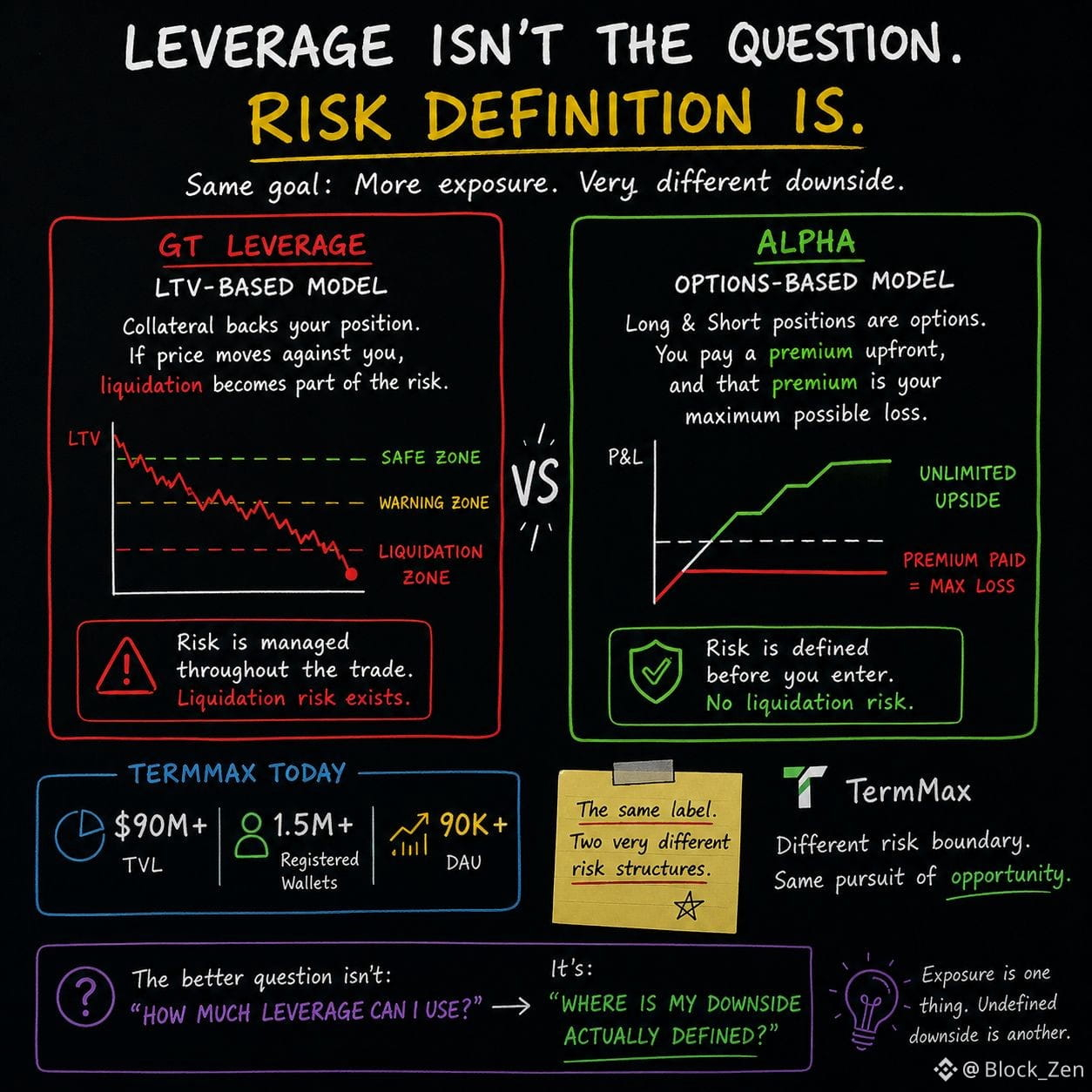
I used to think leverage always came down to one question: how far can a position move against me before liquidation?
Looking deeper into @TermMax made that assumption feel too simple.
GT-based leverage works through LTV. If the collateral moves far enough against the position, liquidation becomes part of the risk.
Alpha is different.
Its Long and Short positions are options. You pay a premium upfront, and that premium defines the position’s maximum possible loss. TermMax describes this as leveraged exposure without liquidation risk.
I do not read that as “safe leverage.”
I read it as a different way of defining the downside.
GT leaves the position exposed to LTV and liquidation mechanics.
Alpha puts the maximum loss at the entry point through the premium.
That distinction changed how I look at the word “leverage.”
The same label can describe two very different risk structures.
And the leverage multiple alone doesn't tell me enough.
It tells me how much exposure I am taking.
It doesn't tell me what happens when I am wrong.
So the question I’m more interested in now is not:
“How much leverage can I use?”
It’s:
“Where is my downside actually defined?”
That feels like a much better place to start.
#termmax @TermMax
Looking deeper into @TermMax made that assumption feel too simple.
GT-based leverage works through LTV. If the collateral moves far enough against the position, liquidation becomes part of the risk.
Alpha is different.
Its Long and Short positions are options. You pay a premium upfront, and that premium defines the position’s maximum possible loss. TermMax describes this as leveraged exposure without liquidation risk.
I do not read that as “safe leverage.”
I read it as a different way of defining the downside.
GT leaves the position exposed to LTV and liquidation mechanics.
Alpha puts the maximum loss at the entry point through the premium.
That distinction changed how I look at the word “leverage.”
The same label can describe two very different risk structures.
And the leverage multiple alone doesn't tell me enough.
It tells me how much exposure I am taking.
It doesn't tell me what happens when I am wrong.
So the question I’m more interested in now is not:
“How much leverage can I use?”
It’s:
“Where is my downside actually defined?”
That feels like a much better place to start.
#termmax @TermMax
#dusk $DUSK @Dusk
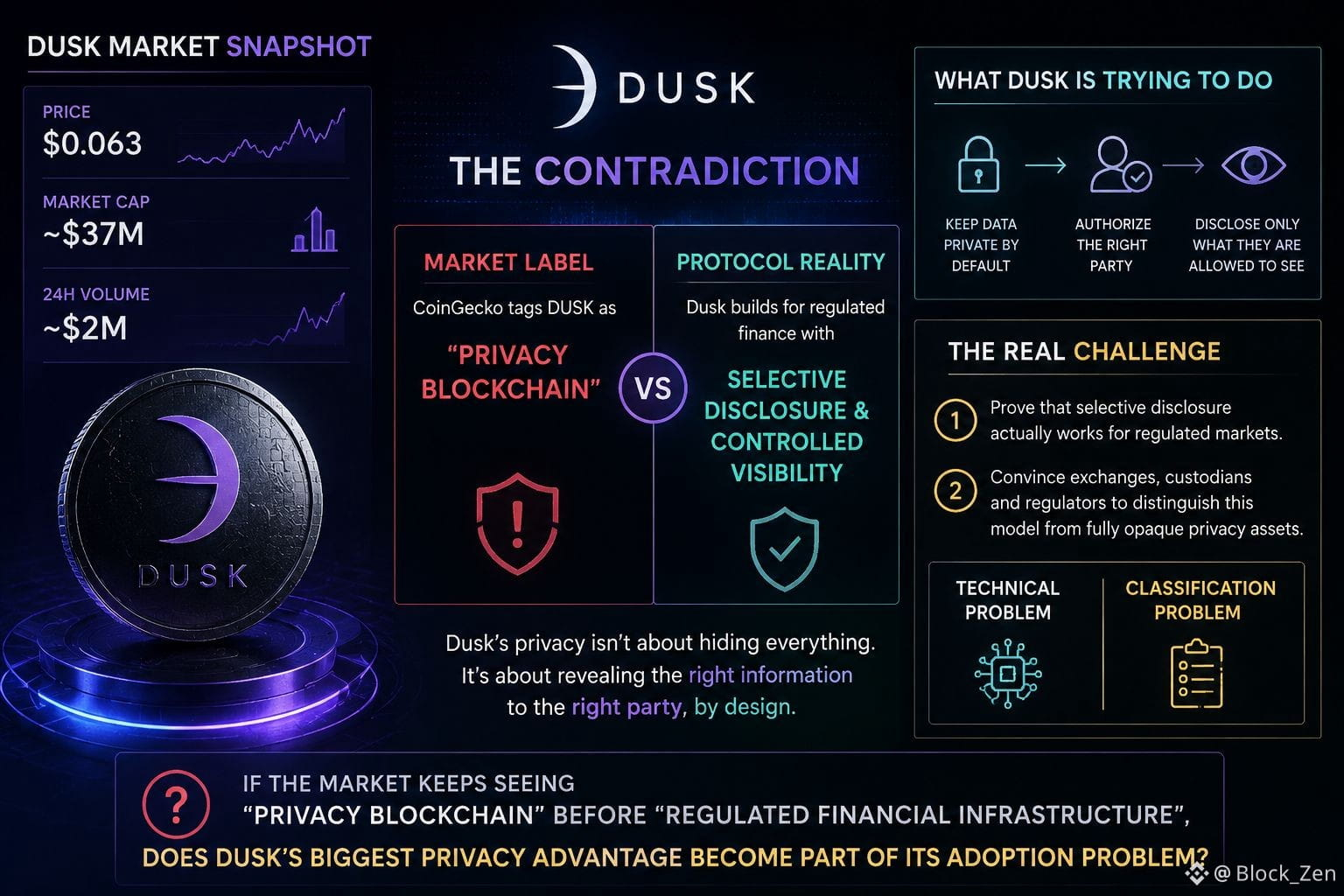
I have been looking at DUSK around $0.063 lately, and the market is still treating it like a small-cap token: roughly $37M market cap and about $2M in daily volume.
But the more interesting part for me isn’t the size. It’s the contradiction.
CoinGecko still puts DUSK in the “Privacy Blockchain” bucket, while Dusk is building around regulated assets, selective disclosure and controlled visibility.
That sounds like a simple classification issue until you look at what the protocol is actually trying to do.
Dusk does not seem to treat privacy as “nobody can see anything.” Its design is closer to: keep sensitive financial information hidden by default, then let the issuer, venue, auditor or regulator see the specific information they’re authorized to see.
That creates the contradiction I keep coming back to.
The protocol is trying to make privacy compatible with regulation, while the privacy label itself can become a regulatory risk signal.
So Dusk may have to prove two things at once.
First, that selective disclosure actually works for regulated markets.
Second, that exchanges and custodians are willing to distinguish that model from fully opaque privacy assets.
The first is a technical problem.
The second is a classification problem.
And honestly, I’m more curious about the second one.
If the market keeps seeing “privacy blockchain” before it sees “regulated financial infrastructure,” does Dusk’s biggest privacy advantage become part of its adoption problem?
@Dusk #dusk $DUSK
l
I have been looking at DUSK around $0.063 lately, and the market is still treating it like a small-cap token: roughly $37M market cap and about $2M in daily volume.
But the more interesting part for me isn’t the size. It’s the contradiction.
CoinGecko still puts DUSK in the “Privacy Blockchain” bucket, while Dusk is building around regulated assets, selective disclosure and controlled visibility.
That sounds like a simple classification issue until you look at what the protocol is actually trying to do.
Dusk does not seem to treat privacy as “nobody can see anything.” Its design is closer to: keep sensitive financial information hidden by default, then let the issuer, venue, auditor or regulator see the specific information they’re authorized to see.
That creates the contradiction I keep coming back to.
The protocol is trying to make privacy compatible with regulation, while the privacy label itself can become a regulatory risk signal.
So Dusk may have to prove two things at once.
First, that selective disclosure actually works for regulated markets.
Second, that exchanges and custodians are willing to distinguish that model from fully opaque privacy assets.
The first is a technical problem.
The second is a classification problem.
And honestly, I’m more curious about the second one.
If the market keeps seeing “privacy blockchain” before it sees “regulated financial infrastructure,” does Dusk’s biggest privacy advantage become part of its adoption problem?
@Dusk #dusk $DUSK
l
#dusk $DUSK @Dusk
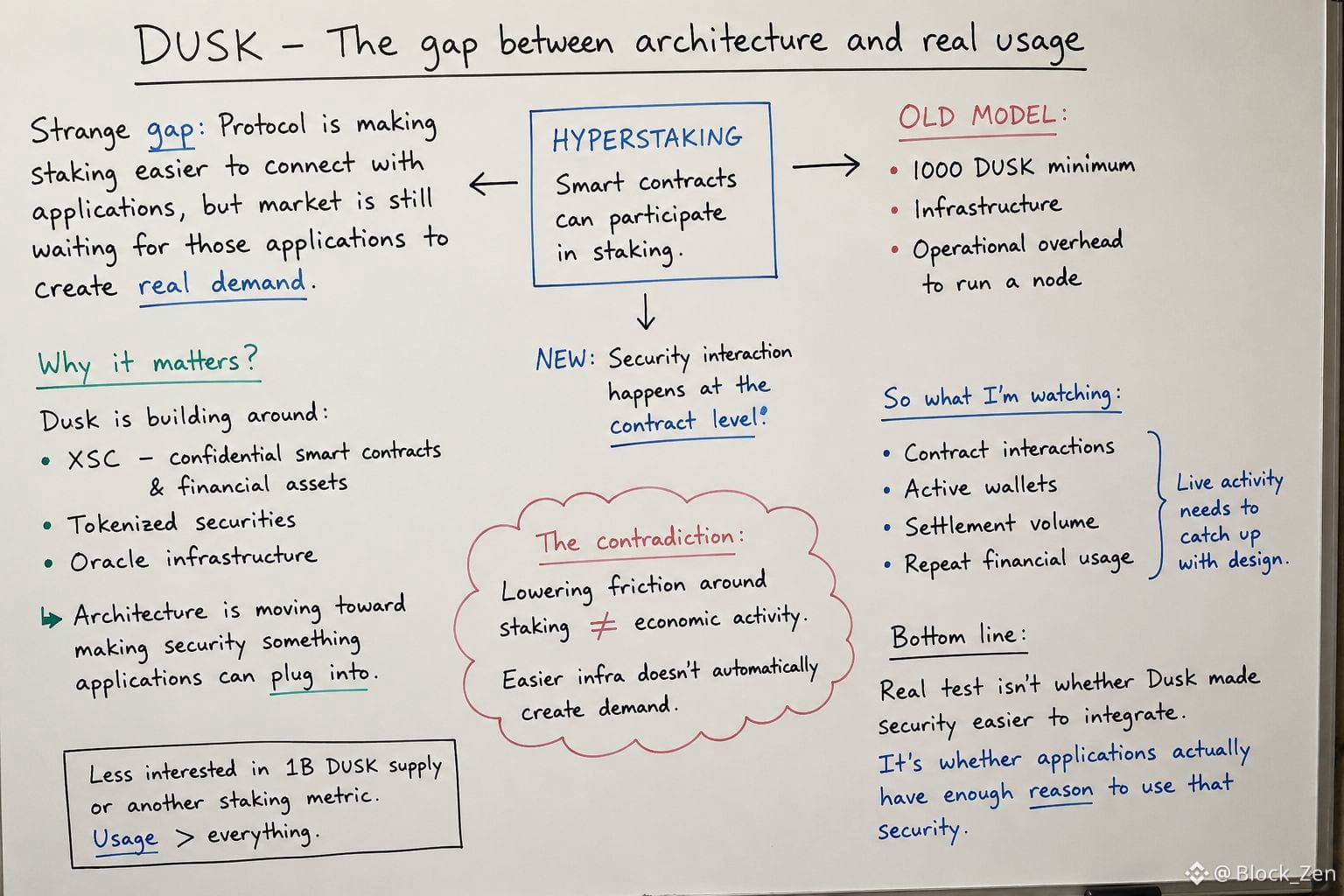
I keep coming back to a strange gap in Dusk: the protocol is making staking easier to connect with applications, while the market still seems to be waiting for those applications to create real demand.
Hyperstaking lets smart contracts participate in staking. Under the older model, staking meant more operational overhead, including the 1,000 DUSK minimum and the infrastructure required to run a node. Now that security interaction can happen at the contract level.
That matters more when you look at what Dusk is actually building around it: XSC for confidential smart contracts and financial assets, plus work around tokenized securities and oracle infrastructure.
So the architecture is moving toward making security something applications can plug into.
But here’s the contradiction I find more interesting.
Lowering the friction around staking should make the network easier to use, yet easier infrastructure doesn’t automatically create economic activity. If financial applications aren’t generating recurring transactions, Hyperstaking can improve the architecture without materially changing the network’s usage.
That’s why I am less interested in the 1B DUSK supply or another staking metric by itself.
I want to see whether live activity starts catching up with the design: contract interactions, active wallets, settlement volume and repeat financial usage.
Because the real test is not whether Dusk made security easier to integrate.
It’s whether applications actually have enough reason to use that security.
@Dusk #dusk $DUSK
I keep coming back to a strange gap in Dusk: the protocol is making staking easier to connect with applications, while the market still seems to be waiting for those applications to create real demand.
Hyperstaking lets smart contracts participate in staking. Under the older model, staking meant more operational overhead, including the 1,000 DUSK minimum and the infrastructure required to run a node. Now that security interaction can happen at the contract level.
That matters more when you look at what Dusk is actually building around it: XSC for confidential smart contracts and financial assets, plus work around tokenized securities and oracle infrastructure.
So the architecture is moving toward making security something applications can plug into.
But here’s the contradiction I find more interesting.
Lowering the friction around staking should make the network easier to use, yet easier infrastructure doesn’t automatically create economic activity. If financial applications aren’t generating recurring transactions, Hyperstaking can improve the architecture without materially changing the network’s usage.
That’s why I am less interested in the 1B DUSK supply or another staking metric by itself.
I want to see whether live activity starts catching up with the design: contract interactions, active wallets, settlement volume and repeat financial usage.
Because the real test is not whether Dusk made security easier to integrate.
It’s whether applications actually have enough reason to use that security.
@Dusk #dusk $DUSK
#termmax @TermMax
I used to read @TermMax through the retail layer, but the current numbers make me look at it differently.
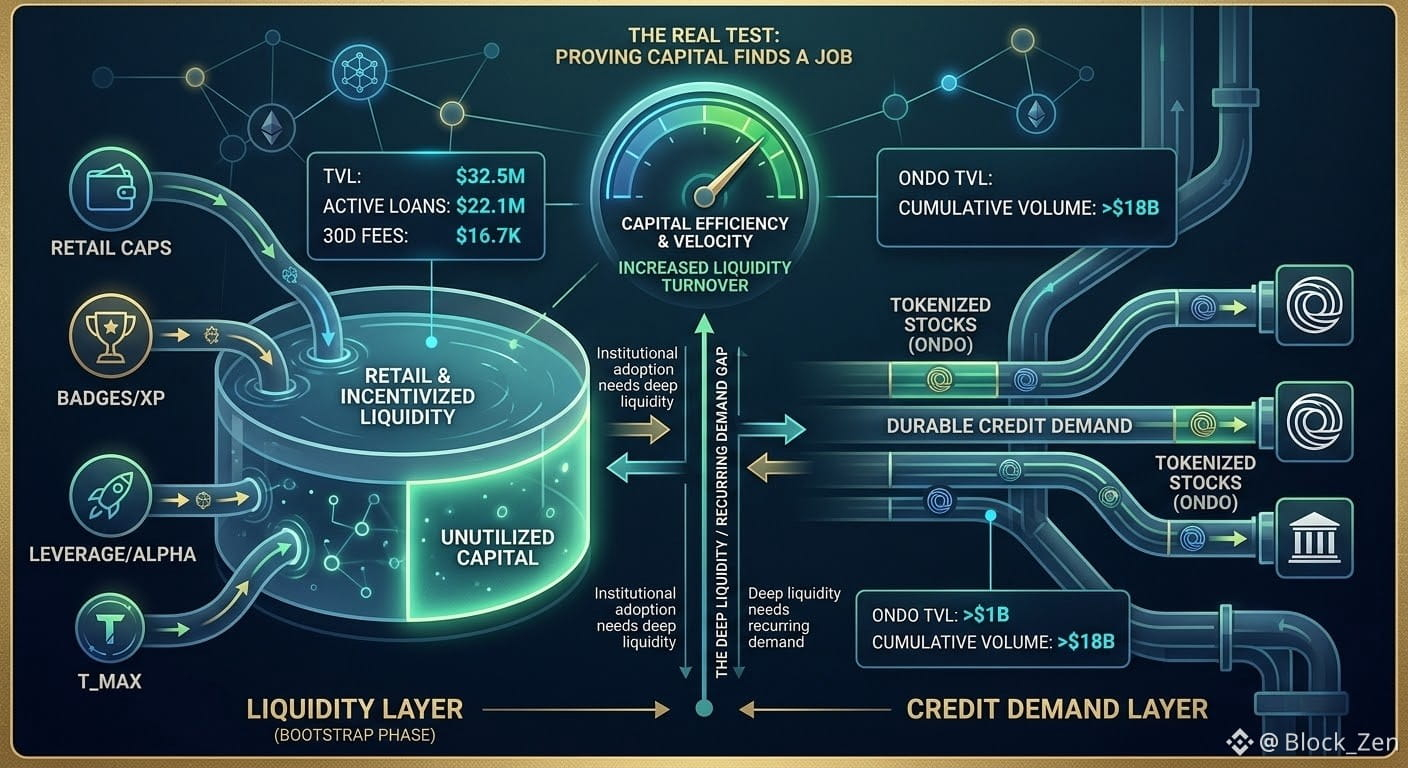
TMX campaigns, XP, badges, leverage and Alpha create visible activity. TermMax is sitting around $32.5M TVL, with roughly $22.1M in active loans and $16.7K in fees over 30 days.
What caught me is not the size. It’s the gap between liquidity and actual credit demand.
If retail is helping bootstrap the liquidity layer, the harder question is whether that capital keeps finding productive use, rather than simply accumulating on the balance sheet.
The institutional direction makes this more interesting. TermMax has already moved into fixed-rate financing around Ondo tokenized stocks, while Ondo’s tokenized-stock platform has crossed $1B TVL and $18B in cumulative volume.
So the market opportunity looks real.
But there’s a contradiction here I keep coming back to:
institutional adoption needs deep liquidity, while deep liquidity itself needs recurring demand.
Retail can help create the first side quickly. Institutions may eventually provide the second, but they need predictable funding, defined maturities and enough depth to deploy meaningful size.
That’s why I am less interested in TermMax simply growing TVL.
I’m watching whether existing liquidity starts turning over more frequently into durable credit demand.
Maybe the real test is not attracting more capital.
It’s proving that the capital already there can keep finding a job.
I used to read @TermMax through the retail layer, but the current numbers make me look at it differently.
TMX campaigns, XP, badges, leverage and Alpha create visible activity. TermMax is sitting around $32.5M TVL, with roughly $22.1M in active loans and $16.7K in fees over 30 days.
What caught me is not the size. It’s the gap between liquidity and actual credit demand.
If retail is helping bootstrap the liquidity layer, the harder question is whether that capital keeps finding productive use, rather than simply accumulating on the balance sheet.
The institutional direction makes this more interesting. TermMax has already moved into fixed-rate financing around Ondo tokenized stocks, while Ondo’s tokenized-stock platform has crossed $1B TVL and $18B in cumulative volume.
So the market opportunity looks real.
But there’s a contradiction here I keep coming back to:
institutional adoption needs deep liquidity, while deep liquidity itself needs recurring demand.
Retail can help create the first side quickly. Institutions may eventually provide the second, but they need predictable funding, defined maturities and enough depth to deploy meaningful size.
That’s why I am less interested in TermMax simply growing TVL.
I’m watching whether existing liquidity starts turning over more frequently into durable credit demand.
Maybe the real test is not attracting more capital.
It’s proving that the capital already there can keep finding a job.
#termmax @TermMax
I kept coming back to TermMax’s Range Orders because, honestly, I first thought it was just another order-book feature.
Then I looked at the current numbers and started seeing the design a bit differently.
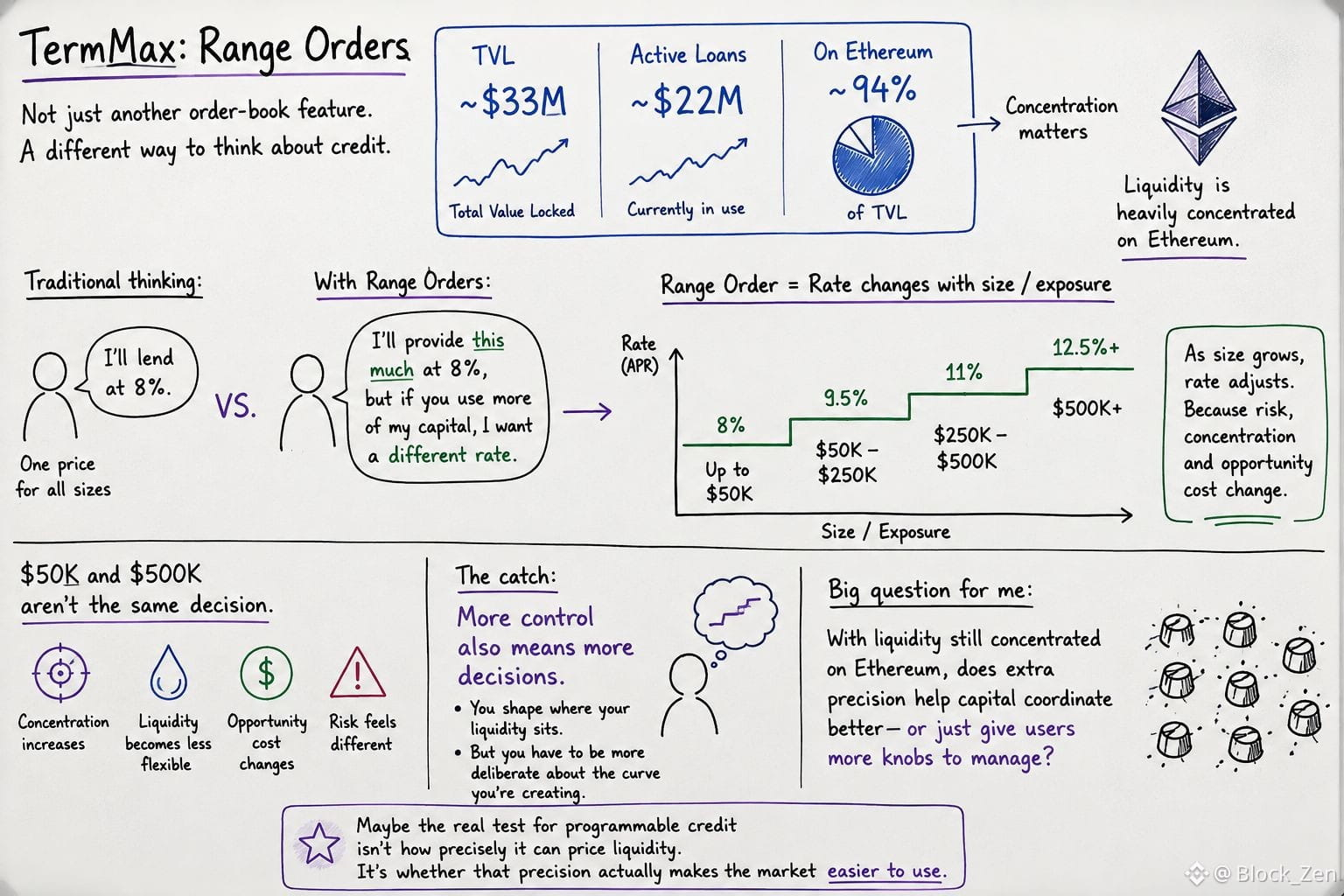
TermMax is around $33M in TVL with roughly $22M in active loans, while about 94% of TVL is still on Ethereum.
What stood out to me is how the Range Order handles size.
A lender is not simply saying, “I'll lend at 8%.”
It's more like, “I'll provide this much at 8%, but if you use more of my capital, I want a different rate.”
That feels closer to how I’d actually think about my own money.
I might be perfectly comfortable putting $50K somewhere, but $500K would make me pause. The concentration is different. The liquidity I’m giving up is different. Even the opportunity cost starts to feel different.
At first, I saw this as simply better credit pricing.
But there's a catch I didn't think about initially.
More control also means more decisions.
You get to shape where your liquidity sits, but you also have to be more deliberate about the curve you're creating.
And with liquidity still heavily concentrated on Ethereum, I keep wondering whether this extra precision actually helps capital coordinate better or just gives users more knobs to manage.
Maybe that's the real test for programmable credit.
@TermMax #termax
I kept coming back to TermMax’s Range Orders because, honestly, I first thought it was just another order-book feature.
Then I looked at the current numbers and started seeing the design a bit differently.
TermMax is around $33M in TVL with roughly $22M in active loans, while about 94% of TVL is still on Ethereum.
What stood out to me is how the Range Order handles size.
A lender is not simply saying, “I'll lend at 8%.”
It's more like, “I'll provide this much at 8%, but if you use more of my capital, I want a different rate.”
That feels closer to how I’d actually think about my own money.
I might be perfectly comfortable putting $50K somewhere, but $500K would make me pause. The concentration is different. The liquidity I’m giving up is different. Even the opportunity cost starts to feel different.
At first, I saw this as simply better credit pricing.
But there's a catch I didn't think about initially.
More control also means more decisions.
You get to shape where your liquidity sits, but you also have to be more deliberate about the curve you're creating.
And with liquidity still heavily concentrated on Ethereum, I keep wondering whether this extra precision actually helps capital coordinate better or just gives users more knobs to manage.
Maybe that's the real test for programmable credit.
@TermMax #termax
#dusk $DUSK @Dusk
I was looking through DUSK’s Citadel setup and one small thing kept bothering me: selective disclosure reduces the data you expose, but it can make the credential issuer even more important.
The idea itself is pretty straightforward. A user gets verified, receives a license, and can later prove things like accredited status, sanctions clearance, or jurisdiction without showing the whole identity record.
At first, I thought, okay, this is simply less trust and less data everywhere.
Then I started thinking about what happens behind that credential.
The original KYC decision still came from somewhere. If that credential is portable, the same decision can be reused across different interactions instead of every institution starting the process again.
That's useful.
But it also means I am relying more heavily on whoever issued it.
And this is where the timing part caught my attention. A credential can be valid today and not mean the same thing later. Sanctions change. Eligibility changes. Compliance information gets old.
So the tradeoff I keep seeing is pretty simple:
the verifier sees less, but the issuer matters more.
That makes things like revocation, freshness and accountability pretty important.
I'm also more interested in whether people actually use these credentials repeatedly than how many integrations get announced.
Because eventually, someone has to trust the credential enough to act on it.
If that credential turns out to be outdated or wrong, I'm still wondering:
who is actually responsible?
@Dusk #dusk $DUSK
When a credential is wrong or outdated, who should be accountable?
I was looking through DUSK’s Citadel setup and one small thing kept bothering me: selective disclosure reduces the data you expose, but it can make the credential issuer even more important.
The idea itself is pretty straightforward. A user gets verified, receives a license, and can later prove things like accredited status, sanctions clearance, or jurisdiction without showing the whole identity record.
At first, I thought, okay, this is simply less trust and less data everywhere.
Then I started thinking about what happens behind that credential.
The original KYC decision still came from somewhere. If that credential is portable, the same decision can be reused across different interactions instead of every institution starting the process again.
That's useful.
But it also means I am relying more heavily on whoever issued it.
And this is where the timing part caught my attention. A credential can be valid today and not mean the same thing later. Sanctions change. Eligibility changes. Compliance information gets old.
So the tradeoff I keep seeing is pretty simple:
the verifier sees less, but the issuer matters more.
That makes things like revocation, freshness and accountability pretty important.
I'm also more interested in whether people actually use these credentials repeatedly than how many integrations get announced.
Because eventually, someone has to trust the credential enough to act on it.
If that credential turns out to be outdated or wrong, I'm still wondering:
who is actually responsible?
@Dusk #dusk $DUSK
When a credential is wrong or outdated, who should be accountable?
The credential issuer
67%
The verifier
33%
Both equally
0%
3 votes • Voting closed
#dusk $DUSK @Dusk
I kept coming back to one odd contrast in DuskEVM: the market is treating DUSK like a quiet $0.064 asset right now, with roughly $4.1M in 24h volume, while the architecture is quietly making DUSK the first step into the EVM itself.
Before deploying Solidity, you bridge DUSK from DuskDS. It becomes the gas asset on DuskEVM, while DuskDS remains the settlement and data-availability layer.
That initially looked like ordinary testnet plumbing to me.
Then the contradiction clicked.
DuskEVM is supposed to feel familiar to EVM developers, but the first economic action isn’t Ethereum-like at all. You’re entering through Dusk’s own settlement layer first.
So the compatibility story and the settlement story are pulling in different directions: familiar execution on one side, a deliberately Dusk-native dependency underneath.
And that might matter more than the bridge itself.
If developers eventually use DuskEVM for privacy-sensitive financial applications, the question isn’t just whether the EVM feels familiar. It’s whether that underlying connection to DuskDS becomes part of why the application works the way it does.
Right now, with DUSK still trading around six cents, the market doesn’t seem to be pricing much into that distinction.
I’m not sure whether that’s because the architecture is early, or because the dependency ultimately won’t matter as much as I think.
Which side proves right once real applications arrive?
@Dusk #dusk $DUSK
What matters more for DuskEVM’s long-term adoption?
I kept coming back to one odd contrast in DuskEVM: the market is treating DUSK like a quiet $0.064 asset right now, with roughly $4.1M in 24h volume, while the architecture is quietly making DUSK the first step into the EVM itself.
Before deploying Solidity, you bridge DUSK from DuskDS. It becomes the gas asset on DuskEVM, while DuskDS remains the settlement and data-availability layer.
That initially looked like ordinary testnet plumbing to me.
Then the contradiction clicked.
DuskEVM is supposed to feel familiar to EVM developers, but the first economic action isn’t Ethereum-like at all. You’re entering through Dusk’s own settlement layer first.
So the compatibility story and the settlement story are pulling in different directions: familiar execution on one side, a deliberately Dusk-native dependency underneath.
And that might matter more than the bridge itself.
If developers eventually use DuskEVM for privacy-sensitive financial applications, the question isn’t just whether the EVM feels familiar. It’s whether that underlying connection to DuskDS becomes part of why the application works the way it does.
Right now, with DUSK still trading around six cents, the market doesn’t seem to be pricing much into that distinction.
I’m not sure whether that’s because the architecture is early, or because the dependency ultimately won’t matter as much as I think.
Which side proves right once real applications arrive?
@Dusk #dusk $DUSK
What matters more for DuskEVM’s long-term adoption?
EVM compatibility
67%
DuskDS settlement
0%
Privacy-native apps
33%
6 votes • Voting closed
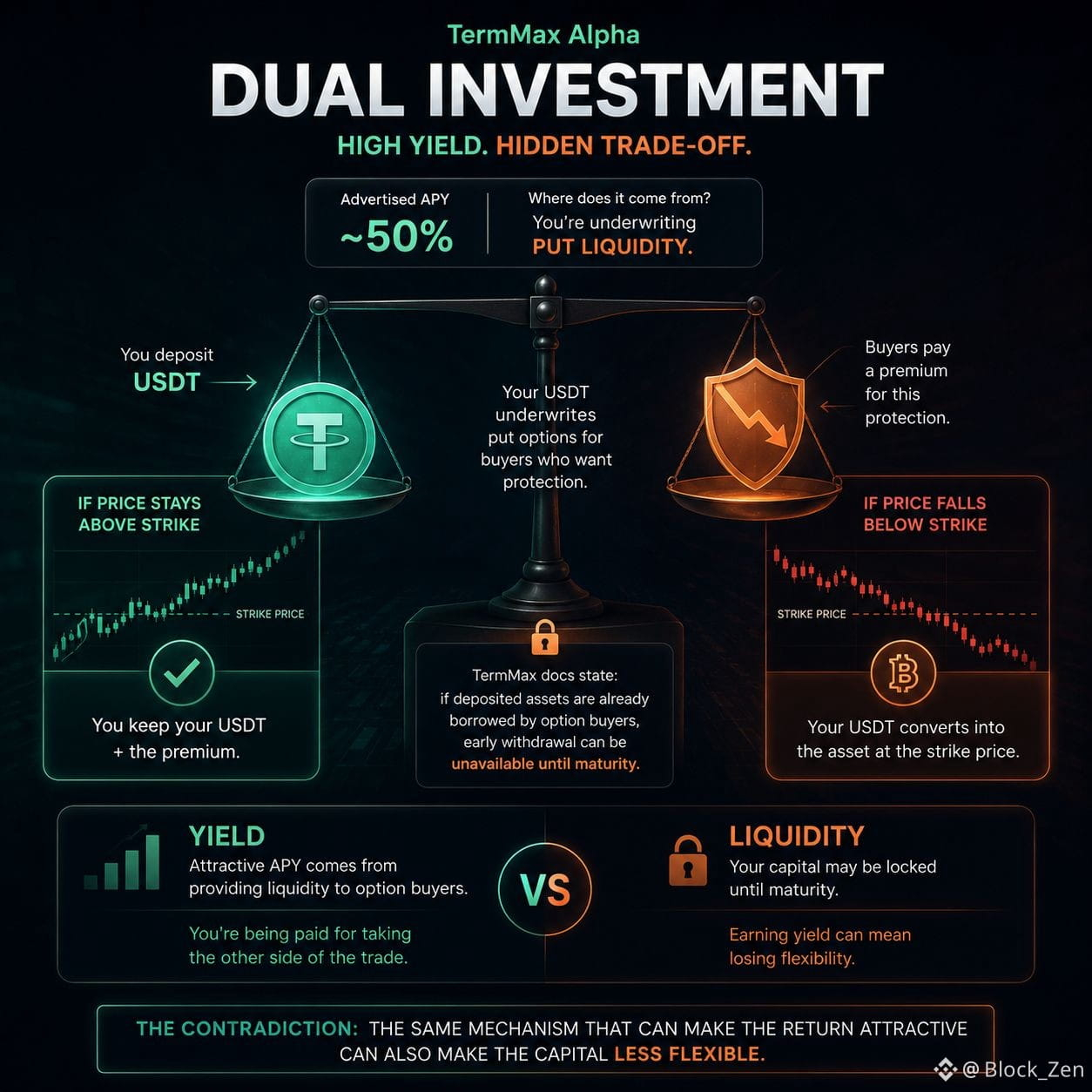
I kept looking at @TermMax Alpha’s Dual Investment, and one contradiction stood out more than the APY.
The current interface advertises yields around 50%, but the part I find more interesting is where that yield comes from: your USDT is effectively underwriting put liquidity.
If price stays above your strike, you keep USDT and the premium. If it falls below, the USDT can convert into the asset at your chosen strike.
So the attractive yield comes with a less obvious condition: your liquidity may not remain fully liquid.
TermMax’s docs say that when deposited assets are already borrowed by option buyers, early withdrawal can be unavailable until maturity.
That changes how I think about the product.
The APY is not really paying you just for parking USDT. You’re being compensated for making that liquidity available to someone taking the other side of the option.
And if the market moves hard, that distinction matters.
You could be earning while simultaneously becoming less flexible with the capital.
I’m curious whether users will value that trade-off once the headline APY stops being the main attraction.
The key contradiction here is yield vs liquidity: the same mechanism that can make the return attractive can also make the capital less flexible.
@TermMax #termmax
The current interface advertises yields around 50%, but the part I find more interesting is where that yield comes from: your USDT is effectively underwriting put liquidity.
If price stays above your strike, you keep USDT and the premium. If it falls below, the USDT can convert into the asset at your chosen strike.
So the attractive yield comes with a less obvious condition: your liquidity may not remain fully liquid.
TermMax’s docs say that when deposited assets are already borrowed by option buyers, early withdrawal can be unavailable until maturity.
That changes how I think about the product.
The APY is not really paying you just for parking USDT. You’re being compensated for making that liquidity available to someone taking the other side of the option.
And if the market moves hard, that distinction matters.
You could be earning while simultaneously becoming less flexible with the capital.
I’m curious whether users will value that trade-off once the headline APY stops being the main attraction.
The key contradiction here is yield vs liquidity: the same mechanism that can make the return attractive can also make the capital less flexible.
@TermMax #termmax
#termmax @TermMax
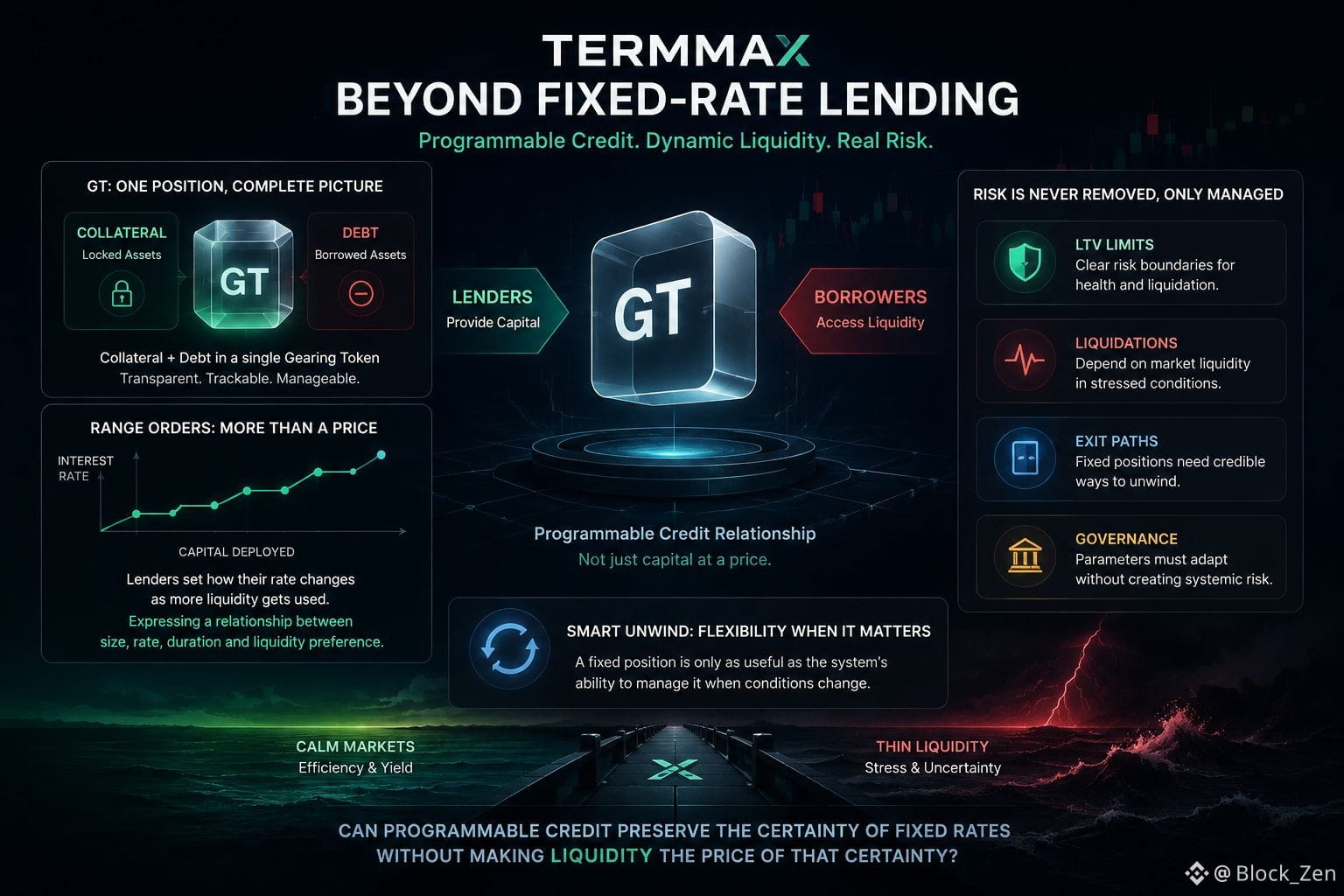
I used to think TermMax was mainly solving one problem: bringing fixed-rate lending on-chain. After spending more time with the design, I think the harder problem is what happens to that fixed credit when liquidity starts moving.
That’s where the architecture became more interesting to me.
The GT structure puts collateral and debt into one position, while LTV limits make the risk boundary easier to see. Range Orders go a step further by letting lenders express how their required rate changes as more of their liquidity gets used.
That subtle difference matters.
It means the market isn't only matching capital at a price. It can start expressing a relationship between size, rate, duration and liquidity preference.
But flexibility does not remove risk. It moves some of the complexity elsewhere.
Liquidations still depend on market liquidity. Fixed positions still need credible exit paths. Governance still has to change parameters without turning a local adjustment into a broader risk event.
That’s why Smart Unwind caught my attention too. A fixed position is only as useful as the system’s ability to manage it when the original conditions no longer feel comfortable.
So I’m watching TermMax less for the headline rate now, and more for what happens when liquidity gets thin.
Can programmable credit preserve the certainty of fixed rates without quietly making liquidity the price of that certainty?
#TermMax @TermMax
I used to think TermMax was mainly solving one problem: bringing fixed-rate lending on-chain. After spending more time with the design, I think the harder problem is what happens to that fixed credit when liquidity starts moving.
That’s where the architecture became more interesting to me.
The GT structure puts collateral and debt into one position, while LTV limits make the risk boundary easier to see. Range Orders go a step further by letting lenders express how their required rate changes as more of their liquidity gets used.
That subtle difference matters.
It means the market isn't only matching capital at a price. It can start expressing a relationship between size, rate, duration and liquidity preference.
But flexibility does not remove risk. It moves some of the complexity elsewhere.
Liquidations still depend on market liquidity. Fixed positions still need credible exit paths. Governance still has to change parameters without turning a local adjustment into a broader risk event.
That’s why Smart Unwind caught my attention too. A fixed position is only as useful as the system’s ability to manage it when the original conditions no longer feel comfortable.
So I’m watching TermMax less for the headline rate now, and more for what happens when liquidity gets thin.
Can programmable credit preserve the certainty of fixed rates without quietly making liquidity the price of that certainty?
#TermMax @TermMax
#dusk $DUSK @Dusk
I was reading the Dusk Whitepaper again, and one thought kept sticking with me: privacy in financial markets is not really about hiding everything.
It's about hiding what should not be public, while still proving what actually needs to be verified.
That distinction sounds small, but I think it's the harder problem.
A public blockchain makes verification easy because everyone can see the same data. But regulated finance does not always work that way. Sensitive transactions may need confidentiality, while ownership rules, eligibility, or transaction validity still need to be provable.
That's where @Dusk caught my attention.
Phoenix takes a UTXO-based approach and combines tools like stealth addresses, nullifiers, signatures and zero-knowledge proofs. What interests me is not simply that transaction details can stay private.
It's that verification doesn't necessarily have to mean disclosure.
Then Zedger takes the idea further toward confidential smart contracts and financial applications.
To me, this is the interesting boundary: privacy shouldn't mean creating a black box, and compliance should not mean making every financial action public.
The real test is whether regulators can accept cryptographic proof as meaningful evidence without needing to see everything underneath it.
If that balance works, that's a much more useful idea than privacy alone.
What do you think: can regulated finance eventually trust proof without demanding full visibility?
@Dusk #dusk $DUSK
What matters most for regulated finance on-chain?
I was reading the Dusk Whitepaper again, and one thought kept sticking with me: privacy in financial markets is not really about hiding everything.
It's about hiding what should not be public, while still proving what actually needs to be verified.
That distinction sounds small, but I think it's the harder problem.
A public blockchain makes verification easy because everyone can see the same data. But regulated finance does not always work that way. Sensitive transactions may need confidentiality, while ownership rules, eligibility, or transaction validity still need to be provable.
That's where @Dusk caught my attention.
Phoenix takes a UTXO-based approach and combines tools like stealth addresses, nullifiers, signatures and zero-knowledge proofs. What interests me is not simply that transaction details can stay private.
It's that verification doesn't necessarily have to mean disclosure.
Then Zedger takes the idea further toward confidential smart contracts and financial applications.
To me, this is the interesting boundary: privacy shouldn't mean creating a black box, and compliance should not mean making every financial action public.
The real test is whether regulators can accept cryptographic proof as meaningful evidence without needing to see everything underneath it.
If that balance works, that's a much more useful idea than privacy alone.
What do you think: can regulated finance eventually trust proof without demanding full visibility?
@Dusk #dusk $DUSK
What matters most for regulated finance on-chain?
Privacy by default
0%
Full transparency
0%
Verifiable compliance
0%
0 votes • Voting closed
#dusk $DUSK
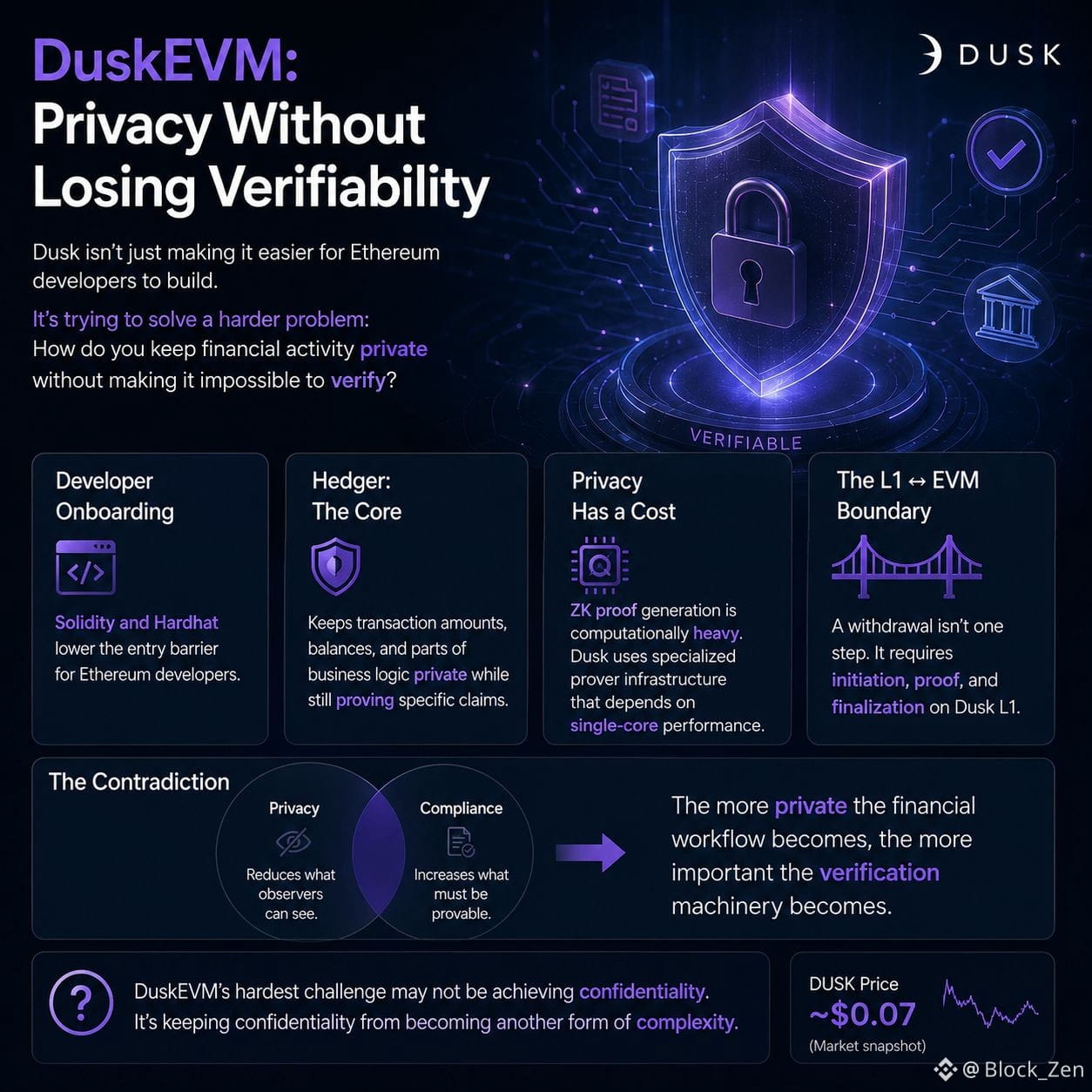
I initially thought DuskEVM was mainly an EVM onboarding play. Then I looked at the market and the architecture together, and the contradiction became harder to ignore.
DUSK is trading around the ~$0.07 area, while the protocol is trying to solve a problem that is not really about price: how do you make financial activity private without making it impossible to verify?
Solidity and Hardhat lower the developer barrier, but Hedger is where my attention stayed.
The interesting part isn't simply hiding balances or transaction data. It's that Dusk is trying to keep sensitive information protected while still allowing specific claims to be proven.
But privacy has a cost.
ZK proof generation is computationally heavy enough that Dusk separates prover work into specialized infrastructure, with performance depending heavily on single-core capacity.
And then there is the bridge between Dusk L1 and DuskEVM. A withdrawal isn't just one action; it requires initiation, proof, and finalization on the L1.
So the contradiction I keep coming back to is this:
The more private the financial workflow becomes, the more important the verification machinery becomes.
Privacy reduces what observers can see.
Compliance increases what must be provable.
Maybe DuskEVM's hardest problem isn't achieving confidentiality.
It’s keeping confidentiality from becoming another form of complexity.
That’s the part I’m still watching.
@Dusk #dusk $DUSK
I initially thought DuskEVM was mainly an EVM onboarding play. Then I looked at the market and the architecture together, and the contradiction became harder to ignore.
DUSK is trading around the ~$0.07 area, while the protocol is trying to solve a problem that is not really about price: how do you make financial activity private without making it impossible to verify?
Solidity and Hardhat lower the developer barrier, but Hedger is where my attention stayed.
The interesting part isn't simply hiding balances or transaction data. It's that Dusk is trying to keep sensitive information protected while still allowing specific claims to be proven.
But privacy has a cost.
ZK proof generation is computationally heavy enough that Dusk separates prover work into specialized infrastructure, with performance depending heavily on single-core capacity.
And then there is the bridge between Dusk L1 and DuskEVM. A withdrawal isn't just one action; it requires initiation, proof, and finalization on the L1.
So the contradiction I keep coming back to is this:
The more private the financial workflow becomes, the more important the verification machinery becomes.
Privacy reduces what observers can see.
Compliance increases what must be provable.
Maybe DuskEVM's hardest problem isn't achieving confidentiality.
It’s keeping confidentiality from becoming another form of complexity.
That’s the part I’m still watching.
@Dusk #dusk $DUSK
#dusk $DUSK
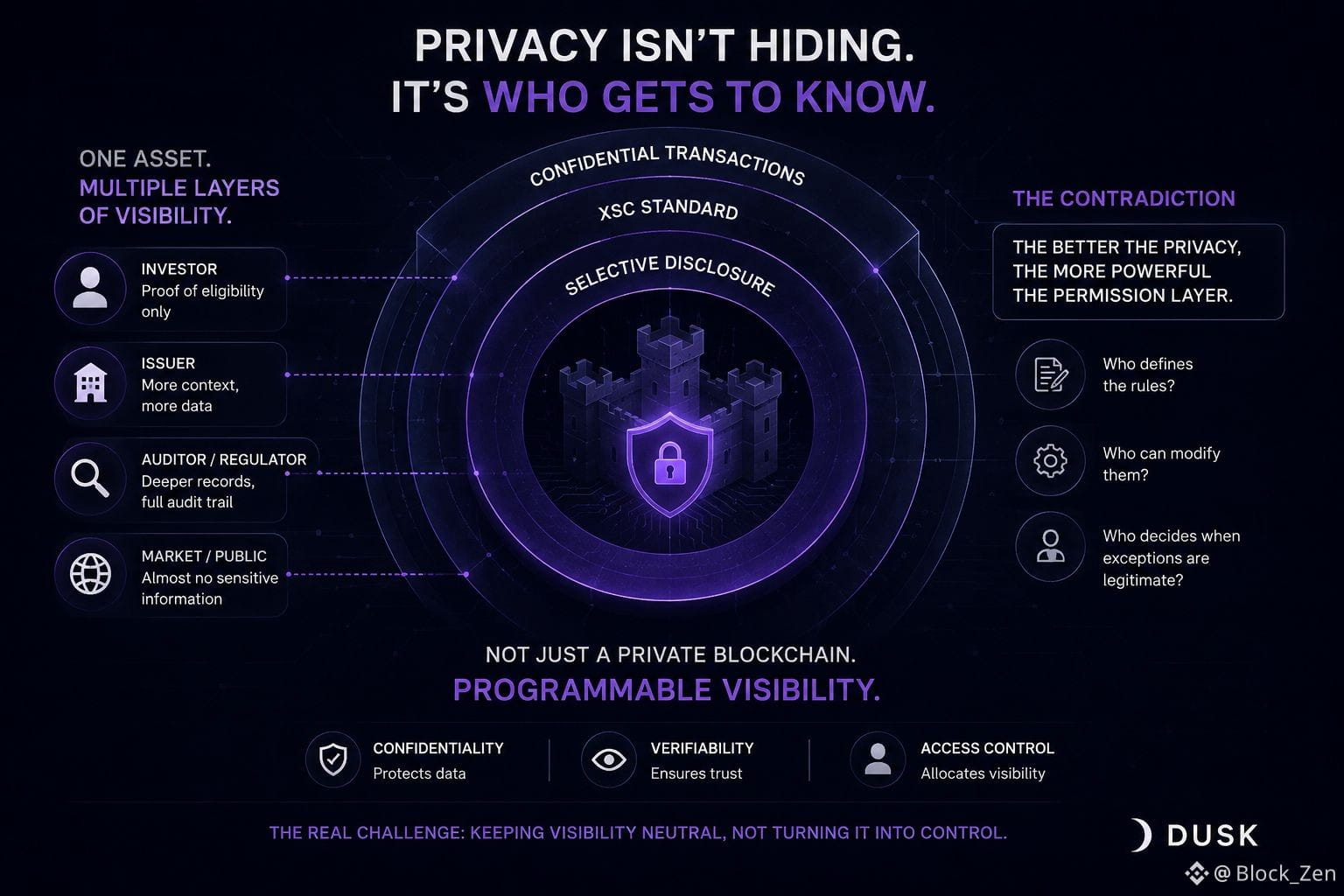
I keep coming back to a contradiction in @Dusk: the more useful privacy becomes for institutions, the more valuable controlled visibility becomes.
DUSK is around $0.0648, up 6.75%, but the price move is not really the part I care about.
What caught my attention is the architecture around confidential transactions, XSC, and selective disclosure. The idea is not simply to hide financial information. It's to let different participants access different layers of it when the situation requires.
An investor may only need proof of eligibility.
An issuer may need more context.
An auditor or regulator could require deeper records.
The wider market may need almost nothing.
That changes privacy from a hiding problem into an access-allocation problem.
And this is where the contradiction gets interesting.
The better programmable disclosure becomes, the more important the permission layer becomes too.
Who defines those rules?
Who can modify them?
Who decides when an exception is legitimate?
Because a system can protect sensitive information while still concentrating power over who is allowed to see it.
That's the boundary I find more interesting than private blockchain.
Dusk may be testing whether financial markets can have confidentiality without losing verifiability.
But the harder test could be whether programmable visibility stays neutral or slowly becomes programmable control.
That's what I'm watching beyond the price chart.
@Dusk #dusk $DUSK
I keep coming back to a contradiction in @Dusk: the more useful privacy becomes for institutions, the more valuable controlled visibility becomes.
DUSK is around $0.0648, up 6.75%, but the price move is not really the part I care about.
What caught my attention is the architecture around confidential transactions, XSC, and selective disclosure. The idea is not simply to hide financial information. It's to let different participants access different layers of it when the situation requires.
An investor may only need proof of eligibility.
An issuer may need more context.
An auditor or regulator could require deeper records.
The wider market may need almost nothing.
That changes privacy from a hiding problem into an access-allocation problem.
And this is where the contradiction gets interesting.
The better programmable disclosure becomes, the more important the permission layer becomes too.
Who defines those rules?
Who can modify them?
Who decides when an exception is legitimate?
Because a system can protect sensitive information while still concentrating power over who is allowed to see it.
That's the boundary I find more interesting than private blockchain.
Dusk may be testing whether financial markets can have confidentiality without losing verifiability.
But the harder test could be whether programmable visibility stays neutral or slowly becomes programmable control.
That's what I'm watching beyond the price chart.
@Dusk #dusk $DUSK
#dusk $DUSK
I used to think Sybil resistance was about stopping fake identities. After digging into Dusk’s staking design, I am starting to think the harder problem is pricing influence.
The 1,000 DUSK minimum is only the first layer. What caught my attention is that new stake does not become active immediately. Dusk uses 2,160-block epochs, with activation landing after the next epoch boundary, roughly 6–12 hours depending on when the stake arrives.
That creates a strange trade-off.
An attacker can acquire capital, but can not instantly turn it into consensus weight. Yet the same friction applies to honest capital. Security gets stronger partly because the system makes everyone wait.
Then I looked at the incentive side. Dusk plans to emit 500M DUSK over 36 years to fund staking rewards. That means security isn’t just a technical property; it depends on validators continuing to find the economics worth the capital and operating effort.
So I’m less interested now in how many identities someone can create.
I’m more interested in how expensive it is to make those identities matter.
Maybe Sybil resistance isn’t really about preventing fake identities.
Maybe it’s about making influence expensive, slow, and accountable.
Is that a better way to think about staking security?
@Dusk #dusk $DUSK
What matters most for Sybil resistance?
I used to think Sybil resistance was about stopping fake identities. After digging into Dusk’s staking design, I am starting to think the harder problem is pricing influence.
The 1,000 DUSK minimum is only the first layer. What caught my attention is that new stake does not become active immediately. Dusk uses 2,160-block epochs, with activation landing after the next epoch boundary, roughly 6–12 hours depending on when the stake arrives.
That creates a strange trade-off.
An attacker can acquire capital, but can not instantly turn it into consensus weight. Yet the same friction applies to honest capital. Security gets stronger partly because the system makes everyone wait.
Then I looked at the incentive side. Dusk plans to emit 500M DUSK over 36 years to fund staking rewards. That means security isn’t just a technical property; it depends on validators continuing to find the economics worth the capital and operating effort.
So I’m less interested now in how many identities someone can create.
I’m more interested in how expensive it is to make those identities matter.
Maybe Sybil resistance isn’t really about preventing fake identities.
Maybe it’s about making influence expensive, slow, and accountable.
Is that a better way to think about staking security?
@Dusk #dusk $DUSK
What matters most for Sybil resistance?
Making influence expensive
34%
Delaying new stake
33%
Both together
33%
3 votes • Voting closed
#dusk $DUSK
I keep coming back to a contradiction in @Dusk: the system is trying to reveal less, yet regulated finance may actually require more things to be provable.
Citadel 2 and XSC make that distinction pretty clear. You can prove eligibility without exposing the identity behind the credential, while financial activity can stay confidential without removing compliance or audit requirements.
So the goal is not really “hide everything.”
It’s more like: prove the claim, withhold the unnecessary data.
What makes this more interesting is the security side.
AEGIS remediated 39 findings, including 7 classified as critical, touching execution, fee integrity and consensus authentication. Dusk says no evidence of exploitation was found.
That gave me a slightly different way to look at privacy.
Reducing disclosure does not reduce the number of assumptions underneath the system. If anything, it makes the underlying verification boundaries more important.
And the market still looks tiny relative to that ambition.
So I am wondering if Dusk’s real challenge is not proving that financial data can stay private.
It’s proving that less visible information can still produce enough verifiable truth for institutions to trust the system.
How much data actually needs to be public before transparency starts becoming unnecessary exposure?
@Dusk #dusk $DUSK
I keep coming back to a contradiction in @Dusk: the system is trying to reveal less, yet regulated finance may actually require more things to be provable.
Citadel 2 and XSC make that distinction pretty clear. You can prove eligibility without exposing the identity behind the credential, while financial activity can stay confidential without removing compliance or audit requirements.
So the goal is not really “hide everything.”
It’s more like: prove the claim, withhold the unnecessary data.
What makes this more interesting is the security side.
AEGIS remediated 39 findings, including 7 classified as critical, touching execution, fee integrity and consensus authentication. Dusk says no evidence of exploitation was found.
That gave me a slightly different way to look at privacy.
Reducing disclosure does not reduce the number of assumptions underneath the system. If anything, it makes the underlying verification boundaries more important.
And the market still looks tiny relative to that ambition.
So I am wondering if Dusk’s real challenge is not proving that financial data can stay private.
It’s proving that less visible information can still produce enough verifiable truth for institutions to trust the system.
How much data actually needs to be public before transparency starts becoming unnecessary exposure?
@Dusk #dusk $DUSK
I used to think Babylon's security started once BTC was locked on Bitcoin.
Then I spent some time following how a vault actually moves from creation to settlement, and that assumption started to change.
Bitcoin is the final checkpoint. But before anything reaches Bitcoin, signatures have to be collected, conditions have to be satisfied, and different participants have to coordinate. A lot has already happened before a transaction is even ready to settle.
That made me look at security differently.
Most of us judge security by asking whether funds can be stolen after settlement. I'm starting to think another question matters too: how much uncertainty can a protocol remove before settlement ever happens?
The strongest security event might be the one we never see on-chain.
A missing signature, a failed coordination attempt, or a condition that isn't met usually leaves no visible trace because the transaction never happens. Success often looks like nothing happened at all.
That's why I do not think Bitcoin and Babylon are solving the same problem. Bitcoin makes finalized history extremely hard to change. Babylon tries to make sure only well-validated history gets that far.
I like that design. What I am still curious about is how it behaves when things stop going as planned. If operators are delayed or coordination starts breaking down, do these safeguards still hold up? That's probably where the real test begins.
@BabylonLabs_io #baby $BABY
Then I spent some time following how a vault actually moves from creation to settlement, and that assumption started to change.
Bitcoin is the final checkpoint. But before anything reaches Bitcoin, signatures have to be collected, conditions have to be satisfied, and different participants have to coordinate. A lot has already happened before a transaction is even ready to settle.
That made me look at security differently.
Most of us judge security by asking whether funds can be stolen after settlement. I'm starting to think another question matters too: how much uncertainty can a protocol remove before settlement ever happens?
The strongest security event might be the one we never see on-chain.
A missing signature, a failed coordination attempt, or a condition that isn't met usually leaves no visible trace because the transaction never happens. Success often looks like nothing happened at all.
That's why I do not think Bitcoin and Babylon are solving the same problem. Bitcoin makes finalized history extremely hard to change. Babylon tries to make sure only well-validated history gets that far.
I like that design. What I am still curious about is how it behaves when things stop going as planned. If operators are delayed or coordination starts breaking down, do these safeguards still hold up? That's probably where the real test begins.
@BabylonLabs_io #baby $BABY
I went back to @BabylonLabs_io today expecting the biggest number to be the most important one.
It was not.
The dashboard shows 56,853 BTC staked in Babylon's vaults roughly $5.6B secured natively, without wrapped BTC or bridges.
That's the number everyone talks about.
But after digging into the borrowing architecture, I realized it's only measuring one side of the system.
At first, I assumed more Bitcoin in the vaults would naturally mean more borrowing capacity.
It does not.
More BTC strengthens collateral.
It does not create liquidity.
Every loan still depends on a separate pool of lender-supplied capital, governed by the Hub's risk parameters. The vault proves your position is safe. The Hub determines whether there's actually money to lend.
That completely changed how I looked at the dashboard.
Babylon can attract billions more in Bitcoin while borrowing capacity grows much more slowly if lender liquidity doesn't keep pace.
The collateral layer and the liquidity layer don't scale together.
I actually think that's smart design.
A shared liquidity Hub is far more capital efficient than forcing every Bitcoin application to build its own fragmented lending market.
But capital efficiency introduces a dependency that's easy to miss.
The Protocol can keep setting new TVL records while users still compete for the same pool of borrowable assets.
That's not a contradiction.
It's a reminder that TVL measures collateral, not credit.
Maybe we've been describing BTCFi the wrong way.
The challenge is not simply unlocking Bitcoin.
It's coordinating enough liquidity to make that collateral economically useful.
Maybe BTCFi does not have a Bitcoin scaling Problem. Maybe it has a liquidity coordination problem.
That is the metric I'll be watching not just how much Bitcoin enters the vaults, but whether the liquidity layer grows fast enough to keep the collateral productive.
@BabylonLabs_io #baby $BABY
What's the real bottleneck for BTCFi?
It was not.
The dashboard shows 56,853 BTC staked in Babylon's vaults roughly $5.6B secured natively, without wrapped BTC or bridges.
That's the number everyone talks about.
But after digging into the borrowing architecture, I realized it's only measuring one side of the system.
At first, I assumed more Bitcoin in the vaults would naturally mean more borrowing capacity.
It does not.
More BTC strengthens collateral.
It does not create liquidity.
Every loan still depends on a separate pool of lender-supplied capital, governed by the Hub's risk parameters. The vault proves your position is safe. The Hub determines whether there's actually money to lend.
That completely changed how I looked at the dashboard.
Babylon can attract billions more in Bitcoin while borrowing capacity grows much more slowly if lender liquidity doesn't keep pace.
The collateral layer and the liquidity layer don't scale together.
I actually think that's smart design.
A shared liquidity Hub is far more capital efficient than forcing every Bitcoin application to build its own fragmented lending market.
But capital efficiency introduces a dependency that's easy to miss.
The Protocol can keep setting new TVL records while users still compete for the same pool of borrowable assets.
That's not a contradiction.
It's a reminder that TVL measures collateral, not credit.
Maybe we've been describing BTCFi the wrong way.
The challenge is not simply unlocking Bitcoin.
It's coordinating enough liquidity to make that collateral economically useful.
Maybe BTCFi does not have a Bitcoin scaling Problem. Maybe it has a liquidity coordination problem.
That is the metric I'll be watching not just how much Bitcoin enters the vaults, but whether the liquidity layer grows fast enough to keep the collateral productive.
@BabylonLabs_io #baby $BABY
What's the real bottleneck for BTCFi?
More BTC collateral
100%
More lender liquidity
0%
Risk parameters
0%
1 votes • Voting closed
I used to think the hardest part of bringing Bitcoin into DeFi was building a better bridge.
After spending time reading Babylon's Trustless Vaults paper, my perspective shifted. What stood out was not another way to move BTC between chains it was the idea of keeping Bitcoin under its own rules while letting external applications prove they've met specific conditions.
That felt more grounded than the usual crypto story of "move assets everywhere." Instead of asking users to trust a custodian or wrapped asset, the design tries to make cryptographic proof the thing that matters. It reminded me that sometimes the biggest innovation isn't adding more flexibility it's reducing how much trust you need.
That said, I'm still left with questions. Can the complexity around ZK proofs, BitVM3, and off-chain infrastructure stay invisible for everyday users? And will developers embrace application-specific vaults if it means giving up some composability?
For me, the biggest lesson was not about a new feature. It was realizing that the future of Bitcoin in DeFi might depend less on making Bitcoin change, and more on making applications adapt to Bitcoin.
The more I read, the more I realize that learning in crypto is not about collecting stronger opinions it's about being willing to replace old assumptions with better ones.
@BabylonLabs_io #baby $BABY
What's Babylon's biggest innovation?
After spending time reading Babylon's Trustless Vaults paper, my perspective shifted. What stood out was not another way to move BTC between chains it was the idea of keeping Bitcoin under its own rules while letting external applications prove they've met specific conditions.
That felt more grounded than the usual crypto story of "move assets everywhere." Instead of asking users to trust a custodian or wrapped asset, the design tries to make cryptographic proof the thing that matters. It reminded me that sometimes the biggest innovation isn't adding more flexibility it's reducing how much trust you need.
That said, I'm still left with questions. Can the complexity around ZK proofs, BitVM3, and off-chain infrastructure stay invisible for everyday users? And will developers embrace application-specific vaults if it means giving up some composability?
For me, the biggest lesson was not about a new feature. It was realizing that the future of Bitcoin in DeFi might depend less on making Bitcoin change, and more on making applications adapt to Bitcoin.
The more I read, the more I realize that learning in crypto is not about collecting stronger opinions it's about being willing to replace old assumptions with better ones.
@BabylonLabs_io #baby $BABY
What's Babylon's biggest innovation?
Native BTC
67%
Less trust, more proofs
0%
Apps adapt to Bitcoin
33%
3 votes • Voting closed
Log in to explore more content