

Block_Zen
24k Posts

Block_Zen
 Square Verified
Report
Block User
Crypto is my pulse | charts are my language | Fearless in the bull | patient in the bear | X : Block_Zen
936 Following
33.1K+ Followers
19.5K+ Liked
Posts
All
Quotes
Live
·
--
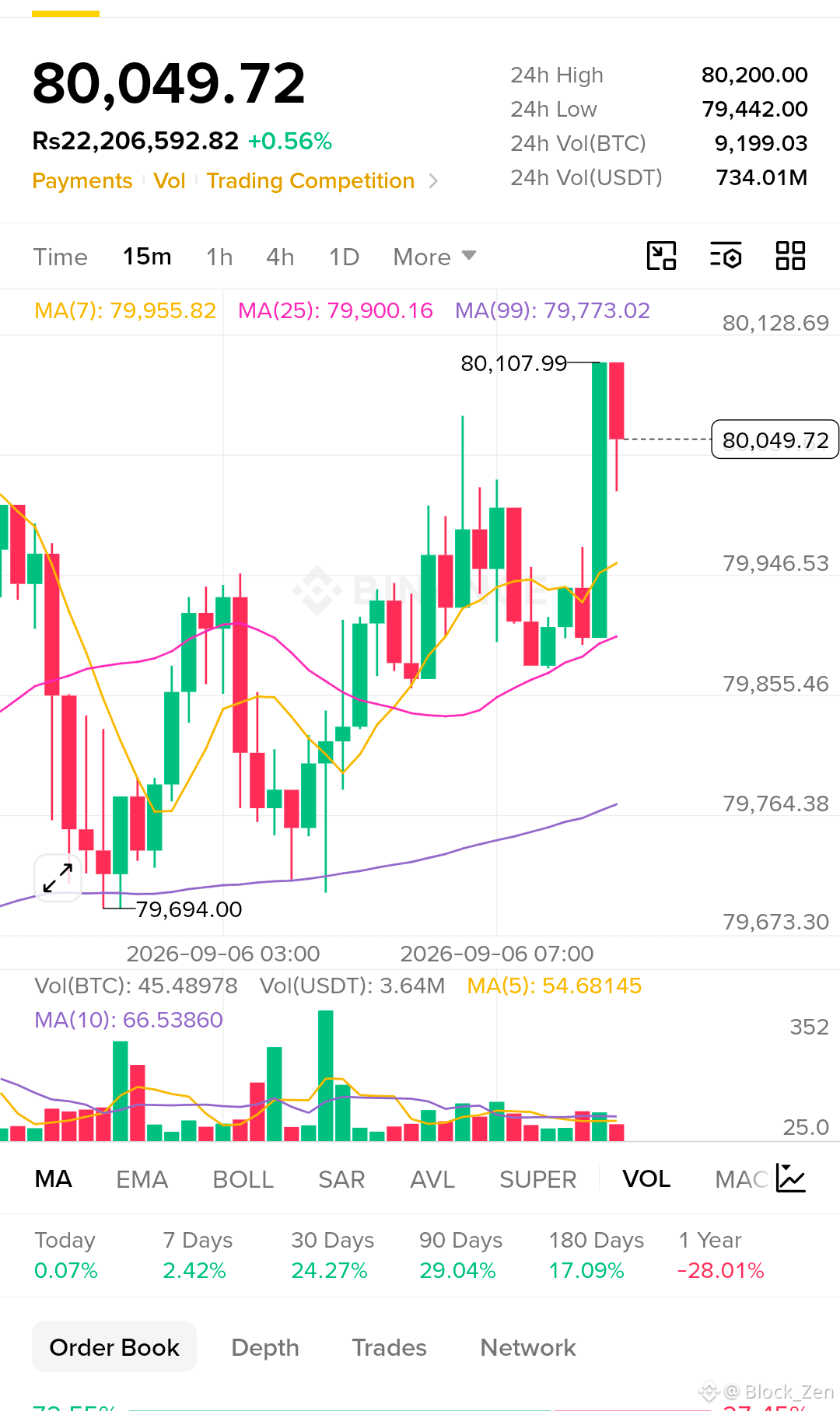
Guys, after that sharp push above $80K, $BTC faced rejection near $80,108. Price is now back around $80,050, and the latest 15m candle is showing some selling pressure at the highs.
If buyers fail to reclaim the rejection zone, a short setup could develop.
Entry Zone: $80,000–$80,100
TPs: $79,950 → $79,855 → $79,765
SL: $80,220
BTC is still holding above the MA(7), MA(25), and MA(99), so I’d want confirmation before entering.
Keep the position size and leverage controlled.
$BTC
Guys, after that sharp push above $80K, $BTC faced rejection near $80,108. Price is now back around $80,050, and the latest 15m candle is showing some selling pressure at the highs.
If buyers fail to reclaim the rejection zone, a short setup could develop.
Entry Zone: $80,000–$80,100
TPs: $79,950 → $79,855 → $79,765
SL: $80,220
BTC is still holding above the MA(7), MA(25), and MA(99), so I’d want confirmation before entering.
Keep the position size and leverage controlled.
$BTC
If buyers fail to reclaim the rejection zone, a short setup could develop.
Entry Zone: $80,000–$80,100
TPs: $79,950 → $79,855 → $79,765
SL: $80,220
BTC is still holding above the MA(7), MA(25), and MA(99), so I’d want confirmation before entering.
Keep the position size and leverage controlled.
$BTC
103
·
--
Guys, after that aggressive push, $PENGU is showing rejection near the $0.00895 resistance. Price is now around $0.00891, and the latest candle is starting to lose momentum at the highs.
If sellers keep control, this could offer a short setup.
Entry Zone: $0.00890–$0.00894
TPs: $0.00882 → $0.00873 → $0.00860
SL: $0.00899
Volume has picked up sharply during the move, so I’d wait for confirmation rather than chase.
Keep the position size and leverage controlled.
$PENGU
Guys, after that aggressive push, $PENGU is showing rejection near the $0.00895 resistance. Price is now around $0.00891, and the latest candle is starting to lose momentum at the highs.
If sellers keep control, this could offer a short setup.
Entry Zone: $0.00890–$0.00894
TPs: $0.00882 → $0.00873 → $0.00860
SL: $0.00899
Volume has picked up sharply during the move, so I’d wait for confirmation rather than chase.
Keep the position size and leverage controlled.
$PENGU
If sellers keep control, this could offer a short setup.
Entry Zone: $0.00890–$0.00894
TPs: $0.00882 → $0.00873 → $0.00860
SL: $0.00899
Volume has picked up sharply during the move, so I’d wait for confirmation rather than chase.
Keep the position size and leverage controlled.
$PENGU
165
·
--
$BNB / USDT – Range Bound, Awaiting Breakout
Trading at 765.55 (+5.73%), consolidating between MA(25) at 766.89 and MA(99) at 756.72.
Key Levels:
· Resistance: 766.89 / 780.64 (24h high)
· Support: 756.72 / 720.69 (24h low)
Trade Setup:
· Entry: 763–766
· TP: 772 / 780 / 790
· SL: 756
Volume is drying up (1.01K BNB vs 1.27K MA5). Break above 767 confirms upside toward 780; lose 756 and we retest 745.
RR: ~2:1
Patience – low volume often precedes a volatility spike.
$BNB
#LululemonTumbles20%OnWeakGuidance
#ZECHitsANewAllTimeHigh #USAugustAvgHourlyEarningsRise3.1% #AdobeSharesFall3%OnCEOTransition
$BNB / USDT – Range Bound, Awaiting Breakout
Trading at 765.55 (+5.73%), consolidating between MA(25) at 766.89 and MA(99) at 756.72.
Key Levels:
· Resistance: 766.89 / 780.64 (24h high)
· Support: 756.72 / 720.69 (24h low)
Trade Setup:
· Entry: 763–766
· TP: 772 / 780 / 790
· SL: 756
Volume is drying up (1.01K BNB vs 1.27K MA5). Break above 767 confirms upside toward 780; lose 756 and we retest 745.
RR: ~2:1
Patience – low volume often precedes a volatility spike.
$BNB
#LululemonTumbles20%OnWeakGuidance
#ZECHitsANewAllTimeHigh #USAugustAvgHourlyEarningsRise3.1% #AdobeSharesFall3%OnCEOTransition
Trading at 765.55 (+5.73%), consolidating between MA(25) at 766.89 and MA(99) at 756.72.
Key Levels:
· Resistance: 766.89 / 780.64 (24h high)
· Support: 756.72 / 720.69 (24h low)
Trade Setup:
· Entry: 763–766
· TP: 772 / 780 / 790
· SL: 756
Volume is drying up (1.01K BNB vs 1.27K MA5). Break above 767 confirms upside toward 780; lose 756 and we retest 745.
RR: ~2:1
Patience – low volume often precedes a volatility spike.
$BNB
#LululemonTumbles20%OnWeakGuidance
#ZECHitsANewAllTimeHigh #USAugustAvgHourlyEarningsRise3.1% #AdobeSharesFall3%OnCEOTransition
138
·
--
$ASTER / USDT – Breakout Watch
Price is consolidating at 0.784 after a +7.10% rally. The MA(7) and MA(25) converge at 0.785–0.786 – this is the line in the sand.
Key Levels:
· Resistance: 0.785 (breakout trigger)
· Support: 0.777 (MA99)
Trade Setup:
· Entry: 0.782–0.785
· TP: 0.792 / 0.804 / 0.812
· SL: 0.777
Volume is thin (69.4K vs 210K MA5) – confirmation requires a spike above 210K. Breakout above 0.786 targets 0.874; failure to hold 0.777 invalidates.
Risk/Reward: ~2:1
Monitor the squeeze – volatility expansion is imminent.
$ASTER
#RussiaUkraine72-hourCeasefire #LululemonTumbles20%OnWeakGuidance #USAugustJobGrowthNearlyTriplesForecast #BitcoinEthereumHitMultiMonthHighs
$ASTER / USDT – Breakout Watch
Price is consolidating at 0.784 after a +7.10% rally. The MA(7) and MA(25) converge at 0.785–0.786 – this is the line in the sand.
Key Levels:
· Resistance: 0.785 (breakout trigger)
· Support: 0.777 (MA99)
Trade Setup:
· Entry: 0.782–0.785
· TP: 0.792 / 0.804 / 0.812
· SL: 0.777
Volume is thin (69.4K vs 210K MA5) – confirmation requires a spike above 210K. Breakout above 0.786 targets 0.874; failure to hold 0.777 invalidates.
Risk/Reward: ~2:1
Monitor the squeeze – volatility expansion is imminent.
$ASTER
#RussiaUkraine72-hourCeasefire #LululemonTumbles20%OnWeakGuidance #USAugustJobGrowthNearlyTriplesForecast #BitcoinEthereumHitMultiMonthHighs
Price is consolidating at 0.784 after a +7.10% rally. The MA(7) and MA(25) converge at 0.785–0.786 – this is the line in the sand.
Key Levels:
· Resistance: 0.785 (breakout trigger)
· Support: 0.777 (MA99)
Trade Setup:
· Entry: 0.782–0.785
· TP: 0.792 / 0.804 / 0.812
· SL: 0.777
Volume is thin (69.4K vs 210K MA5) – confirmation requires a spike above 210K. Breakout above 0.786 targets 0.874; failure to hold 0.777 invalidates.
Risk/Reward: ~2:1
Monitor the squeeze – volatility expansion is imminent.
$ASTER
#RussiaUkraine72-hourCeasefire #LululemonTumbles20%OnWeakGuidance #USAugustJobGrowthNearlyTriplesForecast #BitcoinEthereumHitMultiMonthHighs
339
·
--
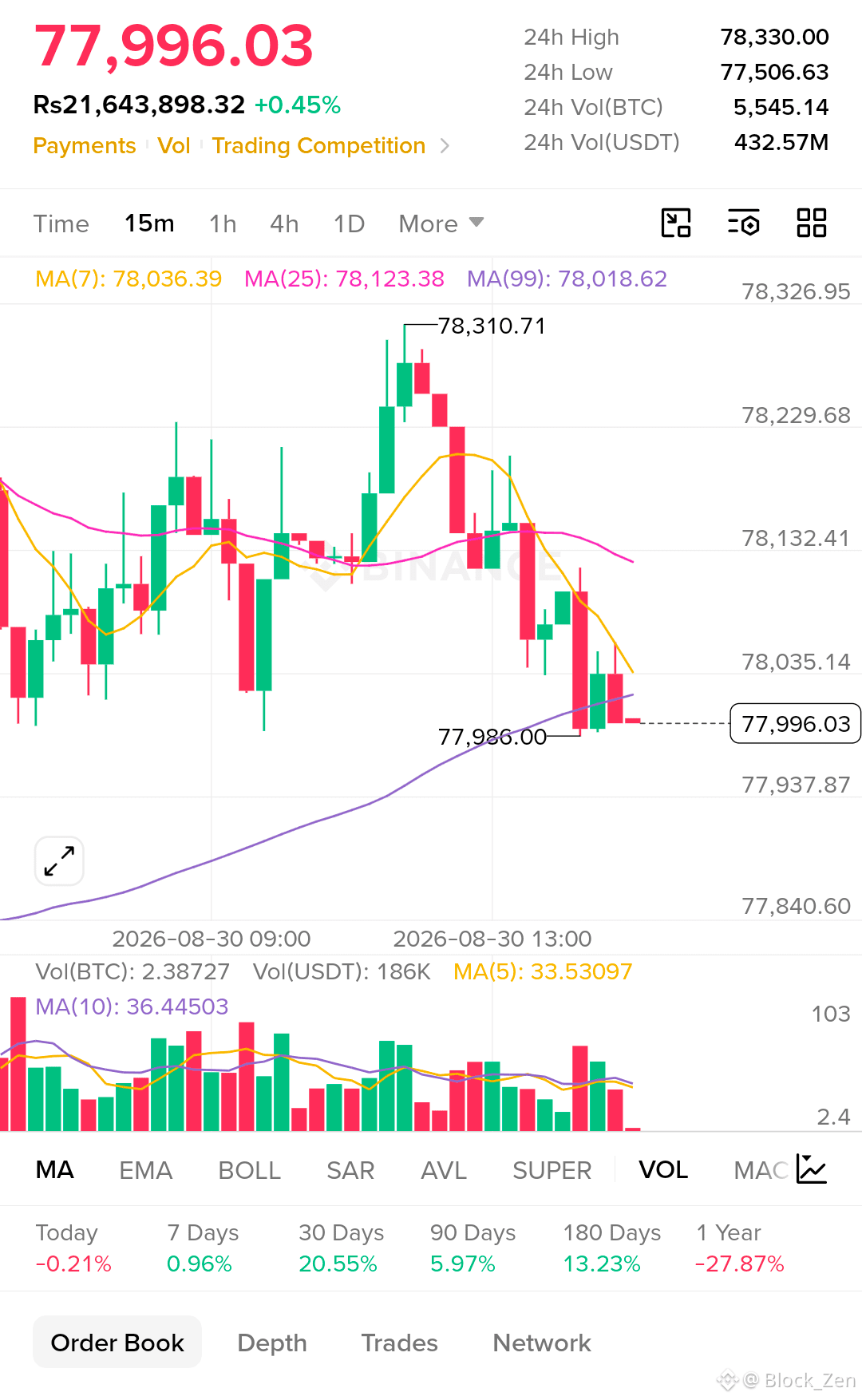
What I’m watching on BTC now is whether the 99-MA can keep absorbing the selling pressure not whether price can bounce a few dollars.
The 15m chart shows BTC rejected from $78,310.71 and has since rolled back toward $77,996, with price now sitting almost directly on the 99-MA at $78,018.62.
The short-term structure has weakened: BTC is below the 7-MA ($78,036) and 25-MA ($78,123), while the 99-MA is the last nearby dynamic support.
Fresh market data puts BTC around $78.1K–$78.2K. Aug. 29 closed near $78,246 after trading between $77,382 and $78,328, while Aug. 28 saw a much larger range from roughly $76.91K to $81.35K. �
StatMuse +1
That gives me a very clean short-term map:
$78,000–$78,020 = support.
$78,120–$78,310 = resistance.
If BTC reclaims $78,120 and then breaks $78,310, I’d look toward $78,600–$79,000.
If the 99-MA fails decisively, the next downside levels I’m watching are $77,940 and then the broader $77,500 area.
My Plan: • Pair: BTCUSDT
• Bias: Neutral → bullish above $78,120
• Entry: $78,000–$78,050 after confirmed support
• Stop: $77,850
• Target 1: $78,310
• Target 2: $78,600
• Target 3: $79,000
• R:R: ~1.5–4:1
Invalidation: A decisive 15m close below $77,850 would weaken the immediate recovery setup.
I’ve learned not to treat a moving average as support simply because price is sitting on it. The reaction matters. If buyers are actually defending $78K, I want to see that show up in the candles and volume before committing.
For now, I’m waiting for BTC to prove whether $78K is being defended or merely tested.
Does the 99-MA hold, or does BTC open the door back toward $77.5K?
#KoreaSingleStockLeveragedETFTradingFalls #VenezuelaUSSign25YearOilDeal #XRPETFsBiggestWeeklyHaulOf2026
What I’m watching on BTC now is whether the 99-MA can keep absorbing the selling pressure not whether price can bounce a few dollars.
The 15m chart shows BTC rejected from $78,310.71 and has since rolled back toward $77,996, with price now sitting almost directly on the 99-MA at $78,018.62.
The short-term structure has weakened: BTC is below the 7-MA ($78,036) and 25-MA ($78,123), while the 99-MA is the last nearby dynamic support.
Fresh market data puts BTC around $78.1K–$78.2K. Aug. 29 closed near $78,246 after trading between $77,382 and $78,328, while Aug. 28 saw a much larger range from roughly $76.91K to $81.35K. �
StatMuse +1
That gives me a very clean short-term map:
$78,000–$78,020 = support.
$78,120–$78,310 = resistance.
If BTC reclaims $78,120 and then breaks $78,310, I’d look toward $78,600–$79,000.
If the 99-MA fails decisively, the next downside levels I’m watching are $77,940 and then the broader $77,500 area.
My Plan: • Pair: BTCUSDT
• Bias: Neutral → bullish above $78,120
• Entry: $78,000–$78,050 after confirmed support
• Stop: $77,850
• Target 1: $78,310
• Target 2: $78,600
• Target 3: $79,000
• R:R: ~1.5–4:1
Invalidation: A decisive 15m close below $77,850 would weaken the immediate recovery setup.
I’ve learned not to treat a moving average as support simply because price is sitting on it. The reaction matters. If buyers are actually defending $78K, I want to see that show up in the candles and volume before committing.
For now, I’m waiting for BTC to prove whether $78K is being defended or merely tested.
Does the 99-MA hold, or does BTC open the door back toward $77.5K?
#KoreaSingleStockLeveragedETFTradingFalls #VenezuelaUSSign25YearOilDeal #XRPETFsBiggestWeeklyHaulOf2026
The 15m chart shows BTC rejected from $78,310.71 and has since rolled back toward $77,996, with price now sitting almost directly on the 99-MA at $78,018.62.
The short-term structure has weakened: BTC is below the 7-MA ($78,036) and 25-MA ($78,123), while the 99-MA is the last nearby dynamic support.
Fresh market data puts BTC around $78.1K–$78.2K. Aug. 29 closed near $78,246 after trading between $77,382 and $78,328, while Aug. 28 saw a much larger range from roughly $76.91K to $81.35K. �
StatMuse +1
That gives me a very clean short-term map:
$78,000–$78,020 = support.
$78,120–$78,310 = resistance.
If BTC reclaims $78,120 and then breaks $78,310, I’d look toward $78,600–$79,000.
If the 99-MA fails decisively, the next downside levels I’m watching are $77,940 and then the broader $77,500 area.
My Plan: • Pair: BTCUSDT
• Bias: Neutral → bullish above $78,120
• Entry: $78,000–$78,050 after confirmed support
• Stop: $77,850
• Target 1: $78,310
• Target 2: $78,600
• Target 3: $79,000
• R:R: ~1.5–4:1
Invalidation: A decisive 15m close below $77,850 would weaken the immediate recovery setup.
I’ve learned not to treat a moving average as support simply because price is sitting on it. The reaction matters. If buyers are actually defending $78K, I want to see that show up in the candles and volume before committing.
For now, I’m waiting for BTC to prove whether $78K is being defended or merely tested.
Does the 99-MA hold, or does BTC open the door back toward $77.5K?
#KoreaSingleStockLeveragedETFTradingFalls #VenezuelaUSSign25YearOilDeal #XRPETFsBiggestWeeklyHaulOf2026
1
133
·
--
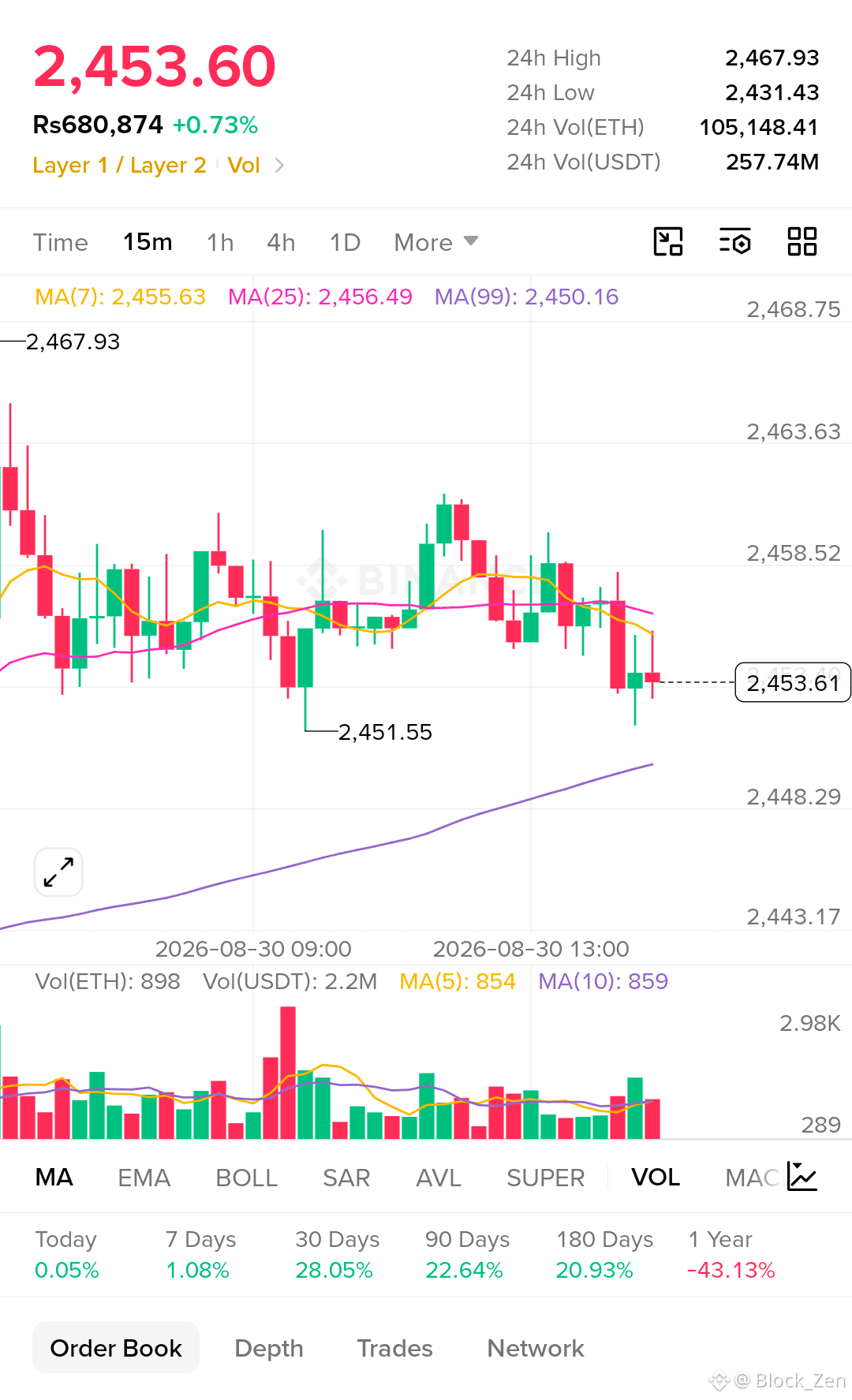
What I’m watching on ETH right now is the loss of short-term momentum, not the broader trend.
On the 15m chart, ETH pushed into $2,458–$2,460 but failed to hold the breakout. Price has now slipped back toward $2,453, sitting just below both the 7-period MA at $2,455.63 and 25-period MA at $2,456.49.
The important part is that the 99-MA remains lower around $2,450.16, so the larger intraday structure hasn’t completely broken.
Fresh market data has ETH around $2,459, with today’s range roughly $2,431–$2,468. ETH also closed Aug. 29 near $2,457, after recovering from the previous day’s sharp selloff. �
Investing.com South Africa +1
That leaves me with a very defined decision zone:
$2,450–$2,452 = support.
$2,458–$2,468 = resistance.
If ETH reclaims $2,460 with momentum, I’d look for $2,468 first, then $2,480–$2,500.
If $2,450 fails decisively, I’d expect a deeper retracement toward $2,443 and potentially the $2,431 area.
My Plan: • Pair: ETHUSDT
• Bias: Neutral → bullish above $2,460
• Entry: $2,450–$2,454 after support confirmation
• Stop: $2,441
• Target 1: $2,468
• Target 2: $2,480
• Target 3: $2,500
• R:R: ~1.2–4:1
Invalidation: A 15m close below $2,441 would weaken the recovery structure.
I’m not interested in buying simply because ETH is holding above $2,450. I want to see buyers reclaim the short-term averages and actually accept above $2,460.
After the volatility of the last few sessions, I’d rather let ETH show its hand than manufacture conviction from a few green candles.
Does $2,450 hold as demand, or does ETH finally lose the intraday structure?
#KoreaSingleStockLeveragedETFTradingFalls #GoldFalls3.24%ThisWeek #AfghanistanTalibanReportedlyBansCryptoNationwide #XRPETFsBiggestWeeklyHaulOf2026
What I’m watching on ETH right now is the loss of short-term momentum, not the broader trend.
On the 15m chart, ETH pushed into $2,458–$2,460 but failed to hold the breakout. Price has now slipped back toward $2,453, sitting just below both the 7-period MA at $2,455.63 and 25-period MA at $2,456.49.
The important part is that the 99-MA remains lower around $2,450.16, so the larger intraday structure hasn’t completely broken.
Fresh market data has ETH around $2,459, with today’s range roughly $2,431–$2,468. ETH also closed Aug. 29 near $2,457, after recovering from the previous day’s sharp selloff. �
Investing.com South Africa +1
That leaves me with a very defined decision zone:
$2,450–$2,452 = support.
$2,458–$2,468 = resistance.
If ETH reclaims $2,460 with momentum, I’d look for $2,468 first, then $2,480–$2,500.
If $2,450 fails decisively, I’d expect a deeper retracement toward $2,443 and potentially the $2,431 area.
My Plan: • Pair: ETHUSDT
• Bias: Neutral → bullish above $2,460
• Entry: $2,450–$2,454 after support confirmation
• Stop: $2,441
• Target 1: $2,468
• Target 2: $2,480
• Target 3: $2,500
• R:R: ~1.2–4:1
Invalidation: A 15m close below $2,441 would weaken the recovery structure.
I’m not interested in buying simply because ETH is holding above $2,450. I want to see buyers reclaim the short-term averages and actually accept above $2,460.
After the volatility of the last few sessions, I’d rather let ETH show its hand than manufacture conviction from a few green candles.
Does $2,450 hold as demand, or does ETH finally lose the intraday structure?
#KoreaSingleStockLeveragedETFTradingFalls #GoldFalls3.24%ThisWeek #AfghanistanTalibanReportedlyBansCryptoNationwide #XRPETFsBiggestWeeklyHaulOf2026
On the 15m chart, ETH pushed into $2,458–$2,460 but failed to hold the breakout. Price has now slipped back toward $2,453, sitting just below both the 7-period MA at $2,455.63 and 25-period MA at $2,456.49.
The important part is that the 99-MA remains lower around $2,450.16, so the larger intraday structure hasn’t completely broken.
Fresh market data has ETH around $2,459, with today’s range roughly $2,431–$2,468. ETH also closed Aug. 29 near $2,457, after recovering from the previous day’s sharp selloff. �
Investing.com South Africa +1
That leaves me with a very defined decision zone:
$2,450–$2,452 = support.
$2,458–$2,468 = resistance.
If ETH reclaims $2,460 with momentum, I’d look for $2,468 first, then $2,480–$2,500.
If $2,450 fails decisively, I’d expect a deeper retracement toward $2,443 and potentially the $2,431 area.
My Plan: • Pair: ETHUSDT
• Bias: Neutral → bullish above $2,460
• Entry: $2,450–$2,454 after support confirmation
• Stop: $2,441
• Target 1: $2,468
• Target 2: $2,480
• Target 3: $2,500
• R:R: ~1.2–4:1
Invalidation: A 15m close below $2,441 would weaken the recovery structure.
I’m not interested in buying simply because ETH is holding above $2,450. I want to see buyers reclaim the short-term averages and actually accept above $2,460.
After the volatility of the last few sessions, I’d rather let ETH show its hand than manufacture conviction from a few green candles.
Does $2,450 hold as demand, or does ETH finally lose the intraday structure?
#KoreaSingleStockLeveragedETFTradingFalls #GoldFalls3.24%ThisWeek #AfghanistanTalibanReportedlyBansCryptoNationwide #XRPETFsBiggestWeeklyHaulOf2026
1
143
·
--
#dusk $DUSK @Dusk_Foundation
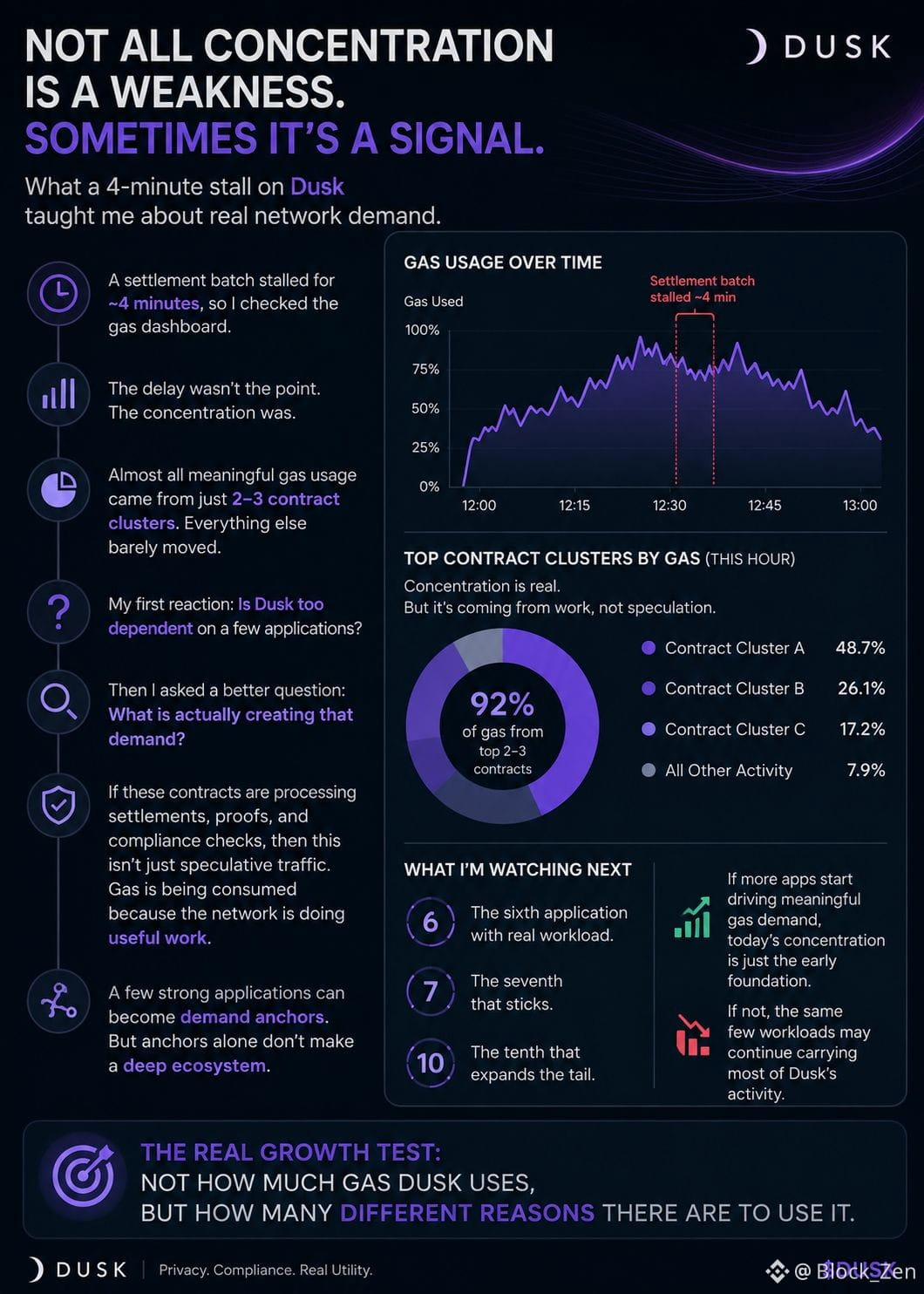
I noticed something yesterday on Dusk that looked like a weakness at first, but the longer I watched it, the more I started thinking about it differently.
A settlement batch stalled for roughly four minutes, so I opened the gas dashboard to see where the pressure was actually coming from.
The delay wasn't the most interesting part.
The concentration was.
Almost all meaningful gas usage during that hour came from just two or three contract clusters. Small transfers, wallets, and test deployments barely mattered.
My first reaction was simple: is Dusk too dependent on a few applications?
But then I asked a better question:
What is actually creating that demand?
If these contracts are processing settlements, proofs, and compliance checks, then this isn't just speculative traffic. Gas is being consumed because the network is doing useful work.
That distinction matters.
A few strong applications can become demand anchors. But anchors alone don't make a deep ecosystem.
Eventually, I want to see a longer tail of applications creating recurring, independent workload.
That's why I'm less interested in today's top five contracts.
I'm watching for the sixth.
Then the seventh.
Then the tenth.
If they start contributing meaningful gas demand, today's concentration could simply be the early foundation of a much broader ecosystem.
If they don't, the same few workloads may continue carrying most of Dusk's activity.
For me, that's the real growth test:
not how much gas Dusk uses, but how many different reasons there are to use it.
@Dusk_Foundation #dusk $DUSK
#dusk $DUSK @Dusk
I noticed something yesterday on Dusk that looked like a weakness at first, but the longer I watched it, the more I started thinking about it differently.
A settlement batch stalled for roughly four minutes, so I opened the gas dashboard to see where the pressure was actually coming from.
The delay wasn't the most interesting part.
The concentration was.
Almost all meaningful gas usage during that hour came from just two or three contract clusters. Small transfers, wallets, and test deployments barely mattered.
My first reaction was simple: is Dusk too dependent on a few applications?
But then I asked a better question:
What is actually creating that demand?
If these contracts are processing settlements, proofs, and compliance checks, then this isn't just speculative traffic. Gas is being consumed because the network is doing useful work.
That distinction matters.
A few strong applications can become demand anchors. But anchors alone don't make a deep ecosystem.
Eventually, I want to see a longer tail of applications creating recurring, independent workload.
That's why I'm less interested in today's top five contracts.
I'm watching for the sixth.
Then the seventh.
Then the tenth.
If they start contributing meaningful gas demand, today's concentration could simply be the early foundation of a much broader ecosystem.
If they don't, the same few workloads may continue carrying most of Dusk's activity.
For me, that's the real growth test:
not how much gas Dusk uses, but how many different reasons there are to use it.
@Dusk #dusk $DUSK
I noticed something yesterday on Dusk that looked like a weakness at first, but the longer I watched it, the more I started thinking about it differently.
A settlement batch stalled for roughly four minutes, so I opened the gas dashboard to see where the pressure was actually coming from.
The delay wasn't the most interesting part.
The concentration was.
Almost all meaningful gas usage during that hour came from just two or three contract clusters. Small transfers, wallets, and test deployments barely mattered.
My first reaction was simple: is Dusk too dependent on a few applications?
But then I asked a better question:
What is actually creating that demand?
If these contracts are processing settlements, proofs, and compliance checks, then this isn't just speculative traffic. Gas is being consumed because the network is doing useful work.
That distinction matters.
A few strong applications can become demand anchors. But anchors alone don't make a deep ecosystem.
Eventually, I want to see a longer tail of applications creating recurring, independent workload.
That's why I'm less interested in today's top five contracts.
I'm watching for the sixth.
Then the seventh.
Then the tenth.
If they start contributing meaningful gas demand, today's concentration could simply be the early foundation of a much broader ecosystem.
If they don't, the same few workloads may continue carrying most of Dusk's activity.
For me, that's the real growth test:
not how much gas Dusk uses, but how many different reasons there are to use it.
@Dusk #dusk $DUSK
6
4
265
·
--
#dusk $DUSK @Dusk_Foundation
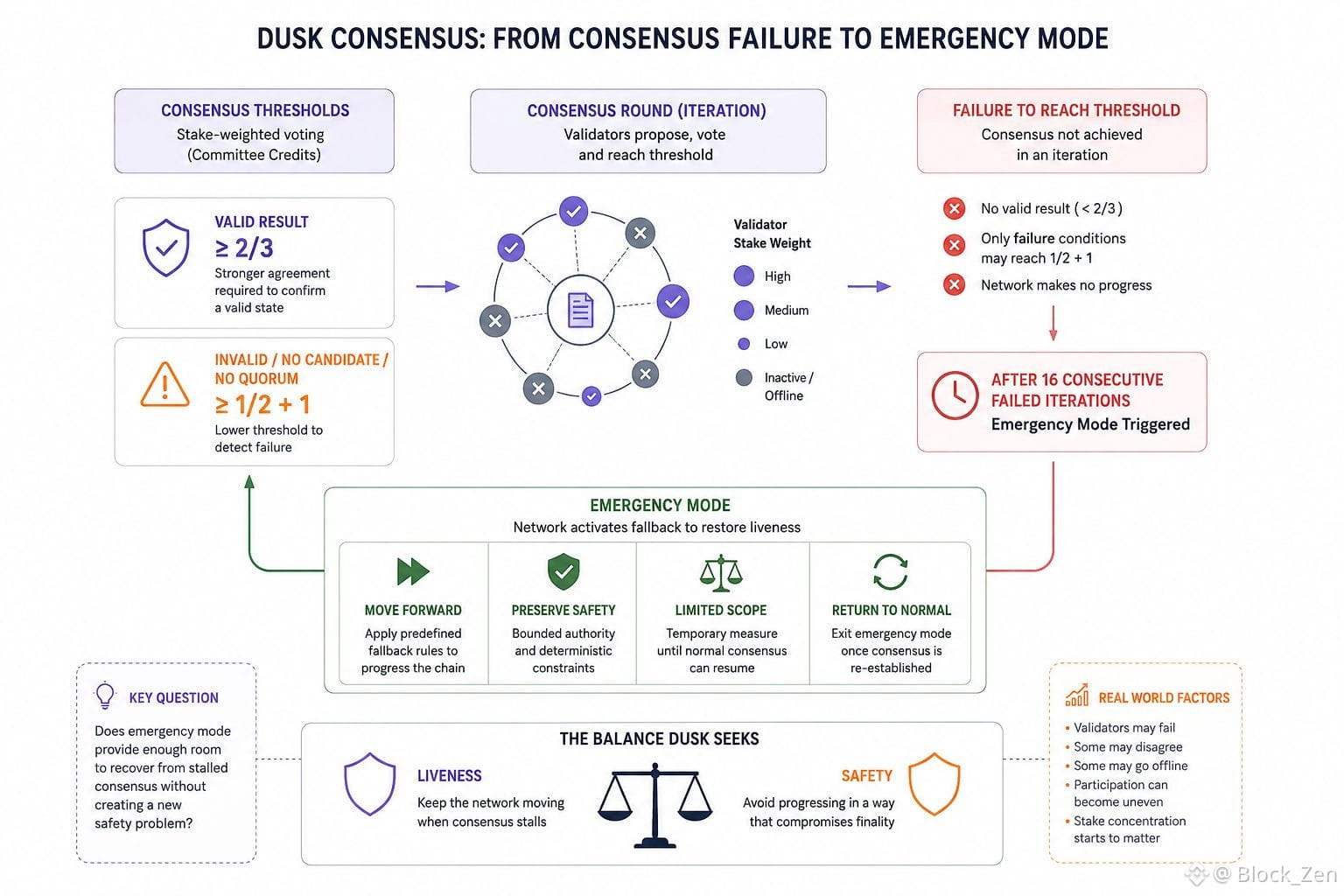
I kept coming back to one small detail in Dusk’s consensus design: what actually happens after 16 failed iterations.
At first, I read emergency mode as a simple liveness safeguard. If consensus keeps failing, the network eventually needs another way to move forward.
But the more I sat with it, the less simple that felt.
Dusk’s thresholds already make an interesting distinction. A Valid result needs 2/3, while Invalid, NoCandidate, or NoQuorum can reach 1/2 + 1.
I can see the reasoning: confirming a valid state should require stronger agreement than recognizing that consensus has failed.
Still, that creates a question I don’t think is answered just by looking at the thresholds.
Where exactly does Dusk draw the line between not progressing and progressing too aggressively?
The 16-iteration trigger makes that question more interesting, especially because voting power is stake-weighted through committee credits. If validator participation becomes uneven, concentration starts mattering alongside the failure mechanism itself.
I am not calling this a weakness. If anything, it’s one of the details I’d rather study before forming an opinion.
Real validator failures probably won’t arrive in a neat package. Some may disappear, some may disagree, and some may simply stop participating.
So I keep wondering what happens when those conditions overlap.
Does emergency mode give Dusk enough room to recover from stalled consensus without creating a new safety problem?
That balance between liveness and safety is probably the part I want to understand better.
@Dusk_Foundation #dusk $DUSK
#dusk $DUSK @Dusk
I kept coming back to one small detail in Dusk’s consensus design: what actually happens after 16 failed iterations.
At first, I read emergency mode as a simple liveness safeguard. If consensus keeps failing, the network eventually needs another way to move forward.
But the more I sat with it, the less simple that felt.
Dusk’s thresholds already make an interesting distinction. A Valid result needs 2/3, while Invalid, NoCandidate, or NoQuorum can reach 1/2 + 1.
I can see the reasoning: confirming a valid state should require stronger agreement than recognizing that consensus has failed.
Still, that creates a question I don’t think is answered just by looking at the thresholds.
Where exactly does Dusk draw the line between not progressing and progressing too aggressively?
The 16-iteration trigger makes that question more interesting, especially because voting power is stake-weighted through committee credits. If validator participation becomes uneven, concentration starts mattering alongside the failure mechanism itself.
I am not calling this a weakness. If anything, it’s one of the details I’d rather study before forming an opinion.
Real validator failures probably won’t arrive in a neat package. Some may disappear, some may disagree, and some may simply stop participating.
So I keep wondering what happens when those conditions overlap.
Does emergency mode give Dusk enough room to recover from stalled consensus without creating a new safety problem?
That balance between liveness and safety is probably the part I want to understand better.
@Dusk #dusk $DUSK
I kept coming back to one small detail in Dusk’s consensus design: what actually happens after 16 failed iterations.
At first, I read emergency mode as a simple liveness safeguard. If consensus keeps failing, the network eventually needs another way to move forward.
But the more I sat with it, the less simple that felt.
Dusk’s thresholds already make an interesting distinction. A Valid result needs 2/3, while Invalid, NoCandidate, or NoQuorum can reach 1/2 + 1.
I can see the reasoning: confirming a valid state should require stronger agreement than recognizing that consensus has failed.
Still, that creates a question I don’t think is answered just by looking at the thresholds.
Where exactly does Dusk draw the line between not progressing and progressing too aggressively?
The 16-iteration trigger makes that question more interesting, especially because voting power is stake-weighted through committee credits. If validator participation becomes uneven, concentration starts mattering alongside the failure mechanism itself.
I am not calling this a weakness. If anything, it’s one of the details I’d rather study before forming an opinion.
Real validator failures probably won’t arrive in a neat package. Some may disappear, some may disagree, and some may simply stop participating.
So I keep wondering what happens when those conditions overlap.
Does emergency mode give Dusk enough room to recover from stalled consensus without creating a new safety problem?
That balance between liveness and safety is probably the part I want to understand better.
@Dusk #dusk $DUSK
9
8
294
·
--
#dusk $DUSK @Dusk_Foundation
I kept coming back to one uncomfortable detail in Dusk: compliance may be less about whether you can freeze an asset, and more about whether you can freeze it before finality gets there.
Phoenix makes the distinction sharper. Ownership, authorship, balance validity and double-spend protection are proven inside the transaction itself, without exposing the underlying note. The chain can establish correctness without needing visibility.
But regulated assets introduce a timing problem.
A wallet can still hold the cryptographic key while the legal system has already decided that position must be frozen. Dusk has transfer restrictions, issuer-driven actions and recovery/remediation logic, but there is still a small window between the legal instruction and the rule becoming enforceable.
Instruction received.
Rule updated.
Transaction rejected.
If finality lands somewhere inside that gap, the network may have settled a transaction that the legal layer had already decided should not happen.
That makes “can Dusk freeze assets?” feel like the wrong question.
The harder metric might be freeze propagation time.
Privacy complicates it further. A viewing key can give an authorized party access to information the chain has already verified, while repeated failed transfers might still expose behavioral patterns.
And lost keys create the inverse problem: legal ownership can survive after cryptographic control disappears.
So I keep wondering whether the real compliance boundary isn't privacy or finality alone, but how quickly legal authority can catch up with a deterministic state machine.
@Dusk_Foundation #dusk $DUSK
#dusk $DUSK @Dusk
I kept coming back to one uncomfortable detail in Dusk: compliance may be less about whether you can freeze an asset, and more about whether you can freeze it before finality gets there.
Phoenix makes the distinction sharper. Ownership, authorship, balance validity and double-spend protection are proven inside the transaction itself, without exposing the underlying note. The chain can establish correctness without needing visibility.
But regulated assets introduce a timing problem.
A wallet can still hold the cryptographic key while the legal system has already decided that position must be frozen. Dusk has transfer restrictions, issuer-driven actions and recovery/remediation logic, but there is still a small window between the legal instruction and the rule becoming enforceable.
Instruction received.
Rule updated.
Transaction rejected.
If finality lands somewhere inside that gap, the network may have settled a transaction that the legal layer had already decided should not happen.
That makes “can Dusk freeze assets?” feel like the wrong question.
The harder metric might be freeze propagation time.
Privacy complicates it further. A viewing key can give an authorized party access to information the chain has already verified, while repeated failed transfers might still expose behavioral patterns.
And lost keys create the inverse problem: legal ownership can survive after cryptographic control disappears.
So I keep wondering whether the real compliance boundary isn't privacy or finality alone, but how quickly legal authority can catch up with a deterministic state machine.
@Dusk #dusk $DUSK
I kept coming back to one uncomfortable detail in Dusk: compliance may be less about whether you can freeze an asset, and more about whether you can freeze it before finality gets there.
Phoenix makes the distinction sharper. Ownership, authorship, balance validity and double-spend protection are proven inside the transaction itself, without exposing the underlying note. The chain can establish correctness without needing visibility.
But regulated assets introduce a timing problem.
A wallet can still hold the cryptographic key while the legal system has already decided that position must be frozen. Dusk has transfer restrictions, issuer-driven actions and recovery/remediation logic, but there is still a small window between the legal instruction and the rule becoming enforceable.
Instruction received.
Rule updated.
Transaction rejected.
If finality lands somewhere inside that gap, the network may have settled a transaction that the legal layer had already decided should not happen.
That makes “can Dusk freeze assets?” feel like the wrong question.
The harder metric might be freeze propagation time.
Privacy complicates it further. A viewing key can give an authorized party access to information the chain has already verified, while repeated failed transfers might still expose behavioral patterns.
And lost keys create the inverse problem: legal ownership can survive after cryptographic control disappears.
So I keep wondering whether the real compliance boundary isn't privacy or finality alone, but how quickly legal authority can catch up with a deterministic state machine.
@Dusk #dusk $DUSK
25
13
281
·
--
#dusk $DUSK @Dusk_Foundation
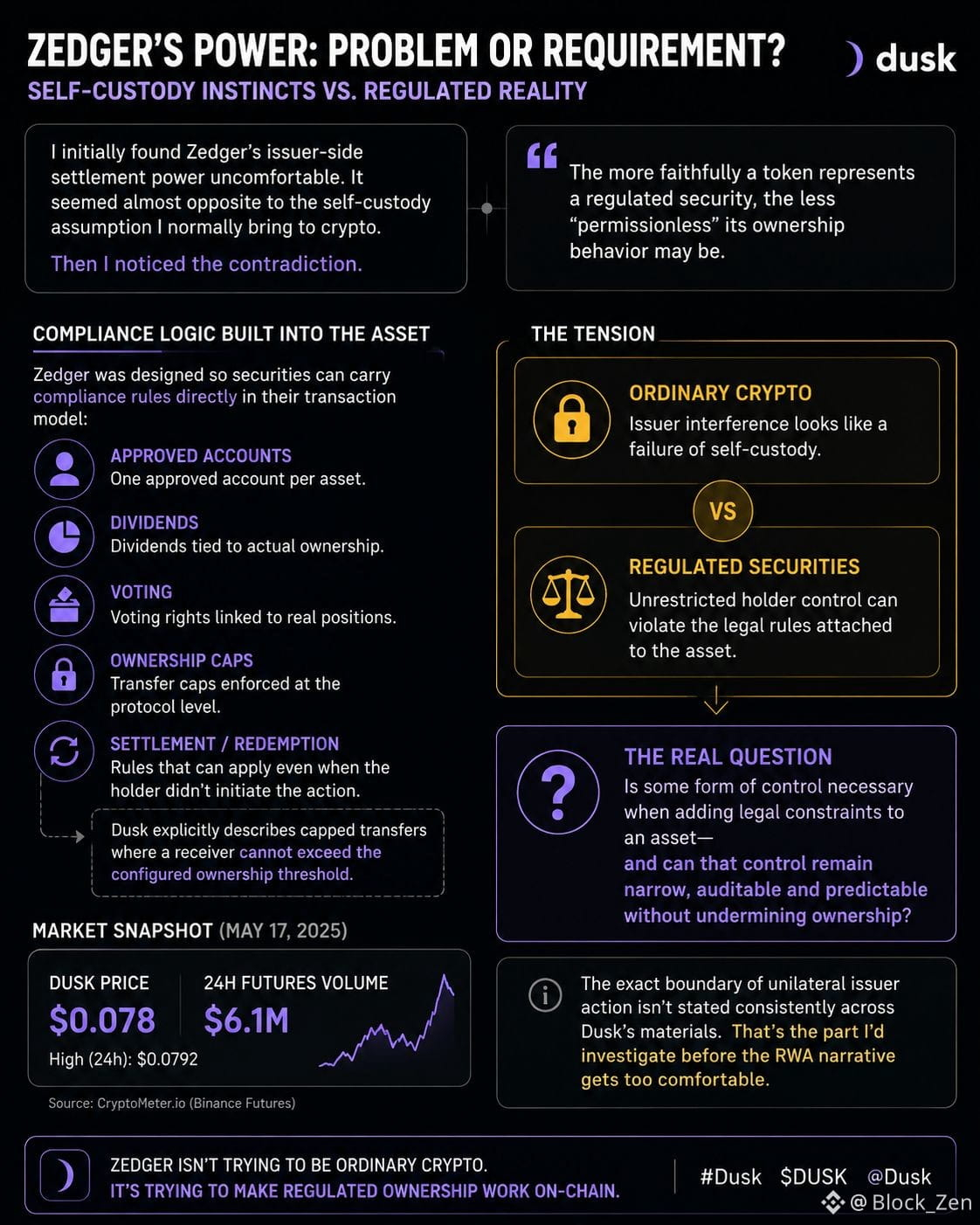
I initially found Zedger’s issuer-side settlement power uncomfortable. It seemed almost opposite to the self-custody assumption I normally bring to crypto.
Then I noticed the contradiction.
DUSK has been trading around $0.078 today, after pushing near $0.0792, with roughly $6.1M in 24h futures volume.
Meanwhile, the protocol detail that interests me has little to do with price.
Zedger was designed so securities can carry compliance rules directly in their transaction model: approved accounts, ownership caps, dividends, voting, and settlement/redemption logic. Dusk explicitly describes capped transfers where a receiver cannot exceed the configured ownership threshold.
That creates an odd tension.
The more faithfully a token represents a regulated security, the less “permissionless” its ownership behavior may be.
For ordinary crypto, issuer interference looks like a failure of self-custody.
For securities, unrestricted holder control can itself violate the rules attached to the asset.
So the interesting question isn't whether Zedger gives issuers control.
It's whether adding legal constraints to an asset makes some form of control necessary — and whether that control can remain narrow, auditable and predictable.
I haven't found the exact boundary of unilateral issuer action stated consistently enough to settle that question.
And honestly, that's the part I'd investigate before the RWA narrative gets too comfortable.
@Dusk_Foundation #dusk $DUSK
#dusk $DUSK @Dusk
I initially found Zedger’s issuer-side settlement power uncomfortable. It seemed almost opposite to the self-custody assumption I normally bring to crypto.
Then I noticed the contradiction.
DUSK has been trading around $0.078 today, after pushing near $0.0792, with roughly $6.1M in 24h futures volume.
Meanwhile, the protocol detail that interests me has little to do with price.
Zedger was designed so securities can carry compliance rules directly in their transaction model: approved accounts, ownership caps, dividends, voting, and settlement/redemption logic. Dusk explicitly describes capped transfers where a receiver cannot exceed the configured ownership threshold.
That creates an odd tension.
The more faithfully a token represents a regulated security, the less “permissionless” its ownership behavior may be.
For ordinary crypto, issuer interference looks like a failure of self-custody.
For securities, unrestricted holder control can itself violate the rules attached to the asset.
So the interesting question isn't whether Zedger gives issuers control.
It's whether adding legal constraints to an asset makes some form of control necessary — and whether that control can remain narrow, auditable and predictable.
I haven't found the exact boundary of unilateral issuer action stated consistently enough to settle that question.
And honestly, that's the part I'd investigate before the RWA narrative gets too comfortable.
@Dusk #dusk $DUSK
I initially found Zedger’s issuer-side settlement power uncomfortable. It seemed almost opposite to the self-custody assumption I normally bring to crypto.
Then I noticed the contradiction.
DUSK has been trading around $0.078 today, after pushing near $0.0792, with roughly $6.1M in 24h futures volume.
Meanwhile, the protocol detail that interests me has little to do with price.
Zedger was designed so securities can carry compliance rules directly in their transaction model: approved accounts, ownership caps, dividends, voting, and settlement/redemption logic. Dusk explicitly describes capped transfers where a receiver cannot exceed the configured ownership threshold.
That creates an odd tension.
The more faithfully a token represents a regulated security, the less “permissionless” its ownership behavior may be.
For ordinary crypto, issuer interference looks like a failure of self-custody.
For securities, unrestricted holder control can itself violate the rules attached to the asset.
So the interesting question isn't whether Zedger gives issuers control.
It's whether adding legal constraints to an asset makes some form of control necessary — and whether that control can remain narrow, auditable and predictable.
I haven't found the exact boundary of unilateral issuer action stated consistently enough to settle that question.
And honestly, that's the part I'd investigate before the RWA narrative gets too comfortable.
@Dusk #dusk $DUSK
16
10
284
·
--
Verified
#dusk $DUSK @Dusk_Foundation
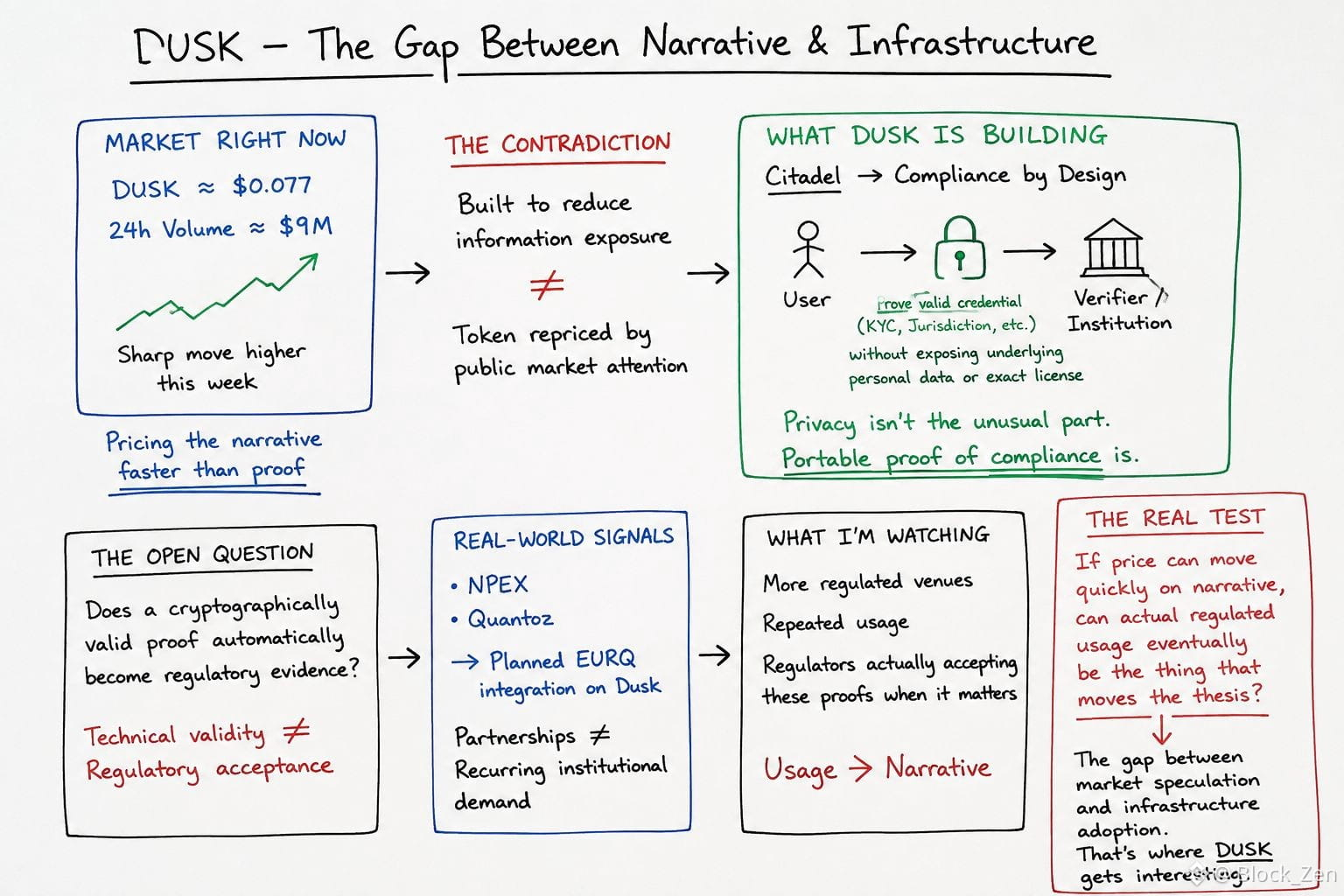
I have heard “this coin is different” enough times to become suspicious of the phrase. Dusk made me look twice because the market seems to be pricing the narrative faster than the infrastructure is being proven.
DUSK is around $0.077 with roughly $9M in 24h volume, after a sharp move higher this week.
That’s where the contradiction gets interesting.
The thing Dusk is building is about reducing information exposure, yet its token is currently being repriced by very public market attention.
Underneath that noise, Citadel takes a different approach to compliance. Users can prove they hold a valid credential without putting the underlying personal details or exact license on-chain.
So privacy is not really the unusual part.
The unusual part is trying to make proof of compliance portable.
But that creates a question I can not answer from architecture alone: does a cryptographically valid proof become regulatory evidence simply because it is technically verifiable?
NPEX and Quantoz give the thesis more substance, including the planned EURQ integration on Dusk. But partnerships aren't the same thing as recurring institutional demand.
That’s what I am watching now.
If price can move this quickly on narrative, can actual regulated usage eventually become the thing that moves the thesis?
That gap between market speculation and infrastructure adoption is where DUSK gets interesting to me.
@Dusk_Foundation #DUSK $DUSK
#dusk $DUSK @Dusk
I have heard “this coin is different” enough times to become suspicious of the phrase. Dusk made me look twice because the market seems to be pricing the narrative faster than the infrastructure is being proven.
DUSK is around $0.077 with roughly $9M in 24h volume, after a sharp move higher this week.
That’s where the contradiction gets interesting.
The thing Dusk is building is about reducing information exposure, yet its token is currently being repriced by very public market attention.
Underneath that noise, Citadel takes a different approach to compliance. Users can prove they hold a valid credential without putting the underlying personal details or exact license on-chain.
So privacy is not really the unusual part.
The unusual part is trying to make proof of compliance portable.
But that creates a question I can not answer from architecture alone: does a cryptographically valid proof become regulatory evidence simply because it is technically verifiable?
NPEX and Quantoz give the thesis more substance, including the planned EURQ integration on Dusk. But partnerships aren't the same thing as recurring institutional demand.
That’s what I am watching now.
If price can move this quickly on narrative, can actual regulated usage eventually become the thing that moves the thesis?
That gap between market speculation and infrastructure adoption is where DUSK gets interesting to me.
@Dusk #DUSK $DUSK
I have heard “this coin is different” enough times to become suspicious of the phrase. Dusk made me look twice because the market seems to be pricing the narrative faster than the infrastructure is being proven.
DUSK is around $0.077 with roughly $9M in 24h volume, after a sharp move higher this week.
That’s where the contradiction gets interesting.
The thing Dusk is building is about reducing information exposure, yet its token is currently being repriced by very public market attention.
Underneath that noise, Citadel takes a different approach to compliance. Users can prove they hold a valid credential without putting the underlying personal details or exact license on-chain.
So privacy is not really the unusual part.
The unusual part is trying to make proof of compliance portable.
But that creates a question I can not answer from architecture alone: does a cryptographically valid proof become regulatory evidence simply because it is technically verifiable?
NPEX and Quantoz give the thesis more substance, including the planned EURQ integration on Dusk. But partnerships aren't the same thing as recurring institutional demand.
That’s what I am watching now.
If price can move this quickly on narrative, can actual regulated usage eventually become the thing that moves the thesis?
That gap between market speculation and infrastructure adoption is where DUSK gets interesting to me.
@Dusk #DUSK $DUSK
26
15
235
·
--
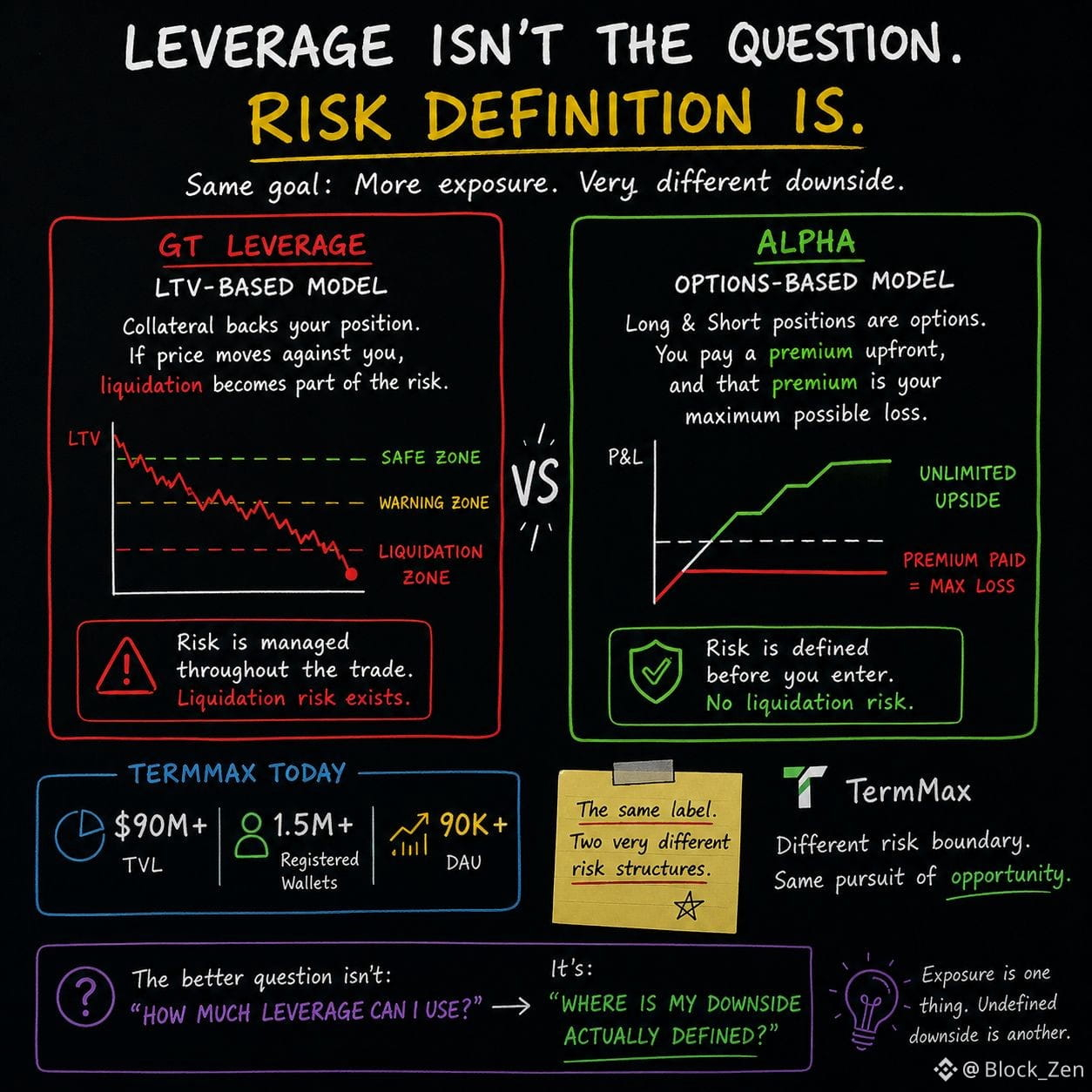
I used to think leverage always came down to one question: how far can a position move against me before liquidation?
Looking deeper into @termmax made that assumption feel too simple.
GT-based leverage works through LTV. If the collateral moves far enough against the position, liquidation becomes part of the risk.
Alpha is different.
Its Long and Short positions are options. You pay a premium upfront, and that premium defines the position’s maximum possible loss. TermMax describes this as leveraged exposure without liquidation risk.
I do not read that as “safe leverage.”
I read it as a different way of defining the downside.
GT leaves the position exposed to LTV and liquidation mechanics.
Alpha puts the maximum loss at the entry point through the premium.
That distinction changed how I look at the word “leverage.”
The same label can describe two very different risk structures.
And the leverage multiple alone doesn't tell me enough.
It tells me how much exposure I am taking.
It doesn't tell me what happens when I am wrong.
So the question I’m more interested in now is not:
“How much leverage can I use?”
It’s:
“Where is my downside actually defined?”
That feels like a much better place to start.
#termmax @termmax
I used to think leverage always came down to one question: how far can a position move against me before liquidation?
Looking deeper into @TermMax made that assumption feel too simple.
GT-based leverage works through LTV. If the collateral moves far enough against the position, liquidation becomes part of the risk.
Alpha is different.
Its Long and Short positions are options. You pay a premium upfront, and that premium defines the position’s maximum possible loss. TermMax describes this as leveraged exposure without liquidation risk.
I do not read that as “safe leverage.”
I read it as a different way of defining the downside.
GT leaves the position exposed to LTV and liquidation mechanics.
Alpha puts the maximum loss at the entry point through the premium.
That distinction changed how I look at the word “leverage.”
The same label can describe two very different risk structures.
And the leverage multiple alone doesn't tell me enough.
It tells me how much exposure I am taking.
It doesn't tell me what happens when I am wrong.
So the question I’m more interested in now is not:
“How much leverage can I use?”
It’s:
“Where is my downside actually defined?”
That feels like a much better place to start.
#termmax @TermMax
Looking deeper into @TermMax made that assumption feel too simple.
GT-based leverage works through LTV. If the collateral moves far enough against the position, liquidation becomes part of the risk.
Alpha is different.
Its Long and Short positions are options. You pay a premium upfront, and that premium defines the position’s maximum possible loss. TermMax describes this as leveraged exposure without liquidation risk.
I do not read that as “safe leverage.”
I read it as a different way of defining the downside.
GT leaves the position exposed to LTV and liquidation mechanics.
Alpha puts the maximum loss at the entry point through the premium.
That distinction changed how I look at the word “leverage.”
The same label can describe two very different risk structures.
And the leverage multiple alone doesn't tell me enough.
It tells me how much exposure I am taking.
It doesn't tell me what happens when I am wrong.
So the question I’m more interested in now is not:
“How much leverage can I use?”
It’s:
“Where is my downside actually defined?”
That feels like a much better place to start.
#termmax @TermMax
18
13
489
·
--
#dusk $DUSK @Dusk_Foundation
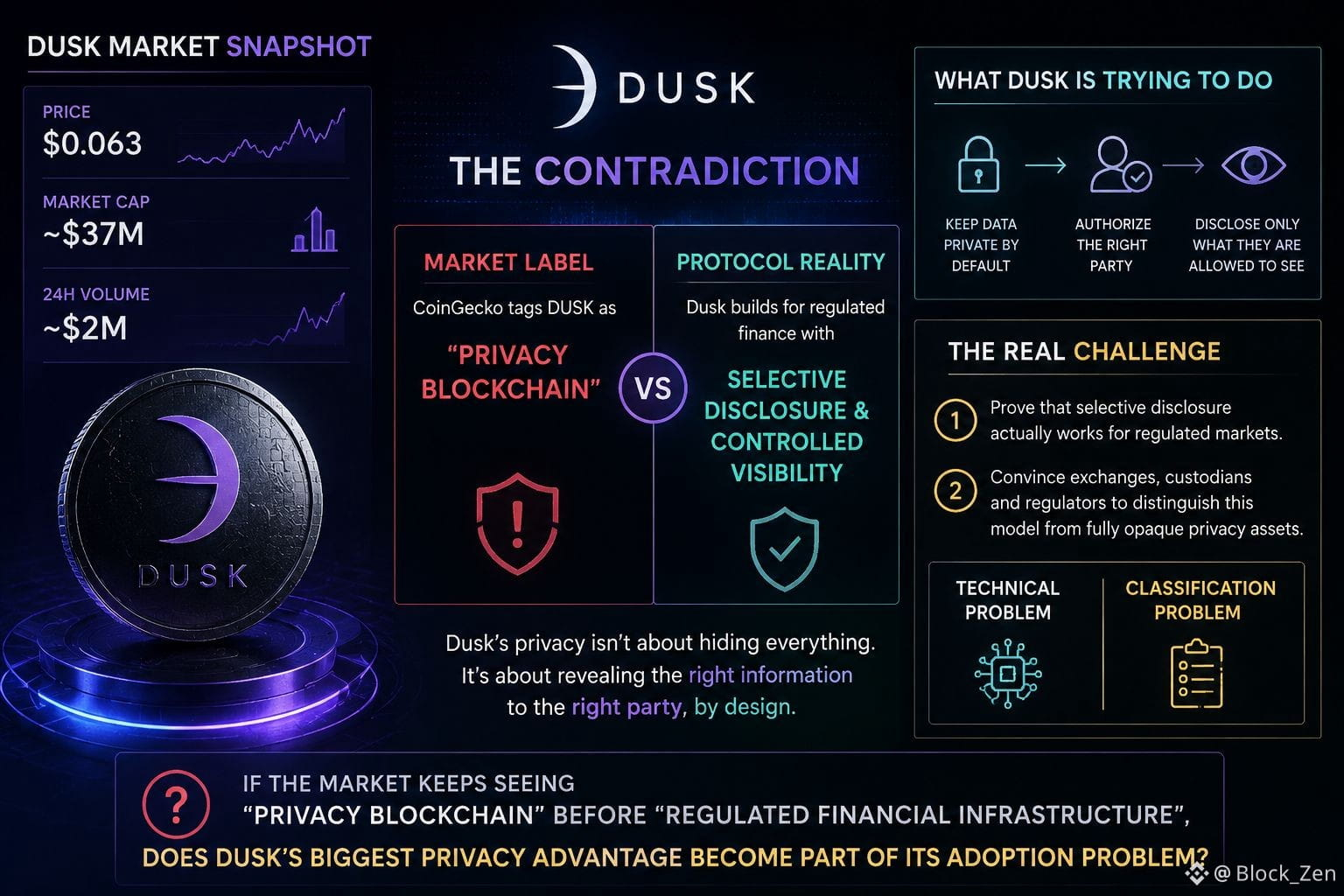
I have been looking at DUSK around $0.063 lately, and the market is still treating it like a small-cap token: roughly $37M market cap and about $2M in daily volume.
But the more interesting part for me isn’t the size. It’s the contradiction.
CoinGecko still puts DUSK in the “Privacy Blockchain” bucket, while Dusk is building around regulated assets, selective disclosure and controlled visibility.
That sounds like a simple classification issue until you look at what the protocol is actually trying to do.
Dusk does not seem to treat privacy as “nobody can see anything.” Its design is closer to: keep sensitive financial information hidden by default, then let the issuer, venue, auditor or regulator see the specific information they’re authorized to see.
That creates the contradiction I keep coming back to.
The protocol is trying to make privacy compatible with regulation, while the privacy label itself can become a regulatory risk signal.
So Dusk may have to prove two things at once.
First, that selective disclosure actually works for regulated markets.
Second, that exchanges and custodians are willing to distinguish that model from fully opaque privacy assets.
The first is a technical problem.
The second is a classification problem.
And honestly, I’m more curious about the second one.
If the market keeps seeing “privacy blockchain” before it sees “regulated financial infrastructure,” does Dusk’s biggest privacy advantage become part of its adoption problem?
@Dusk_Foundation #dusk $DUSK
l
#dusk $DUSK @Dusk
I have been looking at DUSK around $0.063 lately, and the market is still treating it like a small-cap token: roughly $37M market cap and about $2M in daily volume.
But the more interesting part for me isn’t the size. It’s the contradiction.
CoinGecko still puts DUSK in the “Privacy Blockchain” bucket, while Dusk is building around regulated assets, selective disclosure and controlled visibility.
That sounds like a simple classification issue until you look at what the protocol is actually trying to do.
Dusk does not seem to treat privacy as “nobody can see anything.” Its design is closer to: keep sensitive financial information hidden by default, then let the issuer, venue, auditor or regulator see the specific information they’re authorized to see.
That creates the contradiction I keep coming back to.
The protocol is trying to make privacy compatible with regulation, while the privacy label itself can become a regulatory risk signal.
So Dusk may have to prove two things at once.
First, that selective disclosure actually works for regulated markets.
Second, that exchanges and custodians are willing to distinguish that model from fully opaque privacy assets.
The first is a technical problem.
The second is a classification problem.
And honestly, I’m more curious about the second one.
If the market keeps seeing “privacy blockchain” before it sees “regulated financial infrastructure,” does Dusk’s biggest privacy advantage become part of its adoption problem?
@Dusk #dusk $DUSK
l
I have been looking at DUSK around $0.063 lately, and the market is still treating it like a small-cap token: roughly $37M market cap and about $2M in daily volume.
But the more interesting part for me isn’t the size. It’s the contradiction.
CoinGecko still puts DUSK in the “Privacy Blockchain” bucket, while Dusk is building around regulated assets, selective disclosure and controlled visibility.
That sounds like a simple classification issue until you look at what the protocol is actually trying to do.
Dusk does not seem to treat privacy as “nobody can see anything.” Its design is closer to: keep sensitive financial information hidden by default, then let the issuer, venue, auditor or regulator see the specific information they’re authorized to see.
That creates the contradiction I keep coming back to.
The protocol is trying to make privacy compatible with regulation, while the privacy label itself can become a regulatory risk signal.
So Dusk may have to prove two things at once.
First, that selective disclosure actually works for regulated markets.
Second, that exchanges and custodians are willing to distinguish that model from fully opaque privacy assets.
The first is a technical problem.
The second is a classification problem.
And honestly, I’m more curious about the second one.
If the market keeps seeing “privacy blockchain” before it sees “regulated financial infrastructure,” does Dusk’s biggest privacy advantage become part of its adoption problem?
@Dusk #dusk $DUSK
l
42
16
240
·
--
#dusk $DUSK @Dusk_Foundation
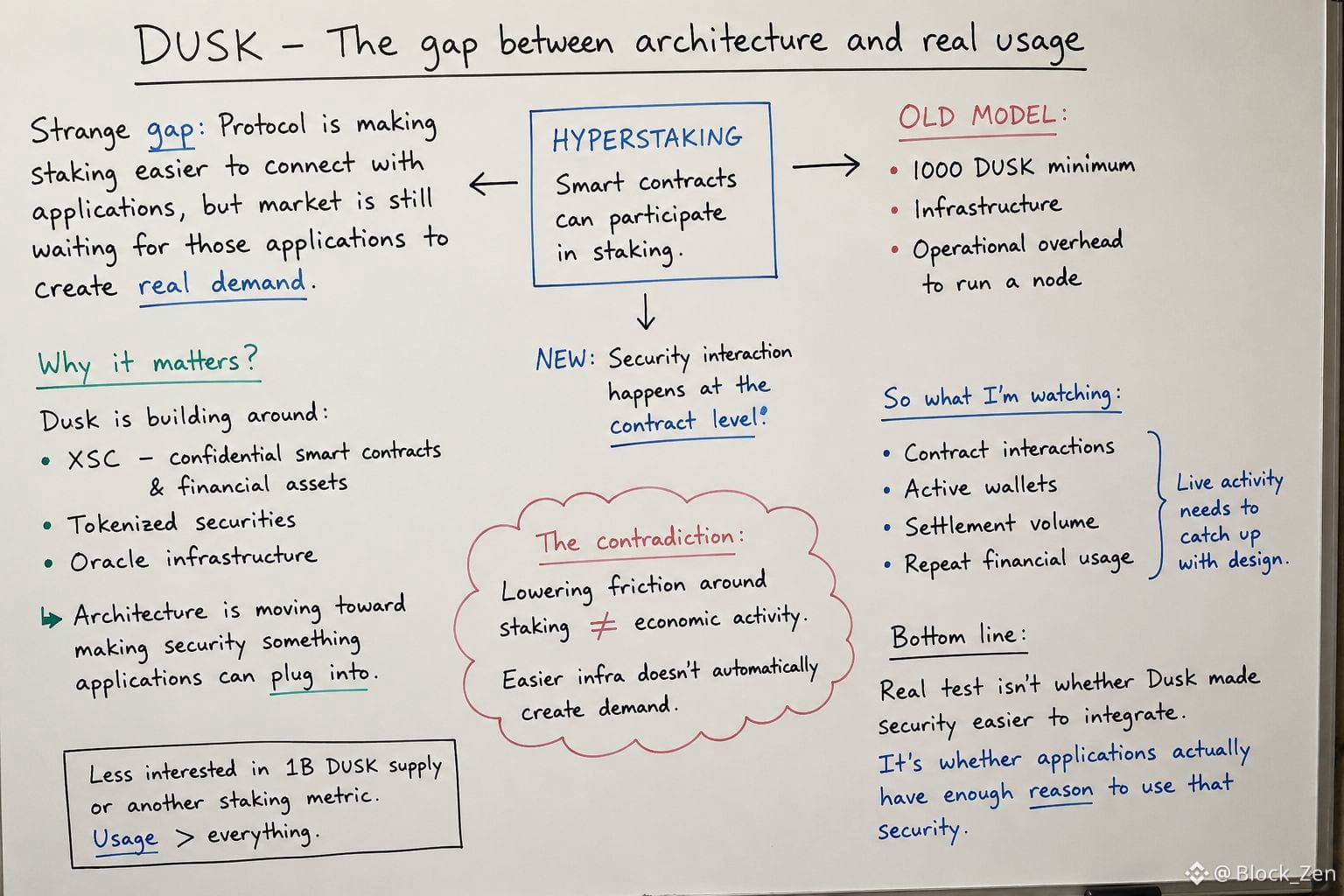
I keep coming back to a strange gap in Dusk: the protocol is making staking easier to connect with applications, while the market still seems to be waiting for those applications to create real demand.
Hyperstaking lets smart contracts participate in staking. Under the older model, staking meant more operational overhead, including the 1,000 DUSK minimum and the infrastructure required to run a node. Now that security interaction can happen at the contract level.
That matters more when you look at what Dusk is actually building around it: XSC for confidential smart contracts and financial assets, plus work around tokenized securities and oracle infrastructure.
So the architecture is moving toward making security something applications can plug into.
But here’s the contradiction I find more interesting.
Lowering the friction around staking should make the network easier to use, yet easier infrastructure doesn’t automatically create economic activity. If financial applications aren’t generating recurring transactions, Hyperstaking can improve the architecture without materially changing the network’s usage.
That’s why I am less interested in the 1B DUSK supply or another staking metric by itself.
I want to see whether live activity starts catching up with the design: contract interactions, active wallets, settlement volume and repeat financial usage.
Because the real test is not whether Dusk made security easier to integrate.
It’s whether applications actually have enough reason to use that security.
@Dusk_Foundation #dusk $DUSK
#dusk $DUSK @Dusk
I keep coming back to a strange gap in Dusk: the protocol is making staking easier to connect with applications, while the market still seems to be waiting for those applications to create real demand.
Hyperstaking lets smart contracts participate in staking. Under the older model, staking meant more operational overhead, including the 1,000 DUSK minimum and the infrastructure required to run a node. Now that security interaction can happen at the contract level.
That matters more when you look at what Dusk is actually building around it: XSC for confidential smart contracts and financial assets, plus work around tokenized securities and oracle infrastructure.
So the architecture is moving toward making security something applications can plug into.
But here’s the contradiction I find more interesting.
Lowering the friction around staking should make the network easier to use, yet easier infrastructure doesn’t automatically create economic activity. If financial applications aren’t generating recurring transactions, Hyperstaking can improve the architecture without materially changing the network’s usage.
That’s why I am less interested in the 1B DUSK supply or another staking metric by itself.
I want to see whether live activity starts catching up with the design: contract interactions, active wallets, settlement volume and repeat financial usage.
Because the real test is not whether Dusk made security easier to integrate.
It’s whether applications actually have enough reason to use that security.
@Dusk #dusk $DUSK
I keep coming back to a strange gap in Dusk: the protocol is making staking easier to connect with applications, while the market still seems to be waiting for those applications to create real demand.
Hyperstaking lets smart contracts participate in staking. Under the older model, staking meant more operational overhead, including the 1,000 DUSK minimum and the infrastructure required to run a node. Now that security interaction can happen at the contract level.
That matters more when you look at what Dusk is actually building around it: XSC for confidential smart contracts and financial assets, plus work around tokenized securities and oracle infrastructure.
So the architecture is moving toward making security something applications can plug into.
But here’s the contradiction I find more interesting.
Lowering the friction around staking should make the network easier to use, yet easier infrastructure doesn’t automatically create economic activity. If financial applications aren’t generating recurring transactions, Hyperstaking can improve the architecture without materially changing the network’s usage.
That’s why I am less interested in the 1B DUSK supply or another staking metric by itself.
I want to see whether live activity starts catching up with the design: contract interactions, active wallets, settlement volume and repeat financial usage.
Because the real test is not whether Dusk made security easier to integrate.
It’s whether applications actually have enough reason to use that security.
@Dusk #dusk $DUSK
55
20
249
·
--
#termmax @termmax
I used to read @TermMax through the retail layer, but the current numbers make me look at it differently.
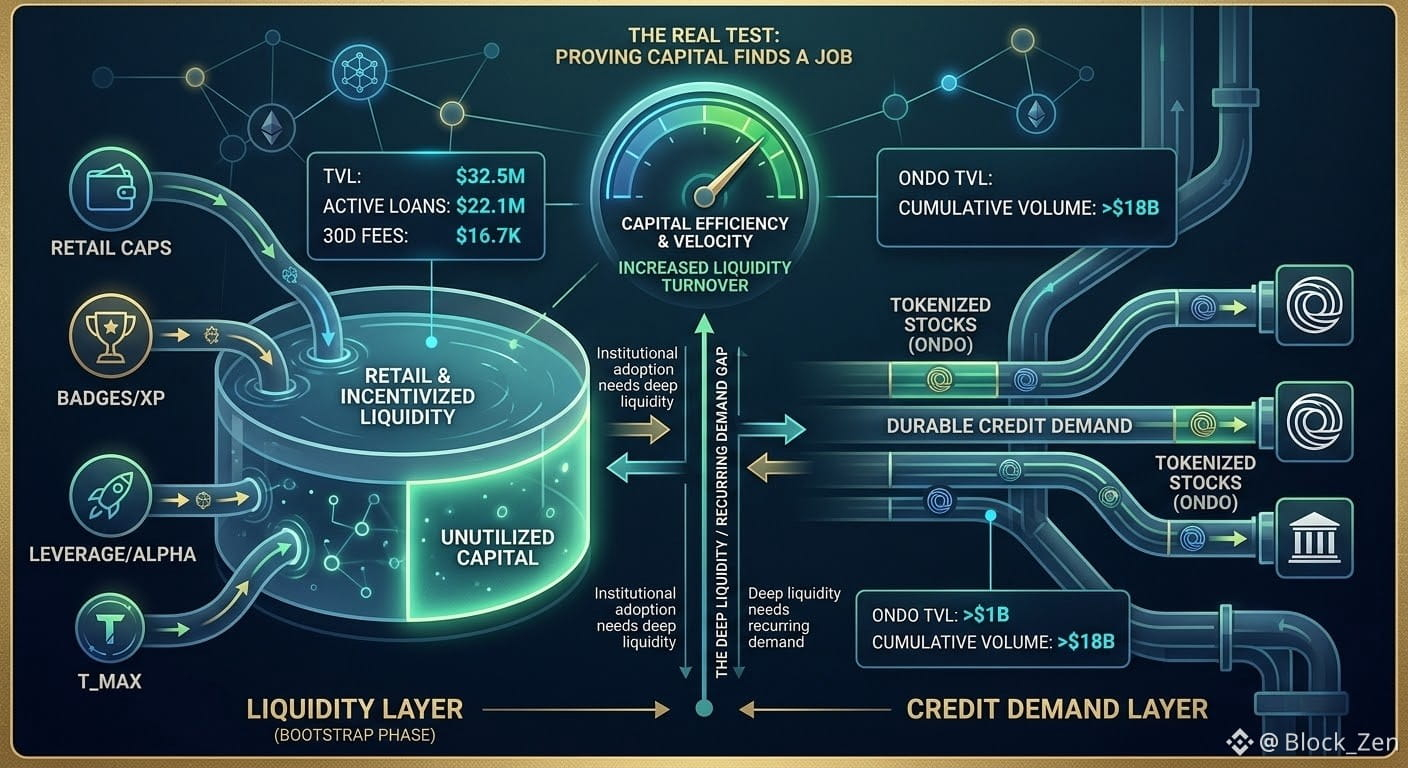
TMX campaigns, XP, badges, leverage and Alpha create visible activity. TermMax is sitting around $32.5M TVL, with roughly $22.1M in active loans and $16.7K in fees over 30 days.
What caught me is not the size. It’s the gap between liquidity and actual credit demand.
If retail is helping bootstrap the liquidity layer, the harder question is whether that capital keeps finding productive use, rather than simply accumulating on the balance sheet.
The institutional direction makes this more interesting. TermMax has already moved into fixed-rate financing around Ondo tokenized stocks, while Ondo’s tokenized-stock platform has crossed $1B TVL and $18B in cumulative volume.
So the market opportunity looks real.
But there’s a contradiction here I keep coming back to:
institutional adoption needs deep liquidity, while deep liquidity itself needs recurring demand.
Retail can help create the first side quickly. Institutions may eventually provide the second, but they need predictable funding, defined maturities and enough depth to deploy meaningful size.
That’s why I am less interested in TermMax simply growing TVL.
I’m watching whether existing liquidity starts turning over more frequently into durable credit demand.
Maybe the real test is not attracting more capital.
It’s proving that the capital already there can keep finding a job.
#termmax @TermMax
I used to read @TermMax through the retail layer, but the current numbers make me look at it differently.
TMX campaigns, XP, badges, leverage and Alpha create visible activity. TermMax is sitting around $32.5M TVL, with roughly $22.1M in active loans and $16.7K in fees over 30 days.
What caught me is not the size. It’s the gap between liquidity and actual credit demand.
If retail is helping bootstrap the liquidity layer, the harder question is whether that capital keeps finding productive use, rather than simply accumulating on the balance sheet.
The institutional direction makes this more interesting. TermMax has already moved into fixed-rate financing around Ondo tokenized stocks, while Ondo’s tokenized-stock platform has crossed $1B TVL and $18B in cumulative volume.
So the market opportunity looks real.
But there’s a contradiction here I keep coming back to:
institutional adoption needs deep liquidity, while deep liquidity itself needs recurring demand.
Retail can help create the first side quickly. Institutions may eventually provide the second, but they need predictable funding, defined maturities and enough depth to deploy meaningful size.
That’s why I am less interested in TermMax simply growing TVL.
I’m watching whether existing liquidity starts turning over more frequently into durable credit demand.
Maybe the real test is not attracting more capital.
It’s proving that the capital already there can keep finding a job.
I used to read @TermMax through the retail layer, but the current numbers make me look at it differently.
TMX campaigns, XP, badges, leverage and Alpha create visible activity. TermMax is sitting around $32.5M TVL, with roughly $22.1M in active loans and $16.7K in fees over 30 days.
What caught me is not the size. It’s the gap between liquidity and actual credit demand.
If retail is helping bootstrap the liquidity layer, the harder question is whether that capital keeps finding productive use, rather than simply accumulating on the balance sheet.
The institutional direction makes this more interesting. TermMax has already moved into fixed-rate financing around Ondo tokenized stocks, while Ondo’s tokenized-stock platform has crossed $1B TVL and $18B in cumulative volume.
So the market opportunity looks real.
But there’s a contradiction here I keep coming back to:
institutional adoption needs deep liquidity, while deep liquidity itself needs recurring demand.
Retail can help create the first side quickly. Institutions may eventually provide the second, but they need predictable funding, defined maturities and enough depth to deploy meaningful size.
That’s why I am less interested in TermMax simply growing TVL.
I’m watching whether existing liquidity starts turning over more frequently into durable credit demand.
Maybe the real test is not attracting more capital.
It’s proving that the capital already there can keep finding a job.
42
25
1.9k
·
--
#termmax @termmax
I kept coming back to TermMax’s Range Orders because, honestly, I first thought it was just another order-book feature.
Then I looked at the current numbers and started seeing the design a bit differently.
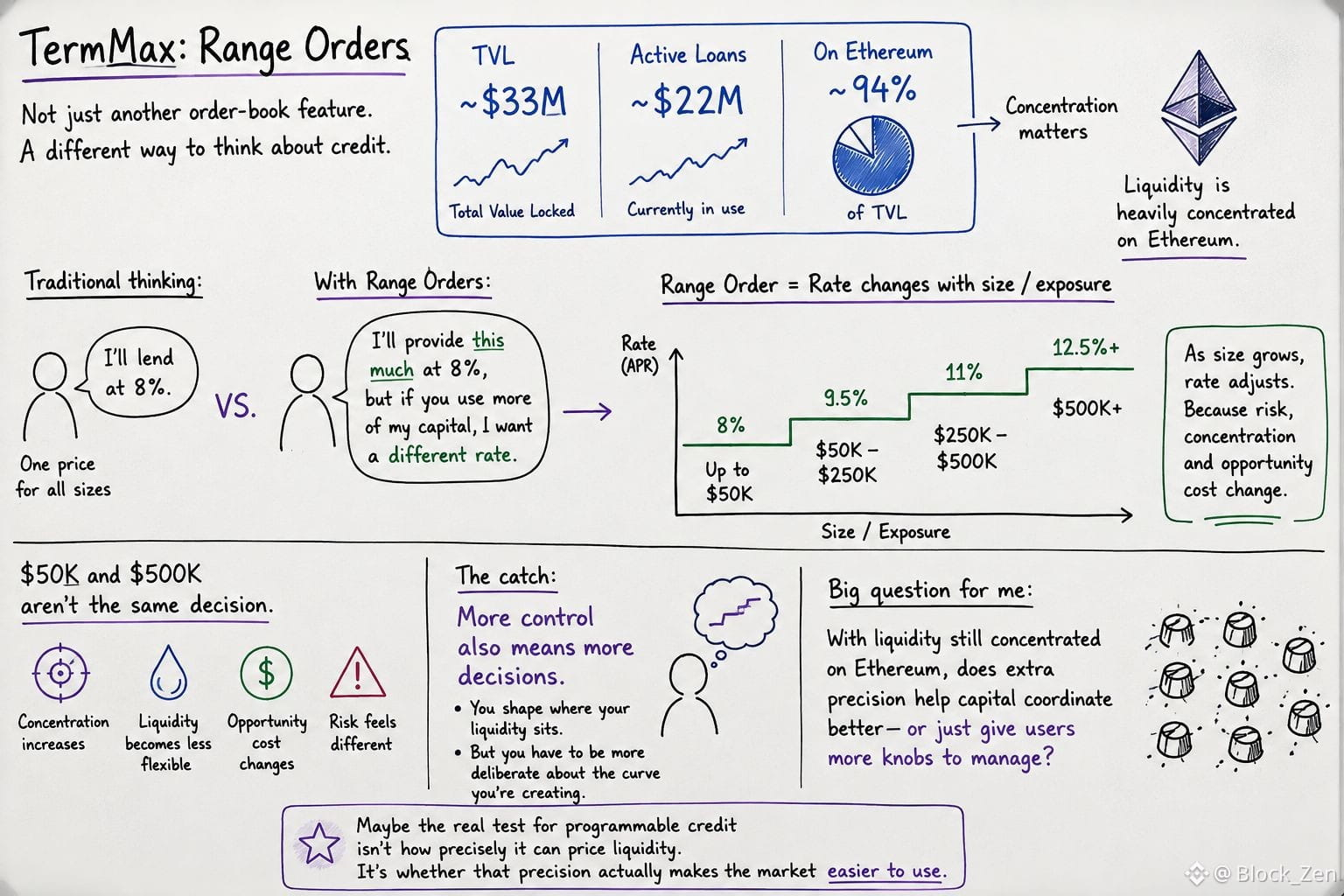
TermMax is around $33M in TVL with roughly $22M in active loans, while about 94% of TVL is still on Ethereum.
What stood out to me is how the Range Order handles size.
A lender is not simply saying, “I'll lend at 8%.”
It's more like, “I'll provide this much at 8%, but if you use more of my capital, I want a different rate.”
That feels closer to how I’d actually think about my own money.
I might be perfectly comfortable putting $50K somewhere, but $500K would make me pause. The concentration is different. The liquidity I’m giving up is different. Even the opportunity cost starts to feel different.
At first, I saw this as simply better credit pricing.
But there's a catch I didn't think about initially.
More control also means more decisions.
You get to shape where your liquidity sits, but you also have to be more deliberate about the curve you're creating.
And with liquidity still heavily concentrated on Ethereum, I keep wondering whether this extra precision actually helps capital coordinate better or just gives users more knobs to manage.
Maybe that's the real test for programmable credit.
@termmax #termax
#termmax @TermMax
I kept coming back to TermMax’s Range Orders because, honestly, I first thought it was just another order-book feature.
Then I looked at the current numbers and started seeing the design a bit differently.
TermMax is around $33M in TVL with roughly $22M in active loans, while about 94% of TVL is still on Ethereum.
What stood out to me is how the Range Order handles size.
A lender is not simply saying, “I'll lend at 8%.”
It's more like, “I'll provide this much at 8%, but if you use more of my capital, I want a different rate.”
That feels closer to how I’d actually think about my own money.
I might be perfectly comfortable putting $50K somewhere, but $500K would make me pause. The concentration is different. The liquidity I’m giving up is different. Even the opportunity cost starts to feel different.
At first, I saw this as simply better credit pricing.
But there's a catch I didn't think about initially.
More control also means more decisions.
You get to shape where your liquidity sits, but you also have to be more deliberate about the curve you're creating.
And with liquidity still heavily concentrated on Ethereum, I keep wondering whether this extra precision actually helps capital coordinate better or just gives users more knobs to manage.
Maybe that's the real test for programmable credit.
@TermMax #termax
I kept coming back to TermMax’s Range Orders because, honestly, I first thought it was just another order-book feature.
Then I looked at the current numbers and started seeing the design a bit differently.
TermMax is around $33M in TVL with roughly $22M in active loans, while about 94% of TVL is still on Ethereum.
What stood out to me is how the Range Order handles size.
A lender is not simply saying, “I'll lend at 8%.”
It's more like, “I'll provide this much at 8%, but if you use more of my capital, I want a different rate.”
That feels closer to how I’d actually think about my own money.
I might be perfectly comfortable putting $50K somewhere, but $500K would make me pause. The concentration is different. The liquidity I’m giving up is different. Even the opportunity cost starts to feel different.
At first, I saw this as simply better credit pricing.
But there's a catch I didn't think about initially.
More control also means more decisions.
You get to shape where your liquidity sits, but you also have to be more deliberate about the curve you're creating.
And with liquidity still heavily concentrated on Ethereum, I keep wondering whether this extra precision actually helps capital coordinate better or just gives users more knobs to manage.
Maybe that's the real test for programmable credit.
@TermMax #termax
27
18
218
·
--
#dusk $DUSK @Dusk_Foundation
I was looking through DUSK’s Citadel setup and one small thing kept bothering me: selective disclosure reduces the data you expose, but it can make the credential issuer even more important.
The idea itself is pretty straightforward. A user gets verified, receives a license, and can later prove things like accredited status, sanctions clearance, or jurisdiction without showing the whole identity record.
At first, I thought, okay, this is simply less trust and less data everywhere.
Then I started thinking about what happens behind that credential.
The original KYC decision still came from somewhere. If that credential is portable, the same decision can be reused across different interactions instead of every institution starting the process again.
That's useful.
But it also means I am relying more heavily on whoever issued it.
And this is where the timing part caught my attention. A credential can be valid today and not mean the same thing later. Sanctions change. Eligibility changes. Compliance information gets old.
So the tradeoff I keep seeing is pretty simple:
the verifier sees less, but the issuer matters more.
That makes things like revocation, freshness and accountability pretty important.
I'm also more interested in whether people actually use these credentials repeatedly than how many integrations get announced.
Because eventually, someone has to trust the credential enough to act on it.
If that credential turns out to be outdated or wrong, I'm still wondering:
who is actually responsible?
@Dusk_Foundation #dusk $DUSK
When a credential is wrong or outdated, who should be accountable?
#dusk $DUSK @Dusk
I was looking through DUSK’s Citadel setup and one small thing kept bothering me: selective disclosure reduces the data you expose, but it can make the credential issuer even more important.
The idea itself is pretty straightforward. A user gets verified, receives a license, and can later prove things like accredited status, sanctions clearance, or jurisdiction without showing the whole identity record.
At first, I thought, okay, this is simply less trust and less data everywhere.
Then I started thinking about what happens behind that credential.
The original KYC decision still came from somewhere. If that credential is portable, the same decision can be reused across different interactions instead of every institution starting the process again.
That's useful.
But it also means I am relying more heavily on whoever issued it.
And this is where the timing part caught my attention. A credential can be valid today and not mean the same thing later. Sanctions change. Eligibility changes. Compliance information gets old.
So the tradeoff I keep seeing is pretty simple:
the verifier sees less, but the issuer matters more.
That makes things like revocation, freshness and accountability pretty important.
I'm also more interested in whether people actually use these credentials repeatedly than how many integrations get announced.
Because eventually, someone has to trust the credential enough to act on it.
If that credential turns out to be outdated or wrong, I'm still wondering:
who is actually responsible?
@Dusk #dusk $DUSK
When a credential is wrong or outdated, who should be accountable?
I was looking through DUSK’s Citadel setup and one small thing kept bothering me: selective disclosure reduces the data you expose, but it can make the credential issuer even more important.
The idea itself is pretty straightforward. A user gets verified, receives a license, and can later prove things like accredited status, sanctions clearance, or jurisdiction without showing the whole identity record.
At first, I thought, okay, this is simply less trust and less data everywhere.
Then I started thinking about what happens behind that credential.
The original KYC decision still came from somewhere. If that credential is portable, the same decision can be reused across different interactions instead of every institution starting the process again.
That's useful.
But it also means I am relying more heavily on whoever issued it.
And this is where the timing part caught my attention. A credential can be valid today and not mean the same thing later. Sanctions change. Eligibility changes. Compliance information gets old.
So the tradeoff I keep seeing is pretty simple:
the verifier sees less, but the issuer matters more.
That makes things like revocation, freshness and accountability pretty important.
I'm also more interested in whether people actually use these credentials repeatedly than how many integrations get announced.
Because eventually, someone has to trust the credential enough to act on it.
If that credential turns out to be outdated or wrong, I'm still wondering:
who is actually responsible?
@Dusk #dusk $DUSK
When a credential is wrong or outdated, who should be accountable?
The credential issuer
67%
The verifier
33%
Both equally
0%
3 votes • Voting closed
75
28
291
·
--
#dusk $DUSK @Dusk_Foundation
I kept coming back to one odd contrast in DuskEVM: the market is treating DUSK like a quiet $0.064 asset right now, with roughly $4.1M in 24h volume, while the architecture is quietly making DUSK the first step into the EVM itself.
Before deploying Solidity, you bridge DUSK from DuskDS. It becomes the gas asset on DuskEVM, while DuskDS remains the settlement and data-availability layer.
That initially looked like ordinary testnet plumbing to me.
Then the contradiction clicked.
DuskEVM is supposed to feel familiar to EVM developers, but the first economic action isn’t Ethereum-like at all. You’re entering through Dusk’s own settlement layer first.
So the compatibility story and the settlement story are pulling in different directions: familiar execution on one side, a deliberately Dusk-native dependency underneath.
And that might matter more than the bridge itself.
If developers eventually use DuskEVM for privacy-sensitive financial applications, the question isn’t just whether the EVM feels familiar. It’s whether that underlying connection to DuskDS becomes part of why the application works the way it does.
Right now, with DUSK still trading around six cents, the market doesn’t seem to be pricing much into that distinction.
I’m not sure whether that’s because the architecture is early, or because the dependency ultimately won’t matter as much as I think.
Which side proves right once real applications arrive?
@Dusk_Foundation #dusk $DUSK
What matters more for DuskEVM’s long-term adoption?
#dusk $DUSK @Dusk
I kept coming back to one odd contrast in DuskEVM: the market is treating DUSK like a quiet $0.064 asset right now, with roughly $4.1M in 24h volume, while the architecture is quietly making DUSK the first step into the EVM itself.
Before deploying Solidity, you bridge DUSK from DuskDS. It becomes the gas asset on DuskEVM, while DuskDS remains the settlement and data-availability layer.
That initially looked like ordinary testnet plumbing to me.
Then the contradiction clicked.
DuskEVM is supposed to feel familiar to EVM developers, but the first economic action isn’t Ethereum-like at all. You’re entering through Dusk’s own settlement layer first.
So the compatibility story and the settlement story are pulling in different directions: familiar execution on one side, a deliberately Dusk-native dependency underneath.
And that might matter more than the bridge itself.
If developers eventually use DuskEVM for privacy-sensitive financial applications, the question isn’t just whether the EVM feels familiar. It’s whether that underlying connection to DuskDS becomes part of why the application works the way it does.
Right now, with DUSK still trading around six cents, the market doesn’t seem to be pricing much into that distinction.
I’m not sure whether that’s because the architecture is early, or because the dependency ultimately won’t matter as much as I think.
Which side proves right once real applications arrive?
@Dusk #dusk $DUSK
What matters more for DuskEVM’s long-term adoption?
I kept coming back to one odd contrast in DuskEVM: the market is treating DUSK like a quiet $0.064 asset right now, with roughly $4.1M in 24h volume, while the architecture is quietly making DUSK the first step into the EVM itself.
Before deploying Solidity, you bridge DUSK from DuskDS. It becomes the gas asset on DuskEVM, while DuskDS remains the settlement and data-availability layer.
That initially looked like ordinary testnet plumbing to me.
Then the contradiction clicked.
DuskEVM is supposed to feel familiar to EVM developers, but the first economic action isn’t Ethereum-like at all. You’re entering through Dusk’s own settlement layer first.
So the compatibility story and the settlement story are pulling in different directions: familiar execution on one side, a deliberately Dusk-native dependency underneath.
And that might matter more than the bridge itself.
If developers eventually use DuskEVM for privacy-sensitive financial applications, the question isn’t just whether the EVM feels familiar. It’s whether that underlying connection to DuskDS becomes part of why the application works the way it does.
Right now, with DUSK still trading around six cents, the market doesn’t seem to be pricing much into that distinction.
I’m not sure whether that’s because the architecture is early, or because the dependency ultimately won’t matter as much as I think.
Which side proves right once real applications arrive?
@Dusk #dusk $DUSK
What matters more for DuskEVM’s long-term adoption?
EVM compatibility
67%
DuskDS settlement
0%
Privacy-native apps
33%
6 votes • Voting closed
62
31
577
·
--
I kept looking at @TermMax Alpha’s Dual Investment, and one contradiction stood out more than the APY.
The current interface advertises yields around 50%, but the part I find more interesting is where that yield comes from: your USDT is effectively underwriting put liquidity.
If price stays above your strike, you keep USDT and the premium. If it falls below, the USDT can convert into the asset at your chosen strike.
So the attractive yield comes with a less obvious condition: your liquidity may not remain fully liquid.
TermMax’s docs say that when deposited assets are already borrowed by option buyers, early withdrawal can be unavailable until maturity.
That changes how I think about the product.
The APY is not really paying you just for parking USDT. You’re being compensated for making that liquidity available to someone taking the other side of the option.
And if the market moves hard, that distinction matters.
You could be earning while simultaneously becoming less flexible with the capital.
I’m curious whether users will value that trade-off once the headline APY stops being the main attraction.
The key contradiction here is yield vs liquidity: the same mechanism that can make the return attractive can also make the capital less flexible.
@termmax #termmax
I kept looking at @TermMax Alpha’s Dual Investment, and one contradiction stood out more than the APY.
The current interface advertises yields around 50%, but the part I find more interesting is where that yield comes from: your USDT is effectively underwriting put liquidity.
If price stays above your strike, you keep USDT and the premium. If it falls below, the USDT can convert into the asset at your chosen strike.
So the attractive yield comes with a less obvious condition: your liquidity may not remain fully liquid.
TermMax’s docs say that when deposited assets are already borrowed by option buyers, early withdrawal can be unavailable until maturity.
That changes how I think about the product.
The APY is not really paying you just for parking USDT. You’re being compensated for making that liquidity available to someone taking the other side of the option.
And if the market moves hard, that distinction matters.
You could be earning while simultaneously becoming less flexible with the capital.
I’m curious whether users will value that trade-off once the headline APY stops being the main attraction.
The key contradiction here is yield vs liquidity: the same mechanism that can make the return attractive can also make the capital less flexible.
@TermMax #termmax
The current interface advertises yields around 50%, but the part I find more interesting is where that yield comes from: your USDT is effectively underwriting put liquidity.
If price stays above your strike, you keep USDT and the premium. If it falls below, the USDT can convert into the asset at your chosen strike.
So the attractive yield comes with a less obvious condition: your liquidity may not remain fully liquid.
TermMax’s docs say that when deposited assets are already borrowed by option buyers, early withdrawal can be unavailable until maturity.
That changes how I think about the product.
The APY is not really paying you just for parking USDT. You’re being compensated for making that liquidity available to someone taking the other side of the option.
And if the market moves hard, that distinction matters.
You could be earning while simultaneously becoming less flexible with the capital.
I’m curious whether users will value that trade-off once the headline APY stops being the main attraction.
The key contradiction here is yield vs liquidity: the same mechanism that can make the return attractive can also make the capital less flexible.
@TermMax #termmax
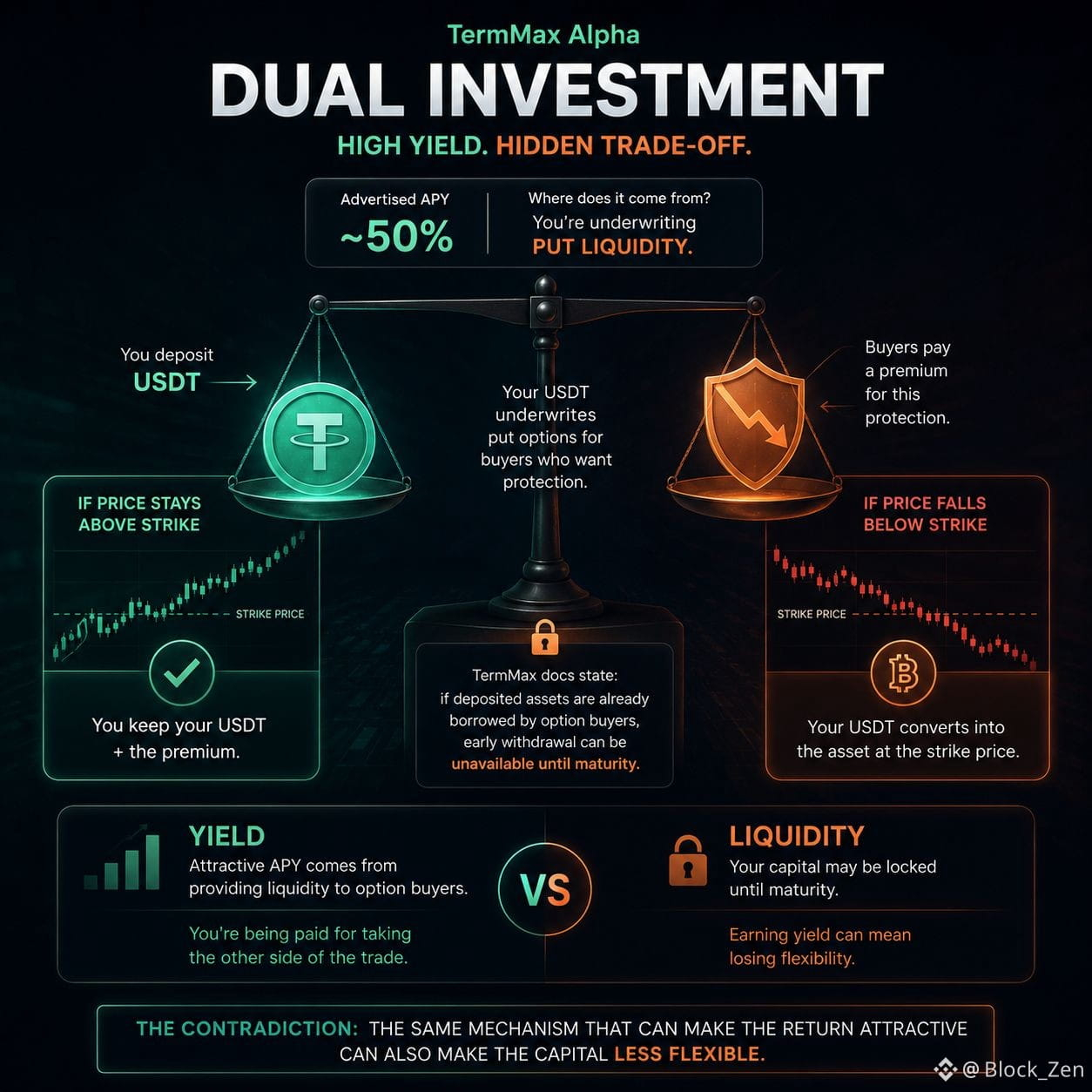
38
13
326
·
--
#termmax @termmax
I used to think TermMax was mainly solving one problem: bringing fixed-rate lending on-chain. After spending more time with the design, I think the harder problem is what happens to that fixed credit when liquidity starts moving.
That’s where the architecture became more interesting to me.
The GT structure puts collateral and debt into one position, while LTV limits make the risk boundary easier to see. Range Orders go a step further by letting lenders express how their required rate changes as more of their liquidity gets used.
That subtle difference matters.
It means the market isn't only matching capital at a price. It can start expressing a relationship between size, rate, duration and liquidity preference.
But flexibility does not remove risk. It moves some of the complexity elsewhere.
Liquidations still depend on market liquidity. Fixed positions still need credible exit paths. Governance still has to change parameters without turning a local adjustment into a broader risk event.
That’s why Smart Unwind caught my attention too. A fixed position is only as useful as the system’s ability to manage it when the original conditions no longer feel comfortable.
So I’m watching TermMax less for the headline rate now, and more for what happens when liquidity gets thin.
Can programmable credit preserve the certainty of fixed rates without quietly making liquidity the price of that certainty?
#TermMax @termmax
#termmax @TermMax
I used to think TermMax was mainly solving one problem: bringing fixed-rate lending on-chain. After spending more time with the design, I think the harder problem is what happens to that fixed credit when liquidity starts moving.
That’s where the architecture became more interesting to me.
The GT structure puts collateral and debt into one position, while LTV limits make the risk boundary easier to see. Range Orders go a step further by letting lenders express how their required rate changes as more of their liquidity gets used.
That subtle difference matters.
It means the market isn't only matching capital at a price. It can start expressing a relationship between size, rate, duration and liquidity preference.
But flexibility does not remove risk. It moves some of the complexity elsewhere.
Liquidations still depend on market liquidity. Fixed positions still need credible exit paths. Governance still has to change parameters without turning a local adjustment into a broader risk event.
That’s why Smart Unwind caught my attention too. A fixed position is only as useful as the system’s ability to manage it when the original conditions no longer feel comfortable.
So I’m watching TermMax less for the headline rate now, and more for what happens when liquidity gets thin.
Can programmable credit preserve the certainty of fixed rates without quietly making liquidity the price of that certainty?
#TermMax @TermMax
I used to think TermMax was mainly solving one problem: bringing fixed-rate lending on-chain. After spending more time with the design, I think the harder problem is what happens to that fixed credit when liquidity starts moving.
That’s where the architecture became more interesting to me.
The GT structure puts collateral and debt into one position, while LTV limits make the risk boundary easier to see. Range Orders go a step further by letting lenders express how their required rate changes as more of their liquidity gets used.
That subtle difference matters.
It means the market isn't only matching capital at a price. It can start expressing a relationship between size, rate, duration and liquidity preference.
But flexibility does not remove risk. It moves some of the complexity elsewhere.
Liquidations still depend on market liquidity. Fixed positions still need credible exit paths. Governance still has to change parameters without turning a local adjustment into a broader risk event.
That’s why Smart Unwind caught my attention too. A fixed position is only as useful as the system’s ability to manage it when the original conditions no longer feel comfortable.
So I’m watching TermMax less for the headline rate now, and more for what happens when liquidity gets thin.
Can programmable credit preserve the certainty of fixed rates without quietly making liquidity the price of that certainty?
#TermMax @TermMax
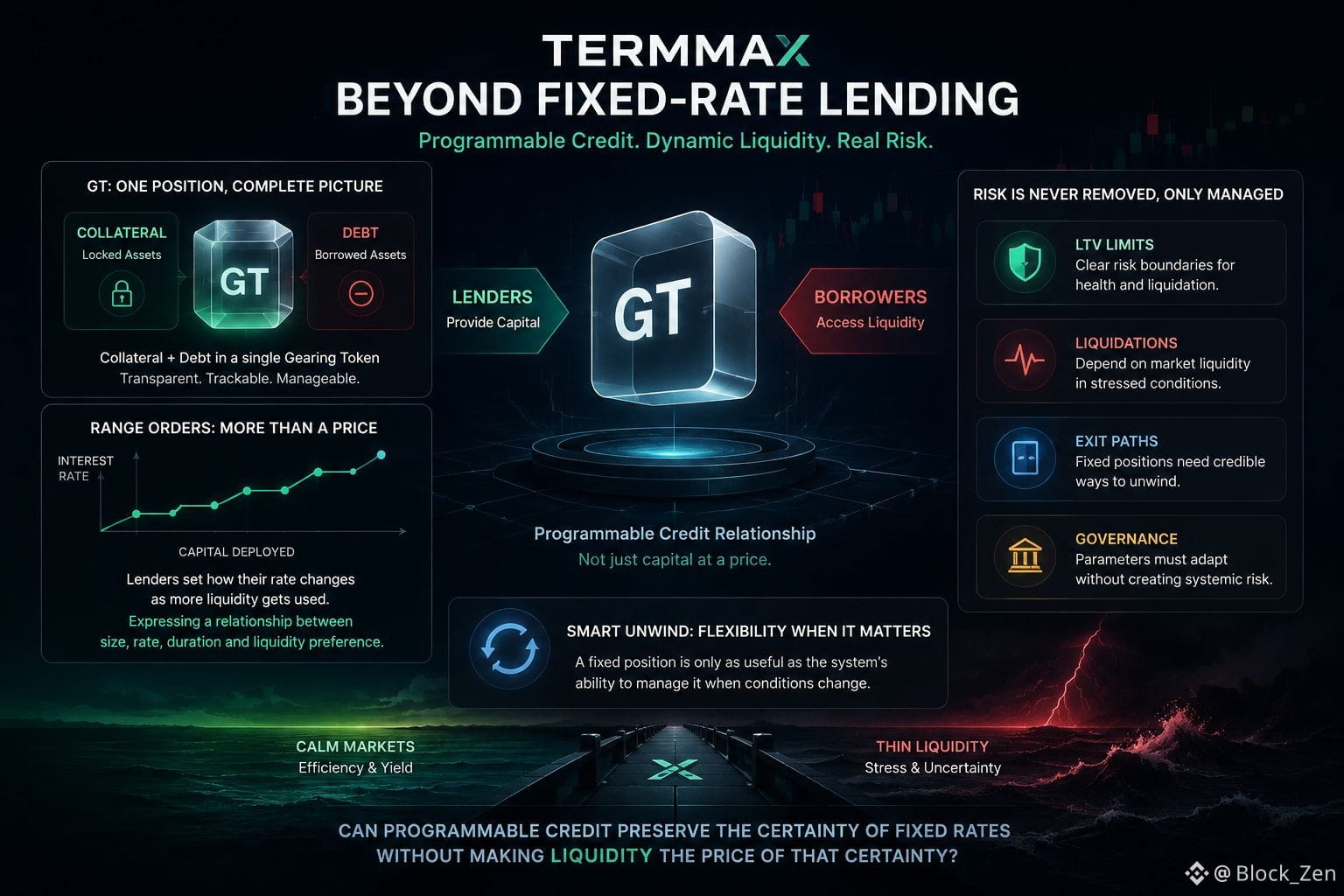
31
15
269
Log in to explore more content
Join global crypto users on Binance Square
⚡️ Get latest and useful information about crypto.
💬 Trusted by the world’s largest crypto exchange.
👍 Discover real insights from verified creators.
Email / Phone number
Trending Topics
EthereumDropsBelow$2300
1,517 views
63 Discussing
CZ predicted this way before 🤣
$BTC below $80K
$ETH below $2300
$XRP below $1.3
Is this another opportunity to accumulate or you guys waiting for Bitcoin $35k bottom ❓
ParvezMayar
·8 Likes
·3.7k views
BitcoinSlipsBelow$80KAgain
1,997 views
36 Discussing
ThailandLaunchesWORPTStablecoinToQRPaymentApp
3,550 views
109 Discussing