

I didn’t “get” Plasma right away.
Not because it was complicated—but because it wasn’t trying to impress me.
At first glance, it looked familiar: a Layer 1, EVM-compatible, fast finality.I almost dismissed it on autopilot. I’ve seen that pattern too many times. But the more I sat with it, the more I realized Plasma wasn’t asking for attention. It was quietly solving a very specific problem—and that’s what pulled me back.
Plasma isn’t trying to be everything. It’s trying to be useful.
What finally clicked for me was this: Plasma isn’t built for narratives. It’s built for settlement. For stablecoins moving between real people, real businesses, and real institutions that don’t have the luxury of “experimental downtime.”
When you look at it that way, the design choices stop feeling random.
Take gasless USDT transfers. At first, it sounds like a UX feature. But then you imagine someone using stablecoins daily—in a high-adoption market, or running payments for a business. That person doesn’t care about gas tokens. They care about sending money without friction. Plasma seems to start from that reality instead of forcing users to adapt to blockchain mechanics.
Same with stablecoin-first gas. It’s not elegant in a theoretical sense—but it’s intuitive. You pay fees in the asset you’re already using. That’s how normal systems work.
Privacy was another thing I had to rethink.
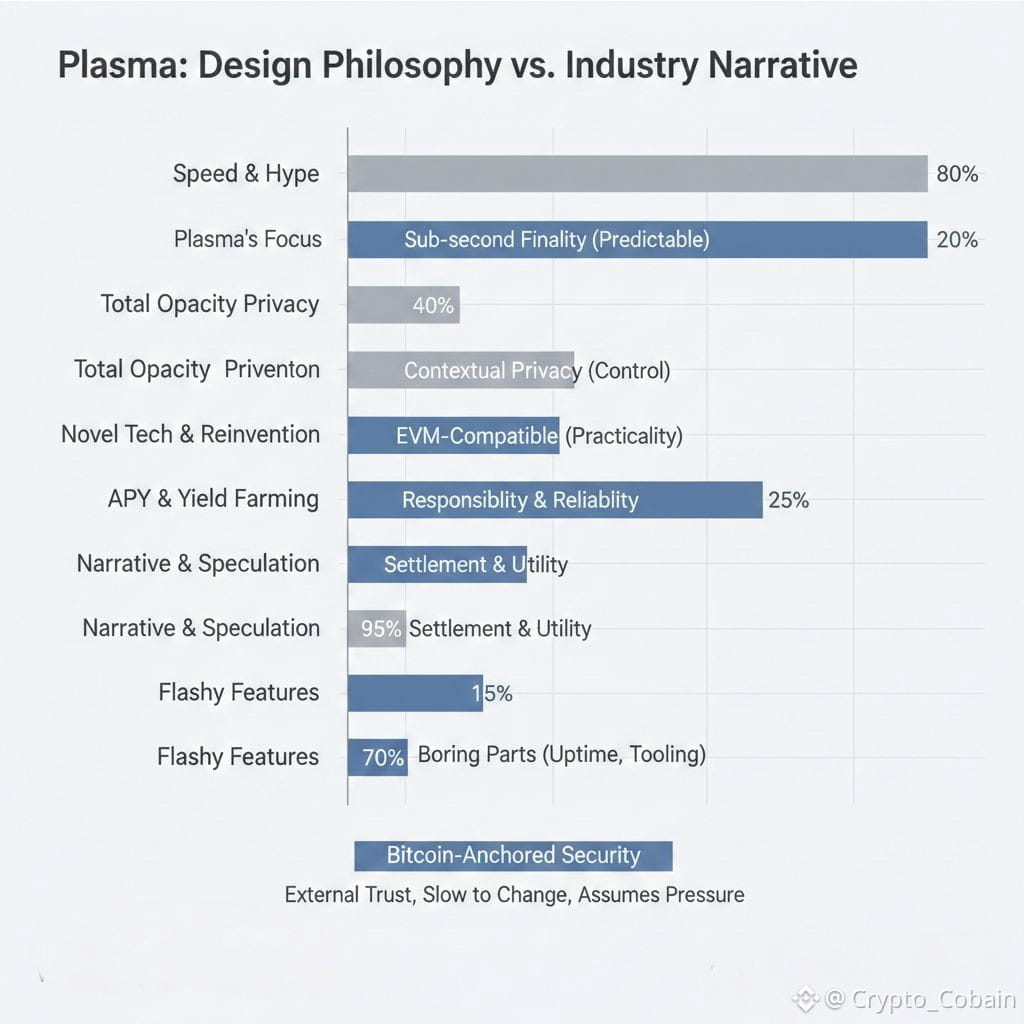
I used to believe privacy had to mean total opacity or it wasn’t real. Plasma doesn’t follow that line of thinking. And over time, I understood why.
Here, privacy is contextual. It’s about control—who sees what, when, and for what reason. That matters when audits, compliance, and accountability are part of the environment. Absolute secrecy sounds nice until a system needs to operate under legal or institutional pressure. Plasma seems to accept that reality instead of fighting it.
That doesn’t feel ideological. It feels grown up.
What really stood out to me, though, were the boring parts.
Tooling updates.
Better observability.
Metadata handling.
Node reliability improvements.
Quiet performance upgrades.
None of this trends. None of this goes viral. But these are exactly the things that matter when people are responsible for uptime, reporting, and explaining system behavior to someone who expects real answers.
The choice to stay fully EVM-compatible isn’t flashy, but it’s practical. It means existing tools work. Developers don’t have to relearn everything. Systems can migrate without breaking. It’s not revolutionary—it’s considerate.
Sub-second finality through PlasmaBFT feels the same way. It’s not about bragging rights. It’s about certainty. Settlement systems don’t need hype-speed; they need predictable finality.
Even the Bitcoin-anchored security model started making more sense the longer I thought about it.
It’s not about symbolism. It’s about anchoring trust to something external, slow to change, and hard to manipulate. That kind of design only matters if you expect pressure—regulatory, political, or economic. Plasma seems to assume that pressure is inevitable.
That assumption changes everything.
When I looked into the token mechanics and staking, I didn’t find a sales pitch. I found structure.
Staking here feels less like yield farming and more like responsibility. Validators aren’t just participants—they’re operators. Incentives are there, but they’re tied to reliability and alignment, not hype cycles.
It’s not perfect. It’s not frictionless. And Plasma doesn’t pretend it is.
Legacy systems exist. Migration takes time. Adoption doesn’t happen overnight. Plasma seems comfortable acknowledging those trade-offs instead of pretending the world resets at launch.
What changed for me wasn’t excitement—it was clarity.
Plasma isn’t trying to win attention.
It’s trying to hold up under scrutiny.
Under audits.
Under real usage.
The more I understood it, the calmer I felt about it. Not energized. Not euphoric. Just… steady.
And that’s when I realized why it kept making sense the longer I looked at it.
This feels like a system designed by people who expect to be questioned—and are okay with that.
Not because they have the loudest answers, but because the structure itself can explain them.
That kind of confidence doesn’t shout.
It waits.

