
Zhao Liying
257 Publicações

Zhao Liying
Denunciar
Bloquear Utilizador
Aberto ao trading
Trader Ocasional
1 mês(es)
8 A seguir
1 Seguidores
0 Gostaram
Publicações
Portfólio
·
--
Artigo
Ver tradução
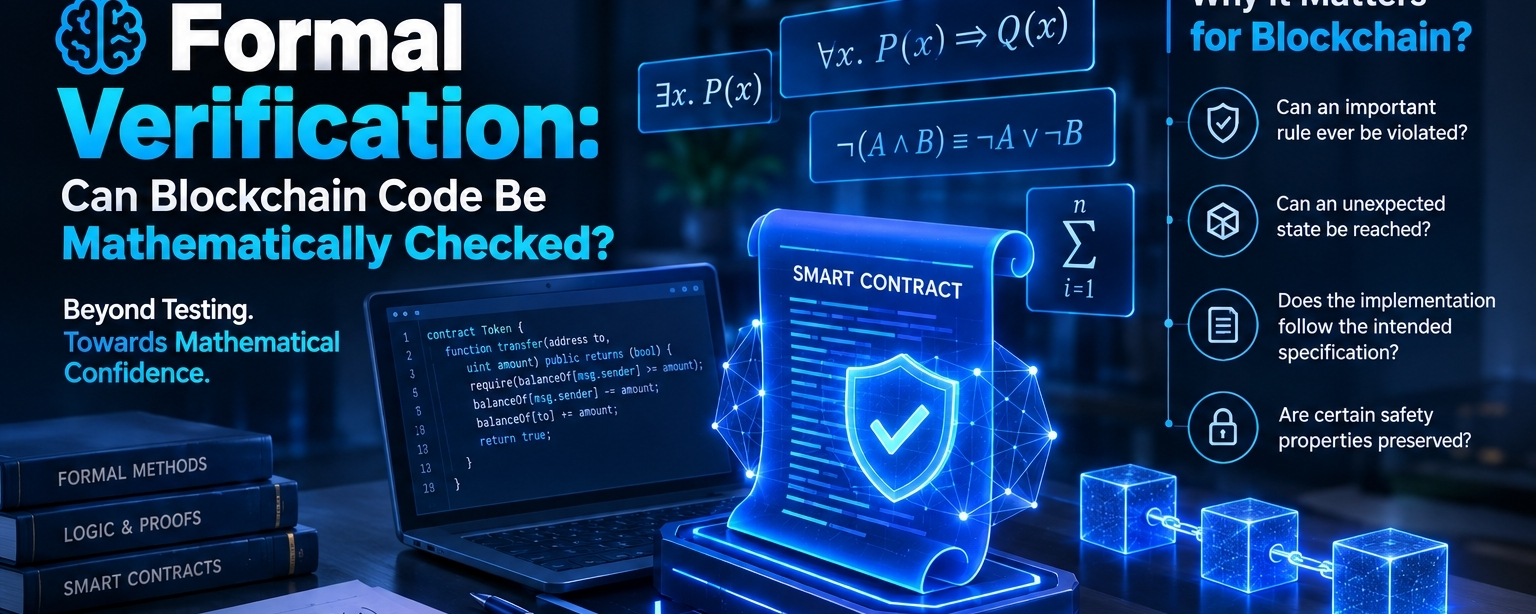
Formal Verification: Can Blockchain Code Be Mathematically Checked?Blockchain applications can hold valuable digital assets and execute important operations through code.
But how can developers gain stronger confidence that a smart contract behaves according to its intended rules?
One approach is formal verification — a method that uses mathematical techniques to check whether software satisfies specific properties.
🔍 More Than Ordinary Testing
Traditional testing checks selected scenarios:
🧪 “What happens if this function receives this input?”
🧪 “What happens when these two actions occur together?”
Formal verification takes a different approach.
Instead of checking only selected examples, developers can mathematically specify certain properties and attempt to prove that the code satisfies them.
⚙️ Why It Matters for Blockchain
Smart contracts can be difficult to change after deployment, so finding problems early can be especially important.
Formal methods can help developers examine questions such as:
🔹 Can an important rule ever be violated?
🔹 Can an unexpected state be reached?
🔹 Does the implementation follow the intended specification?
🔹 Are certain safety properties preserved?
🚀 The Bigger Picture
Blockchain innovation isn't only about creating new protocols.
It's also about improving the engineering discipline behind them.
As smart contracts become more sophisticated, techniques such as formal verification could become an increasingly important part of building software that people can confidently rely on.
💡 The future of blockchain security may not be just about finding bugs — it may also be about mathematically proving that certain classes of mistakes cannot occur.
💬 Question:
Would mathematical verification make you more confident in a blockchain application?
#Blockchain #SmartContracts #Web3 #Cryptography #BlockchainSecurity #CryptoEducation
Formal Verification: Can Blockchain Code Be Mathematically Checked?
Blockchain applications can hold valuable digital assets and execute important operations through code.
But how can developers gain stronger confidence that a smart contract behaves according to its intended rules?
One approach is formal verification — a method that uses mathematical techniques to check whether software satisfies specific properties.
🔍 More Than Ordinary Testing
Traditional testing checks selected scenarios:
🧪 “What happens if this function receives this input?”
🧪 “What happens when these two actions occur together?”
Formal verification takes a different approach.
Instead of checking only selected examples, developers can mathematically specify certain properties and attempt to prove that the code satisfies them.
⚙️ Why It Matters for Blockchain
Smart contracts can be difficult to change after deployment, so finding problems early can be especially important.
Formal methods can help developers examine questions such as:
🔹 Can an important rule ever be violated?
🔹 Can an unexpected state be reached?
🔹 Does the implementation follow the intended specification?
🔹 Are certain safety properties preserved?
🚀 The Bigger Picture
Blockchain innovation isn't only about creating new protocols.
It's also about improving the engineering discipline behind them.
As smart contracts become more sophisticated, techniques such as formal verification could become an increasingly important part of building software that people can confidently rely on.
💡 The future of blockchain security may not be just about finding bugs — it may also be about mathematically proving that certain classes of mistakes cannot occur.
💬 Question:
Would mathematical verification make you more confident in a blockchain application?
#Blockchain #SmartContracts #Web3 #Cryptography #BlockchainSecurity #CryptoEducation
But how can developers gain stronger confidence that a smart contract behaves according to its intended rules?
One approach is formal verification — a method that uses mathematical techniques to check whether software satisfies specific properties.
🔍 More Than Ordinary Testing
Traditional testing checks selected scenarios:
🧪 “What happens if this function receives this input?”
🧪 “What happens when these two actions occur together?”
Formal verification takes a different approach.
Instead of checking only selected examples, developers can mathematically specify certain properties and attempt to prove that the code satisfies them.
⚙️ Why It Matters for Blockchain
Smart contracts can be difficult to change after deployment, so finding problems early can be especially important.
Formal methods can help developers examine questions such as:
🔹 Can an important rule ever be violated?
🔹 Can an unexpected state be reached?
🔹 Does the implementation follow the intended specification?
🔹 Are certain safety properties preserved?
🚀 The Bigger Picture
Blockchain innovation isn't only about creating new protocols.
It's also about improving the engineering discipline behind them.
As smart contracts become more sophisticated, techniques such as formal verification could become an increasingly important part of building software that people can confidently rely on.
💡 The future of blockchain security may not be just about finding bugs — it may also be about mathematically proving that certain classes of mistakes cannot occur.
💬 Question:
Would mathematical verification make you more confident in a blockchain application?
#Blockchain #SmartContracts #Web3 #Cryptography #BlockchainSecurity #CryptoEducation
2
·
--

Artigo
Ver tradução
The Blockchain’s “Memory”: Why State Management Could Shape Web3’s FutureWhen we think about blockchain, we usually think about transactions, wallets, and blocks.
But behind all of them is a less visible question:
How does a blockchain keep track of everything that has changed?
The answer involves state management — the way a blockchain maintains information about its current condition.
🔄 From Transactions to Current State
Every valid transaction can change something:
📥 An account receives assets
📤 Another account sends them
⚙️ A smart contract updates its stored information
🔐 Ownership or permissions may change
Over time, these changes create a constantly evolving state.
🚧 Why State Is Becoming More Important
As blockchain applications become more complex, they may need to manage huge amounts of changing information.
That creates technical challenges around:
🔹 Storage efficiency
🔹 Fast data access
🔹 State synchronization
🔹 Verification
🔹 Long-term scalability
Developers therefore aren't only asking “How many transactions can a network process?”
They're also asking:
“How efficiently can the network maintain and update everything those transactions change?”
🌐 The Bigger Picture
The future of blockchain infrastructure may depend as much on state management as transaction throughput.
A network can process transactions, but applications need the resulting information to remain accessible, consistent, and verifiable.
🚀 The next generation of blockchain innovation may happen beneath the surface — in the infrastructure that helps networks remember.
💬 What do you think will matter more for future blockchains: faster transactions or more efficient data management?
#Blockchain #CryptoEducation #Web3 #BlockchainTechnology #CryptoInfrastructure
The Blockchain’s “Memory”: Why State Management Could Shape Web3’s Future
When we think about blockchain, we usually think about transactions, wallets, and blocks.
But behind all of them is a less visible question:
How does a blockchain keep track of everything that has changed?
The answer involves state management — the way a blockchain maintains information about its current condition.
🔄 From Transactions to Current State
Every valid transaction can change something:
📥 An account receives assets
📤 Another account sends them
⚙️ A smart contract updates its stored information
🔐 Ownership or permissions may change
Over time, these changes create a constantly evolving state.
🚧 Why State Is Becoming More Important
As blockchain applications become more complex, they may need to manage huge amounts of changing information.
That creates technical challenges around:
🔹 Storage efficiency
🔹 Fast data access
🔹 State synchronization
🔹 Verification
🔹 Long-term scalability
Developers therefore aren't only asking “How many transactions can a network process?”
They're also asking:
“How efficiently can the network maintain and update everything those transactions change?”
🌐 The Bigger Picture
The future of blockchain infrastructure may depend as much on state management as transaction throughput.
A network can process transactions, but applications need the resulting information to remain accessible, consistent, and verifiable.
🚀 The next generation of blockchain innovation may happen beneath the surface — in the infrastructure that helps networks remember.
💬 What do you think will matter more for future blockchains: faster transactions or more efficient data management?
#Blockchain #CryptoEducation #Web3 #BlockchainTechnology #CryptoInfrastructure
But behind all of them is a less visible question:
How does a blockchain keep track of everything that has changed?
The answer involves state management — the way a blockchain maintains information about its current condition.
🔄 From Transactions to Current State
Every valid transaction can change something:
📥 An account receives assets
📤 Another account sends them
⚙️ A smart contract updates its stored information
🔐 Ownership or permissions may change
Over time, these changes create a constantly evolving state.
🚧 Why State Is Becoming More Important
As blockchain applications become more complex, they may need to manage huge amounts of changing information.
That creates technical challenges around:
🔹 Storage efficiency
🔹 Fast data access
🔹 State synchronization
🔹 Verification
🔹 Long-term scalability
Developers therefore aren't only asking “How many transactions can a network process?”
They're also asking:
“How efficiently can the network maintain and update everything those transactions change?”
🌐 The Bigger Picture
The future of blockchain infrastructure may depend as much on state management as transaction throughput.
A network can process transactions, but applications need the resulting information to remain accessible, consistent, and verifiable.
🚀 The next generation of blockchain innovation may happen beneath the surface — in the infrastructure that helps networks remember.
💬 What do you think will matter more for future blockchains: faster transactions or more efficient data management?
#Blockchain #CryptoEducation #Web3 #BlockchainTechnology #CryptoInfrastructure
4
·
--
Ver tradução
State Channels: Moving Some Activity Off-Chain
What if two or more participants could conduct multiple interactions without recording every single step directly on the main blockchain?
State channels are a technology designed around this idea.
🔹 Multiple interactions can happen off-chain
🔹 Only relevant information needs to be settled on-chain
🔹 Can reduce the amount of blockchain activity required
🔹 Useful for specific types of applications
💡 The goal isn't to replace the blockchain — it's to use the blockchain more efficiently by moving suitable activity elsewhere.
#Blockchain #Layer2 #Web3 #CryptoTechnology
State Channels: Moving Some Activity Off-Chain
What if two or more participants could conduct multiple interactions without recording every single step directly on the main blockchain?
State channels are a technology designed around this idea.
🔹 Multiple interactions can happen off-chain
🔹 Only relevant information needs to be settled on-chain
🔹 Can reduce the amount of blockchain activity required
🔹 Useful for specific types of applications
💡 The goal isn't to replace the blockchain — it's to use the blockchain more efficiently by moving suitable activity elsewhere.
#Blockchain #Layer2 #Web3 #CryptoTechnology
What if two or more participants could conduct multiple interactions without recording every single step directly on the main blockchain?
State channels are a technology designed around this idea.
🔹 Multiple interactions can happen off-chain
🔹 Only relevant information needs to be settled on-chain
🔹 Can reduce the amount of blockchain activity required
🔹 Useful for specific types of applications
💡 The goal isn't to replace the blockchain — it's to use the blockchain more efficiently by moving suitable activity elsewhere.
#Blockchain #Layer2 #Web3 #CryptoTechnology
5
·
--
Ver tradução
Slashing: A Mechanism Used in Some
Proof-of-Stake Networks
Proof-of-Stake networks need mechanisms to discourage certain forms of validator misconduct.
Slashing is one mechanism used by some PoS blockchain systems.
⚙️ Validators help maintain network consensus
🔍 Protocol rules monitor validator behavior
⚠️ Certain prohibited behavior can trigger penalties
🌐 The exact rules differ between blockchain protocols
The broader idea is simple:
Network security depends not only on rewards, but also on clearly defined consequences for violating protocol rules.
#ProofOfStake #Blockchain #CryptoEducation #Web3
Slashing: A Mechanism Used in Some
Proof-of-Stake Networks
Proof-of-Stake networks need mechanisms to discourage certain forms of validator misconduct.
Slashing is one mechanism used by some PoS blockchain systems.
⚙️ Validators help maintain network consensus
🔍 Protocol rules monitor validator behavior
⚠️ Certain prohibited behavior can trigger penalties
🌐 The exact rules differ between blockchain protocols
The broader idea is simple:
Network security depends not only on rewards, but also on clearly defined consequences for violating protocol rules.
#ProofOfStake #Blockchain #CryptoEducation #Web3
Proof-of-Stake Networks
Proof-of-Stake networks need mechanisms to discourage certain forms of validator misconduct.
Slashing is one mechanism used by some PoS blockchain systems.
⚙️ Validators help maintain network consensus
🔍 Protocol rules monitor validator behavior
⚠️ Certain prohibited behavior can trigger penalties
🌐 The exact rules differ between blockchain protocols
The broader idea is simple:
Network security depends not only on rewards, but also on clearly defined consequences for violating protocol rules.
#ProofOfStake #Blockchain #CryptoEducation #Web3
25
·
--
Ver tradução
Smart Contract Events: How Applications Know What Happened
Smart contracts can perform actions, but applications also need a way to recognize and organize those actions.
That's where events and logs become useful.
📌 A contract can emit an event
🔍 Applications can monitor those events
📊 Data can be organized for interfaces and analytics
🌐 Users can see activity reflected in blockchain applications
For example, an application may detect that a particular contract action occurred and update its interface accordingly.
💡 Smart contracts execute logic; events help applications understand what happened.
#SmartContracts #Ethereum #Web3 #Blockchain
Smart Contract Events: How Applications Know What Happened
Smart contracts can perform actions, but applications also need a way to recognize and organize those actions.
That's where events and logs become useful.
📌 A contract can emit an event
🔍 Applications can monitor those events
📊 Data can be organized for interfaces and analytics
🌐 Users can see activity reflected in blockchain applications
For example, an application may detect that a particular contract action occurred and update its interface accordingly.
💡 Smart contracts execute logic; events help applications understand what happened.
#SmartContracts #Ethereum #Web3 #Blockchain
Smart contracts can perform actions, but applications also need a way to recognize and organize those actions.
That's where events and logs become useful.
📌 A contract can emit an event
🔍 Applications can monitor those events
📊 Data can be organized for interfaces and analytics
🌐 Users can see activity reflected in blockchain applications
For example, an application may detect that a particular contract action occurred and update its interface accordingly.
💡 Smart contracts execute logic; events help applications understand what happened.
#SmartContracts #Ethereum #Web3 #Blockchain
28
·
--
Bifurcações de Blockchain: Quando uma Rede Segue um Caminho Diferente
Blockchains são mantidas por redes distribuídas, então às vezes as regras de software ou o histórico da cadeia podem divergir.
Isso pode criar uma bifurcação.
🔹 Soft fork — introduz mudanças nas regras que permanecem compatíveis com softwares mais antigos em certas circunstâncias.
🔹 Hard fork — introduz mudanças que podem exigir que os participantes da rede atualizem para permanecer na mesma cadeia.
As bifurcações mostram que o desenvolvimento de blockchain não é totalmente estático.
🧠 Uma blockchain pode evoluir — mas mudar suas regras exige coordenação em todo o seu ecossistema.
#Blockchain #Crypto #Web3 #Bitcoin
Bifurcações de Blockchain: Quando uma Rede Segue um Caminho Diferente
Blockchains são mantidas por redes distribuídas, então às vezes as regras de software ou o histórico da cadeia podem divergir.
Isso pode criar uma bifurcação.
🔹 Soft fork — introduz mudanças nas regras que permanecem compatíveis com softwares mais antigos em certas circunstâncias.
🔹 Hard fork — introduz mudanças que podem exigir que os participantes da rede atualizem para permanecer na mesma cadeia.
As bifurcações mostram que o desenvolvimento de blockchain não é totalmente estático.
🧠 Uma blockchain pode evoluir — mas mudar suas regras exige coordenação em todo o seu ecossistema.
#Blockchain #Crypto #Web3 #Bitcoin
Blockchains são mantidas por redes distribuídas, então às vezes as regras de software ou o histórico da cadeia podem divergir.
Isso pode criar uma bifurcação.
🔹 Soft fork — introduz mudanças nas regras que permanecem compatíveis com softwares mais antigos em certas circunstâncias.
🔹 Hard fork — introduz mudanças que podem exigir que os participantes da rede atualizem para permanecer na mesma cadeia.
As bifurcações mostram que o desenvolvimento de blockchain não é totalmente estático.
🧠 Uma blockchain pode evoluir — mas mudar suas regras exige coordenação em todo o seu ecossistema.
#Blockchain #Crypto #Web3 #Bitcoin
56
·
--
Ver tradução
Gas Estimation: Predicting the Computational Cost
Blockchain transactions don't all require the same amount of computational work.
Gas estimation helps applications determine how much computational resource a transaction may require before it is submitted.
🧮 Different operations require different amounts of computation
⚙️ Complex smart-contract interactions can require more resources
📱 Wallets can use estimates when preparing transactions
🔍 Actual requirements can depend on the transaction and network conditions
💡 Gas isn't simply a “fee” — it represents computational resources used by blockchain operations.
#Ethereum #Blockchain #CryptoEducation #SmartContracts
Gas Estimation: Predicting the Computational Cost
Blockchain transactions don't all require the same amount of computational work.
Gas estimation helps applications determine how much computational resource a transaction may require before it is submitted.
🧮 Different operations require different amounts of computation
⚙️ Complex smart-contract interactions can require more resources
📱 Wallets can use estimates when preparing transactions
🔍 Actual requirements can depend on the transaction and network conditions
💡 Gas isn't simply a “fee” — it represents computational resources used by blockchain operations.
#Ethereum #Blockchain #CryptoEducation #SmartContracts
Blockchain transactions don't all require the same amount of computational work.
Gas estimation helps applications determine how much computational resource a transaction may require before it is submitted.
🧮 Different operations require different amounts of computation
⚙️ Complex smart-contract interactions can require more resources
📱 Wallets can use estimates when preparing transactions
🔍 Actual requirements can depend on the transaction and network conditions
💡 Gas isn't simply a “fee” — it represents computational resources used by blockchain operations.
#Ethereum #Blockchain #CryptoEducation #SmartContracts
65
·
--
Modelo UTXO: Um Jeito Diferente de Rastrear o Bitcoin
Nem toda blockchain gerencia saldos da mesma forma.
O Bitcoin usa o modelo UTXO (Unspent Transaction Output - Saída de Transação Não Utilizada), em que transações criam saídas que depois podem ser usadas como entradas para novas transações.
🔹 Ajuda a rastrear o Bitcoin que pode ser gasto
🔹 Cada saída tem um valor específico
🔹 Saídas não utilizadas permanecem disponíveis para transações futuras
🔹 Diferente dos modelos baseados em conta usados por algumas outras blockchains
💡 Entender UTXOs ajuda a explicar como o Bitcoin realmente mantém o controle da propriedade.
#Bitcoin #Blockchain #CryptoEducation #Web3
Modelo UTXO: Um Jeito Diferente de Rastrear o Bitcoin
Nem toda blockchain gerencia saldos da mesma forma.
O Bitcoin usa o modelo UTXO (Unspent Transaction Output - Saída de Transação Não Utilizada), em que transações criam saídas que depois podem ser usadas como entradas para novas transações.
🔹 Ajuda a rastrear o Bitcoin que pode ser gasto
🔹 Cada saída tem um valor específico
🔹 Saídas não utilizadas permanecem disponíveis para transações futuras
🔹 Diferente dos modelos baseados em conta usados por algumas outras blockchains
💡 Entender UTXOs ajuda a explicar como o Bitcoin realmente mantém o controle da propriedade.
#Bitcoin #Blockchain #CryptoEducation #Web3
Nem toda blockchain gerencia saldos da mesma forma.
O Bitcoin usa o modelo UTXO (Unspent Transaction Output - Saída de Transação Não Utilizada), em que transações criam saídas que depois podem ser usadas como entradas para novas transações.
🔹 Ajuda a rastrear o Bitcoin que pode ser gasto
🔹 Cada saída tem um valor específico
🔹 Saídas não utilizadas permanecem disponíveis para transações futuras
🔹 Diferente dos modelos baseados em conta usados por algumas outras blockchains
💡 Entender UTXOs ajuda a explicar como o Bitcoin realmente mantém o controle da propriedade.
#Bitcoin #Blockchain #CryptoEducation #Web3
75
·
--
Ver tradução
Digital Signatures vs. Encryption: Two Different Jobs
People sometimes assume that cryptography is mainly about hiding information.
But digital signatures and encryption solve different problems.
🔏 Digital signatures help demonstrate authorization and authenticity.
🔐 Encryption is primarily used to protect information from unauthorized viewing.
Understanding this difference helps explain how blockchain systems can verify who authorized an action without treating every transaction as encrypted data.
💡 Cryptography isn't one technology doing one job — it's a collection of tools solving different problems.
#Cryptography #Blockchain #CyberSecurity #CryptoEducation
Digital Signatures vs. Encryption: Two Different Jobs
People sometimes assume that cryptography is mainly about hiding information.
But digital signatures and encryption solve different problems.
🔏 Digital signatures help demonstrate authorization and authenticity.
🔐 Encryption is primarily used to protect information from unauthorized viewing.
Understanding this difference helps explain how blockchain systems can verify who authorized an action without treating every transaction as encrypted data.
💡 Cryptography isn't one technology doing one job — it's a collection of tools solving different problems.
#Cryptography #Blockchain #CyberSecurity #CryptoEducation
People sometimes assume that cryptography is mainly about hiding information.
But digital signatures and encryption solve different problems.
🔏 Digital signatures help demonstrate authorization and authenticity.
🔐 Encryption is primarily used to protect information from unauthorized viewing.
Understanding this difference helps explain how blockchain systems can verify who authorized an action without treating every transaction as encrypted data.
💡 Cryptography isn't one technology doing one job — it's a collection of tools solving different problems.
#Cryptography #Blockchain #CyberSecurity #CryptoEducation
2
·
--
Arquivos de Blockchain: preservando a história da rede
Uma blockchain cria um registro continuamente crescente de atividades.
Mas acessar informações históricas pode exigir uma infraestrutura especializada.
Sistemas focados em arquivos podem preservar um estado histórico extenso da blockchain e disponibilizá-lo para:
🔎 Pesquisa
📊 Análises
🧑💻 Desenvolvimento
🗂️ Consultas a dados históricos
À medida que os ecossistemas de blockchain crescem, preservar e acessar informações históricas se torna um desafio de infraestrutura cada vez mais importante.
💬 Você acha que a história do blockchain deve permanecer sempre facilmente acessível?
#Blockchain #CryptoData #Web3 #BlockchainInfrastructure
Arquivos de Blockchain: preservando a história da rede
Uma blockchain cria um registro continuamente crescente de atividades.
Mas acessar informações históricas pode exigir uma infraestrutura especializada.
Sistemas focados em arquivos podem preservar um estado histórico extenso da blockchain e disponibilizá-lo para:
🔎 Pesquisa
📊 Análises
🧑💻 Desenvolvimento
🗂️ Consultas a dados históricos
À medida que os ecossistemas de blockchain crescem, preservar e acessar informações históricas se torna um desafio de infraestrutura cada vez mais importante.
💬 Você acha que a história do blockchain deve permanecer sempre facilmente acessível?
#Blockchain #CryptoData #Web3 #BlockchainInfrastructure
Uma blockchain cria um registro continuamente crescente de atividades.
Mas acessar informações históricas pode exigir uma infraestrutura especializada.
Sistemas focados em arquivos podem preservar um estado histórico extenso da blockchain e disponibilizá-lo para:
🔎 Pesquisa
📊 Análises
🧑💻 Desenvolvimento
🗂️ Consultas a dados históricos
À medida que os ecossistemas de blockchain crescem, preservar e acessar informações históricas se torna um desafio de infraestrutura cada vez mais importante.
💬 Você acha que a história do blockchain deve permanecer sempre facilmente acessível?
#Blockchain #CryptoData #Web3 #BlockchainInfrastructure
24
·
--
Cobertura de Testes de Blockchain: Como os Desenvolvedores Medem o que Testaram
Testar não é simplesmente executar alguns exemplos.
Os desenvolvedores podem usar a cobertura de testes para entender quais partes do código realmente foram exercitadas pelos testes.
🧪 Mais cenários podem ser testados
🔍 Áreas não testadas podem ser identificadas
⚙️ Casos extremos podem receber atenção
🛡️ As equipes de desenvolvimento podem melhorar a confiança no próprio código
Mas alta cobertura de testes não significa automaticamente que o software esteja livre de bugs.
Boas práticas de teste são sobre cenários significativos — não apenas um alto percentual.
#BlockchainDevelopment #SmartContracts #Web3 #SoftwareTesting
Cobertura de Testes de Blockchain: Como os Desenvolvedores Medem o que Testaram
Testar não é simplesmente executar alguns exemplos.
Os desenvolvedores podem usar a cobertura de testes para entender quais partes do código realmente foram exercitadas pelos testes.
🧪 Mais cenários podem ser testados
🔍 Áreas não testadas podem ser identificadas
⚙️ Casos extremos podem receber atenção
🛡️ As equipes de desenvolvimento podem melhorar a confiança no próprio código
Mas alta cobertura de testes não significa automaticamente que o software esteja livre de bugs.
Boas práticas de teste são sobre cenários significativos — não apenas um alto percentual.
#BlockchainDevelopment #SmartContracts #Web3 #SoftwareTesting
Testar não é simplesmente executar alguns exemplos.
Os desenvolvedores podem usar a cobertura de testes para entender quais partes do código realmente foram exercitadas pelos testes.
🧪 Mais cenários podem ser testados
🔍 Áreas não testadas podem ser identificadas
⚙️ Casos extremos podem receber atenção
🛡️ As equipes de desenvolvimento podem melhorar a confiança no próprio código
Mas alta cobertura de testes não significa automaticamente que o software esteja livre de bugs.
Boas práticas de teste são sobre cenários significativos — não apenas um alto percentual.
#BlockchainDevelopment #SmartContracts #Web3 #SoftwareTesting
20
·
--
Compromissos Criptográficos: Provar Sem Revelar Tudo
Às vezes, uma aplicação de blockchain precisa provar que uma informação foi determinada anteriormente sem revelar imediatamente a própria informação.
É aí que os compromissos criptográficos podem ser úteis.
🔐 Comprometer-se com a informação
🕐 Revelar depois
✅ Permitir verificação
🛡️ Reduzir a divulgação desnecessária de informações
Este conceito aparece em diferentes áreas da criptografia e pode apoiar aplicações em que privacidade e verificação precisam trabalhar juntas.
💡 O princípio é simples: comprometer primeiro, revelar depois e provar que a informação não foi alterada.
#Criptografia #Blockchain #Privacidade #Web3
Compromissos Criptográficos: Provar Sem Revelar Tudo
Às vezes, uma aplicação de blockchain precisa provar que uma informação foi determinada anteriormente sem revelar imediatamente a própria informação.
É aí que os compromissos criptográficos podem ser úteis.
🔐 Comprometer-se com a informação
🕐 Revelar depois
✅ Permitir verificação
🛡️ Reduzir a divulgação desnecessária de informações
Este conceito aparece em diferentes áreas da criptografia e pode apoiar aplicações em que privacidade e verificação precisam trabalhar juntas.
💡 O princípio é simples: comprometer primeiro, revelar depois e provar que a informação não foi alterada.
#Criptografia #Blockchain #Privacidade #Web3
Às vezes, uma aplicação de blockchain precisa provar que uma informação foi determinada anteriormente sem revelar imediatamente a própria informação.
É aí que os compromissos criptográficos podem ser úteis.
🔐 Comprometer-se com a informação
🕐 Revelar depois
✅ Permitir verificação
🛡️ Reduzir a divulgação desnecessária de informações
Este conceito aparece em diferentes áreas da criptografia e pode apoiar aplicações em que privacidade e verificação precisam trabalhar juntas.
💡 O princípio é simples: comprometer primeiro, revelar depois e provar que a informação não foi alterada.
#Criptografia #Blockchain #Privacidade #Web3
38
·
--
Sequenciadores de Rollup: os Controladores de Tráfego da Camada-2
Sistemas de Camada-2 podem processar transações longe da blockchain principal, mas essas transações ainda precisam ser organizadas.
É aí que entram os sequenciadores.
⚙️ Organize transações
📦 Crie lotes de transações
🚀 Ajude sistemas de Camada-2 a processar a atividade com eficiência
🔗 Coordene informações antes de serem confirmadas na blockchain subjacente
O desafio interessante é encontrar o equilíbrio certo entre desempenho, confiabilidade e descentralização.
💬 O que mais importa para a infraestrutura da Camada-2: velocidade ou descentralização?
#Layer2 #Ethereum #Blockchain #Web3
Sequenciadores de Rollup: os Controladores de Tráfego da Camada-2
Sistemas de Camada-2 podem processar transações longe da blockchain principal, mas essas transações ainda precisam ser organizadas.
É aí que entram os sequenciadores.
⚙️ Organize transações
📦 Crie lotes de transações
🚀 Ajude sistemas de Camada-2 a processar a atividade com eficiência
🔗 Coordene informações antes de serem confirmadas na blockchain subjacente
O desafio interessante é encontrar o equilíbrio certo entre desempenho, confiabilidade e descentralização.
💬 O que mais importa para a infraestrutura da Camada-2: velocidade ou descentralização?
#Layer2 #Ethereum #Blockchain #Web3
Sistemas de Camada-2 podem processar transações longe da blockchain principal, mas essas transações ainda precisam ser organizadas.
É aí que entram os sequenciadores.
⚙️ Organize transações
📦 Crie lotes de transações
🚀 Ajude sistemas de Camada-2 a processar a atividade com eficiência
🔗 Coordene informações antes de serem confirmadas na blockchain subjacente
O desafio interessante é encontrar o equilíbrio certo entre desempenho, confiabilidade e descentralização.
💬 O que mais importa para a infraestrutura da Camada-2: velocidade ou descentralização?
#Layer2 #Ethereum #Blockchain #Web3
42
·
--
Provas de Merkle: Como os Dados da Blockchain Podem Ser Verificados
Uma blockchain pode conter milhares ou até milhões de registros, mas a verificação nem sempre requer checar tudo.
As provas de Merkle permitem que um sistema demonstre que um determinado dado pertence a um conjunto maior usando uma quantidade relativamente pequena de informação.
🔹 Verificação eficiente
🔹 Provas menores
🔹 Úteis para estruturas de dados de blockchain
🔹 Ajuda sistemas leves a verificar informações
💡 Ideia principal: Você pode verificar informações específicas sem processar o conjunto de dados inteiro.
#Blockchain #CryptoEducation #Criptografia #Web3
Provas de Merkle: Como os Dados da Blockchain Podem Ser Verificados
Uma blockchain pode conter milhares ou até milhões de registros, mas a verificação nem sempre requer checar tudo.
As provas de Merkle permitem que um sistema demonstre que um determinado dado pertence a um conjunto maior usando uma quantidade relativamente pequena de informação.
🔹 Verificação eficiente
🔹 Provas menores
🔹 Úteis para estruturas de dados de blockchain
🔹 Ajuda sistemas leves a verificar informações
💡 Ideia principal: Você pode verificar informações específicas sem processar o conjunto de dados inteiro.
#Blockchain #CryptoEducation #Criptografia #Web3
Uma blockchain pode conter milhares ou até milhões de registros, mas a verificação nem sempre requer checar tudo.
As provas de Merkle permitem que um sistema demonstre que um determinado dado pertence a um conjunto maior usando uma quantidade relativamente pequena de informação.
🔹 Verificação eficiente
🔹 Provas menores
🔹 Úteis para estruturas de dados de blockchain
🔹 Ajuda sistemas leves a verificar informações
💡 Ideia principal: Você pode verificar informações específicas sem processar o conjunto de dados inteiro.
#Blockchain #CryptoEducation #Criptografia #Web3
55
·
--
Atualizações de Smart Contract: Alterando o Código sem Quebrar Tudo
Aplicativos de blockchain podem evoluir com o tempo, mas atualizar software em uma infraestrutura descentralizada pode ser tecnicamente complicado.
Desenvolvedores podem precisar melhorar funcionalidades, corrigir problemas ou adaptar aplicações a novos requisitos.
Isso cria um desafio importante de engenharia:
Como um sistema de smart contract pode evoluir, protegendo usuários e dados existentes?
🔧 Mecanismos de atualização
🧪 Testes extensivos
📋 Documentação clara
🛡️ Controles de acesso cuidadosos
O objetivo não é simplesmente mudar o código.
É fazer mudanças de forma previsível e responsável.
💬 Você confiaria mais em um aplicativo de blockchain se seu processo de atualização fosse documentado publicamente?
#SmartContracts #BlockchainDevelopment #Web3 #Crypto #BlockchainSecurity
Atualizações de Smart Contract: Alterando o Código sem Quebrar Tudo
Aplicativos de blockchain podem evoluir com o tempo, mas atualizar software em uma infraestrutura descentralizada pode ser tecnicamente complicado.
Desenvolvedores podem precisar melhorar funcionalidades, corrigir problemas ou adaptar aplicações a novos requisitos.
Isso cria um desafio importante de engenharia:
Como um sistema de smart contract pode evoluir, protegendo usuários e dados existentes?
🔧 Mecanismos de atualização
🧪 Testes extensivos
📋 Documentação clara
🛡️ Controles de acesso cuidadosos
O objetivo não é simplesmente mudar o código.
É fazer mudanças de forma previsível e responsável.
💬 Você confiaria mais em um aplicativo de blockchain se seu processo de atualização fosse documentado publicamente?
#SmartContracts #BlockchainDevelopment #Web3 #Crypto #BlockchainSecurity
Aplicativos de blockchain podem evoluir com o tempo, mas atualizar software em uma infraestrutura descentralizada pode ser tecnicamente complicado.
Desenvolvedores podem precisar melhorar funcionalidades, corrigir problemas ou adaptar aplicações a novos requisitos.
Isso cria um desafio importante de engenharia:
Como um sistema de smart contract pode evoluir, protegendo usuários e dados existentes?
🔧 Mecanismos de atualização
🧪 Testes extensivos
📋 Documentação clara
🛡️ Controles de acesso cuidadosos
O objetivo não é simplesmente mudar o código.
É fazer mudanças de forma previsível e responsável.
💬 Você confiaria mais em um aplicativo de blockchain se seu processo de atualização fosse documentado publicamente?
#SmartContracts #BlockchainDevelopment #Web3 #Crypto #BlockchainSecurity
2
·
--
Blockchain RPC: A Porta de Entrada Entre Apps e Redes
Quando uma aplicação de blockchain precisa se comunicar com uma rede de blockchain, ela precisa de uma forma de enviar solicitações e receber informações.
A infraestrutura de RPC (Remote Procedure Call) ajuda a tornar essa comunicação possível.
📡 Apps enviam solicitações
🔍 Informações da blockchain podem ser recuperadas
⚙️ Transações podem ser enviadas
🌐 Carteiras e aplicações Web3 podem se comunicar com redes
Sem uma infraestrutura de comunicação confiável, mesmo uma aplicação de blockchain bem projetada pode ter dificuldades para funcionar de maneira fluida.
💡 O usuário vê a aplicação — mas, por trás dela, a infraestrutura de comunicação faz um trabalho importante.
#Blockchain #Web3 #RPC #CryptoTechnology
Blockchain RPC: A Porta de Entrada Entre Apps e Redes
Quando uma aplicação de blockchain precisa se comunicar com uma rede de blockchain, ela precisa de uma forma de enviar solicitações e receber informações.
A infraestrutura de RPC (Remote Procedure Call) ajuda a tornar essa comunicação possível.
📡 Apps enviam solicitações
🔍 Informações da blockchain podem ser recuperadas
⚙️ Transações podem ser enviadas
🌐 Carteiras e aplicações Web3 podem se comunicar com redes
Sem uma infraestrutura de comunicação confiável, mesmo uma aplicação de blockchain bem projetada pode ter dificuldades para funcionar de maneira fluida.
💡 O usuário vê a aplicação — mas, por trás dela, a infraestrutura de comunicação faz um trabalho importante.
#Blockchain #Web3 #RPC #CryptoTechnology
Quando uma aplicação de blockchain precisa se comunicar com uma rede de blockchain, ela precisa de uma forma de enviar solicitações e receber informações.
A infraestrutura de RPC (Remote Procedure Call) ajuda a tornar essa comunicação possível.
📡 Apps enviam solicitações
🔍 Informações da blockchain podem ser recuperadas
⚙️ Transações podem ser enviadas
🌐 Carteiras e aplicações Web3 podem se comunicar com redes
Sem uma infraestrutura de comunicação confiável, mesmo uma aplicação de blockchain bem projetada pode ter dificuldades para funcionar de maneira fluida.
💡 O usuário vê a aplicação — mas, por trás dela, a infraestrutura de comunicação faz um trabalho importante.
#Blockchain #Web3 #RPC #CryptoTechnology
5
·
--
NFTs Além de Colecionáveis Digitais
NFTs são frequentemente associados a arte digital, mas a tecnologia subjacente pode representar algo mais amplo: registros digitais únicos.
Um NFT pode potencialmente ser usado para representar:
🎟️ Acesso ou associação
🏆 Conquistas digitais
🎮 Itens de jogos
📜 Certificados ou credenciais
🌐 Outras formas de propriedade digital única
A ideia maior não é simplesmente a imagem anexada a um NFT.
É a capacidade de criar um registro digital verificável e único em uma blockchain.
💬 Na sua opinião, onde os NFTs poderiam oferecer o valor mais prático fora da arte digital?
#NFT #Blockchain #Web3 #DigitalOwnership
NFTs Além de Colecionáveis Digitais
NFTs são frequentemente associados a arte digital, mas a tecnologia subjacente pode representar algo mais amplo: registros digitais únicos.
Um NFT pode potencialmente ser usado para representar:
🎟️ Acesso ou associação
🏆 Conquistas digitais
🎮 Itens de jogos
📜 Certificados ou credenciais
🌐 Outras formas de propriedade digital única
A ideia maior não é simplesmente a imagem anexada a um NFT.
É a capacidade de criar um registro digital verificável e único em uma blockchain.
💬 Na sua opinião, onde os NFTs poderiam oferecer o valor mais prático fora da arte digital?
#NFT #Blockchain #Web3 #DigitalOwnership
NFTs são frequentemente associados a arte digital, mas a tecnologia subjacente pode representar algo mais amplo: registros digitais únicos.
Um NFT pode potencialmente ser usado para representar:
🎟️ Acesso ou associação
🏆 Conquistas digitais
🎮 Itens de jogos
📜 Certificados ou credenciais
🌐 Outras formas de propriedade digital única
A ideia maior não é simplesmente a imagem anexada a um NFT.
É a capacidade de criar um registro digital verificável e único em uma blockchain.
💬 Na sua opinião, onde os NFTs poderiam oferecer o valor mais prático fora da arte digital?
#NFT #Blockchain #Web3 #DigitalOwnership
7
·
--
Ver tradução
Smart Contracts: Why Code Logic Matters
A smart contract is more than a digital agreement.
It is software that follows predefined rules on a blockchain.
⚙️ Rules are written into code
🔄 Transactions can trigger those rules
📋 Outcomes depend on the programmed logic
🌐 Applications can build additional functionality around them
The important point is that a smart contract doesn't “understand” intentions. It executes according to its programmed logic.
🧠 In Web3, good ideas still need good code.
#SmartContracts #Blockchain #Web3 #Crypto
Smart Contracts: Why Code Logic Matters
A smart contract is more than a digital agreement.
It is software that follows predefined rules on a blockchain.
⚙️ Rules are written into code
🔄 Transactions can trigger those rules
📋 Outcomes depend on the programmed logic
🌐 Applications can build additional functionality around them
The important point is that a smart contract doesn't “understand” intentions. It executes according to its programmed logic.
🧠 In Web3, good ideas still need good code.
#SmartContracts #Blockchain #Web3 #Crypto
A smart contract is more than a digital agreement.
It is software that follows predefined rules on a blockchain.
⚙️ Rules are written into code
🔄 Transactions can trigger those rules
📋 Outcomes depend on the programmed logic
🌐 Applications can build additional functionality around them
The important point is that a smart contract doesn't “understand” intentions. It executes according to its programmed logic.
🧠 In Web3, good ideas still need good code.
#SmartContracts #Blockchain #Web3 #Crypto
8
·
--
Ver tradução
Blockchain Bridges: Why They Need Careful Design
Different blockchains operate as separate networks, but applications sometimes need information or assets to move between them.
That's where blockchain bridges come in.
🔹 Connect different blockchain environments
🔹 Enable cross-network applications
🔹 Transfer information between ecosystems
🔹 Require strong security and verification mechanisms
💡 A bridge isn't simply a “connection.” It is infrastructure that has to correctly verify what happened on one network before representing it somewhere else.
💬 Question: What matters more for blockchain bridges — speed, simplicity, or security?
#Blockchain #Web3 #CryptoEducation #DeFi
Blockchain Bridges: Why They Need Careful Design
Different blockchains operate as separate networks, but applications sometimes need information or assets to move between them.
That's where blockchain bridges come in.
🔹 Connect different blockchain environments
🔹 Enable cross-network applications
🔹 Transfer information between ecosystems
🔹 Require strong security and verification mechanisms
💡 A bridge isn't simply a “connection.” It is infrastructure that has to correctly verify what happened on one network before representing it somewhere else.
💬 Question: What matters more for blockchain bridges — speed, simplicity, or security?
#Blockchain #Web3 #CryptoEducation #DeFi
Different blockchains operate as separate networks, but applications sometimes need information or assets to move between them.
That's where blockchain bridges come in.
🔹 Connect different blockchain environments
🔹 Enable cross-network applications
🔹 Transfer information between ecosystems
🔹 Require strong security and verification mechanisms
💡 A bridge isn't simply a “connection.” It is infrastructure that has to correctly verify what happened on one network before representing it somewhere else.
💬 Question: What matters more for blockchain bridges — speed, simplicity, or security?
#Blockchain #Web3 #CryptoEducation #DeFi
8
·
--
Artigo
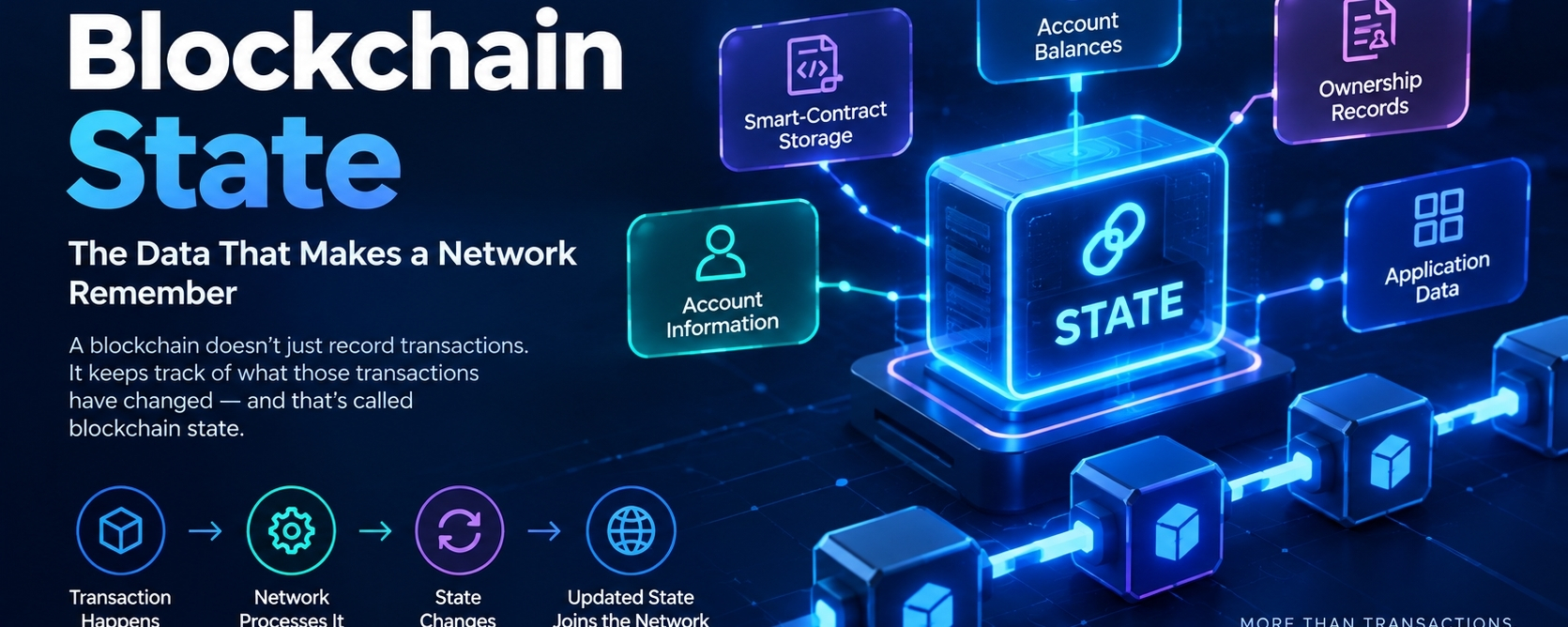
Estado do Blockchain: Os Dados que Fazem uma Rede se LembrarUma blockchain não apenas registra transações. Ela também precisa acompanhar o que essas transações alteraram.
Essa condição contínua é chamada de estado da blockchain.
Pense nisso como um registro continuamente atualizado:
📦 Uma transação acontece →
⚙️ A rede o processa →
🔄 O estado muda →
🌐 O estado atualizado passa a fazer parte da visão atual da rede.
🔍 O que “Estado” Pode Representar?
Dependendo da blockchain, o estado pode incluir coisas como:
🔹 Saldos da conta
🔹 Armazenamento de contratos inteligentes
Estado do Blockchain: Os Dados que Fazem uma Rede se Lembrar
Uma blockchain não apenas registra transações. Ela também precisa acompanhar o que essas transações alteraram.
Essa condição contínua é chamada de estado da blockchain.
Pense nisso como um registro continuamente atualizado:
📦 Uma transação acontece →
⚙️ A rede o processa →
🔄 O estado muda →
🌐 O estado atualizado passa a fazer parte da visão atual da rede.
🔍 O que “Estado” Pode Representar?
Dependendo da blockchain, o estado pode incluir coisas como:
🔹 Saldos da conta
🔹 Armazenamento de contratos inteligentes
Essa condição contínua é chamada de estado da blockchain.
Pense nisso como um registro continuamente atualizado:
📦 Uma transação acontece →
⚙️ A rede o processa →
🔄 O estado muda →
🌐 O estado atualizado passa a fazer parte da visão atual da rede.
🔍 O que “Estado” Pode Representar?
Dependendo da blockchain, o estado pode incluir coisas como:
🔹 Saldos da conta
🔹 Armazenamento de contratos inteligentes
2
Inicia sessão para explorar mais conteúdos
Junta-te a utilizadores de criptomoedas de todo o mundo na Binance Square
⚡️ Obtém informações úteis e recentes sobre criptomoedas.
💬 Com a confiança da maior exchange de criptomoedas do mundo.
👍 Descobre perspetivas reais de criadores verificados.
E-mail/Número de telefone
Tópicos em Tendência
BOJRaisesRatesTo31YearHigh
91,446 visualizações
1,427 a discutir
#bojraisesratesto31yearhigh
🇯🇵 BOJ Aumenta as Taxas. Então Por que o Iene CAIU?
Imagine contrair um empréstimo em uma moeda cujo banco central acabou de aumentar as taxas…
…e ainda assim essa moeda continua enfraquecendo. 😂
No dia 18 de setembro, o BOJ aumentou as taxas em 25 pontos-base para 1,25%, o maior nível em 31 anos.
O voto? 7–2.
Mas USD/JPY disparou, chegando a 158,05, enquanto traders questionavam o quão agressivos serão os próximos aumentos.
MAS AQUI ESTÁ O QUE MUITA GENTE NÃO PERCEBE 👀
O mercado não estava apenas negociando o aumento.
Estava precificando o “gap” de orientação.
A alta de 25 pontos-base era amplamente esperada. O que importava era se o governador do BOJ, Ueda, indicaria um caminho claro para mais aperto.
Ele não se comprometeu com um ritmo pré-determinado.
Enquanto isso, o diferencial de juros entre EUA e Japão continua amplo o suficiente para manter viva a história do carry trade: o financiamento com ienes baratos ainda consegue competir com ativos de maior rendimento em outros lugares.
E então veio a reviravolta do mercado cripto:
BTC reagiu e subiu ~5,9% para perto de US$ 81 mil após a decisão do BOJ.
Então:
Aperto do BOJ ≠ venda automática de cripto.
Mas existe outro risco.
Se USD/JPY continuar subindo, as preocupações com intervenção podem se intensificar. Se o iene fortalecer de repente, posições de carry “lotadas” podem ser desfeitas rapidamente.
🧠 Insight do Square:
Os mercados não negociam apenas o aumento da taxa. Eles negociam a diferença entre o que foi esperado e o que foi entregue.
Você acha que o próximo movimento do BOJ vai, enfim, quebrar o carry trade?
Comentário de mercado apenas. Não é aconselhamento financeiro.
#BOJ #JapaneseYen #CarryTrade
$BTC
TuilaNamKy
·5 gostos
·6k visualizações
BuffettStepsDownAsBerkshireChairman
41,789 visualizações
668 a discutir
XRPExchangeReservesHitSevenYearLow
47,134 visualizações
637 a discutir