Binance Square
saadan453
18 Publicações

saadan453

2 A seguir
7 Seguidores
13 Gostaram
Publicações
·
--
Ver tradução
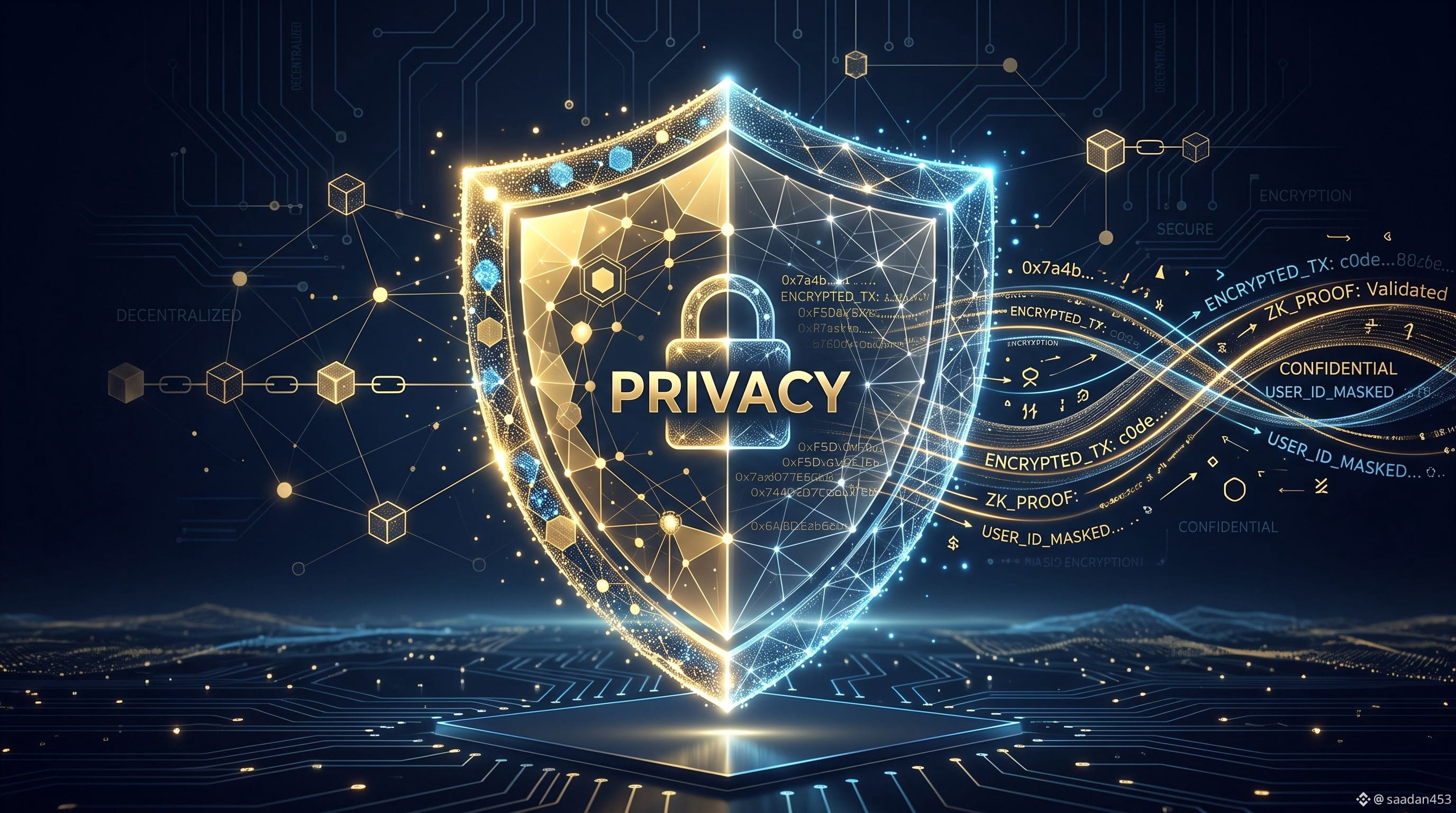
#dusk $DUSK @Dusk_Foundation #dusk $DUSK @Dusk Most "compliant" chains fake privacy by just hiding data off-chain — which means it's not really on-chain settlement anymore. That defeats the whole point for regulated finance. Dusk solves this differently with its Phoenix transaction model. Instead of choosing between "fully public" or "fully hidden," Phoenix lets a single transaction carry both a private note and an optional disclosure key: Transactions settle with zero-knowledge proofs, so validity is checked without exposing amounts or parties Obfuscated notes keep balances private by default on-chain, not off it A viewing key can be selectively shared with regulators or auditors, without exposing the transaction to the public This means the same transaction can be private to the public and transparent to an authorized auditor — auditability without surveillance. That's the actual unlock for tokenized securities: privacy that doesn't break the audit trail. @Dusk_Foundation #dusk
#dusk $DUSK @Dusk #dusk $DUSK @Dusk Most "compliant" chains fake privacy by just hiding data off-chain — which means it's not really on-chain settlement anymore. That defeats the whole point for regulated finance.
Dusk solves this differently with its Phoenix transaction model. Instead of choosing between "fully public" or "fully hidden," Phoenix lets a single transaction carry both a private note and an optional disclosure key:
Transactions settle with zero-knowledge proofs, so validity is checked without exposing amounts or parties
Obfuscated notes keep balances private by default on-chain, not off it
A viewing key can be selectively shared with regulators or auditors, without exposing the transaction to the public
This means the same transaction can be private to the public and transparent to an authorized auditor — auditability without surveillance.
That's the actual unlock for tokenized securities: privacy that doesn't break the audit trail. @Dusk #dusk
Ver tradução
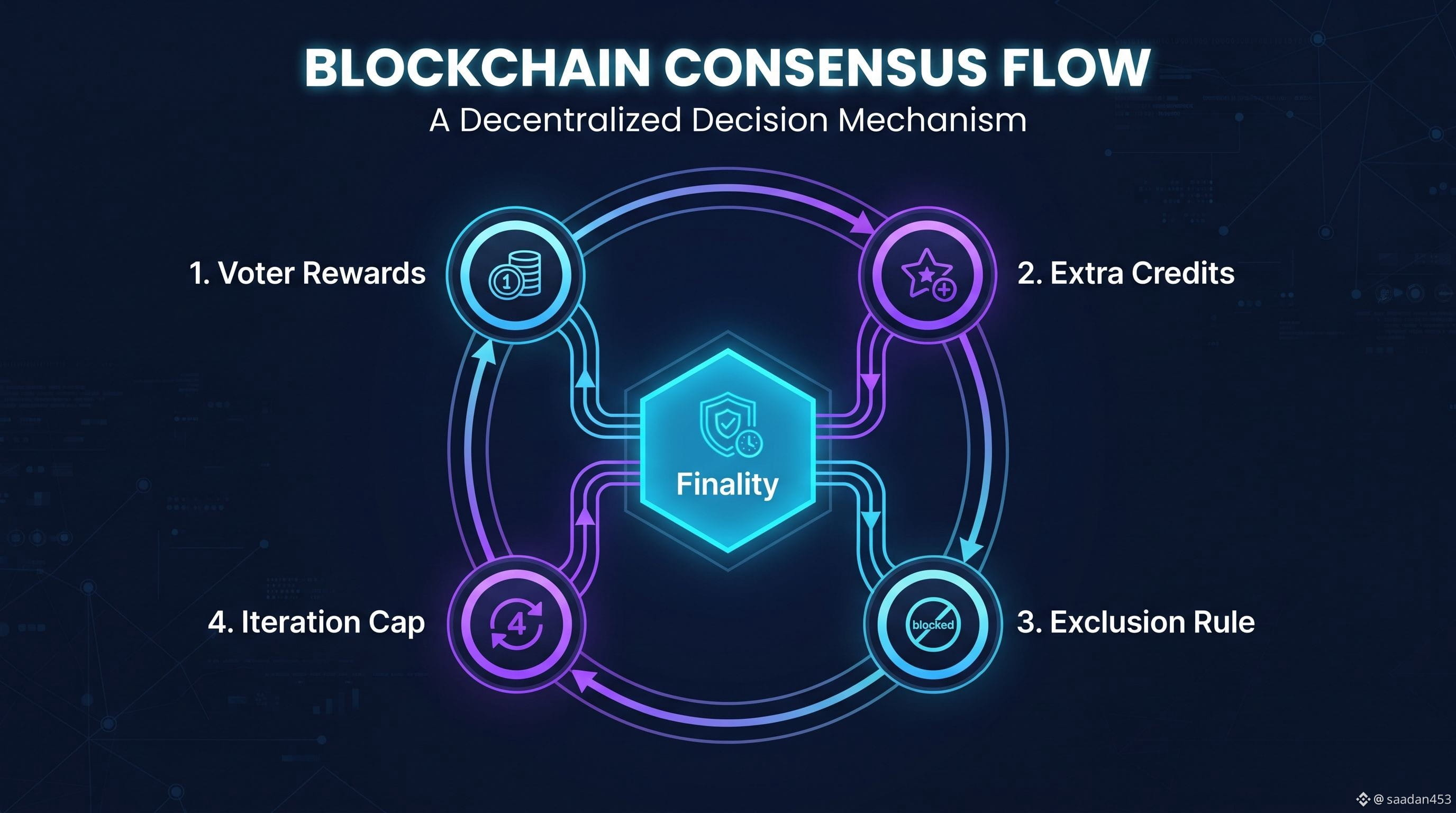
#dusk $DUSK @Dusk_Foundation Most PoS chains never solve this: why would a future block generator vote honestly if letting earlier iterations fail hands them the reward? That's the "future-generator incentive problem" in @Dusk's Succinct Attestation consensus. Since block generators for every iteration in a round are known in advance, a higher-iteration generator is tempted to just... not vote, hoping earlier candidates fail so they win the block reward instead. $DUSK's fix is elegant — four layered mechanisms: Voter rewards make voting itself profitable, not just generating The generator's bonus (10% of reward) is tied to including as many votes as possible The next iteration's generator is banned from voting in the current one — killing the "sit out and wait" incentive Max iterations per round is capped (currently 50) so there's less to gain from stalling Combine that with rolling finality (blocks go accepted → attested → confirmed → final based on successor votes) and Dusk gets sub-second block times without sacrificing decentralization — critical for a chain built for regulated finance. This is the kind of incentive-design detail that separates "another L1" from infrastructure built to actually run securities on-chain. #dusk
#dusk $DUSK @Dusk Most PoS chains never solve this: why would a future block generator vote honestly if letting earlier iterations fail hands them the reward?
That's the "future-generator incentive problem" in @Dusk's Succinct Attestation consensus. Since block generators for every iteration in a round are known in advance, a higher-iteration generator is tempted to just... not vote, hoping earlier candidates fail so they win the block reward instead.
$DUSK 's fix is elegant — four layered mechanisms:
Voter rewards make voting itself profitable, not just generating
The generator's bonus (10% of reward) is tied to including as many votes as possible
The next iteration's generator is banned from voting in the current one — killing the "sit out and wait" incentive
Max iterations per round is capped (currently 50) so there's less to gain from stalling
Combine that with rolling finality (blocks go accepted → attested → confirmed → final based on successor votes) and Dusk gets sub-second block times without sacrificing decentralization — critical for a chain built for regulated finance.
This is the kind of incentive-design detail that separates "another L1" from infrastructure built to actually run securities on-chain.
#dusk
Artigo
TermMax: Trazendo Rendimento com Taxa Fixa e Previsível para o DeFi O Problema: O DeFi Nunca Foi Feito para CertaPergunte a qualquer pessoa que já tenha emprestado ou tomado empréstimo em Aave, Compound ou um protocolo similar de mercado monetário qual taxa ela estará ganhando ou pagando em três meses, e a resposta honesta é: ninguém sabe. As taxas de juros nessas plataformas mudam de forma algorítmica de acordo com oferta e demanda dentro do pool. Deposite hoje com 6% de APY e, na próxima semana, esse número pode ser 3% ou 12%, dependendo inteiramente de quanto capital entra ou sai. Para usuários casuais de DeFi que buscam rendimento de curto prazo, essa volatilidade é apenas um ruído de fundo. Mas para qualquer pessoa tentando planejar o DeFi do mesmo jeito que planeja um título, um depósito a prazo ou um produto de renda fixa, isso é um impeditivo. Tomadores de empréstimo não conseguem orçar um empréstimo quando o custo dos juros pode dobrar da noite para o dia. Credores não conseguem comprometer capital por meses sem o risco de uma queda na taxa destruir seus retornos. Instituições — o tipo de capital que o DeFi vem tentando atrair há anos — geralmente não mexem em um produto em que o retorno não é conhecido com antecedência.

TermMax: Trazendo Rendimento com Taxa Fixa e Previsível para o DeFi O Problema: O DeFi Nunca Foi Feito para Certa

Pergunte a qualquer pessoa que já tenha emprestado ou tomado empréstimo em Aave, Compound ou um protocolo similar de mercado monetário qual taxa ela estará ganhando ou pagando em três meses, e a resposta honesta é: ninguém sabe. As taxas de juros nessas plataformas mudam de forma algorítmica de acordo com oferta e demanda dentro do pool. Deposite hoje com 6% de APY e, na próxima semana, esse número pode ser 3% ou 12%, dependendo inteiramente de quanto capital entra ou sai.
Para usuários casuais de DeFi que buscam rendimento de curto prazo, essa volatilidade é apenas um ruído de fundo. Mas para qualquer pessoa tentando planejar o DeFi do mesmo jeito que planeja um título, um depósito a prazo ou um produto de renda fixa, isso é um impeditivo. Tomadores de empréstimo não conseguem orçar um empréstimo quando o custo dos juros pode dobrar da noite para o dia. Credores não conseguem comprometer capital por meses sem o risco de uma queda na taxa destruir seus retornos. Instituições — o tipo de capital que o DeFi vem tentando atrair há anos — geralmente não mexem em um produto em que o retorno não é conhecido com antecedência.
Ver tradução
#termmax @termmax #TermMax @TermMax Most lending protocols don't tell you your real yield until you're already in the position — rates float with utilization, so what you see on day 1 isn't what you get at exit. TermMax handles this differently with a 3-token setup: FT works like a zero-coupon bond (fixed yield, locked at deposit), XT keeps the system's interest obligations balanced, and GT is the collateral/leverage token. Deposit, and you already know your exact return at maturity — no guessing based on pool utilization swings. The part I love the most about it is rates aren't set by an algorithm here. "Curators" actively price fixed-term loans using Range Orders — similar to how a bond desk quotes bid/ask spreads across maturities, instead of a formula reacting to supply/demand after the fact. That's a meaningfully different trust model from Aave or Compound. They've also rolled out liquidation-free leverage on BNB Chain for Alpha tokens — you pay a premium upfront instead of facing margin calls mid-trade. Still watching how that holds up as volume grows, but it's a real attempt at removing forced-liquidation risk rather than just delaying it.
#termmax @TermMax #TermMax @TermMax Most lending protocols don't tell you your real yield until you're already in the position — rates float with utilization, so what you see on day 1 isn't what you get at exit.
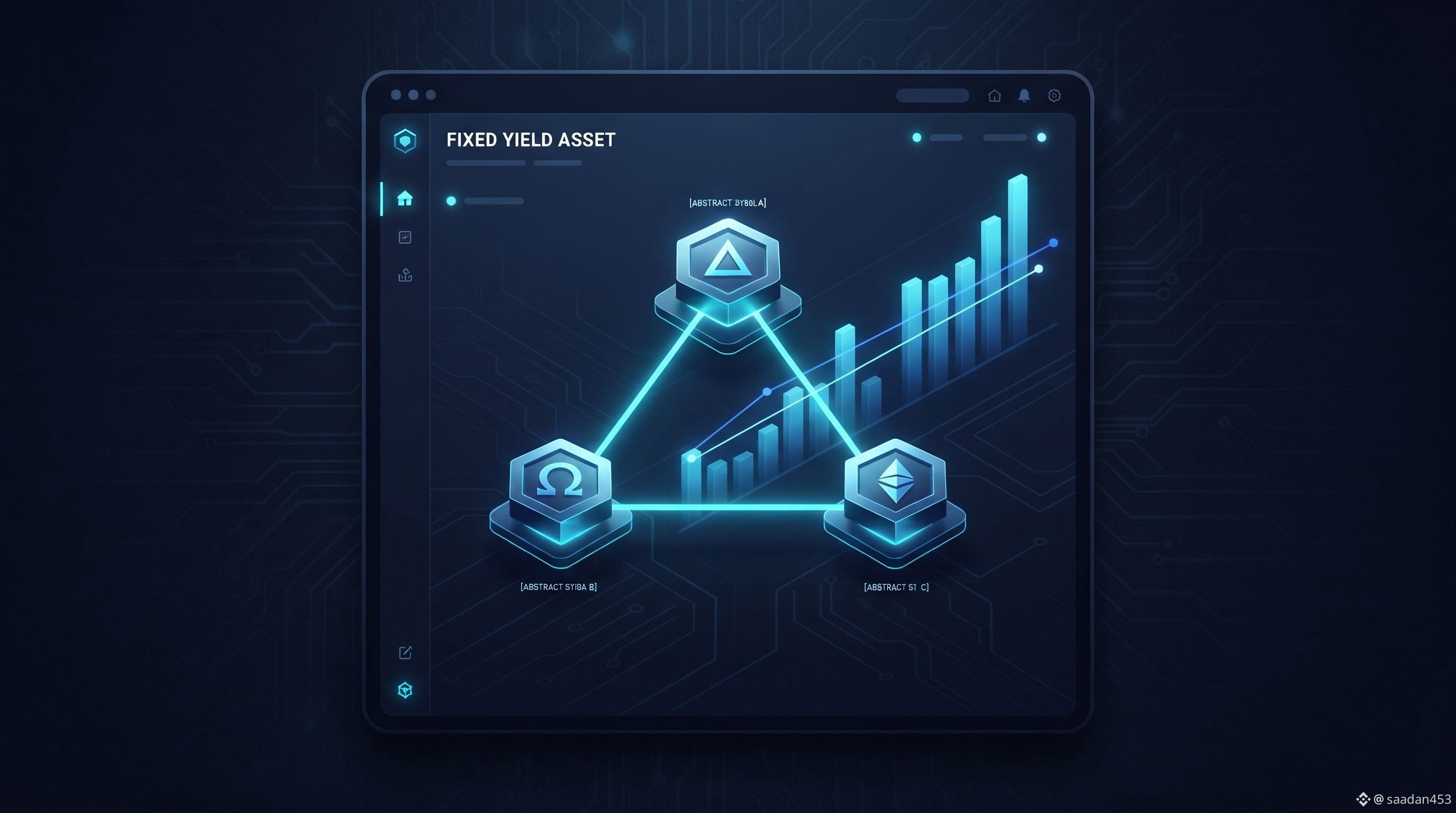
TermMax handles this differently with a 3-token setup: FT works like a zero-coupon bond (fixed yield, locked at deposit), XT keeps the system's interest obligations balanced, and GT is the collateral/leverage token. Deposit, and you already know your exact return at maturity — no guessing based on pool utilization swings.
The part I love the most about it is rates aren't set by an algorithm here. "Curators" actively price fixed-term loans using Range Orders — similar to how a bond desk quotes bid/ask spreads across maturities, instead of a formula reacting to supply/demand after the fact. That's a meaningfully different trust model from Aave or Compound.
They've also rolled out liquidation-free leverage on BNB Chain for Alpha tokens — you pay a premium upfront instead of facing margin calls mid-trade. Still watching how that holds up as volume grows, but it's a real attempt at removing forced-liquidation risk rather than just delaying it.
Artigo
Ver tradução
Dusk: Building a Privacy-First Blockchain for Regulated Finance Why Traditional Finance Has StruggleFor over a decade, public blockchains have promised to remake how value moves through the global economy. Yet financial institutions have remained cautious adopters, and the reason comes down to a structural tension that most networks have never fully resolved: the same transparency that makes a blockchain trustworthy also makes it unusable for regulated finance. Every balance, every transfer, every counterparty relationship sits in the open, visible to competitors, counterparties, and anyone else who cares to look. Platforms like Ethereum and Bitcoin were never designed with this problem in mind, and while layered solutions such as zk-rollups have emerged to patch the gap, they remain additions bolted onto networks whose core design assumes full visibility. On the other side of the spectrum, privacy-oriented chains such as Zcash and Monero solved the visibility problem using tools like zk-SNARKs and ring signatures, hiding senders, receivers, and amounts effectively. But this came at a cost that regulated institutions can't accept: those systems weren't built with auditability or compliance workflows in mind, and they generally lack the smart contract infrastructure that modern financial products require. Dusk is a Layer 1 blockchain built specifically to close this gap. Rather than treating privacy and compliance as opposing goals, Dusk's architecture is designed so that regulators and auditors can access the information they legitimately need, while the general public and unauthorized parties cannot see sensitive transaction details. This philosophy runs through every major component of the network: its peer-to-peer layer, its consensus mechanism, and its dual approach to handling transactions. The Network Layer: Kadcast Every blockchain needs an efficient way to get blocks, transactions, and votes to every participant quickly and reliably. Dusk handles this using Kadcast, a peer-to-peer protocol built on the foundations of the Kademlia distributed hash table. Rather than having nodes blast messages out to every neighbor — the approach used by traditional gossip-based networks — Kadcast organizes the network into a structured, tree-like arrangement based on the XOR distance between node identifiers. When a node needs to relay information, it doesn't flood its neighbors indiscriminately. Instead, it forwards the message to selected peers at progressively increasing distances, creating a cascading, multicast-style distribution pattern that covers the whole network while dramatically cutting down on redundant transmissions. This matters for two practical reasons. First, it reduces the bandwidth burden on the network, which becomes increasingly important as transaction volume scales toward the levels financial markets require. Second, because messages propagate through intermediate relays rather than direct connections, it becomes much harder for an outside observer to trace a message back to its true point of origin — a privacy benefit baked directly into the transport layer, before any cryptography around the transactions themselves even comes into play. Kadcast also inherits Kademlia's resilience properties. Because routing tables are continuously updated as peers join, leave, or go offline, and because multiple redundant paths exist within each routing bucket, the network can route around failures without needing centralized coordination. Combined with signature verification on relayed messages — which guards against Sybil-style disruption — Kadcast gives Dusk a communication backbone suited to a financial-grade network that needs to keep working even when parts of it are unreliable. Consensus: Succinct Attestation At the heart of Dusk sits its consensus protocol, Succinct Attestation (SA) — a permissionless, proof-of-stake mechanism built around committees of network participants called provisioners. A provisioner is simply a user who has locked up at least 1,000 DUSK as stake; once that stake matures (a process tied to the network's 2,160-block epoch cycle), the provisioner becomes eligible to be selected for block production and voting duties. Selection happens through a process called deterministic sortition, which is worth pausing on because it's one of the more elegant pieces of the design. Rather than relying on a lottery that needs coordination between nodes, sortition uses a deterministically generated pseudorandom score — built from the previous block's seed, the round and step numbers, and other inputs — to walk through the list of eligible provisioners and assign them "credits" in proportion to their stake. The more a provisioner has staked, the more often they appear in committees, but the process is fully reproducible: any node can independently verify who was selected without needing to trust a third party. Each round of consensus moves through iterations, and each iteration has three phases: Proposal — A single provisioner, chosen via sortition, is responsible for assembling and broadcasting a candidate block. Validation — A separately-selected committee checks the candidate against the current chain tip and votes on its validity. A quorum requires either a two-thirds supermajority voting the block valid, or a bare majority rejecting it. Ratification — Yet another committee confirms the outcome of the validation step, again requiring a supermajority to finalize a result. If a candidate clears both the validation and ratification stages with a "Success" outcome, it's accepted onto the chain immediately, and the round ends. If not, the process simply tries again with a new iteration — up to a capped number of attempts (currently 50) per round. This structure is what allows Dusk to claim transaction finality within seconds, a critical requirement for markets accustomed to near-instant settlement expectations. Handling the Edge Cases Real networks don't always behave ideally, and Dusk's protocol has mechanisms for the uncomfortable scenarios. If enough consecutive iterations fail — suggesting many provisioners are offline or unreachable — the network shifts into an emergency mode, where timeouts are lifted and iterations simply run until a block is produced, with forks resolved in favor of the lowest iteration number. In the extreme case where even this fails, provisioners holding a majority of stake can request the creation of a special empty emergency block to keep the chain moving. Because Dusk's asynchronous network can occasionally produce competing candidate blocks in the same round, the protocol also includes a fallback mechanism that allows the chain to revert to a lower-iteration block if one later reaches consensus — and a rolling finality system that gradually upgrades a block's status from "accepted" to "attested" to "confirmed" and ultimately "final" as more of the network builds on top of it and confirms it wasn't part of a discarded fork. Keeping Provisioners Honest A subtle design challenge in any committee-based system with predictable future generators is that later-iteration provisioners could be tempted to let earlier iterations fail on purpose, hoping to win the block reward themselves. Dusk counters this with a layered incentive structure: voters are rewarded for participating in validation and ratification (giving them a reliable payoff rather than gambling on a future generator slot), block generators earn a larger share of the reward when they include more of the network's votes, and the provisioner in line to generate the next iteration's block is deliberately excluded from voting on the current one, removing their motive to sandbag the process. Reward distribution itself is straightforward: 80% of a block's reward (newly minted DUSK plus fees) goes to the block generator, 10% to the voting committee, and 10% to the Dusk treasury. Misbehavior is punished through suspension (temporary removal from sortition eligibility) and slashing, with "soft" slashing for minor lapses like failing to broadcast a block, and "hard" slashing — which burns a portion of stake — reserved for serious violations such as double voting or broadcasting conflicting candidate blocks. Two Ways to Transact: Moonlight and Phoenix Perhaps the most distinctive design decision in Dusk is that it doesn't force every user into a single transaction model. Instead, it offers two, both governed by the same underlying transfer contract, and both required to satisfy the same core guarantees: proof of ownership over the funds being spent, sufficient balance to cover the transfer and fees, prevention of double-spending, and protection against a transaction being tampered with after it's created. Moonlight is the transparent option — an account-based model similar in spirit to Ethereum. Each account is tied to a public/private key pair, transactions carry a nonce to prevent replay, and ownership is proven with a straightforward digital signature. Because account balances are public, the network can verify sufficient funds directly, without needing any cryptographic trickery. This makes Moonlight simple, auditable by default, and well suited to use cases where transparency is actually desirable — for instance, publicly reporting institutional treasury movements. Phoenix, by contrast, is a UTXO-based model — conceptually closer to Bitcoin, but enhanced with privacy techniques drawn from Zcash and CryptoNote. Instead of open account balances, Phoenix works with "notes": encrypted representations of value that live in a Merkle tree. Only the intended recipient, using their view key, can recognize that a note belongs to them and decrypt its contents; only the holder of the full secret key can actually spend it. When a note is spent, the owner generates a nullifier — a value that proves a note has been consumed without revealing which note in the entire tree it was. Everything about the legitimacy of a Phoenix transaction — that funds weren't double-spent, that the amounts balance, that the sender genuinely owned what they're spending — is proven through a zero-knowledge proof rather than by exposing the underlying data. Notably, Phoenix also supports a "transparent" mode alongside its obfuscated one, giving users flexibility depending on the compliance needs of a given transaction. The practical effect of running these two models side by side is that Dusk can serve very different participants in the same ecosystem: institutions that need to demonstrate transparency to regulators can use Moonlight, while transactions requiring confidentiality — say, a securities trade where competitors shouldn't see position sizes — can use Phoenix, all while both remain subject to the same network-level rules around fees, gas, and validity. Regulatory Compliance Without Sacrificing Privacy: Zedger Layered on top of the core transaction models is Zedger, a protocol purpose-built for issuing and managing securities and other real-world assets on Dusk. Zedger contracts support the operational lifecycle of financial instruments — minting, burning, corporate actions such as dividend distributions, and forced transfers that an issuer might need to execute for compliance reasons — all while preserving confidentiality for ordinary participants and enabling auditability where regulation requires it. This is arguably where Dusk's core thesis becomes most concrete: a securities token can be privacy-preserving for the market at large while still remaining auditable to the parties legally entitled to that visibility. Designed With Energy Efficiency in Mind Beyond privacy and compliance, Dusk's architecture reflects an explicit effort to minimize environmental impact, which matters increasingly to institutional adopters facing their own sustainability mandates. The proof-of-stake foundation of the SA protocol avoids the energy-intensive computational puzzles associated with proof-of-work systems entirely, echoing the dramatic efficiency gains seen when Ethereum made its own transition away from mining. Deterministic sortition adds to this by selecting participants without any computational race, and rolling finality reduces the number of consensus iterations that need to run to lock in a block, cutting down on redundant network activity. The Kadcast communication layer contributes its own efficiency gains, reportedly cutting bandwidth usage substantially compared to unstructured gossip protocols and reducing the rate of stale, ultimately-discarded blocks in fast-block-time networks — meaning less wasted computation on blocks that never make it into the canonical chain. Finally, at the smart contract execution layer, Dusk's virtual machine offloads computationally expensive cryptographic operations — hashing, zero-knowledge proof verification, signature checks — to native host functions rather than running them inside a sandboxed WebAssembly environment, avoiding the substantial performance overhead that virtualized execution otherwise imposes on this class of workload. Under the Hood: Piecrust and the Genesis Contracts Dusk's smart contract platform, Piecrust, is a WebAssembly-based virtual machine written in Rust, built around two components: the core VM itself, and a companion toolkit, piecrust-uplink, that developers use to write, test, and deploy contracts. Its design emphasizes modularity, aiming to let the network evolve and add capabilities over time without disruptive overhauls, while its integration with Dusk's native cryptographic host functions keeps contract execution both fast and secure. At genesis, the network deploys a handful of foundational contracts. The transfer contract serves as the entry point for essentially all DUSK movement and gas handling, validating transactions according to whichever model — Moonlight or Phoenix — a user has chosen. The stake contract manages the entire lifecycle of becoming and remaining a provisioner: locking tokens, validating stake amounts against the network minimum, and processing unstaking requests once a lock period ends. Alongside these sit the Zedger contracts for securities issuance, and a Citadel license contract, which governs the issuance and validation of licenses used to gate certain privileged actions on the network — an identity and permissioning layer that complements the transaction-level privacy guarantees elsewhere in the system. Where This Leaves Dusk Taken as a whole, Dusk's design reads less like a single breakthrough and more like a coordinated set of choices, each aimed at removing one of the specific reasons institutional finance has stayed on the sidelines of public blockchains. Fast, deterministic finality through Succinct Attestation addresses the throughput expectations of financial markets. Kadcast keeps the network efficient and resistant to the bandwidth and traceability weaknesses of older gossip protocols. The Moonlight/Phoenix duality lets the same base layer serve both fully transparent and confidentiality-sensitive use cases without forcing a tradeoff. And Zedger extends that logic into the specific mechanics of regulated securities. Whether this combination proves durable in practice will depend on adoption, real-world audits of the cryptography, and how regulators actually respond to a chain built explicitly around their needs — but as a piece of protocol design, Dusk represents one of the more deliberate attempts yet to build a blockchain where privacy and compliance aren't treated as opposites.

Dusk: Building a Privacy-First Blockchain for Regulated Finance Why Traditional Finance Has Struggle

For over a decade, public blockchains have promised to remake how value moves through the global economy. Yet financial institutions have remained cautious adopters, and the reason comes down to a structural tension that most networks have never fully resolved: the same transparency that makes a blockchain trustworthy also makes it unusable for regulated finance. Every balance, every transfer, every counterparty relationship sits in the open, visible to competitors, counterparties, and anyone else who cares to look. Platforms like Ethereum and Bitcoin were never designed with this problem in mind, and while layered solutions such as zk-rollups have emerged to patch the gap, they remain additions bolted onto networks whose core design assumes full visibility.
On the other side of the spectrum, privacy-oriented chains such as Zcash and Monero solved the visibility problem using tools like zk-SNARKs and ring signatures, hiding senders, receivers, and amounts effectively. But this came at a cost that regulated institutions can't accept: those systems weren't built with auditability or compliance workflows in mind, and they generally lack the smart contract infrastructure that modern financial products require.
Dusk is a Layer 1 blockchain built specifically to close this gap. Rather than treating privacy and compliance as opposing goals, Dusk's architecture is designed so that regulators and auditors can access the information they legitimately need, while the general public and unauthorized parties cannot see sensitive transaction details. This philosophy runs through every major component of the network: its peer-to-peer layer, its consensus mechanism, and its dual approach to handling transactions.
The Network Layer: Kadcast
Every blockchain needs an efficient way to get blocks, transactions, and votes to every participant quickly and reliably. Dusk handles this using Kadcast, a peer-to-peer protocol built on the foundations of the Kademlia distributed hash table. Rather than having nodes blast messages out to every neighbor — the approach used by traditional gossip-based networks — Kadcast organizes the network into a structured, tree-like arrangement based on the XOR distance between node identifiers.
When a node needs to relay information, it doesn't flood its neighbors indiscriminately. Instead, it forwards the message to selected peers at progressively increasing distances, creating a cascading, multicast-style distribution pattern that covers the whole network while dramatically cutting down on redundant transmissions. This matters for two practical reasons. First, it reduces the bandwidth burden on the network, which becomes increasingly important as transaction volume scales toward the levels financial markets require. Second, because messages propagate through intermediate relays rather than direct connections, it becomes much harder for an outside observer to trace a message back to its true point of origin — a privacy benefit baked directly into the transport layer, before any cryptography around the transactions themselves even comes into play.
Kadcast also inherits Kademlia's resilience properties. Because routing tables are continuously updated as peers join, leave, or go offline, and because multiple redundant paths exist within each routing bucket, the network can route around failures without needing centralized coordination. Combined with signature verification on relayed messages — which guards against Sybil-style disruption — Kadcast gives Dusk a communication backbone suited to a financial-grade network that needs to keep working even when parts of it are unreliable.
Consensus: Succinct Attestation
At the heart of Dusk sits its consensus protocol, Succinct Attestation (SA) — a permissionless, proof-of-stake mechanism built around committees of network participants called provisioners. A provisioner is simply a user who has locked up at least 1,000 DUSK as stake; once that stake matures (a process tied to the network's 2,160-block epoch cycle), the provisioner becomes eligible to be selected for block production and voting duties.
Selection happens through a process called deterministic sortition, which is worth pausing on because it's one of the more elegant pieces of the design. Rather than relying on a lottery that needs coordination between nodes, sortition uses a deterministically generated pseudorandom score — built from the previous block's seed, the round and step numbers, and other inputs — to walk through the list of eligible provisioners and assign them "credits" in proportion to their stake. The more a provisioner has staked, the more often they appear in committees, but the process is fully reproducible: any node can independently verify who was selected without needing to trust a third party.
Each round of consensus moves through iterations, and each iteration has three phases:
Proposal — A single provisioner, chosen via sortition, is responsible for assembling and broadcasting a candidate block.
Validation — A separately-selected committee checks the candidate against the current chain tip and votes on its validity. A quorum requires either a two-thirds supermajority voting the block valid, or a bare majority rejecting it.
Ratification — Yet another committee confirms the outcome of the validation step, again requiring a supermajority to finalize a result.
If a candidate clears both the validation and ratification stages with a "Success" outcome, it's accepted onto the chain immediately, and the round ends. If not, the process simply tries again with a new iteration — up to a capped number of attempts (currently 50) per round. This structure is what allows Dusk to claim transaction finality within seconds, a critical requirement for markets accustomed to near-instant settlement expectations.
Handling the Edge Cases
Real networks don't always behave ideally, and Dusk's protocol has mechanisms for the uncomfortable scenarios. If enough consecutive iterations fail — suggesting many provisioners are offline or unreachable — the network shifts into an emergency mode, where timeouts are lifted and iterations simply run until a block is produced, with forks resolved in favor of the lowest iteration number. In the extreme case where even this fails, provisioners holding a majority of stake can request the creation of a special empty emergency block to keep the chain moving.
Because Dusk's asynchronous network can occasionally produce competing candidate blocks in the same round, the protocol also includes a fallback mechanism that allows the chain to revert to a lower-iteration block if one later reaches consensus — and a rolling finality system that gradually upgrades a block's status from "accepted" to "attested" to "confirmed" and ultimately "final" as more of the network builds on top of it and confirms it wasn't part of a discarded fork.
Keeping Provisioners Honest
A subtle design challenge in any committee-based system with predictable future generators is that later-iteration provisioners could be tempted to let earlier iterations fail on purpose, hoping to win the block reward themselves. Dusk counters this with a layered incentive structure: voters are rewarded for participating in validation and ratification (giving them a reliable payoff rather than gambling on a future generator slot), block generators earn a larger share of the reward when they include more of the network's votes, and the provisioner in line to generate the next iteration's block is deliberately excluded from voting on the current one, removing their motive to sandbag the process.
Reward distribution itself is straightforward: 80% of a block's reward (newly minted DUSK plus fees) goes to the block generator, 10% to the voting committee, and 10% to the Dusk treasury. Misbehavior is punished through suspension (temporary removal from sortition eligibility) and slashing, with "soft" slashing for minor lapses like failing to broadcast a block, and "hard" slashing — which burns a portion of stake — reserved for serious violations such as double voting or broadcasting conflicting candidate blocks.
Two Ways to Transact: Moonlight and Phoenix
Perhaps the most distinctive design decision in Dusk is that it doesn't force every user into a single transaction model. Instead, it offers two, both governed by the same underlying transfer contract, and both required to satisfy the same core guarantees: proof of ownership over the funds being spent, sufficient balance to cover the transfer and fees, prevention of double-spending, and protection against a transaction being tampered with after it's created.
Moonlight is the transparent option — an account-based model similar in spirit to Ethereum. Each account is tied to a public/private key pair, transactions carry a nonce to prevent replay, and ownership is proven with a straightforward digital signature. Because account balances are public, the network can verify sufficient funds directly, without needing any cryptographic trickery. This makes Moonlight simple, auditable by default, and well suited to use cases where transparency is actually desirable — for instance, publicly reporting institutional treasury movements.
Phoenix, by contrast, is a UTXO-based model — conceptually closer to Bitcoin, but enhanced with privacy techniques drawn from Zcash and CryptoNote. Instead of open account balances, Phoenix works with "notes": encrypted representations of value that live in a Merkle tree. Only the intended recipient, using their view key, can recognize that a note belongs to them and decrypt its contents; only the holder of the full secret key can actually spend it. When a note is spent, the owner generates a nullifier — a value that proves a note has been consumed without revealing which note in the entire tree it was. Everything about the legitimacy of a Phoenix transaction — that funds weren't double-spent, that the amounts balance, that the sender genuinely owned what they're spending — is proven through a zero-knowledge proof rather than by exposing the underlying data. Notably, Phoenix also supports a "transparent" mode alongside its obfuscated one, giving users flexibility depending on the compliance needs of a given transaction.
The practical effect of running these two models side by side is that Dusk can serve very different participants in the same ecosystem: institutions that need to demonstrate transparency to regulators can use Moonlight, while transactions requiring confidentiality — say, a securities trade where competitors shouldn't see position sizes — can use Phoenix, all while both remain subject to the same network-level rules around fees, gas, and validity.
Regulatory Compliance Without Sacrificing Privacy: Zedger
Layered on top of the core transaction models is Zedger, a protocol purpose-built for issuing and managing securities and other real-world assets on Dusk. Zedger contracts support the operational lifecycle of financial instruments — minting, burning, corporate actions such as dividend distributions, and forced transfers that an issuer might need to execute for compliance reasons — all while preserving confidentiality for ordinary participants and enabling auditability where regulation requires it. This is arguably where Dusk's core thesis becomes most concrete: a securities token can be privacy-preserving for the market at large while still remaining auditable to the parties legally entitled to that visibility.
Designed With Energy Efficiency in Mind
Beyond privacy and compliance, Dusk's architecture reflects an explicit effort to minimize environmental impact, which matters increasingly to institutional adopters facing their own sustainability mandates. The proof-of-stake foundation of the SA protocol avoids the energy-intensive computational puzzles associated with proof-of-work systems entirely, echoing the dramatic efficiency gains seen when Ethereum made its own transition away from mining. Deterministic sortition adds to this by selecting participants without any computational race, and rolling finality reduces the number of consensus iterations that need to run to lock in a block, cutting down on redundant network activity.
The Kadcast communication layer contributes its own efficiency gains, reportedly cutting bandwidth usage substantially compared to unstructured gossip protocols and reducing the rate of stale, ultimately-discarded blocks in fast-block-time networks — meaning less wasted computation on blocks that never make it into the canonical chain. Finally, at the smart contract execution layer, Dusk's virtual machine offloads computationally expensive cryptographic operations — hashing, zero-knowledge proof verification, signature checks — to native host functions rather than running them inside a sandboxed WebAssembly environment, avoiding the substantial performance overhead that virtualized execution otherwise imposes on this class of workload.
Under the Hood: Piecrust and the Genesis Contracts
Dusk's smart contract platform, Piecrust, is a WebAssembly-based virtual machine written in Rust, built around two components: the core VM itself, and a companion toolkit, piecrust-uplink, that developers use to write, test, and deploy contracts. Its design emphasizes modularity, aiming to let the network evolve and add capabilities over time without disruptive overhauls, while its integration with Dusk's native cryptographic host functions keeps contract execution both fast and secure.
At genesis, the network deploys a handful of foundational contracts. The transfer contract serves as the entry point for essentially all DUSK movement and gas handling, validating transactions according to whichever model — Moonlight or Phoenix — a user has chosen. The stake contract manages the entire lifecycle of becoming and remaining a provisioner: locking tokens, validating stake amounts against the network minimum, and processing unstaking requests once a lock period ends. Alongside these sit the Zedger contracts for securities issuance, and a Citadel license contract, which governs the issuance and validation of licenses used to gate certain privileged actions on the network — an identity and permissioning layer that complements the transaction-level privacy guarantees elsewhere in the system.
Where This Leaves Dusk
Taken as a whole, Dusk's design reads less like a single breakthrough and more like a coordinated set of choices, each aimed at removing one of the specific reasons institutional finance has stayed on the sidelines of public blockchains. Fast, deterministic finality through Succinct Attestation addresses the throughput expectations of financial markets. Kadcast keeps the network efficient and resistant to the bandwidth and traceability weaknesses of older gossip protocols. The Moonlight/Phoenix duality lets the same base layer serve both fully transparent and confidentiality-sensitive use cases without forcing a tradeoff. And Zedger extends that logic into the specific mechanics of regulated securities.
Whether this combination proves durable in practice will depend on adoption, real-world audits of the cryptography, and how regulators actually respond to a chain built explicitly around their needs — but as a piece of protocol design, Dusk represents one of the more deliberate attempts yet to build a blockchain where privacy and compliance aren't treated as opposites.
Ver tradução
#dusk $DUSK @Dusk_Foundation What if privacy becomes a core feature of Web3 instead of an afterthought? That’s where @Dusk stands out. With its focus on privacy, compliance, and scalable blockchain infrastructure, Dusk is building toward a future where real-world financial applications can operate on-chain without sacrificing confidentiality. $DUSK #dusk
#dusk $DUSK @Dusk What if privacy becomes a core feature of Web3 instead of an afterthought? That’s where @Dusk stands out. With its focus on privacy, compliance, and scalable blockchain infrastructure, Dusk is building toward a future where real-world financial applications can operate on-chain without sacrificing confidentiality. $DUSK #dusk
Ver tradução
#dusk $DUSK @Dusk_Foundation Most "privacy chains" force you to choose: hide everything or comply with nothing. @Dusk solves this differently. Its Succinct Attestation consensus finalizes blocks in seconds through a 3-step process (Proposal → Validation → Ratification), while its Phoenix transaction model uses ZK proofs so regulators can audit what they need without exposing everyone's data. Add Moonlight for transparent transfers, Kadcast for efficient P2P propagation, and Zedger for compliant security tokens — $DUSK isn't chasing privacy for its own sake, it's building the rail traditional finance actually needs. #dusk @Dusk_Foundation
#dusk $DUSK @Dusk Most "privacy chains" force you to choose: hide everything or comply with nothing. @Dusk solves this differently. Its Succinct Attestation consensus finalizes blocks in seconds through a 3-step process (Proposal → Validation → Ratification), while its Phoenix transaction model uses ZK proofs so regulators can audit what they need without exposing everyone's data. Add Moonlight for transparent transfers, Kadcast for efficient P2P propagation, and Zedger for compliant security tokens — $DUSK isn't chasing privacy for its own sake, it's building the rail traditional finance actually needs. #dusk @Dusk
Ver tradução
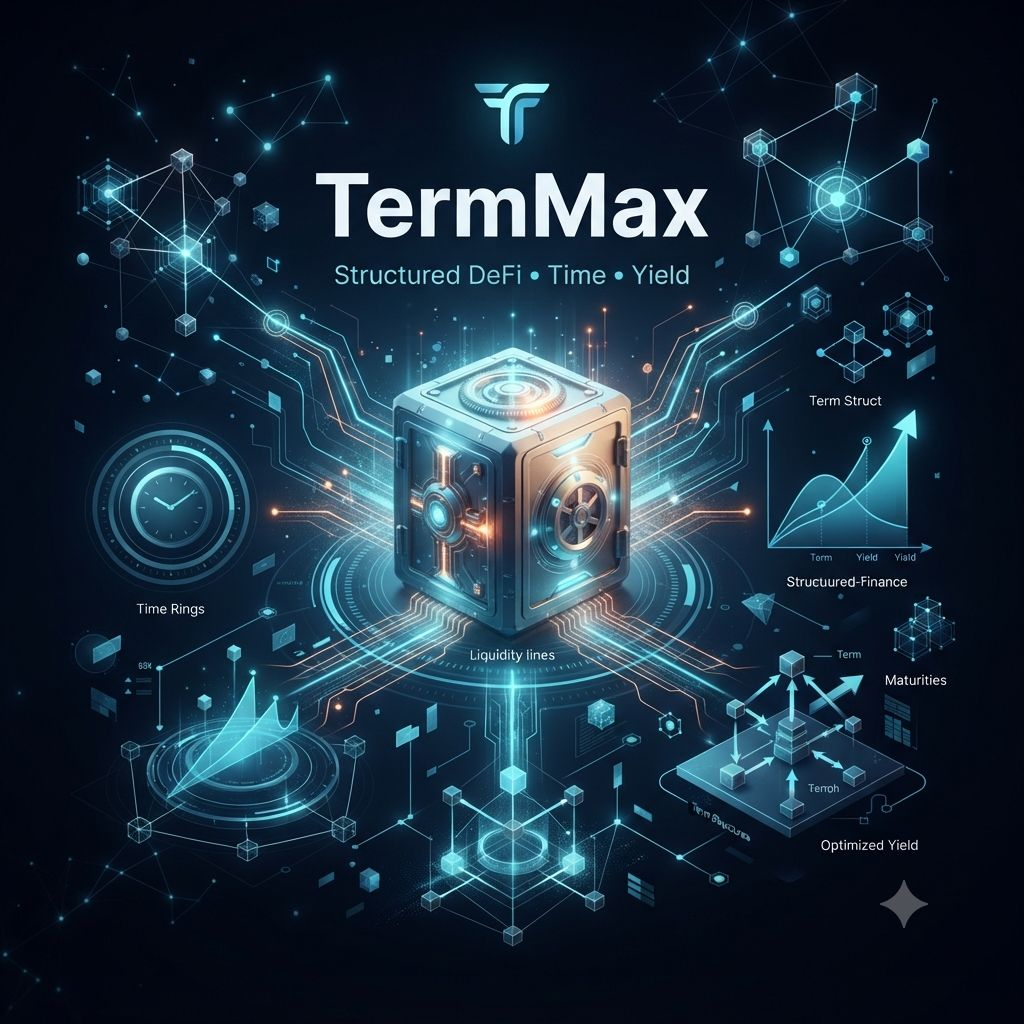
#termmax @termmax Why I’m watching TermMax more closely 👀 DeFi becomes much more interesting when users can think beyond simple spot trading. @TermMax is building around structured, fixed-term financial products, creating a different way to approach yield and risk management in crypto. What stands out to me is the focus on making time-based strategies more accessible on-chain rather than treating DeFi as only short-term speculation. The next phase of DeFi may be less about chasing every pump and more about having better tools to manage capital with a clear strategy. That’s the angle I’ll be watching from @termmax TermMax. #TermMax
#termmax @TermMax Why I’m watching TermMax more closely 👀

DeFi becomes much more interesting when users can think beyond simple spot trading. @TermMax is building around structured, fixed-term financial products, creating a different way to approach yield and risk management in crypto. What stands out to me is the focus on making time-based strategies more accessible on-chain rather than treating DeFi as only short-term speculation.

The next phase of DeFi may be less about chasing every pump and more about having better tools to manage capital with a clear strategy. That’s the angle I’ll be watching from @TermMax TermMax. #TermMax
Ver tradução
#dusk $DUSK @Dusk_Foundation Privacy and compliance don’t have to work against each other. That’s what makes Dusk interesting to watch: it aims to bring privacy-preserving technology together with the requirements of regulated financial markets. As blockchain adoption moves toward real-world assets and institutional use, solutions that can balance confidentiality, transparency, and compliance could become increasingly important. @Dusk $DUSK #dusk
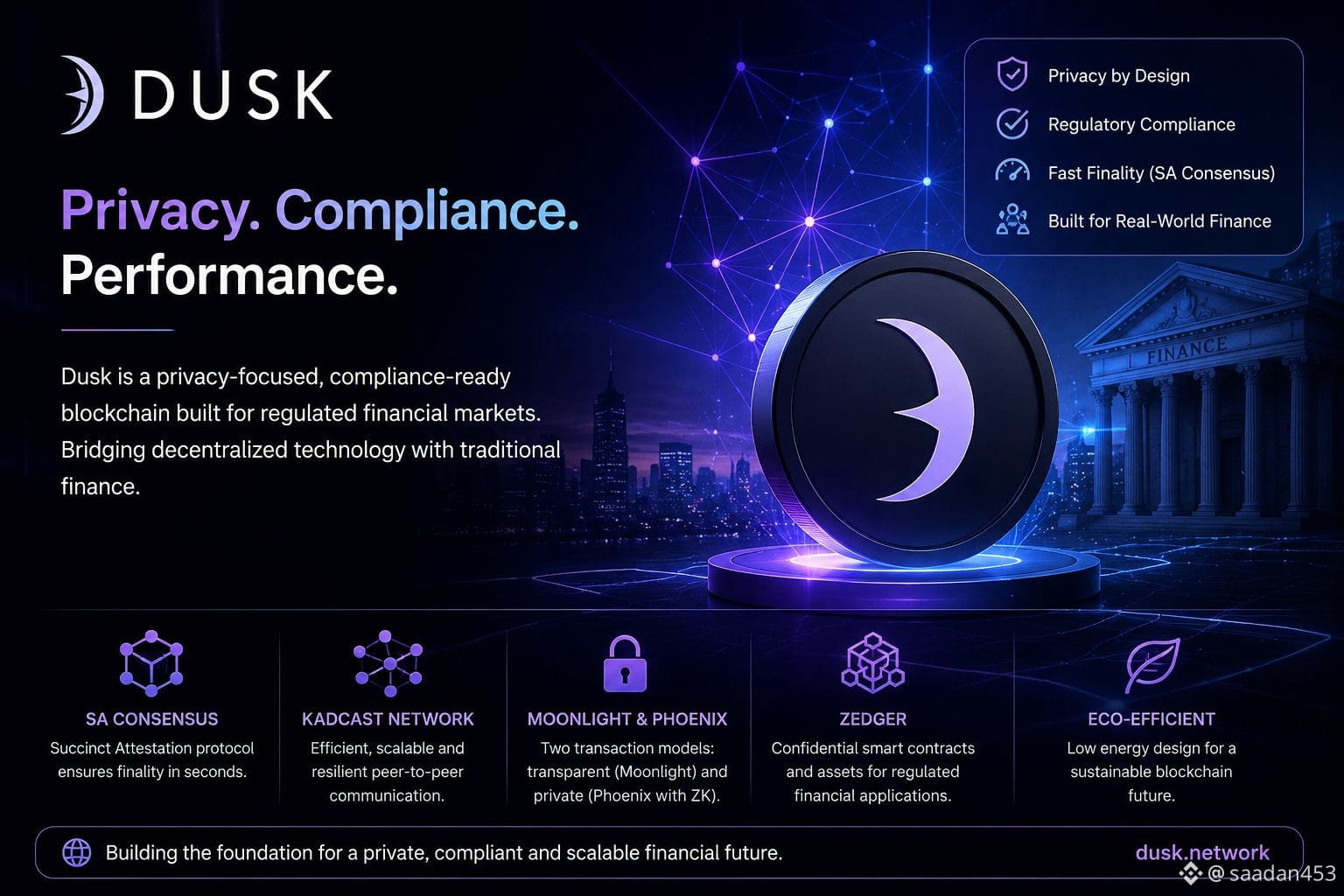
#dusk $DUSK @Dusk Privacy and compliance don’t have to work against each other. That’s what makes Dusk interesting to watch: it aims to bring privacy-preserving technology together with the requirements of regulated financial markets. As blockchain adoption moves toward real-world assets and institutional use, solutions that can balance confidentiality, transparency, and compliance could become increasingly important. @Dusk $DUSK #dusk
#termmax @termmax TermMax está construindo uma direção DeFi interessante em torno de produtos financeiros estruturados on-chain, com foco em tornar estratégias avançadas mais acessíveis por meio de uma infraestrutura transparente de blockchain. Estou acompanhando como @termmax TermMax desenvolve seu ecossistema e a experiência do usuário à medida que o projeto evolui. #TermMax
#termmax @TermMax TermMax está construindo uma direção DeFi interessante em torno de produtos financeiros estruturados on-chain, com foco em tornar estratégias avançadas mais acessíveis por meio de uma infraestrutura transparente de blockchain. Estou acompanhando como @TermMax TermMax desenvolve seu ecossistema e a experiência do usuário à medida que o projeto evolui. #TermMax
#dusk $DUSK @Dusk_Foundation 🚀 A Dusk está construindo o futuro das finanças em conformidade. O que torna @Dusk_Foundation Dusk interessante é o seu foco em trazer privacidade, conformidade e mercados financeiros do mundo real para a cadeia—sem tratar esses objetivos como opostos. À medida que a adoção institucional de blockchain cresce, a infraestrutura que possa dar suporte a ativos regulados preservando a privacidade pode se tornar cada vez mais importante. Estou de olho em $DUSK e no ecossistema da Dusk. 👀 O que você acha—será que a Dusk poderia se tornar uma grande camada para a adoção de RWA institucionais? 🔥 #dusk
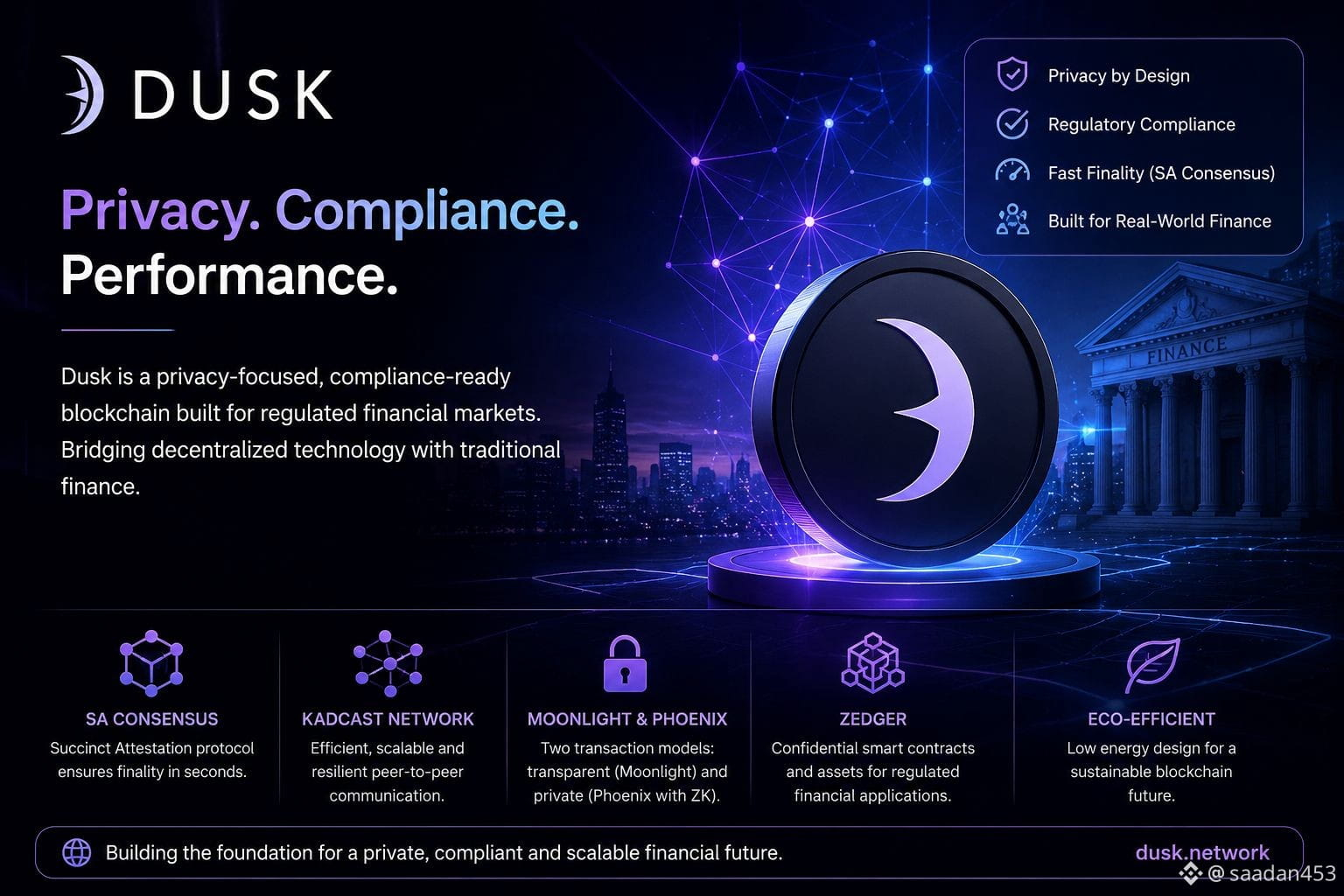
#dusk $DUSK @Dusk 🚀 A Dusk está construindo o futuro das finanças em conformidade.

O que torna @Dusk Dusk interessante é o seu foco em trazer privacidade, conformidade e mercados financeiros do mundo real para a cadeia—sem tratar esses objetivos como opostos. À medida que a adoção institucional de blockchain cresce, a infraestrutura que possa dar suporte a ativos regulados preservando a privacidade pode se tornar cada vez mais importante.

Estou de olho em $DUSK e no ecossistema da Dusk. 👀

O que você acha—será que a Dusk poderia se tornar uma grande camada para a adoção de RWA institucionais? 🔥

#dusk
#termmax @termmax TermMax está construindo uma abordagem interessante para mercados on-chain de prazo fixo, oferecendo aos usuários formas mais estruturadas de pensar sobre rendimento, maturidade e risco. Vou observar como o protocolo se desenvolve e como seu ecossistema cresce. @TermMax #TermMaxBooster
#termmax @TermMax TermMax está construindo uma abordagem interessante para mercados on-chain de prazo fixo, oferecendo aos usuários formas mais estruturadas de pensar sobre rendimento, maturidade e risco. Vou observar como o protocolo se desenvolve e como seu ecossistema cresce. @TermMax #TermMaxBooster
#dusk $DUSK 🚨 E se o blockchain não precisasse escolher entre PRIVACIDADE e CONFORMIDADE? Essa é a ideia por trás da @Dusk. A Dusk é projetada para mercados financeiros regulados, combinando transações com foco em privacidade com infraestrutura construída em torno de conformidade e escalabilidade. Sua arquitetura inclui consenso SA, Kadcast, Moonlight & Phoenix e Zedger. � Dusk_Whitepaper_2024_4db72f92a1.pdf O que torna isso interessante para mim é o modelo Phoenix, que usa tecnologia de conhecimento zero para viabilizar transações privadas, enquanto o design mais amplo da Dusk busca permanecer adequado para finanças reguladas. � 💭 Pergunta para a comunidade: Você preferiria usar um blockchain com 🔓 Máxima transparência ou 🔐 Privacidade + conformidade regulatória? Comente sua escolha: TRANSPARÊNCIA ou PRIVACIDADE 👇 $DUSK #dusk @Dusk_Foundation
#dusk $DUSK 🚨 E se o blockchain não precisasse escolher entre PRIVACIDADE e CONFORMIDADE?
Essa é a ideia por trás da @Dusk.
A Dusk é projetada para mercados financeiros regulados, combinando transações com foco em privacidade com infraestrutura construída em torno de conformidade e escalabilidade. Sua arquitetura inclui consenso SA, Kadcast, Moonlight & Phoenix e Zedger. �
Dusk_Whitepaper_2024_4db72f92a1.pdf
O que torna isso interessante para mim é o modelo Phoenix, que usa tecnologia de conhecimento zero para viabilizar transações privadas, enquanto o design mais amplo da Dusk busca permanecer adequado para finanças reguladas. �
💭 Pergunta para a comunidade:
Você preferiria usar um blockchain com
🔓 Máxima transparência
ou
🔐 Privacidade + conformidade regulatória?
Comente sua escolha: TRANSPARÊNCIA ou PRIVACIDADE 👇
$DUSK #dusk @Dusk
#termmax 🚀 Explorando o TermMax — um protocolo descentralizado de empréstimos e empréstimos a taxa fixa e negociação de opções. Os usuários podem emprestar e tomar emprestados ativos cripto enquanto negociam opções, com o TMX fornecendo governança e utilidade para o ecossistema. @termmax TermMax #TermMax $TMX
#termmax 🚀 Explorando o TermMax — um protocolo descentralizado de empréstimos e empréstimos a taxa fixa e negociação de opções. Os usuários podem emprestar e tomar emprestados ativos cripto enquanto negociam opções, com o TMX fornecendo governança e utilidade para o ecossistema. @TermMax TermMax #TermMax $TMX
Verificado
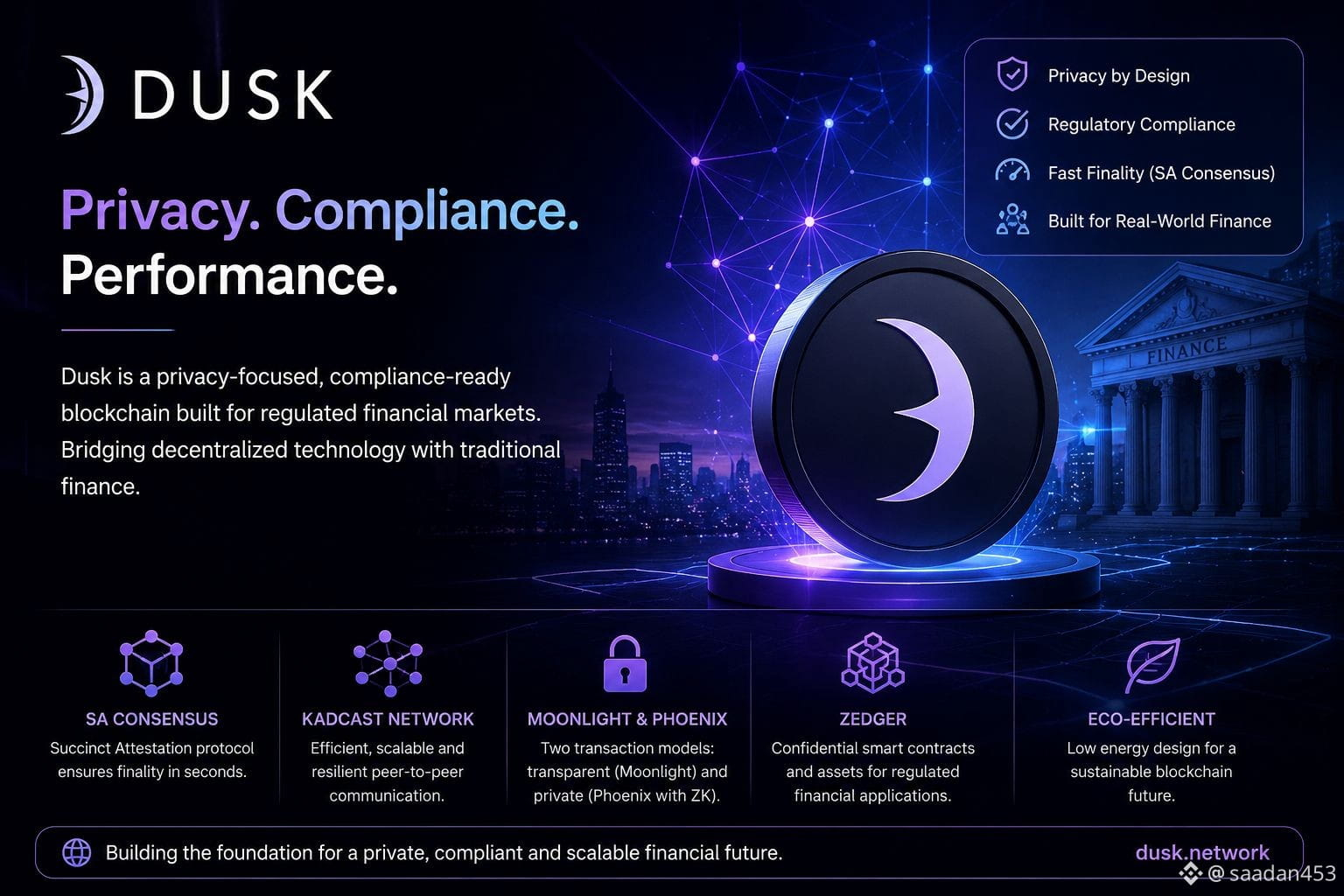
#dusk $DUSK O Crepúsculo está adotando uma abordagem diferente para a infraestrutura de blockchain. @Dusk é projetado para mercados financeiros regulamentados, com o objetivo de combinar privacidade, conformidade e escalabilidade em vez de tratá-las como problemas separados. O consenso de Atestação Sucinta (SA) é construído para finalização rápida, enquanto o Kadcast oferece comunicação eficiente ponto a ponto. A rede também usa Moonlight para transações transparentes e Phoenix para transações focadas em privacidade usando provas de zero conhecimento. Além disso, o Zedger foi projetado para aplicações financeiras confidenciais e ativos do mundo real. $DUSK #dusk O que mais me interessa é a ideia de unir privacidade em blockchain e requisitos regulatórios, em vez de escolher um em detrimento do outro. A arquitetura técnica faz com que o Dusk valha a pena ser acompanhado à medida que a infraestrutura de blockchain continua se aproximando de casos de uso financeiros do mundo real. @Dusk_Foundation
#dusk $DUSK O Crepúsculo está adotando uma abordagem diferente para a infraestrutura de blockchain. @Dusk é projetado para mercados financeiros regulamentados, com o objetivo de combinar privacidade, conformidade e escalabilidade em vez de tratá-las como problemas separados. O consenso de Atestação Sucinta (SA) é construído para finalização rápida, enquanto o Kadcast oferece comunicação eficiente ponto a ponto. A rede também usa Moonlight para transações transparentes e Phoenix para transações focadas em privacidade usando provas de zero conhecimento. Além disso, o Zedger foi projetado para aplicações financeiras confidenciais e ativos do mundo real. $DUSK #dusk

O que mais me interessa é a ideia de unir privacidade em blockchain e requisitos regulatórios, em vez de escolher um em detrimento do outro. A arquitetura técnica faz com que o Dusk valha a pena ser acompanhado à medida que a infraestrutura de blockchain continua se aproximando de casos de uso financeiros do mundo real. @Dusk
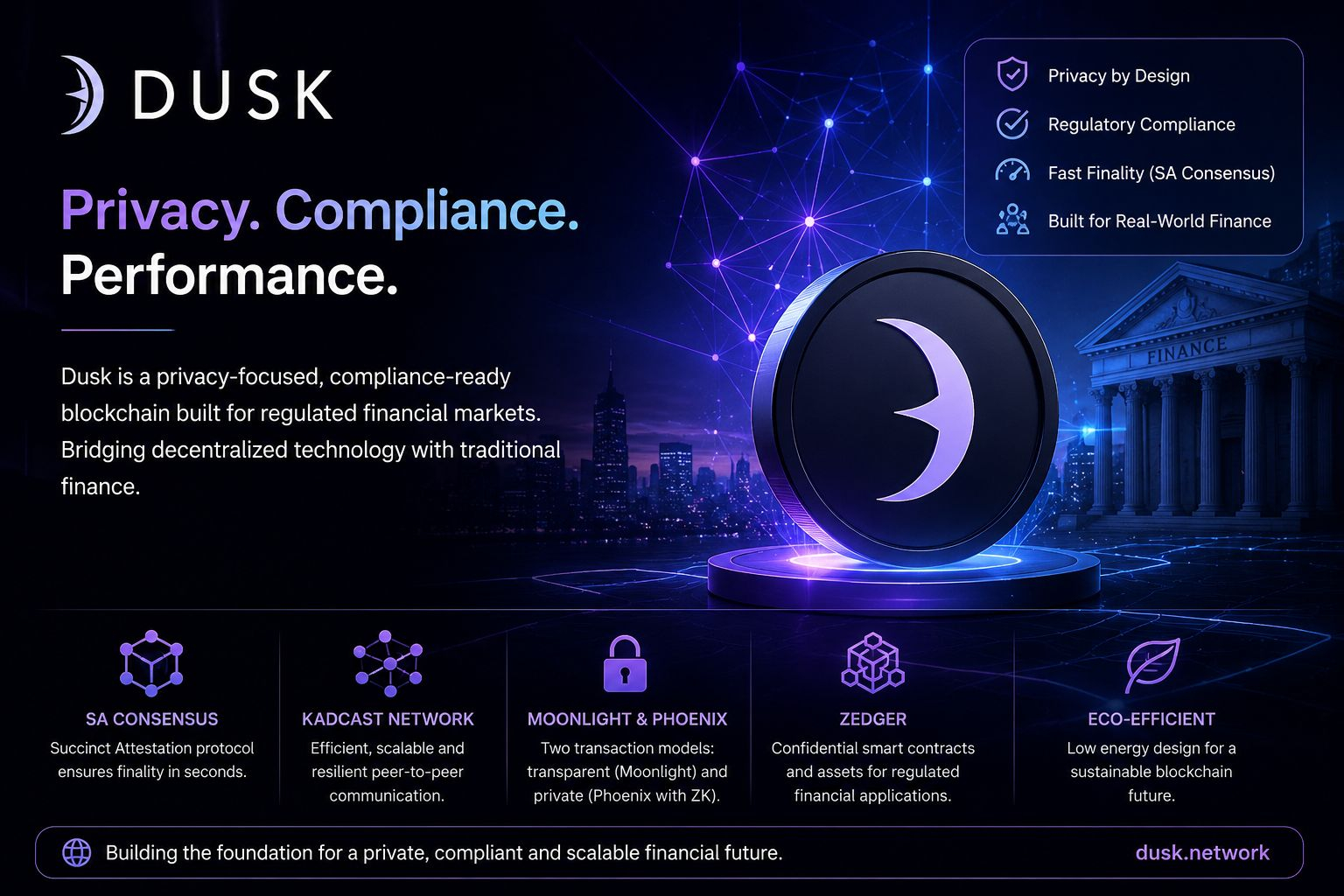
#dusk $DUSK O Dusk está adotando uma abordagem diferente para a infraestrutura de blockchain. O @Dusk foi projetado para mercados financeiros regulamentados, com o objetivo de combinar privacidade, conformidade e escalabilidade em vez de tratá-las como problemas separados. O seu consenso de Atestação Sucinta (SA) foi construído para uma finalização rápida, enquanto o Kadcast fornece comunicação eficiente ponto a ponto. A rede também usa Moonlight para transações transparentes e Phoenix para transações com foco em privacidade usando provas de zero-knowledge. Além disso, o Zedger foi projetado para aplicações financeiras confidenciais e ativos do mundo real. $DUSK #dusk O que mais me interessa é a ideia de unir privacidade em blockchain e requisitos regulatórios em vez de escolher um em detrimento do outro. A arquitetura técnica torna o Dusk algo a se observar enquanto a infraestrutura de blockchain continua avançando em direção a casos de uso financeiros do mundo real.
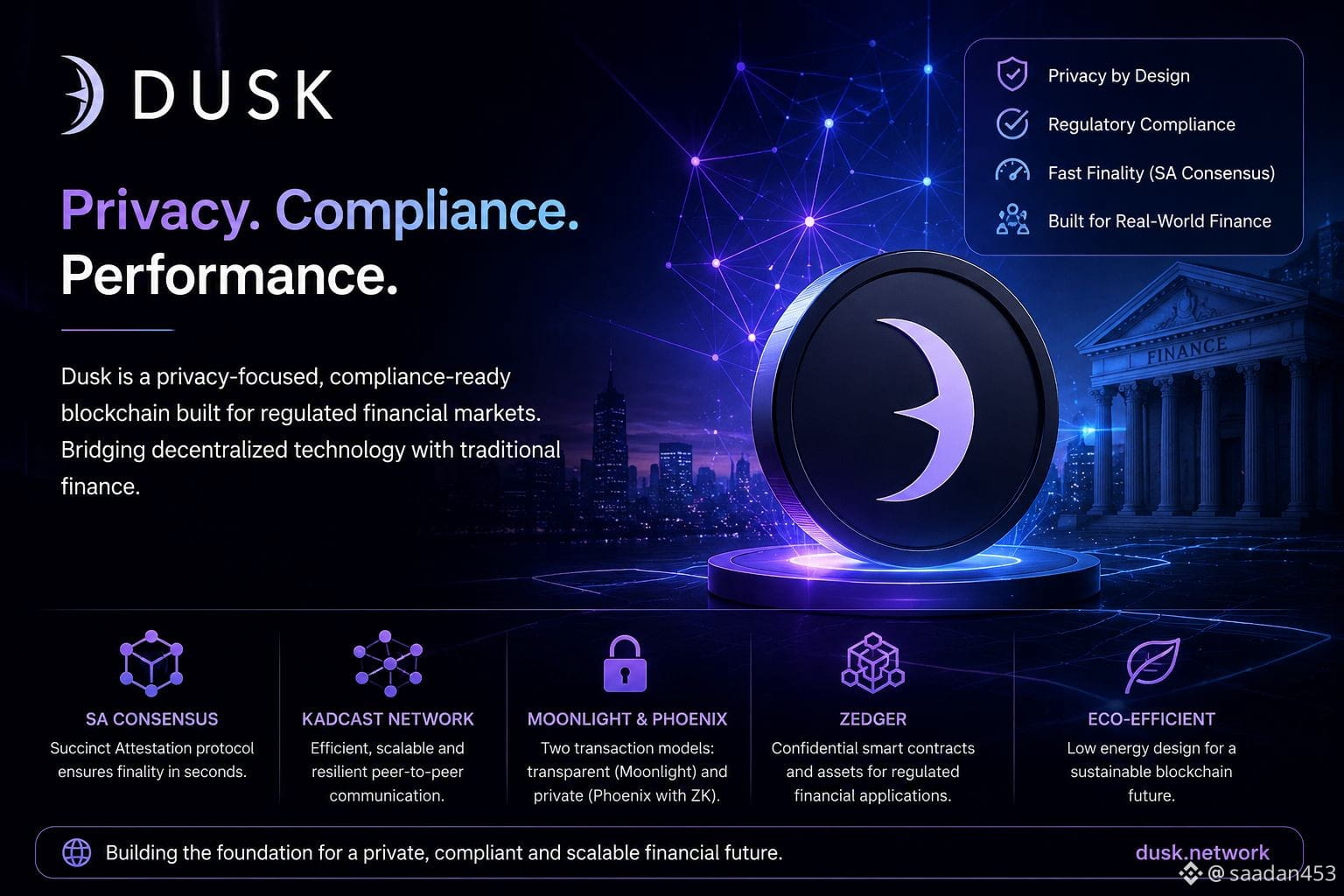
#dusk $DUSK O Dusk está adotando uma abordagem diferente para a infraestrutura de blockchain. O @Dusk foi projetado para mercados financeiros regulamentados, com o objetivo de combinar privacidade, conformidade e escalabilidade em vez de tratá-las como problemas separados. O seu consenso de Atestação Sucinta (SA) foi construído para uma finalização rápida, enquanto o Kadcast fornece comunicação eficiente ponto a ponto. A rede também usa Moonlight para transações transparentes e Phoenix para transações com foco em privacidade usando provas de zero-knowledge. Além disso, o Zedger foi projetado para aplicações financeiras confidenciais e ativos do mundo real. $DUSK #dusk

O que mais me interessa é a ideia de unir privacidade em blockchain e requisitos regulatórios em vez de escolher um em detrimento do outro. A arquitetura técnica torna o Dusk algo a se observar enquanto a infraestrutura de blockchain continua avançando em direção a casos de uso financeiros do mundo real.
·
--
Em Alta
Ver tradução
🚀 *Hey Pakistan Crypto Fam!* 🇵🇰 Binance Square is buzzing! 🌟 Join the conversation on: 🔹 Latest crypto trends 📈 🔹 New listings & opportunities 🚀 🔹 Market insights & analysis 📊 Connect with fellow traders and enthusiasts! 💬 Share your thoughts, ask questions, and level up your crypto game! 😊$ 👉 Join Binance Square now and be part of the crypto movement! 🌎 #2025withBinance
🚀 *Hey Pakistan Crypto Fam!* 🇵🇰 Binance Square is buzzing! 🌟 Join the conversation on:
🔹 Latest crypto trends 📈
🔹 New listings & opportunities 🚀
🔹 Market insights & analysis 📊

Connect with fellow traders and enthusiasts! 💬 Share your thoughts, ask questions, and level up your crypto game! 😊$

👉 Join Binance Square now and be part of the crypto movement! 🌎
#2025withBinance
Ver tradução
BNB to the moon 🥂

BNB to the moon 🥂
saadi6464
·
--
"Prepare-se para levar sua negociação para o próximo nível! 💰📈 A BNBATH está cheia de oportunidades. Mantenha-se à frente do que está por vir e tome decisões informadas com atualizações em tempo real do mercado. 💻📊 Se você é um trader experiente ou está apenas começando, nossa comunidade está aqui para apoiar você em cada etapa do caminho. 🤝 Compartilhe suas percepções de trading, aprenda com os outros e faça seu portfólio crescer. 📈💸 Participe da conversa e vamos navegar juntos pelo mercado cripto! #BNBATH $BNB #Binance
Inicia sessão para explorar mais conteúdos
Junta-te a utilizadores de criptomoedas de todo o mundo na Binance Square
⚡️ Obtém informações úteis e recentes sobre criptomoedas.
💬 Com a confiança da maior exchange de criptomoedas do mundo.
👍 Descobre perspetivas reais de criadores verificados.
E-mail/Número de telefone
Mapa do sítio
Preferências de cookies
Termos e Condições da Plataforma