
Sahil_crypto1
297 Publicações

Sahil_crypto1
Denunciar
Bloquear Utilizador
Aberto ao trading
Trader Frequente
1.9 ano(s)
24 A seguir
121 Seguidores
455 Gostaram
Publicações
Portfólio
Tudo
Em direto
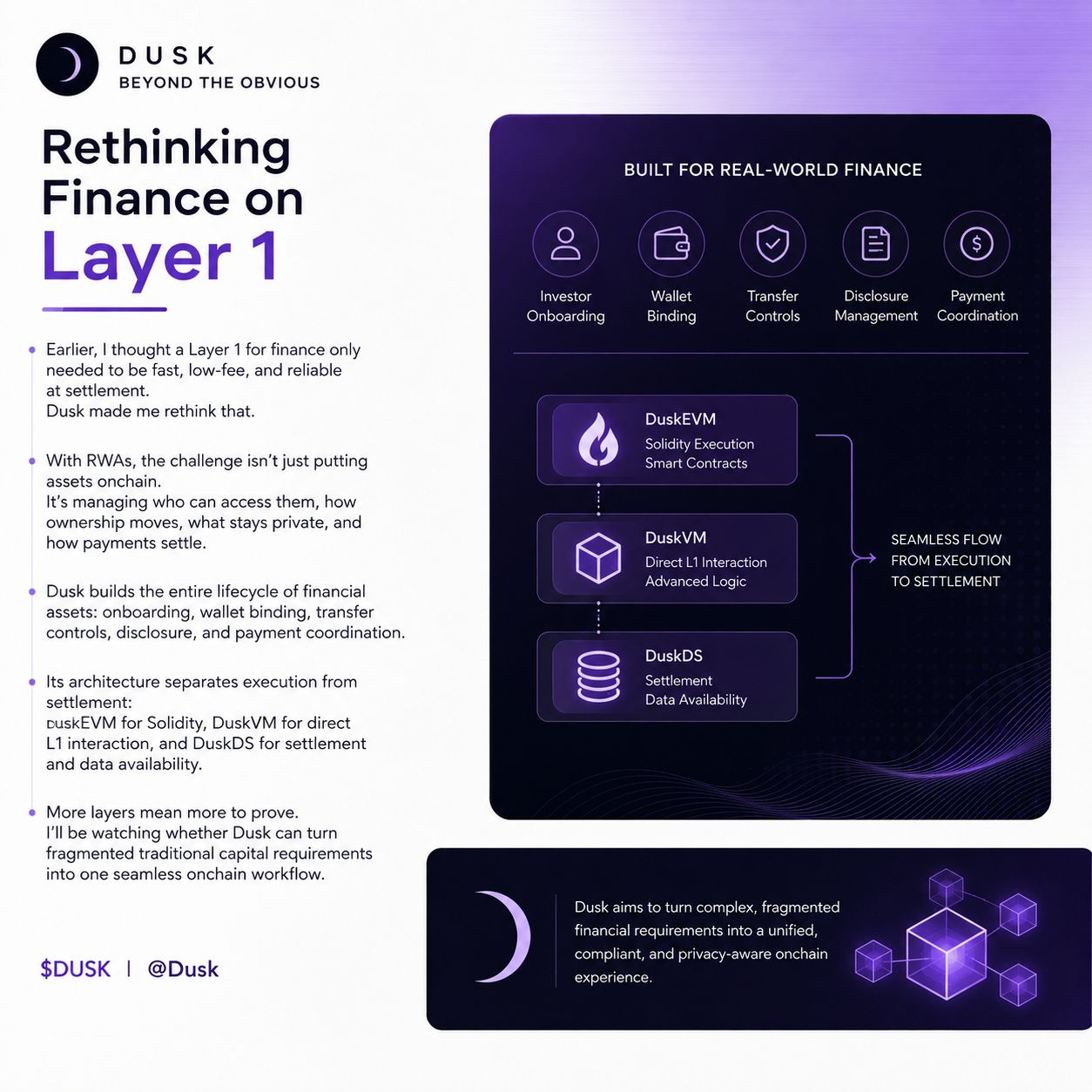
#dusk $DUSK @Dusk_Foundation Antes, eu achava que uma Layer 1 financeira precisava principalmente de velocidade, baixas taxas e liquidação confiável. A Dusk me fez repensar isso.
Com RWAs, a parte difícil não é apenas colocar ativos onchain. É gerenciar quem pode acessá-los, como a propriedade é transferida, o que permanece privado e como os pagamentos são liquidados.
Por isso acho a Dusk interessante. A sua arquitetura conecta DuskEVM, DuskVM e DuskDS em torno de execução, aplicações, liquidação e disponibilidade de dados.
Ainda estou observando se essa complexidade se traduz em adoção real, mas a grande questão é convincente:
A Dusk consegue transformar exigências financeiras tradicionais fragmentadas em um único fluxo onchain contínuo?
$DUSK @Dusk_Foundation
{spot}(DUSKUSDT)
#dusk $DUSK @Dusk Antes, eu achava que uma Layer 1 financeira precisava principalmente de velocidade, baixas taxas e liquidação confiável. A Dusk me fez repensar isso.
Com RWAs, a parte difícil não é apenas colocar ativos onchain. É gerenciar quem pode acessá-los, como a propriedade é transferida, o que permanece privado e como os pagamentos são liquidados.
Por isso acho a Dusk interessante. A sua arquitetura conecta DuskEVM, DuskVM e DuskDS em torno de execução, aplicações, liquidação e disponibilidade de dados.
Ainda estou observando se essa complexidade se traduz em adoção real, mas a grande questão é convincente:
A Dusk consegue transformar exigências financeiras tradicionais fragmentadas em um único fluxo onchain contínuo?
$DUSK @Dusk
Com RWAs, a parte difícil não é apenas colocar ativos onchain. É gerenciar quem pode acessá-los, como a propriedade é transferida, o que permanece privado e como os pagamentos são liquidados.
Por isso acho a Dusk interessante. A sua arquitetura conecta DuskEVM, DuskVM e DuskDS em torno de execução, aplicações, liquidação e disponibilidade de dados.
Ainda estou observando se essa complexidade se traduz em adoção real, mas a grande questão é convincente:
A Dusk consegue transformar exigências financeiras tradicionais fragmentadas em um único fluxo onchain contínuo?
$DUSK @Dusk
69
$ETH ETH Momento 🚀
O ETH acabou de ultrapassar US$ 2.300 com forte momentum. Se os compradores continuarem no controle e $ 2.330–2.350 romperem de forma limpa, o próximo grande alvo pode ser US$ 2.600. O volume está aumentando, mas a confirmação é importante. Fique de olho na ruptura! 📈
$ETH #Ethereum #ETH
$ETH ETH Momento 🚀
O ETH acabou de ultrapassar US$ 2.300 com forte momentum. Se os compradores continuarem no controle e $ 2.330–2.350 romperem de forma limpa, o próximo grande alvo pode ser US$ 2.600. O volume está aumentando, mas a confirmação é importante. Fique de olho na ruptura! 📈
$ETH #Ethereum #ETH
O ETH acabou de ultrapassar US$ 2.300 com forte momentum. Se os compradores continuarem no controle e $ 2.330–2.350 romperem de forma limpa, o próximo grande alvo pode ser US$ 2.600. O volume está aumentando, mas a confirmação é importante. Fique de olho na ruptura! 📈
$ETH #Ethereum #ETH
111
$BTC Bitcoin está voltando a parecer interessante novamente à medida que o momentum comprador cresce em todo o mercado. Se os compradores continuarem defendendo os níveis atuais e a resistência for rompida, estou observando a faixa de US$ 73.000 como um possível próximo alvo.
Um movimento em direção a US$ 73 mil pode atrair uma atenção renovada para o BTC e potencialmente fortalecer o sentimento geral do mercado. É claro que o Bitcoin pode se mover rapidamente em ambas as direções, então a confirmação e a gestão de risco ainda importam.
Por enquanto, estou observando volume, momentum e como o BTC reage em torno de resistências importantes antes de ficar agressivo demais.
O Bitcoin continua sendo um dos gráficos que estou acompanhando de perto. 🚀
#Bitcoin #BTC #Crypto $BTC
{spot}(BTCUSDT)
$BTC Bitcoin está voltando a parecer interessante novamente à medida que o momentum comprador cresce em todo o mercado. Se os compradores continuarem defendendo os níveis atuais e a resistência for rompida, estou observando a faixa de US$ 73.000 como um possível próximo alvo.
Um movimento em direção a US$ 73 mil pode atrair uma atenção renovada para o BTC e potencialmente fortalecer o sentimento geral do mercado. É claro que o Bitcoin pode se mover rapidamente em ambas as direções, então a confirmação e a gestão de risco ainda importam.
Por enquanto, estou observando volume, momentum e como o BTC reage em torno de resistências importantes antes de ficar agressivo demais.
O Bitcoin continua sendo um dos gráficos que estou acompanhando de perto. 🚀
#Bitcoin #BTC #Crypto $BTC
Um movimento em direção a US$ 73 mil pode atrair uma atenção renovada para o BTC e potencialmente fortalecer o sentimento geral do mercado. É claro que o Bitcoin pode se mover rapidamente em ambas as direções, então a confirmação e a gestão de risco ainda importam.
Por enquanto, estou observando volume, momentum e como o BTC reage em torno de resistências importantes antes de ficar agressivo demais.
O Bitcoin continua sendo um dos gráficos que estou acompanhando de perto. 🚀
#Bitcoin #BTC #Crypto $BTC
1
65
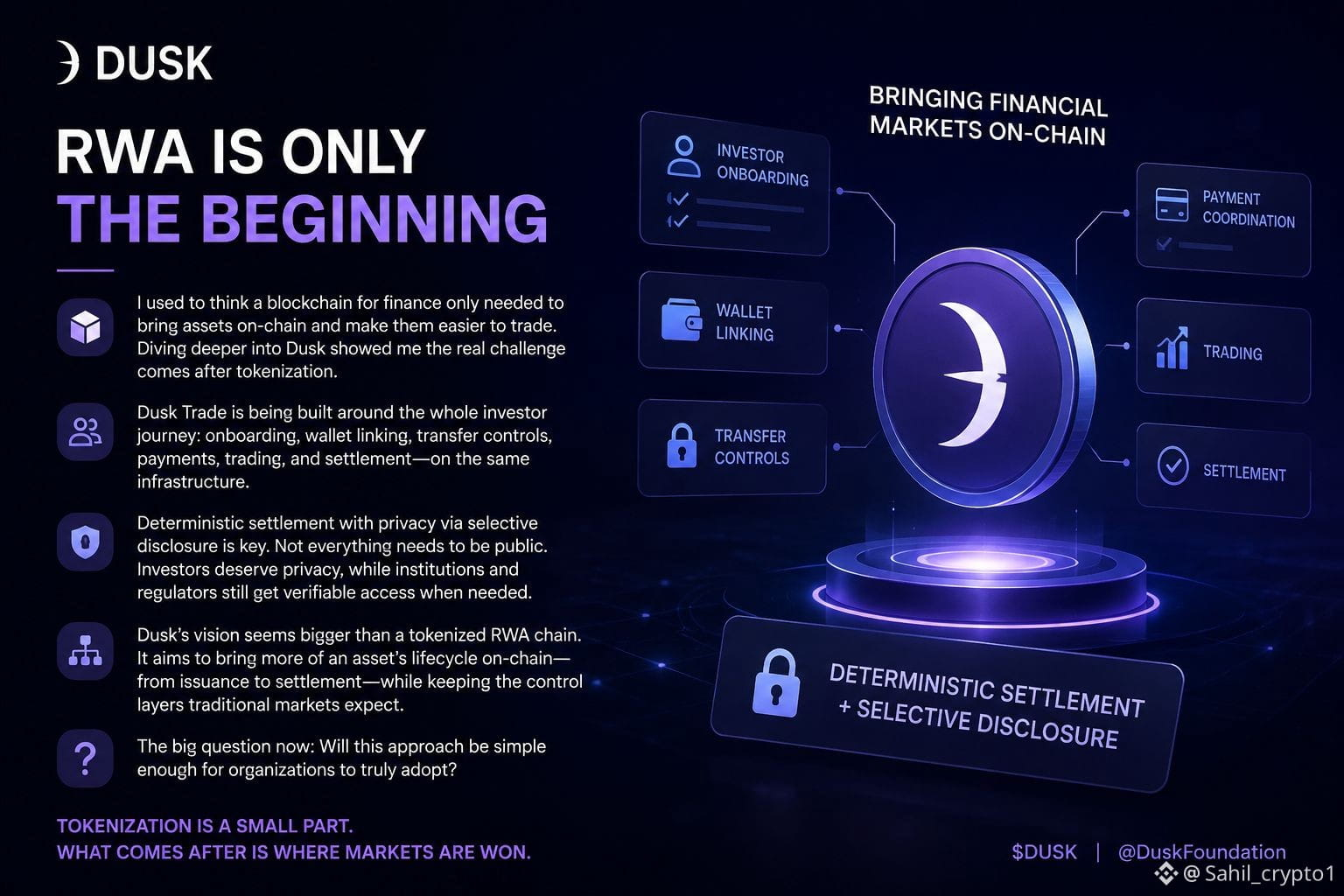
#dusk $DUSK @Dusk_Foundation Eu costumava achar que uma blockchain para finanças só precisava fazer duas coisas bem: trazer ativos do mundo real para a rede e torná-los mais fáceis de negociar.
Mas ao me aprofundar na Dusk, mudei a forma como vejo o discurso de RWA.
A tokenização é apenas o começo. O desafio maior vem depois que o ativo existe on-chain: onboarding de investidores, vinculação de carteiras, controles de transferência, coordenação de pagamentos, negociação e liquidação precisam funcionar juntos.
É isso que torna o Dusk Trade interessante para mim. A ambição parece ser mais ampla do que simplesmente criar mais um marketplace para ativos tokenizados. A Dusk está tentando construir infraestrutura em torno de mais etapas do ciclo de vida do ativo, combinando liquidação determinística com divulgação seletiva.
Eu costumava presumir que mais transparência de blockchain seria sempre melhor. Mas os mercados financeiros me mostraram por que isso nem sempre é verdade. Os investidores podem precisar de privacidade, enquanto instituições e reguladores ainda precisam de uma forma confiável de verificar as informações quando necessário.
Então estou começando a ver a Dusk menos como mais uma “chain de RWA tokenizada” e mais como uma tentativa de levar fluxos de trabalho financeiros tradicionais para o on-chain sem remover os controles dos quais esses mercados dependem.
A verdadeira questão para mim agora não é se a tecnologia soa bem.
É se as organizações vão achar todo o sistema simples o suficiente para realmente usá-lo.
{spot}(DUSKUSDT)
#dusk $DUSK @Dusk Eu costumava achar que uma blockchain para finanças só precisava fazer duas coisas bem: trazer ativos do mundo real para a rede e torná-los mais fáceis de negociar.
Mas ao me aprofundar na Dusk, mudei a forma como vejo o discurso de RWA.
A tokenização é apenas o começo. O desafio maior vem depois que o ativo existe on-chain: onboarding de investidores, vinculação de carteiras, controles de transferência, coordenação de pagamentos, negociação e liquidação precisam funcionar juntos.
É isso que torna o Dusk Trade interessante para mim. A ambição parece ser mais ampla do que simplesmente criar mais um marketplace para ativos tokenizados. A Dusk está tentando construir infraestrutura em torno de mais etapas do ciclo de vida do ativo, combinando liquidação determinística com divulgação seletiva.
Eu costumava presumir que mais transparência de blockchain seria sempre melhor. Mas os mercados financeiros me mostraram por que isso nem sempre é verdade. Os investidores podem precisar de privacidade, enquanto instituições e reguladores ainda precisam de uma forma confiável de verificar as informações quando necessário.
Então estou começando a ver a Dusk menos como mais uma “chain de RWA tokenizada” e mais como uma tentativa de levar fluxos de trabalho financeiros tradicionais para o on-chain sem remover os controles dos quais esses mercados dependem.
A verdadeira questão para mim agora não é se a tecnologia soa bem.
É se as organizações vão achar todo o sistema simples o suficiente para realmente usá-lo.
Mas ao me aprofundar na Dusk, mudei a forma como vejo o discurso de RWA.
A tokenização é apenas o começo. O desafio maior vem depois que o ativo existe on-chain: onboarding de investidores, vinculação de carteiras, controles de transferência, coordenação de pagamentos, negociação e liquidação precisam funcionar juntos.
É isso que torna o Dusk Trade interessante para mim. A ambição parece ser mais ampla do que simplesmente criar mais um marketplace para ativos tokenizados. A Dusk está tentando construir infraestrutura em torno de mais etapas do ciclo de vida do ativo, combinando liquidação determinística com divulgação seletiva.
Eu costumava presumir que mais transparência de blockchain seria sempre melhor. Mas os mercados financeiros me mostraram por que isso nem sempre é verdade. Os investidores podem precisar de privacidade, enquanto instituições e reguladores ainda precisam de uma forma confiável de verificar as informações quando necessário.
Então estou começando a ver a Dusk menos como mais uma “chain de RWA tokenizada” e mais como uma tentativa de levar fluxos de trabalho financeiros tradicionais para o on-chain sem remover os controles dos quais esses mercados dependem.
A verdadeira questão para mim agora não é se a tecnologia soa bem.
É se as organizações vão achar todo o sistema simples o suficiente para realmente usá-lo.
1
63
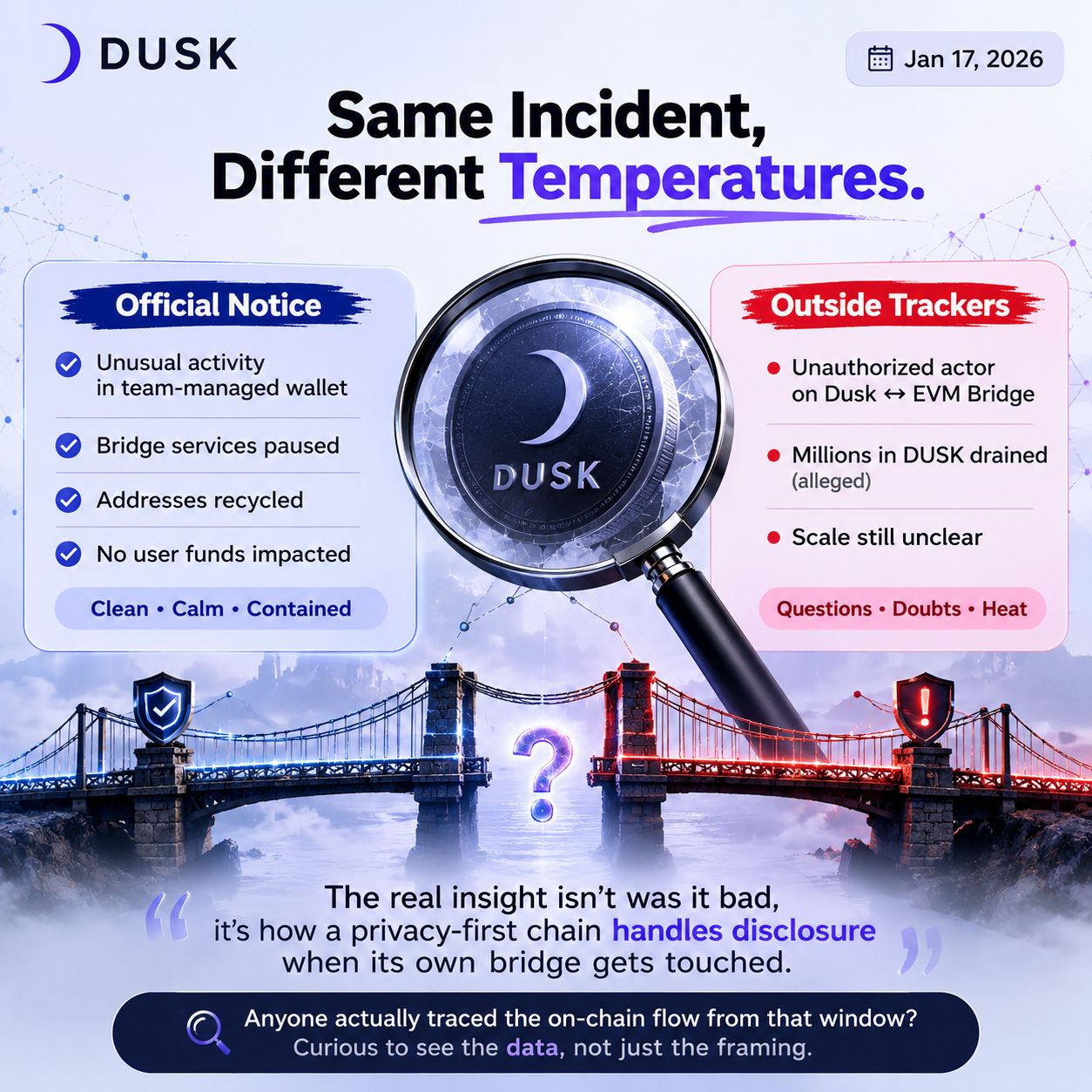
#dusk $DUSK @Dusk_Foundation I voltei repetidamente ao aviso do incidente de janeiro da Dusk, e a redação se destacou mais do que o exploit.
Oficialmente: atividade incomum, uma carteira gerenciada pela equipe, serviços de ponte pausados, endereços reciclados, nenhum fundo do usuário foi afetado.
Mas rastreadores externos descreveram milhões em DUSK drenados através da ponte Dusk-to-EVM.
O mesmo incidente, temperaturas bem diferentes.
Essa diferença importa. Não porque eu saiba o número final — eu não sei — mas porque divulgação também faz parte da segurança.
Se alguém realmente rastreou o fluxo on-chain a partir daquela janela, eu genuinamente gostaria de ver o que você encontrou.
{spot}(DUSKUSDT)
#dusk $DUSK @Dusk I voltei repetidamente ao aviso do incidente de janeiro da Dusk, e a redação se destacou mais do que o exploit.
Oficialmente: atividade incomum, uma carteira gerenciada pela equipe, serviços de ponte pausados, endereços reciclados, nenhum fundo do usuário foi afetado.
Mas rastreadores externos descreveram milhões em DUSK drenados através da ponte Dusk-to-EVM.
O mesmo incidente, temperaturas bem diferentes.
Essa diferença importa. Não porque eu saiba o número final — eu não sei — mas porque divulgação também faz parte da segurança.
Se alguém realmente rastreou o fluxo on-chain a partir daquela janela, eu genuinamente gostaria de ver o que você encontrou.
Oficialmente: atividade incomum, uma carteira gerenciada pela equipe, serviços de ponte pausados, endereços reciclados, nenhum fundo do usuário foi afetado.
Mas rastreadores externos descreveram milhões em DUSK drenados através da ponte Dusk-to-EVM.
O mesmo incidente, temperaturas bem diferentes.
Essa diferença importa. Não porque eu saiba o número final — eu não sei — mas porque divulgação também faz parte da segurança.
Se alguém realmente rastreou o fluxo on-chain a partir daquela janela, eu genuinamente gostaria de ver o que você encontrou.
1
76
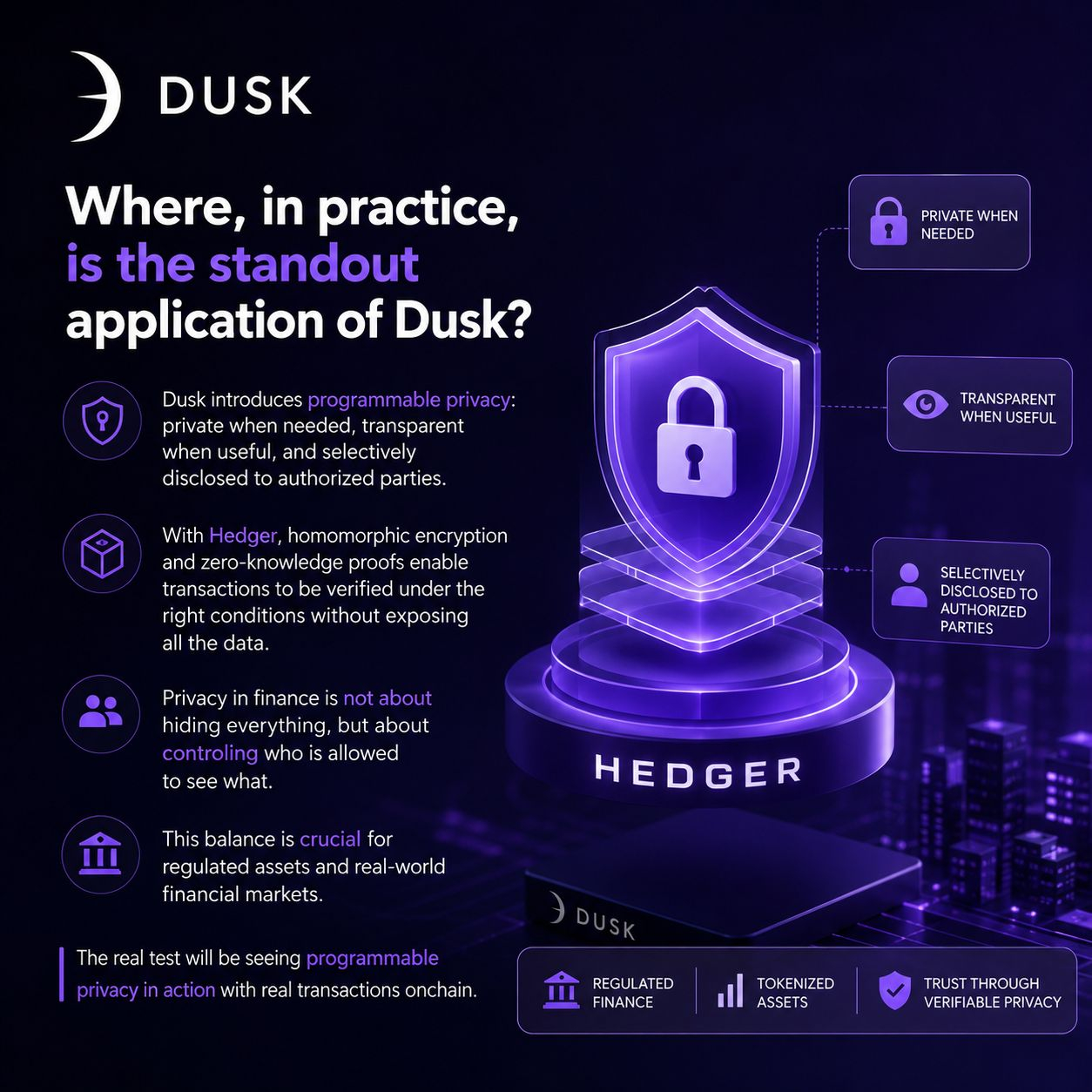
Passei mais tempo com Dusk e uma pergunta continuou voltando: onde o modelo de privacidade dele realmente se torna útil?
Eu costumava associar transparência financeira com confiança. Se todo mundo consegue ver os dados, eu presumiria que a verificação fica mais fácil. Mas as finanças reguladas mudam essa equação.
A ideia do Dusk de privacidade programável parece mais prática: manter informações sensíveis em sigilo, enquanto permite que partes autorizadas verifiquem o que importa.
Foi aí que Hedger chamou minha atenção. Criptografia homomórfica e provas de conhecimento zero não são apenas sobre ocultar transações. A ideia maior é criar um sistema em que a atividade financeira possa permanecer confidencial, ao mesmo tempo em que ainda seja verificável nas condições certas.
Isso faz a privacidade parecer menos como “esconder tudo” e mais como “controlar quem pode ver o quê”.
Para ativos tokenizados e mercados regulados, essa diferença pode importar muito.
Ainda estou observando de perto. O teste real será ver como o Dusk lida com atividades financeiras reais onchain, e não apenas o quão convincente a arquitetura soa no papel.
#dusk @Dusk_Foundation $DUSK
{spot}(DUSKUSDT)
Passei mais tempo com Dusk e uma pergunta continuou voltando: onde o modelo de privacidade dele realmente se torna útil?
Eu costumava associar transparência financeira com confiança. Se todo mundo consegue ver os dados, eu presumiria que a verificação fica mais fácil. Mas as finanças reguladas mudam essa equação.
A ideia do Dusk de privacidade programável parece mais prática: manter informações sensíveis em sigilo, enquanto permite que partes autorizadas verifiquem o que importa.
Foi aí que Hedger chamou minha atenção. Criptografia homomórfica e provas de conhecimento zero não são apenas sobre ocultar transações. A ideia maior é criar um sistema em que a atividade financeira possa permanecer confidencial, ao mesmo tempo em que ainda seja verificável nas condições certas.
Isso faz a privacidade parecer menos como “esconder tudo” e mais como “controlar quem pode ver o quê”.
Para ativos tokenizados e mercados regulados, essa diferença pode importar muito.
Ainda estou observando de perto. O teste real será ver como o Dusk lida com atividades financeiras reais onchain, e não apenas o quão convincente a arquitetura soa no papel.
#dusk @Dusk $DUSK
Eu costumava associar transparência financeira com confiança. Se todo mundo consegue ver os dados, eu presumiria que a verificação fica mais fácil. Mas as finanças reguladas mudam essa equação.
A ideia do Dusk de privacidade programável parece mais prática: manter informações sensíveis em sigilo, enquanto permite que partes autorizadas verifiquem o que importa.
Foi aí que Hedger chamou minha atenção. Criptografia homomórfica e provas de conhecimento zero não são apenas sobre ocultar transações. A ideia maior é criar um sistema em que a atividade financeira possa permanecer confidencial, ao mesmo tempo em que ainda seja verificável nas condições certas.
Isso faz a privacidade parecer menos como “esconder tudo” e mais como “controlar quem pode ver o quê”.
Para ativos tokenizados e mercados regulados, essa diferença pode importar muito.
Ainda estou observando de perto. O teste real será ver como o Dusk lida com atividades financeiras reais onchain, e não apenas o quão convincente a arquitetura soa no papel.
#dusk @Dusk $DUSK
1
72
#dusk $DUSK Quanto mais eu me aprofundo no DUSK, mais o modelo de privacidade dele faz sentido para mim.
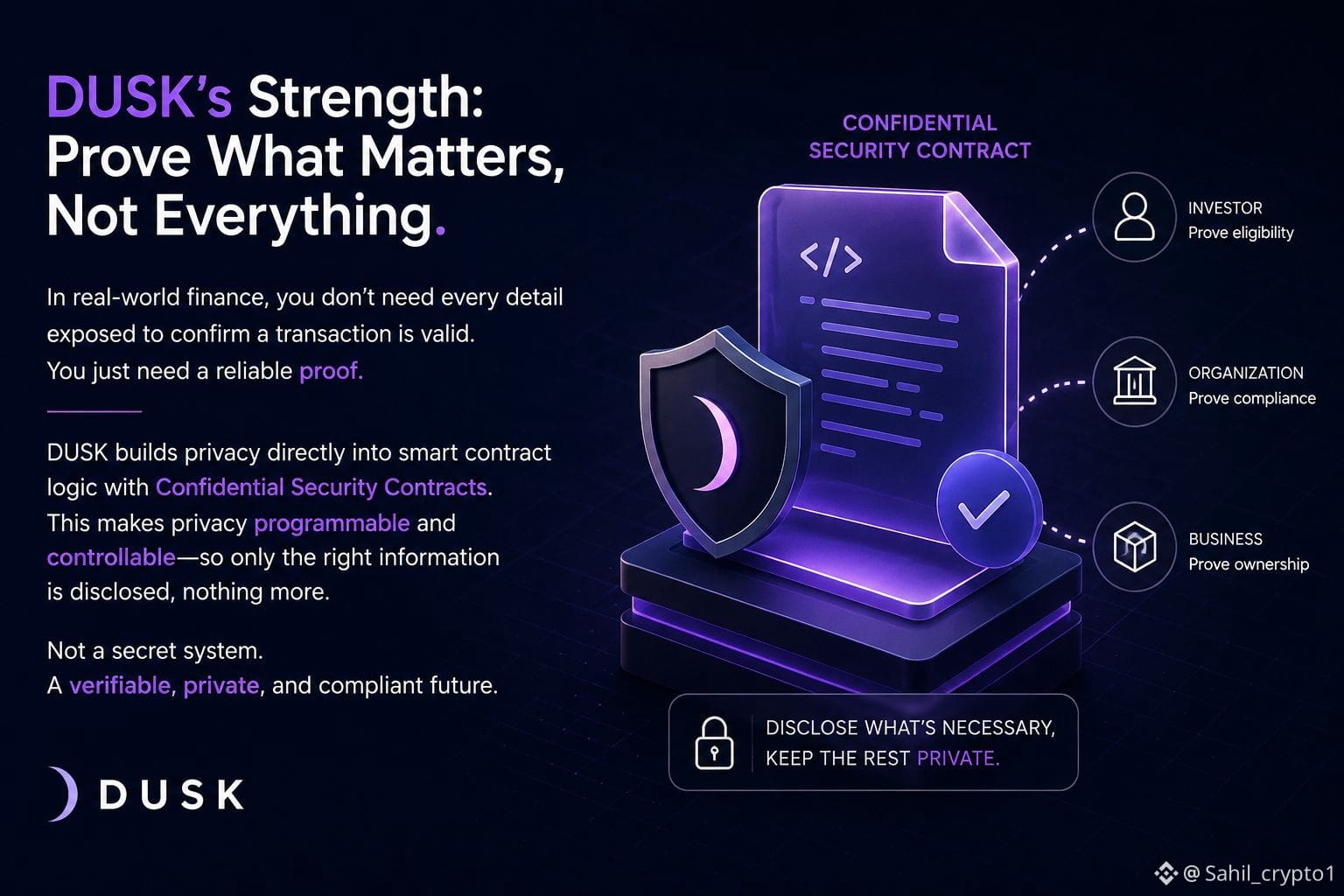
As finanças do mundo real não precisam expor todos os detalhes apenas para provar que uma transação é válida. Um investidor pode precisar provar a elegibilidade, uma empresa pode precisar verificar a propriedade e as instituições podem precisar demonstrar conformidade regulatória.
Foi aí que o DUSK chamou minha atenção. A abordagem dele trata a privacidade como parte da lógica do contrato inteligente, em vez de algo adicionado depois.
Talvez o futuro da privacidade no blockchain não seja tornar tudo invisível. É tornar a divulgação programável — provando exatamente o que precisa ser provado, mantendo as informações desnecessárias privadas.
Isso poderia ser um caminho bem mais prático para levar atividades financeiras regulamentadas para o onchain.@Dusk_Foundation $DUSK
{spot}(DUSKUSDT)
#dusk $DUSK Quanto mais eu me aprofundo no DUSK, mais o modelo de privacidade dele faz sentido para mim.
As finanças do mundo real não precisam expor todos os detalhes apenas para provar que uma transação é válida. Um investidor pode precisar provar a elegibilidade, uma empresa pode precisar verificar a propriedade e as instituições podem precisar demonstrar conformidade regulatória.
Foi aí que o DUSK chamou minha atenção. A abordagem dele trata a privacidade como parte da lógica do contrato inteligente, em vez de algo adicionado depois.
Talvez o futuro da privacidade no blockchain não seja tornar tudo invisível. É tornar a divulgação programável — provando exatamente o que precisa ser provado, mantendo as informações desnecessárias privadas.
Isso poderia ser um caminho bem mais prático para levar atividades financeiras regulamentadas para o onchain.@Dusk $DUSK
As finanças do mundo real não precisam expor todos os detalhes apenas para provar que uma transação é válida. Um investidor pode precisar provar a elegibilidade, uma empresa pode precisar verificar a propriedade e as instituições podem precisar demonstrar conformidade regulatória.
Foi aí que o DUSK chamou minha atenção. A abordagem dele trata a privacidade como parte da lógica do contrato inteligente, em vez de algo adicionado depois.
Talvez o futuro da privacidade no blockchain não seja tornar tudo invisível. É tornar a divulgação programável — provando exatamente o que precisa ser provado, mantendo as informações desnecessárias privadas.
Isso poderia ser um caminho bem mais prático para levar atividades financeiras regulamentadas para o onchain.@Dusk $DUSK
2
73
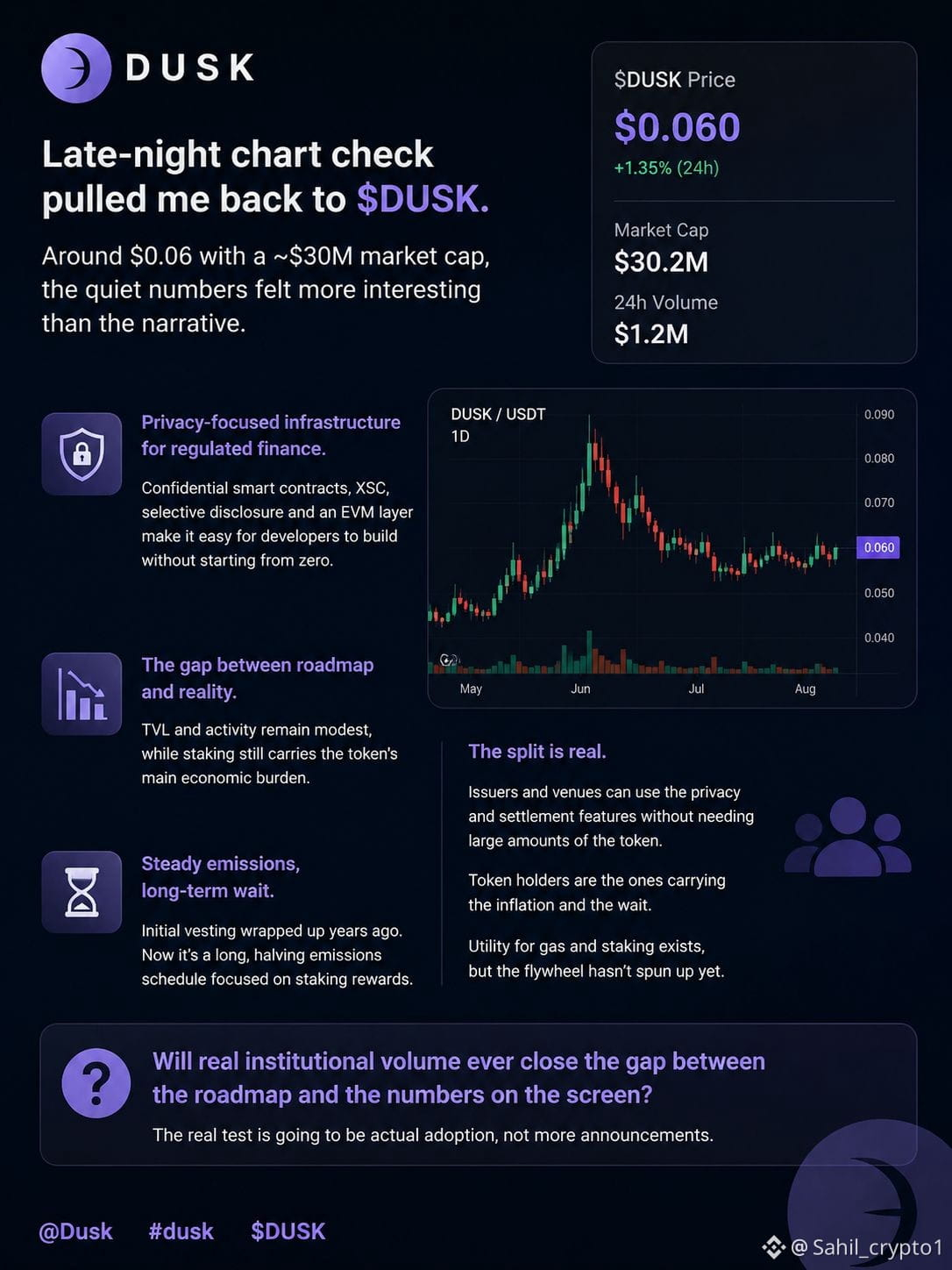
Uma verificação do gráfico tarde da noite me puxou de volta para $DUSK. Por volta de $0,06 com uma capitalização de mercado de ~$30M, os números silenciosos pareceram mais interessantes do que a narrativa.
@Dusk_Foundation está construindo uma infraestrutura focada em privacidade para finanças reguladas, com contratos inteligentes confidenciais, XSC, divulgação seletiva e uma camada EVM.
A história da tecnologia faz sentido. O que eu estou observando agora é a diferença entre o roadmap e o uso real. TVL e atividade seguem modestas, enquanto o staking ainda carrega o principal peso econômico do token.
O volume institucional real é a parte que importa. Até isso aparecer, $DUSK ainda parece uma história esperando que seus números alcancem.
#dusk $ACE
{spot}(ACEUSDT)
$CYS
{future}(CYSUSDT)
{spot}(DUSKUSDT)
Uma verificação do gráfico tarde da noite me puxou de volta para $DUSK . Por volta de $0,06 com uma capitalização de mercado de ~$30M, os números silenciosos pareceram mais interessantes do que a narrativa.
@Dusk está construindo uma infraestrutura focada em privacidade para finanças reguladas, com contratos inteligentes confidenciais, XSC, divulgação seletiva e uma camada EVM.
A história da tecnologia faz sentido. O que eu estou observando agora é a diferença entre o roadmap e o uso real. TVL e atividade seguem modestas, enquanto o staking ainda carrega o principal peso econômico do token.
O volume institucional real é a parte que importa. Até isso aparecer, $DUSK ainda parece uma história esperando que seus números alcancem.
#dusk $ACE
$CYS
@Dusk está construindo uma infraestrutura focada em privacidade para finanças reguladas, com contratos inteligentes confidenciais, XSC, divulgação seletiva e uma camada EVM.
A história da tecnologia faz sentido. O que eu estou observando agora é a diferença entre o roadmap e o uso real. TVL e atividade seguem modestas, enquanto o staking ainda carrega o principal peso econômico do token.
O volume institucional real é a parte que importa. Até isso aparecer, $DUSK ainda parece uma história esperando que seus números alcancem.
#dusk $ACE
$CYS
1
1
81
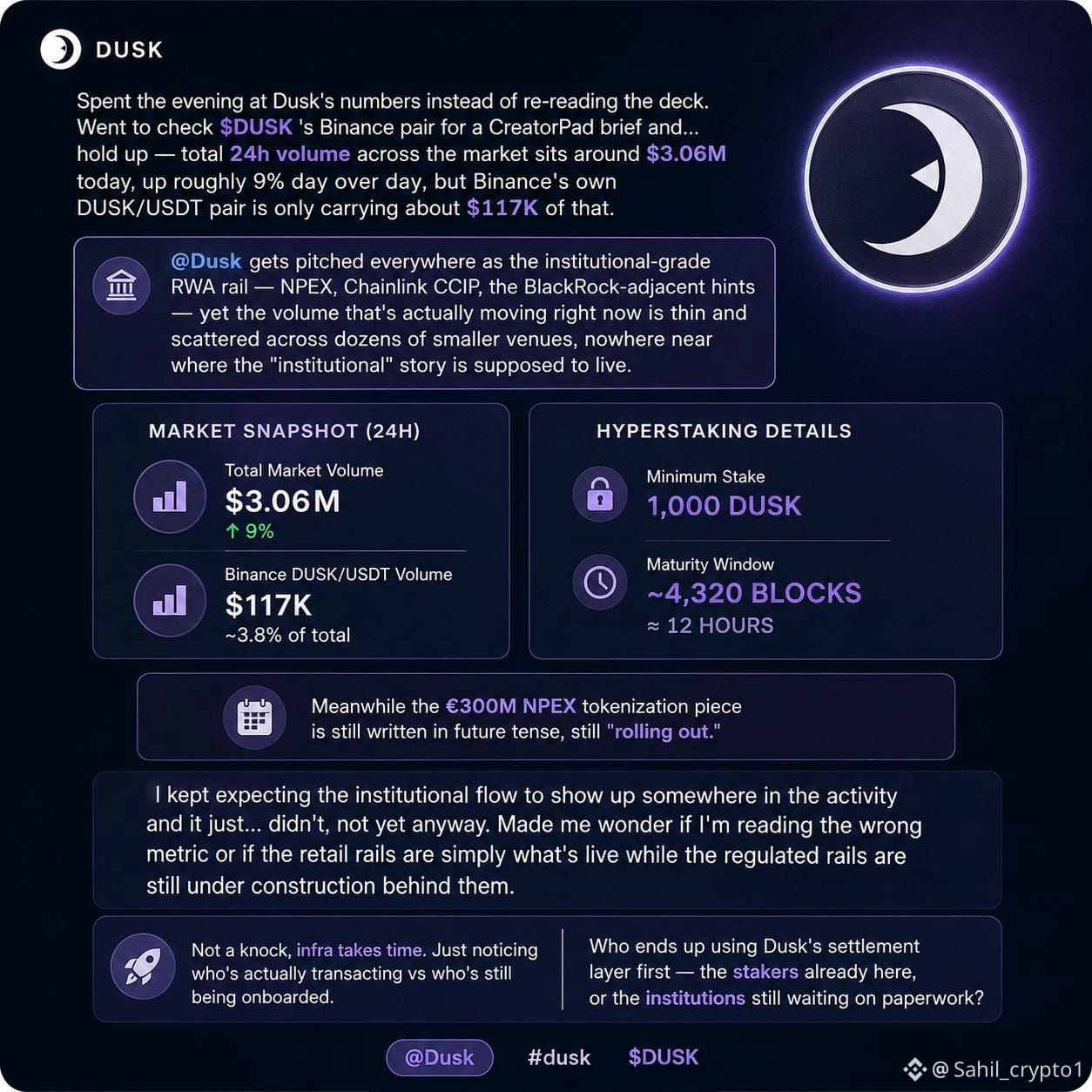
Passei algum tempo cavando $DUSK números em vez dos habituais títulos do roadmap.
O volume de mercado nas últimas 24h está em torno de US$ 3M, mas o par DUSK/USDT da Binance é apenas uma pequena fatia desse fluxo. Para um projeto posicionado em torno de infraestrutura de RWA voltada para instituições, essa diferença chamou minha atenção.
Até o Hyperstaking parece bem acessível: mínimo de 1.000 DUSK e uma janela de maturidade de aproximadamente 12 horas.
Então fico com uma única pergunta: a atividade de varejo da Dusk é apenas a parte que está ativa hoje, enquanto os trilhos institucionais maiores ainda estão sendo construídos?
Não é bearish — só estou acompanhando onde aparece a atividade real.
Quem chega primeiro: os stakers existentes ou as instituições?
@Dusk_Foundation #dusk $DUSK
{spot}(DUSKUSDT)
Passei algum tempo cavando $DUSK números em vez dos habituais títulos do roadmap.
O volume de mercado nas últimas 24h está em torno de US$ 3M, mas o par DUSK/USDT da Binance é apenas uma pequena fatia desse fluxo. Para um projeto posicionado em torno de infraestrutura de RWA voltada para instituições, essa diferença chamou minha atenção.
Até o Hyperstaking parece bem acessível: mínimo de 1.000 DUSK e uma janela de maturidade de aproximadamente 12 horas.
Então fico com uma única pergunta: a atividade de varejo da Dusk é apenas a parte que está ativa hoje, enquanto os trilhos institucionais maiores ainda estão sendo construídos?
Não é bearish — só estou acompanhando onde aparece a atividade real.
Quem chega primeiro: os stakers existentes ou as instituições?
@Dusk #dusk $DUSK
O volume de mercado nas últimas 24h está em torno de US$ 3M, mas o par DUSK/USDT da Binance é apenas uma pequena fatia desse fluxo. Para um projeto posicionado em torno de infraestrutura de RWA voltada para instituições, essa diferença chamou minha atenção.
Até o Hyperstaking parece bem acessível: mínimo de 1.000 DUSK e uma janela de maturidade de aproximadamente 12 horas.
Então fico com uma única pergunta: a atividade de varejo da Dusk é apenas a parte que está ativa hoje, enquanto os trilhos institucionais maiores ainda estão sendo construídos?
Não é bearish — só estou acompanhando onde aparece a atividade real.
Quem chega primeiro: os stakers existentes ou as instituições?
@Dusk #dusk $DUSK
1
69
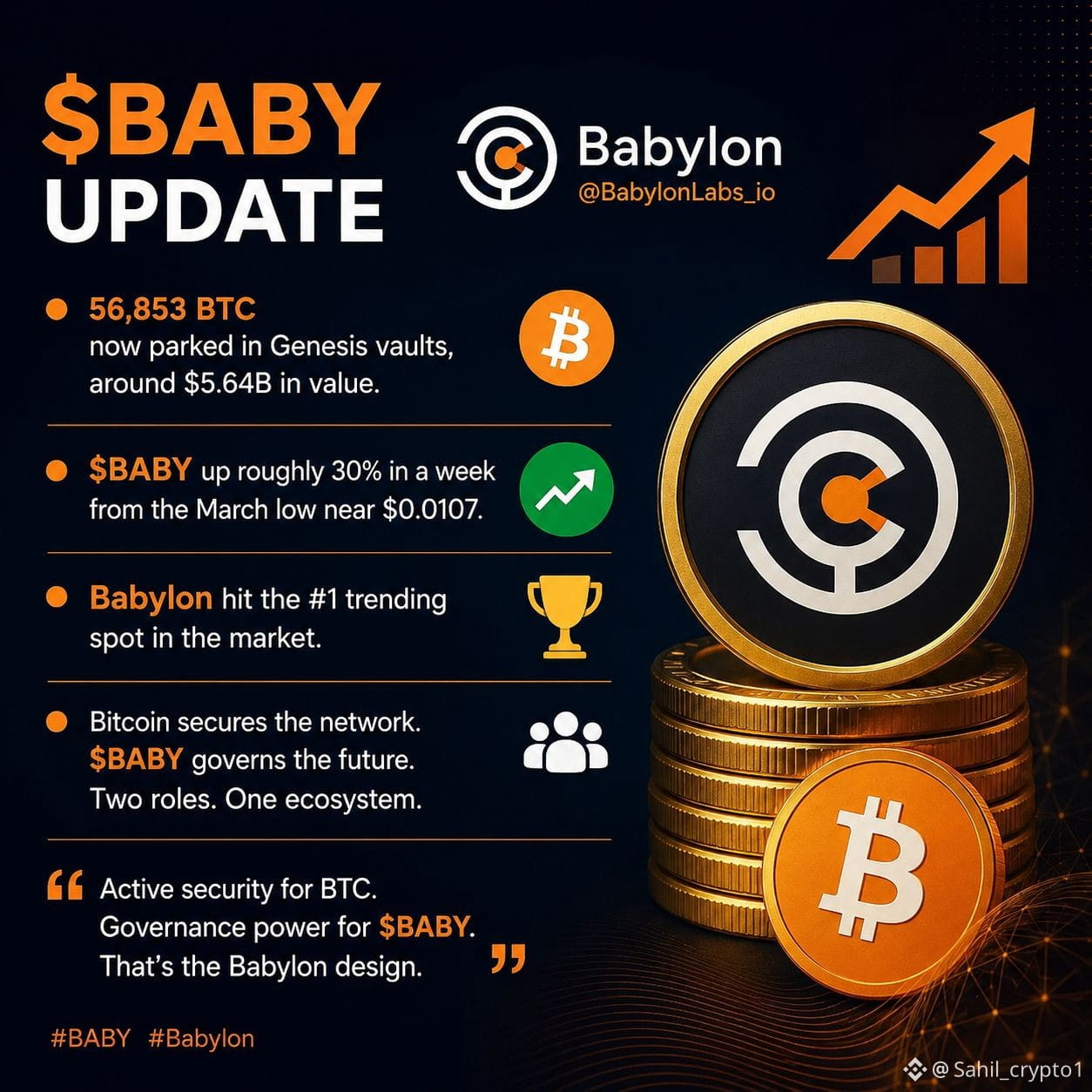
Tenho acompanhado @babylonlabs_io today e um detalhe se destacou além dos gráficos de preços. Cerca de 56,853 BTC já está agora alocado em cofres da Genesis, enquanto $BABY se recuperou fortemente das mínimas recentes.
Quanto mais eu lia, mais percebia que o papel do Bitcoin é segurança, não governança. Os detentores de BTC ajudam a proteger a rede e ganham recompensas, mas as atualizações do protocolo, mudanças de parâmetros e decisões de governança permanecem nas mãos dos detentores de $BABY por meio de delegação.
É uma separação interessante de responsabilidades. O Bitcoin fornece a segurança econômica, enquanto o BABY fornece o poder de tomada de decisão. Esse desenho pode manter a governança eficiente, mas também significa que o ativo que oferece a segurança não molda diretamente o futuro do protocolo.
Fico curioso para ver se os participantes que fazem staking de BTC alguma vez ganham um papel de governança mais forte, ou se esse modelo em duas camadas foi pensado para permanecer permanente.
#Baby $BTC
{spot}(BTCUSDT)
{spot}(BABYUSDT)
Tenho acompanhado @BabylonLabs_io today e um detalhe se destacou além dos gráficos de preços. Cerca de 56,853 BTC já está agora alocado em cofres da Genesis, enquanto $BABY se recuperou fortemente das mínimas recentes.
Quanto mais eu lia, mais percebia que o papel do Bitcoin é segurança, não governança. Os detentores de BTC ajudam a proteger a rede e ganham recompensas, mas as atualizações do protocolo, mudanças de parâmetros e decisões de governança permanecem nas mãos dos detentores de $BABY por meio de delegação.
É uma separação interessante de responsabilidades. O Bitcoin fornece a segurança econômica, enquanto o BABY fornece o poder de tomada de decisão. Esse desenho pode manter a governança eficiente, mas também significa que o ativo que oferece a segurança não molda diretamente o futuro do protocolo.
Fico curioso para ver se os participantes que fazem staking de BTC alguma vez ganham um papel de governança mais forte, ou se esse modelo em duas camadas foi pensado para permanecer permanente.
#Baby $BTC
Quanto mais eu lia, mais percebia que o papel do Bitcoin é segurança, não governança. Os detentores de BTC ajudam a proteger a rede e ganham recompensas, mas as atualizações do protocolo, mudanças de parâmetros e decisões de governança permanecem nas mãos dos detentores de $BABY por meio de delegação.
É uma separação interessante de responsabilidades. O Bitcoin fornece a segurança econômica, enquanto o BABY fornece o poder de tomada de decisão. Esse desenho pode manter a governança eficiente, mas também significa que o ativo que oferece a segurança não molda diretamente o futuro do protocolo.
Fico curioso para ver se os participantes que fazem staking de BTC alguma vez ganham um papel de governança mais forte, ou se esse modelo em duas camadas foi pensado para permanecer permanente.
#Baby $BTC
2
97
Passei algum tempo comparando o que estava acontecendo em torno de @babylonlabs_io com o que de fato estava acontecendo dentro do protocolo, e a diferença foi interessante.
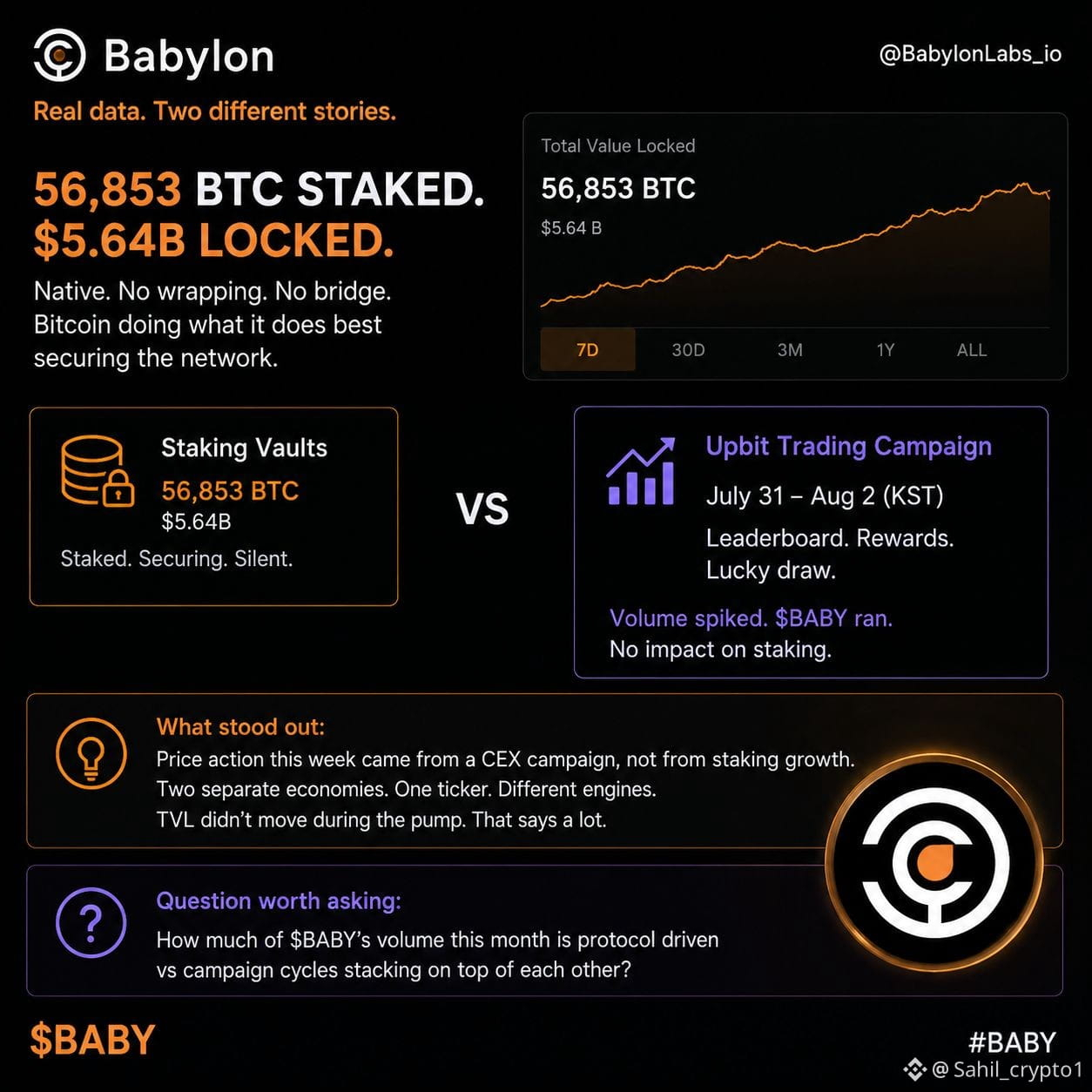
De um lado, o staking do Bitcoin permaneceu notavelmente estável. Mais de 56K BTC continuaram bloqueados no sistema nativo de staking da Babylon, mostrando que os participantes de longo prazo não estavam com pressa para mover seu capital.
Do outro lado, a maior parte da empolgação desta semana parecia ter vindo da campanha de negociação da Upbit. Maior atividade de negociação, competição no ranking e incentivos de recompensa direcionaram a atenção para $BABY sem, no entanto, alterar de forma significativa a atividade de staking on-chain.
Isso me lembrou que impulso de preço e adoção do protocolo nem sempre andam juntos. Às vezes, o mercado reage a incentivos de exchange enquanto a rede subjacente continua silenciosamente fazendo seu trabalho em segundo plano.
Observar os dois indicadores lado a lado provavelmente conta uma história mais completa do que acompanhar apenas o preço.
#BABY $BTC $BABY
{future}(BABYUSDT)
{spot}(BTCUSDT)
Passei algum tempo comparando o que estava acontecendo em torno de @BabylonLabs_io com o que de fato estava acontecendo dentro do protocolo, e a diferença foi interessante.
De um lado, o staking do Bitcoin permaneceu notavelmente estável. Mais de 56K BTC continuaram bloqueados no sistema nativo de staking da Babylon, mostrando que os participantes de longo prazo não estavam com pressa para mover seu capital.
Do outro lado, a maior parte da empolgação desta semana parecia ter vindo da campanha de negociação da Upbit. Maior atividade de negociação, competição no ranking e incentivos de recompensa direcionaram a atenção para $BABY sem, no entanto, alterar de forma significativa a atividade de staking on-chain.
Isso me lembrou que impulso de preço e adoção do protocolo nem sempre andam juntos. Às vezes, o mercado reage a incentivos de exchange enquanto a rede subjacente continua silenciosamente fazendo seu trabalho em segundo plano.
Observar os dois indicadores lado a lado provavelmente conta uma história mais completa do que acompanhar apenas o preço.
#BABY $BTC $BABY
De um lado, o staking do Bitcoin permaneceu notavelmente estável. Mais de 56K BTC continuaram bloqueados no sistema nativo de staking da Babylon, mostrando que os participantes de longo prazo não estavam com pressa para mover seu capital.
Do outro lado, a maior parte da empolgação desta semana parecia ter vindo da campanha de negociação da Upbit. Maior atividade de negociação, competição no ranking e incentivos de recompensa direcionaram a atenção para $BABY sem, no entanto, alterar de forma significativa a atividade de staking on-chain.
Isso me lembrou que impulso de preço e adoção do protocolo nem sempre andam juntos. Às vezes, o mercado reage a incentivos de exchange enquanto a rede subjacente continua silenciosamente fazendo seu trabalho em segundo plano.
Observar os dois indicadores lado a lado provavelmente conta uma história mais completa do que acompanhar apenas o preço.
#BABY $BTC $BABY
5
2
95
🚨Abri os gráficos para $BABY depois de ver o burburinho recente da campanha em torno de @babylonlabs_io e decidi investigar mais, em vez de parar na análise da ação do preço.
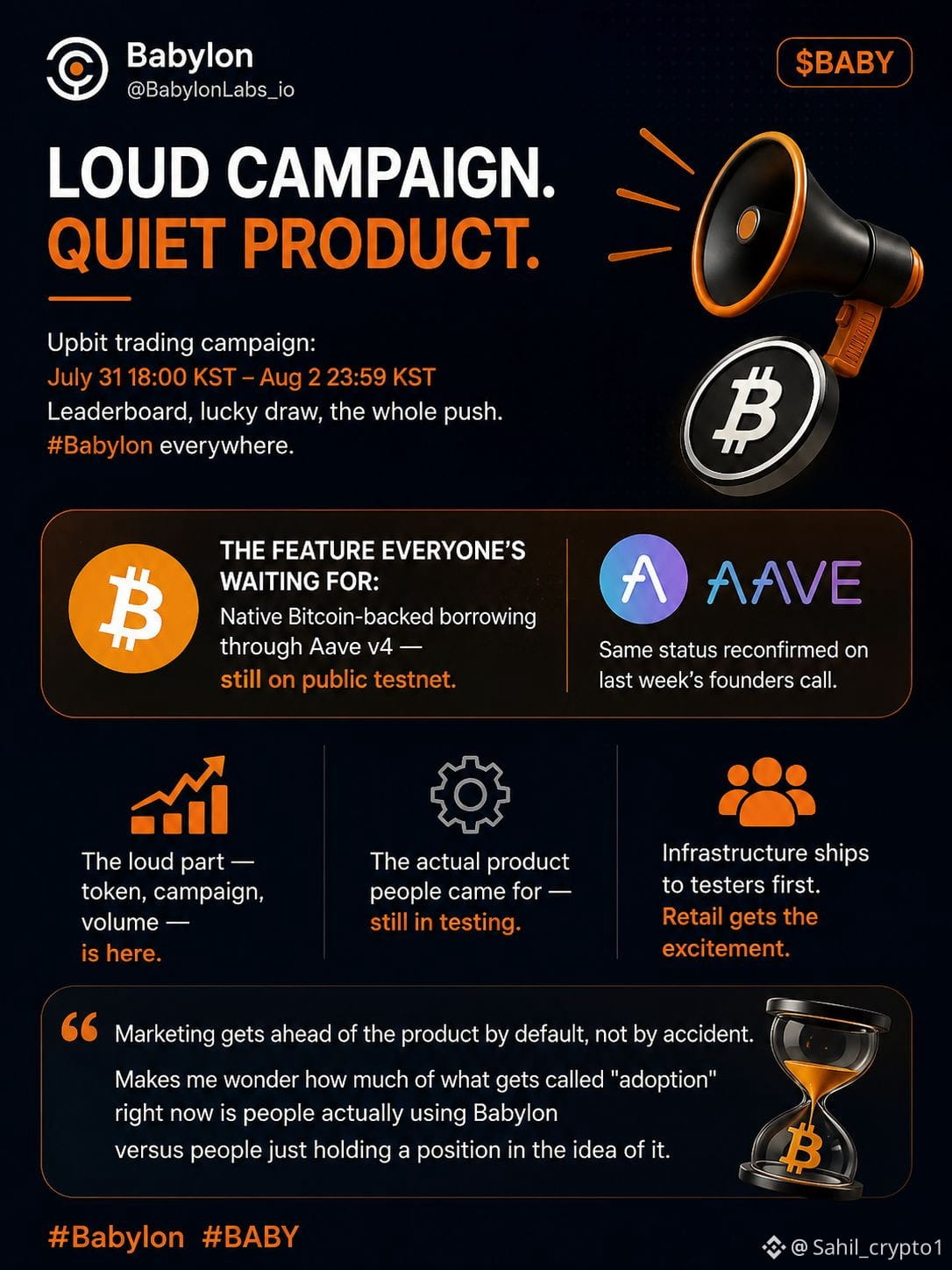
A campanha de trading chamou bastante atenção, mas eu estava mais interessado no recurso que a Babylon continua destacando: usar Bitcoin nativo como garantia sem abrir mão da custódia. Depois de conferir as atualizações mais recentes, esse fluxo de empréstimos via integração Aave v4 ainda está disponível na testnet pública, e não na mainnet.
Isso não foi decepcionante — foi um lembrete de como normalmente os projetos cripto evoluem. Campanhas da comunidade, atividade em exchanges e negociação de tokens frequentemente chegam antes do produto principal alcançar usuários do dia a dia. Os desenvolvedores coletam feedback, corrigem casos de borda e fortalecem a infraestrutura enquanto o mercado negocia o potencial futuro.
Isso cria uma lacuna interessante. O preço reflete expectativas, enquanto a adoção depende de as pessoas usarem o produto quando ele estiver no ar. Esses dois nem sempre caminham juntos.
Vou ficar menos atento aos números da campanha e mais ao momento em que o empréstimo com Bitcoin nativo como garantia chegar à produção. É quando teremos uma imagem mais clara de quanta demanda existe além da empolgação.
#Babylon #BABY $BTC
{spot}(BABYUSDT)
{spot}(BTCUSDT)
🚨Abri os gráficos para $BABY depois de ver o burburinho recente da campanha em torno de @BabylonLabs_io e decidi investigar mais, em vez de parar na análise da ação do preço.
A campanha de trading chamou bastante atenção, mas eu estava mais interessado no recurso que a Babylon continua destacando: usar Bitcoin nativo como garantia sem abrir mão da custódia. Depois de conferir as atualizações mais recentes, esse fluxo de empréstimos via integração Aave v4 ainda está disponível na testnet pública, e não na mainnet.
Isso não foi decepcionante — foi um lembrete de como normalmente os projetos cripto evoluem. Campanhas da comunidade, atividade em exchanges e negociação de tokens frequentemente chegam antes do produto principal alcançar usuários do dia a dia. Os desenvolvedores coletam feedback, corrigem casos de borda e fortalecem a infraestrutura enquanto o mercado negocia o potencial futuro.
Isso cria uma lacuna interessante. O preço reflete expectativas, enquanto a adoção depende de as pessoas usarem o produto quando ele estiver no ar. Esses dois nem sempre caminham juntos.
Vou ficar menos atento aos números da campanha e mais ao momento em que o empréstimo com Bitcoin nativo como garantia chegar à produção. É quando teremos uma imagem mais clara de quanta demanda existe além da empolgação.
#Babylon #BABY $BTC
A campanha de trading chamou bastante atenção, mas eu estava mais interessado no recurso que a Babylon continua destacando: usar Bitcoin nativo como garantia sem abrir mão da custódia. Depois de conferir as atualizações mais recentes, esse fluxo de empréstimos via integração Aave v4 ainda está disponível na testnet pública, e não na mainnet.
Isso não foi decepcionante — foi um lembrete de como normalmente os projetos cripto evoluem. Campanhas da comunidade, atividade em exchanges e negociação de tokens frequentemente chegam antes do produto principal alcançar usuários do dia a dia. Os desenvolvedores coletam feedback, corrigem casos de borda e fortalecem a infraestrutura enquanto o mercado negocia o potencial futuro.
Isso cria uma lacuna interessante. O preço reflete expectativas, enquanto a adoção depende de as pessoas usarem o produto quando ele estiver no ar. Esses dois nem sempre caminham juntos.
Vou ficar menos atento aos números da campanha e mais ao momento em que o empréstimo com Bitcoin nativo como garantia chegar à produção. É quando teremos uma imagem mais clara de quanta demanda existe além da empolgação.
#Babylon #BABY $BTC
2
1
113
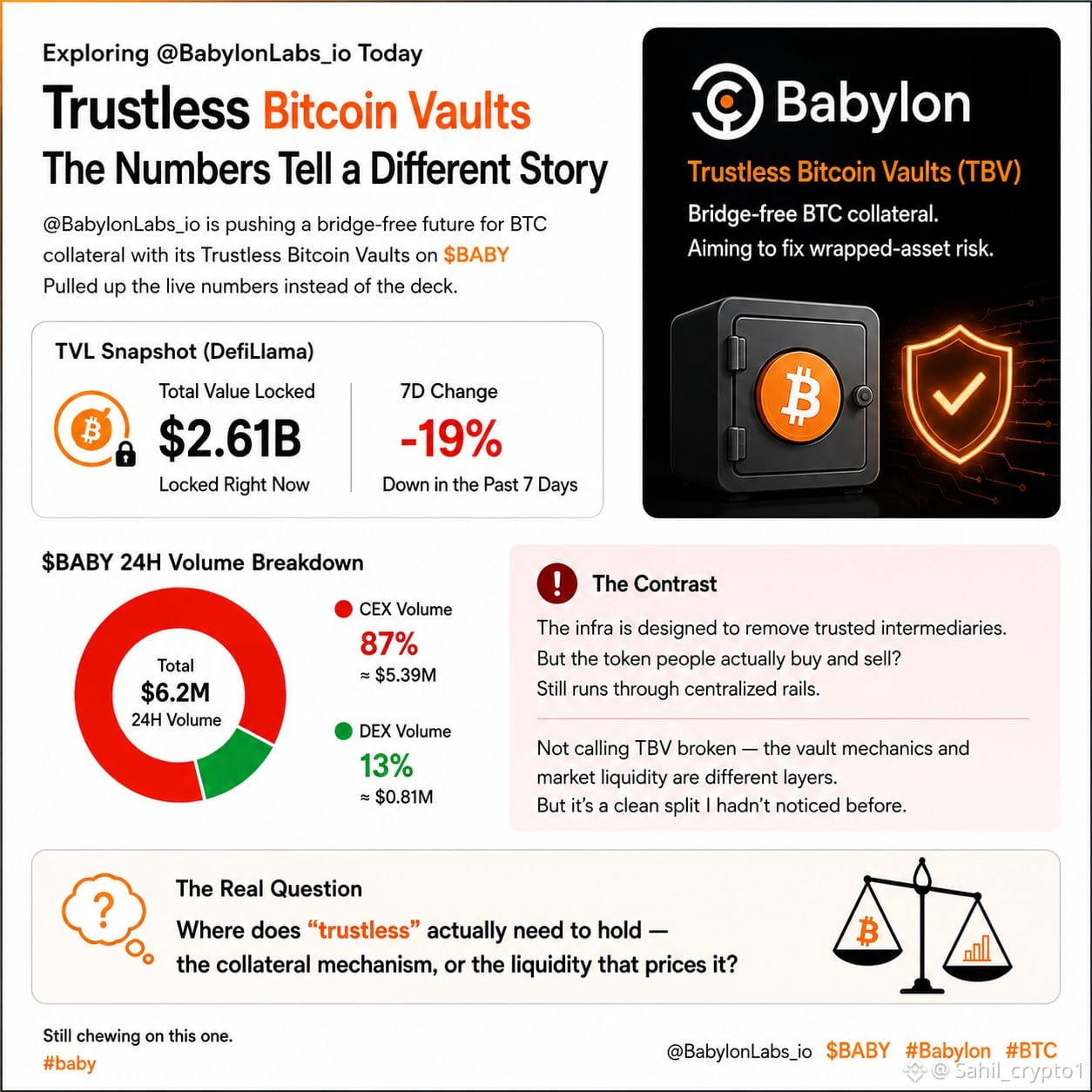
Passei um tempo explorando @babylonlabs_io today e uma coisa continuou me puxando de volta. Todo mundo fala sobre Trustless Bitcoin Vaults porque eles permitem que o BTC permaneça nativo em vez de depender de ativos embrulhados, mas o mercado conta uma história diferente.
O protocolo está empurrando o Bitcoin para um futuro sem pontes, enquanto a maior parte de $BABY trading ainda acontece em ambientes centralizados. Esse contraste é interessante. A infraestrutura descentralizada não cria automaticamente liquidez descentralizada.
Isso me fez perceber que "trustless" não é apenas uma única caixa de seleção. A garantia pode ser minimizada em confiança, mas a formação do preço do token ainda pode depender do fluxo de exchanges tradicionais. Talvez seja apenas onde o ecossistema está hoje—ou talvez seja o próximo desafio que a Babylon precisa resolver.
Curioso para ver como esse equilíbrio muda à medida que o ecossistema cresce.
#Baby #Babylon $BTC
{future}(BABYUSDT)
{spot}(BTCUSDT)
Passei um tempo explorando @BabylonLabs_io today e uma coisa continuou me puxando de volta. Todo mundo fala sobre Trustless Bitcoin Vaults porque eles permitem que o BTC permaneça nativo em vez de depender de ativos embrulhados, mas o mercado conta uma história diferente.
O protocolo está empurrando o Bitcoin para um futuro sem pontes, enquanto a maior parte de $BABY trading ainda acontece em ambientes centralizados. Esse contraste é interessante. A infraestrutura descentralizada não cria automaticamente liquidez descentralizada.
Isso me fez perceber que "trustless" não é apenas uma única caixa de seleção. A garantia pode ser minimizada em confiança, mas a formação do preço do token ainda pode depender do fluxo de exchanges tradicionais. Talvez seja apenas onde o ecossistema está hoje—ou talvez seja o próximo desafio que a Babylon precisa resolver.
Curioso para ver como esse equilíbrio muda à medida que o ecossistema cresce.
#Baby #Babylon $BTC
O protocolo está empurrando o Bitcoin para um futuro sem pontes, enquanto a maior parte de $BABY trading ainda acontece em ambientes centralizados. Esse contraste é interessante. A infraestrutura descentralizada não cria automaticamente liquidez descentralizada.
Isso me fez perceber que "trustless" não é apenas uma única caixa de seleção. A garantia pode ser minimizada em confiança, mas a formação do preço do token ainda pode depender do fluxo de exchanges tradicionais. Talvez seja apenas onde o ecossistema está hoje—ou talvez seja o próximo desafio que a Babylon precisa resolver.
Curioso para ver como esse equilíbrio muda à medida que o ecossistema cresce.
#Baby #Babylon $BTC
2
1
80
Passei algum tempo pesquisando a documentação @babylonlabs_io hoje e um detalhe continuou me puxando de volta. O Bitcoin bloqueado pelo Trustless Vault permanece nativo na rede Bitcoin enquanto é usado como garantia produtiva em outros lugares. Essa parte é tecnicamente elegante.
Depois, verifiquei o mercado. $BABY ainda está sendo negociado com uma avaliação relativamente pequena em comparação com os bilhões de dólares em BTC que o ecossistema ajuda a proteger. O contraste é difícil de ignorar.
A infraestrutura pode estar operando exatamente como pretendido enquanto o mercado demora muito mais para reconhecer seu valor. Se essa diferença diminuirá provavelmente dependerá da adoção, da demanda por empréstimos e da atividade real do protocolo—não apenas de narrativas.
Por enquanto, estou acompanhando os fundamentos mais do que o preço.
#BABY #Bitcoin $BTC
{spot}(BTCUSDT)
{spot}(BABYUSDT)
Passei algum tempo pesquisando a documentação @BabylonLabs_io hoje e um detalhe continuou me puxando de volta. O Bitcoin bloqueado pelo Trustless Vault permanece nativo na rede Bitcoin enquanto é usado como garantia produtiva em outros lugares. Essa parte é tecnicamente elegante.
Depois, verifiquei o mercado. $BABY ainda está sendo negociado com uma avaliação relativamente pequena em comparação com os bilhões de dólares em BTC que o ecossistema ajuda a proteger. O contraste é difícil de ignorar.
A infraestrutura pode estar operando exatamente como pretendido enquanto o mercado demora muito mais para reconhecer seu valor. Se essa diferença diminuirá provavelmente dependerá da adoção, da demanda por empréstimos e da atividade real do protocolo—não apenas de narrativas.
Por enquanto, estou acompanhando os fundamentos mais do que o preço.
#BABY #Bitcoin $BTC
Depois, verifiquei o mercado. $BABY ainda está sendo negociado com uma avaliação relativamente pequena em comparação com os bilhões de dólares em BTC que o ecossistema ajuda a proteger. O contraste é difícil de ignorar.
A infraestrutura pode estar operando exatamente como pretendido enquanto o mercado demora muito mais para reconhecer seu valor. Se essa diferença diminuirá provavelmente dependerá da adoção, da demanda por empréstimos e da atividade real do protocolo—não apenas de narrativas.
Por enquanto, estou acompanhando os fundamentos mais do que o preço.
#BABY #Bitcoin $BTC
3
1
112
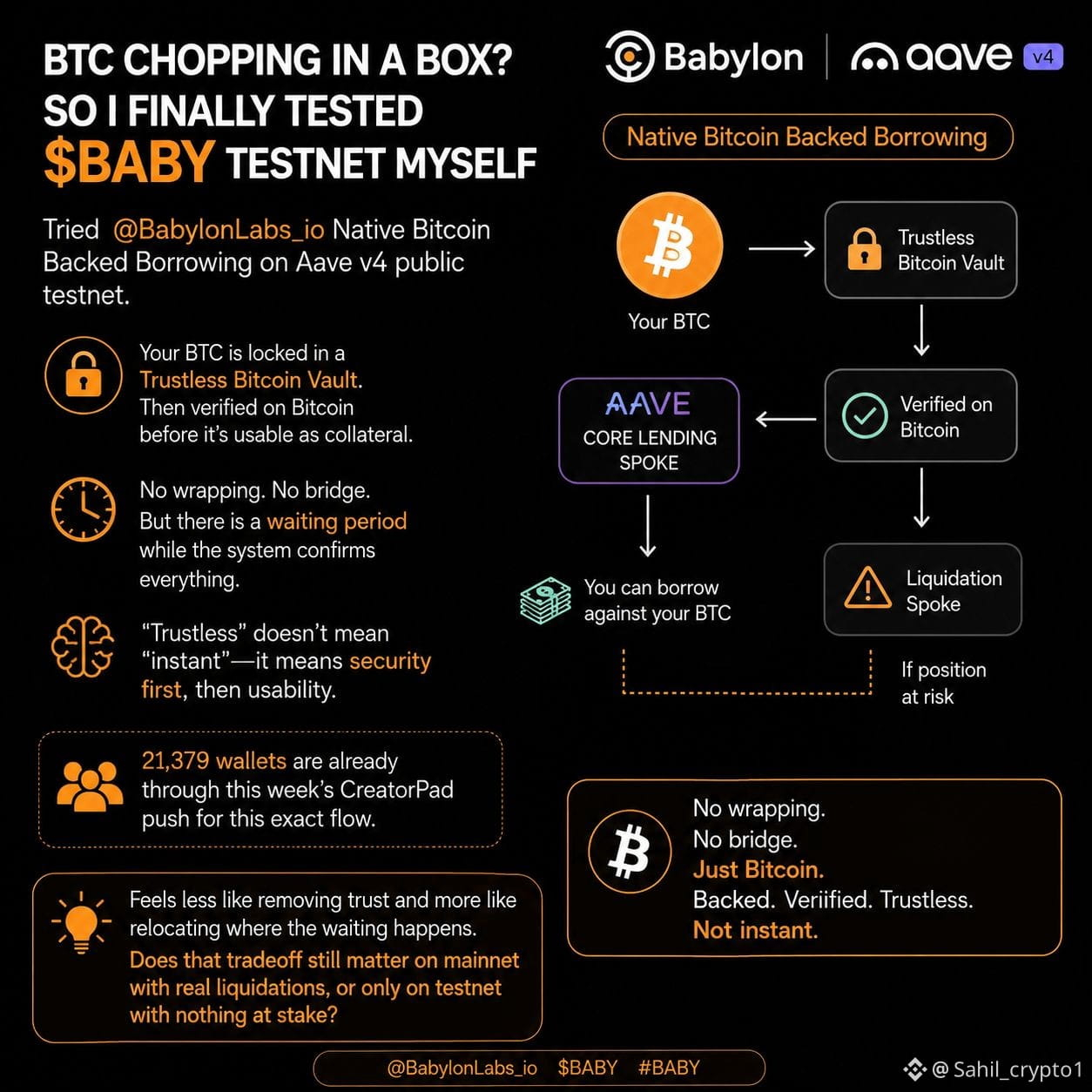
O BTC mal se moveu por dias, então finalmente parei de acompanhar os gráficos e testei pessoalmente o fluxo de Native Bitcoin Backed Borrowing da Babylon.
Uma coisa se destacou: "trustless" não significa "instantâneo".
Seu BTC fica bloqueado dentro de um Cofre de Bitcoin Trustless e, depois, é verificado na Bitcoin antes de se tornar utilizável como garantia. Sem wrapping, sem bridge — mas ainda existe um período de espera enquanto o protocolo confirma tudo.
Essa demora me fez pensar. Talvez o objetivo não seja eliminar a fricção, mas deslocá-la para uma segurança mais forte.
Estou curioso para ver como isso se sente quando a liquidez do mainnet, os limites de empréstimo e liquidações reais estiverem ativos.
@babylonlabs_io o #BABY $BABY
{spot}(BABYUSDT)
$BTC
{spot}(BTCUSDT)
O BTC mal se moveu por dias, então finalmente parei de acompanhar os gráficos e testei pessoalmente o fluxo de Native Bitcoin Backed Borrowing da Babylon.
Uma coisa se destacou: "trustless" não significa "instantâneo".
Seu BTC fica bloqueado dentro de um Cofre de Bitcoin Trustless e, depois, é verificado na Bitcoin antes de se tornar utilizável como garantia. Sem wrapping, sem bridge — mas ainda existe um período de espera enquanto o protocolo confirma tudo.
Essa demora me fez pensar. Talvez o objetivo não seja eliminar a fricção, mas deslocá-la para uma segurança mais forte.
Estou curioso para ver como isso se sente quando a liquidez do mainnet, os limites de empréstimo e liquidações reais estiverem ativos.
@BabylonLabs_io o #BABY $BABY
$BTC
Uma coisa se destacou: "trustless" não significa "instantâneo".
Seu BTC fica bloqueado dentro de um Cofre de Bitcoin Trustless e, depois, é verificado na Bitcoin antes de se tornar utilizável como garantia. Sem wrapping, sem bridge — mas ainda existe um período de espera enquanto o protocolo confirma tudo.
Essa demora me fez pensar. Talvez o objetivo não seja eliminar a fricção, mas deslocá-la para uma segurança mais forte.
Estou curioso para ver como isso se sente quando a liquidez do mainnet, os limites de empréstimo e liquidações reais estiverem ativos.
@BabylonLabs_io o #BABY $BABY
$BTC
5
1
76
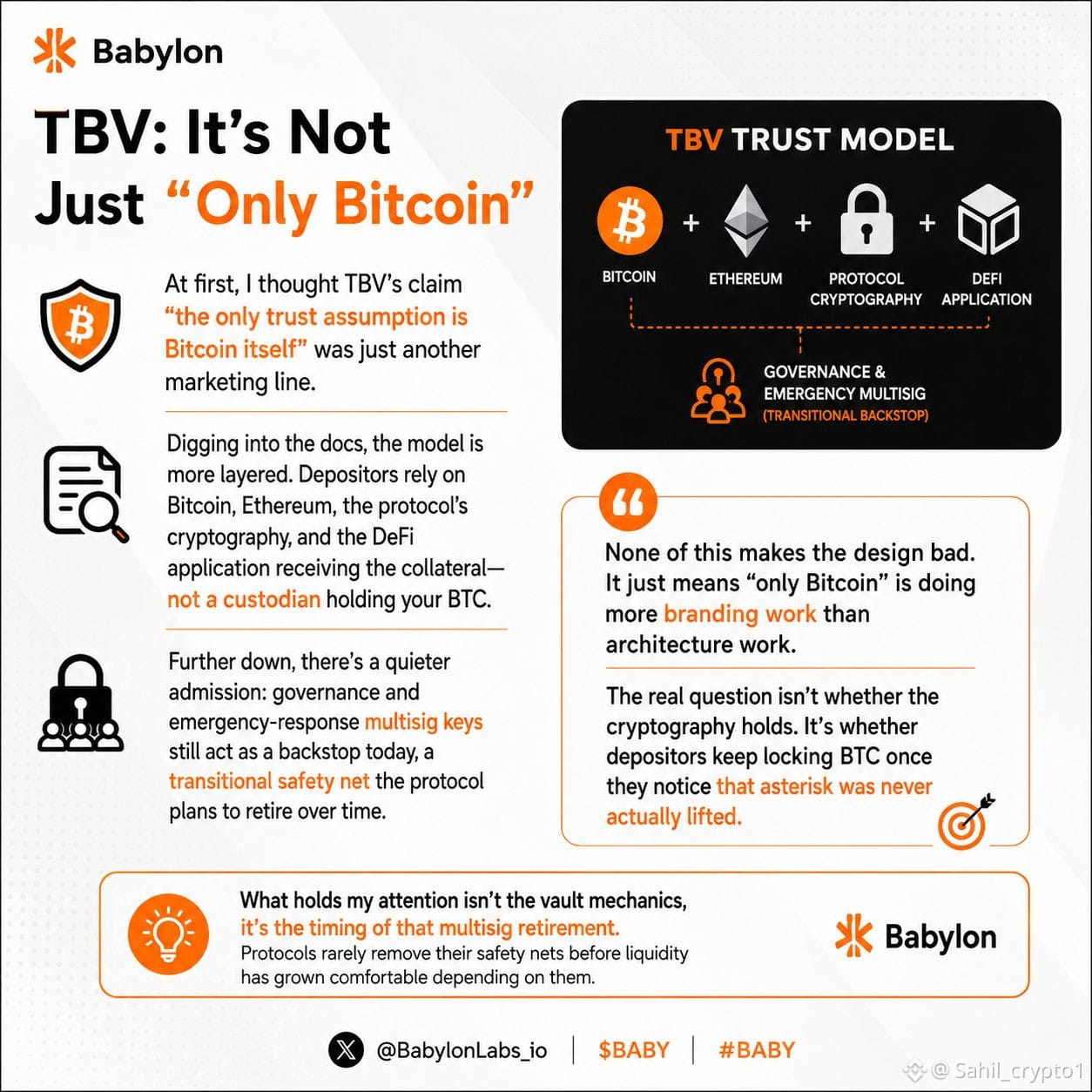
Entrei na TBV pensando que o título era simples: confiar no Bitcoin e em mais nada. Depois de ler com mais profundidade, o modelo é mais sutil. Depositantes confiam no Bitcoin, Ethereum, na criptografia de protocolos e na aplicação DeFi de destino — e não em um custodiante. Essa mudança é significativa, mas não é toda a história.
O detalhe que mais chamou minha atenção foi a governança e o multisig de emergência. A documentação o apresenta como uma salvaguarda temporária que, eventualmente, será removida à medida que o sistema amadurecer. Isso parece menos uma falha e mais como um marco importante para acompanhar.
Para mim, o maior sinal não será apenas o TVL. Será o momento em que esses controles de contingência desaparecerem e o protocolo operar exatamente como foi projetado para o longo prazo. É aí que o modelo de confiança realmente será testado.
@babylonlabs_io $BABY #BABY $BTC $ETH
Entrei na TBV pensando que o título era simples: confiar no Bitcoin e em mais nada. Depois de ler com mais profundidade, o modelo é mais sutil. Depositantes confiam no Bitcoin, Ethereum, na criptografia de protocolos e na aplicação DeFi de destino — e não em um custodiante. Essa mudança é significativa, mas não é toda a história.
O detalhe que mais chamou minha atenção foi a governança e o multisig de emergência. A documentação o apresenta como uma salvaguarda temporária que, eventualmente, será removida à medida que o sistema amadurecer. Isso parece menos uma falha e mais como um marco importante para acompanhar.
Para mim, o maior sinal não será apenas o TVL. Será o momento em que esses controles de contingência desaparecerem e o protocolo operar exatamente como foi projetado para o longo prazo. É aí que o modelo de confiança realmente será testado.
@BabylonLabs_io $BABY #BABY $BTC $ETH
O detalhe que mais chamou minha atenção foi a governança e o multisig de emergência. A documentação o apresenta como uma salvaguarda temporária que, eventualmente, será removida à medida que o sistema amadurecer. Isso parece menos uma falha e mais como um marco importante para acompanhar.
Para mim, o maior sinal não será apenas o TVL. Será o momento em que esses controles de contingência desaparecerem e o protocolo operar exatamente como foi projetado para o longo prazo. É aí que o modelo de confiança realmente será testado.
@BabylonLabs_io $BABY #BABY $BTC $ETH
4
1
111
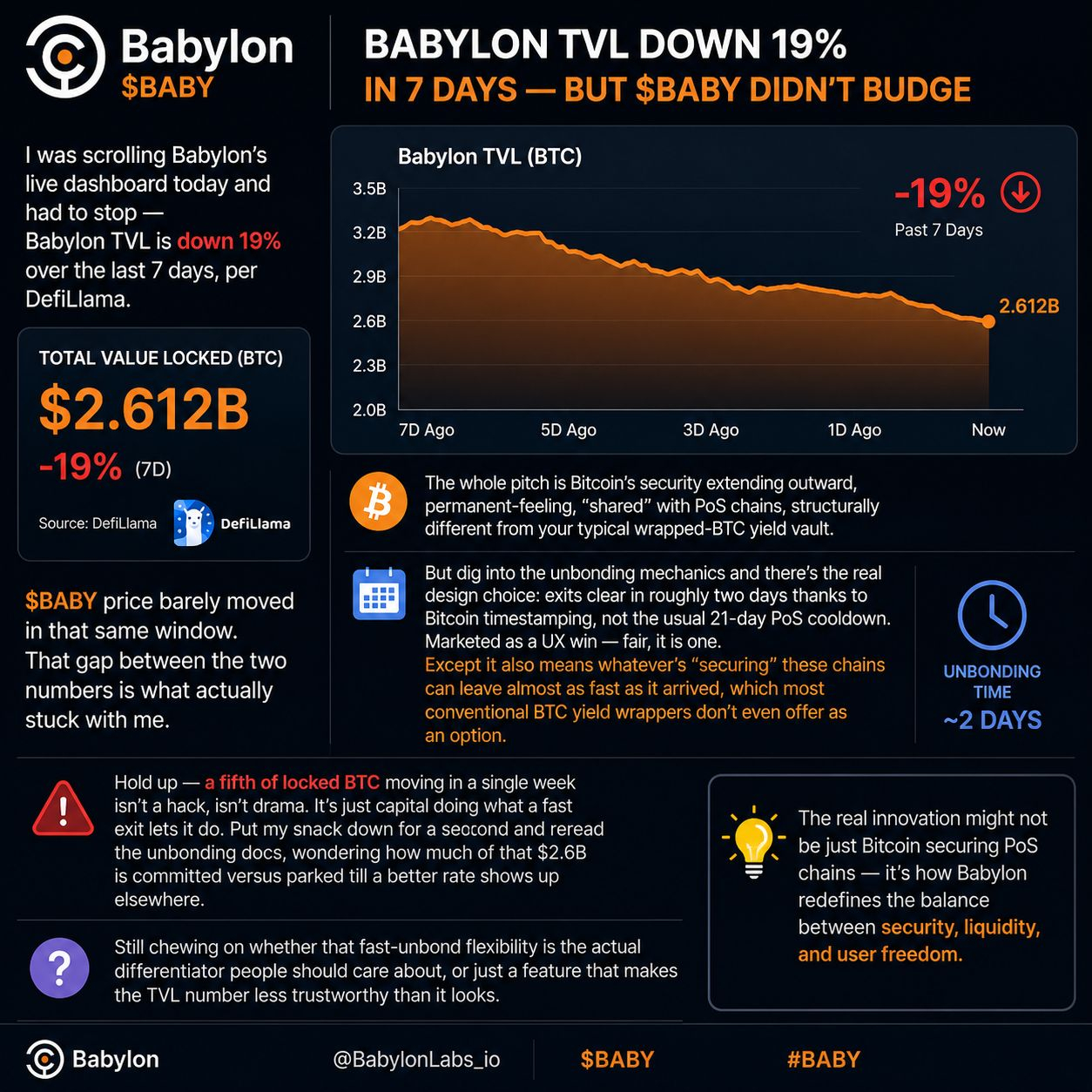
Eu abri o painel da Babylon esperando os números usuais e estáveis, mas uma métrica me fez pausar. Na última semana, o BTC TVL da Babylon caiu acentuadamente, enquanto <0>$BABY </0> mal reagiu. Essa desconexão parece mais interessante do que o próprio preço.
Quanto mais eu lia, mais percebia que as mudanças rápidas de unbonding da Babylon alteram como o TVL deve ser interpretado. Como as saídas levam cerca de dois dias em vez dos longos períodos de espera comuns em muitas redes PoS, o capital consegue rotacionar muito mais rápido. Isso é ótimo para a flexibilidade, mas também significa que o TVL pode refletir oportunidades de curto prazo mais do que convicção de longo prazo.
Um TVL em queda não sinaliza fraqueza automaticamente. Às vezes, é simplesmente liquidez se movendo para onde os rendimentos ou incentivos parecem melhores. A grande questão é se a segurança do Bitcoin continua resiliente quando os participantes têm uma saída com baixo atrito.
Estou começando a achar que a inovação real não é apenas o Bitcoin garantir cadeias PoS — é como a Babylon redefine o equilíbrio entre segurança, liquidez e liberdade do usuário.
@babylonlabs_io #Baby $BABY
{spot}(BABYUSDT)
Eu abri o painel da Babylon esperando os números usuais e estáveis, mas uma métrica me fez pausar. Na última semana, o BTC TVL da Babylon caiu acentuadamente, enquanto <0>$BABY </0> mal reagiu. Essa desconexão parece mais interessante do que o próprio preço.
Quanto mais eu lia, mais percebia que as mudanças rápidas de unbonding da Babylon alteram como o TVL deve ser interpretado. Como as saídas levam cerca de dois dias em vez dos longos períodos de espera comuns em muitas redes PoS, o capital consegue rotacionar muito mais rápido. Isso é ótimo para a flexibilidade, mas também significa que o TVL pode refletir oportunidades de curto prazo mais do que convicção de longo prazo.
Um TVL em queda não sinaliza fraqueza automaticamente. Às vezes, é simplesmente liquidez se movendo para onde os rendimentos ou incentivos parecem melhores. A grande questão é se a segurança do Bitcoin continua resiliente quando os participantes têm uma saída com baixo atrito.
Estou começando a achar que a inovação real não é apenas o Bitcoin garantir cadeias PoS — é como a Babylon redefine o equilíbrio entre segurança, liquidez e liberdade do usuário.
@BabylonLabs_io #Baby $BABY
Quanto mais eu lia, mais percebia que as mudanças rápidas de unbonding da Babylon alteram como o TVL deve ser interpretado. Como as saídas levam cerca de dois dias em vez dos longos períodos de espera comuns em muitas redes PoS, o capital consegue rotacionar muito mais rápido. Isso é ótimo para a flexibilidade, mas também significa que o TVL pode refletir oportunidades de curto prazo mais do que convicção de longo prazo.
Um TVL em queda não sinaliza fraqueza automaticamente. Às vezes, é simplesmente liquidez se movendo para onde os rendimentos ou incentivos parecem melhores. A grande questão é se a segurança do Bitcoin continua resiliente quando os participantes têm uma saída com baixo atrito.
Estou começando a achar que a inovação real não é apenas o Bitcoin garantir cadeias PoS — é como a Babylon redefine o equilíbrio entre segurança, liquidez e liberdade do usuário.
@BabylonLabs_io #Baby $BABY
1
2
80
🚀Eu ficava me perguntando o que @BabylonLabs_io realmente era.
No começo, achei que fosse só mais um ecossistema de staking. Mais TVL, mais recompensas, mais números para comparar.
Depois passei um tempo dentro da comunidade.
O que se destacou não foram os gráficos nem as conversas de mercado. Foi a forma como as pessoas apareciam umas para as outras. As conversas iam do Bitcoin para a vida do dia a dia, de dúvidas técnicas para momentos aleatórios que, de algum jeito, faziam todo mundo sorrir.
Crypto pode parecer barulhenta. Preços se movem, o sentimento muda, os prazos correm atrás da próxima tendência. Mas uma comunidade forte te dá um motivo para continuar quando a empolgação passa.
É isso que eu vejo na Babylon. Um lugar onde as pessoas aprendem juntas, celebram pequenas vitórias e lembram uma à outra que há mais nesse espaço do que apenas velas verdes.
Às vezes, o maior valor não é o token na sua carteira.
É a gente que fica do seu lado em cada ciclo.
💚 @babylonlabs_io #BABY $BABY $VANRY $DEXE
{future}(DEXEUSDT)
{spot}(VANRYUSDT)
{spot}(BABYUSDT)
🚀Eu ficava me perguntando o que @BabylonLabs_io realmente era.
No começo, achei que fosse só mais um ecossistema de staking. Mais TVL, mais recompensas, mais números para comparar.
Depois passei um tempo dentro da comunidade.
O que se destacou não foram os gráficos nem as conversas de mercado. Foi a forma como as pessoas apareciam umas para as outras. As conversas iam do Bitcoin para a vida do dia a dia, de dúvidas técnicas para momentos aleatórios que, de algum jeito, faziam todo mundo sorrir.
Crypto pode parecer barulhenta. Preços se movem, o sentimento muda, os prazos correm atrás da próxima tendência. Mas uma comunidade forte te dá um motivo para continuar quando a empolgação passa.
É isso que eu vejo na Babylon. Um lugar onde as pessoas aprendem juntas, celebram pequenas vitórias e lembram uma à outra que há mais nesse espaço do que apenas velas verdes.
Às vezes, o maior valor não é o token na sua carteira.
É a gente que fica do seu lado em cada ciclo.
💚 @BabylonLabs_io #BABY $BABY $VANRY $DEXE
No começo, achei que fosse só mais um ecossistema de staking. Mais TVL, mais recompensas, mais números para comparar.
Depois passei um tempo dentro da comunidade.
O que se destacou não foram os gráficos nem as conversas de mercado. Foi a forma como as pessoas apareciam umas para as outras. As conversas iam do Bitcoin para a vida do dia a dia, de dúvidas técnicas para momentos aleatórios que, de algum jeito, faziam todo mundo sorrir.
Crypto pode parecer barulhenta. Preços se movem, o sentimento muda, os prazos correm atrás da próxima tendência. Mas uma comunidade forte te dá um motivo para continuar quando a empolgação passa.
É isso que eu vejo na Babylon. Um lugar onde as pessoas aprendem juntas, celebram pequenas vitórias e lembram uma à outra que há mais nesse espaço do que apenas velas verdes.
Às vezes, o maior valor não é o token na sua carteira.
É a gente que fica do seu lado em cada ciclo.
💚 @BabylonLabs_io #BABY $BABY $VANRY $DEXE
1
2
297
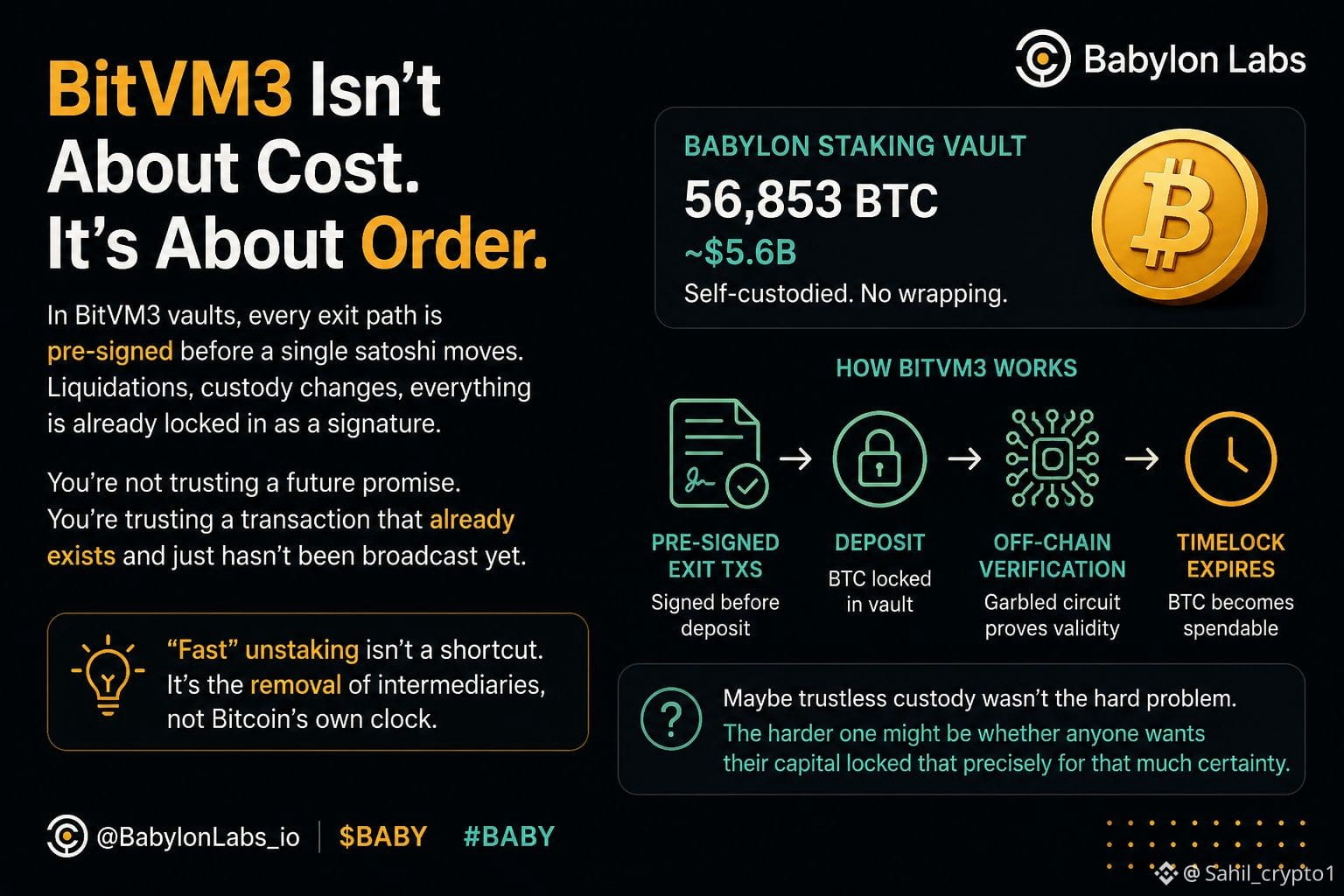
@babylonlabs_io I originalmente pensei que o “unstaking rápido” da Babylon significava que o BTC ficaria disponível muito antes. Depois de olhar com mais atenção, a parte interessante não é um período de espera menor — é a remoção da confiança desnecessária.
A Babylon ainda segue o cronograma nativo de unbonding do Bitcoin. O que muda é o que acontece depois. Não há uma transação de reivindicação extra, aprovação do custodiante ou intermediário exigido antes que você recupere o controle. Assim que o período de unbonding termina, seu BTC simplesmente volta a poder ser gasto.
Essa diferença importa. “Rápido” não significa burlar o modelo de segurança do Bitcoin. Significa eliminar camadas adicionais que muitos wrappers de BTC introduzem após o unbonding. Com mais de 56.853 BTC assegurados no sistema de staking da Babylon, essa escolha de design parece mais importante do que o próprio título.
#baby $BTC $BABY
{future}(BABYUSDT)
{spot}(BTCUSDT)
@BabylonLabs_io I originalmente pensei que o “unstaking rápido” da Babylon significava que o BTC ficaria disponível muito antes. Depois de olhar com mais atenção, a parte interessante não é um período de espera menor — é a remoção da confiança desnecessária.
A Babylon ainda segue o cronograma nativo de unbonding do Bitcoin. O que muda é o que acontece depois. Não há uma transação de reivindicação extra, aprovação do custodiante ou intermediário exigido antes que você recupere o controle. Assim que o período de unbonding termina, seu BTC simplesmente volta a poder ser gasto.
Essa diferença importa. “Rápido” não significa burlar o modelo de segurança do Bitcoin. Significa eliminar camadas adicionais que muitos wrappers de BTC introduzem após o unbonding. Com mais de 56.853 BTC assegurados no sistema de staking da Babylon, essa escolha de design parece mais importante do que o próprio título.
#baby $BTC $BABY
A Babylon ainda segue o cronograma nativo de unbonding do Bitcoin. O que muda é o que acontece depois. Não há uma transação de reivindicação extra, aprovação do custodiante ou intermediário exigido antes que você recupere o controle. Assim que o período de unbonding termina, seu BTC simplesmente volta a poder ser gasto.
Essa diferença importa. “Rápido” não significa burlar o modelo de segurança do Bitcoin. Significa eliminar camadas adicionais que muitos wrappers de BTC introduzem após o unbonding. Com mais de 56.853 BTC assegurados no sistema de staking da Babylon, essa escolha de design parece mais importante do que o próprio título.
#baby $BTC $BABY
4
2
101
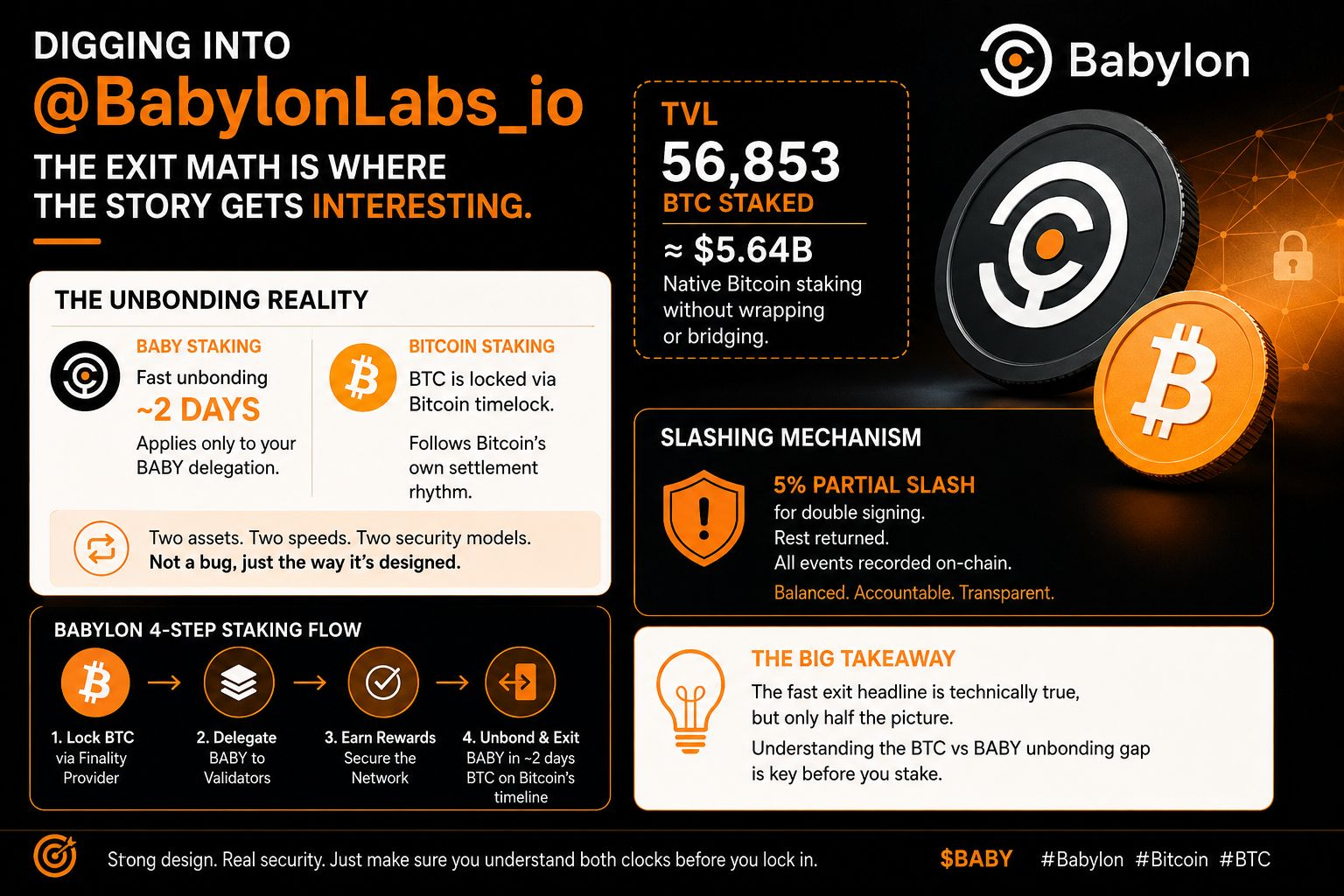
🚀Passei algum tempo pesquisando @BabylonLabs_io e um detalhe se destacou mais do que os números do título.
Com mais de 56.853 BTC apostados, a Babylon provou que há forte demanda por staking nativo de Bitcoin sem fazer wrapping ou bridge de ativos. Mas a parte mais interessante é como o protocolo lida com as saídas.
O staking BABY oferece desinscrição (unbonding) rápida, por volta de 2 dias, o que parece impressionante à primeira vista. O porém é que isso se aplica apenas à sua delegação em BABY. O BTC garantido via timelocks do Bitcoin segue seu próprio processo de liquidação, funcionando independentemente dos epochs do validador da Babylon.
Essa distinção importa porque dois ativos estão seguindo dois modelos de segurança diferentes. Não é enganoso, mas é uma nuance importante que muitas pessoas podem deixar passar ao comparar experiências de staking.
Também passei algum tempo lendo o design do slashing. Assinar duas vezes (double-signing) resulta em um slash parcial de 5%, com a parte restante do stake devolvida e cada evento registrado on-chain. O mecanismo parece equilibrado, priorizando responsabilização sem ser excessivamente punitivo.
O principal aprendizado não foi o TVL ou a alegação de desinscrição rápida. Foi perceber que entender a Babylon significa entender a separação entre as garantias de segurança do Bitcoin e a mecânica de staking do BABY.
É aí que as verdadeiras trocas (trade-offs) do design ficam claras.
$BABY #Baby #Bitcoin $BTC @babylonlabs_io
{spot}(BTCUSDT)
{spot}(BABYUSDT)
🚀Passei algum tempo pesquisando @BabylonLabs_io e um detalhe se destacou mais do que os números do título.
Com mais de 56.853 BTC apostados, a Babylon provou que há forte demanda por staking nativo de Bitcoin sem fazer wrapping ou bridge de ativos. Mas a parte mais interessante é como o protocolo lida com as saídas.
O staking BABY oferece desinscrição (unbonding) rápida, por volta de 2 dias, o que parece impressionante à primeira vista. O porém é que isso se aplica apenas à sua delegação em BABY. O BTC garantido via timelocks do Bitcoin segue seu próprio processo de liquidação, funcionando independentemente dos epochs do validador da Babylon.
Essa distinção importa porque dois ativos estão seguindo dois modelos de segurança diferentes. Não é enganoso, mas é uma nuance importante que muitas pessoas podem deixar passar ao comparar experiências de staking.
Também passei algum tempo lendo o design do slashing. Assinar duas vezes (double-signing) resulta em um slash parcial de 5%, com a parte restante do stake devolvida e cada evento registrado on-chain. O mecanismo parece equilibrado, priorizando responsabilização sem ser excessivamente punitivo.
O principal aprendizado não foi o TVL ou a alegação de desinscrição rápida. Foi perceber que entender a Babylon significa entender a separação entre as garantias de segurança do Bitcoin e a mecânica de staking do BABY.
É aí que as verdadeiras trocas (trade-offs) do design ficam claras.
$BABY #Baby #Bitcoin $BTC @BabylonLabs_io
Com mais de 56.853 BTC apostados, a Babylon provou que há forte demanda por staking nativo de Bitcoin sem fazer wrapping ou bridge de ativos. Mas a parte mais interessante é como o protocolo lida com as saídas.
O staking BABY oferece desinscrição (unbonding) rápida, por volta de 2 dias, o que parece impressionante à primeira vista. O porém é que isso se aplica apenas à sua delegação em BABY. O BTC garantido via timelocks do Bitcoin segue seu próprio processo de liquidação, funcionando independentemente dos epochs do validador da Babylon.
Essa distinção importa porque dois ativos estão seguindo dois modelos de segurança diferentes. Não é enganoso, mas é uma nuance importante que muitas pessoas podem deixar passar ao comparar experiências de staking.
Também passei algum tempo lendo o design do slashing. Assinar duas vezes (double-signing) resulta em um slash parcial de 5%, com a parte restante do stake devolvida e cada evento registrado on-chain. O mecanismo parece equilibrado, priorizando responsabilização sem ser excessivamente punitivo.
O principal aprendizado não foi o TVL ou a alegação de desinscrição rápida. Foi perceber que entender a Babylon significa entender a separação entre as garantias de segurança do Bitcoin e a mecânica de staking do BABY.
É aí que as verdadeiras trocas (trade-offs) do design ficam claras.
$BABY #Baby #Bitcoin $BTC @BabylonLabs_io
2
1
87
Inicia sessão para explorar mais conteúdos
Junta-te a utilizadores de criptomoedas de todo o mundo na Binance Square
⚡️ Obtém informações úteis e recentes sobre criptomoedas.
💬 Com a confiança da maior exchange de criptomoedas do mundo.
👍 Descobre perspetivas reais de criadores verificados.
E-mail/Número de telefone
Tópicos em Tendência
SECReceivesGrayscaleLitecoinTrustETFFiling
53,585 visualizações
1,040 a discutir
#secreceivesgrayscalelitecointrustetffiling
A SEC RECEBE O PROCESSO DO ETF DE LITECOIN DA GRAYSCALE: LTC ACABOU DE GANHAR MAIS DESTAQUE 🚨
O mercado se movia em silêncio quando mais um título sobre Litecoin apareceu. Para traders que observam de fora, era o tipo de processo que faz você pausar e pensar: o acesso institucional está ficando mais perto?
O Grayscale’s Litecoin Trust deu mais um passo em direção a uma estrutura de ETF, com novas documentações ligadas à transição proposta e ao processo de listagem na NYSE Arca. O registro da SEC mostra procedimentos anteriores em torno da proposta de Litecoin da Grayscale, enquanto as atividades mais recentes mantêm a história em evidência.
O ponto importante é que um processo não é uma aprovação. Investidores devem separar o avanço regulatório das expectativas de um lançamento imediato de ETF.
Minha leitura: a história maior é a acessibilidade. Uma estrutura de ETF pode, potencialmente, tornar a exposição ao LTC mais fácil para investidores tradicionais que preferem produtos de mercado regulamentados em vez de manter criptomoedas diretamente.
O Litecoin atualmente é negociado por volta de US$ 53,69 na Binance, com o ativo mostrando um movimento moderado nas últimas 24 horas. Isso torna o desenvolvimento regulatório mais interessante do que apenas correr atrás de uma reação de preço baseada em manchetes.
O teste real vem agora: decisões regulatórias, demanda do mercado, liquidez e se o interesse institucional de fato acompanha a documentação.
Um processo pode abrir a porta, mas a demanda é que decide o que acontece depois que ela se abre.
❓Você acha que um ETF de Litecoin da Grayscale poderia mudar materialmente a demanda institucional por LTC?
Aviso: isto é apenas para fins informativos e não constitui aconselhamento financeiro. Ativos cripto são voláteis, e os resultados regulatórios são incertos.
#Litecoin #CryptoETF #GrowWithSAC $LTC $ETH $SOL
#SECReceivesGrayscaleLitecoinTrustETFFiling
Sienna Leo-你真棒-带我走
·2 gostos
·1.5k visualizações
ClarityActFacesProceduralVoteSept15
172,293 visualizações
1,951 a discutir
US10YearTreasuryYieldNears5%
59,186 visualizações
1,064 a discutir