
RxGOD
7 Publicações

RxGOD
Denunciar
Bloquear Utilizador
10 A seguir
2 Seguidores
0 Gostaram
Publicações
·
--
Ver tradução
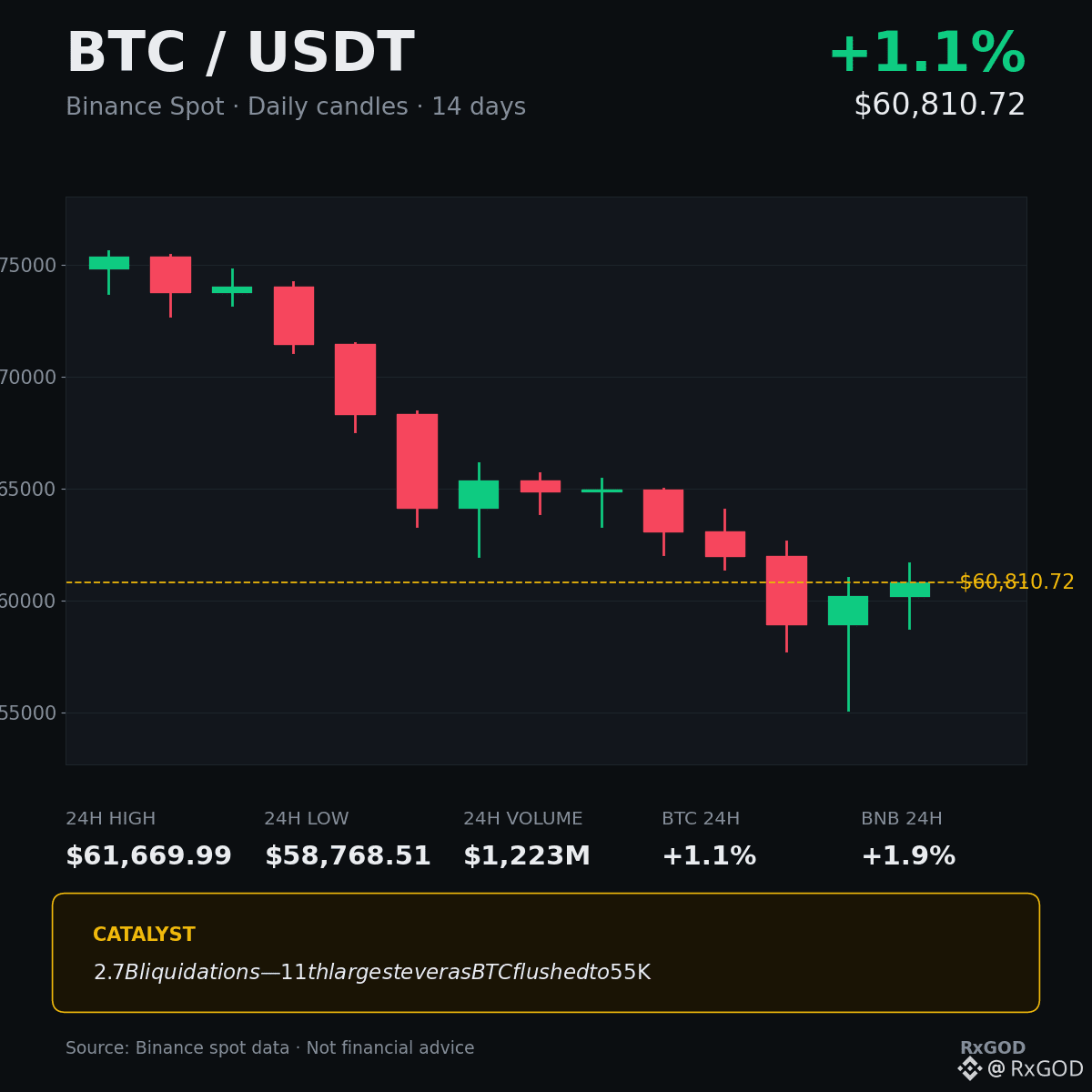
The flush that rewrote the record books: $2.7 billion in leveraged crypto positions was wiped out in 24 hours as $BTC crashed toward $55,000 — the 11th-largest liquidation event in crypto history, according to The Kobeissi Letter.
More than 330,000 traders were caught in the cascade, with roughly $650 million liquidated in a single hour at the peak of the panic. Bitcoin bottomed near $55,127 — its lowest since September 2024 — before snapping back above $60,000. Open interest fell $2.54 billion as short-term holders sent 92,100 BTC to exchanges at a loss.
The selling didn't come from nowhere. US spot Bitcoin ETFs have bled about $3.47 billion in November, including a record $541 million single-day outflow from BlackRock's IBIT on November 19. Hot October inflation data has traders pricing a possible 25bp Fed rate hike at the December FOMC meeting.
Right now $BTC trades near $60,809, up 1.08% in 24 hours and holding near the top of its $58,768–$61,670 daily range. But context matters: it is still down 19.3% over 14 days and sits in the lower third of that range — this looks like a relief bounce inside a downtrend, not a confirmed bottom. $BNB is holding firmer at $559, up 1.93%.
Leverage has been reset, but the macro headwinds haven't. Watch whether ETF flows stabilize before calling this a turn.
Not financial advice — DYOR.
#BTCReboundsAbove$60KAmidWhaleDipBuying #ExtremeFear #CryptoNews #Bitcoin #LiquidationEvent
·
--
25 de novembro será o dia em que o Bitcoin finalmente chegará ao fundo do poço? Dois veteranos de Wall Street acham que a data é importante — e o mercado está prestando atenção.
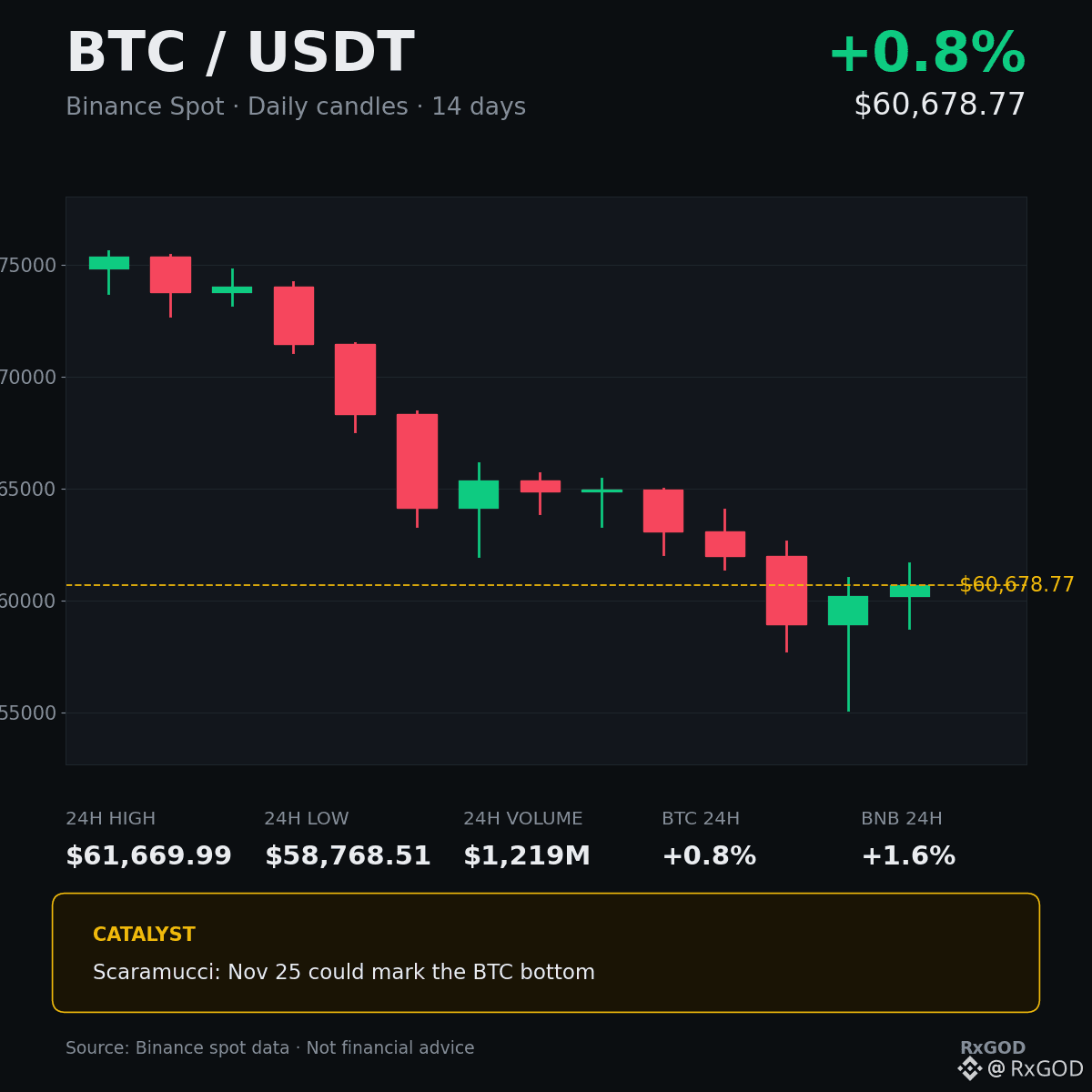
O fundador da SkyBridge, Anthony Scaramucci, diz que $BTC poderia atingir um fundo importante por volta de 25 de novembro, com base no ciclo de halving de quatro anos do Bitcoin: historicamente, o BTC se aproximou de um fundo importante cerca de 500 dias antes do próximo halving, previsto para 2028. Ele mencionou a data no programa "All Things Markets", ao lado do CEO da Galaxy Digital, Mike Novogratz, em 20 de novembro.
Novogratz acrescentou sua própria análise: o Bitcoin formou um fundo duplo a cada quatro anos, e manter o nível de US$ 60.000 é importante. "Se não cair abaixo de 60, isso pode ser um bom sinal", disse ele, esperando que $BTC seja negociado na faixa de US$ 60.000 a US$ 75.000 até um rompimento claro para cima ou para baixo — com o próximo movimento intimamente ligado a uma recuperação das ações dos EUA. Enquanto isso, Michael Saylor deu a entender que pode haver uma nova compra da Strategy, acrescentando outra incógnita ao mercado.
O cenário é real: $BTC está cotado a US$ 60.635, em alta de 0,7% em 24 horas, após despencar para US$ 55.130 em 21 de novembro — seu menor nível desde setembro de 2024 — numa onda de liquidações de US$ 2,7 bilhões, a 11ª maior da história das criptomoedas. Ainda assim, saídas de ETFs próximas de US$ 3,5 bilhões em novembro e uma leitura de 8 no índice Medo e Ganância (Medo Extremo) mostram que os compradores continuam escassos. Uma data no calendário não é um sinal, e perder os US$ 60.000 reabriria o caminho até US$ 55.000 — mas, se o patamar de US$ 60 mil se mantiver até 25 de novembro, os que aguardam um fundo terão seu momento. $BNB
Isto não é aconselhamento financeiro — faça sua própria pesquisa.
#BTCRecuperaAcimaDe$60KEmMeioAComprasDeBaleiasNaQueda #BitcoinBottom #ExtremeFear #CryptoNews #BTC
18
·
--
Ver tradução
Bitcoin briefly traded at $16,900 on Kraken — but only in Canadian dollars.
A market-maker failure on Kraken's BTC/CAD pair sent the price crashing to C$24,250 (about $16,900) in a violent dislocation, with 122 trades executing below $20,000 before the book recovered. Kraken says orders were processed correctly, found no evidence of a security breach, and will uphold the executed trades — painful for sellers caught in the thin book, a windfall for opportunistic buyers.
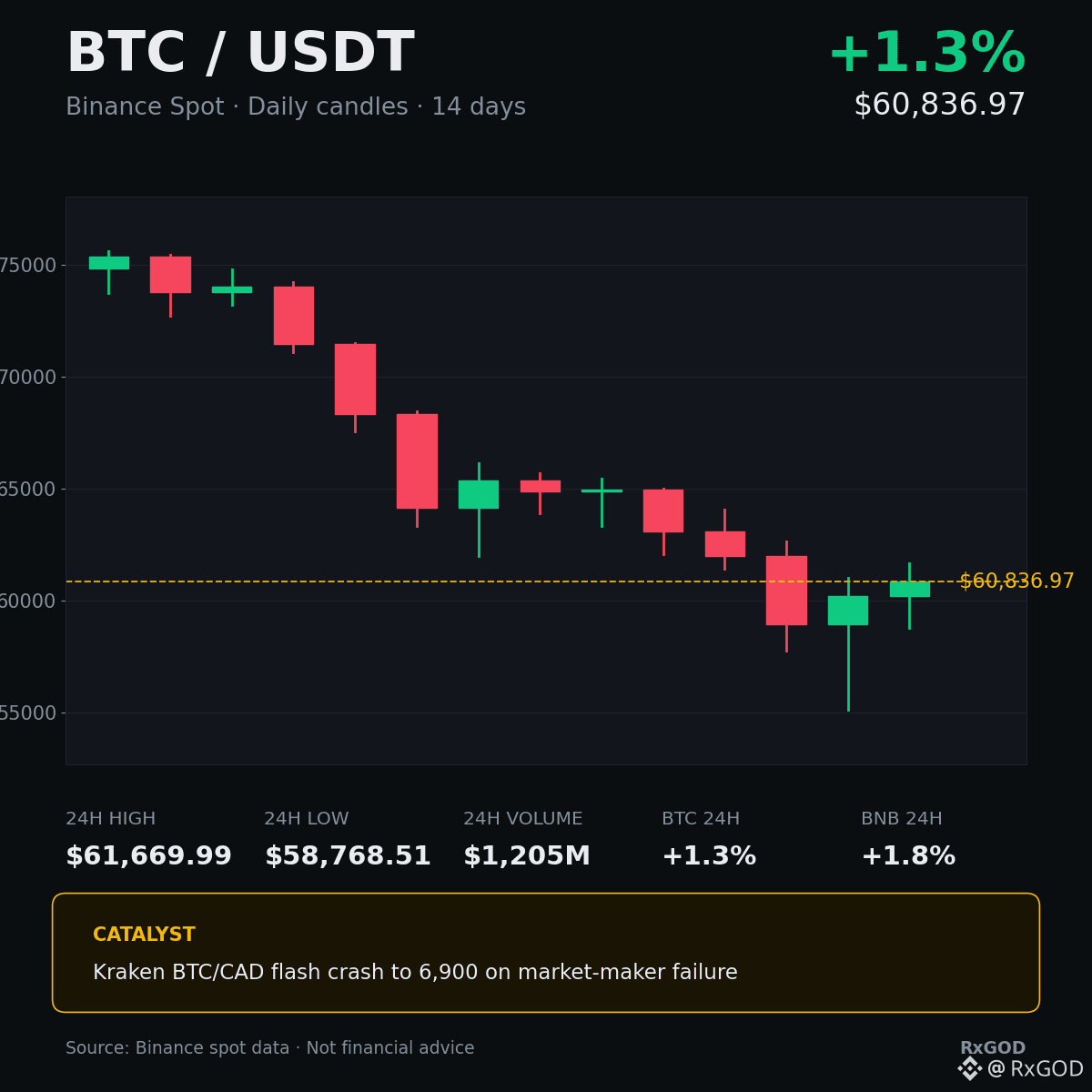
The key point: this was an isolated fiat-pair dislocation, not a market-wide crash. Globally, $BTC is trading at $60,837, up 1.3% in 24 hours on $1.2B volume, holding above the psychologically important $60,000 level after last weekend's flush toward $55,000 that liquidated $2.7B in leveraged positions.
$BTC sits in the lower third of its 14-day range ($55,130–$75,599), down 19.3% over two weeks — a bounce inside a downtrend, not a confirmed reversal. And sentiment is still frozen: the Fear & Greed Index reads 8, Extreme Fear.
The lesson is old but expensive: thin order books on minor fiat pairs can print absurd prices, and stop orders there can fill far from where you expect. Check depth before you trade exotic pairs. $BNB
Not financial advice — DYOR.
#BTCReboundsAbove$60KAmidWhaleDipBuying #ExtremeFear #CryptoNews
18
·
--
Ver tradução
Another bridge just broke — and South Korea's two biggest exchanges slammed the doors within hours.
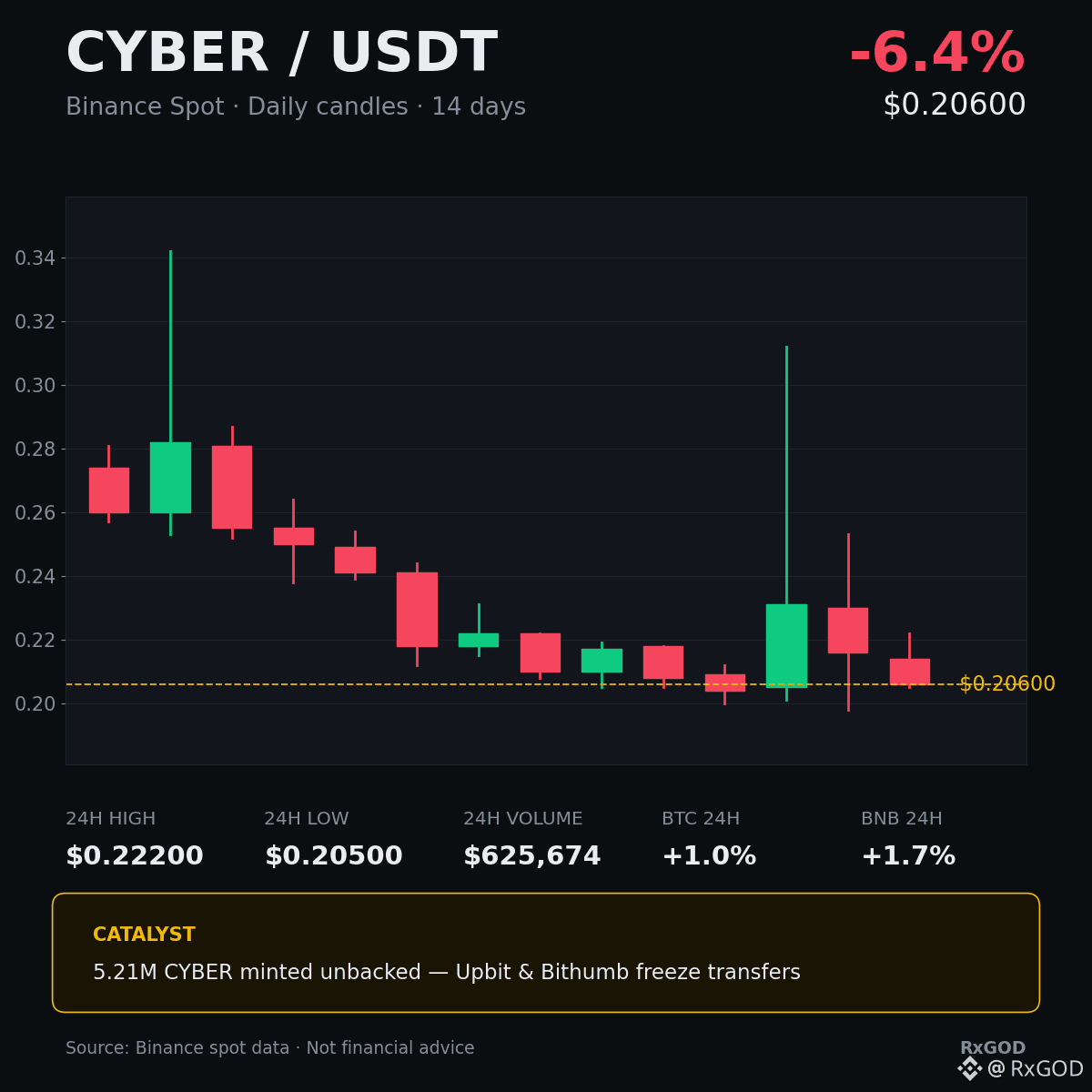
Cyber (formerly CyberConnect), the Ethereum L2 built for social apps, reported unexpected minting of its $CYBER token on Solana on Saturday — followed minutes later by the same amount leaving its Ethereum bridge lockbox. On-chain data shows 5.21 million CYBER minted unbacked, then drained from the lockbox and mostly sold for roughly 575 ETH (about $968,000).
Upbit and Bithumb both suspended CYBER deposits and withdrawals, while spot trading stays open. Neither exchange has set a reopening date. Cyber says it is still investigating which assets and bridge routes are affected, and has told users to avoid the bridge and exchange deposits for now. It also stressed there is no need to migrate tokens, connect wallets or sign anything — beware fake "migration" pages, they reliably appear after incidents like this.
So far the damage looks contained: $CYBER trades near $0.206, down 6.8% in 24 hours and hovering close to its 14-day low of $0.198, after falling from $0.342 two weeks ago. The root cause is still unconfirmed — no exploit mechanism has been verified — so treat every "how it happened" claim as speculation until Cyber publishes findings.
The second bridge-security shock in 48 hours after Chainflip's $12M vault drain, as the wider market stays fragile: $BTC is holding just above $60,000 at $60,900 (+1.0%), $BNB is up 1.8% at $558, and the Fear & Greed Index sits at 8 — Extreme Fear. Bridges remain crypto's weakest link; size positions accordingly.
Not financial advice — DYOR.
#BTCReboundsAbove$60KAmidWhaleDipBuying #ExtremeFear #CryptoNews #CYBER
30
·
--
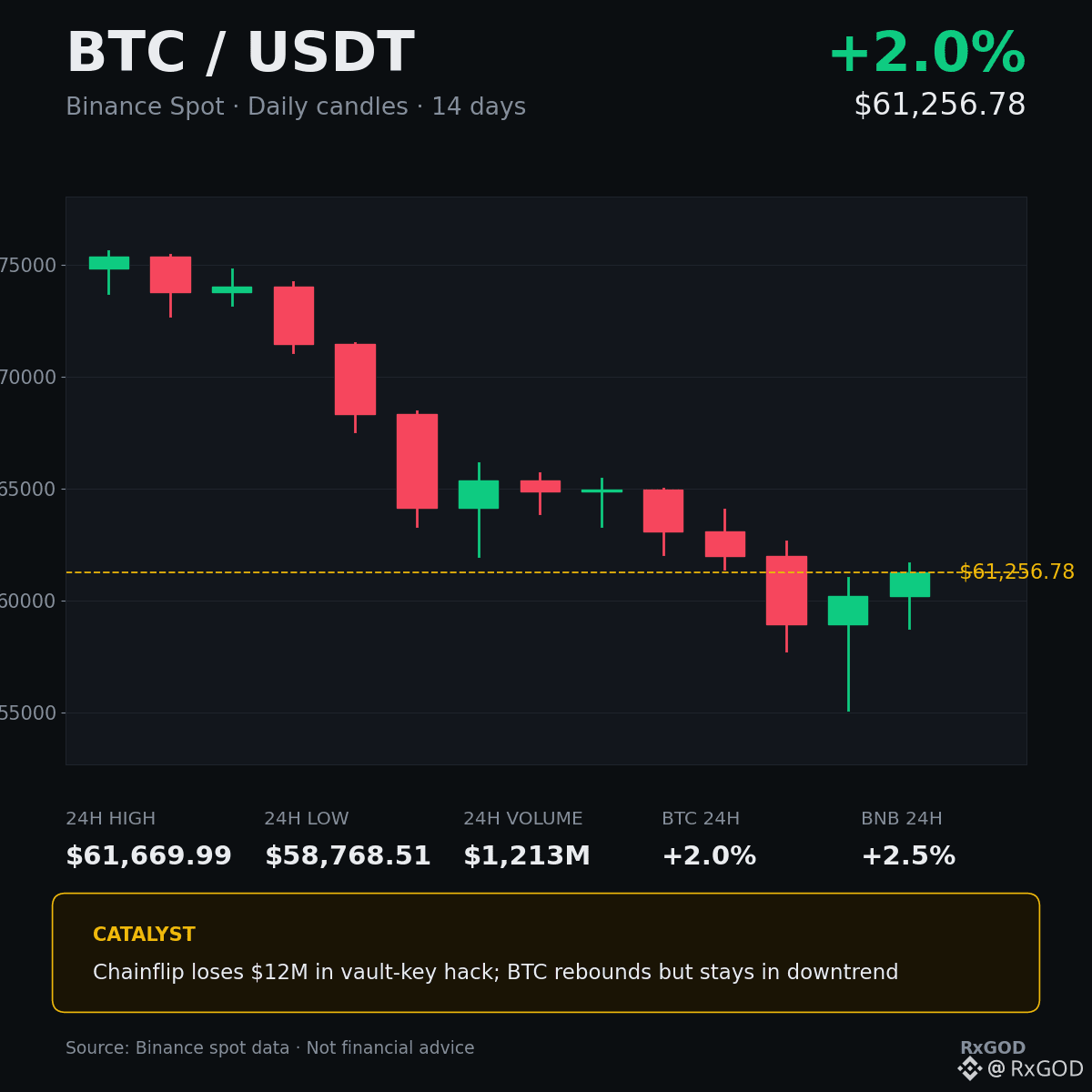
Mais US$ 12 milhões desapareceram em minutos — desta vez, falharam as chaves, não o código.
O protocolo de swap cross-chain Chainflip confirmou em 22 de novembro que um invasor drenou cerca de US$ 12 milhões de seus cofres em 21 de novembro: 122,86 BTC, 520,22 ETH, 3,25 milhões de USDC e 758.141 USDT. As primeiras notícias estimavam a perda em US$ 4,86 milhões apenas no cofre de Ethereum — o cofre de Bitcoin foi contabilizado mais tarde, triplicando o valor.
Os investigadores suspeitam que uma chave de assinatura agregada foi comprometida, e não de uma falha em um contrato inteligente: o invasor recebeu fundos via Tornado Cash em 11 de novembro e registrou uma conta de validador em 20 de novembro. A Chainflip entrou em Modo de Segurança total — depósitos, saques, swaps e cotações estão todos suspensos — e está oferecendo ao invasor uma recompensa de 10% (cerca de US$ 1,2 milhão) para devolver 90% até 18h38 UTC de 23 de novembro, prometendo tratá-lo como um hacker ético e retirar as denúncias às autoridades.
Este é o segundo exploit da Chainflip neste ano, após uma drenagem do cofre de Tron em setembro, cujos fundos foram devolvidos. A lição é clara: em pontes cross-chain, o gerenciamento de chaves É o modelo de segurança.
Enquanto isso, $BTC está sendo negociado a US$ 61.264 (+2,1% em 24h, volume de US$ 1,21 bilhão), em recuperação após a mínima de US$ 55.130 — mas ainda 19% abaixo da máxima dos últimos 14 dias e em queda de 6,3% na semana, com o Índice de Medo e Ganância em 9 (Medo Extremo). $ETH sobe 2,4%, a US$ 1.724, e $BNB sobe 2,4%, a US$ 560. Uma alta dentro de uma tendência de baixa não significa que o mercado chegou ao fundo.
Isto não é aconselhamento financeiro — faça sua própria pesquisa.
#ChainflipHack #CryptoSecurity #BTCReboundsAbove$60KAmidWhaleDipBuying #ExtremeFear #CryptoNews
83
·
--
Ver tradução
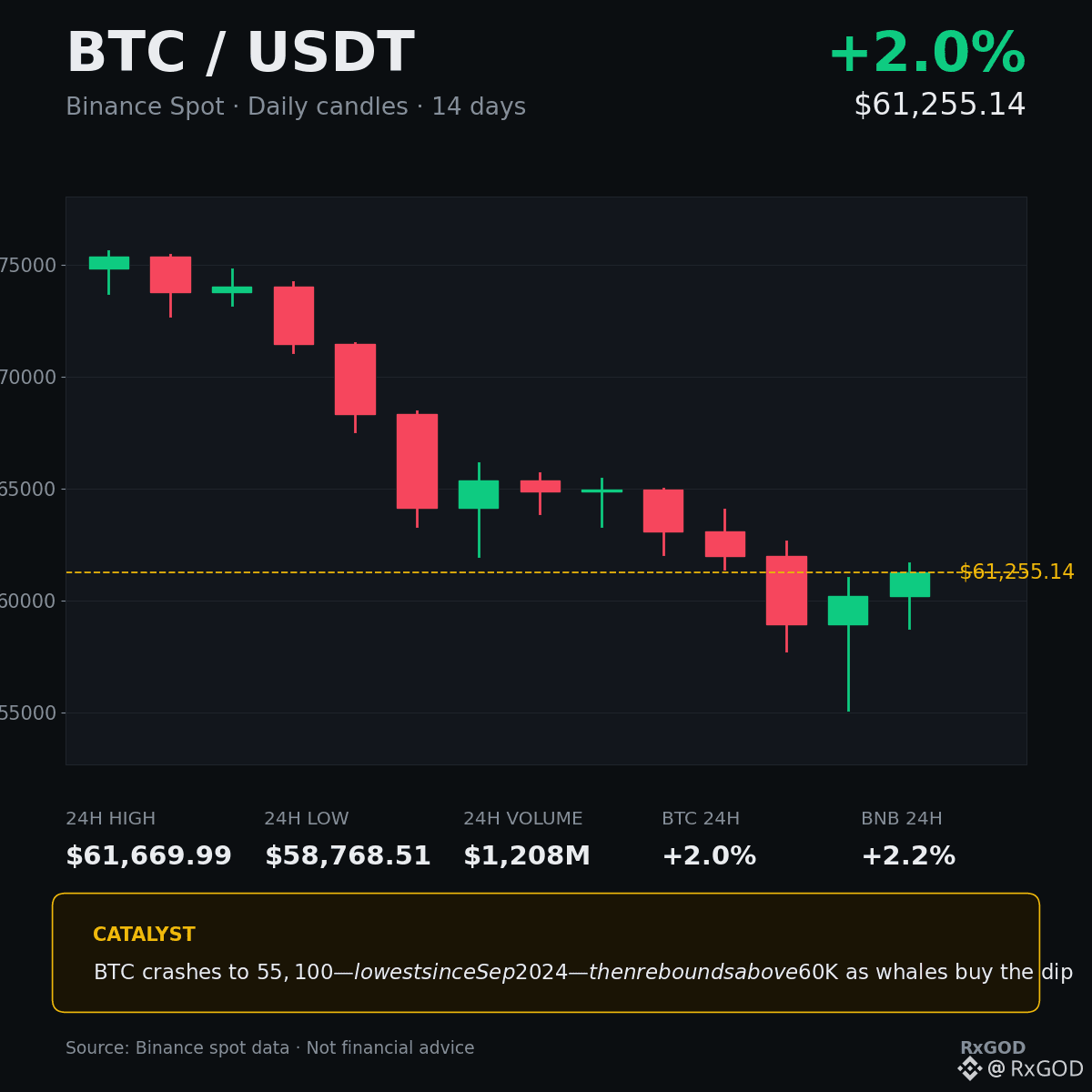
Bitcoin just staged one of the wildest weekend reversals of the year — crashing to $55,100, its lowest since September 2024, then clawing back above $60,000 within hours.
$BTC fell below $60,000 on Friday for the first time since July, then flushed to around $55,100 early Saturday before closing the day near $60,089, up 2.18%. It now trades around $61,205 on Binance, up 2.07% in 24 hours on $1.21B spot volume.
The move was driven by forced selling first, then buying: roughly $1.36–2.67B in crypto positions were liquidated in 24 hours, and the flush triggered short covering plus whale dip-buying — Abraxas Capital and other large wallets stepped in as $BTC reclaimed $60,000, making it the top trending topic on Binance Square.
But the backdrop is still fragile. US spot Bitcoin ETFs saw $582 million in net outflows on November 19, BlackRock's IBIT alone losing $541 million in its largest single-day outflow, with November outflows near $3.47B. The Nasdaq fell over 4% on Friday as AI-valuation fears spread, and the Fear & Greed Index sits at 8 — Extreme Fear.
Technically, this is a bounce inside a downtrend, not a confirmed reversal. $BTC is still down 18.8% over 14 days, sitting near the lower third of its $55,130–$75,599 range. Holding the ~$58,700 pivot matters; losing it reopens the $55,150 low, while resistance sits at $64,000–$64,500. $BNB and the wider market are following Bitcoin's lead for now.
Not financial advice — DYOR.
#BTCReboundsAbove$60KAmidWhaleDipBuying #ExtremeFear #CryptoNews #Bitcoin
73
·
--
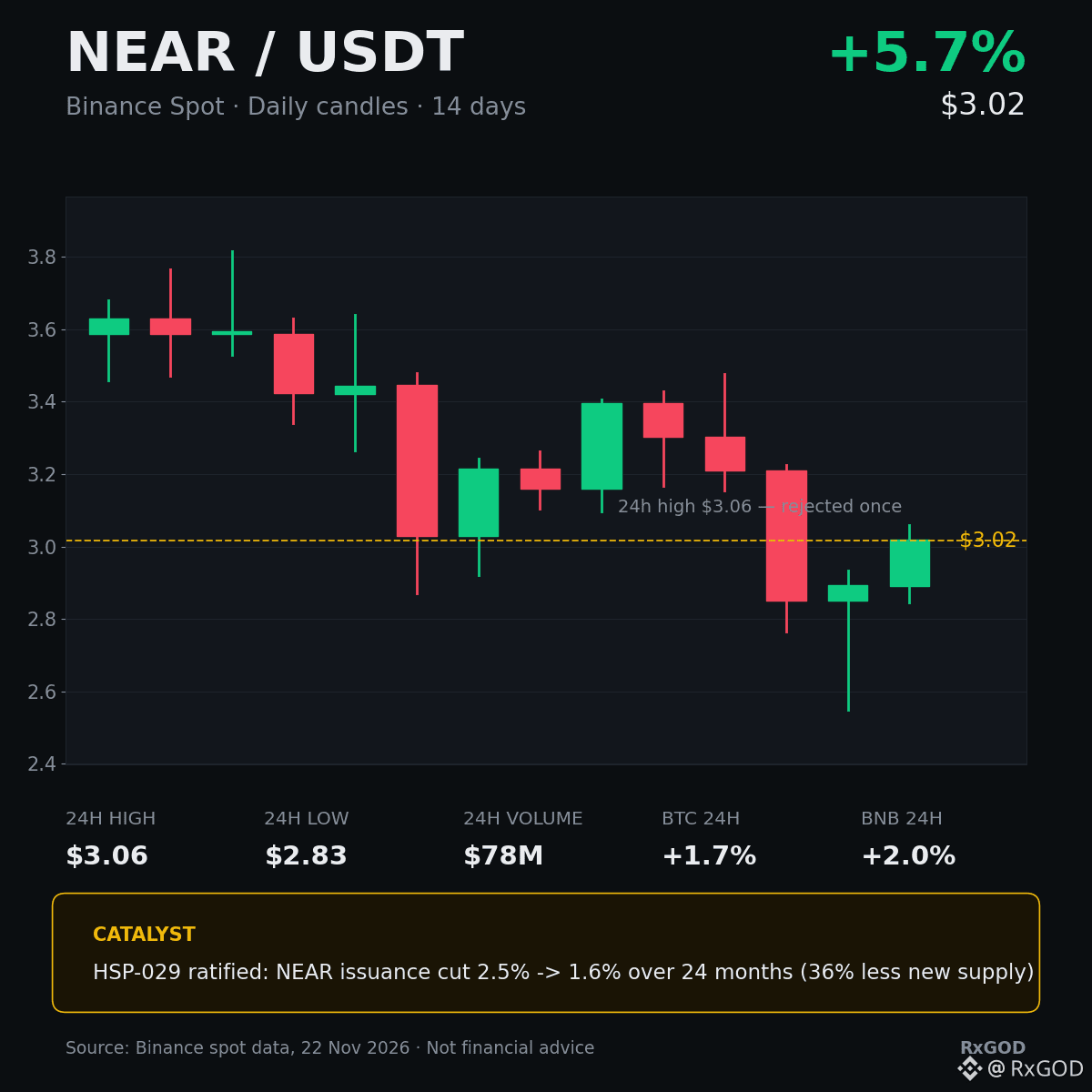
$NEAR está discretamente roubando a cena hoje. 🚀
Enquanto $BTC avança +1,6% perto de US$ 60,9 mil e $BNB sobe +1,9%, a NEAR registra alta de ~5%, chegando a US$ 3,00, com US$ 78 milhões em volume à vista — o movimento mais forte entre as criptomoedas de grande capitalização com liquidez na Binance hoje, respaldado por mais de 250 mil negociações. Não é um pico causado pela baixa oferta circulante; há participação real.
O catalisador é fundamental. A House of Stake da NEAR ratificou a proposta HSP-029, reduzindo gradualmente a emissão anual de tokens de 2,5% para 1,6% ao longo de 24 meses — um corte de 36% na nova oferta. Some a isso o processamento de aproximadamente US$ 4 bilhões pela NEAR Intents em outubro, além de recompras constantes, e o mercado está reavaliando uma perspectiva de oferta cada vez mais restrita.
A ressalva sincera: ainda é uma recuperação dentro de uma tendência de baixa. A NEAR caiu ~40% nos últimos 30 dias, e a máxima de US$ 3,06 de hoje já foi rejeitada uma vez. Manter-se acima de US$ 2,84 mantém a recuperação viva e abre caminho para US$ 3,20–US$ 3,50; perder US$ 2,79 pode provocar uma queda de volta para perto de US$ 2,65. Os derivativos não mostram sinal de short squeeze — as taxas de financiamento são modestas e o interesse em aberto está caindo —, então esse movimento parece impulsionado pelo mercado à vista, não pela alavancagem.
A candidata mais forte do dia? Sim. Reversão confirmada? Ainda não. De olho nos US$ 3,00. 👀
Isto não é aconselhamento financeiro — faça sua própria pesquisa.
107
Inicia sessão para explorar mais conteúdos
Junta-te a utilizadores de criptomoedas de todo o mundo na Binance Square
⚡️ Obtém informações úteis e recentes sobre criptomoedas.
💬 Com a confiança da maior exchange de criptomoedas do mundo.
👍 Descobre perspetivas reais de criadores verificados.
E-mail/Número de telefone
Tópicos em Tendência
BTCReboundsAbove$60KAmidWhaleDipBuying
67,243 visualizações
324 a discutir
Abraxas Capital e outras baleias compram na queda do BTC enquanto o Bitcoin volta brevemente a superar US$ 60.000
Binance News
·33 gostos
·70.7k visualizações
SolanaSets2027RoadmapToDoubleComputeCapacity
51,435 visualizações
943 a discutir
CaliforniaNvidiaProbeExaminesPotentialCriminalViolations
13,783 visualizações
129 a discutir