

M AFZAL RYK
9.6k Publicações

M AFZAL RYK
Denunciar
Bloquear Utilizador
Crypto lover || Creatorpad content creator || BNB || BTC || SOL || Square Influencer
Aberto ao trading
Trader Frequente
1 ano(s)
644 A seguir
19.9K+ Seguidores
7.0K+ Gostaram
Publicações
Portfólio
Tudo
Cotações
Em direto
PINNED
·
--
Em Alta
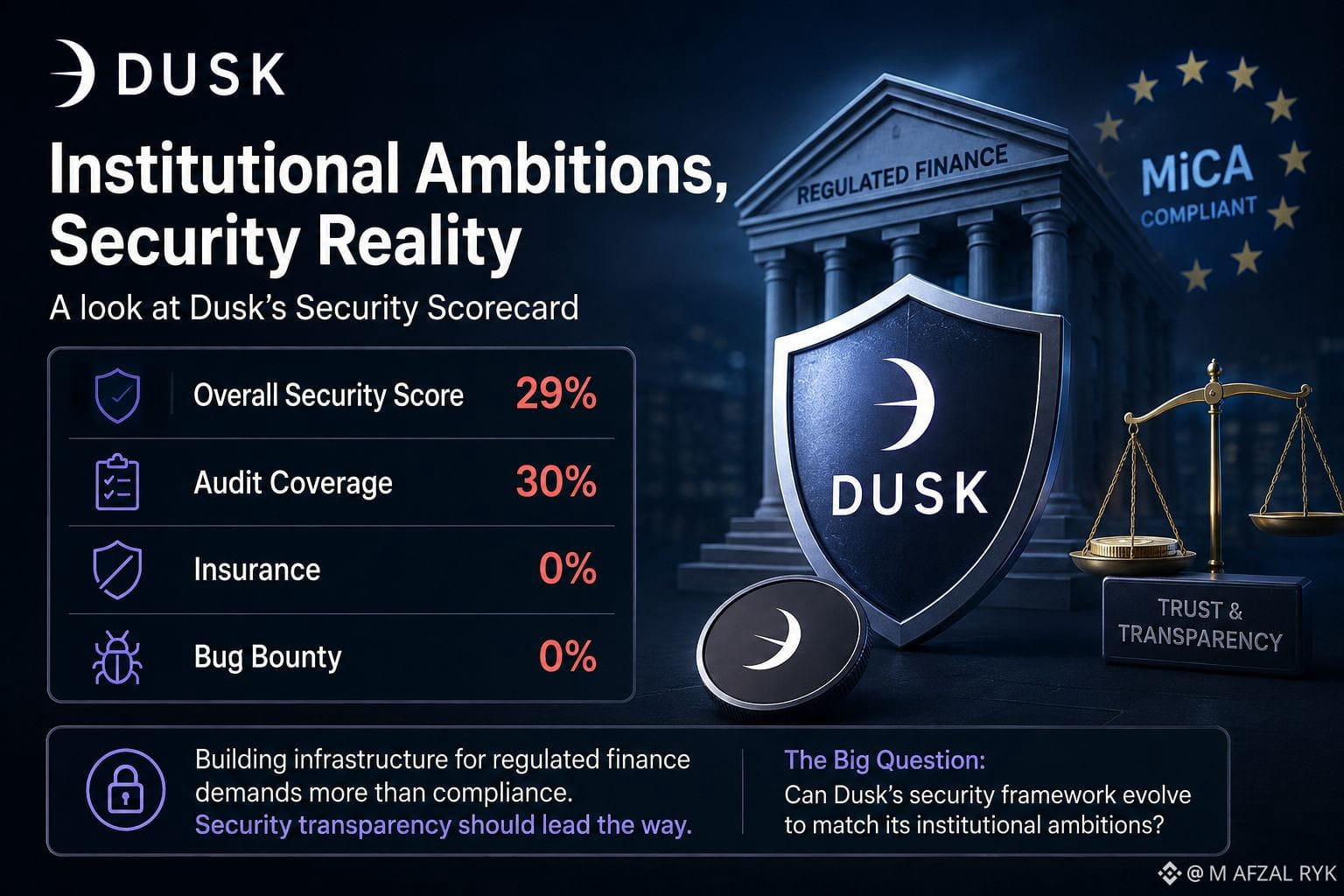
O crepúsculo $DUSK parece convincente do lado institucional, especialmente com seu foco em finanças reguladas, títulos tokenizados e infraestrutura compatível com MiCA.
Mas a avaliação de segurança me fez pausar.
Pontuação geral de segurança: 29%
Cobertura de auditoria: 30%
Seguro: 0%
Bug bounty: 0%
O bug bounty de 0% é a maior questão para mim. Um projeto que mira custodians, instituições e ativos financeiros regulados deveria, idealmente, ter incentivos sólidos para que pesquisadores independentes encontrem e relatem vulnerabilidades.
Isso não significa que o Dusk seja inseguro. Apenas destaca uma lacuna entre a narrativa de nível institucional e as métricas de segurança atualmente visíveis.
O DUSK está em torno de US$ 0,065 após ganhar aproximadamente 1,4% nas últimas 24h, mas o preço não é a história principal aqui.
Se o Dusk quer ser confiável para as finanças reguladas, não deveria sua transparência de segurança ser tão forte quanto sua narrativa de conformidade?
#dusk @Dusk_Foundation $DUSK
O crepúsculo $DUSK parece convincente do lado institucional, especialmente com seu foco em finanças reguladas, títulos tokenizados e infraestrutura compatível com MiCA.
Mas a avaliação de segurança me fez pausar.
Pontuação geral de segurança: 29%
Cobertura de auditoria: 30%
Seguro: 0%
Bug bounty: 0%
O bug bounty de 0% é a maior questão para mim. Um projeto que mira custodians, instituições e ativos financeiros regulados deveria, idealmente, ter incentivos sólidos para que pesquisadores independentes encontrem e relatem vulnerabilidades.
Isso não significa que o Dusk seja inseguro. Apenas destaca uma lacuna entre a narrativa de nível institucional e as métricas de segurança atualmente visíveis.
O DUSK está em torno de US$ 0,065 após ganhar aproximadamente 1,4% nas últimas 24h, mas o preço não é a história principal aqui.
Se o Dusk quer ser confiável para as finanças reguladas, não deveria sua transparência de segurança ser tão forte quanto sua narrativa de conformidade?
#dusk @Dusk $DUSK
Mas a avaliação de segurança me fez pausar.
Pontuação geral de segurança: 29%
Cobertura de auditoria: 30%
Seguro: 0%
Bug bounty: 0%
O bug bounty de 0% é a maior questão para mim. Um projeto que mira custodians, instituições e ativos financeiros regulados deveria, idealmente, ter incentivos sólidos para que pesquisadores independentes encontrem e relatem vulnerabilidades.
Isso não significa que o Dusk seja inseguro. Apenas destaca uma lacuna entre a narrativa de nível institucional e as métricas de segurança atualmente visíveis.
O DUSK está em torno de US$ 0,065 após ganhar aproximadamente 1,4% nas últimas 24h, mas o preço não é a história principal aqui.
Se o Dusk quer ser confiável para as finanças reguladas, não deveria sua transparência de segurança ser tão forte quanto sua narrativa de conformidade?
#dusk @Dusk $DUSK
10
7
163
·
--
Em Alta
Dusk $DUSK é um caso interessante porque a história e os números de segurança ainda não se alinham completamente.
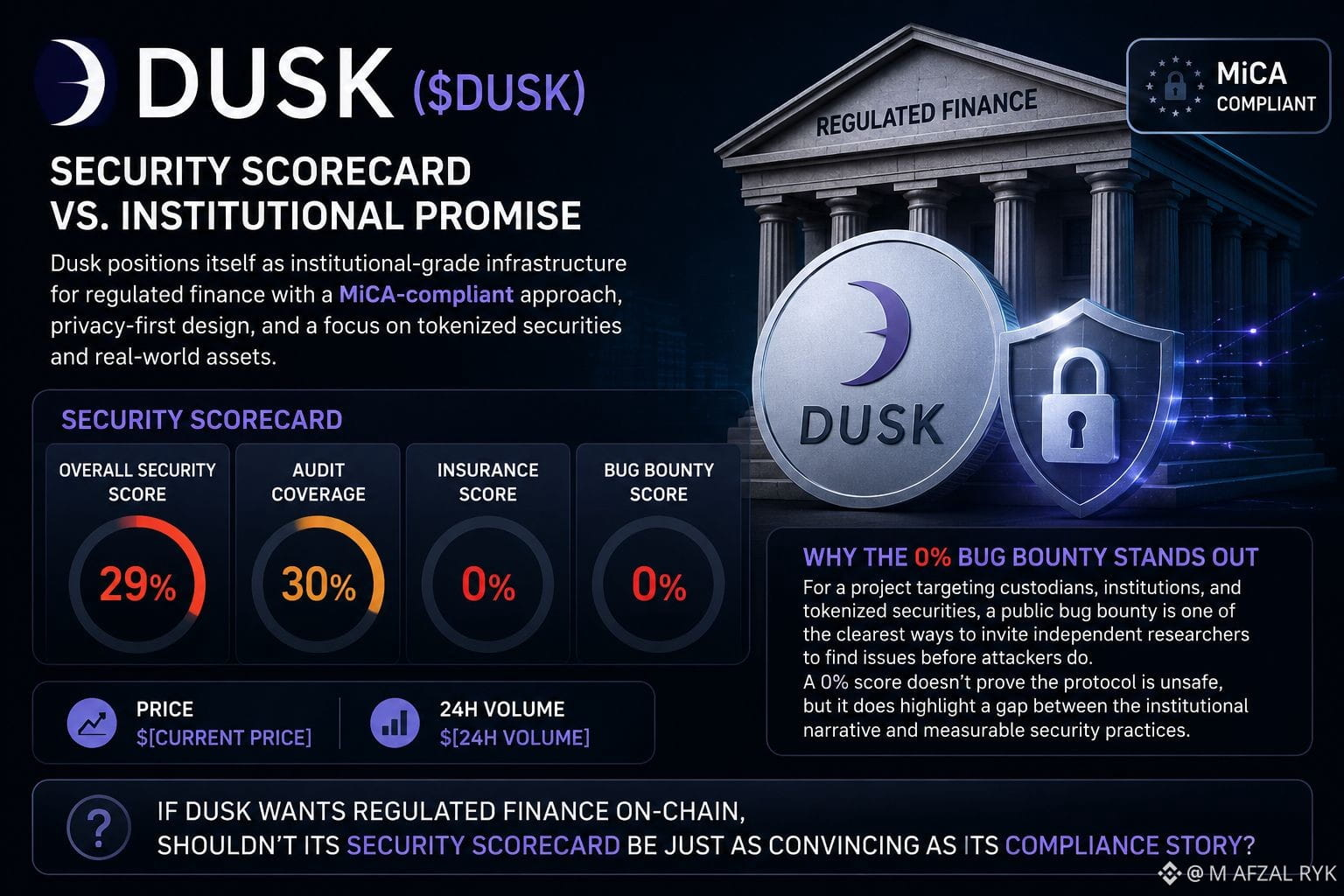
O projeto se posiciona como infraestrutura de nível institucional para finanças regulamentadas, com uma narrativa forte compatível com MiCA e foco em títulos tokenizados, privacidade e ativos do mundo real. Isso parece convincente. Mas depois de analisar a parte de segurança, acho que as métricas merecem mais atenção do que o gráfico de preços usual.
A pontuação de segurança atual está em apenas 29%, com cobertura de auditoria em 30%. Seguro é 0% e a pontuação do bug bounty também é 0%.
Esse último número chama minha atenção.
Para uma rede que tenta atrair instituições, custodians e aplicações financeiras regulamentadas, um bug bounty público é uma das formas mais claras de incentivar pesquisadores independentes de segurança a encontrar vulnerabilidades antes que os atacantes o façam. Uma pontuação de 0% não prova que o protocolo seja inseguro, mas deixa uma lacuna evidente entre a narrativa de nível institucional e a estrutura de segurança mensurável.
A DUSK tem ganhado atenção recentemente, com o token em torno de US$ [current price] e volume nas últimas 24h perto de US$ [24h volume]. Mas o preço não é a parte em que eu focaria aqui.
A questão maior é se a Dusk consegue transformar suas ambições de conformidade e institucionais em práticas de segurança igualmente fortes e mensuráveis.
Se a Dusk quer finanças regulamentadas on-chain, não deveria seu placar de segurança ser tão convincente quanto sua história de conformidade?
#dusk @Dusk_Foundation $DUSK
{spot}(DUSKUSDT)
Dusk $DUSK é um caso interessante porque a história e os números de segurança ainda não se alinham completamente.
O projeto se posiciona como infraestrutura de nível institucional para finanças regulamentadas, com uma narrativa forte compatível com MiCA e foco em títulos tokenizados, privacidade e ativos do mundo real. Isso parece convincente. Mas depois de analisar a parte de segurança, acho que as métricas merecem mais atenção do que o gráfico de preços usual.
A pontuação de segurança atual está em apenas 29%, com cobertura de auditoria em 30%. Seguro é 0% e a pontuação do bug bounty também é 0%.
Esse último número chama minha atenção.
Para uma rede que tenta atrair instituições, custodians e aplicações financeiras regulamentadas, um bug bounty público é uma das formas mais claras de incentivar pesquisadores independentes de segurança a encontrar vulnerabilidades antes que os atacantes o façam. Uma pontuação de 0% não prova que o protocolo seja inseguro, mas deixa uma lacuna evidente entre a narrativa de nível institucional e a estrutura de segurança mensurável.
A DUSK tem ganhado atenção recentemente, com o token em torno de US$ [current price] e volume nas últimas 24h perto de US$ [24h volume]. Mas o preço não é a parte em que eu focaria aqui.
A questão maior é se a Dusk consegue transformar suas ambições de conformidade e institucionais em práticas de segurança igualmente fortes e mensuráveis.
Se a Dusk quer finanças regulamentadas on-chain, não deveria seu placar de segurança ser tão convincente quanto sua história de conformidade?
#dusk @Dusk $DUSK
O projeto se posiciona como infraestrutura de nível institucional para finanças regulamentadas, com uma narrativa forte compatível com MiCA e foco em títulos tokenizados, privacidade e ativos do mundo real. Isso parece convincente. Mas depois de analisar a parte de segurança, acho que as métricas merecem mais atenção do que o gráfico de preços usual.
A pontuação de segurança atual está em apenas 29%, com cobertura de auditoria em 30%. Seguro é 0% e a pontuação do bug bounty também é 0%.
Esse último número chama minha atenção.
Para uma rede que tenta atrair instituições, custodians e aplicações financeiras regulamentadas, um bug bounty público é uma das formas mais claras de incentivar pesquisadores independentes de segurança a encontrar vulnerabilidades antes que os atacantes o façam. Uma pontuação de 0% não prova que o protocolo seja inseguro, mas deixa uma lacuna evidente entre a narrativa de nível institucional e a estrutura de segurança mensurável.
A DUSK tem ganhado atenção recentemente, com o token em torno de US$ [current price] e volume nas últimas 24h perto de US$ [24h volume]. Mas o preço não é a parte em que eu focaria aqui.
A questão maior é se a Dusk consegue transformar suas ambições de conformidade e institucionais em práticas de segurança igualmente fortes e mensuráveis.
Se a Dusk quer finanças regulamentadas on-chain, não deveria seu placar de segurança ser tão convincente quanto sua história de conformidade?
#dusk @Dusk $DUSK
10
5
177
·
--
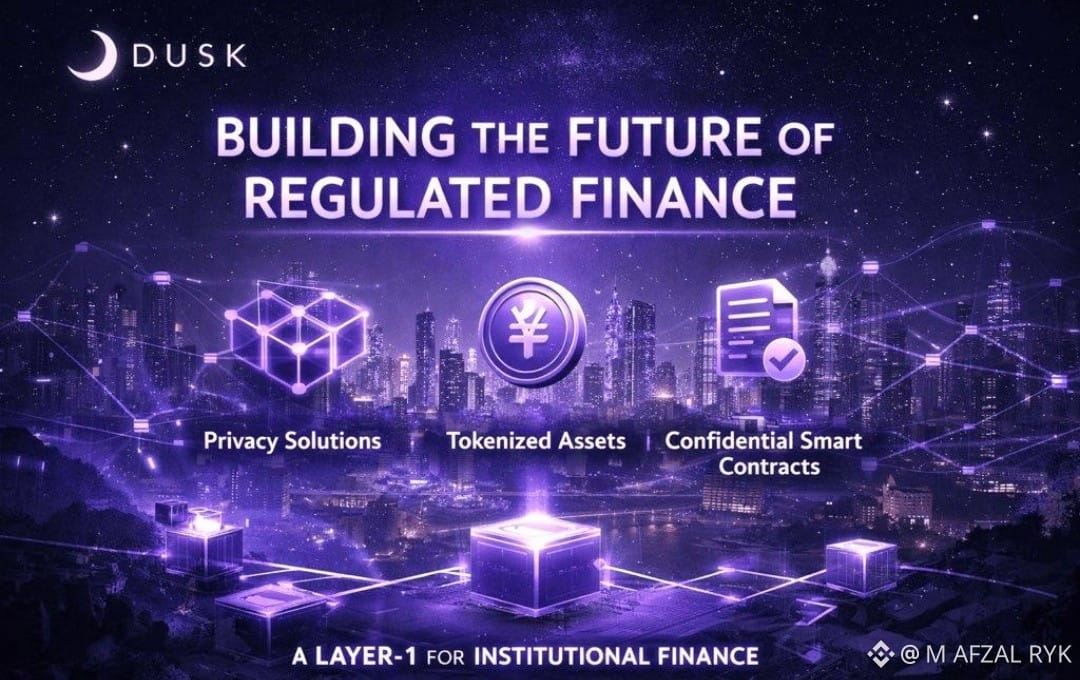
Dusk ($DUSK ) é um daqueles projetos em que a história é maior do que os números.
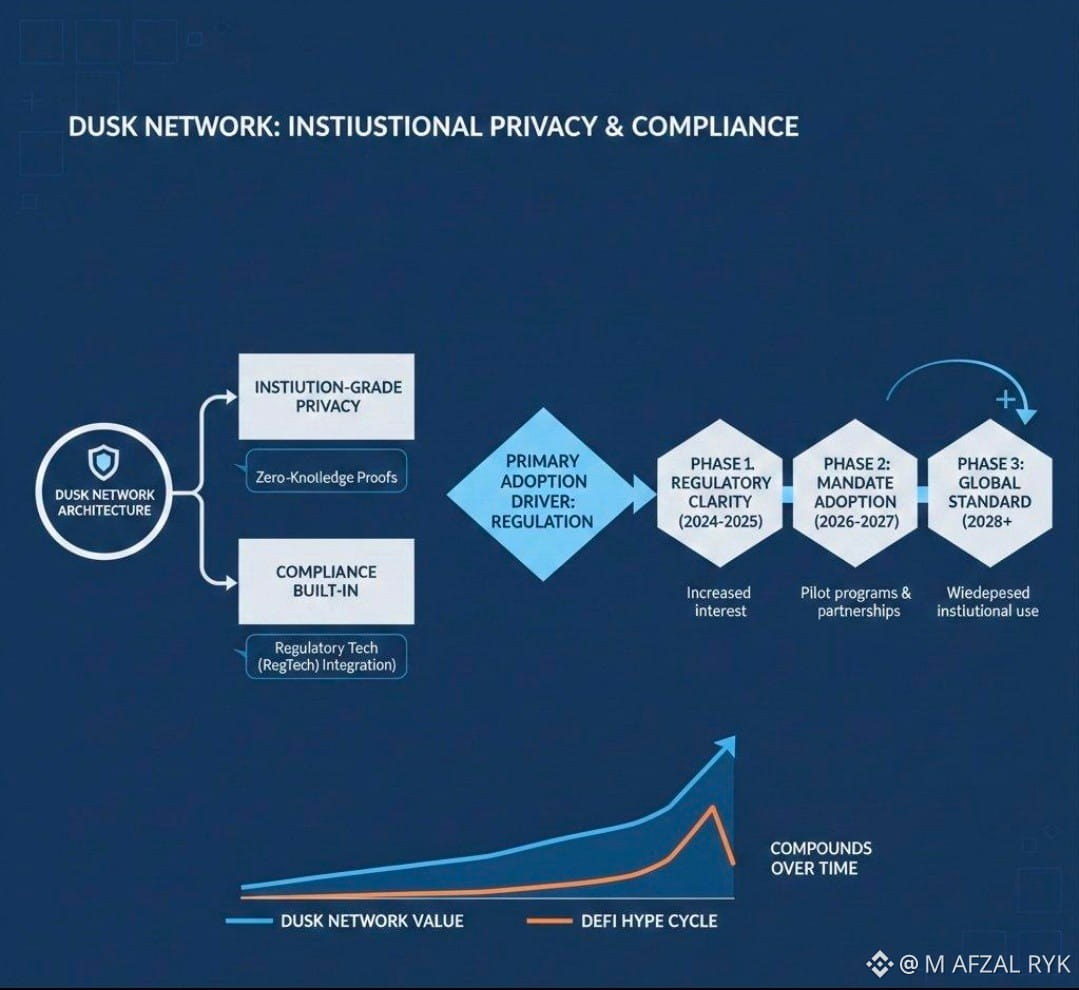
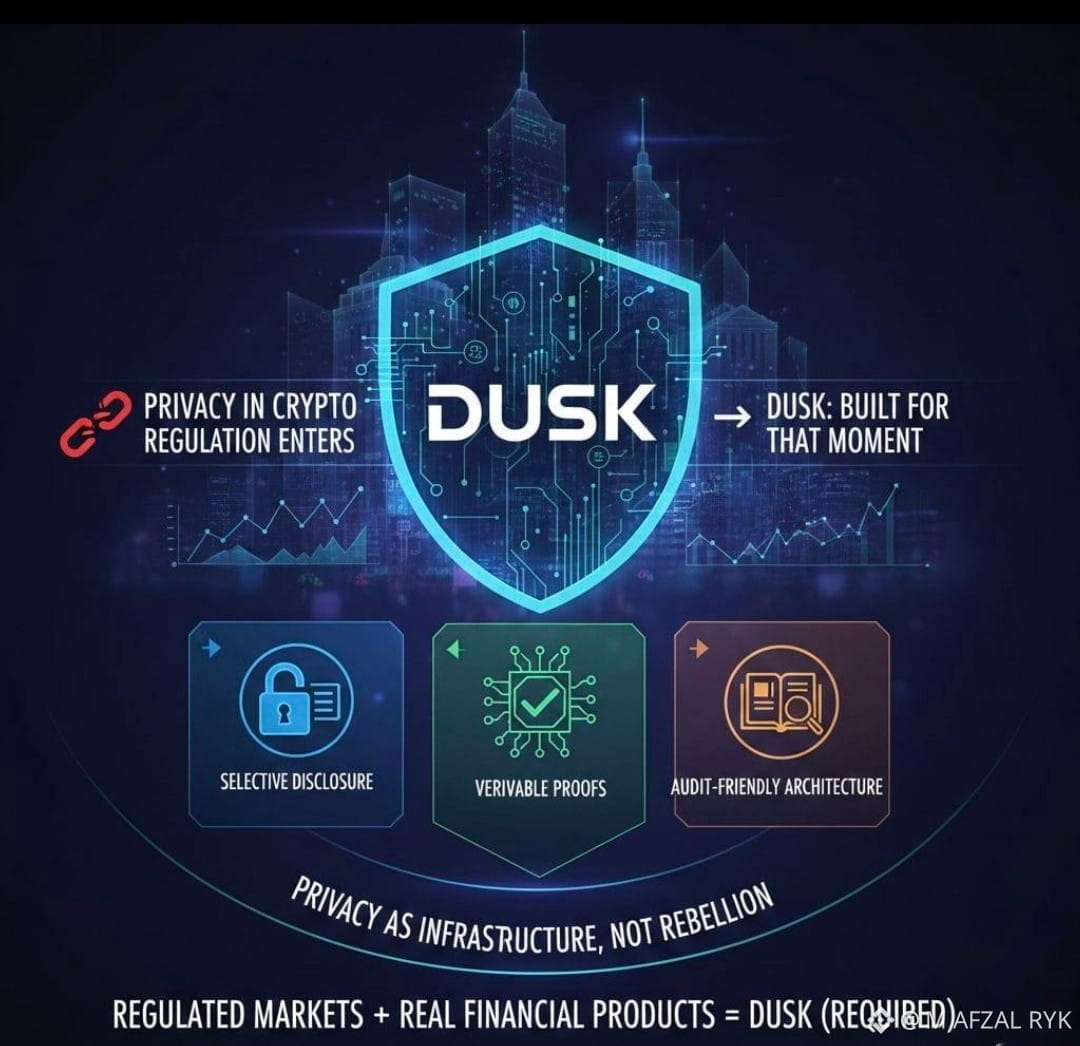
Ele se posiciona como uma Layer-1 de nível institucional para finanças reguladas, com privacidade, contratos inteligentes confidenciais, ativos tokenizados e uma narrativa forte de conformidade com a MiCA. Isso torna a segurança uma parte bastante importante do discurso.
Então eu olhei a planilha de score de segurança em vez do gráfico de preços.
Os números são difíceis de ignorar: a pontuação geral de segurança está em 29%, a cobertura de auditorias em 30%, enquanto as pontuações de seguro e de bug bounty são ambas 0%.
Para ser justo, isso não significa que a Dusk não foi auditada. O time diz que concluiu 10 auditorias cobrindo partes importantes da stack, e publicou detalhes sobre essas revisões.
Mas a pontuação de 0% em bug bounty ainda chama minha atenção.
Se você está mirando finanças reguladas, custodians, instituições e títulos tokenizados, você esperaria um incentivo ativo para que pesquisadores independentes busquem continuamente fraquezas. A própria Dusk anteriormente reconheceu que não tinha um programa de bug bounty, embora isso tenha sido informado em 2023.
Há também uma checagem de realidade útil: a Dusk divulgou descobertas sérias corrigidas por meio de sua atualização AEGIS de 2026, incluindo sete achados críticos de uma auditoria interna.
A DUSK está sendo negociada por volta de US$ 0,06, com aproximadamente US$ 3,7M em volume nas últimas 24h, mas preço não é a parte interessante aqui.
A verdadeira questão é se os processos de segurança da Dusk conseguem, eventualmente, atingir o nível “de padrão institucional” da história que ela está vendendo.
Para uma blockchain construída em torno de finanças reguladas, a transparência de segurança não deveria ser um de seus produtos mais fortes?
@Dusk_Foundation #dusk $DUSK
{future}(DUSKUSDT)
Dusk ($DUSK ) é um daqueles projetos em que a história é maior do que os números.
Ele se posiciona como uma Layer-1 de nível institucional para finanças reguladas, com privacidade, contratos inteligentes confidenciais, ativos tokenizados e uma narrativa forte de conformidade com a MiCA. Isso torna a segurança uma parte bastante importante do discurso.
Então eu olhei a planilha de score de segurança em vez do gráfico de preços.
Os números são difíceis de ignorar: a pontuação geral de segurança está em 29%, a cobertura de auditorias em 30%, enquanto as pontuações de seguro e de bug bounty são ambas 0%.
Para ser justo, isso não significa que a Dusk não foi auditada. O time diz que concluiu 10 auditorias cobrindo partes importantes da stack, e publicou detalhes sobre essas revisões.
Mas a pontuação de 0% em bug bounty ainda chama minha atenção.
Se você está mirando finanças reguladas, custodians, instituições e títulos tokenizados, você esperaria um incentivo ativo para que pesquisadores independentes busquem continuamente fraquezas. A própria Dusk anteriormente reconheceu que não tinha um programa de bug bounty, embora isso tenha sido informado em 2023.
Há também uma checagem de realidade útil: a Dusk divulgou descobertas sérias corrigidas por meio de sua atualização AEGIS de 2026, incluindo sete achados críticos de uma auditoria interna.
A DUSK está sendo negociada por volta de US$ 0,06, com aproximadamente US$ 3,7M em volume nas últimas 24h, mas preço não é a parte interessante aqui.
A verdadeira questão é se os processos de segurança da Dusk conseguem, eventualmente, atingir o nível “de padrão institucional” da história que ela está vendendo.
Para uma blockchain construída em torno de finanças reguladas, a transparência de segurança não deveria ser um de seus produtos mais fortes?
@Dusk #dusk $DUSK
Ele se posiciona como uma Layer-1 de nível institucional para finanças reguladas, com privacidade, contratos inteligentes confidenciais, ativos tokenizados e uma narrativa forte de conformidade com a MiCA. Isso torna a segurança uma parte bastante importante do discurso.
Então eu olhei a planilha de score de segurança em vez do gráfico de preços.
Os números são difíceis de ignorar: a pontuação geral de segurança está em 29%, a cobertura de auditorias em 30%, enquanto as pontuações de seguro e de bug bounty são ambas 0%.
Para ser justo, isso não significa que a Dusk não foi auditada. O time diz que concluiu 10 auditorias cobrindo partes importantes da stack, e publicou detalhes sobre essas revisões.
Mas a pontuação de 0% em bug bounty ainda chama minha atenção.
Se você está mirando finanças reguladas, custodians, instituições e títulos tokenizados, você esperaria um incentivo ativo para que pesquisadores independentes busquem continuamente fraquezas. A própria Dusk anteriormente reconheceu que não tinha um programa de bug bounty, embora isso tenha sido informado em 2023.
Há também uma checagem de realidade útil: a Dusk divulgou descobertas sérias corrigidas por meio de sua atualização AEGIS de 2026, incluindo sete achados críticos de uma auditoria interna.
A DUSK está sendo negociada por volta de US$ 0,06, com aproximadamente US$ 3,7M em volume nas últimas 24h, mas preço não é a parte interessante aqui.
A verdadeira questão é se os processos de segurança da Dusk conseguem, eventualmente, atingir o nível “de padrão institucional” da história que ela está vendendo.
Para uma blockchain construída em torno de finanças reguladas, a transparência de segurança não deveria ser um de seus produtos mais fortes?
@Dusk #dusk $DUSK
6
6
143
·
--
Em Alta
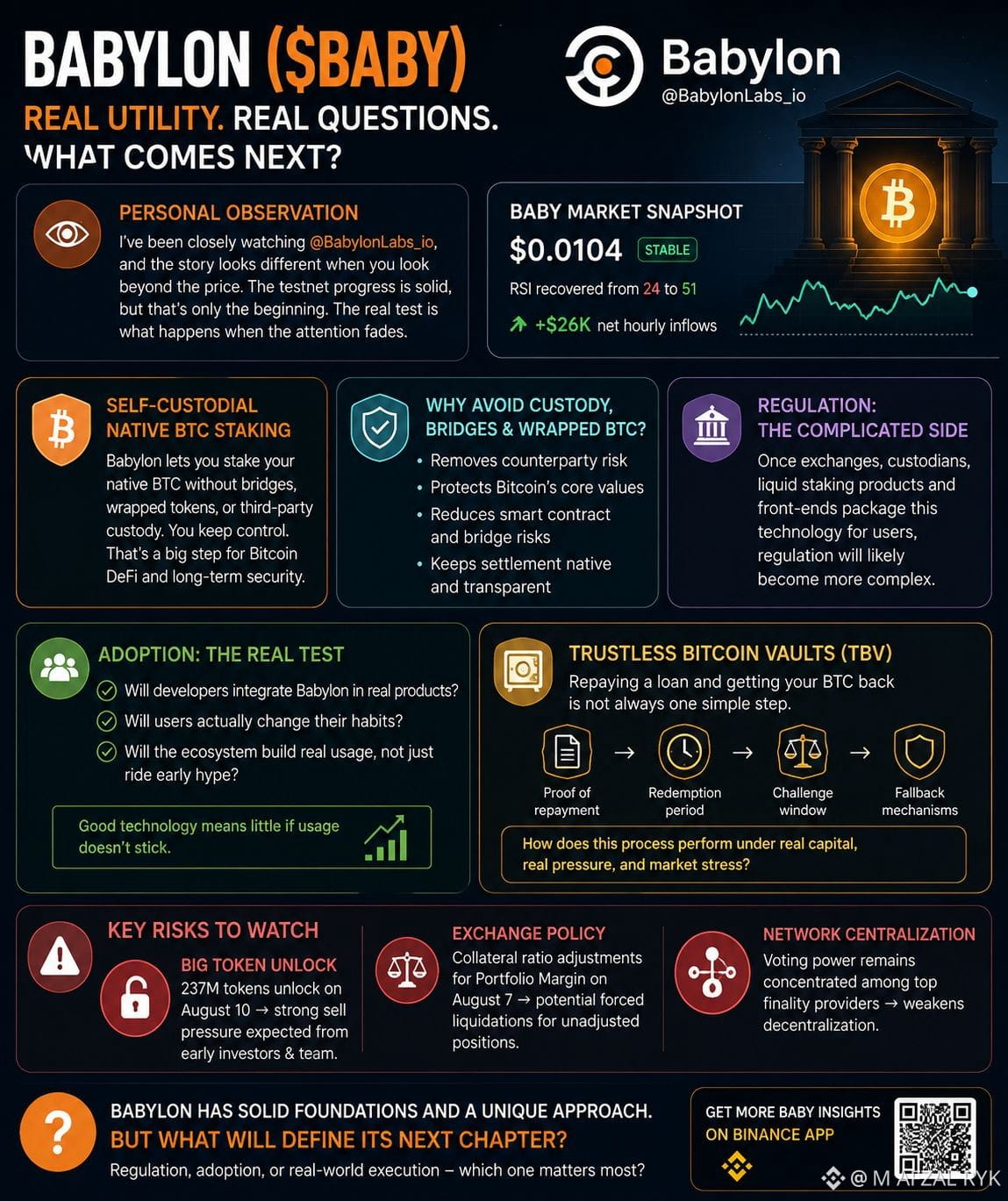
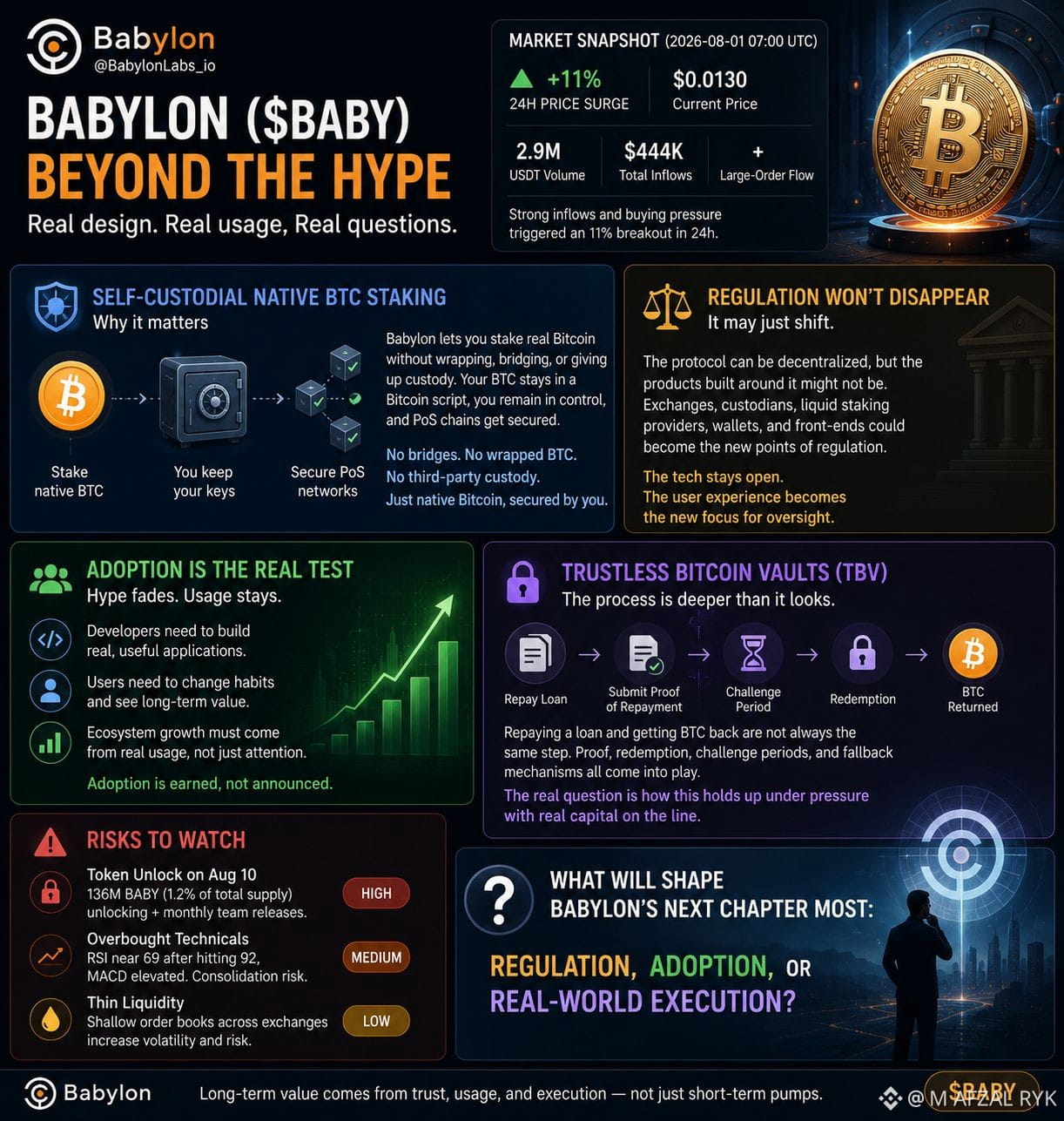
Passei mais tempo observando @babylonlabs_io esta semana, e a história parece diferente quando você para de olhar apenas para o preço. O progresso recente no testnet é encorajador, mas continuo me perguntando o que acontece depois que a primeira onda de empolgação passa. $BABY foi construída em torno de staking de Bitcoin autocustodiado, em que as pessoas mantêm o controle do próprio BTC em vez de depender de bridges, moedas wrapadas ou um custodiante central. Isso elimina uma camada de confiança, mas não remove todos os desafios. A regulação ainda pode se tornar mais complexa à medida que exchanges, custodiante, produtos de liquidez via staking e aplicativos de carteira empacotam essa experiência para usuários do dia a dia. A próxima barreira é a adoção. Um bom design significa pouco se os desenvolvedores não constroem em cima dele ou se os usuários nunca mudam seus hábitos. Também vale uma análise mais cuidadosa das Trustless Bitcoin Vaults. Pagar de volta um empréstimo e receber BTC nem sempre é uma única ação. Provas, resgates, períodos de contestação e caminhos alternativos ainda importam, especialmente quando há dinheiro real envolvido. À medida que $BABY cresce, o que vai importar mais: regulação, adoção ou execução no mundo real?
@babylonlabs_io #baby $BABY
Passei mais tempo observando @BabylonLabs_io esta semana, e a história parece diferente quando você para de olhar apenas para o preço. O progresso recente no testnet é encorajador, mas continuo me perguntando o que acontece depois que a primeira onda de empolgação passa. $BABY foi construída em torno de staking de Bitcoin autocustodiado, em que as pessoas mantêm o controle do próprio BTC em vez de depender de bridges, moedas wrapadas ou um custodiante central. Isso elimina uma camada de confiança, mas não remove todos os desafios. A regulação ainda pode se tornar mais complexa à medida que exchanges, custodiante, produtos de liquidez via staking e aplicativos de carteira empacotam essa experiência para usuários do dia a dia. A próxima barreira é a adoção. Um bom design significa pouco se os desenvolvedores não constroem em cima dele ou se os usuários nunca mudam seus hábitos. Também vale uma análise mais cuidadosa das Trustless Bitcoin Vaults. Pagar de volta um empréstimo e receber BTC nem sempre é uma única ação. Provas, resgates, períodos de contestação e caminhos alternativos ainda importam, especialmente quando há dinheiro real envolvido. À medida que $BABY cresce, o que vai importar mais: regulação, adoção ou execução no mundo real?
@BabylonLabs_io #baby $BABY
@BabylonLabs_io #baby $BABY
13
11
199
·
--
Em Alta
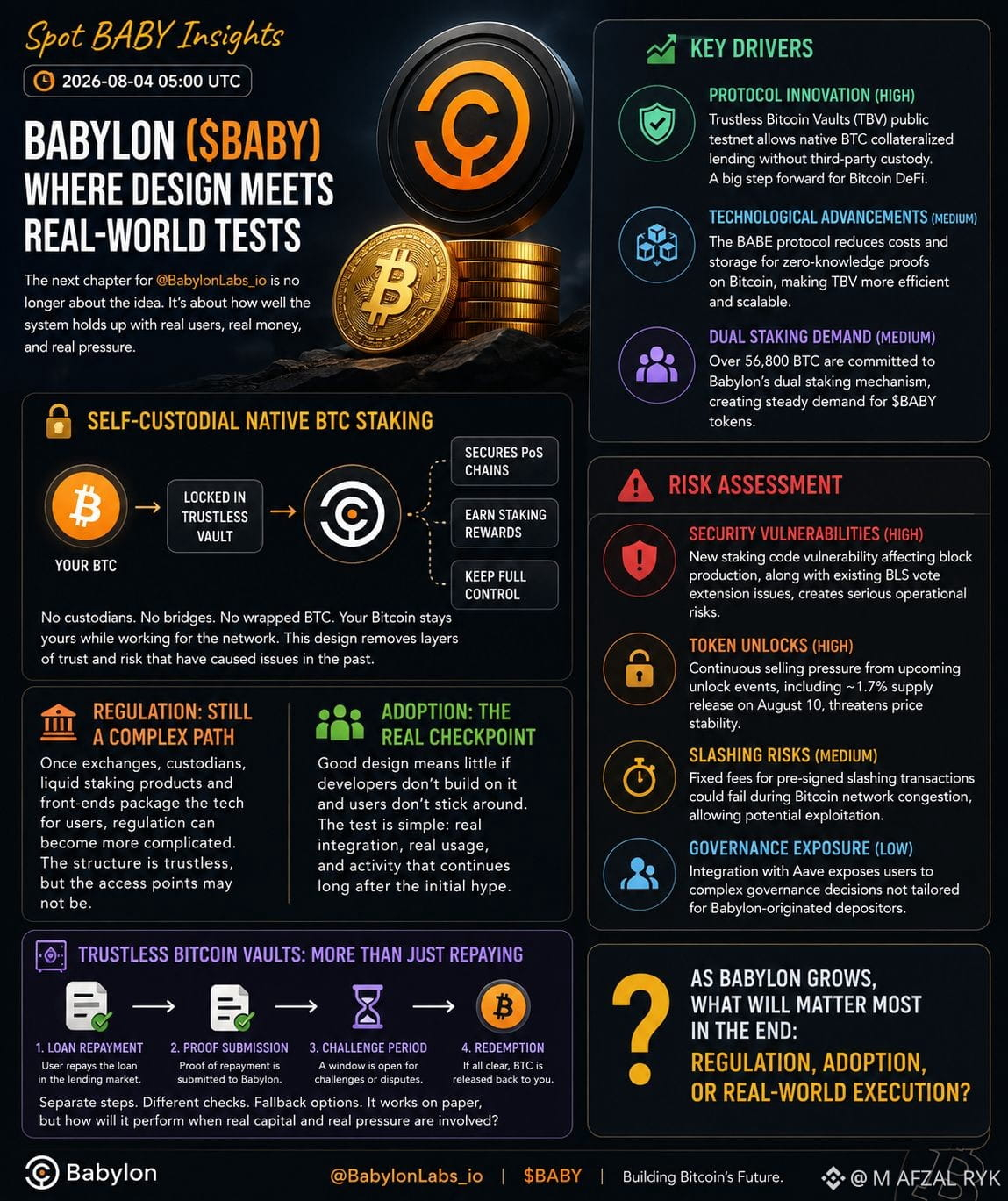
Hoje, peguei-me olhando além dos gráficos enquanto acompanhava @BabylonLabs_io. O que manteve minha atenção não foi outro anúncio de recurso. Foi a curiosidade sobre como tudo isso parece quando usuários reais, dinheiro real e expectativas reais entram em cena. Essa parece ser a verdadeira história para $BABY
A abordagem da Babylon é atraente porque o Bitcoin permanece sob o controle do proprietário, em vez de passar por pontes, ativos tokenizados (wrapped) ou custodians tradicionais. Isso remove alguns riscos familiares. Ainda assim, a regulação pode se tornar mais complicada à medida que exchanges, custodians, produtos de liquidez (liquid staking) e apps mais amigáveis constroem serviços em torno do protocolo.
A adoção vai decidir se a ideia dura. Tecnologia forte é apenas o começo. Os desenvolvedores precisam integrá-la, os usuários precisam confiar nela e a atividade do dia a dia precisa continuar crescendo depois que a empolgação inicial diminui.
Os Vaults de Bitcoin sem necessidade de confiança (Trustless) também merecem atenção cuidadosa. Finalizar um empréstimo e receber BTC de volta pode envolver provas, resgates, períodos de contestação e etapas de contingência. Esses detalhes importam muito mais quando os mercados se movem rápido e o capital real está em jogo.
No próximo capítulo da Babylon, o que pesa mais: regulação, adoção ou execução no mundo real?
@babylonlabs_io #baby $BABY
{future}(BABYUSDT)
Hoje, peguei-me olhando além dos gráficos enquanto acompanhava @BabylonLabs_io. O que manteve minha atenção não foi outro anúncio de recurso. Foi a curiosidade sobre como tudo isso parece quando usuários reais, dinheiro real e expectativas reais entram em cena. Essa parece ser a verdadeira história para $BABY
A abordagem da Babylon é atraente porque o Bitcoin permanece sob o controle do proprietário, em vez de passar por pontes, ativos tokenizados (wrapped) ou custodians tradicionais. Isso remove alguns riscos familiares. Ainda assim, a regulação pode se tornar mais complicada à medida que exchanges, custodians, produtos de liquidez (liquid staking) e apps mais amigáveis constroem serviços em torno do protocolo.
A adoção vai decidir se a ideia dura. Tecnologia forte é apenas o começo. Os desenvolvedores precisam integrá-la, os usuários precisam confiar nela e a atividade do dia a dia precisa continuar crescendo depois que a empolgação inicial diminui.
Os Vaults de Bitcoin sem necessidade de confiança (Trustless) também merecem atenção cuidadosa. Finalizar um empréstimo e receber BTC de volta pode envolver provas, resgates, períodos de contestação e etapas de contingência. Esses detalhes importam muito mais quando os mercados se movem rápido e o capital real está em jogo.
No próximo capítulo da Babylon, o que pesa mais: regulação, adoção ou execução no mundo real?
@BabylonLabs_io #baby $BABY
A abordagem da Babylon é atraente porque o Bitcoin permanece sob o controle do proprietário, em vez de passar por pontes, ativos tokenizados (wrapped) ou custodians tradicionais. Isso remove alguns riscos familiares. Ainda assim, a regulação pode se tornar mais complicada à medida que exchanges, custodians, produtos de liquidez (liquid staking) e apps mais amigáveis constroem serviços em torno do protocolo.
A adoção vai decidir se a ideia dura. Tecnologia forte é apenas o começo. Os desenvolvedores precisam integrá-la, os usuários precisam confiar nela e a atividade do dia a dia precisa continuar crescendo depois que a empolgação inicial diminui.
Os Vaults de Bitcoin sem necessidade de confiança (Trustless) também merecem atenção cuidadosa. Finalizar um empréstimo e receber BTC de volta pode envolver provas, resgates, períodos de contestação e etapas de contingência. Esses detalhes importam muito mais quando os mercados se movem rápido e o capital real está em jogo.
No próximo capítulo da Babylon, o que pesa mais: regulação, adoção ou execução no mundo real?
@BabylonLabs_io #baby $BABY
2
3
154
·
--
Em Alta
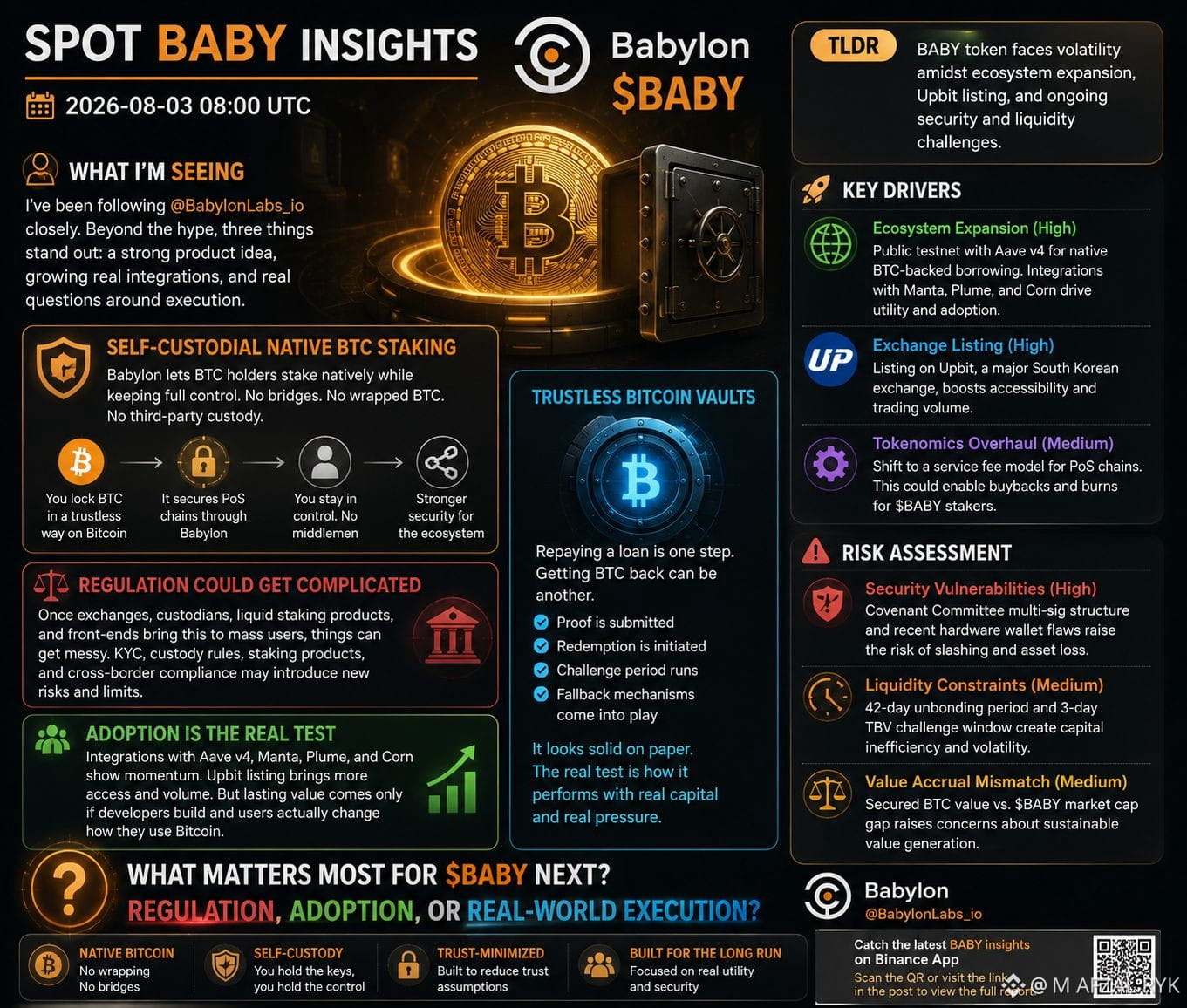
Venho seguindo @BabylonLabs_io há algum tempo, e a maior mudança no meu modo de pensar não foi sobre os gráficos. Foi perceber que a história real começa depois do primeiro título. A ideia da Babylon de permitir que as pessoas façam stake de Bitcoin nativo mantendo o controle sobre suas próprias moedas, sem pontes ou BTC envolvido (wrapped BTC), parece uma direção mais limpa. Mas também fico me perguntando o que acontece quando corretoras, custodiante, produtos de liquid staking e aplicativos fáceis de usar empacotam tudo para os usuários do dia a dia. É aí que a regulação pode se tornar muito mais complicada do que a própria tecnologia.
A adoção é a parte que estou observando com mais atenção. Novas parcerias e integrações parecem encorajadoras, mas o valor duradouro só vem se desenvolvedores construírem em cima disso e se os usuários realmente mudarem a forma como usam o Bitcoin.
O fluxo do Trustless Bitcoin Vault também merece mais atenção. Pagar um empréstimo é apenas uma etapa. Recuperar o BTC ainda pode envolver prova, resgate, períodos de contestação e caminhos alternativos. Na teoria, tudo parece razoável, mas os mercados reais se comportam de forma diferente sob pressão.
Para o $BABY, o que importa mais agora: regulação, adoção ou execução no mundo real?
@babylonlabs_io $BABY #baby
Venho seguindo @BabylonLabs_io há algum tempo, e a maior mudança no meu modo de pensar não foi sobre os gráficos. Foi perceber que a história real começa depois do primeiro título. A ideia da Babylon de permitir que as pessoas façam stake de Bitcoin nativo mantendo o controle sobre suas próprias moedas, sem pontes ou BTC envolvido (wrapped BTC), parece uma direção mais limpa. Mas também fico me perguntando o que acontece quando corretoras, custodiante, produtos de liquid staking e aplicativos fáceis de usar empacotam tudo para os usuários do dia a dia. É aí que a regulação pode se tornar muito mais complicada do que a própria tecnologia.
A adoção é a parte que estou observando com mais atenção. Novas parcerias e integrações parecem encorajadoras, mas o valor duradouro só vem se desenvolvedores construírem em cima disso e se os usuários realmente mudarem a forma como usam o Bitcoin.
O fluxo do Trustless Bitcoin Vault também merece mais atenção. Pagar um empréstimo é apenas uma etapa. Recuperar o BTC ainda pode envolver prova, resgate, períodos de contestação e caminhos alternativos. Na teoria, tudo parece razoável, mas os mercados reais se comportam de forma diferente sob pressão.
Para o $BABY , o que importa mais agora: regulação, adoção ou execução no mundo real?
@BabylonLabs_io $BABY #baby
A adoção é a parte que estou observando com mais atenção. Novas parcerias e integrações parecem encorajadoras, mas o valor duradouro só vem se desenvolvedores construírem em cima disso e se os usuários realmente mudarem a forma como usam o Bitcoin.
O fluxo do Trustless Bitcoin Vault também merece mais atenção. Pagar um empréstimo é apenas uma etapa. Recuperar o BTC ainda pode envolver prova, resgate, períodos de contestação e caminhos alternativos. Na teoria, tudo parece razoável, mas os mercados reais se comportam de forma diferente sob pressão.
Para o $BABY , o que importa mais agora: regulação, adoção ou execução no mundo real?
@BabylonLabs_io $BABY #baby
3
2
106
·
--
Em Alta
Tenho acompanhado @BabylonLabs_io há algum tempo, e a história que continua me puxando de volta já não é o preço. É se as pessoas realmente confiam na forma como o Bitcoin está sendo usado. A ideia por trás de $BABY é simples: fazer staking de BTC nativo mantendo suas próprias chaves, sem depender de moedas envolvidas, bridges ou entregando a custódia a outra pessoa. Isso parece um passo real à frente.
Ainda assim, não acho que a regulamentação desapareça. Ela pode apenas mudar para as empresas que constroem carteiras, exchanges, serviços de custódia, produtos de liquid staking e interfaces fáceis ao redor do protocolo. A tecnologia pode continuar descentralizada, enquanto a experiência do usuário vira um novo foco para a supervisão.
A adoção é onde a resposta real vai aparecer. Desenvolvedores precisam construir aplicativos úteis, usuários precisam de motivos para continuar, e a atividade tem que continuar depois que a empolgação inicial passa.
Também vale dar uma atenção mais de perto às Trustless Bitcoin Vaults. Reembolsar um empréstimo e receber BTC de volta nem sempre é o mesmo momento. Provas, resgates, períodos de contestação e caminhos de contingência importam quando dinheiro de verdade está em jogo.
Então, o que vai definir o próximo capítulo da Babylon mais: regulamentação, adoção ou execução no mundo real?
@babylonlabs_io #baby $BABY
Tenho acompanhado @BabylonLabs_io há algum tempo, e a história que continua me puxando de volta já não é o preço. É se as pessoas realmente confiam na forma como o Bitcoin está sendo usado. A ideia por trás de $BABY é simples: fazer staking de BTC nativo mantendo suas próprias chaves, sem depender de moedas envolvidas, bridges ou entregando a custódia a outra pessoa. Isso parece um passo real à frente.
Ainda assim, não acho que a regulamentação desapareça. Ela pode apenas mudar para as empresas que constroem carteiras, exchanges, serviços de custódia, produtos de liquid staking e interfaces fáceis ao redor do protocolo. A tecnologia pode continuar descentralizada, enquanto a experiência do usuário vira um novo foco para a supervisão.
A adoção é onde a resposta real vai aparecer. Desenvolvedores precisam construir aplicativos úteis, usuários precisam de motivos para continuar, e a atividade tem que continuar depois que a empolgação inicial passa.
Também vale dar uma atenção mais de perto às Trustless Bitcoin Vaults. Reembolsar um empréstimo e receber BTC de volta nem sempre é o mesmo momento. Provas, resgates, períodos de contestação e caminhos de contingência importam quando dinheiro de verdade está em jogo.
Então, o que vai definir o próximo capítulo da Babylon mais: regulamentação, adoção ou execução no mundo real?
@BabylonLabs_io #baby $BABY
Ainda assim, não acho que a regulamentação desapareça. Ela pode apenas mudar para as empresas que constroem carteiras, exchanges, serviços de custódia, produtos de liquid staking e interfaces fáceis ao redor do protocolo. A tecnologia pode continuar descentralizada, enquanto a experiência do usuário vira um novo foco para a supervisão.
A adoção é onde a resposta real vai aparecer. Desenvolvedores precisam construir aplicativos úteis, usuários precisam de motivos para continuar, e a atividade tem que continuar depois que a empolgação inicial passa.
Também vale dar uma atenção mais de perto às Trustless Bitcoin Vaults. Reembolsar um empréstimo e receber BTC de volta nem sempre é o mesmo momento. Provas, resgates, períodos de contestação e caminhos de contingência importam quando dinheiro de verdade está em jogo.
Então, o que vai definir o próximo capítulo da Babylon mais: regulamentação, adoção ou execução no mundo real?
@BabylonLabs_io #baby $BABY
6
4
122
·
--
Em Alta
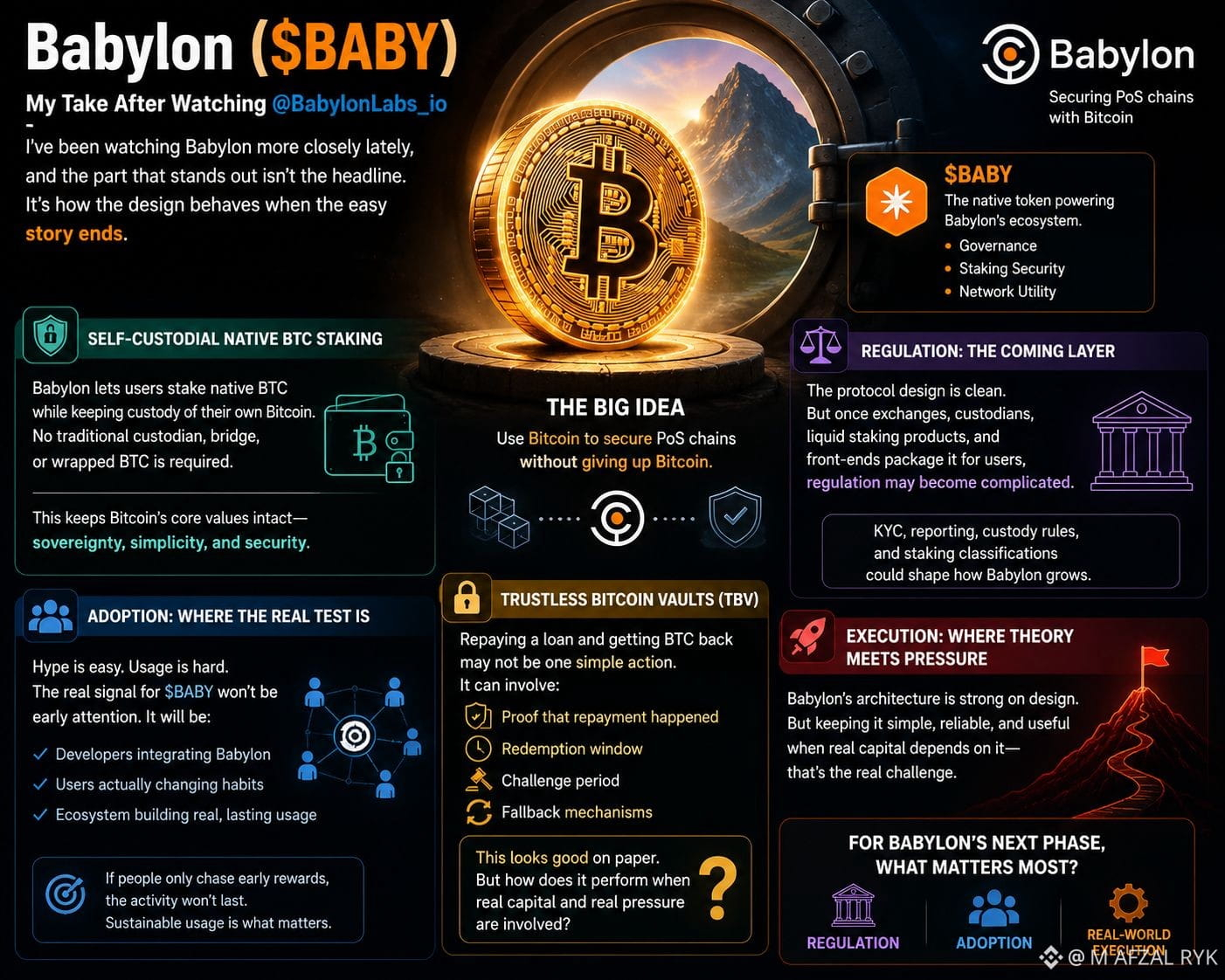
Tenho observado @BabylonLabs_io com mais atenção ultimamente, e a parte que se destaca não é o título. É como o design se comporta quando a história fácil termina.
A Babylon permite que os usuários façam staking de BTC nativo mantendo a custódia do próprio Bitcoin. Não é necessário um custodiante tradicional, uma ponte, nem BTC envolvido. Essa é uma mudança significativa, mas a regulamentação pode ficar complicada quando exchanges, custodiante, produtos de liquid staking e front-ends começarem a empacotar essa experiência para usuários do dia a dia.
Em seguida vem a adoção. O sinal real para $BABY won’t be early attention. Será desenvolvedores escolhendo a Babylon, usuários mudando hábitos e aplicações criando motivos para permanecer.
Eu também volto sempre às Trustless Bitcoin Vaults. Pagar um empréstimo e receber BTC de volta talvez não seja uma ação simples. Provas, resgates, períodos de contestação e caminhos alternativos podem se tornar importantes quando o dinheiro está realmente em jogo.
É aqui que a teoria encontra a pressão. A arquitetura da Babylon consegue continuar simples, confiável e útil quando capital real começa a depender dela?
Na próxima fase da Babylon, o que mais importa: regulamentação, adoção ou execução no mundo real?
@babylonlabs_io #baby $BABY
Tenho observado @BabylonLabs_io com mais atenção ultimamente, e a parte que se destaca não é o título. É como o design se comporta quando a história fácil termina.
A Babylon permite que os usuários façam staking de BTC nativo mantendo a custódia do próprio Bitcoin. Não é necessário um custodiante tradicional, uma ponte, nem BTC envolvido. Essa é uma mudança significativa, mas a regulamentação pode ficar complicada quando exchanges, custodiante, produtos de liquid staking e front-ends começarem a empacotar essa experiência para usuários do dia a dia.
Em seguida vem a adoção. O sinal real para $BABY won’t be early attention. Será desenvolvedores escolhendo a Babylon, usuários mudando hábitos e aplicações criando motivos para permanecer.
Eu também volto sempre às Trustless Bitcoin Vaults. Pagar um empréstimo e receber BTC de volta talvez não seja uma ação simples. Provas, resgates, períodos de contestação e caminhos alternativos podem se tornar importantes quando o dinheiro está realmente em jogo.
É aqui que a teoria encontra a pressão. A arquitetura da Babylon consegue continuar simples, confiável e útil quando capital real começa a depender dela?
Na próxima fase da Babylon, o que mais importa: regulamentação, adoção ou execução no mundo real?
@BabylonLabs_io #baby $BABY
A Babylon permite que os usuários façam staking de BTC nativo mantendo a custódia do próprio Bitcoin. Não é necessário um custodiante tradicional, uma ponte, nem BTC envolvido. Essa é uma mudança significativa, mas a regulamentação pode ficar complicada quando exchanges, custodiante, produtos de liquid staking e front-ends começarem a empacotar essa experiência para usuários do dia a dia.
Em seguida vem a adoção. O sinal real para $BABY won’t be early attention. Será desenvolvedores escolhendo a Babylon, usuários mudando hábitos e aplicações criando motivos para permanecer.
Eu também volto sempre às Trustless Bitcoin Vaults. Pagar um empréstimo e receber BTC de volta talvez não seja uma ação simples. Provas, resgates, períodos de contestação e caminhos alternativos podem se tornar importantes quando o dinheiro está realmente em jogo.
É aqui que a teoria encontra a pressão. A arquitetura da Babylon consegue continuar simples, confiável e útil quando capital real começa a depender dela?
Na próxima fase da Babylon, o que mais importa: regulamentação, adoção ou execução no mundo real?
@BabylonLabs_io #baby $BABY
7
6
308
·
--
Em Alta
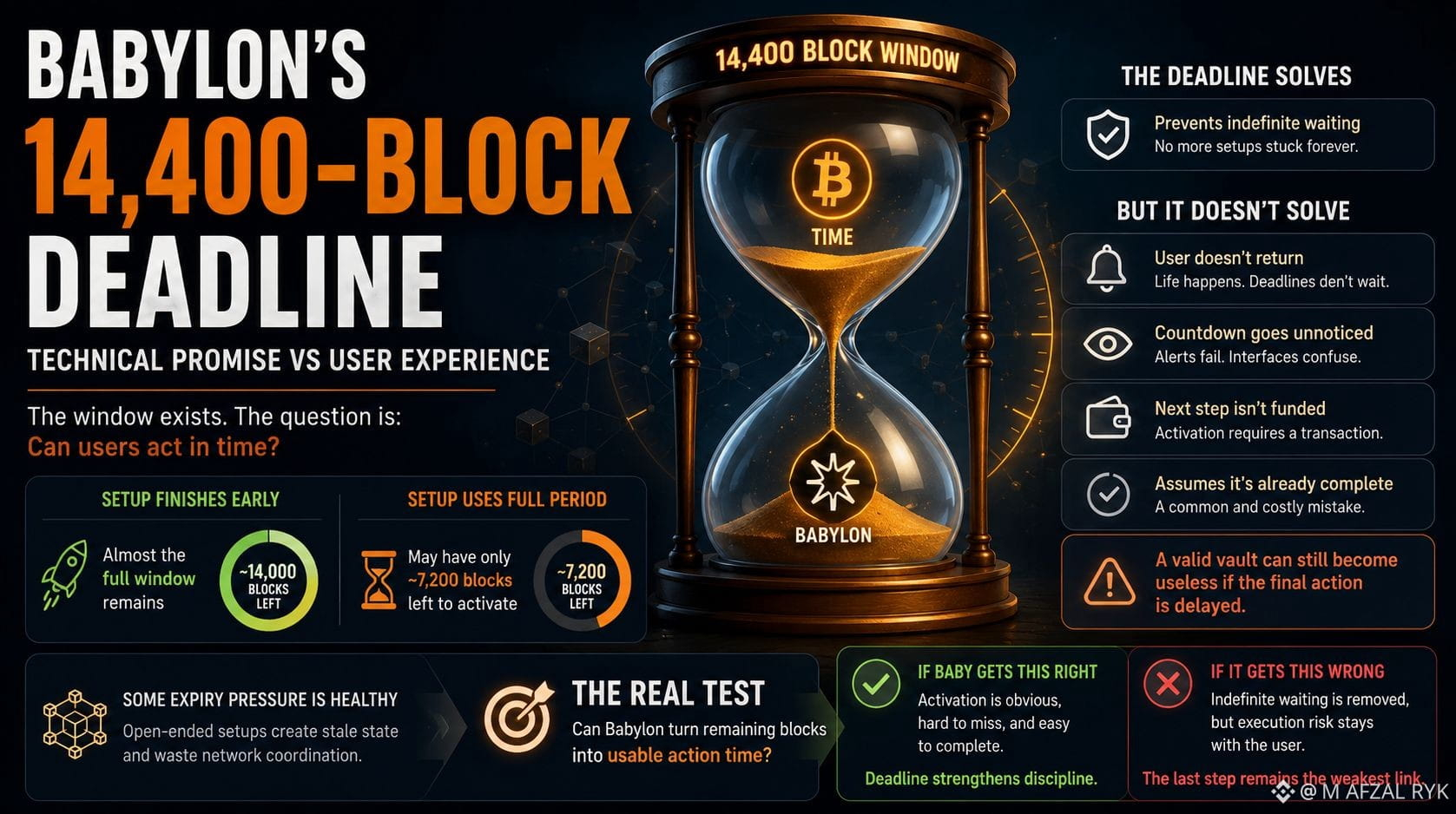
Meu primeiro instinto foi medir o prazo de 14.400 blocos de Babylon pelo número de blocos que restam após a configuração. Uma configuração rápida deixa quase toda a janela disponível. Uma configuração lenta pode deixar apenas cerca de 7.200 blocos para a ativação.
Isso parece importante, mas não é toda a história.
O prazo resolve um problema de protocolo: ele impede que configurações permaneçam pendentes para sempre. Ele não resolve o passo final, em que os usuários precisam agir. O protocolo pode manter a janela de ativação aberta, mas não pode fazer alguém verificar a carteira, notar um lembrete, assinar a transação ou voltar antes de o prazo expirar.
Essa diferença é fácil de ignorar.
Um cofre pode ser perfeitamente válido do ponto de vista técnico e ainda assim nunca ser ativado porque o usuário perde o último passo. Nesse caso, a limitação não é Bitcoin nem Babylon. É a lacuna entre as regras do protocolo e o comportamento no mundo real.
É por isso que eu não vejo 14.400 blocos como uma garantia simples de segurança. Eu vejo como uma troca de design. O protocolo elimina a espera sem fim, mas o sucesso ainda depende de os usuários conseguirem concluir o processo antes que o tempo acabe.
Prazos são necessários. Sem eles, configurações inacabadas se acumulariam e desperdiçariam coordenação na rede. A pergunta mais interessante é se o tempo restante parece utilizável na prática, especialmente quando a configuração termina tarde ou quando notificações são perdidas.
Para BABY, o desafio não é apenas criar um fluxo de ativação seguro. É tornar o passo final tão claro que os usuários raramente falhem por causa do timing. Se Babylon acertar isso, o prazo vira uma força. Se não acertar, o protocolo resolve a espera indefinida enquanto deixa o risco da última execução exatamente onde os usuários o vivenciam com mais frequência.
@babylonlabs_io #baby $BABY
Meu primeiro instinto foi medir o prazo de 14.400 blocos de Babylon pelo número de blocos que restam após a configuração. Uma configuração rápida deixa quase toda a janela disponível. Uma configuração lenta pode deixar apenas cerca de 7.200 blocos para a ativação.
Isso parece importante, mas não é toda a história.
O prazo resolve um problema de protocolo: ele impede que configurações permaneçam pendentes para sempre. Ele não resolve o passo final, em que os usuários precisam agir. O protocolo pode manter a janela de ativação aberta, mas não pode fazer alguém verificar a carteira, notar um lembrete, assinar a transação ou voltar antes de o prazo expirar.
Essa diferença é fácil de ignorar.
Um cofre pode ser perfeitamente válido do ponto de vista técnico e ainda assim nunca ser ativado porque o usuário perde o último passo. Nesse caso, a limitação não é Bitcoin nem Babylon. É a lacuna entre as regras do protocolo e o comportamento no mundo real.
É por isso que eu não vejo 14.400 blocos como uma garantia simples de segurança. Eu vejo como uma troca de design. O protocolo elimina a espera sem fim, mas o sucesso ainda depende de os usuários conseguirem concluir o processo antes que o tempo acabe.
Prazos são necessários. Sem eles, configurações inacabadas se acumulariam e desperdiçariam coordenação na rede. A pergunta mais interessante é se o tempo restante parece utilizável na prática, especialmente quando a configuração termina tarde ou quando notificações são perdidas.
Para BABY, o desafio não é apenas criar um fluxo de ativação seguro. É tornar o passo final tão claro que os usuários raramente falhem por causa do timing. Se Babylon acertar isso, o prazo vira uma força. Se não acertar, o protocolo resolve a espera indefinida enquanto deixa o risco da última execução exatamente onde os usuários o vivenciam com mais frequência.
@BabylonLabs_io #baby $BABY
Isso parece importante, mas não é toda a história.
O prazo resolve um problema de protocolo: ele impede que configurações permaneçam pendentes para sempre. Ele não resolve o passo final, em que os usuários precisam agir. O protocolo pode manter a janela de ativação aberta, mas não pode fazer alguém verificar a carteira, notar um lembrete, assinar a transação ou voltar antes de o prazo expirar.
Essa diferença é fácil de ignorar.
Um cofre pode ser perfeitamente válido do ponto de vista técnico e ainda assim nunca ser ativado porque o usuário perde o último passo. Nesse caso, a limitação não é Bitcoin nem Babylon. É a lacuna entre as regras do protocolo e o comportamento no mundo real.
É por isso que eu não vejo 14.400 blocos como uma garantia simples de segurança. Eu vejo como uma troca de design. O protocolo elimina a espera sem fim, mas o sucesso ainda depende de os usuários conseguirem concluir o processo antes que o tempo acabe.
Prazos são necessários. Sem eles, configurações inacabadas se acumulariam e desperdiçariam coordenação na rede. A pergunta mais interessante é se o tempo restante parece utilizável na prática, especialmente quando a configuração termina tarde ou quando notificações são perdidas.
Para BABY, o desafio não é apenas criar um fluxo de ativação seguro. É tornar o passo final tão claro que os usuários raramente falhem por causa do timing. Se Babylon acertar isso, o prazo vira uma força. Se não acertar, o protocolo resolve a espera indefinida enquanto deixa o risco da última execução exatamente onde os usuários o vivenciam com mais frequência.
@BabylonLabs_io #baby $BABY
5
6
94
·
--
Em Alta
Quanto mais eu olhava para Babylon, mais uma coisa começava a me incomodar.
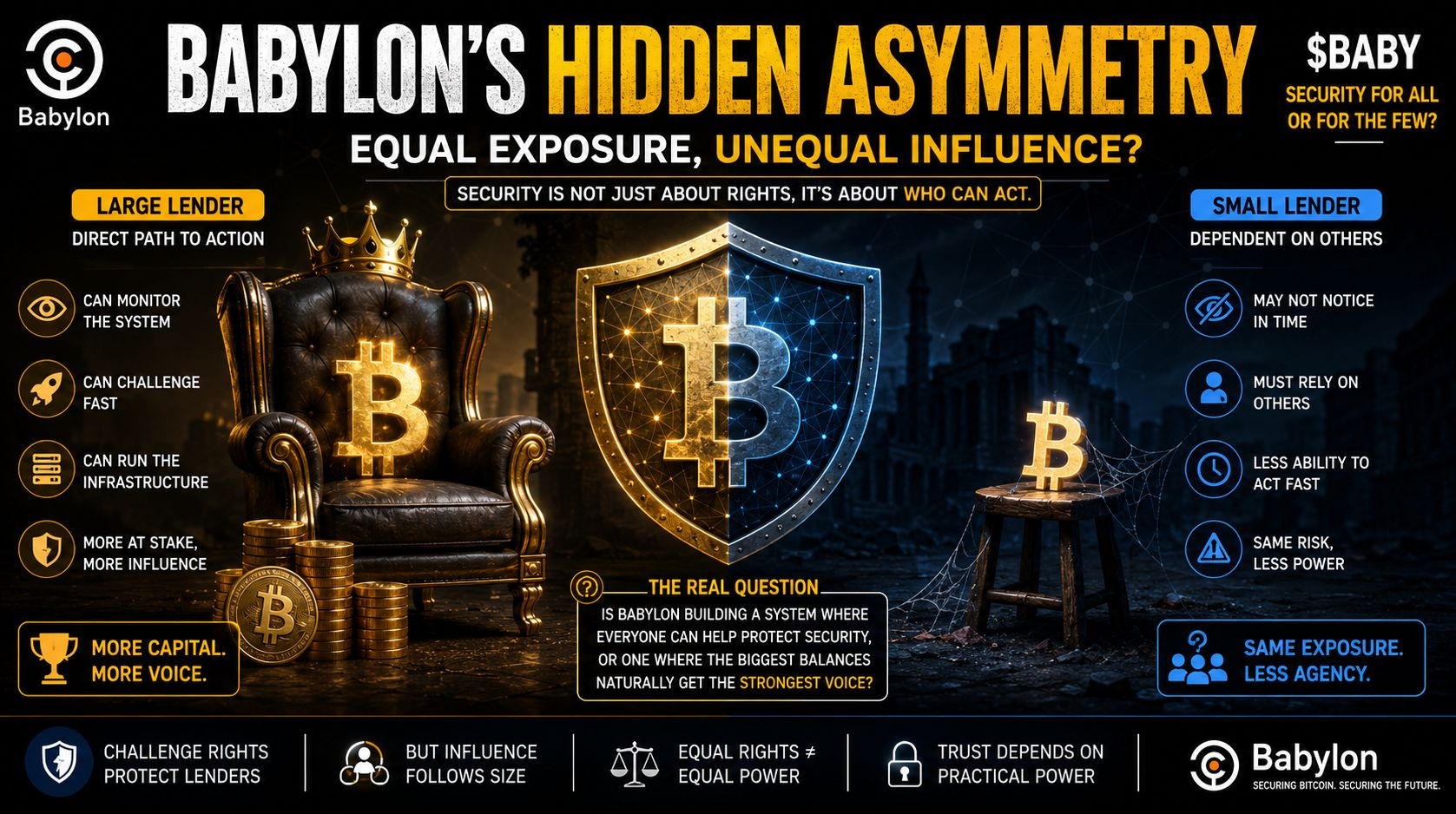
Um desfecho ruim pode ser contestável, mas quem de fato está pronto para contestá-lo?
Um grande credor pode se dar ao luxo de observar o sistema de perto, fazer a configuração necessária e reagir rapidamente quando algo dá errado.
Um credor menor pode até ter o mesmo direito em tese, mas não a mesma capacidade de agir.
Isso cria uma lacuna entre ter um direito de segurança e ter o poder de usá-lo.
E eu acho que essa é uma parte importante da história do Babylon que merece mais atenção.
Segurança não é apenas sobre se existe ou não uma prova de fraude.
Também é sobre quem está observando, quem consegue reagir e quem tem o suficiente em jogo para continuar ativo.
Credores grandes naturalmente assumem mais risco, então alguma diferença de influência faz sentido.
Mas se a segurança passar a depender demais do tamanho do capital, então a proteção igual pode, aos poucos, se transformar em participação desigual.
Isso me deixa com uma pergunta:
O Babylon está construindo um sistema em que todos podem ajudar a proteger a segurança, ou um em que os maiores saldos naturalmente ganham a voz mais forte?
Para essa diferença, pode importar mais do que as pessoas pensam.
@babylonlabs_io #baby $BABY
{spot}(BABYUSDT)
Quanto mais eu olhava para Babylon, mais uma coisa começava a me incomodar.
Um desfecho ruim pode ser contestável, mas quem de fato está pronto para contestá-lo?
Um grande credor pode se dar ao luxo de observar o sistema de perto, fazer a configuração necessária e reagir rapidamente quando algo dá errado.
Um credor menor pode até ter o mesmo direito em tese, mas não a mesma capacidade de agir.
Isso cria uma lacuna entre ter um direito de segurança e ter o poder de usá-lo.
E eu acho que essa é uma parte importante da história do Babylon que merece mais atenção.
Segurança não é apenas sobre se existe ou não uma prova de fraude.
Também é sobre quem está observando, quem consegue reagir e quem tem o suficiente em jogo para continuar ativo.
Credores grandes naturalmente assumem mais risco, então alguma diferença de influência faz sentido.
Mas se a segurança passar a depender demais do tamanho do capital, então a proteção igual pode, aos poucos, se transformar em participação desigual.
Isso me deixa com uma pergunta:
O Babylon está construindo um sistema em que todos podem ajudar a proteger a segurança, ou um em que os maiores saldos naturalmente ganham a voz mais forte?
Para essa diferença, pode importar mais do que as pessoas pensam.
@BabylonLabs_io #baby $BABY
Um desfecho ruim pode ser contestável, mas quem de fato está pronto para contestá-lo?
Um grande credor pode se dar ao luxo de observar o sistema de perto, fazer a configuração necessária e reagir rapidamente quando algo dá errado.
Um credor menor pode até ter o mesmo direito em tese, mas não a mesma capacidade de agir.
Isso cria uma lacuna entre ter um direito de segurança e ter o poder de usá-lo.
E eu acho que essa é uma parte importante da história do Babylon que merece mais atenção.
Segurança não é apenas sobre se existe ou não uma prova de fraude.
Também é sobre quem está observando, quem consegue reagir e quem tem o suficiente em jogo para continuar ativo.
Credores grandes naturalmente assumem mais risco, então alguma diferença de influência faz sentido.
Mas se a segurança passar a depender demais do tamanho do capital, então a proteção igual pode, aos poucos, se transformar em participação desigual.
Isso me deixa com uma pergunta:
O Babylon está construindo um sistema em que todos podem ajudar a proteger a segurança, ou um em que os maiores saldos naturalmente ganham a voz mais forte?
Para essa diferença, pode importar mais do que as pessoas pensam.
@BabylonLabs_io #baby $BABY
3
1
295
·
--
Em Alta
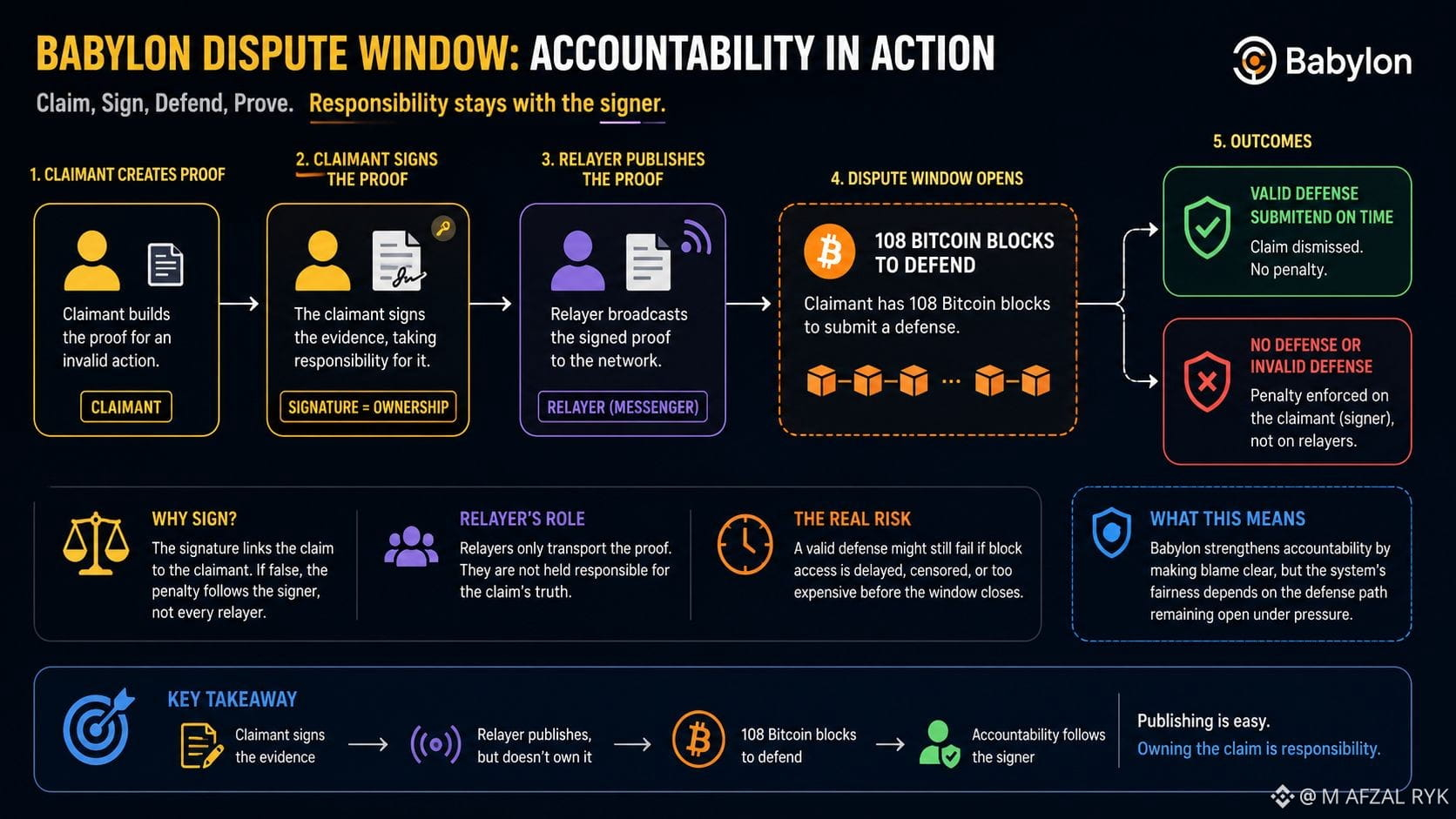
Quanto mais eu olhei para a janela de disputa de Babylon, mais interessante se tornou um detalhe.
Um requerente não apenas envia provas e sai. Ele assina as evidências que coloca adiante, o que significa que a reivindicação pode mais tarde ser rastreada até a pessoa que a aprovou.
A Babylon dá ao requerente 108 blocos de Bitcoin para defender essa prova.
No começo, eu vi isso apenas como um período de resposta. Mas parece mais uma camada de responsabilização.
Um relayer pode publicar ou encaminhar a prova, mas o requerente é quem fica vinculado à reivindicação. Se as evidências se mostrarem falsas, a responsabilidade pode recair sobre o signatário em vez de se espalhar por todos que trataram a mensagem.
Essa distinção é fácil de perder:
Publicar evidências ≠ possuir a reivindicação.
E ainda há uma parte sobre a qual continuo pensando.
O que acontece quando a defesa é válida, mas incluí-la se torna difícil?
Pressão da rede, acesso atrasado ou espaço de blocos limitado podem transformar uma janela de defesa justa em uma corrida contra o tempo.
Então, talvez a Babylon tenha deixado a responsabilização muito mais clara.
Agora, a questão maior é se esse mesmo processo de defesa continua aberto e prático quando a rede está sob pressão real.
É essa parte que estou observando.
@babylonlabs_io #baby $BABY
{spot}(BABYUSDT)
Quanto mais eu olhei para a janela de disputa de Babylon, mais interessante se tornou um detalhe.
Um requerente não apenas envia provas e sai. Ele assina as evidências que coloca adiante, o que significa que a reivindicação pode mais tarde ser rastreada até a pessoa que a aprovou.
A Babylon dá ao requerente 108 blocos de Bitcoin para defender essa prova.
No começo, eu vi isso apenas como um período de resposta. Mas parece mais uma camada de responsabilização.
Um relayer pode publicar ou encaminhar a prova, mas o requerente é quem fica vinculado à reivindicação. Se as evidências se mostrarem falsas, a responsabilidade pode recair sobre o signatário em vez de se espalhar por todos que trataram a mensagem.
Essa distinção é fácil de perder:
Publicar evidências ≠ possuir a reivindicação.
E ainda há uma parte sobre a qual continuo pensando.
O que acontece quando a defesa é válida, mas incluí-la se torna difícil?
Pressão da rede, acesso atrasado ou espaço de blocos limitado podem transformar uma janela de defesa justa em uma corrida contra o tempo.
Então, talvez a Babylon tenha deixado a responsabilização muito mais clara.
Agora, a questão maior é se esse mesmo processo de defesa continua aberto e prático quando a rede está sob pressão real.
É essa parte que estou observando.
@BabylonLabs_io #baby $BABY
Um requerente não apenas envia provas e sai. Ele assina as evidências que coloca adiante, o que significa que a reivindicação pode mais tarde ser rastreada até a pessoa que a aprovou.
A Babylon dá ao requerente 108 blocos de Bitcoin para defender essa prova.
No começo, eu vi isso apenas como um período de resposta. Mas parece mais uma camada de responsabilização.
Um relayer pode publicar ou encaminhar a prova, mas o requerente é quem fica vinculado à reivindicação. Se as evidências se mostrarem falsas, a responsabilidade pode recair sobre o signatário em vez de se espalhar por todos que trataram a mensagem.
Essa distinção é fácil de perder:
Publicar evidências ≠ possuir a reivindicação.
E ainda há uma parte sobre a qual continuo pensando.
O que acontece quando a defesa é válida, mas incluí-la se torna difícil?
Pressão da rede, acesso atrasado ou espaço de blocos limitado podem transformar uma janela de defesa justa em uma corrida contra o tempo.
Então, talvez a Babylon tenha deixado a responsabilização muito mais clara.
Agora, a questão maior é se esse mesmo processo de defesa continua aberto e prático quando a rede está sob pressão real.
É essa parte que estou observando.
@BabylonLabs_io #baby $BABY
5
3
134
·
--
Em Alta
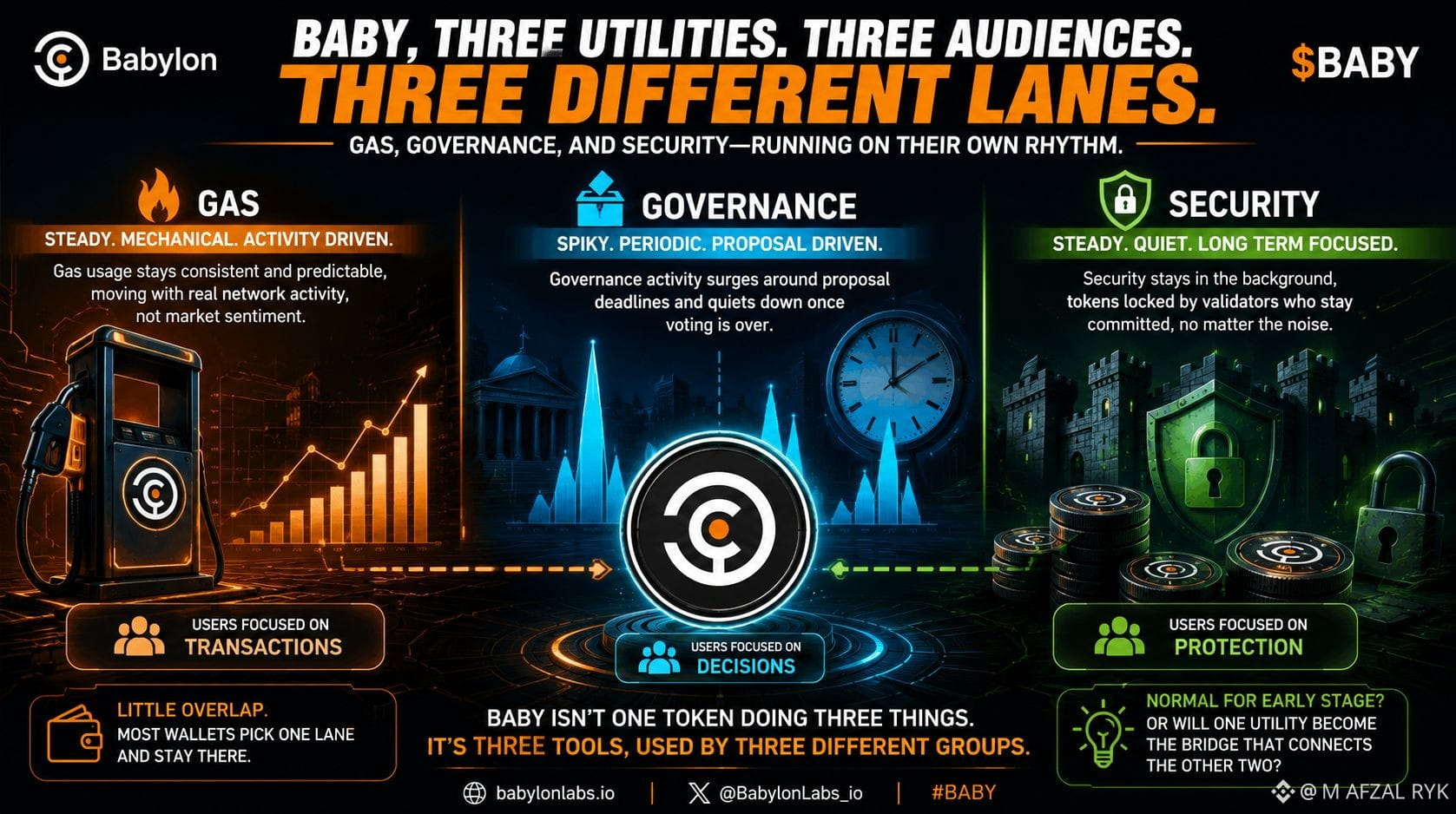
Quando comecei a investigar o BABY pela primeira vez, esperava que seus três papéis principais — gás, governança e segurança — funcionassem como um sistema conectado. Quanto mais eu olhava, mais interessante ficava o quadro.
O gás parecia a parte mais previsível. Ele simplesmente acompanhava a atividade da rede, subindo e descendo à medida que as pessoas usavam a cadeia. A governança tinha um ritmo completamente diferente. A atividade disparava sempre que apareciam propostas e depois diminuía uma vez que a votação terminava.
A segurança era diferente novamente. Uma grande parcela do BABY permanecia bloqueada com validadores, ajudando silenciosamente a proteger a rede sem reagir muito a eventos de governança nem ao volume diário de transações.
O que mais me surpreendeu não foi como essas utilidades funcionavam individualmente — foi o quanto elas se sobrepunham pouco. Poucas carteiras participavam ativamente das três. A maioria dos usuários parecia se concentrar em um único propósito: seja pagar taxas de gás, votar ou proteger a rede.
Isso faz o BABY parecer menos como um único token com três funções conectadas e mais como um único ativo que atende a três grupos diferentes de usuários.
Talvez isso seja totalmente normal para um ecossistema em crescimento. Ou talvez, com o tempo, uma utilidade se torne a ponte que naturalmente conecta as outras duas. Será interessante ver como isso evolui à medida que o ecossistema Babylon continua a crescer.
@babylonlabs_io #baby $BABY
Quando comecei a investigar o BABY pela primeira vez, esperava que seus três papéis principais — gás, governança e segurança — funcionassem como um sistema conectado. Quanto mais eu olhava, mais interessante ficava o quadro.
O gás parecia a parte mais previsível. Ele simplesmente acompanhava a atividade da rede, subindo e descendo à medida que as pessoas usavam a cadeia. A governança tinha um ritmo completamente diferente. A atividade disparava sempre que apareciam propostas e depois diminuía uma vez que a votação terminava.
A segurança era diferente novamente. Uma grande parcela do BABY permanecia bloqueada com validadores, ajudando silenciosamente a proteger a rede sem reagir muito a eventos de governança nem ao volume diário de transações.
O que mais me surpreendeu não foi como essas utilidades funcionavam individualmente — foi o quanto elas se sobrepunham pouco. Poucas carteiras participavam ativamente das três. A maioria dos usuários parecia se concentrar em um único propósito: seja pagar taxas de gás, votar ou proteger a rede.
Isso faz o BABY parecer menos como um único token com três funções conectadas e mais como um único ativo que atende a três grupos diferentes de usuários.
Talvez isso seja totalmente normal para um ecossistema em crescimento. Ou talvez, com o tempo, uma utilidade se torne a ponte que naturalmente conecta as outras duas. Será interessante ver como isso evolui à medida que o ecossistema Babylon continua a crescer.
@BabylonLabs_io #baby $BABY
O gás parecia a parte mais previsível. Ele simplesmente acompanhava a atividade da rede, subindo e descendo à medida que as pessoas usavam a cadeia. A governança tinha um ritmo completamente diferente. A atividade disparava sempre que apareciam propostas e depois diminuía uma vez que a votação terminava.
A segurança era diferente novamente. Uma grande parcela do BABY permanecia bloqueada com validadores, ajudando silenciosamente a proteger a rede sem reagir muito a eventos de governança nem ao volume diário de transações.
O que mais me surpreendeu não foi como essas utilidades funcionavam individualmente — foi o quanto elas se sobrepunham pouco. Poucas carteiras participavam ativamente das três. A maioria dos usuários parecia se concentrar em um único propósito: seja pagar taxas de gás, votar ou proteger a rede.
Isso faz o BABY parecer menos como um único token com três funções conectadas e mais como um único ativo que atende a três grupos diferentes de usuários.
Talvez isso seja totalmente normal para um ecossistema em crescimento. Ou talvez, com o tempo, uma utilidade se torne a ponte que naturalmente conecta as outras duas. Será interessante ver como isso evolui à medida que o ecossistema Babylon continua a crescer.
@BabylonLabs_io #baby $BABY
4
5
144
·
--
Em Alta
Parcialmente verdadeiro
LUMIA fez um grande movimento, subindo mais de 34% em apenas 24 horas, à medida que compras fortes empurraram o preço para cima. A alta começou quando o token voltou a ficar acima da sua EMA de 99 horas e rompeu uma longa faixa de negociação. Esse movimento chamou a atenção dos traders e impulsionou novas compras em todo o mercado.
Uma das maiores razões por trás do salto foi a forte entrada de dinheiro na LUMIA. Grandes ordens de compra e entradas positivas ajudaram a manter o preço em alta. O sentimento do mercado também permaneceu positivo. Muitos traders apontaram para um setup de gráfico altista, enquanto o apoio de vozes conhecidas do setor cripto e o crescente interesse de compradores de varejo adicionaram mais combustível à alta.
Mesmo com os ganhos fortes, alguns sinais de alerta começam a aparecer. A maior preocupação é o desbloqueio de tokens planejado para 18 de julho. Cerca de 6,41 milhões de tokens da LUMIA, equivalentes a 2,68% da oferta total, entrarão no mercado. Isso pode aumentar as vendas caso alguns detentores decidam realizar lucros após o recente salto no preço.
Os sinais do gráfico também sugerem que o movimento pode estar ficando “quente” demais. O RSI subiu acima de 90, indicando que a compra tem sido muito forte e pode não ser fácil de sustentar. O preço também tocou a Banda de Bollinger superior, o que frequentemente aponta para uma maior chance de queda no curto prazo. Alguns traders já abriram posições vendidas, esperando uma correção.
A LUMIA está demonstrando força agora, mas o próximo desbloqueio de tokens e as condições aquecidas do mercado podem trazer oscilações bruscas de preço no curto prazo.
$LUMIA
{future}(LUMIAUSDT)
$KAITO
{future}(KAITOUSDT)
$ONE
{spot}(ONEUSDT)
LUMIA fez um grande movimento, subindo mais de 34% em apenas 24 horas, à medida que compras fortes empurraram o preço para cima. A alta começou quando o token voltou a ficar acima da sua EMA de 99 horas e rompeu uma longa faixa de negociação. Esse movimento chamou a atenção dos traders e impulsionou novas compras em todo o mercado.
Uma das maiores razões por trás do salto foi a forte entrada de dinheiro na LUMIA. Grandes ordens de compra e entradas positivas ajudaram a manter o preço em alta. O sentimento do mercado também permaneceu positivo. Muitos traders apontaram para um setup de gráfico altista, enquanto o apoio de vozes conhecidas do setor cripto e o crescente interesse de compradores de varejo adicionaram mais combustível à alta.
Mesmo com os ganhos fortes, alguns sinais de alerta começam a aparecer. A maior preocupação é o desbloqueio de tokens planejado para 18 de julho. Cerca de 6,41 milhões de tokens da LUMIA, equivalentes a 2,68% da oferta total, entrarão no mercado. Isso pode aumentar as vendas caso alguns detentores decidam realizar lucros após o recente salto no preço.
Os sinais do gráfico também sugerem que o movimento pode estar ficando “quente” demais. O RSI subiu acima de 90, indicando que a compra tem sido muito forte e pode não ser fácil de sustentar. O preço também tocou a Banda de Bollinger superior, o que frequentemente aponta para uma maior chance de queda no curto prazo. Alguns traders já abriram posições vendidas, esperando uma correção.
A LUMIA está demonstrando força agora, mas o próximo desbloqueio de tokens e as condições aquecidas do mercado podem trazer oscilações bruscas de preço no curto prazo.
$LUMIA
$KAITO
$ONE
Uma das maiores razões por trás do salto foi a forte entrada de dinheiro na LUMIA. Grandes ordens de compra e entradas positivas ajudaram a manter o preço em alta. O sentimento do mercado também permaneceu positivo. Muitos traders apontaram para um setup de gráfico altista, enquanto o apoio de vozes conhecidas do setor cripto e o crescente interesse de compradores de varejo adicionaram mais combustível à alta.
Mesmo com os ganhos fortes, alguns sinais de alerta começam a aparecer. A maior preocupação é o desbloqueio de tokens planejado para 18 de julho. Cerca de 6,41 milhões de tokens da LUMIA, equivalentes a 2,68% da oferta total, entrarão no mercado. Isso pode aumentar as vendas caso alguns detentores decidam realizar lucros após o recente salto no preço.
Os sinais do gráfico também sugerem que o movimento pode estar ficando “quente” demais. O RSI subiu acima de 90, indicando que a compra tem sido muito forte e pode não ser fácil de sustentar. O preço também tocou a Banda de Bollinger superior, o que frequentemente aponta para uma maior chance de queda no curto prazo. Alguns traders já abriram posições vendidas, esperando uma correção.
A LUMIA está demonstrando força agora, mas o próximo desbloqueio de tokens e as condições aquecidas do mercado podem trazer oscilações bruscas de preço no curto prazo.
$LUMIA
$KAITO
$ONE
⏰ July 18 token unlock
29%
📢 Bullish market hype
43%
💰 Heavy money inflow
0%
🔥 Strong breakout
28%
7 Votos • Votação encerrada
1.1k
·
--
Artigo
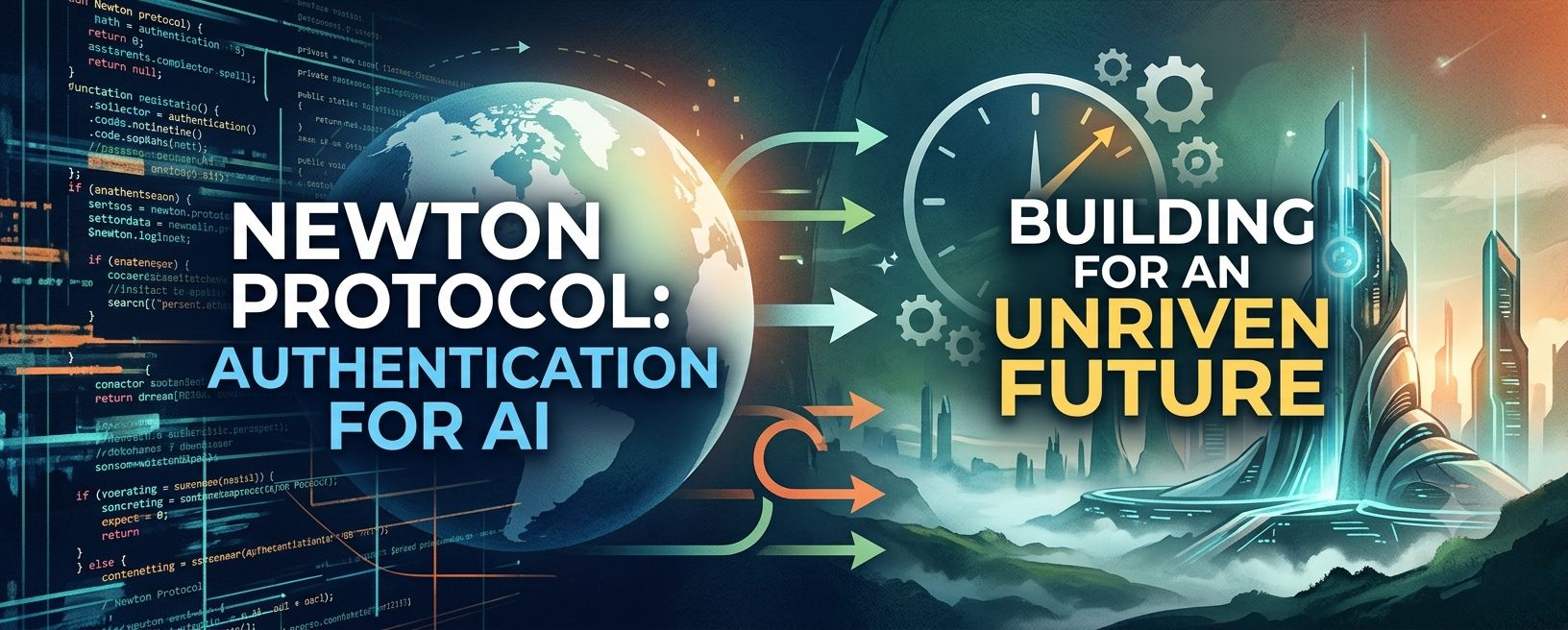
Protocolo Newton e o Risco de Construir para um Futuro que Ainda Não ChegouUm dos desafios mais difíceis na tecnologia não é construir algo útil. É construir algo útil no momento certo.
A história está repleta de produtos e plataformas que resolveram problemas genuínos anos antes de o mercado reconhecer que esses problemas existiam. A tecnologia era sólida. A visão era precisa. Ainda assim, a adoção ficou para trás porque a urgência ainda não havia alcançado a inovação.
O Protocolo Newton parece estar situado diretamente nessa tensão.
Numa época em que grande parte da indústria cripto continua focada em escalabilidade, liquidez, incentivos por tokens e aquisição de usuários, a Newton está perseguindo um objetivo diferente. Em vez de competir para se tornar mais uma blockchain ou mais uma aplicação financeira, ela tenta criar uma camada de autorização para a atividade financeira autônoma.
Protocolo Newton e o Risco de Construir para um Futuro que Ainda Não Chegou
Um dos desafios mais difíceis na tecnologia não é construir algo útil. É construir algo útil no momento certo.
A história está repleta de produtos e plataformas que resolveram problemas genuínos anos antes de o mercado reconhecer que esses problemas existiam. A tecnologia era sólida. A visão era precisa. Ainda assim, a adoção ficou para trás porque a urgência ainda não havia alcançado a inovação.
O Protocolo Newton parece estar situado diretamente nessa tensão.
Numa época em que grande parte da indústria cripto continua focada em escalabilidade, liquidez, incentivos por tokens e aquisição de usuários, a Newton está perseguindo um objetivo diferente. Em vez de competir para se tornar mais uma blockchain ou mais uma aplicação financeira, ela tenta criar uma camada de autorização para a atividade financeira autônoma.
A história está repleta de produtos e plataformas que resolveram problemas genuínos anos antes de o mercado reconhecer que esses problemas existiam. A tecnologia era sólida. A visão era precisa. Ainda assim, a adoção ficou para trás porque a urgência ainda não havia alcançado a inovação.
O Protocolo Newton parece estar situado diretamente nessa tensão.
Numa época em que grande parte da indústria cripto continua focada em escalabilidade, liquidez, incentivos por tokens e aquisição de usuários, a Newton está perseguindo um objetivo diferente. Em vez de competir para se tornar mais uma blockchain ou mais uma aplicação financeira, ela tenta criar uma camada de autorização para a atividade financeira autônoma.
7
4
225
·
--
Verificado
$THE
{spot}(THEUSDT)
$ESP
{future}(ESPUSDT)
$LAB
{future}(LABUSDT)
#SamsungExploresPotentialUSADRListing #BinanceTurns9 #CXMTReportedlyToListInShanghaiJuly27 #SamsungSKHynixLeveragedETFsNearlyHalve #USSaysItWillBlockadeIran
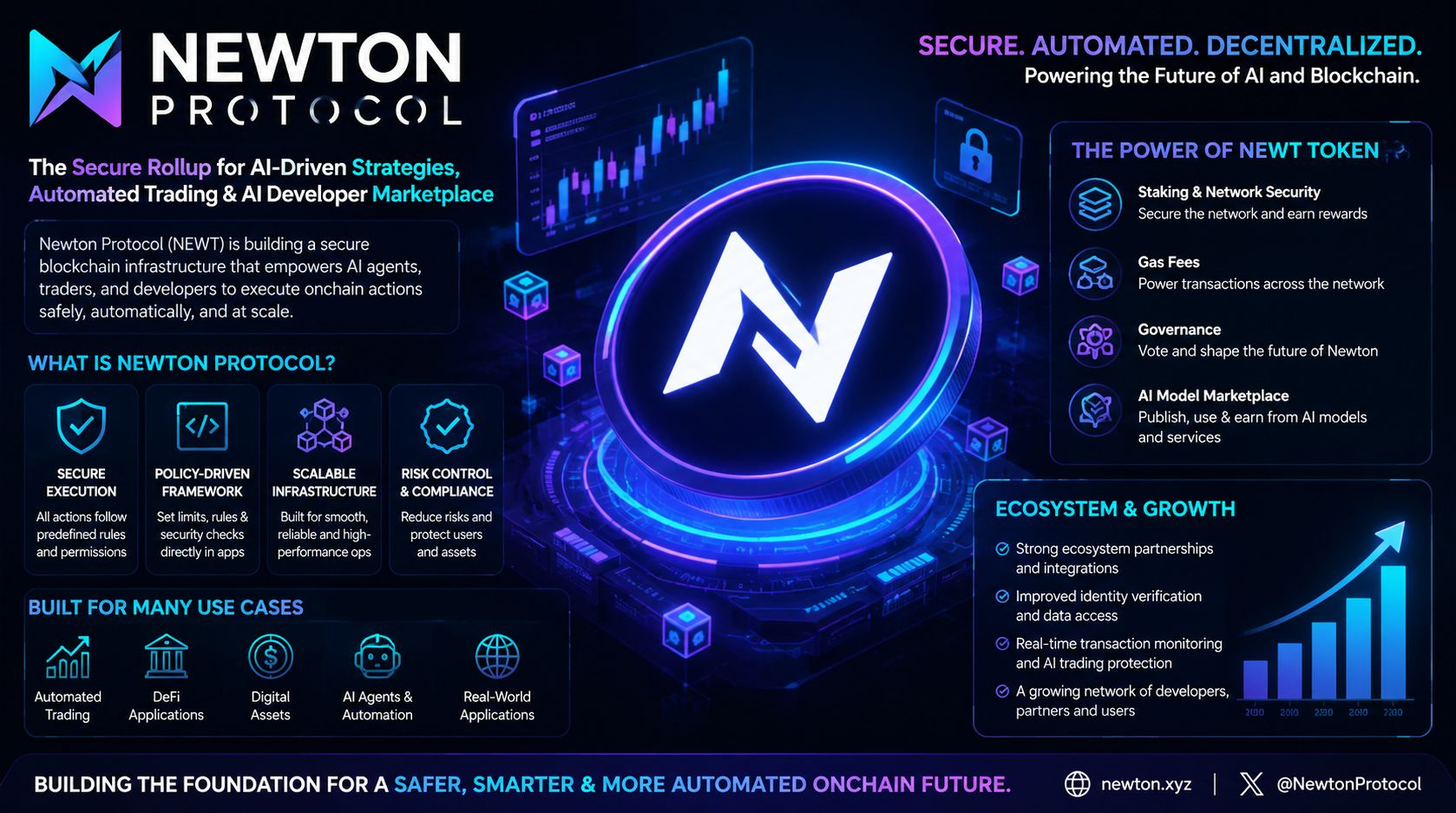
O Newton Protocol (NEWT) é um projeto de blockchain criado para tornar o trading e a automação com IA mais seguros, inteligentes e fáceis de confiar. Ele cria uma rede segura onde agentes de IA podem executar tarefas, gerenciar negociações e seguir instruções do usuário sem abrir mão de transparência ou controle.
O protocolo combina ferramentas avançadas de segurança com tecnologia blockchain para verificar e checar cada ação. Isso ajuda a reduzir riscos e garante que os sistemas de IA sigam as regras definidas pelos usuários. À medida que a IA se torna mais envolvida em finanças e serviços digitais, a Newton busca oferecer uma base segura para a tomada de decisões automatizada.
Uma de suas funcionalidades mais importantes é o Newton Model Registry, um marketplace onde desenvolvedores de IA podem compartilhar, vender e ganhar com seus modelos e agentes de IA. Os desenvolvedores recebem recompensas em tokens NEWT, enquanto operadores recebem taxas por apoiar a rede.
O token NEWT impulsiona o ecossistema. Ele é usado para fazer staking, pagar taxas de rede, acessar serviços e participar de decisões de governança. A oferta total é fixa em 1 bilhão de tokens.
O crescimento recente trouxe novas parcerias e integrações que melhoram a verificação de identidade, a segurança do usuário e as ferramentas de trading automatizado. Essas atualizações fortalecem o objetivo do protocolo de criar um ambiente confiável para aplicações orientadas por IA.
Ao unir IA, blockchain e segurança robusta, o Newton Protocol está trabalhando para construir um futuro em que sistemas automatizados possam operar com eficiência, segurança e com maior confiança do usuário.
$THE
$ESP
$LAB
#SamsungExploresPotentialUSADRListing #BinanceTurns9 #CXMTReportedlyToListInShanghaiJuly27 #SamsungSKHynixLeveragedETFsNearlyHalve #USSaysItWillBlockadeIran
O Newton Protocol (NEWT) é um projeto de blockchain criado para tornar o trading e a automação com IA mais seguros, inteligentes e fáceis de confiar. Ele cria uma rede segura onde agentes de IA podem executar tarefas, gerenciar negociações e seguir instruções do usuário sem abrir mão de transparência ou controle.
O protocolo combina ferramentas avançadas de segurança com tecnologia blockchain para verificar e checar cada ação. Isso ajuda a reduzir riscos e garante que os sistemas de IA sigam as regras definidas pelos usuários. À medida que a IA se torna mais envolvida em finanças e serviços digitais, a Newton busca oferecer uma base segura para a tomada de decisões automatizada.
Uma de suas funcionalidades mais importantes é o Newton Model Registry, um marketplace onde desenvolvedores de IA podem compartilhar, vender e ganhar com seus modelos e agentes de IA. Os desenvolvedores recebem recompensas em tokens NEWT, enquanto operadores recebem taxas por apoiar a rede.
O token NEWT impulsiona o ecossistema. Ele é usado para fazer staking, pagar taxas de rede, acessar serviços e participar de decisões de governança. A oferta total é fixa em 1 bilhão de tokens.
O crescimento recente trouxe novas parcerias e integrações que melhoram a verificação de identidade, a segurança do usuário e as ferramentas de trading automatizado. Essas atualizações fortalecem o objetivo do protocolo de criar um ambiente confiável para aplicações orientadas por IA.
Ao unir IA, blockchain e segurança robusta, o Newton Protocol está trabalhando para construir um futuro em que sistemas automatizados possam operar com eficiência, segurança e com maior confiança do usuário.
$ESP
$LAB
#SamsungExploresPotentialUSADRListing #BinanceTurns9 #CXMTReportedlyToListInShanghaiJuly27 #SamsungSKHynixLeveragedETFsNearlyHalve #USSaysItWillBlockadeIran
O Newton Protocol (NEWT) é um projeto de blockchain criado para tornar o trading e a automação com IA mais seguros, inteligentes e fáceis de confiar. Ele cria uma rede segura onde agentes de IA podem executar tarefas, gerenciar negociações e seguir instruções do usuário sem abrir mão de transparência ou controle.
O protocolo combina ferramentas avançadas de segurança com tecnologia blockchain para verificar e checar cada ação. Isso ajuda a reduzir riscos e garante que os sistemas de IA sigam as regras definidas pelos usuários. À medida que a IA se torna mais envolvida em finanças e serviços digitais, a Newton busca oferecer uma base segura para a tomada de decisões automatizada.
Uma de suas funcionalidades mais importantes é o Newton Model Registry, um marketplace onde desenvolvedores de IA podem compartilhar, vender e ganhar com seus modelos e agentes de IA. Os desenvolvedores recebem recompensas em tokens NEWT, enquanto operadores recebem taxas por apoiar a rede.
O token NEWT impulsiona o ecossistema. Ele é usado para fazer staking, pagar taxas de rede, acessar serviços e participar de decisões de governança. A oferta total é fixa em 1 bilhão de tokens.
O crescimento recente trouxe novas parcerias e integrações que melhoram a verificação de identidade, a segurança do usuário e as ferramentas de trading automatizado. Essas atualizações fortalecem o objetivo do protocolo de criar um ambiente confiável para aplicações orientadas por IA.
Ao unir IA, blockchain e segurança robusta, o Newton Protocol está trabalhando para construir um futuro em que sistemas automatizados possam operar com eficiência, segurança e com maior confiança do usuário.
🔹 Unlikely
34%
🔹 Not sure yet
33%
🔹 Yes, definitely
33%
🔹 Maybe, partially
0%
3 Votos • Votação encerrada
1
748
·
--
Em Alta
O Newton Protocol (NEWT) é um projeto de infraestrutura blockchain focado em automação segura e execução onchain. Ele foi projetado para ajudar usuários e aplicações a realizarem transações e operações por meio de um sistema confiável e baseado em regras. Ao combinar recursos avançados de segurança com uma infraestrutura escalável, o protocolo tem como objetivo melhorar a forma como as aplicações de blockchain interagem e operam.
Uma das principais forças do Newton Protocol é sua estrutura orientada por políticas. Os desenvolvedores podem criar regras personalizadas, limites de transação e condições de segurança que devem ser seguidas antes de as ações serem aprovadas. Isso ajuda a melhorar a segurança, reduzir riscos operacionais e apoiar serviços de blockchain mais confiáveis.
O token NEWT serve como o ativo central do ecossistema. Ele é usado para staking, taxas de rede e participação na governança. Os detentores de tokens podem contribuir para o desenvolvimento da rede enquanto ajudam a proteger o protocolo. O ecossistema também inclui um marketplace que permite aos desenvolvedores publicar ferramentas e serviços, criando oportunidades adicionais de crescimento e colaboração.
O Newton Protocol continua a se expandir por meio de parcerias no ecossistema e integrações técnicas. Esses avanços melhoram o acesso a dados, os processos de verificação e o monitoramento de transações em toda a rede. À medida que a adoção de blockchain cresce, o Newton Protocol está construindo a infraestrutura necessária para operações onchain seguras, eficientes e escaláveis, tornando-se um projeto bastante acompanhado por muitos participantes do setor de ativos digitais.
#Newt @NewtonProtocol $NEWT
{spot}(NEWTUSDT)
$SXT
{spot}(SXTUSDT)
$ZBT
{spot}(ZBTUSDT)
O Newton Protocol (NEWT) é um projeto de infraestrutura blockchain focado em automação segura e execução onchain. Ele foi projetado para ajudar usuários e aplicações a realizarem transações e operações por meio de um sistema confiável e baseado em regras. Ao combinar recursos avançados de segurança com uma infraestrutura escalável, o protocolo tem como objetivo melhorar a forma como as aplicações de blockchain interagem e operam.
Uma das principais forças do Newton Protocol é sua estrutura orientada por políticas. Os desenvolvedores podem criar regras personalizadas, limites de transação e condições de segurança que devem ser seguidas antes de as ações serem aprovadas. Isso ajuda a melhorar a segurança, reduzir riscos operacionais e apoiar serviços de blockchain mais confiáveis.
O token NEWT serve como o ativo central do ecossistema. Ele é usado para staking, taxas de rede e participação na governança. Os detentores de tokens podem contribuir para o desenvolvimento da rede enquanto ajudam a proteger o protocolo. O ecossistema também inclui um marketplace que permite aos desenvolvedores publicar ferramentas e serviços, criando oportunidades adicionais de crescimento e colaboração.
O Newton Protocol continua a se expandir por meio de parcerias no ecossistema e integrações técnicas. Esses avanços melhoram o acesso a dados, os processos de verificação e o monitoramento de transações em toda a rede. À medida que a adoção de blockchain cresce, o Newton Protocol está construindo a infraestrutura necessária para operações onchain seguras, eficientes e escaláveis, tornando-se um projeto bastante acompanhado por muitos participantes do setor de ativos digitais.
#Newt @NewtonProtocol $NEWT
$SXT
$ZBT
Uma das principais forças do Newton Protocol é sua estrutura orientada por políticas. Os desenvolvedores podem criar regras personalizadas, limites de transação e condições de segurança que devem ser seguidas antes de as ações serem aprovadas. Isso ajuda a melhorar a segurança, reduzir riscos operacionais e apoiar serviços de blockchain mais confiáveis.
O token NEWT serve como o ativo central do ecossistema. Ele é usado para staking, taxas de rede e participação na governança. Os detentores de tokens podem contribuir para o desenvolvimento da rede enquanto ajudam a proteger o protocolo. O ecossistema também inclui um marketplace que permite aos desenvolvedores publicar ferramentas e serviços, criando oportunidades adicionais de crescimento e colaboração.
O Newton Protocol continua a se expandir por meio de parcerias no ecossistema e integrações técnicas. Esses avanços melhoram o acesso a dados, os processos de verificação e o monitoramento de transações em toda a rede. À medida que a adoção de blockchain cresce, o Newton Protocol está construindo a infraestrutura necessária para operações onchain seguras, eficientes e escaláveis, tornando-se um projeto bastante acompanhado por muitos participantes do setor de ativos digitais.
#Newt @NewtonProtocol $NEWT
$SXT
$ZBT
8
6
914
·
--
Em Alta
Está mostrando um melhor equilíbrio após algumas semanas movimentadas, com o token permanecendo perto de US$ 0,046 após seu lançamento na Mainnet Beta. Esta atualização é um grande passo para o projeto. A rede agora está ativa na Base e no Ethereum, trazendo um sistema que verifica regras antes que as transações sejam concluídas. Isso ajuda a melhorar a segurança, dá suporte a ferramentas de IA e pode atrair investidores maiores em busca de uma proteção mais forte em redes blockchain.
O movimento de preços também melhorou. A NEWT voltou para cerca de US$ 0,0462 após a recente fraqueza. O RSI subiu de um nível muito baixo, perto de 19, para cerca de 50, indicando que a pressão de venda diminuiu. O MACD também voltou a ficar positivo, o que muitas vezes aponta para uma melhor força do mercado no curto prazo e uma possível mudança no sentimento dos traders.
Ainda assim, um evento importante está chegando. Em 24 de julho, cerca de 17,84 milhões de tokens NEWT, ou 1,8% da oferta total, serão liberados. Muitos desses tokens pertencem a membros da equipe e a apoiadores iniciais. Se alguns decidirem vender, a oferta extra pode pressionar o preço.
O projeto também tem alguns obstáculos a superar. A NEWT usa o sistema de regras Rego, que pode ser difícil para novos desenvolvedores aprenderem. Isso pode desacelerar o crescimento da rede ao longo do tempo. A atividade de negociação ainda está baixa, o que deixa o token mais suscetível a movimentos rápidos e acentuados de preço. No geral, a NEWT está avançando, mas a próxima liberação de tokens continua sendo o principal ponto a observar.
$LAB
{future}(LABUSDT)
$VELVET
{future}(VELVETUSDT)
$LUMIA
{future}(LUMIAUSDT)
Está mostrando um melhor equilíbrio após algumas semanas movimentadas, com o token permanecendo perto de US$ 0,046 após seu lançamento na Mainnet Beta. Esta atualização é um grande passo para o projeto. A rede agora está ativa na Base e no Ethereum, trazendo um sistema que verifica regras antes que as transações sejam concluídas. Isso ajuda a melhorar a segurança, dá suporte a ferramentas de IA e pode atrair investidores maiores em busca de uma proteção mais forte em redes blockchain.
O movimento de preços também melhorou. A NEWT voltou para cerca de US$ 0,0462 após a recente fraqueza. O RSI subiu de um nível muito baixo, perto de 19, para cerca de 50, indicando que a pressão de venda diminuiu. O MACD também voltou a ficar positivo, o que muitas vezes aponta para uma melhor força do mercado no curto prazo e uma possível mudança no sentimento dos traders.
Ainda assim, um evento importante está chegando. Em 24 de julho, cerca de 17,84 milhões de tokens NEWT, ou 1,8% da oferta total, serão liberados. Muitos desses tokens pertencem a membros da equipe e a apoiadores iniciais. Se alguns decidirem vender, a oferta extra pode pressionar o preço.
O projeto também tem alguns obstáculos a superar. A NEWT usa o sistema de regras Rego, que pode ser difícil para novos desenvolvedores aprenderem. Isso pode desacelerar o crescimento da rede ao longo do tempo. A atividade de negociação ainda está baixa, o que deixa o token mais suscetível a movimentos rápidos e acentuados de preço. No geral, a NEWT está avançando, mas a próxima liberação de tokens continua sendo o principal ponto a observar.
$LAB
$VELVET
$LUMIA
O movimento de preços também melhorou. A NEWT voltou para cerca de US$ 0,0462 após a recente fraqueza. O RSI subiu de um nível muito baixo, perto de 19, para cerca de 50, indicando que a pressão de venda diminuiu. O MACD também voltou a ficar positivo, o que muitas vezes aponta para uma melhor força do mercado no curto prazo e uma possível mudança no sentimento dos traders.
Ainda assim, um evento importante está chegando. Em 24 de julho, cerca de 17,84 milhões de tokens NEWT, ou 1,8% da oferta total, serão liberados. Muitos desses tokens pertencem a membros da equipe e a apoiadores iniciais. Se alguns decidirem vender, a oferta extra pode pressionar o preço.
O projeto também tem alguns obstáculos a superar. A NEWT usa o sistema de regras Rego, que pode ser difícil para novos desenvolvedores aprenderem. Isso pode desacelerar o crescimento da rede ao longo do tempo. A atividade de negociação ainda está baixa, o que deixa o token mais suscetível a movimentos rápidos e acentuados de preço. No geral, a NEWT está avançando, mas a próxima liberação de tokens continua sendo o principal ponto a observar.
$LAB
$VELVET
$LUMIA
yes👍
67%
🙂↔️ NO
33%
yes
0%
No
0%
3 Votos • Votação encerrada
2
3
485
·
--
Artigo
Newton Protocol: Construindo o Futuro ou Resolvendo o Problema de Amanhã Tarde Demais?Cada ciclo de tecnologia produz um padrão familiar.
Surge um novo projeto com uma visão cativante, engenharia sofisticada e a promessa de resolver problemas que a maioria das pessoas ainda nem começou a considerar. Alguns desses projetos acabam se tornando a base de indústrias inteiras. Outros passam anos aguardando uma demanda que nunca chega plenamente.
O Protocolo Newton está diretamente nesse cruzamento.
O projeto não está tentando construir outra exchange, outra carteira ou outra aplicação que gere rendimento. Em vez disso, ele está tentando algo muito mais ambicioso: criar a infraestrutura que poderia permitir que agentes de IA operem com segurança e autonomia onchain.
Newton Protocol: Construindo o Futuro ou Resolvendo o Problema de Amanhã Tarde Demais?
Cada ciclo de tecnologia produz um padrão familiar.
Surge um novo projeto com uma visão cativante, engenharia sofisticada e a promessa de resolver problemas que a maioria das pessoas ainda nem começou a considerar. Alguns desses projetos acabam se tornando a base de indústrias inteiras. Outros passam anos aguardando uma demanda que nunca chega plenamente.
O Protocolo Newton está diretamente nesse cruzamento.
O projeto não está tentando construir outra exchange, outra carteira ou outra aplicação que gere rendimento. Em vez disso, ele está tentando algo muito mais ambicioso: criar a infraestrutura que poderia permitir que agentes de IA operem com segurança e autonomia onchain.
Surge um novo projeto com uma visão cativante, engenharia sofisticada e a promessa de resolver problemas que a maioria das pessoas ainda nem começou a considerar. Alguns desses projetos acabam se tornando a base de indústrias inteiras. Outros passam anos aguardando uma demanda que nunca chega plenamente.
O Protocolo Newton está diretamente nesse cruzamento.
O projeto não está tentando construir outra exchange, outra carteira ou outra aplicação que gere rendimento. Em vez disso, ele está tentando algo muito mais ambicioso: criar a infraestrutura que poderia permitir que agentes de IA operem com segurança e autonomia onchain.
21
13
380
·
--
Em Alta
NEWT continua sob pressão e ainda está sendo negociado perto de suas mínimas em torno de US$ 0,047. Embora o projeto tenha continuado a ser construído e recentemente tenha lançado sua Mainnet Beta, a ação do preço ainda não reflete esses desenvolvimentos.
A Mainnet Beta introduziu automação on-chain verificável e novas integrações com RedStone e Credora, adicionando mais utilidade real ao ecossistema. Esses são passos positivos para o crescimento de longo prazo, mas o sentimento do mercado ainda permanece fraco por enquanto.
Os dados recentes de fluxo de capital mostram que os vendedores ainda estão no controle. As últimas 24 horas registraram, em sua maioria, fluxos negativos, incluindo um notável pico de saída de US$ 46,9K que desacelerou qualquer tentativa de recuperação. Os indicadores técnicos também seguem em silêncio, com RSI perto de 44 e o preço se movendo em uma faixa estreita.
Um fator importante por trás da fraqueza é o unlock de tokens de 24 de junho, que liberou 139 milhões de tokens NEWT no mercado—cerca de 37% da oferta em circulação. Esse grande aumento na oferta continua a gerar pressão de venda e limita o impulso de alta.
Baixo volume de negociação e liquidez mais fina adicionam mais risco, tornando o token mais sensível a oscilações repentinas de preço. A dependência do protocolo de um Gateway centralizado também continua sendo um ponto que os investidores seguem observando.
Por enquanto, NEWT mostra melhora na utilidade e progresso no desenvolvimento, mas a pressão de oferta, a demanda fraca e a liquidez limitada continuam pesando sobre o desempenho do mercado.
#Newt @NewtonProtocol $NEWT
{future}(NEWTUSDT)
$SPCXB
{spot}(SPCXBUSDT)
$AIO
{future}(AIOUSDT)
NEWT continua sob pressão e ainda está sendo negociado perto de suas mínimas em torno de US$ 0,047. Embora o projeto tenha continuado a ser construído e recentemente tenha lançado sua Mainnet Beta, a ação do preço ainda não reflete esses desenvolvimentos.
A Mainnet Beta introduziu automação on-chain verificável e novas integrações com RedStone e Credora, adicionando mais utilidade real ao ecossistema. Esses são passos positivos para o crescimento de longo prazo, mas o sentimento do mercado ainda permanece fraco por enquanto.
Os dados recentes de fluxo de capital mostram que os vendedores ainda estão no controle. As últimas 24 horas registraram, em sua maioria, fluxos negativos, incluindo um notável pico de saída de US$ 46,9K que desacelerou qualquer tentativa de recuperação. Os indicadores técnicos também seguem em silêncio, com RSI perto de 44 e o preço se movendo em uma faixa estreita.
Um fator importante por trás da fraqueza é o unlock de tokens de 24 de junho, que liberou 139 milhões de tokens NEWT no mercado—cerca de 37% da oferta em circulação. Esse grande aumento na oferta continua a gerar pressão de venda e limita o impulso de alta.
Baixo volume de negociação e liquidez mais fina adicionam mais risco, tornando o token mais sensível a oscilações repentinas de preço. A dependência do protocolo de um Gateway centralizado também continua sendo um ponto que os investidores seguem observando.
Por enquanto, NEWT mostra melhora na utilidade e progresso no desenvolvimento, mas a pressão de oferta, a demanda fraca e a liquidez limitada continuam pesando sobre o desempenho do mercado.
#Newt @NewtonProtocol $NEWT
$SPCXB
$AIO
A Mainnet Beta introduziu automação on-chain verificável e novas integrações com RedStone e Credora, adicionando mais utilidade real ao ecossistema. Esses são passos positivos para o crescimento de longo prazo, mas o sentimento do mercado ainda permanece fraco por enquanto.
Os dados recentes de fluxo de capital mostram que os vendedores ainda estão no controle. As últimas 24 horas registraram, em sua maioria, fluxos negativos, incluindo um notável pico de saída de US$ 46,9K que desacelerou qualquer tentativa de recuperação. Os indicadores técnicos também seguem em silêncio, com RSI perto de 44 e o preço se movendo em uma faixa estreita.
Um fator importante por trás da fraqueza é o unlock de tokens de 24 de junho, que liberou 139 milhões de tokens NEWT no mercado—cerca de 37% da oferta em circulação. Esse grande aumento na oferta continua a gerar pressão de venda e limita o impulso de alta.
Baixo volume de negociação e liquidez mais fina adicionam mais risco, tornando o token mais sensível a oscilações repentinas de preço. A dependência do protocolo de um Gateway centralizado também continua sendo um ponto que os investidores seguem observando.
Por enquanto, NEWT mostra melhora na utilidade e progresso no desenvolvimento, mas a pressão de oferta, a demanda fraca e a liquidez limitada continuam pesando sobre o desempenho do mercado.
#Newt @NewtonProtocol $NEWT
$SPCXB
$AIO
🔻$NEWT💚💰💰
60%
🔻$SPCXB🤍
20%
🔻$AIO❤️
20%
5 Votos • Votação encerrada
21
14
785
·
--
Artigo
O MAIOR RISCO PARA O PROTOCOLO NEWTON NÃO É A CONCORRÊNCIA. É O MOMENTO.Quanto mais eu estudo o Protocolo Newton, mais volto a uma ideia que parece ao mesmo tempo óbvia e desconfortável.
E se Newton estivesse resolvendo um problema que todos concordam que existe, mas que muito poucas pessoas estão desesperadas para resolver hoje?
Isso não é uma crítica.
Na verdade, algumas das infraestruturas mais valiosas da história foram construídas muito antes de o mercado entender plenamente por que isso importava.
A internet precisava de sistemas de pagamento antes de o e-commerce explodir.
A computação em nuvem existia antes de as empresas estarem prontas para confiar nela.
O MAIOR RISCO PARA O PROTOCOLO NEWTON NÃO É A CONCORRÊNCIA. É O MOMENTO.
Quanto mais eu estudo o Protocolo Newton, mais volto a uma ideia que parece ao mesmo tempo óbvia e desconfortável.
E se Newton estivesse resolvendo um problema que todos concordam que existe, mas que muito poucas pessoas estão desesperadas para resolver hoje?
Isso não é uma crítica.
Na verdade, algumas das infraestruturas mais valiosas da história foram construídas muito antes de o mercado entender plenamente por que isso importava.
A internet precisava de sistemas de pagamento antes de o e-commerce explodir.
A computação em nuvem existia antes de as empresas estarem prontas para confiar nela.
E se Newton estivesse resolvendo um problema que todos concordam que existe, mas que muito poucas pessoas estão desesperadas para resolver hoje?
Isso não é uma crítica.
Na verdade, algumas das infraestruturas mais valiosas da história foram construídas muito antes de o mercado entender plenamente por que isso importava.
A internet precisava de sistemas de pagamento antes de o e-commerce explodir.
A computação em nuvem existia antes de as empresas estarem prontas para confiar nela.
23
16
353
Inicia sessão para explorar mais conteúdos
Junta-te a utilizadores de criptomoedas de todo o mundo na Binance Square
⚡️ Obtém informações úteis e recentes sobre criptomoedas.
💬 Com a confiança da maior exchange de criptomoedas do mundo.
👍 Descobre perspetivas reais de criadores verificados.
E-mail/Número de telefone
Tópicos em Tendência
ZcashETFPostsFirstWeeklyOutflow$93.6M
23,039 visualizações
63 a discutir
#ZcashETFPostsFirstWeeklyOutflow$93.6M 📊 Grayscale’s Spot Zcash (ZEC) ETF Registra US$ 93,6M em Saídas Líquidas Semanais
Os fluxos de capital institucional estão mostrando uma nova dinâmica. O ETF spot de Zcash da Grayscale acabou de registrar sua primeira grande saída líquida semanal, marcando uma mudança significativa em relação ao forte ritmo de lançamento inicial.
🔹Os Números O ETF spot de ZEC da Grayscale (ticker: ZCSH) registrou aproximadamente US$ 93,6 milhões em saídas líquidas ao longo da semana passada, com saques notáveis ocorrendo no fim de setembro e no início de outubro.
🔹 O Contexto Isso acontece após um período inicial robusto. Depois de converter o Grayscale Zcash Trust e fazer o listamento na NYSE Arca no fim de agosto, o fundo anteriormente havia acumulado entradas líquidas de US$ 271 milhões até meados de setembro.
💡 Análise de Impacto no Mercado
•Dinâmica de Curto Prazo Saídas líquidas grandes de ETF podem introduzir uma pressão temporária de venda no ativo subjacente à medida que o fundo ajusta suas participações para atender aos pedidos de resgate.
• Sentimento & Rebalanceamento Esse recuo pode refletir realização de lucros rotineira ou rebalanceamento de carteira por investidores institucionais no início, e não uma mudança fundamental na utilidade de longo prazo do Zcash ou na proposta de valor focada em privacidade.
• Acompanhe o Ecossistema Os participantes do mercado vão observar se isso é um evento isolado para o ZCSH ou se indica um arrefecimento mais amplo no apetite institucional por ativos digitais com foco em privacidade.
💬 Qual é a sua opinião? Você vê essa saída semanal como uma correção saudável de mercado após um lançamento forte, ou como um sinal de mudança no sentimento institucional em relação a moedas de privacidade? Compartilhe suas ideias nos comentários abaixo!
#Zcash #ZEC #CryptoETF #CryptoInstitucional #AtualizaçãoDeMercado
Isto é apenas para fins educacionais. Não é aconselhamento financeiro (NFA). Faça sua própria pesquisa (DYOR) sempre.
$GLMR $QI $ONE
piknkkk
·0 gostos
·45 visualizações
GreekPoliceBustCryptoScamRingArrest17
31,175 visualizações
354 a discutir
BitcoinRejectedAt$87K
101,170 visualizações
127 a discutir