

Blockonomi
28.2k Publicações

Blockonomi
 Square verificado+
Denunciar
Bloquear Utilizador
A guide to Cryptocurrencies, Technology and the Blockchain Economy #cryptocurrency #blockchain #fintech
0 A seguir
15.8K+ Seguidores
12.8K+ Gostaram
Publicações
·
--
Ações da S&P Global (SPGI): nova ferramenta de avaliação de riscos para cofres mira mercado cripto de US$ 10 bilhõesResumo
A S&P Global lança uma nova ferramenta de avaliação de riscos para o mercado de cofres cripto de US$ 10 bilhões.
A estrutura avalia seis grandes riscos associados aos cofres de empréstimo de ativos digitais.
Os depósitos em cofres cripto saltaram de US$ 1,5 bilhão em 2024 para US$ 10 bilhões em 2026.
As ações da SPGI fecharam em queda de 0,49%, antes de avançarem ligeiramente 0,07% nas negociações pré-mercado.
O lançamento amplia a iniciativa mais abrangente da S&P Global no setor financeiro baseado em blockchain e em dados.
A S&P Global lançou uma nova estrutura de avaliação de riscos para cofres de empréstimo de ativos digitais, voltada para um mercado de US$ 10 bilhões em rápida expansão. A iniciativa reforça o papel crescente da empresa no setor financeiro baseado em blockchain e amplia seus serviços analíticos para além dos mercados de crédito tradicionais. As ações da SPGI fecharam a US$ 386,27, em queda de 0,49%, antes de subirem 0,07%, para US$ 386,54, nas negociações pré-mercado.
Ações da S&P Global (SPGI): nova ferramenta de avaliação de riscos para cofres mira mercado cripto de US$ 10 bilhões
Resumo
A S&P Global lança uma nova ferramenta de avaliação de riscos para o mercado de cofres cripto de US$ 10 bilhões.
A estrutura avalia seis grandes riscos associados aos cofres de empréstimo de ativos digitais.
Os depósitos em cofres cripto saltaram de US$ 1,5 bilhão em 2024 para US$ 10 bilhões em 2026.
As ações da SPGI fecharam em queda de 0,49%, antes de avançarem ligeiramente 0,07% nas negociações pré-mercado.
O lançamento amplia a iniciativa mais abrangente da S&P Global no setor financeiro baseado em blockchain e em dados.
A S&P Global lançou uma nova estrutura de avaliação de riscos para cofres de empréstimo de ativos digitais, voltada para um mercado de US$ 10 bilhões em rápida expansão. A iniciativa reforça o papel crescente da empresa no setor financeiro baseado em blockchain e amplia seus serviços analíticos para além dos mercados de crédito tradicionais. As ações da SPGI fecharam a US$ 386,27, em queda de 0,49%, antes de subirem 0,07%, para US$ 386,54, nas negociações pré-mercado.
A S&P Global lança uma nova ferramenta de avaliação de riscos para o mercado de cofres cripto de US$ 10 bilhões.
A estrutura avalia seis grandes riscos associados aos cofres de empréstimo de ativos digitais.
Os depósitos em cofres cripto saltaram de US$ 1,5 bilhão em 2024 para US$ 10 bilhões em 2026.
As ações da SPGI fecharam em queda de 0,49%, antes de avançarem ligeiramente 0,07% nas negociações pré-mercado.
O lançamento amplia a iniciativa mais abrangente da S&P Global no setor financeiro baseado em blockchain e em dados.
A S&P Global lançou uma nova estrutura de avaliação de riscos para cofres de empréstimo de ativos digitais, voltada para um mercado de US$ 10 bilhões em rápida expansão. A iniciativa reforça o papel crescente da empresa no setor financeiro baseado em blockchain e amplia seus serviços analíticos para além dos mercados de crédito tradicionais. As ações da SPGI fecharam a US$ 386,27, em queda de 0,49%, antes de subirem 0,07%, para US$ 386,54, nas negociações pré-mercado.
SPGIUS+0,44%
15
·
--
Ações da Metaplanet Inc. (3350.T): sobem com plano de alocar 85% em BitcoinResumo
As ações da Metaplanet sobem 2,06%, enquanto o Bitcoin continua sendo central para sua estratégia de tesouraria.
A Metaplanet planeja manter de 85% a 90% de seus ativos totais alocados em Bitcoin.
Os empréstimos de linhas de crédito relacionadas ao Bitcoin permanecerão abaixo de cerca de 10% do valor líquido dos ativos em BTC.
Os investimentos estratégicos corresponderão a cerca de 10% a 15% dos ativos totais da empresa.
O Projeto Nova busca gerar fluxo de caixa recorrente para apoiar novas compras de Bitcoin.
As ações da Metaplanet Inc. (3350.T) fecharam a ¥297,00, com alta de 2,06%, após se recuperarem da fraqueza no início do pregão. A alta ocorreu após a revisão da política de alocação de capital, que mantém o Bitcoin no centro do balanço patrimonial da empresa. De acordo com a estrutura atualizada, a Metaplanet planeja manter cerca de 85% a 90% de seus ativos totais em Bitcoin.
Ações da Metaplanet Inc. (3350.T): sobem com plano de alocar 85% em Bitcoin
Resumo
As ações da Metaplanet sobem 2,06%, enquanto o Bitcoin continua sendo central para sua estratégia de tesouraria.
A Metaplanet planeja manter de 85% a 90% de seus ativos totais alocados em Bitcoin.
Os empréstimos de linhas de crédito relacionadas ao Bitcoin permanecerão abaixo de cerca de 10% do valor líquido dos ativos em BTC.
Os investimentos estratégicos corresponderão a cerca de 10% a 15% dos ativos totais da empresa.
O Projeto Nova busca gerar fluxo de caixa recorrente para apoiar novas compras de Bitcoin.
As ações da Metaplanet Inc. (3350.T) fecharam a ¥297,00, com alta de 2,06%, após se recuperarem da fraqueza no início do pregão. A alta ocorreu após a revisão da política de alocação de capital, que mantém o Bitcoin no centro do balanço patrimonial da empresa. De acordo com a estrutura atualizada, a Metaplanet planeja manter cerca de 85% a 90% de seus ativos totais em Bitcoin.
As ações da Metaplanet sobem 2,06%, enquanto o Bitcoin continua sendo central para sua estratégia de tesouraria.
A Metaplanet planeja manter de 85% a 90% de seus ativos totais alocados em Bitcoin.
Os empréstimos de linhas de crédito relacionadas ao Bitcoin permanecerão abaixo de cerca de 10% do valor líquido dos ativos em BTC.
Os investimentos estratégicos corresponderão a cerca de 10% a 15% dos ativos totais da empresa.
O Projeto Nova busca gerar fluxo de caixa recorrente para apoiar novas compras de Bitcoin.
As ações da Metaplanet Inc. (3350.T) fecharam a ¥297,00, com alta de 2,06%, após se recuperarem da fraqueza no início do pregão. A alta ocorreu após a revisão da política de alocação de capital, que mantém o Bitcoin no centro do balanço patrimonial da empresa. De acordo com a estrutura atualizada, a Metaplanet planeja manter cerca de 85% a 90% de seus ativos totais em Bitcoin.
35
·
--
Ações da CoinShares PLC (CSHR): alta após pesquisa sobre criptomoedas indicar forte demandaRESUMO
A ação da CSHR subiu 0,41% enquanto a CoinShares publicou uma importante pesquisa sobre criptomoedas entre investidores de alto poder aquisitivo.
A posse de criptomoedas chega a 70% nos EUA, no Reino Unido e na Alemanha, enquanto na Suécia fica em 54%.
Entre os atuais detentores nos EUA, no Reino Unido e na Alemanha, 91% pretendem aumentar sua exposição.
O Bitcoin continua dominante, enquanto 89% dos detentores de Bitcoin também possuem outras criptomoedas.
Cerca de 69% considerariam contratar gestores de patrimônio com conhecimento especializado em ativos digitais.
As ações da CoinShares PLC fecharam a segunda-feira a US$ 4,95, com alta de 0,41%, após a empresa divulgar uma importante pesquisa sobre ativos digitais. O estudo abrangeu 2.230 participantes de alto poder aquisitivo em sete dos principais mercados da Europa e dos Estados Unidos. Os resultados apontaram ampla posse de criptomoedas, planos de aumentar a alocação e forte demanda por serviços profissionais relacionados a ativos digitais.
Ações da CoinShares PLC (CSHR): alta após pesquisa sobre criptomoedas indicar forte demanda
RESUMO
A ação da CSHR subiu 0,41% enquanto a CoinShares publicou uma importante pesquisa sobre criptomoedas entre investidores de alto poder aquisitivo.
A posse de criptomoedas chega a 70% nos EUA, no Reino Unido e na Alemanha, enquanto na Suécia fica em 54%.
Entre os atuais detentores nos EUA, no Reino Unido e na Alemanha, 91% pretendem aumentar sua exposição.
O Bitcoin continua dominante, enquanto 89% dos detentores de Bitcoin também possuem outras criptomoedas.
Cerca de 69% considerariam contratar gestores de patrimônio com conhecimento especializado em ativos digitais.
As ações da CoinShares PLC fecharam a segunda-feira a US$ 4,95, com alta de 0,41%, após a empresa divulgar uma importante pesquisa sobre ativos digitais. O estudo abrangeu 2.230 participantes de alto poder aquisitivo em sete dos principais mercados da Europa e dos Estados Unidos. Os resultados apontaram ampla posse de criptomoedas, planos de aumentar a alocação e forte demanda por serviços profissionais relacionados a ativos digitais.
A ação da CSHR subiu 0,41% enquanto a CoinShares publicou uma importante pesquisa sobre criptomoedas entre investidores de alto poder aquisitivo.
A posse de criptomoedas chega a 70% nos EUA, no Reino Unido e na Alemanha, enquanto na Suécia fica em 54%.
Entre os atuais detentores nos EUA, no Reino Unido e na Alemanha, 91% pretendem aumentar sua exposição.
O Bitcoin continua dominante, enquanto 89% dos detentores de Bitcoin também possuem outras criptomoedas.
Cerca de 69% considerariam contratar gestores de patrimônio com conhecimento especializado em ativos digitais.
As ações da CoinShares PLC fecharam a segunda-feira a US$ 4,95, com alta de 0,41%, após a empresa divulgar uma importante pesquisa sobre ativos digitais. O estudo abrangeu 2.230 participantes de alto poder aquisitivo em sete dos principais mercados da Europa e dos Estados Unidos. Os resultados apontaram ampla posse de criptomoedas, planos de aumentar a alocação e forte demanda por serviços profissionais relacionados a ativos digitais.
CSHRUS+0,40%
10
·
--
Ações da Oracle (ORCL) disparam com US$ 10 milhões destinados à Nashville SymphonyResumo
As ações da Oracle subiram 3,06%, para US$ 142,30, e avançaram mais 0,44% nas negociações do pré-mercado.
A Oracle prometeu US$ 10 milhões para apoiar os esforços de reestruturação da Nashville Symphony.
O financiamento restabelece a temporada de 2026-27 e cancela as licenças não remuneradas previstas para outubro.
A Oracle associa a parceria à expansão de sua presença com a sede em Nashville.
A Nashville Symphony alcança 550.000 pessoas por ano e 13 milhões de ouvintes em todo o mundo.
As ações da Oracle subiram 3,06%, para US$ 142,30, no fechamento de segunda-feira, e avançaram mais 0,44%, para US$ 143,15, no pré-mercado. A Oracle anunciou um investimento de US$ 10 milhões e uma parceria estratégica com a Nashville Symphony. O financiamento apoiará a reestruturação da orquestra e ajudará a restabelecer sua temporada suspensa de 2026-27.
Ações da Oracle (ORCL) disparam com US$ 10 milhões destinados à Nashville Symphony
Resumo
As ações da Oracle subiram 3,06%, para US$ 142,30, e avançaram mais 0,44% nas negociações do pré-mercado.
A Oracle prometeu US$ 10 milhões para apoiar os esforços de reestruturação da Nashville Symphony.
O financiamento restabelece a temporada de 2026-27 e cancela as licenças não remuneradas previstas para outubro.
A Oracle associa a parceria à expansão de sua presença com a sede em Nashville.
A Nashville Symphony alcança 550.000 pessoas por ano e 13 milhões de ouvintes em todo o mundo.
As ações da Oracle subiram 3,06%, para US$ 142,30, no fechamento de segunda-feira, e avançaram mais 0,44%, para US$ 143,15, no pré-mercado. A Oracle anunciou um investimento de US$ 10 milhões e uma parceria estratégica com a Nashville Symphony. O financiamento apoiará a reestruturação da orquestra e ajudará a restabelecer sua temporada suspensa de 2026-27.
As ações da Oracle subiram 3,06%, para US$ 142,30, e avançaram mais 0,44% nas negociações do pré-mercado.
A Oracle prometeu US$ 10 milhões para apoiar os esforços de reestruturação da Nashville Symphony.
O financiamento restabelece a temporada de 2026-27 e cancela as licenças não remuneradas previstas para outubro.
A Oracle associa a parceria à expansão de sua presença com a sede em Nashville.
A Nashville Symphony alcança 550.000 pessoas por ano e 13 milhões de ouvintes em todo o mundo.
As ações da Oracle subiram 3,06%, para US$ 142,30, no fechamento de segunda-feira, e avançaram mais 0,44%, para US$ 143,15, no pré-mercado. A Oracle anunciou um investimento de US$ 10 milhões e uma parceria estratégica com a Nashville Symphony. O financiamento apoiará a reestruturação da orquestra e ajudará a restabelecer sua temporada suspensa de 2026-27.
54
·
--
EUA sancionam instituições de caridade francesas por alegadas transferências de criptomoedas para o HamasResumo
O OFAC sancionou, a 2 de outubro, duas instituições de caridade sediadas em França e três pessoas por alegado financiamento do Hamas.
O Tesouro afirma que dois angariadores de fundos franceses enviaram centenas de milhares de dólares em criptomoedas a um comandante do Hamas em Gaza.
A rede terá angariado mais de 2 milhões de dólares para o Hamas entre 2020 e 2026.
As empresas de criptomoedas dos EUA têm de bloquear os ativos associados às partes sancionadas e comunicá-los no prazo de 10 dias úteis.
As instituições financeiras estrangeiras poderão ser alvo de sanções secundárias por ajudarem conscientemente a rede.
EUA sancionam instituições de caridade francesas por alegadas transferências de criptomoedas para o Hamas
Resumo
O OFAC sancionou, a 2 de outubro, duas instituições de caridade sediadas em França e três pessoas por alegado financiamento do Hamas.
O Tesouro afirma que dois angariadores de fundos franceses enviaram centenas de milhares de dólares em criptomoedas a um comandante do Hamas em Gaza.
A rede terá angariado mais de 2 milhões de dólares para o Hamas entre 2020 e 2026.
As empresas de criptomoedas dos EUA têm de bloquear os ativos associados às partes sancionadas e comunicá-los no prazo de 10 dias úteis.
As instituições financeiras estrangeiras poderão ser alvo de sanções secundárias por ajudarem conscientemente a rede.
O OFAC sancionou, a 2 de outubro, duas instituições de caridade sediadas em França e três pessoas por alegado financiamento do Hamas.
O Tesouro afirma que dois angariadores de fundos franceses enviaram centenas de milhares de dólares em criptomoedas a um comandante do Hamas em Gaza.
A rede terá angariado mais de 2 milhões de dólares para o Hamas entre 2020 e 2026.
As empresas de criptomoedas dos EUA têm de bloquear os ativos associados às partes sancionadas e comunicá-los no prazo de 10 dias úteis.
As instituições financeiras estrangeiras poderão ser alvo de sanções secundárias por ajudarem conscientemente a rede.
5
·
--
ETFs de Bitcoin seguem em alta enquanto ETFs de Ether perdem US$ 138 milhõesResumo
Os ETFs spot de Bitcoin dos EUA receberam US$ 241,1 milhões na semana passada, sua terceira semana consecutiva de entradas líquidas.
Os ETFs de Ether registraram US$ 138 milhões em saídas líquidas, após receberem US$ 690 milhões na semana anterior.
Os fundos de Zcash registraram sua primeira saída semanal desde que há registros, perdendo cerca de US$ 94 milhões.
Os ETFs de Solana e XRP prolongaram suas sequências de entradas, com US$ 2,4 milhões e US$ 4,7 milhões, respectivamente.
O Índice de Medo e Ganância das Criptomoedas permaneceu na zona de “Ganância”, em 70, abaixo dos 74.
Os fundos negociados em bolsa (ETFs) spot de Bitcoin dos EUA registraram uma terceira semana consecutiva de entradas líquidas na semana passada. Os ETFs de Ether foram na direção oposta, registrando saídas líquidas após uma semana anterior forte.
ETFs de Bitcoin seguem em alta enquanto ETFs de Ether perdem US$ 138 milhões
Resumo
Os ETFs spot de Bitcoin dos EUA receberam US$ 241,1 milhões na semana passada, sua terceira semana consecutiva de entradas líquidas.
Os ETFs de Ether registraram US$ 138 milhões em saídas líquidas, após receberem US$ 690 milhões na semana anterior.
Os fundos de Zcash registraram sua primeira saída semanal desde que há registros, perdendo cerca de US$ 94 milhões.
Os ETFs de Solana e XRP prolongaram suas sequências de entradas, com US$ 2,4 milhões e US$ 4,7 milhões, respectivamente.
O Índice de Medo e Ganância das Criptomoedas permaneceu na zona de “Ganância”, em 70, abaixo dos 74.
Os fundos negociados em bolsa (ETFs) spot de Bitcoin dos EUA registraram uma terceira semana consecutiva de entradas líquidas na semana passada. Os ETFs de Ether foram na direção oposta, registrando saídas líquidas após uma semana anterior forte.
Os ETFs spot de Bitcoin dos EUA receberam US$ 241,1 milhões na semana passada, sua terceira semana consecutiva de entradas líquidas.
Os ETFs de Ether registraram US$ 138 milhões em saídas líquidas, após receberem US$ 690 milhões na semana anterior.
Os fundos de Zcash registraram sua primeira saída semanal desde que há registros, perdendo cerca de US$ 94 milhões.
Os ETFs de Solana e XRP prolongaram suas sequências de entradas, com US$ 2,4 milhões e US$ 4,7 milhões, respectivamente.
O Índice de Medo e Ganância das Criptomoedas permaneceu na zona de “Ganância”, em 70, abaixo dos 74.
Os fundos negociados em bolsa (ETFs) spot de Bitcoin dos EUA registraram uma terceira semana consecutiva de entradas líquidas na semana passada. Os ETFs de Ether foram na direção oposta, registrando saídas líquidas após uma semana anterior forte.
154
·
--
Hong Kong apresentará projeto de lei sobre licenciamento de criptoativos antes do final de 2026RESUMO
Hong Kong planeia apresentar um projeto de lei antes do final de 2026 para criar quatro novos regimes de licenciamento de criptoativos.
As licenças abrangeriam serviços de negociação, custódia, consultoria e gestão de ativos virtuais.
As regras de consultoria e gestão deverão seguir, em termos gerais, os padrões de licenciamento de valores mobiliários já existentes.
Hong Kong já licencia plataformas de negociação de criptoativos e emissores de stablecoins ao abrigo de regimes separados.
A SFC planeia reforçar a supervisão da custódia em 2026, com a introdução de mais ferramentas de monitorização em 2027.
Hong Kong planeia apresentar legislação antes do final de 2026 para criar novos regimes de licenciamento para quatro tipos de serviços de criptoativos. O plano abrange negociação, custódia, consultoria e gestão de ativos virtuais.
Hong Kong apresentará projeto de lei sobre licenciamento de criptoativos antes do final de 2026
RESUMO
Hong Kong planeia apresentar um projeto de lei antes do final de 2026 para criar quatro novos regimes de licenciamento de criptoativos.
As licenças abrangeriam serviços de negociação, custódia, consultoria e gestão de ativos virtuais.
As regras de consultoria e gestão deverão seguir, em termos gerais, os padrões de licenciamento de valores mobiliários já existentes.
Hong Kong já licencia plataformas de negociação de criptoativos e emissores de stablecoins ao abrigo de regimes separados.
A SFC planeia reforçar a supervisão da custódia em 2026, com a introdução de mais ferramentas de monitorização em 2027.
Hong Kong planeia apresentar legislação antes do final de 2026 para criar novos regimes de licenciamento para quatro tipos de serviços de criptoativos. O plano abrange negociação, custódia, consultoria e gestão de ativos virtuais.
Hong Kong planeia apresentar um projeto de lei antes do final de 2026 para criar quatro novos regimes de licenciamento de criptoativos.
As licenças abrangeriam serviços de negociação, custódia, consultoria e gestão de ativos virtuais.
As regras de consultoria e gestão deverão seguir, em termos gerais, os padrões de licenciamento de valores mobiliários já existentes.
Hong Kong já licencia plataformas de negociação de criptoativos e emissores de stablecoins ao abrigo de regimes separados.
A SFC planeia reforçar a supervisão da custódia em 2026, com a introdução de mais ferramentas de monitorização em 2027.
Hong Kong planeia apresentar legislação antes do final de 2026 para criar novos regimes de licenciamento para quatro tipos de serviços de criptoativos. O plano abrange negociação, custódia, consultoria e gestão de ativos virtuais.
66
·
--
Tribunal das Filipinas congela 25 carteiras de criptomoedas em investigação sobre corrupção relacionada com o controlo de cheiasResumo
O Tribunal de Apelações das Filipinas congelou 25 carteiras de criptomoedas, 86 contas bancárias e outros ativos no âmbito de uma investigação sobre corrupção relacionada com o controlo de cheias.
Os ativos estão ligados a um destacado legislador cujo nome não foi divulgado, a uma empresa e a várias pessoas e entidades.
As autoridades não divulgaram o valor, o tipo de criptomoedas nem os endereços das carteiras envolvidos.
Os investigadores afirmam que os fundos passaram por bancos, intermediários, plataformas de criptomoedas e carteiras privadas para dificultar o seu rastreio.
O congelamento pode vigorar inicialmente durante 20 dias e ser prolongado no decurso do processo judicial.
Tribunal das Filipinas congela 25 carteiras de criptomoedas em investigação sobre corrupção relacionada com o controlo de cheias
Resumo
O Tribunal de Apelações das Filipinas congelou 25 carteiras de criptomoedas, 86 contas bancárias e outros ativos no âmbito de uma investigação sobre corrupção relacionada com o controlo de cheias.
Os ativos estão ligados a um destacado legislador cujo nome não foi divulgado, a uma empresa e a várias pessoas e entidades.
As autoridades não divulgaram o valor, o tipo de criptomoedas nem os endereços das carteiras envolvidos.
Os investigadores afirmam que os fundos passaram por bancos, intermediários, plataformas de criptomoedas e carteiras privadas para dificultar o seu rastreio.
O congelamento pode vigorar inicialmente durante 20 dias e ser prolongado no decurso do processo judicial.
O Tribunal de Apelações das Filipinas congelou 25 carteiras de criptomoedas, 86 contas bancárias e outros ativos no âmbito de uma investigação sobre corrupção relacionada com o controlo de cheias.
Os ativos estão ligados a um destacado legislador cujo nome não foi divulgado, a uma empresa e a várias pessoas e entidades.
As autoridades não divulgaram o valor, o tipo de criptomoedas nem os endereços das carteiras envolvidos.
Os investigadores afirmam que os fundos passaram por bancos, intermediários, plataformas de criptomoedas e carteiras privadas para dificultar o seu rastreio.
O congelamento pode vigorar inicialmente durante 20 dias e ser prolongado no decurso do processo judicial.
88
·
--
Ver tradução
Veysage Introduces $250 Entry Point for Selected Private AI Investment OpportunitiesFrankfurt, Germany — Veysage has introduced minimum investments starting at $250 for selected private-market opportunities, expanding the range of investment sizes available to eligible users interested in private companies.
The platform currently includes opportunities associated with artificial intelligence companies, with minimums and availability determined separately for each offering.
The entry point addresses one of the practical differences between private and public investing. Private-company transactions have traditionally involved larger minimum commitments, while individual opportunities can also carry different ownership structures, fees and eligibility requirements.
Veysage presents these conditions before a purchase is made rather than applying the $250 minimum across every investment on the platform.
Selected opportunities start at $250
Veysage currently shows a $250 minimum for selected private-market opportunities, including certain exposure to private artificial intelligence companies.
The minimum is specific to the individual offering. Other positions may require a different investment amount depending on available inventory and transaction structure.
This distinction is important because Veysage is not dividing publicly traded shares into smaller orders. The platform provides access to private-market positions, which can come with their own terms and ownership arrangements.
Before investing, users can review the stated minimum alongside the price, fees, eligibility requirements and structure of the position.
The lower entry point changes the amount of capital required for selected opportunities, but it does not change the risks associated with private-company investing.
Private AI companies remain a focus
Artificial intelligence is currently one of the main sectors represented in Veysage’s private marketplace.
The platform has displayed opportunities associated with companies including OpenAI and Anthropic. Access depends on available private-market inventory rather than those companies being listed on a public stock exchange.
An opportunity associated with a private company should also not be interpreted as an endorsement, partnership or direct fundraising relationship with that company unless explicitly stated.
Private-market positions can originate through existing shareholders and other secondary transactions. Depending on the offering, investors may acquire direct shares or a beneficial interest in a structure holding the underlying asset.
Veysage discloses the applicable ownership structure within the offering information.
Investment terms are available before purchase
The minimum investment is only one part of the information users can review.
Veysage also provides the terms attached to an available position so an investor can examine how the transaction is structured before committing capital.
Once a purchase is submitted, the platform continues to track the transaction through settlement. Purchase confirmations, ownership documentation and position information can then remain available through the user’s account.
This creates a continuous record around the investment rather than separating discovery, purchasing and ownership tracking into different systems.
The platform also includes company research, allowing users to examine an opportunity before reviewing its transaction terms.
Smaller minimums do not change private-market liquidity
Reducing the minimum required for an investment does not make a private position behave like a public stock.
Private-company investments can remain illiquid for long periods. An investor may not be able to sell a position when desired, and there is no guarantee that the underlying company will complete an IPO, acquisition or another liquidity event.
Valuations can also change between financing rounds or secondary transactions.
For investors, the $250 starting point therefore changes the size of the initial commitment for selected opportunities, not the nature of the asset itself.
Veysage identifies private-market investments as speculative and illiquid. Investors can lose some or all of the capital committed to an opportunity.
Eligibility also remains dependent on the individual offering and applicable requirements.
Veysage broadens investment sizes in private markets
The introduction of selected opportunities starting at $250 forms part of Veysage’s broader private-market platform.
Alongside access, the company is building the account infrastructure around private investing, including research, offering information, settlement tracking, ownership documentation and portfolio records.
Minimums will continue to vary according to the position being offered rather than following one platform-wide threshold.
About Veysage
Veysage is a private-market investing and portfolio management platform providing eligible investors with access to selected private-company opportunities. The platform combines company research, offering terms, purchasing, settlement tracking, ownership documentation and portfolio records within one account.
Private-market investments are speculative and illiquid and may result in loss of capital. Availability, minimum investment amounts, eligibility, fees and ownership structures vary by offering.
Learn more at Veysage official website
The post Veysage Introduces $250 Entry Point for Selected Private AI Investment Opportunities appeared first on Blockonomi.
Veysage Introduces $250 Entry Point for Selected Private AI Investment Opportunities
Frankfurt, Germany — Veysage has introduced minimum investments starting at $250 for selected private-market opportunities, expanding the range of investment sizes available to eligible users interested in private companies.
The platform currently includes opportunities associated with artificial intelligence companies, with minimums and availability determined separately for each offering.
The entry point addresses one of the practical differences between private and public investing. Private-company transactions have traditionally involved larger minimum commitments, while individual opportunities can also carry different ownership structures, fees and eligibility requirements.
Veysage presents these conditions before a purchase is made rather than applying the $250 minimum across every investment on the platform.
Selected opportunities start at $250
Veysage currently shows a $250 minimum for selected private-market opportunities, including certain exposure to private artificial intelligence companies.
The minimum is specific to the individual offering. Other positions may require a different investment amount depending on available inventory and transaction structure.
This distinction is important because Veysage is not dividing publicly traded shares into smaller orders. The platform provides access to private-market positions, which can come with their own terms and ownership arrangements.
Before investing, users can review the stated minimum alongside the price, fees, eligibility requirements and structure of the position.
The lower entry point changes the amount of capital required for selected opportunities, but it does not change the risks associated with private-company investing.
Private AI companies remain a focus
Artificial intelligence is currently one of the main sectors represented in Veysage’s private marketplace.
The platform has displayed opportunities associated with companies including OpenAI and Anthropic. Access depends on available private-market inventory rather than those companies being listed on a public stock exchange.
An opportunity associated with a private company should also not be interpreted as an endorsement, partnership or direct fundraising relationship with that company unless explicitly stated.
Private-market positions can originate through existing shareholders and other secondary transactions. Depending on the offering, investors may acquire direct shares or a beneficial interest in a structure holding the underlying asset.
Veysage discloses the applicable ownership structure within the offering information.
Investment terms are available before purchase
The minimum investment is only one part of the information users can review.
Veysage also provides the terms attached to an available position so an investor can examine how the transaction is structured before committing capital.
Once a purchase is submitted, the platform continues to track the transaction through settlement. Purchase confirmations, ownership documentation and position information can then remain available through the user’s account.
This creates a continuous record around the investment rather than separating discovery, purchasing and ownership tracking into different systems.
The platform also includes company research, allowing users to examine an opportunity before reviewing its transaction terms.
Smaller minimums do not change private-market liquidity
Reducing the minimum required for an investment does not make a private position behave like a public stock.
Private-company investments can remain illiquid for long periods. An investor may not be able to sell a position when desired, and there is no guarantee that the underlying company will complete an IPO, acquisition or another liquidity event.
Valuations can also change between financing rounds or secondary transactions.
For investors, the $250 starting point therefore changes the size of the initial commitment for selected opportunities, not the nature of the asset itself.
Veysage identifies private-market investments as speculative and illiquid. Investors can lose some or all of the capital committed to an opportunity.
Eligibility also remains dependent on the individual offering and applicable requirements.
Veysage broadens investment sizes in private markets
The introduction of selected opportunities starting at $250 forms part of Veysage’s broader private-market platform.
Alongside access, the company is building the account infrastructure around private investing, including research, offering information, settlement tracking, ownership documentation and portfolio records.
Minimums will continue to vary according to the position being offered rather than following one platform-wide threshold.
About Veysage
Veysage is a private-market investing and portfolio management platform providing eligible investors with access to selected private-company opportunities. The platform combines company research, offering terms, purchasing, settlement tracking, ownership documentation and portfolio records within one account.
Private-market investments are speculative and illiquid and may result in loss of capital. Availability, minimum investment amounts, eligibility, fees and ownership structures vary by offering.
Learn more at Veysage official website
The post Veysage Introduces $250 Entry Point for Selected Private AI Investment Opportunities appeared first on Blockonomi.
The platform currently includes opportunities associated with artificial intelligence companies, with minimums and availability determined separately for each offering.
The entry point addresses one of the practical differences between private and public investing. Private-company transactions have traditionally involved larger minimum commitments, while individual opportunities can also carry different ownership structures, fees and eligibility requirements.
Veysage presents these conditions before a purchase is made rather than applying the $250 minimum across every investment on the platform.
Selected opportunities start at $250
Veysage currently shows a $250 minimum for selected private-market opportunities, including certain exposure to private artificial intelligence companies.
The minimum is specific to the individual offering. Other positions may require a different investment amount depending on available inventory and transaction structure.
This distinction is important because Veysage is not dividing publicly traded shares into smaller orders. The platform provides access to private-market positions, which can come with their own terms and ownership arrangements.
Before investing, users can review the stated minimum alongside the price, fees, eligibility requirements and structure of the position.
The lower entry point changes the amount of capital required for selected opportunities, but it does not change the risks associated with private-company investing.
Private AI companies remain a focus
Artificial intelligence is currently one of the main sectors represented in Veysage’s private marketplace.
The platform has displayed opportunities associated with companies including OpenAI and Anthropic. Access depends on available private-market inventory rather than those companies being listed on a public stock exchange.
An opportunity associated with a private company should also not be interpreted as an endorsement, partnership or direct fundraising relationship with that company unless explicitly stated.
Private-market positions can originate through existing shareholders and other secondary transactions. Depending on the offering, investors may acquire direct shares or a beneficial interest in a structure holding the underlying asset.
Veysage discloses the applicable ownership structure within the offering information.
Investment terms are available before purchase
The minimum investment is only one part of the information users can review.
Veysage also provides the terms attached to an available position so an investor can examine how the transaction is structured before committing capital.
Once a purchase is submitted, the platform continues to track the transaction through settlement. Purchase confirmations, ownership documentation and position information can then remain available through the user’s account.
This creates a continuous record around the investment rather than separating discovery, purchasing and ownership tracking into different systems.
The platform also includes company research, allowing users to examine an opportunity before reviewing its transaction terms.
Smaller minimums do not change private-market liquidity
Reducing the minimum required for an investment does not make a private position behave like a public stock.
Private-company investments can remain illiquid for long periods. An investor may not be able to sell a position when desired, and there is no guarantee that the underlying company will complete an IPO, acquisition or another liquidity event.
Valuations can also change between financing rounds or secondary transactions.
For investors, the $250 starting point therefore changes the size of the initial commitment for selected opportunities, not the nature of the asset itself.
Veysage identifies private-market investments as speculative and illiquid. Investors can lose some or all of the capital committed to an opportunity.
Eligibility also remains dependent on the individual offering and applicable requirements.
Veysage broadens investment sizes in private markets
The introduction of selected opportunities starting at $250 forms part of Veysage’s broader private-market platform.
Alongside access, the company is building the account infrastructure around private investing, including research, offering information, settlement tracking, ownership documentation and portfolio records.
Minimums will continue to vary according to the position being offered rather than following one platform-wide threshold.
About Veysage
Veysage is a private-market investing and portfolio management platform providing eligible investors with access to selected private-company opportunities. The platform combines company research, offering terms, purchasing, settlement tracking, ownership documentation and portfolio records within one account.
Private-market investments are speculative and illiquid and may result in loss of capital. Availability, minimum investment amounts, eligibility, fees and ownership structures vary by offering.
Learn more at Veysage official website
The post Veysage Introduces $250 Entry Point for Selected Private AI Investment Opportunities appeared first on Blockonomi.
10
·
--
CEO da Bitwise, Hunter Horsley, Diz Que Investidores Ocupados São o “Boss Final” da CriptoTLDR:
Horsley diz que investidores ocupados são o último obstáculo para a adoção de cripto, depois das exchanges e da custódia.
Horsley diz que o Bitcoin precisa de ganhos constantes, e não de uma queda brusca ou de uma corrida para US$ 150.000 até o fim de outubro.
Horsley não vê clientes nem parceiros esperando por Clarity, enquanto as instituições continuam se movendo para o cripto.
O ETF de NEAR da Bitwise captou mais de US$ 50 milhões em entradas líquidas desde seu lançamento no fim de setembro.
Hunter Horsley, CEO da Bitwise, disse que investidores ocupados demais agora são o maior obstáculo para a adoção de cripto. Ele fez as declarações em uma entrevista no domingo para o Wolf Of The All Street.
CEO da Bitwise, Hunter Horsley, Diz Que Investidores Ocupados São o “Boss Final” da Cripto
TLDR:
Horsley diz que investidores ocupados são o último obstáculo para a adoção de cripto, depois das exchanges e da custódia.
Horsley diz que o Bitcoin precisa de ganhos constantes, e não de uma queda brusca ou de uma corrida para US$ 150.000 até o fim de outubro.
Horsley não vê clientes nem parceiros esperando por Clarity, enquanto as instituições continuam se movendo para o cripto.
O ETF de NEAR da Bitwise captou mais de US$ 50 milhões em entradas líquidas desde seu lançamento no fim de setembro.
Hunter Horsley, CEO da Bitwise, disse que investidores ocupados demais agora são o maior obstáculo para a adoção de cripto. Ele fez as declarações em uma entrevista no domingo para o Wolf Of The All Street.
Horsley diz que investidores ocupados são o último obstáculo para a adoção de cripto, depois das exchanges e da custódia.
Horsley diz que o Bitcoin precisa de ganhos constantes, e não de uma queda brusca ou de uma corrida para US$ 150.000 até o fim de outubro.
Horsley não vê clientes nem parceiros esperando por Clarity, enquanto as instituições continuam se movendo para o cripto.
O ETF de NEAR da Bitwise captou mais de US$ 50 milhões em entradas líquidas desde seu lançamento no fim de setembro.
Hunter Horsley, CEO da Bitwise, disse que investidores ocupados demais agora são o maior obstáculo para a adoção de cripto. Ele fez as declarações em uma entrevista no domingo para o Wolf Of The All Street.
BTC+1,06%
NEARETF+0,06%
160
·
--
Entradas de ETFs dos EUA Batem Recorde de US$ 1,93 Tri à medida que o 3T Entrega um Aumento Histórico de US$ 771 BiRESUMO:
As entradas de ETFs dos EUA atingiram um recorde de US$ 1,93 tri em 29 de setembro, acima de US$ 580 bi, ou 43%, em relação ao mesmo período de 2025.
O 3T entregou um recorde de US$ 771 bi em entradas de ETFs listados nos EUA, elevando o ritmo mensal para cerca de US$ 214 bi em 2026.
ETFs de ações atraíram mais de US$ 1 tri em 2026, enquanto ETFs de renda fixa captaram mais de US$ 469 bi até setembro.
ETFs de Bitcoin à vista adicionaram US$ 2,65 bi em setembro, enquanto ETFs de Ether à vista atraíram cerca de US$ 832 mi durante o mês.
ETFs negociados em bolsa listados nos EUA estão atraindo capital em um ritmo recorde, com entradas líquidas chegando a cerca de US$ 1,93 tri até 29 de setembro. Dados da Bloomberg compilados pela Citadel Securities mostraram que o total em curso está US$ 580 bi, ou 43%, acima do período de 2025 comparável.
Entradas de ETFs dos EUA Batem Recorde de US$ 1,93 Tri à medida que o 3T Entrega um Aumento Histórico de US$ 771 Bi
RESUMO:
As entradas de ETFs dos EUA atingiram um recorde de US$ 1,93 tri em 29 de setembro, acima de US$ 580 bi, ou 43%, em relação ao mesmo período de 2025.
O 3T entregou um recorde de US$ 771 bi em entradas de ETFs listados nos EUA, elevando o ritmo mensal para cerca de US$ 214 bi em 2026.
ETFs de ações atraíram mais de US$ 1 tri em 2026, enquanto ETFs de renda fixa captaram mais de US$ 469 bi até setembro.
ETFs de Bitcoin à vista adicionaram US$ 2,65 bi em setembro, enquanto ETFs de Ether à vista atraíram cerca de US$ 832 mi durante o mês.
ETFs negociados em bolsa listados nos EUA estão atraindo capital em um ritmo recorde, com entradas líquidas chegando a cerca de US$ 1,93 tri até 29 de setembro. Dados da Bloomberg compilados pela Citadel Securities mostraram que o total em curso está US$ 580 bi, ou 43%, acima do período de 2025 comparável.
As entradas de ETFs dos EUA atingiram um recorde de US$ 1,93 tri em 29 de setembro, acima de US$ 580 bi, ou 43%, em relação ao mesmo período de 2025.
O 3T entregou um recorde de US$ 771 bi em entradas de ETFs listados nos EUA, elevando o ritmo mensal para cerca de US$ 214 bi em 2026.
ETFs de ações atraíram mais de US$ 1 tri em 2026, enquanto ETFs de renda fixa captaram mais de US$ 469 bi até setembro.
ETFs de Bitcoin à vista adicionaram US$ 2,65 bi em setembro, enquanto ETFs de Ether à vista atraíram cerca de US$ 832 mi durante o mês.
ETFs negociados em bolsa listados nos EUA estão atraindo capital em um ritmo recorde, com entradas líquidas chegando a cerca de US$ 1,93 tri até 29 de setembro. Dados da Bloomberg compilados pela Citadel Securities mostraram que o total em curso está US$ 580 bi, ou 43%, acima do período de 2025 comparável.
194
·
--

Artigo
Entrada de TRX na Binance dispara para 136,9M enquanto o preço se mantém perto de US$ 0,335TLDR:
O fluxo líquido de TRX da Binance atingiu +79,8 milhões de TRX em 1º de outubro, a maior entrada líquida diária em 99 dias.
O saldo de sete dias de +75,3 milhões de TRX fica negativo com -30,4 milhões ao longo de 14 dias sem o dia 1º de outubro.
O fluxo líquido mostrou uma correlação de retorno no mesmo dia de +0,62, mas as leituras do dia seguinte e em dois dias permaneceram fracas em -0,05 e +0,19.
O TRX é negociado perto de US$ 0,3357 dentro de um retângulo, com resistência em US$ 0,35 e suporte por volta de US$ 0,322.
O fluxo líquido de TRX da Binance atingiu +79,8 milhões de TRX em 1º de outubro, registrando a maior entrada líquida diária em 99 dias. A entrada totalizou 136,9 milhões de TRX, o que foi 3,1 vezes a média diária dos últimos 30 dias de 44,4 milhões de TRX.
Entrada de TRX na Binance dispara para 136,9M enquanto o preço se mantém perto de US$ 0,335
TLDR:
O fluxo líquido de TRX da Binance atingiu +79,8 milhões de TRX em 1º de outubro, a maior entrada líquida diária em 99 dias.
O saldo de sete dias de +75,3 milhões de TRX fica negativo com -30,4 milhões ao longo de 14 dias sem o dia 1º de outubro.
O fluxo líquido mostrou uma correlação de retorno no mesmo dia de +0,62, mas as leituras do dia seguinte e em dois dias permaneceram fracas em -0,05 e +0,19.
O TRX é negociado perto de US$ 0,3357 dentro de um retângulo, com resistência em US$ 0,35 e suporte por volta de US$ 0,322.
O fluxo líquido de TRX da Binance atingiu +79,8 milhões de TRX em 1º de outubro, registrando a maior entrada líquida diária em 99 dias. A entrada totalizou 136,9 milhões de TRX, o que foi 3,1 vezes a média diária dos últimos 30 dias de 44,4 milhões de TRX.
O fluxo líquido de TRX da Binance atingiu +79,8 milhões de TRX em 1º de outubro, a maior entrada líquida diária em 99 dias.
O saldo de sete dias de +75,3 milhões de TRX fica negativo com -30,4 milhões ao longo de 14 dias sem o dia 1º de outubro.
O fluxo líquido mostrou uma correlação de retorno no mesmo dia de +0,62, mas as leituras do dia seguinte e em dois dias permaneceram fracas em -0,05 e +0,19.
O TRX é negociado perto de US$ 0,3357 dentro de um retângulo, com resistência em US$ 0,35 e suporte por volta de US$ 0,322.
O fluxo líquido de TRX da Binance atingiu +79,8 milhões de TRX em 1º de outubro, registrando a maior entrada líquida diária em 99 dias. A entrada totalizou 136,9 milhões de TRX, o que foi 3,1 vezes a média diária dos últimos 30 dias de 44,4 milhões de TRX.
16
·
--
Mercados de Cripto se Preparam para uma Semana Pesada em Juros de Títulos com Atas do Fed e ISMResumo:
O Bitcoin começa perto de US$ 85.000, à medida que os rendimentos dos títulos, as atas do Fed e os dados do ISM moldam o panorama de cripto desta semana.
A folha de pagamentos de setembro subiu 29.000 versus 90.000 esperados, enquanto o desemprego aumentou para 4,2% no geral.
O rendimento do Treasury de 10 anos atingiu recentemente 5,34%, o nível mais alto em cerca de 24 anos, pressionando os ativos de risco.
Uma reabertura do Treasury de 10 anos de US$ 39B e as atas do Fed tornam de quarta-feira o principal teste do mercado de títulos para a cripto.
Os mercados de criptomoedas entram em uma semana dominada por fatores macroeconômicos, com os rendimentos dos Treasuries novamente moldando as perspectivas para o Bitcoin e outros ativos sensíveis ao risco. A agenda inclui dados de serviços, um grande leilão do Tesouro, atas do Federal Reserve e expectativas de inflação do consumidor.
Mercados de Cripto se Preparam para uma Semana Pesada em Juros de Títulos com Atas do Fed e ISM
Resumo:
O Bitcoin começa perto de US$ 85.000, à medida que os rendimentos dos títulos, as atas do Fed e os dados do ISM moldam o panorama de cripto desta semana.
A folha de pagamentos de setembro subiu 29.000 versus 90.000 esperados, enquanto o desemprego aumentou para 4,2% no geral.
O rendimento do Treasury de 10 anos atingiu recentemente 5,34%, o nível mais alto em cerca de 24 anos, pressionando os ativos de risco.
Uma reabertura do Treasury de 10 anos de US$ 39B e as atas do Fed tornam de quarta-feira o principal teste do mercado de títulos para a cripto.
Os mercados de criptomoedas entram em uma semana dominada por fatores macroeconômicos, com os rendimentos dos Treasuries novamente moldando as perspectivas para o Bitcoin e outros ativos sensíveis ao risco. A agenda inclui dados de serviços, um grande leilão do Tesouro, atas do Federal Reserve e expectativas de inflação do consumidor.
O Bitcoin começa perto de US$ 85.000, à medida que os rendimentos dos títulos, as atas do Fed e os dados do ISM moldam o panorama de cripto desta semana.
A folha de pagamentos de setembro subiu 29.000 versus 90.000 esperados, enquanto o desemprego aumentou para 4,2% no geral.
O rendimento do Treasury de 10 anos atingiu recentemente 5,34%, o nível mais alto em cerca de 24 anos, pressionando os ativos de risco.
Uma reabertura do Treasury de 10 anos de US$ 39B e as atas do Fed tornam de quarta-feira o principal teste do mercado de títulos para a cripto.
Os mercados de criptomoedas entram em uma semana dominada por fatores macroeconômicos, com os rendimentos dos Treasuries novamente moldando as perspectivas para o Bitcoin e outros ativos sensíveis ao risco. A agenda inclui dados de serviços, um grande leilão do Tesouro, atas do Federal Reserve e expectativas de inflação do consumidor.
19
·
--
Bitcoin Enfrenta Risco de Recuo na Segunda-feira com Sinais de Venda de BTC, ETH e SOLRESUMO:
O Bitcoin é negociado perto de US$ 85.300 após ganhos no domingo, com os últimos quatro movimentos de domingo revertendo na segunda-feira.
Os últimos quatro sinais de venda do TD Sequential do BTC foram seguidos por quedas no gráfico que variaram de 1,74% a 4,37%.
Os dois sinais de venda anteriores do ETH antecederam quedas de 5,40% e 3,31%, enquanto os últimos três sinais do SOL chegaram a até 5,76%.
O volume de Bitcoin no fim de semana foi de apenas 16% no estudo de 2024 da Kaiko, deixando as negociações de domingo relativamente mais fracas.
O Bitcoin inicia as negociações de segunda-feira com dois avisos de curto prazo alinhados após mais um fim de semana de alta que manteve o ativo acima de US$ 85.000. As recentes movimentações de domingo têm revertido repetidamente no dia seguinte, enquanto indicadores de quatro horas nas principais criptomoedas agora mostram sinais de venda.
Bitcoin Enfrenta Risco de Recuo na Segunda-feira com Sinais de Venda de BTC, ETH e SOL
RESUMO:
O Bitcoin é negociado perto de US$ 85.300 após ganhos no domingo, com os últimos quatro movimentos de domingo revertendo na segunda-feira.
Os últimos quatro sinais de venda do TD Sequential do BTC foram seguidos por quedas no gráfico que variaram de 1,74% a 4,37%.
Os dois sinais de venda anteriores do ETH antecederam quedas de 5,40% e 3,31%, enquanto os últimos três sinais do SOL chegaram a até 5,76%.
O volume de Bitcoin no fim de semana foi de apenas 16% no estudo de 2024 da Kaiko, deixando as negociações de domingo relativamente mais fracas.
O Bitcoin inicia as negociações de segunda-feira com dois avisos de curto prazo alinhados após mais um fim de semana de alta que manteve o ativo acima de US$ 85.000. As recentes movimentações de domingo têm revertido repetidamente no dia seguinte, enquanto indicadores de quatro horas nas principais criptomoedas agora mostram sinais de venda.
O Bitcoin é negociado perto de US$ 85.300 após ganhos no domingo, com os últimos quatro movimentos de domingo revertendo na segunda-feira.
Os últimos quatro sinais de venda do TD Sequential do BTC foram seguidos por quedas no gráfico que variaram de 1,74% a 4,37%.
Os dois sinais de venda anteriores do ETH antecederam quedas de 5,40% e 3,31%, enquanto os últimos três sinais do SOL chegaram a até 5,76%.
O volume de Bitcoin no fim de semana foi de apenas 16% no estudo de 2024 da Kaiko, deixando as negociações de domingo relativamente mais fracas.
O Bitcoin inicia as negociações de segunda-feira com dois avisos de curto prazo alinhados após mais um fim de semana de alta que manteve o ativo acima de US$ 85.000. As recentes movimentações de domingo têm revertido repetidamente no dia seguinte, enquanto indicadores de quatro horas nas principais criptomoedas agora mostram sinais de venda.
263
·
--

Artigo
“Pump” de Domingo, “Dump” de Segunda: Padrão do Bitcoin Retorna com Sinais do TD Sequential em BTC, ETH e SOLResumo:
De acordo com a Ali Charts, os movimentos de domingo do Bitcoin frequentemente se invertem na segunda-feira ao longo do último mês.
Um sinal de venda do TD Sequential no gráfico de quatro horas do Bitcoin foi seguido por quatro correções passadas a cada vez.
Os dois últimos sinais de venda do TD Sequential do Ethereum foram seguidos por quedas de 5,40% e 3,31%.
Os últimos três sinais comparáveis do Solana precederam correções de 2,44%, 5,76% e 5,30%.
O “pump” de domingo e o “dump” de segunda-feira voltaram ao foco enquanto o Bitcoin subiu mais de 1% em 4 de outubro. Ao longo do último mês, os movimentos de domingo da criptomoeda muitas vezes se inverteram no início da semana.
“Pump” de Domingo, “Dump” de Segunda: Padrão do Bitcoin Retorna com Sinais do TD Sequential em BTC, ETH e SOL
Resumo:
De acordo com a Ali Charts, os movimentos de domingo do Bitcoin frequentemente se invertem na segunda-feira ao longo do último mês.
Um sinal de venda do TD Sequential no gráfico de quatro horas do Bitcoin foi seguido por quatro correções passadas a cada vez.
Os dois últimos sinais de venda do TD Sequential do Ethereum foram seguidos por quedas de 5,40% e 3,31%.
Os últimos três sinais comparáveis do Solana precederam correções de 2,44%, 5,76% e 5,30%.
O “pump” de domingo e o “dump” de segunda-feira voltaram ao foco enquanto o Bitcoin subiu mais de 1% em 4 de outubro. Ao longo do último mês, os movimentos de domingo da criptomoeda muitas vezes se inverteram no início da semana.
De acordo com a Ali Charts, os movimentos de domingo do Bitcoin frequentemente se invertem na segunda-feira ao longo do último mês.
Um sinal de venda do TD Sequential no gráfico de quatro horas do Bitcoin foi seguido por quatro correções passadas a cada vez.
Os dois últimos sinais de venda do TD Sequential do Ethereum foram seguidos por quedas de 5,40% e 3,31%.
Os últimos três sinais comparáveis do Solana precederam correções de 2,44%, 5,76% e 5,30%.
O “pump” de domingo e o “dump” de segunda-feira voltaram ao foco enquanto o Bitcoin subiu mais de 1% em 4 de outubro. Ao longo do último mês, os movimentos de domingo da criptomoeda muitas vezes se inverteram no início da semana.
230
·
--
Verificado
Exportações de Petróleo Bruto do Golfo Pérsico Acima de 14M bpd à Medida que os Fluxos de Óleo por Hormuz se RecuperamTLDR:
As exportações de petróleo bruto do Golfo Pérsico ultrapassaram 14M bpd, recuperando mais de 210% em relação à baixa de cerca de 4,5M bpd em março.
Os fluxos de petróleo em Hormuz atingiram uma média móvel de sete dias de 13,5M bpd no final de setembro, igualando os níveis anteriores à guerra.
As remessas de petróleo do Oriente Médio ficaram em média em 19,5M bpd, superando em 2,5M bpd a referência de cerca de 17M bpd antes da guerra.
As exportações de combustíveis refinados permanecem em apenas 50%-58% dos níveis de 2025, apesar de uma recuperação acentuada nos fluxos de petróleo bruto regionais.
As exportações de petróleo bruto do Golfo Pérsico ultrapassaram 14 milhões de barris por dia, registrando o maior fluxo desde o início da guerra em 28 de fevereiro. A recuperação mostra que o tráfego de petroleiros ao redor de Hormuz está se reconstruindo após as interrupções de março terem empurrado as exportações regionais para cerca de 4,5 milhões de bpd.
Exportações de Petróleo Bruto do Golfo Pérsico Acima de 14M bpd à Medida que os Fluxos de Óleo por Hormuz se Recuperam
TLDR:
As exportações de petróleo bruto do Golfo Pérsico ultrapassaram 14M bpd, recuperando mais de 210% em relação à baixa de cerca de 4,5M bpd em março.
Os fluxos de petróleo em Hormuz atingiram uma média móvel de sete dias de 13,5M bpd no final de setembro, igualando os níveis anteriores à guerra.
As remessas de petróleo do Oriente Médio ficaram em média em 19,5M bpd, superando em 2,5M bpd a referência de cerca de 17M bpd antes da guerra.
As exportações de combustíveis refinados permanecem em apenas 50%-58% dos níveis de 2025, apesar de uma recuperação acentuada nos fluxos de petróleo bruto regionais.
As exportações de petróleo bruto do Golfo Pérsico ultrapassaram 14 milhões de barris por dia, registrando o maior fluxo desde o início da guerra em 28 de fevereiro. A recuperação mostra que o tráfego de petroleiros ao redor de Hormuz está se reconstruindo após as interrupções de março terem empurrado as exportações regionais para cerca de 4,5 milhões de bpd.
As exportações de petróleo bruto do Golfo Pérsico ultrapassaram 14M bpd, recuperando mais de 210% em relação à baixa de cerca de 4,5M bpd em março.
Os fluxos de petróleo em Hormuz atingiram uma média móvel de sete dias de 13,5M bpd no final de setembro, igualando os níveis anteriores à guerra.
As remessas de petróleo do Oriente Médio ficaram em média em 19,5M bpd, superando em 2,5M bpd a referência de cerca de 17M bpd antes da guerra.
As exportações de combustíveis refinados permanecem em apenas 50%-58% dos níveis de 2025, apesar de uma recuperação acentuada nos fluxos de petróleo bruto regionais.
As exportações de petróleo bruto do Golfo Pérsico ultrapassaram 14 milhões de barris por dia, registrando o maior fluxo desde o início da guerra em 28 de fevereiro. A recuperação mostra que o tráfego de petroleiros ao redor de Hormuz está se reconstruindo após as interrupções de março terem empurrado as exportações regionais para cerca de 4,5 milhões de bpd.
427
·
--
Artigo
Open Interest de Bitcoin cai nas principais exchanges enquanto BTC se aproxima de US$ 87.000TLDR:
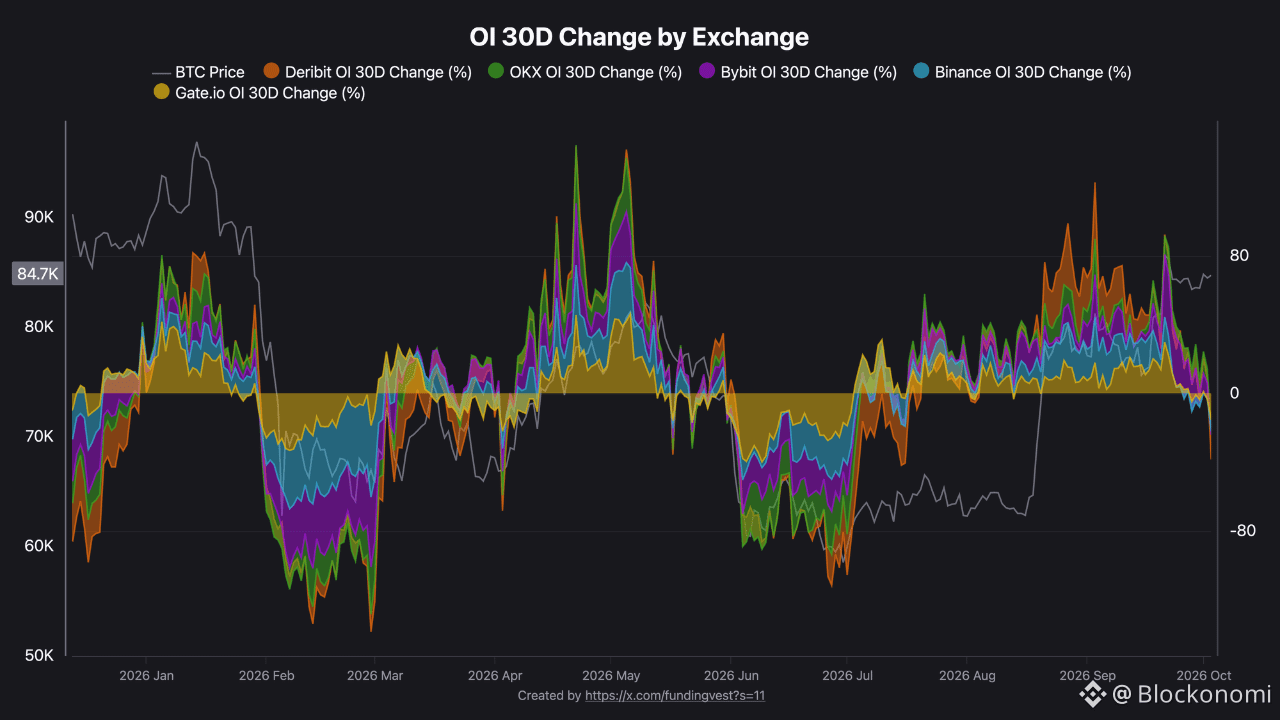
O Open Interest do Bitcoin caiu 6% na Binance ao longo de 30 dias, sinalizando uma perda de equilíbrio na volatilidade.
A Deribit e a Gate.io registraram, cada uma, uma queda de 15% no Open Interest, apontando para o desmonte de posições e um volume mais fraco.
A estrutura de 30 dias corresponde a máximas locais anteriores, em que a contração do Open Interest frequentemente marca a distribuição.
Cenários semelhantes em janeiro e maio de 2026 acompanharam recuos do Bitcoin de aproximadamente US$ 10.000.
O Open Interest de Bitcoin caiu à medida que o ativo se aproxima da faixa de US$ 87.000. A criptomoeda continua perdendo impulso enquanto as quedas se aprofundam em todo o mercado.
Open Interest de Bitcoin cai nas principais exchanges enquanto BTC se aproxima de US$ 87.000
TLDR:
O Open Interest do Bitcoin caiu 6% na Binance ao longo de 30 dias, sinalizando uma perda de equilíbrio na volatilidade.
A Deribit e a Gate.io registraram, cada uma, uma queda de 15% no Open Interest, apontando para o desmonte de posições e um volume mais fraco.
A estrutura de 30 dias corresponde a máximas locais anteriores, em que a contração do Open Interest frequentemente marca a distribuição.
Cenários semelhantes em janeiro e maio de 2026 acompanharam recuos do Bitcoin de aproximadamente US$ 10.000.
O Open Interest de Bitcoin caiu à medida que o ativo se aproxima da faixa de US$ 87.000. A criptomoeda continua perdendo impulso enquanto as quedas se aprofundam em todo o mercado.
O Open Interest do Bitcoin caiu 6% na Binance ao longo de 30 dias, sinalizando uma perda de equilíbrio na volatilidade.
A Deribit e a Gate.io registraram, cada uma, uma queda de 15% no Open Interest, apontando para o desmonte de posições e um volume mais fraco.
A estrutura de 30 dias corresponde a máximas locais anteriores, em que a contração do Open Interest frequentemente marca a distribuição.
Cenários semelhantes em janeiro e maio de 2026 acompanharam recuos do Bitcoin de aproximadamente US$ 10.000.
O Open Interest de Bitcoin caiu à medida que o ativo se aproxima da faixa de US$ 87.000. A criptomoeda continua perdendo impulso enquanto as quedas se aprofundam em todo o mercado.
103
·
--

Artigo
Injective Stockdrop é lançada com estreia da CypherOS e queima de 7,2M INJ na BuyBackResumo:
A Community BuyBack foi encerrada com mais de 7,2 milhões de INJ queimados, e as reivindicações da Stockdrop agora estão abertas.
A CypherOS fez sua primeira aparição pública como uma plataforma de privacidade para negociações confidenciais e tokenização.
A Canary Capital protocolou a Emenda nº 3 para um ETF de INJ Staked que planeja fazer stake de pelo menos 90% dos ativos.
A Robinhood agora oferece suporte a negociações e transferências de INJ, dando aos usuários acesso nativo ao INJ sem uma ponte.
A Injective Stockdrop entrou no ar esta semana, permitindo que os participantes reivindiquem recompensas em ações tokenizadas. A Community BuyBack foi encerrada com mais de 7,2 milhões de INJ queimados até o momento.
Injective Stockdrop é lançada com estreia da CypherOS e queima de 7,2M INJ na BuyBack
Resumo:
A Community BuyBack foi encerrada com mais de 7,2 milhões de INJ queimados, e as reivindicações da Stockdrop agora estão abertas.
A CypherOS fez sua primeira aparição pública como uma plataforma de privacidade para negociações confidenciais e tokenização.
A Canary Capital protocolou a Emenda nº 3 para um ETF de INJ Staked que planeja fazer stake de pelo menos 90% dos ativos.
A Robinhood agora oferece suporte a negociações e transferências de INJ, dando aos usuários acesso nativo ao INJ sem uma ponte.
A Injective Stockdrop entrou no ar esta semana, permitindo que os participantes reivindiquem recompensas em ações tokenizadas. A Community BuyBack foi encerrada com mais de 7,2 milhões de INJ queimados até o momento.
A Community BuyBack foi encerrada com mais de 7,2 milhões de INJ queimados, e as reivindicações da Stockdrop agora estão abertas.
A CypherOS fez sua primeira aparição pública como uma plataforma de privacidade para negociações confidenciais e tokenização.
A Canary Capital protocolou a Emenda nº 3 para um ETF de INJ Staked que planeja fazer stake de pelo menos 90% dos ativos.
A Robinhood agora oferece suporte a negociações e transferências de INJ, dando aos usuários acesso nativo ao INJ sem uma ponte.
A Injective Stockdrop entrou no ar esta semana, permitindo que os participantes reivindiquem recompensas em ações tokenizadas. A Community BuyBack foi encerrada com mais de 7,2 milhões de INJ queimados até o momento.
218
·
--

Artigo
Solana vira a Ethereum quando o volume de DEX ultrapassa L2s e Hyperliquid combinadosTL;DR:
A Solana registrou US$ 3,06 bi em volume diário de DEX spot, superando Ethereum, L2s e Hyperliquid combinados em 3 de outubro.
A Solana capturou mais de 36% do volume global de DEX spot no 1º semestre de 2026, quase o dobro da fatia da Ethereum no período.
A DeFiLlama mostrou cerca de US$ 78 bi em volume de DEX da Solana nos últimos 30 dias, contra aproximadamente US$ 42 bi registrados na Ethereum como um todo.
O volume de memecoins caiu para 16% ante 40%, enquanto as trocas de stablecoins subiram para 19% ante 6% no mesmo período.
A Solana ultrapassou a Ethereum — suas redes de Camada 2 e a Hyperliquid combinadas — no volume de negociação em exchanges descentralizadas (spot) em 3 de outubro, segundo dados da Blockworks Research. A comparação, compartilhada pela SolanaFloor em 4 de outubro, colocou a Solana no topo da mais recente sessão diária concluída.
Solana vira a Ethereum quando o volume de DEX ultrapassa L2s e Hyperliquid combinados
TL;DR:
A Solana registrou US$ 3,06 bi em volume diário de DEX spot, superando Ethereum, L2s e Hyperliquid combinados em 3 de outubro.
A Solana capturou mais de 36% do volume global de DEX spot no 1º semestre de 2026, quase o dobro da fatia da Ethereum no período.
A DeFiLlama mostrou cerca de US$ 78 bi em volume de DEX da Solana nos últimos 30 dias, contra aproximadamente US$ 42 bi registrados na Ethereum como um todo.
O volume de memecoins caiu para 16% ante 40%, enquanto as trocas de stablecoins subiram para 19% ante 6% no mesmo período.
A Solana ultrapassou a Ethereum — suas redes de Camada 2 e a Hyperliquid combinadas — no volume de negociação em exchanges descentralizadas (spot) em 3 de outubro, segundo dados da Blockworks Research. A comparação, compartilhada pela SolanaFloor em 4 de outubro, colocou a Solana no topo da mais recente sessão diária concluída.
A Solana registrou US$ 3,06 bi em volume diário de DEX spot, superando Ethereum, L2s e Hyperliquid combinados em 3 de outubro.
A Solana capturou mais de 36% do volume global de DEX spot no 1º semestre de 2026, quase o dobro da fatia da Ethereum no período.
A DeFiLlama mostrou cerca de US$ 78 bi em volume de DEX da Solana nos últimos 30 dias, contra aproximadamente US$ 42 bi registrados na Ethereum como um todo.
O volume de memecoins caiu para 16% ante 40%, enquanto as trocas de stablecoins subiram para 19% ante 6% no mesmo período.
A Solana ultrapassou a Ethereum — suas redes de Camada 2 e a Hyperliquid combinadas — no volume de negociação em exchanges descentralizadas (spot) em 3 de outubro, segundo dados da Blockworks Research. A comparação, compartilhada pela SolanaFloor em 4 de outubro, colocou a Solana no topo da mais recente sessão diária concluída.
87
·
--

Artigo
Preço do Dogecoin mira uma alta para US$ 0,106 enquanto o triângulo se aproxima do ponto de rupturaTLDR:
DOGE é negociado a US$ 0,09524, com alta de 2,33% em 24 horas, e volume diário de negociações chegando a US$ 472.416.387.
Ali Charts diz que o DOGE está consolidando dentro de um triângulo descendente que está se aproximando do seu ápice.
Um fechamento de 4 horas acima de US$ 0,095 poderia confirmar uma ruptura de alta e desencadear uma alta em direção a US$ 0,106.
O DogeOS lançou uma testnet pública para levar apps estilo Ethereum ao DOGE, enquanto uma golden cross se aproxima.
O preço do Dogecoin está em US$ 0,09524 no momento da publicação, registrando um aumento de 2,33% nas últimas 24 horas. O token também registrou US$ 472.416.387 em volume de negociações durante o mesmo período.
Preço do Dogecoin mira uma alta para US$ 0,106 enquanto o triângulo se aproxima do ponto de ruptura
TLDR:
DOGE é negociado a US$ 0,09524, com alta de 2,33% em 24 horas, e volume diário de negociações chegando a US$ 472.416.387.
Ali Charts diz que o DOGE está consolidando dentro de um triângulo descendente que está se aproximando do seu ápice.
Um fechamento de 4 horas acima de US$ 0,095 poderia confirmar uma ruptura de alta e desencadear uma alta em direção a US$ 0,106.
O DogeOS lançou uma testnet pública para levar apps estilo Ethereum ao DOGE, enquanto uma golden cross se aproxima.
O preço do Dogecoin está em US$ 0,09524 no momento da publicação, registrando um aumento de 2,33% nas últimas 24 horas. O token também registrou US$ 472.416.387 em volume de negociações durante o mesmo período.
DOGE é negociado a US$ 0,09524, com alta de 2,33% em 24 horas, e volume diário de negociações chegando a US$ 472.416.387.
Ali Charts diz que o DOGE está consolidando dentro de um triângulo descendente que está se aproximando do seu ápice.
Um fechamento de 4 horas acima de US$ 0,095 poderia confirmar uma ruptura de alta e desencadear uma alta em direção a US$ 0,106.
O DogeOS lançou uma testnet pública para levar apps estilo Ethereum ao DOGE, enquanto uma golden cross se aproxima.
O preço do Dogecoin está em US$ 0,09524 no momento da publicação, registrando um aumento de 2,33% nas últimas 24 horas. O token também registrou US$ 472.416.387 em volume de negociações durante o mesmo período.
116
Inicia sessão para explorar mais conteúdos
Junta-te a utilizadores de criptomoedas de todo o mundo na Binance Square
⚡️ Obtém informações úteis e recentes sobre criptomoedas.
💬 Com a confiança da maior exchange de criptomoedas do mundo.
👍 Descobre perspetivas reais de criadores verificados.
E-mail/Número de telefone
Tópicos em Tendência
Nikkei225Jumps2.5%ToThreeMonthHigh
13,795 visualizações
307 a discutir
#Nikkei225Jumps2.5%ToThreeMonthHigh
🚀 Nikkei 225 sobe 2,45% e atinge máxima de 3 meses!
O índice de referência japonês Nikkei 225 disparou na segunda-feira, fechando em 69.946,86 após ultrapassar brevemente a marca de 70.000 pontos pela primeira vez em três meses.
💡 O que está impulsionando essa alta?
Boom da IA e dos semicondutores: grandes empresas de tecnologia, como Advantest e Tokyo Electron, lideraram os ganhos expressivos.
Impulso de Wall Street: o reflexo positivo dos mercados dos EUA elevou a confiança geral dos investidores.
Mudanças macroeconômicas: dados de emprego dos EUA mais moderados do que o esperado aliviaram os temores e reduziram as expectativas de uma alta agressiva dos juros pelo Fed em outubro.
📊 Conclusão do mercado:
Essa forte alta sinaliza uma retomada expressiva do apetite dos investidores por tecnologia e ativos impulsionados pela IA. No entanto, os traders devem ficar atentos aos rendimentos elevados dos títulos, que continuam sendo um fator de risco.
Você acha que o Nikkei conseguirá se manter acima dos 70.000 pontos e avançar para novas máximas históricas? Conte para nós o que pensa!
#JapanStocks #StockMarket" #AIStocks #Semiconductors #Investing #Nikkei225
$EWJ
Nurul Hasnat Samir
·0 gostos
·293 visualizações
DriftHackVictimsBeginClaims
91,746 visualizações
992 a discutir
SolanaTokenizedStockVolumeTops$4.4BInSeptember
8,619 visualizações
98 a discutir