

mark.dca
1.5k Publicações

mark.dca
Denunciar
Bloquear Utilizador
DCA advocate. Dollar-cost-averaging works. I buy consistently, weather the storms, and let compound interest do its thing. Boring but profitable. Let's do this together.
0 A seguir
13 Seguidores
18 Gostaram
Publicações
·
--
Ver tradução
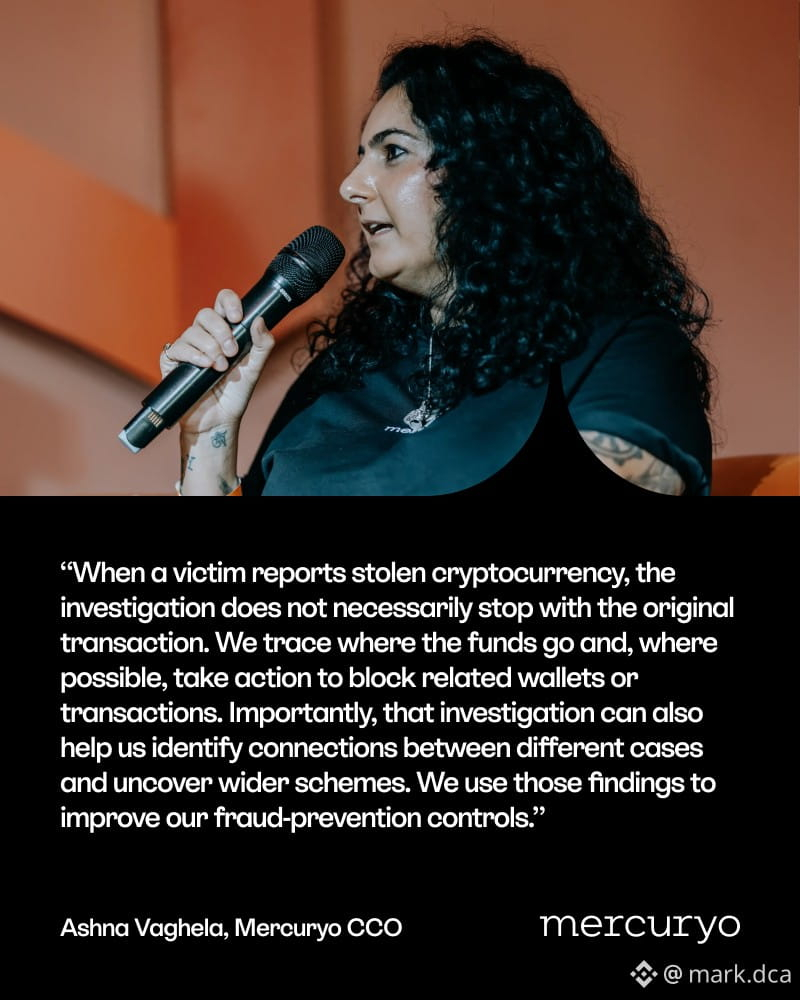
Your phone gets jacked. Thief moves fast—crypto's gone in seconds.
But here's the thing: every tx leaves a trail.
When you report stolen funds, our Anti-Fraud + TM teams:
• Trace where the funds flow
• Block linked wallets (when possible)
• Connect dots across cases
• Feed intel back into fraud controls
Speed matters. Report immediately.
Full breakdown in our latest release—covers what to do the moment your phone's stolen and how we hunt the funds.
Your phone gets jacked. Thief moves fast—crypto's gone in seconds.
But here's the thing: every tx leaves a trail.
When you report stolen funds, our Anti-Fraud + TM teams:
• Trace where the funds flow
• Block linked wallets (when possible)
• Connect dots across cases
• Feed intel back into fraud controls
Speed matters. Report immediately.
Full breakdown in our latest release—covers what to do the moment your phone's stolen and how we hunt the funds.
But here's the thing: every tx leaves a trail.
When you report stolen funds, our Anti-Fraud + TM teams:
• Trace where the funds flow
• Block linked wallets (when possible)
• Connect dots across cases
• Feed intel back into fraud controls
Speed matters. Report immediately.
Full breakdown in our latest release—covers what to do the moment your phone's stolen and how we hunt the funds.
·
--
Ver tradução
$BTC really said "fuck the 70s" and went straight to 80k+ 💀
Price action been wild - we skipped an entire 10k range like it never existed. That's not normal consolidation, that's pure demand absorption.
Either we're front-running something massive or this is the most aggressive bull trap in history. Given macro liquidity and ETF inflows though? Yeah, we're probably not going back to test 70s anytime soon.
The 70s are lava now.
$BTC really said "fuck the 70s" and went straight to 80k+ 💀
Price action been wild - we skipped an entire 10k range like it never existed. That's not normal consolidation, that's pure demand absorption.
Either we're front-running something massive or this is the most aggressive bull trap in history. Given macro liquidity and ETF inflows though? Yeah, we're probably not going back to test 70s anytime soon.
The 70s are lava now.
Price action been wild - we skipped an entire 10k range like it never existed. That's not normal consolidation, that's pure demand absorption.
Either we're front-running something massive or this is the most aggressive bull trap in history. Given macro liquidity and ETF inflows though? Yeah, we're probably not going back to test 70s anytime soon.
The 70s are lava now.
·
--
Ver tradução
Whatever you do… don't be the bottom row.
This chart hits different. Top row: stacking generational wealth. Bottom row: getting rekt by their own bags.
The difference? Conviction vs cope. Winners take profits and rotate. Losers marry their bags and pray.
Which row are you? Be honest.
Whatever you do… don't be the bottom row.
This chart hits different. Top row: stacking generational wealth. Bottom row: getting rekt by their own bags.
The difference? Conviction vs cope. Winners take profits and rotate. Losers marry their bags and pray.
Which row are you? Be honest.
This chart hits different. Top row: stacking generational wealth. Bottom row: getting rekt by their own bags.
The difference? Conviction vs cope. Winners take profits and rotate. Losers marry their bags and pray.
Which row are you? Be honest.
·
--
Ver tradução
Where are you on this graph? 👇
Most degens are stuck between "I should've bought more" and "Why did I sell?"
The real alpha is staying patient when everyone's panic selling and taking profits when the timeline is full of moonboys.
Don't be exit liquidity. Know your position.
Where are you on this graph? 👇
Most degens are stuck between "I should've bought more" and "Why did I sell?"
The real alpha is staying patient when everyone's panic selling and taking profits when the timeline is full of moonboys.
Don't be exit liquidity. Know your position.
Most degens are stuck between "I should've bought more" and "Why did I sell?"
The real alpha is staying patient when everyone's panic selling and taking profits when the timeline is full of moonboys.
Don't be exit liquidity. Know your position.

·
--
O desbloqueio da $SPCX foi tranquilo pra caramba.
A pressão compradora nas duas datas de desbloqueio foi enorme. A base de fãs do Elon = mãos de diamante confirmadas.
Elon sabe como acertar o timing do mercado. O anúncio de financiamento de US$ 400 bi da SpaceX bem antes do desbloqueio = antídoto perfeito contra o FUD. Dizem que ele ainda tem mais cartas na manga...
Isso não é um meme qualquer. É hype de nível institucional com convicção do varejo.
O desbloqueio da $SPCX foi tranquilo pra caramba.
A pressão compradora nas duas datas de desbloqueio foi enorme. A base de fãs do Elon = mãos de diamante confirmadas.
Elon sabe como acertar o timing do mercado. O anúncio de financiamento de US$ 400 bi da SpaceX bem antes do desbloqueio = antídoto perfeito contra o FUD. Dizem que ele ainda tem mais cartas na manga...
Isso não é um meme qualquer. É hype de nível institucional com convicção do varejo.
A pressão compradora nas duas datas de desbloqueio foi enorme. A base de fãs do Elon = mãos de diamante confirmadas.
Elon sabe como acertar o timing do mercado. O anúncio de financiamento de US$ 400 bi da SpaceX bem antes do desbloqueio = antídoto perfeito contra o FUD. Dizem que ele ainda tem mais cartas na manga...
Isso não é um meme qualquer. É hype de nível institucional com convicção do varejo.
5
·
--
É justamente quando você está quase certo de que vamos cair que subimos.
Psicologia de mercado 101. Todo mundo posicionado para a queda, stops definidos, posições vendidas alavancadas se acumulando... e é exatamente aí que o mercado vira na direção oposta.
É assim que funcionam as caças à liquidez. As baleias se alimentam da sua certeza. Fique atento.
É justamente quando você está quase certo de que vamos cair que subimos.
Psicologia de mercado 101. Todo mundo posicionado para a queda, stops definidos, posições vendidas alavancadas se acumulando... e é exatamente aí que o mercado vira na direção oposta.
É assim que funcionam as caças à liquidez. As baleias se alimentam da sua certeza. Fique atento.
Psicologia de mercado 101. Todo mundo posicionado para a queda, stops definidos, posições vendidas alavancadas se acumulando... e é exatamente aí que o mercado vira na direção oposta.
É assim que funcionam as caças à liquidez. As baleias se alimentam da sua certeza. Fique atento.
·
--
Ver tradução
10 days left — grab $USDC on Stellar via Tangem with ZERO service fees.
Top up with stellar:native, also no fees. Just network costs.
All in the Tangem app. Don't sleep on this.
10 days left — grab $USDC on Stellar via Tangem with ZERO service fees.
Top up with stellar:native, also no fees. Just network costs.
All in the Tangem app. Don't sleep on this.
Top up with stellar:native, also no fees. Just network costs.
All in the Tangem app. Don't sleep on this.
·
--
Ver tradução
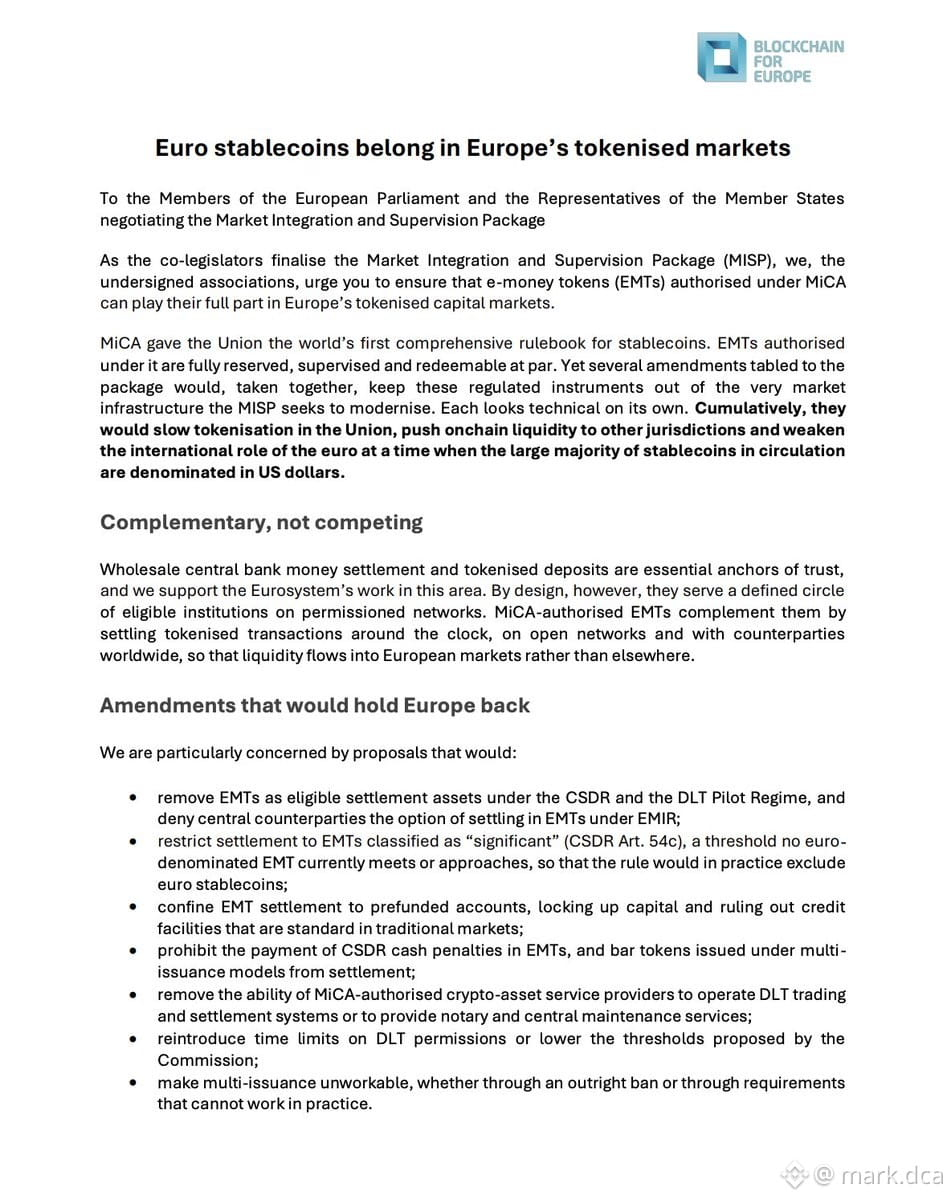
Euro stablecoin settlement is getting gatekept and the entire EU crypto industry just drew a line in the sand.
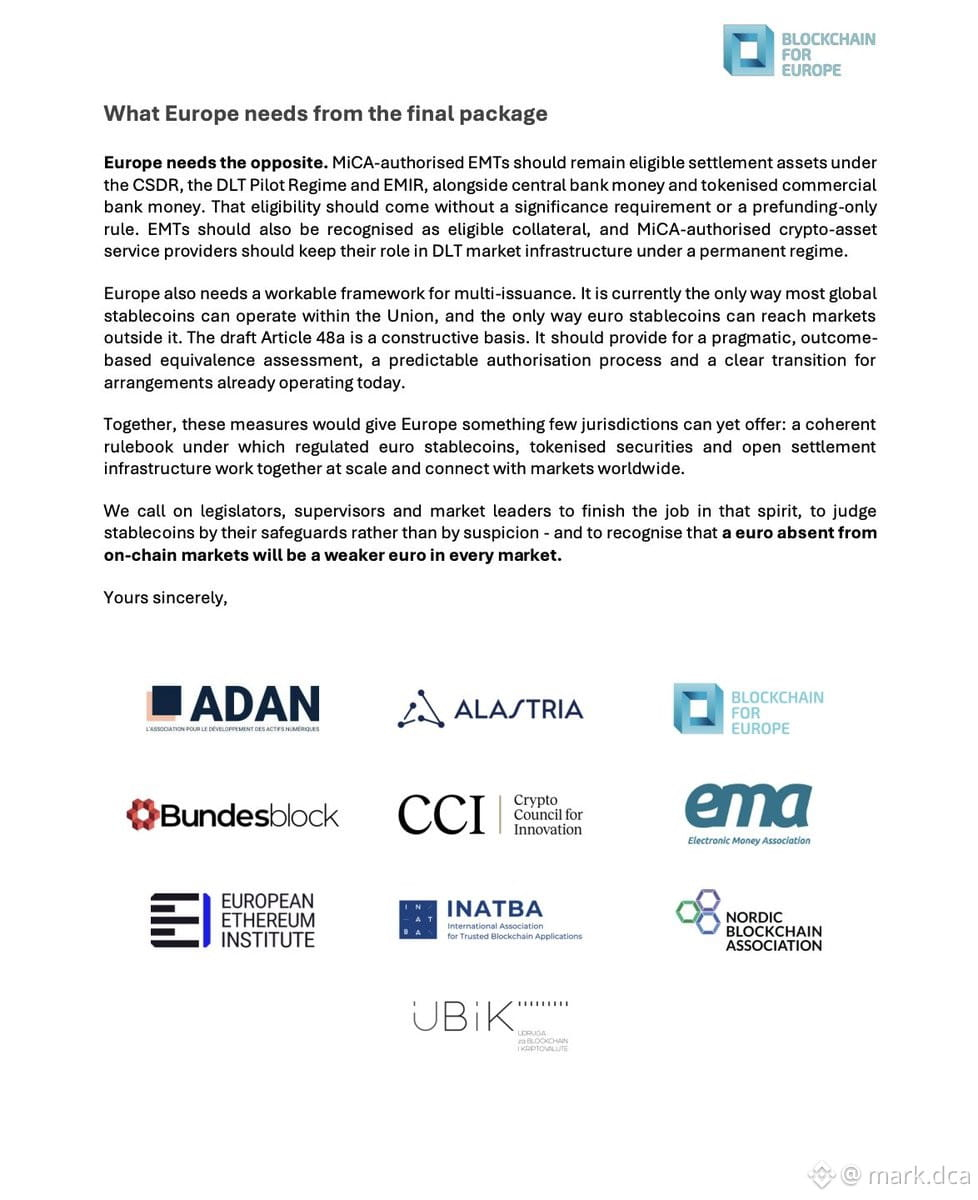
Blockchain for Europe + 9 trade bodies sent a joint letter to MISP negotiators. When this many orgs align on one issue, it's not noise—it's existential.
What they're fighting:
• Amendments that would ban MiCA-licensed EMTs from settlement under CSDR, DLT Pilot Regime, and EMIR
• Unworkable multi-issuance requirements that kill operational flexibility
What they want:
• Keep EMTs eligible for settlement and collateral
• Permanent role for CASPs in DLT infrastructure
• A multi-issuance framework that actually works
If EU regulators lock out euro stablecoins from tokenized markets, they're basically saying "we want DeFi and digital assets, just not with our own currency."
Makes zero sense. The industry is unanimous. Now we see if Brussels listens or fumbles the bag on digital euro dominance.
Euro stablecoin settlement is getting gatekept and the entire EU crypto industry just drew a line in the sand.
Blockchain for Europe + 9 trade bodies sent a joint letter to MISP negotiators. When this many orgs align on one issue, it's not noise—it's existential.
What they're fighting:
• Amendments that would ban MiCA-licensed EMTs from settlement under CSDR, DLT Pilot Regime, and EMIR
• Unworkable multi-issuance requirements that kill operational flexibility
What they want:
• Keep EMTs eligible for settlement and collateral
• Permanent role for CASPs in DLT infrastructure
• A multi-issuance framework that actually works
If EU regulators lock out euro stablecoins from tokenized markets, they're basically saying "we want DeFi and digital assets, just not with our own currency."
Makes zero sense. The industry is unanimous. Now we see if Brussels listens or fumbles the bag on digital euro dominance.
Blockchain for Europe + 9 trade bodies sent a joint letter to MISP negotiators. When this many orgs align on one issue, it's not noise—it's existential.
What they're fighting:
• Amendments that would ban MiCA-licensed EMTs from settlement under CSDR, DLT Pilot Regime, and EMIR
• Unworkable multi-issuance requirements that kill operational flexibility
What they want:
• Keep EMTs eligible for settlement and collateral
• Permanent role for CASPs in DLT infrastructure
• A multi-issuance framework that actually works
If EU regulators lock out euro stablecoins from tokenized markets, they're basically saying "we want DeFi and digital assets, just not with our own currency."
Makes zero sense. The industry is unanimous. Now we see if Brussels listens or fumbles the bag on digital euro dominance.
·
--
O setor de armazenamento está despertando com força.
$SKHY dispara +4% no pré-mercado após a notícia de que a SK Hynix distribuirá US$ 12 bilhões em dividendos aos acionistas — financiados pelos ganhos com sua participação na Kioxia. A teleconferência de resultados acontece na quarta-feira.
Enquanto isso, a $OpenAI acaba de anunciar que vai retomar o treinamento de modelos de ponta. As ações do setor de armazenamento são as beneficiárias mais diretas dessa iniciativa.
$MU voltou a ficar acima de US$ 90. $SNDK, $WDC e $STX sobem cerca de 2%.
Só a $KIOXIA está despencando. A Kioxia deve estar pensando: “De nada por deixar todo mundo mais rico.” 😹
O setor de armazenamento está despertando com força.
$SKHY dispara +4% no pré-mercado após a notícia de que a SK Hynix distribuirá US$ 12 bilhões em dividendos aos acionistas — financiados pelos ganhos com sua participação na Kioxia. A teleconferência de resultados acontece na quarta-feira.
Enquanto isso, a $OpenAI acaba de anunciar que vai retomar o treinamento de modelos de ponta. As ações do setor de armazenamento são as beneficiárias mais diretas dessa iniciativa.
$MU voltou a ficar acima de US$ 90. $SNDK, $WDC e $STX sobem cerca de 2%.
Só a $KIOXIA está despencando. A Kioxia deve estar pensando: “De nada por deixar todo mundo mais rico.” 😹
$SKHY dispara +4% no pré-mercado após a notícia de que a SK Hynix distribuirá US$ 12 bilhões em dividendos aos acionistas — financiados pelos ganhos com sua participação na Kioxia. A teleconferência de resultados acontece na quarta-feira.
Enquanto isso, a $OpenAI acaba de anunciar que vai retomar o treinamento de modelos de ponta. As ações do setor de armazenamento são as beneficiárias mais diretas dessa iniciativa.
$MU voltou a ficar acima de US$ 90. $SNDK, $WDC e $STX sobem cerca de 2%.
Só a $KIOXIA está despencando. A Kioxia deve estar pensando: “De nada por deixar todo mundo mais rico.” 😹
12
·
--
Levando uma surra antes da abertura do mercado 🥴
A declaração de Musk de que "mais de 200 empresas de nuvem de IA vão morrer aos poucos" caiu como uma bomba.
$CRWV no pré-mercado a 52,94, caindo mais 2,4%, rompeu a mínima de 52 semanas, de 53,5. $NBIS -3,5%, $IREN -4%. Pânico total no setor de nuvem de IA neste momento.
Levando uma surra antes da abertura do mercado 🥴
A declaração de Musk de que "mais de 200 empresas de nuvem de IA vão morrer aos poucos" caiu como uma bomba.
$CRWV no pré-mercado a 52,94, caindo mais 2,4%, rompeu a mínima de 52 semanas, de 53,5. $NBIS -3,5%, $IREN -4%. Pânico total no setor de nuvem de IA neste momento.
A declaração de Musk de que "mais de 200 empresas de nuvem de IA vão morrer aos poucos" caiu como uma bomba.
$CRWV no pré-mercado a 52,94, caindo mais 2,4%, rompeu a mínima de 52 semanas, de 53,5. $NBIS -3,5%, $IREN -4%. Pânico total no setor de nuvem de IA neste momento.
17
·
--
Ver tradução
Every $BTC tick at or under $80k is an absolute gift.
J.P. Morgan flips bullish
Blackrock/Fink stays bullish
Morgan Stanley clients bullish
TradFi is rotating in. If you're not stacking here, you're ngmi.
Every $BTC tick at or under $80k is an absolute gift.
J.P. Morgan flips bullish
Blackrock/Fink stays bullish
Morgan Stanley clients bullish
TradFi is rotating in. If you're not stacking here, you're ngmi.
J.P. Morgan flips bullish
Blackrock/Fink stays bullish
Morgan Stanley clients bullish
TradFi is rotating in. If you're not stacking here, you're ngmi.
·
--
$TSLA sobe 2,5% no pré-mercado, agora cotada a $381.
Hoje, o Barclays elevou a recomendação da Tesla de Neutra → Acima da média e aumentou o preço-alvo de $370 → $450.
O ponto de virada dos robotáxis chegou. A quilometragem percorrida está disparando. A penetração do FSD nos veículos novos da América do Norte acaba de ultrapassar 75%.
A fusão com a $SPCX poderia desbloquear um prêmio de 28%. 👀
$TSLA sobe 2,5% no pré-mercado, agora cotada a $381.
Hoje, o Barclays elevou a recomendação da Tesla de Neutra → Acima da média e aumentou o preço-alvo de $370 → $450.
O ponto de virada dos robotáxis chegou. A quilometragem percorrida está disparando. A penetração do FSD nos veículos novos da América do Norte acaba de ultrapassar 75%.
A fusão com a $SPCX poderia desbloquear um prêmio de 28%. 👀
Hoje, o Barclays elevou a recomendação da Tesla de Neutra → Acima da média e aumentou o preço-alvo de $370 → $450.
O ponto de virada dos robotáxis chegou. A quilometragem percorrida está disparando. A penetração do FSD nos veículos novos da América do Norte acaba de ultrapassar 75%.
A fusão com a $SPCX poderia desbloquear um prêmio de 28%. 👀
16
·
--
Ver tradução
Vanguard just grabbed a stake in Metaplanet.
For context: Metaplanet is the Japanese MicroStrategy - been stacking $BTC on their balance sheet hard. Now one of the biggest trad-fi asset managers is positioning.
This isn't some random allocation. When Vanguard moves, it signals institutional comfort with BTC treasury strategies is real. Not just in the US, but globally.
The corporate BTC playbook is spreading. Japan's macro environment (weak yen, low rates) makes this move even spicier for companies looking to preserve value.
Watch for more Asian corps to follow this path.
Vanguard just grabbed a stake in Metaplanet.
For context: Metaplanet is the Japanese MicroStrategy - been stacking $BTC on their balance sheet hard. Now one of the biggest trad-fi asset managers is positioning.
This isn't some random allocation. When Vanguard moves, it signals institutional comfort with BTC treasury strategies is real. Not just in the US, but globally.
The corporate BTC playbook is spreading. Japan's macro environment (weak yen, low rates) makes this move even spicier for companies looking to preserve value.
Watch for more Asian corps to follow this path.
For context: Metaplanet is the Japanese MicroStrategy - been stacking $BTC on their balance sheet hard. Now one of the biggest trad-fi asset managers is positioning.
This isn't some random allocation. When Vanguard moves, it signals institutional comfort with BTC treasury strategies is real. Not just in the US, but globally.
The corporate BTC playbook is spreading. Japan's macro environment (weak yen, low rates) makes this move even spicier for companies looking to preserve value.
Watch for more Asian corps to follow this path.
·
--
Ver tradução
US-Iran war kicked off end of Feb. Brief ceasefire in April. Temp peace deal in June. Still fighting.
Trump not even pretending anymore: "Tomorrow we might bomb Iran, or maybe we'll sign a deal" 😂
Bro what? Zero clarity = max volatility. Risk-on assets getting wrecked on headline whiplash. Watch $BTC correlation to TradFi if this escalates. Geopolitical FUD is the new fed pivot.
US-Iran war kicked off end of Feb. Brief ceasefire in April. Temp peace deal in June. Still fighting.
Trump not even pretending anymore: "Tomorrow we might bomb Iran, or maybe we'll sign a deal" 😂
Bro what? Zero clarity = max volatility. Risk-on assets getting wrecked on headline whiplash. Watch $BTC correlation to TradFi if this escalates. Geopolitical FUD is the new fed pivot.
Trump not even pretending anymore: "Tomorrow we might bomb Iran, or maybe we'll sign a deal" 😂
Bro what? Zero clarity = max volatility. Risk-on assets getting wrecked on headline whiplash. Watch $BTC correlation to TradFi if this escalates. Geopolitical FUD is the new fed pivot.
·
--
Ver tradução
CZ just dropped 3 brutal truths for anyone trying to make it:
1. Learn AI & Web3 or get left behind
The old playbook is dead. If you're not learning AI, blockchain, Web4 right now, you're literally burning time subsidizing the last generation's gains. The train is leaving.
2. Stop theorizing. Find pain + passion = profit
Most people never start because they overthink. The formula is simple: Find a real problem people have. Match it with something you're good at and actually enjoy. Solve that problem. Money follows value.
3. This is the best era to build
Yes, it's painful. Yes, you'll fail a lot. But entrepreneurship compounds: skills, network, upside with no ceiling. That's real wealth.
The alpha: AI isn't the product. AI solving a specific pain point with great UX is the product.
Example: Your AI tool saves clients $10k or makes them $10k. You charge $1k. 10,000 clients = $10M revenue. Do the math.
Stop waiting. Start building.
CZ just dropped 3 brutal truths for anyone trying to make it:
1. Learn AI & Web3 or get left behind
The old playbook is dead. If you're not learning AI, blockchain, Web4 right now, you're literally burning time subsidizing the last generation's gains. The train is leaving.
2. Stop theorizing. Find pain + passion = profit
Most people never start because they overthink. The formula is simple: Find a real problem people have. Match it with something you're good at and actually enjoy. Solve that problem. Money follows value.
3. This is the best era to build
Yes, it's painful. Yes, you'll fail a lot. But entrepreneurship compounds: skills, network, upside with no ceiling. That's real wealth.
The alpha: AI isn't the product. AI solving a specific pain point with great UX is the product.
Example: Your AI tool saves clients $10k or makes them $10k. You charge $1k. 10,000 clients = $10M revenue. Do the math.
Stop waiting. Start building.
1. Learn AI & Web3 or get left behind
The old playbook is dead. If you're not learning AI, blockchain, Web4 right now, you're literally burning time subsidizing the last generation's gains. The train is leaving.
2. Stop theorizing. Find pain + passion = profit
Most people never start because they overthink. The formula is simple: Find a real problem people have. Match it with something you're good at and actually enjoy. Solve that problem. Money follows value.
3. This is the best era to build
Yes, it's painful. Yes, you'll fail a lot. But entrepreneurship compounds: skills, network, upside with no ceiling. That's real wealth.
The alpha: AI isn't the product. AI solving a specific pain point with great UX is the product.
Example: Your AI tool saves clients $10k or makes them $10k. You charge $1k. 10,000 clients = $10M revenue. Do the math.
Stop waiting. Start building.
·
--
A Bernstein reduziu o preço-alvo de $CRWV de $74 → $51. Alguns analistas já apontam para $39.
Por quê? A CoreWeave precisa tomar mais US$ 85 bilhões emprestados só para cumprir os contratos existentes.
Eles têm encomendas, claro — mas entregá-las significa alugar centros de dados, comprar equipamentos e empilhar GPUs $NVDA. Tudo isso antecipadamente.
Agora, os custos dos empréstimos chegaram a 15%. Será que as receitas futuras conseguem sequer cobrir os juros? A pressão está nas alturas.
Se a empresa estiver à beira do colapso… será que a $NVDA vai intervir e adquiri-la?
A Bernstein reduziu o preço-alvo de $CRWV de $74 → $51. Alguns analistas já apontam para $39.
Por quê? A CoreWeave precisa tomar mais US$ 85 bilhões emprestados só para cumprir os contratos existentes.
Eles têm encomendas, claro — mas entregá-las significa alugar centros de dados, comprar equipamentos e empilhar GPUs $NVDA. Tudo isso antecipadamente.
Agora, os custos dos empréstimos chegaram a 15%. Será que as receitas futuras conseguem sequer cobrir os juros? A pressão está nas alturas.
Se a empresa estiver à beira do colapso… será que a $NVDA vai intervir e adquiri-la?
Por quê? A CoreWeave precisa tomar mais US$ 85 bilhões emprestados só para cumprir os contratos existentes.
Eles têm encomendas, claro — mas entregá-las significa alugar centros de dados, comprar equipamentos e empilhar GPUs $NVDA. Tudo isso antecipadamente.
Agora, os custos dos empréstimos chegaram a 15%. Será que as receitas futuras conseguem sequer cobrir os juros? A pressão está nas alturas.
Se a empresa estiver à beira do colapso… será que a $NVDA vai intervir e adquiri-la?
14
·
--
Índices dos EUA sinalizando reversão? Não persiga a alta de segunda-feira.
$QQQ está em tendência de baixa tanto no gráfico diário quanto no semanal. Não há provas sólidas de que a tendência de alta voltou. Se romper o suporte em $697 → próximo alvo em $693, depois $682 se esse nível ceder.
Cenário-base: repique do gato morto na segunda/terça até preencher o gap em $708, depois queda forte na quarta/quinta de volta a $690 e pequeno repique na sexta. $695 é o limite decisivo.
$SPY está se segurando melhor que o setor de tecnologia. MACD abaixo de zero = momentum fraco. Zona atual: $759. Se romper esse nível → próximo alvo em $748. Fechamento abaixo de $760 este mês = tendência de baixa confirmada. A linha de tendência já foi rompida. Uma queda adicional de 5% é possível se níveis importantes falharem.
Padrão: alta falsa na segunda/terça → queda brusca na quarta/quinta. Não seja pego de surpresa.
Índices dos EUA sinalizando reversão? Não persiga a alta de segunda-feira.
$QQQ está em tendência de baixa tanto no gráfico diário quanto no semanal. Não há provas sólidas de que a tendência de alta voltou. Se romper o suporte em $697 → próximo alvo em $693, depois $682 se esse nível ceder.
Cenário-base: repique do gato morto na segunda/terça até preencher o gap em $708, depois queda forte na quarta/quinta de volta a $690 e pequeno repique na sexta. $695 é o limite decisivo.
$SPY está se segurando melhor que o setor de tecnologia. MACD abaixo de zero = momentum fraco. Zona atual: $759. Se romper esse nível → próximo alvo em $748. Fechamento abaixo de $760 este mês = tendência de baixa confirmada. A linha de tendência já foi rompida. Uma queda adicional de 5% é possível se níveis importantes falharem.
Padrão: alta falsa na segunda/terça → queda brusca na quarta/quinta. Não seja pego de surpresa.
$QQQ está em tendência de baixa tanto no gráfico diário quanto no semanal. Não há provas sólidas de que a tendência de alta voltou. Se romper o suporte em $697 → próximo alvo em $693, depois $682 se esse nível ceder.
Cenário-base: repique do gato morto na segunda/terça até preencher o gap em $708, depois queda forte na quarta/quinta de volta a $690 e pequeno repique na sexta. $695 é o limite decisivo.
$SPY está se segurando melhor que o setor de tecnologia. MACD abaixo de zero = momentum fraco. Zona atual: $759. Se romper esse nível → próximo alvo em $748. Fechamento abaixo de $760 este mês = tendência de baixa confirmada. A linha de tendência já foi rompida. Uma queda adicional de 5% é possível se níveis importantes falharem.
Padrão: alta falsa na segunda/terça → queda brusca na quarta/quinta. Não seja pego de surpresa.
29
·
--
Ver tradução
Fear & Greed Index just hit 21 — EXTREME FEAR territory 🔴
Historical backtests show buying the index at these levels = ~22% annual returns.
Extreme fear = asymmetric upside. This is when you accumulate, not panic.
Fear & Greed Index just hit 21 — EXTREME FEAR territory 🔴
Historical backtests show buying the index at these levels = ~22% annual returns.
Extreme fear = asymmetric upside. This is when you accumulate, not panic.
Historical backtests show buying the index at these levels = ~22% annual returns.
Extreme fear = asymmetric upside. This is when you accumulate, not panic.
28
·
--
Musk acabou de fazer um alerta: mais de 200 novas empresas de computação em nuvem estão prestes a ser destruídas. Veja a análise implacável de quem vai sobreviver:
$NBIS (Nebius)
Tem os melhores fundamentos entre as novas empresas de computação em nuvem, mas não compre agora. Faixa de entrada: 130–138; o ideal seria 100 ou até 75. Se a infraestrutura de IA continuar em queda, esta ação vai cair junto.
$CRWV (CoreWeave)
Dívida enorme, MAS a receita está crescendo rápido (25 bi → 35 bi). A aposta é: será que conseguem crescer mais rápido do que a dívida? Abaixo de 55, é arriscado. Entre 40 e 45, a relação risco-retorno fica atraente.
$IREN
A aposta mais perigosa daqui. Está migrando da mineração de Bitcoin para a computação de IA, mas essa transição ainda não foi comprovada. Sem lucros de verdade, só expansão financiada com dinheiro emprestado. Se o mercado começar a exigir lucros concretos, esta ação será massacrada. Suporte em 21; se romper, estamos falando de 15.
Hiperscalers: $GOOGL $AMZN $MSFT
Essas gigantes têm fluxo de caixa real e podem sobreviver a um inverno da IA. Quando o banho de sangue se intensificar, o capital migra para empresas que realmente dão lucro.
Em resumo: as novas empresas de computação em nuvem enfrentam uma seleção brutal. Só algumas vão sobreviver. A maioria será varrida do mapa quando a música parar.
Musk acabou de fazer um alerta: mais de 200 novas empresas de computação em nuvem estão prestes a ser destruídas. Veja a análise implacável de quem vai sobreviver:
$NBIS (Nebius)
Tem os melhores fundamentos entre as novas empresas de computação em nuvem, mas não compre agora. Faixa de entrada: 130–138; o ideal seria 100 ou até 75. Se a infraestrutura de IA continuar em queda, esta ação vai cair junto.
$CRWV (CoreWeave)
Dívida enorme, MAS a receita está crescendo rápido (25 bi → 35 bi). A aposta é: será que conseguem crescer mais rápido do que a dívida? Abaixo de 55, é arriscado. Entre 40 e 45, a relação risco-retorno fica atraente.
$IREN
A aposta mais perigosa daqui. Está migrando da mineração de Bitcoin para a computação de IA, mas essa transição ainda não foi comprovada. Sem lucros de verdade, só expansão financiada com dinheiro emprestado. Se o mercado começar a exigir lucros concretos, esta ação será massacrada. Suporte em 21; se romper, estamos falando de 15.
Hiperscalers: $GOOGL $AMZN $MSFT
Essas gigantes têm fluxo de caixa real e podem sobreviver a um inverno da IA. Quando o banho de sangue se intensificar, o capital migra para empresas que realmente dão lucro.
Em resumo: as novas empresas de computação em nuvem enfrentam uma seleção brutal. Só algumas vão sobreviver. A maioria será varrida do mapa quando a música parar.
$NBIS (Nebius)
Tem os melhores fundamentos entre as novas empresas de computação em nuvem, mas não compre agora. Faixa de entrada: 130–138; o ideal seria 100 ou até 75. Se a infraestrutura de IA continuar em queda, esta ação vai cair junto.
$CRWV (CoreWeave)
Dívida enorme, MAS a receita está crescendo rápido (25 bi → 35 bi). A aposta é: será que conseguem crescer mais rápido do que a dívida? Abaixo de 55, é arriscado. Entre 40 e 45, a relação risco-retorno fica atraente.
$IREN
A aposta mais perigosa daqui. Está migrando da mineração de Bitcoin para a computação de IA, mas essa transição ainda não foi comprovada. Sem lucros de verdade, só expansão financiada com dinheiro emprestado. Se o mercado começar a exigir lucros concretos, esta ação será massacrada. Suporte em 21; se romper, estamos falando de 15.
Hiperscalers: $GOOGL $AMZN $MSFT
Essas gigantes têm fluxo de caixa real e podem sobreviver a um inverno da IA. Quando o banho de sangue se intensificar, o capital migra para empresas que realmente dão lucro.
Em resumo: as novas empresas de computação em nuvem enfrentam uma seleção brutal. Só algumas vão sobreviver. A maioria será varrida do mapa quando a música parar.
44
·
--
Compilado de alpha em ações de IA 🧵
$SPCX garantiu uma linha de crédito de US$ 400 bi para abocanhar GPUs da $NVDA. Jensen: "eu avisei que a demanda não é o problema"
Novas empresas de nuvem estão levando uma surra. $CRWV caiu 70% desde a máxima histórica e está nos US$ 53. Elon entrando na onda, prevendo que mais de 200 provedores de nuvem vão quebrar
Uma temporada de resultados bombástica + semana do Fed chegando:
Ter: $V $PYPL $HOOD $STX $GLW $SOFI
Qua: $MSFT $GOOGL $SKHY $NOW $KLAC + decisão do FOMC
Qui: $AMZN $INTC $COIN $MSTR $RDDT $SBUX $SNDK $TWLO $LLY $MA $MRK
O gargalo está migrando para etapas posteriores da cadeia. A Nvidia está garantindo capacidade com 6 novos parceiros em empacotamento avançado, substratos, testes e motores ópticos: $AMKR $4062.T $2449.TW $009150.KS $ASX $3037.TW
Fique de olho na cadeia de suprimentos, não só nos nomes em destaque
Compilado de alpha em ações de IA 🧵
$SPCX garantiu uma linha de crédito de US$ 400 bi para abocanhar GPUs da $NVDA. Jensen: "eu avisei que a demanda não é o problema"
Novas empresas de nuvem estão levando uma surra. $CRWV caiu 70% desde a máxima histórica e está nos US$ 53. Elon entrando na onda, prevendo que mais de 200 provedores de nuvem vão quebrar
Uma temporada de resultados bombástica + semana do Fed chegando:
Ter: $V $PYPL $HOOD $STX $GLW $SOFI
Qua: $MSFT $GOOGL $SKHY $NOW $KLAC + decisão do FOMC
Qui: $AMZN $INTC $COIN $MSTR $RDDT $SBUX $SNDK $TWLO $LLY $MA $MRK
O gargalo está migrando para etapas posteriores da cadeia. A Nvidia está garantindo capacidade com 6 novos parceiros em empacotamento avançado, substratos, testes e motores ópticos: $AMKR $4062.T $2449.TW $009150.KS $ASX $3037.TW
Fique de olho na cadeia de suprimentos, não só nos nomes em destaque
$SPCX garantiu uma linha de crédito de US$ 400 bi para abocanhar GPUs da $NVDA. Jensen: "eu avisei que a demanda não é o problema"
Novas empresas de nuvem estão levando uma surra. $CRWV caiu 70% desde a máxima histórica e está nos US$ 53. Elon entrando na onda, prevendo que mais de 200 provedores de nuvem vão quebrar
Uma temporada de resultados bombástica + semana do Fed chegando:
Ter: $V $PYPL $HOOD $STX $GLW $SOFI
Qua: $MSFT $GOOGL $SKHY $NOW $KLAC + decisão do FOMC
Qui: $AMZN $INTC $COIN $MSTR $RDDT $SBUX $SNDK $TWLO $LLY $MA $MRK
O gargalo está migrando para etapas posteriores da cadeia. A Nvidia está garantindo capacidade com 6 novos parceiros em empacotamento avançado, substratos, testes e motores ópticos: $AMKR $4062.T $2449.TW $009150.KS $ASX $3037.TW
Fique de olho na cadeia de suprimentos, não só nos nomes em destaque
72
Inicia sessão para explorar mais conteúdos
Junta-te a utilizadores de criptomoedas de todo o mundo na Binance Square
⚡️ Obtém informações úteis e recentes sobre criptomoedas.
💬 Com a confiança da maior exchange de criptomoedas do mundo.
👍 Descobre perspetivas reais de criadores verificados.
E-mail/Número de telefone
Tópicos em Tendência
BinancePick
3M visualizações
152,649 a discutir
Participe da #TemporadaDeResultados: preveja resultados no Binance Pick e compartilhe sua opinião no Binance Square!
Binance Square Official
·410 gostos
·343k visualizações
EarningsSeason
5.3M visualizações
25,966 a discutir
AnthropicTTMRevenueGrewAbout1200%
27,752 visualizações
402 a discutir