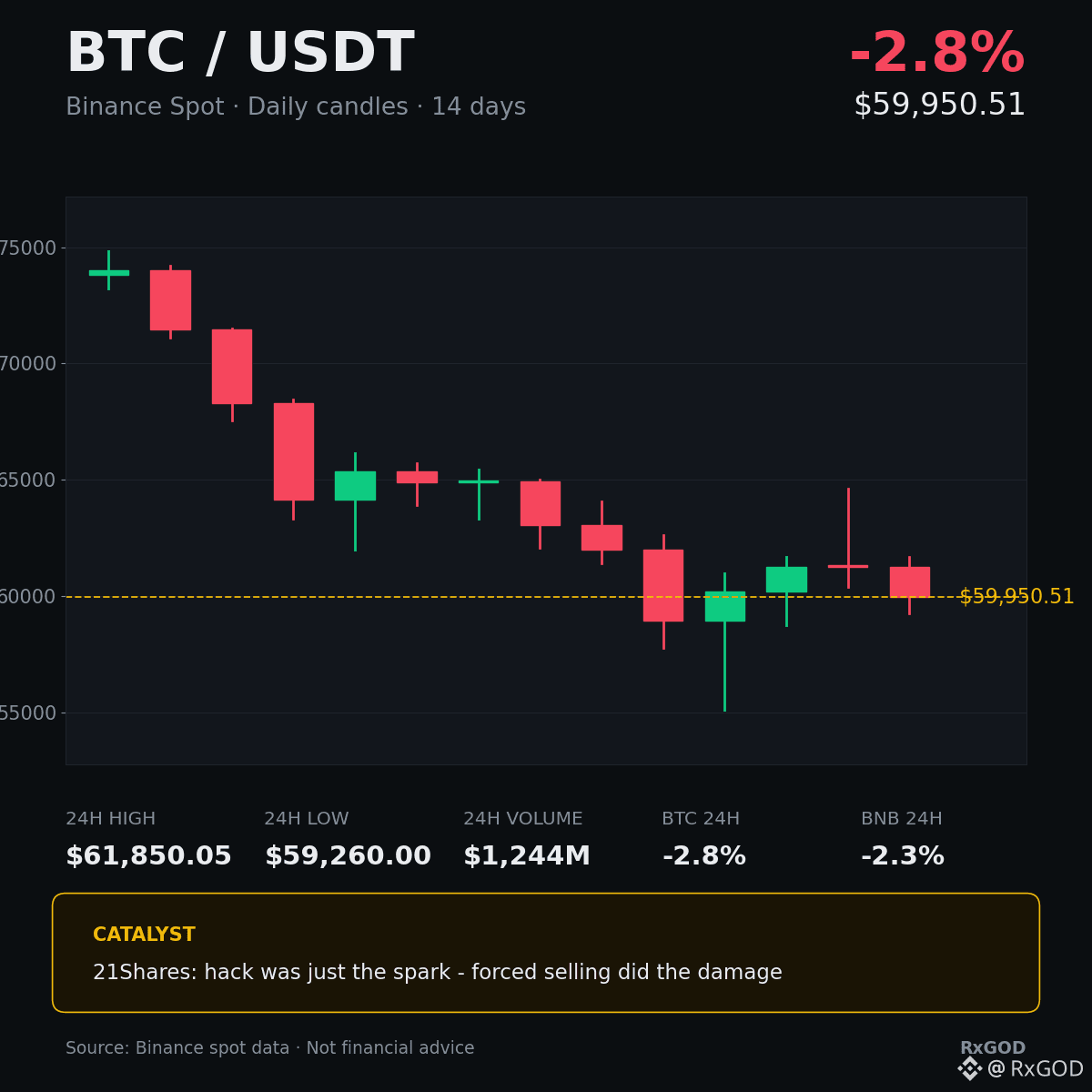
The Binance hack didn't crash Bitcoin. Something else did.
New 21Shares research breaks down the sell-off: the hack is only the spark. $BTC fell just 5.1% in the two days after the October 29 hack, and had nearly recovered by November 4 at $80,488. By November 9 it was only about 7% below its pre-hack level.
The real damage came in two waves. First, demand drained: stablecoin supply fell $10.7 billion — the biggest drop since Terra — while spot Bitcoin and $ETH ETFs bled $3.9 billion between October 30 and November 13, taking Bitcoin down 8.3% to $73,806.
Then forced selling did the most damage: $5.8 billion of liquidations in the week to November 15, 81% of them longs, driving $BTC down another 13.5% in three days.
The feared sellers mostly stayed put: the attacker's 18,270 BTC and 522,409 ETH were still unspent in mid-November, and miners are sending the least to exchanges since 2020.
Where now? $BTC trades near $59,950, down 2.8% in 24 hours, near the bottom of its 14-day range ($55,130–$74,811). 21Shares expects rallies to fade until ETF inflows and stablecoin supply recover, flagging the realized price near $53,250. Fear & Greed: 8, Extreme Fear.
Honest caveat: one firm's analysis, not a verdict — tonight's PCE can still move everything either way.
So — do you buy the 'spark, not the cause' story, or did the hack break trust for good? $53,250 or $65,000 first?
Not financial advice — DYOR.
#BitcoinsReboundFadesBelow$60K #ExtremeFear #CryptoNews