
Decentralized finance is undergoing a foundational evolution.
In its infancy, DeFi 1.0 laid the core primitives: automated market makers (AMMs), decentralized exchanges (DEXs), and collateralized lending protocols. DeFi 2.0 pushed boundaries by introducing liquidity management protocols and cross-application composability. Yet, both cycles suffered from the same core limitation: they remained purely crypto-native. The underlying collateral pool consisted almost entirely of volatile, speculative governance tokens and high-beta altcoins. When liquidity dried up, cascading liquidations and reflexive downward spirals were inevitable.
DeFi 3.0 fundamentally breaks that cycle. The next era of on-chain finance begins when real-world asset (RWA) classes—most notably traditional equities, treasuries, and indices—transform from passive synthetic tokens into fully programmable on-chain assets.
From Crypto-Native Speculation to Structural Health
The fundamental problem with previous decentralized lending and yield protocols was structural risk. Altcoins carry severe volatility and the persistent risk of going to zero. When high-risk assets serve as the core collateral of money markets, systemic solvency remains permanently fragile.
Tokenized real-world assets solve this dilemma. Equities and sovereign debt represent claims on tangible enterprise cash flows, legal rights, and mature macroeconomic production. They are perpetual, liquid, and fundamentally insulated from the existential tail risks common to micro-cap crypto tokens.
In DeFi 3.0, tokenized stocks and credit instruments do not merely sit idle in a Web3 wallet. They become dynamic collateral:
Programmable Liquidity: Investors can pledge tokenized blue-chip equities to mint overcollateralized stablecoins, hedge downside exposure via smart-contract options vaults, or route yield through automated liquidity strategies.
Continuous Settlement: Unlike traditional equities constrained by legacy clearinghouses and rigid market hours, programmable RWAs operate 24/7 with instant on-chain finality.
Institutional-Grade Solvency: Lending markets backed by diversified, productive capital offer transparent, auditable solvency ratios that mitigate systemic liquidation cascades.
This structural upgrade shifts on-chain capital from circular speculation toward real financial utility.
Defining the Standards: PAR and CAR
As institutional capital enters on-chain markets, industry benchmarks must evolve beyond generic metrics like Total Value Locked (TVL), which often counts double-leveraged or inflationary tokens.
Binance is actively shaping this institutional transition, formalizing the framework for the Programmable Asset Era by proposing rigorous quantitative indicators:
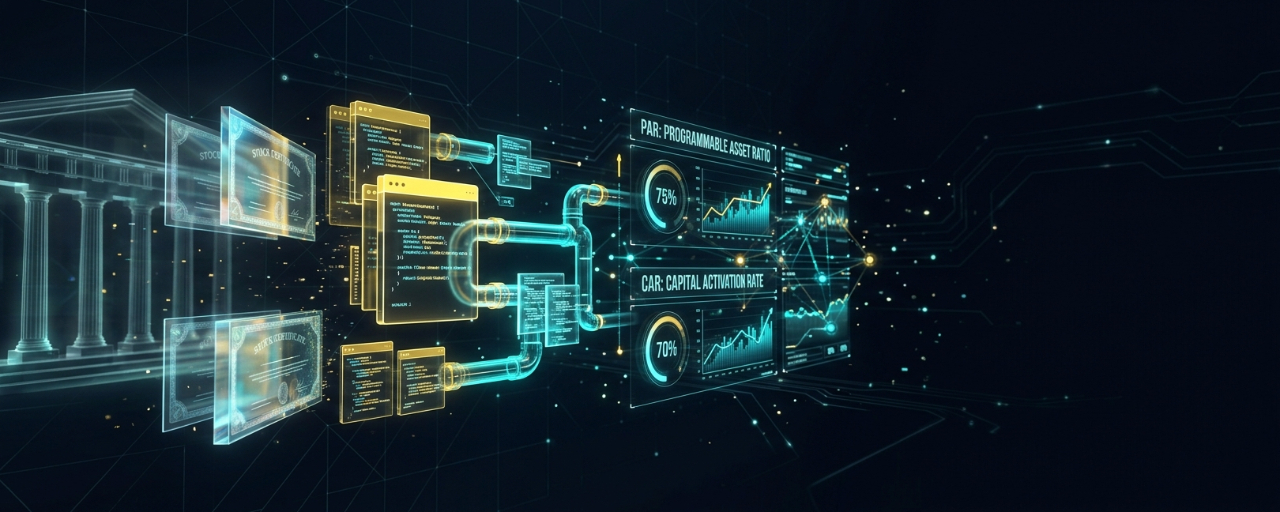
Programmable Asset Ratio (PAR): A metric tracking the proportion of total on-chain assets backed by productive, legal-wrapped real-world instruments versus purely speculative tokens. A rising PAR signals an ecosystem maturing into sustainable institutional utility.
Capital Activation Rate (CAR): A performance indicator that measures how actively tokenized collateral is deployed across automated strategies, credit protocols, and liquidity pools, rather than sitting passive in cold custody.
By pioneering these benchmarks before broader market consensus crystallizes, Binance is positioning its ecosystem to serve as the structural gateway connecting global capital markets with Web3 liquidity.
The Programmable Asset Era
The convergence of real-world equity markets and decentralized smart contracts marks the end of isolated crypto liquidity. When Wall Street assets gain the programmability, composability, and fractional nature of blockchain tokens, finance becomes borderless and modular.
DeFi 3.0 is not about replacing traditional market discipline with algorithmic hype. It is about deploying battle-tested traditional value onto transparent, automated, and hyper-efficient rails. Through deep liquidity infrastructure, compliant gateways, and analytical benchmarks like PAR and CAR, the foundation for the on-chain economy is no longer theoretical—it is actively being constructed.