



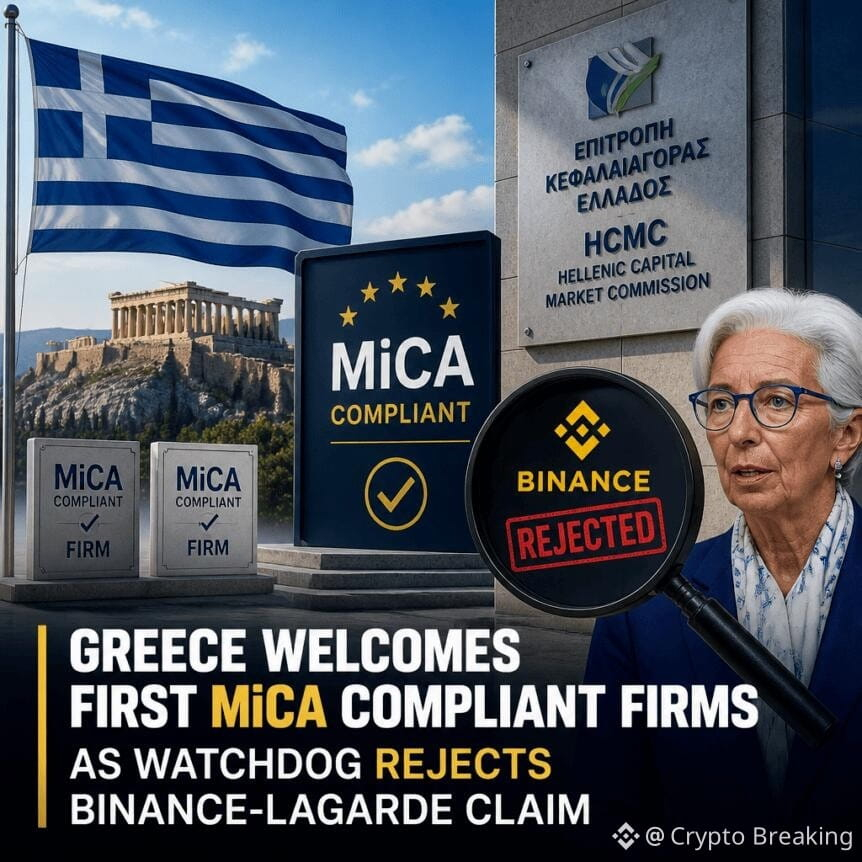
Greece has added its first crypto-asset service providers to the EU’s Markets in Crypto-Assets (MiCA) register, marking a new step in the country’s rollout of Europe’s sweeping crypto framework. The ESMA-updated list now includes four Greek entities: BCash, Xenios Blockchain Group, Capital Wallet Greece and Piraeus Bank.
ESMA’s register update, published Thursday, also brought six additional crypto-asset service providers from Germany, France and Slovenia. With the new entries, the register totals 359 unique providers across the EU.
Key takeaways
ESMA has added four Greek crypto-asset service providers to the MiCA register for the first time.
BCash, Xenios Blockchain Group and Capital Wallet Greece fall under oversight by Greece’s securities regulator (HCMC), while Piraeus Bank is overseen by the Bank of Greece.
The Greek entries underscore how MiCA allows member states to split competent authority responsibilities.
A debate involving Binance’s Greece MiCA application continues in the background, as HCMC has again denied reported remarks attributed to it.
Greece enters the MiCA provider register
ESMA’s Markets in Crypto-Assets register is intended to give market participants visibility into which firms are authorised or registered under MiCA. According to ESMA’s updated listing, the newly added Greek providers are:
BCash
Xenios Blockchain Group
Capital Wallet Greece
Piraeus Bank
ESMA’s update also expanded the register with six providers from Germany, France and Slovenia, lifting the overall count to 359 unique entities.
Why the Binance episode still matters
Greece’s first appearance on the MiCA provider list would normally signal straightforward regulatory progress. But the timing is notable because a major application associated with Binance has been a focal point in earlier reporting about the EU’s authorisation process.
Cointelegraph previously reported that Binance withdrew its Greece-related application on June 24 before Greece’s Hellenic Capital Market Commission (HCMC) issued a formal decision. That sequence raised questions at the time about whether the application would move forward.
Later, the Wall Street Journal reported that European Central Bank (ECB) President Christine Lagarde intervened to block Binance’s Greek foothold after remarks by Greek officials suggested HCMC was leaning toward approval. The Journal further said HCMC denied that its officials made the reported comments, while offering no additional detail.
Now, HCMC has expanded on that denial in remarks provided to Cointelegraph, adding new clarity—at least from the regulator’s perspective—about what it says it did not communicate to any ECB officials.
How MiCA oversight is split in Greece
One of the most consequential details in Greece’s first entries is not just which firms were added, but which authority ESMA lists as competent for each provider.
ESMA’s register lists the HCMC as the competent authority for BCash, Xenios Blockchain Group and Capital Wallet Greece. For Piraeus Bank, the competent authority is listed as the Bank of Greece.
This split reflects the way Greece implemented MiCA: EU rules allow member states to designate more than one competent authority and divide regulatory responsibilities between them. ESMA’s MiCA guidance on “competent authorities” describes this possibility, including the legal basis for such arrangements.
For investors and firms, these designations matter because they can affect supervisory focus, reporting channels and the practical handling of authorisation conditions. In other words, the register entry is not only a stamp of MiCA eligibility—it also signals which regulator is likely to be closest to the supervised activity.
HCMC reiterates denial of reported remarks tied to Lagarde
While ESMA’s list now confirms real-world MiCA provider approvals in Greece, the regulatory narrative in the country has remained entangled with the Binance question. The Wall Street Journal reported on Sept. 18 that Lagarde had helped block Binance after Greek officials indicated approval was forthcoming.
According to the Journal, a HCMC vice chair told Binance that Lagarde asked Prime Minister Kyriakos Mitsotakis not to approve the application. HCMC, in a written response to Cointelegraph, rejected the account.
In its response, HCMC said it categorically rejects the assertions attributed to it. The regulator said no HCMC official made the reported remarks, and that it received no communication regarding Binance’s application from Mitsotakis, his office, the Finance Ministry, or other Greek government officials. HCMC also stated that no HCMC official has had communication with any ECB official on the matter and that none of the reported statements were made by HCMC or its officials.
When asked whether its denial covered the specific report that a vice chair made those comments to Binance, HCMC said the denial did apply to that version of events.
Cointelegraph previously reported that Binance declined to comment on the reported intervention, saying it would “not comment on speculation” while reiterating its commitment to obtaining MiCA authorisation in Europe. The ECB also declined to comment on the report. Cointelegraph said it contacted Mitsotakis’ office for comment but did not receive a response.
As Greece adds more firms to the MiCA register, market participants will likely watch how the split between HCMC oversight and Bank of Greece oversight affects day-to-day supervision. At the same time, the lingering dispute over what HCMC did—or did not—communicate in the Binance case suggests that large authorisation applications may continue to attract political and regulatory scrutiny, even after MiCA listings begin to expand.
This article was originally published as Greece Welcomes First MiCA Compliant Firms as Watchdog Rejects Binance-Lagarde Claim on Crypto Breaking News – your trusted source for crypto news, Bitcoin news, and blockchain updates.