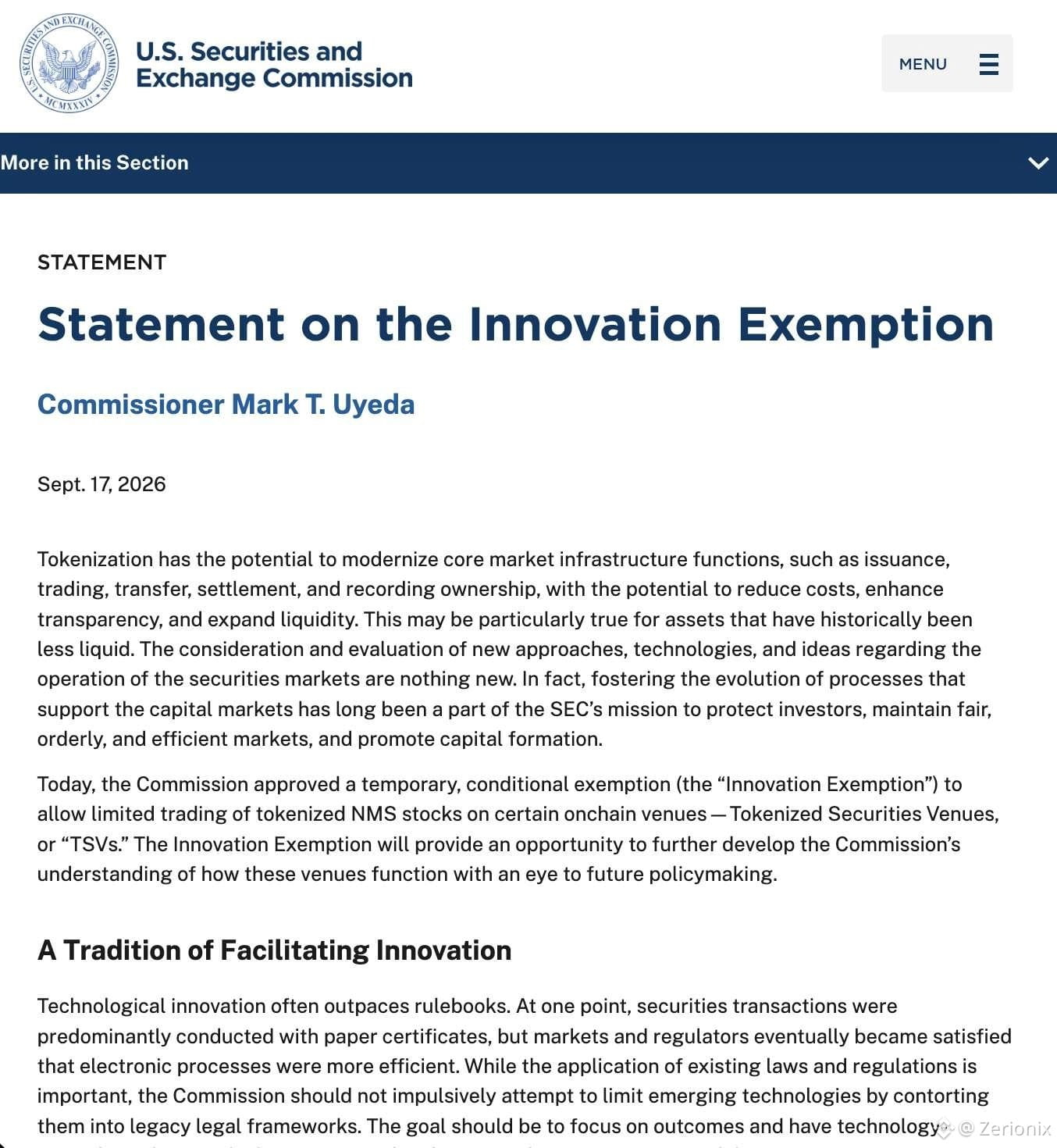
The SEC has approved a five year, conditional Innovation Exemption allowing certain blockchain based venues to trade tokenized U.S. stocks through permissioned automated market makers and liquidity pools.
This is a bigger development for RWAs than another tokenized asset launch.
The SEC is essentially giving crypto native market infrastructure a controlled testing ground inside the U.S. equity market. The venues will face limits on eligible stocks and trading volume, while tokenized shares must provide holders the same rights and privileges as the equivalent traditional shares.
There are guardrails too. Platforms have to notify the underlying company before listing its stock, issuers can object, and synthetic tokens that merely create derivative exposure to a stock are excluded.
What stands out to me is where the experiment is happening.
The SEC isn't just testing tokenization as a new way to represent ownership. It's testing whether blockchain based rails and AMMs can actually handle part of the trading function.
If this works, the potential benefits go beyond putting stocks onchain. Think longer trading hours, fractional ownership, faster settlement, self custody and potentially lower transaction costs.
But this is still a pilot, not the full tokenized stock market.
The real test is whether issuers, liquidity providers and investors actually use these venues at meaningful scale.
Personally, this is the kind of RWA development I pay attention to.
The SEC just moved tokenized equities from “interesting concept” into a regulated market experiment.
Now we get to see whether the rails actually work.
#BTC Price Analysis# #Altcoin Season# $BTC $ETH
This is a bigger development for RWAs than another tokenized asset launch.
The SEC is essentially giving crypto native market infrastructure a controlled testing ground inside the U.S. equity market. The venues will face limits on eligible stocks and trading volume, while tokenized shares must provide holders the same rights and privileges as the equivalent traditional shares.
There are guardrails too. Platforms have to notify the underlying company before listing its stock, issuers can object, and synthetic tokens that merely create derivative exposure to a stock are excluded.
What stands out to me is where the experiment is happening.
The SEC isn't just testing tokenization as a new way to represent ownership. It's testing whether blockchain based rails and AMMs can actually handle part of the trading function.
If this works, the potential benefits go beyond putting stocks onchain. Think longer trading hours, fractional ownership, faster settlement, self custody and potentially lower transaction costs.
But this is still a pilot, not the full tokenized stock market.
The real test is whether issuers, liquidity providers and investors actually use these venues at meaningful scale.
Personally, this is the kind of RWA development I pay attention to.
The SEC just moved tokenized equities from “interesting concept” into a regulated market experiment.
Now we get to see whether the rails actually work.
#BTC Price Analysis# #Altcoin Season# $BTC $ETH