To be honest, I keep thinking the expensive part of SME financing may not be raising the money. It might be everything the company has to rebuild once that money needs somewhere else to go.
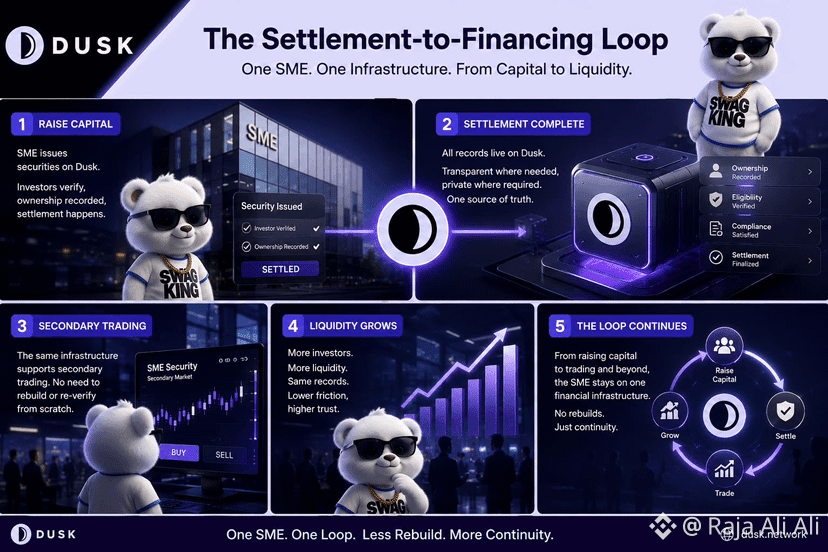
An SME could issue securities through $DUSK, investors complete eligibility checks, ownership gets recorded and settlement happens. On the surface, that looks finished.
Then secondary trading begins.
Suddenly the same company may need another venue, another investor check, another ownership reconciliation, maybe another institution deciding whether the previous records are acceptable. The asset exists already, but the financial workflow starts again.
That makes me wonder about a “Settlement-to-Financing Loop.”
If issuance, investor eligibility, ownership records, settlement and later trading can reuse the same underlying financial state, an SME would not just tokenize an asset once. Each completed step could become infrastructure for the next one.
But reuse creates another problem. A verified record does not automatically mean another institution will accept the decision behind it. Regulations change. Investor status changes. Responsibility still has to sit somewhere.
So the interesting metric may not be how many SMEs issue on Dusk.
I’d watch how little infrastructure an SME has to rebuild when its capital moves from issuance into an actual secondary market.
That is where continuity starts to matter.
#dusk $DUSK @Dusk
An SME could issue securities through $DUSK, investors complete eligibility checks, ownership gets recorded and settlement happens. On the surface, that looks finished.
Then secondary trading begins.
Suddenly the same company may need another venue, another investor check, another ownership reconciliation, maybe another institution deciding whether the previous records are acceptable. The asset exists already, but the financial workflow starts again.
That makes me wonder about a “Settlement-to-Financing Loop.”
If issuance, investor eligibility, ownership records, settlement and later trading can reuse the same underlying financial state, an SME would not just tokenize an asset once. Each completed step could become infrastructure for the next one.
But reuse creates another problem. A verified record does not automatically mean another institution will accept the decision behind it. Regulations change. Investor status changes. Responsibility still has to sit somewhere.
So the interesting metric may not be how many SMEs issue on Dusk.
I’d watch how little infrastructure an SME has to rebuild when its capital moves from issuance into an actual secondary market.
That is where continuity starts to matter.
#dusk $DUSK @Dusk