
$EGLD is trading near $3.022 after bouncing from $2.838, now testing a supply zone that has previously capped upside attempts.
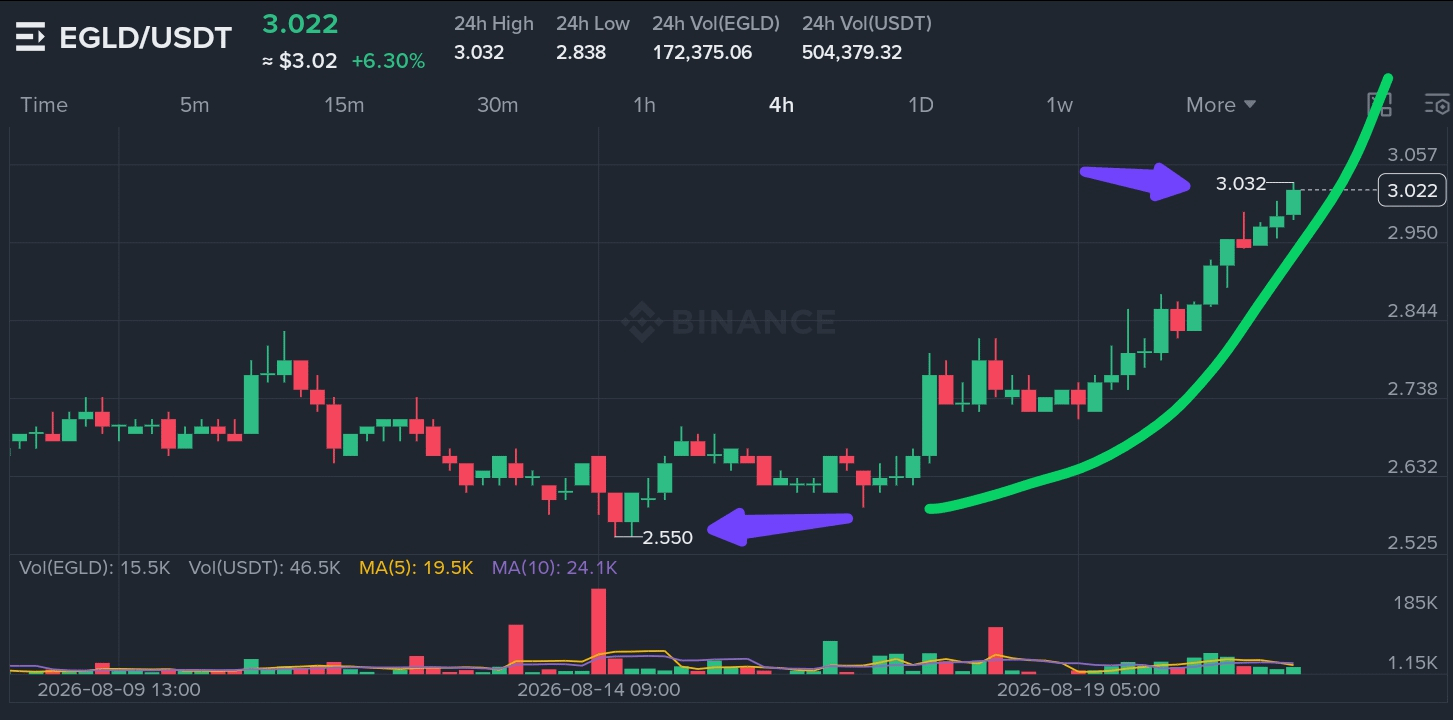
The 4-hour chart shows EGLD recovering from the $2.525 swing low, with price climbing through $2.632 and $2.738 before reaching a high of $3.032. The current rejection from that area suggests overhead pressure exists near $3.032-$3.057. Price is now consolidating above $2.950, which has become a support level to watch. The 24-hour volume of 172,375 EGLD shows thin participation, suggesting the recovery may lack strong conviction.
This zone between $3.032 and $3.057 has rejected price on multiple occasions, making it a significant hurdle for the recovery thesis. A confirmed move above this area would be the first indication of a potential trend shift, while another rejection would reinforce the bearish structure. The $2.950 level has provided a floor during the recent pullback, making it the defining support for the current bounce.
Support: $2.950
Major support: $2.844
Resistance: $3.032
Major resistance: $3.057
Reaction Area: The $2.950 to $3.022 zone could be watched as a potential reaction area if support holds and price shows acceptance above $2.950 with a 4-hour close.
Target Area: If price reclaims $3.032 and holds, the next resistance near $3.057 would be a potential target zone.
Setup Weakens If: A sustained 4-hour close below $2.950 would invalidate this educational setup.

One key lesson here is the concept of momentum divergence. When price rallies on decreasing volume, the move often lacks the fuel needed to break through significant resistance. The current recovery has seen declining participation, which raises questions about its sustainability. A breakout attempt backed by rising volume would carry more weight than one occurring on thin activity.
If EGLD holds above $2.950 and reclaims $3.032, the next resistance near $3.057 would come into focus, potentially opening the door to higher levels. A clean break above $3.057 would suggest that buyers have absorbed the overhead supply.
If $2.950 fails with sustained selling pressure, the structure would weaken significantly, and price could search for support near $2.844. Repeated rejection below $3.032 would keep the bearish case intact, confirming that sellers remain active near that zone.
A sustained 4-hour close below $2.950 would invalidate the current support thesis. Until then, the range between $2.950 and $3.032 remains the primary decision zone. Watch for a clean close above $3.032 to confirm strength, or a close below $2.950 to signal further downside.
Are you watching for a breakout above resistance or a retest of support?
Educational only. Not financial advice. Manage risk.