

Altcoins are “basically dead” as competitors to Bitcoin as money, according to Swan Bitcoin Founder and CEO, Cory Klippsten, who argued that the longer-term future of crypto and decentralized finance (DeFi) may be tied to its integration with traditional finance.
Asked which altcoins could outperform the broader market, Klippsten pointed to Hyperliquid while arguing that centralized crypto businesses will ultimately face the same regulatory framework as traditional financial institutions.
“Hyperliquid is a business and it has a token. If it’s a business that’s centralized, it will eventually just get sucked up by TradFi and be thought of as an exchange and a bank,” Klippsten said.
STABLECOINS | 8% of the Entire USDC Circulating Supply is Now Held on One Decentralized Exchange
Hyperliquid generated about $5.9 million in revenue over the past week ranking fifth among DeFi protocols by weekly revenue, according to DefiLlama.
The HYPE token has also significantly outperformed Bitcoin in 2026 rising about 130% year-to-date while Bitcoin has fallen 28%, according to TradingView data.
But the broader altcoin market is showing signs of becoming increasingly selective as institutional capital takes a larger role.
EXPERT OPINION | Crypto Has Split into 4 Major Segments @Bitwise CEO says the crypto market has effectively split into four major segments:
stablecoins and payments, Bitcoin as a macro asset, tokenization and on-chain finance, and blockchain infrastructure.
Bitwise CEO:… pic.twitter.com/fNtxmpOBgD
— BitKE (@BitcoinKE) May 17, 2026
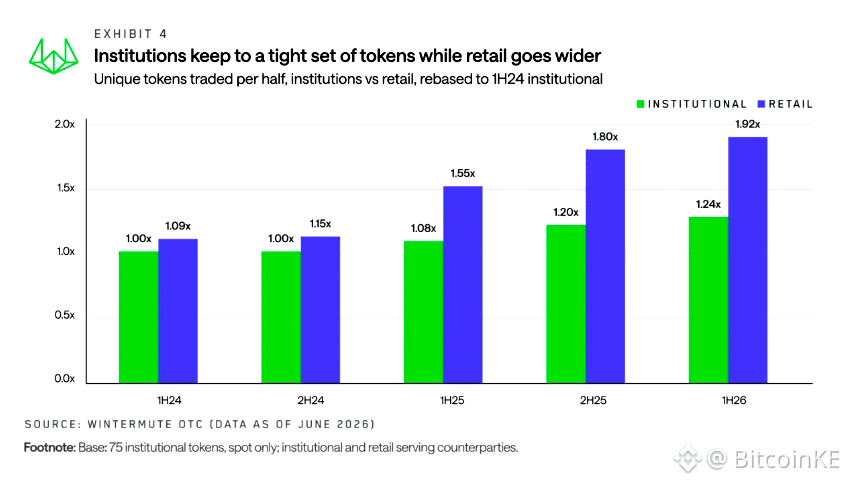
A July 2026 report from crypto market maker, Wintermute, found that institutional counterparties accounted for a record 72% of spot trading flow across all tokens on its OTC desk during the first half of 2026. That was up from 61% in the second half of 2025 and 59% in the first half of 2025.
Wintermute said institutional activity was becoming concentrated in a narrower group of tokens while liquidity across the market’s “long tail” was weakening. The firm also reported that altcoin options notional traded on its desk increased about 3.4 times from the second half of 2025, largely driven by yield strategies.
REPORT | Institutions Accounted for Over 70% of Crypto Trading Volumes in H1 2026, Says Latest Research
The shift suggests that future altcoin rallies may look very different from previous cycles. Rather than capital broadly rotating from Bitcoin into Ethereum and then into smaller tokens, institutional money is increasingly concentrating on assets with deeper liquidity and stronger market demand.
That trend has also been reflected in BitKE’s coverage of institutional crypto adoption, including the growing share of Bitcoin held by institutions and the increasing role of regulated investment products.
INSTITUTIONAL | Europe’s Second-Largest Bitcoin Holder Set to Raise Over $100 Billion in Equity Issuance to Accelerate Bitcoin Holdings
Wintermute’s findings therefore support a broader thesis:
Crypto may not be disappearing, but the market is becoming more institutional. The result could be fewer altcoin winners, narrower rallies and a growing convergence between crypto businesses and traditional financial markets.
Klippsten and his company have been quite accurate and correct in a lot of their analysis before.
Swan published an analysis titled “Dark Moon: The Inevitable Collapse of Luna” before Terra/Luna collapsed in May 2022. Klippsten was openly attacking the sustainability of the Terra ecosystem well before its eventual implosion.
LUNA/UST subsequently went from roughly $50 billion in combined market capitalization to essentially zero.
That was a very strong call.
$LUNA Crashes by 99% Raising Fears of a Network Takeover
In June 2022, shortly before Celsius froze withdrawals, Klippsten publicly argued that Celsius didn’t have sufficient liquidity to meet customer withdrawals. Reuters quoted him during the crisis describing crypto as essentially a highly leveraged system with contagion risk.
TechCrunch also reported Klippsten warning that Celsius could become insolvent if it had to meet all customer redemption requests.
Celsius subsequently froze withdrawals and filed for bankruptcy. The company’s founder, Alex Mashinsky, later pleaded guilty to fraud.
CASE STUDY | This Crypto Crime Could Set a Precedent Leading to Permanent Financial Ban for Founders
Before FTX collapsed, Klippsten was publicly criticizing Sam Bankman-Fried and FTX. When CoinDesk published its November 2022 investigation into Alameda’s balance sheet, Klippsten pointed to the extraordinary dependence of Alameda’s equity on FTT, a token controlled by FTX itself.
FTX subsequently collapsed, and investigations established that customer funds had been improperly diverted to Alameda.
FTX Token ($FTT) Plummets By Over 90% in 7 Days as FTX Files for Bankruptcy
Swan’s and Klippsten’s strongest track record is in identifying structural risks, not predicting Bitcoin’s price.
For Bitcoin, that may reinforce its position as the industry’s primary monetary asset while other crypto networks increasingly compete on their ability to function as financial infrastructure rather than alternative forms of money.
BITCOIN | America’s Largest Bank Says Bitcoin Dominance as Institutional Crypto Asset is Unlikey to Change
Stay tuned to BitKE on crypto developments globally.
Join our WhatsApp channel here.
Follow us on X for the latest posts and updates
Join and interact with our Telegram community
_______________