

Most crypto discussions still orbit around novelty, new primitives, new narratives, new abstractions. But if you’ve ever run production infrastructure, you know something uncomfortable:
Excitement is not a reliability metric.
The systems that matter, payment rails, clearing houses, air traffic control, DNS , are judged by how little you notice them. They win by not failing. They earn trust by surviving stress.
That’s how I think about EVM compatibility on Vanar.
Not as a growth hack.
Not as a marketing bullet.
But as an operational decision about risk containment.
If something works on Ethereum, and it works the same way on Vanar, that’s not convenience. That’s infrastructure discipline.
Reliability is the real adoption curve.
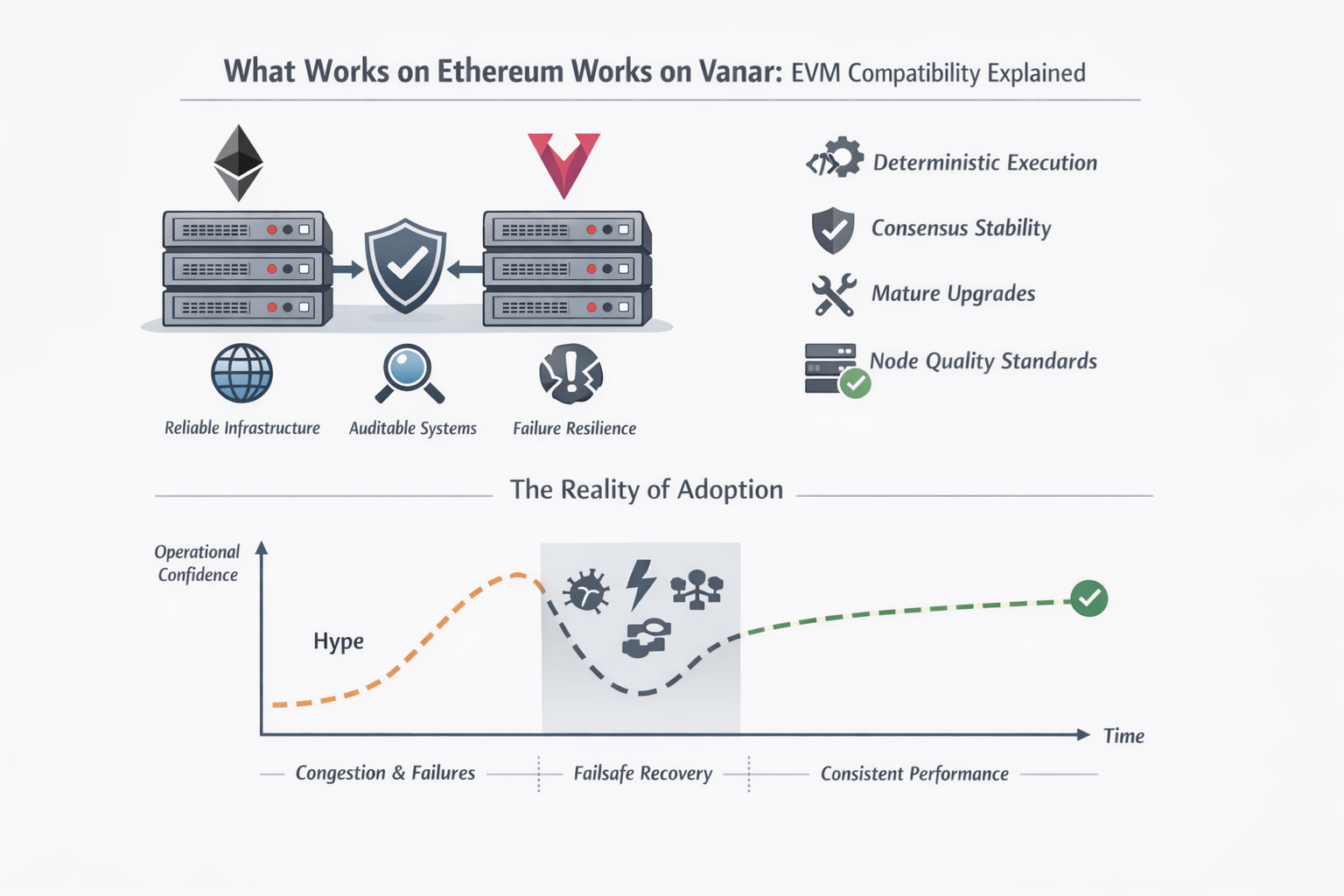
Builders don’t migrate because they’re excited. They migrate because they’re confident.
Look at the ecosystem supported by Ethereum Foundation: the reason tooling, audits, and operational practices have matured around Ethereum isn’t because it’s trendy. It’s because it has survived congestion events, MEV pressure, major protocol upgrades, security incidents, and multi year adversarial testing.
The EVM became a kind of industrial standard, not perfect, but battle-tested.
When Vanar chose EVM compatibility, I don’t see that as imitation. I see it as acknowledging that the hardest part of infrastructure is not inventing something new. It’s reducing unknowns.
In civil engineering, you don’t redesign concrete every decade to stay innovative. You use known load bearing properties and improve around them. Compatibility is reuse of proven load bearing assumptions.
When people hear EVM compatible, they often think about portability of smart contracts. That’s the visible layer.
What matters to operators is deeper: deterministic execution semantics, familiar gas accounting logic, predictable opcode behavior, and toolchain continuity through frameworks and audited contract patterns.
Those are hygiene mechanisms.
If your execution layer behaves differently under stress than developers expect, you don’t get innovation, you get outages.
EVM compatibility narrows the surface area of surprise. And in distributed systems, surprise is expensive.
Compatibility at the execution layer doesn’t matter if consensus underneath it is fragile.
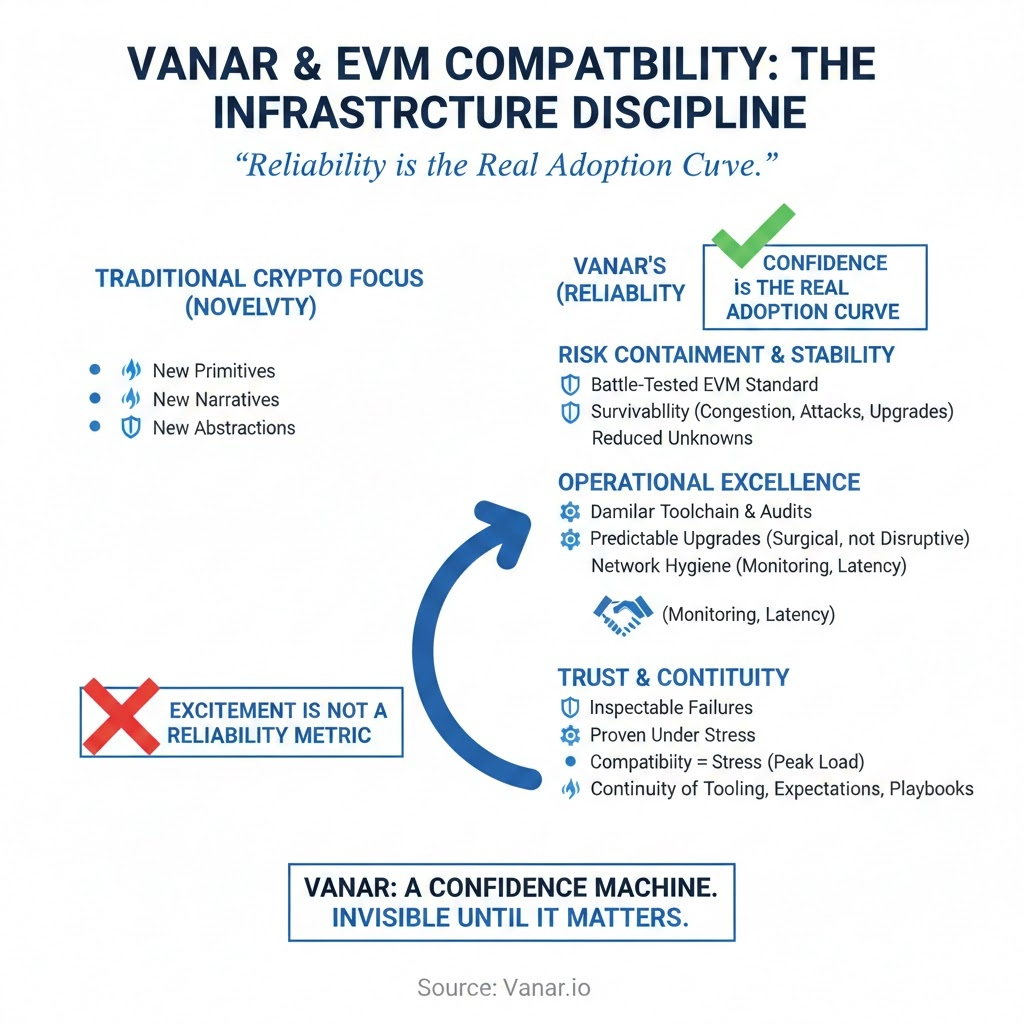
When I evaluate a chain operationally, I look at finality assumptions, validator diversity and quality, liveness under network partitions, and upgrade coordination discipline.
Ethereum’s evolution through Ethereum’s shift from Proof of Work to Proof of Stake was not a feature launch. It was a stress test of governance and coordination. The lesson wasn’t about advancement. It was about whether the network could coordinate change without collapsing trust.
Vanar’s EVM compatibility matters because it isolates complexity. Execution familiarity reduces one axis of risk. That allows consensus engineering to focus on stability, validator health, and predictable block production rather than reinventing execution semantics.
It’s the same logic as containerization in cloud systems. Standardize the runtime. Compete on orchestration quality.
Crypto often treats upgrades like product releases, big announcements, feature drops, roadmap milestones.
In infrastructure, upgrades are closer to surgical procedures.
You prepare rollback paths.
You simulate failure modes.
You communicate with operators in advance.
You document edge cases.
The EVM has years of documented quirks, gas edge cases, and audit patterns. When Vanar aligns with that environment, upgrades become additive rather than disruptive.
Maturity looks like backwards compatibility as a default assumption, deprecation cycles instead of abrupt removals, clear observability before and after changes, and validator coordination tested in staging environments.
It’s not glamorous. But it’s how you avoid waking up to a chain split at 3 a.m.
Network hygiene is invisible until it isn’t.
It includes node performance standards, peer discovery robustness, latency management, resource isolation, and spam mitigation.
EVM compatibility helps here indirectly. It means node operators are already familiar with execution profiling. They understand memory patterns. They’ve seen re entrancy attacks. They know how to monitor gas spikes.
Familiar systems reduce cognitive load. And cognitive load is a real operational risk.
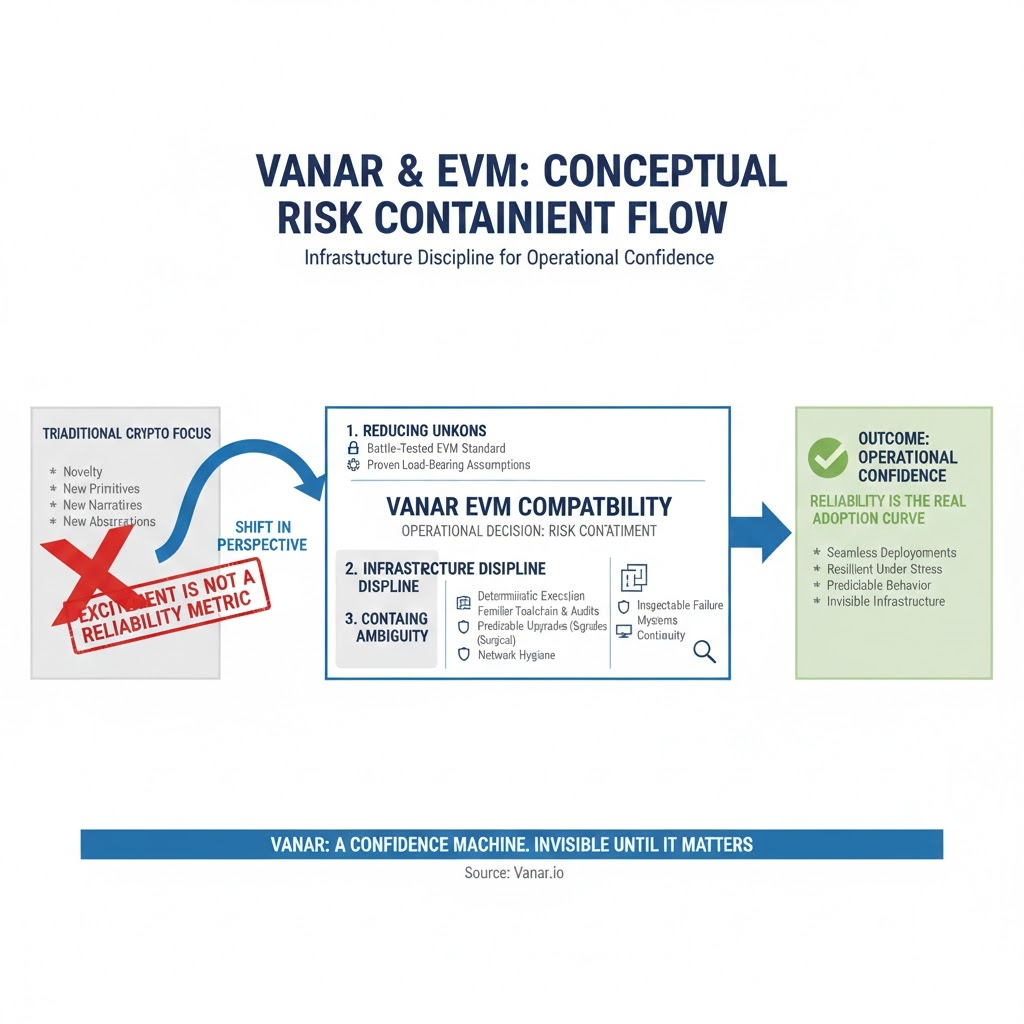
When something goes wrong, what matters most is not preventing every failure. It’s detecting and containing it quickly.
On Ethereum, years of tooling have evolved around mempool monitoring, block explorer indexing, contract event tracing, and log based debugging. Projects like OpenZeppelin didn’t just provide libraries. They codified defensive assumptions.
Vanar inheriting compatibility with this ecosystem isn’t about speed to market. It’s about inheriting observability patterns.
If your production system behaves predictably under inspection, operators remain calm. If it behaves like a black box, panic spreads faster than bugs.
Trust is often a function of how inspectable a failure is.
Every network looks stable at low throughput.
The real test is congestion, adversarial load, or validator churn.
On Ethereum, during peak demand cycles, we saw gas price spikes, MEV extraction games, and contract priority shifts. It wasn’t pretty. But it was transparent. The system bent without breaking consensus.
When Vanar adopts EVM semantics, it aligns with execution behaviors already tested under stress. That reduces the number of unknowns during peak load.
In aviation, aircraft are certified after controlled stress testing. No one certifies planes based on marketing materials. Blockchains should be evaluated the same way.
If you’re a builder running production smart contracts, your risk stack includes compiler behavior, bytecode verification, audit standards, wallet compatibility, and indexing reliability.
EVM compatibility means those layers are not speculative. They are inherited from a widely scrutinized environment.
It’s similar to using POSIX standards in operating systems. You don’t rewrite file I/O semantics to be innovative. You conform so that tools behave consistently.
Vanar’s compatibility means deployment scripts behave predictably, audited contracts don’t require reinterpretation, and wallet integrations don’t introduce semantic drift.
That reduces migration friction, but more importantly, it reduces misconfiguration risk.
There’s a popular narrative that adoption follows narrative momentum.
In my experience, adoption follows operational confidence.
Institutions do not integrate infrastructure that behaves unpredictably. Developers do not port systems that require re learning execution logic under pressure.

The reason Ethereum became foundational wasn’t because it promised everything. It’s because it didn’t implode under scrutiny.
Vanar aligning with what works there is not derivative thinking. It’s acknowledging that standards are earned through stress.
Compatibility says: we are not experimenting with your production assumptions.
A chain earns its reputation during network partitions, validator misbehavior, congestion, and upgrade rollouts, not during bull cycles.
When something breaks, does the system degrade gracefully? Do blocks continue? Is state consistent? Are operators informed?
These are architectural questions.
EVM compatibility doesn’t eliminate failure. But it reduces interpretive ambiguity when failure happens. And ambiguity is what erodes trust fastest.
If Vanar executes this correctly, success will not look viral.
It will look like contracts deploying without drama, audits transferring cleanly, nodes syncing reliably, upgrades happening with minimal disruption, and congestion being managed without existential risk.
No one tweets about power grids when they function.
The highest compliment for infrastructure is invisibility.
When I think about EVM compatibility on Vanar, I don’t think about portability. I think about continuity.
Continuity of tooling.
Continuity of expectations.
Continuity of operational playbooks.
What works on Ethereum works on Vanar, not because innovation is absent, but because risk is contained.
That’s what serious infrastructure does. It reduces variance.
In the end, the most valuable blockchain may not be the one that feels revolutionary. It may be the one that fades into the background of production systems, predictable, inspectable, resilient.
A network that doesn’t demand attention.
A network that earns confidence.
Software that becomes a confidence machine precisely because it simply works.
