


1. Introduction
In 2025, global cryptocurrency regulation is reaching a historic turning point. Once seen as a gray area, the crypto asset sector is increasingly being intervened and reshaped by governments' 'visible hands.' From the introduction and review of a series of milestone crypto bills in the U.S. to the official implementation of the (Stablecoin Regulation) in Hong Kong, major world economies are almost synchronously shifting from a vague, watchful, or even repressive stance to actively constructing clear regulatory frameworks. This global policy shift marks the crypto industry saying goodbye to the era of barbaric growth, moving towards a new stage of compliance and accelerated integration with traditional finance.
This article aims to comprehensively review and deeply analyze the significant developments in global crypto policies since 2025 and to look ahead at their profound impact on future market structures. We will first focus on the U.S., dissecting its series of measures at legislative, administrative, and regulatory levels; then, we will turn our attention to the global scene, overviewing policy dynamics in key jurisdictions such as the EU, Hong Kong, Singapore, and the UAE; next, we will analyze the interplay between policy and market through market prices, institutional movements, and on-chain data; finally, we will distill several core trends in future global crypto policies to provide forward-looking references and insights for investors navigating this transformative landscape of opportunities and challenges.
2. The interplay between crypto policies and the market
The crypto market in 2025 shows a clear policy interlinkage effect, repeatedly demonstrating a 'buy the expectation, sell the fact' trend, with policy interventions bringing regulation and guidance to the crypto industry and reshaping the operational logic of the market.
1. The interplay between crypto policies and market prices
At the beginning of 2025, Bitcoin continued the upward momentum from the end of the previous year and briefly broke historical highs in early January, crossing the $100,000 mark. This surge largely reflected expectations of Trump's victory and his promised 'crypto-friendly' policies. However, market sentiment also fluctuated: due to the delay in specific policy details in mid-January, Bitcoin's price experienced a significant pullback in February, dropping from the early January high (around $105,000) to about $70,000, with a monthly decline of over 17%. This volatility reflects investors' sensitivity to policy implementation—expectations drove the rise, while delays triggered the pullback. In early March, when Trump hinted on social media about establishing a national strategic crypto reserve, the market was reignited: after the weekend announcement, Bitcoin surged by 20%, with altcoins like XRP soaring by 25% within two days. However, the subsequent formal executive order did not include a plan for the government to directly purchase Bitcoin, leading the market to feel that 'the good news has run its course,' causing Bitcoin to retreat about 6% after a brief spike.
As July approached the U.S. 'Crypto Week', legislative benefits began to be gradually realized, and the market experienced a short squeeze rally. In mid-July, Bitcoin broke previous highs and continued to set records, surpassing $120,000 on July 14, marking a historic high. During this period, multiple favorable factors converged: the series of bills (GENIUS, CLARITY, etc.) about to be passed by the House of Representatives were seen as milestones laying the foundation for the industry’s future, prompting investors to position early; simultaneously, the SEC changed its stance to accelerate the approval of spot Bitcoin and Ethereum ETFs, leading to a sustained and strong inflow of funds into Bitcoin spot ETFs, pushing prices to new highs. Crypto-related stocks also surged accordingly, with U.S.-listed mining companies and major holders seeing their stock prices rise sharply. Digital asset investment funds recorded net inflows as high as $3.7 billion in a single week, elevating the industry’s managed asset scale to a historic high of $211 billion. Among them, Bitcoin-related products attracted $2.7 billion, dominating absolutely, while Ethereum also gained considerable incremental funds. It can be said that policy dividends drove funds to 'run into the market,' directly propelling a substantial market increase.
2. Exchange liquidity and institutional movements
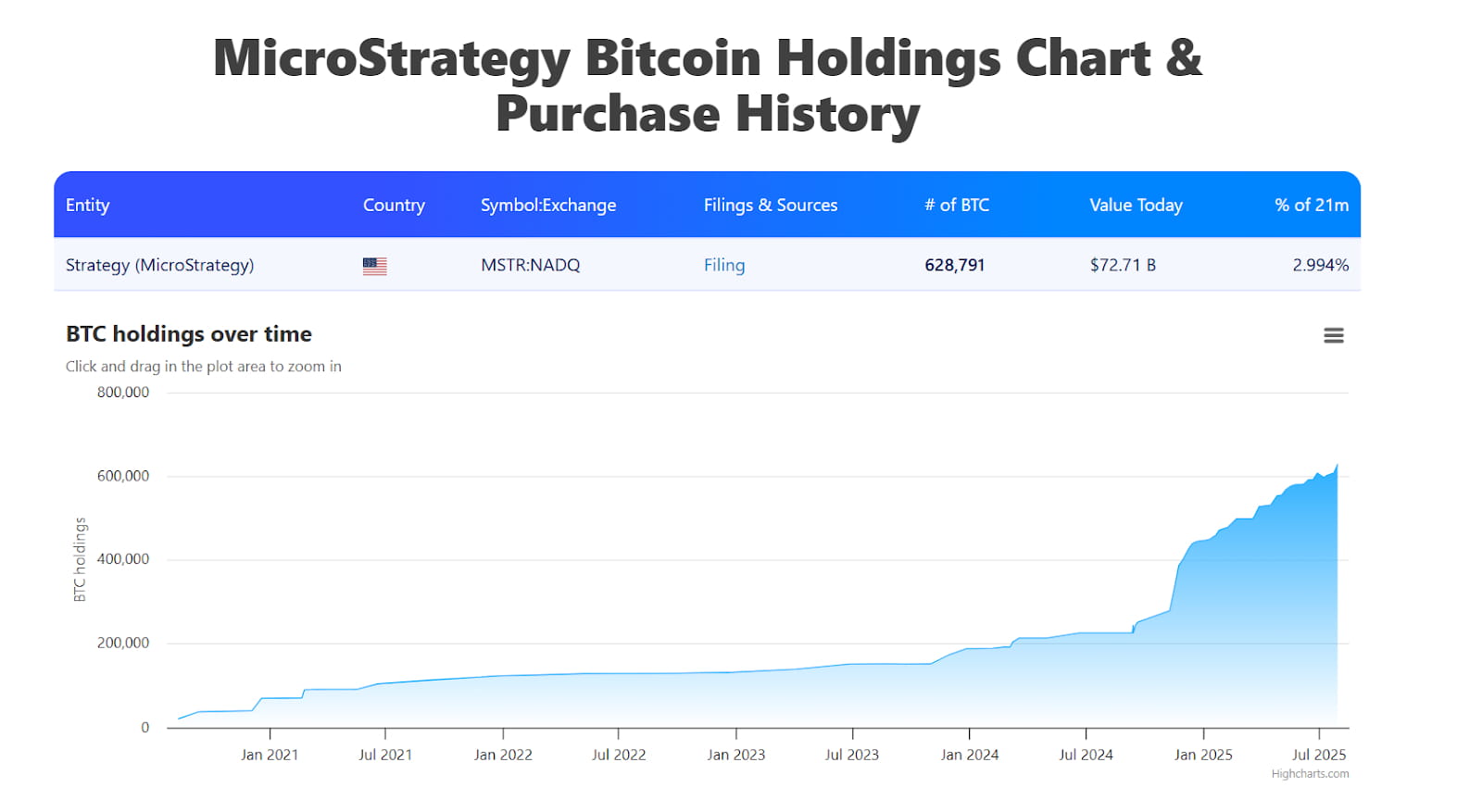
The improvement of the regulatory environment in 2025 is also reflected in the structure of trading markets. First, the liquidity of compliant exchanges in the U.S. has significantly warmed up. As U.S. regulations clarified and institutions entered the market, the depth of Bitcoin orders at several major licensed exchanges (such as Coinbase) surged, and the U.S. market regained dominance in global Bitcoin 1% depth liquidity. The clarity of regulations and a professional execution environment formed positive feedback: deeper liquidity attracted more capital into the market, further deepening market thickness. In addition, the behavior of institutional investors underwent significant changes—besides the influx of ETF funds, enthusiasm among U.S. listed companies and traditional institutions for investing in Bitcoin reappeared. Strategy repeatedly added to its Bitcoin holdings in 2025, reaching a position of 628,791 Bitcoins by July, accounting for 2.994% of the total Bitcoin supply. For example, several Wall Street asset management firms took advantage of favorable policies to issue new cryptocurrency trusts and fund products, providing compliant exposure to clients. According to CoinShares reports, digital asset investment products saw net inflows exceeding $10 billion in the first seven months of 2025, far exceeding the total for all of 2024. Even in traditional hedge funds, crypto assets began to be viewed as compliant components of investment portfolios.
Source: https://bitbo.io/treasuries/microstrategy
3. On-chain data and liquidity
Long-term holders are becoming the absolute dominant force in Bitcoin supply. A Coinbase research report states that as of August 2025, approximately 85% of Bitcoin supply is held in long-term wallets, with the proportion available for trading in circulation dropping to a historical low. A large amount of Bitcoin has not returned to exchanges after early surges but continues to be kept in cold wallets. Correspondingly, the balance of Bitcoin on exchanges has shown a continuous downward trend, indicating that investors prefer long-term holding over frequent trading.
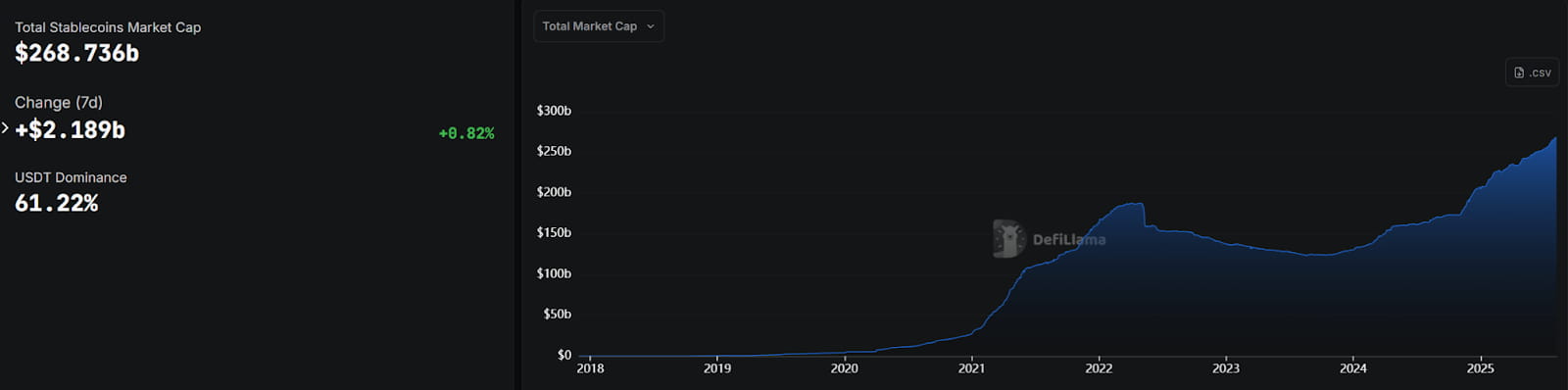
The supply of stablecoins and on-chain liquidity rebounded significantly. After stagnation in 2022-2023, compliant stablecoins began to regrow in 2025, indicating that funds are seeking entry channels. The rising issuance of stablecoins is seen as a leading indicator of restored risk appetite. Especially against the backdrop of clear U.S. regulatory support for dollar stablecoins, the market value of compliant stablecoins such as USDC has rebounded, with a single month’s issuance reaching several billion dollars. These stablecoins provide the market with a new stream of liquidity. On-chain data shows that the average daily trading volume of dollar stablecoins in 2025 increased by 28% year-on-year, and the total on-chain payment transaction volume for the year even surpassed that of Visa and Mastercard combined. This highlights the increasingly important role of stablecoins in global capital flows and reflects regulation driving them from gray areas into mainstream payment networks.
Source: https://defillama.com/stablecoins
In summary, the market response in 2025 can be summarized as follows: the clarification of policies leads to an increase in both incremental capital and holding willingness. Bitcoin, with its trust and liquidity, becomes the biggest beneficiary, not only repeatedly setting new price highs but also seeing its market cap dominance rise to recent peaks. Ethereum closely follows, solidifying its position as 'digital silver.' Meanwhile, most competing coins lag or are marginalized due to regulatory pressures or lack of new narratives. On-chain, mainstream assets accelerate their concentration towards long-term investors, and trading behavior becomes more rational. All of this indicates that the crypto market is gradually shedding its barbaric era and moving towards a mature and stable phase.
3. Progress of U.S. crypto policies
1. Breakthrough in cryptocurrency legislation
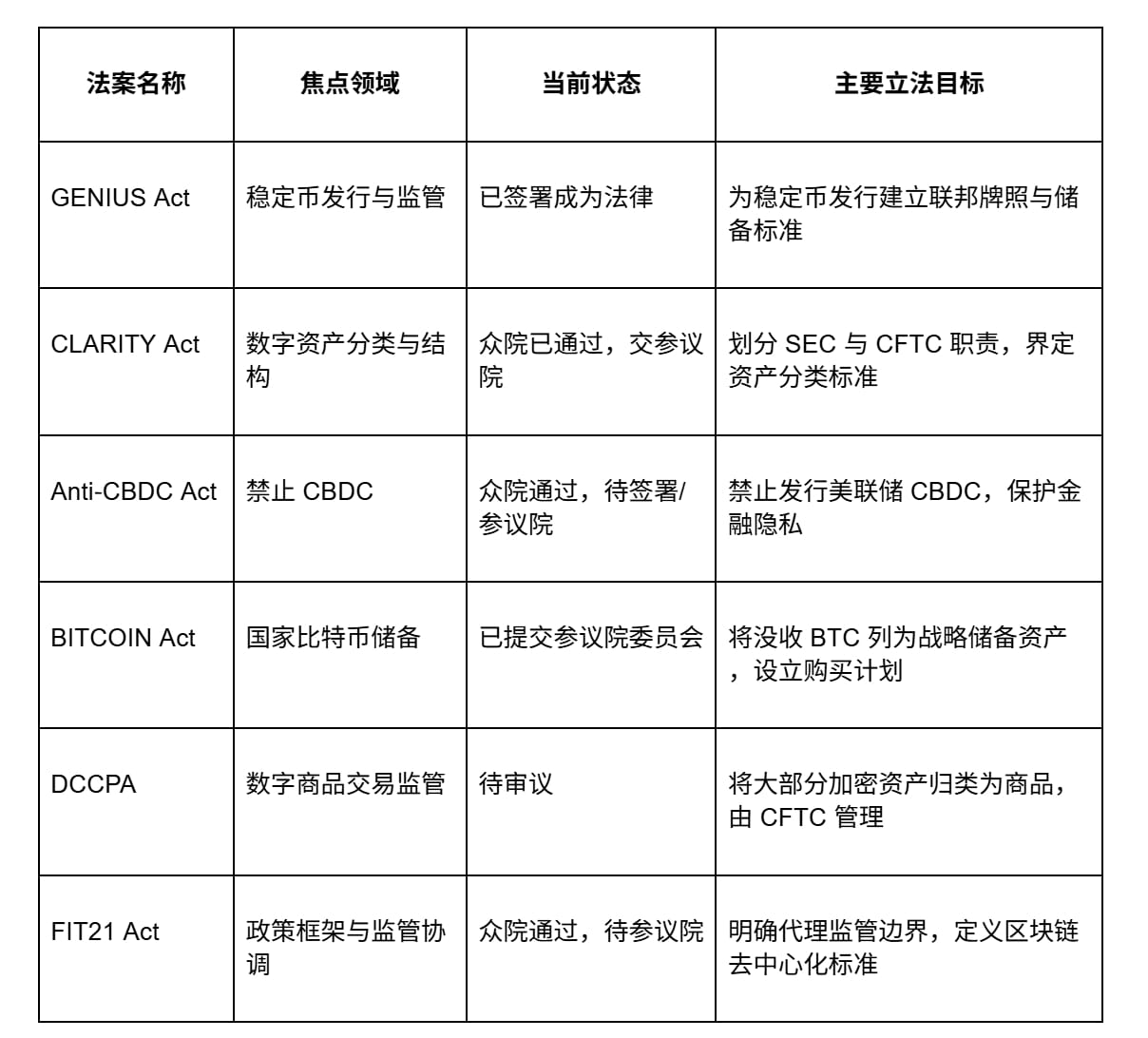
2025 marks a milestone breakthrough in crypto legislation in the U.S. In addition to the recently passed GENIUS and CLARITY acts, several other important legislative proposals related to cryptocurrencies are in progress, covering key areas such as CBDC prohibition, Bitcoin strategic reserves, consumer protection, mining, and taxation.
GENIUS Act: On July 18, Trump signed the (GENIUS Act), marking the first comprehensive cryptocurrency legislation passed by the U.S. Congress, focusing on stablecoin regulation and prohibiting interest payments on them, marking an important step for the U.S. in digital asset policy. The GENIUS Act stipulates that only financial institutions (banks, credit unions, and approved compliant institutions) protected by federal deposit insurance can issue payment stablecoins; issuers must maintain 1:1 backing of fiat currency or high-quality reserve assets and are subject to monthly reserve disclosures and periodic audits; all stablecoin issuers must also comply with the (Bank Secrecy Act), implementing anti-money laundering and anti-terrorism financing measures. The act aims to provide clear regulatory guardrails for the stablecoin industry, seen as a 'bank license' system for stablecoins.
CLARITY Act: Following closely, the U.S. House of Representatives also reviewed another significant bill (CLARITY Act). This bill aims to clarify the criteria for distinguishing digital assets as securities or commodities and to delineate the regulatory responsibilities of the SEC and CFTC regarding cryptocurrencies. The CLARITY Act proposes to grant the Commodity Futures Trading Commission (CFTC) broader regulatory authority over non-security crypto assets, while providing a pathway for certain tokens meeting decentralization and functional standards to transition from securities to commodities, thus ending the previous 'regulatory gray area.' Currently, the CLARITY Act has passed the House and is awaiting Senate review.
Prohibition of CBDC Act: Alongside the GENIUS and CLARITY acts, measures were pushed to set federal prohibitions against the issuance of a U.S. central bank digital currency (CBDC), which has been passed by the House and is awaiting presidential signature or Senate cooperation. This act aims to safeguard financial privacy and limit the Federal Reserve's intervention in the digital currency space.
BITCOIN Act: Proposed by Senator Cynthia Lummis on March 11, 2025, co-sponsored by bipartisan lawmakers. The act aims to centralize Bitcoin obtained by the federal government through confiscation into a 'Strategic Bitcoin Reserve' and requires the development of a purchasing plan, suggesting the proposal to acquire 1 million BTC within five years. It is currently submitted to the Senate Banking Committee for review and has not yet entered the voting stage.
DCCPA: Jointly initiated by several senators, attempting to classify most crypto assets as 'commodities' to be regulated by the CFTC while strengthening consumer protection measures. This act has been under review since 2022 and continues to progress.
FIT21 Act: Passed by the House in May 2024, not yet voted on in the Senate. The aim of this act is similar to that of CLARITY, clarifying the regulatory responsibilities of the CFTC and SEC, defining standards for decentralized blockchain industries, and providing exemption clauses for small-scale issuances, including stablecoins in the regulatory framework and clearly defining anti-fraud enforcement authority.
In addition, some states, such as Texas, passed a state-level 'Bitcoin Strategic Reserve' bill in June 2025, allowing the government to invest in digital assets with a market value of at least $500 billion (such as Bitcoin). The White House Digital Asset Working Group released a 160-page comprehensive report recommending expedited updates to the tax code (such as redefining income from mining, staking, etc.), establishing regulatory sandboxes, and simplifying bank access systems, with content resonating with multiple drafts (CLARITY, GENIUS, Anti-CBDC).
2. Administrative measures and regulatory agency shifts
While the legislation is advancing, administrative authorities and regulatory agencies are also taking a series of significant measures to reverse the uncertain stance towards the crypto industry from the past few years, beginning to coordinate various regulatory agencies from the top down to establish a 'unified strategy' for digital assets.
In January 2025, the newly inaugurated Trump administration issued a presidential executive order titled (Strengthening U.S. Leadership in Digital Financial Technology), which explicitly prohibits the development or use of any U.S. central bank digital currency (CBDC). This executive order reversed the previous administration's supportive stance on exploring CBDCs, directly halting the Fed's potential issuance of a digital dollar, citing financial privacy and currency independence as reasons, and instead emphasized support for dollar-backed stablecoins to maintain the dollar's dominant position in the digital age. This order also stressed the protection of citizens' rights to participate in blockchain networks (including mining, node validation, and self-custody), requiring that no legal policies improperly restrict these activities. More importantly, this executive order revoked the Biden administration's 2022 cryptocurrency executive order and the related framework from the Treasury Department, establishing the White House Digital Asset Market Working Group, led by the newly appointed 'Crypto King'—former PayPal executive David Sacks. This working group brings together senior officials from the Treasury Department, Securities and Exchange Commission (SEC), Commodity Futures Trading Commission (CFTC), and the Department of Justice, requiring agencies to propose a unified digital asset regulatory framework report within 120 days to eliminate regulatory overlap and vacuums. On August 7, Trump signed an executive order allowing alternative assets such as private equity, real estate, and cryptocurrencies to enter 401(k) retirement savings plans, opening the door to approximately $12.5 trillion in retirement account funds.
Regarding the SEC, with the change of ruling parties, there was a significant policy shift at the Securities and Exchange Commission in 2025. The SEC Chairman Paul Atkins, nominated by Trump, made establishing a digital asset regulatory framework the SEC's top priority upon taking office. He adopted a relatively lenient regulatory stance, actively promoting the loosening of cryptocurrency regulations, including the approval of ETFs and regulatory guidance, and settlements of lawsuits. On July 31, Atkins launched a plan called 'Project Crypto,' aimed at comprehensively updating U.S. securities regulations to adapt to the blockchain and digital asset markets. He instructed SEC staff to develop clear guidelines to determine which crypto tokens are securities and to draft disclosure and exemption plans to lower compliance thresholds. He also requested that the SEC collaborate with companies wishing to issue tokenized securities to promote pilot programs for traditional financial assets on-chain.
3. Financial and Accounting Policies
In financial management and accounting standards, the U.S. also introduced supporting measures in 2025 to integrate crypto assets with the traditional financial system. In January 2025, the SEC released SAB 122, rescinding the controversial 2022 crypto custody accounting guidance, SAB 121. Previously, SAB 121 required banks and institutions to account for the crypto assets held on behalf of clients as both liabilities and equivalent assets on their balance sheets, a rule criticized by the banking industry for excessively occupying capital and hindering banks from providing digital asset custody services. Congress attempted to overturn SAB 121 in 2023, but it was vetoed by Biden.
The SEC has now withdrawn this requirement, allowing banks and other custodial institutions to no longer make high reserves on their balance sheets due to the custody of clients' crypto assets. The American Bankers Association (ABA) welcomed this, stating that it will 'allow banks to act as custodians of digital assets with more peace of mind.' It is evident that the U.S. is removing barriers for traditional financial participation in the crypto space from an accounting standards perspective, promoting the entry of compliant funds.
4. Strategic reserves and macro policies
The Trump administration also included Bitcoin and other digital assets in the national strategic vision. In March 2025, the White House issued an executive order establishing a 'Strategic Bitcoin Reserve' and a 'Digital Asset Reserve Account.' According to this order, the federal government will concentrate Bitcoin obtained from law enforcement seizures into strategic reserves, no longer selling them, and authorizing the Treasury and Commerce Departments to explore budget-neutral plans to increase holdings without increasing taxpayer burdens. Meanwhile, government agencies must report their holdings of all crypto assets to the Treasury and the President's Digital Asset Working Group to achieve centralized management of state-owned crypto assets.
The Trump administration emphasized that this initiative aims to make the U.S. one of the 'first countries to establish an official Bitcoin reserve' to leverage Bitcoin's strategic value as 'digital gold.' U.S. officials estimate that the prior scattered disposal of seized Bitcoin has cost taxpayers over $17 billion in potential value. The new policy attempts to correct this by 'locking up' these assets for national needs. The U.S. initiative to reserve crypto assets is unprecedented globally, reflecting a significant shift in U.S. policy from previously high-pressure regulation to viewing crypto assets as strategic resources.
In summary, since 2025, the U.S. has intensively launched measures across legislative, administrative, and regulatory levels, termed by the industry as the 'Spring of Regulation.' Under the leadership of the Trump administration, the U.S. is attempting to position itself as 'the global crypto capital,' reversing previous vague and repressive policies through stablecoin legislation, clear market structure bills, and executive orders. These measures have had an immediate impact on the market: investor sentiment has significantly improved, and new funds have begun to flow into the compliant U.S. market.
4. Progress of Crypto Policies in Other Countries
Outside the U.S., many countries and regions around the world are also intensifying efforts to improve their own cryptocurrency regulatory frameworks in 2025, with a focus on stablecoins, anti-money laundering, and market regulations.
EU: The EU's (Markets in Crypto-Assets Regulation (MiCA)) officially came into full effect at the end of 2024, providing a unified regulatory blueprint for member states regarding crypto assets. MiCA brings the issuance and services of crypto assets under EU financial regulation, establishing strict rules for stablecoins: only entities qualified as electronic money institutions or credit institutions can issue stablecoins pegged to a single fiat currency (EMT), while tokens backed by a basket of assets (ART) must be established and authorized in the EU. Stablecoin issuers must meet capital requirements, and reserve assets must be high-quality and liquid, with regular disclosures of reserve composition and audit reports to regulators. The implementation of MiCA makes the EU the first major economy to establish comprehensive crypto legislation. In the first half of 2025, regulatory agencies in member states (such as the European Securities and Markets Authority (ESMA) and the European Banking Authority (EBA)) are busy drafting technical standards to support MiCA, while exchanges, custodians, and other crypto service providers begin to apply for cross-EU licenses. This unified regulation is expected to attract a batch of compliant trading platforms and stablecoin issuers from Europe by the end of 2025.
United Kingdom and Australia: The UK passed the (Financial Services and Markets Bill) in 2023, which includes provisions to regulate stablecoins and other crypto assets. This law grants powers to the Treasury and the Financial Conduct Authority (FCA) to include the issuance and services of crypto assets in the list of regulated financial activities. From 2024 to 2025, the UK government will successively consult on specific rules, expecting to establish detailed regulations for stablecoin issuance and crypto trading platforms by the end of 2025, aligning them with traditional financial institutions' regulations. The UK has an overall positive attitude, hoping to attract crypto businesses back to London through improved laws. Australia also took action in 2025: following the release of the 'Token Mapping' report in 2022, the Australian government announced plans to propose regulations for crypto asset custody and exchange licensing in 2025 and to improve tax guidelines for digital assets.
Hong Kong: Hong Kong is actively exploring becoming a testing ground for China's cryptocurrency policy, seeking to open trading platforms and public chain technology development, and establish a regulatory sandbox environment to provide references for mainland China's cryptocurrency policies. Hong Kong is committed to building an Asian compliance crypto center. The Hong Kong Securities and Futures Commission (SFC) implemented a licensing system for virtual asset trading platforms back in June 2023. In 2025, regulatory authorities in Hong Kong further expressed their support for the development of compliant stablecoins and tokenized securities. The (Stablecoin Regulation), implemented on August 1, clearly requires any issuer of stablecoins pegged to the Hong Kong dollar to obtain a license in Hong Kong, or else it will be considered illegal. The reserve assets must be high liquidity and high-quality assets, and their value must be equivalent to the nominal value of the circulating stablecoins, subject to regulation and audits by the Monetary Authority. These measures demonstrate Hong Kong's ambition to balance investor protection and innovative development, aiming to attract global compliant crypto businesses. Currently, several large exchanges and crypto funds have chosen to establish offices or seek licenses in Hong Kong, and market liquidity has also rebounded.
Singapore: Singapore adopted an open attitude towards the crypto industry in its early years, attracting a large number of industry firms and talents. However, the collapse of the FTX trading platform in 2022 and significant losses suffered by sovereign funds like Temasek, along with the bankruptcies of well-known crypto trading platforms such as Three Arrows Capital and Terraform Labs, damaged Singapore's reputation as a financial hub in Asia. Starting from 2023, the Monetary Authority of Singapore (MAS) gradually tightened regulatory measures, requiring recognized stablecoins to meet standards for value stability, reserve custody, and capital adequacy, and issuers must obtain corresponding licenses. This led to exchanges like Binance, Bybit, and Huobi failing to obtain licenses and subsequently exiting the Singapore market by the end of 2023. In 2025, MAS continued tightening cryptocurrency trading regulations, requiring that from June 30 onwards, digital token service providers only serving overseas clients must obtain a license from the authority to continue operating in Singapore; otherwise, they must close their trading platforms to curb financial crimes such as money laundering using cryptocurrencies. In terms of investment and innovation, Singapore launched sandbox initiatives like 'Project Guardian' to explore institutional decentralized finance. Overall, Singapore's attitude towards the crypto industry is 'encouraging innovation, cautious regulation.'
UAE: The UAE has actively positioned itself as a crypto-friendly jurisdiction in recent years. The Central Bank of the UAE launched (Payment Token Services Regulation) rules by the end of 2024. This set of rules defines stablecoins pegged to fiat currencies as 'payment tokens' and adopts a tiered access policy: locally issued dirham (AED) pegged stablecoins can apply to be qualified payment tokens for domestic payments, while foreign-issued stablecoins (like USDT, USDC) cannot be used for domestic payments, only for investment and trading purposes. The UAE encourages local banks or institutions to issue AED stablecoins and explores government-backed multi-asset reserve stablecoins (such as those pegged to government bonds or gold). Regulations also prohibit algorithmic stablecoins and anonymous privacy coins from being issued or used domestically to prevent systemic risks and money laundering. Additionally, the Dubai Virtual Assets Regulatory Authority (VARA) has also released rules on token issuance, marketing, and promotion during 2023-2025, requiring crypto companies operating in Dubai to be licensed and comply with a series of regulations on advertising disclosure and investor protection. Overall, the UAE is establishing a multi-layered crypto regulatory system to ensure financial security while making itself one of the most attractive crypto hubs in the Middle East.
Thailand: In 2025, Thailand implemented a series of measures to support and regulate the crypto sector. On one hand, the Thai government announced that from January 1, 2025, capital gains tax on digital asset trading conducted through licensed crypto trading platforms would be waived for five years to encourage compliant trading development. This effectively gives investors tax incentives to participate in crypto investments within a regulated environment, which is expected to enhance the attractiveness of the Thai market. On the other hand, the Thai Securities and Exchange Commission revised regulations in April 2025, requiring foreign crypto service providers (exchanges, brokers) to register and obtain licenses in Thailand if they provide services to Thai citizens; otherwise, they would be deemed illegal operations. At the same time, the Thai SEC has strengthened its regulation of crypto advertising and investor suitability.
Pakistan: Pakistan has shifted from a previously vague or even prohibitive stance towards crypto to embracing virtual assets to promote financial modernization. In July, the Pakistani government officially approved the (2025 Virtual Assets Bill), establishing the Pakistan Virtual Assets Regulatory Authority (PVARA) as an independent regulatory body responsible for licensing and supervising crypto and virtual asset service providers nationwide. This framework is similar to the VARA model in Dubai, aiming to introduce licensed operations and risk management for the domestic crypto industry. The Governor of the State Bank of Pakistan, Jameel Ahmad, stated that a digital rupee (CBDC) pilot is about to launch, and legislation will lay the foundation for licensing and regulating virtual assets. Pakistan has also formed a Crypto Committee (PCC) to promote innovative projects like blockchain and Bitcoin mining and even invited Zhao Changpeng, founder of the world's largest exchange, as an advisor, with plans to establish a national Bitcoin reserve. Overall, Pakistan is trying to shift from strict repression to proactive regulation, hoping to carve out a share in the emerging digital finance sector.
Turkey: As an emerging market country with a large crypto user base, Turkey implemented strict new regulations in 2025 to combat illegal activities and maintain financial stability. The Financial Crimes Investigation Board of the Ministry of Finance has begun to roll out a series of anti-money laundering regulations for crypto: all crypto transactions require mandatory real-name authentication, and transactions exceeding 15,000 lira must be reported for review; all transactions are subject to a delayed settlement mechanism—ordinary transfers take 48 hours to complete, while the first withdrawal requires a waiting period of 72 hours. Additionally, new regulations impose a limit on the circulation of stablecoins: individuals cannot transact more than an equivalent of $3,000 worth of stablecoins daily, and the monthly cumulative amount cannot exceed $50,000. Finance Minister Mehmet Simsek stated that this move aims to 'prevent the laundering of illegal gambling and fraud funds through cryptocurrencies.' Given that an estimated one-fifth of Turkey's population has participated in crypto investment and the trading volume ranks third globally, these regulatory changes will have a wide-ranging impact on the market. In the short term, the new regulations may reduce liquidity in the market, but in the long term, they will help cleanse illegal capital flows and enhance the legitimacy and transparency of Turkey's crypto ecosystem.
India: The Indian government remains cautiously conservative regarding cryptocurrencies, but there are signs of some softening of attitudes. Since 2022, India has imposed a heavy tax of 30% on crypto trading profits and a 1% tax deducted at source (TDS), leading to a sharp decline in domestic trading volumes. However, during its G20 presidency in 2023, India pushed for the IMF and FSB to develop a unified global framework for crypto asset regulation, indicating a tendency to act in concert under international rules. As of 2025, India has yet to introduce dedicated crypto legislation, and domestic exchanges continue to operate under challenging conditions. However, government officials have repeatedly stated that they will not impose a blanket ban on crypto but will wait for international consensus. Regarding CBDCs, the Reserve Bank of India is gradually expanding the pilot scope of the digital rupee. In the future, India may choose to adjust its domestic policies after global standards become clearer.
Russia: Russia has implemented a 'dual approach' to crypto regulation. Domestically, the use of cryptocurrencies as a means of payment remains strictly prohibited, while the promotion of the digital ruble (CBDC) is accelerating to strengthen state control over the monetary system. However, internationally, to avoid Western financial sanctions, Russia's attitude towards cryptocurrencies has become noticeably open. In early 2025, the (Law on the Use of Digital Financial Assets in International Settlements) officially came into effect, providing a legal framework for Russian exporters to use cryptocurrencies for trade settlements with friendly countries. This law authorizes specific enterprises to use mainstream cryptocurrencies like Bitcoin and Ethereum in cross-border transactions to bypass the SWIFT system. Additionally, the Russian government is actively promoting the regulatory management and taxation of the crypto mining industry, hoping to convert the country's abundant energy advantages into national fiscal revenue and foreign exchange reserves, achieving the strategic intent of 'nationalizing crypto mining.'
In addition to major economies, some small countries are also exploring crypto paths. Bhutan, as a small country in South Asia, continues to deepen its 'green mining' strategy in 2025, integrating Bitcoin mining with its abundant hydropower resources to support national fiscal revenue and economic development. The Bhutanese government announced in April 2025 plans to jointly build multiple sustainable mining centers with international enterprises, aiming to become Asia's 'green crypto mining hub.' On the other hand, El Salvador continues and expands its Bitcoin national strategy, announcing in 2025 the establishment of a 'Bitcoin National Wealth Fund' to strengthen the country's Bitcoin reserve scale after making Bitcoin legal tender in 2021. Additionally, the El Salvador government has initiated a dedicated Bitcoin bond issuance project, planning to use the raised funds to build a 'Bitcoin City,' further reinforcing Bitcoin's strategic support for the national economy.
Overall, 2025 saw countries around the world rapidly implementing policies, reflecting both convergence and divergence: developed economies emphasized establishing comprehensive regulatory frameworks, while emerging markets focused more on preventing financial crimes and leveraging crypto opportunities. Stablecoin regulation became a common focus, with the U.S., Europe, and Hong Kong all establishing regulations to ensure stablecoins have sufficient reserves and controlled issuance. Exchange regulation and anti-money laundering also emerged as frequent themes, with countries beginning to apply KYC/AML standards to crypto trading activities similarly to traditional finance. It is foreseeable that the legal status and regulatory requirements for cryptocurrencies will gradually become clearer in major jurisdictions worldwide.
5. Trends and Outlook of Global Crypto Policies
Outlook for the remainder of 2025 and beyond, cryptocurrency policies may exhibit the following trends, profoundly impacting the global market landscape:
1. Accelerated convergence of global regulation: The U.S. policy direction may push major global economies towards similar regulatory frameworks. On one hand, the GENIUS Act sets a benchmark for stablecoin regulation, with its requirements for compliant reserves and licensing potentially serving as a reference for other countries. For instance, regulatory agencies in Japan, South Korea, and other countries have reportedly begun assessing the implications of U.S. new regulations for their own stablecoin policies, and the EU will observe how the U.S. implements this act to adjust its own regulatory details. On the other hand, the challenges that the CLARITY Act attempts to address regarding the classification of securities and commodities are also common challenges faced by many countries. If the U.S. successfully classifies tokens with certain market values and decentralization levels as non-securities, this will provide regulatory insights for jurisdictions like the UK and Singapore looking to develop crypto finance, reducing the regulatory vacuum of 'no law to follow.' At the same time, cross-border regulatory cooperation will strengthen. Under the G20 framework, the IMF and the Financial Stability Board (FSB) proposed high-level guidelines for crypto asset regulation in 2023, and it is expected that by the end of 2025, countries will formulate their national rules based on these principles and share information.
2. Market structure becoming more institutionalized and commoditized: The U.S. regulatory shift is likely to bring traditional finance into the crypto space in large quantities, a trend expected to continue. By the end of 2025, the CFTC may roll out a regulatory framework for on-chain commodity trading, guiding more commodities and indices to trade on-chain in token form and subject to compliance oversight. This will further commoditize and financialize the crypto market, deeply integrating the digital asset market with traditional commodity markets. Additionally, more types of crypto ETFs and investment products will emerge. Following Bitcoin and Ethereum ETFs, regulators may allow a basket of crypto index ETFs, options ETFs, etc., to facilitate institutional allocations. Some large Wall Street institutions are already preparing to issue actively managed crypto funds and pension fund crypto portfolios when policies allow. Bitcoin may gradually exhibit macro sensitivity similar to gold or the Nasdaq index, becoming an 'alternative asset' in institutional asset allocations.
3. Competition and division of regional compliance centers: In Asia and the Middle East, places like Hong Kong, Singapore, and Dubai are competing to build regional crypto hubs. Hong Kong, backed by mainland China and its sound financial infrastructure, along with the intensive introduction of exchange and stablecoin regulatory systems from 2023 to 2025, has attracted many well-known trading platforms and projects to settle. Singapore, with its sound legal system, tax advantages, and business-friendly environment, continues to be a breeding ground for blockchain startups. The collaboration between the two places is expected to establish Asia's important position in the global crypto landscape. The UAE (Dubai) and Saudi Arabia in the Middle East are also not far behind, attracting pressured crypto companies from Europe and the U.S. through loose tax systems and open regulations. In the next few years, we may see a multi-center pattern: North America with crypto financial centers like New York and Miami, Europe with cities like Switzerland and Paris actively embracing regulation, and Asia with Hong Kong and Singapore shining as twin stars, while Dubai serves as a bastion in the Middle East. These compliance highlands will dominate the flow of compliant funds and projects.
4. New opportunities for the integration of technology and compliance: Clear policies will release new momentum for industrial innovation. Once it is clear which behaviors are prohibited, enterprises can boldly invest in permitted directions. For example, the U.S. prohibits CBDCs but supports private stablecoins, which may trigger a surge in the issuance of dollar stablecoins by banks, with traditional banks and fintech companies collaborating to launch various compliant stablecoins to fill payment gaps, which presents enormous market potential. The issuance of security tokens is expected to gain momentum, and listed on compliant exchanges for on-chain stocks and bonds. Blockchain technology will see more applications in traditional fields like supply chain finance and trade settlement. Even technologies such as decentralized identity (DID) and zero-knowledge proofs may find their place in privacy compliance and digital identity verification, achieving innovations in compliance technology.
5. Evolution of investor behavior: Policy evolution will also profoundly impact investor sentiment. After enduring high regulatory pressure from 2022 to 2023, global investors have shown a stronger compliance awareness and risk management mindset in the rebound of 2025. In the near future, we may see U.S. pension plans formally allowing allocations to Bitcoin ETFs, and some countries' sovereign wealth funds openly announcing allocations to digital assets as a long-term strategy. All of these will further strengthen the market's fundamentals and reduce excessive speculation. Of course, under the new policy environment, the market may also experience new volatility patterns—for instance, due to the participation of institutional algorithmic trading, short-term market fluctuations may closely follow macro news and liquidity changes, requiring investors to adapt to the rhythms of an institutional market, which differs from the emotional ups and downs driven by pure retail investors in the past.
Conclusion
The cryptocurrency world in 2025 is undergoing a profound transformation from disorder to order. Compliance has become the main theme, as major global economies extend their 'visible hands' to this emerging field, either by formulating laws or issuing guidelines to bring crypto assets into the financial system's proper track. In the long term, this policy evolution will profoundly shape the infrastructure and investment environment of the crypto industry. Clearer rules will weed out bad coins and retain good ones, allowing the industry to bid farewell to the barbaric growth period and enter a new stage of compliant and orderly development. For ordinary investors, this means that crypto investment is no longer a venture adrift in gray areas, but is expected to gradually become a legally protected, transparent, and sustainable asset allocation choice.
About Us
Hotcoin Research, as the core research institution of Hotcoin Exchange, is dedicated to turning professional analysis into practical tools for you. We analyze market trends through (Weekly Insights) and (In-depth Reports); leveraging exclusive sections like (Hotcoin Selection) (AI + Expert dual screening), we help you identify potential assets and reduce trial and error costs. Each week, our researchers also engage in live sessions with you to interpret hot topics and predict trends. We believe that warm companionship and professional guidance can help more investors navigate cycles and grasp the value opportunities of Web3.
Risk Warning
The cryptocurrency market is highly volatile, and investment itself carries risks. We strongly recommend that investors fully understand these risks and invest under a strict risk management framework to ensure the safety of their funds.
Website: https://lite.hotcoingex.cc/r/Hotcoinresearch
X: x.com/Hotcoin_Academy
Mail: labs@hotcoin.com