

Summary
Ondo Finance has become a key player in the tokenization of Real-World Assets (RWA), with its core mission of popularizing institutional-grade financial products by combining the rigor of traditional finance (TradFi) with the innovation of decentralized finance (DeFi).
This report provides a detailed analysis of Ondo Finance's business model, operational processes, technological pathways, and the realization of its RWA products.
The strategic cornerstone of Ondo is its 'compliance-first' policy established by a team with backgrounds from top financial institutions such as Goldman Sachs. This traditional financial gene profoundly influences its product design, partner selection, and regulatory communication strategies, earning the trust of industry giants like BlackRock and Morgan Stanley. The company adopts a dual-track business model, operating both an asset management division (issuing tokenized products like OUSG and USDY) and a technology division (developing protocols and infrastructures like Flux Finance, Ondo Global Markets, and Ondo Chain).
Its core RWA products are carefully designed to meet the needs of different markets. OUSG is a tokenized U.S. short-term Treasury bond fund aimed at qualified U.S. investors, achieving 24/7 instant subscription and redemption through deep integration with BlackRock's BUIDL fund, addressing the pain point of traditional financial settlement delays. USDY, on the other hand, is an interest-bearing token supported by U.S. Treasury bonds and bank deposits designed to be a widely used, composable collateral in the DeFi ecosystem.
Technically, Ondo's ambition extends beyond becoming an application layer protocol. It is building a vertically integrated financial ecosystem, with the ultimate goal of launching Ondo Chain—a Layer 1 public chain designed for RWAs. This chain plans to adopt innovative mechanisms such as RWA staking, licensed validator nodes, and native oracles to tackle the challenges that current public chains face when handling regulated securities.
Ondo's competitive moat lies not only in its technology but also in its extensive and deep partner network, covering all aspects of asset management, custody, compliance, and liquidity. However, the company also faces significant challenges, including ambiguous token value capture mechanisms, a valuation that is extremely high relative to current income, intense competition from traditional financial giants and Web3 startups, and substantial regulatory and execution risks.
In summary, Ondo Finance's market value is not based on its current cash flow but rather on the market's bullish option on the grand vision of successfully achieving 'Wall Street 2.0'. Whether it can transform from a successful asset management company into an infrastructure provider for future on-chain financial markets will be key to determining its long-term value.
1. Ondo Finance Blueprint
1.1 Mission: Bridging the Worlds of DeFi and TradFi
The core mission of Ondo Finance is clear and grand: to bridge the gap between traditional finance (TradFi) and decentralized finance (DeFi), making institutional-grade financial products and services accessible to everyone. This vision is succinctly encapsulated as building 'Wall Street 2.0', intending to utilize blockchain technology to transform the infrastructure and accessibility of financial markets.
The company's strategic foundation is deeply rooted in the backgrounds of its leadership team. Founders Nathan Allman and Pinku Surana both have experience working at top Wall Street institutions like Goldman Sachs. This is not just a simple resume embellishment but rather a core strategic asset. This background explains why Ondo has placed immense emphasis on compliance since its inception, positioning it as a primary differentiating advantage. The company is one of the first DeFi projects to demonstrate stringent legal compliance, with the on-chain and off-chain flow of its users' assets managed by renowned institutions like Coinbase, BlackRock, and Clear Street.
This 'TradFi-first' mindset allows it to establish deep partnerships with financial giants like BlackRock and engage in high-level regulatory communication. For instance, it hired former U.S. House Financial Services Committee Chairman Patrick McHenry as vice chairman of its advisory board and met with the SEC to discuss the regulatory framework for tokenized securities. These initiatives indicate that Ondo's strategy is to first build a 'moat' based on trust and compliance, and then consolidate its technological advantages. Strong capital support also confirms the market's recognition of its team and vision, as the company successfully raised $46 million from top investment institutions such as Founders Fund, Pantera Capital, and Coinbase Ventures.
1.2 Business Model: Dual Approach of Asset Manager and Technology Provider
Ondo Finance has a unique organizational structure, divided into two mutually supportive core departments, which constitutes its dual-pronged business model.
The first is the asset management department. This department focuses on creating and managing tokenized financial products, serving as the cornerstone of the company's current core business. Its primary products include the Ondo Short-Term US Government Bond Fund (OUSG) for institutions and the US Dollar Yield (USDY) for global retail users.
The second is the technology department. This department is responsible for developing decentralized financial protocols and blockchain infrastructure, which bear the company's future growth potential. Its results include the decentralized lending protocol Flux Finance and the Layer 1 blockchain Ondo Chain designed for RWAs.
This structure enables it to generate revenue through different channels:
Asset Management Fee: For the OUSG product, Ondo charges institutional clients a 0.15% management fee (currently waived until July 1, 2025) and a 0.15% fund operating fee.
Yield Spread: For the USDY product, Ondo retains about a 0.5 percentage point spread from the yield generated by the underlying assets as income.
Future Potential Revenue: As the ecosystem matures, transaction fees on Ondo Chain or authorized use of its technology stack may become new revenue sources.
From the analysis of this model, it can be seen that the current asset management business centered around RWA products has strategic significance far beyond merely collecting management fees.
These high-quality, stable-yield tokenized assets serve more as 'bait' to attract capital and users. Through OUSG and USDY, Ondo successfully attracted a large total locked value (TVL) and users, laying the foundation of liquidity and demand for building a grander technological ecosystem—namely Ondo Chain and Ondo Global Markets.
The currently relatively mild fee structure serves a larger goal: to build network effects and ultimately capture long-term value through its technological infrastructure.
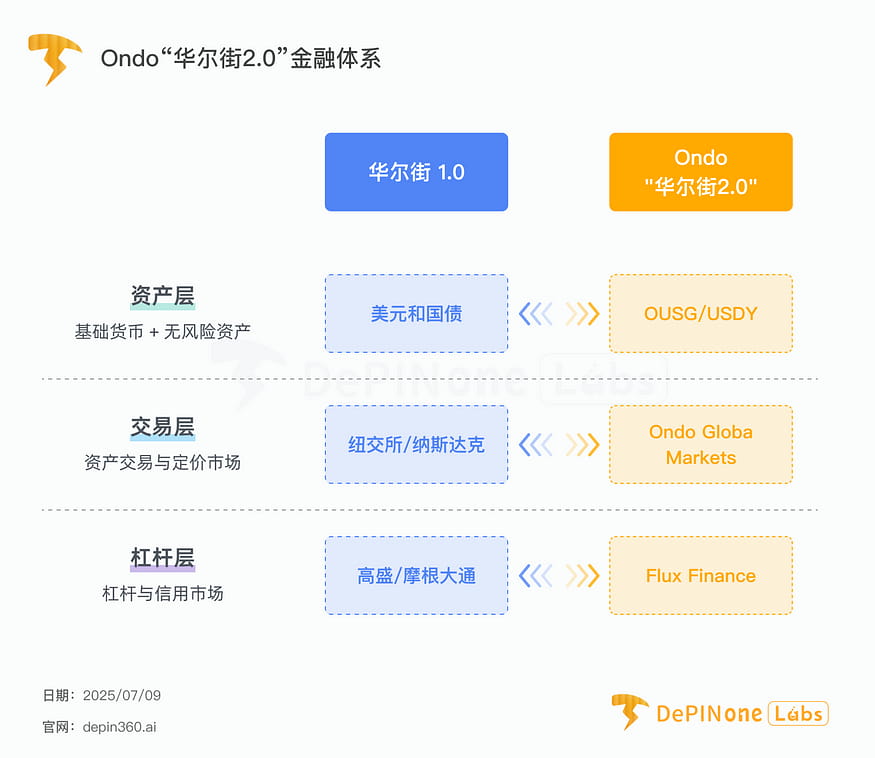
Ondo 'Wall Street 2.0' Financial System
1.3 Competitive Landscape and Market Share
With its compliance-first strategy and strong product-market fit, Ondo Finance has established a leading position in the RWA space. As of early 2025, Ondo ranks among the top three in the tokenized RWA sector, with a TVL exceeding $1 billion.
Notably, Ondo occupies over 90% of the market share in terms of the number of holders of tokenized U.S. Treasuries, largely due to the openness of its USDY product to non-U.S. retail investors.
Despite its impressive achievements, Ondo still faces intense competition from various dimensions:
Crypto Native Competitors: Hashnote (USYC) and Securitize are its main rivals in the Web3 space. In particular, Hashnote has actively competed for market share by offering highly attractive yields.
Traditional Financial Giants: Institutions like BlackRock (BUIDL) and Franklin Templeton (FOBXX/BENJI) are both partners of Ondo and its most powerful potential competitors. They control the sources of RWAs—the issuance of underlying assets—and have begun to personally launch their own tokenized funds.
To more clearly demonstrate the competitive landscape, the following table compares the main participants in the tokenized Treasury market.
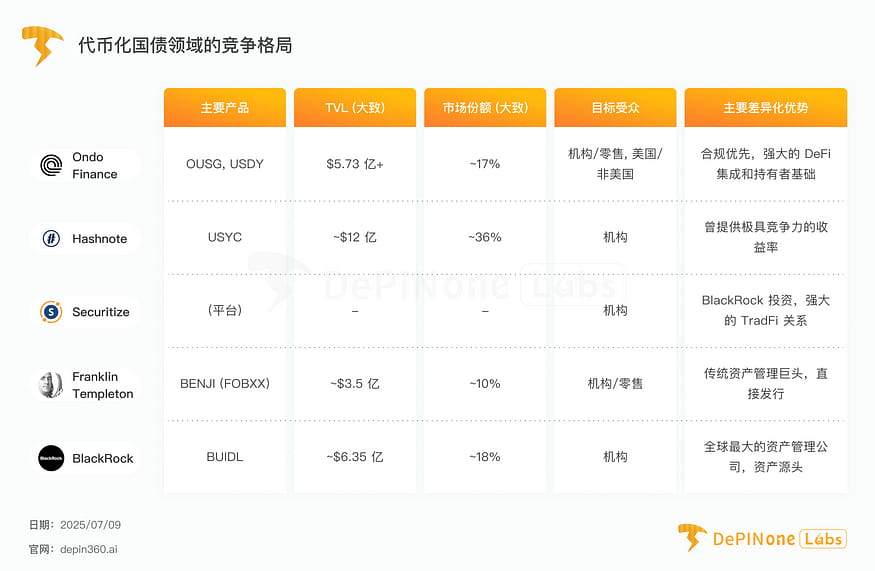
Competitive Landscape in Tokenized Treasuries
Data Source: rwa.xyz. TVL and market share are dynamic data; the approximate values cited here are for illustrative purposes during the reporting period.
2. Ondo's RWA Product Matrix
2.1 OUSG: The Institutional Gateway to On-Chain Treasuries
OUSG (Ondo Short-Term US Government Treasuries) is a tokenized fund that provides investors with exposure to short-term U.S. Treasuries. This product is designed for qualified purchasers and accredited investors, including investors within the U.S.
Strategic Iteration Path
The underlying assets of OUSG have undergone a key strategic iteration, which has had a profound impact on its product characteristics.
Initial Stage: Initially, OUSG's assets were primarily invested in BlackRock's iShares Short Treasury Bond ETF (SHV). However, traditional ETFs follow a T+2 settlement cycle, meaning there is a significant time delay for users redeeming OUSG, which is a huge friction point in the 24/7 operating crypto market.
Strategic Transformation: In March 2024, with BlackRock launching its first tokenized fund BUIDL, Ondo quickly took action to strategically shift $95 million of OUSG's underlying assets to BUIDL. This move was decisive as it allowed OUSG to leverage BUIDL's on-chain features, achieving 24/7/365 instant minting and redemption, completely addressing the pain point of settlement delays.
Current Portfolio: Today, OUSG's portfolio has evolved into a diversified collection of tokenized funds, including BlackRock's BUIDL, Franklin Templeton's BENJI, WisdomTree's WTGXX, supplemented by cash equivalents to ensure liquidity.
Legal and Operational Structure
The operation of OUSG is built on a fully institutional-level, multi-party framework.
Legal Entity: The legal structure of the fund is a limited partnership in Delaware named Ondo I LP. Investors become limited partners in the fund by purchasing OUSG tokens.
Management Structure: The general partner of the fund is Ondo I GP LLC, and the investment manager is Ondo Capital Management LLC. Both companies are wholly owned subsidiaries of Ondo Finance, responsible for managing the fund and making investment decisions.
Asset Custody Chain: The custody path of the assets is clear and secure. Investors' USDC is first deposited into Ondo's account at Coinbase. These funds are then used to purchase underlying assets like BUIDL. Traditional securities (like early ETFs) are custodied by Clear Street, while the assets of the BUIDL fund are custodied by BNY Mellon. On the crypto asset side, OUSG tokens are supported by professional custodians like Zodia Custody and Komainu.
Fund Management: An independent third-party fund manager, NAV Consulting, is responsible for the fund's accounting, daily net asset value (NAV) calculations, and publishing financial reports, ensuring operational transparency and independence.
User Flow
Qualification and Account Opening: Investors must meet the standards of qualified purchasers or accredited investors and pass KYC/AML (Know Your Customer/Anti-Money Laundering) reviews.
Minting (Investment): Users connect their wallets and deposit USDC or PYUSD. The smart contract calculates the number of OUSG tokens to be issued based on the current NAV and transfers the stablecoin to the fund's account at Coinbase to purchase the underlying assets. The minimum investment for instantaneous transactions is $5,000.
Redemption: Users initiate a redemption request. The number of OUSG tokens they hold multiplied by the current NAV yields the USDC value to be returned. This entire process can be conducted 24/7.
Yield and Fee Mechanisms
Yield: The annualized yield of OUSG (APY), for example, 4.09%, comes from the interest generated by its investment in U.S. Treasury bond funds. The yield is reflected in the accumulated growth of the OUSG token price (i.e., NAV). Additionally, Ondo offers a rebasing version rOUSG, which maintains a price of $1, with yields distributed to holders in the form of newly issued tokens daily.
Fees: The fund charges a 0.15% management fee (waived until July 1, 2025) and a maximum of 0.15% fund operating fee.
Ondo's rapid adoption of BUIDL can be considered a textbook strategic action. This move not only addresses OUSG's biggest pain point (settlement delays) but also positions Ondo as a key launch partner for BlackRock's milestone product, at one point holding 38% of the total supply of BUIDL. This has surpassed a simple client relationship, forming a deep strategic symbiosis. Ondo provides on-chain distribution channels for BlackRock's institutional products, while BlackRock offers Ondo unparalleled legitimacy and the technical foundation for 24/7 liquidity. This symbiotic relationship constitutes a strong competitive advantage.
The Differences and Connections with BUIDL
On the surface, OUSG and BUIDL are both tokenized products based on Treasury bonds. In fact, the descriptions above reveal that there are many differences between the two.
In simple terms, OUSG is a 'fund of funds' managed by Ondo Finance, pooling investors' funds to invest in a basket of tokenized U.S. Treasury bond funds, including BlackRock's BUIDL.
Their relationship is symbiotic: Ondo is a major client and important distribution channel for BlackRock's BUIDL; in turn, BUIDL provides the critical technological foundation for OUSG to achieve its core functionality—24/7 instant subscription and redemption.
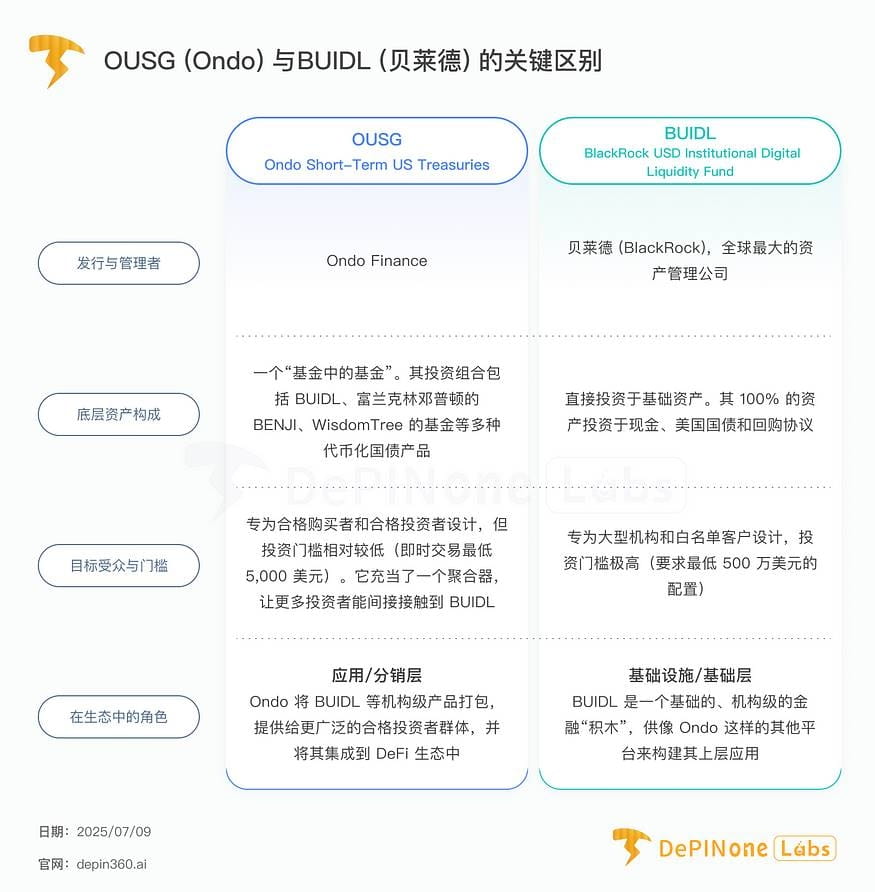
Key Differences Between OUSG (Ondo) and BUIDL (BlackRock)
BUIDL is a wholesale product: Its target customers are other funds, cryptocurrency companies, market makers, and large institutional investors that need to manage their massive on-chain funding pools. BUIDL provides them with a foundational, highly liquid, yield-generating underlying asset.
Ondo operates in the retail (or professional retail) channel: it acts as a distributor. It procures the 'raw material' BUIDL, packages it with other products, adds its services (such as lower investment thresholds, more convenient user interfaces, cross-chain functionality, etc.), and then sells to a broader customer base that still needs to meet accredited investor standards.
2.2 USDY: A Global Interest-Bearing Stablecoin Alternative
USDY (Ondo US Dollar Yield) is a tokenized note backed by short-term U.S. Treasury bonds and bank demand deposits. It is designed as an interest-bearing stablecoin alternative, primarily aimed at non-U.S. individual and institutional investors.
Structure and Collateral
Legal Structure: USDY is issued as a debt instrument by a Delaware bankruptcy-remote entity, Ondo USDY LLC. This structure is designed to legally isolate the assets supporting USDY from Ondo Finance's balance sheet, thereby protecting investor assets in extreme situations.
Underlying Assets: Its collateral consists of a portfolio of short-term U.S. Treasury bonds and bank demand deposits.
Overcollateralization: The portfolio implements overcollateralization, previously mentioned to have a 3% buffer. To ensure transparency, Ondo publishes daily reserve proofs provided by third parties.
⭐ Complete Process for Non-U.S. Investors
Qualification and Account Opening: Limited to non-U.S. individuals or entities that have completed the KYC/AML process.
Investment: Users can invest through USDC, USDT, or wire transfers in USD. Interest begins accruing once the funds are processed.
Transfer Restrictions ('40–50 Day Lock-Up Period'): This is the most critical compliance design for USDY. To comply with Regulation S exemption provisions under U.S. securities laws, newly minted USDY tokens are non-transferable for 40 to 50 days after purchase. During this period, investors hold a 'temporary global certificate'. After the lock-up period ends, the tokens become freely transferable on-chain.
Redemption: USDY can only be redeemed for USD via wire transfer, and the funds must be sent to a non-U.S. bank account.
Similar to OUSG, the standard version of USDY is an accumulating token whose value increases as yields grow. Ondo also provides a rebasing version, rUSDY, to meet the needs of users who prefer a stable price of $1 and earn yields through acquiring additional tokens.
If OUSG is a compliance product established by Ondo for institutional investors with strict entry 'firewalls', then USDY is its main tool for penetrating the broad DeFi ecosystem. Its native deployments on multiple mainstream public chains, such as Ethereum, Solana, Arbitrum, and Sui, along with its fully permissionless transfer characteristics after the lock-up period, make it an ideal composable 'currency Lego'. Ondo is actively promoting USDY as a reserve asset for decentralized autonomous organizations (DAOs) like Arbitrum and MakerDAO, using it in lending and payment scenarios. Although the compliance-driven 40-day lock-up period introduces some usage friction, its strategic goal is clear: to make USDY a high-quality collateral asset that generates yields and is ubiquitous throughout the DeFi world.
2.3 Product Comparison and Strategic Intent
To clearly articulate the differing strategic positions of Ondo's two flagship products, the following table compares their key characteristics.
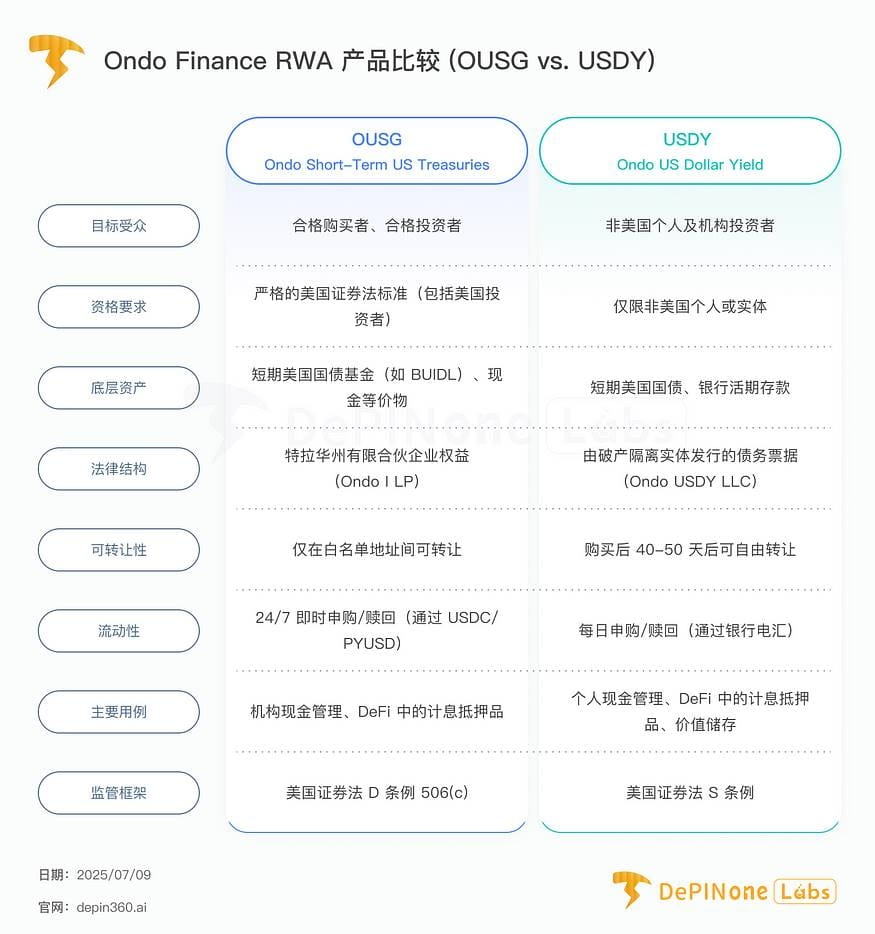
Ondo Finance RWA Product Comparison (OUSG vs. USDY)
2.4 OMMF: A Strategic Contraction
Product Launch: Ondo announced the launch of OMMF (Ondo US Money Markets) in April 2023, a tokenized money market fund aimed at maintaining a stable price of $1 and distributing yields through the issuance of new tokens.
Product Withdrawal: However, according to a third-party risk assessment report from April 2024, Ondo 'withdrew the plan for the tokenized money market fund ($OMMF).'
The quiet withdrawal of OMMF sharply contrasts with the high-profile launch of other products, revealing the strategic discipline and realistic judgment of the Ondo team.
In the mental model of on-chain users, the difference between tokenized money market funds (MMFs) and tokenized short-term Treasury products (like OUSG) may not be significant, as both serve the core need for simple, safe yields. Continuing to push OMMF may dilute its marketing resources and liquidity, with limited marginal benefits. A decisive abandonment of this product line indicates that Ondo is not blindly expanding but is continuously assessing product-market fit and has the capability to 'cut off its arm to survive.'
This strategic clarity and execution discipline is a positive signal for its long-term development potential.
3. Technology Stack: Building the Tracks for 'Wall Street 2.0'
3.1 Core Protocol: Empowering On-Chain Utility
Ondo has developed a series of protocols aimed at providing on-chain usability for its RWA products and laying the foundation for a broader financial market.
Flux Finance: This is a decentralized lending protocol based on a Compound V2 fork. Its core innovation is that it can simultaneously support permissionless tokens like USDC and permissioned RWA tokens like OUSG as collateral. To achieve this, Flux introduces a whitelist mechanism, allowing only addresses that have passed compliance checks to liquidate positions in restricted assets like OUSG, thus creating a 'permissioned DeFi' environment. The governance of the protocol belongs to Ondo DAO, with ONDO token holders making collective decisions.
Ondo Global Markets (GM): This is one of Ondo's most ambitious platforms, aiming to tokenize and bring thousands of publicly traded securities (including stocks, bonds, and ETFs) on-chain. The platform has launched on Solana, aiming to provide 24/7 trading services and deeply integrate with Solana's DeFi ecosystem. Its target audience is non-U.S. investors. Technically, the platform utilizes dynamic bonding curves and integrates with decentralized exchanges (DEX) like Meteora to provide initial liquidity for assets.
Nexus Asset Issuance Protocol: This protocol aims to provide instant liquidity for tokenized Treasury bonds issued by third parties by using OUSG as a shared liquidity layer across issuers. This design elevates OUSG's position from a mere investment product to a core market infrastructure level, demonstrating Ondo's intention to play a more foundational role in the RWA ecosystem.
3.2 Ondo Chain: A Layer 1 Tailored for RWA
Ondo's ultimate technological vision is embodied in Ondo Chain, a public, proof-of-stake Layer 1 blockchain designed for institutional-grade RWAs.
Architectural Design and Innovation:
RWA Staking: Unlike traditional PoS chains that can only stake native tokens, Ondo Chain allows validators to stake RWAs (such as tokens issued by OUSG or Ondo GM) to secure network safety. This design aims to reduce reliance on high-volatility crypto assets for network security.
Licensed Validator Nodes: The validators of Ondo Chain will consist of regulated financial institutions (disclosed potential participants include Franklin Templeton, Wellington, WisdomTree, etc.). This design aims to prevent malicious actions like front-running and fundamentally enhance the network's compliance level.
Native Oracles: Validators will natively and securely publish key off-chain data, such as asset prices, on-chain through consensus mechanisms, thus eliminating the need to rely on third-party oracle services for core functions, reducing systemic risks and costs.
Paying Gas with RWA: Ondo Chain will allow users to pay transaction fees (Gas fee) using RWA tokens, which is a key usability improvement for institutions that wish to operate on-chain but are limited to holding specific assets.
Ondo believes that generic public chains are not optimized for regulated securities. These securities have complex requirements in terms of compliance, corporate actions (like stock splits), and identity verification, which existing blockchains cannot meet well. The birth of Ondo Chain aims to address these specific issues from the ground up.
The development of Ondo Chain reveals the company's ultimate strategy: vertical integration.
Ondo is not satisfied with merely building applications on other public chains; it is dedicated to controlling the entire technology stack from asset tokenization (OUSG, USDY, GM) to lending/trading layers (Flux, GM platform) to the underlying settlement layer (Ondo Chain). This vertical integration, once successful, will grant Ondo significant market control, reduce reliance on external protocols, and enable it to capture value at every stage of the value chain. This is undoubtedly a high-risk but also high-reward grand strategy.
3.3 Interoperability and Security
Cross-Chain Strategy: Ondo has achieved native cross-chain functionality for tokens through its Ondo Bridge. This bridge employs a 'burn-and-mint' mechanism, supported by leading interoperability protocols like Axelar and LayerZero. This approach avoids the inherent security risks of traditional 'wrapped assets' models, ensuring that USDY is a native asset on each supported chain, effectively preventing liquidity fragmentation.
Security Status and Audit Findings: Ondo places a high priority on security, ensuring the robustness of its smart contracts through regular third-party code audits (conducted by organizations such as Code4rena, NetherMind, Zokyo) and a public bug bounty program. In the September 2023 Code4rena audit report, four medium-risk vulnerabilities were identified, including the inability to remove or clear support for a specific chain in bridging contracts, potential permanent loss of funds for users of account abstraction wallets when bridging assets, the risk of two different transactions from different source chains producing the same transaction hash and disrupting the approval process, and the inability for admins to destroy tokens from blacklisted addresses.
4. Ecosystem and Partnerships
4.1 Partner Network Landscape
Ondo has successfully built a multi-layered partner ecosystem spanning TradFi and DeFi, which is crucial for a company aiming to connect the two worlds.
Traditional Financial Asset Managers and Banks: This is the basis of Ondo's legitimacy and asset quality. Partners include BlackRock, Franklin Templeton, Wellington Management, WisdomTree, Morgan Stanley, JPMorgan, ABN AMRO, etc. These relationships not only provide Ondo with high-quality underlying asset sources but also bring invaluable institutional credibility.
Crypto Custodians and Financial Service Providers: This is the institutionalized assurance of Ondo's operations. Partners include Coinbase (crypto asset custody and brokerage), BNY Mellon (BUIDL fund custodian), Clear Street (ETF custodian), NAV Consulting (fund manager), Ankura Trust (trust services), as well as Zodia Custody and Komainu (crypto asset custodians). This network forms the backbone of its institutional-level operations.
Blockchain Platforms: This is the channel for distributing Ondo's products. Ondo's products have been deployed on multiple mainstream public chains, including Ethereum, Solana, Polygon, Arbitrum, Sui, Aptos, Cosmos (via Noble), and XRP Ledger. Extensive deployment ensures the accessibility and network effects of its products.
DeFi Protocols: This reflects the on-chain utility of Ondo's products. Partners include MakerDAO and Arbitrum DAO (which use Ondo products as reserve assets), Pendle, Drift, Helio, Sphere, etc. (integrating products). These collaborations inject composability into Ondo's RWA assets.
Interoperability Protocols: These are the bridges connecting various islands. Axelar and LayerZero provide the underlying technical support for Ondo's native cross-chain bridge.
4.2 Strategic Value Analysis
Ondo's partner network is not only the foundation of its business operations but also a powerful, non-technical competitive moat. In the Web3 world, code can be forked, but rebuilding such a deep, multi-layered trust network that spans TradFi and DeFi is extremely difficult. Every collaboration with institutions such as BlackRock, Coinbase, or NAV Consulting represents a long and rigorous due diligence, legal compliance, and technical integration process.
This network provides Ondo with a mark of 'institutional certification', which is crucial for attracting risk-averse institutional capital. When a new project wants to enter the RWA space, it faces not only technical challenges but also barriers of trust and relationships.
From this perspective, the Ondo ecosystem itself may hold more value than its current codebase and be more difficult to replicate.
5. ONDO Token Economics: Governance, Value, and Future Potential
5.1 Token Distribution and Release Mechanism
Total Supply and Inflation: The total supply of ONDO tokens is fixed at 10 billion, with no planned inflation mechanism.
Distribution Structure: The distribution of tokens aims to balance the interests of the community, investors, and core team.
Ecosystem Growth: 52.1% (5.21 billion tokens). Used for airdrops, incentives, partner support, etc., with 24% unlocking at the token generation event (TGE) and the remainder released gradually over 5 years.
Protocol Development (Core Contributors/Team): 33% (3.3 billion tokens)
Private Sale (Seed Round/A Round): Approximately 12.9% (1.29 billion tokens). 1-year lock-up + 48 months of linear release.
Public Sale (via CoinList): Approximately 2% (198.88 million tokens). About 90% unlock at TGE, 1-year lock-up + 6/18 months of linear release.
Before the DAO vote on January 18, 2024, the transfer of ONDO tokens was restricted. After unlocking, most tokens allocated to investors and the team remain subject to strict, multi-year linear release plans. For example, tokens for private investors typically have a 1-year lock-up, followed by a 48-month linear release.
5.2 Governance Utility
Currently, the primary and clear utility of the ONDO token is governance. Holders can participate in decisions of Ondo DAO, which is responsible for managing protocols like Flux Finance. Token holders can vote on proposals for protocol upgrades, fee structure adjustments, and the addition of collateral assets.
As the Ondo ecosystem develops, the utility of the ONDO token is expected to expand. It is highly likely to become the core governance token of Ondo Chain, used for electing validators and determining eligible staked assets. Additionally, the market widely expects ONDO to be usable for network security staking and earning yields in the future or to enjoy fee discounts and even participate in some form of value feedback mechanism (such as buybacks and burns), though these mechanisms have not yet been formally implemented.
5.3 Critical Analysis of Value Capture
Multiple analysis reports point out that the ONDO token currently lacks a strong and direct value capture mechanism. Its utility is primarily limited to governance rights, and users of Ondo's RWA products (like OUSG or USDY) do not need to hold or use the ONDO token.
Although the direct revenue generated by the protocol is currently relatively limited (one report estimates annual revenue of less than $10 million), the ONDO token maintains a fully diluted valuation (FDV) of billions of dollars.
This phenomenon indicates that the market pricing of ONDO is not based on its current cash flows or direct utility.
In contrast, the market views it as a bullish option on the grand narrative of 'Wall Street 2.0'. Its price reflects a collective belief in the market that Ondo will successfully launch disruptive infrastructures such as Ondo Chain and Global Markets, and that the ONDO token will ultimately capture significant value from this vast ecosystem (e.g., through staking rewards, transaction fee sharing, etc.). This makes the value of ONDO highly sensitive to changes in market narratives and the execution capability of the team's roadmap.
Its high FDV and a large amount of unlocked token supply constitute significant valuation risks—if execution falls short of expectations or market narratives shift, token prices may face severe adjustments.
6. Comprehensive Analysis and Outlook
6.1 Key Risks and Mitigation Measures
Regulatory Risk: The legal framework for tokenized securities is still evolving, which poses the most significant threat to Ondo. Ondo actively manages this risk by engaging with regulatory agencies, hiring policy experts, and carefully designing product structures within existing legal frameworks (such as Regulation D and Regulation S).
Execution Risk: Ondo's roadmap (especially Ondo Chain and Global Markets) is extremely grand and complex, with a high degree of execution difficulty. The company adopts a phased rollout strategy, with an experienced team and strong venture capital support to ensure development. However, this remains its highest internal risk.
Competitive Risk: Traditional financial giants have the capability to establish their own RWA ecosystems, bypassing intermediaries like Ondo. Ondo is attempting to build strong network effects through its extensive partner ecosystem and compete for first-mover advantage in constructing a compliant on-chain financial center.
Valuation Risk: As mentioned earlier, the high valuation of the token is entirely based on optimistic expectations for the future. A series of measures proposed in the current DAO voting gradually establish a long-term token release schedule for insiders and early investors, aiming to ensure long-term alignment of interests and prevent premature sell-offs, thus stabilizing market expectations to some extent.
6.2 Strategic Outlook
Through its unique strategy of placing institutional trust and regulatory compliance first, Ondo Finance has successfully positioned itself as a top competitor in the RWA space. Its outstanding leadership team, strong partner network, and meticulous product structure jointly constitute a solid foundation.
However, the project is at a critical crossroads. Its current success is largely built on several relatively simple yet well-executed tokenized Treasury products. Its multi-billion dollar valuation bets on a more ambitious future: the creation of a wholly new, vertically integrated on-chain financial infrastructure layer.
The ultimate success or failure of Ondo will depend on its ability to bridge the execution gap from a successful asset manager to an infrastructure provider for a future 'Wall Street 2.0'.
For mature investors, Ondo offers a clear, albeit higher-risk, bet on the grand trend of institutional adoption of public chain technology. Though the road is fraught with regulatory, competitive, and technical challenges, the potential rewards of its ultimate goal—to occupy a central position in the future financial system—are equally immense.
Partial References
Ondo Research — BlockBase Insights, https://insights.blockbase.co/ondo-research/
Are Ondo and Ondo Finance the Same? A Deep Dive into Their Role in Tokenized Finance, https://www.okx.com/en-us/learn/ondo-vs-ondo-finance-tokenized-finance
Ondo: Product Line, Competitive Landscape, and Token Valuation …, https://research.mintventures.fund/2025/5/16/Ondo-Product-Line-Competitive-Landscape-and-Token-Valuation-of-a-Leading-RWA-Project/
What is Ondo Finance? Future of RWAs and DeFi — NFTevening, https://nftevening.com/what-is-ondo/
Final Report — Ondo (OUSG) — Particula, https://particula.io/wp-content/uploads/2024/06/Digital-Asset-Risk-Rating-Report-Ondo-OUSG-April-2024.pdf
Ondo Finance, Real-World Asset: Investor Guide, https://www.diadata.org/rwa-real-world-asset-map/ondo-finance/
What Is Ondo ($ONDO)? Everything You Need to Know, https://www.osl.com/hk-en/academy/article/what-is-ondo-usdondo-everything-you-need-to-know
How Does Ondo Finance Work? — CanvasBusinessModel.com, https://canvasbusinessmodel.com/blogs/how-it-works/ondo-finance-how-it-works
Ondo Finance moves $95 million worth of OUSG to BlackRock’s BUIDL — FXStreet, https://www.fxstreet.com/cryptocurrencies/news/ondo-moves-95-million-worth-of-ousg-assets-to-buidl-as-tokenized-fund-attracts-245-million-since-debut-202403281030
Ondo Finance eyes tokenized treasury expansion amid crypto bull market — Cointelegraph, https://cointelegraph.com/news/ondo-finance-eyes-tokenized-treasury-expansion-amid-crypto-bull-market
Stablecoins: What is $USDY by Ondo Finance? — MyEtherWallet, https://www.myetherwallet.com/blog/stablecoins-what-is-usdy-by-ondo/
Ondo Finance Launches Ondo Global Markets on Solana for Tokenized Asset Trading, https://www.ainvest.com/news/ondo-finance-launches-ondo-global-markets-solana-tokenized-asset-trading-2505/
Introducing Ondo Chain: The Omnichain Network for RWAs, https://blog.ondo.finance/introducing-ondo-chain/
Ondo Finance and Axelar Integrate for Cross-Chain Tokenized Secure Notes, https://www.axelar.network/blog/ondo-finance-cross-chain-stablecoin
In-depth analysis of Ondo Finance: Web3 investment bank’s practice of putting US debt on the blockchain — Binance, https://www.binance.com/en/square/post/4888261888578
Special Statement: All articles by DePINone Labs are for informational and educational purposes only and do not constitute any investment advice.
About Us
We welcome you to share your views and insights with us and encourage reposting. Please cite the source.
🏠 Website: https://www.depin360.ai/
🐦 Twitter: https://x.com/DePINoneLabs
🌏 Discord: https://discord.gg/XzEYNGKyG3