

Author: 2898
If you have tens of thousands of U to buy coins, just go all in, but what if you have $400 million?
How should you buy?
If you don't know how to manage your assets, the operations of the Yili Hua fund might provide you with some reference.
Article outline:
🧨 The god operation of bottom-buying at the most FUD moment.
🛒 Bottom-buying should be about buying more as prices drop, in small amounts and multiple times.
🤔 Can you guess what their holding cost is?
💼 Securing profits allows for further advancement
🧾 How to learn bottom-buying strategies from on-chain giants
⚠️ Attention
Address: primarily analyzing the four addresses under Yili Hua.
Cost: tracing back to early 2025, there was a large amount of ETH deposited into Aave, which can be considered long-term holdings, so it can only be estimated at the market price at that time.
Purpose: to see how the big players operate in bottom-buying.
One, the god operation of bottom-buying at the most FUD moment 🧨
Address one:
0x8b0e4a56b3bc5ecbbaff8c64b06967c25af1f319
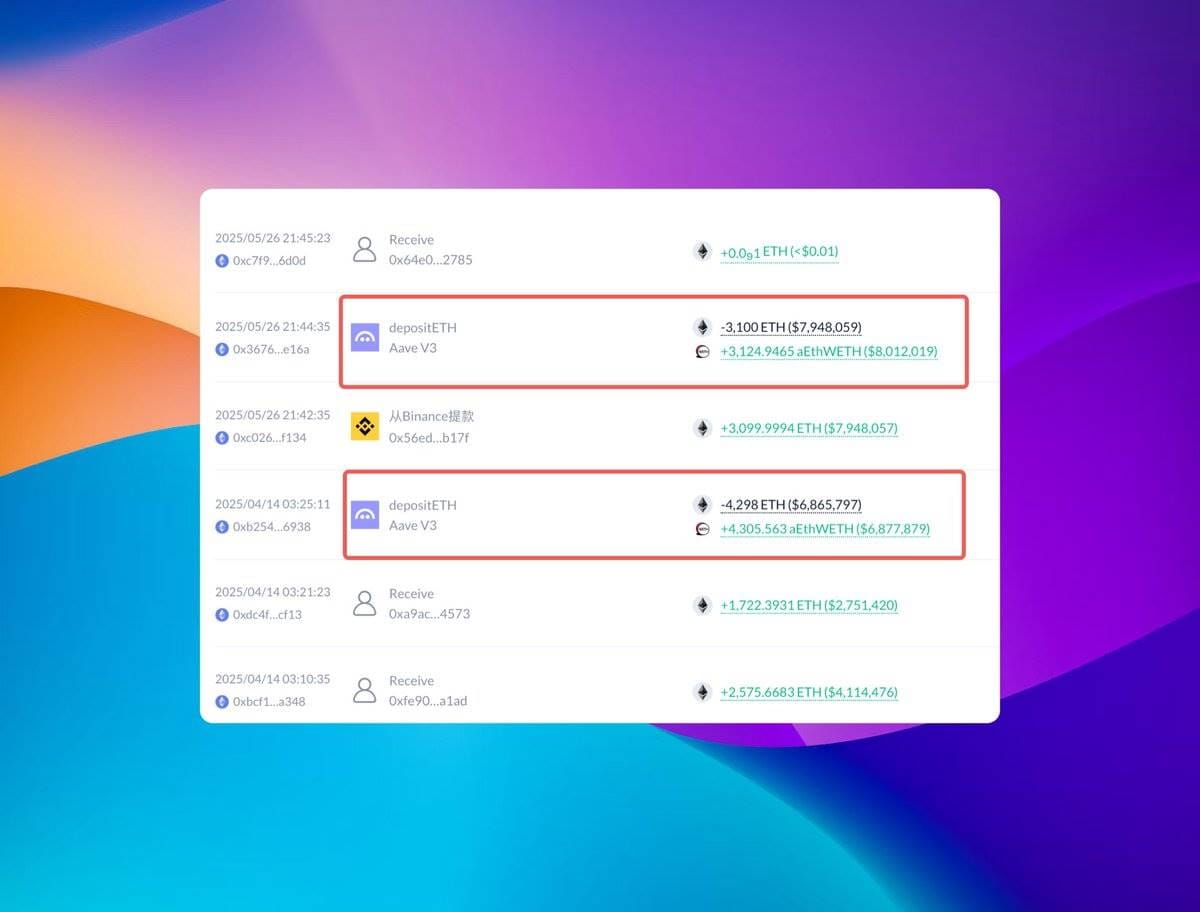
On May 26 at 9:44 PM: spent $8 million to purchase 3100 ETH, deposited into Aave (funds borrowed from Aave)
On May 26 at 9:30 PM: borrowed $8 million from Aave.
On April 14 at 3:26 AM: borrowed $3.8 million from Aave, transferred out.
On April 14 at 3:25 AM: spent $6.87 million to purchase 4298 ETH, deposited into Aave.
On March 27 at 12:14 AM: deposited 366 ETH into Aave.
On March 25 at 3:27 PM: spent $750,000 to purchase 366 ETH.
Total:
Principal: $7.62 million
Current value: 366 + 4298 + 3100 = 7764 (approximately $21 million)
Profit: $13 million 💰
Everyone should bottom-buy in stages
Phase one: 4.14 when FUD was at its peak
Second extreme: 5.26 when the situation became clear, leverage was added, and the amount of capital was the same as during the bottom-buying phase.
🤔 Inspiration
1️⃣ Do large funds still prefer Binance? After all, safety comes first.
2️⃣ This address bought a large amount of NEIRO, which is probably the reason for the previous research report's recommendation.
The research report released on April 24 indicated that from May 11 to May 21, they kept buying; this is a strong endorsement with real money.
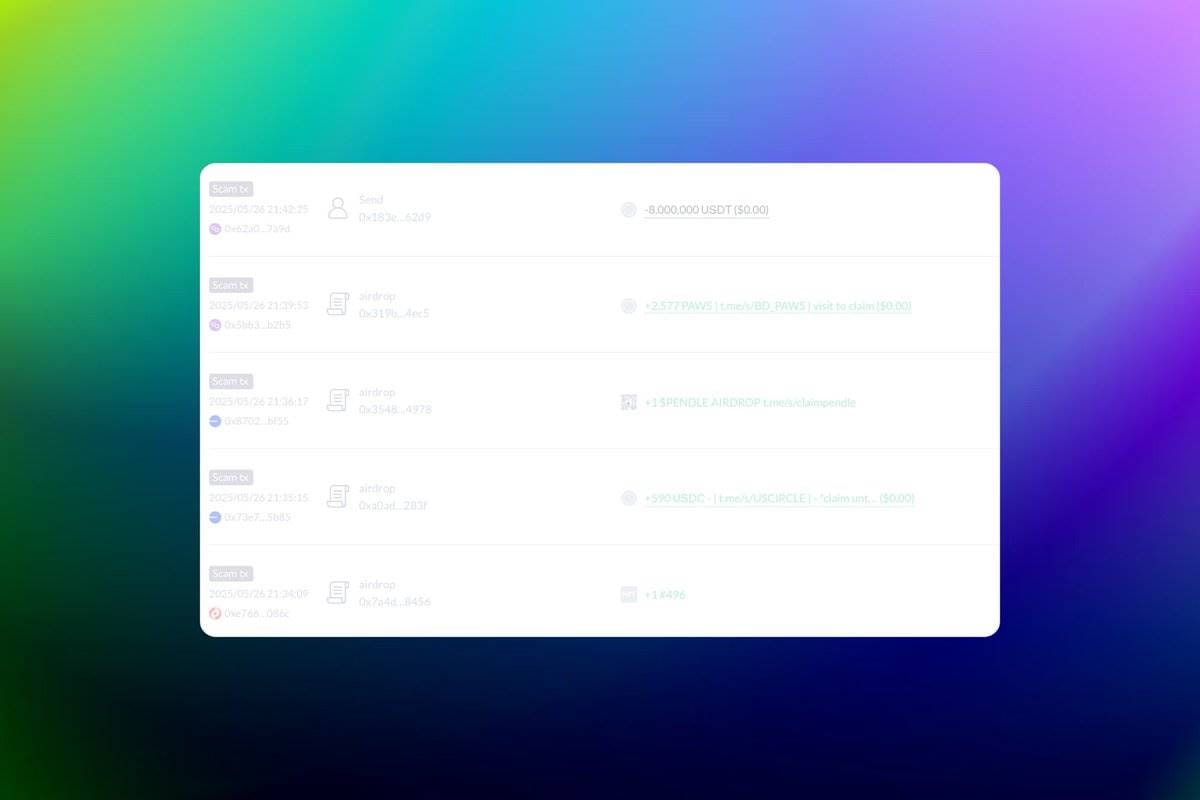
3️⃣ The most frequent trades in the address are phishing trades; everyone with significant capital must be cautious and cautious again.
Two, bottom-buying should be about buying more as prices drop, in small amounts and multiple times 🛒
Address two:
0x74ba54e959bbdd45be1e2f48c8032c776d78376c
On May 26 at 9:48 PM: spent $5.1 million to purchase 1964 ETH, deposited into Aave (certain opportunity to buy ETH)
On May 26 at 9:30 PM: borrowed $5 million from Aave
On April 14 at 3:31 AM: borrowed $900,000 from Aave, transferred out
On March 31 at 12:45 AM: withdrew $1.18 million from Binance, deposited into Aave
On March 24 at 4:26 PM: spent $2 million to purchase 965 ETH, deposited into Aave (ETH price $2081)
On March 24 at 4:03 PM: borrowed $2 million from Aave and deposited into Binance
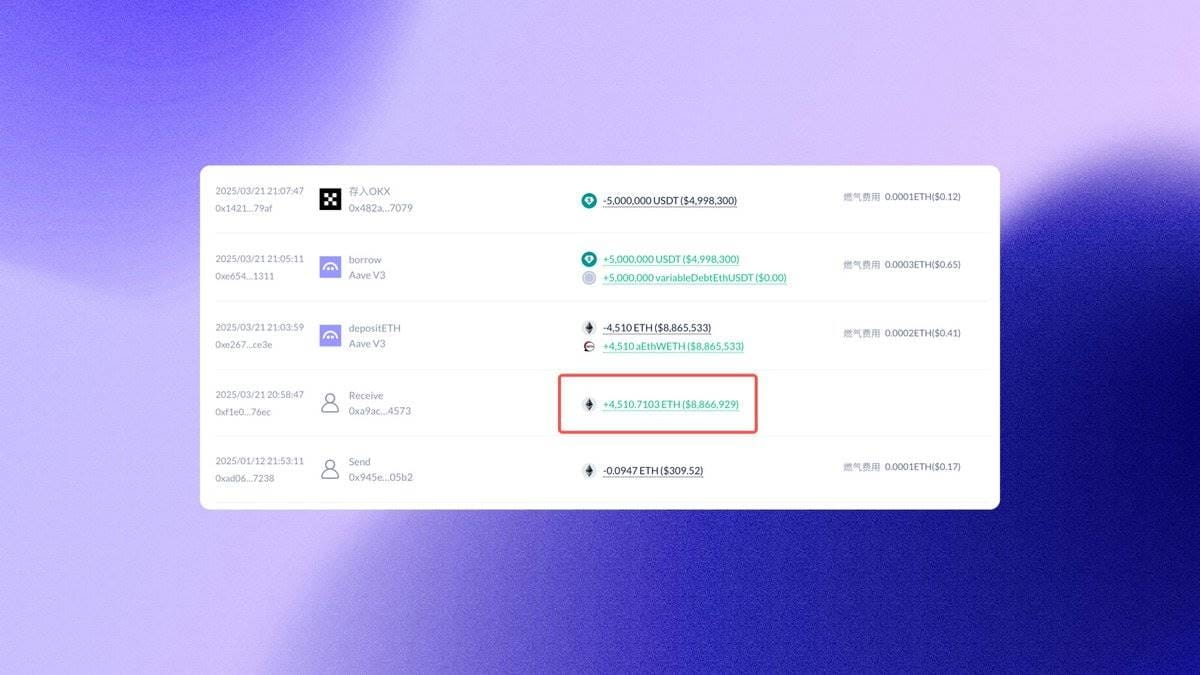
On March 21 at 9:38 PM: spent $5 million to purchase 2560 ETH, deposited into Aave (ETH price $1953)
On March 21 at 9:05 PM: borrowed $5 million from Aave and deposited into OKX
On March 21 at 9:03 PM: withdrew 4510 ETH from Binance, deposited into Aave
On August 7, 2024: borrowed $5 million from Aave and deposited into OKX
Total:
Principal: $8.86 million
Current value: 4510 + 2560 + 965 + 1964 = 10000 (approximately $27.2 million)
Profit: $18.34 million 💰
This is an old address that has been in use, and tracing back has already reached 2024, so I won't go further.
It is also impossible to calculate when and at what cost the initial 4510 ETH were purchased.
🤔 Inspiration
Compared to the previous address's super bottom-buying operation, this address's actions are more like those of an experienced trader.
I feel that if you underestimate my value, I will slowly buy the bottom.
Each bottom-buying only uses a small amount of money: around $5 million.
Continuously buying low, don't go all in, always keep liquid funds.
Three, can you guess what their holding cost is? 🤔
Address:
0xd9cf5e2a699c19a33b4ba7831d9525471e262931
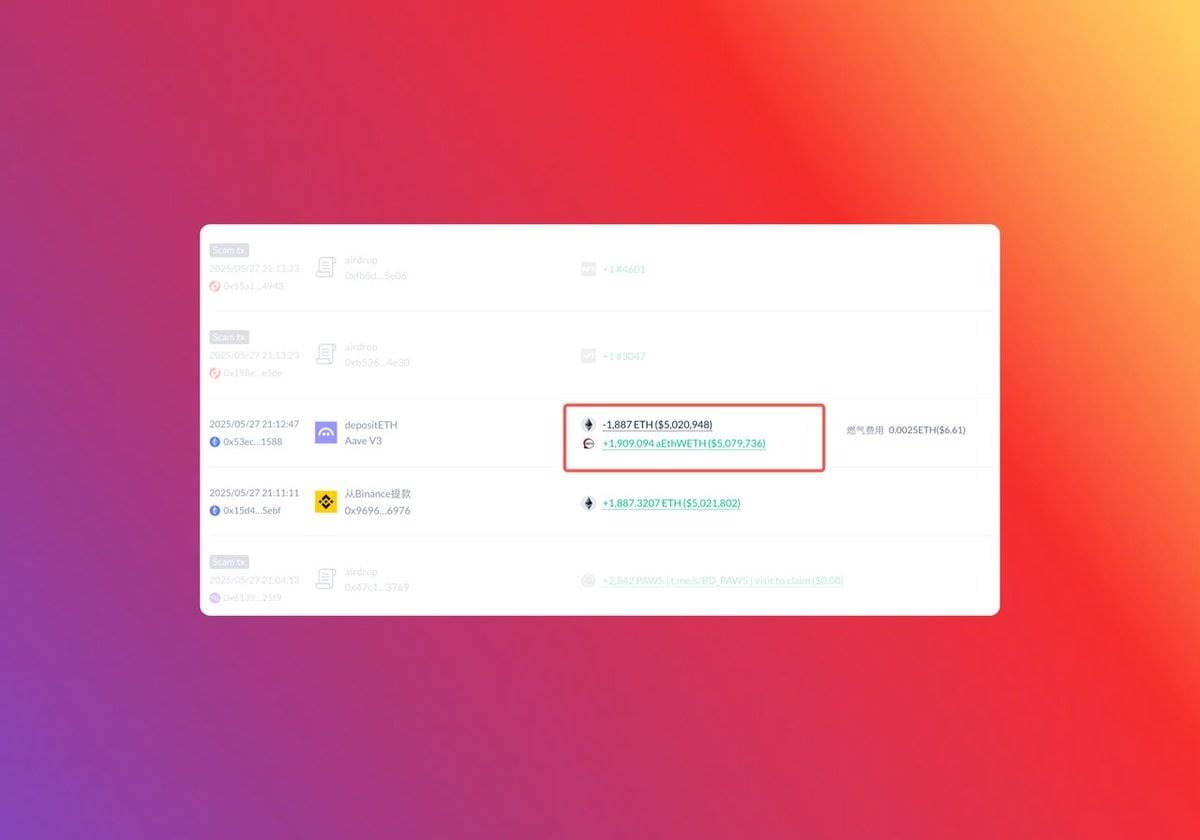
On May 27 at 9:12 PM: spent $5.07 million to purchase 1887 ETH, deposited into Aave (certain opportunity to buy ETH)
On May 27 at 8:51 PM: borrowed $5 million from Aave (one day later than the previous address, also DCA'd)
On April 14 at 2:53 AM: borrowed $1.3 million from Aave, transferred out
On March 24 at 4:26 PM: borrowed $1.4 million from Aave, purchased 674 ETH, deposited into Aave (ETH price $2077)
On March 19 at 7:10 PM: spent $3.11 million to purchase 1513 ETH (ETH price $2055), deposited into Aave
On March 19 at 6:23 PM: deposited 4058 ETH into Aave (worth $8.33 million)
Total:
Principal: $8.33 million
Current value: 4058 + 1513 + 674 + 1887 = 8132 (approximately $22 million)
Profit: $13.67 million 💰
This is also an old address that has been trading meme coins 😂
It is also impossible to calculate when and at what cost the initial 4058 ETH were purchased.
🤔 Inspiration
It can be seen that their target bottom-buying point is $2000, which is not far off for everyone.
I also started bottom-buying from $2500, at $2000, $1800, $1400, so everyone's cost line is not $1400; everyone must remember this.
Four, securing profits allows for further advancement 💼
Address:
0xf2500b6014dfe916b8e7706434e21b5fb2191a15
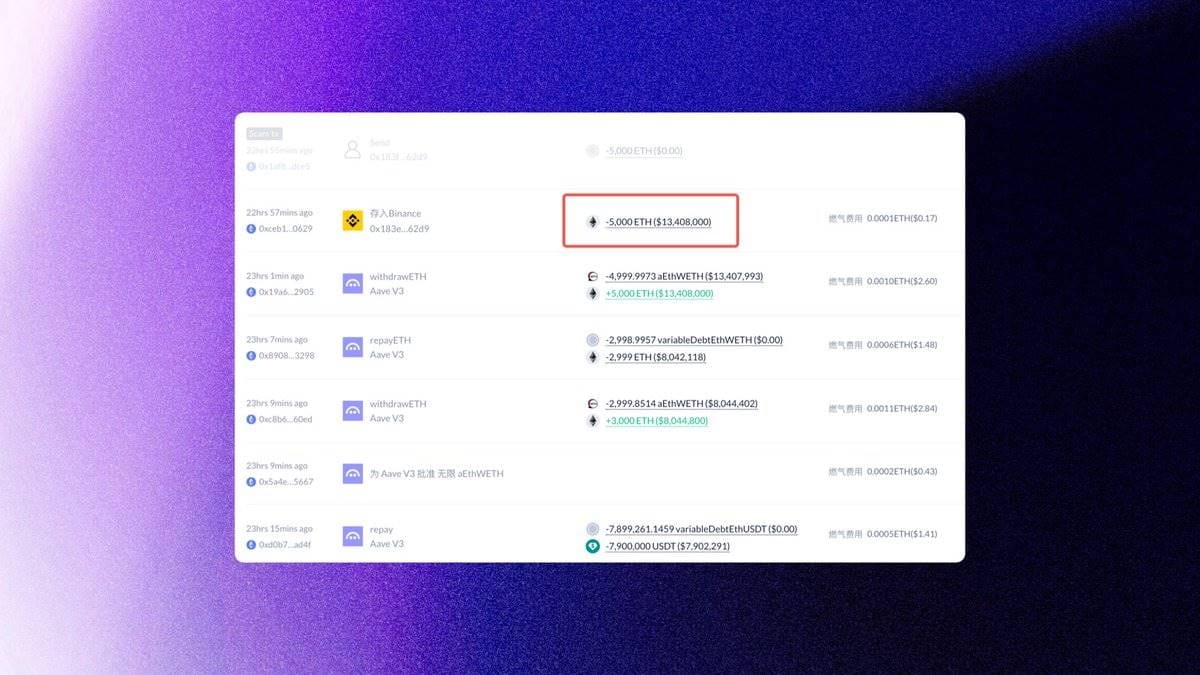
7 hours 58 minutes ago: transferred out $400,000
7 hours 59 minutes ago: transferred out $700,000 to Bybit, did they buy altcoins?
22 hours ago: withdrew $13 million from Binance, gave Aave $10 million as a gift
22 hours and 30 minutes ago: received 956 ETH
22 hours and 52 minutes ago: withdrew 5000 ETH from Aave and sold it on Binance (worth $13.4 million, combined with subsequent withdrawals, it was all sold)
23 hours ago: borrowed 3000 ETH from Aave, deposited into Binance and sold (worth $8 million, repaid after selling at Aave)
On May 28 at 9:12 PM: borrowed $5.09 million, purchased 1900 ETH, deposited into Aave (certain opportunity to buy ETH)
On May 27 at 6:52 PM: borrowed $5.04 million, purchased 1894 ETH, deposited into Aave (certain opportunity to buy ETH)
On March 24 at 5:08 PM: borrowed $1.99 million, purchased 957 ETH, deposited into Aave (ETH price $2079)
On March 19 at 10:37 PM: borrowed $5.07 million, purchased 2467 ETH, deposited into Aave (ETH price $2055)
On February 26: deposited 6922 ETH into Aave (worth $14.23 million)
Total:
Principal: $14.23 million
Current value: 6922 + 2467 + 957 + 1894 + 1900 = 14,140 (approximately $38.46 million)
Profit: $38.45 million
🤔 Inspiration
This address is the one that operates frequently; everyone can observe this and discover its subsequent actions.
Because this address operates frequently, it has been targeted by phishing, and many pages are filled with phishing trades; safety must still be a priority.
Five, how to learn bottom-buying strategies from on-chain whales 🧾
From the four addresses, the overall strategy of the 'Yili Hua' team demonstrates strong capital mobilization and risk control capabilities. Their bottom-buying method has the following core characteristics:
Firmly holding ETH: These four addresses have never sold ETH, only continuously replenishing and leveraging. It can be concluded that this is their core asset allocation.
Building positions in batches, the DCA strategy is clear: whether during the most FUD period or after the market reversal, the whales insist on 'buying more as prices fall, in small amounts and multiple times,' primarily concentrating their capital in the $2000–$2100 range for bottom-buying.
Leverage borrowing to amplify returns: After a large amount of ETH was deposited into Aave, USDC was obtained through borrowing and used to buy ETH again. Once the market rebound was confirmed, timely liquidation was performed to complete the capital closure.
Operating styles vary:
Some addresses focus on 'single point explosion,' precisely timing large purchases;
Some adopt an 'old school style,' slowly building positions in batches;
Others frequently enter and exit, demonstrating strong short-term judgment.
Strong risk control awareness: Each investment amount is relatively conservative compared to the account size, mostly concentrated in the $5-8 million range; multiple addresses were disturbed by phishing trades, reminding us: safety first, on-chain is always a hunting ground.
Behind the bullish calls is a long-term layout: although bullish calls were made at $1400, on-chain data shows they started positioning at $2000. The separation of public opinion and action is a common tactic among large traders.