

Imagine this: while you're staying up late tweeting crypto jokes and then going to sleep, there's an AI named Kaito frantically taking screenshots—it's stuffing your likes, retweets, and emoji usage frequency into an algorithmic cauldron, concocting a string of coins called Yaps. This is the most magical Web3 performance art of 2025: you’re slacking on Twitter, while the AI is printing money in the background.
The essence of Kaito is the 'king of paparazzi' in the crypto world, specializing in quantifying the social influence of influencers (including the #FOMO tags they use when complaining). Unlike traditional platforms that treat users as harvestable crops, it attempts to redistribute traffic dividends through tokenized Yaps—simply put, 'tweeting is mining, and talking is productivity.' As for whether Musk will charge copyright fees for having AI peep at Twitter? That's another cyber ethics story.
This is the project KAITO we are going to introduce in the ninth phase of Binance's HODL airdrop tonight.
Kaito project positioning and core functions
1. Project background and vision
Kaito is an AI-based crypto search engine and social data analysis platform aimed at reconstructing the value distribution system of the attention economy through information finance (InfoFi). Its core idea is to address the current issue of 'attention exploitation' on social media platforms—where users and creators contribute data and content, but the platform monopolizes most of the profits. Through tokenizing social influence (Yaps) and AI-driven data analysis, Kaito aims to establish a fairer ecosystem that allows users, creators, and brands to share value.
2. Core functions and product logic
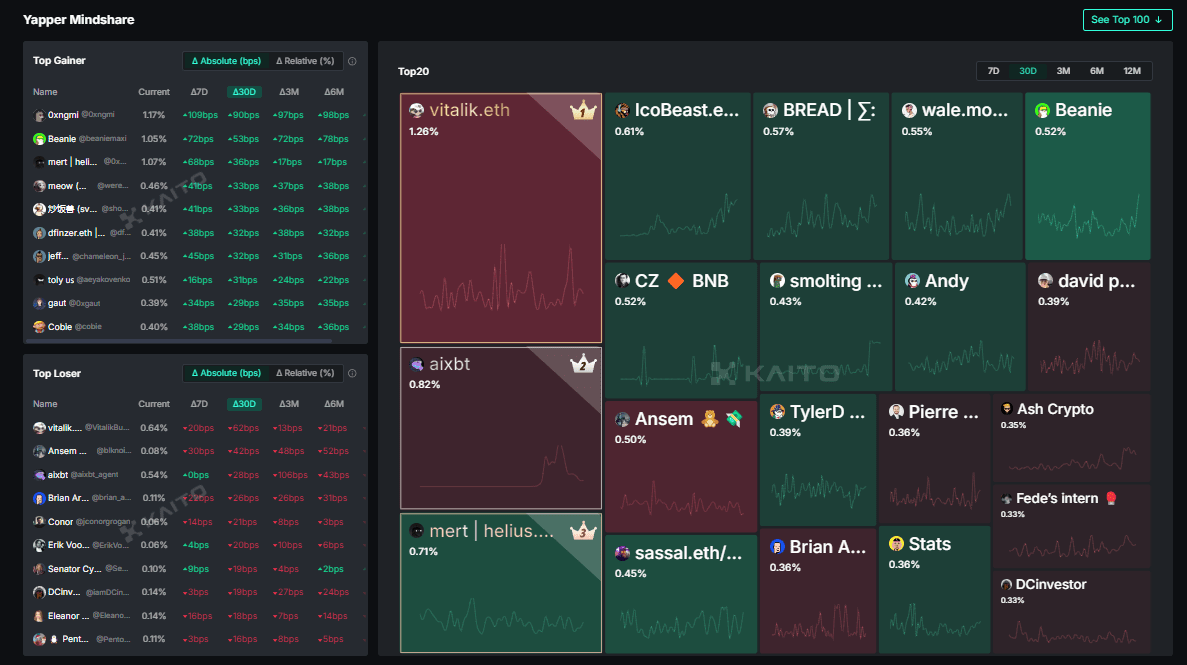
- Yaps mechanism: Yaps is the tokenized attention unit of the Kaito ecosystem, generated by quantifying user social influence on platforms like Twitter (such as content quality, interaction depth, topic relevance). Yaps is not only used to measure user contributions but can also serve as airdrop rewards and governance voting credentials.
"Is Vitalik, CZ actually becoming Kaito's top miner?"
According to data from the KAITO official website, the top five influential users currently are:
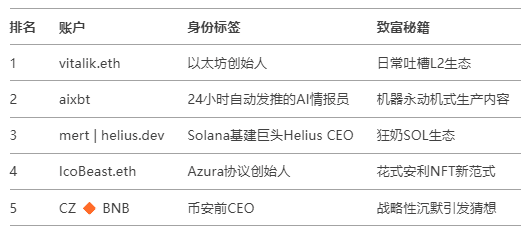
These 'human printing machines' prove: in the Kaito universe, influence = productivity = freedom of pig trotters.
- Kaito Connect: A community-driven voting platform where Yaps holders can vote to decide which projects or content are included in the 'Kaito Mindshare' dashboard, thereby influencing market attention. This mechanism aims to optimize information filtering efficiency through decentralized decision-making.

Search any token, topic, or trend within seconds among thousands of quality Web3 sources and gain instant insights.
- AI-driven data services: Kaito uses AI algorithms to analyze social data in the crypto space (such as Twitter trends, KOL dynamics), providing Alpha tools for project parties, exchanges, and investors, such as predicting market hotspots and optimizing exchange listing strategies.
3. Reasons for choosing Twitter as the main battlefield
Kaito early on relied on Twitter as the core data source due to:
- Transparent social graph: The following relationships and interaction data on Twitter are explicit and easily quantifiable, making it suitable for building KOL scoring systems.
- Centralized traffic structure: The marketing budget in the crypto industry is highly concentrated on Twitter, with strong user consensus, making it easier to obtain high-value data.
KAITO token economics - when 'money-spraying art' meets the self-cultivation of leeks.
1. Token functions and roles
KAITO is the native token of the Kaito ecosystem, serving the following core functions:
- Driving market forces: By staking or consuming KAITO, users can access premium data services (such as real-time trend analysis, in-depth reports).
- Network currency: Used to pay for service fees within the platform (such as API calls, ad placements), Yaps transaction settlements, etc.
- Community governance: Holders participate in ecological decision-making, such as adjusting Yaps algorithm weights, distributing airdrop proportions, etc.
2. Token distribution and release
Based on disclosed information (white paper):
- Total supply: 1 billion pieces.
- Airdrop distribution: 2% (20 million pieces) distributed through Binance HODLer program, users need to stake BNB within a specified period.
- Team and development: The proportion is not clearly defined, but referencing similar projects, it is expected to account for 20%-30%, with a lock-up mechanism.
- Ecological incentives: including Yaps rewards, liquidity mining, partner subsidies, etc., or accounting for 30%-40%.
3. Potential risks of the economic model
- The value anchoring problem of Yaps: The current off-market valuation of 1 Yap is between $80 and $160, but the lack of on-chain trading scenarios may lead to inflated prices or crashes.
- Governance centralization tendency: In the early stages, if the team or institutions hold a large amount of tokens, it may weaken the practical significance of community governance.
KAITO valuation analysis and Binance listing price prediction
1. Valuation logic and reference indicators
- Comparable project benchmarks: Referencing similar social token projects (such as Friend.tech, Galxe), their FDV (fully diluted valuation) typically ranges from $500 million to $2 billion. If KAITO's FDV reaches $1 billion, the unit price would be $1 (total supply of 1 billion).
- Market sentiment and airdrop effects:
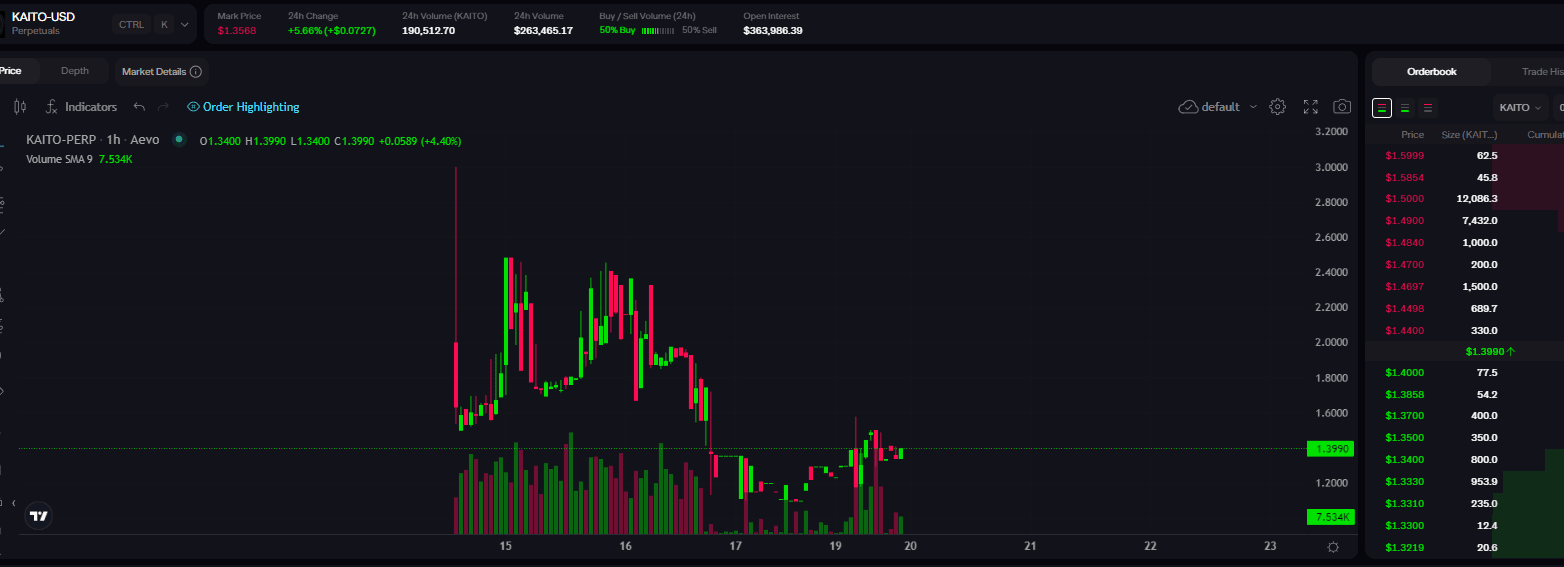
According to AEVO data, the current off-market trading price of KAITO is approximately $1.39, but historical data shows that new tokens often drop by 20%-50% after listing due to early holder sell-offs.
- Yaps ecosystem empowerment: If Yaps can establish a stable exchange ratio with KAITO (for example, 1 Yap = 100 KAITO), then token demand will grow with the expansion of the ecosystem.
2. Listing price range prediction
Comprehensively consider supply-demand relationships and market environment:
- Short-term (first week of listing): Price fluctuations are expected to be between $0.8 and $1.5. If the opening price is below $1, it may attract speculative funds; if above $1.5, be wary of selling pressure risks.
- Mid-term (3-6 months): If Kaito can achieve the following goals, the price is expected to break $2:
- Expanding to more social platforms (such as YouTube, Farcaster).
- Launch on-chain trading market for Yaps and KAITO.
- Reached data cooperation with mainstream exchanges (such as Coinbase).
3. Major risks
- Regulatory uncertainty: Changes in Twitter API policies may affect data acquisition costs, thereby squeezing profit margins.
- Token inflation pressure: If the team overly relies on token incentives (such as airdrops, mining), it may lead to continuous selling pressure increases.
Ultimate Brainstorm: When Kaito merges with FriendTech to start 'cloning' KOLs
A certain user's proposed 'Kaito + FriendTech' model is highly inspiring:
1. KOL assetization: Using Kaito's Yaps rating system, tokenize KOL's influence into NFTs or social tokens, allowing fans to earn airdrops through interactions (comments, retweets).
2. Economic model upgrade: Introduce a split mechanism (such as binding KOL tokens with KAITO), incentivizing fans to hold KAITO to participate in the growth dividends of high-value KOLs.
3. Traffic retention: By implementing tiered rewards (such as core fans receiving a higher proportion of benefits), reduce 'wool-pulling' behavior and enhance user stickiness.
If this model can be implemented, it may address the current shortcoming of Kaito's 'insufficient sense of participation' while absorbing FriendTech's community fission experience to form a differentiated advantage. Imagine the future: you see a certain KOL shouting on Kaito, and the AI automatically pops up a prompt 'The historical accuracy rate of this tweet is 23%, suggest reverse operation.' This is the true 'cyberpunk investment advisor.'
Conclusion: In the crypto circus, we are all monkeys of AI.
When Kaito prices each tweet using AI algorithms, we finally become the version of ourselves we hate the most: while cursing 'another garbage project,' we are secretly calculating how much our tweets are worth in bowls of pig trotters. This magical realism of the crypto world has even led to harvesting angles being optimized by machine learning.
So the question arises: when your social value is clearly priced by AI, will you choose—
A. Crazy tweeting to earn Yaps
B. Report AI infringing on human bragging rights.
C. Pretend not to see, then quietly change the tweet signature to 'Mining Yaps, do not disturb.'