


Oracles are a very important function in blockchain, but I find there is not much discussion, as most people may not understand it. The function of oracles is to write external information into the blockchain, completing the data interconnection between the blockchain and the real world.
The explosion of popular tracks such as RWA, AI, and DePIN also requires the function of oracles, which has also promoted the development of the oracle track. For the RWA track, it is crucial to safely and accurately transmit real-world asset data, such as real estate value, stock prices, gold prices, etc., onto the chain, and this process cannot be separated from the participation of oracles, which serve as a bridge between off-chain and on-chain data, ensuring the timeliness and reliability of the data.
In addition, projects in the AI track of the crypto market also need to access off-chain data for learning and reasoning. Oracles are key components in this process, allowing AI systems to retrieve real-time data from off-chain and execute corresponding operations on the blockchain.
With the development of RWA, AI, and DePIN, the oracle track is also rising, undoubtedly opening up the market value space for oracle projects.
Currently, the three leading blockchain oracle projects on the market are Chainlink, RedStone, and Pyth. Today we will focus on introducing the similarities and differences among the three.
For comparative analysis of oracles, you can check their blog.
https://blog.redstone.finance/2025/01/16/blockchain-oracles-comparison-chainlink-vs-pyth-vs-redstone-2025
Introduction to Chainlink, Pyth, and ReadStone Projects
Chainlink is undoubtedly the leader in the oracle space. It is an old project established in 2017, supporting mature EVM blockchains. Chainlink, as a traditional oracle, adopts a third-party oracle solution (PUSH), where third-party operators host oracle nodes, aggregating external data provided by API providers and inputting it into smart contracts.
Pyth is primarily based on the Pyth Network's own chain on the Solana public chain, with the core mechanism Pull Price Update Model (PUSH), updating only when customers need it. Compared to traditional oracles, it has significant advantages in update speed, asset coverage, and accuracy (high fidelity).
RedStone Oracles is a next-generation oracle provider, offering timely updates, reliable, and secure data sources for over 100 decentralized applications (dApps). It also provides data sources for layer 1 and layer 2 solutions in the entire blockchain ecosystem, compatible with both EVM and non-EVM. RedStone adopts a modular architecture, combining both Chainlink and Pyth's models while supporting both push (PUSH) and pull (PULL) modes.
2. Comparison of Different Characteristics of Chainlink, Pyth, and ReadStone 🆚 Overview
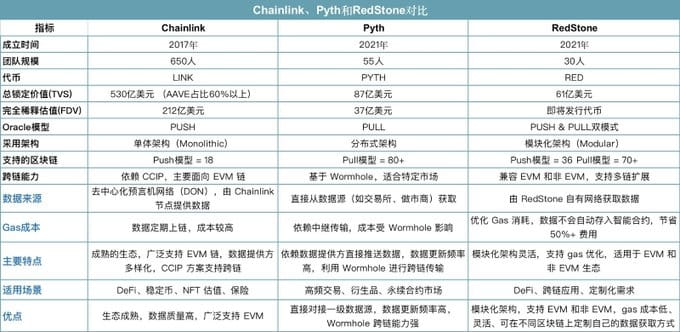
3. Unique Innovations of RedStone
3.1 Modular Architecture: Push + Pull Dual Mode, Adapts to All Needs
RedStone Oracle is the industry's first dual-mode architecture that combines Push (push) + Pull (pull).
Push Mode: Suitable for DeFi ecosystems, ensuring data is automatically updated periodically, suitable for traditional smart contract needs.
Pull Mode: Suitable for high-performance Dapps, retrieving data only when needed, avoiding unnecessary Gas consumption.
👉 This flexibility enables RedStone to serve different types of blockchain applications, unlike Chainlink (which can only Push) or Pyth (which can only Pull) that are limited to a single architecture.
3.2 Gas Fee Optimization, Reducing Operating Costs by 50%+
Currently, traditional oracles like Chainlink require Gas fees for each data update, as data is periodically written into smart contracts. RedStone, however, uses a unique offline storage + on-demand retrieval mechanism, allowing data not to be stored in contracts by default, thus saving a significant amount of Gas fees.
Comparison:
Chainlink: Oracle nodes must be regularly on-chain, leading to high Gas fees.
RedStone: Data is first cached off-chain and retrieved when the contract is called, saving over 50% in Gas costs.
👉 This is a huge cost optimization point for DeFi protocols, especially for projects that require high-frequency data updates.
3.3 True Cross-Chain Oracles, Supporting EVM and Non-EVM
Most oracles mainly focus on the EVM ecosystem (such as Ethereum, Polygon, etc.), while RedStone not only supports EVM-compatible chains but can also extend to non-EVM ecosystems like Solana, Near, and Cosmos, which is unique in the current market.
Comparison:
Chainlink: Mainly supports EVM chains, cross-chain relies on CCIP.
Pyth: Uses Wormhole for cross-chain transmission but is limited to specific markets.
RedStone: Seamlessly supports EVM & non-EVM ecosystems, with stronger scalability.
👉 This means that no matter where your project is deployed, RedStone can provide seamless oracle services.
3.4 Flexible Customization Capabilities to Meet Different DeFi Needs
RedStone provides a modular SDK that allows developers to customize data sources, update frequencies, Gas optimization strategies, etc., enabling DeFi projects to adjust oracle parameters according to their needs rather than passively adapting to oracle rules.
Example:
A certain lending protocol may need to update price data every 5 minutes but does not want high Gas fees → can use RedStone's Pull mode to retrieve data only when needed, saving costs.
A cross-chain DEX needs real-time synchronization of multi-chain prices → RedStone provides EVM + non-EVM cross-chain capabilities, ensuring price consistency across all chains.
👉 This customization capability allows RedStone to be more flexible than traditional oracles, matching the needs of different DeFi ecosystems.
Currently, RedStone's Gas efficiency data sources cover over 50 chains and Rollups, locking in value exceeding $6 billion. Trusted by over 100 projects including Morpho, Venus, and Pendle. If you are a DeFi developer, cross-chain protocol, NFT valuation platform, or derivatives exchange, RedStone Oracle can offer lower-cost, more efficient solutions.
Finally, it is the activity of the ReadStone Chinese community.
From January 20 to January 31, two weeks of exciting activities, total rewards exceed 3,000 USDT, plus a million RSG points waiting for you!
https://x.com/0xStephenR/status/1880206376217243944