
There’s a detail I pay more attention to now when I look at settlement infrastructure, and it’s not whether fees are low. It’s whether costs stay predictable when usage stops being calm.
My earlier bias was simple. Cheaper execution meant better design. Lower fees meant better user experience and stronger adoption. That logic holds in experimental environments. It becomes less reliable when a network is used to settle continuous value instead of occasional activity.
What changed my view was watching how cost instability affects behavior, not just wallets.
In systems where transaction fees expand sharply under load, participants are forced to adjust more than their spending. They adjust their risk assumptions. Position sizing changes. Timing becomes defensive. Safety buffers grow. The protocol rules may be unchanged, but the operating model around them becomes unstable.
That instability is rarely highlighted, but it is very real.
A settlement layer is not just processing transactions. It is anchoring economic expectations. When execution cost can swing widely based on congestion, every strategy built on top inherits that variability. Users are no longer modeling just protocol correctness. They are modeling protocol mood.
This is where Plasma reads differently to me.
What stands out is not a promise of the lowest fees, but a preference for cost behavior that is easier to reason about. The design leans toward consistency over elasticity. Instead of stretching fees aggressively with demand, the system appears structured to keep operational behavior within a narrower band.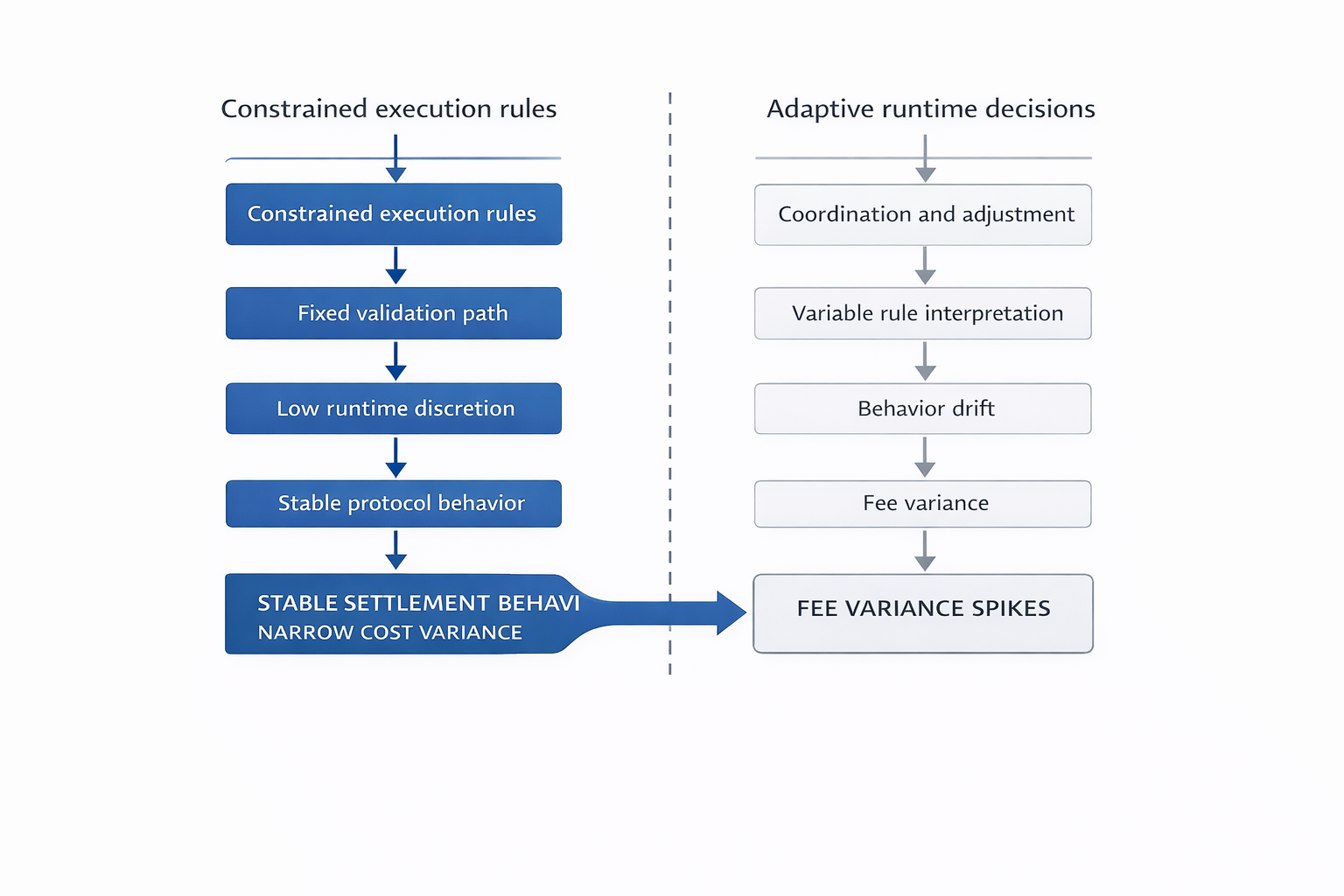
That choice will not win headline comparisons. On a quiet day, a more elastic fee model may look cheaper. But settlement infrastructure is not judged on quiet days. It is judged on uneven ones.
Predictable cost changes how participants build.
When cost ranges are narrow, models stay tight. Strategies do not need oversized buffers for congestion spikes. Execution planning stays closer to protocol rules instead of drifting toward worst case guesses. Fewer defensive adjustments are needed outside the system.
I’ve learned to treat that as a structural advantage, not a cosmetic one.
There is a trade off, and it should be stated plainly. Designs that prioritize predictability often give up peak efficiency. They may not always offer the absolute lowest fee at every moment. They choose bounded behavior over opportunistic optimization.
For settlement, that trade makes sense to me.
Systems that move value repeatedly benefit more from being modelable than from being occasionally cheap. You can plan around stable cost bands. You cannot plan around sudden expansion without adding friction everywhere else.
My own lens now is straightforward. I trust infrastructure more when operating cost is boring and forecastable, even if it is not minimal. Predictability compounds. Cheapness fluctuates.
That is why cost behavior, not just cost level, is the signal I watch first, and why Plasma’s preference for consistency over elasticity stands out in its design.
