Binance Square
sk0614
111 ပို့စ်များ

sk0614

52 ဖော်လိုလုပ်ထားသည်
47 ဖော်လိုလုပ်သူများ
52 လိုက်ခ်လုပ်ထားသည်
ပို့စ်များ
·
--
Close to $6M in fees in one day, paid to mint and trade tokens through Pons — above Pump, above Hyperliquid, above Robinhood Chain's own fee take. One day is a snapshot, not a trend. Not financial advice; check the numbers yourself. #Robinhood $HOOD {future}(HOODUSDT)
Close to $6M in fees in one day, paid to mint and trade tokens through Pons — above Pump, above Hyperliquid, above Robinhood Chain's own fee take.

One day is a snapshot, not a trend.

Not financial advice; check the numbers yourself.
#Robinhood $HOOD
·
--
Robinhood Chain: The 4 Questions That Matter More Than the Hype Robinhood Chain is getting attentionRobinhood Chain: The 4 Questions That Matter More Than the Hype Robinhood Chain is getting attention as an Ethereum layer-2 built with Arbitrum technology, designed around tokenized assets and on-chain financial products. But “new chain” is only the headline. To understand what it actually means, I’d look at four things. 1. The rails An L2 executes transactions separately while using Ethereum for settlement and data availability. Using Arbitrum technology means Robinhood is building on an established L2 stack rather than creating the entire infrastructure from scratch. But the important questions remain: Who sequences transactions? Who controls upgrades? How does the bridge work? What happens when something goes wrong? The technology name alone doesn't answer those questions. 2. The assets This is where the story becomes more complicated. Recent reporting around Robinhood's tokenized stocks, including criticism from AMC's CEO, highlights a basic rule of tokenization: A token carrying a company's name doesn't automatically mean the company issued or approved it. The real question is what the token represents legally and economically. Is it backed by actual shares? Does the holder receive dividends or voting rights? What happens during a stock split, dividend, or market halt? Those answers need to come from the issuer's documentation — not the ticker symbol. 3. The fees One recent report highlighted nearly $6 million in fees in a single day from users creating and trading tokens through Pons. That figure is interesting because fees can reveal economic activity better than raw transaction counts. But one strong day doesn't prove a sustainable business. Launch excitement, speculation and expectations of future rewards can all temporarily increase activity. The more important number will be whether users keep coming back after the initial excitement fades. 4. The market ARB and PONS also extended gains as broader risk assets improved and Bitcoin recovered toward $78,000. That doesn't mean the Robinhood Chain developments caused those moves. When crypto and other risk assets are moving together, macro conditions can explain part of the performance. The bigger lesson When a major consumer platform launches a chain, don't start with the token price. Start with four questions: What are the rails? What exactly are the assets? Where do the fees go? Does the activity survive after the launch hype? Those answers tell you far more about a new network than a short-term price chart. Not financial advice. DYOR. Sources: Decrypt — Robinhood Chain overview CoinDesk — AMC and Robinhood tokenized-stock dispute CoinDesk — Pons fees and Robinhood Chain activity CoinDesk — Bitcoin, ARB and PONS market movements

Robinhood Chain: The 4 Questions That Matter More Than the Hype Robinhood Chain is getting attention

Robinhood Chain: The 4 Questions That Matter More Than the Hype
Robinhood Chain is getting attention as an Ethereum layer-2 built with Arbitrum technology, designed around tokenized assets and on-chain financial products.
But “new chain” is only the headline. To understand what it actually means, I’d look at four things.
1. The rails
An L2 executes transactions separately while using Ethereum for settlement and data availability. Using Arbitrum technology means Robinhood is building on an established L2 stack rather than creating the entire infrastructure from scratch.
But the important questions remain: Who sequences transactions? Who controls upgrades? How does the bridge work? What happens when something goes wrong?
The technology name alone doesn't answer those questions.
2. The assets
This is where the story becomes more complicated.
Recent reporting around Robinhood's tokenized stocks, including criticism from AMC's CEO, highlights a basic rule of tokenization:
A token carrying a company's name doesn't automatically mean the company issued or approved it.
The real question is what the token represents legally and economically.
Is it backed by actual shares? Does the holder receive dividends or voting rights? What happens during a stock split, dividend, or market halt?
Those answers need to come from the issuer's documentation — not the ticker symbol.
3. The fees
One recent report highlighted nearly $6 million in fees in a single day from users creating and trading tokens through Pons.
That figure is interesting because fees can reveal economic activity better than raw transaction counts.
But one strong day doesn't prove a sustainable business.
Launch excitement, speculation and expectations of future rewards can all temporarily increase activity. The more important number will be whether users keep coming back after the initial excitement fades.
4. The market
ARB and PONS also extended gains as broader risk assets improved and Bitcoin recovered toward $78,000.
That doesn't mean the Robinhood Chain developments caused those moves.
When crypto and other risk assets are moving together, macro conditions can explain part of the performance.
The bigger lesson
When a major consumer platform launches a chain, don't start with the token price.
Start with four questions:
What are the rails?
What exactly are the assets?
Where do the fees go?
Does the activity survive after the launch hype?
Those answers tell you far more about a new network than a short-term price chart.
Not financial advice. DYOR.
Sources:
Decrypt — Robinhood Chain overview
CoinDesk — AMC and Robinhood tokenized-stock dispute
CoinDesk — Pons fees and Robinhood Chain activity
CoinDesk — Bitcoin, ARB and PONS market movements
·
--
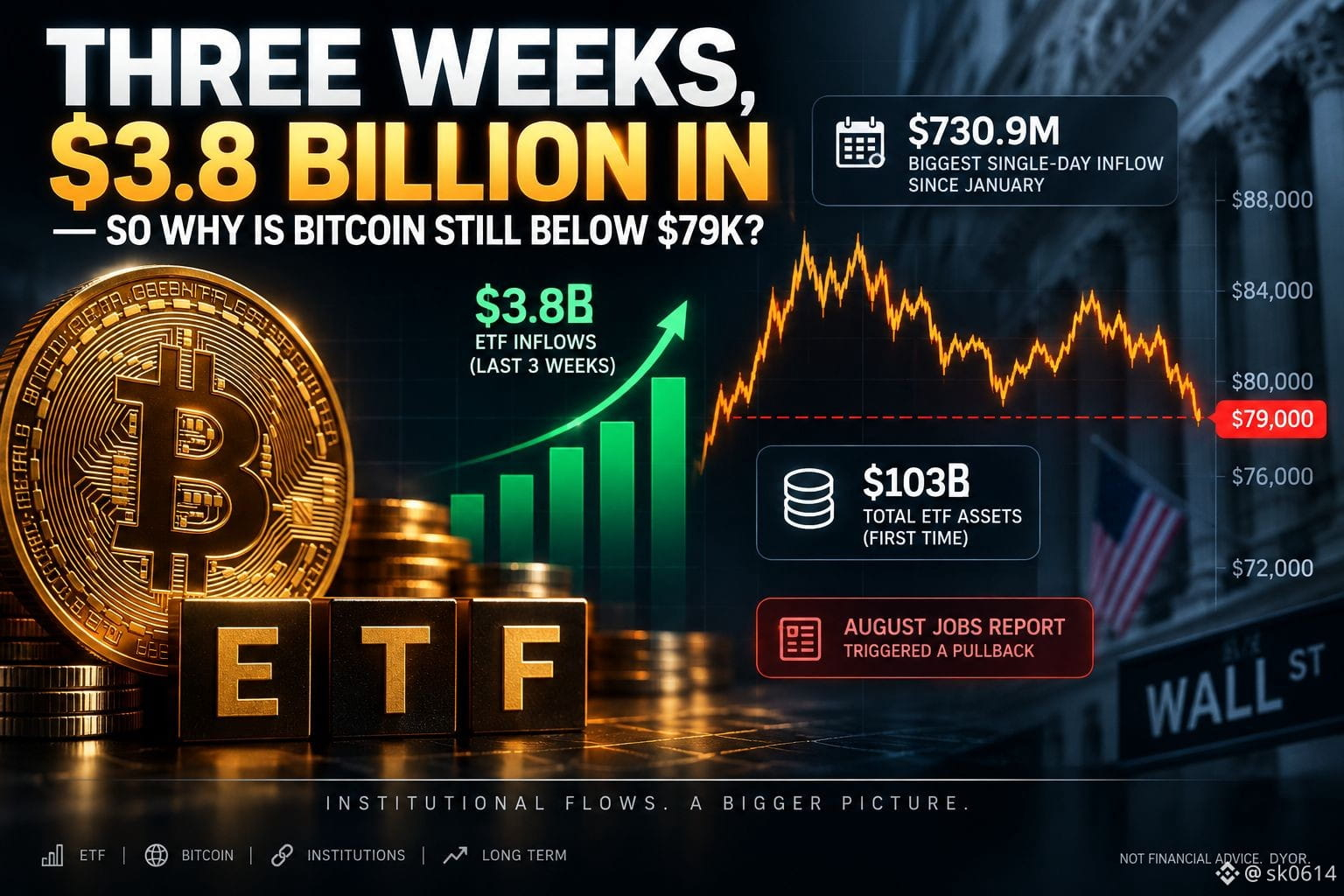
Three Weeks, $3.8 Billion In — So Why Is Bitcoin Still Below $79K? US spot Bitcoin ETFs have seen $3.8 billion in inflows over the past three weeks, according to Cointelegraph, making it the strongest three-week stretch of 2026. Yet $BTC was still trading below $79,000 on Friday. Thursday showed just how strong the flows can be: $730.9 million entered US spot Bitcoin ETFs, the biggest single-day inflow since January. ETF assets also crossed $103 billion for the first time. But here's the interesting part: large ETF inflows don't automatically mean Bitcoin must go higher. CryptoQuant's analysis of the $730.9 million inflow described the fresh demand as weak and highlighted $83,000 as a level to watch. That's analysis, not a guaranteed prediction. The August jobs report also changed the short-term picture, with Bitcoin falling back below $80,000 after briefly reclaiming it. So the question isn't simply “Are institutions buying?” It's whether these ETF inflows can remain strong enough to create sustained demand for $BTC. Three weeks of strong flows is significant. Whether it becomes a lasting trend is what I'll be watching next. Not financial advice. DYOR. Sources: Cointelegraph, CoinDesk.$BTC {future}(BTCUSDT)
Three Weeks, $3.8 Billion In — So Why Is Bitcoin Still Below $79K?
US spot Bitcoin ETFs have seen $3.8 billion in inflows over the past three weeks, according to Cointelegraph, making it the strongest three-week stretch of 2026.
Yet $BTC was still trading below $79,000 on Friday.
Thursday showed just how strong the flows can be: $730.9 million entered US spot Bitcoin ETFs, the biggest single-day inflow since January. ETF assets also crossed $103 billion for the first time.
But here's the interesting part: large ETF inflows don't automatically mean Bitcoin must go higher.
CryptoQuant's analysis of the $730.9 million inflow described the fresh demand as weak and highlighted $83,000 as a level to watch. That's analysis, not a guaranteed prediction.
The August jobs report also changed the short-term picture, with Bitcoin falling back below $80,000 after briefly reclaiming it.
So the question isn't simply “Are institutions buying?”
It's whether these ETF inflows can remain strong enough to create sustained demand for $BTC .
Three weeks of strong flows is significant. Whether it becomes a lasting trend is what I'll be watching next.
Not financial advice. DYOR.
Sources: Cointelegraph, CoinDesk.$BTC
·
--
Article
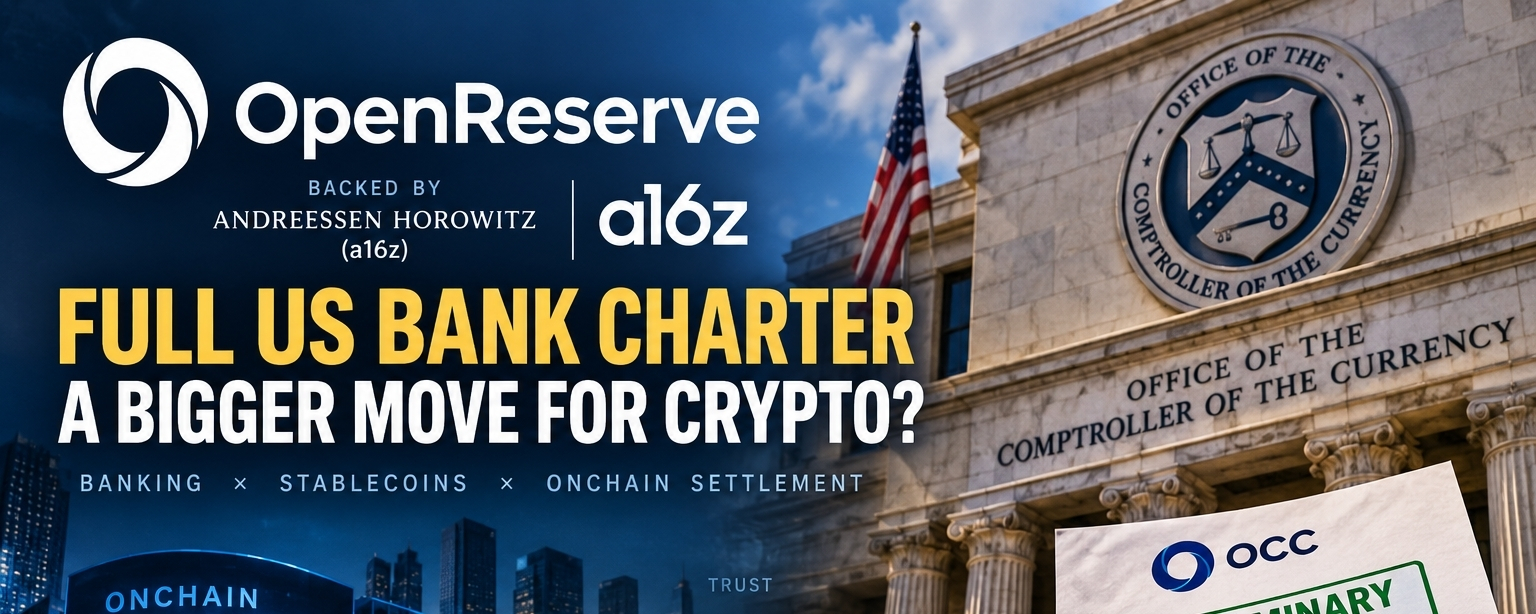
OpenReserve Chose a Full US Bank Charter — Why That Matters for CryptoThe charter is the story: trust versus full national bank Most crypto firms that have pursued an OCC charter have sought a trust charter. OpenReserve asked for the full national bank version — and that choice matters more than the approval headline. The news first, briefly, then the part that stays useful after the news goes stale. Reported on September 3 and 4, 2026: the Office of the Comptroller of the Currency (OCC), the US federal agency that charters national banks, gave early-stage approval to two companies seeking to form US national banks — Revolut and OpenReserve Holdings. OpenReserve is backed by Andreessen Horowitz (a16z), following a $25 million seed round, and is focused on onchain settlement. Both companies have crypto and stablecoin-related services in their plans. A charter is permission to be a bank, and the type of charter determines what that bank can do. A bank charter is the legal authorization to operate as a bank at all. It isn't branding. It sets the perimeter: what the institution may hold, what it may promise customers, and who supervises it. Many crypto firms that have pursued an OCC charter have sought a trust charter. Decrypt reports that OpenReserve went the other way and picked a full national charter, which "clears a path toward insured deposits and conventional lending alongside stablecoin issuance." Worth reading that list twice, because in crypto those three functions usually sit in separate entities. Insured deposits means customer money covered by a deposit insurance scheme rather than resting on the institution's own promise. Conventional lending means ordinary loans on the bank's own book. Stablecoin issuance means being the entity that mints the token and owes the redemption. Then notice the verb. "Clears a path toward" is not "has." Nothing in the reporting I'm working from says insurance has been granted, names a lending product, or names a stablecoin. Approval-stage words are load-bearing Five reports, four descriptions of the same regulatory action. The Block and Cointelegraph: preliminary. CoinDesk: provisional, an initial OK to operate. The Block, on Revolut: conditional. Decrypt's headline: approval, no qualifier. The most telling phrase is Revolut's own, quoted by The Block — an "important step toward" becoming a US bank. Companies pick their adjectives with care. Toward is a direction, not an arrival. The habit worth keeping: in a regulatory headline, find the qualifier and the verb before you find the excitement. Preliminary, conditional and provisional all mean another gate exists. And none of these five reports lists the conditions attached, a timeline, or an opening date — so I can't tell you what the conditions are, and I won't pretend otherwise. Why "onchain settlement" is the phrase to notice Settlement is the unglamorous end of a payment: the point where value actually moves and the obligation is discharged, as distinct from the moment your app flashes a confirmation. In conventional finance that final leg lands on the books of banks and intermediaries. The idea behind onchain settlement is that the final record lives on a blockchain instead. That's the focus The Block attributes to OpenReserve's bank. Which chain, which asset, which customers, and how any of it meets the balance sheet — the research doesn't say. Those blanks stay blank. My reading, labelled as mine If one supervised bank can hold insured deposits, lend, and issue a stablecoin, then reserve backing and the redemption promise sit inside a single supervised entity instead of being stitched across a chain of counterparties. That's a different shape from the custody-plus-partner-bank arrangements crypto has mostly relied on. Whether the different shape works better depends on execution: capital, risk management, whatever conditions the OCC attached, and whether the bank opens at all. The counter-argument Supervision moves risk around; it doesn't remove it. A chartered, supervised, insured bank can still make bad loans or misjudge liquidity. "Regulated" describes who is watching, not how things turn out. A charter is a permission, not a business. Nothing in this reporting shows a live product, a customer, a deposit, or revenue. The $25 million seed round tells you a funding round closed — not how much capital the bank itself will hold, because the research doesn't say. And two companies in one news cycle is a data point, not a trend. What would turn this from a headline into something concrete Final approval rather than preliminary, with the conditions visible. A disclosed opening date. Capital figures for the bank, not a seed round for the holding company. A settlement product with a named chain and asset. Deposit insurance actually in place. Until then, the accurate sentence is: a gate was cleared. One practical warning. None of these five reports mentions a token, a listing, an airdrop, or a sale of any kind. If you see one attached to this name, treat that as a reason for suspicion and go to the company's own official channels rather than any link that finds you. Not financial advice, and no view here on what you should own. I'm working from five news reports dated September 3 and 4, 2026 — read them, and the OCC's own materials, before you decide anything. Sources: https://www.theblock.co/news/regulation/2026-09-04-andreessen-horowitz-backed-openreserve-secures-preliminary-occ-approval-for-national-bank-charter-413528⁠� https://cointelegraph.com/news/revolut-openreserve-occ-approval-national-bank-crypto-plan?utm_source=rss_feed&utm_medium=rss&utm_campaign=rss_partner_inbound⁠� https://decrypt.co/377458/openreserve-occ-approval-full-service-national-bank⁠� https://www.theblock.co/news/regulation/2026-09-03-revolut-takes-important-step-toward-becoming-a-us-bank-with-conditional-occ-approval-413474⁠� https://www.coindesk.com/policy/2026/09/03/u-s-banking-agency-gives-blockchain-bank-openreserve-initial-ok-to-operate⁠�

OpenReserve Chose a Full US Bank Charter — Why That Matters for Crypto

The charter is the story: trust versus full national bank
Most crypto firms that have pursued an OCC charter have sought a trust charter. OpenReserve asked for the full national bank version — and that choice matters more than the approval headline.
The news first, briefly, then the part that stays useful after the news goes stale.
Reported on September 3 and 4, 2026: the Office of the Comptroller of the Currency (OCC), the US federal agency that charters national banks, gave early-stage approval to two companies seeking to form US national banks — Revolut and OpenReserve Holdings. OpenReserve is backed by Andreessen Horowitz (a16z), following a $25 million seed round, and is focused on onchain settlement. Both companies have crypto and stablecoin-related services in their plans.
A charter is permission to be a bank, and the type of charter determines what that bank can do.
A bank charter is the legal authorization to operate as a bank at all. It isn't branding. It sets the perimeter: what the institution may hold, what it may promise customers, and who supervises it.
Many crypto firms that have pursued an OCC charter have sought a trust charter. Decrypt reports that OpenReserve went the other way and picked a full national charter, which "clears a path toward insured deposits and conventional lending alongside stablecoin issuance."
Worth reading that list twice, because in crypto those three functions usually sit in separate entities. Insured deposits means customer money covered by a deposit insurance scheme rather than resting on the institution's own promise. Conventional lending means ordinary loans on the bank's own book. Stablecoin issuance means being the entity that mints the token and owes the redemption.
Then notice the verb. "Clears a path toward" is not "has." Nothing in the reporting I'm working from says insurance has been granted, names a lending product, or names a stablecoin.
Approval-stage words are load-bearing
Five reports, four descriptions of the same regulatory action. The Block and Cointelegraph: preliminary. CoinDesk: provisional, an initial OK to operate. The Block, on Revolut: conditional. Decrypt's headline: approval, no qualifier.
The most telling phrase is Revolut's own, quoted by The Block — an "important step toward" becoming a US bank. Companies pick their adjectives with care. Toward is a direction, not an arrival.
The habit worth keeping: in a regulatory headline, find the qualifier and the verb before you find the excitement. Preliminary, conditional and provisional all mean another gate exists. And none of these five reports lists the conditions attached, a timeline, or an opening date — so I can't tell you what the conditions are, and I won't pretend otherwise.
Why "onchain settlement" is the phrase to notice
Settlement is the unglamorous end of a payment: the point where value actually moves and the obligation is discharged, as distinct from the moment your app flashes a confirmation. In conventional finance that final leg lands on the books of banks and intermediaries. The idea behind onchain settlement is that the final record lives on a blockchain instead.
That's the focus The Block attributes to OpenReserve's bank. Which chain, which asset, which customers, and how any of it meets the balance sheet — the research doesn't say. Those blanks stay blank.
My reading, labelled as mine
If one supervised bank can hold insured deposits, lend, and issue a stablecoin, then reserve backing and the redemption promise sit inside a single supervised entity instead of being stitched across a chain of counterparties. That's a different shape from the custody-plus-partner-bank arrangements crypto has mostly relied on. Whether the different shape works better depends on execution: capital, risk management, whatever conditions the OCC attached, and whether the bank opens at all.
The counter-argument
Supervision moves risk around; it doesn't remove it. A chartered, supervised, insured bank can still make bad loans or misjudge liquidity. "Regulated" describes who is watching, not how things turn out.
A charter is a permission, not a business. Nothing in this reporting shows a live product, a customer, a deposit, or revenue. The $25 million seed round tells you a funding round closed — not how much capital the bank itself will hold, because the research doesn't say.
And two companies in one news cycle is a data point, not a trend.
What would turn this from a headline into something concrete
Final approval rather than preliminary, with the conditions visible. A disclosed opening date. Capital figures for the bank, not a seed round for the holding company. A settlement product with a named chain and asset. Deposit insurance actually in place.
Until then, the accurate sentence is: a gate was cleared.
One practical warning. None of these five reports mentions a token, a listing, an airdrop, or a sale of any kind. If you see one attached to this name, treat that as a reason for suspicion and go to the company's own official channels rather than any link that finds you.
Not financial advice, and no view here on what you should own. I'm working from five news reports dated September 3 and 4, 2026 — read them, and the OCC's own materials, before you decide anything.
Sources:
https://www.theblock.co/news/regulation/2026-09-04-andreessen-horowitz-backed-openreserve-secures-preliminary-occ-approval-for-national-bank-charter-413528⁠�
https://cointelegraph.com/news/revolut-openreserve-occ-approval-national-bank-crypto-plan?utm_source=rss_feed&utm_medium=rss&utm_campaign=rss_partner_inbound⁠�
https://decrypt.co/377458/openreserve-occ-approval-full-service-national-bank⁠�
https://www.theblock.co/news/regulation/2026-09-03-revolut-takes-important-step-toward-becoming-a-us-bank-with-conditional-occ-approval-413474⁠�
https://www.coindesk.com/policy/2026/09/03/u-s-banking-agency-gives-blockchain-bank-openreserve-initial-ok-to-operate⁠�
·
--
တက်ရိပ်ရှိသည်
$BTC {future}(BTCUSDT) $730.9 million in, and bitcoin still lost $80,000 $730.9 million went into US spot bitcoin ETFs on Thursday, the biggest single day since January. By the time the August jobs number landed, bitcoin was back under $80,000. The rest of the reported picture: net assets across those funds crossed $103 billion for the first time, with BlackRock's IBIT holding well over half of it. Bitcoin had reclaimed $80,000 before the jobs print came in stronger than expected. Worth separating figures from interpretation. The $730.9 million, the $103 billion and the IBIT share are reported numbers. CryptoQuant's read — weak fresh demand, with $83,000 as the level it is watching — is one firm's analysis, and I don't have its method to check. What this doesn't tell me: how much of that $103 billion is new money rather than price gains on money already in the funds, or whether Thursday repeats. For scale, these same funds had just posted their worst outflow since July, then a $101.15 million rebound. Not financial advice, and no call on direction from me. Check the sources and decide for yourself. Sources: https://cointelegraph.com/markets/bitcoin-etf-draw-731-million-highest-january-btc-80k?utm_source=rss_feed&utm_medium=rss&utm_campaign=rss_partner_inbound https://www.coindesk.com/business/2026/09/04/live-updates-bitcoin-etfs-take-usd731-million-their-biggest-day-since-january https://decrypt.co/377445/zcash-price-high-decade-shorts-rekt https://decrypt.co/377284/bitcoin-etfs-rebound-ethereum-xrp-end-streaks#BitcoinETFsBiggestDailyInflowSinceJanuary #BitcoinEthereumHitMultiMonthHighs Was the $730.9M ETF inflow a one-day spike or the start of stronger demand?
$BTC

$730.9 million in, and bitcoin still lost $80,000

$730.9 million went into US spot bitcoin ETFs on Thursday, the biggest single day since January. By the time the August jobs number landed, bitcoin was back under $80,000.

The rest of the reported picture: net assets across those funds crossed $103 billion for the first time, with BlackRock's IBIT holding well over half of it. Bitcoin had reclaimed $80,000 before the jobs print came in stronger than expected.

Worth separating figures from interpretation. The $730.9 million, the $103 billion and the IBIT share are reported numbers. CryptoQuant's read — weak fresh demand, with $83,000 as the level it is watching — is one firm's analysis, and I don't have its method to check.

What this doesn't tell me: how much of that $103 billion is new money rather than price gains on money already in the funds, or whether Thursday repeats. For scale, these same funds had just posted their worst outflow since July, then a $101.15 million rebound.

Not financial advice, and no call on direction from me. Check the sources and decide for yourself.

Sources:

https://cointelegraph.com/markets/bitcoin-etf-draw-731-million-highest-january-btc-80k?utm_source=rss_feed&utm_medium=rss&utm_campaign=rss_partner_inbound

https://www.coindesk.com/business/2026/09/04/live-updates-bitcoin-etfs-take-usd731-million-their-biggest-day-since-january

https://decrypt.co/377445/zcash-price-high-decade-shorts-rekt
https://decrypt.co/377284/bitcoin-etfs-rebound-ethereum-xrp-end-streaks#BitcoinETFsBiggestDailyInflowSinceJanuary #BitcoinEthereumHitMultiMonthHighs
Was the $730.9M ETF inflow a one-day spike or the start of stronger demand?
One-day spike
Start of stronger demand
10 နာရီ ကျန်သေးသည်
·
--
Checking that my posting setup connects A brief technical check, nothing more. I want to confirm that the small tool I use to prepare my notes can actually reach Binance Square through the official posting interface, and that what lands here is unchanged from what I reviewed. Nothing in this post is a view on any asset. There is no price, no ticker, no link and nothing to act on. Proper notes will follow once this plumbing is confirmed, and each will state what it draws on. Not financial advice — do your own research. Sources: - No external source — this post is a connectivity check only.
Checking that my posting setup connects

A brief technical check, nothing more. I want to confirm that the small tool I use to prepare my notes can actually reach Binance Square through the official posting interface, and that what lands here is unchanged from what I reviewed.

Nothing in this post is a view on any asset. There is no price, no ticker, no link and nothing to act on. Proper notes will follow once this plumbing is confirmed, and each will state what it draws on. Not financial advice — do your own research.

Sources:
- No external source — this post is a connectivity check only.
·
--
BTC market update: Bitcoin continues to trade in a volatile environment. Always manage risk and do your own research.
·
--
Bitcoin is more than a price chart. Understanding market structure, liquidity and risk management can help traders make better decisions. What are you watching in BTC today? #Bitcoin #BTC #Crypto
Bitcoin is more than a price chart.

Understanding market structure, liquidity and risk management can help traders make better decisions.

What are you watching in BTC today?

#Bitcoin #BTC #Crypto
·
--
Eid Mubarak to all my followers in India, Bangladesh, Pakistan, and everyone celebrating across South Asia today! 🌙 Yesterday we saw the Middle Eastern liquidity drop off, and today the Asian retail markets are taking a well-deserved break. When massive global regions step away from the screens for a holiday weekend, the order books get dangerously thin. This is exactly when market makers run their stop-hunt algorithms to liquidate impatient traders who are overleveraged and bored. The smartest trade you can take today is no trade at all. Enjoy the Biryani, spend time with your families, and protect your capital. The charts will still be here on Monday when the volume returns. Are you forcing trades in this low-volume chop, or are you sitting in stables and enjoying the holiday? Let me know 👇$BTC {future}(BTCUSDT)
Eid Mubarak to all my followers in India, Bangladesh, Pakistan, and everyone celebrating across South Asia today! 🌙
Yesterday we saw the Middle Eastern liquidity drop off, and today the Asian retail markets are taking a well-deserved break.
When massive global regions step away from the screens for a holiday weekend, the order books get dangerously thin. This is exactly when market makers run their stop-hunt algorithms to liquidate impatient traders who are overleveraged and bored.
The smartest trade you can take today is no trade at all.
Enjoy the Biryani, spend time with your families, and protect your capital. The charts will still be here on Monday when the volume returns.
Are you forcing trades in this low-volume chop, or are you sitting in stables and enjoying the holiday? Let me know 👇$BTC
·
--
Good morning! To all my followers in the Middle East and around the world celebrating today—Eid Mubarak! 🌙 Enjoy the time with your families and step away from the screens. ​For the rest of us still trading today, pay close attention to the volume. ​The Middle East is a massive hub for crypto institutional liquidity. With those major players offline for the holiday, the order books are going to be thinner than usual today. ​What this means for the charts: Low liquidity = high manipulation. Market makers will use this thin volume to hunt stop-losses and chop up over-leveraged retail traders in both directions. ​I am keeping my leverage low and my invalidations tight today. If the setup isn't perfect, I'm not taking it. Capital preservation is the only goal in a low-volume environment. ​Are you trading this chop today, or sitting on your hands waiting for the weekend? Let me know 👇$BTC {future}(BTCUSDT)
Good morning! To all my followers in the Middle East and around the world celebrating today—Eid Mubarak! 🌙 Enjoy the time with your families and step away from the screens.
​For the rest of us still trading today, pay close attention to the volume.
​The Middle East is a massive hub for crypto institutional liquidity. With those major players offline for the holiday, the order books are going to be thinner than usual today.
​What this means for the charts:
Low liquidity = high manipulation.
Market makers will use this thin volume to hunt stop-losses and chop up over-leveraged retail traders in both directions.
​I am keeping my leverage low and my invalidations tight today. If the setup isn't perfect, I'm not taking it. Capital preservation is the only goal in a low-volume environment.
​Are you trading this chop today, or sitting on your hands waiting for the weekend? Let me know 👇$BTC
·
--
The $75K Trap or the Next Leg Up? 👀Everyone is screaming about #BitcoinHits$75K today, but retail is completely ignoring the macro data. With the fact that #USFebruaryPPISurgedSurprisingly , inflation is proving to be sticky. The #MarchFedMeeting is injecting massive uncertainty into the market right now. When macro news clashes with technical breakouts, volatility spikes. Smart Money Strategy right now: Do NOT market buy into resistance while Powell is talking. Let the high-leverage retail traders get liquidated in the chop. Wait for the daily candle close to confirm the trend direction. We are setting limit orders at key support zones. Capital preservation first. Are you currently LONG, SHORT, or sitting in stables today? Be honest 👇

The $75K Trap or the Next Leg Up? 👀

Everyone is screaming about #BitcoinHits$75K today, but retail is completely ignoring the macro data.
With the fact that #USFebruaryPPISurgedSurprisingly , inflation is proving to be sticky. The #MarchFedMeeting is injecting massive uncertainty into the market right now.
When macro news clashes with technical breakouts, volatility spikes.
Smart Money Strategy right now:
Do NOT market buy into resistance while Powell is talking.
Let the high-leverage retail traders get liquidated in the chop.
Wait for the daily candle close to confirm the trend direction.
We are setting limit orders at key support zones. Capital preservation first.
Are you currently LONG, SHORT, or sitting in stables today? Be honest 👇
·
--
Bitcoin just slipped below $71,000. 👀 ​Retail is panicking over the Fed holding rates and sticky inflation data. But if you look at the order books, the institutions aren't panic selling—they are absorbing the liquidity. ​The $69,800 - $70,500 zone is the ultimate test today. ​If we hold here, this is just a healthy flush of over-leveraged longs. If we lose it cleanly, $66k is the next major floor. ​No need to catch falling knives. Let the daily candle close and the structure confirm. ​Are you buying this dip, or waiting for lower prices? Be honest 👇 ​— Alpha Flow VIP 📊$BTC {spot}(BTCUSDT) $BTC
Bitcoin just slipped below $71,000. 👀
​Retail is panicking over the Fed holding rates and sticky inflation data. But if you look at the order books, the institutions aren't panic selling—they are absorbing the liquidity.
​The $69,800 - $70,500 zone is the ultimate test today.
​If we hold here, this is just a healthy flush of over-leveraged longs. If we lose it cleanly, $66k is the next major floor.
​No need to catch falling knives. Let the daily candle close and the structure confirm.
​Are you buying this dip, or waiting for lower prices? Be honest 👇
​— Alpha Flow VIP 📊$BTC
$BTC
·
--
​Good morning. ☕ ​Most traders will wake up today and immediately look for a reason to click buttons out of boredom. ​Don’t be liquidity for the smart money. Protect your capital first. Grow it second. ​I am scanning the charts right now. VIP setups will be deployed when the volume confirms the direction. No rush. Patience pays. ​What coin is at the top of your watchlist today? Let me know 👇 ​— Alpha Flow 📊$BTC $ETH $BNB {spot}(BNBUSDT)
​Good morning. ☕
​Most traders will wake up today and immediately look for a reason to click buttons out of boredom.
​Don’t be liquidity for the smart money.
Protect your capital first. Grow it second.
​I am scanning the charts right now. VIP setups will be deployed when the volume confirms the direction. No rush. Patience pays.
​What coin is at the top of your watchlist today? Let me know 👇
​— Alpha Flow 📊$BTC $ETH $BNB
·
--
You’re not seeing this yet 👀 90% of traders will lose here. $ADA They are entering too early. Smart money is waiting. — Alpha Flow 📊
You’re not seeing this yet 👀

90% of traders will lose here.

$ADA

They are entering too early.

Smart money is waiting.

— Alpha Flow 📊
·
--
Long or short? 📈 Chart https://www.binance.com/en/trade/USD1_USDT 🔗 Start trading: your_link — Alpha Flow 📊
Long or short?

📈 Chart
https://www.binance.com/en/trade/USD1_USDT

🔗 Start trading: your_link

— Alpha Flow 📊
·
--
Few are noticing this 👀 $WLD 24h move: 0.867% Structure forming. Watching closely. What’s your bias? Be honest 👇 — Alpha Flow 📊
Few are noticing this 👀

$WLD

24h move: 0.867%

Structure forming.

Watching closely.

What’s your bias?

Be honest 👇

— Alpha Flow 📊
·
--
Smart money watching this 👇 $ZEC Price around 276.6 At a key level. Break = continuation Reject = pullback No rush. Let it confirm. What are you doing here? Be honest 👇 — Alpha Flow 📊
Smart money watching this 👇

$ZEC

Price around 276.6

At a key level.

Break = continuation
Reject = pullback

No rush. Let it confirm.

What are you doing here?

Be honest 👇

— Alpha Flow 📊
·
--
Breakout or fakeout? 📈 Chart https://www.binance.com/en/trade/BONK_USDT — Alpha Flow 📊
Breakout or fakeout?

📈 Chart
https://www.binance.com/en/trade/BONK_USDT

— Alpha Flow 📊
·
--
This setup is interesting 👇 $POLYX Price around 0.0486 At a key level. Break = continuation Reject = pullback No rush. Let it confirm. What are you doing here? Be honest 👇 — Alpha Flow 📊
This setup is interesting 👇

$POLYX

Price around 0.0486

At a key level.

Break = continuation
Reject = pullback

No rush. Let it confirm.

What are you doing here?

Be honest 👇

— Alpha Flow 📊
·
--
🚨 This caught my attention... 📊 Trade Idea TRUUSDT Entry: 0.006 Target: 0.0062 Stop Loss: 0.0058 Clean setup forming. #crypto #trading 📈 Chart https://www.tradingview.com/chart/?symbol=BINANCE:TRUUSDT Would you take this trade?
🚨 This caught my attention...

📊 Trade Idea

TRUUSDT

Entry: 0.006
Target: 0.0062
Stop Loss: 0.0058

Clean setup forming.

#crypto #trading

📈 Chart
https://www.tradingview.com/chart/?symbol=BINANCE:TRUUSDT

Would you take this trade?
Log in to explore more content
Join global crypto users on Binance Square
⚡️ Get latest and useful information about crypto.
💬 Trusted by the world’s largest crypto exchange.
👍 Discover real insights from verified creators.
အီးမေးလ် / ဖုန်းနံပါတ်
ဆိုဒ်မြေပုံ
နှစ်သက်ရာ Cookie ဆက်တင်များ
ပလက်ဖောင်း စည်းမျဉ်းစည်းကမ်းများ