

Top Move
1.5k ပို့စ်များ

Top Move
တိုင်ကြားမည်
သုံးစွဲသူကို ဘလော့မည်
Occasional Trader
1.6 Years
21 ဖော်လိုလုပ်ထားသည်
70 ဖော်လိုလုပ်သူများ
972 လိုက်ခ်လုပ်ထားသည်
ပို့စ်များ
အားလုံး
Quotes
·
--
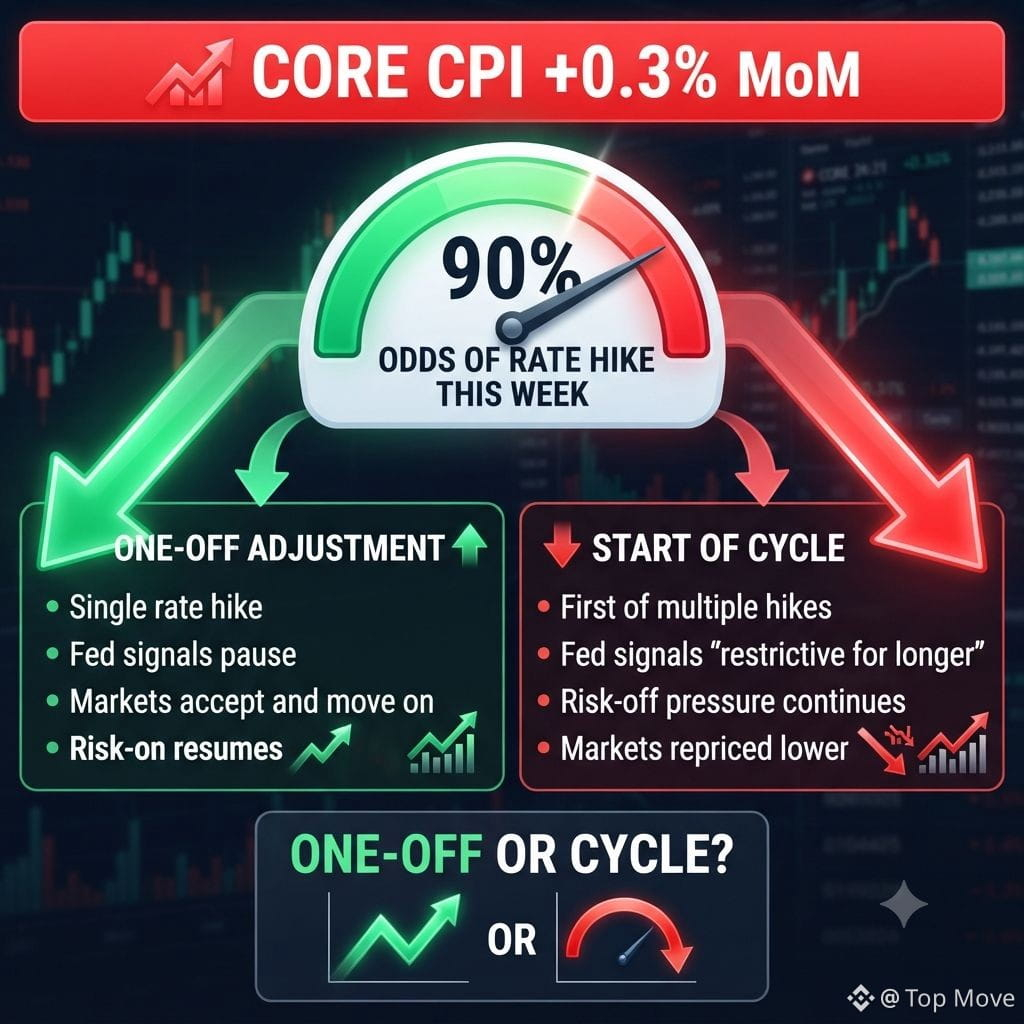
THE 90% HIKE SCENARIO
Core CPI just hit 0.3% month-over-month.
That's the catalyst. 90% odds of a 25bp hike THIS WEEK.
Here's what matters:
This isn't a one-time adjustment. This is the Fed signaling: inflation isn't dead yet.
If they hike, it breaks the "rate cuts only" narrative that's been driving markets since March.
The question isn't "will they hike?" (90% odds say yes).
The real question is: "Is this a one-off, or the start of a longer hiking cycle?"
One-off: Technical adjustment, markets shrug it off
Longer cycle: Fed tightens again, risk-on gets crushed
I'm watching the Powell statement closely. If he signals "restrictive for longer," that's cycle confirmation.
What's your read?
Do you think one hike ends it, or is this the start of tightening 2.0?
$BTC
#FedRateWatch
THE 90% HIKE SCENARIO
Core CPI just hit 0.3% month-over-month.
That's the catalyst. 90% odds of a 25bp hike THIS WEEK.
Here's what matters:
This isn't a one-time adjustment. This is the Fed signaling: inflation isn't dead yet.
If they hike, it breaks the "rate cuts only" narrative that's been driving markets since March.
The question isn't "will they hike?" (90% odds say yes).
The real question is: "Is this a one-off, or the start of a longer hiking cycle?"
One-off: Technical adjustment, markets shrug it off
Longer cycle: Fed tightens again, risk-on gets crushed
I'm watching the Powell statement closely. If he signals "restrictive for longer," that's cycle confirmation.
What's your read?
Do you think one hike ends it, or is this the start of tightening 2.0?
$BTC
#FedRateWatch
Core CPI just hit 0.3% month-over-month.
That's the catalyst. 90% odds of a 25bp hike THIS WEEK.
Here's what matters:
This isn't a one-time adjustment. This is the Fed signaling: inflation isn't dead yet.
If they hike, it breaks the "rate cuts only" narrative that's been driving markets since March.
The question isn't "will they hike?" (90% odds say yes).
The real question is: "Is this a one-off, or the start of a longer hiking cycle?"
One-off: Technical adjustment, markets shrug it off
Longer cycle: Fed tightens again, risk-on gets crushed
I'm watching the Powell statement closely. If he signals "restrictive for longer," that's cycle confirmation.
What's your read?
Do you think one hike ends it, or is this the start of tightening 2.0?
$BTC
#FedRateWatch
134
·
--


Binance Square Official
·
--
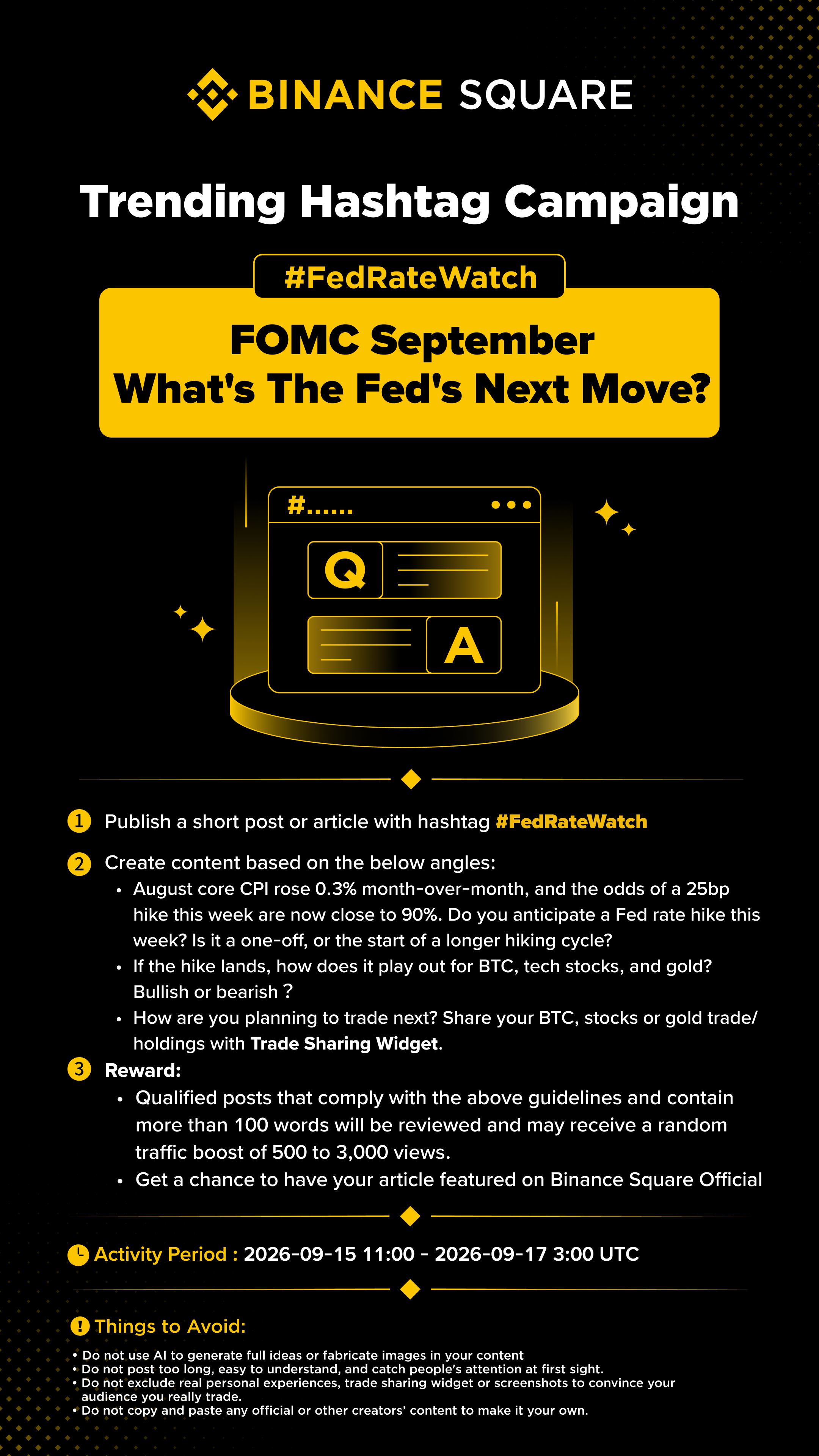
Share & Win Traffic Reward in our Trending Hashtag Campaign
✨Topic: FOMC September, What's The Fed's Next Move?
👉How to Join:
Publish a short post or article with hashtag #FedRateWatch
Create content based on the below angles:
- August core CPI rose 0.3% month-over-month, and the odds of a 25bp hike this week are now close to 90%. Do you anticipate a rate hike this week? Is it a one-off, or the start of a longer hiking cycle?
- If the hike lands, how does it play out for BTC, tech stocks, and gold? Bullish or bearish?
- How are you planning to trade next? Share your BTC, stocks or gold trade/holdings with our trade sharing widget.
⏰Campaign Period:
- 2026-09-15 11:00 - 2026-09-17 3:00 UTC
🎁Reward:
- Qualified posts that comply with the above guidelines and contain more than 100 words will be reviewed and may receive a random traffic boost of 500 to 3,000 views. You will receive a notification from your feed secretary if your post is selected.
- Get a chance to have your article featured on Binance Square Official
Need ideas for your post? Visit the topic page #FedRateWatch or the Square Guide on How to Post for Better Reach.
✨Topic: FOMC September, What's The Fed's Next Move?
👉How to Join:
Publish a short post or article with hashtag #FedRateWatch
Create content based on the below angles:
- August core CPI rose 0.3% month-over-month, and the odds of a 25bp hike this week are now close to 90%. Do you anticipate a rate hike this week? Is it a one-off, or the start of a longer hiking cycle?
- If the hike lands, how does it play out for BTC, tech stocks, and gold? Bullish or bearish?
- How are you planning to trade next? Share your BTC, stocks or gold trade/holdings with our trade sharing widget.
⏰Campaign Period:
- 2026-09-15 11:00 - 2026-09-17 3:00 UTC
🎁Reward:
- Qualified posts that comply with the above guidelines and contain more than 100 words will be reviewed and may receive a random traffic boost of 500 to 3,000 views. You will receive a notification from your feed secretary if your post is selected.
- Get a chance to have your article featured on Binance Square Official
Need ideas for your post? Visit the topic page #FedRateWatch or the Square Guide on How to Post for Better Reach.
16
·
--
CAN INSTITUTIONS ACTUALLY PROGRAM IT?
Most privacy chains offer binary choice: All public or all private.
Dusk's different. It offers programmable privacy.
Translation: Each asset/participant defines their own privacy rules.
Here's what that means:
**Treasury Manager (Company A):**
"I want USD 10M wire movements hidden from competitors, visible to regulators on request"
→ Selective disclosure activated
**Hedge Fund (Investor A):**
"My position sizes stay private, settlement proof goes to auditors"
→ Programmable rules applied
**Market Maker (Broker A):**
"Bid/ask spreads hidden until settlement, then transparent to counterparties"
→ Deterministic settlement with privacy
Same blockchain. Different privacy rules for each participant. Not hardcoded. Programmable.
This is theoretically revolutionary.
But here's what concerns me:
Does programmable privacy actually work at scale with multiple participants?
If Treasury Manager wants X privacy level and Market Maker wants Y, and Regulator needs Z visibility... what happens when those rules conflict?
Most privacy systems assume uniform privacy (everyone gets the same treatment).
Programmable privacy assumes flexible coordination (every participant configures their own).
That coordination problem is REAL.
**My actual question:**
When institutions move capital on Dusk, will they actually program custom privacy rules?
A) Yes - Different participants need different privacy levels (makes sense)
B) No - Complexity forces everyone to use standard presets
C) Partial - Some institutions program, most use defaults
The answer determines if programmable privacy becomes essential or just theoretical.
@Dusk_Foundation $DUSK #dusk
CAN INSTITUTIONS ACTUALLY PROGRAM IT?
Most privacy chains offer binary choice: All public or all private.
Dusk's different. It offers programmable privacy.
Translation: Each asset/participant defines their own privacy rules.
Here's what that means:
**Treasury Manager (Company A):**
"I want USD 10M wire movements hidden from competitors, visible to regulators on request"
→ Selective disclosure activated
**Hedge Fund (Investor A):**
"My position sizes stay private, settlement proof goes to auditors"
→ Programmable rules applied
**Market Maker (Broker A):**
"Bid/ask spreads hidden until settlement, then transparent to counterparties"
→ Deterministic settlement with privacy
Same blockchain. Different privacy rules for each participant. Not hardcoded. Programmable.
This is theoretically revolutionary.
But here's what concerns me:
Does programmable privacy actually work at scale with multiple participants?
If Treasury Manager wants X privacy level and Market Maker wants Y, and Regulator needs Z visibility... what happens when those rules conflict?
Most privacy systems assume uniform privacy (everyone gets the same treatment).
Programmable privacy assumes flexible coordination (every participant configures their own).
That coordination problem is REAL.
**My actual question:**
When institutions move capital on Dusk, will they actually program custom privacy rules?
A) Yes - Different participants need different privacy levels (makes sense)
B) No - Complexity forces everyone to use standard presets
C) Partial - Some institutions program, most use defaults
The answer determines if programmable privacy becomes essential or just theoretical.
@Dusk $DUSK #dusk
Most privacy chains offer binary choice: All public or all private.
Dusk's different. It offers programmable privacy.
Translation: Each asset/participant defines their own privacy rules.
Here's what that means:
**Treasury Manager (Company A):**
"I want USD 10M wire movements hidden from competitors, visible to regulators on request"
→ Selective disclosure activated
**Hedge Fund (Investor A):**
"My position sizes stay private, settlement proof goes to auditors"
→ Programmable rules applied
**Market Maker (Broker A):**
"Bid/ask spreads hidden until settlement, then transparent to counterparties"
→ Deterministic settlement with privacy
Same blockchain. Different privacy rules for each participant. Not hardcoded. Programmable.
This is theoretically revolutionary.
But here's what concerns me:
Does programmable privacy actually work at scale with multiple participants?
If Treasury Manager wants X privacy level and Market Maker wants Y, and Regulator needs Z visibility... what happens when those rules conflict?
Most privacy systems assume uniform privacy (everyone gets the same treatment).
Programmable privacy assumes flexible coordination (every participant configures their own).
That coordination problem is REAL.
**My actual question:**
When institutions move capital on Dusk, will they actually program custom privacy rules?
A) Yes - Different participants need different privacy levels (makes sense)
B) No - Complexity forces everyone to use standard presets
C) Partial - Some institutions program, most use defaults
The answer determines if programmable privacy becomes essential or just theoretical.
@Dusk $DUSK #dusk
1
165
·
--
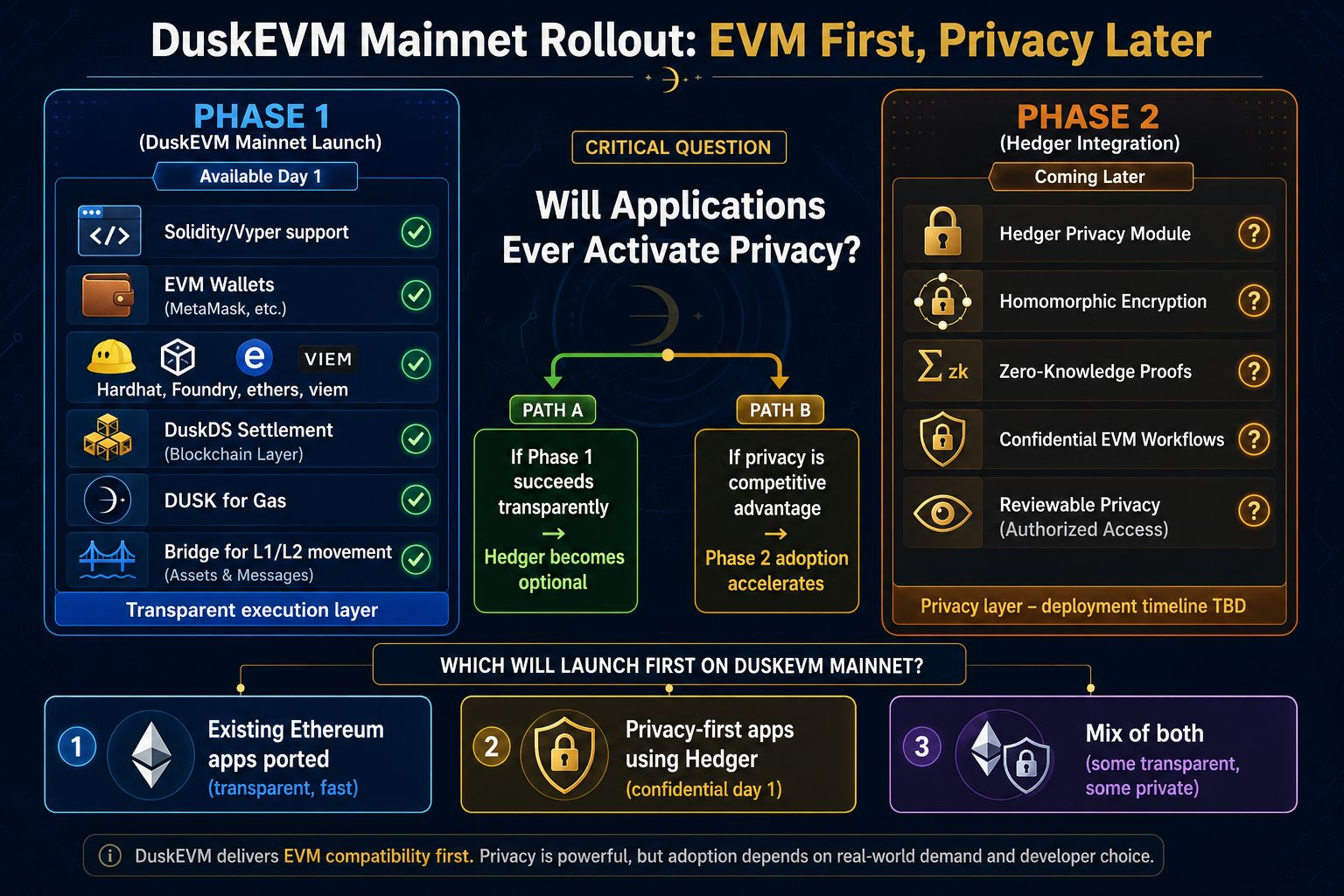
PRIVACY COMES LATER (HONEST BREAKDOWN)
I've been analyzing DuskEVM mainnet architecture and realized something important.
Everyone talks about Hedger (privacy via homomorphic encryption + ZK proofs).
But the actual rollout is different.
Here's what's actually happening:
Day 1 (DuskEVM Launch):
- Solidity support (full EVM compatibility)
- Hardhat, Foundry, ethers, viem (all standard tools)
- DuskDS settlement (via DuskEVM sequencer → batcher → DuskDS)
- DUSK for gas payments
- Bridge for moving DUSK between L1 and DuskEVM
**What's NOT day-1:**
- Hedger (privacy module)
- Confidential EVM workflows
- Homomorphic encryption integration
- ZK proof generation for privacy
This matters because it reveals the actual product strategy.
Marketing says: "Confidential EVM with privacy from day one"
Reality: EVM-compatible layer first. Privacy layer second.
Here's why this actually makes sense:
**Phase 1 (EVM Compatibility):**
Developers port existing Ethereum apps in weeks. Familiar tooling. No learning curve. Users get faster, cheaper execution than Ethereum. Doesn't require privacy.
**Phase 2 (Privacy Integration):**
Once capital is substantial, competitive sensitivity increases. Now Hedger becomes valuable. Applications add privacy optionally.
But there's a timing question I'm actually concerned about:
If Phase 1 succeeds without privacy (EVM apps work fine transparently), will applications ever activate Hedger?
Or will Dusk become "Arbitrum with better settlement" (good infrastructure, but privacy remains theoretical)?
The honest concern:
Hedger is architecturally sound. But if DuskEVM is successful WITHOUT it, institutional adoption might never activate the privacy layer.
Which would be ironic: The infrastructure designed for regulated privacy-first finance ends up settling transparent transactions from EVM apps.
@Dusk_Foundation $DUSK #dusk
PRIVACY COMES LATER (HONEST BREAKDOWN)
I've been analyzing DuskEVM mainnet architecture and realized something important.
Everyone talks about Hedger (privacy via homomorphic encryption + ZK proofs).
But the actual rollout is different.
Here's what's actually happening:
Day 1 (DuskEVM Launch):
- Solidity support (full EVM compatibility)
- Hardhat, Foundry, ethers, viem (all standard tools)
- DuskDS settlement (via DuskEVM sequencer → batcher → DuskDS)
- DUSK for gas payments
- Bridge for moving DUSK between L1 and DuskEVM
**What's NOT day-1:**
- Hedger (privacy module)
- Confidential EVM workflows
- Homomorphic encryption integration
- ZK proof generation for privacy
This matters because it reveals the actual product strategy.
Marketing says: "Confidential EVM with privacy from day one"
Reality: EVM-compatible layer first. Privacy layer second.
Here's why this actually makes sense:
**Phase 1 (EVM Compatibility):**
Developers port existing Ethereum apps in weeks. Familiar tooling. No learning curve. Users get faster, cheaper execution than Ethereum. Doesn't require privacy.
**Phase 2 (Privacy Integration):**
Once capital is substantial, competitive sensitivity increases. Now Hedger becomes valuable. Applications add privacy optionally.
But there's a timing question I'm actually concerned about:
If Phase 1 succeeds without privacy (EVM apps work fine transparently), will applications ever activate Hedger?
Or will Dusk become "Arbitrum with better settlement" (good infrastructure, but privacy remains theoretical)?
The honest concern:
Hedger is architecturally sound. But if DuskEVM is successful WITHOUT it, institutional adoption might never activate the privacy layer.
Which would be ironic: The infrastructure designed for regulated privacy-first finance ends up settling transparent transactions from EVM apps.
@Dusk $DUSK #dusk
I've been analyzing DuskEVM mainnet architecture and realized something important.
Everyone talks about Hedger (privacy via homomorphic encryption + ZK proofs).
But the actual rollout is different.
Here's what's actually happening:
Day 1 (DuskEVM Launch):
- Solidity support (full EVM compatibility)
- Hardhat, Foundry, ethers, viem (all standard tools)
- DuskDS settlement (via DuskEVM sequencer → batcher → DuskDS)
- DUSK for gas payments
- Bridge for moving DUSK between L1 and DuskEVM
**What's NOT day-1:**
- Hedger (privacy module)
- Confidential EVM workflows
- Homomorphic encryption integration
- ZK proof generation for privacy
This matters because it reveals the actual product strategy.
Marketing says: "Confidential EVM with privacy from day one"
Reality: EVM-compatible layer first. Privacy layer second.
Here's why this actually makes sense:
**Phase 1 (EVM Compatibility):**
Developers port existing Ethereum apps in weeks. Familiar tooling. No learning curve. Users get faster, cheaper execution than Ethereum. Doesn't require privacy.
**Phase 2 (Privacy Integration):**
Once capital is substantial, competitive sensitivity increases. Now Hedger becomes valuable. Applications add privacy optionally.
But there's a timing question I'm actually concerned about:
If Phase 1 succeeds without privacy (EVM apps work fine transparently), will applications ever activate Hedger?
Or will Dusk become "Arbitrum with better settlement" (good infrastructure, but privacy remains theoretical)?
The honest concern:
Hedger is architecturally sound. But if DuskEVM is successful WITHOUT it, institutional adoption might never activate the privacy layer.
Which would be ironic: The infrastructure designed for regulated privacy-first finance ends up settling transparent transactions from EVM apps.
@Dusk $DUSK #dusk
1
104
·
--
SOLIDITY OR PRIVACY?
DuskEVM just gave developers a choice.
Use Solidity on DuskEVM (Ethereum-compatible execution layer).
Or use Rust/WASM on DuskVM (privacy-first, Dusk L1 execution).
This matters more than it looks.
On traditional Ethereum: Everyone uses Solidity. It's the default. No choice.
On Dusk: You can go two paths.
Path 1 (DuskEVM): Familiar. Solidity. Hardhat, Foundry, ethers, viem. Existing Ethereum apps port in minutes. Settles on Dusk L1 (DuskDS). Fast. Comfortable.
Path 2 (DuskVM): Rust/WASM. Privacy-native. Integrate directly with Dusk's privacy layer (Hedger). Access transaction models designed for compliance. More work. Better privacy.
Here's what concerns me:
Will Solidity's gravity (familiarity, speed, existing libraries) pull all developers to DuskEVM?
And if so, do most applications ever activate the privacy layer (Hedger)?
Or is DuskEVM just "Arbitrum with better settlement" (fast, but not actually using Dusk's privacy?
The distinction matters because it determines if Dusk becomes:
A) Infrastructure for regulated finance (privacy + compliance)
B) Just another EVM rollup (faster, but privacy is optional)
POLL: Which execution environment will developers choose?
A) DuskEVM (Solidity, familiar, easy) - 70%+ will go here
B) DuskVM (Rust, privacy-native, harder) - Only for specialized apps
C) Hybrid (They'll use both depending on needs)
D) It depends on what Dusk prioritizes in marketing
Which are you building on? And will you actually use the privacy layer?
@Dusk_Foundation $DUSK #dusk
SOLIDITY OR PRIVACY?
DuskEVM just gave developers a choice.
Use Solidity on DuskEVM (Ethereum-compatible execution layer).
Or use Rust/WASM on DuskVM (privacy-first, Dusk L1 execution).
This matters more than it looks.
On traditional Ethereum: Everyone uses Solidity. It's the default. No choice.
On Dusk: You can go two paths.
Path 1 (DuskEVM): Familiar. Solidity. Hardhat, Foundry, ethers, viem. Existing Ethereum apps port in minutes. Settles on Dusk L1 (DuskDS). Fast. Comfortable.
Path 2 (DuskVM): Rust/WASM. Privacy-native. Integrate directly with Dusk's privacy layer (Hedger). Access transaction models designed for compliance. More work. Better privacy.
Here's what concerns me:
Will Solidity's gravity (familiarity, speed, existing libraries) pull all developers to DuskEVM?
And if so, do most applications ever activate the privacy layer (Hedger)?
Or is DuskEVM just "Arbitrum with better settlement" (fast, but not actually using Dusk's privacy?
The distinction matters because it determines if Dusk becomes:
A) Infrastructure for regulated finance (privacy + compliance)
B) Just another EVM rollup (faster, but privacy is optional)
POLL: Which execution environment will developers choose?
A) DuskEVM (Solidity, familiar, easy) - 70%+ will go here
B) DuskVM (Rust, privacy-native, harder) - Only for specialized apps
C) Hybrid (They'll use both depending on needs)
D) It depends on what Dusk prioritizes in marketing
Which are you building on? And will you actually use the privacy layer?
@Dusk $DUSK #dusk
DuskEVM just gave developers a choice.
Use Solidity on DuskEVM (Ethereum-compatible execution layer).
Or use Rust/WASM on DuskVM (privacy-first, Dusk L1 execution).
This matters more than it looks.
On traditional Ethereum: Everyone uses Solidity. It's the default. No choice.
On Dusk: You can go two paths.
Path 1 (DuskEVM): Familiar. Solidity. Hardhat, Foundry, ethers, viem. Existing Ethereum apps port in minutes. Settles on Dusk L1 (DuskDS). Fast. Comfortable.
Path 2 (DuskVM): Rust/WASM. Privacy-native. Integrate directly with Dusk's privacy layer (Hedger). Access transaction models designed for compliance. More work. Better privacy.
Here's what concerns me:
Will Solidity's gravity (familiarity, speed, existing libraries) pull all developers to DuskEVM?
And if so, do most applications ever activate the privacy layer (Hedger)?
Or is DuskEVM just "Arbitrum with better settlement" (fast, but not actually using Dusk's privacy?
The distinction matters because it determines if Dusk becomes:
A) Infrastructure for regulated finance (privacy + compliance)
B) Just another EVM rollup (faster, but privacy is optional)
POLL: Which execution environment will developers choose?
A) DuskEVM (Solidity, familiar, easy) - 70%+ will go here
B) DuskVM (Rust, privacy-native, harder) - Only for specialized apps
C) Hybrid (They'll use both depending on needs)
D) It depends on what Dusk prioritizes in marketing
Which are you building on? And will you actually use the privacy layer?
@Dusk $DUSK #dusk
DuskEVM
0%
DuskVM
100%
Hybrid
0%
depends on Dusk prioritizes
0%
1 မဲများ • မဲပိတ်ပါပြီ
1
90
·
--
$VELVET 's been bleeding but might be putting in a floor here. Watching for a potential double bottom — nothing confirmed yet. Needs to reclaim 0.2 first, then 0.26 to flip the near-term structure bullish.
Upside looks more probable than further downside at this level, but these things whip around hard. Size accordingly. If it can't hold support or fails at resistance, step aside. No edge in forcing it.
$VELVET 's been bleeding but might be putting in a floor here. Watching for a potential double bottom — nothing confirmed yet. Needs to reclaim 0.2 first, then 0.26 to flip the near-term structure bullish.
Upside looks more probable than further downside at this level, but these things whip around hard. Size accordingly. If it can't hold support or fails at resistance, step aside. No edge in forcing it.
Upside looks more probable than further downside at this level, but these things whip around hard. Size accordingly. If it can't hold support or fails at resistance, step aside. No edge in forcing it.
45
·
--
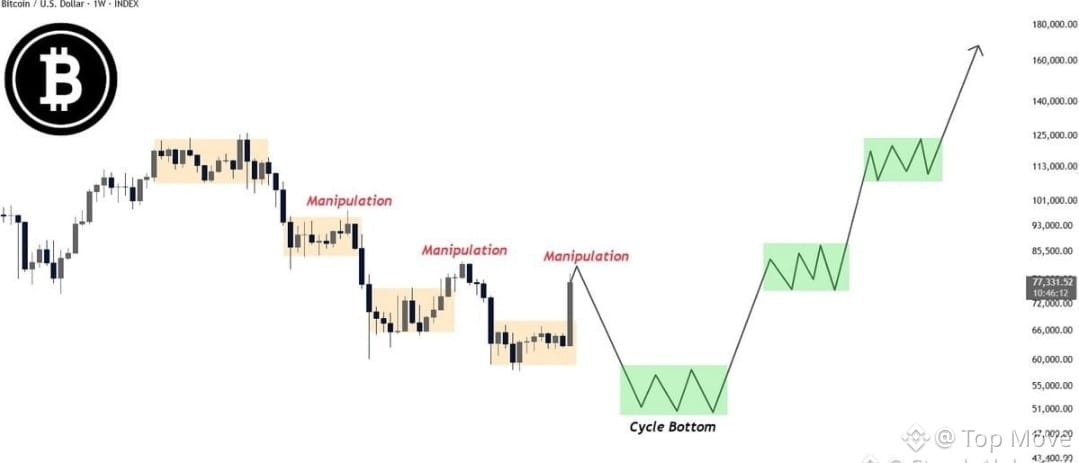
$BTC could still push toward $80K from current levels, but don't be shocked if we see heavy distribution around that zone before the next leg.
If distribution plays out there, the next flush after that would be where I'd look for the real cycle bottom.
That's the setup. Patience pays — let the market show its hand, then act. Time in beats timing.
#BrentDrops1.87%
#SP500FuturesFall
$BTC could still push toward $80K from current levels, but don't be shocked if we see heavy distribution around that zone before the next leg.
If distribution plays out there, the next flush after that would be where I'd look for the real cycle bottom.
That's the setup. Patience pays — let the market show its hand, then act. Time in beats timing.
#BrentDrops1.87%
#SP500FuturesFall
If distribution plays out there, the next flush after that would be where I'd look for the real cycle bottom.
That's the setup. Patience pays — let the market show its hand, then act. Time in beats timing.
#BrentDrops1.87%
#SP500FuturesFall
65
·
--
PRIVACY FOR REGULATED FINANCE
The blockchain industry assumes transparency = good.
But traditional finance works on a different principle: confidentiality.
Companies don't want competitors seeing treasury movements. Investors don't want strategies exposed. Market makers can't function with all bids/asks public.
Dusk's core insight: Privacy and compliance aren't enemies. They work together.
Without privacy, institutions simply won't adopt on-chain settlement. It's not a feature request. It's a requirement under GDPR + MiCA.
So here's my question:
POLL: Can regulated financial markets move on-chain WITHOUT privacy?
A) No - Institutions need privacy to participate (compliance requirement)
B) Yes - Radical transparency is worth the privacy tradeoff
C) Hybrid - Some markets yes, some no (depends on asset class)
D) Don't know - Too early to tell
Vote and tell me why in the comments. Which asset class do you think moves on-chain first?
@Dusk_Foundation $DUSK #dusk
PRIVACY FOR REGULATED FINANCE
The blockchain industry assumes transparency = good.
But traditional finance works on a different principle: confidentiality.
Companies don't want competitors seeing treasury movements. Investors don't want strategies exposed. Market makers can't function with all bids/asks public.
Dusk's core insight: Privacy and compliance aren't enemies. They work together.
Without privacy, institutions simply won't adopt on-chain settlement. It's not a feature request. It's a requirement under GDPR + MiCA.
So here's my question:
POLL: Can regulated financial markets move on-chain WITHOUT privacy?
A) No - Institutions need privacy to participate (compliance requirement)
B) Yes - Radical transparency is worth the privacy tradeoff
C) Hybrid - Some markets yes, some no (depends on asset class)
D) Don't know - Too early to tell
Vote and tell me why in the comments. Which asset class do you think moves on-chain first?
@Dusk $DUSK #dusk
The blockchain industry assumes transparency = good.
But traditional finance works on a different principle: confidentiality.
Companies don't want competitors seeing treasury movements. Investors don't want strategies exposed. Market makers can't function with all bids/asks public.
Dusk's core insight: Privacy and compliance aren't enemies. They work together.
Without privacy, institutions simply won't adopt on-chain settlement. It's not a feature request. It's a requirement under GDPR + MiCA.
So here's my question:
POLL: Can regulated financial markets move on-chain WITHOUT privacy?
A) No - Institutions need privacy to participate (compliance requirement)
B) Yes - Radical transparency is worth the privacy tradeoff
C) Hybrid - Some markets yes, some no (depends on asset class)
D) Don't know - Too early to tell
Vote and tell me why in the comments. Which asset class do you think moves on-chain first?
@Dusk $DUSK #dusk
No Institutions need privacy
50%
Yes Radical transparency worth
50%
Hybrid market's system
0%
Don't know - Too early to tell
0%
2 မဲများ • မဲပိတ်ပါပြီ
3
1
83
·
--
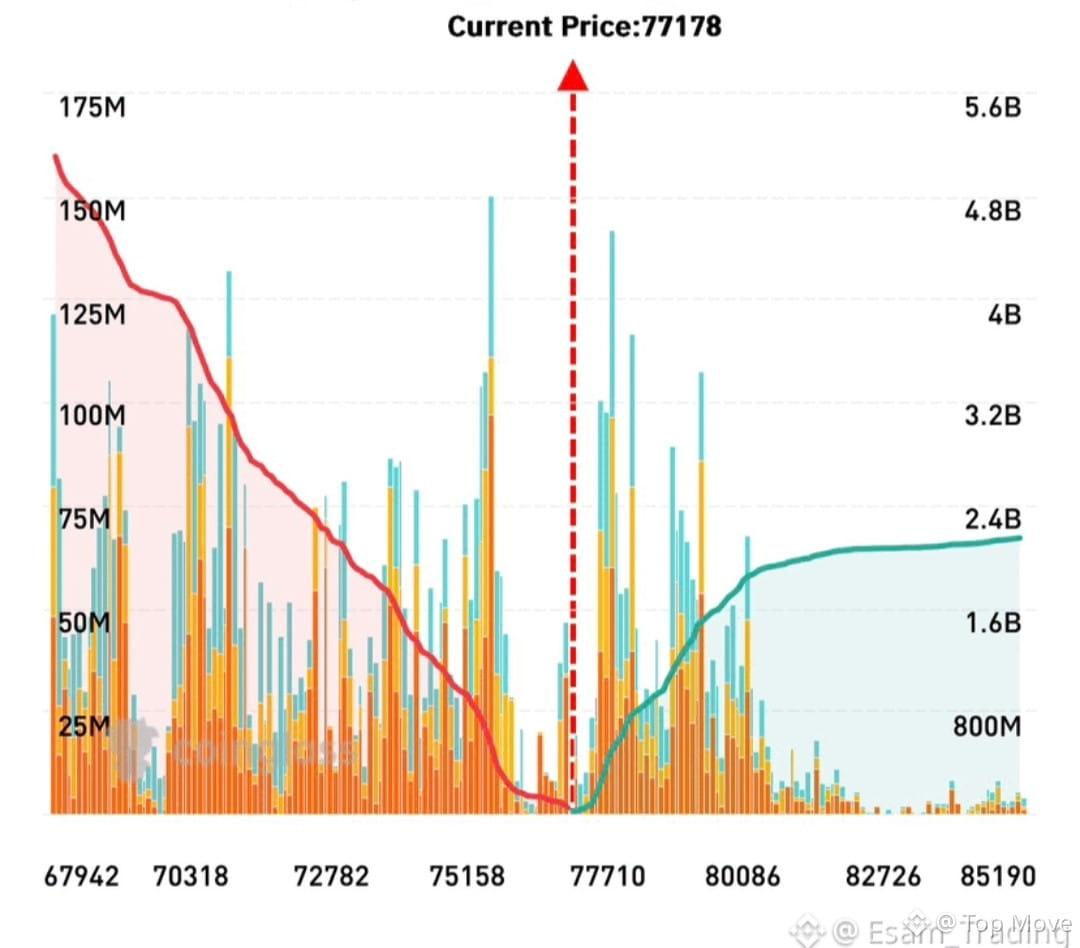
$BTC 7 days estimated liquidation data on three major exchanges:
1️⃣ Shorts Liquidity is piled upto 80k zone
2️⃣ Long Liquidity is piled upto 70k zone
#BitcoinStrongestWeekSinceMarch2023
$BTC 7 days estimated liquidation data on three major exchanges:
1️⃣ Shorts Liquidity is piled upto 80k zone
2️⃣ Long Liquidity is piled upto 70k zone
#BitcoinStrongestWeekSinceMarch2023
1️⃣ Shorts Liquidity is piled upto 80k zone
2️⃣ Long Liquidity is piled upto 70k zone
#BitcoinStrongestWeekSinceMarch2023
79
·
--
This $ETH chart still favors the long side, but chasing at the current price is not the cleanest move. Price is around 2,461.74, sitting well above MA7 2,258.81, MA25 1,990.81, and MA99 1,866.97, so the trend is still strong even after the sharp move.
Bias: Long on pullback
Entry zone: 2,380 to 2,430
Stop: below 2,335
TP1: 2,484
TP2: 2,546
TP3: 2,650 to 2,720 if momentum continues
The reason I prefer long is that ETH broke out from a long consolidation and buyers are still holding above the short-term moving average. A short only starts to make sense if price rejects hard near 2,484 to 2,546 and then loses 2,355. Until that happens, the cleaner setup is waiting for a pullback into support and looking for continuation.
{future}(ETHUSDT)
This $ETH chart still favors the long side, but chasing at the current price is not the cleanest move. Price is around 2,461.74, sitting well above MA7 2,258.81, MA25 1,990.81, and MA99 1,866.97, so the trend is still strong even after the sharp move.
Bias: Long on pullback
Entry zone: 2,380 to 2,430
Stop: below 2,335
TP1: 2,484
TP2: 2,546
TP3: 2,650 to 2,720 if momentum continues
The reason I prefer long is that ETH broke out from a long consolidation and buyers are still holding above the short-term moving average. A short only starts to make sense if price rejects hard near 2,484 to 2,546 and then loses 2,355. Until that happens, the cleaner setup is waiting for a pullback into support and looking for continuation.
Bias: Long on pullback
Entry zone: 2,380 to 2,430
Stop: below 2,335
TP1: 2,484
TP2: 2,546
TP3: 2,650 to 2,720 if momentum continues
The reason I prefer long is that ETH broke out from a long consolidation and buyers are still holding above the short-term moving average. A short only starts to make sense if price rejects hard near 2,484 to 2,546 and then loses 2,355. Until that happens, the cleaner setup is waiting for a pullback into support and looking for continuation.
47
·
--
🚨 A deal was so close… then it collapsed at the last minute. And now the tariff war has begun. 👀🔥
Trade talks between the US and Canada have broken down, plunging the relationship between North America's two largest trading partners into a new phase of tension.
And the number that shocked the markets? 👇
🇺🇸 The US imposed a 50% tariff on approximately $20 billion worth of Canadian goods.
🇨🇦 Canada said it would retaliate dollar for dollar, with the countermeasures taking effect on September 8.
But the story doesn't end there… 👀
Higher tariffs mean: 📈 Higher costs
🛒 Price pressure
🏭 Risks to businesses and supply chains
💵 And potential pressure on investors' risk appetite
And here's the part that matters to the crypto market… 🔥
When trade and inflation concerns rise, Bitcoin and altcoins become more sensitive to global market movements.
Are we witnessing the start of a new round of the trade war… or will the markets shrug off the shock? 👀📉
#BitcoinStrongestWeekSinceMarch2023
#NvidiaAIServerPricesRiseOver15%
#SandboxSANDSuspectedInfiniteMintFlawOnBase
$BTC
$ETH
🚨 A deal was so close… then it collapsed at the last minute. And now the tariff war has begun. 👀🔥
Trade talks between the US and Canada have broken down, plunging the relationship between North America's two largest trading partners into a new phase of tension.
And the number that shocked the markets? 👇
🇺🇸 The US imposed a 50% tariff on approximately $20 billion worth of Canadian goods.
🇨🇦 Canada said it would retaliate dollar for dollar, with the countermeasures taking effect on September 8.
But the story doesn't end there… 👀
Higher tariffs mean: 📈 Higher costs
🛒 Price pressure
🏭 Risks to businesses and supply chains
💵 And potential pressure on investors' risk appetite
And here's the part that matters to the crypto market… 🔥
When trade and inflation concerns rise, Bitcoin and altcoins become more sensitive to global market movements.
Are we witnessing the start of a new round of the trade war… or will the markets shrug off the shock? 👀📉
#BitcoinStrongestWeekSinceMarch2023
#NvidiaAIServerPricesRiseOver15%
#SandboxSANDSuspectedInfiniteMintFlawOnBase
$BTC
$ETH
Trade talks between the US and Canada have broken down, plunging the relationship between North America's two largest trading partners into a new phase of tension.
And the number that shocked the markets? 👇
🇺🇸 The US imposed a 50% tariff on approximately $20 billion worth of Canadian goods.
🇨🇦 Canada said it would retaliate dollar for dollar, with the countermeasures taking effect on September 8.
But the story doesn't end there… 👀
Higher tariffs mean: 📈 Higher costs
🛒 Price pressure
🏭 Risks to businesses and supply chains
💵 And potential pressure on investors' risk appetite
And here's the part that matters to the crypto market… 🔥
When trade and inflation concerns rise, Bitcoin and altcoins become more sensitive to global market movements.
Are we witnessing the start of a new round of the trade war… or will the markets shrug off the shock? 👀📉
#BitcoinStrongestWeekSinceMarch2023
#NvidiaAIServerPricesRiseOver15%
#SandboxSANDSuspectedInfiniteMintFlawOnBase
$BTC
$ETH
44
·
--
$AAOIB keeps hitting shareholders with $500M-$600M ATM offerings and it's getting exhausting.
Sure, the operating outlook might improve. Maybe they're building capacity for future growth.
But at some point, the constant dilution becomes the story — not the business fundamentals.
ATMs are shareholder poison when they're this frequent and this large. You can believe in the long-term thesis and still hate the financing structure.
If management keeps treating equity like a bottomless piggy bank, even bullish narratives lose credibility.
$AAOIB keeps hitting shareholders with $500M-$600M ATM offerings and it's getting exhausting.
Sure, the operating outlook might improve. Maybe they're building capacity for future growth.
But at some point, the constant dilution becomes the story — not the business fundamentals.
ATMs are shareholder poison when they're this frequent and this large. You can believe in the long-term thesis and still hate the financing structure.
If management keeps treating equity like a bottomless piggy bank, even bullish narratives lose credibility.
Sure, the operating outlook might improve. Maybe they're building capacity for future growth.
But at some point, the constant dilution becomes the story — not the business fundamentals.
ATMs are shareholder poison when they're this frequent and this large. You can believe in the long-term thesis and still hate the financing structure.
If management keeps treating equity like a bottomless piggy bank, even bullish narratives lose credibility.
54
·
--
$SOL setup big long now and love me soon
Entry 94,7-93,5
sl 92,8
tp 95,8-96,9
Long $SOL 👇
{future}(SOLUSDT)
$SOL setup big long now and love me soon
Entry 94,7-93,5
sl 92,8
tp 95,8-96,9
Long $SOL 👇
Entry 94,7-93,5
sl 92,8
tp 95,8-96,9
Long $SOL 👇
5
·
--
MASSIVE WEEK FOR CRYPTO
Crypto just had a huge week.
Trump said the U.S. is considering buying large amounts of $BTC and other crypto, while the SEC proposed its first crypto rulebook and the CFTC declared “regulation by enforcement” over.
Bitcoin surged 28% from $62,300 to $79,500, while Ethereum jumped 36%.
Bitcoin and Ethereum ETFs pulled in a combined $2.62B, while $5B in shorts were liquidated and $500B was added to the total crypto market cap.
Even Strategy flipped from $12B underwater to $1.21B in profit.
One week changed the entire market mood.
$BTC $ETH
#BitcoinStrongestWeekSinceMarch2023
MASSIVE WEEK FOR CRYPTO
Crypto just had a huge week.
Trump said the U.S. is considering buying large amounts of $BTC and other crypto, while the SEC proposed its first crypto rulebook and the CFTC declared “regulation by enforcement” over.
Bitcoin surged 28% from $62,300 to $79,500, while Ethereum jumped 36%.
Bitcoin and Ethereum ETFs pulled in a combined $2.62B, while $5B in shorts were liquidated and $500B was added to the total crypto market cap.
Even Strategy flipped from $12B underwater to $1.21B in profit.
One week changed the entire market mood.
$BTC $ETH
#BitcoinStrongestWeekSinceMarch2023
Crypto just had a huge week.
Trump said the U.S. is considering buying large amounts of $BTC and other crypto, while the SEC proposed its first crypto rulebook and the CFTC declared “regulation by enforcement” over.
Bitcoin surged 28% from $62,300 to $79,500, while Ethereum jumped 36%.
Bitcoin and Ethereum ETFs pulled in a combined $2.62B, while $5B in shorts were liquidated and $500B was added to the total crypto market cap.
Even Strategy flipped from $12B underwater to $1.21B in profit.
One week changed the entire market mood.
$BTC $ETH
#BitcoinStrongestWeekSinceMarch2023
77
·
--
WHICH MODEL WINS FOR INSTITUTIONAL FINANCE?
Reading through Dusk's documentation on asset models, I realized the core question institutions face:
Digitization (paper → digital but same old workflow)?
Tokenization (asset wrapped on-chain, custody stays off-chain)?
Native issuance (entire asset lifecycle on-chain from day one)?
Most institutions think tokenization is the obvious path. But I'm not sure.
Here's my thinking:
Tokenization = Bridge solution (gets you 60% of the way there, but you still need off-chain custody/settlement/registry)
Native issuance = Full redesign (eliminates all the off-chain handoffs, but requires regulatory approval + complete workflow rethink)
Dusk is built for native issuance (programmable privacy + deterministic settlement + access controls on-chain).
But which model will actually dominate institutional adoption in the next 2 years?
POLL: Which asset model will drive real institutional capital to Dusk?
Option 1: Digitization (stay traditional, add digital layer)
Option 2: Tokenization$NVDA.US (wrap on-chain, keep off-chain custody)
Option 3: Native issuance (full on-chain lifecycle)
Option 4: Hybrid (mix approaches by asset type)
Vote and tell me why. This determines Dusk's actual TAM.
@Dusk_Foundation $DUSK #dusk
WHICH MODEL WINS FOR INSTITUTIONAL FINANCE?
Reading through Dusk's documentation on asset models, I realized the core question institutions face:
Digitization (paper → digital but same old workflow)?
Tokenization (asset wrapped on-chain, custody stays off-chain)?
Native issuance (entire asset lifecycle on-chain from day one)?
Most institutions think tokenization is the obvious path. But I'm not sure.
Here's my thinking:
Tokenization = Bridge solution (gets you 60% of the way there, but you still need off-chain custody/settlement/registry)
Native issuance = Full redesign (eliminates all the off-chain handoffs, but requires regulatory approval + complete workflow rethink)
Dusk is built for native issuance (programmable privacy + deterministic settlement + access controls on-chain).
But which model will actually dominate institutional adoption in the next 2 years?
POLL: Which asset model will drive real institutional capital to Dusk?
Option 1: Digitization (stay traditional, add digital layer)
Option 2: Tokenization$NVDA.US (wrap on-chain, keep off-chain custody)
Option 3: Native issuance (full on-chain lifecycle)
Option 4: Hybrid (mix approaches by asset type)
Vote and tell me why. This determines Dusk's actual TAM.
@Dusk $DUSK #dusk
Reading through Dusk's documentation on asset models, I realized the core question institutions face:
Digitization (paper → digital but same old workflow)?
Tokenization (asset wrapped on-chain, custody stays off-chain)?
Native issuance (entire asset lifecycle on-chain from day one)?
Most institutions think tokenization is the obvious path. But I'm not sure.
Here's my thinking:
Tokenization = Bridge solution (gets you 60% of the way there, but you still need off-chain custody/settlement/registry)
Native issuance = Full redesign (eliminates all the off-chain handoffs, but requires regulatory approval + complete workflow rethink)
Dusk is built for native issuance (programmable privacy + deterministic settlement + access controls on-chain).
But which model will actually dominate institutional adoption in the next 2 years?
POLL: Which asset model will drive real institutional capital to Dusk?
Option 1: Digitization (stay traditional, add digital layer)
Option 2: Tokenization$NVDA.US (wrap on-chain, keep off-chain custody)
Option 3: Native issuance (full on-chain lifecycle)
Option 4: Hybrid (mix approaches by asset type)
Vote and tell me why. This determines Dusk's actual TAM.
@Dusk $DUSK #dusk
Digitization
0%
Tokenization
67%
Native issuance
0%
Hybrid
33%
6 မဲများ • မဲပိတ်ပါပြီ
DUSK+၀.၈၃%
NVDAUS+၀.၇၈%
1
1
359
·
--
DUSK NATIVE ISSUANCE - WHEN DOES IT ACTUALLY HAPPEN?
WHEN does Dusk actually move to NATIVE ISSUANCE for regulated securities?
That's the real question.
Everyone talks about tokenization vs native issuance as if it's binary.
But here's what actually matters:
Not IF native issuance happens.
WHEN.
And more importantly: WHICH PRODUCTS prove it works FIRST?
Because here's the thing:
Tokenization (wrapping existing assets): Possible TODAY. Faster. Requires less regulatory machinery.
Native issuance (full lifecycle on-chain): Requires regulatory framework approval. Probably 18-24 months. But eliminates legacy dependency entirely.
But the sequencing matters.
Will Dusk move straight to native issuance? Or will institutions first deploy tokenized assets, then migrate to native once infrastructure and regulatory approval exist?
My take: They start with TOKENIZATION first (faster path to capital). Then transition to NATIVE ISSUANCE once they've proven the infrastructure works at scale.
But I could be wrong.
What I'm actually wondering:
Which financial product category PROVES native issuance works FIRST?
Here's my question for builders/traders watching this:
What will Dusk's FIRST native issuance product actually be? And does the sequencing (tokenized first, native later) actually benefit Dusk's ecosystem?
Cast your vote below 👇
@Dusk_Foundation $DUSK #dusk
#GoldReboundsNearly5%
DUSK NATIVE ISSUANCE - WHEN DOES IT ACTUALLY HAPPEN?
WHEN does Dusk actually move to NATIVE ISSUANCE for regulated securities?
That's the real question.
Everyone talks about tokenization vs native issuance as if it's binary.
But here's what actually matters:
Not IF native issuance happens.
WHEN.
And more importantly: WHICH PRODUCTS prove it works FIRST?
Because here's the thing:
Tokenization (wrapping existing assets): Possible TODAY. Faster. Requires less regulatory machinery.
Native issuance (full lifecycle on-chain): Requires regulatory framework approval. Probably 18-24 months. But eliminates legacy dependency entirely.
But the sequencing matters.
Will Dusk move straight to native issuance? Or will institutions first deploy tokenized assets, then migrate to native once infrastructure and regulatory approval exist?
My take: They start with TOKENIZATION first (faster path to capital). Then transition to NATIVE ISSUANCE once they've proven the infrastructure works at scale.
But I could be wrong.
What I'm actually wondering:
Which financial product category PROVES native issuance works FIRST?
Here's my question for builders/traders watching this:
What will Dusk's FIRST native issuance product actually be? And does the sequencing (tokenized first, native later) actually benefit Dusk's ecosystem?
Cast your vote below 👇
@Dusk $DUSK #dusk
#GoldReboundsNearly5%
WHEN does Dusk actually move to NATIVE ISSUANCE for regulated securities?
That's the real question.
Everyone talks about tokenization vs native issuance as if it's binary.
But here's what actually matters:
Not IF native issuance happens.
WHEN.
And more importantly: WHICH PRODUCTS prove it works FIRST?
Because here's the thing:
Tokenization (wrapping existing assets): Possible TODAY. Faster. Requires less regulatory machinery.
Native issuance (full lifecycle on-chain): Requires regulatory framework approval. Probably 18-24 months. But eliminates legacy dependency entirely.
But the sequencing matters.
Will Dusk move straight to native issuance? Or will institutions first deploy tokenized assets, then migrate to native once infrastructure and regulatory approval exist?
My take: They start with TOKENIZATION first (faster path to capital). Then transition to NATIVE ISSUANCE once they've proven the infrastructure works at scale.
But I could be wrong.
What I'm actually wondering:
Which financial product category PROVES native issuance works FIRST?
Here's my question for builders/traders watching this:
What will Dusk's FIRST native issuance product actually be? And does the sequencing (tokenized first, native later) actually benefit Dusk's ecosystem?
Cast your vote below 👇
@Dusk $DUSK #dusk
#GoldReboundsNearly5%
Government bonds
0%
Money market funds
0%
Structured products
0%
Equity securities
100%
2 မဲများ • မဲပိတ်ပါပြီ
2
1
116
·
--
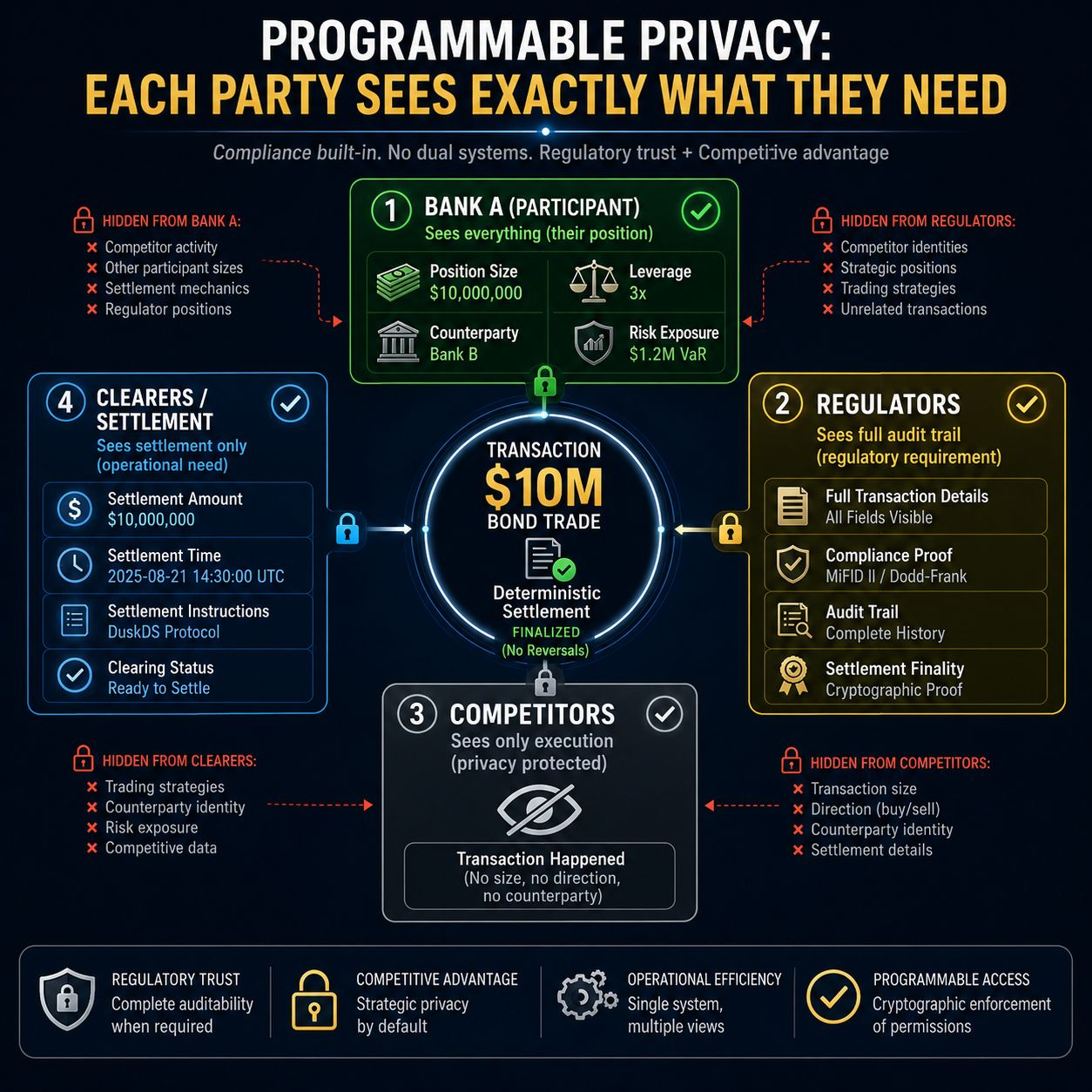
THE REGULATORY BREAKTHROUGH NOBODY TALKS ABOUT
Most people think "privacy in crypto" means hiding everything.
Dusk is doing something completely different.
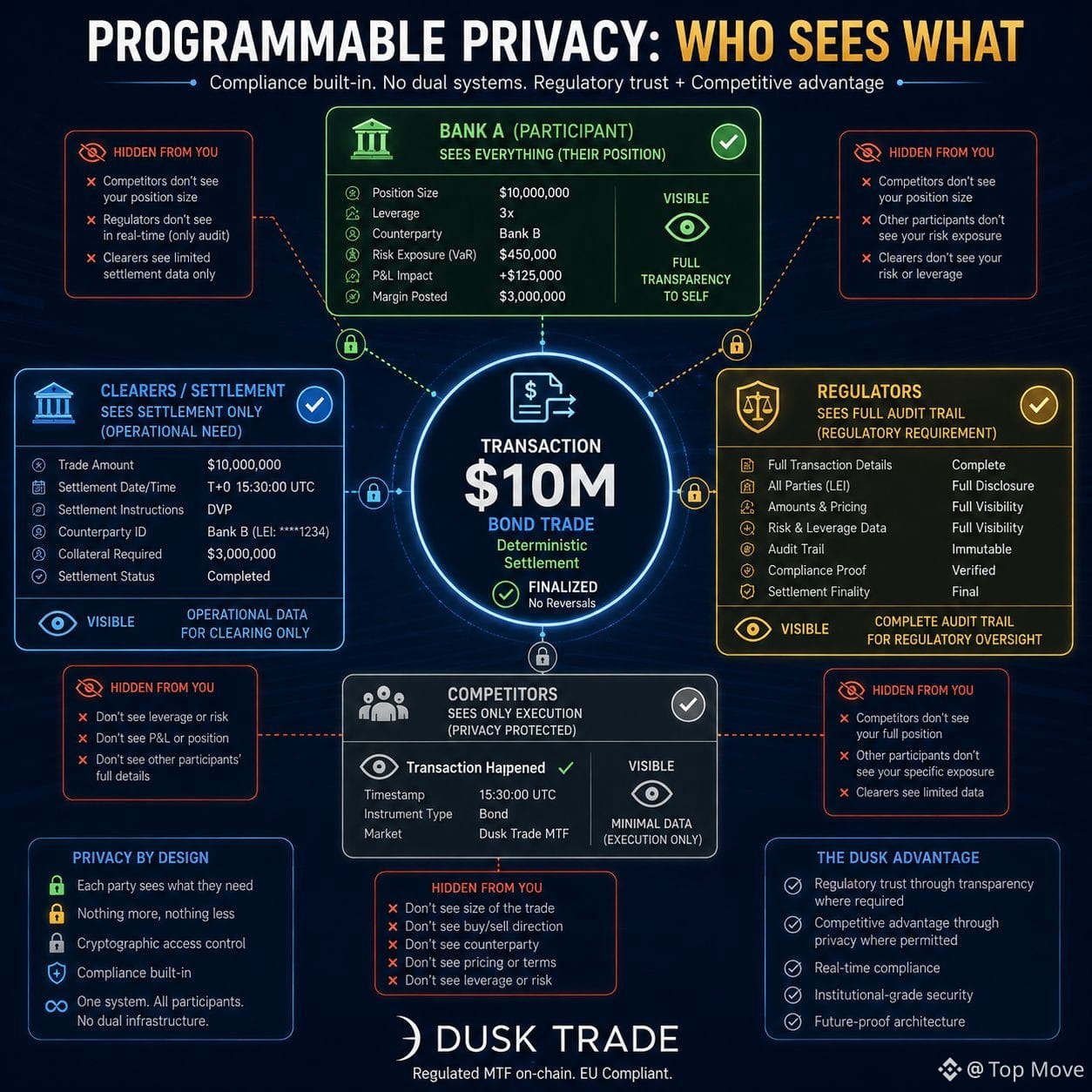
Programmable privacy for regulated markets means:
Privacy where needed (transaction details hidden from competitors)
Transparency where useful (regulator can see everything)
Selective disclosure (counterparties see only what's necessary)
Deterministic settlement (finality, no reversals)
This is the opposite of "hide everything." It's "show exactly what each party needs to see."
Example:
Bank A wants to trade $10M bonds on Dusk.
- Bank A's risk officers see: full position, leverage, counterparty
- Regulators see: everything (full audit trail, compliance proof)
- Competitors see: only that a transaction happened (not size, not direction)
- Clearers see: settlement details only
No single party sees everything except the regulator. But everyone sees exactly what they need.
That's programmable privacy.
Traditional finance: Regulatory audit trails are separate from trading (dual systems, reconciliation nightmare).
Dusk: Privacy and compliance are the same layer (built-in).
What actually excites me:
This works for regulated assets. Not libertarian "code is law" stuff. But institutional capital that NEEDS compliance.
My question:
When does the first institutional asset manager actually deploy on Dusk using programmable privacy for competitive advantage?
Because that's when regulated financial markets change.
#USJoblessClaimsFallTo206000
@Dusk_Foundation $DUSK #dusk
THE REGULATORY BREAKTHROUGH NOBODY TALKS ABOUT
Most people think "privacy in crypto" means hiding everything.
Dusk is doing something completely different.
Programmable privacy for regulated markets means:
Privacy where needed (transaction details hidden from competitors)
Transparency where useful (regulator can see everything)
Selective disclosure (counterparties see only what's necessary)
Deterministic settlement (finality, no reversals)
This is the opposite of "hide everything." It's "show exactly what each party needs to see."
Example:
Bank A wants to trade $10M bonds on Dusk.
- Bank A's risk officers see: full position, leverage, counterparty
- Regulators see: everything (full audit trail, compliance proof)
- Competitors see: only that a transaction happened (not size, not direction)
- Clearers see: settlement details only
No single party sees everything except the regulator. But everyone sees exactly what they need.
That's programmable privacy.
Traditional finance: Regulatory audit trails are separate from trading (dual systems, reconciliation nightmare).
Dusk: Privacy and compliance are the same layer (built-in).
What actually excites me:
This works for regulated assets. Not libertarian "code is law" stuff. But institutional capital that NEEDS compliance.
My question:
When does the first institutional asset manager actually deploy on Dusk using programmable privacy for competitive advantage?
Because that's when regulated financial markets change.
#USJoblessClaimsFallTo206000
@Dusk $DUSK #dusk
Most people think "privacy in crypto" means hiding everything.
Dusk is doing something completely different.
Programmable privacy for regulated markets means:
Privacy where needed (transaction details hidden from competitors)
Transparency where useful (regulator can see everything)
Selective disclosure (counterparties see only what's necessary)
Deterministic settlement (finality, no reversals)
This is the opposite of "hide everything." It's "show exactly what each party needs to see."
Example:
Bank A wants to trade $10M bonds on Dusk.
- Bank A's risk officers see: full position, leverage, counterparty
- Regulators see: everything (full audit trail, compliance proof)
- Competitors see: only that a transaction happened (not size, not direction)
- Clearers see: settlement details only
No single party sees everything except the regulator. But everyone sees exactly what they need.
That's programmable privacy.
Traditional finance: Regulatory audit trails are separate from trading (dual systems, reconciliation nightmare).
Dusk: Privacy and compliance are the same layer (built-in).
What actually excites me:
This works for regulated assets. Not libertarian "code is law" stuff. But institutional capital that NEEDS compliance.
My question:
When does the first institutional asset manager actually deploy on Dusk using programmable privacy for competitive advantage?
Because that's when regulated financial markets change.
#USJoblessClaimsFallTo206000
@Dusk $DUSK #dusk
1
106
·
--
WHEN DOES NPEX ACTUALLY DEPLOY 300M+ EUR?
NPEX (AFM-regulated exchange) + Chainlink + Dusk partnership = 300M+ EUR in financial assets coming onchain.
But here's what actually matters:
Not IF it happens. WHEN.
And more importantly: WHAT GETS LAUNCHED FIRST?
Here's my question for builders/traders watching this:
What will NPEX tokenize on Dusk FIRST?
Option A: "Equity index funds (low complexity, high capital appeal)"
Option B: "Money market funds (instant settlement advantage is huge)"
Option C: "Government bonds (institutional confidence play)"
Option D: "Mixed portfolio (all three simultaneously)"
My take: They start with MMFs. Why?
Instant settlement on Dusk actually improves MMF dynamics (daily redemptions become atomic). With equities, you need more infrastructure (corporate actions, dividend distribution, proxy voting on-chain).
But I could be wrong.
What do YOU think launches first? And does timing matter for Dusk's ecosystem?
@Dusk_Foundation $DUSK #dusk
WHEN DOES NPEX ACTUALLY DEPLOY 300M+ EUR?
NPEX (AFM-regulated exchange) + Chainlink + Dusk partnership = 300M+ EUR in financial assets coming onchain.
But here's what actually matters:
Not IF it happens. WHEN.
And more importantly: WHAT GETS LAUNCHED FIRST?
Here's my question for builders/traders watching this:
What will NPEX tokenize on Dusk FIRST?
Option A: "Equity index funds (low complexity, high capital appeal)"
Option B: "Money market funds (instant settlement advantage is huge)"
Option C: "Government bonds (institutional confidence play)"
Option D: "Mixed portfolio (all three simultaneously)"
My take: They start with MMFs. Why?
Instant settlement on Dusk actually improves MMF dynamics (daily redemptions become atomic). With equities, you need more infrastructure (corporate actions, dividend distribution, proxy voting on-chain).
But I could be wrong.
What do YOU think launches first? And does timing matter for Dusk's ecosystem?
@Dusk $DUSK #dusk
NPEX (AFM-regulated exchange) + Chainlink + Dusk partnership = 300M+ EUR in financial assets coming onchain.
But here's what actually matters:
Not IF it happens. WHEN.
And more importantly: WHAT GETS LAUNCHED FIRST?
Here's my question for builders/traders watching this:
What will NPEX tokenize on Dusk FIRST?
Option A: "Equity index funds (low complexity, high capital appeal)"
Option B: "Money market funds (instant settlement advantage is huge)"
Option C: "Government bonds (institutional confidence play)"
Option D: "Mixed portfolio (all three simultaneously)"
My take: They start with MMFs. Why?
Instant settlement on Dusk actually improves MMF dynamics (daily redemptions become atomic). With equities, you need more infrastructure (corporate actions, dividend distribution, proxy voting on-chain).
But I could be wrong.
What do YOU think launches first? And does timing matter for Dusk's ecosystem?
@Dusk $DUSK #dusk
Equity index funds
0%
Money market funds
0%
Government bonds
0%
Mixed portfolio
100%
2 မဲများ • မဲပိတ်ပါပြီ
1
107
·
--
THE NEOBROKER THAT CHANGES SETTLEMENT
I've been analyzing Dusk Trade and realized something most people miss:
This isn't just "DeFi for institutions."
This is institutional settlement being rebuilt from scratch.
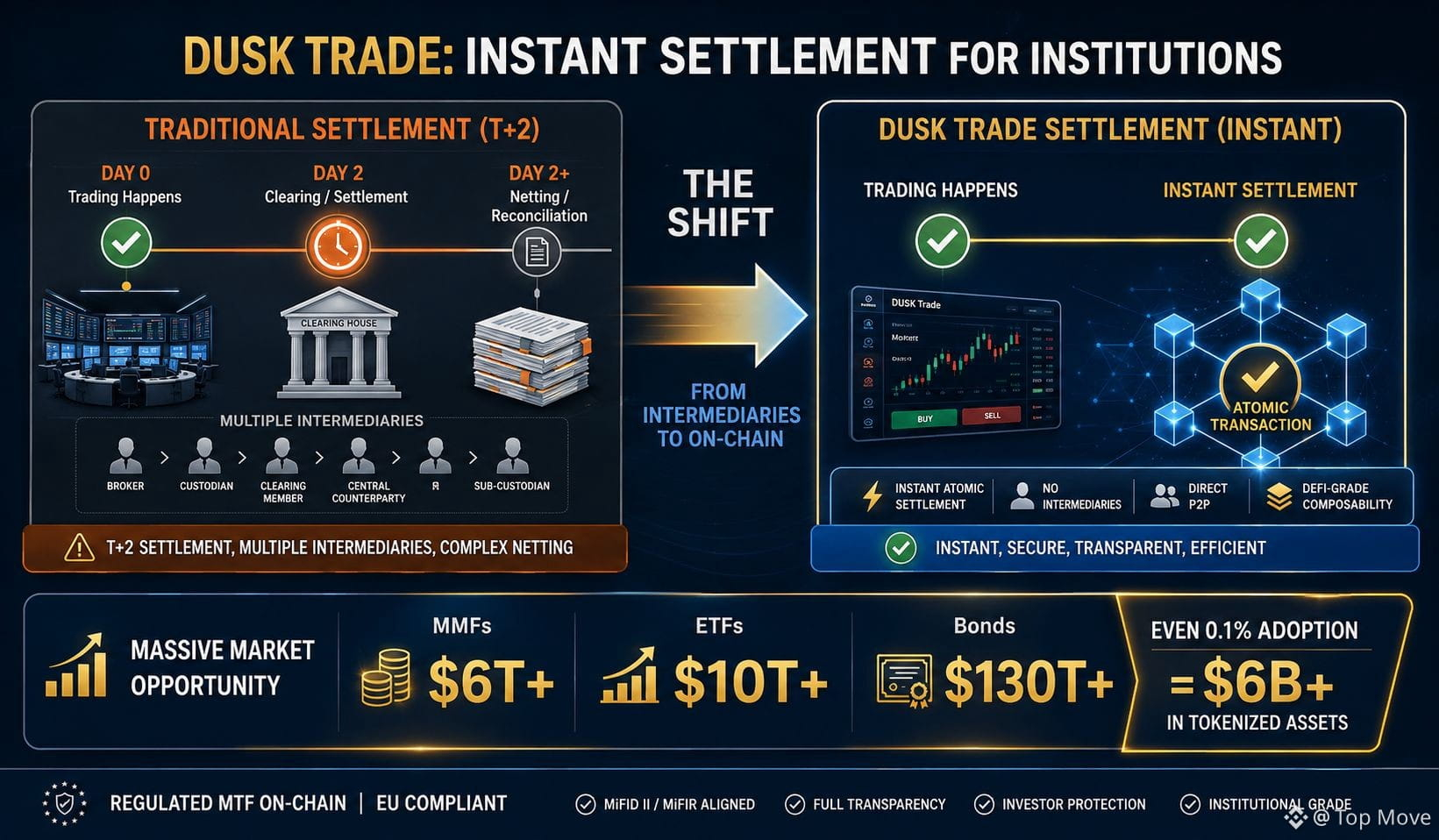
Here's what matters:
Traditional equity settlement: T+2 (2-day clearing, intermediaries, netting complexity)
Dusk Trade settlement: Instant (atomic on-chain, no intermediaries, DeFi-grade composability)
But here's what actually surprised me:
Dusk Trade is structured as a REGULATED MTF (Multilateral Trading Facility) + investment platform under EU law.
Translation: Not a DeFi app trying to work around regulations. An actual licensed financial venue operating on-chain.
MMFs (money market funds) alone represent $6+ trillion globally. If Dusk Trade captures even 0.1%, that's $6 billion in tokenized assets.
Add ETFs ($10+ trillion), bonds ($130+ trillion), RWAs (emerging but growing), and you're looking at a market opportunity that dwarfs most crypto infrastructure.
What actually concerns me:
Does instant settlement work for all product types?
Some institutional flows NEED clearing/netting (complex multi-party settlement). Dusk Trade's atomic model might be too rigid for that.
But for MMFs and simple ETFs? Instant settlement is genuinely revolutionary.
My actual question:
Which financial products move to Dusk Trade FIRST? The ones that benefit most from instant settlement will drive adoption. The complex ones stay on traditional rails longer.
That sequencing determines everything.
@Dusk_Foundation $DUSK #dusk
THE NEOBROKER THAT CHANGES SETTLEMENT
I've been analyzing Dusk Trade and realized something most people miss:
This isn't just "DeFi for institutions."
This is institutional settlement being rebuilt from scratch.
Here's what matters:
Traditional equity settlement: T+2 (2-day clearing, intermediaries, netting complexity)
Dusk Trade settlement: Instant (atomic on-chain, no intermediaries, DeFi-grade composability)
But here's what actually surprised me:
Dusk Trade is structured as a REGULATED MTF (Multilateral Trading Facility) + investment platform under EU law.
Translation: Not a DeFi app trying to work around regulations. An actual licensed financial venue operating on-chain.
MMFs (money market funds) alone represent $6+ trillion globally. If Dusk Trade captures even 0.1%, that's $6 billion in tokenized assets.
Add ETFs ($10+ trillion), bonds ($130+ trillion), RWAs (emerging but growing), and you're looking at a market opportunity that dwarfs most crypto infrastructure.
What actually concerns me:
Does instant settlement work for all product types?
Some institutional flows NEED clearing/netting (complex multi-party settlement). Dusk Trade's atomic model might be too rigid for that.
But for MMFs and simple ETFs? Instant settlement is genuinely revolutionary.
My actual question:
Which financial products move to Dusk Trade FIRST? The ones that benefit most from instant settlement will drive adoption. The complex ones stay on traditional rails longer.
That sequencing determines everything.
@Dusk $DUSK #dusk
I've been analyzing Dusk Trade and realized something most people miss:
This isn't just "DeFi for institutions."
This is institutional settlement being rebuilt from scratch.
Here's what matters:
Traditional equity settlement: T+2 (2-day clearing, intermediaries, netting complexity)
Dusk Trade settlement: Instant (atomic on-chain, no intermediaries, DeFi-grade composability)
But here's what actually surprised me:
Dusk Trade is structured as a REGULATED MTF (Multilateral Trading Facility) + investment platform under EU law.
Translation: Not a DeFi app trying to work around regulations. An actual licensed financial venue operating on-chain.
MMFs (money market funds) alone represent $6+ trillion globally. If Dusk Trade captures even 0.1%, that's $6 billion in tokenized assets.
Add ETFs ($10+ trillion), bonds ($130+ trillion), RWAs (emerging but growing), and you're looking at a market opportunity that dwarfs most crypto infrastructure.
What actually concerns me:
Does instant settlement work for all product types?
Some institutional flows NEED clearing/netting (complex multi-party settlement). Dusk Trade's atomic model might be too rigid for that.
But for MMFs and simple ETFs? Instant settlement is genuinely revolutionary.
My actual question:
Which financial products move to Dusk Trade FIRST? The ones that benefit most from instant settlement will drive adoption. The complex ones stay on traditional rails longer.
That sequencing determines everything.
@Dusk $DUSK #dusk
2
116
·
--
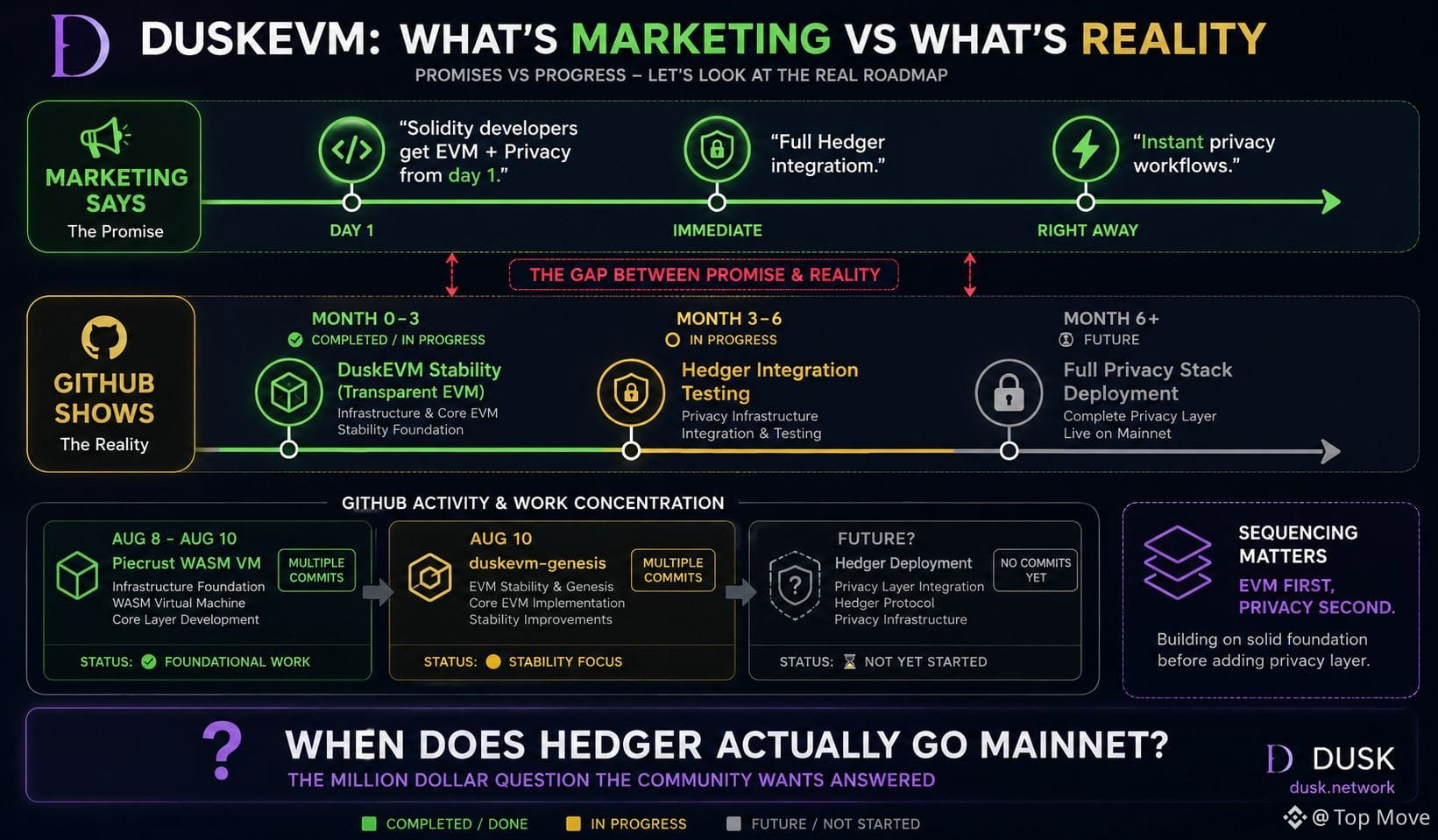
DUSKEVM: SOLIDITY DEVELOPERS' REAL PATH INTO PRIVACY
I've been digging into what DuskEVM actually means for developers.
And there's a gap between marketing and technical reality that matters.
Here's the pitch: "Familiar Solidity/EVM path into Dusk with privacy through Hedger."
Sounds great. Solidity developers don't need to relearn a new language. They get EVM compatibility + privacy optionality.
But I checked the GitHub commits and the work sequencing tells a different story.
DuskEVM is being built for STABILITY first. Hedger (the privacy piece) is coming second.
Translation: Developers deploying on DuskEVM mainnet will get EVM compatibility. Privacy features coming later.
This is actually smart. But it's not what the marketing implies.
Here's what I think is actually happening:
Month 0-3 (Now): DuskEVM launches as compliant EVM chain. No privacy yet. Solidity developers deploy their apps exactly as-is. Works like any other EVM.
Month 3-6: Hedger stabilized and integrated. Developers can opt into privacy for specific contracts/transactions.
Month 6+: Privacy becomes standard. Full Solidity + privacy stack mature.
But here's what bothers me:
If institutions are evaluating DuskEVM mainnet TODAY, they're evaluating a transparent EVM chain. Not a privacy-first chain.
The privacy angle comes later.
This might be intentional (build trust first, add privacy second). Or it might reveal that privacy isn't actually critical for initial institutional adoption.
My question for builders: Do you need Hedger privacy to START deploying on DuskEVM? Or is it valuable only after you've proven the infrastructure works on transparent rails?
Because that answer changes what DuskEVM actually competes with.
@Dusk_Foundation $DUSK #dusk
DUSKEVM: SOLIDITY DEVELOPERS' REAL PATH INTO PRIVACY
I've been digging into what DuskEVM actually means for developers.
And there's a gap between marketing and technical reality that matters.
Here's the pitch: "Familiar Solidity/EVM path into Dusk with privacy through Hedger."
Sounds great. Solidity developers don't need to relearn a new language. They get EVM compatibility + privacy optionality.
But I checked the GitHub commits and the work sequencing tells a different story.
DuskEVM is being built for STABILITY first. Hedger (the privacy piece) is coming second.
Translation: Developers deploying on DuskEVM mainnet will get EVM compatibility. Privacy features coming later.
This is actually smart. But it's not what the marketing implies.
Here's what I think is actually happening:
Month 0-3 (Now): DuskEVM launches as compliant EVM chain. No privacy yet. Solidity developers deploy their apps exactly as-is. Works like any other EVM.
Month 3-6: Hedger stabilized and integrated. Developers can opt into privacy for specific contracts/transactions.
Month 6+: Privacy becomes standard. Full Solidity + privacy stack mature.
But here's what bothers me:
If institutions are evaluating DuskEVM mainnet TODAY, they're evaluating a transparent EVM chain. Not a privacy-first chain.
The privacy angle comes later.
This might be intentional (build trust first, add privacy second). Or it might reveal that privacy isn't actually critical for initial institutional adoption.
My question for builders: Do you need Hedger privacy to START deploying on DuskEVM? Or is it valuable only after you've proven the infrastructure works on transparent rails?
Because that answer changes what DuskEVM actually competes with.
@Dusk $DUSK #dusk
I've been digging into what DuskEVM actually means for developers.
And there's a gap between marketing and technical reality that matters.
Here's the pitch: "Familiar Solidity/EVM path into Dusk with privacy through Hedger."
Sounds great. Solidity developers don't need to relearn a new language. They get EVM compatibility + privacy optionality.
But I checked the GitHub commits and the work sequencing tells a different story.
DuskEVM is being built for STABILITY first. Hedger (the privacy piece) is coming second.
Translation: Developers deploying on DuskEVM mainnet will get EVM compatibility. Privacy features coming later.
This is actually smart. But it's not what the marketing implies.
Here's what I think is actually happening:
Month 0-3 (Now): DuskEVM launches as compliant EVM chain. No privacy yet. Solidity developers deploy their apps exactly as-is. Works like any other EVM.
Month 3-6: Hedger stabilized and integrated. Developers can opt into privacy for specific contracts/transactions.
Month 6+: Privacy becomes standard. Full Solidity + privacy stack mature.
But here's what bothers me:
If institutions are evaluating DuskEVM mainnet TODAY, they're evaluating a transparent EVM chain. Not a privacy-first chain.
The privacy angle comes later.
This might be intentional (build trust first, add privacy second). Or it might reveal that privacy isn't actually critical for initial institutional adoption.
My question for builders: Do you need Hedger privacy to START deploying on DuskEVM? Or is it valuable only after you've proven the infrastructure works on transparent rails?
Because that answer changes what DuskEVM actually competes with.
@Dusk $DUSK #dusk
2
110
Log in to explore more content
Join global crypto users on Binance Square
⚡️ Get latest and useful information about crypto.
💬 Trusted by the world’s largest crypto exchange.
👍 Discover real insights from verified creators.
အီးမေးလ် / ဖုန်းနံပါတ်
ရေပန်းစားနေသော ခေါင်းစဉ်များ
BinanceLaunchesBinanceIntelligence
87,293 views
999 Discussing
🚨 BINANCE JUST PUT AI DIRECTLY INSIDE THE EXCHANGE — AND THIS COULD CHANGE HOW RETAIL TRADES.
Binance has officially launched Binance Intelligence, a new AI layer built into the Binance ecosystem. It combines three products:
Binance AI for everyday users,
Binance AI Pro for automated trading workflows,
and Agent OS for developers building financial agents.
The part traders should care about?
Binance AI can surface market briefs, smart alerts, PnL recaps and personalized information, while AI Pro is designed to turn a plain-English trading idea into a visual strategy workflow.
That means the next phase of exchange competition may not be:
lowest fees vs deepest liquidity.
It could be:
who gives traders the best AI execution layer.
If Binance Intelligence actually drives heavier user activity, automated strategies and higher trading frequency, watch $BNB first.
AI adoption ↑
→ Binance engagement ↑
→ trading activity ↑
→ ecosystem narrative strengthens.
The catalyst I’d watch now:
global rollout + AI Pro launch + measurable user adoption.
Because once AI stops just telling you what the market is doing…
…and starts helping build the trade itself?
That’s when this gets much bigger than another chatbot. 👀
#binancelaunchesbinanceintelligence #EvernorthXRPTreasuryCompletesSPACMerger #ADAGains10%Above$0.27 #ETHUp70%InQ3ButLiquidityFalls #EthStakingExitQueueHits2026High
KimHotbae
·နှစ်သက်မှု 28 ခု
·34.9k views
StriveBuys2000BTCFor$169M
2,026 views
39 Discussing
EvernorthXRPTreasuryCompletesSPACMerger
63,511 views
690 Discussing