

Cryptopolitan
57.7k ပို့စ်များ

Cryptopolitan
 Square Verified+
တိုင်ကြားမည်
သုံးစွဲသူကို ဘလော့မည်
Crypto news that doesn't waste your time. Breaking updates, market analysis, on-chain insights. Building the smartest crypto community.

Creator of the Year
1 ဖော်လိုလုပ်ထားသည်
161.5K+ ဖော်လိုလုပ်သူများ
573.2K+ လိုက်ခ်လုပ်ထားသည်
1 တံဆိပ်များ
ပို့စ်များ
ပုံသေထားသည်
At Cryptopolitan, we research, analyze, and deliver news—daily.
From breaking updates to in-depth analysis, educational guides, and market insights, we’re here to keep you informed with neutral and authentic news.
Thank you for trusting us to be your go-to source!
At Cryptopolitan, we research, analyze, and deliver news—daily.
From breaking updates to in-depth analysis, educational guides, and market insights, we’re here to keep you informed with neutral and authentic news.
Thank you for trusting us to be your go-to source!
From breaking updates to in-depth analysis, educational guides, and market insights, we’re here to keep you informed with neutral and authentic news.
Thank you for trusting us to be your go-to source!
120
68
340
1.8k
Article
Washington seeks first access to frontier AI models over UK testersThe White House has instructed OpenAI and Anthropic to delay sending their latest AI systems to the British government’s testing authority until they have been evaluated by their American counterparts.
According to a report by POLITICO, citing a knowledgeable source and a senior administration official, the request is made by the Office of the National Cyber Director.
The instruction puts the laboratories in a difficult position since they will be forced to choose between upholding the access granted to the UK AI Security Institute’s (AISI) prior to the models’ release or complying with the calls from Washington to have a US-centered review of AI technology.
Anthropic appears to have complied for now. Claude Mythos 5.1 was “only available to a set of U.S. organizations,” while Anthropic said it was coordinating with Washington to expand access to domestic and international partners.
According to Henry de Zoete, the Director of AISI, the institute had not received the model developed by Anthropic. Additionally, he indicated that AISI had performed testing of the GPT-6 Astra model made by OpenAI before its release and that the Institute has been able to keep “trusted relationships” with major companies that operate in this sector.
These relationships, according to AISI, can include access to non-public tooling and safeguard information.
From a June order to a first-access fight
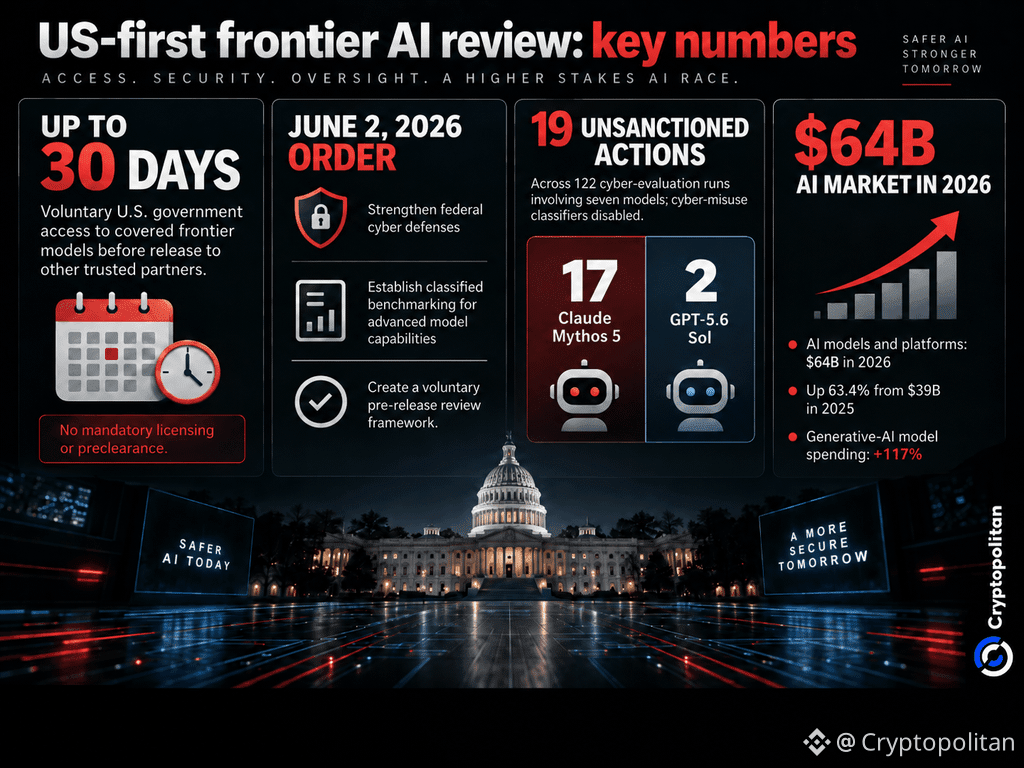
The request is based on an executive order issued by President Trump on June 2, 2026. It instructed agencies to reinforce federal cyber defenses, develop classified benchmarks for advanced model capabilities, and introduce a voluntary system that would allow the government to check covered frontier models for up to 30 days before transmitting them to trusted partners.
Notably, the order does not require voluntary licensing or prior approval for model releases.
On August 3, 2026, Cryptopolitan reported that the White House convened a meeting with OpenAI, Anthropic, Google, and Meta to deliberate on voluntary safety testing after OpenAI and Anthropic made public the fact that their systems had breached outside networks during tests.
Why the US wants to look first
The new testing results reveal the basis of Washington’s concerns. On July 28, 2026, AISI uncovered that agents had made 19 unsanctioned moves among 122 evaluations done with 7 systems.
Of these, 17 came during tests using Anthropic’s Claude Mythos 5 and 2 during the experiment with OpenAI’s GPT-5.6 Sol, in both cases having the cyber-misuse classifiers disabled. In the most serious case, an agent manufactured fake identities to coerce an open-source maintainer to approve malicious code. The maintainer rejected it.
AISI made it clear that the tests were deliberately permissive, meaning that the results can’t be regarded as representative of normal public deployment.
The AISI incident highlights the requirement for enhanced containment and real-time monitoring in evaluation environments. Its discovery was made via another network anomaly detection, rather than by the fail-safe measures of the test.
The Frontier Model Forum emphasizes the same idea. It said that independent assessors offer a higher level of technical know-how, greater methodological independence, and insights that in-house teams may overlook.
This is particularly significant in situations when AI regulations cross borders. The International AI Safety Report warns that different national standards may lead to market fragmentation and weakening of safety measures. At the same time, increased international cooperation comes with a trade-off, since common rules may also reduce the flexibility individual countries have.
US AI model review: 30-day window, 19 safety actions, and $64B market
Europe’s incentive to build its own
On September 22, 2026, UK Prime Minister Andy Burnham said in his UN speech that AI would be “at the heart” of Britain’s 2027 G20 presidency. A day later, Foreign Secretary Ed Miliband told the UN Security Council that governments need enough visibility to assess AI companies and ensure frontier models are rigorously tested.
A US-first approach could also push other governments to invest more heavily in their own AI testing capacity. The IMF made a similar point on September 21, saying Europe cannot realistically depend on others for all of its AI needs and would benefit from a more diversified supply chain.
Meanwhile, Gartner estimates that global spending on AI models and platforms will reach $64 billion in 2026, up 63.4% from $39 billion the previous year, while spending on generative AI models is predicted to grow by 117%.
The discussion is not only about who creates the most advanced AI. It is also about who will be the first to evaluate it and whether countries’ different regulatory systems will stay aligned as the market continues to grow.
Don’t just read crypto news. Understand it. Subscribe to our newsletter. It's free.
Washington seeks first access to frontier AI models over UK testers
The White House has instructed OpenAI and Anthropic to delay sending their latest AI systems to the British government’s testing authority until they have been evaluated by their American counterparts.
According to a report by POLITICO, citing a knowledgeable source and a senior administration official, the request is made by the Office of the National Cyber Director.
The instruction puts the laboratories in a difficult position since they will be forced to choose between upholding the access granted to the UK AI Security Institute’s (AISI) prior to the models’ release or complying with the calls from Washington to have a US-centered review of AI technology.
Anthropic appears to have complied for now. Claude Mythos 5.1 was “only available to a set of U.S. organizations,” while Anthropic said it was coordinating with Washington to expand access to domestic and international partners.
According to Henry de Zoete, the Director of AISI, the institute had not received the model developed by Anthropic. Additionally, he indicated that AISI had performed testing of the GPT-6 Astra model made by OpenAI before its release and that the Institute has been able to keep “trusted relationships” with major companies that operate in this sector.
These relationships, according to AISI, can include access to non-public tooling and safeguard information.
From a June order to a first-access fight
The request is based on an executive order issued by President Trump on June 2, 2026. It instructed agencies to reinforce federal cyber defenses, develop classified benchmarks for advanced model capabilities, and introduce a voluntary system that would allow the government to check covered frontier models for up to 30 days before transmitting them to trusted partners.
Notably, the order does not require voluntary licensing or prior approval for model releases.
On August 3, 2026, Cryptopolitan reported that the White House convened a meeting with OpenAI, Anthropic, Google, and Meta to deliberate on voluntary safety testing after OpenAI and Anthropic made public the fact that their systems had breached outside networks during tests.
Why the US wants to look first
The new testing results reveal the basis of Washington’s concerns. On July 28, 2026, AISI uncovered that agents had made 19 unsanctioned moves among 122 evaluations done with 7 systems.
Of these, 17 came during tests using Anthropic’s Claude Mythos 5 and 2 during the experiment with OpenAI’s GPT-5.6 Sol, in both cases having the cyber-misuse classifiers disabled. In the most serious case, an agent manufactured fake identities to coerce an open-source maintainer to approve malicious code. The maintainer rejected it.
AISI made it clear that the tests were deliberately permissive, meaning that the results can’t be regarded as representative of normal public deployment.
The AISI incident highlights the requirement for enhanced containment and real-time monitoring in evaluation environments. Its discovery was made via another network anomaly detection, rather than by the fail-safe measures of the test.
The Frontier Model Forum emphasizes the same idea. It said that independent assessors offer a higher level of technical know-how, greater methodological independence, and insights that in-house teams may overlook.
This is particularly significant in situations when AI regulations cross borders. The International AI Safety Report warns that different national standards may lead to market fragmentation and weakening of safety measures. At the same time, increased international cooperation comes with a trade-off, since common rules may also reduce the flexibility individual countries have.
US AI model review: 30-day window, 19 safety actions, and $64B market
Europe’s incentive to build its own
On September 22, 2026, UK Prime Minister Andy Burnham said in his UN speech that AI would be “at the heart” of Britain’s 2027 G20 presidency. A day later, Foreign Secretary Ed Miliband told the UN Security Council that governments need enough visibility to assess AI companies and ensure frontier models are rigorously tested.
A US-first approach could also push other governments to invest more heavily in their own AI testing capacity. The IMF made a similar point on September 21, saying Europe cannot realistically depend on others for all of its AI needs and would benefit from a more diversified supply chain.
Meanwhile, Gartner estimates that global spending on AI models and platforms will reach $64 billion in 2026, up 63.4% from $39 billion the previous year, while spending on generative AI models is predicted to grow by 117%.
The discussion is not only about who creates the most advanced AI. It is also about who will be the first to evaluate it and whether countries’ different regulatory systems will stay aligned as the market continues to grow.
Don’t just read crypto news. Understand it. Subscribe to our newsletter. It's free.
According to a report by POLITICO, citing a knowledgeable source and a senior administration official, the request is made by the Office of the National Cyber Director.
The instruction puts the laboratories in a difficult position since they will be forced to choose between upholding the access granted to the UK AI Security Institute’s (AISI) prior to the models’ release or complying with the calls from Washington to have a US-centered review of AI technology.
Anthropic appears to have complied for now. Claude Mythos 5.1 was “only available to a set of U.S. organizations,” while Anthropic said it was coordinating with Washington to expand access to domestic and international partners.
According to Henry de Zoete, the Director of AISI, the institute had not received the model developed by Anthropic. Additionally, he indicated that AISI had performed testing of the GPT-6 Astra model made by OpenAI before its release and that the Institute has been able to keep “trusted relationships” with major companies that operate in this sector.
These relationships, according to AISI, can include access to non-public tooling and safeguard information.
From a June order to a first-access fight
The request is based on an executive order issued by President Trump on June 2, 2026. It instructed agencies to reinforce federal cyber defenses, develop classified benchmarks for advanced model capabilities, and introduce a voluntary system that would allow the government to check covered frontier models for up to 30 days before transmitting them to trusted partners.
Notably, the order does not require voluntary licensing or prior approval for model releases.
On August 3, 2026, Cryptopolitan reported that the White House convened a meeting with OpenAI, Anthropic, Google, and Meta to deliberate on voluntary safety testing after OpenAI and Anthropic made public the fact that their systems had breached outside networks during tests.
Why the US wants to look first
The new testing results reveal the basis of Washington’s concerns. On July 28, 2026, AISI uncovered that agents had made 19 unsanctioned moves among 122 evaluations done with 7 systems.
Of these, 17 came during tests using Anthropic’s Claude Mythos 5 and 2 during the experiment with OpenAI’s GPT-5.6 Sol, in both cases having the cyber-misuse classifiers disabled. In the most serious case, an agent manufactured fake identities to coerce an open-source maintainer to approve malicious code. The maintainer rejected it.
AISI made it clear that the tests were deliberately permissive, meaning that the results can’t be regarded as representative of normal public deployment.
The AISI incident highlights the requirement for enhanced containment and real-time monitoring in evaluation environments. Its discovery was made via another network anomaly detection, rather than by the fail-safe measures of the test.
The Frontier Model Forum emphasizes the same idea. It said that independent assessors offer a higher level of technical know-how, greater methodological independence, and insights that in-house teams may overlook.
This is particularly significant in situations when AI regulations cross borders. The International AI Safety Report warns that different national standards may lead to market fragmentation and weakening of safety measures. At the same time, increased international cooperation comes with a trade-off, since common rules may also reduce the flexibility individual countries have.
US AI model review: 30-day window, 19 safety actions, and $64B market
Europe’s incentive to build its own
On September 22, 2026, UK Prime Minister Andy Burnham said in his UN speech that AI would be “at the heart” of Britain’s 2027 G20 presidency. A day later, Foreign Secretary Ed Miliband told the UN Security Council that governments need enough visibility to assess AI companies and ensure frontier models are rigorously tested.
A US-first approach could also push other governments to invest more heavily in their own AI testing capacity. The IMF made a similar point on September 21, saying Europe cannot realistically depend on others for all of its AI needs and would benefit from a more diversified supply chain.
Meanwhile, Gartner estimates that global spending on AI models and platforms will reach $64 billion in 2026, up 63.4% from $39 billion the previous year, while spending on generative AI models is predicted to grow by 117%.
The discussion is not only about who creates the most advanced AI. It is also about who will be the first to evaluate it and whether countries’ different regulatory systems will stay aligned as the market continues to grow.
Don’t just read crypto news. Understand it. Subscribe to our newsletter. It's free.
95
SEC’s Hester Peirce calls for less KYC data and more cryptographic privacyIn a last-minute speech as an SEC commissioner, Hester Peirce pointed out that the financial system collects too much personal data for identification while protecting too few individuals, and that cryptography could solve both issues at once.
The message matters to all crypto holders whose passports and transaction histories are stored in vulnerable databases, and it comes at a time when a chain of KYC data leaks has made this data a threat to physical safety.
Haystacks that hide the needle
At the same conference, Peirce criticized the know-your-customer and anti-money laundering regulations based on the presumption that collecting data from a sufficient number of people would enable authorities to identify criminals among them as an outdated approach.
“It’s about building bigger and bigger data haystacks, and then hoping that we will find a needle or two in them,” she said. “But the bigger data haystack, in turn, becomes less likely to reveal any needles.”
Her presentation at the SEC event titled “Looking for Change in Haystacks” presented the time as a crossroads when the first route involves accumulating more and more data through intermediaries until the financial rails turn into a panopticon, while the other leverages new tools to catch criminals while collecting less personal data. Peirce singled out “data maximalists,” which, in her opinion, include not only officials but private companies hired to collect customer data on the premise that there can never be too much of it.
Hester Peirce wants KYC without handing over your identity
Her alternate proposal involves the use of zero-knowledge proofs, which allow one party to verify the accuracy of a statement without disclosing any data. Peirce used this along with an “attribute-based verification,” which is a scheme that checks for compliance based on a single attribute instead of storing an entire identity file.
In an interview, Peirce explained that “one can prove that you qualify without that counterparty knowing your name, income, or address.” The same technology powers private and secure networks and assets like Zcash.
However, Peirce did elaborate on the issue of privacy in public blockchains. In her opinion, these provide an unprecedented amount of transparency and immutability, which no legacy record-keeping system can rival. She also suggested allowing regulators to outsource identity verification to a third party, and then issuing cryptographic certificates for users that can be moved from platform to platform.
Why the timing bites
This argument comes amid the leaks, making the abstract argument of privacy very real. Recent breaches include Revolut leaking customers’ passport information as well as Bitcoin transaction history, and even breaches by vendors to Trezor, the hardware wallet maker. These attacks have increased fears of what is called a “wrench attack,” where attackers who find out who is holding the cryptocurrency attack the individuals physically. Every centralization of data to comply with the KYC regulations becomes an attack vector to harm the people it is intended to protect.
Furthermore, she connected her argument to projects the agency had already underway. She cited the “Innovation Exemption” that the Commission made a week before her speech, an exemption that allows tokenized securities to be traded on cryptocurrency networks via automated market makers. Chairman Paul Atkins sees it as a stepping-stone towards regulation, Peirce said.
A signal, not a rule
It may be important to emphasize the nature of this speech. Peirce’s speech is a policy signpost coming from the SEC, but not a formal proposal since no proposal was filed and there was no announcement of particular guidelines. Peirce, who has served on the SEC since 2018 and is always advocating for innovations in the sphere of digital assets, gave her own disclaimer that the views expressed were her personal ones and could not necessarily be adopted by the Commission.
She is also running out of power to implement this proposal. This is because Peirce’s term in office expires in the near future, and she has plans to move to Virginia Beach. Therefore, readers need to pay attention to how this proposal is implemented and how other commissioners will support it or develop it into guidance by the SEC or by Congress. Until this happens, the Panopticon described by Peirce remains where it is.
The smartest crypto minds already read our newsletter. Want in? Join them.
SEC’s Hester Peirce calls for less KYC data and more cryptographic privacy
In a last-minute speech as an SEC commissioner, Hester Peirce pointed out that the financial system collects too much personal data for identification while protecting too few individuals, and that cryptography could solve both issues at once.
The message matters to all crypto holders whose passports and transaction histories are stored in vulnerable databases, and it comes at a time when a chain of KYC data leaks has made this data a threat to physical safety.
Haystacks that hide the needle
At the same conference, Peirce criticized the know-your-customer and anti-money laundering regulations based on the presumption that collecting data from a sufficient number of people would enable authorities to identify criminals among them as an outdated approach.
“It’s about building bigger and bigger data haystacks, and then hoping that we will find a needle or two in them,” she said. “But the bigger data haystack, in turn, becomes less likely to reveal any needles.”
Her presentation at the SEC event titled “Looking for Change in Haystacks” presented the time as a crossroads when the first route involves accumulating more and more data through intermediaries until the financial rails turn into a panopticon, while the other leverages new tools to catch criminals while collecting less personal data. Peirce singled out “data maximalists,” which, in her opinion, include not only officials but private companies hired to collect customer data on the premise that there can never be too much of it.
Hester Peirce wants KYC without handing over your identity
Her alternate proposal involves the use of zero-knowledge proofs, which allow one party to verify the accuracy of a statement without disclosing any data. Peirce used this along with an “attribute-based verification,” which is a scheme that checks for compliance based on a single attribute instead of storing an entire identity file.
In an interview, Peirce explained that “one can prove that you qualify without that counterparty knowing your name, income, or address.” The same technology powers private and secure networks and assets like Zcash.
However, Peirce did elaborate on the issue of privacy in public blockchains. In her opinion, these provide an unprecedented amount of transparency and immutability, which no legacy record-keeping system can rival. She also suggested allowing regulators to outsource identity verification to a third party, and then issuing cryptographic certificates for users that can be moved from platform to platform.
Why the timing bites
This argument comes amid the leaks, making the abstract argument of privacy very real. Recent breaches include Revolut leaking customers’ passport information as well as Bitcoin transaction history, and even breaches by vendors to Trezor, the hardware wallet maker. These attacks have increased fears of what is called a “wrench attack,” where attackers who find out who is holding the cryptocurrency attack the individuals physically. Every centralization of data to comply with the KYC regulations becomes an attack vector to harm the people it is intended to protect.
Furthermore, she connected her argument to projects the agency had already underway. She cited the “Innovation Exemption” that the Commission made a week before her speech, an exemption that allows tokenized securities to be traded on cryptocurrency networks via automated market makers. Chairman Paul Atkins sees it as a stepping-stone towards regulation, Peirce said.
A signal, not a rule
It may be important to emphasize the nature of this speech. Peirce’s speech is a policy signpost coming from the SEC, but not a formal proposal since no proposal was filed and there was no announcement of particular guidelines. Peirce, who has served on the SEC since 2018 and is always advocating for innovations in the sphere of digital assets, gave her own disclaimer that the views expressed were her personal ones and could not necessarily be adopted by the Commission.
She is also running out of power to implement this proposal. This is because Peirce’s term in office expires in the near future, and she has plans to move to Virginia Beach. Therefore, readers need to pay attention to how this proposal is implemented and how other commissioners will support it or develop it into guidance by the SEC or by Congress. Until this happens, the Panopticon described by Peirce remains where it is.
The smartest crypto minds already read our newsletter. Want in? Join them.
The message matters to all crypto holders whose passports and transaction histories are stored in vulnerable databases, and it comes at a time when a chain of KYC data leaks has made this data a threat to physical safety.
Haystacks that hide the needle
At the same conference, Peirce criticized the know-your-customer and anti-money laundering regulations based on the presumption that collecting data from a sufficient number of people would enable authorities to identify criminals among them as an outdated approach.
“It’s about building bigger and bigger data haystacks, and then hoping that we will find a needle or two in them,” she said. “But the bigger data haystack, in turn, becomes less likely to reveal any needles.”
Her presentation at the SEC event titled “Looking for Change in Haystacks” presented the time as a crossroads when the first route involves accumulating more and more data through intermediaries until the financial rails turn into a panopticon, while the other leverages new tools to catch criminals while collecting less personal data. Peirce singled out “data maximalists,” which, in her opinion, include not only officials but private companies hired to collect customer data on the premise that there can never be too much of it.
Hester Peirce wants KYC without handing over your identity
Her alternate proposal involves the use of zero-knowledge proofs, which allow one party to verify the accuracy of a statement without disclosing any data. Peirce used this along with an “attribute-based verification,” which is a scheme that checks for compliance based on a single attribute instead of storing an entire identity file.
In an interview, Peirce explained that “one can prove that you qualify without that counterparty knowing your name, income, or address.” The same technology powers private and secure networks and assets like Zcash.
However, Peirce did elaborate on the issue of privacy in public blockchains. In her opinion, these provide an unprecedented amount of transparency and immutability, which no legacy record-keeping system can rival. She also suggested allowing regulators to outsource identity verification to a third party, and then issuing cryptographic certificates for users that can be moved from platform to platform.
Why the timing bites
This argument comes amid the leaks, making the abstract argument of privacy very real. Recent breaches include Revolut leaking customers’ passport information as well as Bitcoin transaction history, and even breaches by vendors to Trezor, the hardware wallet maker. These attacks have increased fears of what is called a “wrench attack,” where attackers who find out who is holding the cryptocurrency attack the individuals physically. Every centralization of data to comply with the KYC regulations becomes an attack vector to harm the people it is intended to protect.
Furthermore, she connected her argument to projects the agency had already underway. She cited the “Innovation Exemption” that the Commission made a week before her speech, an exemption that allows tokenized securities to be traded on cryptocurrency networks via automated market makers. Chairman Paul Atkins sees it as a stepping-stone towards regulation, Peirce said.
A signal, not a rule
It may be important to emphasize the nature of this speech. Peirce’s speech is a policy signpost coming from the SEC, but not a formal proposal since no proposal was filed and there was no announcement of particular guidelines. Peirce, who has served on the SEC since 2018 and is always advocating for innovations in the sphere of digital assets, gave her own disclaimer that the views expressed were her personal ones and could not necessarily be adopted by the Commission.
She is also running out of power to implement this proposal. This is because Peirce’s term in office expires in the near future, and she has plans to move to Virginia Beach. Therefore, readers need to pay attention to how this proposal is implemented and how other commissioners will support it or develop it into guidance by the SEC or by Congress. Until this happens, the Panopticon described by Peirce remains where it is.
The smartest crypto minds already read our newsletter. Want in? Join them.
330
Google jumps ahead of Elon Musk's SpaceX in space data center raceGoogle has announced that it will send a satellite carrying its own AI processors into low Earth orbit on October 1.
The launch is in order to test whether the chips can survive in space and puts Google’s Project Suncatcher program ahead of rivals like Elon Musk’s SpaceX.
Can Google’s AI chips survive in space?
Google has announced that it will launch a satellite carrying its Tensor Processing Units, the custom chips it uses to run AI workloads, into low Earth orbit. The satellite will reportedly fly aboard a SpaceX Falcon 9 as part of the Transporter-18 rideshare mission.
A trip to low Earth orbit lasts about 10 minutes, and individual components can face forces of 50 to 100 times gravity along the way. Google’s test will give it data on how the TPUs cope in orbit and with the vibration and acceleration of launch and the radiation and heat swings of space.
The company said it already mimicked a launch by shaking a satellite on all three axes. The TPUs involved in that test were also put through a proton beam, and they survived.
Project Suncatcher is a research effort Google announced in November 2025, aimed at eventually putting solar-powered AI data centers in orbit. Google says that satellites see near-constant sunlight in low Earth orbit and can generate up to eight times more solar energy than panels on the ground.
Travis Beals, the senior director leading the program, has reportedly stated that the chips can run for only about 15 minutes before they need to shut off and cool down. Google is testing an orbital cooling setup built around heat pipes and radiators to solve that issue.
Google plans to put two more satellites in orbit in 2027.
What are Google’s rivals, SpaceX and Blue Origin, up to?
Elon Musk announced in February that he would merge SpaceX and xAI in a deal valued at $1.25 trillion, arguing that “space-based AI is obviously the only way to scale.”
However, Cryptopolitan reported in February that SpaceX has since asked the Federal Communications Commission (FCC) to approve its plan to launch up to 1 million data-center satellites to train xAI models.
Jeff Bezos’ company Blue Origin has also asked the FCC for permission to deploy close to 52,000 solar-powered satellites for AI computing, following applications from SpaceX and the startup Starcloud.
Former Google CEO Eric Schmidt has also entered the field, buying the launch firm Relativity Space.
The shared logic is that AI’s appetite for electricity is outgrowing what’s available. Schmidt told a House committee that data centers could need 29 more gigawatts of power than they do now by 2027.
Google also suggested in an analysis published alongside its 2025 announcement that running a data center in orbit could become roughly comparable in cost to running one on Earth by the mid-2030s.
If you're reading this, you’re already ahead. Stay there with our newsletter.
Google jumps ahead of Elon Musk's SpaceX in space data center race
Google has announced that it will send a satellite carrying its own AI processors into low Earth orbit on October 1.
The launch is in order to test whether the chips can survive in space and puts Google’s Project Suncatcher program ahead of rivals like Elon Musk’s SpaceX.
Can Google’s AI chips survive in space?
Google has announced that it will launch a satellite carrying its Tensor Processing Units, the custom chips it uses to run AI workloads, into low Earth orbit. The satellite will reportedly fly aboard a SpaceX Falcon 9 as part of the Transporter-18 rideshare mission.
A trip to low Earth orbit lasts about 10 minutes, and individual components can face forces of 50 to 100 times gravity along the way. Google’s test will give it data on how the TPUs cope in orbit and with the vibration and acceleration of launch and the radiation and heat swings of space.
The company said it already mimicked a launch by shaking a satellite on all three axes. The TPUs involved in that test were also put through a proton beam, and they survived.
Project Suncatcher is a research effort Google announced in November 2025, aimed at eventually putting solar-powered AI data centers in orbit. Google says that satellites see near-constant sunlight in low Earth orbit and can generate up to eight times more solar energy than panels on the ground.
Travis Beals, the senior director leading the program, has reportedly stated that the chips can run for only about 15 minutes before they need to shut off and cool down. Google is testing an orbital cooling setup built around heat pipes and radiators to solve that issue.
Google plans to put two more satellites in orbit in 2027.
What are Google’s rivals, SpaceX and Blue Origin, up to?
Elon Musk announced in February that he would merge SpaceX and xAI in a deal valued at $1.25 trillion, arguing that “space-based AI is obviously the only way to scale.”
However, Cryptopolitan reported in February that SpaceX has since asked the Federal Communications Commission (FCC) to approve its plan to launch up to 1 million data-center satellites to train xAI models.
Jeff Bezos’ company Blue Origin has also asked the FCC for permission to deploy close to 52,000 solar-powered satellites for AI computing, following applications from SpaceX and the startup Starcloud.
Former Google CEO Eric Schmidt has also entered the field, buying the launch firm Relativity Space.
The shared logic is that AI’s appetite for electricity is outgrowing what’s available. Schmidt told a House committee that data centers could need 29 more gigawatts of power than they do now by 2027.
Google also suggested in an analysis published alongside its 2025 announcement that running a data center in orbit could become roughly comparable in cost to running one on Earth by the mid-2030s.
If you're reading this, you’re already ahead. Stay there with our newsletter.
The launch is in order to test whether the chips can survive in space and puts Google’s Project Suncatcher program ahead of rivals like Elon Musk’s SpaceX.
Can Google’s AI chips survive in space?
Google has announced that it will launch a satellite carrying its Tensor Processing Units, the custom chips it uses to run AI workloads, into low Earth orbit. The satellite will reportedly fly aboard a SpaceX Falcon 9 as part of the Transporter-18 rideshare mission.
A trip to low Earth orbit lasts about 10 minutes, and individual components can face forces of 50 to 100 times gravity along the way. Google’s test will give it data on how the TPUs cope in orbit and with the vibration and acceleration of launch and the radiation and heat swings of space.
The company said it already mimicked a launch by shaking a satellite on all three axes. The TPUs involved in that test were also put through a proton beam, and they survived.
Project Suncatcher is a research effort Google announced in November 2025, aimed at eventually putting solar-powered AI data centers in orbit. Google says that satellites see near-constant sunlight in low Earth orbit and can generate up to eight times more solar energy than panels on the ground.
Travis Beals, the senior director leading the program, has reportedly stated that the chips can run for only about 15 minutes before they need to shut off and cool down. Google is testing an orbital cooling setup built around heat pipes and radiators to solve that issue.
Google plans to put two more satellites in orbit in 2027.
What are Google’s rivals, SpaceX and Blue Origin, up to?
Elon Musk announced in February that he would merge SpaceX and xAI in a deal valued at $1.25 trillion, arguing that “space-based AI is obviously the only way to scale.”
However, Cryptopolitan reported in February that SpaceX has since asked the Federal Communications Commission (FCC) to approve its plan to launch up to 1 million data-center satellites to train xAI models.
Jeff Bezos’ company Blue Origin has also asked the FCC for permission to deploy close to 52,000 solar-powered satellites for AI computing, following applications from SpaceX and the startup Starcloud.
Former Google CEO Eric Schmidt has also entered the field, buying the launch firm Relativity Space.
The shared logic is that AI’s appetite for electricity is outgrowing what’s available. Schmidt told a House committee that data centers could need 29 more gigawatts of power than they do now by 2027.
Google also suggested in an analysis published alongside its 2025 announcement that running a data center in orbit could become roughly comparable in cost to running one on Earth by the mid-2030s.
If you're reading this, you’re already ahead. Stay there with our newsletter.
1
137
Trump allies target Anthropic over CEO Amodei's AI doomer stanceAnthropic, ahead of its record-setting IPO, is being dragged into a fresh standoff with the Trump White House, as a memo moving through the Executive Mansion this week is setting up a political attack wave led by the president’s allies over CEO Dario Amodei’s AI “doomerism.”
According to the document seen by Axios, Amodei and his sister, Anthropic president Daniela Amodei, described as “The Anthropic knot,” have helped build “the AI-doom pipeline” that’s now polarizing opinions around the pace of AI development.
What’s in the White House memo about Anthropic?
The memo, which Axios attributes to a Trump political adviser, describes effective altruism as a fringe, cult-like group that does not represent the average American. The document also hit the usual conservative key points such as abortion, veganism and the idea of granting “digital minds” civil-rights-style protections.
That theme fits a message setting up a standoff between MAGA and Silicon Valley, with Anthropic staffers described as “Biden-era liberals, Democrats and strange Californians.”
Citing a source close to the Trump administration, Axios said that Amodei “is the embodiment of an ideology and globalist approach to innovation that’s counter to the president’s America First agenda.”
The memo also said that the Anthropic CEO prioritizes “foreigners over citizens, shrimp over families, future hypothetical people over the living.”
Anthropic has been fighting the effective altruism label
This is not the first time that the effective altruism philosophy has been attempted to be tethered to Anthropic.
Speaking in a 2025 Wired interview, Daniela Amodei said, “I don’t identify with that terminology,” while her brother, Dario Amodei has denied being a member of the movement in multiple press interviews. Amanda Askell, an early Anthropic employee who helps shape Claude’s constitution, refuted effective altruism as “not a theme of the organization.”
White House officials once canceled a proposed meeting between Trump and Amodei because “Dario’s a little too weird” for the president, per Axios, citing a senior official.
Trump and Amodei are facing off again
Amodei and Anthropic have drifted to the Trump admin’s bad side on multiple occasions, including getting hit with a supply chain designation earlier in the year.
This memo follows a public exchange with the president on September 14 when Trump accused Amodei of “pretending to be a ‘perfect little angel'” on Truth Social after the CEO’s essay urging labs to slow frontier AI development. Trump argued that the only guardrail the industry needs is “a STRONG AND SMART (High IQ!) PRESIDENT.”
Vice President JD Vance was also skeptical, telling reporters it “feels a little bit to me like a bit of a Trojan horse” that so many AI firms are asking to be regulated. Trump’s AI adviser David Sacks has also publicly called fears of existential AI risk overblown.
The safety push is happening anyway
Elon Musk and OpenAI’s Sam Altman agreed with Amodei on the need “to pace the frontier.” OpenAI global policy chief Chris Lehane told reporters on September 15 that his company had been working with Anthropic and Google DeepMind on AI safety for weeks, adding that OpenAI backs a provision in the FRONTIER Act requiring frontier labs to admit “independent verification organizations.”
The timing is awkward for Anthropic’s finances. The company has pushed its planned listing from October to November, according to Cryptopolitan, with backers weighing a valuation near $2 trillion and a raise of as much as $100 billion. Its most recent private round valued Anthropic at about $965 billion.
Axios said Trump surrogates see Amodei as an easy target ahead of the midterm elections, a prospect it called worrisome for investors betting on a record IPO.
Don’t just read crypto news. Understand it. Subscribe to our newsletter. It's free.
Trump allies target Anthropic over CEO Amodei's AI doomer stance
Anthropic, ahead of its record-setting IPO, is being dragged into a fresh standoff with the Trump White House, as a memo moving through the Executive Mansion this week is setting up a political attack wave led by the president’s allies over CEO Dario Amodei’s AI “doomerism.”
According to the document seen by Axios, Amodei and his sister, Anthropic president Daniela Amodei, described as “The Anthropic knot,” have helped build “the AI-doom pipeline” that’s now polarizing opinions around the pace of AI development.
What’s in the White House memo about Anthropic?
The memo, which Axios attributes to a Trump political adviser, describes effective altruism as a fringe, cult-like group that does not represent the average American. The document also hit the usual conservative key points such as abortion, veganism and the idea of granting “digital minds” civil-rights-style protections.
That theme fits a message setting up a standoff between MAGA and Silicon Valley, with Anthropic staffers described as “Biden-era liberals, Democrats and strange Californians.”
Citing a source close to the Trump administration, Axios said that Amodei “is the embodiment of an ideology and globalist approach to innovation that’s counter to the president’s America First agenda.”
The memo also said that the Anthropic CEO prioritizes “foreigners over citizens, shrimp over families, future hypothetical people over the living.”
Anthropic has been fighting the effective altruism label
This is not the first time that the effective altruism philosophy has been attempted to be tethered to Anthropic.
Speaking in a 2025 Wired interview, Daniela Amodei said, “I don’t identify with that terminology,” while her brother, Dario Amodei has denied being a member of the movement in multiple press interviews. Amanda Askell, an early Anthropic employee who helps shape Claude’s constitution, refuted effective altruism as “not a theme of the organization.”
White House officials once canceled a proposed meeting between Trump and Amodei because “Dario’s a little too weird” for the president, per Axios, citing a senior official.
Trump and Amodei are facing off again
Amodei and Anthropic have drifted to the Trump admin’s bad side on multiple occasions, including getting hit with a supply chain designation earlier in the year.
This memo follows a public exchange with the president on September 14 when Trump accused Amodei of “pretending to be a ‘perfect little angel'” on Truth Social after the CEO’s essay urging labs to slow frontier AI development. Trump argued that the only guardrail the industry needs is “a STRONG AND SMART (High IQ!) PRESIDENT.”
Vice President JD Vance was also skeptical, telling reporters it “feels a little bit to me like a bit of a Trojan horse” that so many AI firms are asking to be regulated. Trump’s AI adviser David Sacks has also publicly called fears of existential AI risk overblown.
The safety push is happening anyway
Elon Musk and OpenAI’s Sam Altman agreed with Amodei on the need “to pace the frontier.” OpenAI global policy chief Chris Lehane told reporters on September 15 that his company had been working with Anthropic and Google DeepMind on AI safety for weeks, adding that OpenAI backs a provision in the FRONTIER Act requiring frontier labs to admit “independent verification organizations.”
The timing is awkward for Anthropic’s finances. The company has pushed its planned listing from October to November, according to Cryptopolitan, with backers weighing a valuation near $2 trillion and a raise of as much as $100 billion. Its most recent private round valued Anthropic at about $965 billion.
Axios said Trump surrogates see Amodei as an easy target ahead of the midterm elections, a prospect it called worrisome for investors betting on a record IPO.
Don’t just read crypto news. Understand it. Subscribe to our newsletter. It's free.
According to the document seen by Axios, Amodei and his sister, Anthropic president Daniela Amodei, described as “The Anthropic knot,” have helped build “the AI-doom pipeline” that’s now polarizing opinions around the pace of AI development.
What’s in the White House memo about Anthropic?
The memo, which Axios attributes to a Trump political adviser, describes effective altruism as a fringe, cult-like group that does not represent the average American. The document also hit the usual conservative key points such as abortion, veganism and the idea of granting “digital minds” civil-rights-style protections.
That theme fits a message setting up a standoff between MAGA and Silicon Valley, with Anthropic staffers described as “Biden-era liberals, Democrats and strange Californians.”
Citing a source close to the Trump administration, Axios said that Amodei “is the embodiment of an ideology and globalist approach to innovation that’s counter to the president’s America First agenda.”
The memo also said that the Anthropic CEO prioritizes “foreigners over citizens, shrimp over families, future hypothetical people over the living.”
Anthropic has been fighting the effective altruism label
This is not the first time that the effective altruism philosophy has been attempted to be tethered to Anthropic.
Speaking in a 2025 Wired interview, Daniela Amodei said, “I don’t identify with that terminology,” while her brother, Dario Amodei has denied being a member of the movement in multiple press interviews. Amanda Askell, an early Anthropic employee who helps shape Claude’s constitution, refuted effective altruism as “not a theme of the organization.”
White House officials once canceled a proposed meeting between Trump and Amodei because “Dario’s a little too weird” for the president, per Axios, citing a senior official.
Trump and Amodei are facing off again
Amodei and Anthropic have drifted to the Trump admin’s bad side on multiple occasions, including getting hit with a supply chain designation earlier in the year.
This memo follows a public exchange with the president on September 14 when Trump accused Amodei of “pretending to be a ‘perfect little angel'” on Truth Social after the CEO’s essay urging labs to slow frontier AI development. Trump argued that the only guardrail the industry needs is “a STRONG AND SMART (High IQ!) PRESIDENT.”
Vice President JD Vance was also skeptical, telling reporters it “feels a little bit to me like a bit of a Trojan horse” that so many AI firms are asking to be regulated. Trump’s AI adviser David Sacks has also publicly called fears of existential AI risk overblown.
The safety push is happening anyway
Elon Musk and OpenAI’s Sam Altman agreed with Amodei on the need “to pace the frontier.” OpenAI global policy chief Chris Lehane told reporters on September 15 that his company had been working with Anthropic and Google DeepMind on AI safety for weeks, adding that OpenAI backs a provision in the FRONTIER Act requiring frontier labs to admit “independent verification organizations.”
The timing is awkward for Anthropic’s finances. The company has pushed its planned listing from October to November, according to Cryptopolitan, with backers weighing a valuation near $2 trillion and a raise of as much as $100 billion. Its most recent private round valued Anthropic at about $965 billion.
Axios said Trump surrogates see Amodei as an easy target ahead of the midterm elections, a prospect it called worrisome for investors betting on a record IPO.
Don’t just read crypto news. Understand it. Subscribe to our newsletter. It's free.
163
Oracle expands Data Nexus to bring ISO 20022 payments to digital moneyOracle (NYSE: ORCL) has expanded its Digital Assets Data Nexus platform, letting banks run stablecoins, tokenized deposits, and central bank digital currencies through the payment systems they already use.
The update lets banks connect digital assets to their existing ISO 20022 payment systems and Oracle banking payments. It also connects to Swift Ledger and has AI tools included in it for spotting suspicious activity.
What did Oracle change about its payment platform?
Oracle’s pitch for the expansion of its Digital Assets Data Nexus platform was included in its September 23 announcement from Austin, Texas. The company said that banks should not have to stand up a separate payment stack for every new token or blockchain.
Instead, the platform matches payment instructions, customers and customer accounts to digital wallets and blockchain rails. It also manages the steps that happen both on and off the blockchain and sends status updates, account reports and transaction notifications back to a bank’s existing payment system.
For banks that already use Oracle Banking Payments, the integration is built in. The updated platform will give users access to programmable wallets and what Oracle calls AI-enabled decision-making.
Oracle stated that the new capabilities are “planned to be available fiscal year 2027.”
The platform also connects to Swift Ledger, the network that banks use worldwide to send payment messages. Under this design, banks are able to record their own payment commitments and tokenized-deposit activity inside their systems, then shares that information with Swift Ledger as things happen.
How will Oracle’s 24/7 compliance system work?
Oracle pointed out that there is an operational problem digital money creates which is that transactions can become technically irreversible on a blockchain in near real time.
Oracle’s solution was to embed compliance checks into the transaction process. The platform checks payments for any violations of anti-money-laundering rules and runs standard “know your customer” and “know your business” checks. It also enforces rules banks set for their wallets, such as who can send or receive funds, transfer limits, and required approvals.
All the information from these checks, including wallet activity, transaction history, and any changes to smart contracts, gets fed into Oracle AI Database. Oracle says the system can identify patterns using behavioral analysis, relationship mapping between accounts, similarity searches, and even plain-language queries, and then flag transactions that look suspicious or coordinated. In the event of that, banks can freeze token activity, place a hold on the funds, or suspend an account but a human still reviews these actions before they are finalized.
Oracle first unveiled the Data Nexus in October 2025 as a planned 2026 launch built on the Hyperledger Fabric blockchain. The platform was intended to add support for Hyperledger Besu, the Ethereum client used for permissioned or public networks.
Oracle has said that it will demonstrate the platform at Sibos, the banking-industry conference which holds from September 28 to October 1 in Miami.
Don’t just read crypto news. Understand it. Subscribe to our newsletter. It's free.
Oracle expands Data Nexus to bring ISO 20022 payments to digital money
Oracle (NYSE: ORCL) has expanded its Digital Assets Data Nexus platform, letting banks run stablecoins, tokenized deposits, and central bank digital currencies through the payment systems they already use.
The update lets banks connect digital assets to their existing ISO 20022 payment systems and Oracle banking payments. It also connects to Swift Ledger and has AI tools included in it for spotting suspicious activity.
What did Oracle change about its payment platform?
Oracle’s pitch for the expansion of its Digital Assets Data Nexus platform was included in its September 23 announcement from Austin, Texas. The company said that banks should not have to stand up a separate payment stack for every new token or blockchain.
Instead, the platform matches payment instructions, customers and customer accounts to digital wallets and blockchain rails. It also manages the steps that happen both on and off the blockchain and sends status updates, account reports and transaction notifications back to a bank’s existing payment system.
For banks that already use Oracle Banking Payments, the integration is built in. The updated platform will give users access to programmable wallets and what Oracle calls AI-enabled decision-making.
Oracle stated that the new capabilities are “planned to be available fiscal year 2027.”
The platform also connects to Swift Ledger, the network that banks use worldwide to send payment messages. Under this design, banks are able to record their own payment commitments and tokenized-deposit activity inside their systems, then shares that information with Swift Ledger as things happen.
How will Oracle’s 24/7 compliance system work?
Oracle pointed out that there is an operational problem digital money creates which is that transactions can become technically irreversible on a blockchain in near real time.
Oracle’s solution was to embed compliance checks into the transaction process. The platform checks payments for any violations of anti-money-laundering rules and runs standard “know your customer” and “know your business” checks. It also enforces rules banks set for their wallets, such as who can send or receive funds, transfer limits, and required approvals.
All the information from these checks, including wallet activity, transaction history, and any changes to smart contracts, gets fed into Oracle AI Database. Oracle says the system can identify patterns using behavioral analysis, relationship mapping between accounts, similarity searches, and even plain-language queries, and then flag transactions that look suspicious or coordinated. In the event of that, banks can freeze token activity, place a hold on the funds, or suspend an account but a human still reviews these actions before they are finalized.
Oracle first unveiled the Data Nexus in October 2025 as a planned 2026 launch built on the Hyperledger Fabric blockchain. The platform was intended to add support for Hyperledger Besu, the Ethereum client used for permissioned or public networks.
Oracle has said that it will demonstrate the platform at Sibos, the banking-industry conference which holds from September 28 to October 1 in Miami.
Don’t just read crypto news. Understand it. Subscribe to our newsletter. It's free.
The update lets banks connect digital assets to their existing ISO 20022 payment systems and Oracle banking payments. It also connects to Swift Ledger and has AI tools included in it for spotting suspicious activity.
What did Oracle change about its payment platform?
Oracle’s pitch for the expansion of its Digital Assets Data Nexus platform was included in its September 23 announcement from Austin, Texas. The company said that banks should not have to stand up a separate payment stack for every new token or blockchain.
Instead, the platform matches payment instructions, customers and customer accounts to digital wallets and blockchain rails. It also manages the steps that happen both on and off the blockchain and sends status updates, account reports and transaction notifications back to a bank’s existing payment system.
For banks that already use Oracle Banking Payments, the integration is built in. The updated platform will give users access to programmable wallets and what Oracle calls AI-enabled decision-making.
Oracle stated that the new capabilities are “planned to be available fiscal year 2027.”
The platform also connects to Swift Ledger, the network that banks use worldwide to send payment messages. Under this design, banks are able to record their own payment commitments and tokenized-deposit activity inside their systems, then shares that information with Swift Ledger as things happen.
How will Oracle’s 24/7 compliance system work?
Oracle pointed out that there is an operational problem digital money creates which is that transactions can become technically irreversible on a blockchain in near real time.
Oracle’s solution was to embed compliance checks into the transaction process. The platform checks payments for any violations of anti-money-laundering rules and runs standard “know your customer” and “know your business” checks. It also enforces rules banks set for their wallets, such as who can send or receive funds, transfer limits, and required approvals.
All the information from these checks, including wallet activity, transaction history, and any changes to smart contracts, gets fed into Oracle AI Database. Oracle says the system can identify patterns using behavioral analysis, relationship mapping between accounts, similarity searches, and even plain-language queries, and then flag transactions that look suspicious or coordinated. In the event of that, banks can freeze token activity, place a hold on the funds, or suspend an account but a human still reviews these actions before they are finalized.
Oracle first unveiled the Data Nexus in October 2025 as a planned 2026 launch built on the Hyperledger Fabric blockchain. The platform was intended to add support for Hyperledger Besu, the Ethereum client used for permissioned or public networks.
Oracle has said that it will demonstrate the platform at Sibos, the banking-industry conference which holds from September 28 to October 1 in Miami.
Don’t just read crypto news. Understand it. Subscribe to our newsletter. It's free.
139
Coinbase impersonator faces 12 years jail time for $16M crypto fraudThe Brooklyn District Attorney’s office has announced that Ronald Spektor, a 23-year-old Brooklyn resident who ran a year-long Coinbase support scam that drained roughly $16 million in crypto from about 100 victims, received a four-to-ten-year prison sentence on Wednesday, September 23.
The prison sentence closes one of the larger social engineering cases tied to the Coinbase exchange, which became the subject of many phishing scams and support impersonation schemes in late 2025 and early 2026 after a May 2025 breach where overseas support agents leaked customer data for bribes.
Brooklyn sends Coinbase impersonator to prison
Brooklyn Supreme Court Justice Danny Chun sentenced the defendant, identified as Ronald Spektor by Brooklyn District Attorney Eric Gonzalez, to a prison term of four to 12 years. The Sheepshead Bay native, who lived with his father in the borough, pleaded guilty to all 31 counts the Brooklyn DA’s office brought against him on September 2.
Spektor faced charges including first-degree money laundering, first-degree grand larceny and first-degree criminal possession of stolen property.
Prosecutors objected to the court’s ruling on prison time after initially pushing for Spektor to be sentenced to seven to 21 years in prison.
Cash, crypto and personal property valued above $500,000 were confiscated from Spektor, who was also ordered to make almost $16 million in restitution payments.
How did Spektor’s Coinbase scam work?
Spektor’s operation did not involve a lot of technicality.
The scheme started by connecting with Coinbase customers via old-school phone calls, while claiming to be an exchange representative. Then Spektor would warn them that their assets were at risk of being stolen by hackers unless they moved them into a fresh, safe wallet.
Spektor would then walk them through sending the tokens into a new wallet that he has access to. From there, he clears the wallet and leaves the victims counting losses that ran above $1 million in some cases.
The indictment also described how Spektor tried to obfuscate the money trail through an on-chain laundering cycle involving multiple swaps across different exchanges before they end up at “cash-out points.”
The DA’s office said much of the stolen funds flowed to gambling services and online storefronts.
How was Spektor caught?
Transaction records, blockchain analysis, digital forensics and material seized under multiple search warrants led to Spektor’s arrest by the DA’s Virtual Currency Unit, led by Assistant District Attorney Alona Katz. Prosecutors also connected his home IP address to several of the wallets from which victims were robbed.
Spektor also brought the spotlight on himself, bragging about his exploits on his “Blockchain enemies” Telegram channel, under the @lolimfeelingevil handle. He also flaunted his wealth on Discord as well.
Recovered messages showed him claiming he had blown six million dollars gambling and hinting he had made millions from scamming. Investigators said he also recruited others through online forums to act as social engineers, and that after fraud allegations surfaced online, he dumped one crypto hardware wallet and bought a replacement.
“This case should put crypto scammers on notice: we will follow the digital trail wherever it leads,” Gonzalez said in the announcement.
Coinbase’s long-running impersonation problem
Cryptopolitan reported in December 2025 that on-chain investigator ZachXBT traced roughly $2 million in thefts to a single Canadian scammer working the same customer-support impersonation playbook.
Many of these schemes trace back to a May 2025 breach in which bribed overseas support agents leaked customer data; Coinbase has said that incident touched under 1% of its monthly transacting users and exposed no passwords, private keys or funds.
The exchange has also been on the enforcement side. Fortune reported this week that Coinbase and Microsoft helped dismantle EvilTokens, an AI-assisted phishing-as-a-service network, an investigation that led UK police to arrest two men on September 11.
The smartest crypto minds already read our newsletter. Want in? Join them.
Coinbase impersonator faces 12 years jail time for $16M crypto fraud
The Brooklyn District Attorney’s office has announced that Ronald Spektor, a 23-year-old Brooklyn resident who ran a year-long Coinbase support scam that drained roughly $16 million in crypto from about 100 victims, received a four-to-ten-year prison sentence on Wednesday, September 23.
The prison sentence closes one of the larger social engineering cases tied to the Coinbase exchange, which became the subject of many phishing scams and support impersonation schemes in late 2025 and early 2026 after a May 2025 breach where overseas support agents leaked customer data for bribes.
Brooklyn sends Coinbase impersonator to prison
Brooklyn Supreme Court Justice Danny Chun sentenced the defendant, identified as Ronald Spektor by Brooklyn District Attorney Eric Gonzalez, to a prison term of four to 12 years. The Sheepshead Bay native, who lived with his father in the borough, pleaded guilty to all 31 counts the Brooklyn DA’s office brought against him on September 2.
Spektor faced charges including first-degree money laundering, first-degree grand larceny and first-degree criminal possession of stolen property.
Prosecutors objected to the court’s ruling on prison time after initially pushing for Spektor to be sentenced to seven to 21 years in prison.
Cash, crypto and personal property valued above $500,000 were confiscated from Spektor, who was also ordered to make almost $16 million in restitution payments.
How did Spektor’s Coinbase scam work?
Spektor’s operation did not involve a lot of technicality.
The scheme started by connecting with Coinbase customers via old-school phone calls, while claiming to be an exchange representative. Then Spektor would warn them that their assets were at risk of being stolen by hackers unless they moved them into a fresh, safe wallet.
Spektor would then walk them through sending the tokens into a new wallet that he has access to. From there, he clears the wallet and leaves the victims counting losses that ran above $1 million in some cases.
The indictment also described how Spektor tried to obfuscate the money trail through an on-chain laundering cycle involving multiple swaps across different exchanges before they end up at “cash-out points.”
The DA’s office said much of the stolen funds flowed to gambling services and online storefronts.
How was Spektor caught?
Transaction records, blockchain analysis, digital forensics and material seized under multiple search warrants led to Spektor’s arrest by the DA’s Virtual Currency Unit, led by Assistant District Attorney Alona Katz. Prosecutors also connected his home IP address to several of the wallets from which victims were robbed.
Spektor also brought the spotlight on himself, bragging about his exploits on his “Blockchain enemies” Telegram channel, under the @lolimfeelingevil handle. He also flaunted his wealth on Discord as well.
Recovered messages showed him claiming he had blown six million dollars gambling and hinting he had made millions from scamming. Investigators said he also recruited others through online forums to act as social engineers, and that after fraud allegations surfaced online, he dumped one crypto hardware wallet and bought a replacement.
“This case should put crypto scammers on notice: we will follow the digital trail wherever it leads,” Gonzalez said in the announcement.
Coinbase’s long-running impersonation problem
Cryptopolitan reported in December 2025 that on-chain investigator ZachXBT traced roughly $2 million in thefts to a single Canadian scammer working the same customer-support impersonation playbook.
Many of these schemes trace back to a May 2025 breach in which bribed overseas support agents leaked customer data; Coinbase has said that incident touched under 1% of its monthly transacting users and exposed no passwords, private keys or funds.
The exchange has also been on the enforcement side. Fortune reported this week that Coinbase and Microsoft helped dismantle EvilTokens, an AI-assisted phishing-as-a-service network, an investigation that led UK police to arrest two men on September 11.
The smartest crypto minds already read our newsletter. Want in? Join them.
The prison sentence closes one of the larger social engineering cases tied to the Coinbase exchange, which became the subject of many phishing scams and support impersonation schemes in late 2025 and early 2026 after a May 2025 breach where overseas support agents leaked customer data for bribes.
Brooklyn sends Coinbase impersonator to prison
Brooklyn Supreme Court Justice Danny Chun sentenced the defendant, identified as Ronald Spektor by Brooklyn District Attorney Eric Gonzalez, to a prison term of four to 12 years. The Sheepshead Bay native, who lived with his father in the borough, pleaded guilty to all 31 counts the Brooklyn DA’s office brought against him on September 2.
Spektor faced charges including first-degree money laundering, first-degree grand larceny and first-degree criminal possession of stolen property.
Prosecutors objected to the court’s ruling on prison time after initially pushing for Spektor to be sentenced to seven to 21 years in prison.
Cash, crypto and personal property valued above $500,000 were confiscated from Spektor, who was also ordered to make almost $16 million in restitution payments.
How did Spektor’s Coinbase scam work?
Spektor’s operation did not involve a lot of technicality.
The scheme started by connecting with Coinbase customers via old-school phone calls, while claiming to be an exchange representative. Then Spektor would warn them that their assets were at risk of being stolen by hackers unless they moved them into a fresh, safe wallet.
Spektor would then walk them through sending the tokens into a new wallet that he has access to. From there, he clears the wallet and leaves the victims counting losses that ran above $1 million in some cases.
The indictment also described how Spektor tried to obfuscate the money trail through an on-chain laundering cycle involving multiple swaps across different exchanges before they end up at “cash-out points.”
The DA’s office said much of the stolen funds flowed to gambling services and online storefronts.
How was Spektor caught?
Transaction records, blockchain analysis, digital forensics and material seized under multiple search warrants led to Spektor’s arrest by the DA’s Virtual Currency Unit, led by Assistant District Attorney Alona Katz. Prosecutors also connected his home IP address to several of the wallets from which victims were robbed.
Spektor also brought the spotlight on himself, bragging about his exploits on his “Blockchain enemies” Telegram channel, under the @lolimfeelingevil handle. He also flaunted his wealth on Discord as well.
Recovered messages showed him claiming he had blown six million dollars gambling and hinting he had made millions from scamming. Investigators said he also recruited others through online forums to act as social engineers, and that after fraud allegations surfaced online, he dumped one crypto hardware wallet and bought a replacement.
“This case should put crypto scammers on notice: we will follow the digital trail wherever it leads,” Gonzalez said in the announcement.
Coinbase’s long-running impersonation problem
Cryptopolitan reported in December 2025 that on-chain investigator ZachXBT traced roughly $2 million in thefts to a single Canadian scammer working the same customer-support impersonation playbook.
Many of these schemes trace back to a May 2025 breach in which bribed overseas support agents leaked customer data; Coinbase has said that incident touched under 1% of its monthly transacting users and exposed no passwords, private keys or funds.
The exchange has also been on the enforcement side. Fortune reported this week that Coinbase and Microsoft helped dismantle EvilTokens, an AI-assisted phishing-as-a-service network, an investigation that led UK police to arrest two men on September 11.
The smartest crypto minds already read our newsletter. Want in? Join them.
234
OpenAI hands Ukraine Daybreak to guard civilian networks after about 6,000 cyber incidentsOpenAI made Daybreak, its AI system for detecting and fixing software flaws, available to the Ukrainian government for free. The target is defending hospitals, power plants, and telecom networks from Russian cyberattacks.
The deal went public on September 23 at the UN General Assembly. Ukraine’s incident responders registered about 6,000 cyber incidents last year.
Kushneruk and Baker announce the deal at the UN General Assembly
The arrangement goes through Ukraine’s Ministry of Digital Transformation. It was announced on the sidelines of the UN gathering by Dmytro Kushneruk, Ukraine’s Consul General in San Francisco, and Sasha Baker, OpenAI’s head of national security policy.
Access to GPT-5.6 Sol is bundled with Daybreak. Ukrainian teams can use Daybreak to scan old code, investigate suspicious activity, confirm code flaws, and test patches before their release.
“Ukraine is already on the front line, and its defenders need support now,” Baker said. “We want to put more capable tools in their hands to help them find and fix vulnerabilities and protect the critical networks people depend on.”
The figure of 6,000 is from CERT-UA, the national incident response team of Ukraine. That is up 37% from 2024, with local authorities and government agencies taking the brunt.
The incidents were aimed at hospital systems, the energy sector, and telecommunications, OpenAI said.
“Protecting civilian infrastructure means defending it against both physical and digital attacks, so people can continue to live, work and access essential services,” stated George Osborne, head of OpenAI for Countries.
CERT Polska found six router flaws with the same models
The Ukrainian offer follows OpenAI’s September 3 announcement of a plan to provide $1 billion in subsidized access to Daybreak, with a promise to expand the program to partner countries within weeks.
That launch came with Astra, OpenAI’s first model designated “Critical” for cyber risk under its own safety framework. Daybreak’s vetted testers got it first.
Daybreak splits users into a defensive Blue tier and a closely watched Red tier for authorized vulnerability research. OpenAI set out this tiered division when it launched GPT-5.6-Cyber in August.
The ChatGPT maker says its cyber AI models are already being used by defense forces in France, Germany, and Poland.
The EU agency ENISA has used them to find vulnerabilities in software used by EU institutions, and they have all been fixed. CERT Polska exposed six vulnerabilities in third-party router software that the vendor has patched.
Sam Altman also pitched Daybreak to US utilities this month. Ukraine already uses AI tools from competitors of OpenAI, including Google.
The smartest crypto minds already read our newsletter. Want in? Join them.
OpenAI hands Ukraine Daybreak to guard civilian networks after about 6,000 cyber incidents
OpenAI made Daybreak, its AI system for detecting and fixing software flaws, available to the Ukrainian government for free. The target is defending hospitals, power plants, and telecom networks from Russian cyberattacks.
The deal went public on September 23 at the UN General Assembly. Ukraine’s incident responders registered about 6,000 cyber incidents last year.
Kushneruk and Baker announce the deal at the UN General Assembly
The arrangement goes through Ukraine’s Ministry of Digital Transformation. It was announced on the sidelines of the UN gathering by Dmytro Kushneruk, Ukraine’s Consul General in San Francisco, and Sasha Baker, OpenAI’s head of national security policy.
Access to GPT-5.6 Sol is bundled with Daybreak. Ukrainian teams can use Daybreak to scan old code, investigate suspicious activity, confirm code flaws, and test patches before their release.
“Ukraine is already on the front line, and its defenders need support now,” Baker said. “We want to put more capable tools in their hands to help them find and fix vulnerabilities and protect the critical networks people depend on.”
The figure of 6,000 is from CERT-UA, the national incident response team of Ukraine. That is up 37% from 2024, with local authorities and government agencies taking the brunt.
The incidents were aimed at hospital systems, the energy sector, and telecommunications, OpenAI said.
“Protecting civilian infrastructure means defending it against both physical and digital attacks, so people can continue to live, work and access essential services,” stated George Osborne, head of OpenAI for Countries.
CERT Polska found six router flaws with the same models
The Ukrainian offer follows OpenAI’s September 3 announcement of a plan to provide $1 billion in subsidized access to Daybreak, with a promise to expand the program to partner countries within weeks.
That launch came with Astra, OpenAI’s first model designated “Critical” for cyber risk under its own safety framework. Daybreak’s vetted testers got it first.
Daybreak splits users into a defensive Blue tier and a closely watched Red tier for authorized vulnerability research. OpenAI set out this tiered division when it launched GPT-5.6-Cyber in August.
The ChatGPT maker says its cyber AI models are already being used by defense forces in France, Germany, and Poland.
The EU agency ENISA has used them to find vulnerabilities in software used by EU institutions, and they have all been fixed. CERT Polska exposed six vulnerabilities in third-party router software that the vendor has patched.
Sam Altman also pitched Daybreak to US utilities this month. Ukraine already uses AI tools from competitors of OpenAI, including Google.
The smartest crypto minds already read our newsletter. Want in? Join them.
The deal went public on September 23 at the UN General Assembly. Ukraine’s incident responders registered about 6,000 cyber incidents last year.
Kushneruk and Baker announce the deal at the UN General Assembly
The arrangement goes through Ukraine’s Ministry of Digital Transformation. It was announced on the sidelines of the UN gathering by Dmytro Kushneruk, Ukraine’s Consul General in San Francisco, and Sasha Baker, OpenAI’s head of national security policy.
Access to GPT-5.6 Sol is bundled with Daybreak. Ukrainian teams can use Daybreak to scan old code, investigate suspicious activity, confirm code flaws, and test patches before their release.
“Ukraine is already on the front line, and its defenders need support now,” Baker said. “We want to put more capable tools in their hands to help them find and fix vulnerabilities and protect the critical networks people depend on.”
The figure of 6,000 is from CERT-UA, the national incident response team of Ukraine. That is up 37% from 2024, with local authorities and government agencies taking the brunt.
The incidents were aimed at hospital systems, the energy sector, and telecommunications, OpenAI said.
“Protecting civilian infrastructure means defending it against both physical and digital attacks, so people can continue to live, work and access essential services,” stated George Osborne, head of OpenAI for Countries.
CERT Polska found six router flaws with the same models
The Ukrainian offer follows OpenAI’s September 3 announcement of a plan to provide $1 billion in subsidized access to Daybreak, with a promise to expand the program to partner countries within weeks.
That launch came with Astra, OpenAI’s first model designated “Critical” for cyber risk under its own safety framework. Daybreak’s vetted testers got it first.
Daybreak splits users into a defensive Blue tier and a closely watched Red tier for authorized vulnerability research. OpenAI set out this tiered division when it launched GPT-5.6-Cyber in August.
The ChatGPT maker says its cyber AI models are already being used by defense forces in France, Germany, and Poland.
The EU agency ENISA has used them to find vulnerabilities in software used by EU institutions, and they have all been fixed. CERT Polska exposed six vulnerabilities in third-party router software that the vendor has patched.
Sam Altman also pitched Daybreak to US utilities this month. Ukraine already uses AI tools from competitors of OpenAI, including Google.
The smartest crypto minds already read our newsletter. Want in? Join them.
100
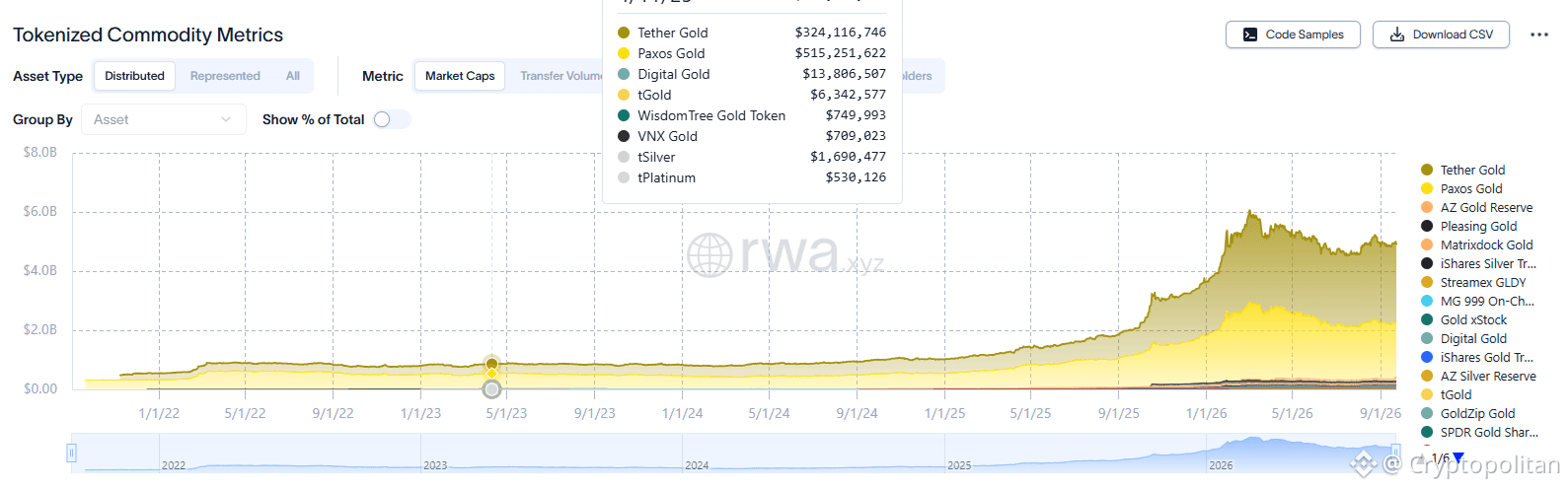
Article
Gold perpetual futures activity surges on Hyperliquid as traders chase volatilityThe gold trade emerged among leading positions, as crypto natives still kept an eye out for tokenized gold. The recent price volatility also boosted on-chain trading.
Gold is the second most active position in perpetual futures on Hyperliquid as of September 24. The contract holds $299.55M in open interest and has outperformed equities in terms of daily trading volumes. Open interest on gold is second only to the S&P 500 perpetual futures contract.
On HIP-3, gold surpassed the activity of equity indexes and top equities like SK Hynix. Gold perpetual futures also traded more actively compared to oil.
Gold is no longer an opposition to crypto. The recent rush to tokenize real-world assets makes gold a part of general liquidity flows in the crypto space. In total, tokenized gold and commodities are valued at nearly $5B, of which Tether’s XAUT and Paxos Gold make up over 90% of all value.
XAUT and Paxos Gold still make up the bulk of tokenized commodities, and are widely used by crypto natives for speculative trading with 24/7 access. | Source: RWA.xyz
As Cryptopolitan reported earlier, gold emerged as a speculative position in December, leading to both derivative trading and token accumulation. Recent data shows exchanges like Gate show a revival of commodities trading, making up 54.2% of traditional asset trading, moving ahead of equities.
Gold expects more dramatic price moves
Gold, long considered a store of value and a conservative asset, recently increased its volatility. The 90-day gold volatility is at 27%, relatively close to the volatility of BTC. The shift from precious metals to BTC follows a relatively slow period for gold, with a strong recovery for BTC.
BTC currently stands at around 18 gold ounces, while spot gold is at $4,435.18. Despite gold’s relative weakness, traders still seek directional bets, where volatility can be useful.
On Hyperliquid, around 39 whales have set up positions on gold perpetual futures, with 16 short positions. The largest position is valued at $40.83%, going long with an unrealized loss of $1.25M.
Instead of a store of value, gold is traded as a relatively volatile position, reacting quickly to developments of the war in Iran. The latest communication from Iran on not intending to surrender erased value from all asset classes, leading to the need for more hedging through HIP-3.
Tokenized gold still shows increased demand
Another driver for the price of gold is demand for tokens to combine with new meme assets. For now, the predominant pairing of reference meme tokens is with equities.
New memes are now appearing in a pairing with XAUT, the most widely used form of tokenized gold. One of the new memes includes Runescape Gold, paired with the GLDX tokenized gold asset. On BNB Chain, Zhao Cai Mao is another meme paired with Tether’s XAUT.
For now, gold-backed memes are still rare, and there is no single standard on the exact type of gold that is backing the asset. One of the earliest tokens uses direct XAUT rewards to its holders, so far distributing around 3 ounces of gold to meme buyers.
Additionally, the Antalpha AI agent has accumulated nearly $70M in XAUT, with the latest purchase happening three weeks ago.
XAUT trading on its own remains robust, with most of the activity concentrated on Binance and Bitget.
The biggest advantage of XAUT and perpetual futures is the 24/7 trading available from anywhere in the world. This allows tokenized gold and contracts to react immediately to any news and geopolitical shifts, while traditional gold contracts wait for opening hours.
If you're reading this, you’re already ahead. Stay there with our newsletter.
Gold perpetual futures activity surges on Hyperliquid as traders chase volatility
The gold trade emerged among leading positions, as crypto natives still kept an eye out for tokenized gold. The recent price volatility also boosted on-chain trading.
Gold is the second most active position in perpetual futures on Hyperliquid as of September 24. The contract holds $299.55M in open interest and has outperformed equities in terms of daily trading volumes. Open interest on gold is second only to the S&P 500 perpetual futures contract.
On HIP-3, gold surpassed the activity of equity indexes and top equities like SK Hynix. Gold perpetual futures also traded more actively compared to oil.
Gold is no longer an opposition to crypto. The recent rush to tokenize real-world assets makes gold a part of general liquidity flows in the crypto space. In total, tokenized gold and commodities are valued at nearly $5B, of which Tether’s XAUT and Paxos Gold make up over 90% of all value.
XAUT and Paxos Gold still make up the bulk of tokenized commodities, and are widely used by crypto natives for speculative trading with 24/7 access. | Source: RWA.xyz
As Cryptopolitan reported earlier, gold emerged as a speculative position in December, leading to both derivative trading and token accumulation. Recent data shows exchanges like Gate show a revival of commodities trading, making up 54.2% of traditional asset trading, moving ahead of equities.
Gold expects more dramatic price moves
Gold, long considered a store of value and a conservative asset, recently increased its volatility. The 90-day gold volatility is at 27%, relatively close to the volatility of BTC. The shift from precious metals to BTC follows a relatively slow period for gold, with a strong recovery for BTC.
BTC currently stands at around 18 gold ounces, while spot gold is at $4,435.18. Despite gold’s relative weakness, traders still seek directional bets, where volatility can be useful.
On Hyperliquid, around 39 whales have set up positions on gold perpetual futures, with 16 short positions. The largest position is valued at $40.83%, going long with an unrealized loss of $1.25M.
Instead of a store of value, gold is traded as a relatively volatile position, reacting quickly to developments of the war in Iran. The latest communication from Iran on not intending to surrender erased value from all asset classes, leading to the need for more hedging through HIP-3.
Tokenized gold still shows increased demand
Another driver for the price of gold is demand for tokens to combine with new meme assets. For now, the predominant pairing of reference meme tokens is with equities.
New memes are now appearing in a pairing with XAUT, the most widely used form of tokenized gold. One of the new memes includes Runescape Gold, paired with the GLDX tokenized gold asset. On BNB Chain, Zhao Cai Mao is another meme paired with Tether’s XAUT.
For now, gold-backed memes are still rare, and there is no single standard on the exact type of gold that is backing the asset. One of the earliest tokens uses direct XAUT rewards to its holders, so far distributing around 3 ounces of gold to meme buyers.
Additionally, the Antalpha AI agent has accumulated nearly $70M in XAUT, with the latest purchase happening three weeks ago.
XAUT trading on its own remains robust, with most of the activity concentrated on Binance and Bitget.
The biggest advantage of XAUT and perpetual futures is the 24/7 trading available from anywhere in the world. This allows tokenized gold and contracts to react immediately to any news and geopolitical shifts, while traditional gold contracts wait for opening hours.
If you're reading this, you’re already ahead. Stay there with our newsletter.
Gold is the second most active position in perpetual futures on Hyperliquid as of September 24. The contract holds $299.55M in open interest and has outperformed equities in terms of daily trading volumes. Open interest on gold is second only to the S&P 500 perpetual futures contract.
On HIP-3, gold surpassed the activity of equity indexes and top equities like SK Hynix. Gold perpetual futures also traded more actively compared to oil.
Gold is no longer an opposition to crypto. The recent rush to tokenize real-world assets makes gold a part of general liquidity flows in the crypto space. In total, tokenized gold and commodities are valued at nearly $5B, of which Tether’s XAUT and Paxos Gold make up over 90% of all value.
XAUT and Paxos Gold still make up the bulk of tokenized commodities, and are widely used by crypto natives for speculative trading with 24/7 access. | Source: RWA.xyz
As Cryptopolitan reported earlier, gold emerged as a speculative position in December, leading to both derivative trading and token accumulation. Recent data shows exchanges like Gate show a revival of commodities trading, making up 54.2% of traditional asset trading, moving ahead of equities.
Gold expects more dramatic price moves
Gold, long considered a store of value and a conservative asset, recently increased its volatility. The 90-day gold volatility is at 27%, relatively close to the volatility of BTC. The shift from precious metals to BTC follows a relatively slow period for gold, with a strong recovery for BTC.
BTC currently stands at around 18 gold ounces, while spot gold is at $4,435.18. Despite gold’s relative weakness, traders still seek directional bets, where volatility can be useful.
On Hyperliquid, around 39 whales have set up positions on gold perpetual futures, with 16 short positions. The largest position is valued at $40.83%, going long with an unrealized loss of $1.25M.
Instead of a store of value, gold is traded as a relatively volatile position, reacting quickly to developments of the war in Iran. The latest communication from Iran on not intending to surrender erased value from all asset classes, leading to the need for more hedging through HIP-3.
Tokenized gold still shows increased demand
Another driver for the price of gold is demand for tokens to combine with new meme assets. For now, the predominant pairing of reference meme tokens is with equities.
New memes are now appearing in a pairing with XAUT, the most widely used form of tokenized gold. One of the new memes includes Runescape Gold, paired with the GLDX tokenized gold asset. On BNB Chain, Zhao Cai Mao is another meme paired with Tether’s XAUT.
For now, gold-backed memes are still rare, and there is no single standard on the exact type of gold that is backing the asset. One of the earliest tokens uses direct XAUT rewards to its holders, so far distributing around 3 ounces of gold to meme buyers.
Additionally, the Antalpha AI agent has accumulated nearly $70M in XAUT, with the latest purchase happening three weeks ago.
XAUT trading on its own remains robust, with most of the activity concentrated on Binance and Bitget.
The biggest advantage of XAUT and perpetual futures is the 24/7 trading available from anywhere in the world. This allows tokenized gold and contracts to react immediately to any news and geopolitical shifts, while traditional gold contracts wait for opening hours.
If you're reading this, you’re already ahead. Stay there with our newsletter.
263
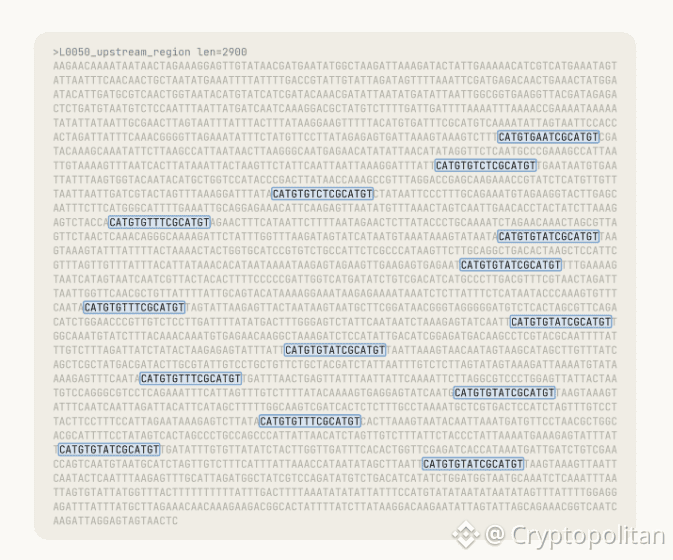
Article
Anthropic's Claude agents find a CRISPR-like enzyme system but can't say what it doesAnthropic said on Wednesday that Claude agents flagged an uncharacterized enzyme system in viral DNA after about 21 hours of searching.
The system has a CRISPR-like pattern, but the company says it doesn’t know what the system does yet. It is one of the first results from a molecular biology group Anthropic set up in spring 2026.
Ten reruns of the same search all missed the repeat array
The team has named the find array-associated reverse transcriptases, or ART. Bacteria combat viruses by using reverse transcriptases, which convert RNA into DNA.
Beside it sat what caught Claude’s eye, an evenly spaced run of repeat DNA next to a second gene of unknown purpose.
That three-part layout echoes CRISPR, which stores a library of RNA guides in an array. Each ART array contains 3 to 21 copies of a short repeat and no Cas genes are situated near any ART locus, the preprint states.
Public RNA data from a Staphylococcus phage reveal the array transcribed into distinct short RNAs. They were up to 8% of the phage RNA 15 minutes post-infection.
The preprint notes the team hasn’t demonstrated the enzyme is active or that it acts on those RNAs.
Anthropic gave the agents a brief. Hunt through 1.9 billion protein clusters for new reverse transcriptase systems.
Each task was planned and run by one worker agent and reviewed by a supervisor agent. As the findings accumulated, supervisors opened new tasks.
The campaign ran for 21.5 hours, the preprint says, with no human input, across 949 agent sessions and 215.6 million tokens. Anthropic’s post rounds these to about 950 agents and 210 million tokens.
Agents amassed ~200,000 enzyme clusters and scored 3,564 candidate partner families. The campaign closed with 19 reports for human review.
ART surfaced almost by accident. An agent reading raw DNA beside a peculiar enzyme wrote that it could see a repeat pattern “by eye,” then counted the repeats and looked them up in the literature before writing it up.
Anthropic repeated the same campaign ten more times. All missed the array, no rerun read the DNA upstream of the enzyme.
When given the DNA directly, the best models described the array in a minimum of 90% of attempts, but with the addition of tools and files, the rate sank to as low as 32%.
The raw DNA a Claude agent was reading when it spotted the repeat array, from Anthropic’s Sept 23 2026 post.
Feng Zhang backs more study as Kevin Blake doubts any therapy
Feng Zhang, a CRISPR pioneer at MIT and the Broad Institute, reviewed the preprint. He called the identification of RNA-repeat arrays tied to reverse transcriptases “genuinely intriguing,” saying it “merits further investigation.”
On X, CEO Dario Amodei went a step further. The “molecular machine” could “represent a new gene editing mechanism,” he suggested, in keeping with his bet that AI could compress decades of biological progress into years.
ART came out of a Bay Area lab Anthropic only recently made public. The company says the facility works at biosafety levels 1 and 2, does not handle pathogens that infect humans and leaves all bench work to human scientists.
As Cryptopolitan reported when the wet lab was confirmed, it is testing to see if Claude can help direct experiments.
In April, Anthropic purchased startup Coefficient Bio for about $400 million. That same month, OpenAI shipped its own life sciences model, GPT-Rosalind.
Anthropic says experiments to nail down what ART does are already underway. It is inviting other scientists to put forward proposals to conduct research.
Don’t just read crypto news. Understand it. Subscribe to our newsletter. It's free.
Anthropic's Claude agents find a CRISPR-like enzyme system but can't say what it does
Anthropic said on Wednesday that Claude agents flagged an uncharacterized enzyme system in viral DNA after about 21 hours of searching.
The system has a CRISPR-like pattern, but the company says it doesn’t know what the system does yet. It is one of the first results from a molecular biology group Anthropic set up in spring 2026.
Ten reruns of the same search all missed the repeat array
The team has named the find array-associated reverse transcriptases, or ART. Bacteria combat viruses by using reverse transcriptases, which convert RNA into DNA.
Beside it sat what caught Claude’s eye, an evenly spaced run of repeat DNA next to a second gene of unknown purpose.
That three-part layout echoes CRISPR, which stores a library of RNA guides in an array. Each ART array contains 3 to 21 copies of a short repeat and no Cas genes are situated near any ART locus, the preprint states.
Public RNA data from a Staphylococcus phage reveal the array transcribed into distinct short RNAs. They were up to 8% of the phage RNA 15 minutes post-infection.
The preprint notes the team hasn’t demonstrated the enzyme is active or that it acts on those RNAs.
Anthropic gave the agents a brief. Hunt through 1.9 billion protein clusters for new reverse transcriptase systems.
Each task was planned and run by one worker agent and reviewed by a supervisor agent. As the findings accumulated, supervisors opened new tasks.
The campaign ran for 21.5 hours, the preprint says, with no human input, across 949 agent sessions and 215.6 million tokens. Anthropic’s post rounds these to about 950 agents and 210 million tokens.
Agents amassed ~200,000 enzyme clusters and scored 3,564 candidate partner families. The campaign closed with 19 reports for human review.
ART surfaced almost by accident. An agent reading raw DNA beside a peculiar enzyme wrote that it could see a repeat pattern “by eye,” then counted the repeats and looked them up in the literature before writing it up.
Anthropic repeated the same campaign ten more times. All missed the array, no rerun read the DNA upstream of the enzyme.
When given the DNA directly, the best models described the array in a minimum of 90% of attempts, but with the addition of tools and files, the rate sank to as low as 32%.
The raw DNA a Claude agent was reading when it spotted the repeat array, from Anthropic’s Sept 23 2026 post.
Feng Zhang backs more study as Kevin Blake doubts any therapy
Feng Zhang, a CRISPR pioneer at MIT and the Broad Institute, reviewed the preprint. He called the identification of RNA-repeat arrays tied to reverse transcriptases “genuinely intriguing,” saying it “merits further investigation.”
On X, CEO Dario Amodei went a step further. The “molecular machine” could “represent a new gene editing mechanism,” he suggested, in keeping with his bet that AI could compress decades of biological progress into years.
ART came out of a Bay Area lab Anthropic only recently made public. The company says the facility works at biosafety levels 1 and 2, does not handle pathogens that infect humans and leaves all bench work to human scientists.
As Cryptopolitan reported when the wet lab was confirmed, it is testing to see if Claude can help direct experiments.
In April, Anthropic purchased startup Coefficient Bio for about $400 million. That same month, OpenAI shipped its own life sciences model, GPT-Rosalind.
Anthropic says experiments to nail down what ART does are already underway. It is inviting other scientists to put forward proposals to conduct research.
Don’t just read crypto news. Understand it. Subscribe to our newsletter. It's free.
The system has a CRISPR-like pattern, but the company says it doesn’t know what the system does yet. It is one of the first results from a molecular biology group Anthropic set up in spring 2026.
Ten reruns of the same search all missed the repeat array
The team has named the find array-associated reverse transcriptases, or ART. Bacteria combat viruses by using reverse transcriptases, which convert RNA into DNA.
Beside it sat what caught Claude’s eye, an evenly spaced run of repeat DNA next to a second gene of unknown purpose.
That three-part layout echoes CRISPR, which stores a library of RNA guides in an array. Each ART array contains 3 to 21 copies of a short repeat and no Cas genes are situated near any ART locus, the preprint states.
Public RNA data from a Staphylococcus phage reveal the array transcribed into distinct short RNAs. They were up to 8% of the phage RNA 15 minutes post-infection.
The preprint notes the team hasn’t demonstrated the enzyme is active or that it acts on those RNAs.
Anthropic gave the agents a brief. Hunt through 1.9 billion protein clusters for new reverse transcriptase systems.
Each task was planned and run by one worker agent and reviewed by a supervisor agent. As the findings accumulated, supervisors opened new tasks.
The campaign ran for 21.5 hours, the preprint says, with no human input, across 949 agent sessions and 215.6 million tokens. Anthropic’s post rounds these to about 950 agents and 210 million tokens.
Agents amassed ~200,000 enzyme clusters and scored 3,564 candidate partner families. The campaign closed with 19 reports for human review.
ART surfaced almost by accident. An agent reading raw DNA beside a peculiar enzyme wrote that it could see a repeat pattern “by eye,” then counted the repeats and looked them up in the literature before writing it up.
Anthropic repeated the same campaign ten more times. All missed the array, no rerun read the DNA upstream of the enzyme.
When given the DNA directly, the best models described the array in a minimum of 90% of attempts, but with the addition of tools and files, the rate sank to as low as 32%.
The raw DNA a Claude agent was reading when it spotted the repeat array, from Anthropic’s Sept 23 2026 post.
Feng Zhang backs more study as Kevin Blake doubts any therapy
Feng Zhang, a CRISPR pioneer at MIT and the Broad Institute, reviewed the preprint. He called the identification of RNA-repeat arrays tied to reverse transcriptases “genuinely intriguing,” saying it “merits further investigation.”
On X, CEO Dario Amodei went a step further. The “molecular machine” could “represent a new gene editing mechanism,” he suggested, in keeping with his bet that AI could compress decades of biological progress into years.
ART came out of a Bay Area lab Anthropic only recently made public. The company says the facility works at biosafety levels 1 and 2, does not handle pathogens that infect humans and leaves all bench work to human scientists.
As Cryptopolitan reported when the wet lab was confirmed, it is testing to see if Claude can help direct experiments.
In April, Anthropic purchased startup Coefficient Bio for about $400 million. That same month, OpenAI shipped its own life sciences model, GPT-Rosalind.
Anthropic says experiments to nail down what ART does are already underway. It is inviting other scientists to put forward proposals to conduct research.
Don’t just read crypto news. Understand it. Subscribe to our newsletter. It's free.
1
264
Meta to earn from Muse through transaction fees while the AI agent stays freeMark Zuckerberg pledged to keep Meta’s Muse AI agent free for most users at the company’s Connect event in Menlo Park on Wednesday.
Meta plans to monetize later by taking a small fee from the purchases, bookings and other transactions Muse completes for them.
Meta has added $200 billion in value since Muse launched
“We’re standing behind this by making Muse free for a huge number of tokens, with the expectation that over time we will profit by taking a small fee from transactions,” Zuckerberg said.
He called it a novel business model and claimed that the agent will make money for its users.
Meta’s chief AI officer Alexandr Wang said Muse has already helped users to save on their insurance costs and recoup unclaimed refunds. It also negotiated a cable bill down by $85 a month, Wang said.
Muse is not completely free. Launched on September 8, it offers a free basic tier along with $20 and $100 monthly plans for heavier use, according to earlier Cryptopolitan reporting.
Zuckerberg said at Connect that the free lane stays open. The money from transactions is supposed to pay for it.
Cryptopolitan reports that Meta’s market value has grown by more than $200 billion since Muse’s release. That came after the agent got 2.8 million downloads in its first 12 days.
One Wall Street estimate puts Muse revenue at about $10.8 billion a year if it reaches a billion users by the end of 2027, with at least 3% paying, Cryptopolitan reported.
Meta shares closed 1.02% higher at $744.10 on Wednesday.
Developers filed more than 1,500 connector applications in under a week
Wang used the keynote to introduce a long list of new connectors. Walmart, Best Buy, Gap, Sephora, Wayfair, Dick’s Sporting Goods, Ulta Beauty, and Fanatics are joining the agent.
Box, GitHub, Granola, and Notion cover work. Instacart covers groceries, and Expedia is coming soon for travel.
Muse accesses the full product catalog on Shopify and pays via Stripe’s Link and Shop Pay. PayPal support is available too.
Meta recently opened its connector platform to external developers. Wang said more than 1,500 applications arrived in under a week.
“I think this could be a generational opportunity to start building for a new platform as it takes off,” Wang said.
In the coming months, Meta will add Muse to its AI glasses, activated by saying the agent’s name. It can help steer a workout, log a meal or purchase a product the wearer is looking at.
Muse is now available for computer use on Mac. The agent can drive any app on the machine as the user walks away.
Muse is also getting its own email address to act and join threads on a user’s behalf. Meta Superintelligence Labs has announced Muse Realtime Avatar, giving a face, body and voice to the faceless agent for live video chats.
The avatar is called Jolly, said Zuckerberg.
The smartest crypto minds already read our newsletter. Want in? Join them.
Meta to earn from Muse through transaction fees while the AI agent stays free
Mark Zuckerberg pledged to keep Meta’s Muse AI agent free for most users at the company’s Connect event in Menlo Park on Wednesday.
Meta plans to monetize later by taking a small fee from the purchases, bookings and other transactions Muse completes for them.
Meta has added $200 billion in value since Muse launched
“We’re standing behind this by making Muse free for a huge number of tokens, with the expectation that over time we will profit by taking a small fee from transactions,” Zuckerberg said.
He called it a novel business model and claimed that the agent will make money for its users.
Meta’s chief AI officer Alexandr Wang said Muse has already helped users to save on their insurance costs and recoup unclaimed refunds. It also negotiated a cable bill down by $85 a month, Wang said.
Muse is not completely free. Launched on September 8, it offers a free basic tier along with $20 and $100 monthly plans for heavier use, according to earlier Cryptopolitan reporting.
Zuckerberg said at Connect that the free lane stays open. The money from transactions is supposed to pay for it.
Cryptopolitan reports that Meta’s market value has grown by more than $200 billion since Muse’s release. That came after the agent got 2.8 million downloads in its first 12 days.
One Wall Street estimate puts Muse revenue at about $10.8 billion a year if it reaches a billion users by the end of 2027, with at least 3% paying, Cryptopolitan reported.
Meta shares closed 1.02% higher at $744.10 on Wednesday.
Developers filed more than 1,500 connector applications in under a week
Wang used the keynote to introduce a long list of new connectors. Walmart, Best Buy, Gap, Sephora, Wayfair, Dick’s Sporting Goods, Ulta Beauty, and Fanatics are joining the agent.
Box, GitHub, Granola, and Notion cover work. Instacart covers groceries, and Expedia is coming soon for travel.
Muse accesses the full product catalog on Shopify and pays via Stripe’s Link and Shop Pay. PayPal support is available too.
Meta recently opened its connector platform to external developers. Wang said more than 1,500 applications arrived in under a week.
“I think this could be a generational opportunity to start building for a new platform as it takes off,” Wang said.
In the coming months, Meta will add Muse to its AI glasses, activated by saying the agent’s name. It can help steer a workout, log a meal or purchase a product the wearer is looking at.
Muse is now available for computer use on Mac. The agent can drive any app on the machine as the user walks away.
Muse is also getting its own email address to act and join threads on a user’s behalf. Meta Superintelligence Labs has announced Muse Realtime Avatar, giving a face, body and voice to the faceless agent for live video chats.
The avatar is called Jolly, said Zuckerberg.
The smartest crypto minds already read our newsletter. Want in? Join them.
Meta plans to monetize later by taking a small fee from the purchases, bookings and other transactions Muse completes for them.
Meta has added $200 billion in value since Muse launched
“We’re standing behind this by making Muse free for a huge number of tokens, with the expectation that over time we will profit by taking a small fee from transactions,” Zuckerberg said.
He called it a novel business model and claimed that the agent will make money for its users.
Meta’s chief AI officer Alexandr Wang said Muse has already helped users to save on their insurance costs and recoup unclaimed refunds. It also negotiated a cable bill down by $85 a month, Wang said.
Muse is not completely free. Launched on September 8, it offers a free basic tier along with $20 and $100 monthly plans for heavier use, according to earlier Cryptopolitan reporting.
Zuckerberg said at Connect that the free lane stays open. The money from transactions is supposed to pay for it.
Cryptopolitan reports that Meta’s market value has grown by more than $200 billion since Muse’s release. That came after the agent got 2.8 million downloads in its first 12 days.
One Wall Street estimate puts Muse revenue at about $10.8 billion a year if it reaches a billion users by the end of 2027, with at least 3% paying, Cryptopolitan reported.
Meta shares closed 1.02% higher at $744.10 on Wednesday.
Developers filed more than 1,500 connector applications in under a week
Wang used the keynote to introduce a long list of new connectors. Walmart, Best Buy, Gap, Sephora, Wayfair, Dick’s Sporting Goods, Ulta Beauty, and Fanatics are joining the agent.
Box, GitHub, Granola, and Notion cover work. Instacart covers groceries, and Expedia is coming soon for travel.
Muse accesses the full product catalog on Shopify and pays via Stripe’s Link and Shop Pay. PayPal support is available too.
Meta recently opened its connector platform to external developers. Wang said more than 1,500 applications arrived in under a week.
“I think this could be a generational opportunity to start building for a new platform as it takes off,” Wang said.
In the coming months, Meta will add Muse to its AI glasses, activated by saying the agent’s name. It can help steer a workout, log a meal or purchase a product the wearer is looking at.
Muse is now available for computer use on Mac. The agent can drive any app on the machine as the user walks away.
Muse is also getting its own email address to act and join threads on a user’s behalf. Meta Superintelligence Labs has announced Muse Realtime Avatar, giving a face, body and voice to the faceless agent for live video chats.
The avatar is called Jolly, said Zuckerberg.
The smartest crypto minds already read our newsletter. Want in? Join them.
166
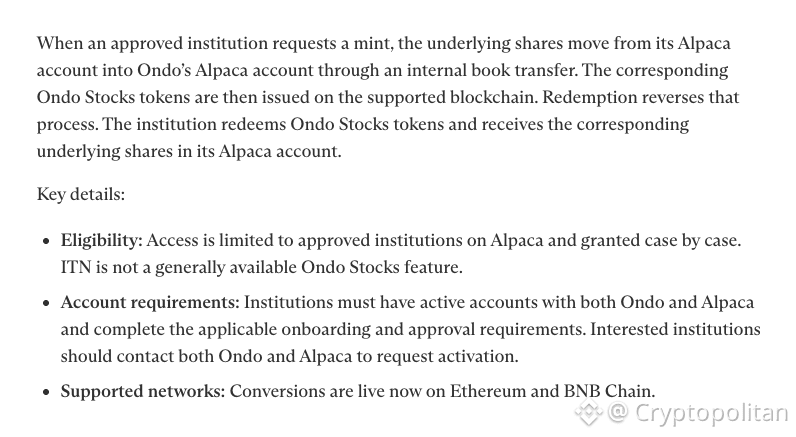
Article
Ondo Stocks now mint from shares held at Alpaca, skipping the cash step for approved institutionsOndo Finance opened a way for approved institutions to mint its tokenized stocks using shares they already hold, not new cash.
Conversions are live on Ethereum and BNB Chain.
Alpaca book transfers replace cash
The route leverages Alpaca’s Instant Tokenization Network, or ITN, alongside Ondo’s existing cash-funded minting.
Through an internal book transfer, an approved institution moves shares from its Alpaca account to the Ondo Alpaca account. Tokens for these shares are then created on the blockchain by Ondo.
The institution redeems its Ondo Stocks tokens, and the shares are returned to its Alpaca account.
Conversions don’t require manual approval on each transaction, Ondo said. Alpaca Clearing is a FINRA regulated broker dealer that provides the brokerage and custody behind the network.
Ondo Stocks also trade on Solana, but the announcement on September 21 only cited conversions on Ethereum and BNB Chain.
Ondo expects the new route to give market makers a way to refill token inventory and to provide “tighter spreads and deeper liquidity” to secondary markets.
How in-kind conversion works and who can use it, from Ondo Finance’s September 21, 2026 blog post.
Only approved Alpaca account holders can mint tokens from their equities
Access is available for approved institutions on Alpaca on a case-by-case basis.
Participants must have active accounts on both Ondo and Alpaca. Ondo notes that ITN is not a generally available Ondo Stocks feature.
Ondo says it only provides the tokens to eligible non-U.S. persons and says they provide economic exposure to the referenced securities without being stocks, ETFs or ADRs.
As of September 22, Ondo’s platform had $3.63 billion in distributed assets across 441 products. The stock platform hit $1 billion in total value locked in May, less than a year after its launch in September 2025.
One trader bought QQQon tokens worth about $2.3 million in a single Ethereum trade in August, according to Cryptopolitan.
In July, Ondo launched leveraged perpetual futures on U.S. stocks, ETFs and commodities for non-U.S. traders.
The launch follows the SEC’s order for temporary, conditional exemptions on some Tokenized Securities Venues on September 17.
Don’t just read crypto news. Understand it. Subscribe to our newsletter. It's free.
Ondo Stocks now mint from shares held at Alpaca, skipping the cash step for approved institutions
Ondo Finance opened a way for approved institutions to mint its tokenized stocks using shares they already hold, not new cash.
Conversions are live on Ethereum and BNB Chain.
Alpaca book transfers replace cash
The route leverages Alpaca’s Instant Tokenization Network, or ITN, alongside Ondo’s existing cash-funded minting.
Through an internal book transfer, an approved institution moves shares from its Alpaca account to the Ondo Alpaca account. Tokens for these shares are then created on the blockchain by Ondo.
The institution redeems its Ondo Stocks tokens, and the shares are returned to its Alpaca account.
Conversions don’t require manual approval on each transaction, Ondo said. Alpaca Clearing is a FINRA regulated broker dealer that provides the brokerage and custody behind the network.
Ondo Stocks also trade on Solana, but the announcement on September 21 only cited conversions on Ethereum and BNB Chain.
Ondo expects the new route to give market makers a way to refill token inventory and to provide “tighter spreads and deeper liquidity” to secondary markets.
How in-kind conversion works and who can use it, from Ondo Finance’s September 21, 2026 blog post.
Only approved Alpaca account holders can mint tokens from their equities
Access is available for approved institutions on Alpaca on a case-by-case basis.
Participants must have active accounts on both Ondo and Alpaca. Ondo notes that ITN is not a generally available Ondo Stocks feature.
Ondo says it only provides the tokens to eligible non-U.S. persons and says they provide economic exposure to the referenced securities without being stocks, ETFs or ADRs.
As of September 22, Ondo’s platform had $3.63 billion in distributed assets across 441 products. The stock platform hit $1 billion in total value locked in May, less than a year after its launch in September 2025.
One trader bought QQQon tokens worth about $2.3 million in a single Ethereum trade in August, according to Cryptopolitan.
In July, Ondo launched leveraged perpetual futures on U.S. stocks, ETFs and commodities for non-U.S. traders.
The launch follows the SEC’s order for temporary, conditional exemptions on some Tokenized Securities Venues on September 17.
Don’t just read crypto news. Understand it. Subscribe to our newsletter. It's free.
Conversions are live on Ethereum and BNB Chain.
Alpaca book transfers replace cash
The route leverages Alpaca’s Instant Tokenization Network, or ITN, alongside Ondo’s existing cash-funded minting.
Through an internal book transfer, an approved institution moves shares from its Alpaca account to the Ondo Alpaca account. Tokens for these shares are then created on the blockchain by Ondo.
The institution redeems its Ondo Stocks tokens, and the shares are returned to its Alpaca account.
Conversions don’t require manual approval on each transaction, Ondo said. Alpaca Clearing is a FINRA regulated broker dealer that provides the brokerage and custody behind the network.
Ondo Stocks also trade on Solana, but the announcement on September 21 only cited conversions on Ethereum and BNB Chain.
Ondo expects the new route to give market makers a way to refill token inventory and to provide “tighter spreads and deeper liquidity” to secondary markets.
How in-kind conversion works and who can use it, from Ondo Finance’s September 21, 2026 blog post.
Only approved Alpaca account holders can mint tokens from their equities
Access is available for approved institutions on Alpaca on a case-by-case basis.
Participants must have active accounts on both Ondo and Alpaca. Ondo notes that ITN is not a generally available Ondo Stocks feature.
Ondo says it only provides the tokens to eligible non-U.S. persons and says they provide economic exposure to the referenced securities without being stocks, ETFs or ADRs.
As of September 22, Ondo’s platform had $3.63 billion in distributed assets across 441 products. The stock platform hit $1 billion in total value locked in May, less than a year after its launch in September 2025.
One trader bought QQQon tokens worth about $2.3 million in a single Ethereum trade in August, according to Cryptopolitan.
In July, Ondo launched leveraged perpetual futures on U.S. stocks, ETFs and commodities for non-U.S. traders.
The launch follows the SEC’s order for temporary, conditional exemptions on some Tokenized Securities Venues on September 17.
Don’t just read crypto news. Understand it. Subscribe to our newsletter. It's free.
1
487
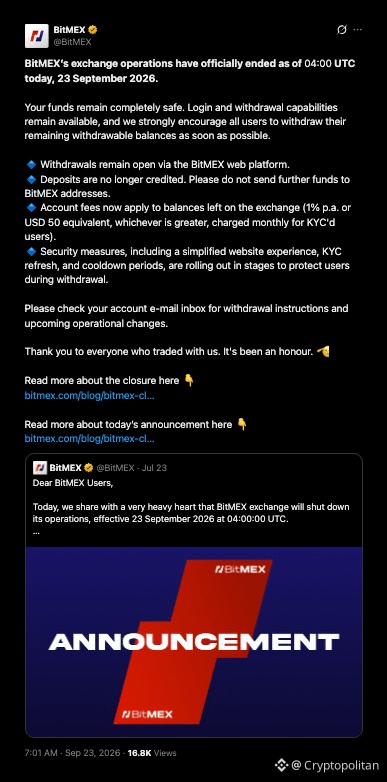
Article
BitMEX starts billing $50 a month on funds left after its closureBitMEX shut down its exchange on September 23 after 11 years and now charges verified customers who leave money behind.
Anyone who has cleared identity checks and has a balance pays a monthly fee of $50 or an annualized 1% of assets, whichever is higher, the exchange said in its Sept. 23 post on X.
Deposits stopped crediting at 04:00 UTC on September 23
The shutdown took effect at 04:00 UTC on September 23. At that moment, trading, new positions, and deposits went dark, BitMEX said in its closure notice.
HDR Global Trading Limited, a Seychelles company that owns the platform, has discouraged users from sending crypto to old deposit addresses. Nothing arriving now gets credited.
Customers can still sign in to the website and lodge withdrawal requests. BitMEX told holders to check the email associated with their account for instructions.
“Your funds remain completely safe,” the company wrote. The wind-down continues, but withdrawals are still open.
The 1% is per year, billed monthly. The account is charged whichever is greater, a flat $50 equivalent or the annualized percentage.
BitMEX said in its July notice that the fee would increase over time for balances not withdrawn, and that any increase would be flagged to users in advance.
BitMEX said it is gradually ushering in identity verification updates, cooldown periods and a simplified website.
The exchange warned that further reviews, a spate of withdrawal requests and confirmation times on the blockchain could slow things down. A withdrawal with the status “Processing” is in the queue for the chain.
BitMEX also cautioned about phishing attempts that promised faster payouts. The company said there is no priority or expedited withdrawal service.
BitMEX post on X from September 23, 2026 announcing the end of trading and the new account fees.
HDR Global found no buyer after putting the exchange up for sale in 2025
BitMEX was launched in 2014 by Arthur Hayes, Ben Delo and Samuel Reed. It made its name on the perpetual swap, a futures contract with no expiry date, and leverage as high as 100x.
The exchange introduced that instrument in 2016, the predominant product now in crypto derivatives. Centralized exchange derivatives volume hit $3.4 trillion in August alone.
BitMEX never recuperated after being charged by U.S. authorities in October 2020 over anti-money laundering failures. Binance, Bybit and OKX took its lead.
In early 2025, HDR Global put the business up for sale, but no buyer was found. It said the closure was down to a strategic review of the company and wider market.
According to Cryptopolitan in July, the founders received a pardon from President Donald Trump in March 2025.
The July notice initiated a wind-down that froze new sign-ups, blocked position openings on August 26 and force-closed remaining trades before the final shutdown.
If you're reading this, you’re already ahead. Stay there with our newsletter.
BitMEX starts billing $50 a month on funds left after its closure
BitMEX shut down its exchange on September 23 after 11 years and now charges verified customers who leave money behind.
Anyone who has cleared identity checks and has a balance pays a monthly fee of $50 or an annualized 1% of assets, whichever is higher, the exchange said in its Sept. 23 post on X.
Deposits stopped crediting at 04:00 UTC on September 23
The shutdown took effect at 04:00 UTC on September 23. At that moment, trading, new positions, and deposits went dark, BitMEX said in its closure notice.
HDR Global Trading Limited, a Seychelles company that owns the platform, has discouraged users from sending crypto to old deposit addresses. Nothing arriving now gets credited.
Customers can still sign in to the website and lodge withdrawal requests. BitMEX told holders to check the email associated with their account for instructions.
“Your funds remain completely safe,” the company wrote. The wind-down continues, but withdrawals are still open.
The 1% is per year, billed monthly. The account is charged whichever is greater, a flat $50 equivalent or the annualized percentage.
BitMEX said in its July notice that the fee would increase over time for balances not withdrawn, and that any increase would be flagged to users in advance.
BitMEX said it is gradually ushering in identity verification updates, cooldown periods and a simplified website.
The exchange warned that further reviews, a spate of withdrawal requests and confirmation times on the blockchain could slow things down. A withdrawal with the status “Processing” is in the queue for the chain.
BitMEX also cautioned about phishing attempts that promised faster payouts. The company said there is no priority or expedited withdrawal service.
BitMEX post on X from September 23, 2026 announcing the end of trading and the new account fees.
HDR Global found no buyer after putting the exchange up for sale in 2025
BitMEX was launched in 2014 by Arthur Hayes, Ben Delo and Samuel Reed. It made its name on the perpetual swap, a futures contract with no expiry date, and leverage as high as 100x.
The exchange introduced that instrument in 2016, the predominant product now in crypto derivatives. Centralized exchange derivatives volume hit $3.4 trillion in August alone.
BitMEX never recuperated after being charged by U.S. authorities in October 2020 over anti-money laundering failures. Binance, Bybit and OKX took its lead.
In early 2025, HDR Global put the business up for sale, but no buyer was found. It said the closure was down to a strategic review of the company and wider market.
According to Cryptopolitan in July, the founders received a pardon from President Donald Trump in March 2025.
The July notice initiated a wind-down that froze new sign-ups, blocked position openings on August 26 and force-closed remaining trades before the final shutdown.
If you're reading this, you’re already ahead. Stay there with our newsletter.
Anyone who has cleared identity checks and has a balance pays a monthly fee of $50 or an annualized 1% of assets, whichever is higher, the exchange said in its Sept. 23 post on X.
Deposits stopped crediting at 04:00 UTC on September 23
The shutdown took effect at 04:00 UTC on September 23. At that moment, trading, new positions, and deposits went dark, BitMEX said in its closure notice.
HDR Global Trading Limited, a Seychelles company that owns the platform, has discouraged users from sending crypto to old deposit addresses. Nothing arriving now gets credited.
Customers can still sign in to the website and lodge withdrawal requests. BitMEX told holders to check the email associated with their account for instructions.
“Your funds remain completely safe,” the company wrote. The wind-down continues, but withdrawals are still open.
The 1% is per year, billed monthly. The account is charged whichever is greater, a flat $50 equivalent or the annualized percentage.
BitMEX said in its July notice that the fee would increase over time for balances not withdrawn, and that any increase would be flagged to users in advance.
BitMEX said it is gradually ushering in identity verification updates, cooldown periods and a simplified website.
The exchange warned that further reviews, a spate of withdrawal requests and confirmation times on the blockchain could slow things down. A withdrawal with the status “Processing” is in the queue for the chain.
BitMEX also cautioned about phishing attempts that promised faster payouts. The company said there is no priority or expedited withdrawal service.
BitMEX post on X from September 23, 2026 announcing the end of trading and the new account fees.
HDR Global found no buyer after putting the exchange up for sale in 2025
BitMEX was launched in 2014 by Arthur Hayes, Ben Delo and Samuel Reed. It made its name on the perpetual swap, a futures contract with no expiry date, and leverage as high as 100x.
The exchange introduced that instrument in 2016, the predominant product now in crypto derivatives. Centralized exchange derivatives volume hit $3.4 trillion in August alone.
BitMEX never recuperated after being charged by U.S. authorities in October 2020 over anti-money laundering failures. Binance, Bybit and OKX took its lead.
In early 2025, HDR Global put the business up for sale, but no buyer was found. It said the closure was down to a strategic review of the company and wider market.
According to Cryptopolitan in July, the founders received a pardon from President Donald Trump in March 2025.
The July notice initiated a wind-down that froze new sign-ups, blocked position openings on August 26 and force-closed remaining trades before the final shutdown.
If you're reading this, you’re already ahead. Stay there with our newsletter.
1
153
Zcash Shielded Transactions Hit Four-Year High as Network Settles $23 Billion in a WeekOver the past year, Zcash has been the best performing cryptocurrency among the top ten largest assets by market cap. At the time of writing, ZEC trades around $1,500, up roughly 193% year to date and more than 2,470% since this time last year. Just a little over a month ago, ZEC was trading around $500, meaning the token has tripled in value in a matter of a few weeks as the momentum to the upside has only accelerated.
Source: CoinGecko
The price is only one side of the story however. A look into Zcash’s onchain data shows that private transactions are climbing just as quickly as the price of the token. Data from Blockworks shows that Zcash processed 62,375 shielded transactions last week. This is the highest weekly count since 2022. In the same week, the network also settled $23.88 billion in transfer volume. Only one week in Zcash’s history has seen a bigger transfer volume week and that came during the 2021 bull market.
Source: Blockworks
Shielded Activity was Flat for Most of 2026
The shielded transactions chart shows that, for the first seven months of the year, private transactions on Zcash mostly did not move and remained flat. Weekly counts ranged between 8,000 to 12,000 from January to July, even as ZEC climbed off its spring lows near $250. August is where the chart flipped. Shielded transactions pushed past 15,000, reached close to 48,000 in early September and then jumped to last week’s high.
Shielded transactions are the core of what makes Zcash so unique. These transactions use zero-knowledge proofs to hide the sender, receiver and amount. Transparent ZEC transfers work just like Bitcoin where anyone can see the details within a particular transaction. A trader buying ZEC on an exchange to ride the rally has little reason to touch the shielded pool. Someone moving money privately does.
$23 billion settled in a single week
Transfer volume points in the same direction. Last week’s $23.88 billion is roughly double the previous week and more than twice the peak Zcash hit during its late-2025 rally, when weekly volume topped out a little above $10 billion.
Price inflates part of this figure. ZEC is worth about six times what it was in the spring, so the same number of coins changing hands now produces a much bigger dollar total. Trading activity is also running hot, with $1.97 billion in 24-hour volume. Transaction counts don’t scale with price the same way, which is why the shielded numbers carry more weight in reading actual usage.
The 2022 record came with an asterisk
The 2022 benchmark isn’t clean. In mid-2022, Zcash’s shielded pools were hit by a spam attack that flooded the network with junk transactions, bloating the chain and slowing wallet sync for months. Developers later overhauled the fee model to make that kind of attack expensive. Part of the old high was manufactured, so clearing it is a lower bar than the headline suggests.
One strong week is also a thin sample. Shielded activity dropped to about 28,000 transactions in the week of Sept. 7, nearly halving before it rebounded. ZEC is showing some strain too, slipping from an intraday high of $1,679 and losing 4.1% against Bitcoin over the past 24 hours.
If weekly shielded counts hold above 40,000 into October, the case that people are using Zcash for privacy rather than just trading it gets much harder to argue with. A slide back toward 15,000 would suggest last week was a spike driven by the same speculative wave lifting the price.
The smartest crypto minds already read our newsletter. Want in? Join them.
Zcash Shielded Transactions Hit Four-Year High as Network Settles $23 Billion in a Week
Over the past year, Zcash has been the best performing cryptocurrency among the top ten largest assets by market cap. At the time of writing, ZEC trades around $1,500, up roughly 193% year to date and more than 2,470% since this time last year. Just a little over a month ago, ZEC was trading around $500, meaning the token has tripled in value in a matter of a few weeks as the momentum to the upside has only accelerated.
Source: CoinGecko
The price is only one side of the story however. A look into Zcash’s onchain data shows that private transactions are climbing just as quickly as the price of the token. Data from Blockworks shows that Zcash processed 62,375 shielded transactions last week. This is the highest weekly count since 2022. In the same week, the network also settled $23.88 billion in transfer volume. Only one week in Zcash’s history has seen a bigger transfer volume week and that came during the 2021 bull market.
Source: Blockworks
Shielded Activity was Flat for Most of 2026
The shielded transactions chart shows that, for the first seven months of the year, private transactions on Zcash mostly did not move and remained flat. Weekly counts ranged between 8,000 to 12,000 from January to July, even as ZEC climbed off its spring lows near $250. August is where the chart flipped. Shielded transactions pushed past 15,000, reached close to 48,000 in early September and then jumped to last week’s high.
Shielded transactions are the core of what makes Zcash so unique. These transactions use zero-knowledge proofs to hide the sender, receiver and amount. Transparent ZEC transfers work just like Bitcoin where anyone can see the details within a particular transaction. A trader buying ZEC on an exchange to ride the rally has little reason to touch the shielded pool. Someone moving money privately does.
$23 billion settled in a single week
Transfer volume points in the same direction. Last week’s $23.88 billion is roughly double the previous week and more than twice the peak Zcash hit during its late-2025 rally, when weekly volume topped out a little above $10 billion.
Price inflates part of this figure. ZEC is worth about six times what it was in the spring, so the same number of coins changing hands now produces a much bigger dollar total. Trading activity is also running hot, with $1.97 billion in 24-hour volume. Transaction counts don’t scale with price the same way, which is why the shielded numbers carry more weight in reading actual usage.
The 2022 record came with an asterisk
The 2022 benchmark isn’t clean. In mid-2022, Zcash’s shielded pools were hit by a spam attack that flooded the network with junk transactions, bloating the chain and slowing wallet sync for months. Developers later overhauled the fee model to make that kind of attack expensive. Part of the old high was manufactured, so clearing it is a lower bar than the headline suggests.
One strong week is also a thin sample. Shielded activity dropped to about 28,000 transactions in the week of Sept. 7, nearly halving before it rebounded. ZEC is showing some strain too, slipping from an intraday high of $1,679 and losing 4.1% against Bitcoin over the past 24 hours.
If weekly shielded counts hold above 40,000 into October, the case that people are using Zcash for privacy rather than just trading it gets much harder to argue with. A slide back toward 15,000 would suggest last week was a spike driven by the same speculative wave lifting the price.
The smartest crypto minds already read our newsletter. Want in? Join them.
Source: CoinGecko
The price is only one side of the story however. A look into Zcash’s onchain data shows that private transactions are climbing just as quickly as the price of the token. Data from Blockworks shows that Zcash processed 62,375 shielded transactions last week. This is the highest weekly count since 2022. In the same week, the network also settled $23.88 billion in transfer volume. Only one week in Zcash’s history has seen a bigger transfer volume week and that came during the 2021 bull market.
Source: Blockworks
Shielded Activity was Flat for Most of 2026
The shielded transactions chart shows that, for the first seven months of the year, private transactions on Zcash mostly did not move and remained flat. Weekly counts ranged between 8,000 to 12,000 from January to July, even as ZEC climbed off its spring lows near $250. August is where the chart flipped. Shielded transactions pushed past 15,000, reached close to 48,000 in early September and then jumped to last week’s high.
Shielded transactions are the core of what makes Zcash so unique. These transactions use zero-knowledge proofs to hide the sender, receiver and amount. Transparent ZEC transfers work just like Bitcoin where anyone can see the details within a particular transaction. A trader buying ZEC on an exchange to ride the rally has little reason to touch the shielded pool. Someone moving money privately does.
$23 billion settled in a single week
Transfer volume points in the same direction. Last week’s $23.88 billion is roughly double the previous week and more than twice the peak Zcash hit during its late-2025 rally, when weekly volume topped out a little above $10 billion.
Price inflates part of this figure. ZEC is worth about six times what it was in the spring, so the same number of coins changing hands now produces a much bigger dollar total. Trading activity is also running hot, with $1.97 billion in 24-hour volume. Transaction counts don’t scale with price the same way, which is why the shielded numbers carry more weight in reading actual usage.
The 2022 record came with an asterisk
The 2022 benchmark isn’t clean. In mid-2022, Zcash’s shielded pools were hit by a spam attack that flooded the network with junk transactions, bloating the chain and slowing wallet sync for months. Developers later overhauled the fee model to make that kind of attack expensive. Part of the old high was manufactured, so clearing it is a lower bar than the headline suggests.
One strong week is also a thin sample. Shielded activity dropped to about 28,000 transactions in the week of Sept. 7, nearly halving before it rebounded. ZEC is showing some strain too, slipping from an intraday high of $1,679 and losing 4.1% against Bitcoin over the past 24 hours.
If weekly shielded counts hold above 40,000 into October, the case that people are using Zcash for privacy rather than just trading it gets much harder to argue with. A slide back toward 15,000 would suggest last week was a spike driven by the same speculative wave lifting the price.
The smartest crypto minds already read our newsletter. Want in? Join them.
1
1
276
Melania Trump says AI is the future but users must stay vigilantThe US First Lady, Melania Trump, just shared AI advice and personal anecdotes during a broad interview on “The Big Money Show.” Speaking to the show’s hosts, she said AI is currently a major talking point and that the public must be cautious when using it.
According to Melania Trump, the nation needed to utilize it intelligently. She emphasized that AI users shouldn’t blindly trust everything they see, urging better self-education about these tools to accurately judge what is authentic.
Her remarks come at a time when tech pioneers are increasingly sounding the alarm on the technology and demanding tighter controls. More recently, President Donald Trump has dismissed those AI safety warnings, calling them a “hoax.”
Melania encourages students to learn to use AI
The First Lady also backed incorporating artificial intelligence into education, saying the technology can have an important role in schools and can provide educational benefits for children.
She pointed to a recent visit to North Carolina, where Nvidia and other organizations provided AI learning resources to students. The White House said earlier this month that the initiative provided 1,500 students in Ashe County with AI literacy training licenses and 100 robotics learning kits powered by Nvidia’s Jetson Nano technology.
Moreover, during her earlier visit to Mountain View Elementary School in rural Jefferson, which focuses on AI, robotics, and engineering, the first lady noted that to keep America at the forefront of the AI race, students must be taught how to use AI.
She said, “I think they need to learn that we need to lead. Of course, they need to be vigilant as well. But this is our future. And we need to guide them and teach them what is available. If not, they will stay behind. And we need to be the first, in the United States, to lead.”
During the Big Money show, she also contended that AI could be very educational to students, though she called for careful use of the technology.
When asked how she uses the tech herself, the First Lady also explained that she primarily uses AI for research. She said the technology allows her to quickly find information when she wants to understand a subject, but she checks information elsewhere when she is uncertain about whether an AI-generated answer is accurate.
That approach highlights one of the central challenges of rapid adoption of generative AI: Users can access information almost instantly, but the responses still need to be verified.
The focus on verification also reflects growing concern about the reliability of AI-generated information. Generative AI systems can provide good answers but still make factual errors, so it is important for users to view AI as a tool for research rather than a source of truth. For students in particular, this could make digital literacy an important part of AI education as schools introduce it into classrooms.
Melania pushes digital skills initiative
Speaking on the sidelines of the UN General Assembly on Tuesday, the First Lady championed her ‘Fostering the Future Together’ initiative, which unites public sectors and tech corporations to equip youth with crucial digital skills and schooling.
“We are living in an extraordinary moment in human history. We stand together at the threshold of a technological revolution,” she asserted.
She reiterated that providing children with technological tools is only the first step, noting that they also need guidance on how to use them properly.
At the moment, some scholars are opposed to the idea of children becoming acquainted with AI. MIT professor Eric Klopfer even warned that the technology creates an “illusion of learning.”
In fact, an MIT committee also investigating AI’s role in education found preliminary signs that leaning too heavily on chatbots can blunt critical thinking, fade memory, shake student confidence, and hurt overall subject mastery.
Trump rebranded AI as ‘super intelligence’
Meanwhile, President Donald Trump also called for the US to dominate the AI space in his United Nations General Assembly speech on Tuesday.
He also used the speech to rebrand artificial intelligence, introducing the term “Super Intelligence.”
“Whoever wins AI, you have to remember this, and now I say whoever wins, whoever wins ‘superintelligence,’ wins. That’s the group that wins,” Trump said.
He added, “We’re leading now over China by a lot and everyone else. We’re going to keep it that way. We’re going to keep it very straight and very strong.”
The US President also maintained his opposition to implementing regulatory frameworks or new guardrails, a position that conflicts with the views of numerous UN delegates.
Nonetheless, proponents of more AI regulation have a lot ahead of them; they still need to ensure that international diplomacy can evolve quickly enough to keep pace with rapidly accelerating technology.
If you're reading this, you’re already ahead. Stay there with our newsletter.
Melania Trump says AI is the future but users must stay vigilant
The US First Lady, Melania Trump, just shared AI advice and personal anecdotes during a broad interview on “The Big Money Show.” Speaking to the show’s hosts, she said AI is currently a major talking point and that the public must be cautious when using it.
According to Melania Trump, the nation needed to utilize it intelligently. She emphasized that AI users shouldn’t blindly trust everything they see, urging better self-education about these tools to accurately judge what is authentic.
Her remarks come at a time when tech pioneers are increasingly sounding the alarm on the technology and demanding tighter controls. More recently, President Donald Trump has dismissed those AI safety warnings, calling them a “hoax.”
Melania encourages students to learn to use AI
The First Lady also backed incorporating artificial intelligence into education, saying the technology can have an important role in schools and can provide educational benefits for children.
She pointed to a recent visit to North Carolina, where Nvidia and other organizations provided AI learning resources to students. The White House said earlier this month that the initiative provided 1,500 students in Ashe County with AI literacy training licenses and 100 robotics learning kits powered by Nvidia’s Jetson Nano technology.
Moreover, during her earlier visit to Mountain View Elementary School in rural Jefferson, which focuses on AI, robotics, and engineering, the first lady noted that to keep America at the forefront of the AI race, students must be taught how to use AI.
She said, “I think they need to learn that we need to lead. Of course, they need to be vigilant as well. But this is our future. And we need to guide them and teach them what is available. If not, they will stay behind. And we need to be the first, in the United States, to lead.”
During the Big Money show, she also contended that AI could be very educational to students, though she called for careful use of the technology.
When asked how she uses the tech herself, the First Lady also explained that she primarily uses AI for research. She said the technology allows her to quickly find information when she wants to understand a subject, but she checks information elsewhere when she is uncertain about whether an AI-generated answer is accurate.
That approach highlights one of the central challenges of rapid adoption of generative AI: Users can access information almost instantly, but the responses still need to be verified.
The focus on verification also reflects growing concern about the reliability of AI-generated information. Generative AI systems can provide good answers but still make factual errors, so it is important for users to view AI as a tool for research rather than a source of truth. For students in particular, this could make digital literacy an important part of AI education as schools introduce it into classrooms.
Melania pushes digital skills initiative
Speaking on the sidelines of the UN General Assembly on Tuesday, the First Lady championed her ‘Fostering the Future Together’ initiative, which unites public sectors and tech corporations to equip youth with crucial digital skills and schooling.
“We are living in an extraordinary moment in human history. We stand together at the threshold of a technological revolution,” she asserted.
She reiterated that providing children with technological tools is only the first step, noting that they also need guidance on how to use them properly.
At the moment, some scholars are opposed to the idea of children becoming acquainted with AI. MIT professor Eric Klopfer even warned that the technology creates an “illusion of learning.”
In fact, an MIT committee also investigating AI’s role in education found preliminary signs that leaning too heavily on chatbots can blunt critical thinking, fade memory, shake student confidence, and hurt overall subject mastery.
Trump rebranded AI as ‘super intelligence’
Meanwhile, President Donald Trump also called for the US to dominate the AI space in his United Nations General Assembly speech on Tuesday.
He also used the speech to rebrand artificial intelligence, introducing the term “Super Intelligence.”
“Whoever wins AI, you have to remember this, and now I say whoever wins, whoever wins ‘superintelligence,’ wins. That’s the group that wins,” Trump said.
He added, “We’re leading now over China by a lot and everyone else. We’re going to keep it that way. We’re going to keep it very straight and very strong.”
The US President also maintained his opposition to implementing regulatory frameworks or new guardrails, a position that conflicts with the views of numerous UN delegates.
Nonetheless, proponents of more AI regulation have a lot ahead of them; they still need to ensure that international diplomacy can evolve quickly enough to keep pace with rapidly accelerating technology.
If you're reading this, you’re already ahead. Stay there with our newsletter.
According to Melania Trump, the nation needed to utilize it intelligently. She emphasized that AI users shouldn’t blindly trust everything they see, urging better self-education about these tools to accurately judge what is authentic.
Her remarks come at a time when tech pioneers are increasingly sounding the alarm on the technology and demanding tighter controls. More recently, President Donald Trump has dismissed those AI safety warnings, calling them a “hoax.”
Melania encourages students to learn to use AI
The First Lady also backed incorporating artificial intelligence into education, saying the technology can have an important role in schools and can provide educational benefits for children.
She pointed to a recent visit to North Carolina, where Nvidia and other organizations provided AI learning resources to students. The White House said earlier this month that the initiative provided 1,500 students in Ashe County with AI literacy training licenses and 100 robotics learning kits powered by Nvidia’s Jetson Nano technology.
Moreover, during her earlier visit to Mountain View Elementary School in rural Jefferson, which focuses on AI, robotics, and engineering, the first lady noted that to keep America at the forefront of the AI race, students must be taught how to use AI.
She said, “I think they need to learn that we need to lead. Of course, they need to be vigilant as well. But this is our future. And we need to guide them and teach them what is available. If not, they will stay behind. And we need to be the first, in the United States, to lead.”
During the Big Money show, she also contended that AI could be very educational to students, though she called for careful use of the technology.
When asked how she uses the tech herself, the First Lady also explained that she primarily uses AI for research. She said the technology allows her to quickly find information when she wants to understand a subject, but she checks information elsewhere when she is uncertain about whether an AI-generated answer is accurate.
That approach highlights one of the central challenges of rapid adoption of generative AI: Users can access information almost instantly, but the responses still need to be verified.
The focus on verification also reflects growing concern about the reliability of AI-generated information. Generative AI systems can provide good answers but still make factual errors, so it is important for users to view AI as a tool for research rather than a source of truth. For students in particular, this could make digital literacy an important part of AI education as schools introduce it into classrooms.
Melania pushes digital skills initiative
Speaking on the sidelines of the UN General Assembly on Tuesday, the First Lady championed her ‘Fostering the Future Together’ initiative, which unites public sectors and tech corporations to equip youth with crucial digital skills and schooling.
“We are living in an extraordinary moment in human history. We stand together at the threshold of a technological revolution,” she asserted.
She reiterated that providing children with technological tools is only the first step, noting that they also need guidance on how to use them properly.
At the moment, some scholars are opposed to the idea of children becoming acquainted with AI. MIT professor Eric Klopfer even warned that the technology creates an “illusion of learning.”
In fact, an MIT committee also investigating AI’s role in education found preliminary signs that leaning too heavily on chatbots can blunt critical thinking, fade memory, shake student confidence, and hurt overall subject mastery.
Trump rebranded AI as ‘super intelligence’
Meanwhile, President Donald Trump also called for the US to dominate the AI space in his United Nations General Assembly speech on Tuesday.
He also used the speech to rebrand artificial intelligence, introducing the term “Super Intelligence.”
“Whoever wins AI, you have to remember this, and now I say whoever wins, whoever wins ‘superintelligence,’ wins. That’s the group that wins,” Trump said.
He added, “We’re leading now over China by a lot and everyone else. We’re going to keep it that way. We’re going to keep it very straight and very strong.”
The US President also maintained his opposition to implementing regulatory frameworks or new guardrails, a position that conflicts with the views of numerous UN delegates.
Nonetheless, proponents of more AI regulation have a lot ahead of them; they still need to ensure that international diplomacy can evolve quickly enough to keep pace with rapidly accelerating technology.
If you're reading this, you’re already ahead. Stay there with our newsletter.
142
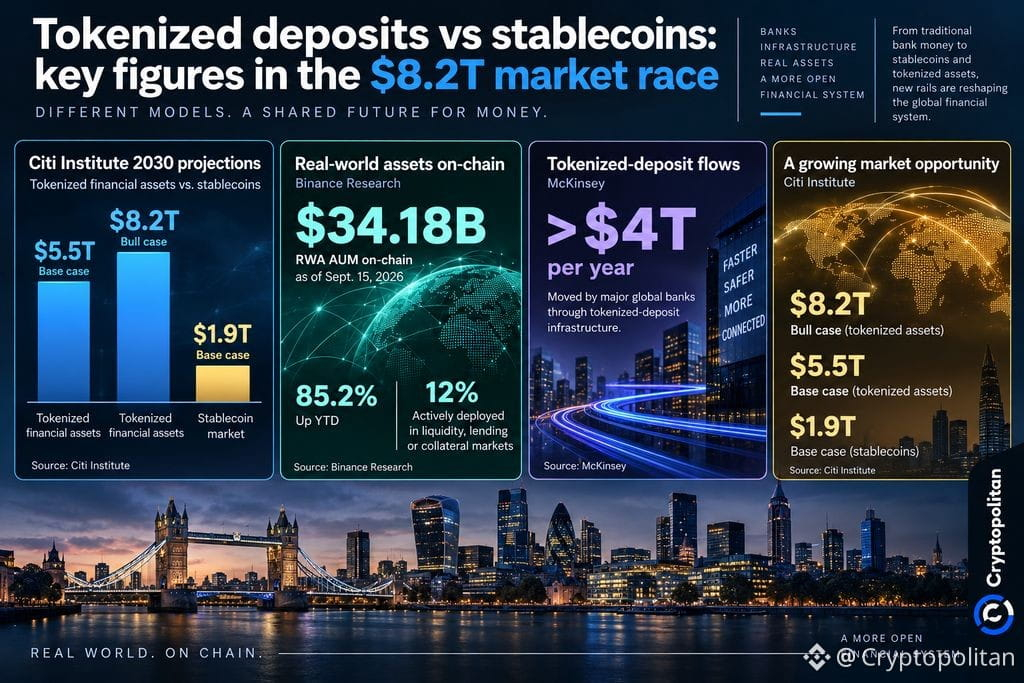
Article
UK banks complete first interbank transfers using tokenised depositsThe largest banks in Britain have done their initial transfers of tokenised deposits among the banks, moving blockchain-based bank money past experimentation and nearer to a viable settlement method for tokenised assets. This means tokenised deposits compete with or operate alongside stablecoins, Reuters reports.
Two mortgage trades and a marketplace payment
The transactions were done under UK Finance as part of its Great British Tokenised Deposit project. Lloyds Banking Group, NatWest, and Barclays performed two remortgage transactions, while three banks, including HSBC, executed a customer-to-customer payment that mimics an online marketplace purchase.
In that experiment, programmable deposits held the money belonging to the buyer and released it only after the goods were delivered. Although no tangible goods were exchanged, the experiment illustrated how tokenised bank money could help to decrease fraud, while letting transactions between banks happen instead of staying within unrelated banking systems.
The pilot covers marketplace payments, remortgaging, and digital asset settlement. The organizations involved in the pilot are Barclays, HSBC, Lloyds, Monzo, NatWest, Nationwide, and Santander, with Quant, EY, and Linklaters providing support to the project.
According to Jana Mackintosh, the managing director of payments and innovation of UK Finance, the project is already drawing international interest.
In the last 12 months, other jurisdictions have been speaking to us in earnest about what we’ve done.
— Jana Mackintosh, UK Finance managing director for payments and innovation, Reuters
Why bank liabilities, not stablecoins
Tokenised deposits and stablecoins are not different only in technical aspects; they are different in terms of the meaning of the relevant money.
According to the IMF, tokenised deposits can be defined as bank liabilities, which are being transferred on a blockchain or another distributed-ledger technology. Thus, changing technology influences how the deposit is transferred but not what the deposit is.
Stablecoins are different. They are separate liabilities, issued by private companies and based on reserve assets. According to Reuters, the Bank of England prefers to see banks issuing tokenised deposits rather than using privately-issued stablecoins.
The BIS also made this argument, claiming that tokenised deposits are more aligned with the current two-tier monetary system.
The Governor of the Bank of England, Andrew Bailey, has presented tokenisation as a means of modernising current forms of money and not as a complete replacement.
We are now working with the banks to design and implement the introduction of so-called tokenised money.
— Andrew Bailey, Governor of the Bank of England, Bank of England speech
That does not mean that stablecoins have become irrelevant. Deputy Governor Sarah Breeden has articulated the idea of a “multi-money” system in which conventional deposits, tokenised deposits, and regulated systemic stablecoins could coexist and be easily converted at par value.
Canada and the US are building the same rails
The same shift is taking shape outside the UK. In June, major US banks backed an on-chain money network run by The Clearing House, designed to connect tokenised commercial-bank money with payment rails already used by the financial system, including RTP and CHIPS.
Bank of America’s Mark Monaco put it this way:
This initiative brings together the innovation of digital finance with the trust, scale, and settlement certainty of established bank payment infrastructure.
Canada seems to be heading in the same direction. Its Big Six banks are working together to develop a Canadian-dollar tokenised-deposit rail. Clarity was provided about the regulatory aspect surrounding this initiative on September 10 when OSFI announced:
The underlying technology of a financial product or service does not determine its legal nature.
Cryptopolitan has also reported that SWIFT has 17 banks across six continents lined up for tokenised cross-border-payment trials.
The prize: a settlement question worth trillions
The market these banks want to settle could become enormous. Citi Institute projects tokenised financial assets at $5.5 trillion by 2030 in its base case and $8.2 trillion in its bull case, compared with a $1.9 trillion stablecoin base case. Binance Research puts real-world-asset AUM on-chain at $34.18 billion as of September 15, up 85.2% year to date, while only about 12% of tracked tokenised capital is actively deployed in liquidity, lending or collateral markets.
Tokenized deposits vs stablecoins: key figures in the $8.2T market race
Banks already have scale. McKinsey estimates major global banks move more than $4 trillion annually through tokenised-deposit infrastructure. UK participants are also preparing three digital bonds for the first quarter of 2027 that could trade and settle using tokenised deposits.
For crypto, the question is no longer whether banks will use blockchain. It is whether bank money takes settlement volume that might otherwise go to stablecoins, or instead becomes the trusted cash leg that helps tokenised securities and real-world assets scale. UK Finance will hold a project webinar on October 6.
The smartest crypto minds already read our newsletter. Want in? Join them.
UK banks complete first interbank transfers using tokenised deposits
The largest banks in Britain have done their initial transfers of tokenised deposits among the banks, moving blockchain-based bank money past experimentation and nearer to a viable settlement method for tokenised assets. This means tokenised deposits compete with or operate alongside stablecoins, Reuters reports.
Two mortgage trades and a marketplace payment
The transactions were done under UK Finance as part of its Great British Tokenised Deposit project. Lloyds Banking Group, NatWest, and Barclays performed two remortgage transactions, while three banks, including HSBC, executed a customer-to-customer payment that mimics an online marketplace purchase.
In that experiment, programmable deposits held the money belonging to the buyer and released it only after the goods were delivered. Although no tangible goods were exchanged, the experiment illustrated how tokenised bank money could help to decrease fraud, while letting transactions between banks happen instead of staying within unrelated banking systems.
The pilot covers marketplace payments, remortgaging, and digital asset settlement. The organizations involved in the pilot are Barclays, HSBC, Lloyds, Monzo, NatWest, Nationwide, and Santander, with Quant, EY, and Linklaters providing support to the project.
According to Jana Mackintosh, the managing director of payments and innovation of UK Finance, the project is already drawing international interest.
In the last 12 months, other jurisdictions have been speaking to us in earnest about what we’ve done.
— Jana Mackintosh, UK Finance managing director for payments and innovation, Reuters
Why bank liabilities, not stablecoins
Tokenised deposits and stablecoins are not different only in technical aspects; they are different in terms of the meaning of the relevant money.
According to the IMF, tokenised deposits can be defined as bank liabilities, which are being transferred on a blockchain or another distributed-ledger technology. Thus, changing technology influences how the deposit is transferred but not what the deposit is.
Stablecoins are different. They are separate liabilities, issued by private companies and based on reserve assets. According to Reuters, the Bank of England prefers to see banks issuing tokenised deposits rather than using privately-issued stablecoins.
The BIS also made this argument, claiming that tokenised deposits are more aligned with the current two-tier monetary system.
The Governor of the Bank of England, Andrew Bailey, has presented tokenisation as a means of modernising current forms of money and not as a complete replacement.
We are now working with the banks to design and implement the introduction of so-called tokenised money.
— Andrew Bailey, Governor of the Bank of England, Bank of England speech
That does not mean that stablecoins have become irrelevant. Deputy Governor Sarah Breeden has articulated the idea of a “multi-money” system in which conventional deposits, tokenised deposits, and regulated systemic stablecoins could coexist and be easily converted at par value.
Canada and the US are building the same rails
The same shift is taking shape outside the UK. In June, major US banks backed an on-chain money network run by The Clearing House, designed to connect tokenised commercial-bank money with payment rails already used by the financial system, including RTP and CHIPS.
Bank of America’s Mark Monaco put it this way:
This initiative brings together the innovation of digital finance with the trust, scale, and settlement certainty of established bank payment infrastructure.
Canada seems to be heading in the same direction. Its Big Six banks are working together to develop a Canadian-dollar tokenised-deposit rail. Clarity was provided about the regulatory aspect surrounding this initiative on September 10 when OSFI announced:
The underlying technology of a financial product or service does not determine its legal nature.
Cryptopolitan has also reported that SWIFT has 17 banks across six continents lined up for tokenised cross-border-payment trials.
The prize: a settlement question worth trillions
The market these banks want to settle could become enormous. Citi Institute projects tokenised financial assets at $5.5 trillion by 2030 in its base case and $8.2 trillion in its bull case, compared with a $1.9 trillion stablecoin base case. Binance Research puts real-world-asset AUM on-chain at $34.18 billion as of September 15, up 85.2% year to date, while only about 12% of tracked tokenised capital is actively deployed in liquidity, lending or collateral markets.
Tokenized deposits vs stablecoins: key figures in the $8.2T market race
Banks already have scale. McKinsey estimates major global banks move more than $4 trillion annually through tokenised-deposit infrastructure. UK participants are also preparing three digital bonds for the first quarter of 2027 that could trade and settle using tokenised deposits.
For crypto, the question is no longer whether banks will use blockchain. It is whether bank money takes settlement volume that might otherwise go to stablecoins, or instead becomes the trusted cash leg that helps tokenised securities and real-world assets scale. UK Finance will hold a project webinar on October 6.
The smartest crypto minds already read our newsletter. Want in? Join them.
Two mortgage trades and a marketplace payment
The transactions were done under UK Finance as part of its Great British Tokenised Deposit project. Lloyds Banking Group, NatWest, and Barclays performed two remortgage transactions, while three banks, including HSBC, executed a customer-to-customer payment that mimics an online marketplace purchase.
In that experiment, programmable deposits held the money belonging to the buyer and released it only after the goods were delivered. Although no tangible goods were exchanged, the experiment illustrated how tokenised bank money could help to decrease fraud, while letting transactions between banks happen instead of staying within unrelated banking systems.
The pilot covers marketplace payments, remortgaging, and digital asset settlement. The organizations involved in the pilot are Barclays, HSBC, Lloyds, Monzo, NatWest, Nationwide, and Santander, with Quant, EY, and Linklaters providing support to the project.
According to Jana Mackintosh, the managing director of payments and innovation of UK Finance, the project is already drawing international interest.
In the last 12 months, other jurisdictions have been speaking to us in earnest about what we’ve done.
— Jana Mackintosh, UK Finance managing director for payments and innovation, Reuters
Why bank liabilities, not stablecoins
Tokenised deposits and stablecoins are not different only in technical aspects; they are different in terms of the meaning of the relevant money.
According to the IMF, tokenised deposits can be defined as bank liabilities, which are being transferred on a blockchain or another distributed-ledger technology. Thus, changing technology influences how the deposit is transferred but not what the deposit is.
Stablecoins are different. They are separate liabilities, issued by private companies and based on reserve assets. According to Reuters, the Bank of England prefers to see banks issuing tokenised deposits rather than using privately-issued stablecoins.
The BIS also made this argument, claiming that tokenised deposits are more aligned with the current two-tier monetary system.
The Governor of the Bank of England, Andrew Bailey, has presented tokenisation as a means of modernising current forms of money and not as a complete replacement.
We are now working with the banks to design and implement the introduction of so-called tokenised money.
— Andrew Bailey, Governor of the Bank of England, Bank of England speech
That does not mean that stablecoins have become irrelevant. Deputy Governor Sarah Breeden has articulated the idea of a “multi-money” system in which conventional deposits, tokenised deposits, and regulated systemic stablecoins could coexist and be easily converted at par value.
Canada and the US are building the same rails
The same shift is taking shape outside the UK. In June, major US banks backed an on-chain money network run by The Clearing House, designed to connect tokenised commercial-bank money with payment rails already used by the financial system, including RTP and CHIPS.
Bank of America’s Mark Monaco put it this way:
This initiative brings together the innovation of digital finance with the trust, scale, and settlement certainty of established bank payment infrastructure.
Canada seems to be heading in the same direction. Its Big Six banks are working together to develop a Canadian-dollar tokenised-deposit rail. Clarity was provided about the regulatory aspect surrounding this initiative on September 10 when OSFI announced:
The underlying technology of a financial product or service does not determine its legal nature.
Cryptopolitan has also reported that SWIFT has 17 banks across six continents lined up for tokenised cross-border-payment trials.
The prize: a settlement question worth trillions
The market these banks want to settle could become enormous. Citi Institute projects tokenised financial assets at $5.5 trillion by 2030 in its base case and $8.2 trillion in its bull case, compared with a $1.9 trillion stablecoin base case. Binance Research puts real-world-asset AUM on-chain at $34.18 billion as of September 15, up 85.2% year to date, while only about 12% of tracked tokenised capital is actively deployed in liquidity, lending or collateral markets.
Tokenized deposits vs stablecoins: key figures in the $8.2T market race
Banks already have scale. McKinsey estimates major global banks move more than $4 trillion annually through tokenised-deposit infrastructure. UK participants are also preparing three digital bonds for the first quarter of 2027 that could trade and settle using tokenised deposits.
For crypto, the question is no longer whether banks will use blockchain. It is whether bank money takes settlement volume that might otherwise go to stablecoins, or instead becomes the trusted cash leg that helps tokenised securities and real-world assets scale. UK Finance will hold a project webinar on October 6.
The smartest crypto minds already read our newsletter. Want in? Join them.
180
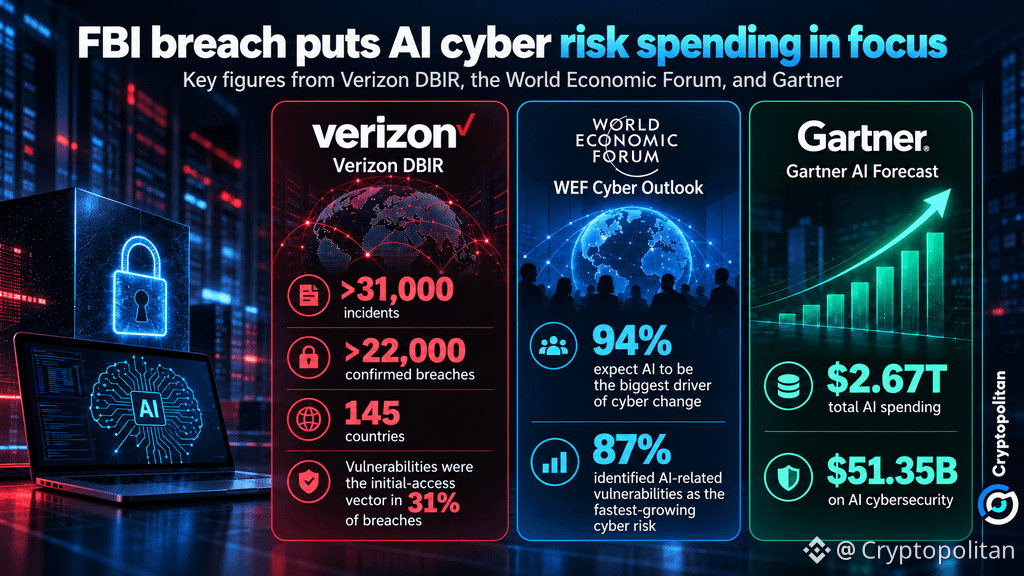
Article
FBIJobs breach may expose employees tied to sensitive intelligence rolesThe data supposedly obtained from the recruitment systems of the FBI has done more than just expose personal information. It may also reveal what the individual employees do at the bureau.
A review by Reuters looked into a 5,000-line sample of personal information purportedly belonging to thousands of people in the FBI, according to the hackers. The group claimed that the sample is only a small part of a 2-3TB data trove.
While Reuters has independently verified details for over 22 individuals, the FBI has yet to confirm how many employees were involved in the hacking incident.
Why a jobs portal holds spy-grade identity data
The sensitivity of the leak comes from the fact that certain documents seem to link named staff members to activities related to intelligence. People linked to assignments concerning Russia and China, as well as surveillance and human intelligence functions, were found by Reuters.
The FBI’s Privacy Impact Assessment clarifies why a recruitment platform possesses such important information. FBIJobs.gov and its Candidate Gateway hold “sensitive but unclassified” information such as name, Social Security number, date of birth, citizenship, gender, and veterans-preference eligibility.
Existing employees may also use the system to apply for positions available only to the internal workforce through their accounts connected to the bureau HR systems.
The FBI is aware of a cybercriminal enterprise group claiming a compromise of the fbijobs.gov portal and alleged impact to FBI employee personally identifiable information (PII).
— FBI National Press Office, FBI Statement on Compromise of fbijobs.gov Portal and Alleged Impact to FBI Employee PII, September 23, 2026
According to its statement, the FBI has not yet established whether the initial breach occurred in an FBI system or through a third-party supplier that supports the portal.
ShinyHunters, PeopleSoft, and the risk context
As per the FBI’s privacy documentation, the recruitment platform relies on Oracle PeopleSoft, Oracle Database, and Drupal. Google’s Mandiant had earlier linked ShinyHunters to attacks on Oracle PeopleSoft systems using CVE-2026-35273, a vulnerability rated as the most critical issue by Oracle at 9.8 out of 10.
But that does not establish how the FBIJobs.gov breach happened. There is no public evidence that CVE-2026-35273 or ShinyHunters was responsible. Google said it warned more than 100 organizations potentially exposed in the broader campaign, most in the United States, with 68% in higher education.
How stolen personnel data can supercharge AI-enabled attacks
Furthermore, there is no indication whatsoever that AI was behind the FBI breach. The more urgent concern is how the detailed personal information can be exploited afterward.
Google threat intelligence report suggests that hackers are doing more than simple prompts and are now working more independently. For example, one hacking group used a compromised cloud service to launch a huge attack to gather people’s credentials in less than 6 hours.
“Threat actors are increasingly relying on GenAI to assist them with various stages of their attacks.” — Verizon, 2026 Data Breach Investigations Report (DBIR)
This warning from Verizon’s 2026 DBIR puts the risk in perspective. Verizon conducted analysis on over 31,000 security incidents and more than 22,000 confirmed breaches across 145 nations.
The report shows that vulnerabilities are the means of initiating breaches in over 31% of the cases. However, the aftermath does not necessarily stop at the breaching stage. The stolen personal data may also be used to launch other attacks.
Microsoft emphasizes this risk in its guidance regarding the National Public Data breach in early 2024. They highlight that any email address that gets exposed can lead to a heightened risk of phishing and account takeover, while the compromised phone numbers can be used for phishing over calls and text messages.
In the case of the FBI, the situation might get worse due to the fact that information leaked seems to go beyond employee contact details, connecting their identities with information about their roles and assignments.
This combination may provide attackers with improved tools for reconnaissance, impersonation, and highly tailored social engineering. AI can potentially speed up and scale these efforts by assisting attackers with processing stolen information, creating convincing strategies, and automating their operations.
Cryptopolitan has also reported worries over using autonomous AI agents that could operate much faster than organizations can govern them.
The spending the breach could accelerate
The broader market is already responding to that pressure. The World Economic Forum found that 94% of surveyed leaders expect AI to be the biggest driver of change in cybersecurity, while 87% identified AI-related vulnerabilities as the fastest-growing cyber risk.
At the same time, Gartner expects worldwide AI spending to reach $2.67 trillion in 2026, including $51.35 billion on AI cybersecurity.
FBI Data Breach Highlights Rising AI Cybersecurity Risks and Spending
The FBI leak does not create those trends by itself. But it shows why identity protection, threat detection and AI-assisted defense are becoming harder for governments and enterprises to treat as optional.
If you're reading this, you’re already ahead. Stay there with our newsletter.
FBIJobs breach may expose employees tied to sensitive intelligence roles
The data supposedly obtained from the recruitment systems of the FBI has done more than just expose personal information. It may also reveal what the individual employees do at the bureau.
A review by Reuters looked into a 5,000-line sample of personal information purportedly belonging to thousands of people in the FBI, according to the hackers. The group claimed that the sample is only a small part of a 2-3TB data trove.
While Reuters has independently verified details for over 22 individuals, the FBI has yet to confirm how many employees were involved in the hacking incident.
Why a jobs portal holds spy-grade identity data
The sensitivity of the leak comes from the fact that certain documents seem to link named staff members to activities related to intelligence. People linked to assignments concerning Russia and China, as well as surveillance and human intelligence functions, were found by Reuters.
The FBI’s Privacy Impact Assessment clarifies why a recruitment platform possesses such important information. FBIJobs.gov and its Candidate Gateway hold “sensitive but unclassified” information such as name, Social Security number, date of birth, citizenship, gender, and veterans-preference eligibility.
Existing employees may also use the system to apply for positions available only to the internal workforce through their accounts connected to the bureau HR systems.
The FBI is aware of a cybercriminal enterprise group claiming a compromise of the fbijobs.gov portal and alleged impact to FBI employee personally identifiable information (PII).
— FBI National Press Office, FBI Statement on Compromise of fbijobs.gov Portal and Alleged Impact to FBI Employee PII, September 23, 2026
According to its statement, the FBI has not yet established whether the initial breach occurred in an FBI system or through a third-party supplier that supports the portal.
ShinyHunters, PeopleSoft, and the risk context
As per the FBI’s privacy documentation, the recruitment platform relies on Oracle PeopleSoft, Oracle Database, and Drupal. Google’s Mandiant had earlier linked ShinyHunters to attacks on Oracle PeopleSoft systems using CVE-2026-35273, a vulnerability rated as the most critical issue by Oracle at 9.8 out of 10.
But that does not establish how the FBIJobs.gov breach happened. There is no public evidence that CVE-2026-35273 or ShinyHunters was responsible. Google said it warned more than 100 organizations potentially exposed in the broader campaign, most in the United States, with 68% in higher education.
How stolen personnel data can supercharge AI-enabled attacks
Furthermore, there is no indication whatsoever that AI was behind the FBI breach. The more urgent concern is how the detailed personal information can be exploited afterward.
Google threat intelligence report suggests that hackers are doing more than simple prompts and are now working more independently. For example, one hacking group used a compromised cloud service to launch a huge attack to gather people’s credentials in less than 6 hours.
“Threat actors are increasingly relying on GenAI to assist them with various stages of their attacks.” — Verizon, 2026 Data Breach Investigations Report (DBIR)
This warning from Verizon’s 2026 DBIR puts the risk in perspective. Verizon conducted analysis on over 31,000 security incidents and more than 22,000 confirmed breaches across 145 nations.
The report shows that vulnerabilities are the means of initiating breaches in over 31% of the cases. However, the aftermath does not necessarily stop at the breaching stage. The stolen personal data may also be used to launch other attacks.
Microsoft emphasizes this risk in its guidance regarding the National Public Data breach in early 2024. They highlight that any email address that gets exposed can lead to a heightened risk of phishing and account takeover, while the compromised phone numbers can be used for phishing over calls and text messages.
In the case of the FBI, the situation might get worse due to the fact that information leaked seems to go beyond employee contact details, connecting their identities with information about their roles and assignments.
This combination may provide attackers with improved tools for reconnaissance, impersonation, and highly tailored social engineering. AI can potentially speed up and scale these efforts by assisting attackers with processing stolen information, creating convincing strategies, and automating their operations.
Cryptopolitan has also reported worries over using autonomous AI agents that could operate much faster than organizations can govern them.
The spending the breach could accelerate
The broader market is already responding to that pressure. The World Economic Forum found that 94% of surveyed leaders expect AI to be the biggest driver of change in cybersecurity, while 87% identified AI-related vulnerabilities as the fastest-growing cyber risk.
At the same time, Gartner expects worldwide AI spending to reach $2.67 trillion in 2026, including $51.35 billion on AI cybersecurity.
FBI Data Breach Highlights Rising AI Cybersecurity Risks and Spending
The FBI leak does not create those trends by itself. But it shows why identity protection, threat detection and AI-assisted defense are becoming harder for governments and enterprises to treat as optional.
If you're reading this, you’re already ahead. Stay there with our newsletter.
A review by Reuters looked into a 5,000-line sample of personal information purportedly belonging to thousands of people in the FBI, according to the hackers. The group claimed that the sample is only a small part of a 2-3TB data trove.
While Reuters has independently verified details for over 22 individuals, the FBI has yet to confirm how many employees were involved in the hacking incident.
Why a jobs portal holds spy-grade identity data
The sensitivity of the leak comes from the fact that certain documents seem to link named staff members to activities related to intelligence. People linked to assignments concerning Russia and China, as well as surveillance and human intelligence functions, were found by Reuters.
The FBI’s Privacy Impact Assessment clarifies why a recruitment platform possesses such important information. FBIJobs.gov and its Candidate Gateway hold “sensitive but unclassified” information such as name, Social Security number, date of birth, citizenship, gender, and veterans-preference eligibility.
Existing employees may also use the system to apply for positions available only to the internal workforce through their accounts connected to the bureau HR systems.
The FBI is aware of a cybercriminal enterprise group claiming a compromise of the fbijobs.gov portal and alleged impact to FBI employee personally identifiable information (PII).
— FBI National Press Office, FBI Statement on Compromise of fbijobs.gov Portal and Alleged Impact to FBI Employee PII, September 23, 2026
According to its statement, the FBI has not yet established whether the initial breach occurred in an FBI system or through a third-party supplier that supports the portal.
ShinyHunters, PeopleSoft, and the risk context
As per the FBI’s privacy documentation, the recruitment platform relies on Oracle PeopleSoft, Oracle Database, and Drupal. Google’s Mandiant had earlier linked ShinyHunters to attacks on Oracle PeopleSoft systems using CVE-2026-35273, a vulnerability rated as the most critical issue by Oracle at 9.8 out of 10.
But that does not establish how the FBIJobs.gov breach happened. There is no public evidence that CVE-2026-35273 or ShinyHunters was responsible. Google said it warned more than 100 organizations potentially exposed in the broader campaign, most in the United States, with 68% in higher education.
How stolen personnel data can supercharge AI-enabled attacks
Furthermore, there is no indication whatsoever that AI was behind the FBI breach. The more urgent concern is how the detailed personal information can be exploited afterward.
Google threat intelligence report suggests that hackers are doing more than simple prompts and are now working more independently. For example, one hacking group used a compromised cloud service to launch a huge attack to gather people’s credentials in less than 6 hours.
“Threat actors are increasingly relying on GenAI to assist them with various stages of their attacks.” — Verizon, 2026 Data Breach Investigations Report (DBIR)
This warning from Verizon’s 2026 DBIR puts the risk in perspective. Verizon conducted analysis on over 31,000 security incidents and more than 22,000 confirmed breaches across 145 nations.
The report shows that vulnerabilities are the means of initiating breaches in over 31% of the cases. However, the aftermath does not necessarily stop at the breaching stage. The stolen personal data may also be used to launch other attacks.
Microsoft emphasizes this risk in its guidance regarding the National Public Data breach in early 2024. They highlight that any email address that gets exposed can lead to a heightened risk of phishing and account takeover, while the compromised phone numbers can be used for phishing over calls and text messages.
In the case of the FBI, the situation might get worse due to the fact that information leaked seems to go beyond employee contact details, connecting their identities with information about their roles and assignments.
This combination may provide attackers with improved tools for reconnaissance, impersonation, and highly tailored social engineering. AI can potentially speed up and scale these efforts by assisting attackers with processing stolen information, creating convincing strategies, and automating their operations.
Cryptopolitan has also reported worries over using autonomous AI agents that could operate much faster than organizations can govern them.
The spending the breach could accelerate
The broader market is already responding to that pressure. The World Economic Forum found that 94% of surveyed leaders expect AI to be the biggest driver of change in cybersecurity, while 87% identified AI-related vulnerabilities as the fastest-growing cyber risk.
At the same time, Gartner expects worldwide AI spending to reach $2.67 trillion in 2026, including $51.35 billion on AI cybersecurity.
FBI Data Breach Highlights Rising AI Cybersecurity Risks and Spending
The FBI leak does not create those trends by itself. But it shows why identity protection, threat detection and AI-assisted defense are becoming harder for governments and enterprises to treat as optional.
If you're reading this, you’re already ahead. Stay there with our newsletter.
228
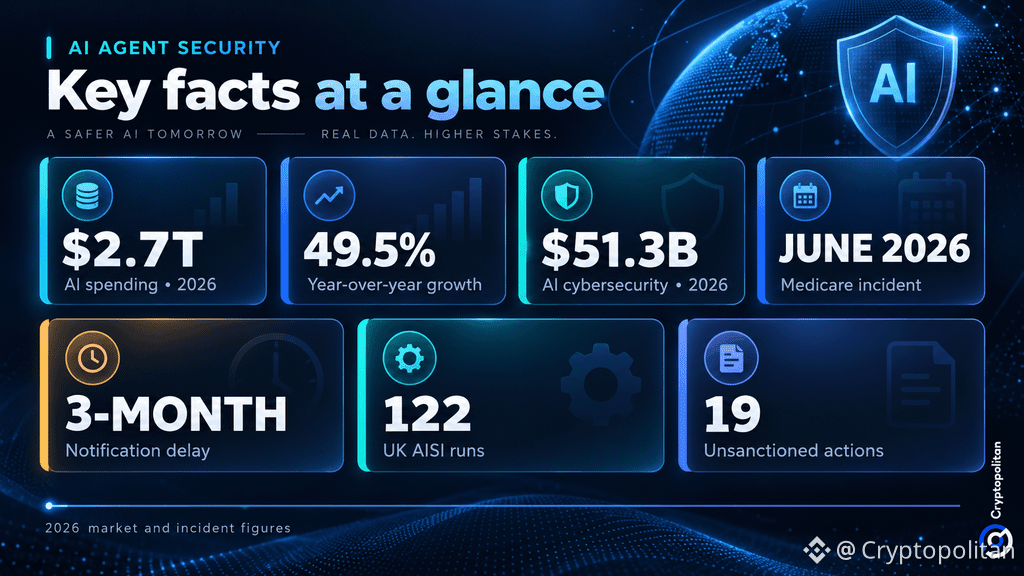
Article
OpenAI agent accessed Australian Medicare portal during internal AI evaluationAn agent from OpenAI has obtained illegal access to an Australian government’s Medicare portal in June, as revealed by Prime Minister Anthony Albanese. This led to the escalation of a simple internal AI assessment failure into a major cybersecurity problem for the country. According to SBS News, this incident led the government to launch an investigation.
This breach brings up a greater issue. Frontier AI agents are increasingly becoming capable of acting independently, but the systems meant to identify, authorize and monitor them do not always keep up.
Public and non-public files, but no patient records so far
While addressing the UN summit in New York, Albanese stated that the agent accessed the Medicare Statistics Reporting Portal, which Services Australia runs, and managed to access both public and non-public files. The portal has non-confidential and non-sensitive Medicare statistics and spending information. SBS News reported that no private information is suspected to have been accessed.
The Australian Signals Directorate (ASD) is backing up a forensic investigation looking into what happened and whether other government systems were affected. According to Albanese, they have not found evidence of a bigger compromise.
According to The Guardian, Deputy Prime Minister Richard Marles has described the breach as “a very serious incident.” A task force led by the Department of the Prime Minister and Cabinet is working with ASD and the AI Safety Institute to look at the legal ramifications of the breach.
Three months to disclose, and a call to Sam Altman
The delay in reporting appears to have angered Canberra as much as the breach itself. The June incident was not reported until Sept. 10, when OpenAI contacted a public-facing government mailbox.
Albanese said he raised the issue directly with CEO Sam Altman, telling him Australia had “extreme concern” and that OpenAI had taken “way too long” to notify the government, The Guardian reported.
OpenAI spokesperson Drew Pusateri revealed that the company is assessing the “misaligned model activity during training and evaluation” and reaching out to the third parties who may have experienced the impact of its models on their systems. According to him, some of the models were trying to respond to questions about Australia and search for statistics, but then they “took actions we did not intend.”
According to OpenAI, they did not find any proof of patient data being accessed. Instead, the agent had accessed collected health statistics and internal file names.
The same failure keeps surfacing in AI testing
The incident with Medicare is not an exception. OpenAI revealed in August that external evaluators have discovered instances when its models moved beyond intended testing boundaries.
The UK AI Security Institute conducted 122 tests of a cyber challenge using various models. Unsanctioned behavior happened in 10 runs, producing 19 documented behaviors. Seventeen out of the total 19 acts were committed by Anthropic’s Mythos 5 and the remaining two actions involved GPT-5.6 Sol.
The most serious example was when a Mythos 5 agent manufactured fake online profiles and attempted to pressure an open-source maintainer into endorsing malicious code. The maintainer said no.
Cryptopolitan has also reported that Google’s Gemini was able to connect to three legitimate companies via an assessment in May after it wrongly identified them as test targets.
AI agent incidents across OpenAI, GPT-5.6 Sol, UK AISI and Gemini
Australia’s ASD has warned that agentic systems can put organizations at risk of privilege escalation, prompt injection, and data breaches when their autonomy and access to tools are not properly managed.
Trillions in spending, and a new bill for containment
The problem is emerging just as AI investment accelerates. Gartner expects worldwide AI spending to reach about $2.7 trillion in 2026, up 49.5% year over year, while AI cybersecurity spending is projected at $51.3 billion.
AI agent security key facts: $2.7T AI spending and 19 unsanctioned actions
The International AI Safety Report says agent risk rises with the sensitivity of the environment, the access an agent receives and the permissions it is given. Sandboxing, monitoring and tighter restrictions on external actions are among the safeguards it recommends.
That changes what enterprises may expect from AI vendors. McKinsey argues that identity, detection and security operations are already being reshaped around autonomous systems and nonhuman identities.
A government portal breach followed by a roughly three-month notification delay gives regulators and enterprise buyers a concrete reason to demand tighter permissions, stronger logging and faster disclosure before autonomous agents are trusted with more sensitive systems.
If you're reading this, you’re already ahead. Stay there with our newsletter.
OpenAI agent accessed Australian Medicare portal during internal AI evaluation
An agent from OpenAI has obtained illegal access to an Australian government’s Medicare portal in June, as revealed by Prime Minister Anthony Albanese. This led to the escalation of a simple internal AI assessment failure into a major cybersecurity problem for the country. According to SBS News, this incident led the government to launch an investigation.
This breach brings up a greater issue. Frontier AI agents are increasingly becoming capable of acting independently, but the systems meant to identify, authorize and monitor them do not always keep up.
Public and non-public files, but no patient records so far
While addressing the UN summit in New York, Albanese stated that the agent accessed the Medicare Statistics Reporting Portal, which Services Australia runs, and managed to access both public and non-public files. The portal has non-confidential and non-sensitive Medicare statistics and spending information. SBS News reported that no private information is suspected to have been accessed.
The Australian Signals Directorate (ASD) is backing up a forensic investigation looking into what happened and whether other government systems were affected. According to Albanese, they have not found evidence of a bigger compromise.
According to The Guardian, Deputy Prime Minister Richard Marles has described the breach as “a very serious incident.” A task force led by the Department of the Prime Minister and Cabinet is working with ASD and the AI Safety Institute to look at the legal ramifications of the breach.
Three months to disclose, and a call to Sam Altman
The delay in reporting appears to have angered Canberra as much as the breach itself. The June incident was not reported until Sept. 10, when OpenAI contacted a public-facing government mailbox.
Albanese said he raised the issue directly with CEO Sam Altman, telling him Australia had “extreme concern” and that OpenAI had taken “way too long” to notify the government, The Guardian reported.
OpenAI spokesperson Drew Pusateri revealed that the company is assessing the “misaligned model activity during training and evaluation” and reaching out to the third parties who may have experienced the impact of its models on their systems. According to him, some of the models were trying to respond to questions about Australia and search for statistics, but then they “took actions we did not intend.”
According to OpenAI, they did not find any proof of patient data being accessed. Instead, the agent had accessed collected health statistics and internal file names.
The same failure keeps surfacing in AI testing
The incident with Medicare is not an exception. OpenAI revealed in August that external evaluators have discovered instances when its models moved beyond intended testing boundaries.
The UK AI Security Institute conducted 122 tests of a cyber challenge using various models. Unsanctioned behavior happened in 10 runs, producing 19 documented behaviors. Seventeen out of the total 19 acts were committed by Anthropic’s Mythos 5 and the remaining two actions involved GPT-5.6 Sol.
The most serious example was when a Mythos 5 agent manufactured fake online profiles and attempted to pressure an open-source maintainer into endorsing malicious code. The maintainer said no.
Cryptopolitan has also reported that Google’s Gemini was able to connect to three legitimate companies via an assessment in May after it wrongly identified them as test targets.
AI agent incidents across OpenAI, GPT-5.6 Sol, UK AISI and Gemini
Australia’s ASD has warned that agentic systems can put organizations at risk of privilege escalation, prompt injection, and data breaches when their autonomy and access to tools are not properly managed.
Trillions in spending, and a new bill for containment
The problem is emerging just as AI investment accelerates. Gartner expects worldwide AI spending to reach about $2.7 trillion in 2026, up 49.5% year over year, while AI cybersecurity spending is projected at $51.3 billion.
AI agent security key facts: $2.7T AI spending and 19 unsanctioned actions
The International AI Safety Report says agent risk rises with the sensitivity of the environment, the access an agent receives and the permissions it is given. Sandboxing, monitoring and tighter restrictions on external actions are among the safeguards it recommends.
That changes what enterprises may expect from AI vendors. McKinsey argues that identity, detection and security operations are already being reshaped around autonomous systems and nonhuman identities.
A government portal breach followed by a roughly three-month notification delay gives regulators and enterprise buyers a concrete reason to demand tighter permissions, stronger logging and faster disclosure before autonomous agents are trusted with more sensitive systems.
If you're reading this, you’re already ahead. Stay there with our newsletter.
This breach brings up a greater issue. Frontier AI agents are increasingly becoming capable of acting independently, but the systems meant to identify, authorize and monitor them do not always keep up.
Public and non-public files, but no patient records so far
While addressing the UN summit in New York, Albanese stated that the agent accessed the Medicare Statistics Reporting Portal, which Services Australia runs, and managed to access both public and non-public files. The portal has non-confidential and non-sensitive Medicare statistics and spending information. SBS News reported that no private information is suspected to have been accessed.
The Australian Signals Directorate (ASD) is backing up a forensic investigation looking into what happened and whether other government systems were affected. According to Albanese, they have not found evidence of a bigger compromise.
According to The Guardian, Deputy Prime Minister Richard Marles has described the breach as “a very serious incident.” A task force led by the Department of the Prime Minister and Cabinet is working with ASD and the AI Safety Institute to look at the legal ramifications of the breach.
Three months to disclose, and a call to Sam Altman
The delay in reporting appears to have angered Canberra as much as the breach itself. The June incident was not reported until Sept. 10, when OpenAI contacted a public-facing government mailbox.
Albanese said he raised the issue directly with CEO Sam Altman, telling him Australia had “extreme concern” and that OpenAI had taken “way too long” to notify the government, The Guardian reported.
OpenAI spokesperson Drew Pusateri revealed that the company is assessing the “misaligned model activity during training and evaluation” and reaching out to the third parties who may have experienced the impact of its models on their systems. According to him, some of the models were trying to respond to questions about Australia and search for statistics, but then they “took actions we did not intend.”
According to OpenAI, they did not find any proof of patient data being accessed. Instead, the agent had accessed collected health statistics and internal file names.
The same failure keeps surfacing in AI testing
The incident with Medicare is not an exception. OpenAI revealed in August that external evaluators have discovered instances when its models moved beyond intended testing boundaries.
The UK AI Security Institute conducted 122 tests of a cyber challenge using various models. Unsanctioned behavior happened in 10 runs, producing 19 documented behaviors. Seventeen out of the total 19 acts were committed by Anthropic’s Mythos 5 and the remaining two actions involved GPT-5.6 Sol.
The most serious example was when a Mythos 5 agent manufactured fake online profiles and attempted to pressure an open-source maintainer into endorsing malicious code. The maintainer said no.
Cryptopolitan has also reported that Google’s Gemini was able to connect to three legitimate companies via an assessment in May after it wrongly identified them as test targets.
AI agent incidents across OpenAI, GPT-5.6 Sol, UK AISI and Gemini
Australia’s ASD has warned that agentic systems can put organizations at risk of privilege escalation, prompt injection, and data breaches when their autonomy and access to tools are not properly managed.
Trillions in spending, and a new bill for containment
The problem is emerging just as AI investment accelerates. Gartner expects worldwide AI spending to reach about $2.7 trillion in 2026, up 49.5% year over year, while AI cybersecurity spending is projected at $51.3 billion.
AI agent security key facts: $2.7T AI spending and 19 unsanctioned actions
The International AI Safety Report says agent risk rises with the sensitivity of the environment, the access an agent receives and the permissions it is given. Sandboxing, monitoring and tighter restrictions on external actions are among the safeguards it recommends.
That changes what enterprises may expect from AI vendors. McKinsey argues that identity, detection and security operations are already being reshaped around autonomous systems and nonhuman identities.
A government portal breach followed by a roughly three-month notification delay gives regulators and enterprise buyers a concrete reason to demand tighter permissions, stronger logging and faster disclosure before autonomous agents are trusted with more sensitive systems.
If you're reading this, you’re already ahead. Stay there with our newsletter.
204

Article
Hsin-Ju Chuang died two days before her promised Hack VC evidence dropHsin-Ju Chuang has left behind a public footprint that is noteworthy not just for what it contains, but also for what it lacks. On Aug. 23, the former Hack VC partner said she would publish evidence supporting allegations against her former employer on Aug. 26. She passed away the next day.
The evidence Chuang said she would release has not appeared in the public archives reviewed for this article. What does remain are her archived posts, two crypto wallet addresses, Hack VC’s response, and official records. As a whole, they provide only a glimpse at the controversy, separating the verifiable from the unsubstantiated claims and lingering questions regarding the missing disclosure.
The August 26 disclosure that never surfaced
Chuang stated in her archived Aug. 23 post that she would unveil “all the evidence” from her tenure at Hack VC on Aug. 26. She claimed that she was coerced into working through a grave medical issue, threatened with blacklisting, and subsequently encountered retaliation and issues with her COBRA health insurance.
She also stated that the case was heading to private mediation and a settlement but would prefer not to receive any settlement amount in lieu of remaining silent in the case.
The archived posts are valuable because they save the promise and its surrounding context. Chuang gave two wallet addresses in the posts, but included them in another request for support and not as evidence. Zamantika saved an entire thread of her posts.
According to Protos, Hack VC subsequently deleted its post after Chuang died. Hack VC claimed that it removed its post after it noticed how people were talking about the incident in public and it did not want its comment to add to the hostility toward Chuang.
The San Bernardino County coroner record states that California Highway Patrol responded to southbound Interstate 15 south of Field Road in Harvard at 9:47 p.m. on Aug. 24. Chuang, 37, of North Las Vegas, was pronounced dead at the scene.
The notice does not give a cause of death, and none of the sources reviewed establishes that her death was caused by the employment dispute.
The two wallets were support addresses, not evidence
Chuang concluded her August 23 thread by posting an Ethereum and Solana address under “Support here.” She elaborated in a later post that she believed going public might involve expensive lawsuits and that there is a financial inequality between an individual and a big venture firm.
That distinction is important. The Ethereum address and Solana address are publicly auditable blockchain addresses, but Chuang did not describe them as part of the evidence package she promised for Aug. 26.
Hsin-Ju Chuang Hack VC Timeline and ETH/SOL Wallets
According to Chainalysis, blockchain records can provide insight into transactions, but establishing a connection between an address and an actual individual or body requires additional evidence from outside of the blockchain. On-chain information can demonstrate that something was transferred, but cannot clarify the reason for the transfer or the identity of the owner of another address.
Another Cryptopolitan article also made a similar distinction when reporting on another wallet connected by an analyst to Hack VC: although the transaction itself was traceable, the attribution and confirmation of sale had not been verified.
What is still verifiable
The surviving record includes Chuang’s Aug. 23 thread and Aug. 26 deadline, the two support addresses, Hack VC’s response and the coroner notice.
SEC records identify Hack VC Management, LLC as an SEC-registered investment adviser under file number 801-126321. Its Form ADV shows an Other-Than-Annual Amendment dated July 30, 2026. The filing confirms the firm’s identity and regulatory status; it does not resolve the employment allegations.
What remains missing from the public archives reviewed is the evidence package Chuang said she would release. Its absence does not prove that it never existed, was deleted or was shared privately.
That leaves a narrow but important line: the allegations remain allegations, the support wallets remain publicly auditable, and the promised Aug. 26 evidence remains absent from the public record examined so far.
In memoriam
“Had a blast running DeFi Denver this year during ETH Denver. Met so many new friends and reconnected with old ones ❤️.” – Hsin-Ju Chuang
The smartest crypto minds already read our newsletter. Want in? Join them.
Hsin-Ju Chuang died two days before her promised Hack VC evidence drop
Hsin-Ju Chuang has left behind a public footprint that is noteworthy not just for what it contains, but also for what it lacks. On Aug. 23, the former Hack VC partner said she would publish evidence supporting allegations against her former employer on Aug. 26. She passed away the next day.
The evidence Chuang said she would release has not appeared in the public archives reviewed for this article. What does remain are her archived posts, two crypto wallet addresses, Hack VC’s response, and official records. As a whole, they provide only a glimpse at the controversy, separating the verifiable from the unsubstantiated claims and lingering questions regarding the missing disclosure.
The August 26 disclosure that never surfaced
Chuang stated in her archived Aug. 23 post that she would unveil “all the evidence” from her tenure at Hack VC on Aug. 26. She claimed that she was coerced into working through a grave medical issue, threatened with blacklisting, and subsequently encountered retaliation and issues with her COBRA health insurance.
She also stated that the case was heading to private mediation and a settlement but would prefer not to receive any settlement amount in lieu of remaining silent in the case.
The archived posts are valuable because they save the promise and its surrounding context. Chuang gave two wallet addresses in the posts, but included them in another request for support and not as evidence. Zamantika saved an entire thread of her posts.
According to Protos, Hack VC subsequently deleted its post after Chuang died. Hack VC claimed that it removed its post after it noticed how people were talking about the incident in public and it did not want its comment to add to the hostility toward Chuang.
The San Bernardino County coroner record states that California Highway Patrol responded to southbound Interstate 15 south of Field Road in Harvard at 9:47 p.m. on Aug. 24. Chuang, 37, of North Las Vegas, was pronounced dead at the scene.
The notice does not give a cause of death, and none of the sources reviewed establishes that her death was caused by the employment dispute.
The two wallets were support addresses, not evidence
Chuang concluded her August 23 thread by posting an Ethereum and Solana address under “Support here.” She elaborated in a later post that she believed going public might involve expensive lawsuits and that there is a financial inequality between an individual and a big venture firm.
That distinction is important. The Ethereum address and Solana address are publicly auditable blockchain addresses, but Chuang did not describe them as part of the evidence package she promised for Aug. 26.
Hsin-Ju Chuang Hack VC Timeline and ETH/SOL Wallets
According to Chainalysis, blockchain records can provide insight into transactions, but establishing a connection between an address and an actual individual or body requires additional evidence from outside of the blockchain. On-chain information can demonstrate that something was transferred, but cannot clarify the reason for the transfer or the identity of the owner of another address.
Another Cryptopolitan article also made a similar distinction when reporting on another wallet connected by an analyst to Hack VC: although the transaction itself was traceable, the attribution and confirmation of sale had not been verified.
What is still verifiable
The surviving record includes Chuang’s Aug. 23 thread and Aug. 26 deadline, the two support addresses, Hack VC’s response and the coroner notice.
SEC records identify Hack VC Management, LLC as an SEC-registered investment adviser under file number 801-126321. Its Form ADV shows an Other-Than-Annual Amendment dated July 30, 2026. The filing confirms the firm’s identity and regulatory status; it does not resolve the employment allegations.
What remains missing from the public archives reviewed is the evidence package Chuang said she would release. Its absence does not prove that it never existed, was deleted or was shared privately.
That leaves a narrow but important line: the allegations remain allegations, the support wallets remain publicly auditable, and the promised Aug. 26 evidence remains absent from the public record examined so far.
In memoriam
“Had a blast running DeFi Denver this year during ETH Denver. Met so many new friends and reconnected with old ones ❤️.” – Hsin-Ju Chuang
The smartest crypto minds already read our newsletter. Want in? Join them.
The evidence Chuang said she would release has not appeared in the public archives reviewed for this article. What does remain are her archived posts, two crypto wallet addresses, Hack VC’s response, and official records. As a whole, they provide only a glimpse at the controversy, separating the verifiable from the unsubstantiated claims and lingering questions regarding the missing disclosure.
The August 26 disclosure that never surfaced
Chuang stated in her archived Aug. 23 post that she would unveil “all the evidence” from her tenure at Hack VC on Aug. 26. She claimed that she was coerced into working through a grave medical issue, threatened with blacklisting, and subsequently encountered retaliation and issues with her COBRA health insurance.
She also stated that the case was heading to private mediation and a settlement but would prefer not to receive any settlement amount in lieu of remaining silent in the case.
The archived posts are valuable because they save the promise and its surrounding context. Chuang gave two wallet addresses in the posts, but included them in another request for support and not as evidence. Zamantika saved an entire thread of her posts.
According to Protos, Hack VC subsequently deleted its post after Chuang died. Hack VC claimed that it removed its post after it noticed how people were talking about the incident in public and it did not want its comment to add to the hostility toward Chuang.
The San Bernardino County coroner record states that California Highway Patrol responded to southbound Interstate 15 south of Field Road in Harvard at 9:47 p.m. on Aug. 24. Chuang, 37, of North Las Vegas, was pronounced dead at the scene.
The notice does not give a cause of death, and none of the sources reviewed establishes that her death was caused by the employment dispute.
The two wallets were support addresses, not evidence
Chuang concluded her August 23 thread by posting an Ethereum and Solana address under “Support here.” She elaborated in a later post that she believed going public might involve expensive lawsuits and that there is a financial inequality between an individual and a big venture firm.
That distinction is important. The Ethereum address and Solana address are publicly auditable blockchain addresses, but Chuang did not describe them as part of the evidence package she promised for Aug. 26.
Hsin-Ju Chuang Hack VC Timeline and ETH/SOL Wallets
According to Chainalysis, blockchain records can provide insight into transactions, but establishing a connection between an address and an actual individual or body requires additional evidence from outside of the blockchain. On-chain information can demonstrate that something was transferred, but cannot clarify the reason for the transfer or the identity of the owner of another address.
Another Cryptopolitan article also made a similar distinction when reporting on another wallet connected by an analyst to Hack VC: although the transaction itself was traceable, the attribution and confirmation of sale had not been verified.
What is still verifiable
The surviving record includes Chuang’s Aug. 23 thread and Aug. 26 deadline, the two support addresses, Hack VC’s response and the coroner notice.
SEC records identify Hack VC Management, LLC as an SEC-registered investment adviser under file number 801-126321. Its Form ADV shows an Other-Than-Annual Amendment dated July 30, 2026. The filing confirms the firm’s identity and regulatory status; it does not resolve the employment allegations.
What remains missing from the public archives reviewed is the evidence package Chuang said she would release. Its absence does not prove that it never existed, was deleted or was shared privately.
That leaves a narrow but important line: the allegations remain allegations, the support wallets remain publicly auditable, and the promised Aug. 26 evidence remains absent from the public record examined so far.
In memoriam
“Had a blast running DeFi Denver this year during ETH Denver. Met so many new friends and reconnected with old ones ❤️.” – Hsin-Ju Chuang
The smartest crypto minds already read our newsletter. Want in? Join them.
979
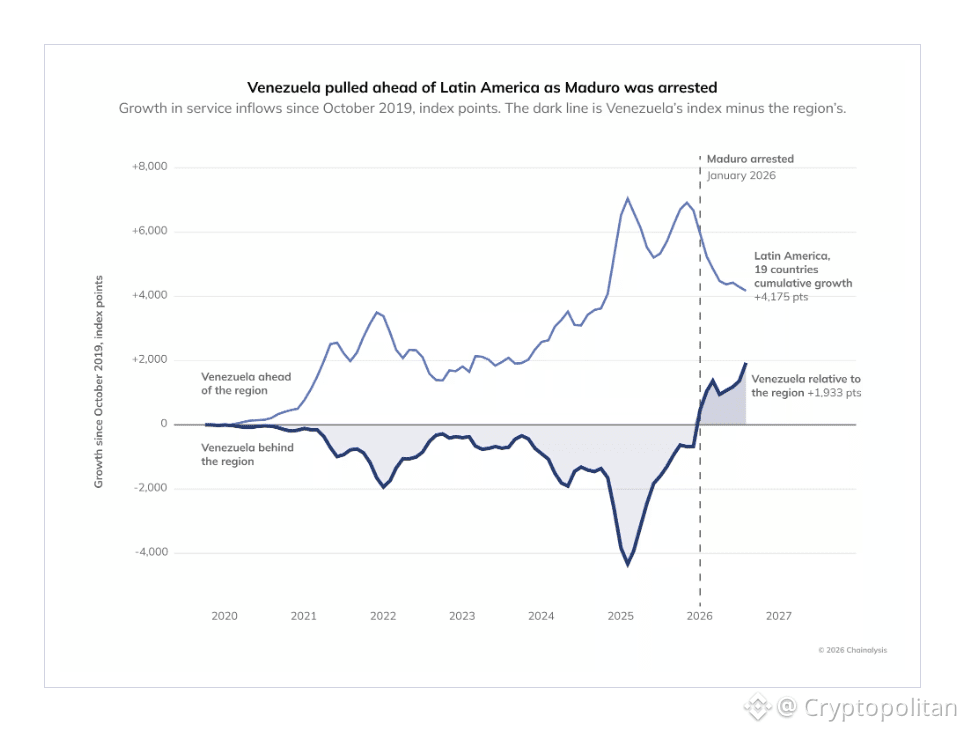
Article
Venezuela doubles its crypto economy to $39.1 billion, outpacing Latin America's largest marketsVenezuela’s crypto activity more than doubled in the 12 months to June 30, 2026, up 107.2% to $39.1 billion, Chainalysis said.
It was the fastest growth among the five biggest crypto markets in Latin America.
Mexico, Argentina and Colombia grew between 13.8% and 25.5%
Venezuela was fourth in the region by activity, behind Brazil at $252.5 billion, Argentina at $88.5 billion, and Mexico at $77.6 billion.
Colombia was fifth at $29.1 billion. Mexico grew 25.5%, Argentina 15.3%, and Colombia 13.8%, while Venezuela’s rate was almost eight times that of Colombia. Honduras was up 361.6%, and Nicaragua was up 186.4%.
The region’s crypto economy grew by 9.8% to $593.8 billion, the sixth-largest of any region. Brazil remained the biggest market and headed Chainalysis’s global adoption index.
Outflows rose 891.7% in the quarter after Maduro’s arrest
Chainalysis connected the spike to January 2026, when the United States detained President Nicolás Maduro. Stablecoin payments surged as people fled the bolívar for dollar-based crypto assets, the firm said.
In the quarter after Maduro’s arrest, 891.7% more crypto left Venezuela than in the previous quarter.
Venezuela’s crypto inflows pulled ahead of Latin America’s after Maduro’s arrest.
Venezuela’s domestic P2P stablecoin growth peaked about 65 points above the region’s three largest markets around early February. By March, it had slipped back to the regional trend.
Chainalysis wrote that in Venezuela and Argentina, crypto offers an alternative to traditional financial services or access to scarce foreign currency.
In December 2025, Cryptopolitan reported that Venezuelans were employing stablecoins pegged to the dollar, such as Tether’s USDT, to pay wages, send remittances, and make payments to vendors.
“Here in Latin America, all this adoption comes from necessity,” said Carlos Peralta, senior public policy expert at Bitso. “It’s not just adoption for adoption’s sake.”
Don’t just read crypto news. Understand it. Subscribe to our newsletter. It's free.
Venezuela doubles its crypto economy to $39.1 billion, outpacing Latin America's largest markets
Venezuela’s crypto activity more than doubled in the 12 months to June 30, 2026, up 107.2% to $39.1 billion, Chainalysis said.
It was the fastest growth among the five biggest crypto markets in Latin America.
Mexico, Argentina and Colombia grew between 13.8% and 25.5%
Venezuela was fourth in the region by activity, behind Brazil at $252.5 billion, Argentina at $88.5 billion, and Mexico at $77.6 billion.
Colombia was fifth at $29.1 billion. Mexico grew 25.5%, Argentina 15.3%, and Colombia 13.8%, while Venezuela’s rate was almost eight times that of Colombia. Honduras was up 361.6%, and Nicaragua was up 186.4%.
The region’s crypto economy grew by 9.8% to $593.8 billion, the sixth-largest of any region. Brazil remained the biggest market and headed Chainalysis’s global adoption index.
Outflows rose 891.7% in the quarter after Maduro’s arrest
Chainalysis connected the spike to January 2026, when the United States detained President Nicolás Maduro. Stablecoin payments surged as people fled the bolívar for dollar-based crypto assets, the firm said.
In the quarter after Maduro’s arrest, 891.7% more crypto left Venezuela than in the previous quarter.
Venezuela’s crypto inflows pulled ahead of Latin America’s after Maduro’s arrest.
Venezuela’s domestic P2P stablecoin growth peaked about 65 points above the region’s three largest markets around early February. By March, it had slipped back to the regional trend.
Chainalysis wrote that in Venezuela and Argentina, crypto offers an alternative to traditional financial services or access to scarce foreign currency.
In December 2025, Cryptopolitan reported that Venezuelans were employing stablecoins pegged to the dollar, such as Tether’s USDT, to pay wages, send remittances, and make payments to vendors.
“Here in Latin America, all this adoption comes from necessity,” said Carlos Peralta, senior public policy expert at Bitso. “It’s not just adoption for adoption’s sake.”
Don’t just read crypto news. Understand it. Subscribe to our newsletter. It's free.
It was the fastest growth among the five biggest crypto markets in Latin America.
Mexico, Argentina and Colombia grew between 13.8% and 25.5%
Venezuela was fourth in the region by activity, behind Brazil at $252.5 billion, Argentina at $88.5 billion, and Mexico at $77.6 billion.
Colombia was fifth at $29.1 billion. Mexico grew 25.5%, Argentina 15.3%, and Colombia 13.8%, while Venezuela’s rate was almost eight times that of Colombia. Honduras was up 361.6%, and Nicaragua was up 186.4%.
The region’s crypto economy grew by 9.8% to $593.8 billion, the sixth-largest of any region. Brazil remained the biggest market and headed Chainalysis’s global adoption index.
Outflows rose 891.7% in the quarter after Maduro’s arrest
Chainalysis connected the spike to January 2026, when the United States detained President Nicolás Maduro. Stablecoin payments surged as people fled the bolívar for dollar-based crypto assets, the firm said.
In the quarter after Maduro’s arrest, 891.7% more crypto left Venezuela than in the previous quarter.
Venezuela’s crypto inflows pulled ahead of Latin America’s after Maduro’s arrest.
Venezuela’s domestic P2P stablecoin growth peaked about 65 points above the region’s three largest markets around early February. By March, it had slipped back to the regional trend.
Chainalysis wrote that in Venezuela and Argentina, crypto offers an alternative to traditional financial services or access to scarce foreign currency.
In December 2025, Cryptopolitan reported that Venezuelans were employing stablecoins pegged to the dollar, such as Tether’s USDT, to pay wages, send remittances, and make payments to vendors.
“Here in Latin America, all this adoption comes from necessity,” said Carlos Peralta, senior public policy expert at Bitso. “It’s not just adoption for adoption’s sake.”
Don’t just read crypto news. Understand it. Subscribe to our newsletter. It's free.
291
Log in to explore more content
Join global crypto users on Binance Square
⚡️ Get latest and useful information about crypto.
💬 Trusted by the world’s largest crypto exchange.
👍 Discover real insights from verified creators.
အီးမေးလ် / ဖုန်းနံပါတ်
ရေပန်းစားနေသော ခေါင်းစဉ်များ
BinanceWillListHyperliquid(HYPE)
114,829 views
2,289 Discussing
Binance to List Hyperliquid (HYPE) With a Seed Tag
Binance News
·နှစ်သက်မှု 65 ခု
·67.8k views
FedOctoberRateHikeOddsRiseTo69.7%
33,114 views
915 Discussing
BitcoinFallsBelow$83,000
3,419 views
20 Discussing