

Cointelegraph
37.2k ပို့စ်များ

Cointelegraph
 Square Verified+
တိုင်ကြားမည်
သုံးစွဲသူကို ဘလော့မည်
Cointelegraph covers fintech, blockchain and Bitcoin, bringing you the latest news and analyses on the future of money.
2 ဖော်လိုလုပ်ထားသည်
186.3K+ ဖော်လိုလုပ်သူများ
567.1K+ လိုက်ခ်လုပ်ထားသည်
1 တံဆိပ်များ
ပို့စ်များ
Article
UK names 6 banks to lead first digitally native government bondThe UK government has appointed six major banks to lead the issuance of its first digitally native government bond, with the pilot expected by the first quarter of 2027.
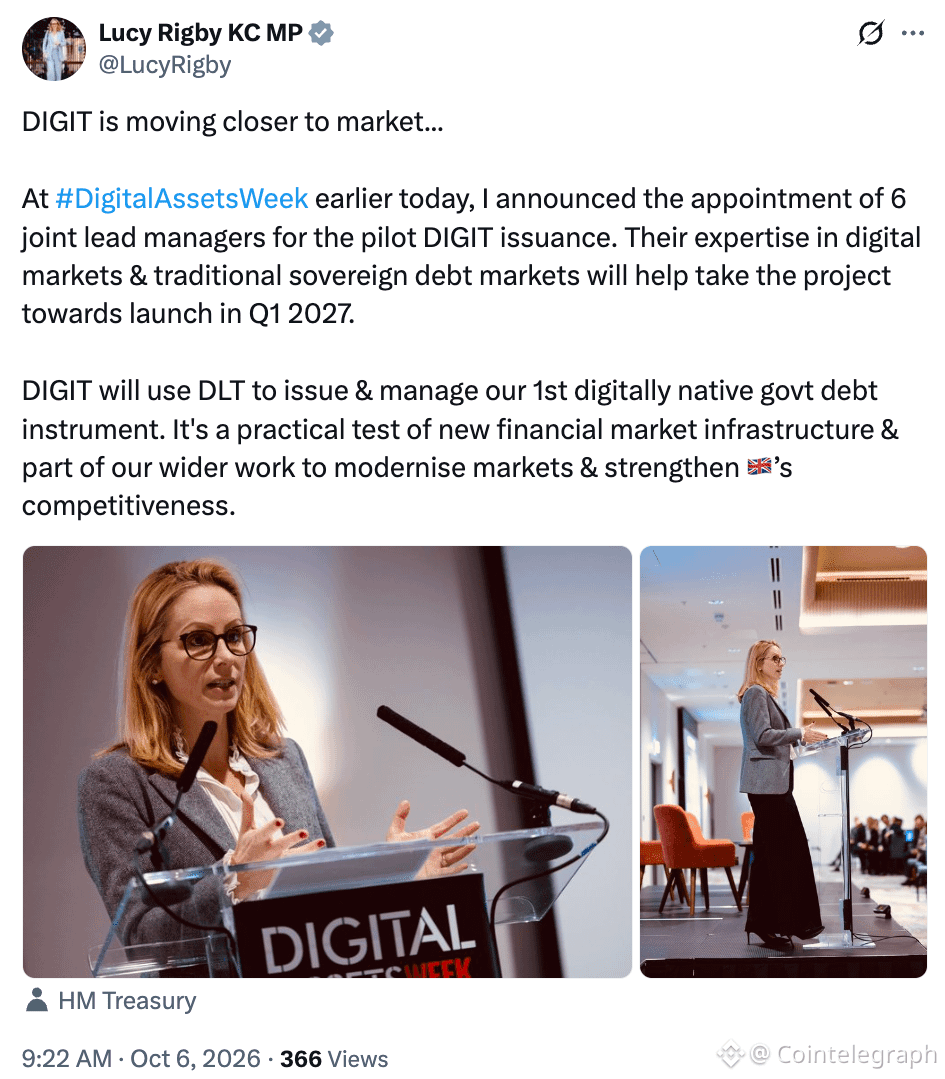
Barclays, HSBC, Lloyds, Morgan Stanley, NatWest and RBC Capital Markets were named joint lead managers for the Digital Gilt Instrument (DIGIT) following a competitive procurement process. Economic Secretary to the Treasury Lucy Rigby announced the appointments Tuesday during a keynote at UK Digital Assets Week.
The banks will provide underwriting, investor engagement and distribution services for the pilot issuance.
Source: Lucy Rigby
DIGIT will be issued on a platform operating within the UK’s Digital Securities Sandbox and will test the use of distributed ledger technology (DLT) across the bond’s issuance and lifecycle, including onchain settlement. The government said the pilot is intended to explore the use of DLT in sovereign debt markets while encouraging the development of digital financial infrastructure in the UK.
The project follows HSBC’s appointment in February as the pilot’s DLT supplier and a July agreement between HSBC and the London Stock Exchange Group to develop a digital securities depository link.
In an X post on Tuesday, Rigby said the appointments mark an important step toward issuing the digital gilt early next year, calling DIGIT “a practical test of new financial market infrastructure.”
Related: Crypto adoption blooming in Germany, while UK is falling ‘behind,’ says CoinShares researcher
Digital bond faces infrastructure test
In comments shared with Cointelegraph, Richard Baker, CEO and founder of Tokenovate and a member of HM Treasury’s Wholesale Digital Markets Industry Taskforce, said the pilot will need to address how digital securities connect with existing financial infrastructure:
On-chain settlement will need to connect with cash, custody and existing settlement infrastructure, with common standards and legal certainty keeping lifecycle events consistent across systems.
Baker said that building that connectivity from the outset could help demonstrate whether tokenization can improve liquidity and market efficiency without creating new digital silos.
Marius Jurgilas, CEO of Axiology and a former central banker, added that the potential impact of DIGIT could extend beyond government borrowing:
Connecting issuance, distribution, trading and settlement through regulated infrastructure could broaden their investor base and create more funding options. Government support for that development can help establish the foundations for a market in which capital moves more easily between countries and reaches a wider range of issuers.
Magazine: Too big to pause: Could an AI slowdown crash the economy?
UK names 6 banks to lead first digitally native government bond
The UK government has appointed six major banks to lead the issuance of its first digitally native government bond, with the pilot expected by the first quarter of 2027.
Barclays, HSBC, Lloyds, Morgan Stanley, NatWest and RBC Capital Markets were named joint lead managers for the Digital Gilt Instrument (DIGIT) following a competitive procurement process. Economic Secretary to the Treasury Lucy Rigby announced the appointments Tuesday during a keynote at UK Digital Assets Week.
The banks will provide underwriting, investor engagement and distribution services for the pilot issuance.
Source: Lucy Rigby
DIGIT will be issued on a platform operating within the UK’s Digital Securities Sandbox and will test the use of distributed ledger technology (DLT) across the bond’s issuance and lifecycle, including onchain settlement. The government said the pilot is intended to explore the use of DLT in sovereign debt markets while encouraging the development of digital financial infrastructure in the UK.
The project follows HSBC’s appointment in February as the pilot’s DLT supplier and a July agreement between HSBC and the London Stock Exchange Group to develop a digital securities depository link.
In an X post on Tuesday, Rigby said the appointments mark an important step toward issuing the digital gilt early next year, calling DIGIT “a practical test of new financial market infrastructure.”
Related: Crypto adoption blooming in Germany, while UK is falling ‘behind,’ says CoinShares researcher
Digital bond faces infrastructure test
In comments shared with Cointelegraph, Richard Baker, CEO and founder of Tokenovate and a member of HM Treasury’s Wholesale Digital Markets Industry Taskforce, said the pilot will need to address how digital securities connect with existing financial infrastructure:
On-chain settlement will need to connect with cash, custody and existing settlement infrastructure, with common standards and legal certainty keeping lifecycle events consistent across systems.
Baker said that building that connectivity from the outset could help demonstrate whether tokenization can improve liquidity and market efficiency without creating new digital silos.
Marius Jurgilas, CEO of Axiology and a former central banker, added that the potential impact of DIGIT could extend beyond government borrowing:
Connecting issuance, distribution, trading and settlement through regulated infrastructure could broaden their investor base and create more funding options. Government support for that development can help establish the foundations for a market in which capital moves more easily between countries and reaches a wider range of issuers.
Magazine: Too big to pause: Could an AI slowdown crash the economy?
Barclays, HSBC, Lloyds, Morgan Stanley, NatWest and RBC Capital Markets were named joint lead managers for the Digital Gilt Instrument (DIGIT) following a competitive procurement process. Economic Secretary to the Treasury Lucy Rigby announced the appointments Tuesday during a keynote at UK Digital Assets Week.
The banks will provide underwriting, investor engagement and distribution services for the pilot issuance.
Source: Lucy Rigby
DIGIT will be issued on a platform operating within the UK’s Digital Securities Sandbox and will test the use of distributed ledger technology (DLT) across the bond’s issuance and lifecycle, including onchain settlement. The government said the pilot is intended to explore the use of DLT in sovereign debt markets while encouraging the development of digital financial infrastructure in the UK.
The project follows HSBC’s appointment in February as the pilot’s DLT supplier and a July agreement between HSBC and the London Stock Exchange Group to develop a digital securities depository link.
In an X post on Tuesday, Rigby said the appointments mark an important step toward issuing the digital gilt early next year, calling DIGIT “a practical test of new financial market infrastructure.”
Related: Crypto adoption blooming in Germany, while UK is falling ‘behind,’ says CoinShares researcher
Digital bond faces infrastructure test
In comments shared with Cointelegraph, Richard Baker, CEO and founder of Tokenovate and a member of HM Treasury’s Wholesale Digital Markets Industry Taskforce, said the pilot will need to address how digital securities connect with existing financial infrastructure:
On-chain settlement will need to connect with cash, custody and existing settlement infrastructure, with common standards and legal certainty keeping lifecycle events consistent across systems.
Baker said that building that connectivity from the outset could help demonstrate whether tokenization can improve liquidity and market efficiency without creating new digital silos.
Marius Jurgilas, CEO of Axiology and a former central banker, added that the potential impact of DIGIT could extend beyond government borrowing:
Connecting issuance, distribution, trading and settlement through regulated infrastructure could broaden their investor base and create more funding options. Government support for that development can help establish the foundations for a market in which capital moves more easily between countries and reaches a wider range of issuers.
Magazine: Too big to pause: Could an AI slowdown crash the economy?
54
Russia’s digital ruble accounts top 220K in first month, nearly 4X central bank forecastEarly adoption of Russia’s central bank digital currency, the digital ruble, has vastly exceeded forecasts, with more than 220,000 accounts opened in its first month, offering an early test of whether CBDCs can move beyond pilot programs and gain real-world adoption.
As Reuters reported Tuesday, Russian central bank Deputy Governor Zulfiya Kakhrumanova said the figure far exceeded the roughly 60,000 accounts officials had expected following the CBDC’s Sept. 1 launch.
The rollout comes as BRICS, the bloc of major emerging economies that includes Russia, China and India, explores ways to link members’ CBDCs for cross-border payments. As Reuters reported, Russia accelerated development of the digital ruble after Western sanctions imposed over the war in Ukraine cut the country off from parts of the global financial system and complicated payments with major trading partners, including China and India.
Separate reporting from Reuters suggested CBDCs were a key topic at the 18th BRICS Summit in New Delhi, India, last month, where leaders backed efforts to expand local currency trade settlement and link members’ CBDCs for cross-border payments.
CBDCs have drawn controversy over concerns about government surveillance and centralized control of money. In the United States, a major housing law enacted earlier this year included a provision barring the Federal Reserve from issuing or creating a CBDC through the end of 2030.
Russia’s digital ruble accounts top 220K in first month, nearly 4X central bank forecast
Early adoption of Russia’s central bank digital currency, the digital ruble, has vastly exceeded forecasts, with more than 220,000 accounts opened in its first month, offering an early test of whether CBDCs can move beyond pilot programs and gain real-world adoption.
As Reuters reported Tuesday, Russian central bank Deputy Governor Zulfiya Kakhrumanova said the figure far exceeded the roughly 60,000 accounts officials had expected following the CBDC’s Sept. 1 launch.
The rollout comes as BRICS, the bloc of major emerging economies that includes Russia, China and India, explores ways to link members’ CBDCs for cross-border payments. As Reuters reported, Russia accelerated development of the digital ruble after Western sanctions imposed over the war in Ukraine cut the country off from parts of the global financial system and complicated payments with major trading partners, including China and India.
Separate reporting from Reuters suggested CBDCs were a key topic at the 18th BRICS Summit in New Delhi, India, last month, where leaders backed efforts to expand local currency trade settlement and link members’ CBDCs for cross-border payments.
CBDCs have drawn controversy over concerns about government surveillance and centralized control of money. In the United States, a major housing law enacted earlier this year included a provision barring the Federal Reserve from issuing or creating a CBDC through the end of 2030.
As Reuters reported Tuesday, Russian central bank Deputy Governor Zulfiya Kakhrumanova said the figure far exceeded the roughly 60,000 accounts officials had expected following the CBDC’s Sept. 1 launch.
The rollout comes as BRICS, the bloc of major emerging economies that includes Russia, China and India, explores ways to link members’ CBDCs for cross-border payments. As Reuters reported, Russia accelerated development of the digital ruble after Western sanctions imposed over the war in Ukraine cut the country off from parts of the global financial system and complicated payments with major trading partners, including China and India.
Separate reporting from Reuters suggested CBDCs were a key topic at the 18th BRICS Summit in New Delhi, India, last month, where leaders backed efforts to expand local currency trade settlement and link members’ CBDCs for cross-border payments.
CBDCs have drawn controversy over concerns about government surveillance and centralized control of money. In the United States, a major housing law enacted earlier this year included a provision barring the Federal Reserve from issuing or creating a CBDC through the end of 2030.
103
Bill aims at stopping US lawmaker bets on their own elections ahead of midtermsA North Carolina lawmaker has introduced legislation aimed at blocking politicians from using prediction market platforms to potentially profit on their own elections.
On Monday, Representative Don Davis introduced the No Betting on Your Own Race Act, prohibiting federal candidates, their campaigns, their spouses and children from “buying, selling, acquiring, disposing of, or holding contracts” related to their elections. Davis said that the legislation was designed to prevent market interference, insider trading and lawmakers from “cashing in” on elections, with a proposed $10,000 civil penalty for each violation or three times any potential financial windfall.
Although the text of the bill did not explicitly mention prediction market platforms like Kalshi and Polymarket, it referred to “political event contracts,” signaling that the legislation targeted activities through such companies. Republican House of Representatives candidate Laurie Buckhout received a three-year suspension and a $2,590 penalty from Kalshi in August over trading event contracts related to her race, but did not face civil or criminal charges.
However, Davis’ bill will not be addressed before the 2026 midterm elections as the House and Senate are out of session until November, though the House has been holding some pro forma sessions. Event contracts on US elections continue to be available on both Kalshi and Polymarket, offering better odds on Democrats retaking Congress in 2027.
Bill aims at stopping US lawmaker bets on their own elections ahead of midterms
A North Carolina lawmaker has introduced legislation aimed at blocking politicians from using prediction market platforms to potentially profit on their own elections.
On Monday, Representative Don Davis introduced the No Betting on Your Own Race Act, prohibiting federal candidates, their campaigns, their spouses and children from “buying, selling, acquiring, disposing of, or holding contracts” related to their elections. Davis said that the legislation was designed to prevent market interference, insider trading and lawmakers from “cashing in” on elections, with a proposed $10,000 civil penalty for each violation or three times any potential financial windfall.
Although the text of the bill did not explicitly mention prediction market platforms like Kalshi and Polymarket, it referred to “political event contracts,” signaling that the legislation targeted activities through such companies. Republican House of Representatives candidate Laurie Buckhout received a three-year suspension and a $2,590 penalty from Kalshi in August over trading event contracts related to her race, but did not face civil or criminal charges.
However, Davis’ bill will not be addressed before the 2026 midterm elections as the House and Senate are out of session until November, though the House has been holding some pro forma sessions. Event contracts on US elections continue to be available on both Kalshi and Polymarket, offering better odds on Democrats retaking Congress in 2027.
On Monday, Representative Don Davis introduced the No Betting on Your Own Race Act, prohibiting federal candidates, their campaigns, their spouses and children from “buying, selling, acquiring, disposing of, or holding contracts” related to their elections. Davis said that the legislation was designed to prevent market interference, insider trading and lawmakers from “cashing in” on elections, with a proposed $10,000 civil penalty for each violation or three times any potential financial windfall.
Although the text of the bill did not explicitly mention prediction market platforms like Kalshi and Polymarket, it referred to “political event contracts,” signaling that the legislation targeted activities through such companies. Republican House of Representatives candidate Laurie Buckhout received a three-year suspension and a $2,590 penalty from Kalshi in August over trading event contracts related to her race, but did not face civil or criminal charges.
However, Davis’ bill will not be addressed before the 2026 midterm elections as the House and Senate are out of session until November, though the House has been holding some pro forma sessions. Event contracts on US elections continue to be available on both Kalshi and Polymarket, offering better odds on Democrats retaking Congress in 2027.
51
Article
Affluent investors seen boosting crypto exposure: SurveyA majority of affluent investors across seven of the biggest economies hold digital assets, with crypto accounting for around 10% of their portfolios on average, according to a new CoinShares survey.
The survey covered 2,230 investors with at least $500,000 in investable assets across the US, UK, France, Germany, Italy, Sweden and Switzerland. Digital asset ownership ranged from 54% in Sweden to about 70% in the US, UK, Germany and Switzerland.
At least 85% of current digital asset investors in five of the seven countries said they planned to increase their exposure in 2026, with as much as 91% in the US, UK and Germany.
CoinShares survey of affluent investors across seven countries. Source: CoinShares
The February 2026 crypto market downturn did little to dampen that appetite. In all seven countries, more respondents said the sell-off made them more likely to invest in digital assets than less likely.
That resilience appears to reflect a longer-term view of the asset class. Long-term appreciation and diversification were the leading reasons respondents gave for investing in crypto, while speculation ranked last. Just 6% identified primarily as short-term traders.
Bitcoin (BTC) remained the most widely held digital asset, owned by 80% of digital asset investors on average, though 89% of BTC investors also held other digital assets. Meanwhile, 77% of respondents believed BTC would play a significant role in the future global financial system, while 79% supported increased regulation of digital asset markets.
Crypto exposure was particularly high among younger investors. That cohort allocated more to digital assets than older investors in all seven countries and roughly twice as much in four of them.
Advisers lag crypto investors
The survey also found signs of a disconnect between affluent investors and their financial advisers. Roughly four in 10 respondents in Switzerland, France, the US and Germany who worked with an adviser said they found them overly cautious about digital assets.
The respondents’ view on advisers was echoed by Ric Edelman, founder of the Digital Assets Council of Financial Professionals and Edelman Financial Engines.
Edelman told Cointelegraph that financial advisers remain slow adopters of digital assets, with many lacking the knowledge or incentive to learn about the asset class. He said:
Advisors are busy; they are already operating a successful practice filled with happy clients — so why bother learning something new? — and most are getting little to no encouragement from their firms.
He added that some firms prohibit advisers from discussing crypto or offering crypto-related investments to clients. As a result, he said advisers may not know which of their clients own crypto and could be missing opportunities to provide tax, estate-planning and philanthropic services around those holdings.
How much crypto should investors hold?
Edelman challenged CoinShares’ finding that crypto allocations among affluent investors average around 10%, saying his own research suggests allocations of 2% to 5% are far more common.
Despite questioning the survey’s figure, Edelman recommends allocations ranging from 10% to 40%, depending on risk tolerance. He recommends 10% for conservative portfolios, 25% for moderate portfolios and 40% for aggressive portfolios.
“As the asset class matures, 10% allocations or higher will become the norm,” Edelman said. “The sooner people do that, the better off they will be.”
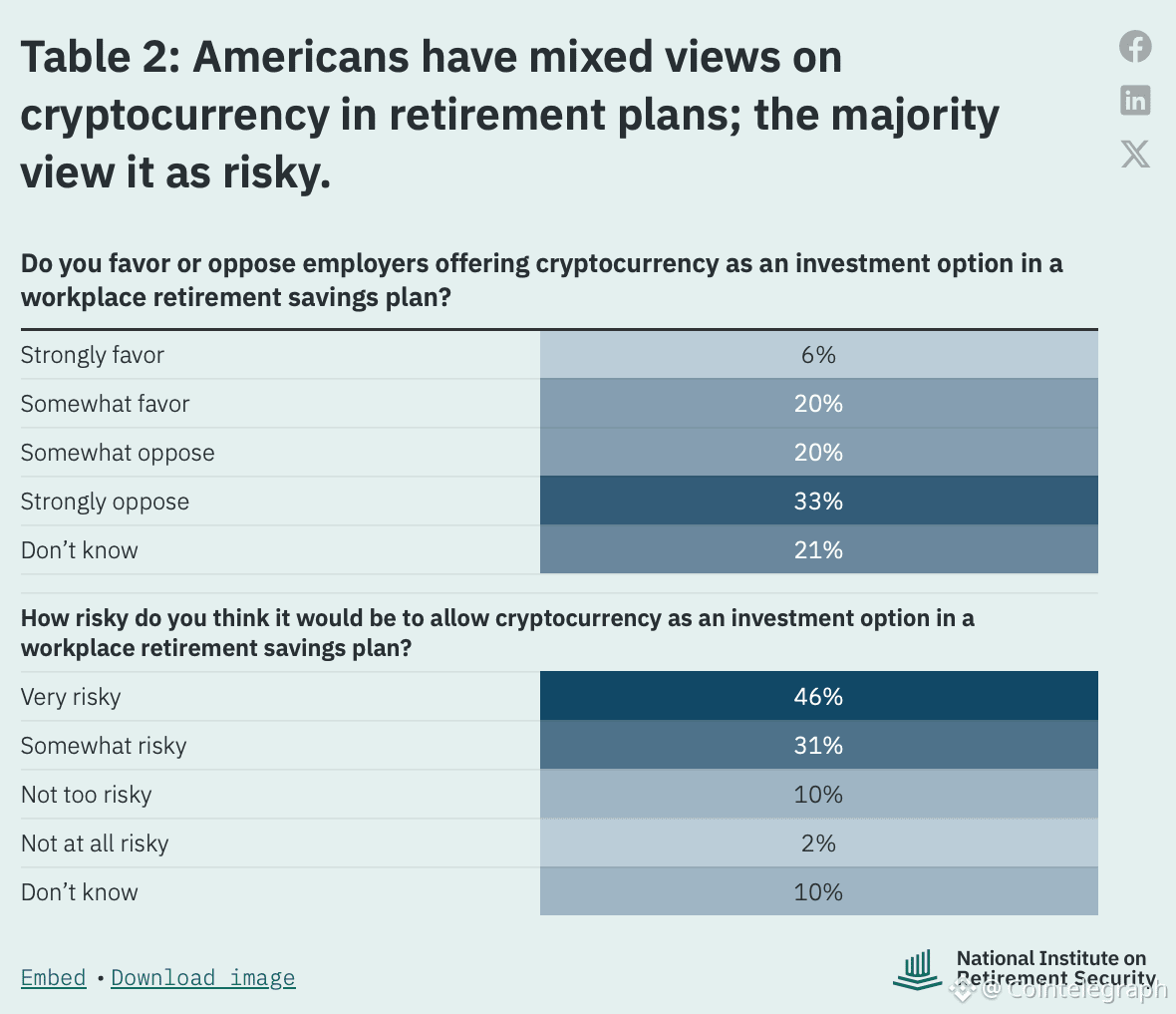
Edelman’s recommended allocations stand in contrast to broader skepticism about using crypto for retirement savings. An August survey from the National Institute on Retirement Security found that 77% of Americans considered cryptocurrency in workplace retirement plans risky, including 46% who viewed it as very risky.
Americans view of crypto in retirement plans. Source: National Institute of Retirement Security
Magazine: Peter Brandt says Bitcoin may hit $600K by 2029, calls XRP a ‘fool coin’
Affluent investors seen boosting crypto exposure: Survey
A majority of affluent investors across seven of the biggest economies hold digital assets, with crypto accounting for around 10% of their portfolios on average, according to a new CoinShares survey.
The survey covered 2,230 investors with at least $500,000 in investable assets across the US, UK, France, Germany, Italy, Sweden and Switzerland. Digital asset ownership ranged from 54% in Sweden to about 70% in the US, UK, Germany and Switzerland.
At least 85% of current digital asset investors in five of the seven countries said they planned to increase their exposure in 2026, with as much as 91% in the US, UK and Germany.
CoinShares survey of affluent investors across seven countries. Source: CoinShares
The February 2026 crypto market downturn did little to dampen that appetite. In all seven countries, more respondents said the sell-off made them more likely to invest in digital assets than less likely.
That resilience appears to reflect a longer-term view of the asset class. Long-term appreciation and diversification were the leading reasons respondents gave for investing in crypto, while speculation ranked last. Just 6% identified primarily as short-term traders.
Bitcoin (BTC) remained the most widely held digital asset, owned by 80% of digital asset investors on average, though 89% of BTC investors also held other digital assets. Meanwhile, 77% of respondents believed BTC would play a significant role in the future global financial system, while 79% supported increased regulation of digital asset markets.
Crypto exposure was particularly high among younger investors. That cohort allocated more to digital assets than older investors in all seven countries and roughly twice as much in four of them.
Advisers lag crypto investors
The survey also found signs of a disconnect between affluent investors and their financial advisers. Roughly four in 10 respondents in Switzerland, France, the US and Germany who worked with an adviser said they found them overly cautious about digital assets.
The respondents’ view on advisers was echoed by Ric Edelman, founder of the Digital Assets Council of Financial Professionals and Edelman Financial Engines.
Edelman told Cointelegraph that financial advisers remain slow adopters of digital assets, with many lacking the knowledge or incentive to learn about the asset class. He said:
Advisors are busy; they are already operating a successful practice filled with happy clients — so why bother learning something new? — and most are getting little to no encouragement from their firms.
He added that some firms prohibit advisers from discussing crypto or offering crypto-related investments to clients. As a result, he said advisers may not know which of their clients own crypto and could be missing opportunities to provide tax, estate-planning and philanthropic services around those holdings.
How much crypto should investors hold?
Edelman challenged CoinShares’ finding that crypto allocations among affluent investors average around 10%, saying his own research suggests allocations of 2% to 5% are far more common.
Despite questioning the survey’s figure, Edelman recommends allocations ranging from 10% to 40%, depending on risk tolerance. He recommends 10% for conservative portfolios, 25% for moderate portfolios and 40% for aggressive portfolios.
“As the asset class matures, 10% allocations or higher will become the norm,” Edelman said. “The sooner people do that, the better off they will be.”
Edelman’s recommended allocations stand in contrast to broader skepticism about using crypto for retirement savings. An August survey from the National Institute on Retirement Security found that 77% of Americans considered cryptocurrency in workplace retirement plans risky, including 46% who viewed it as very risky.
Americans view of crypto in retirement plans. Source: National Institute of Retirement Security
Magazine: Peter Brandt says Bitcoin may hit $600K by 2029, calls XRP a ‘fool coin’
The survey covered 2,230 investors with at least $500,000 in investable assets across the US, UK, France, Germany, Italy, Sweden and Switzerland. Digital asset ownership ranged from 54% in Sweden to about 70% in the US, UK, Germany and Switzerland.
At least 85% of current digital asset investors in five of the seven countries said they planned to increase their exposure in 2026, with as much as 91% in the US, UK and Germany.
CoinShares survey of affluent investors across seven countries. Source: CoinShares
The February 2026 crypto market downturn did little to dampen that appetite. In all seven countries, more respondents said the sell-off made them more likely to invest in digital assets than less likely.
That resilience appears to reflect a longer-term view of the asset class. Long-term appreciation and diversification were the leading reasons respondents gave for investing in crypto, while speculation ranked last. Just 6% identified primarily as short-term traders.
Bitcoin (BTC) remained the most widely held digital asset, owned by 80% of digital asset investors on average, though 89% of BTC investors also held other digital assets. Meanwhile, 77% of respondents believed BTC would play a significant role in the future global financial system, while 79% supported increased regulation of digital asset markets.
Crypto exposure was particularly high among younger investors. That cohort allocated more to digital assets than older investors in all seven countries and roughly twice as much in four of them.
Advisers lag crypto investors
The survey also found signs of a disconnect between affluent investors and their financial advisers. Roughly four in 10 respondents in Switzerland, France, the US and Germany who worked with an adviser said they found them overly cautious about digital assets.
The respondents’ view on advisers was echoed by Ric Edelman, founder of the Digital Assets Council of Financial Professionals and Edelman Financial Engines.
Edelman told Cointelegraph that financial advisers remain slow adopters of digital assets, with many lacking the knowledge or incentive to learn about the asset class. He said:
Advisors are busy; they are already operating a successful practice filled with happy clients — so why bother learning something new? — and most are getting little to no encouragement from their firms.
He added that some firms prohibit advisers from discussing crypto or offering crypto-related investments to clients. As a result, he said advisers may not know which of their clients own crypto and could be missing opportunities to provide tax, estate-planning and philanthropic services around those holdings.
How much crypto should investors hold?
Edelman challenged CoinShares’ finding that crypto allocations among affluent investors average around 10%, saying his own research suggests allocations of 2% to 5% are far more common.
Despite questioning the survey’s figure, Edelman recommends allocations ranging from 10% to 40%, depending on risk tolerance. He recommends 10% for conservative portfolios, 25% for moderate portfolios and 40% for aggressive portfolios.
“As the asset class matures, 10% allocations or higher will become the norm,” Edelman said. “The sooner people do that, the better off they will be.”
Edelman’s recommended allocations stand in contrast to broader skepticism about using crypto for retirement savings. An August survey from the National Institute on Retirement Security found that 77% of Americans considered cryptocurrency in workplace retirement plans risky, including 46% who viewed it as very risky.
Americans view of crypto in retirement plans. Source: National Institute of Retirement Security
Magazine: Peter Brandt says Bitcoin may hit $600K by 2029, calls XRP a ‘fool coin’
92
Article
Bitcoin grinds toward $87K as US equities hit new record highsBitcoin (BTC) continued to circle $86,000 on Tuesday as US stock markets hit fresh all-time highs.
Key points:
Bitcoin attempted to move toward $87,000 but faces ongoing friction from ask liquidity clustered around this key level.
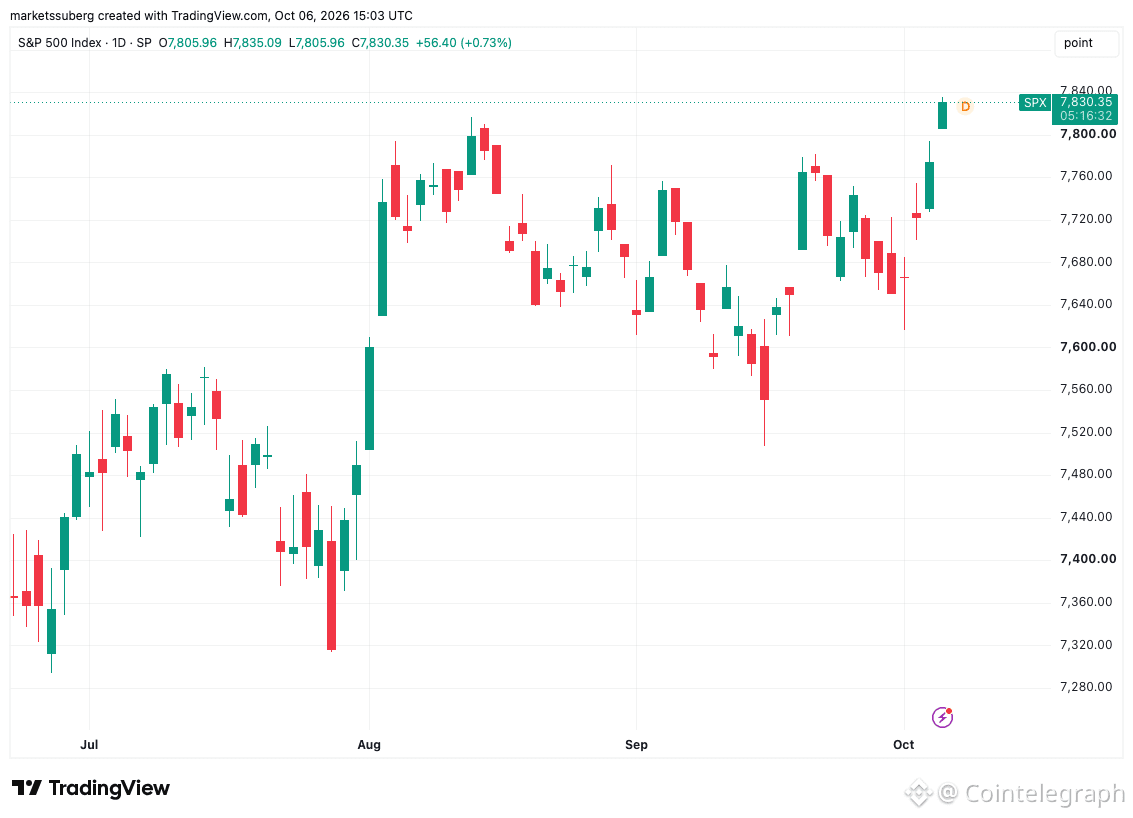
US stock markets returned to all-time highs, with the S&P 500 Index adding 0.8% to reach 7,835 points.
BTC price analysis saw the 21-day simple moving average (SMA) at $83,500 as nearby key support.
Bitcoin rangebound as S&P 500, Nasdaq see new highs
Data from TradingView showed BTC/USD attempting to return to $87,000 after another failed attempt to break higher on Monday.
BTC/USD one-hour chart. Source: Cointelegraph/TradingView
Stocks were in focus after the Wall Street open as the S&P 500, Nasdaq 100 and tech-heavy Nasdaq Composite Index hit new record highs of 7,835, 31,312 and 27,683 points, respectively.
S&P 500 one-day chart. Source: Cointelegraph/TradingView
Commenting on the move, trading resource The Kobeissi Letter noted that the S&P 500 had added 24%, or $71.3 trillion, in value since March 30.
In new analysis looking at the outlook for stocks, Mosaic Asset Company suggested that cooling expectations of interest-rate hikes from the Federal Reserve in Q4 2026 could propel markets higher.
“Shifting views around the Fed and a slower pace of rate hikes could become the catalyst for a durable rally,” it summarized on Tuesday.
Mosaic reiterated that stock-market breadth remained near its lowest levels in six months, with just 25% of stocks trading above their 50-day simple moving average (SMA) last week. Tech companies supplied the lion’s share of the latest upside.
“Breadth has been this oversold just one other time this year, which was back in late March as the S&P 500 fell near correction territory. Oversold conditions helped spark a reversal back then, and could do so again,” it commented.
S&P 500 stocks trading above 50-day SMA. Source: Mosaic Asset Company
Data from onchain analytics platform CryptoQuant shows a modest positive correlation between Bitcoin and the S&P 500. It currently sits at 0.51 as of Oct. 2, its highest since early June.
BTC/USD vs. S&P 500 correlation. Source: CryptoQuant.
BTC price support hinges on 21-day trend line
BTC price action continued to face overhead resistance near range highs thanks to ask liquidity on exchange order books.
Data from CoinGlass showed the largest concentration of liquidity around $87,000 on Tuesday. A “ladder” of asks extended down to $86,500, likely contributing to capped price upside.
BTC liquidation heatmap. Source: CoinGlass
In his latest market overview on X, Keith Alan, cofounder of crypto trading suite Material Indicators, identified support at $83,500, Bitcoin’s current 21-day SMA. This level was last traded on Sept. 18.
“I’m watching price around $83,555, the structure of any $82,500 support test, and whether buyers can clear the Monthly signal’s $87,375 invalidation threshold,” Alan wrote in analysis on Oct. 1.
“Beyond that, a reclaim and successful retest of the Yearly Open at $87,496 would strengthen my case for a durable move above $91,540 which would act as another validation of a confirmed bull market.”
BTC/USD one-day chart with 21 SMA. Source: Cointelegraph/TradingView
Bitcoin grinds toward $87K as US equities hit new record highs
Bitcoin (BTC) continued to circle $86,000 on Tuesday as US stock markets hit fresh all-time highs.
Key points:
Bitcoin attempted to move toward $87,000 but faces ongoing friction from ask liquidity clustered around this key level.
US stock markets returned to all-time highs, with the S&P 500 Index adding 0.8% to reach 7,835 points.
BTC price analysis saw the 21-day simple moving average (SMA) at $83,500 as nearby key support.
Bitcoin rangebound as S&P 500, Nasdaq see new highs
Data from TradingView showed BTC/USD attempting to return to $87,000 after another failed attempt to break higher on Monday.
BTC/USD one-hour chart. Source: Cointelegraph/TradingView
Stocks were in focus after the Wall Street open as the S&P 500, Nasdaq 100 and tech-heavy Nasdaq Composite Index hit new record highs of 7,835, 31,312 and 27,683 points, respectively.
S&P 500 one-day chart. Source: Cointelegraph/TradingView
Commenting on the move, trading resource The Kobeissi Letter noted that the S&P 500 had added 24%, or $71.3 trillion, in value since March 30.
In new analysis looking at the outlook for stocks, Mosaic Asset Company suggested that cooling expectations of interest-rate hikes from the Federal Reserve in Q4 2026 could propel markets higher.
“Shifting views around the Fed and a slower pace of rate hikes could become the catalyst for a durable rally,” it summarized on Tuesday.
Mosaic reiterated that stock-market breadth remained near its lowest levels in six months, with just 25% of stocks trading above their 50-day simple moving average (SMA) last week. Tech companies supplied the lion’s share of the latest upside.
“Breadth has been this oversold just one other time this year, which was back in late March as the S&P 500 fell near correction territory. Oversold conditions helped spark a reversal back then, and could do so again,” it commented.
S&P 500 stocks trading above 50-day SMA. Source: Mosaic Asset Company
Data from onchain analytics platform CryptoQuant shows a modest positive correlation between Bitcoin and the S&P 500. It currently sits at 0.51 as of Oct. 2, its highest since early June.
BTC/USD vs. S&P 500 correlation. Source: CryptoQuant.
BTC price support hinges on 21-day trend line
BTC price action continued to face overhead resistance near range highs thanks to ask liquidity on exchange order books.
Data from CoinGlass showed the largest concentration of liquidity around $87,000 on Tuesday. A “ladder” of asks extended down to $86,500, likely contributing to capped price upside.
BTC liquidation heatmap. Source: CoinGlass
In his latest market overview on X, Keith Alan, cofounder of crypto trading suite Material Indicators, identified support at $83,500, Bitcoin’s current 21-day SMA. This level was last traded on Sept. 18.
“I’m watching price around $83,555, the structure of any $82,500 support test, and whether buyers can clear the Monthly signal’s $87,375 invalidation threshold,” Alan wrote in analysis on Oct. 1.
“Beyond that, a reclaim and successful retest of the Yearly Open at $87,496 would strengthen my case for a durable move above $91,540 which would act as another validation of a confirmed bull market.”
BTC/USD one-day chart with 21 SMA. Source: Cointelegraph/TradingView
Key points:
Bitcoin attempted to move toward $87,000 but faces ongoing friction from ask liquidity clustered around this key level.
US stock markets returned to all-time highs, with the S&P 500 Index adding 0.8% to reach 7,835 points.
BTC price analysis saw the 21-day simple moving average (SMA) at $83,500 as nearby key support.
Bitcoin rangebound as S&P 500, Nasdaq see new highs
Data from TradingView showed BTC/USD attempting to return to $87,000 after another failed attempt to break higher on Monday.
BTC/USD one-hour chart. Source: Cointelegraph/TradingView
Stocks were in focus after the Wall Street open as the S&P 500, Nasdaq 100 and tech-heavy Nasdaq Composite Index hit new record highs of 7,835, 31,312 and 27,683 points, respectively.
S&P 500 one-day chart. Source: Cointelegraph/TradingView
Commenting on the move, trading resource The Kobeissi Letter noted that the S&P 500 had added 24%, or $71.3 trillion, in value since March 30.
In new analysis looking at the outlook for stocks, Mosaic Asset Company suggested that cooling expectations of interest-rate hikes from the Federal Reserve in Q4 2026 could propel markets higher.
“Shifting views around the Fed and a slower pace of rate hikes could become the catalyst for a durable rally,” it summarized on Tuesday.
Mosaic reiterated that stock-market breadth remained near its lowest levels in six months, with just 25% of stocks trading above their 50-day simple moving average (SMA) last week. Tech companies supplied the lion’s share of the latest upside.
“Breadth has been this oversold just one other time this year, which was back in late March as the S&P 500 fell near correction territory. Oversold conditions helped spark a reversal back then, and could do so again,” it commented.
S&P 500 stocks trading above 50-day SMA. Source: Mosaic Asset Company
Data from onchain analytics platform CryptoQuant shows a modest positive correlation between Bitcoin and the S&P 500. It currently sits at 0.51 as of Oct. 2, its highest since early June.
BTC/USD vs. S&P 500 correlation. Source: CryptoQuant.
BTC price support hinges on 21-day trend line
BTC price action continued to face overhead resistance near range highs thanks to ask liquidity on exchange order books.
Data from CoinGlass showed the largest concentration of liquidity around $87,000 on Tuesday. A “ladder” of asks extended down to $86,500, likely contributing to capped price upside.
BTC liquidation heatmap. Source: CoinGlass
In his latest market overview on X, Keith Alan, cofounder of crypto trading suite Material Indicators, identified support at $83,500, Bitcoin’s current 21-day SMA. This level was last traded on Sept. 18.
“I’m watching price around $83,555, the structure of any $82,500 support test, and whether buyers can clear the Monthly signal’s $87,375 invalidation threshold,” Alan wrote in analysis on Oct. 1.
“Beyond that, a reclaim and successful retest of the Yearly Open at $87,496 would strengthen my case for a durable move above $91,540 which would act as another validation of a confirmed bull market.”
BTC/USD one-day chart with 21 SMA. Source: Cointelegraph/TradingView
1
118
Article
Securitize stock jumps 8% amid South Korea tokenization pushShares of tokenization platform Securitize rallied sharply on Tuesday after the company announced a partnership with South Korean technology company LG CNS as the country prepares to introduce a new framework for tokenized securities.
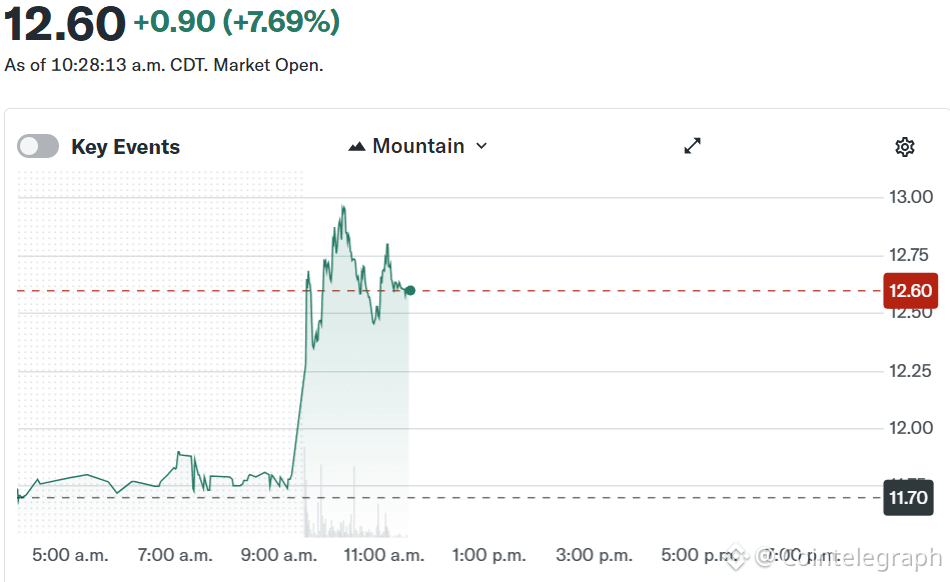
Securitize (SECZ) rose nearly 8% in early Tuesday trading to around $12.60, outperforming most major crypto-linked stocks, before pulling back later in the morning. The company began trading on the New York Stock Exchange in July after completing its merger with special purpose acquisition company Cantor Equity Partners II.
Securitize Corp (SECZ) stock. Source: Yahoo Finance
Securitize and LG CNS signed a memorandum of understanding to develop tokenized assets and digital asset infrastructure for South Korean financial institutions. The companies said the partnership will explore tokenized funds, stocks and stablecoins, while also identifying opportunities across the broader Asia-Pacific market.
The agreement comes as South Korea prepares to implement a new framework for tokenized securities. Last week, the country’s Financial Services Commission proposed rules governing the issuance and circulation of tokenized stocks, bonds, funds and other securities, with the framework set to take effect in February 2027.
The partnership potentially gives Securitize an early foothold in South Korea as financial institutions prepare for the new regime. LG CNS also launched a blockchain infrastructure platform on Tuesday designed to help banks and other financial companies support stablecoins and tokenized securities.
Stocks emerge as the next major tokenization market
Securitize has become a major player in the tokenized real-world asset market, which has grown to roughly $40 billion. Much of the early growth centered on US Treasurys, private credit and other yield-bearing assets, but tokenized stocks are beginning to gain ground.
The market for tokenized stocks has repeatedly hit record highs as exchanges and financial institutions explore bringing traditional equities onchain. Tokenized equities were valued at roughly $3.2 billion, up 10.6% over the past 30 days, according to RWA.xyz data.
Securitize CEO Carlos Domingo has argued that even modest adoption could have a much larger impact on crypto markets. Speaking at ETHConf in July, Domingo said tokenized stocks could help push the overall crypto market to a $5 trillion valuation.
Securitize stock jumps 8% amid South Korea tokenization push
Shares of tokenization platform Securitize rallied sharply on Tuesday after the company announced a partnership with South Korean technology company LG CNS as the country prepares to introduce a new framework for tokenized securities.
Securitize (SECZ) rose nearly 8% in early Tuesday trading to around $12.60, outperforming most major crypto-linked stocks, before pulling back later in the morning. The company began trading on the New York Stock Exchange in July after completing its merger with special purpose acquisition company Cantor Equity Partners II.
Securitize Corp (SECZ) stock. Source: Yahoo Finance
Securitize and LG CNS signed a memorandum of understanding to develop tokenized assets and digital asset infrastructure for South Korean financial institutions. The companies said the partnership will explore tokenized funds, stocks and stablecoins, while also identifying opportunities across the broader Asia-Pacific market.
The agreement comes as South Korea prepares to implement a new framework for tokenized securities. Last week, the country’s Financial Services Commission proposed rules governing the issuance and circulation of tokenized stocks, bonds, funds and other securities, with the framework set to take effect in February 2027.
The partnership potentially gives Securitize an early foothold in South Korea as financial institutions prepare for the new regime. LG CNS also launched a blockchain infrastructure platform on Tuesday designed to help banks and other financial companies support stablecoins and tokenized securities.
Stocks emerge as the next major tokenization market
Securitize has become a major player in the tokenized real-world asset market, which has grown to roughly $40 billion. Much of the early growth centered on US Treasurys, private credit and other yield-bearing assets, but tokenized stocks are beginning to gain ground.
The market for tokenized stocks has repeatedly hit record highs as exchanges and financial institutions explore bringing traditional equities onchain. Tokenized equities were valued at roughly $3.2 billion, up 10.6% over the past 30 days, according to RWA.xyz data.
Securitize CEO Carlos Domingo has argued that even modest adoption could have a much larger impact on crypto markets. Speaking at ETHConf in July, Domingo said tokenized stocks could help push the overall crypto market to a $5 trillion valuation.
Securitize (SECZ) rose nearly 8% in early Tuesday trading to around $12.60, outperforming most major crypto-linked stocks, before pulling back later in the morning. The company began trading on the New York Stock Exchange in July after completing its merger with special purpose acquisition company Cantor Equity Partners II.
Securitize Corp (SECZ) stock. Source: Yahoo Finance
Securitize and LG CNS signed a memorandum of understanding to develop tokenized assets and digital asset infrastructure for South Korean financial institutions. The companies said the partnership will explore tokenized funds, stocks and stablecoins, while also identifying opportunities across the broader Asia-Pacific market.
The agreement comes as South Korea prepares to implement a new framework for tokenized securities. Last week, the country’s Financial Services Commission proposed rules governing the issuance and circulation of tokenized stocks, bonds, funds and other securities, with the framework set to take effect in February 2027.
The partnership potentially gives Securitize an early foothold in South Korea as financial institutions prepare for the new regime. LG CNS also launched a blockchain infrastructure platform on Tuesday designed to help banks and other financial companies support stablecoins and tokenized securities.
Stocks emerge as the next major tokenization market
Securitize has become a major player in the tokenized real-world asset market, which has grown to roughly $40 billion. Much of the early growth centered on US Treasurys, private credit and other yield-bearing assets, but tokenized stocks are beginning to gain ground.
The market for tokenized stocks has repeatedly hit record highs as exchanges and financial institutions explore bringing traditional equities onchain. Tokenized equities were valued at roughly $3.2 billion, up 10.6% over the past 30 days, according to RWA.xyz data.
Securitize CEO Carlos Domingo has argued that even modest adoption could have a much larger impact on crypto markets. Speaking at ETHConf in July, Domingo said tokenized stocks could help push the overall crypto market to a $5 trillion valuation.
SECZUS+၁.၆၇%
73
ECB policymaker warns of fragmentation without digital euroA member of the European Central Bank’s (ECB) executive board has warned that other entities could provide alternatives without the central bank’s introduction of a digital euro, potentially weakening Europe’s “resilience and monetary sovereignty.”
ECB executive board member Piero Cipollone said on a Monday MNI Connect Webcast that without a “pan-European digital payment solution that caters to every type of day-to-day transaction,” the potential for fragmentation could increase across tokenization platforms. He said that the central bank’s goal should be to create a digital euro exchangeable across banks for day-to-day transactions.
“Our objective is not to take over the role of banks,” said Cipollone. “On the contrary, the digital euro would equip banks with the infrastructure they need to compete in the digital age and help them expand the reach and use cases of their own solutions.”
According to Cipollone, the ECB has not decided whether to issue a digital euro, but plans to conclude the legislative process by the end of 2026. Should the central bank move forward with the project, it will run a 12-month pilot program starting in the second half of 2027, with the potential for issuance in 2029.
The ECB first proposed introducing a digital euro in October 2020 as a central bank digital currency (CBDC) to complement cash as a digital payment option. Critics of the CBDC argue that the digital currency could give EU officials the means to surveil and potentially control bloc residents’ spending.
Cipollone said in September 2025 that “the digital euro will ensure that all Europeans can pay at all times with a free, universally accepted digital means of payment, even in case of major disruptions.”
ECB policymaker warns of fragmentation without digital euro
A member of the European Central Bank’s (ECB) executive board has warned that other entities could provide alternatives without the central bank’s introduction of a digital euro, potentially weakening Europe’s “resilience and monetary sovereignty.”
ECB executive board member Piero Cipollone said on a Monday MNI Connect Webcast that without a “pan-European digital payment solution that caters to every type of day-to-day transaction,” the potential for fragmentation could increase across tokenization platforms. He said that the central bank’s goal should be to create a digital euro exchangeable across banks for day-to-day transactions.
“Our objective is not to take over the role of banks,” said Cipollone. “On the contrary, the digital euro would equip banks with the infrastructure they need to compete in the digital age and help them expand the reach and use cases of their own solutions.”
According to Cipollone, the ECB has not decided whether to issue a digital euro, but plans to conclude the legislative process by the end of 2026. Should the central bank move forward with the project, it will run a 12-month pilot program starting in the second half of 2027, with the potential for issuance in 2029.
The ECB first proposed introducing a digital euro in October 2020 as a central bank digital currency (CBDC) to complement cash as a digital payment option. Critics of the CBDC argue that the digital currency could give EU officials the means to surveil and potentially control bloc residents’ spending.
Cipollone said in September 2025 that “the digital euro will ensure that all Europeans can pay at all times with a free, universally accepted digital means of payment, even in case of major disruptions.”
ECB executive board member Piero Cipollone said on a Monday MNI Connect Webcast that without a “pan-European digital payment solution that caters to every type of day-to-day transaction,” the potential for fragmentation could increase across tokenization platforms. He said that the central bank’s goal should be to create a digital euro exchangeable across banks for day-to-day transactions.
“Our objective is not to take over the role of banks,” said Cipollone. “On the contrary, the digital euro would equip banks with the infrastructure they need to compete in the digital age and help them expand the reach and use cases of their own solutions.”
According to Cipollone, the ECB has not decided whether to issue a digital euro, but plans to conclude the legislative process by the end of 2026. Should the central bank move forward with the project, it will run a 12-month pilot program starting in the second half of 2027, with the potential for issuance in 2029.
The ECB first proposed introducing a digital euro in October 2020 as a central bank digital currency (CBDC) to complement cash as a digital payment option. Critics of the CBDC argue that the digital currency could give EU officials the means to surveil and potentially control bloc residents’ spending.
Cipollone said in September 2025 that “the digital euro will ensure that all Europeans can pay at all times with a free, universally accepted digital means of payment, even in case of major disruptions.”
80
Ripple expands Brevan Howard deal with prime brokerage servicesRipple Prime will provide multi-asset prime brokerage, clearing and financing services to funds managed by Brevan Howard, a global investment manager with about $35 billion in assets.
Under the expanded agreement, Brevan Howard will gain access to Ripple Prime’s services across traditional and digital asset markets, according to a Tuesday announcement.
The deal builds on an existing relationship between the firms. Brevan Howard-affiliated funds participated in a $500 million investment in Ripple in 2025 that valued the company at $40 billion.
“As digital and traditional markets become more interconnected, the need for institutional-quality digital asset infrastructure that enables a seamless experience for investors is only growing,” Brevan Howard chief operating officer Alan McGroarty said.
The investment manager serves global clients including sovereign wealth funds, corporate and public pension plans, foundations and endowments.
The agreement comes as Ripple expands its prime brokerage business. In August, Ripple Prime raised $275 million through a senior note offering to fund its expansion into prime brokerage, financing and multi-asset clearing. Ripple launched the business after acquiring prime broker Hidden Road for about $1.25 billion in 2025.
Magazine: Too big to pause: Could an AI slowdown crash the economy?
Ripple expands Brevan Howard deal with prime brokerage services
Ripple Prime will provide multi-asset prime brokerage, clearing and financing services to funds managed by Brevan Howard, a global investment manager with about $35 billion in assets.
Under the expanded agreement, Brevan Howard will gain access to Ripple Prime’s services across traditional and digital asset markets, according to a Tuesday announcement.
The deal builds on an existing relationship between the firms. Brevan Howard-affiliated funds participated in a $500 million investment in Ripple in 2025 that valued the company at $40 billion.
“As digital and traditional markets become more interconnected, the need for institutional-quality digital asset infrastructure that enables a seamless experience for investors is only growing,” Brevan Howard chief operating officer Alan McGroarty said.
The investment manager serves global clients including sovereign wealth funds, corporate and public pension plans, foundations and endowments.
The agreement comes as Ripple expands its prime brokerage business. In August, Ripple Prime raised $275 million through a senior note offering to fund its expansion into prime brokerage, financing and multi-asset clearing. Ripple launched the business after acquiring prime broker Hidden Road for about $1.25 billion in 2025.
Magazine: Too big to pause: Could an AI slowdown crash the economy?
Under the expanded agreement, Brevan Howard will gain access to Ripple Prime’s services across traditional and digital asset markets, according to a Tuesday announcement.
The deal builds on an existing relationship between the firms. Brevan Howard-affiliated funds participated in a $500 million investment in Ripple in 2025 that valued the company at $40 billion.
“As digital and traditional markets become more interconnected, the need for institutional-quality digital asset infrastructure that enables a seamless experience for investors is only growing,” Brevan Howard chief operating officer Alan McGroarty said.
The investment manager serves global clients including sovereign wealth funds, corporate and public pension plans, foundations and endowments.
The agreement comes as Ripple expands its prime brokerage business. In August, Ripple Prime raised $275 million through a senior note offering to fund its expansion into prime brokerage, financing and multi-asset clearing. Ripple launched the business after acquiring prime broker Hidden Road for about $1.25 billion in 2025.
Magazine: Too big to pause: Could an AI slowdown crash the economy?
94
OKX exchange raises fresh capital at $25B valuationCryptocurrency exchange OKX raised an undisclosed sum at a $25 billion valuation from its existing partners and investors.
The round saw participation from Standard Chartered’s SC Ventures investment arm, Qube Research & Technologies, Ripple and stablecoin issuer Circle, OKX announced in a Tuesday press announcement shared with Cointelegraph.
OKX declined to disclose the size of the investment round.
The raise marks an extension to the funding round announced in March, when OKX raised $200 million at the same valuation from the Intercontinental Exchange (ICE), the parent company of the New York Stock Exchange.
The fresh funding will be used to help OKX transition into a “broader global financial technology platform” that combines “crypto technology with the standards people expect from global financial institutions,” said Star Xu, founder and CEO of OKX.
On Monday, a joint venture between OKX and ICE filed with the US Securities and Exchange Commission to launch a tokenized stock trading platform, under the regulator’s new innovation exemption.
OKX exchange raises fresh capital at $25B valuation
Cryptocurrency exchange OKX raised an undisclosed sum at a $25 billion valuation from its existing partners and investors.
The round saw participation from Standard Chartered’s SC Ventures investment arm, Qube Research & Technologies, Ripple and stablecoin issuer Circle, OKX announced in a Tuesday press announcement shared with Cointelegraph.
OKX declined to disclose the size of the investment round.
The raise marks an extension to the funding round announced in March, when OKX raised $200 million at the same valuation from the Intercontinental Exchange (ICE), the parent company of the New York Stock Exchange.
The fresh funding will be used to help OKX transition into a “broader global financial technology platform” that combines “crypto technology with the standards people expect from global financial institutions,” said Star Xu, founder and CEO of OKX.
On Monday, a joint venture between OKX and ICE filed with the US Securities and Exchange Commission to launch a tokenized stock trading platform, under the regulator’s new innovation exemption.
The round saw participation from Standard Chartered’s SC Ventures investment arm, Qube Research & Technologies, Ripple and stablecoin issuer Circle, OKX announced in a Tuesday press announcement shared with Cointelegraph.
OKX declined to disclose the size of the investment round.
The raise marks an extension to the funding round announced in March, when OKX raised $200 million at the same valuation from the Intercontinental Exchange (ICE), the parent company of the New York Stock Exchange.
The fresh funding will be used to help OKX transition into a “broader global financial technology platform” that combines “crypto technology with the standards people expect from global financial institutions,” said Star Xu, founder and CEO of OKX.
On Monday, a joint venture between OKX and ICE filed with the US Securities and Exchange Commission to launch a tokenized stock trading platform, under the regulator’s new innovation exemption.
1
129
Article
Capital starting to rotate back to crypto from AI: Raoul PalA weakening US dollar could give crypto the “green light” and help extend the industry’s rally, says Real Vision founder Raoul Pal.
He tells Cointelegraph on the latest episode of Trade Secrets that higher bond yields and the strong dollar are keeping liquidity from flowing freely.
“If they can engineer the dollar lower, then we get a green light for further movement in crypto,” he says. “I don’t want to get overly excited, so I haven’t got a full green light on everything.”
The US Dollar Index has been trading at the year’s highest levels. Source: TradingView
However he believes Bitcoin will miss out of much of the crypto economic activity generated by AI agents, which is likely to flow to smart contract platforms like Ethereum and Solana.
Pal is among the most experienced high profile crypto analysts, having worked in hedge fund sales at Goldman Sachs in Europe and co-managed a global macro fund at GLG Partners. He launched the research platform Global Macro Investor in 2005 and co-founded financial media Real Vision in 2014.
Pal says he first bought Bitcoin in 2013, after applying a gold-based valuation framework to the cryptocurrency.
An AI pause could help crypto catch up
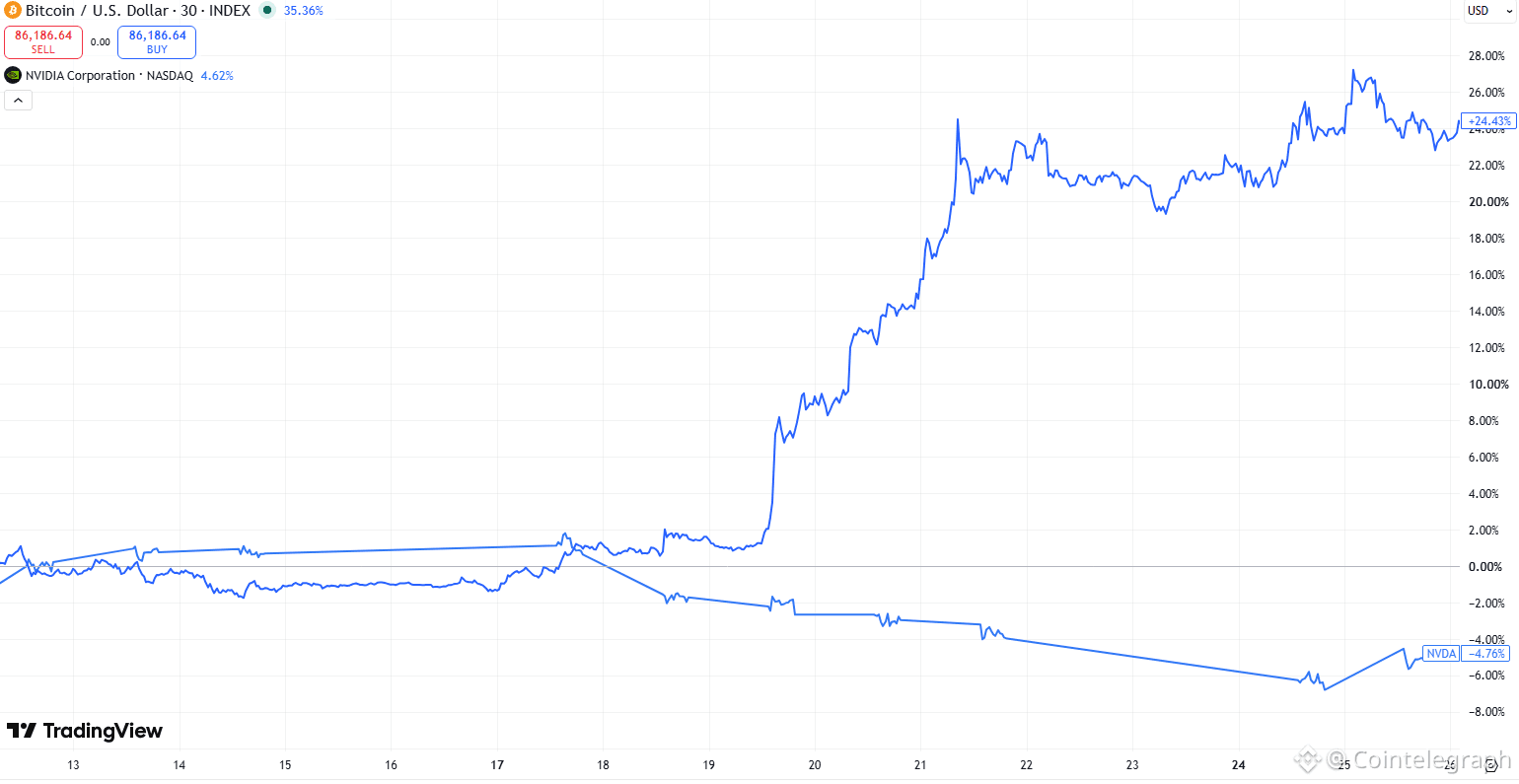
Bitcoin’s cycle recovery arguably came between Aug. 19 and Aug. 25 when BTC rose about 25% to $80,000. Interestingly, over that period, AI bellwether stock Nvidia notched up seven consecutive losing sessions.
Pal says pauses in the AI trade have allowed capital to rotate into crypto.
“You can tell there’s this sort of rotation for liquidity that’s around right now, which means it’s not abundant yet,” he says.
Bitcoin rallied while Nvidia shares fell in August. Source: TradingView
While AI has been competing with crypto for funds, an AI crash would be an unwelcome prospect, as a bursting bubble would indicate that liquidity is being “sucked out of the system,” while threatening the conditions crypto needs to rise.
“Things don’t go bust if liquidity is plentiful,” Pal says.
His preferred outcome would be a weaker dollar, a steeper yield curve and banks expanding the money supply through increased lending.
However, borrowing costs have been moving higher. The US 10-year Treasury yield climbed to 5.29% in September, while the Fed raised its benchmark rate by a quarter-point.
If those conditions don’t materialize, Pal’s “second best scenario” is for AI stocks to trade sideways, which would allow capital to rotate into crypto.
AI agents could bring more business to Ethereum and Solana
AI agents can now pay to access web content using stablecoins through a feature that Amazon Web Services introduced in June. Coinbase handles payment verification and settlement through its x402 protocol, with USDC on Base among the supported payment options.
Pal says agents could eventually raise the money they need to operate, by issuing tokens to fund projects that could last “a week, a month, a year,” then carrying out the work and generating returns.
He says Ethereum and Solana could attract more activity as software uses their smart contracts to transact.
“My guess is they’ll get more adoption over time as AI uses them,” he says.
Solana needs more than activity to overtake Ethereum
Ethereum’s greater concentration of capital makes Pal cautious about claims Solana will overtake it in market value, despite his enthusiasm for both networks.
Multicoin Capital co-founder Kyle Samani predicted on Trade Secrets last month that SOL would surpass Ether’s market capitalization “this market cycle.”
Samani “needs to hold his horses a little bit,” Pal says, even though he acknowledged that it is possible.
The networks are ahead of each other on different metrics. Solana recorded around 3.2 million active addresses over the preceding 24 hours on Monday, compared with Ethereum’s 387,000, according to DefiLlama. But Ethereum has about $54.4 billion in decentralized finance protocols, which is far ahead of Solana’s $6.7 billion.
Pal compares the networks using what he calls “economic density,” dividing total value locked by active users. He says Ethereum attracts more capital relative to its user count, and Solana’s activity involves smaller amounts.
“Solana’s core activity is speculation,” he says. “It’s just smaller clip sizes.”
Pal says he has stopped giving public price targets because his forecasts get clipped and recirculated online. He describes million-dollar Bitcoin by 2030 as a “meme” reflecting growing adoption, ETF interest and Bitcoin’s use as collateral.
“Does it make a million bucks? I don’t know, but certainly by 2032, yeah, I don’t have an issue with that.”
Magazine: Former SEC boss made AI Czar, Bitcoin may hit $600K this cycle: Hodler’s Digest
Capital starting to rotate back to crypto from AI: Raoul Pal
A weakening US dollar could give crypto the “green light” and help extend the industry’s rally, says Real Vision founder Raoul Pal.
He tells Cointelegraph on the latest episode of Trade Secrets that higher bond yields and the strong dollar are keeping liquidity from flowing freely.
“If they can engineer the dollar lower, then we get a green light for further movement in crypto,” he says. “I don’t want to get overly excited, so I haven’t got a full green light on everything.”
The US Dollar Index has been trading at the year’s highest levels. Source: TradingView
However he believes Bitcoin will miss out of much of the crypto economic activity generated by AI agents, which is likely to flow to smart contract platforms like Ethereum and Solana.
Pal is among the most experienced high profile crypto analysts, having worked in hedge fund sales at Goldman Sachs in Europe and co-managed a global macro fund at GLG Partners. He launched the research platform Global Macro Investor in 2005 and co-founded financial media Real Vision in 2014.
Pal says he first bought Bitcoin in 2013, after applying a gold-based valuation framework to the cryptocurrency.
An AI pause could help crypto catch up
Bitcoin’s cycle recovery arguably came between Aug. 19 and Aug. 25 when BTC rose about 25% to $80,000. Interestingly, over that period, AI bellwether stock Nvidia notched up seven consecutive losing sessions.
Pal says pauses in the AI trade have allowed capital to rotate into crypto.
“You can tell there’s this sort of rotation for liquidity that’s around right now, which means it’s not abundant yet,” he says.
Bitcoin rallied while Nvidia shares fell in August. Source: TradingView
While AI has been competing with crypto for funds, an AI crash would be an unwelcome prospect, as a bursting bubble would indicate that liquidity is being “sucked out of the system,” while threatening the conditions crypto needs to rise.
“Things don’t go bust if liquidity is plentiful,” Pal says.
His preferred outcome would be a weaker dollar, a steeper yield curve and banks expanding the money supply through increased lending.
However, borrowing costs have been moving higher. The US 10-year Treasury yield climbed to 5.29% in September, while the Fed raised its benchmark rate by a quarter-point.
If those conditions don’t materialize, Pal’s “second best scenario” is for AI stocks to trade sideways, which would allow capital to rotate into crypto.
AI agents could bring more business to Ethereum and Solana
AI agents can now pay to access web content using stablecoins through a feature that Amazon Web Services introduced in June. Coinbase handles payment verification and settlement through its x402 protocol, with USDC on Base among the supported payment options.
Pal says agents could eventually raise the money they need to operate, by issuing tokens to fund projects that could last “a week, a month, a year,” then carrying out the work and generating returns.
He says Ethereum and Solana could attract more activity as software uses their smart contracts to transact.
“My guess is they’ll get more adoption over time as AI uses them,” he says.
Solana needs more than activity to overtake Ethereum
Ethereum’s greater concentration of capital makes Pal cautious about claims Solana will overtake it in market value, despite his enthusiasm for both networks.
Multicoin Capital co-founder Kyle Samani predicted on Trade Secrets last month that SOL would surpass Ether’s market capitalization “this market cycle.”
Samani “needs to hold his horses a little bit,” Pal says, even though he acknowledged that it is possible.
The networks are ahead of each other on different metrics. Solana recorded around 3.2 million active addresses over the preceding 24 hours on Monday, compared with Ethereum’s 387,000, according to DefiLlama. But Ethereum has about $54.4 billion in decentralized finance protocols, which is far ahead of Solana’s $6.7 billion.
Pal compares the networks using what he calls “economic density,” dividing total value locked by active users. He says Ethereum attracts more capital relative to its user count, and Solana’s activity involves smaller amounts.
“Solana’s core activity is speculation,” he says. “It’s just smaller clip sizes.”
Pal says he has stopped giving public price targets because his forecasts get clipped and recirculated online. He describes million-dollar Bitcoin by 2030 as a “meme” reflecting growing adoption, ETF interest and Bitcoin’s use as collateral.
“Does it make a million bucks? I don’t know, but certainly by 2032, yeah, I don’t have an issue with that.”
Magazine: Former SEC boss made AI Czar, Bitcoin may hit $600K this cycle: Hodler’s Digest
He tells Cointelegraph on the latest episode of Trade Secrets that higher bond yields and the strong dollar are keeping liquidity from flowing freely.
“If they can engineer the dollar lower, then we get a green light for further movement in crypto,” he says. “I don’t want to get overly excited, so I haven’t got a full green light on everything.”
The US Dollar Index has been trading at the year’s highest levels. Source: TradingView
However he believes Bitcoin will miss out of much of the crypto economic activity generated by AI agents, which is likely to flow to smart contract platforms like Ethereum and Solana.
Pal is among the most experienced high profile crypto analysts, having worked in hedge fund sales at Goldman Sachs in Europe and co-managed a global macro fund at GLG Partners. He launched the research platform Global Macro Investor in 2005 and co-founded financial media Real Vision in 2014.
Pal says he first bought Bitcoin in 2013, after applying a gold-based valuation framework to the cryptocurrency.
An AI pause could help crypto catch up
Bitcoin’s cycle recovery arguably came between Aug. 19 and Aug. 25 when BTC rose about 25% to $80,000. Interestingly, over that period, AI bellwether stock Nvidia notched up seven consecutive losing sessions.
Pal says pauses in the AI trade have allowed capital to rotate into crypto.
“You can tell there’s this sort of rotation for liquidity that’s around right now, which means it’s not abundant yet,” he says.
Bitcoin rallied while Nvidia shares fell in August. Source: TradingView
While AI has been competing with crypto for funds, an AI crash would be an unwelcome prospect, as a bursting bubble would indicate that liquidity is being “sucked out of the system,” while threatening the conditions crypto needs to rise.
“Things don’t go bust if liquidity is plentiful,” Pal says.
His preferred outcome would be a weaker dollar, a steeper yield curve and banks expanding the money supply through increased lending.
However, borrowing costs have been moving higher. The US 10-year Treasury yield climbed to 5.29% in September, while the Fed raised its benchmark rate by a quarter-point.
If those conditions don’t materialize, Pal’s “second best scenario” is for AI stocks to trade sideways, which would allow capital to rotate into crypto.
AI agents could bring more business to Ethereum and Solana
AI agents can now pay to access web content using stablecoins through a feature that Amazon Web Services introduced in June. Coinbase handles payment verification and settlement through its x402 protocol, with USDC on Base among the supported payment options.
Pal says agents could eventually raise the money they need to operate, by issuing tokens to fund projects that could last “a week, a month, a year,” then carrying out the work and generating returns.
He says Ethereum and Solana could attract more activity as software uses their smart contracts to transact.
“My guess is they’ll get more adoption over time as AI uses them,” he says.
Solana needs more than activity to overtake Ethereum
Ethereum’s greater concentration of capital makes Pal cautious about claims Solana will overtake it in market value, despite his enthusiasm for both networks.
Multicoin Capital co-founder Kyle Samani predicted on Trade Secrets last month that SOL would surpass Ether’s market capitalization “this market cycle.”
Samani “needs to hold his horses a little bit,” Pal says, even though he acknowledged that it is possible.
The networks are ahead of each other on different metrics. Solana recorded around 3.2 million active addresses over the preceding 24 hours on Monday, compared with Ethereum’s 387,000, according to DefiLlama. But Ethereum has about $54.4 billion in decentralized finance protocols, which is far ahead of Solana’s $6.7 billion.
Pal compares the networks using what he calls “economic density,” dividing total value locked by active users. He says Ethereum attracts more capital relative to its user count, and Solana’s activity involves smaller amounts.
“Solana’s core activity is speculation,” he says. “It’s just smaller clip sizes.”
Pal says he has stopped giving public price targets because his forecasts get clipped and recirculated online. He describes million-dollar Bitcoin by 2030 as a “meme” reflecting growing adoption, ETF interest and Bitcoin’s use as collateral.
“Does it make a million bucks? I don’t know, but certainly by 2032, yeah, I don’t have an issue with that.”
Magazine: Former SEC boss made AI Czar, Bitcoin may hit $600K this cycle: Hodler’s Digest
211
Article
US crypto rules need to survive the next electionOpinion by Andrew M. Cuomo, former governor of New York
The digital asset revolution is here, and it’s already transforming our financial system.
We’re no longer questioning if it will continue to develop. It will. The issue is whether the United States will establish clear, durable rules for it to develop here.
Right now, the answer is no.
The CLARITY Act was intended to solve this problem. It would have provided a national framework for digital assets, clarified the roles of federal agencies including the Securities and Exchange Commission (SEC) and the Commodity Futures Trading Commission (CFTC), and given businesses, investors and consumers a clear understanding of the rules.
The House passed the CLARITY Act in 2025, but Congress has yet to send a bill to the president. The Senate failed to advance the Act in September, leaving most to wonder: what happens now?
Those same federal agencies have rushed in with new regulations that significantly restructure the market. Both the SEC and CFTC have been hyper-aggressive in promulgating new rules, filling the void left by Congress, proposing a new federal framework for crypto trading platforms and a bespoke regulatory regime for certain crypto assets.
In the short term, this is great, and we’ll see many new market opportunities as a result. But the reality is that these rules have been adopted in the absence of a market structure law enacted by Congress and rely on agencies’ existing statutory authority, lacking the durability of a new law.
More poignantly from the Democrats’ point of view, they were adopted despite congressional opposition. That means the rules are politically vulnerable from the start.
And hell hath no fury like a Congress scorned.
The next election could upend the rules
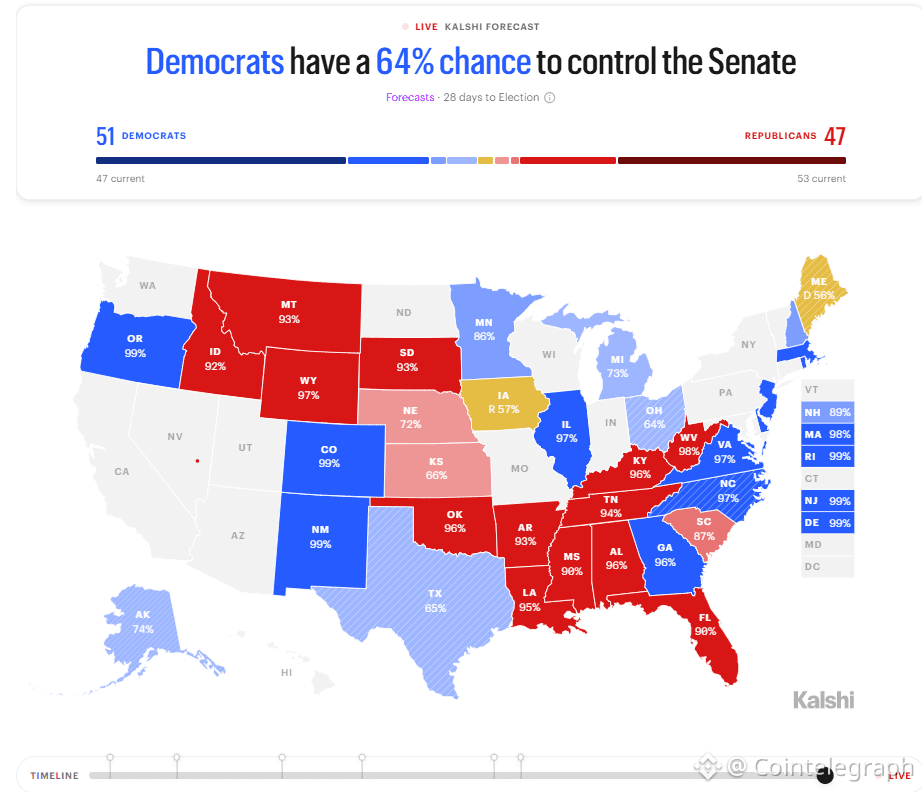
If prediction markets and current electoral trends are to be believed, Democrats will control one, if not both, houses of Congress after the midterms. And the power of Congress to derail and disrupt agency action should never be underestimated.
Democrats have a 64% chance of controlling the Senate. Source: Kalshi
I lived this dynamic when I was in the Clinton administration at the Department of Housing and Urban Development (HUD). The 1994 midterm elections swept Republicans into control of the House and Senate. The department’s power was greatly impeded. Oversight intensified, funding became leverage, and Congress used every tool at its disposal to challenge and constrain the administration. It’s what Congress does when it believes the executive branch has gone too far.
Democrats will be looking to prove their claims that the Trump administration was corrupt and that agency actions were designed to benefit individuals personally and political donors collectively. Whether those claims are fair or not, they will drive the politics. And the politics will drive the oversight.
The legislature has many tools at its disposal. Agencies must submit new rules and regulations before they take effect, allowing lawmakers to weigh in. They can limit funding for agency programs, pass legislation overriding agency actions, or use the Congressional Review Act to repeal certain regulations. Congress also has the power to investigate and issue subpoenas that can wreak havoc when coupled with public hearings. Just ask Anthony Fauci and Jack Smith!
Congress must put politics aside
The overall challenge is that private sector technological innovation must be reconciled and aligned with intelligent government regulation. When the CLARITY Act failed, ambiguity prevailed. It’s bad for business, bad for investors, bad for consumers and bad for America.
Companies should not have to guess whether the rules in place today will survive the next election. They should not have to decide whether to build and invest in the United States based on which party controls Washington. They should know what is legal, what is prohibited, who regulates what and how the rules will be enforced.
America deserves a system that encourages innovation while protecting consumers and investors. It deserves rules that prevent illicit activity and protect market integrity. It deserves a framework that companies can rely on when they choose where to hire, invest and build.
Other countries understand this. They are establishing their frameworks, like Europe’s Markets in Crypto Assets (MiCA) regulation or Singapore’s Payment Services Act, providing regulatory certainty and setting standards. The United States cannot afford to let political gridlock determine the future of financial innovation.
It is essential that a top priority for the next Congress is to put politics aside — even for a moment — and pass bipartisan legislation authorizing digital asset activities, so that companies can invest safely and intelligently in the US.
About the author: Andrew M. Cuomo served as governor of New York from 2011 to 2021 and previously served as New York attorney general and US secretary of Housing and Urban Development. He currently serves on the board of OKX and co-chairs OKXICE, a joint venture between OKX and Intercontinental Exchange focused on tokenized and digitally native financial products.
Opinion: A single market worth protecting: Getting the MiCA review right
US crypto rules need to survive the next election
Opinion by Andrew M. Cuomo, former governor of New York
The digital asset revolution is here, and it’s already transforming our financial system.
We’re no longer questioning if it will continue to develop. It will. The issue is whether the United States will establish clear, durable rules for it to develop here.
Right now, the answer is no.
The CLARITY Act was intended to solve this problem. It would have provided a national framework for digital assets, clarified the roles of federal agencies including the Securities and Exchange Commission (SEC) and the Commodity Futures Trading Commission (CFTC), and given businesses, investors and consumers a clear understanding of the rules.
The House passed the CLARITY Act in 2025, but Congress has yet to send a bill to the president. The Senate failed to advance the Act in September, leaving most to wonder: what happens now?
Those same federal agencies have rushed in with new regulations that significantly restructure the market. Both the SEC and CFTC have been hyper-aggressive in promulgating new rules, filling the void left by Congress, proposing a new federal framework for crypto trading platforms and a bespoke regulatory regime for certain crypto assets.
In the short term, this is great, and we’ll see many new market opportunities as a result. But the reality is that these rules have been adopted in the absence of a market structure law enacted by Congress and rely on agencies’ existing statutory authority, lacking the durability of a new law.
More poignantly from the Democrats’ point of view, they were adopted despite congressional opposition. That means the rules are politically vulnerable from the start.
And hell hath no fury like a Congress scorned.
The next election could upend the rules
If prediction markets and current electoral trends are to be believed, Democrats will control one, if not both, houses of Congress after the midterms. And the power of Congress to derail and disrupt agency action should never be underestimated.
Democrats have a 64% chance of controlling the Senate. Source: Kalshi
I lived this dynamic when I was in the Clinton administration at the Department of Housing and Urban Development (HUD). The 1994 midterm elections swept Republicans into control of the House and Senate. The department’s power was greatly impeded. Oversight intensified, funding became leverage, and Congress used every tool at its disposal to challenge and constrain the administration. It’s what Congress does when it believes the executive branch has gone too far.
Democrats will be looking to prove their claims that the Trump administration was corrupt and that agency actions were designed to benefit individuals personally and political donors collectively. Whether those claims are fair or not, they will drive the politics. And the politics will drive the oversight.
The legislature has many tools at its disposal. Agencies must submit new rules and regulations before they take effect, allowing lawmakers to weigh in. They can limit funding for agency programs, pass legislation overriding agency actions, or use the Congressional Review Act to repeal certain regulations. Congress also has the power to investigate and issue subpoenas that can wreak havoc when coupled with public hearings. Just ask Anthony Fauci and Jack Smith!
Congress must put politics aside
The overall challenge is that private sector technological innovation must be reconciled and aligned with intelligent government regulation. When the CLARITY Act failed, ambiguity prevailed. It’s bad for business, bad for investors, bad for consumers and bad for America.
Companies should not have to guess whether the rules in place today will survive the next election. They should not have to decide whether to build and invest in the United States based on which party controls Washington. They should know what is legal, what is prohibited, who regulates what and how the rules will be enforced.
America deserves a system that encourages innovation while protecting consumers and investors. It deserves rules that prevent illicit activity and protect market integrity. It deserves a framework that companies can rely on when they choose where to hire, invest and build.
Other countries understand this. They are establishing their frameworks, like Europe’s Markets in Crypto Assets (MiCA) regulation or Singapore’s Payment Services Act, providing regulatory certainty and setting standards. The United States cannot afford to let political gridlock determine the future of financial innovation.
It is essential that a top priority for the next Congress is to put politics aside — even for a moment — and pass bipartisan legislation authorizing digital asset activities, so that companies can invest safely and intelligently in the US.
About the author: Andrew M. Cuomo served as governor of New York from 2011 to 2021 and previously served as New York attorney general and US secretary of Housing and Urban Development. He currently serves on the board of OKX and co-chairs OKXICE, a joint venture between OKX and Intercontinental Exchange focused on tokenized and digitally native financial products.
Opinion: A single market worth protecting: Getting the MiCA review right
The digital asset revolution is here, and it’s already transforming our financial system.
We’re no longer questioning if it will continue to develop. It will. The issue is whether the United States will establish clear, durable rules for it to develop here.
Right now, the answer is no.
The CLARITY Act was intended to solve this problem. It would have provided a national framework for digital assets, clarified the roles of federal agencies including the Securities and Exchange Commission (SEC) and the Commodity Futures Trading Commission (CFTC), and given businesses, investors and consumers a clear understanding of the rules.
The House passed the CLARITY Act in 2025, but Congress has yet to send a bill to the president. The Senate failed to advance the Act in September, leaving most to wonder: what happens now?
Those same federal agencies have rushed in with new regulations that significantly restructure the market. Both the SEC and CFTC have been hyper-aggressive in promulgating new rules, filling the void left by Congress, proposing a new federal framework for crypto trading platforms and a bespoke regulatory regime for certain crypto assets.
In the short term, this is great, and we’ll see many new market opportunities as a result. But the reality is that these rules have been adopted in the absence of a market structure law enacted by Congress and rely on agencies’ existing statutory authority, lacking the durability of a new law.
More poignantly from the Democrats’ point of view, they were adopted despite congressional opposition. That means the rules are politically vulnerable from the start.
And hell hath no fury like a Congress scorned.
The next election could upend the rules
If prediction markets and current electoral trends are to be believed, Democrats will control one, if not both, houses of Congress after the midterms. And the power of Congress to derail and disrupt agency action should never be underestimated.
Democrats have a 64% chance of controlling the Senate. Source: Kalshi
I lived this dynamic when I was in the Clinton administration at the Department of Housing and Urban Development (HUD). The 1994 midterm elections swept Republicans into control of the House and Senate. The department’s power was greatly impeded. Oversight intensified, funding became leverage, and Congress used every tool at its disposal to challenge and constrain the administration. It’s what Congress does when it believes the executive branch has gone too far.
Democrats will be looking to prove their claims that the Trump administration was corrupt and that agency actions were designed to benefit individuals personally and political donors collectively. Whether those claims are fair or not, they will drive the politics. And the politics will drive the oversight.
The legislature has many tools at its disposal. Agencies must submit new rules and regulations before they take effect, allowing lawmakers to weigh in. They can limit funding for agency programs, pass legislation overriding agency actions, or use the Congressional Review Act to repeal certain regulations. Congress also has the power to investigate and issue subpoenas that can wreak havoc when coupled with public hearings. Just ask Anthony Fauci and Jack Smith!
Congress must put politics aside
The overall challenge is that private sector technological innovation must be reconciled and aligned with intelligent government regulation. When the CLARITY Act failed, ambiguity prevailed. It’s bad for business, bad for investors, bad for consumers and bad for America.
Companies should not have to guess whether the rules in place today will survive the next election. They should not have to decide whether to build and invest in the United States based on which party controls Washington. They should know what is legal, what is prohibited, who regulates what and how the rules will be enforced.
America deserves a system that encourages innovation while protecting consumers and investors. It deserves rules that prevent illicit activity and protect market integrity. It deserves a framework that companies can rely on when they choose where to hire, invest and build.
Other countries understand this. They are establishing their frameworks, like Europe’s Markets in Crypto Assets (MiCA) regulation or Singapore’s Payment Services Act, providing regulatory certainty and setting standards. The United States cannot afford to let political gridlock determine the future of financial innovation.
It is essential that a top priority for the next Congress is to put politics aside — even for a moment — and pass bipartisan legislation authorizing digital asset activities, so that companies can invest safely and intelligently in the US.
About the author: Andrew M. Cuomo served as governor of New York from 2011 to 2021 and previously served as New York attorney general and US secretary of Housing and Urban Development. He currently serves on the board of OKX and co-chairs OKXICE, a joint venture between OKX and Intercontinental Exchange focused on tokenized and digitally native financial products.
Opinion: A single market worth protecting: Getting the MiCA review right
2
124
စိစစ်အတည်ပြုထားသည်
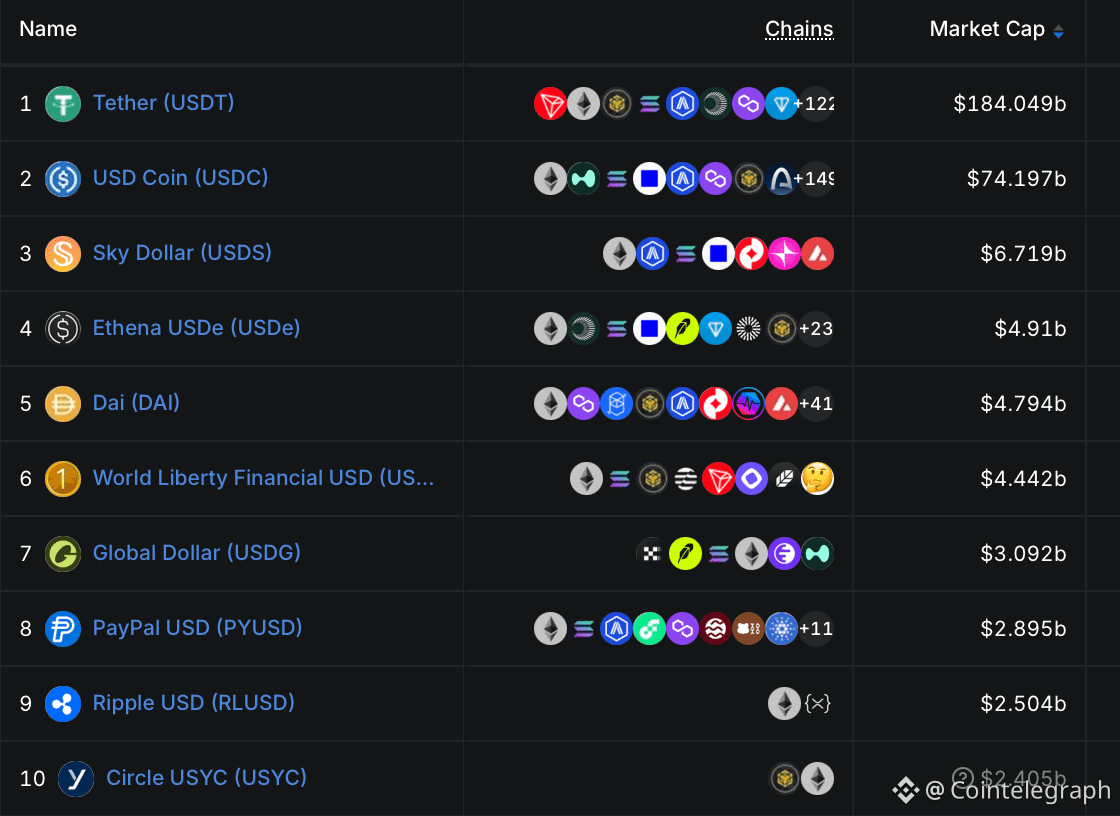
Article
Paxos’ $3B USDG stablecoin launches on ArbitrumPaxos-issued stablecoin Global Dollar (USDG) has launched on Arbitrum as the blockchain joins the Global Dollar Network.
According to an announcement shared with Cointelegraph, USDG is natively issued on Arbitrum One, with integrations across decentralized finance protocols including Fluid, Morpho, GMX and Maple. Kraken will support deposits and withdrawals, while Stargate will enable transfers between Arbitrum and other blockchains.
A proposal submitted to the ArbitrumDAO would make USDG growth a strategic objective and add 100 million ARB to an incentive program to increase adoption. The proposal also calls for deploying Arbitrum treasury assets to support USDG liquidity, while businesses integrating the stablecoin can apply for support from the Arbitrum Foundation.
As a Global Dollar Network partner, Arbitrum will share in rewards generated by USDG activity on the network, with the proceeds directed toward adoption and ecosystem development.
Related: Mantle adds Paxos’ USDG stablecoin, joins Global Dollar Network. Source: DefiLlama
About $4 billion in stablecoins are currently held on Arbitrum, according to the Arbitrum Foundation. USDG, meanwhile, is the seventh-largest stablecoin by market capitalization, with about $3.09 billion in circulation, according to DeFiLlama data. Most of its supply is concentrated on X Layer, Robinhood Chain and Solana.
Arbitrum targets growing tokenization market
The USDG launch comes as Arbitrum expands beyond crypto-native applications and becomes infrastructure for financial platforms bringing traditional assets onchain.
The most prominent example is Robinhood Chain, which launched its public mainnet in July after a public testnet debuted in February. The Ethereum layer-2 network is built using Arbitrum and designed to support tokenized real-world and digital assets, including 24/7 trading, lending markets and perpetual futures exchanges.
Last month, Standard Chartered said Robinhood Chain could signal a shift in Arbitrum’s economics, with the network receiving 10% of net protocol revenue generated by companies building on its infrastructure.
The bank forecast that those economics, combined with growing asset tokenization, could help push ARB to $10 by 2030, roughly 70 times its price at the time. Standard Chartered expects tokenized assets to reach $4 trillion by the end of 2028, with Arbitrum among the potential beneficiaries as more assets move onchain.
Magazine: Stablecoins can drain from banks and nations at lightning speed
Paxos’ $3B USDG stablecoin launches on Arbitrum
Paxos-issued stablecoin Global Dollar (USDG) has launched on Arbitrum as the blockchain joins the Global Dollar Network.
According to an announcement shared with Cointelegraph, USDG is natively issued on Arbitrum One, with integrations across decentralized finance protocols including Fluid, Morpho, GMX and Maple. Kraken will support deposits and withdrawals, while Stargate will enable transfers between Arbitrum and other blockchains.
A proposal submitted to the ArbitrumDAO would make USDG growth a strategic objective and add 100 million ARB to an incentive program to increase adoption. The proposal also calls for deploying Arbitrum treasury assets to support USDG liquidity, while businesses integrating the stablecoin can apply for support from the Arbitrum Foundation.
As a Global Dollar Network partner, Arbitrum will share in rewards generated by USDG activity on the network, with the proceeds directed toward adoption and ecosystem development.
Related: Mantle adds Paxos’ USDG stablecoin, joins Global Dollar Network. Source: DefiLlama
About $4 billion in stablecoins are currently held on Arbitrum, according to the Arbitrum Foundation. USDG, meanwhile, is the seventh-largest stablecoin by market capitalization, with about $3.09 billion in circulation, according to DeFiLlama data. Most of its supply is concentrated on X Layer, Robinhood Chain and Solana.
Arbitrum targets growing tokenization market
The USDG launch comes as Arbitrum expands beyond crypto-native applications and becomes infrastructure for financial platforms bringing traditional assets onchain.
The most prominent example is Robinhood Chain, which launched its public mainnet in July after a public testnet debuted in February. The Ethereum layer-2 network is built using Arbitrum and designed to support tokenized real-world and digital assets, including 24/7 trading, lending markets and perpetual futures exchanges.
Last month, Standard Chartered said Robinhood Chain could signal a shift in Arbitrum’s economics, with the network receiving 10% of net protocol revenue generated by companies building on its infrastructure.
The bank forecast that those economics, combined with growing asset tokenization, could help push ARB to $10 by 2030, roughly 70 times its price at the time. Standard Chartered expects tokenized assets to reach $4 trillion by the end of 2028, with Arbitrum among the potential beneficiaries as more assets move onchain.
Magazine: Stablecoins can drain from banks and nations at lightning speed
According to an announcement shared with Cointelegraph, USDG is natively issued on Arbitrum One, with integrations across decentralized finance protocols including Fluid, Morpho, GMX and Maple. Kraken will support deposits and withdrawals, while Stargate will enable transfers between Arbitrum and other blockchains.
A proposal submitted to the ArbitrumDAO would make USDG growth a strategic objective and add 100 million ARB to an incentive program to increase adoption. The proposal also calls for deploying Arbitrum treasury assets to support USDG liquidity, while businesses integrating the stablecoin can apply for support from the Arbitrum Foundation.
As a Global Dollar Network partner, Arbitrum will share in rewards generated by USDG activity on the network, with the proceeds directed toward adoption and ecosystem development.
Related: Mantle adds Paxos’ USDG stablecoin, joins Global Dollar Network. Source: DefiLlama
About $4 billion in stablecoins are currently held on Arbitrum, according to the Arbitrum Foundation. USDG, meanwhile, is the seventh-largest stablecoin by market capitalization, with about $3.09 billion in circulation, according to DeFiLlama data. Most of its supply is concentrated on X Layer, Robinhood Chain and Solana.
Arbitrum targets growing tokenization market
The USDG launch comes as Arbitrum expands beyond crypto-native applications and becomes infrastructure for financial platforms bringing traditional assets onchain.
The most prominent example is Robinhood Chain, which launched its public mainnet in July after a public testnet debuted in February. The Ethereum layer-2 network is built using Arbitrum and designed to support tokenized real-world and digital assets, including 24/7 trading, lending markets and perpetual futures exchanges.
Last month, Standard Chartered said Robinhood Chain could signal a shift in Arbitrum’s economics, with the network receiving 10% of net protocol revenue generated by companies building on its infrastructure.
The bank forecast that those economics, combined with growing asset tokenization, could help push ARB to $10 by 2030, roughly 70 times its price at the time. Standard Chartered expects tokenized assets to reach $4 trillion by the end of 2028, with Arbitrum among the potential beneficiaries as more assets move onchain.
Magazine: Stablecoins can drain from banks and nations at lightning speed
1
215
Polymarket overhauls smart contracts with new Protocol V2 rolloutPrediction market platform Polymarket is rebuilding its smart contract infrastructure, laying the groundwork for new market features and potential expansion beyond Polygon.
Polymarket began rolling out Protocol V2 on Monday, introducing a new smart contract system designed to support different market types through a single exchange, according to an X post by Rajath Alex, the company’s head of protocol.
The platform is testing the system on a limited number of live markets through Oct. 30, with a tentative Nov. 2 target for switching new markets to V2.
The overhaul replaces infrastructure based on code developed in 2019 that requires additional contracts to support new market types.
New protocol uses pUSD as sole collateral token
Protocol V2 uses Polymarket USD (pUSD) as its sole collateral token, alongside a single contract for position tokens and one exchange supporting different market types.
Introduced as part of an exchange upgrade in April 2026, pUSD is a collateral token backed 1:1 by Circle’s dollar-pegged stablecoin, USDC.
The new protocol is designed to support transferring positions, collateral and market outcome data between blockchains, although Polymarket has not announced when cross-chain functionality will launch or which networks it will support.
Polymarket currently operates its prediction markets on Polygon, an Ethereum scaling network, where pUSD is also issued.
Cointelegraph reached out to Polymarket for details on which blockchains it plans to support and when the expansion could take place.
Upgradeable contracts support new features and oracles
Protocol V2 introduces upgradeable smart contracts, allowing Polymarket to modify contracts through a ”secure governance process,“ reducing the need to deploy additional contracts for new features.
It also introduces OracleAggregator, a system designed to connect to different oracles, including UMA and Chainlink, to determine market outcomes.
Polymarket said the new system underwent audits by blockchain security platforms such as Cantina, Quantstamp and Zellic, as well as formal verification by Certora. The company is offering bug bounty rewards of up to $5 million for critical vulnerabilities.
According to the Protocol V2 migration guide, existing positions will not be converted to V2, and app and website users will not need to take technical steps to migrate, although they may be asked to approve new contracts when trading.
Magazine: Former SEC boss made AI Czar, Bitcoin may hit $600K this cycle: Hodler’s Digest
Polymarket overhauls smart contracts with new Protocol V2 rollout
Prediction market platform Polymarket is rebuilding its smart contract infrastructure, laying the groundwork for new market features and potential expansion beyond Polygon.
Polymarket began rolling out Protocol V2 on Monday, introducing a new smart contract system designed to support different market types through a single exchange, according to an X post by Rajath Alex, the company’s head of protocol.
The platform is testing the system on a limited number of live markets through Oct. 30, with a tentative Nov. 2 target for switching new markets to V2.
The overhaul replaces infrastructure based on code developed in 2019 that requires additional contracts to support new market types.
New protocol uses pUSD as sole collateral token
Protocol V2 uses Polymarket USD (pUSD) as its sole collateral token, alongside a single contract for position tokens and one exchange supporting different market types.
Introduced as part of an exchange upgrade in April 2026, pUSD is a collateral token backed 1:1 by Circle’s dollar-pegged stablecoin, USDC.
The new protocol is designed to support transferring positions, collateral and market outcome data between blockchains, although Polymarket has not announced when cross-chain functionality will launch or which networks it will support.
Polymarket currently operates its prediction markets on Polygon, an Ethereum scaling network, where pUSD is also issued.
Cointelegraph reached out to Polymarket for details on which blockchains it plans to support and when the expansion could take place.
Upgradeable contracts support new features and oracles
Protocol V2 introduces upgradeable smart contracts, allowing Polymarket to modify contracts through a ”secure governance process,“ reducing the need to deploy additional contracts for new features.
It also introduces OracleAggregator, a system designed to connect to different oracles, including UMA and Chainlink, to determine market outcomes.
Polymarket said the new system underwent audits by blockchain security platforms such as Cantina, Quantstamp and Zellic, as well as formal verification by Certora. The company is offering bug bounty rewards of up to $5 million for critical vulnerabilities.
According to the Protocol V2 migration guide, existing positions will not be converted to V2, and app and website users will not need to take technical steps to migrate, although they may be asked to approve new contracts when trading.
Magazine: Former SEC boss made AI Czar, Bitcoin may hit $600K this cycle: Hodler’s Digest
Polymarket began rolling out Protocol V2 on Monday, introducing a new smart contract system designed to support different market types through a single exchange, according to an X post by Rajath Alex, the company’s head of protocol.
The platform is testing the system on a limited number of live markets through Oct. 30, with a tentative Nov. 2 target for switching new markets to V2.
The overhaul replaces infrastructure based on code developed in 2019 that requires additional contracts to support new market types.
New protocol uses pUSD as sole collateral token
Protocol V2 uses Polymarket USD (pUSD) as its sole collateral token, alongside a single contract for position tokens and one exchange supporting different market types.
Introduced as part of an exchange upgrade in April 2026, pUSD is a collateral token backed 1:1 by Circle’s dollar-pegged stablecoin, USDC.
The new protocol is designed to support transferring positions, collateral and market outcome data between blockchains, although Polymarket has not announced when cross-chain functionality will launch or which networks it will support.
Polymarket currently operates its prediction markets on Polygon, an Ethereum scaling network, where pUSD is also issued.
Cointelegraph reached out to Polymarket for details on which blockchains it plans to support and when the expansion could take place.
Upgradeable contracts support new features and oracles
Protocol V2 introduces upgradeable smart contracts, allowing Polymarket to modify contracts through a ”secure governance process,“ reducing the need to deploy additional contracts for new features.
It also introduces OracleAggregator, a system designed to connect to different oracles, including UMA and Chainlink, to determine market outcomes.
Polymarket said the new system underwent audits by blockchain security platforms such as Cantina, Quantstamp and Zellic, as well as formal verification by Certora. The company is offering bug bounty rewards of up to $5 million for critical vulnerabilities.
According to the Protocol V2 migration guide, existing positions will not be converted to V2, and app and website users will not need to take technical steps to migrate, although they may be asked to approve new contracts when trading.
Magazine: Former SEC boss made AI Czar, Bitcoin may hit $600K this cycle: Hodler’s Digest
2
114
Hong Kong officials double down on end-2026 deadline for crypto licensing billThe Hong Kong government reaffirmed its plans to submit an amendment bill before the end of 2026 to establish licensing regimes for digital asset trading, custody, advisory and management services as part of its broader crypto licensing bill.
Secretary for Financial Services and the Treasury of Hong Kong, Christopher Hui, told a Monday policy briefing that the government will submit an amendment bill “within this year” to establish a broader framework for digital asset activities, according to a statement released by the Hong Kong government.
The secretary said the amendment bill covering the four categories will come in response to the “innovative developments” in financial technology.
In January, Hui revealed that regulators planned to submit a draft proposal related to crypto asset regulation before the end of 2026. He also said that the Hong Kong Monetary Authority (HKMA) had begun processing license applications for stablecoin issuers.
In April, the HKMA granted its first stablecoin issuer licenses to Anchorpoint Financial and the Hongkong and Shanghai Banking Corporation.
Hong Kong officials double down on end-2026 deadline for crypto licensing bill
The Hong Kong government reaffirmed its plans to submit an amendment bill before the end of 2026 to establish licensing regimes for digital asset trading, custody, advisory and management services as part of its broader crypto licensing bill.
Secretary for Financial Services and the Treasury of Hong Kong, Christopher Hui, told a Monday policy briefing that the government will submit an amendment bill “within this year” to establish a broader framework for digital asset activities, according to a statement released by the Hong Kong government.
The secretary said the amendment bill covering the four categories will come in response to the “innovative developments” in financial technology.
In January, Hui revealed that regulators planned to submit a draft proposal related to crypto asset regulation before the end of 2026. He also said that the Hong Kong Monetary Authority (HKMA) had begun processing license applications for stablecoin issuers.
In April, the HKMA granted its first stablecoin issuer licenses to Anchorpoint Financial and the Hongkong and Shanghai Banking Corporation.
Secretary for Financial Services and the Treasury of Hong Kong, Christopher Hui, told a Monday policy briefing that the government will submit an amendment bill “within this year” to establish a broader framework for digital asset activities, according to a statement released by the Hong Kong government.
The secretary said the amendment bill covering the four categories will come in response to the “innovative developments” in financial technology.
In January, Hui revealed that regulators planned to submit a draft proposal related to crypto asset regulation before the end of 2026. He also said that the Hong Kong Monetary Authority (HKMA) had begun processing license applications for stablecoin issuers.
In April, the HKMA granted its first stablecoin issuer licenses to Anchorpoint Financial and the Hongkong and Shanghai Banking Corporation.
2
115
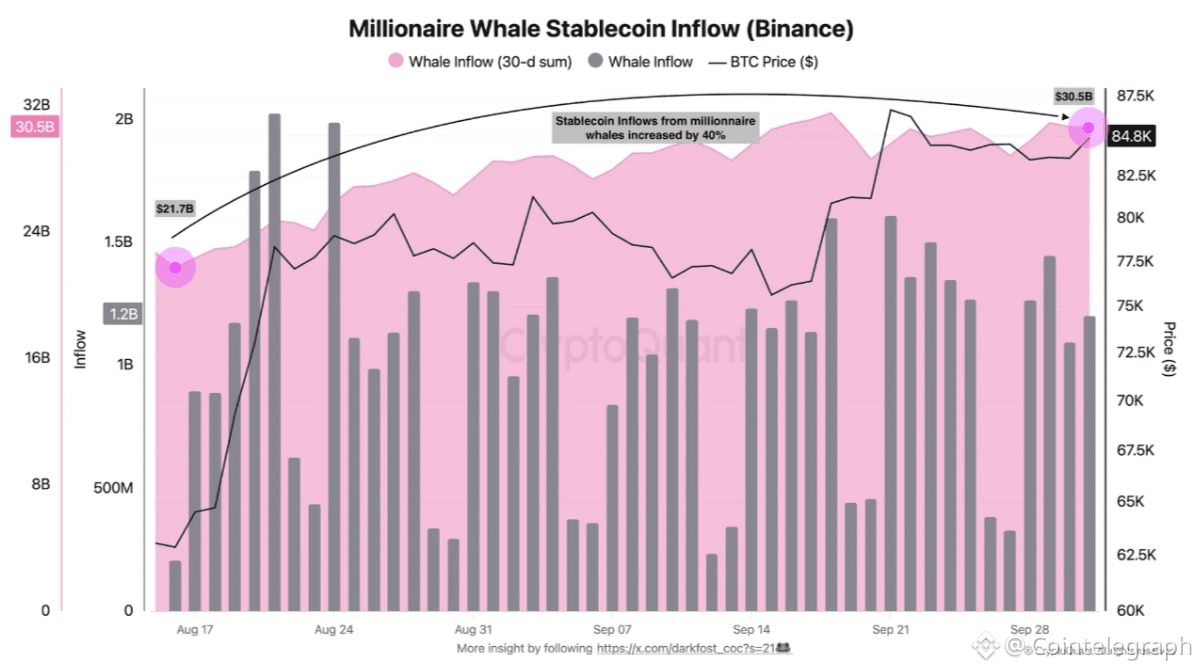
Article
Binance BTC outflows hit highest since mid-2023 as whales deposit stablecoinsBitcoin (BTC) outflows from largest crypto exchange Binance set multiyear records in late September, new analysis reveals.
Key points:
Binance net Bitcoin outflows passed 23,000 BTC in the fourth week of September, their highest in over three years.
CryptoQuant analysis saw better odds of BTC/USD breaking out of its current range as a result.
Whales increased stablecoin inflows to Binance by 40% since mid-August.
Binance Bitcoin reserves fall by nearly 40,000 BTC since Sept. 20
Data from onchain analytics platform CryptoQuant shows that in the seven days through Sept. 27, Binance’s net outflow reached 23,137 BTC.
On a weekly basis, the total marked Binance’s largest outflow since June 2023, when its BTC balance dropped by 44,942 in a single week. While last month saw merely half this amount, CryptoQuant sees similar conditions sparking both withdrawal runs.
“The more BTC leaves a widely accessible platform like Binance, the stronger the signal that accumulation is taking place. Withdrawing BTC from an exchange is a longer-term investment behavior, and therefore a positive signal,” it wrote in a blog post.
Binance BTC daily, weekly netflows data. Source: CryptoQuant
In June 2023, BTC/USD went from $26,300 to $30,500 in the weekly candle that followed the Binance outflows, seeing new 12-month highs as part of its recovery from the 2022 bear market.
A similar accumulation pattern, CryptoQuant continued, is also reflected in Binance’s reserves dropping by nearly 40,000 BTC since Sept. 20.
“Combined with fading sellers, this accumulation could be enough to push Bitcoin out of this consolidation phase fairly quickly,” it added.
BTC/USD has traded in a range between $82,500 and $87,400 since Sept. 21. As Cointelegraph reported, walls of liquidity on exchanges have dictated low-timeframe price moves during that time, with the 2026 yearly open at $87,570 still overhead as resistance.
Binance whales line up stablecoin capital
Separate data shows that large-volume whale entities have increased the supply of stablecoins to Binance over the past six weeks.
Stablecoin supply on exchanges is considered “dry powder” waiting for deployment into cryptoassets, and increasing balances suggest mounting interest in increasing capital exposure.
CryptoQuant reports that between Aug. 15 and the end of September, whale entities increased their rolling 30-day stablecoin inflows to Binance by 40% — from $21.7 billion to $30.5 billion.
“This change in behavior comes after a long lull, during which their inflows receded from the October peak, when they exceeded $61B,” it commented, referring to crypto markets’ current all-time highs from October 2025.
Bitcoin whale stablecoin inflows to Binance (screenshot). Source: CryptoQuant
Binance BTC outflows hit highest since mid-2023 as whales deposit stablecoins
Bitcoin (BTC) outflows from largest crypto exchange Binance set multiyear records in late September, new analysis reveals.
Key points:
Binance net Bitcoin outflows passed 23,000 BTC in the fourth week of September, their highest in over three years.
CryptoQuant analysis saw better odds of BTC/USD breaking out of its current range as a result.
Whales increased stablecoin inflows to Binance by 40% since mid-August.
Binance Bitcoin reserves fall by nearly 40,000 BTC since Sept. 20
Data from onchain analytics platform CryptoQuant shows that in the seven days through Sept. 27, Binance’s net outflow reached 23,137 BTC.
On a weekly basis, the total marked Binance’s largest outflow since June 2023, when its BTC balance dropped by 44,942 in a single week. While last month saw merely half this amount, CryptoQuant sees similar conditions sparking both withdrawal runs.
“The more BTC leaves a widely accessible platform like Binance, the stronger the signal that accumulation is taking place. Withdrawing BTC from an exchange is a longer-term investment behavior, and therefore a positive signal,” it wrote in a blog post.
Binance BTC daily, weekly netflows data. Source: CryptoQuant
In June 2023, BTC/USD went from $26,300 to $30,500 in the weekly candle that followed the Binance outflows, seeing new 12-month highs as part of its recovery from the 2022 bear market.
A similar accumulation pattern, CryptoQuant continued, is also reflected in Binance’s reserves dropping by nearly 40,000 BTC since Sept. 20.
“Combined with fading sellers, this accumulation could be enough to push Bitcoin out of this consolidation phase fairly quickly,” it added.
BTC/USD has traded in a range between $82,500 and $87,400 since Sept. 21. As Cointelegraph reported, walls of liquidity on exchanges have dictated low-timeframe price moves during that time, with the 2026 yearly open at $87,570 still overhead as resistance.
Binance whales line up stablecoin capital
Separate data shows that large-volume whale entities have increased the supply of stablecoins to Binance over the past six weeks.
Stablecoin supply on exchanges is considered “dry powder” waiting for deployment into cryptoassets, and increasing balances suggest mounting interest in increasing capital exposure.
CryptoQuant reports that between Aug. 15 and the end of September, whale entities increased their rolling 30-day stablecoin inflows to Binance by 40% — from $21.7 billion to $30.5 billion.
“This change in behavior comes after a long lull, during which their inflows receded from the October peak, when they exceeded $61B,” it commented, referring to crypto markets’ current all-time highs from October 2025.
Bitcoin whale stablecoin inflows to Binance (screenshot). Source: CryptoQuant
Key points:
Binance net Bitcoin outflows passed 23,000 BTC in the fourth week of September, their highest in over three years.
CryptoQuant analysis saw better odds of BTC/USD breaking out of its current range as a result.
Whales increased stablecoin inflows to Binance by 40% since mid-August.
Binance Bitcoin reserves fall by nearly 40,000 BTC since Sept. 20
Data from onchain analytics platform CryptoQuant shows that in the seven days through Sept. 27, Binance’s net outflow reached 23,137 BTC.
On a weekly basis, the total marked Binance’s largest outflow since June 2023, when its BTC balance dropped by 44,942 in a single week. While last month saw merely half this amount, CryptoQuant sees similar conditions sparking both withdrawal runs.
“The more BTC leaves a widely accessible platform like Binance, the stronger the signal that accumulation is taking place. Withdrawing BTC from an exchange is a longer-term investment behavior, and therefore a positive signal,” it wrote in a blog post.
Binance BTC daily, weekly netflows data. Source: CryptoQuant
In June 2023, BTC/USD went from $26,300 to $30,500 in the weekly candle that followed the Binance outflows, seeing new 12-month highs as part of its recovery from the 2022 bear market.
A similar accumulation pattern, CryptoQuant continued, is also reflected in Binance’s reserves dropping by nearly 40,000 BTC since Sept. 20.
“Combined with fading sellers, this accumulation could be enough to push Bitcoin out of this consolidation phase fairly quickly,” it added.
BTC/USD has traded in a range between $82,500 and $87,400 since Sept. 21. As Cointelegraph reported, walls of liquidity on exchanges have dictated low-timeframe price moves during that time, with the 2026 yearly open at $87,570 still overhead as resistance.
Binance whales line up stablecoin capital
Separate data shows that large-volume whale entities have increased the supply of stablecoins to Binance over the past six weeks.
Stablecoin supply on exchanges is considered “dry powder” waiting for deployment into cryptoassets, and increasing balances suggest mounting interest in increasing capital exposure.
CryptoQuant reports that between Aug. 15 and the end of September, whale entities increased their rolling 30-day stablecoin inflows to Binance by 40% — from $21.7 billion to $30.5 billion.
“This change in behavior comes after a long lull, during which their inflows receded from the October peak, when they exceeded $61B,” it commented, referring to crypto markets’ current all-time highs from October 2025.
Bitcoin whale stablecoin inflows to Binance (screenshot). Source: CryptoQuant
157
Ondo opens private markets with tokenized pre-IPO AI exposureReal-world asset tokenization platform Ondo Finance is expanding into private markets with tokenized exposures to an unnamed pre-IPO artificial intelligence company.
The platform introduced Ondo Private Markets, offering tokenized notes whose payouts are linked to the value realized per common share of the referenced company at a qualifying liquidity event. The note provides economic exposure without direct ownership of the company’s shares.
Eligible investors will be able to hold the notes in self-custody wallets or trade them on secondary markets around the clock. Ondo said the first notes are expected to start trading this week, with products tied to companies in robotics, cybersecurity, biotech, infrastructure and other sectors planned to follow.
Ondo Stocks, its platform for tokenized US stocks and exchange-traded funds, has more than $1 billion in total value locked and offers more than 450 tokenized stocks and ETFs, according to the company.
Other platforms have also pushed into private markets. In April, Robinhood’s venture fund invested $75 million in OpenAI common stock to give retail investors exposure through its publicly traded closed-end fund. Citi was reported in June to be launching a blockchain marketplace for private-company shares.
Ondo opens private markets with tokenized pre-IPO AI exposure
Real-world asset tokenization platform Ondo Finance is expanding into private markets with tokenized exposures to an unnamed pre-IPO artificial intelligence company.
The platform introduced Ondo Private Markets, offering tokenized notes whose payouts are linked to the value realized per common share of the referenced company at a qualifying liquidity event. The note provides economic exposure without direct ownership of the company’s shares.
Eligible investors will be able to hold the notes in self-custody wallets or trade them on secondary markets around the clock. Ondo said the first notes are expected to start trading this week, with products tied to companies in robotics, cybersecurity, biotech, infrastructure and other sectors planned to follow.
Ondo Stocks, its platform for tokenized US stocks and exchange-traded funds, has more than $1 billion in total value locked and offers more than 450 tokenized stocks and ETFs, according to the company.
Other platforms have also pushed into private markets. In April, Robinhood’s venture fund invested $75 million in OpenAI common stock to give retail investors exposure through its publicly traded closed-end fund. Citi was reported in June to be launching a blockchain marketplace for private-company shares.
The platform introduced Ondo Private Markets, offering tokenized notes whose payouts are linked to the value realized per common share of the referenced company at a qualifying liquidity event. The note provides economic exposure without direct ownership of the company’s shares.
Eligible investors will be able to hold the notes in self-custody wallets or trade them on secondary markets around the clock. Ondo said the first notes are expected to start trading this week, with products tied to companies in robotics, cybersecurity, biotech, infrastructure and other sectors planned to follow.
Ondo Stocks, its platform for tokenized US stocks and exchange-traded funds, has more than $1 billion in total value locked and offers more than 450 tokenized stocks and ETFs, according to the company.
Other platforms have also pushed into private markets. In April, Robinhood’s venture fund invested $75 million in OpenAI common stock to give retail investors exposure through its publicly traded closed-end fund. Citi was reported in June to be launching a blockchain marketplace for private-company shares.
1
412
Solana Foundation targets settlement in seconds with DvP launchThe Solana Foundation announced Tuesday the launch of Solana DvP, an open-source settlement program for financial institutions that aims to cut settlement times.
Solana DvP offers an open-source application programming interface for delivery-versus-payment (DvP) settlement on Solana.
The program aims to cut securities settlement from one to two days to seconds by transferring assets and payment in a single transaction that either completes in full or does not take effect, the Solana Foundation said in a press release. It is designed to offer institutions a reusable alternative to custom smart contracts.
The settlement standard is the type of “foundational infrastructure” that institutional market participants need to “operate at scale without introducing settlement risk and counterparty exposure,” said Rhodel D’Souza, head of markets digital assets at JPMorgan. The bank provided input on institutional settlement practices and requirements during work on Solana DvP.
The announcement adds to efforts to speed up financial settlement using blockchain infrastructure. In June 2025, Chainlink, JPMorgan’s Kinexys and Ondo Finance completed a cross-chain DvP pilot involving Ondo’s tokenized US Treasury fund and payment through Kinexys.
On Monday, Kraken’s parent company, Payward, partnered with Singapore Gulf Bank to enable 24/7 US dollar settlement for select institutional clients in Asia and the Gulf region.
Solana Foundation targets settlement in seconds with DvP launch
The Solana Foundation announced Tuesday the launch of Solana DvP, an open-source settlement program for financial institutions that aims to cut settlement times.
Solana DvP offers an open-source application programming interface for delivery-versus-payment (DvP) settlement on Solana.
The program aims to cut securities settlement from one to two days to seconds by transferring assets and payment in a single transaction that either completes in full or does not take effect, the Solana Foundation said in a press release. It is designed to offer institutions a reusable alternative to custom smart contracts.
The settlement standard is the type of “foundational infrastructure” that institutional market participants need to “operate at scale without introducing settlement risk and counterparty exposure,” said Rhodel D’Souza, head of markets digital assets at JPMorgan. The bank provided input on institutional settlement practices and requirements during work on Solana DvP.
The announcement adds to efforts to speed up financial settlement using blockchain infrastructure. In June 2025, Chainlink, JPMorgan’s Kinexys and Ondo Finance completed a cross-chain DvP pilot involving Ondo’s tokenized US Treasury fund and payment through Kinexys.
On Monday, Kraken’s parent company, Payward, partnered with Singapore Gulf Bank to enable 24/7 US dollar settlement for select institutional clients in Asia and the Gulf region.
Solana DvP offers an open-source application programming interface for delivery-versus-payment (DvP) settlement on Solana.
The program aims to cut securities settlement from one to two days to seconds by transferring assets and payment in a single transaction that either completes in full or does not take effect, the Solana Foundation said in a press release. It is designed to offer institutions a reusable alternative to custom smart contracts.
The settlement standard is the type of “foundational infrastructure” that institutional market participants need to “operate at scale without introducing settlement risk and counterparty exposure,” said Rhodel D’Souza, head of markets digital assets at JPMorgan. The bank provided input on institutional settlement practices and requirements during work on Solana DvP.
The announcement adds to efforts to speed up financial settlement using blockchain infrastructure. In June 2025, Chainlink, JPMorgan’s Kinexys and Ondo Finance completed a cross-chain DvP pilot involving Ondo’s tokenized US Treasury fund and payment through Kinexys.
On Monday, Kraken’s parent company, Payward, partnered with Singapore Gulf Bank to enable 24/7 US dollar settlement for select institutional clients in Asia and the Gulf region.
199
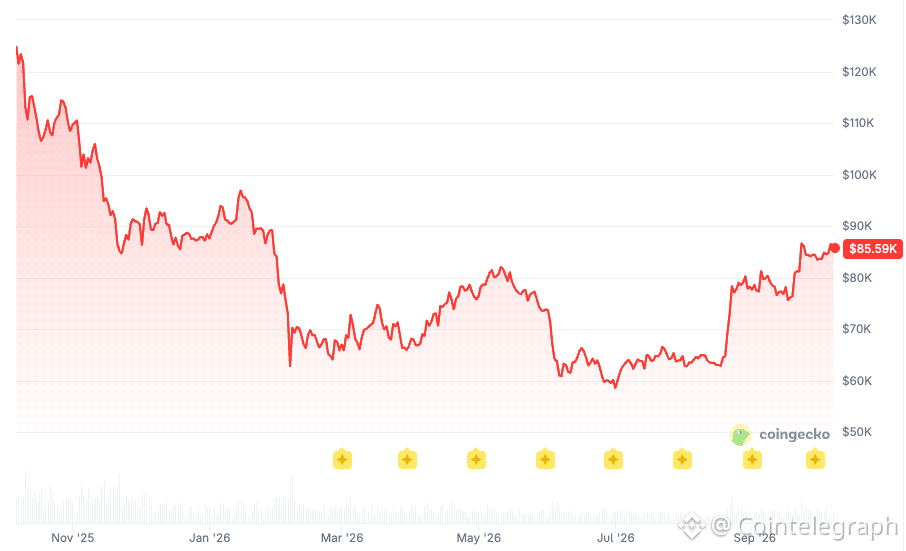
Article
Bitcoin ETFs shed $90M as BTC sits 32% below year-old ATHUS spot Bitcoin exchange-traded funds (ETFs) shed $89.9 million on Monday, reversing two days of inflows as Bitcoin slipped below $86,000.
Bitcoin ETFs attracted around $293 million over the previous two October trading sessions before Monday’s reversal, with total trading volume reaching $2.18 billion, according to SoSoValue data.
The pullback came a day before the first anniversary of Bitcoin’s $126,080 all-time high on Oct. 6, 2025, with BTC trading at $85,559 at the time of publication, or roughly 32% below its record, according to CoinGecko.
Bitcoin (BTC) price chart over the past year. Source: CoinGecko
Since then, cumulative net inflows into US spot Bitcoin ETFs have fallen 5.8%, from around $61.3 billion to $57.7 billion as of Monday, according to SoSoValue.
US spot Ether (ETH) ETFs also recorded roughly $51 million in net outflows on Monday, extending their losing streak to five consecutive trading days. The funds lost a combined $206 million throughout the streak, with cumulative net inflows standing at $13.8 billion.
Other altcoin ETFs posted mixed results on Monday. Solana (SOL) and Zcash (ZEC) funds recorded net outflows of $9.3 million and $3.6 million, respectively, while XRP ETFs saw no net flows after posting $3.3 million in outflows on Friday.
Bitcoin ETFs shed $90M as BTC sits 32% below year-old ATH
US spot Bitcoin exchange-traded funds (ETFs) shed $89.9 million on Monday, reversing two days of inflows as Bitcoin slipped below $86,000.
Bitcoin ETFs attracted around $293 million over the previous two October trading sessions before Monday’s reversal, with total trading volume reaching $2.18 billion, according to SoSoValue data.
The pullback came a day before the first anniversary of Bitcoin’s $126,080 all-time high on Oct. 6, 2025, with BTC trading at $85,559 at the time of publication, or roughly 32% below its record, according to CoinGecko.
Bitcoin (BTC) price chart over the past year. Source: CoinGecko
Since then, cumulative net inflows into US spot Bitcoin ETFs have fallen 5.8%, from around $61.3 billion to $57.7 billion as of Monday, according to SoSoValue.
US spot Ether (ETH) ETFs also recorded roughly $51 million in net outflows on Monday, extending their losing streak to five consecutive trading days. The funds lost a combined $206 million throughout the streak, with cumulative net inflows standing at $13.8 billion.
Other altcoin ETFs posted mixed results on Monday. Solana (SOL) and Zcash (ZEC) funds recorded net outflows of $9.3 million and $3.6 million, respectively, while XRP ETFs saw no net flows after posting $3.3 million in outflows on Friday.
Bitcoin ETFs attracted around $293 million over the previous two October trading sessions before Monday’s reversal, with total trading volume reaching $2.18 billion, according to SoSoValue data.
The pullback came a day before the first anniversary of Bitcoin’s $126,080 all-time high on Oct. 6, 2025, with BTC trading at $85,559 at the time of publication, or roughly 32% below its record, according to CoinGecko.
Bitcoin (BTC) price chart over the past year. Source: CoinGecko
Since then, cumulative net inflows into US spot Bitcoin ETFs have fallen 5.8%, from around $61.3 billion to $57.7 billion as of Monday, according to SoSoValue.
US spot Ether (ETH) ETFs also recorded roughly $51 million in net outflows on Monday, extending their losing streak to five consecutive trading days. The funds lost a combined $206 million throughout the streak, with cumulative net inflows standing at $13.8 billion.
Other altcoin ETFs posted mixed results on Monday. Solana (SOL) and Zcash (ZEC) funds recorded net outflows of $9.3 million and $3.6 million, respectively, while XRP ETFs saw no net flows after posting $3.3 million in outflows on Friday.
583
စိစစ်အတည်ပြုထားသည်
EEZ tests atomic L1-to-L2 transaction in push to unify EthereumThe Ethereum Economic Zone (EEZ) has tested an atomic transaction between Ethereum mainnet and a layer-2 network, according to a project contributor.
On Tuesday, EEZ contributor Eduardo Antuña Díez shared the transaction and called it the “first atomic cross-chain” L1-to-L2 transaction. The transaction’s logs record a cross-chain call carrying 0.001 Ether (ETH) and a state update for a rollup.
In an atomic transaction, linked actions across networks either all succeed or are all reversed if any part fails.
In March, developers behind the EEZ said the framework was designed to let rollups interact with each other and Ethereum mainnet within a single transaction, without relying on bridges. The project aims to reconnect liquidity and applications spread across separate L2 networks.
Gnosis co-founder Friederike Ernst previously told Cointelegraph that the lack of synchronous composability forces protocols to maintain separate deployments across L2s, fragmenting liquidity into multiple markets.
Jakub Gregus, co-founder of decentralized finance protocol Hydration, called the demonstration “one of the most important milestones” in crypto, saying that the technology could directly benefit Ethereum.
EEZ tests atomic L1-to-L2 transaction in push to unify Ethereum
The Ethereum Economic Zone (EEZ) has tested an atomic transaction between Ethereum mainnet and a layer-2 network, according to a project contributor.
On Tuesday, EEZ contributor Eduardo Antuña Díez shared the transaction and called it the “first atomic cross-chain” L1-to-L2 transaction. The transaction’s logs record a cross-chain call carrying 0.001 Ether (ETH) and a state update for a rollup.
In an atomic transaction, linked actions across networks either all succeed or are all reversed if any part fails.
In March, developers behind the EEZ said the framework was designed to let rollups interact with each other and Ethereum mainnet within a single transaction, without relying on bridges. The project aims to reconnect liquidity and applications spread across separate L2 networks.
Gnosis co-founder Friederike Ernst previously told Cointelegraph that the lack of synchronous composability forces protocols to maintain separate deployments across L2s, fragmenting liquidity into multiple markets.
Jakub Gregus, co-founder of decentralized finance protocol Hydration, called the demonstration “one of the most important milestones” in crypto, saying that the technology could directly benefit Ethereum.
On Tuesday, EEZ contributor Eduardo Antuña Díez shared the transaction and called it the “first atomic cross-chain” L1-to-L2 transaction. The transaction’s logs record a cross-chain call carrying 0.001 Ether (ETH) and a state update for a rollup.
In an atomic transaction, linked actions across networks either all succeed or are all reversed if any part fails.
In March, developers behind the EEZ said the framework was designed to let rollups interact with each other and Ethereum mainnet within a single transaction, without relying on bridges. The project aims to reconnect liquidity and applications spread across separate L2 networks.
Gnosis co-founder Friederike Ernst previously told Cointelegraph that the lack of synchronous composability forces protocols to maintain separate deployments across L2s, fragmenting liquidity into multiple markets.
Jakub Gregus, co-founder of decentralized finance protocol Hydration, called the demonstration “one of the most important milestones” in crypto, saying that the technology could directly benefit Ethereum.
1
617
Better Markets says CFTC is ‘wrong agency’ to regulate retail cryptoBetter Markets says the US derivatives regulator’s push to develop rules for certain retail crypto transactions could leave investors with weaker safeguards, arguing the agency is ill-equipped to oversee the market.
The Commodity Futures Trading Commission on Monday sought public comment on a potential framework for margined, leveraged or financed retail crypto transactions under its existing authority. Benjamin Schiffrin, director of securities policy at Better Markets, a nonprofit financial reform advocacy group, argued that CFTC oversight is less suited than the SEC to protecting retail investors.
“Unlike the SEC, the CFTC lacks an investor protection mandate. Its mission is to regulate the commodity and derivatives markets, which historically have been dominated by large institutions with very little retail investor participation,” said Schiffrin.
“Because the CFTC’s rules lack the protections that apply when investors trade securities regulated by the SEC, the CFTC is the wrong agency to regulate transactions involving crypto assets by retail customers,” he added.
Better Markets’ criticism comes as the CFTC and SEC move ahead with crypto policy under existing law after the CLARITY Act stalled in Congress. Both agencies had previously signaled they were prepared to act without new legislation.
Better Markets questions “crypto capital” goal
Better Markets also challenged the CFTC’s claim that Congress intended the agency to oversee these types of retail crypto transactions.
Schiffrin noted that the statutory authority cited by the CFTC was originally enacted to address fraud in leveraged precious-metals trading, and argued that this did not show an intent for the agency to become a primary regulator for retail crypto.
He also criticized the framework under consideration for potentially allowing affiliations between market participants that Better Markets said contributed to FTX’s collapse.
Schiffrin also took aim at CFTC Chair Mike Selig’s statements about making the US the crypto capital of the world.
“Yet he does not explain why that is a good thing. For example, the US is not the cocaine production capital of the world, and no one is complaining—for good reason,” he said.
“Crypto—after 18 years of effort and innumerable disproved and baseless claims—still lacks any real-world use case. It is used either purely for speculation or for criminal purposes,” he said.
Nate Geraci, president of NovaDius Wealth Management, pushed back on the characterization, saying the crypto industry is simply seeking clear rules of the road and arguing that, if Congress cannot provide them, the CFTC and SEC may have to do so.
CFTC, SEC move ahead after CLARITY setback
The CFTC’s newly proposed crypto framework also considers a new federal category for crypto trading platforms that would bring qualifying exchanges directly under CFTC oversight.
Meanwhile, the SEC has also pushed ahead with several crypto measures. On Thursday, it proposed easing some custody rules for investment advisers, while separately allowing limited tokenized US stock trading and issuing new guidance on how securities laws apply to crypto.
Magazine: Too big to pause: Could an AI slowdown crash the economy?
Better Markets says CFTC is ‘wrong agency’ to regulate retail crypto
Better Markets says the US derivatives regulator’s push to develop rules for certain retail crypto transactions could leave investors with weaker safeguards, arguing the agency is ill-equipped to oversee the market.
The Commodity Futures Trading Commission on Monday sought public comment on a potential framework for margined, leveraged or financed retail crypto transactions under its existing authority. Benjamin Schiffrin, director of securities policy at Better Markets, a nonprofit financial reform advocacy group, argued that CFTC oversight is less suited than the SEC to protecting retail investors.
“Unlike the SEC, the CFTC lacks an investor protection mandate. Its mission is to regulate the commodity and derivatives markets, which historically have been dominated by large institutions with very little retail investor participation,” said Schiffrin.
“Because the CFTC’s rules lack the protections that apply when investors trade securities regulated by the SEC, the CFTC is the wrong agency to regulate transactions involving crypto assets by retail customers,” he added.
Better Markets’ criticism comes as the CFTC and SEC move ahead with crypto policy under existing law after the CLARITY Act stalled in Congress. Both agencies had previously signaled they were prepared to act without new legislation.
Better Markets questions “crypto capital” goal
Better Markets also challenged the CFTC’s claim that Congress intended the agency to oversee these types of retail crypto transactions.
Schiffrin noted that the statutory authority cited by the CFTC was originally enacted to address fraud in leveraged precious-metals trading, and argued that this did not show an intent for the agency to become a primary regulator for retail crypto.
He also criticized the framework under consideration for potentially allowing affiliations between market participants that Better Markets said contributed to FTX’s collapse.
Schiffrin also took aim at CFTC Chair Mike Selig’s statements about making the US the crypto capital of the world.
“Yet he does not explain why that is a good thing. For example, the US is not the cocaine production capital of the world, and no one is complaining—for good reason,” he said.
“Crypto—after 18 years of effort and innumerable disproved and baseless claims—still lacks any real-world use case. It is used either purely for speculation or for criminal purposes,” he said.
Nate Geraci, president of NovaDius Wealth Management, pushed back on the characterization, saying the crypto industry is simply seeking clear rules of the road and arguing that, if Congress cannot provide them, the CFTC and SEC may have to do so.
CFTC, SEC move ahead after CLARITY setback
The CFTC’s newly proposed crypto framework also considers a new federal category for crypto trading platforms that would bring qualifying exchanges directly under CFTC oversight.
Meanwhile, the SEC has also pushed ahead with several crypto measures. On Thursday, it proposed easing some custody rules for investment advisers, while separately allowing limited tokenized US stock trading and issuing new guidance on how securities laws apply to crypto.
Magazine: Too big to pause: Could an AI slowdown crash the economy?
The Commodity Futures Trading Commission on Monday sought public comment on a potential framework for margined, leveraged or financed retail crypto transactions under its existing authority. Benjamin Schiffrin, director of securities policy at Better Markets, a nonprofit financial reform advocacy group, argued that CFTC oversight is less suited than the SEC to protecting retail investors.
“Unlike the SEC, the CFTC lacks an investor protection mandate. Its mission is to regulate the commodity and derivatives markets, which historically have been dominated by large institutions with very little retail investor participation,” said Schiffrin.
“Because the CFTC’s rules lack the protections that apply when investors trade securities regulated by the SEC, the CFTC is the wrong agency to regulate transactions involving crypto assets by retail customers,” he added.
Better Markets’ criticism comes as the CFTC and SEC move ahead with crypto policy under existing law after the CLARITY Act stalled in Congress. Both agencies had previously signaled they were prepared to act without new legislation.
Better Markets questions “crypto capital” goal
Better Markets also challenged the CFTC’s claim that Congress intended the agency to oversee these types of retail crypto transactions.
Schiffrin noted that the statutory authority cited by the CFTC was originally enacted to address fraud in leveraged precious-metals trading, and argued that this did not show an intent for the agency to become a primary regulator for retail crypto.
He also criticized the framework under consideration for potentially allowing affiliations between market participants that Better Markets said contributed to FTX’s collapse.
Schiffrin also took aim at CFTC Chair Mike Selig’s statements about making the US the crypto capital of the world.
“Yet he does not explain why that is a good thing. For example, the US is not the cocaine production capital of the world, and no one is complaining—for good reason,” he said.
“Crypto—after 18 years of effort and innumerable disproved and baseless claims—still lacks any real-world use case. It is used either purely for speculation or for criminal purposes,” he said.
Nate Geraci, president of NovaDius Wealth Management, pushed back on the characterization, saying the crypto industry is simply seeking clear rules of the road and arguing that, if Congress cannot provide them, the CFTC and SEC may have to do so.
CFTC, SEC move ahead after CLARITY setback
The CFTC’s newly proposed crypto framework also considers a new federal category for crypto trading platforms that would bring qualifying exchanges directly under CFTC oversight.
Meanwhile, the SEC has also pushed ahead with several crypto measures. On Thursday, it proposed easing some custody rules for investment advisers, while separately allowing limited tokenized US stock trading and issuing new guidance on how securities laws apply to crypto.
Magazine: Too big to pause: Could an AI slowdown crash the economy?
905
Log in to explore more content
Join global crypto users on Binance Square
⚡️ Get latest and useful information about crypto.
💬 Trusted by the world’s largest crypto exchange.
👍 Discover real insights from verified creators.
အီးမေးလ် / ဖုန်းနံပါတ်
ရေပန်းစားနေသော ခေါင်းစဉ်များ
BinanceLaunchesBinanceIntelligence
400,604 views
3,075 Discussing
#BinanceLaunchesBinanceIntelligence
⚡ AI Meets Crypto Trading: Binance Intelligence is Live! ⚡
Trading just got a massive upgrade with Binance's new AI suite:
1️⃣ Binance AI: Personalized market dashboards & 4-hour macro market audio briefings.
2️⃣ Binance AI Pro: Build and run automated strategies using simple natural language prompts.
3️⃣ Binance Agent OS: Developer framework for autonomous financial AI agents.
Describe your strategy ➔ Paper test ➔ Execute 24/7.
Are you building your next trading strategy with AI? Drop your thoughts below! 👇
#BinanceLaunchesBinanceIntelligence #BinanceSquare #CryptoAI #Trading $EDEN
Hazi BNB
·နှစ်သက်မှု 1 ခု
·876 views
BitcoinTargets2026OpenAt$87570
2,340 views
75 Discussing
BitcoinRejectedAt$87KThirdTime
2,353 views
62 Discussing