I Lost $47,000 in 6 Hours on October 10th. Here's What They're Not Telling You About That Day.
October 10th, 2025. I watched my portfolio drop by nearly 50 grand while sitting in a coffee shop, refreshing my phone every 30 seconds like a maniac. No news alerts. No emergency headlines. Just blood. Everywhere. And the worst part? Nobody could tell me why. "Just crypto being crypto," they said. "Volatility is normal," they said. Bull. Shit. I spent the last month obsessively researching what actually happened that day. What I uncovered is so calculated, so perfectly timed, that it honestly made me question everything I thought I knew about "free markets." This isn't another conspiracy theory. This is documented, traceable, and way more sinister than a simple market correction. Let me show you exactly what happened.
The Day the Market Broke (And Nobody Noticed Why) October 10th was supposed to be a normal trading day. No Federal Reserve meetings. No exchange hacks. No Elon tweet. No China ban rumors. Nothing on the calendar that screamed "massive crash incoming." Bitcoin just... collapsed. Ethereum followed. Then everything else. Liquidations hit $1.5 billion in under 12 hours. Leverage got absolutely nuked. The fear index spiked higher than it did during the FTX collapse. Every trader I know was asking the same thing: "What the hell just happened?" Here's what nobody was looking at: while we were all panicking and checking Binance, a seemingly boring financial document was quietly published that would explain everything. The Document Nobody Read (But Everyone Should Have) That same evening—literally hours before the crash started—MSCI dropped a "consultation paper." Now, I know what you're thinking. "MSCI? Sounds boring. Why should I care?" Here's why: MSCI creates the indexes that control where TRILLIONS of institutional dollars flow. When they make a rule change, it's not a suggestion. It's a mandate that moves mountains of money whether anyone likes it or not. In this document, they proposed something that sent chills down my spine once I understood the implications: If any company holds 50% or more of its assets in digital currencies AND operates mainly as a digital asset treasury, MSCI can remove them from global indexes. Translation: If you're a public company that's gone all-in on Bitcoin, you might be about to get kicked out of every major index fund in the world. Why This Is the Financial Equivalent of a Nuclear Bomb Most people don't understand how index funds work, so let me break it down: When you buy an S&P 500 index fund, that fund doesn't choose which stocks to own. It MUST own all 500 companies in the exact proportions that the index dictates. It's literally in their legal mandate. So what happens when MSCI removes a company from their indexes? Every. Single. Fund. Must. Sell. Not "might sell." Not "can consider selling." MUST sell. Immediately. No exceptions. Now guess which company this rule seems custom-built to target? MicroStrategy. You know, the company that owns over 250,000 Bitcoin. The company whose stock moves like Bitcoin on steroids. The company that every institutional investor uses as a proxy to get Bitcoin exposure in their traditional portfolios. If MSCI removes MicroStrategy from their indexes, here's what happens next: Trillions of dollars in index funds are forced to dump MSTR sharesMSTR stock price collapsesMarket interprets this as institutional Bitcoin rejectionConfidence evaporatesLeveraged Bitcoin positions get liquidatedBitcoin crashesAltcoins follow Bitcoin into the abyssRetail panic sells at the bottom And here's the truly terrifying part: this wasn't a theory on October 10th. It was a fear that hit the market in real-time. The Market Was Already on Life Support Context matters here. October's market wasn't healthy. We were dealing with: New tariff announcements creating macro uncertaintyNasdaq showing serious cracksBitcoin futures markets overleveraged to hellPersistent whispers that the four-year cycle was topping outLiquidity thinner than it had been in months
The market was a powder keg. MSCI's announcement was the match. Traders didn't wait to see what would actually happen. They saw the possibility of forced institutional selling on a scale crypto has never experienced, and they ran for the exits. The cascade was brutal. Automated liquidations triggered more liquidations. Stop losses triggered more stop losses. In leveraged markets, fear spreads faster than any virus. By the time the dust settled, we'd witnessed one of the most violent liquidation events in crypto history. And most people still had no idea what caused it. Then JPMorgan Twisted the Knife Just when you thought it couldn't get worse, guess who showed up? JPMorgan. Three days ago. With a perfectly timed research report. Their analysts published a bearish note specifically highlighting the MSCI classification risks for Bitcoin-heavy companies. The timing was chef's kiss perfect: MicroStrategy was already bleeding badlyBitcoin was showing major weaknessVolume was pathetically lowSentiment was already in the gutterEveryone was looking for confirmation of their worst fears JPMorgan gave them that confirmation. Bitcoin dropped another 14% in days. Now, if you're new to traditional markets, this might seem like normal analyst behavior. But if you've been around, you recognize this pattern immediately. JPMorgan has done this with gold. With silver. With bonds. With every major asset class they want to accumulate on the cheap. The playbook never changes: Step 1: Publish bearish research when the asset is already weak Step 2: Watch your analysis amplify existing panic Step 3: Let retail investors puke their positions at the bottom
Step 4: Quietly accumulate while everyone else is terrified Step 5: Publish bullish research months later when prices recover Step 6: Profit massively This isn't conspiracy theory. This is documented market behavior by major financial institutions over decades. They literally paid billions in fines for manipulating gold and silver markets using these exact tactics. And now they're doing it with Bitcoin. Michael Saylor Wasn't Having It While everyone was panicking, Michael Saylor—the guy who literally bet his company on Bitcoin—came out swinging. He released a detailed public statement that basically said: "You're all missing the point." His key arguments: "MicroStrategy is NOT a passive Bitcoin fund." We're a real operating company with: $500 million in annual software revenueActive product developmentFive new digital credit instruments launched this year$7.7 billion in innovative financial products issuedThe world's first Bitcoin-backed variable yield instrumentOngoing business operations beyond just holding Bitcoin His message was clear: "Label us however you want. We're building the future of corporate treasury management. Your index classifications don't change what we're actually accomplishing." Bold? Yes. Accurate? Also yes. But here's the problem: the market doesn't care about nuance when fear is driving. And right now, fear is very much in the driver's seat. What This Actually Means for Your Portfolio Let me cut through the noise and give you the brutal truth: The October 10th crash was engineered. Not by some secret cabal, but by traditional finance mechanisms intersecting with crypto markets in ways we haven't seen before. Wall Street is playing 4D chess. They're using sophisticated tactics to shake out weak hands and accumulate positions. If you're getting emotional and panic selling, you're playing their game. The fundamentals haven't changed. Bitcoin's supply is still fixed. Adoption is still growing. Institutional interest is still increasing. Technology is still revolutionary. But the risk isn't over. MSCI's final decision drops on January 15, 2026. Implementation happens in February 2026. We've got over a year of potential uncertainty, FUD campaigns, and volatility. Between now and then, expect: More "analyst reports" at convenient timesMore orchestrated fear campaignsMore liquidation events designed to shake you outMore buying opportunities if you can control your emotions The Uncomfortable Truth Nobody Wants to Admit Here's what really pisses me off about all this: We talk about crypto like it's this decentralized, democratized financial system that can't be manipulated by traditional institutions. But that's becoming less true every day. The moment Bitcoin ETFs launched, the moment MicroStrategy made BTC its treasury strategy, the moment traditional finance started paying attention—we invited Wall Street into our space. And Wall Street plays by different rules. They have tools we don't. Capital we can't match. Connections we'll never have. Experience manipulating markets that stretches back a century. The October 10th crash wasn't about Bitcoin failing. It was about traditional finance stress-testing how much they can move crypto markets using their institutional playbooks. And you know what? It worked. They moved the market. Massively. So What Do We Do Now? I'm not going to lie to you and say "just HODL" or "zoom out" or any of that toxic positivity garbage. What happened on October 10th was real. The threat from MSCI classifications is real. The risk of forced institutional selling is real. But here's what's also real: Bitcoin didn't exist because markets were stable. It exists because the traditional financial system is broken, manipulated, and designed to benefit those who already have power. October 10th proved why we need Bitcoin. We got a masterclass in how traditional institutions can manufacture fear and move markets at will. The question isn't whether you believe in Bitcoin's fundamentals. It's whether you can stomach the volatility while institutions try to shake you out before they position themselves for the next bull run. I can't tell you what to do with your money. But I can tell you this: I watched my portfolio drop $47,000 in one day. And I didn't sell a single satoshi. Because I've seen this movie before. And I know how it ends. The institutions that are spreading fear today will be the same ones pumping hopium when Bitcoin hits new all-time highs. Don't let them buy your bags at a discount. Did you hold through October 10th or did you panic sell? Be honest—no judgment. Drop a comment and let's talk about it. We're all in this together.
Ethereum's Critical Moment: Understanding What the Charts Are Really Telling Us
Hey everyone, I wanted to share something that's been keeping me up at night lately. I've been studying Ethereum's price movements for years now, and what I'm seeing right now demands our attention.
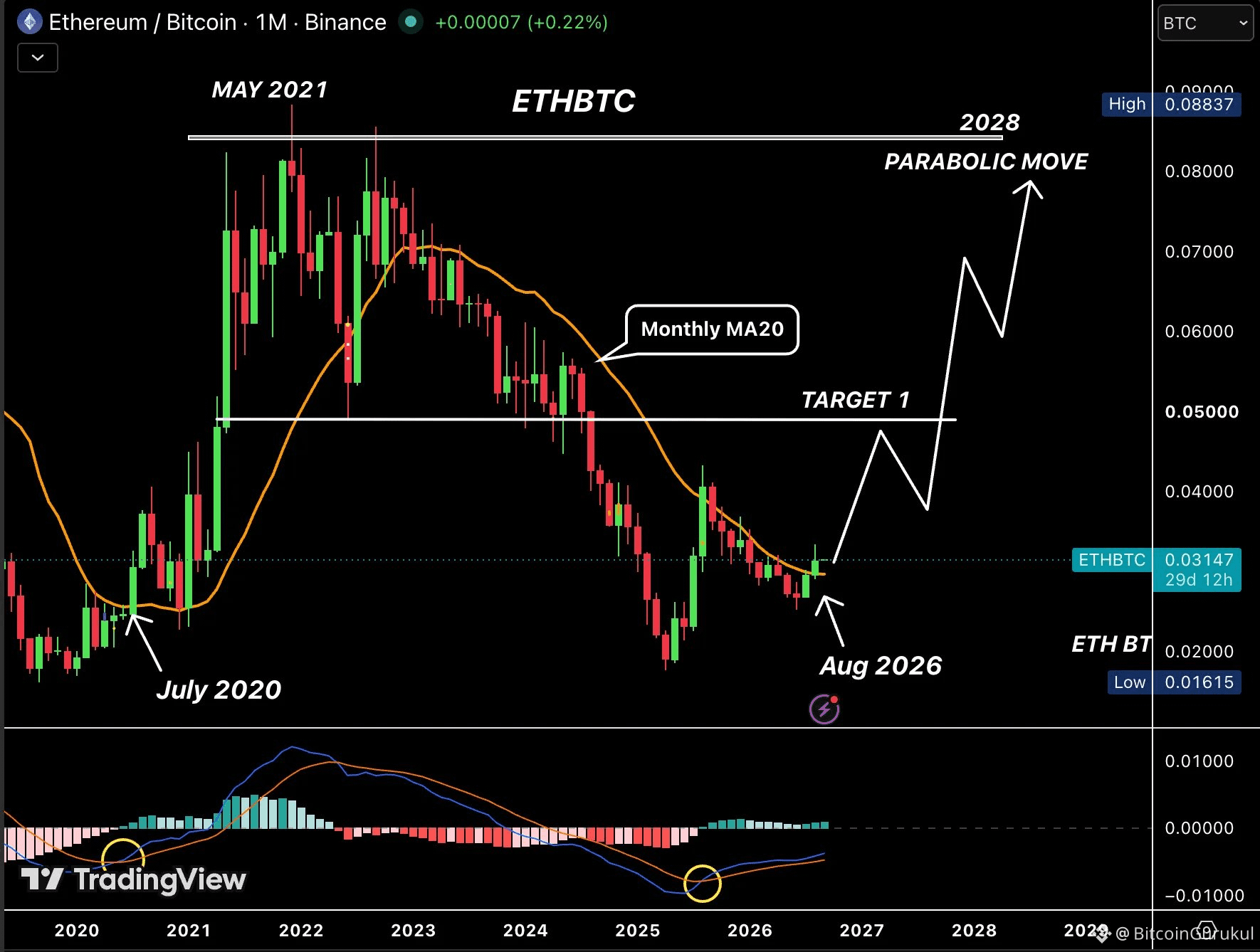
The Pattern That Keeps Repeating Let me walk you through what's happening. If you look at Ethereum's journey since 2016, there's a striking pattern that emerges. Think of it like a staircase where each step represents a consolidation phase before the next move. The 2016-2018 Phase: Back then, ETH was building its foundation in the low double digits. It established a base, tested it multiple times, and when that support finally gave way, we saw a significant correction that shook out many early believers. The 2018-2021 Cycle: After the initial boom and bust, Ethereum found new footing. The price consolidated in a higher range, creating what traders call an accumulation zone. This became the launching pad for the incredible run we witnessed, but again, when that base cracked, the pullback was substantial. Now - The 2022-2025 Structure: Here's where things get interesting, and frankly, a bit concerning. We're currently testing a support zone that's been holding since 2022. This isn't just any support level - it's the foundation that the entire recent structure is built upon.
Why This Moment Matters I'm not here to spread panic or negativity. What I want to share is what the data is actually showing us, free from emotion or bias. When you examine the current price action, Ethereum is dancing right at the edge of this critical zone. The technical structure looks eerily similar to those previous cycles right before major corrections occurred. Think of it like a building's foundation. If the ground floor starts cracking, everything above becomes unstable. That's essentially what we're looking at right now with this support level.
What "Air Below" Actually Means You might have heard traders talk about "nothing but air below" a certain price level. Let me explain what that really means in practical terms. In technical analysis, support zones are areas where buyers have historically stepped in with force. They're like safety nets. When you break through a major support zone, the next significant level where buyers might show up could be much, much lower. Looking at Ethereum's historical chart, if this current base fails to hold, the next major support zone that showed consistent buying pressure in the past sits considerably lower. That gap - that's the "air" people are referring to.
Historical Context Is Everything Here's the thing about market cycles - they don't photocopy themselves, but they definitely have a rhythm. Each previous cycle showed us that when these major support structures break, the decline isn't gradual. It tends to accelerate because: Stop losses get triggered in wavesPanic selling kicks inLeveraged positions get liquidatedConfidence erodes quickly I've watched this happen twice before with Ethereum, and the pattern recognition is hard to ignore.
My Honest Take Look, I'm heavily invested in the crypto space, both financially and emotionally. I believe in the technology and Ethereum's long-term potential remains strong with its ongoing developments and ecosystem growth. But believing in the future doesn't mean ignoring present risks. What the charts are showing right now isn't speculation or gut feeling - it's measurable technical deterioration at a critical juncture. The price structure that took three years to build is under severe stress.
What Should You Consider? I'm not telling anyone what to do with their investments. That's a personal decision based on your risk tolerance, time horizon, and financial situation. But here's what I'm personally paying attention to: Volume patterns: Is selling pressure increasing or decreasing?The actual support level: Are we bouncing off it or slicing through it?Broader market conditions: What's happening with Bitcoin and traditional markets?On-chain metrics: Are whales accumulating or distributing? The Bigger Picture Whether you're bullish or bearish short-term, understanding these technical levels helps you make informed decisions rather than emotional ones. The reality is that every major bull run in crypto history has been preceded by periods that tested investor conviction. Shakeouts happen. Capitulation events occur. And often, those become the best buying opportunities in hindsight. But - and this is crucial - you need to survive the storm to benefit from the sunshine after.
Final Thoughts This isn't about creating fear. It's about respecting what the market is communicating through price action. The chart doesn't lie, it doesn't have bias, and it doesn't care about our bags. If Ethereum holds this support and bounces, it could set up another powerful leg higher. But if it breaks down decisively, we need to be mentally and strategically prepared for what that could mean. History has shown us this pattern before. Whether it plays out the same way this time remains to be seen. But ignoring the warning signs isn't strategy - it's hope disguised as conviction. Stay safe out there, do your own research, and never invest more than you can afford to lose. What are your thoughts on this? I'd genuinely love to hear different perspectives, especially if you're seeing something in the charts that I'm missing.
APRO- The Silent Army Rebuilding Trust in a Trustless World
There's something almost poetic about infrastructure. It doesn't scream. It doesn't demand attention. It just works—or it doesn't, and everything collapses. APRO sits in that category, the kind of technology that operates in the shadows of the blockchain world, where the real battles for reliability are fought. Not with marketing campaigns or influencer partnerships, but with the quiet, relentless work of turning chaos into certainty. I've been watching oracle solutions for years now, and most of them follow a predictable script: fetch data, verify it loosely, push it to the chain, hope nothing breaks. APRO doesn't play that game. It treats data like a living thing—something that needs to be analyzed, filtered, shaped, and verified before it ever touches a smart contract. That shift in philosophy? That's where things get interesting.
The Real Oracle Problem Was Never Just About Speed When people talk about oracles, they usually focus on latency—how fast can you get that price feed? How quickly can you react to market movements? But speed without accuracy is just noise traveling fast. The oracle problem was always deeper than velocity. It was about trust in a trustless system, about how you verify reality when the blockchain itself is blind to the world outside its own code. APRO approaches this with a kind of architectural honesty. It doesn't pretend that grabbing data from an API and slapping it onto Ethereum is enough anymore. Instead, it builds a two-layer system where data gets processed, analyzed, and validated before it becomes actionable. Layer One handles the messy work—external interactions, preliminary AI sorting, organizing the chaos of real-world inputs. Layer Two does the heavy consensus work, the deep verification, the final aggregation. This separation creates redundancy, yes, but more importantly, it creates resilience. Because here's the thing: decentralized systems are only as strong as their weakest data point. One manipulated feed. One compromised source. One moment where the oracle blinks, and suddenly an entire DeFi protocol is draining millions in liquidations that shouldn't have happened. APRO's use of AI as a sentinel against this kind of corruption isn't just a feature—it's a necessary evolution. Static rules can't catch dynamic threats. The AI analyzes incoming signals in real time, detects anomalies, rejects data that fails its tests. It's living validation in a world where threats morph faster than rulebooks can be written.
Push and Pull: The Architecture of Intention Most systems claim to offer both push and pull data models, but APRO actually separates them by purpose. Push is for the protocols that need instant reactions—DeFi systems where milliseconds matter, where a price condition triggers a cascade of automated trades. Pull is for precision moments, when a user initiates something deliberate, when you need verifiable randomness for an NFT mint or a fair lottery distribution. This isn't just technical flexibility. It's design philosophy 🔥 that understands different use cases need different architectures. High-frequency trading environments don't operate like gaming platforms. Institutional-grade financial products don't behave like experimental DAOs. APRO's dual-mode approach acknowledges that one-size-fits-all solutions are actually one-size-fits-nobody. And randomness? That's where most projects quietly fail. True randomness is mathematically hard. Predictable randomness is just bias wearing a mask. APRO's verifiable randomness isn't just unpredictable—it's provably fair. No node can manipulate the outcome. No participant can game the system. In decentralized ecosystems where fairness is the entire value proposition, this matters more than almost any other feature.
The Multi-Chain Reality Nobody Wants to Admit The dream of one blockchain to rule them all is dead. It died somewhere between Ethereum's scaling challenges and the rise of specialized chains for gaming, for DeFi, for social applications. We live in a multi-chain reality now, where different networks operate at different speeds, with different security models, different consensus mechanisms. Most oracle solutions were built for a single-chain world and struggle to adapt. APRO was designed for fragmentation. It connects with over forty blockchain networks, adapting its data validation to each chain's specific requirements. That's not just technical compatibility—it's philosophical alignment with where the ecosystem is actually heading. The future isn't convergence. It's interoperability. It's shared truth across disconnected systems. APRO becomes the data backbone that holds that fragmented universe together.
Where This Actually Leads DeFi won't reach institutional adoption without oracles that can handle complexity. Gaming won't achieve mainstream fairness without verifiable randomness. Real-world assets won't tokenize reliably without constant, authenticated data streams from physical reality. APRO isn't solving yesterday's problems. It's building infrastructure for systems that don't fully exist yet—virtual economies, tokenized real estate, decentralized social layers, on-chain corporate bonds. The bridge between physical assets and digital networks is where the oracle problem gets truly complicated. Property metrics. Corporate earnings reports. Regulatory compliance data. These aren't simple price feeds. They're complex, multi-source information streams that need authentication, verification, and constant updating. APRO's architecture is one of the few systems built to handle that level of integration without compromising security. Because ultimately, that's what separates infrastructure from hype. Hype solves the problems everyone's talking about. Infrastructure solves the problems that will matter in three years, when nobody remembers the hype cycles but everyone depends on the systems that actually work.
The Silence Is Strategic APRO doesn't need to be loud because it's building trust at the foundational layer. Smart contracts don't care about branding. Protocols don't respond to marketing. They respond to reliability, to uptime, to data integrity measured in years of consistent performance. That's the kind of adoption that doesn't happen overnight, but once it's established, it's nearly impossible to displace. The question isn't whether oracle infrastructure matters—it clearly does. The question is which systems will still be running when the next generation of blockchain applications requires data complexity we can barely imagine right now. APRO's layered architecture, AI-driven validation, and multi-chain adaptability position it for that future. Not as a flashy solution, but as the kind of infrastructure that becomes invisible precisely because it works so consistently you forget it's there. The best technology doesn't announce itself. It just becomes the layer everything else depends on. How are you interpreting this shift toward intelligent data infrastructure in Web3?
The $100B Robotics DePIN Revolution: Three Projects Leading the Charge
Why Everyone's Missing the Biggest Opportunity in Decentralized Infrastructure Look, I get it. Everyone's eyes are glued to the latest AI token launches, watching memecoins pump and dump, chasing the next big narrative in crypto. But here's what barely anyone is talking about: Robotics DePIN is about to explode into a $100 billion industry by 2030, and most people are completely sleeping on it. I've been deep in the weeds researching this space, and three projects keep coming up again and again. These aren't your typical vaporware crypto projects. They're building real infrastructure for the machine economy that's coming whether we're ready for it or not. Let me break down what I've discovered about PEAQ, AUKI, and NATIX – three projects that could genuinely reshape how robots and machines interact with our economy.
The Machine Economy Revolution Nobody's Watching Before we dive into specific projects, let's talk about what's actually happening here. We're not talking about some distant sci-fi future. Right now, thousands of robots, sensors, and smart devices need to coordinate, share data, and transact with each other. The problem? Most of this infrastructure is centralized, controlled by big tech companies, and completely closed off. That's where Decentralized Physical Infrastructure Networks (DePIN) come in. Think of it as giving machines their own economy – a way for autonomous devices to earn, spend, and coordinate without needing permission from Google, Amazon, or Apple. And three projects are building completely different pieces of this puzzle.
PEAQ: Building the Economic Foundation for Machines The Vision: What if every robot, sensor, and IoT device could become its own economic agent? PEAQ isn't trying to be just another blockchain. They're building a Layer-1 network specifically engineered for machine economies. Built using Substrate technology and secured through Polkadot's consensus mechanism, PEAQ offers the kind of modularity that lets it support virtually any type of robotics application you can imagine. What Makes PEAQ Different Here's where it gets interesting. PEAQ is compatible with both EVM and Rust, meaning developers can build using familiar tools. But the real magic is in what it's already accomplished: Over 60 applications are actively building on the networkSpanning 22+ different industriesMore than 5 million people and machines already interacting through PEAQ-powered applications This isn't theoretical. Real companies are using this infrastructure right now. Take Silencio, for example. They've got over 1.2 million users crowdsourcing sound pollution data that feeds into robotics and AI systems. Autonomous vehicle fleets coordinate routes and payments through PEAQ. IoT devices monetize their data output automatically.
How the Token Economics Work The $PEAQ token powers every machine action on the network: Registering new robotsRequesting data from sensorsExecuting autonomous tasksProcessing payments between machines The economic model is brilliant in its simplicity. Supply inflation starts at 3.5% and decreases by 10% annually, eventually stabilizing at 1%. This rewards early participants while ensuring long-term sustainability. Distribution of inflation rewards: 40% goes to validators and delegators securing the network60% funds the treasury for DePIN rewards and machine subsidies Every aspect of the tokenomics is designed to fuel actual network activity, not just speculative trading.
My Take on PEAQ If robotics DePIN becomes a mainstream category, PEAQ is positioned as the settlement layer – the backbone that everything else plugs into. They're not building a robot chain; they're building the economic system that all robots will need to use. Best for: Infrastructure-focused investors who want exposure to the entire robotics economy AUKI: Giving Robots Eyes and Spatial Intelligence The Vision: What if robots could share a decentralized understanding of physical space? While PEAQ handles the economic layer, AUKI tackles something equally critical: spatial perception. The Centralization Problem in Robotics Right now, if a robot needs to understand and navigate physical space, it relies on centralized systems from Apple, NVIDIA, or Meta. AUKI is decentralizing that entire stack. Their network consists of specialized nodes: Compute Nodes handle heavy spatial AI processingMotion Nodes manage real-time pathfinding and navigationReconstruction Nodes build 3D maps and scene reconstructions Together, these create a decentralized Visual Positioning System (VPS) that any robot or extended reality (XR) device can tap into.
Why This Matters for Robotics Think about it: instead of every robot carrying its own massive AI stack for navigation and perception, they can offload that computation to AUKI's network. This means: Longer battery lifeLower hardware costsEasier scalabilityBetter performance The network essentially becomes the "eyes and brain" for spatial intelligence that robots rent on-demand.
Real-World Applications Already Live AUKI isn't waiting for the future. They've already partnered with: EngineAINeura RoboticsUnitree Robotics Their products include: Gotu 2.0: App-free XR navigationDMT 2.0: AI-powered scene reconstructionRobotics Copilots: AI-assisted movement and perception systems Token Economics: Usage-Driven and Deflationary The $AUKI token starts with a 10 billion supply that gradually halves toward 5 billion as network usage increases. Here's the economic loop: Developers burn AUKI tokens to purchase service creditsCredits pay for spatial computing tasks (navigation, 3D reconstruction, mapping)Node operators earn rewards based on the computational work they provide There's no venture capital dump, no pointless emissions, no inflation treadmill. Just pure usage-driven economics.
My Take on AUKI AUKI is building the layer that makes robots spatially intelligent. As AI robotics scales in physical environments, spatial computing becomes non-negotiable. AUKI could become as essential to robots as GPS is to smartphones. Best for: Investors betting on the AI robotics boom and spatial computing's growth
NATIX: The Global Camera Network Feeding Robot Vision The Vision: What if every smartphone and dashcam became a data node for autonomous systems? NATIX took a completely different approach. Instead of building new hardware, they're tapping into cameras that already exist everywhere. The Genius of Using Existing Infrastructure Smartphones, dashcams, Tesla cameras, vehicles with 360° sensors – NATIX turns all of these into nodes in a massive Camera DePIN network built on Solana. This network feeds critical data to: High-definition mapping systemsTraffic intelligence platformsAutonomous driving algorithmsPhysical AI for robotic navigation The AI validation layer ensures no personally identifiable information gets stored or transmitted. Privacy is baked into the architecture. Scale That's Already Here Here's what blows my mind: NATIX is already operating in 171 countries with over 260,000 drivers contributing real-world data. While other projects are still in testnet, NATIX has achieved something rare in crypto: instant global scale. How Participants Earn The utility model is straightforward: Drivers earn $NATIX for contributing validated camera dataGovernors and stakers shape network incentive structuresUsers unlock premium navigation and HD mapping featuresEnterprises purchase data analytics and mapping APIs NATIX is expanding partnerships with: U.S. mobility platformsEuropean mapping providersGrab ecosystem integration (major ride-sharing app in Southeast Asia) Deflationary Economics with Real Revenue NATIX has a fixed supply of 100 billion tokens, but the burn mechanics are aggressive: Over 516 million tokens already burned40% of protocol revenue goes to buyback and burn35% distributed as staking rewards25% funds research and development Revenue streams include: Map sales to enterprisesPremium navigation featuresData analytics subscriptionsIn-app advertisingCorporate contracts Even user actions like instant unstaking trigger token burns. This makes NATIX one of the few projects with revenue-backed deflationary pressure. My Take on NATIX NATIX is the mobility data layer – the crowdsourced camera network that feeds real-time perception to AI robots globally. As autonomous systems need more real-world data, NATIX's network becomes more valuable. Best for: Investors who want exposure to mobility tech and real-world data networks
The Bigger Picture: Why These Three Don't Compete Here's what's crucial to understand: These projects aren't competing – they're complementary. PEAQ provides the economic foundation and transaction layer for machine coordinationAUKI delivers the spatial intelligence robots need to perceive and navigate physical spacesNATIX supplies the real-world mobility data and camera feeds that power AI systems The robotics revolution won't run on just one blockchain or one network. It requires: Economic coordination systems ✓Spatial reasoning capabilities ✓Real-world data infrastructure ✓ These three projects are building different critical layers of that stack. Comparing the Three: My Rankings Architecture Strength Winner: PEAQ > AUKI > NATIX PEAQ's Substrate-based Layer-1 is industrial-grade infrastructure. AUKI's spatial computing network is technically sophisticated. NATIX operates at the application layer but achieves remarkable scalability. Current Adoption & Utility Winner: NATIX > AUKI > PEAQ NATIX's 260,000+ active drivers represent real adoption happening now. AUKI's robotics partnerships are emerging rapidly. PEAQ supports 60+ applications across multiple industries. Economic Sustainability Winner: PEAQ > NATIX > AUKI PEAQ's disinflationary model with treasury design is built for the long term. NATIX's revenue-backed burns are robust and proven. AUKI's model is thoughtfully designed but earlier stage. Which One Should You Watch? This depends entirely on what aspect of the robotics economy you find most compelling: Choose PEAQ if you want exposure to the foundational infrastructure layer – the economic rails that all machine-to-machine transactions will run on. Choose AUKI if you believe AI-powered spatial robotics will become critical, and decentralized perception layers will replace centralized alternatives. Choose NATIX if you're bullish on mobility tech, autonomous vehicles, and mass-scale data networks that are already operational. The Bottom Line: Why This Matters Now While crypto investors obsess over the latest AI token narrative, an entire infrastructure layer for the machine economy is being built beneath the surface. The robotics DePIN sector is projected to reach $100 billion by 2030. That's not some analyst's wild guess – it's based on the very real need for decentralized coordination as billions of machines come online. PEAQ, AUKI, and NATIX aren't just positioning themselves for that future. They're actively building it right now, with real users, real partnerships, and real infrastructure. The opportunity isn't theoretical. It's happening today, and most people are looking in the completely wrong direction.
What do you think? Are you paying attention to robotics DePIN, or still chasing the same narratives as everyone else? Drop your thoughts below.
Why Your Altcoins Are Bleeding While Everyone Screams "Altseason" – The Truth Behind the Numbers
If you've been watching your portfolio lately, you might be feeling confused. Social media is buzzing with talk of altseason, yet your carefully selected altcoins seem stuck in quicksand. Here's what's really happening – and why understanding one simple number could save your portfolio.
The Altcoin Season Index: Your Reality Check
There's a metric that cuts through all the noise: the Altcoin Season Index. Think of it as a thermometer for the crypto market's true temperature. Right now, it's sitting at 37 out of 100. Here's what those numbers actually mean: 0-25: Bitcoin is running the show completely. Altcoins? They're basically spectators. 75-100: This is genuine altseason territory – the kind where even random projects pump, and your entire watchlist turns green. The middle zone (where we are now): This is what I call the chop zone. It's where most altcoins quietly underperform against Bitcoin, and traders get caught in false breakouts.
What a Score of 37 Actually Tells Us
At 37, we're not in altseason. We're in a phase where Bitcoin maintains control, and only select altcoins are catching momentum. A few narratives are working. Most aren't. This isn't the explosive, portfolio-changing environment of 2017 or 2021 – not yet, anyway. The hard truth? If you're holding random altcoins expecting them to moon simply because "it's time," you're playing a waiting game that could last months.
What Real Altseason Actually Requires
For authentic altseason to arrive, three critical things need to happen:
Bitcoin needs to stop trending and start ranging: When Bitcoin consolidates after a run, attention shifts. Right now, BTC is still the main character in this market cycle. Bitcoin dominance must roll over: As long as BTC dominance stays elevated, capital remains locked in Bitcoin rather than flowing into alternative coins. Liquidity needs to cascade: Money flows in stages – first from Bitcoin to Ethereum and major altcoins, then gradually into mid-cap and smaller projects. We're not seeing this rotation yet. How to Navigate This Market Intelligently
Here's the strategy that's actually working right now:
Focus on Bitcoin and major altcoins: They're absorbing most of the capital and attention. Fighting this trend is expensive. Be highly selective with altcoins: Not every altcoin will pump. Only strong narratives with genuine traction are performing. Quality over quantity matters more than ever. Stop chasing every pump: That green candle you're seeing? By the time you notice it, early holders are often taking profits. Chasing leads to quiet underperformance that compounds over time. Trade what's real, not what you wish was real: Your altseason fantasies won't change market structure. The data doesn't care about hope.
The Bottom Line
This isn't a market where you throw money at every altcoin and watch them all multiply. This is a selective market where understanding the actual phase we're in makes all the difference. The Altcoin Season Index doesn't lie. At 37, we're in Bitcoin's world, with strategic opportunities in select altcoins that have strong fundamentals and narratives. Treat this like a focused market with selective opportunities, not a wide-open casino where everything works. When real altseason arrives – and it will eventually – the Index will tell you. You'll see it climb past 75, Bitcoin dominance will drop, and capital will flow like water finding its level. But trying to force that reality before it exists is how portfolios get quietly destroyed. Stay patient. Stay selective. And most importantly, trade the market you're actually in, not the one you're dreaming about.
Bitcoin Reaches Its Most Critical Price Point: What Every Investor Must Know Right Now
If you've been following cryptocurrency markets, the next few weeks could determine Bitcoin's trajectory for the entire year ahead. We're witnessing something that doesn't happen often—a moment where past patterns and current price action are aligning at a crucial threshold.
The Price Level That Changes Everything Bitcoin has returned to test its yearly opening price, and this isn't just another support line on a chart. This specific price point has historically acted as the dividing line between explosive growth periods and extended corrections. Looking at the current chart pattern, we can see Bitcoin recently experienced significant volatility after touching higher resistance zones. The price has now pulled back to retest the yearly open—that horizontal line you'll notice cutting through the middle of the trading range.
What History Tells Us About This Moment Here's where things get interesting. When we examine previous market cycles, this yearly benchmark has consistently separated winning positions from losing ones. If Bitcoin holds above this level: We're likely looking at confirmation that the upward trend remains intact. Previous cycles have shown that maintaining support above the yearly open typically preceded sustained rallies, sometimes leading to gains of 50% or more in the following months. If Bitcoin breaks below and stays beneath: The market could be signaling that additional weakness lies ahead. Past data suggests that failure to reclaim this level has often resulted in extended consolidation or deeper pullbacks before any meaningful recovery begins.
Why This Technical Setup Matters More Than Most You might be wondering—what makes this particular price level so important compared to the hundreds of other support and resistance zones traders watch? The answer lies in market psychology and institutional positioning. The yearly open represents where major players began placing their bets for the current calendar year. It's where significant capital made directional decisions. When price returns to this zone, it forces a reckoning: were those initial positions correct, or do they need adjustment?
Reading the Current Market Structure The chart reveals several key elements worth noting: Recent volatility spike: Notice how price action became choppy with larger candlestick wicks, showing increased disagreement between buyers and sellersSupport test in progress: The current price structure shows Bitcoin probing this critical zone, with the outcome still undecidedVolume patterns: Higher trading volumes near this level indicate serious participants are actively defending or challenging this threshold What Smart Investors Are Watching Now Rather than trying to predict which direction Bitcoin will break, experienced traders are preparing for both scenarios: Bullish confirmation signals to watch for: Strong buying pressure that pushes price decisively above the yearly openIncreased volume accompanying any upward movementAbility to hold gains and establish higher support levels Bearish warning signs to monitor: Repeated failures to break back above the yearly openDeclining volume on bounce attemptsBreak of recent swing lows with conviction The Bigger Picture Context This technical moment doesn't exist in isolation. Several macro factors are converging that make this price level even more significant: The cryptocurrency market has matured considerably, with institutional participation at all-time highs. This means price movements around key levels tend to be more decisive and carry greater follow-through than in previous cycles. Additionally, we're seeing broader financial markets grappling with their own uncertainties, which often influences risk asset behavior including cryptocurrencies.
How to Approach This Critical Juncture Whether you're currently holding Bitcoin, considering an entry, or simply watching from the sidelines, here's what matters: Stay objective. Past performance at similar technical setups provides context, not guarantees. Markets evolve, and each cycle brings unique characteristics. Manage risk appropriately. If you're positioned in the market, having clear rules about when you'll adjust or exit can prevent emotional decision-making during volatile periods. Watch for confirmation. A single candlestick or day of trading rarely tells the complete story. Look for sustained behavior above or below key levels before drawing strong conclusions.
The Historical Perspective That Provides Clarity One of the most valuable aspects of technical analysis is that it gives us a framework for understanding current conditions based on what has worked historically. The yearly open as a pivot point has demonstrated reliability across multiple Bitcoin cycles. During the 2017 bull market, holding above the yearly open preceded the historic run to nearly $20,000. Conversely, when Bitcoin lost this level in early 2018, it marked the beginning of an extended bear market. More recently, in 2023, the reclaim of the yearly open after initial weakness signaled the beginning of recovery that eventually led to new all-time highs in 2024.
What Makes This Time Unique While historical patterns provide guidance, this particular setup has some distinctive features. Bitcoin's market cap has grown substantially, meaning price movements require significantly more capital to execute. This often leads to more gradual trends rather than the explosive moves seen in earlier, less liquid markets. The regulatory landscape has also evolved dramatically. Greater institutional acceptance and clearer regulatory frameworks in many jurisdictions have changed how markets respond to various catalysts.
Bottom Line: Why This Matters to Your Portfolio Whether you're a seasoned cryptocurrency investor or someone who checks Bitcoin prices occasionally, understanding these critical technical levels can inform better decision-making. The yearly open isn't just a line on a chart—it represents a battleground where market participants with billions of dollars at stake are determining Bitcoin's next major move. The resolution of this test will likely set the tone for months to come.
Taking Action Without Overreacting The temptation during these pivotal moments is to either ignore them completely or overweight their importance. The balanced approach recognizes that while this level carries significant historical weight, it's one piece of a larger puzzle. Consider your own investment timeline, risk tolerance, and overall strategy. Does your current positioning align with potential outcomes in both directions? Have you determined in advance what price action would cause you to reassess? These questions matter more than trying to perfectly predict which way Bitcoin breaks from this level.
Final Thoughts: Respect the Pattern, Prepare for Reality Markets have a way of humbling those who ignore repeated historical patterns. The yearly open has earned its reputation as a reliable indicator through cycle after cycle of accurate signals. That doesn't mean it's infallible—no technical indicator is. But it does mean paying attention when Bitcoin returns to this level has historically separated profitable traders from those caught on the wrong side of major moves. The setup is clear. The historical context is established. Now we wait to see whether Bitcoin respects this critical threshold or breaks through to establish a new trend direction. One thing is certain: this is not the time to be complacent or unaware. Major trend shifts often happen at exactly these moments when a clear line in the sand has been drawn. The yearly open is speaking. The question isn't whether you should listen—it's whether you're positioned appropriately for either outcome.
24 Hours That Shook Crypto: From Fake Gold Bars to Billion-Dollar Breakthroughs
The cryptocurrency space just witnessed one of its most action-packed days in recent memory. Here's everything you need to know.
The Gold Bar Showdown That Broke the Internet Picture this: Two financial titans on stage, debating the future of money. On one side, CZ championing Bitcoin. On the other, Peter Schiff defending gold with his usual passion. Then CZ does something absolutely brilliant. He pulls out what appears to be a solid gold bar and challenges Schiff to verify its authenticity right there on stage. Schiff hesitates, admitting he'd need specialized equipment to confirm whether it's genuine or fake. And that's when CZ drives his point home beautifully. While traditional assets like gold require physical verification tools and expert authentication, Bitcoin transactions get confirmed instantly on the blockchain. No special equipment needed. No trust required. Just pure, verifiable mathematics. The moment perfectly captured why digital assets are revolutionizing how we think about value and ownership.
America Makes Its Biggest Crypto Move Yet Here's something that'll make your jaw drop: The United States just announced that spot cryptocurrency products will start trading on federally regulated futures exchanges for the first time ever. Acting Chairman Caroline D. Pham from the Commodity Futures Trading Commission made this groundbreaking announcement, calling it a major milestone in positioning America as the global crypto capital. This isn't just regulatory approval—it's the government rolling out the red carpet for institutional crypto adoption. Think about what this means. Major exchanges, operating under federal oversight, will now offer direct spot crypto trading. This is the kind of legitimacy the industry has been building toward for years.
Ethereum Just Achieved Its 10-Year Dream If you've been following Ethereum since the early days, you know sharding has been the holy grail since 2015. Well, guess what? It's finally here. Vitalik Buterin himself confirmed that PeerDAS in the upcoming Fusaka upgrade represents genuine sharding implementation. This is absolutely massive for blockchain scalability. Now, Vitalik being Vitalik, he was quick to point out three areas where the current sharding implementation remains incomplete. Layer 2 solutions can process significantly more transactions than the main Ethereum chain currently handles. The proposer-builder architecture still creates bottlenecks. And we're still waiting on a fully sharded mempool. But here's the exciting part—Vitalik described this as a fundamental breakthrough in blockchain architecture. The development team now has a solid two-year runway to refine and optimize the PeerDAS mechanism.
Fresh Trading Platforms and Strategic Partnerships Lighter.xyz just opened its doors to spot trading, starting with ETH support on their Ethereum Layer 2 solution. With a recent valuation hitting $1.5 billion, they're clearly doing something right. They've been on fire lately, adding equities perpetual trading for stocks like Coinbase and Robinhood, plus expanding their foreign exchange offerings. Meanwhile, Aave and CoW Protocol took their collaboration to the next level. All swap features on Aave.com now run through CoW Protocol's MEV-protected solver network. They've also launched what they're calling the first flash loan product designed specifically for intent-based infrastructure, opening up new possibilities for programmable liquidity.
Prediction Markets Hit the Mainstream Kalshi is making serious waves in traditional media. They've struck partnerships with both CNBC and CNN, bringing prediction market data directly into mainstream news coverage. The timing couldn't be better—Kalshi's co-founder Luana Lopes just became a billionaire following their $1 billion funding round this week. Prediction markets are officially moving from crypto curiosity to financial powerhouse.
The Million-Dollar Insider Trading Controversy Here's a story that's raising eyebrows across the crypto community. A Google employee reportedly made over $1 million trading on Google Search-related markets on Polymarket. The trader, known as AlphaRaccoon, profited on 16 out of 17 active contracts related to Google products. The most notable win? Correctly predicting the Gemini 3 release date before official announcements, pocketing $100,000 on that single bet. Some trades netted $1 million in profit within just 24 hours. This raises fascinating questions about information advantages, insider knowledge, and the regulatory landscape for prediction markets.
Institutional Money Floods In
Digital Asset, the brilliant minds behind Canton Network, announced strategic investments from some absolute heavyweights: Bank of New York Mellon, iCapital, Nasdaq, and S&P Global. These aren't your typical crypto investors—these are the foundations of traditional finance. Their backing validates Canton's approach to privacy-enabled blockchain technology for global financial markets, combining decentralization with the compliance and legal certainty that institutions require.
Aerodrome Lands on Robinhood In a move that'll make DeFi more accessible to millions, Aerodrome (AERO) just became available on Robinhood Crypto, including in New York. This listing comes as AERO prepares for its scheduled merger with VELO, potentially creating an even stronger combined protocol.
What This All Means
Twenty-four hours. That's all it took for crypto to demonstrate its growing maturity, mainstream adoption, and continued innovation. We saw theatrical debates highlighting Bitcoin's verification advantages. Federal regulators opening doors previously locked shut. Ethereum delivering on decade-old promises. Institutional giants placing major bets on blockchain infrastructure. And prediction markets proving they can compete with traditional financial instruments. The cryptocurrency revolution isn't coming—it's already here. And if the last day is any indication, we're just getting started. The question isn't whether blockchain technology will reshape finance anymore. The question is how fast you'll adapt to this new reality.
What was your biggest takeaway from these developments? Drop your thoughts below.
The Oracle That Learned to Think: APRO and the Intelligent Data Revolution
I've been watching oracle projects for years, and most of them feel like glorified messenger services. Data goes in, data goes out. Rinse, repeat. But then you encounter something like APRO and realize the entire game might be shifting underneath us. This isn't about faster feeds or cheaper gas anymore—it's about oracles that can actually think about the data they're handling. And honestly? That changes everything.
The blockchain world has operated under a simple assumption:
move information from the real world onto the chain, and let smart contracts figure out what to do with it. Clean. Simple. Broken. Because here's what nobody planned for—what happens when that data is wrong? What happens when markets move faster than your oracle can verify? What happens when an AI agent needs to make a million-dollar decision based on information that's three seconds old? APRO is approaching this problem from a completely different angle. Instead of just being a data highway, it's becoming a data intelligence layer. The architecture is hybrid by design—offchain nodes collect and process information while onchain logic verifies and distributes it. You get the speed and flexibility of offchain computation with the security and immutability of onchain settlement. It's not revolutionary in concept, but the execution is where things get interesting.
Two methods sit at the core of this system.
Data Push keeps information flowing constantly—think price feeds, liquidity signals, yield curves, anything that needs to update in real time. Data Pull lets developers fetch information only when they need it, which sounds basic until you realize how much gas that saves across thousands of transactions. One method for constant streams, one for surgical precision. Both working together to create something that actually feels responsive to how DeFi operates today. And DeFi moves fast. Markets shift in seconds ⚡ liquidation engines fire automatically, derivatives platforms adjust positions in milliseconds. A single wrong data point can cascade into protocol-wide chaos. APRO's betting that the solution isn't just faster oracles—it's smarter ones. That's where the AI verification layer enters the picture. Most oracles read data and pass it along like a delivery driver dropping off a package. APRO's AI layer actually inspects that package. It checks for anomalies, compares multiple sources, assigns confidence scores, filters out noise. This isn't some vague "AI-powered" marketing line—it's a specific architectural choice that fundamentally changes what smart contracts can trust. Instead of raw data, developers get refined, verified, reliability-scored information. That's not a small upgrade. That's the difference between building on sand and building on bedrock. The two-layer network architecture makes this possible. Lower layer handles collection and aggregation—the messy work of pulling information from dozens of sources. Upper layer applies AI verification, routing logic, governance rules, delivery protocols. This separation means the system can evolve without tearing itself apart. New chains? Plug them in. New data types? Add them to the pipeline. New AI models? Swap them into the verification layer. Modularity isn't sexy, but it's how long-term infrastructure survives.
What caught my attention recently was the momentum shift.
APRO moved from theoretical architecture to real-world integration faster than most projects manage. The YZI Labs funding round in late 2025 wasn't just capital—it was validation that institutional money sees something here. That funding is earmarked for specific milestones: stronger prediction market infrastructure, deeper RWA integrations, and the launch of the AI Agent Data OS in early 2026. That last piece—the AI Agent Data OS—might be the most important thing APRO is building. Because AI agents are coming. They're going to run portfolios, execute trades, manage risk, operate businesses. And they can't do any of that on garbage data. They need information that's intelligent, self-checking, near real-time, and verifiable. APRO is positioning itself as the data backbone that makes autonomous agents possible. If that vision plays out, we're not talking about another oracle project. We're talking about critical infrastructure for an entirely new economy. The ecosystem moves are telling a similar story. OKX Wallet integration brings APRO's feeds directly into millions of wallets and dApps. That's not a partnership—that's embedding yourself into the plumbing of Web3. The Lista DAO collaboration is even more revealing. Lista operates one of the most active liquid staking ecosystems on BNB Chain, and they chose APRO as their oracle provider. In LSDfi, oracle accuracy isn't optional—it's existential. One bad price feed and the entire liquid staking economy breaks. Lista betting on APRO says something about the depth and reliability of the data infrastructure being built here. Then there's the multi-chain reality. APRO is live across more than forty chains. That's not a feature—that's a statement about where the industry is heading. DeFi is going cross-chain whether anyone likes it or not. Developers want to launch on Ethereum and expand to BNB Chain, Solana, Polygon, Base without rewriting their entire data logic. Users want seamless experiences across networks. Investors want liquidity that flows freely. APRO is building the unified data layer that makes all of that possible.
Real world assets are another gravity well pulling APRO forward.
RWAs need structured, verifiable, continuously updated data to function onchain. A tokenized real estate asset needs price feeds, property metadata, market conditions, compliance signals, interest rate data—all of it reliable, all of it verifiable, all of it timestamped. Traditional oracles can't handle that complexity. APRO's AI verification and multi-layer processing are built exactly for this use case. As RWAs scale into a multi-trillion-dollar category, the oracle that can handle complex asset data wins.
The intelligent oracle layer isn't just coming. It's already here, and it's learning fast.
Keeta Network: The Blockchain That's Rewriting the Rules of Global Finance
Ever feel like the crypto world and traditional banking are speaking completely different languages? Well, there's a project that's about to change that conversation entirely. Let me introduce you to Keeta Network ($KTA) – and trust me, this isn't just another blockchain trying to reinvent the wheel.
What Exactly Is Keeta Network?
Picture this: a blockchain that doesn't just promise speed, but actually delivers it. We're talking about a Layer-1 platform that's laser-focused on bringing decentralized finance and traditional banking together in a way that actually makes sense. The genius behind Keeta? It's built from the ground up to handle real-world financial demands. And when I say "backed by serious players," I mean Eric Schmidt (yeah, the former Google CEO) is supporting this project. That alone should tell you something about its potential.
The Technology That's Breaking Records
Here's where things get really interesting. Most blockchains work like a single-lane highway – transactions have to wait in line. Keeta uses something called DAG architecture (think of it as a multi-lane expressway where everything moves at once). The numbers are honestly mind-blowing. During stress tests with Google Cloud Spanner, Keeta processed over 11 million transactions per second. Read that again – 11 million. And each transaction finalizes in under a second. To put this in perspective, that's faster than anything else in the blockchain space right now. Not by a little. By a lot.
Why Traditional Finance Actually Cares
Now, here's the part that gets me excited. Most crypto projects ignore the elephant in the room: compliance. Banks and financial institutions can't just adopt technology that doesn't follow regulations. Keeta gets this. It has KYC (Know Your Customer) and KYB (Know Your Business) protocols built directly into the system. No add-ons, no workarounds – it's baked right into the foundation. This means banks can actually use this technology without having compliance nightmares. Game changer. The PASS Credit Bureau: A Revolutionary Concept Want to know something wild? Keeta is partnering with SOLO to create the world's first blockchain-based credit bureau called PASS. Think about what this means: verified identities, actual credit scoring, and lending – all on-chain, all transparent, all compliant with regulations. This could fundamentally transform how we think about credit and financial identity in the digital age.
What Makes Keeta Stand Out From The Crowd
Let's be honest – there are thousands of blockchain projects out there. So what makes Keeta different? Speed That's Actually Real: Unlike projects that promise millions of TPS in whitepapers, Keeta has actually demonstrated this capability under real testing conditions. Built for Institutions: Most blockchains are built for retail users and hope institutions will adapt. Keeta flipped the script – it's designed for institutional requirements from day one. Smart Compliance: The rules engine lets you program specific controls for tokenized assets. Want to ensure a security token only trades between verified accredited investors? Done. Need to restrict certain transactions based on jurisdictions? Built-in. True Cross-Chain Capabilities: Moving assets between different blockchains, fiat systems, and tokenized real-world assets isn't an afterthought – it's core functionality.
Real-World Applications That Matter
So what can you actually do with this technology? Global Payments: Send money across borders with near-instant settlement and built-in compliance. No more waiting days for international transfers. Asset Tokenization: Real estate, company shares, commodities – all can be tokenized with enforceable rules that protect both issuers and investors. DeFi Meets Traditional Finance: Lending and borrowing services that work with the credit bureau system, bringing actual credit scoring to decentralized finance. Enterprise Solutions: Companies can launch compliant financial products with blockchain efficiency without navigating regulatory minefields.
The Numbers Behind KTA
Let's talk tokenomics for a second: Current Price: $0.25 Market Cap: $113.48 million Circulating Supply: 443.07 million tokens Total Supply: 1 billion tokens Token Ticker: $KTA With less than half the total supply in circulation, there's room for growth as the network expands and more tokens enter the market through structured releases.
Why This Could Be Huge
Here's my take after diving deep into this project: Keeta isn't trying to replace Bitcoin or compete with Ethereum on their turf. It's carving out a completely different space. The blockchain industry has been waiting for that bridge between crypto innovation and traditional finance. We've seen projects try and fail because they either went too far in one direction or the other. Keeta seems to have found the balance. It's fast enough for crypto enthusiasts, compliant enough for institutions, and scalable enough for mass adoption.
The Bottom Line Is Keeta Network the future of finance? That's a bold claim, and only time will tell. But the pieces are certainly in place. When you combine record-breaking performance with institutional-grade compliance, cross-chain functionality, and innovative features like an on-chain credit bureau, you get something that could genuinely reshape how financial systems operate. The traditional finance world needs blockchain technology that works within their framework. The crypto world needs credibility and mainstream adoption. Keeta is positioning itself right at that intersection. Whether you're a crypto native or a traditional finance professional, this is a project worth watching closely. The infrastructure is solid, the backing is serious, and the potential applications are enormous.
Bitcoin vs Gold: Are We Finally Done with the Pain?
Let me share something that's been on my mind lately, and I think you'll find it pretty fascinating. We've been living through what I'd call one of the most brutal periods in Bitcoin's relationship with gold. Eleven months of watching our portfolios bleed – and trust me, I feel your pain because I've been right there with you. The Peak That Everyone Missed (Until It Was Too Late) Looking back now, the warning signs were flashing in neon lights. Remember when political figures started launching their own digital tokens? Yeah, that moment when the President and First Lady jumped into the memecoin space should have been our red flag. It's like that old saying: when your taxi driver starts giving you stock tips, it's probably time to get out of the market.
The Numbers Don't Lie – And They're Rough
Here's where things get real. Bitcoin has dropped roughly 44% from its peak when measured against gold. Let that sink in for a moment. Nearly half the value, gone. For those of you keeping score at home, that's significant. That's the kind of drawdown that separates the believers from the tourists. But Here's Where It Gets Interesting... I've been digging through historical patterns, and there's something encouraging hiding in the data. Previous bear market cycles for Bitcoin typically ran their course in about twelve months. No more, no less – like clockwork. We're now eleven months deep into this correction. Do you see where I'm going with this?
Could the Worst Be Behind Us? If market history has anything to teach us (and it usually does), we might already be past the darkest hour. That capitulation moment everyone was waiting for? There's a real possibility it already happened, and most people didn't even notice. Think about it: the best buying opportunities rarely come with a big announcement. They happen quietly, while everyone else is still nursing their wounds and swearing off crypto forever.
What This Means for You
I'm not here to tell you what to do with your money – that's between you and your financial advisor. But what I will say is this: understanding where we are in the cycle matters. A lot. Whether you're holding, buying, or sitting on the sidelines, knowing that we might be in the early stages of a recovery phase changes the entire narrative. The ratio between Bitcoin and gold has been a reliable indicator for years. When Bitcoin weakens against gold, it tells us something about risk appetite in the markets. When it starts strengthening again? That's when things get exciting.
The Bottom Line
Eleven months of pain has tested everyone's conviction. We watched what seemed like an unstoppable rally fade into a grinding correction. But if historical patterns hold true – and they have a pretty good track record – this cycle might be wrapping up right about now. The chart doesn't lie. The green circle at the bottom might just be marking the spot where smart money started accumulating again. Meanwhile, that red circle at the top? That's the lesson we all paid tuition to learn. Stay sharp out there. The market has a way of rewarding patience, even when it feels like you're being punished for it. What do you think? Are we really at the bottom, or is there more pain ahead? Drop your thoughts below.
India's Crypto Revolution: How Investors Are Building Smarter Portfolios in 2025
I've been tracking the Indian cryptocurrency market for years, and honestly, the transformation I'm seeing right now is mind-blowing. The latest insights from CoinDCX's 2025 annual report reveal something extraordinary happening in our crypto ecosystem—and trust me, you'll want to know about this.
The Big Picture: Indians Are Getting Serious About Crypto Remember when most of us were just holding Bitcoin and maybe one altcoin? Those days are gone. The typical Indian crypto investor now manages five different tokens in their portfolio. That's almost double compared to the 2-3 tokens we were juggling back in 2022. What does this tell us? We're maturing as investors. We're diversifying. We're thinking long-term.
What's Actually in Indian Crypto Wallets Right Now? Here's where it gets really interesting. After analyzing countless portfolios, here's what the average breakdown looks like: Layer 1 blockchains dominate with 43.3% of holdings. Think Ethereum, Solana, and similar foundational networks. Indians are betting big on the infrastructure that powers Web3. Bitcoin still holds strong at 26.5%. The original cryptocurrency hasn't lost its appeal. Many of us still see it as digital gold—a store of value that anchors our portfolios. Meme coins capture 11.8% of investments. Yes, we're serious investors, but we also understand that calculated risks on community-driven tokens can sometimes pay off spectacularly.
City-by-City: Where the Real Action Is Happening This part absolutely fascinated me because it shows how different Indian cities are developing their own unique crypto personalities: Bengaluru: The Ethereum Powerhouse Bangalore's tech community has embraced Ethereum like nowhere else. Trading volumes jumped 6.6 times compared to previous periods. The city's developers and startup founders clearly see Ethereum's potential for building decentralized applications. Pune: The Dark Horse That Nobody Saw Coming Pune shocked everyone with 10 times growth in Ethereum volumes. But here's the kicker—Solana volumes in Pune surged 4 times. The city is rapidly becoming a hub for next-generation blockchain adoption. Mumbai: The Great Pivot India's financial capital is making a strategic shift. Investors in Mumbai are increasingly favoring Ethereum over Bitcoin. This isn't random—it reflects a deeper understanding of smart contracts and DeFi opportunities. Lucknow: The Emerging Market Don't sleep on tier-2 cities. Lucknow witnessed 5 times the Ethereum growth, proving that crypto adoption is spreading far beyond metropolitan areas.
The Maturity Factor: Age Is Just a Number (But It Tells a Story) Here's something that really caught my attention: the average investor age has shifted from 25 to 32 years old. What does this mean practically? More disposable income for investmentsBetter risk management understandingLonger investment horizonsLess susceptibility to FOMO and panic sellingGreater focus on fundamentals over hype We're seeing experienced professionals—people with established careers—entering the market with strategic intent rather than speculative fever.
What This Means for the Future of Indian Crypto The data points to several undeniable trends: Diversification is becoming standard practice. Gone are the days of putting everything into one coin and hoping for the moon. Indians are building balanced portfolios that can weather market volatility. Regional preferences are emerging. Different cities favor different tokens based on local tech communities, investment cultures, and industry focuses. Education levels are rising. The shift toward Layer 1 investments shows that people understand blockchain technology beyond just price speculation. Tier-2 cities are the next frontier. If you thought crypto was just a metro phenomenon, think again. Smaller cities are showing explosive growth rates.
My Take on Where We Go From Here Look, I've been in this space long enough to know that nothing moves in a straight line. But what I'm seeing now feels different from the 2021 bull run frenzy. This feels sustainable. When investors hold five different tokens instead of one, when they shift from Bitcoin to Ethereum based on use-case understanding, when tier-2 cities show organic growth—these aren't signs of a bubble. These are signs of a market finding its footing. The maturation of the investor base particularly excites me. Thirty-two-year-olds with families and mortgages don't gamble their savings on pure speculation. They invest with strategy, they do research, they think about five-year horizons.
Questions I'm Asking Myself (And You Should Too) Are you still holding just one or two tokens, or have you diversified?Does your portfolio reflect the current market structure, or are you stuck in 2021 thinking?Are you taking advantage of regional opportunities if you live in high-growth cities?Have you graduated from pure speculation to fundamental analysis? The Bottom Line India's crypto market is growing up. We're not just chasing pumps anymore—we're building portfolios, understanding technology, and investing with intention. The numbers from CoinDCX's report don't just show growth; they show evolution. They show that Indian investors are getting smarter, more strategic, and more serious about cryptocurrency as an asset class. Whether you're in Bengaluru's tech scene, Mumbai's financial district, Pune's rising crypto community, or Lucknow's emerging market—there's never been a more exciting time to be part of India's crypto journey. What's your portfolio looking like? Are you part of this five-token trend, or are you taking a different approach?
SEBI has fined Avadhut Sathe, founder of Avadhut Sathe Trading Academy, ₹601 crore for offering unregistered investment advisory and research services disguised as educational programs
It is now one of the biggest actions against a financial influencer in India.