
Aeri 艾瑞
7.9k Posts
 LIVE
LIVEAeri 艾瑞
@Aeshiha
431 Following
13.0K+ Followers
10.4K+ Liked
Posts
All
Quotes
Live
PINNED
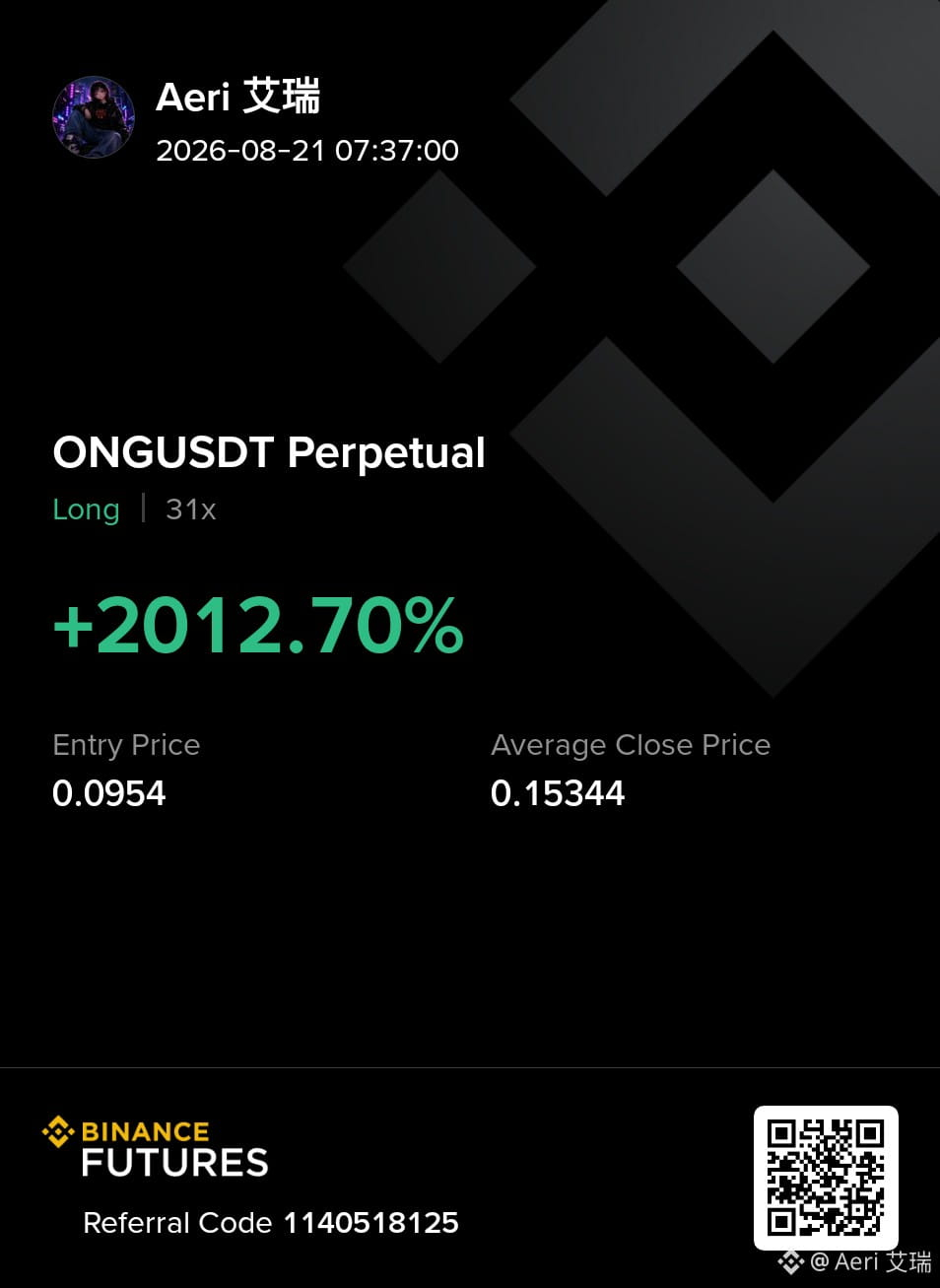
Closed the trade at a crazy 2012% ROI 🚀🔥 Honestly, I’m still processing that number. Took the profit, locked it in and walked away smiling. 📈💰 What a ride!
A little reminder: don’t let greed turn a good trade into a regret. 📈 Take your profits protect your gains and remember there’s always another opportunity. 🧠💰
A little reminder: don’t let greed turn a good trade into a regret. 📈 Take your profits protect your gains and remember there’s always another opportunity. 🧠💰

M A L I Z-مالیز 马 利 兹
·
--
Bullish🔥BIG GIVEAWAY ALERT! Let’s grow together!🔥
Hey everyone! Hope you’re all doing amazing.
⚡ I need your massive support on my latest posts!
👇 Here is what you need to do RIGHT NOW:
1. LIKE and COMMENT or REPOPO/REPOST on my latest posts.
2. REPOST/REPOPO this post for your friends and fans to spread the word! 🎁
Your Reward: Do this, and I will instantly return the favor (100% back) and you can claim your reward right here! Don't miss out! 🚀🚀
#repopo #repopomypopo #repopomybothpinpoposuppome #malizgiveaway $btc...$bnb DYOR GUYS
WHAT #MALIZ MADE THE WORD FOR REPOSTING?
ANSWER IN COMMENTS👇
$XAU $BTC $ACE
Hey everyone! Hope you’re all doing amazing.
⚡ I need your massive support on my latest posts!
👇 Here is what you need to do RIGHT NOW:
1. LIKE and COMMENT or REPOPO/REPOST on my latest posts.
2. REPOST/REPOPO this post for your friends and fans to spread the word! 🎁
Your Reward: Do this, and I will instantly return the favor (100% back) and you can claim your reward right here! Don't miss out! 🚀🚀
#repopo #repopomypopo #repopomybothpinpoposuppome #malizgiveaway $btc...$bnb DYOR GUYS
WHAT #MALIZ MADE THE WORD FOR REPOSTING?
ANSWER IN COMMENTS👇
$XAU $BTC $ACE




Verified
#dusk $DUSK @Dusk
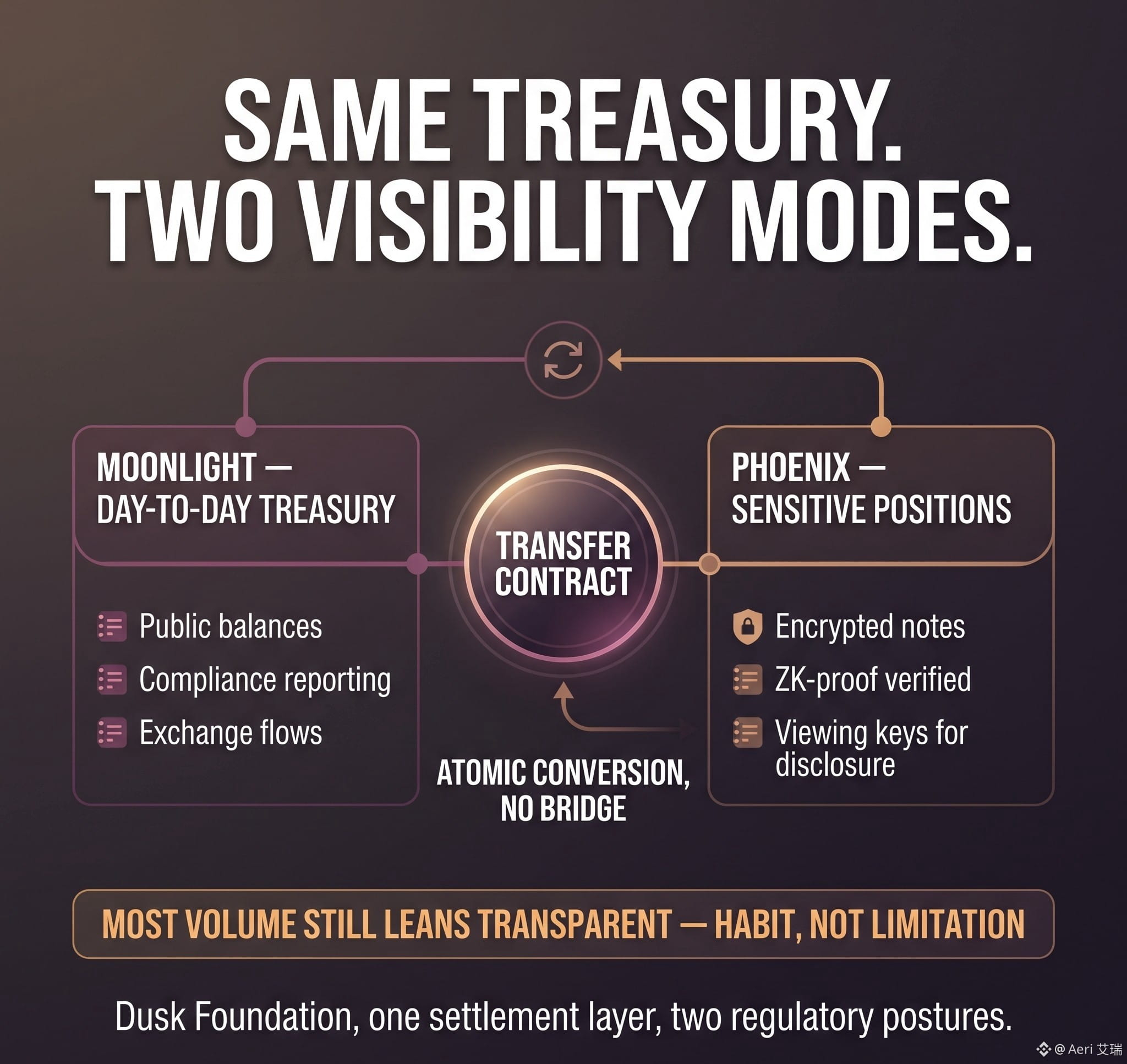
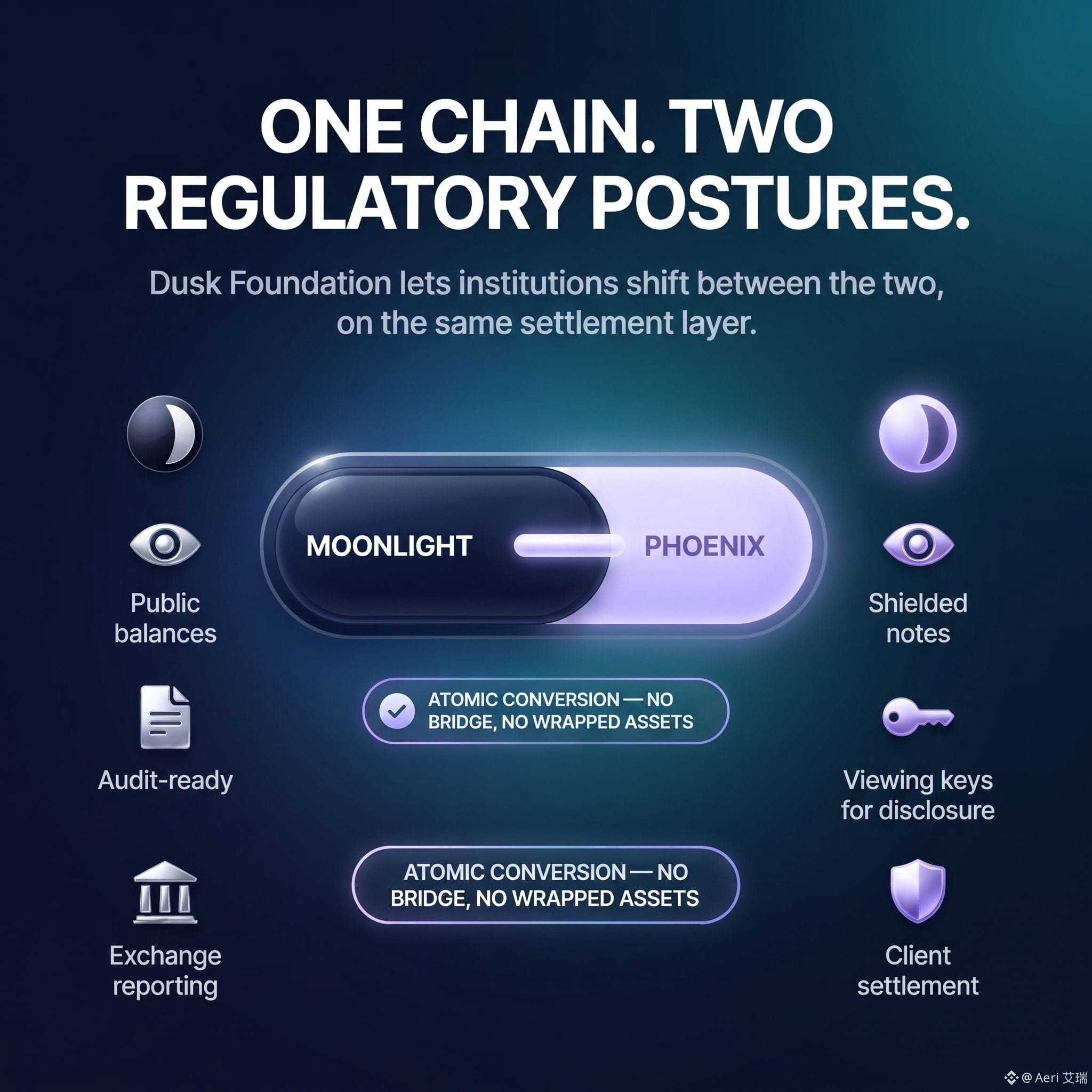
been digging into Dusk’s dual models more carefully lately and the Moonlight versus Phoenix setup feels less like two separate tools and more like a single institution’s ability to flip its regulatory posture without leaving the chain.
moonlight is the open ledger side. Balances sit in plain view, every transfer shows who sent what to whom. That makes it the path of least resistance for exchanges, reporting or any flow where auditors or counterparties need full visibility. Phoenix flips it. Funds move as encrypted notes. The network only sees that the math checks out through zero knowledge proofs. Amounts and links stay hidden from the public yet the receiver still knows the sender and viewing keys can open the box for authorized parties when required.
what stands out is how cleanly the two sit on the same settlement layer. An institution can keep day to day treasury or compliance reporting on Moonlight then move sensitive positions or client settlements into Phoenix when the disclosure rules tighten or when market impact becomes a concern. No bridge, no wrapped assets, just an atomic conversion through the Transfer contract. That removes the usual fragmentation tax you see when privacy and transparency live on different networks.
the limitation is real though. Most volume still seems to prefer the transparent path, whether from habit, wallet defaults or the simple fact that many regulated workflows still demand public trails. Privacy only matters if the incentives and tooling actually pull people into the shielded side.
does that dual mode flexibility actually lower the barrier for institutions or does it just create another layer of operational complexity they will hesitate to manage?
been digging into Dusk’s dual models more carefully lately and the Moonlight versus Phoenix setup feels less like two separate tools and more like a single institution’s ability to flip its regulatory posture without leaving the chain.
moonlight is the open ledger side. Balances sit in plain view, every transfer shows who sent what to whom. That makes it the path of least resistance for exchanges, reporting or any flow where auditors or counterparties need full visibility. Phoenix flips it. Funds move as encrypted notes. The network only sees that the math checks out through zero knowledge proofs. Amounts and links stay hidden from the public yet the receiver still knows the sender and viewing keys can open the box for authorized parties when required.
what stands out is how cleanly the two sit on the same settlement layer. An institution can keep day to day treasury or compliance reporting on Moonlight then move sensitive positions or client settlements into Phoenix when the disclosure rules tighten or when market impact becomes a concern. No bridge, no wrapped assets, just an atomic conversion through the Transfer contract. That removes the usual fragmentation tax you see when privacy and transparency live on different networks.
the limitation is real though. Most volume still seems to prefer the transparent path, whether from habit, wallet defaults or the simple fact that many regulated workflows still demand public trails. Privacy only matters if the incentives and tooling actually pull people into the shielded side.
does that dual mode flexibility actually lower the barrier for institutions or does it just create another layer of operational complexity they will hesitate to manage?
Partly True
#dusk $DUSK @Dusk
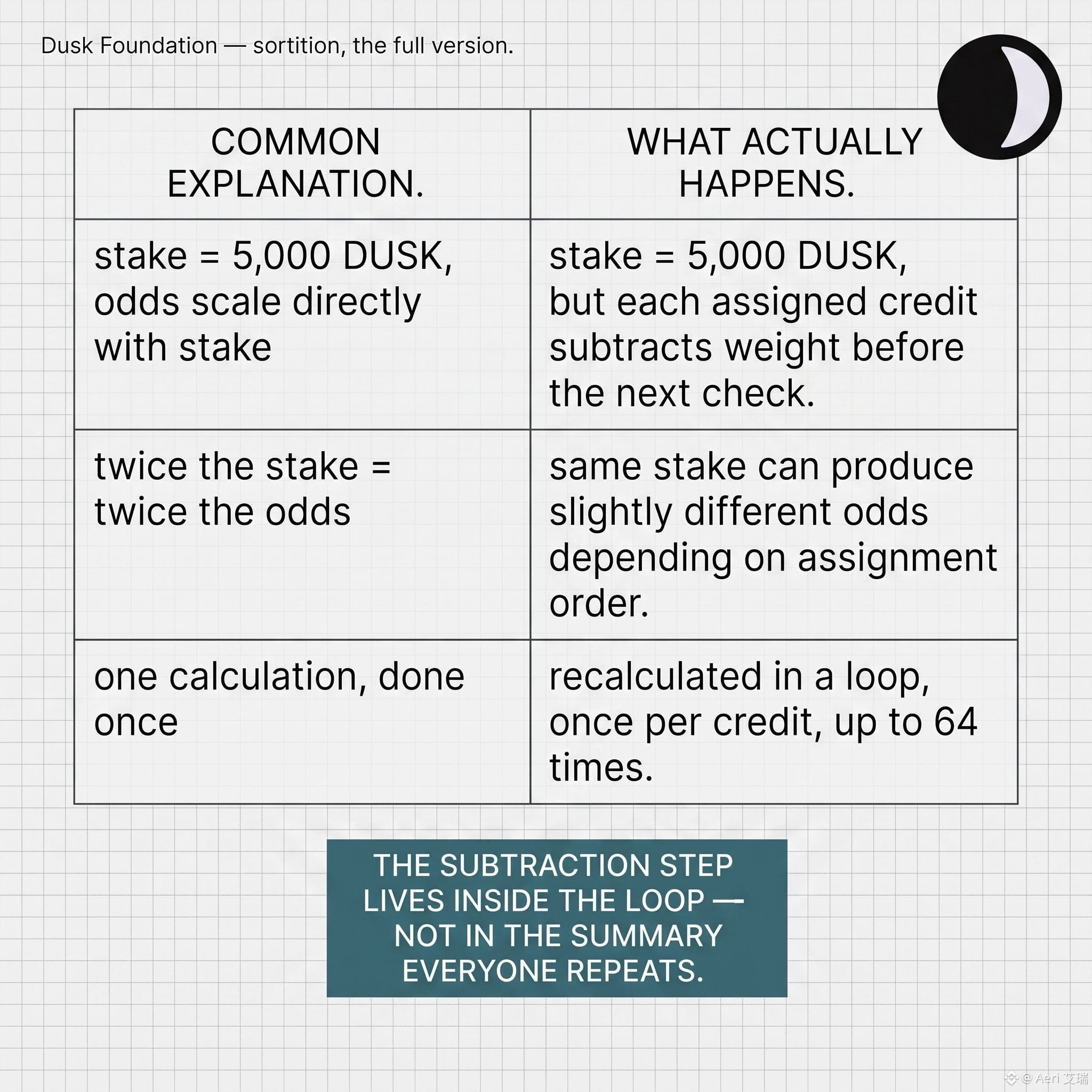
i thought more stakes just meant more voting power, plain and simple. Twice the DUSK staked, twice the odds of getting picked. Dusk's own sortition algorithm says that's not quite the full picture and i only caught it by reading past the summary.
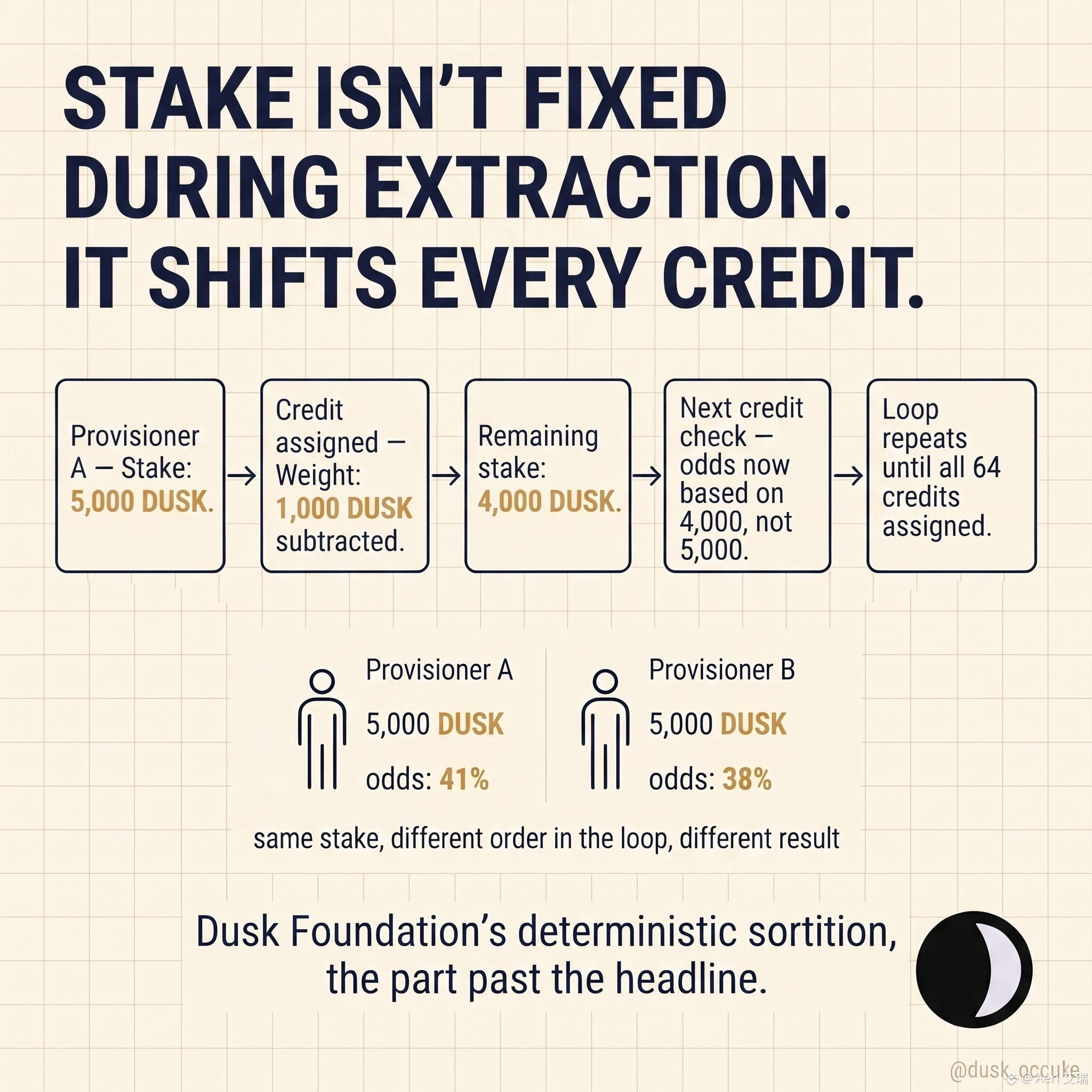
when Dusk builds a voting committee, it doesn't just look at your stake once and hand out credits based on that single number. It assigns credits one at a time, in a loop. And every time a provisioner gets a credit, the algorithm subtracts that credit's weight from their stake before it even checks who's eligible for the next credit in line.
so your stake isn't a fixed, frozen number for the whole extraction process. It's shifting, credit by credit as the loop runs through the committee. That means the exact same raw stake, say two identical provisioners with equal DUSK staked can end up with slightly different real odds depending purely on where in the sequence their credits get assigned. Not some huge swing that flips outcomes. But not the perfectly clean straight line most people assume when someone says "more stake, more power" either.
i almost missed this entirely, honestly. The usual explanation of Dusk's sortition stops right at "bigger stake, better odds" and leaves it there which isn't wrong, just incomplete. The subtraction step lives one layer deeper, inside the actual deterministic extraction loop not in the headline version everyone repeats.
so here's the honest take. This isn't some hidden flaw or a gotcha. It's just more textured than the pitch. Dusk built a system where stake matters a lot just not in a perfectly linear way once you actually watch the loop run credit by credit.
i thought more stakes just meant more voting power, plain and simple. Twice the DUSK staked, twice the odds of getting picked. Dusk's own sortition algorithm says that's not quite the full picture and i only caught it by reading past the summary.
when Dusk builds a voting committee, it doesn't just look at your stake once and hand out credits based on that single number. It assigns credits one at a time, in a loop. And every time a provisioner gets a credit, the algorithm subtracts that credit's weight from their stake before it even checks who's eligible for the next credit in line.
so your stake isn't a fixed, frozen number for the whole extraction process. It's shifting, credit by credit as the loop runs through the committee. That means the exact same raw stake, say two identical provisioners with equal DUSK staked can end up with slightly different real odds depending purely on where in the sequence their credits get assigned. Not some huge swing that flips outcomes. But not the perfectly clean straight line most people assume when someone says "more stake, more power" either.
i almost missed this entirely, honestly. The usual explanation of Dusk's sortition stops right at "bigger stake, better odds" and leaves it there which isn't wrong, just incomplete. The subtraction step lives one layer deeper, inside the actual deterministic extraction loop not in the headline version everyone repeats.
so here's the honest take. This isn't some hidden flaw or a gotcha. It's just more textured than the pitch. Dusk built a system where stake matters a lot just not in a perfectly linear way once you actually watch the loop run credit by credit.
路人1688-luren
·
--
Flowers bloom and fall, spring goes and autumn comes—so it is with life, too, in cycles of return. So in the limited span of your life, I hope you’ll go ahead and indulge freely: do what you love, love the people you love most. Don’t overthink yourself into exhaustion. Take good care of yourself. If you’re here, the world is here; if you’re not, everything goes back to zero—starting over again, just like flowers bloom and fall, spring goes and autumn comes……#1688家族family



Verified
#dusk $DUSK @Dusk
I assumed only one proof system needs a trusted setup and the other just skips it. That's not what's actually true and Dusk's own setup made that clear to me.
Here's the thing. Both PlonK and Groth16 need a trusted setup. Dusk supports both built right into the Piecrust engine as native functions. The real difference isn't whether you need one. It's how often.
Groth16 needs a fresh setup for every single circuit. New contract logic new setup every time. That's expensive to organize but it pays off. The proofs are tiny and verification is fast.
PlonK does it differently. One setup, done once reused across any circuit you build later. Way more flexible. But the proofs get bigger and checking them costs more.
So Dusk isn't choosing one winner here. It's giving developers both tools and letting the tradeoff be theirs. Want speed and don't mind reorganizing setup work per circuit? Groth16. Want flexibility and can eat a bigger proof? PlonK.
I used to think trusted setup was a yes or no question. Dusk's docs showed me it's really a question of how much setup work you're willing to redo and how big a proof you're willing to carry.
I assumed only one proof system needs a trusted setup and the other just skips it. That's not what's actually true and Dusk's own setup made that clear to me.
Here's the thing. Both PlonK and Groth16 need a trusted setup. Dusk supports both built right into the Piecrust engine as native functions. The real difference isn't whether you need one. It's how often.
Groth16 needs a fresh setup for every single circuit. New contract logic new setup every time. That's expensive to organize but it pays off. The proofs are tiny and verification is fast.
PlonK does it differently. One setup, done once reused across any circuit you build later. Way more flexible. But the proofs get bigger and checking them costs more.
So Dusk isn't choosing one winner here. It's giving developers both tools and letting the tradeoff be theirs. Want speed and don't mind reorganizing setup work per circuit? Groth16. Want flexibility and can eat a bigger proof? PlonK.
I used to think trusted setup was a yes or no question. Dusk's docs showed me it's really a question of how much setup work you're willing to redo and how big a proof you're willing to carry.
#termmax @TermMax
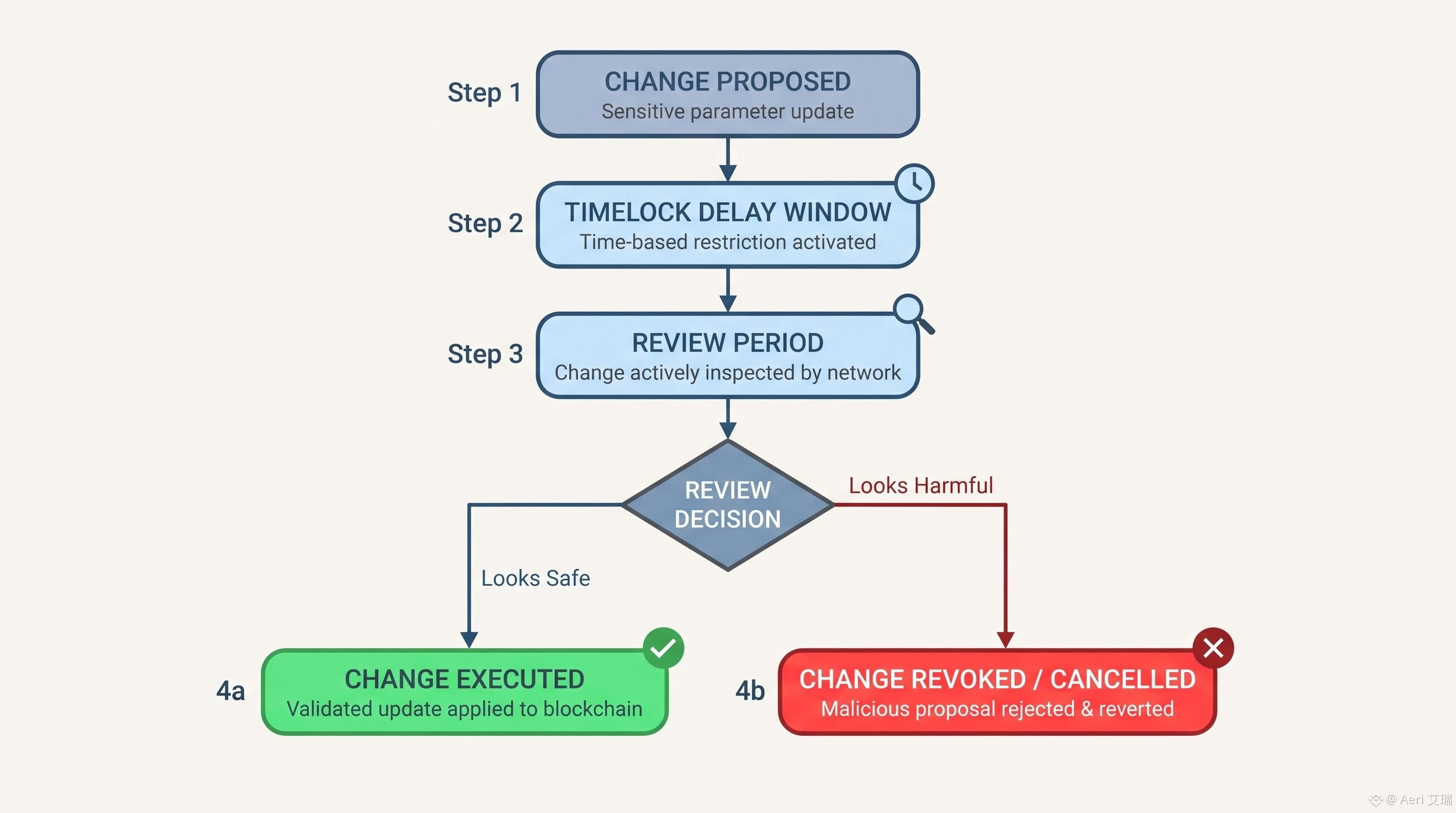
I used to think a timelock was just a delay added to a smart contract. After looking at the TermMax security docs, I think that misses the real reason for it.
What caught my attention is that sensitive operations do not take effect immediately. Critical parameter changes have to wait before they are implemented. That gives people time to review the change and, if something looks harmful, potentially revoke it before it becomes active.
Here's a simple example. If a sensitive Vault parameter is changed, the system doesn't treat the approved change as something that must happen right away. There is a window between the decision and the actual implementation. That window matters because mistakes or harmful changes are much easier to deal with before they take effect.
The tradeoff is speed. TermMax gives up instant changes in exchange for a chance to catch problems first. And I think that's the more interesting part of the design. Security is not always about adding more control. Sometimes it is about deliberately slowing control down.
TermMax makes me wonder about something else too. If a parameter change is urgent, how much delay is acceptable before protection itself starts becoming a problem?
That balance is what makes the TMX timelock design worth paying attention to.
I used to think a timelock was just a delay added to a smart contract. After looking at the TermMax security docs, I think that misses the real reason for it.
What caught my attention is that sensitive operations do not take effect immediately. Critical parameter changes have to wait before they are implemented. That gives people time to review the change and, if something looks harmful, potentially revoke it before it becomes active.
Here's a simple example. If a sensitive Vault parameter is changed, the system doesn't treat the approved change as something that must happen right away. There is a window between the decision and the actual implementation. That window matters because mistakes or harmful changes are much easier to deal with before they take effect.
The tradeoff is speed. TermMax gives up instant changes in exchange for a chance to catch problems first. And I think that's the more interesting part of the design. Security is not always about adding more control. Sometimes it is about deliberately slowing control down.
TermMax makes me wonder about something else too. If a parameter change is urgent, how much delay is acceptable before protection itself starts becoming a problem?
That balance is what makes the TMX timelock design worth paying attention to.
#dusk $DUSK @Dusk
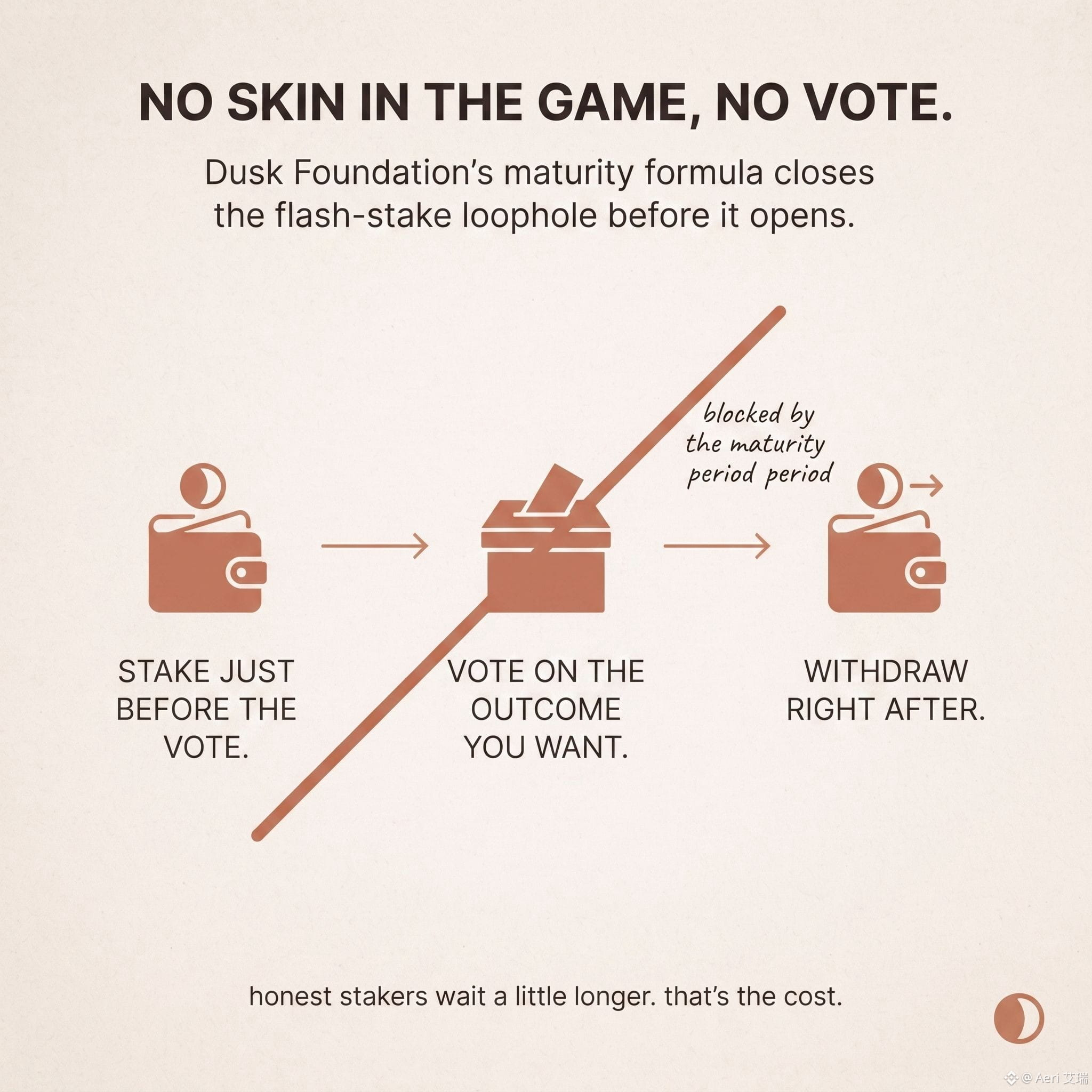
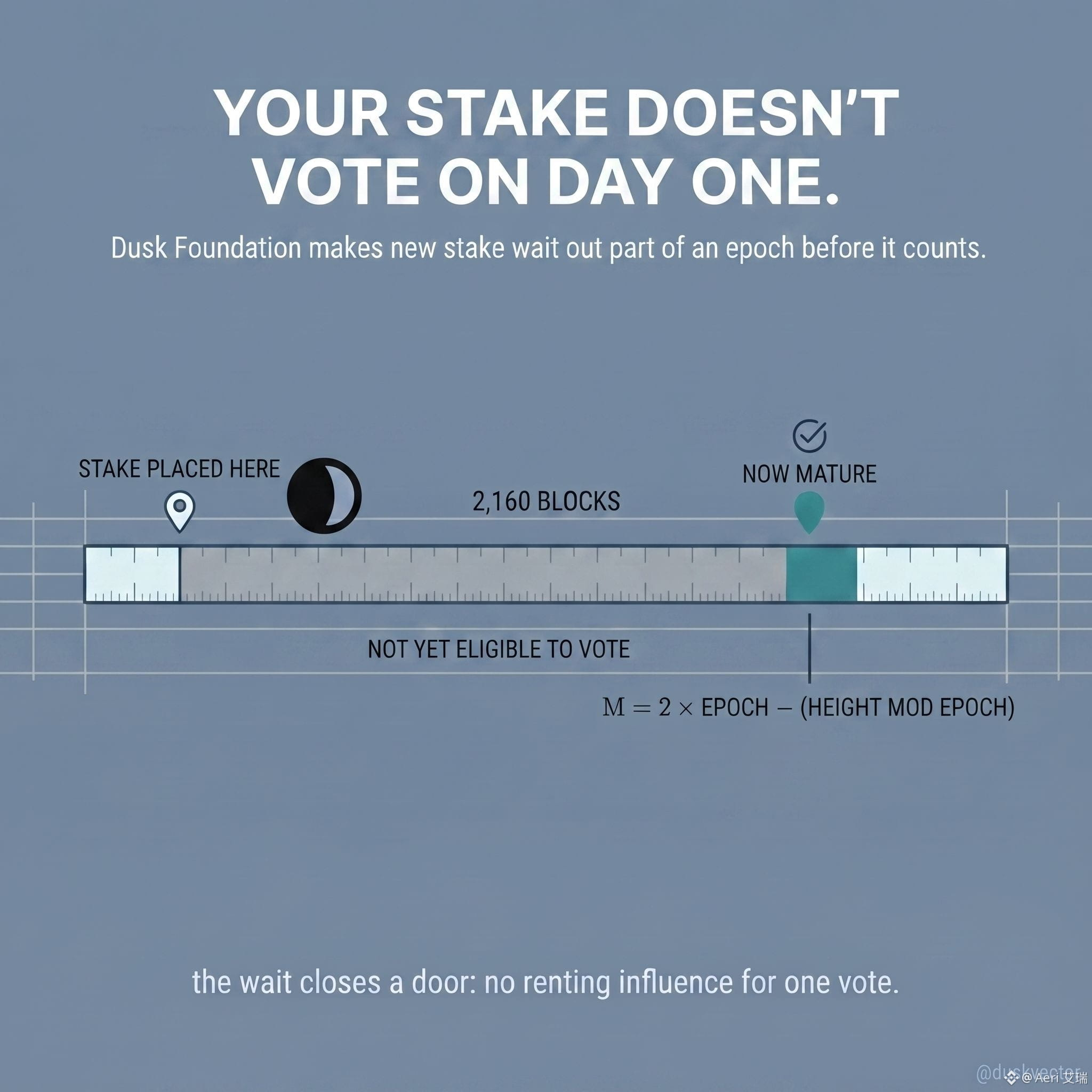
I stake, and I want my vote to count right away. So when I found out Dusk makes you wait, I got annoyed. Then I actually read why. Here's the setup: Dusk runs on epochs, blocks of 2,160 blocks each. When you stake, you don't become vote-eligible the second your DUSK hits the network. There's a formula deciding when you actually mature: M equals two times epoch, minus your height mod epoch. Sounds like math class. It's really just a wait timer.
At first I thought this was just red tape. Then I thought about what happens without it. If new stake could vote instantly, someone could watch the upcoming committee, quickly stake right before a vote they want to influence, cast it, then pull out. In and out, no real skin in the game. Dusk closes that door. You have to sit through part of an epoch before your stake counts for anything.
The tradeoff is real too. Honest stakers wait longer than they'd like, and there's no way around that cost. But I'd rather wait a bit than stake on a chain where anyone can rent influence for one vote. Dusk picked patience over speed here, and after digging into it, I get why.
I stake, and I want my vote to count right away. So when I found out Dusk makes you wait, I got annoyed. Then I actually read why. Here's the setup: Dusk runs on epochs, blocks of 2,160 blocks each. When you stake, you don't become vote-eligible the second your DUSK hits the network. There's a formula deciding when you actually mature: M equals two times epoch, minus your height mod epoch. Sounds like math class. It's really just a wait timer.
At first I thought this was just red tape. Then I thought about what happens without it. If new stake could vote instantly, someone could watch the upcoming committee, quickly stake right before a vote they want to influence, cast it, then pull out. In and out, no real skin in the game. Dusk closes that door. You have to sit through part of an epoch before your stake counts for anything.
The tradeoff is real too. Honest stakers wait longer than they'd like, and there's no way around that cost. But I'd rather wait a bit than stake on a chain where anyone can rent influence for one vote. Dusk picked patience over speed here, and after digging into it, I get why.
The Market Is Closed. So Why Can a TradFi Perpetual Still Trade? 👀
This is one of the more interesting things about Binance Futures' TradFi products.
Traditional stock markets don't operate 24/7.
Yet Binance offers TradFi perpetual contracts that can trade around the clock.
So what exactly are you trading?
Not the actual stock.
You're trading a perpetual futures contract that tracks the price of the underlying asset.
That distinction matters.
Imagine you're watching a stock whose traditional exchange has already closed for the day.
News breaks overnight.
The underlying exchange isn't actively trading, but the perpetual contract can still have its own market activity.
That creates an important question:
How does the contract stay connected to the underlying asset's price?
Perpetual contracts use mechanisms such as an index/mark-price system and funding rates to help keep the contract aligned with the underlying market.
And that's why understanding the product structure matters more than simply recognizing the ticker.
You might see:
TSLAUSDT
and think:
“I'm buying Tesla.”
But that's not the same as owning Tesla shares.
You're trading a derivative whose value tracks the underlying asset.
📌 The lesson:
A familiar ticker doesn't necessarily mean a familiar product.
Before trading any TradFi perpetual, understand:
→ What the contract represents
→ How its price is determined
→ When the underlying market trades
→ How funding works
→ What leverage you're using
Same underlying asset ≠ same financial instrument.
That's the detail I'd want to understand before placing a trade.
#Binance #TradFi #futures #cryptoeducation
This is one of the more interesting things about Binance Futures' TradFi products.
Traditional stock markets don't operate 24/7.
Yet Binance offers TradFi perpetual contracts that can trade around the clock.
So what exactly are you trading?
Not the actual stock.
You're trading a perpetual futures contract that tracks the price of the underlying asset.
That distinction matters.
Imagine you're watching a stock whose traditional exchange has already closed for the day.
News breaks overnight.
The underlying exchange isn't actively trading, but the perpetual contract can still have its own market activity.
That creates an important question:
How does the contract stay connected to the underlying asset's price?
Perpetual contracts use mechanisms such as an index/mark-price system and funding rates to help keep the contract aligned with the underlying market.
And that's why understanding the product structure matters more than simply recognizing the ticker.
You might see:
TSLAUSDT
and think:
“I'm buying Tesla.”
But that's not the same as owning Tesla shares.
You're trading a derivative whose value tracks the underlying asset.
📌 The lesson:
A familiar ticker doesn't necessarily mean a familiar product.
Before trading any TradFi perpetual, understand:
→ What the contract represents
→ How its price is determined
→ When the underlying market trades
→ How funding works
→ What leverage you're using
Same underlying asset ≠ same financial instrument.
That's the detail I'd want to understand before placing a trade.
#Binance #TradFi #futures #cryptoeducation
Verified
#dusk $DUSK
@Dusk
Every crypto project slaps an audited badge on their homepage now. At this point it's basically wallpaper. Nobody reads what's behind it. i did for once and specifically for @Dusk _Foundation And it changed how I think about this whole audit thing.
Dusk builds privacy tech for regulated finance tokenized assets compliant trading the unglamorous plumbing that actual banks might use. Not flashy. But that's kind of the point. Money infrastructure is supposed to be boring.
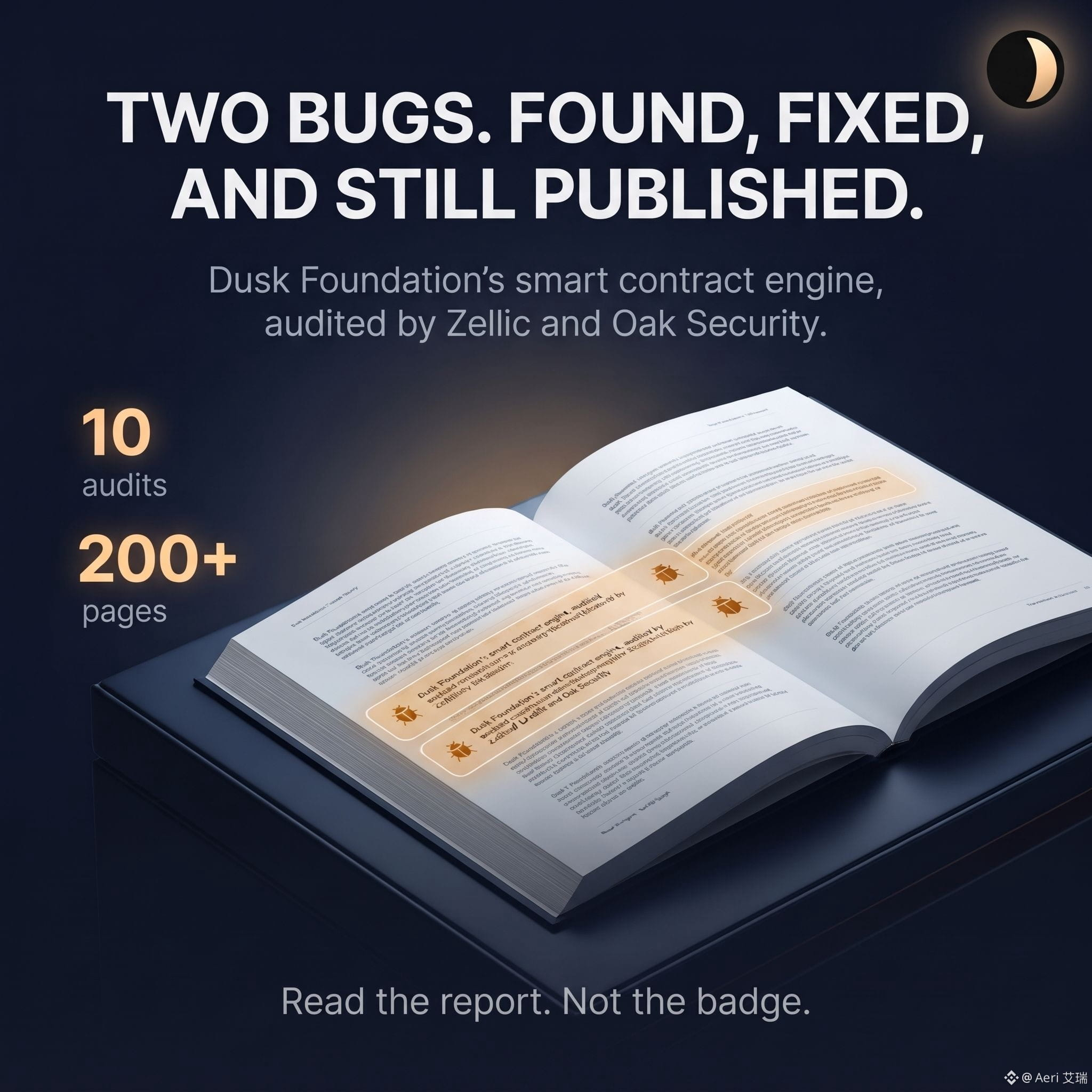
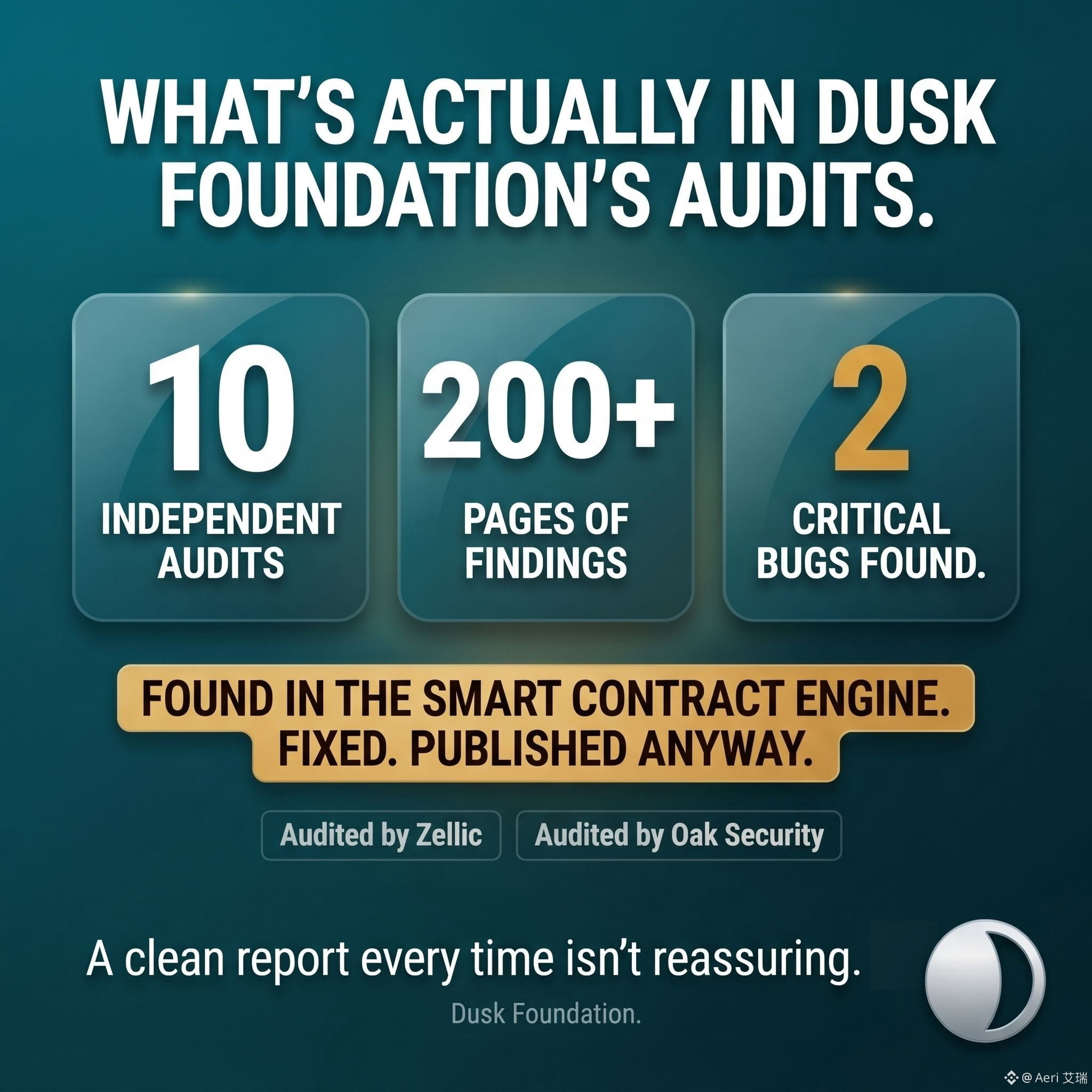
It was Dusk's audit trail sitting in public on GitHub. Ten separate audits over 200 pages combined run by outside firms like Zellic and Oak Security with zero reason to go easy on them.
And it wasn't a clean sweep. One review of their smart contract engine turned up two serious bugs the kind that could crash things or let numbers behave in ways they shouldn't. Real problems. The team fixed them and posted the findings anyway mistakes included.
That's the detail that matters. A report with zero findings every single time isn't reassuring. It's suspicious. Bugs getting caught and closed is what a real process looks like and skip the badge. Read the actual report. Check what got flagged and whether the team owned it. That tells you more than any logo ever will.
@Dusk
Every crypto project slaps an audited badge on their homepage now. At this point it's basically wallpaper. Nobody reads what's behind it. i did for once and specifically for @Dusk _Foundation And it changed how I think about this whole audit thing.
Dusk builds privacy tech for regulated finance tokenized assets compliant trading the unglamorous plumbing that actual banks might use. Not flashy. But that's kind of the point. Money infrastructure is supposed to be boring.
It was Dusk's audit trail sitting in public on GitHub. Ten separate audits over 200 pages combined run by outside firms like Zellic and Oak Security with zero reason to go easy on them.
And it wasn't a clean sweep. One review of their smart contract engine turned up two serious bugs the kind that could crash things or let numbers behave in ways they shouldn't. Real problems. The team fixed them and posted the findings anyway mistakes included.
That's the detail that matters. A report with zero findings every single time isn't reassuring. It's suspicious. Bugs getting caught and closed is what a real process looks like and skip the badge. Read the actual report. Check what got flagged and whether the team owned it. That tells you more than any logo ever will.
#termmax @TermMax
I used to think liquidation was mostly about selling collateral, taking the loss, and trying to recover what was owed. After reading the TermMax FAQ i realized the process can look quite different.
The part that caught my attention is what can happen during a partial liquidation. Instead of treating the collateral only as something to sell for debt recovery FT holders can receive a proportional share of the collateral.
That changes the way i look at the mechanism. Imagine a position becomes undercollateralized and only part of it needs to be liquidated. With TermMax, the affected FT holders can receive their share of the collateral itself. So the outcome is tied more directly to the underlying asset rather than being reduced to a simple recovery payment.
But there is a tradeoff. Physical delivery does not remove liquidation risk. The value of the collateral can still move, and receiving an asset directly means the holder may now have exposure to that asset's market price.
That's what i find interesting about TermMax. Liquidation isn't just an emergency sale mechanism. It can also change who ends up holding the collateral after a position is reduced.
TMX makes me wonder whether physical delivery creates a fairer liquidation process, or simply shifts part of the risk from the protocol back to the FT holder.
What does physical delivery change?
I used to think liquidation was mostly about selling collateral, taking the loss, and trying to recover what was owed. After reading the TermMax FAQ i realized the process can look quite different.
The part that caught my attention is what can happen during a partial liquidation. Instead of treating the collateral only as something to sell for debt recovery FT holders can receive a proportional share of the collateral.
That changes the way i look at the mechanism. Imagine a position becomes undercollateralized and only part of it needs to be liquidated. With TermMax, the affected FT holders can receive their share of the collateral itself. So the outcome is tied more directly to the underlying asset rather than being reduced to a simple recovery payment.
But there is a tradeoff. Physical delivery does not remove liquidation risk. The value of the collateral can still move, and receiving an asset directly means the holder may now have exposure to that asset's market price.
That's what i find interesting about TermMax. Liquidation isn't just an emergency sale mechanism. It can also change who ends up holding the collateral after a position is reduced.
TMX makes me wonder whether physical delivery creates a fairer liquidation process, or simply shifts part of the risk from the protocol back to the FT holder.
What does physical delivery change?
Shifts risk to holders
67%
Makes liquidation riskier
0%
Fairer for FT holders
33%
Reduces liquidation losses
0%
3 votes • Voting closed
#termmax @TermMax
I used to think splitting liquidity across several orders meant the actual capital had to be split too. After reading the Atomic Orders design I realized that isn't necessarily the case. The interesting part is the use of virtual liquidity. Capital can be positioned across multiple orders before anyone actually borrows from it without physically moving the same funds into every order. So one pool of capital can effectively support several market positions at once.
Imagine I have 100 units of capital and want exposure to several different rate ranges. Instead of putting separate chunks into each order, the system can represent liquidity across those orders first while the underlying funds remain together until they are actually needed. That's the part I find interesting about TMX. It changes the problem from How do I split my capital? to how can the same capital be made available across different orders without creating unnecessary fragmentation?
TMX also makes me think about the tradeoff. Virtual positioning can make capital more flexible, but the system still has to decide how those virtual positions are settled when actual borrowing happens. That is where the design becomes much more important than the headline feature.
My question is whether TMX's approach can make liquidity more efficient without simply moving the complexity from capital allocation into execution.
I used to think splitting liquidity across several orders meant the actual capital had to be split too. After reading the Atomic Orders design I realized that isn't necessarily the case. The interesting part is the use of virtual liquidity. Capital can be positioned across multiple orders before anyone actually borrows from it without physically moving the same funds into every order. So one pool of capital can effectively support several market positions at once.
Imagine I have 100 units of capital and want exposure to several different rate ranges. Instead of putting separate chunks into each order, the system can represent liquidity across those orders first while the underlying funds remain together until they are actually needed. That's the part I find interesting about TMX. It changes the problem from How do I split my capital? to how can the same capital be made available across different orders without creating unnecessary fragmentation?
TMX also makes me think about the tradeoff. Virtual positioning can make capital more flexible, but the system still has to decide how those virtual positions are settled when actual borrowing happens. That is where the design becomes much more important than the headline feature.
My question is whether TMX's approach can make liquidity more efficient without simply moving the complexity from capital allocation into execution.
#dusk $DUSK
@Dusk
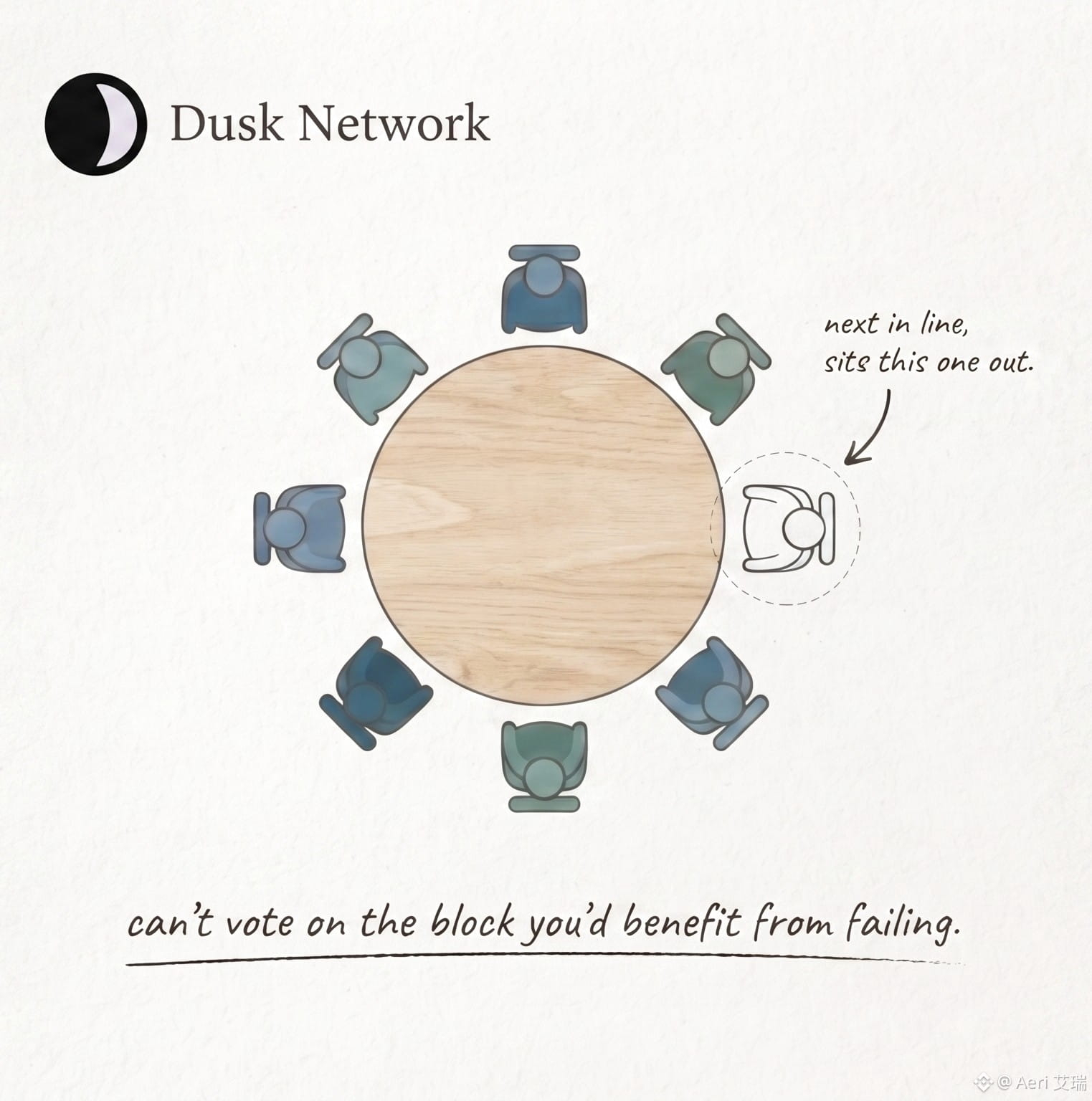
So i was studying through Dusk's consensus rules and found something that seemed random at first but actually makes a lot of sense once you think about it. Here's the setup in Dusk each iteration has its own block generator, the person who proposes the block and its own voting committee that checks if that block is good or not and i would think anyone eligible could just vote in any iteration but Dusk blocks one specific group from voting whoever is set to be the generator in the next iteration.
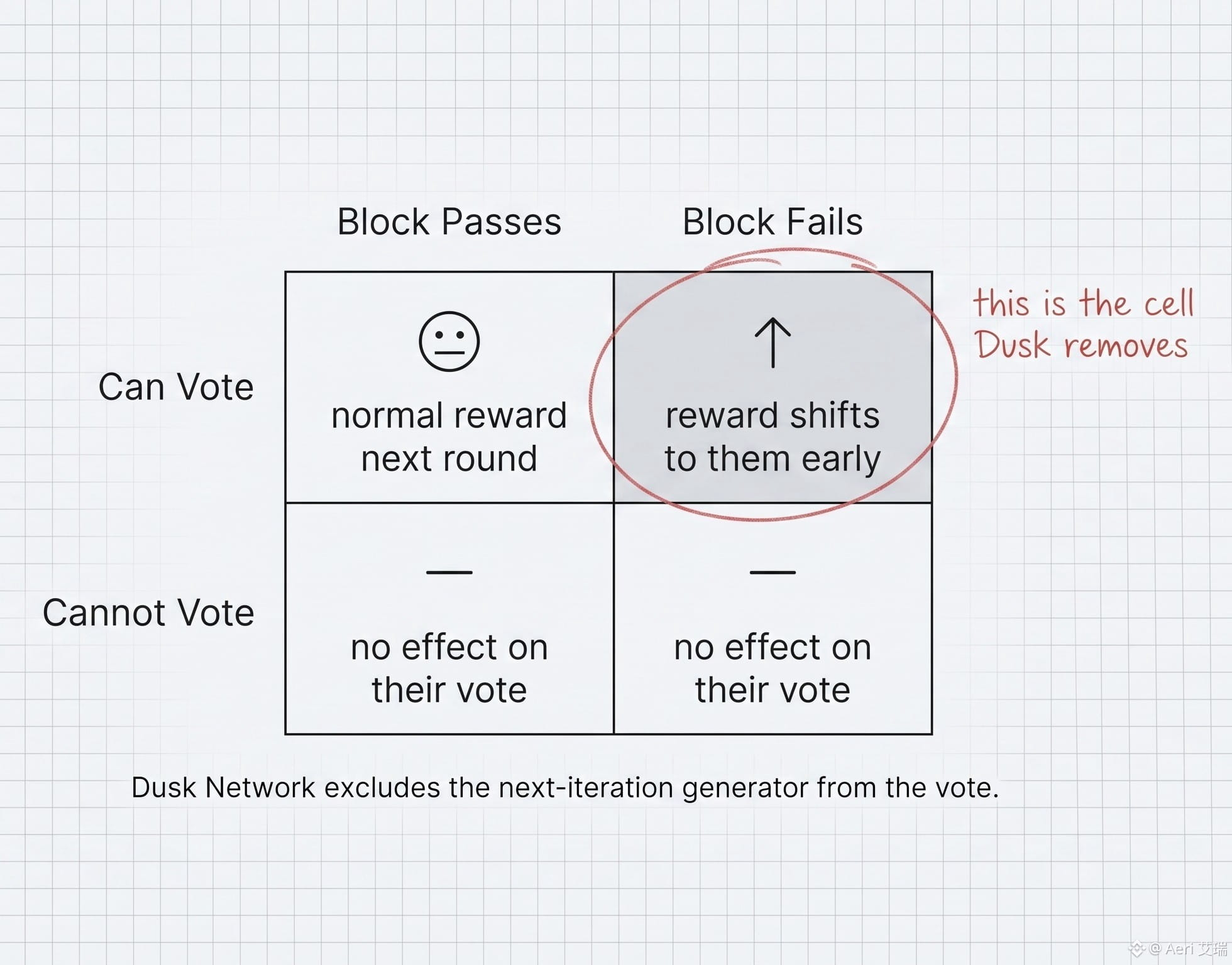
At first i thought why block them? They're still a normal provisioner. But then i got it. If that future generator could vote right now, they'd have a reason to vote against the current block because if this block fails, the job and the reward roll over to them next round. That's a straight up conflict of interest.
Vote no get paid later So Dusk just removes the temptation. No vote no reason to sabotage. It's a small rule but it's doing real work. It keeps generators focused on their own turn instead of gaming someone else's. And honestly that's the kind of detail that shows whether a network actually thought about incentives or just copied a template. Dusk isn't Ostentatious about this stuff. But little rules like this are why i keep reading Dusk's docs instead of just their marketing.
@Dusk
So i was studying through Dusk's consensus rules and found something that seemed random at first but actually makes a lot of sense once you think about it. Here's the setup in Dusk each iteration has its own block generator, the person who proposes the block and its own voting committee that checks if that block is good or not and i would think anyone eligible could just vote in any iteration but Dusk blocks one specific group from voting whoever is set to be the generator in the next iteration.
At first i thought why block them? They're still a normal provisioner. But then i got it. If that future generator could vote right now, they'd have a reason to vote against the current block because if this block fails, the job and the reward roll over to them next round. That's a straight up conflict of interest.
Vote no get paid later So Dusk just removes the temptation. No vote no reason to sabotage. It's a small rule but it's doing real work. It keeps generators focused on their own turn instead of gaming someone else's. And honestly that's the kind of detail that shows whether a network actually thought about incentives or just copied a template. Dusk isn't Ostentatious about this stuff. But little rules like this are why i keep reading Dusk's docs instead of just their marketing.
Traditional Markets on Binance? The Part I’d Understand First Isn’t the Asset. It’s the Risk.
Binance Futures now gives traders access to selected TradFi assets, which can make traditional-market exposure available alongside crypto markets.
At first glance, that sounds straightforward.
But there’s an important distinction:
Access to an asset doesn't mean the risk becomes simple.
Before trading a TradFi futures product, I would want to understand:
🔹 Leverage — A small market move can have a much larger impact on your position when leverage is involved.
🔹 Liquidation — If the market moves far enough against a leveraged position, the position can be closed automatically.
🔹 Volatility — Traditional assets can move sharply too. “TradFi” doesn't mean “low risk.”
🔹 Trading conditions — Different markets can have different trading hours, liquidity, and price behavior.
🔹 Position size — The amount you put at risk matters just as much as the direction you're predicting.
This is why I think beginners should change the question from:
❌ “How much can I make?”
to:
✅ “How much can I lose if I'm wrong?”
That one question can completely change how you approach leveraged trading.
Futures can be useful tools for experienced traders, but they aren't suitable for everyone.
Understand the product. Understand leverage. Understand liquidation. Then decide whether the risk fits you.
Not financial advice. Always do your own research and never trade with money you can't afford to lose.
#Binance #TradFi #CryptoTrading #RiskManagement #future
Binance Futures now gives traders access to selected TradFi assets, which can make traditional-market exposure available alongside crypto markets.
At first glance, that sounds straightforward.
But there’s an important distinction:
Access to an asset doesn't mean the risk becomes simple.
Before trading a TradFi futures product, I would want to understand:
🔹 Leverage — A small market move can have a much larger impact on your position when leverage is involved.
🔹 Liquidation — If the market moves far enough against a leveraged position, the position can be closed automatically.
🔹 Volatility — Traditional assets can move sharply too. “TradFi” doesn't mean “low risk.”
🔹 Trading conditions — Different markets can have different trading hours, liquidity, and price behavior.
🔹 Position size — The amount you put at risk matters just as much as the direction you're predicting.
This is why I think beginners should change the question from:
❌ “How much can I make?”
to:
✅ “How much can I lose if I'm wrong?”
That one question can completely change how you approach leveraged trading.
Futures can be useful tools for experienced traders, but they aren't suitable for everyone.
Understand the product. Understand leverage. Understand liquidation. Then decide whether the risk fits you.
Not financial advice. Always do your own research and never trade with money you can't afford to lose.
#Binance #TradFi #CryptoTrading #RiskManagement #future
#dusk $DUSK @Dusk
I was reading through Dusk's consensus docs and got stuck on one small detail that turned out to matter more than I expected.
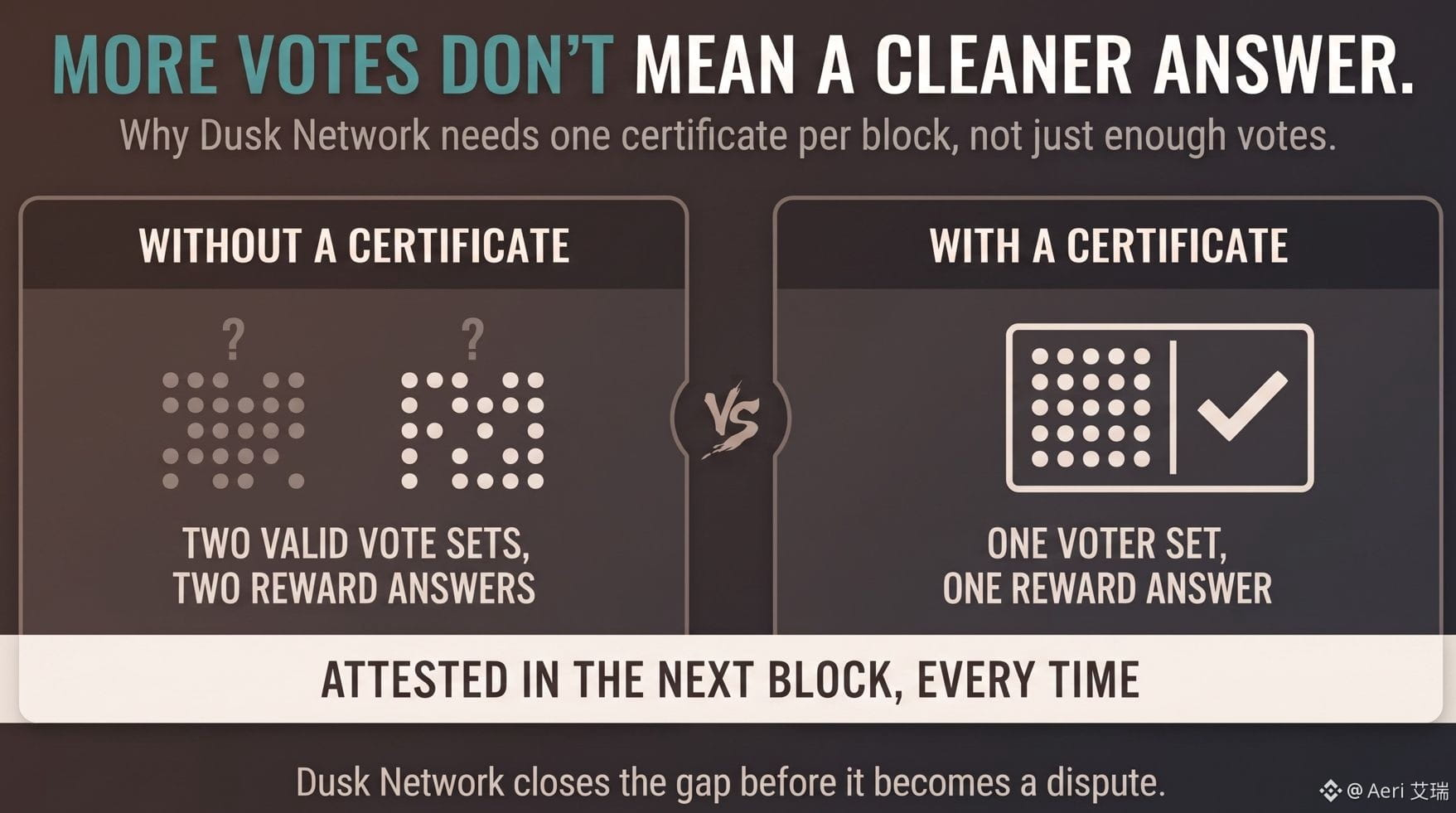
So here's the setup. When a committee votes on a block you only need a certain number of votes to hit quorum. But nothing stops more votes from coming in after that point. Which means you could technically end up with two different valid proofs that quorum was reached for the same block, just with different sets of voters included.
That sounds like a small technical footnote. But it's actually a problem. If you don't pick one specific proof, you can't cleanly figure out who gets rewarded and who gets penalized.
Two different vote sets mean two different reward calculations.
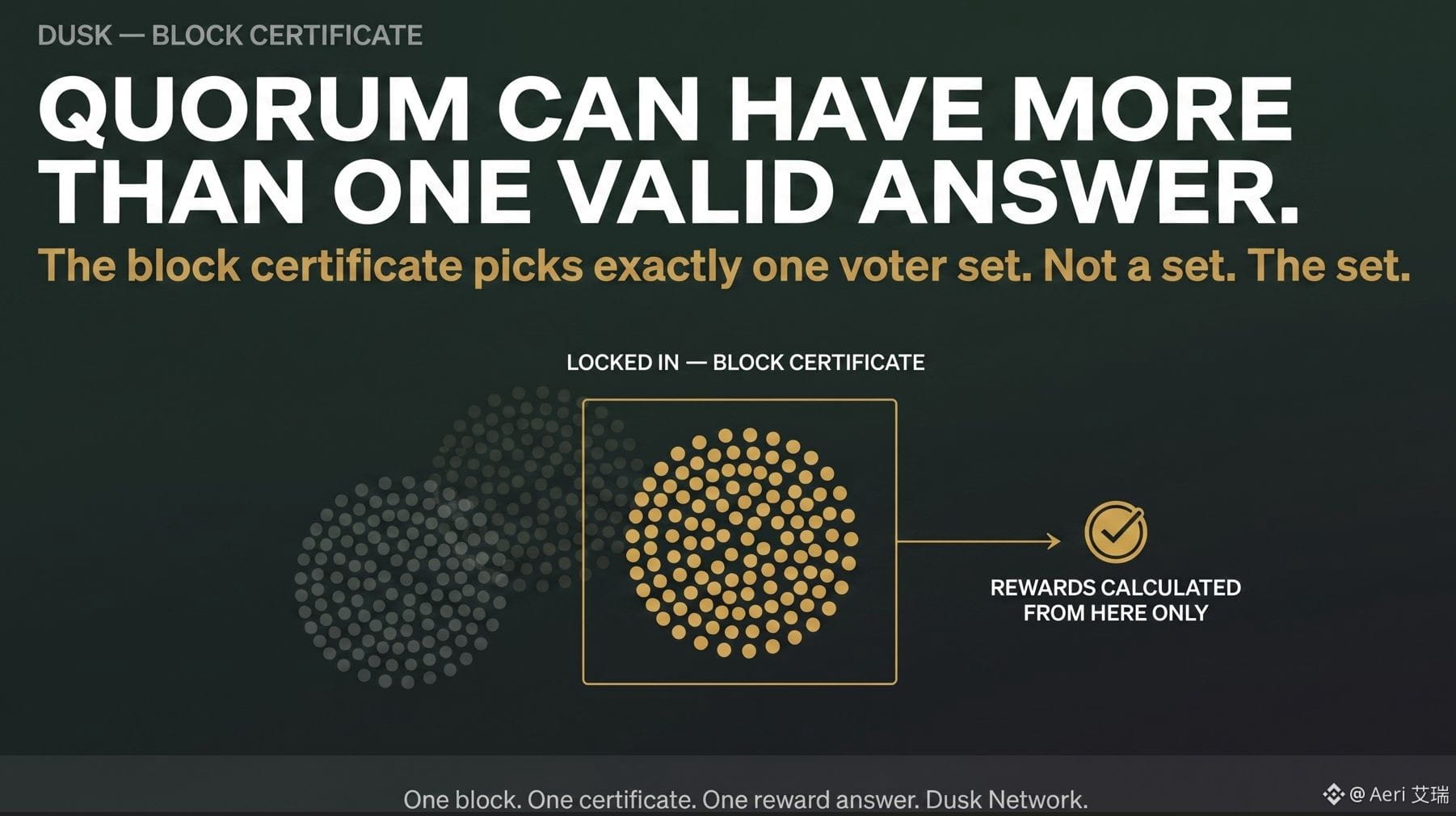
Dusk fixes this in a pretty simple way. Every new block has to include an attestation of the block before it. That attestation is called the block certificate. And its whole job is to lock in one specific unique set of voters for that block. Not a valid set. The set.
So the certificate isn't really about proving the block happened. Consensus already did that. It's about making sure Dusk has exactly one answer to "who voted, and how much do they get paid for it. Small mechanism, but it closes a gap that would otherwise leave Dusk's reward system open to ambiguity.
When is a block's certificate created and included on Dusk Network?
I was reading through Dusk's consensus docs and got stuck on one small detail that turned out to matter more than I expected.
So here's the setup. When a committee votes on a block you only need a certain number of votes to hit quorum. But nothing stops more votes from coming in after that point. Which means you could technically end up with two different valid proofs that quorum was reached for the same block, just with different sets of voters included.
That sounds like a small technical footnote. But it's actually a problem. If you don't pick one specific proof, you can't cleanly figure out who gets rewarded and who gets penalized.
Two different vote sets mean two different reward calculations.
Dusk fixes this in a pretty simple way. Every new block has to include an attestation of the block before it. That attestation is called the block certificate. And its whole job is to lock in one specific unique set of voters for that block. Not a valid set. The set.
So the certificate isn't really about proving the block happened. Consensus already did that. It's about making sure Dusk has exactly one answer to "who voted, and how much do they get paid for it. Small mechanism, but it closes a gap that would otherwise leave Dusk's reward system open to ambiguity.
When is a block's certificate created and included on Dusk Network?
In the same block it attest to
60%
At the end of every epoch
30%
Only during emergency mode
0%
Next block attests prior
10%
10 votes • Voting closed
Verified
#termmax @TermMax
I used to think a curator in DeFi was mostly there to decide where the money goes. After reading the @TermMax docs more closely, I think that misses the bigger role.
A curator is also making decisions about risk.
In TermMax, curators can set pricing curves and risk parameters for markets. So they aren't just moving capital around. They are helping decide what borrowing and lending conditions should look like.
Here's the part I find interesting.
Say a market has volatile collateral. A curator might need to set tighter risk limits and a different pricing curve than they would for a more stable asset. Those choices can affect how much capital gets used and what rates users see.
So the real question isn't simply whether a curator can manage liquidity.
It's how much judgment should be given to that curator in the first place.
Giving more decisions to a specialist can make a system respond faster to changing market conditions. But it also creates another point users have to trust. If the parameters are poorly chosen, the problem isn't just inefficient capital. It can become a risk issue.
That tension is what stood out to me about TermMax.
Protocol rules are predictable, but they can be slow to react. Curators can react faster, but their decisions need stronger controls.
And that leaves me with one question: how much market judgment should TermMax give to curators, and how much should stay inside fixed protocol rules?
What do TermMax curators help set?
I used to think a curator in DeFi was mostly there to decide where the money goes. After reading the @TermMax docs more closely, I think that misses the bigger role.
A curator is also making decisions about risk.
In TermMax, curators can set pricing curves and risk parameters for markets. So they aren't just moving capital around. They are helping decide what borrowing and lending conditions should look like.
Here's the part I find interesting.
Say a market has volatile collateral. A curator might need to set tighter risk limits and a different pricing curve than they would for a more stable asset. Those choices can affect how much capital gets used and what rates users see.
So the real question isn't simply whether a curator can manage liquidity.
It's how much judgment should be given to that curator in the first place.
Giving more decisions to a specialist can make a system respond faster to changing market conditions. But it also creates another point users have to trust. If the parameters are poorly chosen, the problem isn't just inefficient capital. It can become a risk issue.
That tension is what stood out to me about TermMax.
Protocol rules are predictable, but they can be slow to react. Curators can react faster, but their decisions need stronger controls.
And that leaves me with one question: how much market judgment should TermMax give to curators, and how much should stay inside fixed protocol rules?
What do TermMax curators help set?
Pricing and risk parameters
43%
Blockchain consensus rules
29%
Token supply schedule
28%
Wallet recovery phrases
0%
7 votes • Voting closed


MrRUHUL
·
--
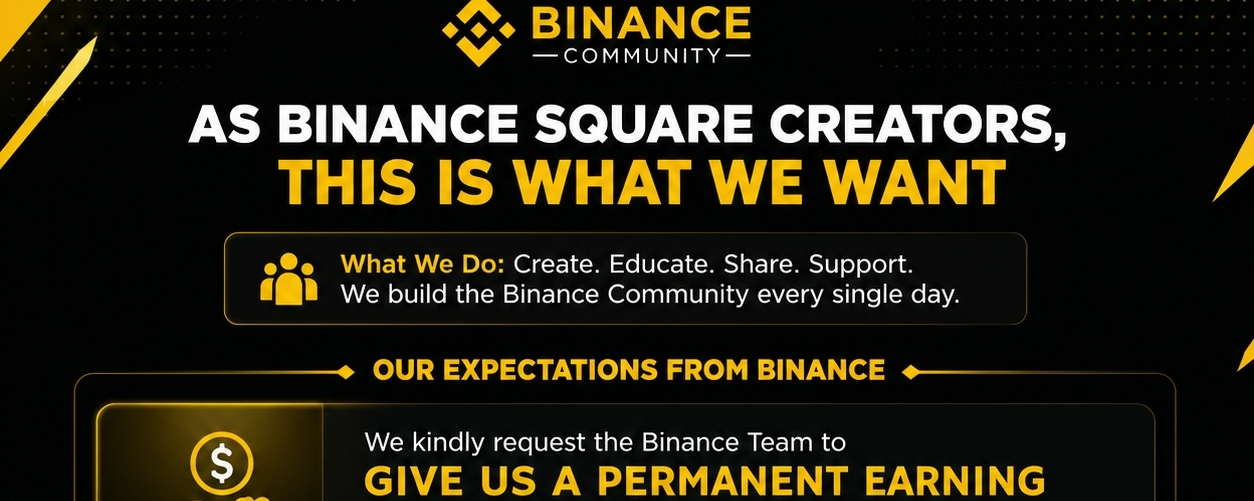
As a Binance square Creator What we want... What our Expectations From Binance
Guys today I'm going to say something important to the binance team after hearing lot's of creator opinion... So
Dear Binance we as a consistent creator we spend and we give 24/7 hours time to the Binance Day after day months after month year after years with a expectation that We as a creator We can Earn lots of money Form square as a creator we expect that Binance give us some permanent earning solution but our hope and expectations completely going to breaking.
We know that there is a creator pad there is a alpha section write to earn but those are not a permanent solution and we also know what's going on behind the creator paid or alpha section and write to earn etc.
We also see binance always give more priority to the new user and ignore old creator that's why lots of old creator day by day inactive.... But binance forgot that community makes community.
So our Request to the Binance team that Give us a permanent Earning Like Monitization or something like that and the Creator feel more energetic and we will create more Quality Contant..
As a world Largest Exchange Its very easy to solve this issue and one more thing that is if creator getting earning then Binance with the creator will make history...
@Binance Margin @Binance South Africa Official
@Binance Square Official @CZ @ETHcryptohub @AloNe72 @undefined @Jia Lilly @Dr Nohawn @Naccy小妹 @Crypto-First21 @Triple_S @Nadyisom
Dear Binance we as a consistent creator we spend and we give 24/7 hours time to the Binance Day after day months after month year after years with a expectation that We as a creator We can Earn lots of money Form square as a creator we expect that Binance give us some permanent earning solution but our hope and expectations completely going to breaking.
We know that there is a creator pad there is a alpha section write to earn but those are not a permanent solution and we also know what's going on behind the creator paid or alpha section and write to earn etc.
We also see binance always give more priority to the new user and ignore old creator that's why lots of old creator day by day inactive.... But binance forgot that community makes community.
So our Request to the Binance team that Give us a permanent Earning Like Monitization or something like that and the Creator feel more energetic and we will create more Quality Contant..
As a world Largest Exchange Its very easy to solve this issue and one more thing that is if creator getting earning then Binance with the creator will make history...
@Binance Margin @Binance South Africa Official
@Binance Square Official @CZ @ETHcryptohub @AloNe72 @undefined @Jia Lilly @Dr Nohawn @Naccy小妹 @Crypto-First21 @Triple_S @Nadyisom
Tokenized Stocks Sound Like Stocks. But There’s an Important Difference. 📈
You may have seen Binance’s bStocks and wondered:
“Am I actually buying the company’s stock?”
That’s exactly where beginners should slow down and understand the structure.
bStocks are designed to give users exposure to traditional stocks through tokenized representations, bringing traditional-market exposure into a blockchain-based environment.
But tokenized exposure doesn't automatically mean the same thing as holding a conventional stock through a traditional brokerage.
Before using a product like this, understand:
🔹 What exactly does the token represent?
🔹 What rights come with the product?
🔹 How is the underlying asset represented and backed?
🔹 What are the trading hours and liquidity conditions?
🔹 What fees and risks apply?
This is why I think the most important question isn't:
“Can I trade stocks on-chain?”
It's:
“Do I understand what I'm actually buying?”
That distinction matters.
Tokenization can make traditional assets more accessible within a digital-asset ecosystem, but accessibility doesn't remove investment risk.
📌 My rule:
Understand the asset → understand the structure → understand the risks → then decide.
Don't buy something simply because the name looks familiar.
#Binance #BStocks #Tokenization #Investing #cryptoeducation
You may have seen Binance’s bStocks and wondered:
“Am I actually buying the company’s stock?”
That’s exactly where beginners should slow down and understand the structure.
bStocks are designed to give users exposure to traditional stocks through tokenized representations, bringing traditional-market exposure into a blockchain-based environment.
But tokenized exposure doesn't automatically mean the same thing as holding a conventional stock through a traditional brokerage.
Before using a product like this, understand:
🔹 What exactly does the token represent?
🔹 What rights come with the product?
🔹 How is the underlying asset represented and backed?
🔹 What are the trading hours and liquidity conditions?
🔹 What fees and risks apply?
This is why I think the most important question isn't:
“Can I trade stocks on-chain?”
It's:
“Do I understand what I'm actually buying?”
That distinction matters.
Tokenization can make traditional assets more accessible within a digital-asset ecosystem, but accessibility doesn't remove investment risk.
📌 My rule:
Understand the asset → understand the structure → understand the risks → then decide.
Don't buy something simply because the name looks familiar.
#Binance #BStocks #Tokenization #Investing #cryptoeducation
Log in to explore more content