

The most expensive sentence in DeFi usually arrives too late.
The transaction has been identified.
The exploit has been traced.
The vault moved outside the expected range.
The team is investigating.
The report will be published soon.
I understand why post mortems matter.
They explain what happened. They show the timeline. They help users understand which control failed. They give builders, auditors and the community a record to study.
But a post mortem has one weakness that cannot be ignored.
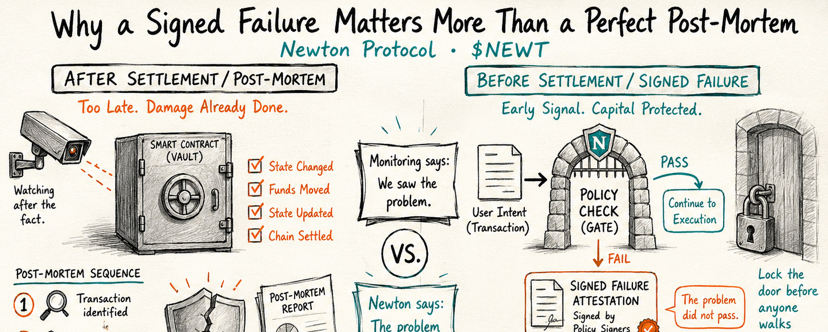
It arrives after settlement.
By then, the chain already accepted the transaction. The smart contract already executed. The funds already moved. The state already changed.
The report may be perfect.
The damage may already be real.
That is why Newton pass/fail policy model feels important to me.
The interesting part is not only that a transaction can receive approval.
The more powerful part is that a transaction can be denied before execution.
A pass says the action satisfied the active policy.
A fail says the system refused to let an out of policy action move forward.
That is a different kind of safety.
Most DeFi safety tools are built around visibility.
They show what happened. They track risky wallets. They flag suspicious flows. They alert teams. They help produce reports after something goes wrong.
That is useful.
But visibility is not the same as control.
Monitoring says:
We saw the problem.
Newton model is designed to say:
The problem did not pass.
That difference matters.
The core mechanism is simple.
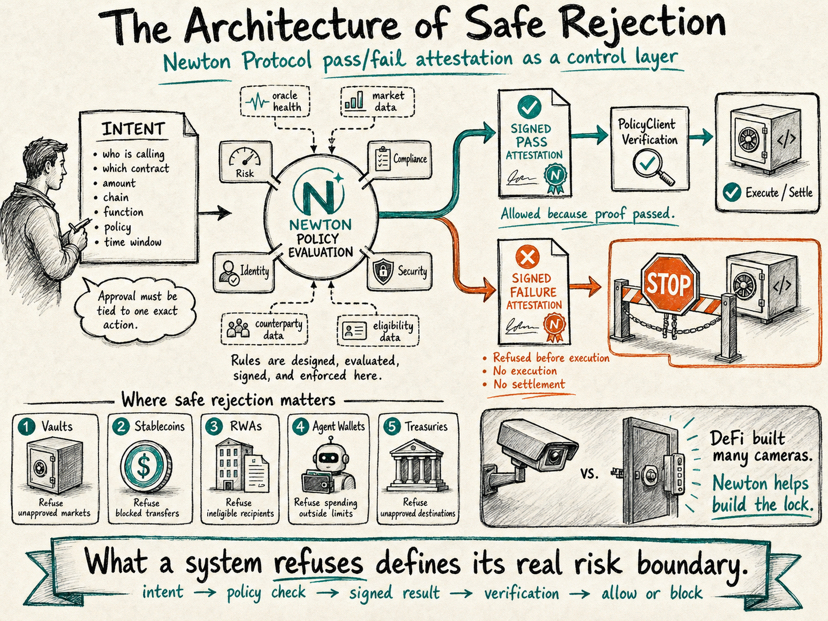
A transaction intent is created.
Newton evaluates that intent against an active policy.
Operators run the policy logic and return an allow or deny result.
In production, that result can be represented as a signed attestation.
The smart contract verifies the attestation before execution.
If the policy allows the action, the transaction can continue.
If the policy denies the action, execution should stop before capital moves.
That is the part people may underrate.
Failure is usually treated like a negative word.
In product language, everyone wants success, approval, completion, green checks and smooth flows.
But in financial infrastructure, a good failure can be extremely valuable.
A failed policy check can mean a vault did not break its mandate.
A failed transfer can mean a risky counterparty did not receive funds.
A failed agent action can mean a wallet stayed inside its spending limits.
A failed RWA transaction can mean eligibility rules were respected.
A failed stablecoin transfer can mean a blocked address did not pass the rule layer.
Sometimes the safest system is not the one that says yes fastest.
Sometimes it is the one that says no at the right moment.
Imagine a DeFi vault.
The vault has a rule that capital should not be allocated to an unapproved market. A curator creates a transaction intent. Maybe the yield looks attractive. Maybe the timing feels urgent. Maybe the market looks safe from the outside.
In a weak system, the transaction executes first.
Later, someone notices the vault moved outside its mandate.
Then the post-mortem begins.
But in a Newton-style flow, the intent must pass the active policy before the smart contract accepts the action. If the market is not approved, the policy check should deny the intent. Without a valid attestation, the contract should not execute.
The failure becomes the protection.
No emergency announcement.
No long investigation.
No reviewing the situation.
The transaction simply does not pass.
That is why a signed denial can be stronger than a beautiful report after the fact.
The report explains the mistake.
The denial stops the mistake from becoming final execution.
This matters because settlement is unforgiving.
Once something settles onchain, reversal is difficult. Sometimes it is impossible. Even if a team understands the issue quickly, they may still be too late.
The chain does not wait for a risk committee.
It does not pause for a governance discussion.
It executes what the contract allows.
So the real question is not only how fast DeFi can detect problems.
The real question is what the contract is allowed to accept in the first place.
That is where Newton sits.
Blockchains already answer one question:
Does this transaction satisfy the contract code?
Newton adds another:
Does this exact transaction satisfy the active policy?
That policy can include risk limits, compliance checks, identity conditions, oracle health, fraud signals, market rules or agent permissions.
The important part is not that every application uses the same policy.
The important part is that each application can define the rules it needs and require proof before execution.
For vaults, the rule may involve exposure limits, approved markets, oracle health, counterparty quality or strategy boundaries.
For stablecoins, the rule may involve compliance checks, transfer limits or blocked addresses.
For RWAs, the rule may involve investor eligibility, jurisdiction or asset-specific restrictions.
For agent wallets, the rule may involve spend caps, approved contracts, allowed functions or time windows.
For treasury systems, the rule may involve approval thresholds, destination controls and amount limits.
In all of these cases, the strongest moment is not the post-mortem.
The strongest moment is the point where the transaction tries to enter execution and the policy says no.
That no needs to be verifiable.
A frontend saying no can be bypassed.
A dashboard saying no may only warn after the action.
A private server saying no is not enough for onchain enforcement.
A manual team saying no may be too late.
Newton matters because it gives the smart contract a signed result it can verify.
The contract does not need to trust a social promise.
It checks proof.
That is the bridge between offchain policy evaluation and onchain enforcement.
The attestation is not just a message.
It is a signed result tied to a policy check.
It helps prove that the correct intent was evaluated against the correct policy in the correct context.
That matters because vague approvals are dangerous.
A strong authorization system should not approve a loose idea like move funds.
It should approve one exact action.
Who is calling?
Which contract is involved?
What amount?
Which chain?
Which function?
Which policy?
Which time window?
Which external conditions?
A pass or fail result only has meaning if it is bound to those details.
That is where Newton mechanism becomes practical.
Policy becomes part of execution logic.
Not a warning.
Not a note.
Not a guideline.
Execution logic.
To me, this is the strongest angle for $NEWT.
The market often talks about infrastructure with broad words.
More security.
More compliance.
More automation.
More trust.
But Newton has a specific design point:
before settlement, a transaction intent can be checked against rules, and the result can be brought back onchain as verifiable proof.
That is a real mechanism.
And the fail side of the mechanism may be the most important side.
Crypto culture naturally celebrates successful execution.
We want transactions to go through. We want fast UX. We want fewer blockers. We want automation to feel smooth.
But serious financial systems also need safe rejection.
A payment network is not valuable only because it approves payments.
It is valuable because it can decline the wrong ones.
A vault is not safer only because it can allocate capital.
It is safer when it can refuse allocations outside its mandate.
A smart wallet is not better only because it can automate.
It is better when automation cannot exceed its permission boundary.
A stablecoin system is not stronger only because it can move value quickly.
It is stronger when certain transfers cannot pass the rule layer.
This is the side of DeFi that needs more attention.
Permissionless infrastructure is powerful, but application-level controls still matter.
Vaults, RWAs, stablecoins, institutional DeFi and agent wallets cannot rely only on blind execution.
They need rules that are clear, programmable and enforceable before money moves.
Newton does not need to control every transaction in crypto to matter.
It only needs to become useful for the transactions where rules must matter before settlement.
That is a large design space.
And this is why the failed attestation is not just a technical detail.
It is a confidence signal.
If I am a depositor in a vault, I do not only want to know what the vault did.
I want to know what it was not allowed to do.
If I am looking at an agent wallet, I do not only care what the agent can execute.
I care what it cannot execute.
If I am watching an RWA product, I do not only care that tokens move.
I care whether eligibility rules can be ignored.
If I am looking at stablecoin infrastructure, I do not only care about speed.
I care whether transfers can be checked before settlement.
A signed denial makes the boundary real.
It proves the system had a rule, checked the action and refused execution.
That is very different from saying we noticed later.
The difference is like a locked door versus a security camera.
The camera shows who entered.
The lock decides whether they enter at all.
DeFi has built many cameras.
Newton is helping build the lock.
This does not mean Newton removes all risk.
A policy is only as good as its design. Bad policies can still allow bad actions. Weak data can produce weak checks. Builders still need to decide carefully what should pass and what should fail.
But that is exactly why the policy layer matters.
It creates a place where those rules can be designed, evaluated, signed and enforced.
That is a major improvement over keeping risk rules scattered across documents, dashboards, manual approvals and private server checks.
When rules are scattered, accountability becomes messy.
When rules sit inside the transaction path, accountability becomes clearer.
This action passed.
This action failed.
This policy was checked.
This proof was verified.
This execution was allowed or blocked.
That clarity can change how users judge DeFi systems.
Today, people often ask:
What is the APY?
What is the TVL?
Who is the team?
Which chain is it on?
Who are the partners?
Those questions still matter.
But for serious DeFi, better questions are coming.
What rules does this application enforce before execution?
Which actions can fail?
Who evaluates the policy?
Can the smart contract verify the result?
Can users see proof that a rule was checked?
Does the system block invalid actions before settlement?
These are the questions Newton is built around.
That is why I see NEWT as more than a short term narrative.
The real value is not only whether people talk about it.
The real value is whether applications start depending on Newton for policy enforcement before execution.
If vaults require policy attestations before rebalancing, that is usage.
If agent wallets require policy checks before spending, that is usage.
If RWA platforms require eligibility proofs before transfers, that is usage.
If stablecoin flows require compliance checks before settlement, that is usage.
If smart contracts treat Newton attestations as part of their execution gate, Newton is no longer just another tool around DeFi.
It becomes part of the control layer.
This is also where denied actions become meaningful network activity.
People naturally focus on successful transactions.
But the blocked ones matter too.
A denied policy check can show that a rule was active.
It can show that the application did not simply allow everything.
It can show that the system had discipline.
That is especially valuable for vaults.
A vault that can show what it refused may become more trusted than a vault that only shows what it executed.
Because the hidden quality of a vault is not only its returns.
It is the shape of its refusals.
What does it refuse to touch?
What exposure does it refuse to exceed?
What oracle condition does it refuse to ignore?
What market does it refuse to enter?
What counterparty does it refuse to use?
What action does it refuse to execute?
Those refusals define the real risk boundary.
Newton gives those refusals a way to become part of the architecture.
That is powerful.
A post-mortem can teach the market a lesson.
A signed failure can stop the lesson from becoming a loss.
DeFi does not need more perfect explanations after failure.
It needs more systems that can fail safely before execution.
The strongest infrastructure is not always the one that says yes fastest.
Sometimes it is the one that says no at the right moment.
Newton pass/fail attestation model brings that logic into onchain transactions.
A transaction intent comes in.
The active policy checks it.
Operators return the allow or deny result.
The smart contract verifies the attestation.
Execution happens only if the proof passes.
That is clean, simple and important.
My personal take is that the next serious wave of DeFi will be judged less by how quickly it can move capital and more by how well it controls capital movement.
Speed without control is just faster risk.
Transparency without prevention is just a better record of damage.
Monitoring without enforcement is still late.
Newton is trying to make authorization a normal part of onchain execution.
And in that model, failure is not weakness.
A signed failure can be the strongest proof that the system worked.
