

WEB3TITAN
284 ໂພສ

WEB3TITAN
ລາຍງານ
ບລັອກຜູ້ໃຊ້
Ambassador | BlockHub | Exploring blockchain | Content Creator | Designer | Crypto Trader | 📩 DM for Collaboration.
26 ກໍາລັງຕິດຕາມ
35 ຜູ້ຕິດຕາມ
116 Liked
ໂພສ
ທັງໝົດ
ວົງຢືມ
ວີດີໂອ
·
--
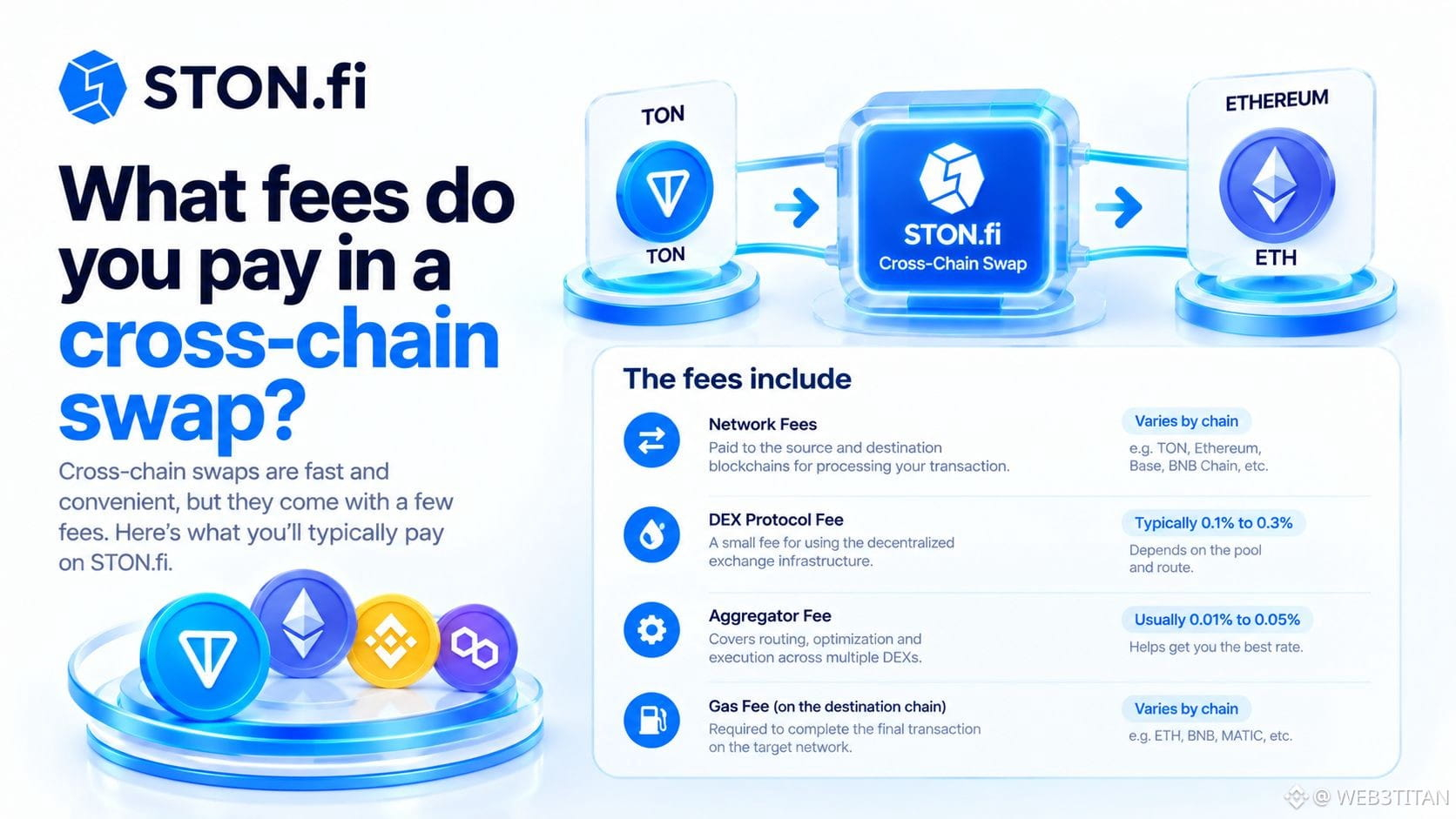
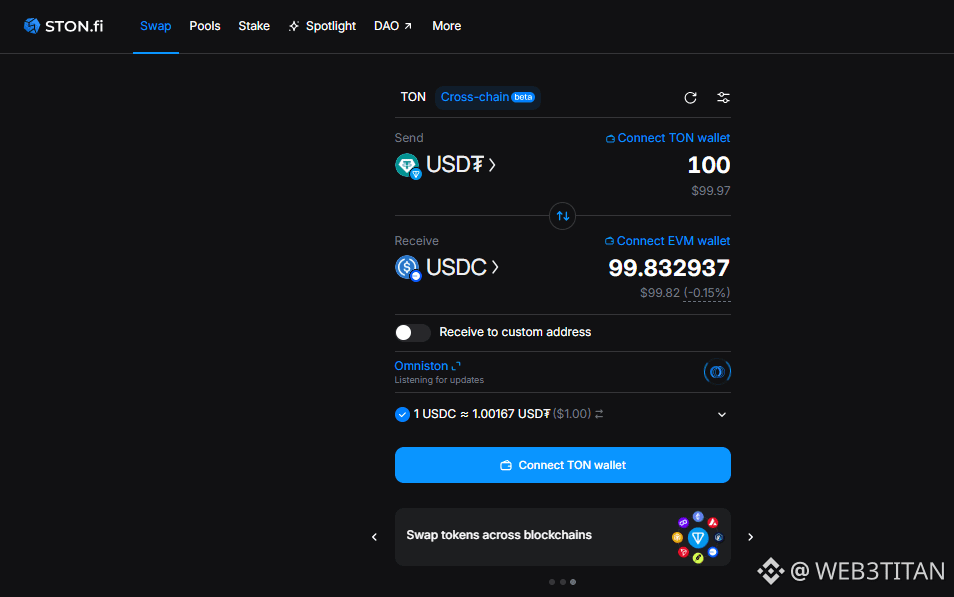
What Fees Do You Pay in a Cross Chain Swap?
Cross chain swaps can involve more than one type of cost, and the final amount isn't always just a simple “swap fee.”
WHAT ARE YOU PAYING FOR?
The total cost can include:
Source chain gas: The blockchain fee required to initiate the transaction.
Execution costs: Fees associated with processing and settling the cross chain swap.
Destination costs: Depending on the route, additional blockchain or execution costs may apply.
Price impact: Your trade can move the price, especially with larger or less liquid swaps.
WHY FEES VARY
Different blockchains have different fee structures and network conditions.
A transaction involving Ethereum can have a very different gas cost from one using Base or Polygon, so the same cross chain swap may have different costs depending on the route.
FEE ≠ PRICE IMPACT
These are different.
Fee is what you pay for transaction or execution services.
Price impact is the difference caused by your trade interacting with available liquidity.
Slippage can also occur when the market moves between the quoted price and execution.
BEFORE YOU CONFIRM
Always review the swap quote first.
Check the amount you're sending, amount you'll receive, estimated fees, route, and any price impact or slippage information before confirming.
MY TAKE
The cheapest looking route isn't always about the lowest fee alone. You also need to consider the final amount you receive after execution costs and price effects.
$XRP $BEAT $GRAM
#EarningsSeason
What Fees Do You Pay in a Cross Chain Swap?
Cross chain swaps can involve more than one type of cost, and the final amount isn't always just a simple “swap fee.”
WHAT ARE YOU PAYING FOR?
The total cost can include:
Source chain gas: The blockchain fee required to initiate the transaction.
Execution costs: Fees associated with processing and settling the cross chain swap.
Destination costs: Depending on the route, additional blockchain or execution costs may apply.
Price impact: Your trade can move the price, especially with larger or less liquid swaps.
WHY FEES VARY
Different blockchains have different fee structures and network conditions.
A transaction involving Ethereum can have a very different gas cost from one using Base or Polygon, so the same cross chain swap may have different costs depending on the route.
FEE ≠ PRICE IMPACT
These are different.
Fee is what you pay for transaction or execution services.
Price impact is the difference caused by your trade interacting with available liquidity.
Slippage can also occur when the market moves between the quoted price and execution.
BEFORE YOU CONFIRM
Always review the swap quote first.
Check the amount you're sending, amount you'll receive, estimated fees, route, and any price impact or slippage information before confirming.
MY TAKE
The cheapest looking route isn't always about the lowest fee alone. You also need to consider the final amount you receive after execution costs and price effects.
$XRP $BEAT $GRAM
#EarningsSeason
Cross chain swaps can involve more than one type of cost, and the final amount isn't always just a simple “swap fee.”
WHAT ARE YOU PAYING FOR?
The total cost can include:
Source chain gas: The blockchain fee required to initiate the transaction.
Execution costs: Fees associated with processing and settling the cross chain swap.
Destination costs: Depending on the route, additional blockchain or execution costs may apply.
Price impact: Your trade can move the price, especially with larger or less liquid swaps.
WHY FEES VARY
Different blockchains have different fee structures and network conditions.
A transaction involving Ethereum can have a very different gas cost from one using Base or Polygon, so the same cross chain swap may have different costs depending on the route.
FEE ≠ PRICE IMPACT
These are different.
Fee is what you pay for transaction or execution services.
Price impact is the difference caused by your trade interacting with available liquidity.
Slippage can also occur when the market moves between the quoted price and execution.
BEFORE YOU CONFIRM
Always review the swap quote first.
Check the amount you're sending, amount you'll receive, estimated fees, route, and any price impact or slippage information before confirming.
MY TAKE
The cheapest looking route isn't always about the lowest fee alone. You also need to consider the final amount you receive after execution costs and price effects.
$XRP $BEAT $GRAM
#EarningsSeason
65
·
--
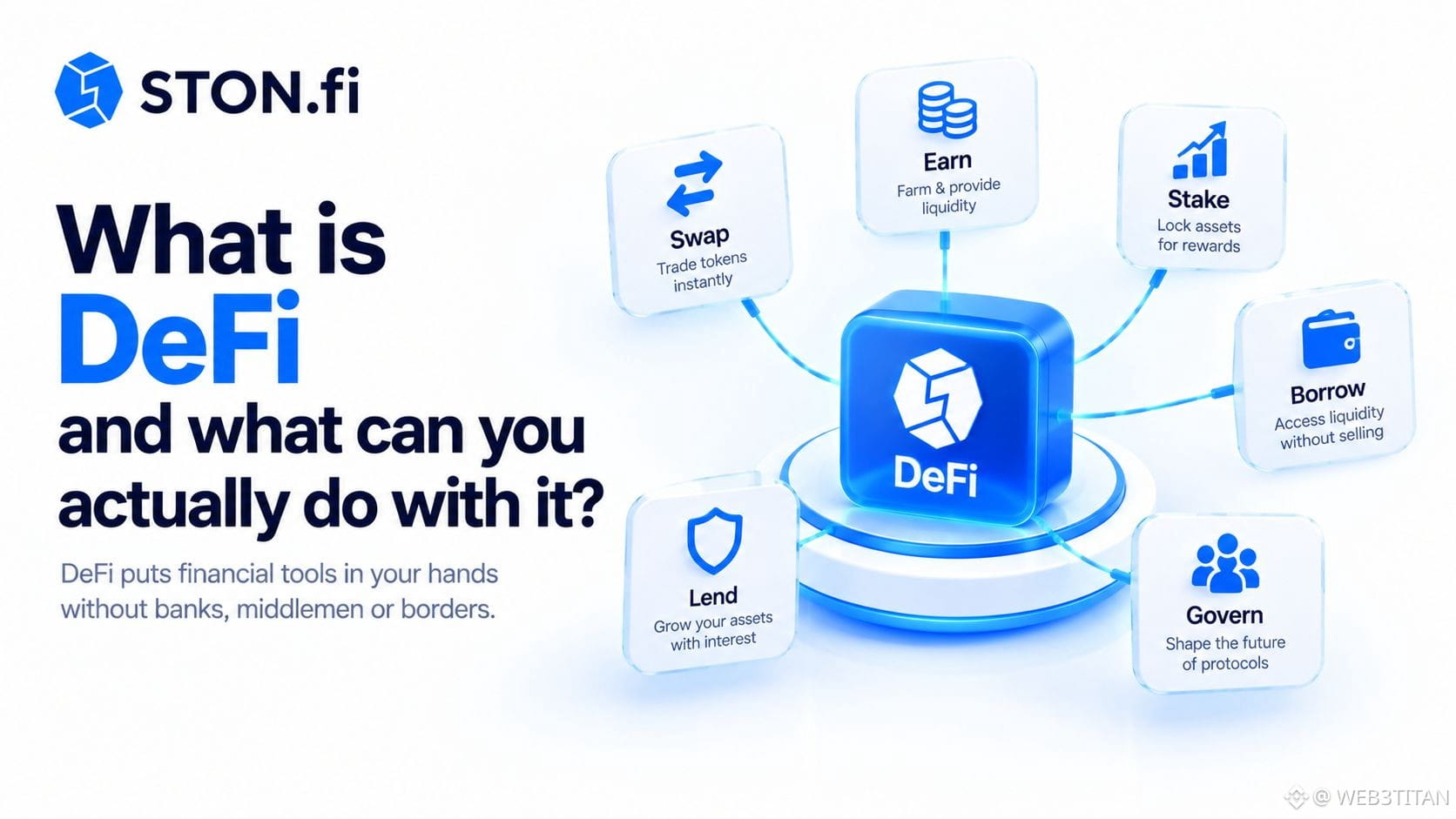
What Is DeFi and What Can You Actually Do With It?
DeFi, short for decentralized finance, uses blockchain and smart contracts to provide financial services without relying entirely on traditional intermediaries.
WHAT CAN YOU DO?
Swap: Exchange tokens directly from your wallet.
Provide liquidity: Add assets to liquidity pools and potentially earn fees.
Stake: Lock or stake tokens to support protocols and potentially earn rewards.
Borrow & lend: Some DeFi protocols let users lend assets or borrow against collateral.
Move across chains: Use bridges or cross-chain systems to move or exchange assets between networks.
THE TRADE-OFF
DeFi gives you self-custody, but also more responsibility. Smart contract bugs, market volatility, slippage, and transaction mistakes can all create risks.
A SIMPLE TON JOURNEY
You could start by connecting a wallet, swapping or providing liquidity on STONfi, then explore other DeFi tools as you understand the risks.
For supported cross-chain swaps, Omniston can coordinate liquidity and execution across networks.
MY TAKE
DeFi isn't one product. It's an ecosystem of financial tools where understanding the mechanics matters just as much as knowing how to use them.
$PUMP $BEAT
#QNTFallsOver40%FromMorningHigh
What Is DeFi and What Can You Actually Do With It?
DeFi, short for decentralized finance, uses blockchain and smart contracts to provide financial services without relying entirely on traditional intermediaries.
WHAT CAN YOU DO?
Swap: Exchange tokens directly from your wallet.
Provide liquidity: Add assets to liquidity pools and potentially earn fees.
Stake: Lock or stake tokens to support protocols and potentially earn rewards.
Borrow & lend: Some DeFi protocols let users lend assets or borrow against collateral.
Move across chains: Use bridges or cross-chain systems to move or exchange assets between networks.
THE TRADE-OFF
DeFi gives you self-custody, but also more responsibility. Smart contract bugs, market volatility, slippage, and transaction mistakes can all create risks.
A SIMPLE TON JOURNEY
You could start by connecting a wallet, swapping or providing liquidity on STONfi, then explore other DeFi tools as you understand the risks.
For supported cross-chain swaps, Omniston can coordinate liquidity and execution across networks.
MY TAKE
DeFi isn't one product. It's an ecosystem of financial tools where understanding the mechanics matters just as much as knowing how to use them.
$PUMP $BEAT
#QNTFallsOver40%FromMorningHigh
DeFi, short for decentralized finance, uses blockchain and smart contracts to provide financial services without relying entirely on traditional intermediaries.
WHAT CAN YOU DO?
Swap: Exchange tokens directly from your wallet.
Provide liquidity: Add assets to liquidity pools and potentially earn fees.
Stake: Lock or stake tokens to support protocols and potentially earn rewards.
Borrow & lend: Some DeFi protocols let users lend assets or borrow against collateral.
Move across chains: Use bridges or cross-chain systems to move or exchange assets between networks.
THE TRADE-OFF
DeFi gives you self-custody, but also more responsibility. Smart contract bugs, market volatility, slippage, and transaction mistakes can all create risks.
A SIMPLE TON JOURNEY
You could start by connecting a wallet, swapping or providing liquidity on STONfi, then explore other DeFi tools as you understand the risks.
For supported cross-chain swaps, Omniston can coordinate liquidity and execution across networks.
MY TAKE
DeFi isn't one product. It's an ecosystem of financial tools where understanding the mechanics matters just as much as knowing how to use them.
$PUMP $BEAT
#QNTFallsOver40%FromMorningHigh
742
·
--
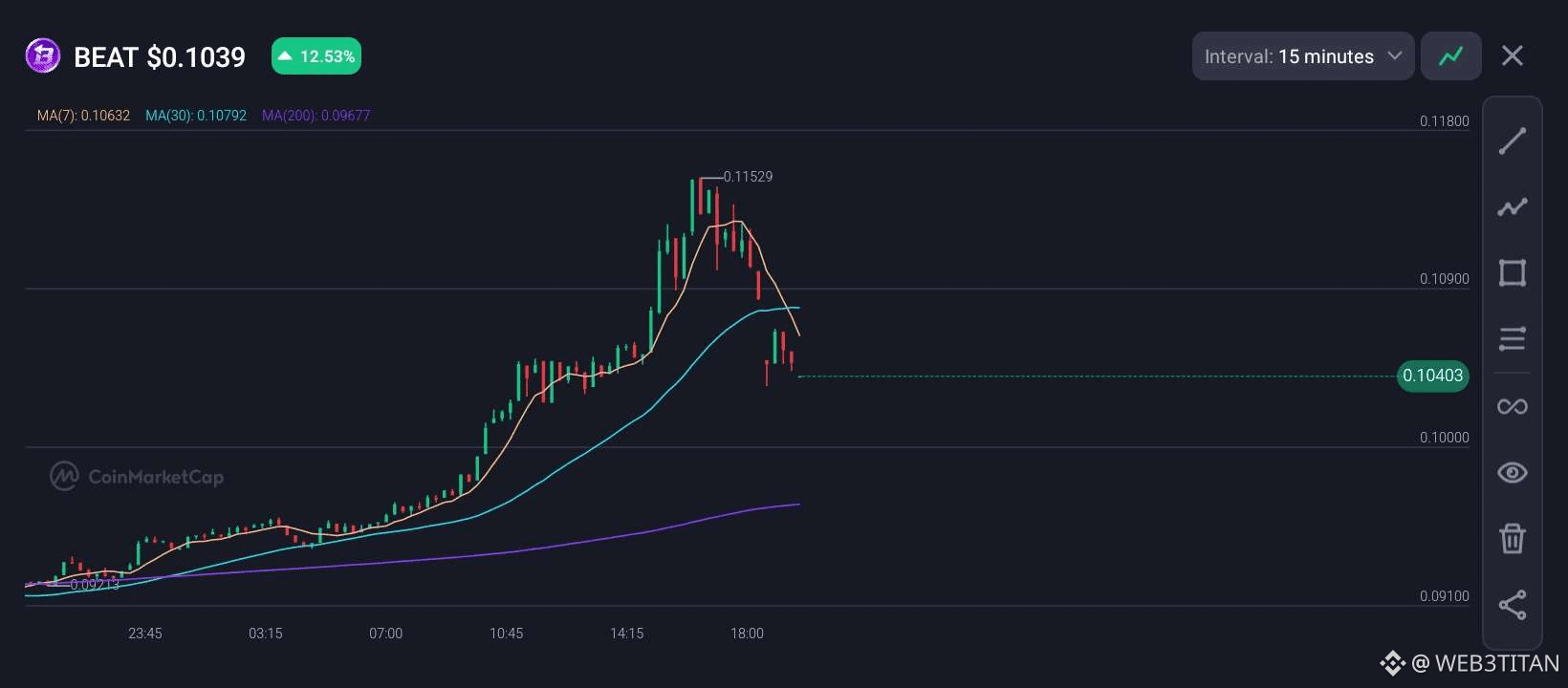
Price is consolidating after a strong push higher.
$BEAT is currently trading at $0.1039 after a +12.53% move.
Recently, price climbed from the 0.09213 area up to a high of 0.11529 before pulling back. It is now stabilizing after the correction, still well above the prior base.
Bias: UPTREND (LONG)
Why:
The rally was impulsive and sustained. Despite the rejection from 0.11529, price remains elevated and is holding the higher range, keeping the short-term structure constructive as long as support holds.
Entry: $0.1020 – $0.1050
Stop Loss: $0.0970
Take Profits
TP1: $0.1100
TP2: $0.1150
TP3: $0.1200 – $0.1250
Another feature on @stonfi worth knowing is staking. Users can lock eligible STON to participate in protocol rewards and gain exposure to the ecosystem’s governance and community reward mechanisms. It gives STON holders another use for their tokens beyond simply holding or swapping them.
$BEAT #CircleMints500MUSDCOnSolana
Price is consolidating after a strong push higher.
$BEAT is currently trading at $0.1039 after a +12.53% move.
Recently, price climbed from the 0.09213 area up to a high of 0.11529 before pulling back. It is now stabilizing after the correction, still well above the prior base.
Bias: UPTREND (LONG)
Why:
The rally was impulsive and sustained. Despite the rejection from 0.11529, price remains elevated and is holding the higher range, keeping the short-term structure constructive as long as support holds.
Entry: $0.1020 – $0.1050
Stop Loss: $0.0970
Take Profits
TP1: $0.1100
TP2: $0.1150
TP3: $0.1200 – $0.1250
Another feature on @STONfi DEX worth knowing is staking. Users can lock eligible STON to participate in protocol rewards and gain exposure to the ecosystem’s governance and community reward mechanisms. It gives STON holders another use for their tokens beyond simply holding or swapping them.
$BEAT #CircleMints500MUSDCOnSolana
$BEAT is currently trading at $0.1039 after a +12.53% move.
Recently, price climbed from the 0.09213 area up to a high of 0.11529 before pulling back. It is now stabilizing after the correction, still well above the prior base.
Bias: UPTREND (LONG)
Why:
The rally was impulsive and sustained. Despite the rejection from 0.11529, price remains elevated and is holding the higher range, keeping the short-term structure constructive as long as support holds.
Entry: $0.1020 – $0.1050
Stop Loss: $0.0970
Take Profits
TP1: $0.1100
TP2: $0.1150
TP3: $0.1200 – $0.1250
Another feature on @STONfi DEX worth knowing is staking. Users can lock eligible STON to participate in protocol rewards and gain exposure to the ecosystem’s governance and community reward mechanisms. It gives STON holders another use for their tokens beyond simply holding or swapping them.
$BEAT #CircleMints500MUSDCOnSolana
2
1
823
·
--
Price is holding near the highs after a strong climb.
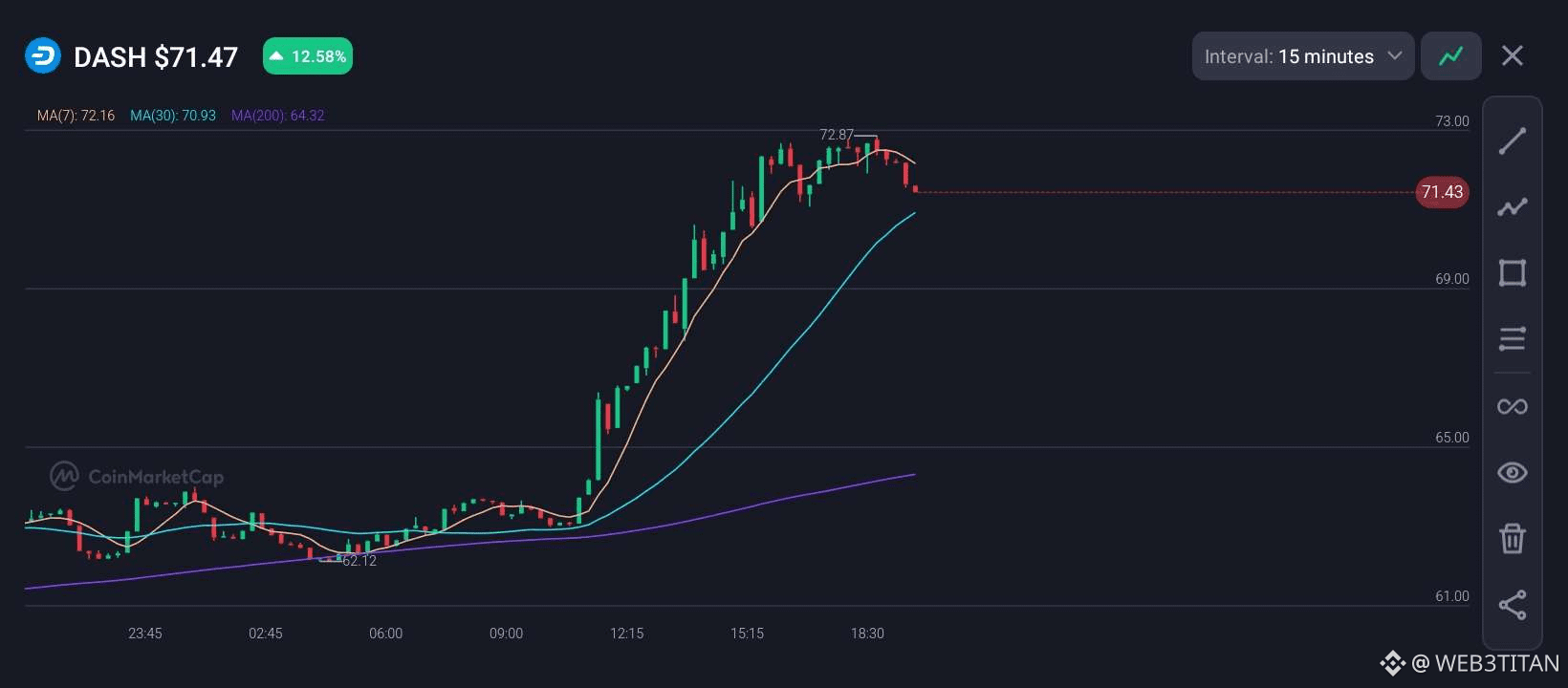
$DASH is currently trading at $71.47 after a +12.58% move.
Recently, price climbed aggressively from the 62.12 area up to a high of 72.87 before a mild pullback. It is now consolidating just below the peak.
Bias: UPTREND (LONG)
Why:
The rally was impulsive and sustained. Despite the short-term rejection from 72.87, price remains elevated near the highs with the overall structure firmly bullish.
Entry: $70.50 – $71.80
Stop Loss: $68.00
Take Profits
TP1: $74.00
TP2: $76.50
TP3: $79.00 – $82.00
For traders moving between different opportunities, @stonfi also supports xStocks, bringing selected tokenized traditional market assets into the TON DeFi ecosystem. It gives users another category of assets to explore on-chain, alongside the crypto markets they already trade and manage.
#CoinMarketCapCompletesCoinglassAcquisition
Price is holding near the highs after a strong climb.
$DASH is currently trading at $71.47 after a +12.58% move.
Recently, price climbed aggressively from the 62.12 area up to a high of 72.87 before a mild pullback. It is now consolidating just below the peak.
Bias: UPTREND (LONG)
Why:
The rally was impulsive and sustained. Despite the short-term rejection from 72.87, price remains elevated near the highs with the overall structure firmly bullish.
Entry: $70.50 – $71.80
Stop Loss: $68.00
Take Profits
TP1: $74.00
TP2: $76.50
TP3: $79.00 – $82.00
For traders moving between different opportunities, @STONfi DEX also supports xStocks, bringing selected tokenized traditional market assets into the TON DeFi ecosystem. It gives users another category of assets to explore on-chain, alongside the crypto markets they already trade and manage.
#CoinMarketCapCompletesCoinglassAcquisition
$DASH is currently trading at $71.47 after a +12.58% move.
Recently, price climbed aggressively from the 62.12 area up to a high of 72.87 before a mild pullback. It is now consolidating just below the peak.
Bias: UPTREND (LONG)
Why:
The rally was impulsive and sustained. Despite the short-term rejection from 72.87, price remains elevated near the highs with the overall structure firmly bullish.
Entry: $70.50 – $71.80
Stop Loss: $68.00
Take Profits
TP1: $74.00
TP2: $76.50
TP3: $79.00 – $82.00
For traders moving between different opportunities, @STONfi DEX also supports xStocks, bringing selected tokenized traditional market assets into the TON DeFi ecosystem. It gives users another category of assets to explore on-chain, alongside the crypto markets they already trade and manage.
#CoinMarketCapCompletesCoinglassAcquisition
386
·
--
Price is holding the higher range after a strong push.
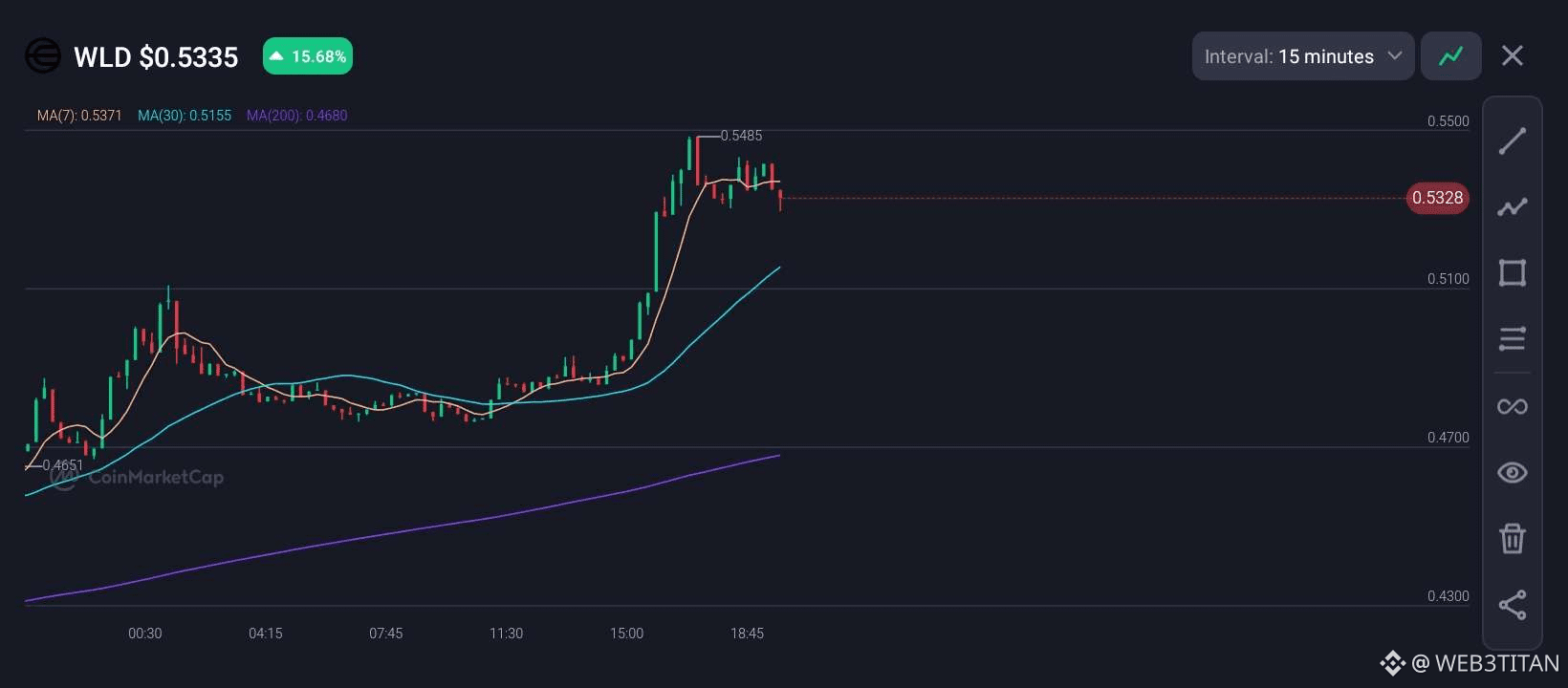
$WLD is currently trading at $0.5335 after a +15.68% move.
Recently, price climbed from the 0.4651 area up to a high of 0.5485 before a mild pullback. It is now consolidating just below the peak.
Bias: UPTREND (LONG)
Why:
The rally was impulsive and sustained. Despite the short-term rejection from 0.5485, price remains elevated near the highs with the overall structure firmly bullish.
Entry: $0.5250 – $0.5380
Stop Loss: $0.5000
Take Profits
TP1: $0.5600
TP2: $0.5800
TP3: $0.6000 – $0.6300
If you're looking beyond the usual swap and farming features, @stonfi also supports staking STON to participate in protocol rewards and governance-related mechanisms. It gives long-term STON holders another way to stay involved in the ecosystem while putting their tokens to use rather than simply leaving them idle.
#PolymarketBankFailureBetsDrawFDICConcern
Price is holding the higher range after a strong push.
$WLD is currently trading at $0.5335 after a +15.68% move.
Recently, price climbed from the 0.4651 area up to a high of 0.5485 before a mild pullback. It is now consolidating just below the peak.
Bias: UPTREND (LONG)
Why:
The rally was impulsive and sustained. Despite the short-term rejection from 0.5485, price remains elevated near the highs with the overall structure firmly bullish.
Entry: $0.5250 – $0.5380
Stop Loss: $0.5000
Take Profits
TP1: $0.5600
TP2: $0.5800
TP3: $0.6000 – $0.6300
If you're looking beyond the usual swap and farming features, @STONfi DEX also supports staking STON to participate in protocol rewards and governance-related mechanisms. It gives long-term STON holders another way to stay involved in the ecosystem while putting their tokens to use rather than simply leaving them idle.
#PolymarketBankFailureBetsDrawFDICConcern
$WLD is currently trading at $0.5335 after a +15.68% move.
Recently, price climbed from the 0.4651 area up to a high of 0.5485 before a mild pullback. It is now consolidating just below the peak.
Bias: UPTREND (LONG)
Why:
The rally was impulsive and sustained. Despite the short-term rejection from 0.5485, price remains elevated near the highs with the overall structure firmly bullish.
Entry: $0.5250 – $0.5380
Stop Loss: $0.5000
Take Profits
TP1: $0.5600
TP2: $0.5800
TP3: $0.6000 – $0.6300
If you're looking beyond the usual swap and farming features, @STONfi DEX also supports staking STON to participate in protocol rewards and governance-related mechanisms. It gives long-term STON holders another way to stay involved in the ecosystem while putting their tokens to use rather than simply leaving them idle.
#PolymarketBankFailureBetsDrawFDICConcern
211
·
--
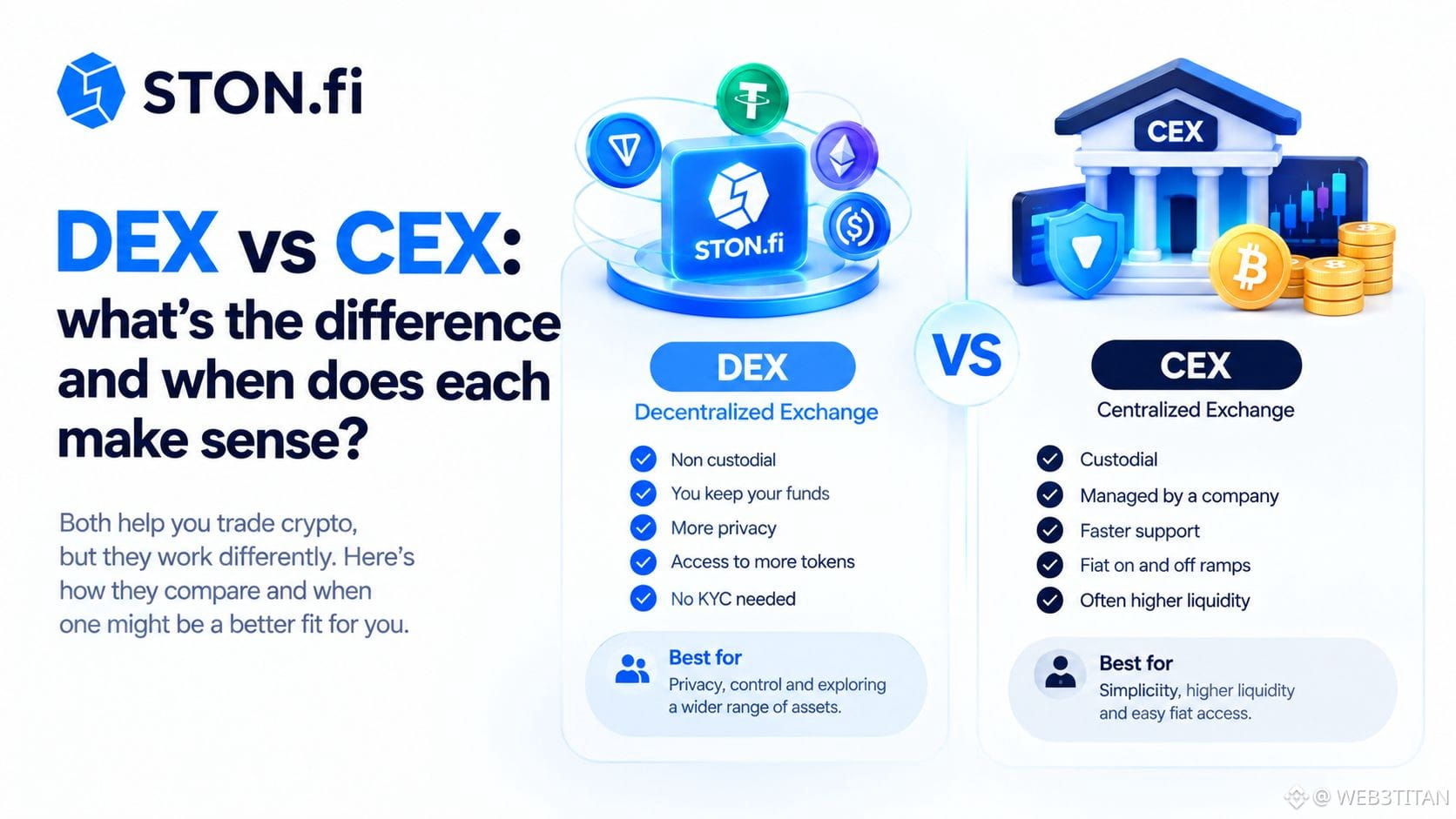
DEX vs CEX: What’s the Difference and When Does Each Make Sense?
When trading crypto, you'll usually use either a DEX or CEX. Both let you buy and sell digital assets, but they work differently.
WHAT IS A CEX?
A centralized exchange (CEX) is operated by a company that manages the platform, accounts, and trading infrastructure.
Users create accounts and may need to complete KYC, depending on the platform and jurisdiction.
The exchange can also custody your assets.
WHAT IS A DEX?
A decentralized exchange (DEX) lets you connect your own wallet and trade through on-chain liquidity.
You generally don't need a traditional exchange account, and the DEX doesn't take custody of your assets.
Transactions are executed through smart contracts.
KEY DIFFERENCES
CEX: Centralized trading, account-based services, and often access to deeper markets.
DEX: Self custody, on-chain execution, and decentralized liquidity.
CEXs involve exchange custody and infrastructure risk. DEXs involve wallet management, smart contract risk, blockchain fees, and transaction execution.
WHEN DOES EACH MAKE SENSE?
A CEX can make sense for a familiar interface, account-based services, or specific centralized markets.
A DEX can make sense when you want to trade directly from your wallet without giving custody to a centralized platform.
HOW A DEX SWAP WORKS
With STONfi:
Connect wallet → choose tokens → review quote → confirm swap → receive tokens.
The transaction is processed on-chain.
MY TAKE
Neither model is automatically better.
The key trade-offs are custody, access, execution, liquidity, fees, and risk.
Understanding them helps you choose what fits your needs.
$PUMP $GRAM
#PolymarketBankFailureBetsDrawFDICConcern
DEX vs CEX: What’s the Difference and When Does Each Make Sense?
When trading crypto, you'll usually use either a DEX or CEX. Both let you buy and sell digital assets, but they work differently.
WHAT IS A CEX?
A centralized exchange (CEX) is operated by a company that manages the platform, accounts, and trading infrastructure.
Users create accounts and may need to complete KYC, depending on the platform and jurisdiction.
The exchange can also custody your assets.
WHAT IS A DEX?
A decentralized exchange (DEX) lets you connect your own wallet and trade through on-chain liquidity.
You generally don't need a traditional exchange account, and the DEX doesn't take custody of your assets.
Transactions are executed through smart contracts.
KEY DIFFERENCES
CEX: Centralized trading, account-based services, and often access to deeper markets.
DEX: Self custody, on-chain execution, and decentralized liquidity.
CEXs involve exchange custody and infrastructure risk. DEXs involve wallet management, smart contract risk, blockchain fees, and transaction execution.
WHEN DOES EACH MAKE SENSE?
A CEX can make sense for a familiar interface, account-based services, or specific centralized markets.
A DEX can make sense when you want to trade directly from your wallet without giving custody to a centralized platform.
HOW A DEX SWAP WORKS
With STONfi:
Connect wallet → choose tokens → review quote → confirm swap → receive tokens.
The transaction is processed on-chain.
MY TAKE
Neither model is automatically better.
The key trade-offs are custody, access, execution, liquidity, fees, and risk.
Understanding them helps you choose what fits your needs.
$PUMP $GRAM
#PolymarketBankFailureBetsDrawFDICConcern
When trading crypto, you'll usually use either a DEX or CEX. Both let you buy and sell digital assets, but they work differently.
WHAT IS A CEX?
A centralized exchange (CEX) is operated by a company that manages the platform, accounts, and trading infrastructure.
Users create accounts and may need to complete KYC, depending on the platform and jurisdiction.
The exchange can also custody your assets.
WHAT IS A DEX?
A decentralized exchange (DEX) lets you connect your own wallet and trade through on-chain liquidity.
You generally don't need a traditional exchange account, and the DEX doesn't take custody of your assets.
Transactions are executed through smart contracts.
KEY DIFFERENCES
CEX: Centralized trading, account-based services, and often access to deeper markets.
DEX: Self custody, on-chain execution, and decentralized liquidity.
CEXs involve exchange custody and infrastructure risk. DEXs involve wallet management, smart contract risk, blockchain fees, and transaction execution.
WHEN DOES EACH MAKE SENSE?
A CEX can make sense for a familiar interface, account-based services, or specific centralized markets.
A DEX can make sense when you want to trade directly from your wallet without giving custody to a centralized platform.
HOW A DEX SWAP WORKS
With STONfi:
Connect wallet → choose tokens → review quote → confirm swap → receive tokens.
The transaction is processed on-chain.
MY TAKE
Neither model is automatically better.
The key trade-offs are custody, access, execution, liquidity, fees, and risk.
Understanding them helps you choose what fits your needs.
$PUMP $GRAM
#PolymarketBankFailureBetsDrawFDICConcern
505
·
--
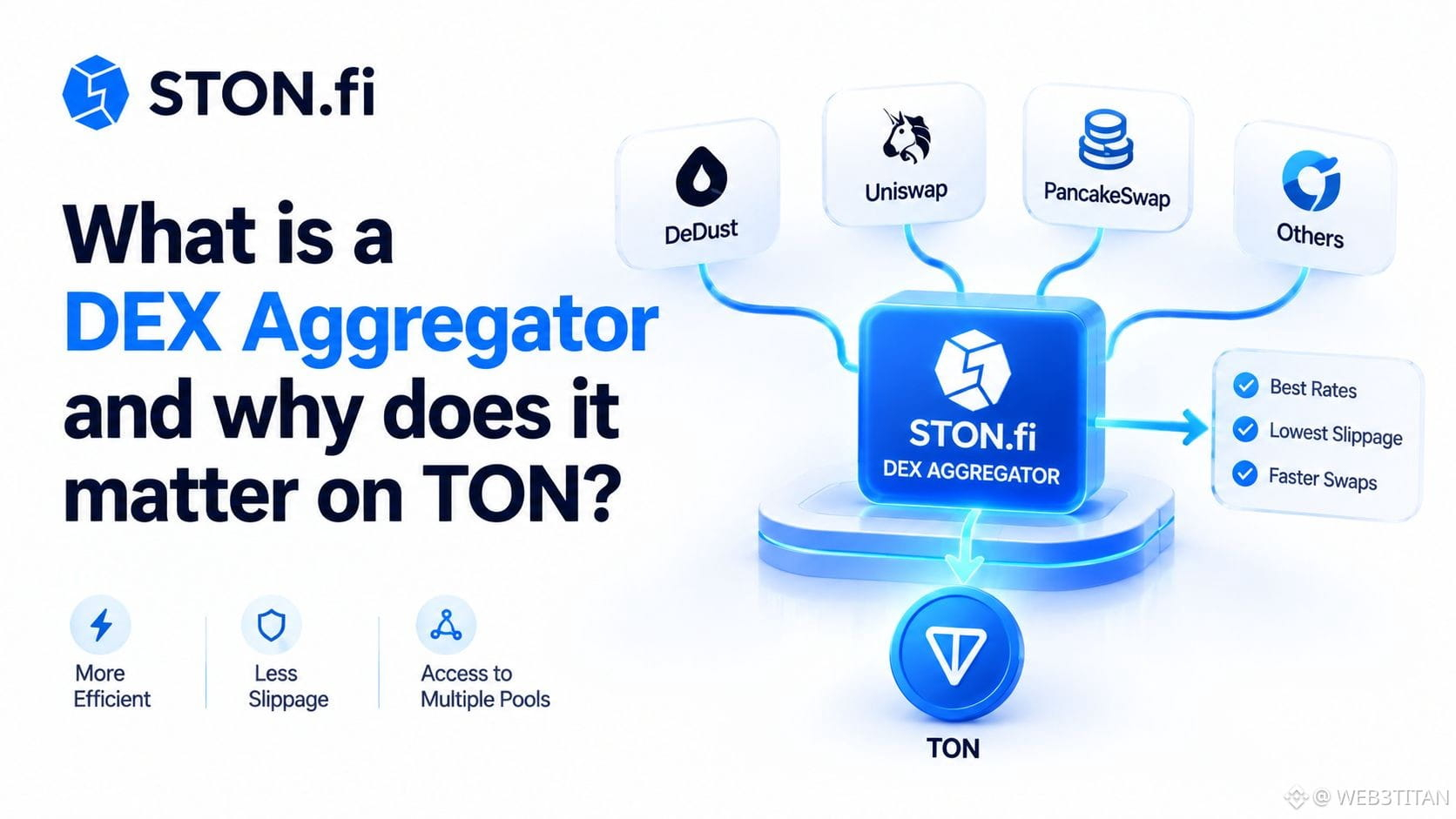
What Is a DEX Aggregator and Why Does It Matter on TON?
Liquidity on TON isn't always in one place. Different DEXs and pools can offer different prices for the same token pair.
That's where a DEX aggregator becomes useful.
WHAT IS A DEX AGGREGATOR?
A DEX aggregator is a routing layer that searches across connected liquidity sources to find efficient ways to execute a swap.
Instead of checking every venue manually, the aggregator compares available routes automatically.
WHY DOES IT MATTER?
Imagine you want to swap TON for another token.
One DEX might have deeper liquidity, while another could offer a better price. A multi-hop route through several pools might also produce better execution than a direct swap.
Liquidity fragmentation means the best available route isn't always in one pool.
It can also affect price impact, especially when a trade uses a shallow pool.
THE MANUAL ALTERNATIVE
Without aggregation, you would need to compare different TON DEXs yourself.
You might check prices, pool depth, and possible routes across several platforms before deciding where to execute.
That becomes difficult when there are many liquidity sources and possible combinations.
WHERE OMNISTON FITS
Omniston is STONfi's liquidity aggregation infrastructure for TON.
It can search connected liquidity sources and coordinate routes for swaps, including documented sources such as STONfi, DeDust, Tonco, and swap.coffee.
This brings route discovery and execution into a unified system rather than requiring users to compare everything manually.
ONE IMPORTANT LIMITATION
An aggregator can only optimize across the liquidity sources it is connected to.
So aggregation doesn't mean every possible market is automatically included.
MY TAKE
The main value of aggregation is simple: more connected liquidity sources create more routes to compare.
On a fragmented network like TON, that can make finding efficient swap execution much easier.
$BANK $XRP
#CircleMints500MUSDCOnSolana
What Is a DEX Aggregator and Why Does It Matter on TON?
Liquidity on TON isn't always in one place. Different DEXs and pools can offer different prices for the same token pair.
That's where a DEX aggregator becomes useful.
WHAT IS A DEX AGGREGATOR?
A DEX aggregator is a routing layer that searches across connected liquidity sources to find efficient ways to execute a swap.
Instead of checking every venue manually, the aggregator compares available routes automatically.
WHY DOES IT MATTER?
Imagine you want to swap TON for another token.
One DEX might have deeper liquidity, while another could offer a better price. A multi-hop route through several pools might also produce better execution than a direct swap.
Liquidity fragmentation means the best available route isn't always in one pool.
It can also affect price impact, especially when a trade uses a shallow pool.
THE MANUAL ALTERNATIVE
Without aggregation, you would need to compare different TON DEXs yourself.
You might check prices, pool depth, and possible routes across several platforms before deciding where to execute.
That becomes difficult when there are many liquidity sources and possible combinations.
WHERE OMNISTON FITS
Omniston is STONfi's liquidity aggregation infrastructure for TON.
It can search connected liquidity sources and coordinate routes for swaps, including documented sources such as STONfi, DeDust, Tonco, and swap.coffee.
This brings route discovery and execution into a unified system rather than requiring users to compare everything manually.
ONE IMPORTANT LIMITATION
An aggregator can only optimize across the liquidity sources it is connected to.
So aggregation doesn't mean every possible market is automatically included.
MY TAKE
The main value of aggregation is simple: more connected liquidity sources create more routes to compare.
On a fragmented network like TON, that can make finding efficient swap execution much easier.
$BANK $XRP
#CircleMints500MUSDCOnSolana
Liquidity on TON isn't always in one place. Different DEXs and pools can offer different prices for the same token pair.
That's where a DEX aggregator becomes useful.
WHAT IS A DEX AGGREGATOR?
A DEX aggregator is a routing layer that searches across connected liquidity sources to find efficient ways to execute a swap.
Instead of checking every venue manually, the aggregator compares available routes automatically.
WHY DOES IT MATTER?
Imagine you want to swap TON for another token.
One DEX might have deeper liquidity, while another could offer a better price. A multi-hop route through several pools might also produce better execution than a direct swap.
Liquidity fragmentation means the best available route isn't always in one pool.
It can also affect price impact, especially when a trade uses a shallow pool.
THE MANUAL ALTERNATIVE
Without aggregation, you would need to compare different TON DEXs yourself.
You might check prices, pool depth, and possible routes across several platforms before deciding where to execute.
That becomes difficult when there are many liquidity sources and possible combinations.
WHERE OMNISTON FITS
Omniston is STONfi's liquidity aggregation infrastructure for TON.
It can search connected liquidity sources and coordinate routes for swaps, including documented sources such as STONfi, DeDust, Tonco, and swap.coffee.
This brings route discovery and execution into a unified system rather than requiring users to compare everything manually.
ONE IMPORTANT LIMITATION
An aggregator can only optimize across the liquidity sources it is connected to.
So aggregation doesn't mean every possible market is automatically included.
MY TAKE
The main value of aggregation is simple: more connected liquidity sources create more routes to compare.
On a fragmented network like TON, that can make finding efficient swap execution much easier.
$BANK $XRP
#CircleMints500MUSDCOnSolana
97
·
--
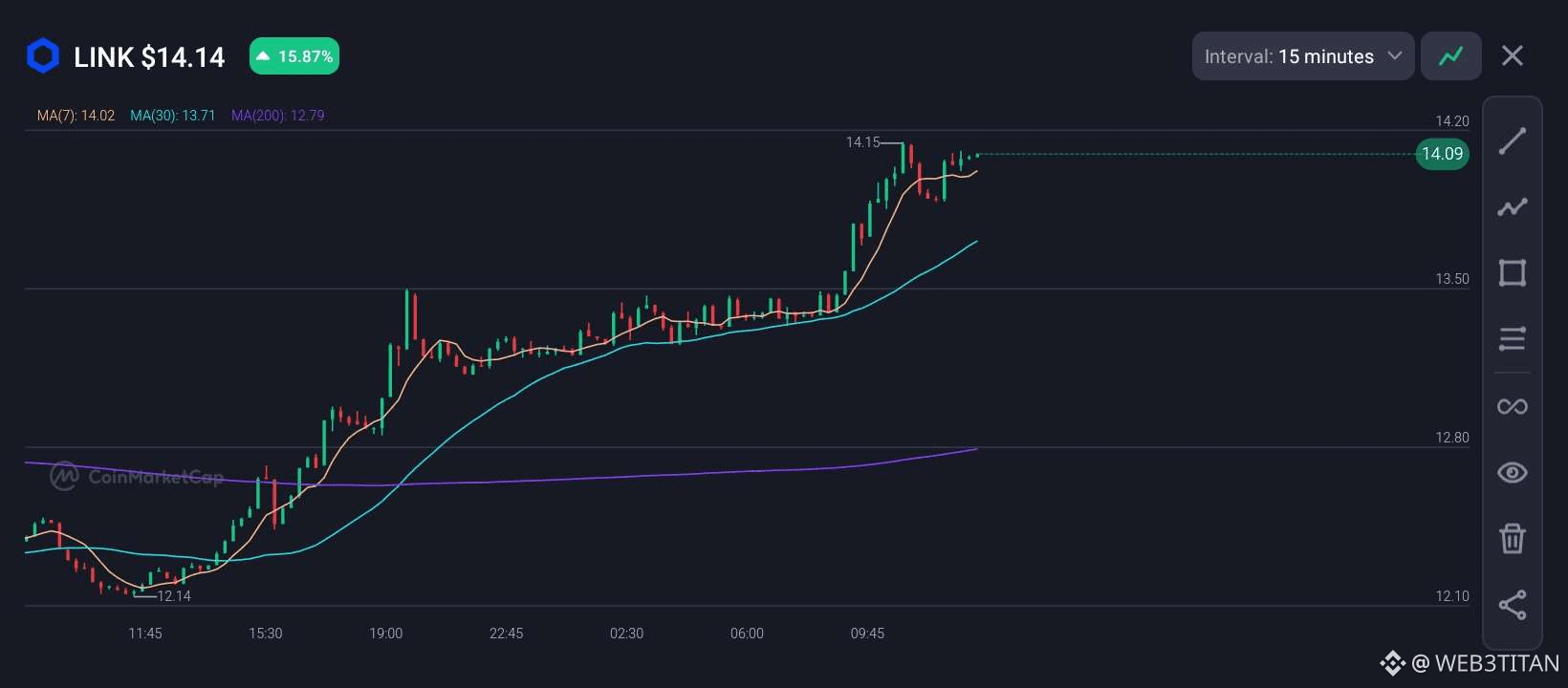
Strong momentum is still holding near the highs.
$LINK is currently trading at $14.14 after a +15.87% move.
Recently, price climbed from the 12.14 area up to a high of 14.15 and is now consolidating right at the peak.
Bias: UPTREND (LONG)
Why:
The rally was sustained and impulsive. Price remains elevated near the highs with limited rejection so far, keeping the short-term structure firmly bullish.
Entry: $13.90 – $14.20
Stop Loss: $13.40
Take Profits
TP1: $14.60
TP2: $15.00
TP3: $15.50 – $16.00
Another part of @stonfi worth exploring is its farming ecosystem. Liquidity providers can deposit eligible LP tokens into supported farms to earn additional rewards on top of the liquidity position, giving users another way to potentially generate returns from assets they are already providing to DeFi markets.
$LINK #LINK🔥🔥🔥
Strong momentum is still holding near the highs.
$LINK is currently trading at $14.14 after a +15.87% move.
Recently, price climbed from the 12.14 area up to a high of 14.15 and is now consolidating right at the peak.
Bias: UPTREND (LONG)
Why:
The rally was sustained and impulsive. Price remains elevated near the highs with limited rejection so far, keeping the short-term structure firmly bullish.
Entry: $13.90 – $14.20
Stop Loss: $13.40
Take Profits
TP1: $14.60
TP2: $15.00
TP3: $15.50 – $16.00
Another part of @STONfi DEX worth exploring is its farming ecosystem. Liquidity providers can deposit eligible LP tokens into supported farms to earn additional rewards on top of the liquidity position, giving users another way to potentially generate returns from assets they are already providing to DeFi markets.
$LINK #LINK🔥🔥🔥
$LINK is currently trading at $14.14 after a +15.87% move.
Recently, price climbed from the 12.14 area up to a high of 14.15 and is now consolidating right at the peak.
Bias: UPTREND (LONG)
Why:
The rally was sustained and impulsive. Price remains elevated near the highs with limited rejection so far, keeping the short-term structure firmly bullish.
Entry: $13.90 – $14.20
Stop Loss: $13.40
Take Profits
TP1: $14.60
TP2: $15.00
TP3: $15.50 – $16.00
Another part of @STONfi DEX worth exploring is its farming ecosystem. Liquidity providers can deposit eligible LP tokens into supported farms to earn additional rewards on top of the liquidity position, giving users another way to potentially generate returns from assets they are already providing to DeFi markets.
$LINK #LINK🔥🔥🔥
83
·
--
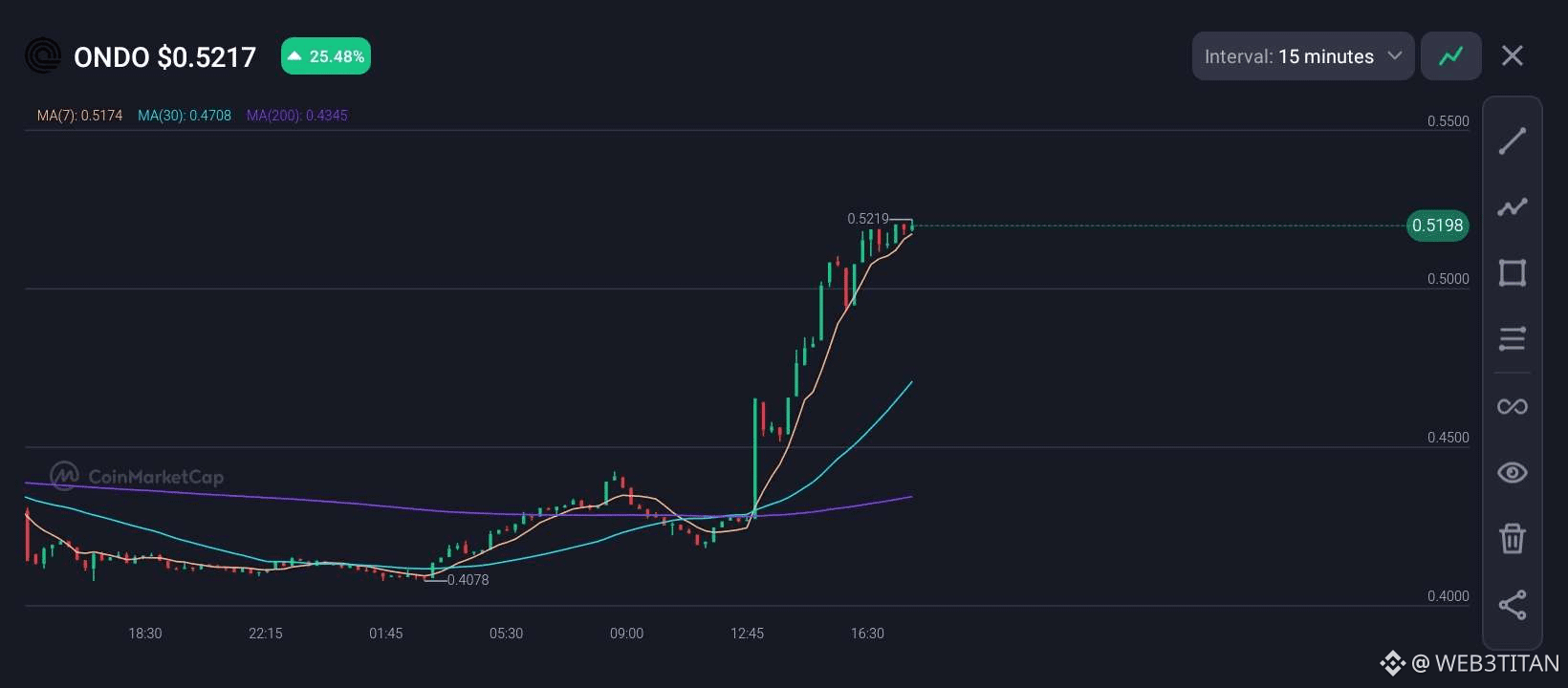
Strong expansion is still in play near the highs.
$ONDO is currently trading at $0.5217 after a +25.48% move.
Recently, price climbed aggressively from the 0.4078 area up to a high of 0.5219 and is now holding right at the peak.
Bias: UPTREND (LONG)
Why:
The rally was highly impulsive and sustained. Price remains elevated at the highs with limited rejection so far, keeping the short-term structure firmly bullish.
Entry: $0.5100 – $0.5250
Stop Loss: $0.4800
Take Profits
TP1: $0.5500
TP2: $0.5800
TP3: $0.6200 – $0.6500
When a token is making a strong move like this, managing exposure across different networks can become important. @stonfi offers cross-chain swaps that let users move supported assets between supported networks through one DeFi experience, making it easier to access liquidity without treating every chain as a completely separate market.
$ONDO #ONDO #FedOctoberRateHikeOddsRiseTo69.7%
Strong expansion is still in play near the highs.
$ONDO is currently trading at $0.5217 after a +25.48% move.
Recently, price climbed aggressively from the 0.4078 area up to a high of 0.5219 and is now holding right at the peak.
Bias: UPTREND (LONG)
Why:
The rally was highly impulsive and sustained. Price remains elevated at the highs with limited rejection so far, keeping the short-term structure firmly bullish.
Entry: $0.5100 – $0.5250
Stop Loss: $0.4800
Take Profits
TP1: $0.5500
TP2: $0.5800
TP3: $0.6200 – $0.6500
When a token is making a strong move like this, managing exposure across different networks can become important. @STONfi DEX offers cross-chain swaps that let users move supported assets between supported networks through one DeFi experience, making it easier to access liquidity without treating every chain as a completely separate market.
$ONDO #ONDO #FedOctoberRateHikeOddsRiseTo69.7%
$ONDO is currently trading at $0.5217 after a +25.48% move.
Recently, price climbed aggressively from the 0.4078 area up to a high of 0.5219 and is now holding right at the peak.
Bias: UPTREND (LONG)
Why:
The rally was highly impulsive and sustained. Price remains elevated at the highs with limited rejection so far, keeping the short-term structure firmly bullish.
Entry: $0.5100 – $0.5250
Stop Loss: $0.4800
Take Profits
TP1: $0.5500
TP2: $0.5800
TP3: $0.6200 – $0.6500
When a token is making a strong move like this, managing exposure across different networks can become important. @STONfi DEX offers cross-chain swaps that let users move supported assets between supported networks through one DeFi experience, making it easier to access liquidity without treating every chain as a completely separate market.
$ONDO #ONDO #FedOctoberRateHikeOddsRiseTo69.7%
145
·
--
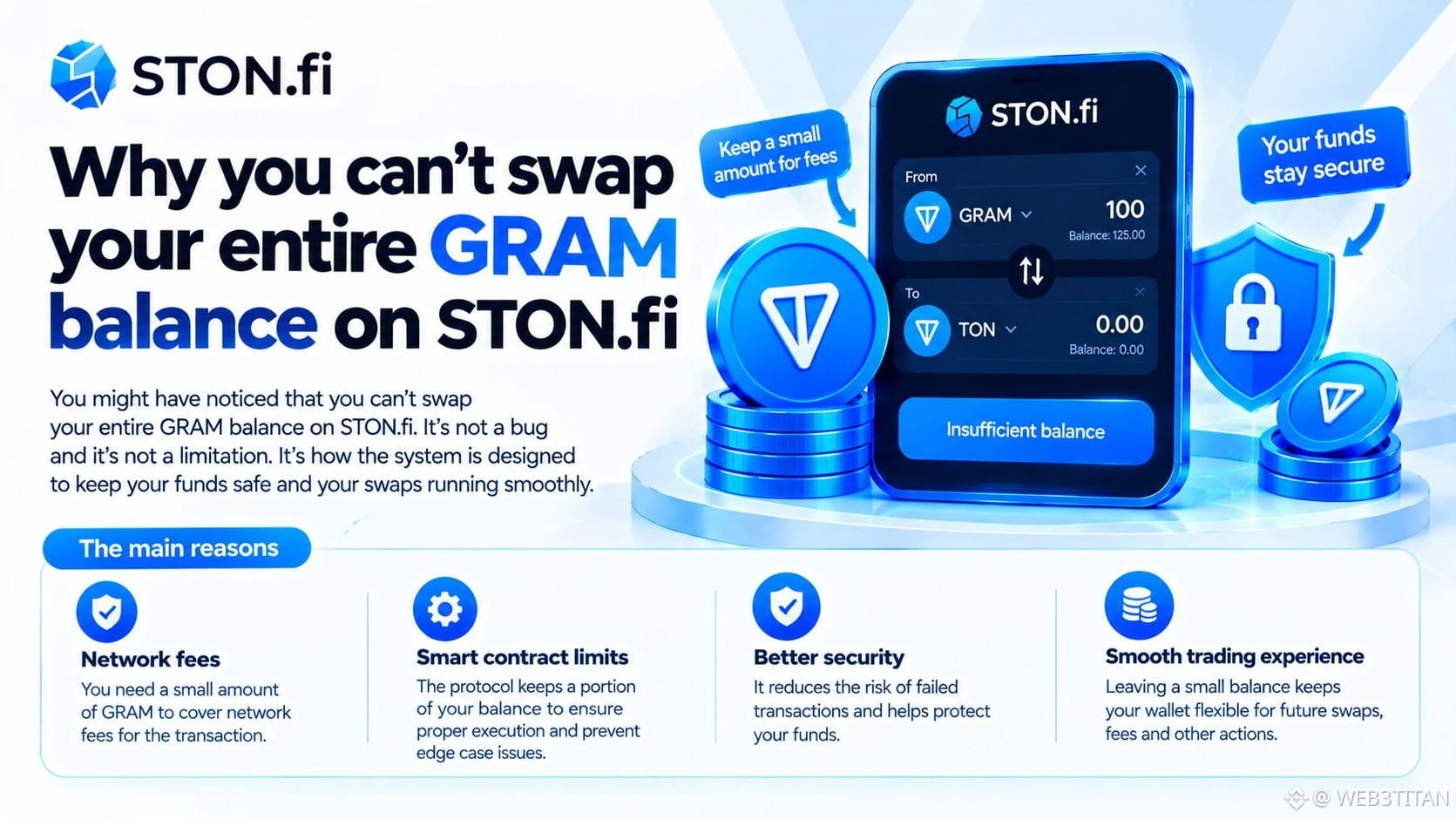
Why You Can’t Swap Your Entire GRAM Balance on STONfi
If you try to swap your entire GRAM balance, you may notice that STONfi doesn't let you use every last token.
This is related to how transactions work on TON.
YOU NEED GAS
Your GRAM is a Jetton, but the transaction still needs TON to pay for gas.
STONfi's swap documentation shows that Jetton swaps require TON for the transaction and forwarding costs.
So having enough GRAM doesn't automatically mean you can spend 100% of it in one transaction.
WHY THE RESERVE MATTERS
A small amount of balance may need to remain available for the wallet to handle the transaction and related blockchain operations.
If you attempt to leave the wallet with nothing available for required costs, execution can fail.
THE SIMPLE FIX
Instead of entering your entire GRAM balance, reduce the input amount slightly and leave enough room for the required TON gas.
For example, if your wallet holds 100 GRAM, don't assume the full 100 GRAM can always be used in the transaction.
The exact amount to leave depends on the transaction and wallet setup.
WHAT TO CHECK
Before confirming, check:
Your TON balance
The GRAM amount you're entering
The estimated transaction cost
The amount remaining after the swap
STONfi's transaction documentation explains that the TON amount sent with a transaction is used to pay for gas.
MY TAKE
This isn't necessarily a swap limitation.
It's a reminder that on TON, Jetton transactions still depend on the blockchain's native TON for execution costs.
Leave enough TON for gas, reduce the GRAM input when necessary, and the transaction can be prepared with those costs in mind.
$XRP $ETH
Why You Can’t Swap Your Entire GRAM Balance on STONfi
If you try to swap your entire GRAM balance, you may notice that STONfi doesn't let you use every last token.
This is related to how transactions work on TON.
YOU NEED GAS
Your GRAM is a Jetton, but the transaction still needs TON to pay for gas.
STONfi's swap documentation shows that Jetton swaps require TON for the transaction and forwarding costs.
So having enough GRAM doesn't automatically mean you can spend 100% of it in one transaction.
WHY THE RESERVE MATTERS
A small amount of balance may need to remain available for the wallet to handle the transaction and related blockchain operations.
If you attempt to leave the wallet with nothing available for required costs, execution can fail.
THE SIMPLE FIX
Instead of entering your entire GRAM balance, reduce the input amount slightly and leave enough room for the required TON gas.
For example, if your wallet holds 100 GRAM, don't assume the full 100 GRAM can always be used in the transaction.
The exact amount to leave depends on the transaction and wallet setup.
WHAT TO CHECK
Before confirming, check:
Your TON balance
The GRAM amount you're entering
The estimated transaction cost
The amount remaining after the swap
STONfi's transaction documentation explains that the TON amount sent with a transaction is used to pay for gas.
MY TAKE
This isn't necessarily a swap limitation.
It's a reminder that on TON, Jetton transactions still depend on the blockchain's native TON for execution costs.
Leave enough TON for gas, reduce the GRAM input when necessary, and the transaction can be prepared with those costs in mind.
$XRP $ETH
If you try to swap your entire GRAM balance, you may notice that STONfi doesn't let you use every last token.
This is related to how transactions work on TON.
YOU NEED GAS
Your GRAM is a Jetton, but the transaction still needs TON to pay for gas.
STONfi's swap documentation shows that Jetton swaps require TON for the transaction and forwarding costs.
So having enough GRAM doesn't automatically mean you can spend 100% of it in one transaction.
WHY THE RESERVE MATTERS
A small amount of balance may need to remain available for the wallet to handle the transaction and related blockchain operations.
If you attempt to leave the wallet with nothing available for required costs, execution can fail.
THE SIMPLE FIX
Instead of entering your entire GRAM balance, reduce the input amount slightly and leave enough room for the required TON gas.
For example, if your wallet holds 100 GRAM, don't assume the full 100 GRAM can always be used in the transaction.
The exact amount to leave depends on the transaction and wallet setup.
WHAT TO CHECK
Before confirming, check:
Your TON balance
The GRAM amount you're entering
The estimated transaction cost
The amount remaining after the swap
STONfi's transaction documentation explains that the TON amount sent with a transaction is used to pay for gas.
MY TAKE
This isn't necessarily a swap limitation.
It's a reminder that on TON, Jetton transactions still depend on the blockchain's native TON for execution costs.
Leave enough TON for gas, reduce the GRAM input when necessary, and the transaction can be prepared with those costs in mind.
$XRP $ETH
1
167
·
--
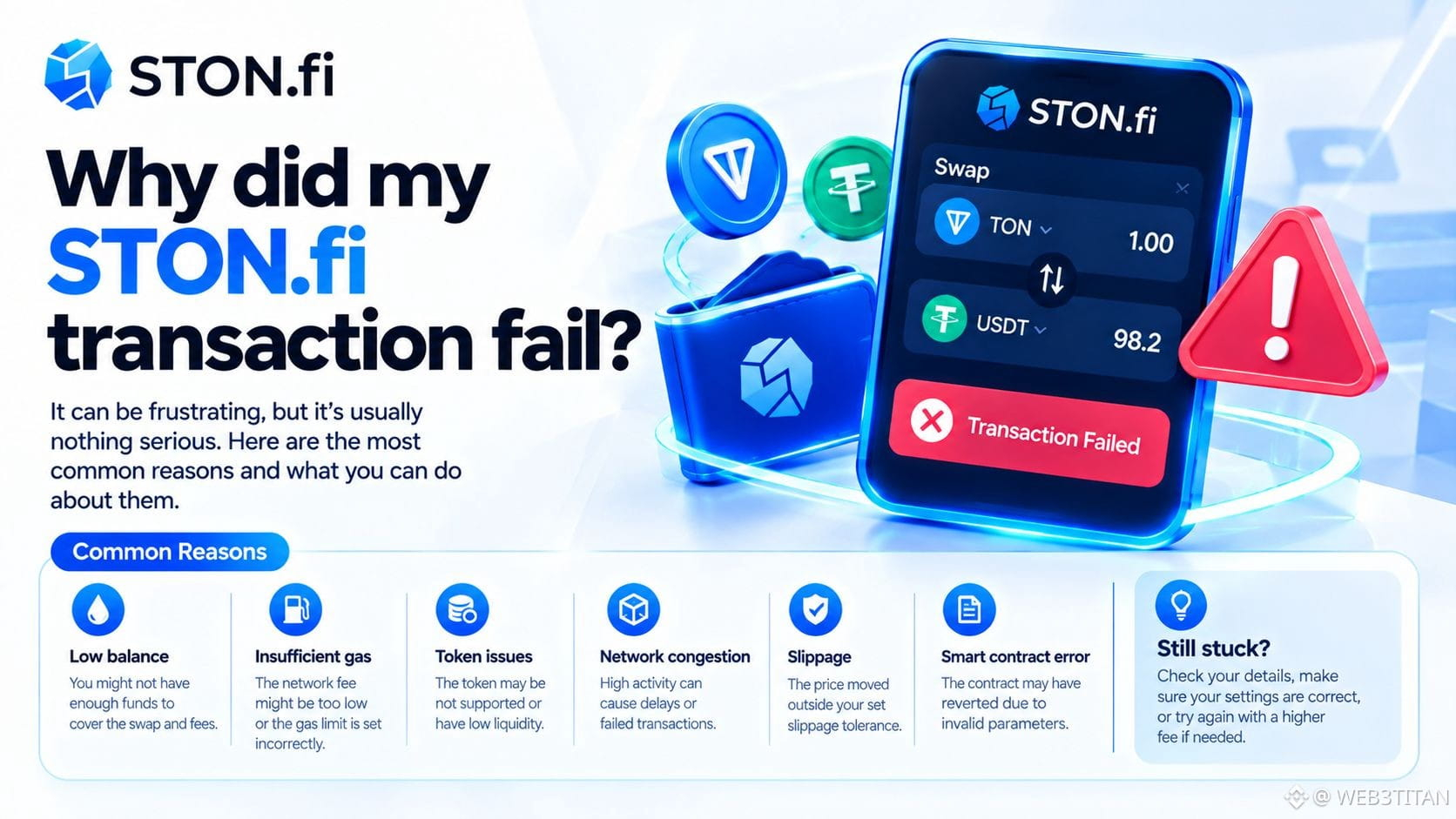
Why Did My STONfi Transaction Fail?
A failed transaction can be frustrating, especially when you're not sure what went wrong. Before trying again, it's worth checking a few things.
CHECK THE OPERATION
First, identify what you were doing.
Was it a swap, liquidity deposit, withdrawal, staking action, or another transaction?
The possible cause can depend on the operation.
CHECK YOUR GAS BALANCE
Your wallet needs enough TON to cover the blockchain fees required to process the transaction.
If your TON balance is too low, the transaction may not be completed.
REVIEW THE SWAP DETAILS
For swaps, check the slippage settings, price changes, and token warnings shown before confirmation.
A significant price movement can cause the transaction conditions to no longer be valid.
CHECK THE TRANSACTION STATUS
If you've already submitted the transaction, check its status on a TON blockchain explorer.
This can help determine whether it failed, is still processing, or was successfully completed.
BEFORE RETRYING
Don't immediately submit the same transaction again.
First identify the likely cause, then check your balance and transaction details. If the issue continues, keep the transaction hash and relevant wallet details available when contacting support.
MY TAKE
A failed transaction doesn't always mean something is wrong with STONfi.
Understanding the operation, gas requirements, swap conditions, and on-chain status can help you identify the problem before making another attempt.
$GRAM $SOL #BTCBreaks80K
Why Did My STONfi Transaction Fail?
A failed transaction can be frustrating, especially when you're not sure what went wrong. Before trying again, it's worth checking a few things.
CHECK THE OPERATION
First, identify what you were doing.
Was it a swap, liquidity deposit, withdrawal, staking action, or another transaction?
The possible cause can depend on the operation.
CHECK YOUR GAS BALANCE
Your wallet needs enough TON to cover the blockchain fees required to process the transaction.
If your TON balance is too low, the transaction may not be completed.
REVIEW THE SWAP DETAILS
For swaps, check the slippage settings, price changes, and token warnings shown before confirmation.
A significant price movement can cause the transaction conditions to no longer be valid.
CHECK THE TRANSACTION STATUS
If you've already submitted the transaction, check its status on a TON blockchain explorer.
This can help determine whether it failed, is still processing, or was successfully completed.
BEFORE RETRYING
Don't immediately submit the same transaction again.
First identify the likely cause, then check your balance and transaction details. If the issue continues, keep the transaction hash and relevant wallet details available when contacting support.
MY TAKE
A failed transaction doesn't always mean something is wrong with STONfi.
Understanding the operation, gas requirements, swap conditions, and on-chain status can help you identify the problem before making another attempt.
$GRAM $SOL #BTCBreaks80K
A failed transaction can be frustrating, especially when you're not sure what went wrong. Before trying again, it's worth checking a few things.
CHECK THE OPERATION
First, identify what you were doing.
Was it a swap, liquidity deposit, withdrawal, staking action, or another transaction?
The possible cause can depend on the operation.
CHECK YOUR GAS BALANCE
Your wallet needs enough TON to cover the blockchain fees required to process the transaction.
If your TON balance is too low, the transaction may not be completed.
REVIEW THE SWAP DETAILS
For swaps, check the slippage settings, price changes, and token warnings shown before confirmation.
A significant price movement can cause the transaction conditions to no longer be valid.
CHECK THE TRANSACTION STATUS
If you've already submitted the transaction, check its status on a TON blockchain explorer.
This can help determine whether it failed, is still processing, or was successfully completed.
BEFORE RETRYING
Don't immediately submit the same transaction again.
First identify the likely cause, then check your balance and transaction details. If the issue continues, keep the transaction hash and relevant wallet details available when contacting support.
MY TAKE
A failed transaction doesn't always mean something is wrong with STONfi.
Understanding the operation, gas requirements, swap conditions, and on-chain status can help you identify the problem before making another attempt.
$GRAM $SOL #BTCBreaks80K
1
130
·
--
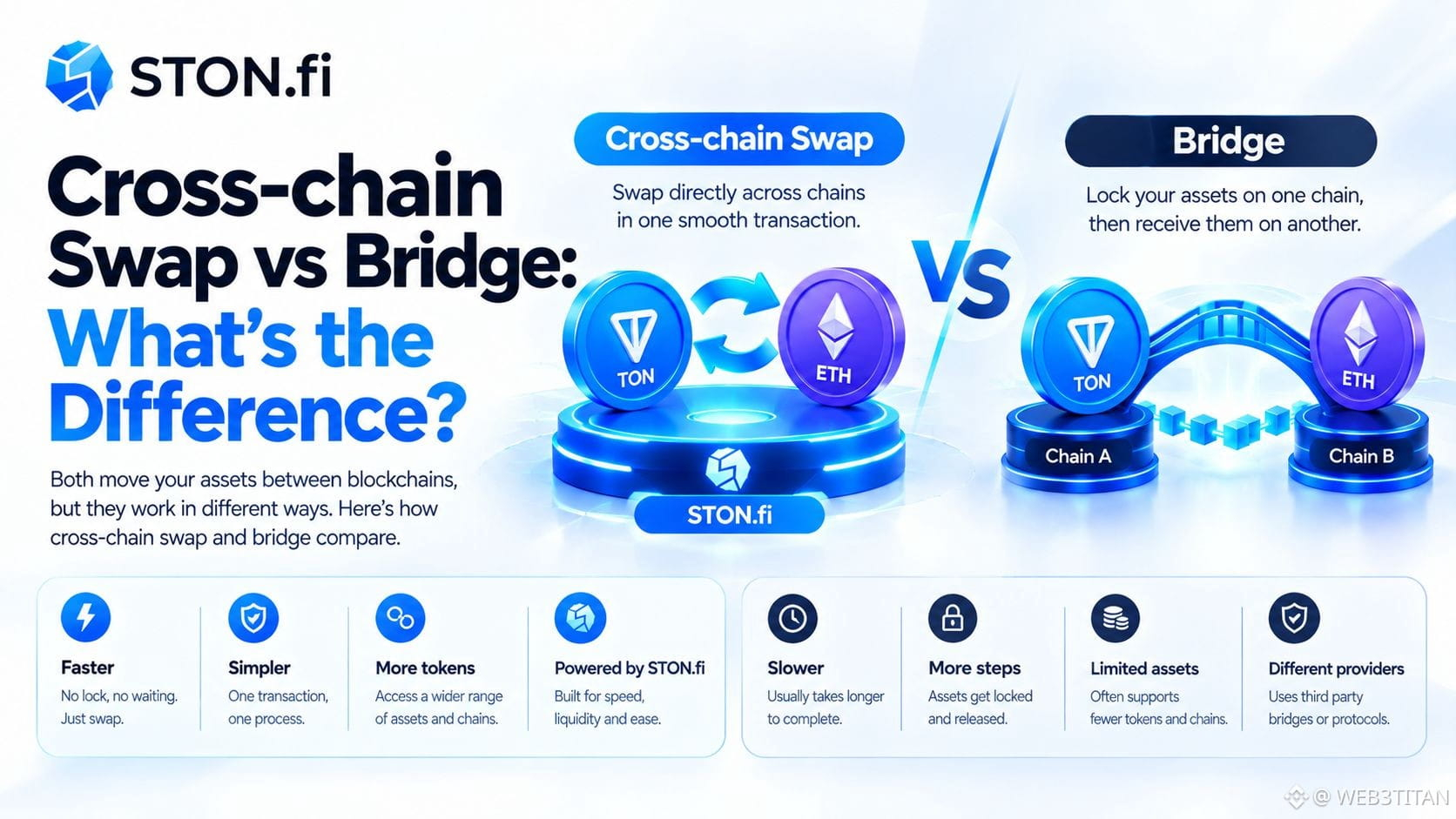
Cross Chain Swap vs Bridge: What’s the Difference?
Moving assets between blockchains can happen in different ways. Two common approaches are bridges and cross chain swaps, but they solve different problems.
WHAT IS A BRIDGE?
A bridge is designed to move an asset from one blockchain to another.
Depending on its architecture, the original asset may be locked or held while a corresponding wrapped or bridged version is created on the destination network.
WHAT IS A CROSS CHAIN SWAP?
A cross chain swap lets you exchange an asset on one network for another asset on a different network.
Instead of simply moving the same asset, you can receive a different native or supported asset on the destination chain.
THE KEY DIFFERENCES
Bridge: Move an asset between networks, often involving locking and representing it on the destination.
Cross chain swap: Exchange one asset for another across different networks.
They can also differ in custody assumptions, route complexity, fees, and how failed transactions or refunds are handled.
WHERE OMNISTON FITS
Omniston focuses on cross chain execution and liquidity aggregation. It coordinates available liquidity and routes to help users exchange assets across supported networks.
That doesn't make bridges universally wrong.
Bridges can be useful when you specifically want to move an asset between networks, while cross chain swaps are useful when you want to exchange one asset for another.
MY TAKE
The right model depends on the goal.
If you need the same asset on another network, a bridge may fit. If you want a different asset on another network, a cross chain swap offers a different approach.
Understanding the architecture first makes it easier to choose the right tool.
$GRAM $XRP
#MemeLaunchpads82%OfArcDayOneVolume
Cross Chain Swap vs Bridge: What’s the Difference?
Moving assets between blockchains can happen in different ways. Two common approaches are bridges and cross chain swaps, but they solve different problems.
WHAT IS A BRIDGE?
A bridge is designed to move an asset from one blockchain to another.
Depending on its architecture, the original asset may be locked or held while a corresponding wrapped or bridged version is created on the destination network.
WHAT IS A CROSS CHAIN SWAP?
A cross chain swap lets you exchange an asset on one network for another asset on a different network.
Instead of simply moving the same asset, you can receive a different native or supported asset on the destination chain.
THE KEY DIFFERENCES
Bridge: Move an asset between networks, often involving locking and representing it on the destination.
Cross chain swap: Exchange one asset for another across different networks.
They can also differ in custody assumptions, route complexity, fees, and how failed transactions or refunds are handled.
WHERE OMNISTON FITS
Omniston focuses on cross chain execution and liquidity aggregation. It coordinates available liquidity and routes to help users exchange assets across supported networks.
That doesn't make bridges universally wrong.
Bridges can be useful when you specifically want to move an asset between networks, while cross chain swaps are useful when you want to exchange one asset for another.
MY TAKE
The right model depends on the goal.
If you need the same asset on another network, a bridge may fit. If you want a different asset on another network, a cross chain swap offers a different approach.
Understanding the architecture first makes it easier to choose the right tool.
$GRAM $XRP
#MemeLaunchpads82%OfArcDayOneVolume
Moving assets between blockchains can happen in different ways. Two common approaches are bridges and cross chain swaps, but they solve different problems.
WHAT IS A BRIDGE?
A bridge is designed to move an asset from one blockchain to another.
Depending on its architecture, the original asset may be locked or held while a corresponding wrapped or bridged version is created on the destination network.
WHAT IS A CROSS CHAIN SWAP?
A cross chain swap lets you exchange an asset on one network for another asset on a different network.
Instead of simply moving the same asset, you can receive a different native or supported asset on the destination chain.
THE KEY DIFFERENCES
Bridge: Move an asset between networks, often involving locking and representing it on the destination.
Cross chain swap: Exchange one asset for another across different networks.
They can also differ in custody assumptions, route complexity, fees, and how failed transactions or refunds are handled.
WHERE OMNISTON FITS
Omniston focuses on cross chain execution and liquidity aggregation. It coordinates available liquidity and routes to help users exchange assets across supported networks.
That doesn't make bridges universally wrong.
Bridges can be useful when you specifically want to move an asset between networks, while cross chain swaps are useful when you want to exchange one asset for another.
MY TAKE
The right model depends on the goal.
If you need the same asset on another network, a bridge may fit. If you want a different asset on another network, a cross chain swap offers a different approach.
Understanding the architecture first makes it easier to choose the right tool.
$GRAM $XRP
#MemeLaunchpads82%OfArcDayOneVolume
2
448
·
--
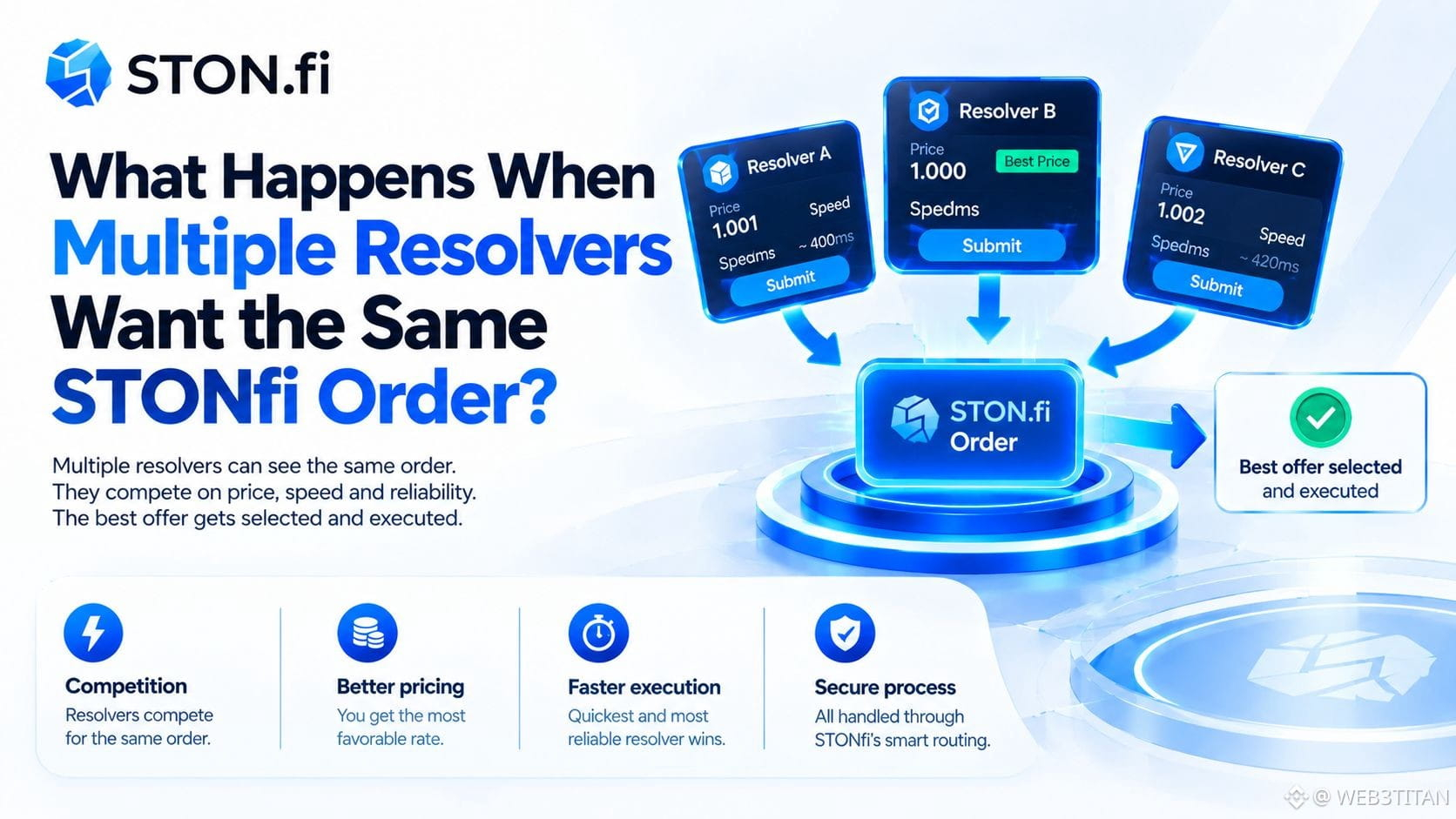
What Happens When Multiple Resolvers Want the Same STONfi Order?
One interesting part of Omniston is what happens when multiple resolvers can fulfill the same order.
Instead of relying on just one source, the system can create competition between available liquidity providers.
MULTIPLE QUOTES
When an order is submitted, eligible resolvers can respond with quotes.
Each resolver can offer different pricing and execution terms based on the liquidity and routes available to them.
That means the same order can receive multiple competing quotes.
HOW THE BEST OPTION IS SELECTED
The quotes can then be compared to determine which option offers the most suitable execution.
Price matters, but execution isn't simply about choosing the biggest number. The route, available liquidity, and ability to complete the transaction also matter.
WHY COMPETITION MATTERS
Multiple resolvers create a more competitive environment.
If one resolver offers a weaker quote while another can provide better execution, the order has alternatives instead of being dependent on a single liquidity source.
This can help improve pricing and execution efficiency.
WHAT HAPPENS NEXT?
Once the preferred quote is selected, the resolver handles the execution according to the order's conditions.
The goal is to move from quote discovery → selection → execution without forcing the user to manually compare every liquidity source.
MY TAKE
This is one of the interesting ideas behind Omniston.
Resolvers aren't just additional infrastructure. Their competition can become part of the mechanism for finding better execution.
More resolvers can mean more quotes, more competition, and potentially better outcomes for the same STONfi order.
$GRAM $XRP
#CPIWatch
What Happens When Multiple Resolvers Want the Same STONfi Order?
One interesting part of Omniston is what happens when multiple resolvers can fulfill the same order.
Instead of relying on just one source, the system can create competition between available liquidity providers.
MULTIPLE QUOTES
When an order is submitted, eligible resolvers can respond with quotes.
Each resolver can offer different pricing and execution terms based on the liquidity and routes available to them.
That means the same order can receive multiple competing quotes.
HOW THE BEST OPTION IS SELECTED
The quotes can then be compared to determine which option offers the most suitable execution.
Price matters, but execution isn't simply about choosing the biggest number. The route, available liquidity, and ability to complete the transaction also matter.
WHY COMPETITION MATTERS
Multiple resolvers create a more competitive environment.
If one resolver offers a weaker quote while another can provide better execution, the order has alternatives instead of being dependent on a single liquidity source.
This can help improve pricing and execution efficiency.
WHAT HAPPENS NEXT?
Once the preferred quote is selected, the resolver handles the execution according to the order's conditions.
The goal is to move from quote discovery → selection → execution without forcing the user to manually compare every liquidity source.
MY TAKE
This is one of the interesting ideas behind Omniston.
Resolvers aren't just additional infrastructure. Their competition can become part of the mechanism for finding better execution.
More resolvers can mean more quotes, more competition, and potentially better outcomes for the same STONfi order.
$GRAM $XRP
#CPIWatch
One interesting part of Omniston is what happens when multiple resolvers can fulfill the same order.
Instead of relying on just one source, the system can create competition between available liquidity providers.
MULTIPLE QUOTES
When an order is submitted, eligible resolvers can respond with quotes.
Each resolver can offer different pricing and execution terms based on the liquidity and routes available to them.
That means the same order can receive multiple competing quotes.
HOW THE BEST OPTION IS SELECTED
The quotes can then be compared to determine which option offers the most suitable execution.
Price matters, but execution isn't simply about choosing the biggest number. The route, available liquidity, and ability to complete the transaction also matter.
WHY COMPETITION MATTERS
Multiple resolvers create a more competitive environment.
If one resolver offers a weaker quote while another can provide better execution, the order has alternatives instead of being dependent on a single liquidity source.
This can help improve pricing and execution efficiency.
WHAT HAPPENS NEXT?
Once the preferred quote is selected, the resolver handles the execution according to the order's conditions.
The goal is to move from quote discovery → selection → execution without forcing the user to manually compare every liquidity source.
MY TAKE
This is one of the interesting ideas behind Omniston.
Resolvers aren't just additional infrastructure. Their competition can become part of the mechanism for finding better execution.
More resolvers can mean more quotes, more competition, and potentially better outcomes for the same STONfi order.
$GRAM $XRP
#CPIWatch
2
282
·
--
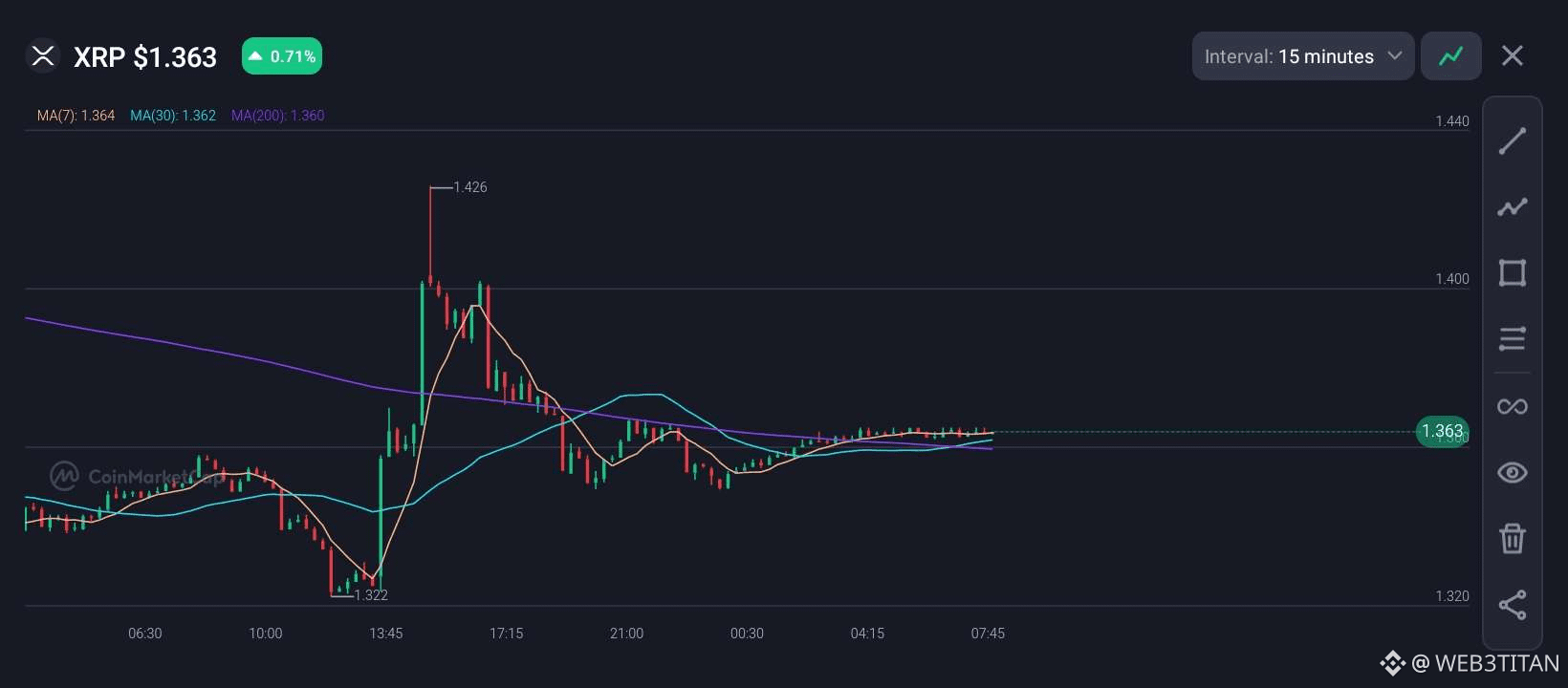
Price is consolidating tightly after the recent spike.
$XRP is currently trading at $1.363 after a +0.71% move.
Recently, price pushed up to a high of 1.426 before pulling back from the 1.322 low area. It is now stabilizing in a tight range after the volatility.
Bias: UPTREND (LONG)
Why:
Despite the rejection from 1.426, price is holding above the recent low and showing signs of range compression. The structure remains constructive as long as support around the current zone holds.
Entry: $1.355 – $1.370
Stop Loss: $1.330
Take Profits
TP1: $1.400
TP2: $1.430
TP3: $1.460 – $1.500
Range compression can create good opportunities for traders watching for the next move. @stonfi makes it easy to swap between supported assets when that move comes, while its liquidity pools let users provide liquidity to trading pairs and potentially earn fees generated by swap activity.
$XRP #CPIWatch
Price is consolidating tightly after the recent spike.
$XRP is currently trading at $1.363 after a +0.71% move.
Recently, price pushed up to a high of 1.426 before pulling back from the 1.322 low area. It is now stabilizing in a tight range after the volatility.
Bias: UPTREND (LONG)
Why:
Despite the rejection from 1.426, price is holding above the recent low and showing signs of range compression. The structure remains constructive as long as support around the current zone holds.
Entry: $1.355 – $1.370
Stop Loss: $1.330
Take Profits
TP1: $1.400
TP2: $1.430
TP3: $1.460 – $1.500
Range compression can create good opportunities for traders watching for the next move. @STONfi DEX makes it easy to swap between supported assets when that move comes, while its liquidity pools let users provide liquidity to trading pairs and potentially earn fees generated by swap activity.
$XRP #CPIWatch
$XRP is currently trading at $1.363 after a +0.71% move.
Recently, price pushed up to a high of 1.426 before pulling back from the 1.322 low area. It is now stabilizing in a tight range after the volatility.
Bias: UPTREND (LONG)
Why:
Despite the rejection from 1.426, price is holding above the recent low and showing signs of range compression. The structure remains constructive as long as support around the current zone holds.
Entry: $1.355 – $1.370
Stop Loss: $1.330
Take Profits
TP1: $1.400
TP2: $1.430
TP3: $1.460 – $1.500
Range compression can create good opportunities for traders watching for the next move. @STONfi DEX makes it easy to swap between supported assets when that move comes, while its liquidity pools let users provide liquidity to trading pairs and potentially earn fees generated by swap activity.
$XRP #CPIWatch
1
146
·
--
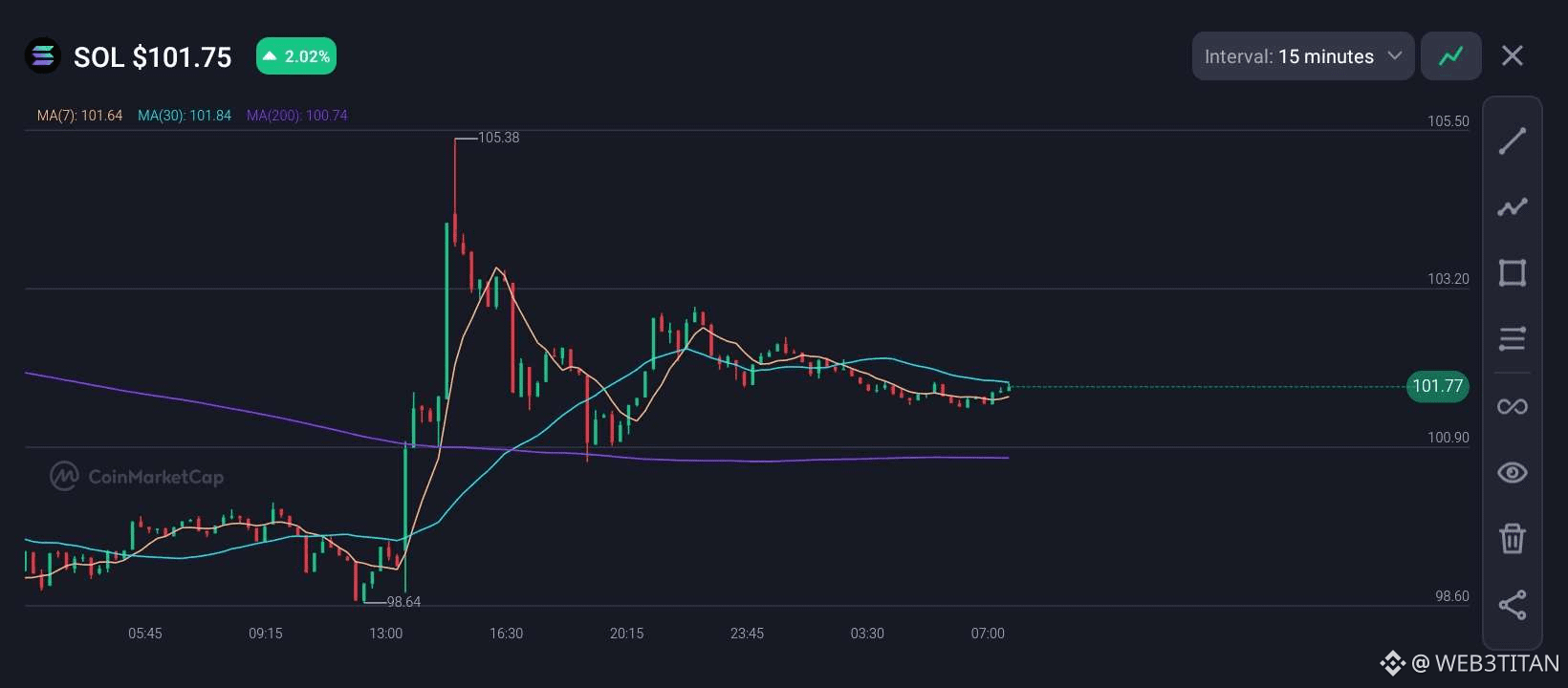
Price is consolidating after the recent volatility.
$SOL is currently trading at $101.75 after a +2.02% move.
Recently, price spiked up to a high of 105.38 before pulling back from the 98.64 low area. It is now stabilizing in the mid-range after the move.
Bias: UPTREND (LONG)
Why:
Despite the rejection from 105.38, price is holding above the recent low and showing signs of stabilization. The structure remains constructive as long as support around the current zone holds.
Entry: $101.20 – $102.00
Stop Loss: $99.50
Take Profits
TP1: $103.50
TP2: $105.00
TP3: $107.00 – $109.00
For traders rotating between assets as setups develop, @stonfi makes on-chain swaps straightforward without needing to leave the DeFi environment. Beyond swapping, its liquidity pools connect directly to that trading activity, giving users another way to participate by supplying liquidity and potentially earning fees from swaps.
$SOL
#CPIWatch
Price is consolidating after the recent volatility.
$SOL is currently trading at $101.75 after a +2.02% move.
Recently, price spiked up to a high of 105.38 before pulling back from the 98.64 low area. It is now stabilizing in the mid-range after the move.
Bias: UPTREND (LONG)
Why:
Despite the rejection from 105.38, price is holding above the recent low and showing signs of stabilization. The structure remains constructive as long as support around the current zone holds.
Entry: $101.20 – $102.00
Stop Loss: $99.50
Take Profits
TP1: $103.50
TP2: $105.00
TP3: $107.00 – $109.00
For traders rotating between assets as setups develop, @STONfi DEX makes on-chain swaps straightforward without needing to leave the DeFi environment. Beyond swapping, its liquidity pools connect directly to that trading activity, giving users another way to participate by supplying liquidity and potentially earning fees from swaps.
$SOL
#CPIWatch
$SOL is currently trading at $101.75 after a +2.02% move.
Recently, price spiked up to a high of 105.38 before pulling back from the 98.64 low area. It is now stabilizing in the mid-range after the move.
Bias: UPTREND (LONG)
Why:
Despite the rejection from 105.38, price is holding above the recent low and showing signs of stabilization. The structure remains constructive as long as support around the current zone holds.
Entry: $101.20 – $102.00
Stop Loss: $99.50
Take Profits
TP1: $103.50
TP2: $105.00
TP3: $107.00 – $109.00
For traders rotating between assets as setups develop, @STONfi DEX makes on-chain swaps straightforward without needing to leave the DeFi environment. Beyond swapping, its liquidity pools connect directly to that trading activity, giving users another way to participate by supplying liquidity and potentially earning fees from swaps.
$SOL
#CPIWatch
1
63
·
--
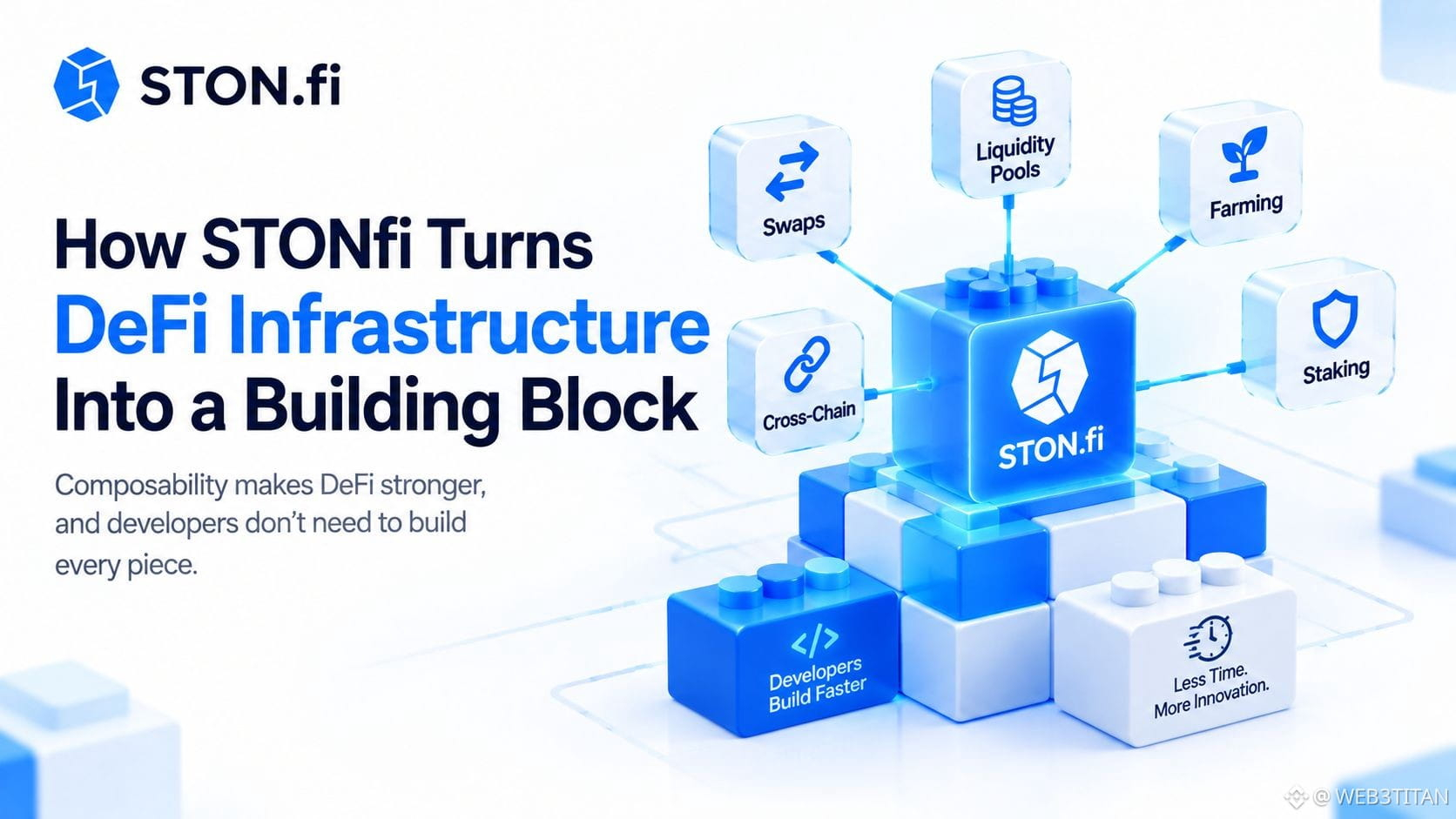
How STONfi Turns DeFi Infrastructure Into a Building Block
One thing that stands out about DeFi is that developers don't always need to build every component from scratch.
Existing infrastructure can become a building block for new applications.
WHAT COMPOSABILITY MEANS
Composability means different DeFi components can work together.
A developer building a trading app doesn't necessarily need to create their own liquidity pools, routing system, or swap interface.
They can build on existing infrastructure and focus on what makes their application different.
STONfi AS INFRASTRUCTURE
STONfi provides trading infrastructure developers can build around.
Through its API, SDK, Widget, and liquidity infrastructure, developers can connect swapping functionality to their applications without recreating the entire trading stack.
WHY THIS MATTERS
Building every trading component independently takes time and resources.
With composable infrastructure, developers can focus more on their product while relying on existing systems for core DeFi functionality.
A wallet, Telegram application, portfolio tool, or trading interface can integrate swap functionality without becoming a DEX itself.
THE BIGGER PICTURE
This is how DeFi infrastructure becomes more powerful.
Its value isn't only in the original application. It's also in what other developers can build on top of it.
More reusable infrastructure can lead to more applications, use cases, and a more connected ecosystem.
MY TAKE
Developers shouldn't have to rebuild the same trading infrastructure every time they create a new product.
When infrastructure becomes a building block, DeFi applications can focus less on rebuilding the foundation and more on creating something new.
$GRAM $SOL
#CPIWatch
How STONfi Turns DeFi Infrastructure Into a Building Block
One thing that stands out about DeFi is that developers don't always need to build every component from scratch.
Existing infrastructure can become a building block for new applications.
WHAT COMPOSABILITY MEANS
Composability means different DeFi components can work together.
A developer building a trading app doesn't necessarily need to create their own liquidity pools, routing system, or swap interface.
They can build on existing infrastructure and focus on what makes their application different.
STONfi AS INFRASTRUCTURE
STONfi provides trading infrastructure developers can build around.
Through its API, SDK, Widget, and liquidity infrastructure, developers can connect swapping functionality to their applications without recreating the entire trading stack.
WHY THIS MATTERS
Building every trading component independently takes time and resources.
With composable infrastructure, developers can focus more on their product while relying on existing systems for core DeFi functionality.
A wallet, Telegram application, portfolio tool, or trading interface can integrate swap functionality without becoming a DEX itself.
THE BIGGER PICTURE
This is how DeFi infrastructure becomes more powerful.
Its value isn't only in the original application. It's also in what other developers can build on top of it.
More reusable infrastructure can lead to more applications, use cases, and a more connected ecosystem.
MY TAKE
Developers shouldn't have to rebuild the same trading infrastructure every time they create a new product.
When infrastructure becomes a building block, DeFi applications can focus less on rebuilding the foundation and more on creating something new.
$GRAM $SOL
#CPIWatch
One thing that stands out about DeFi is that developers don't always need to build every component from scratch.
Existing infrastructure can become a building block for new applications.
WHAT COMPOSABILITY MEANS
Composability means different DeFi components can work together.
A developer building a trading app doesn't necessarily need to create their own liquidity pools, routing system, or swap interface.
They can build on existing infrastructure and focus on what makes their application different.
STONfi AS INFRASTRUCTURE
STONfi provides trading infrastructure developers can build around.
Through its API, SDK, Widget, and liquidity infrastructure, developers can connect swapping functionality to their applications without recreating the entire trading stack.
WHY THIS MATTERS
Building every trading component independently takes time and resources.
With composable infrastructure, developers can focus more on their product while relying on existing systems for core DeFi functionality.
A wallet, Telegram application, portfolio tool, or trading interface can integrate swap functionality without becoming a DEX itself.
THE BIGGER PICTURE
This is how DeFi infrastructure becomes more powerful.
Its value isn't only in the original application. It's also in what other developers can build on top of it.
More reusable infrastructure can lead to more applications, use cases, and a more connected ecosystem.
MY TAKE
Developers shouldn't have to rebuild the same trading infrastructure every time they create a new product.
When infrastructure becomes a building block, DeFi applications can focus less on rebuilding the foundation and more on creating something new.
$GRAM $SOL
#CPIWatch
1
193
·
--
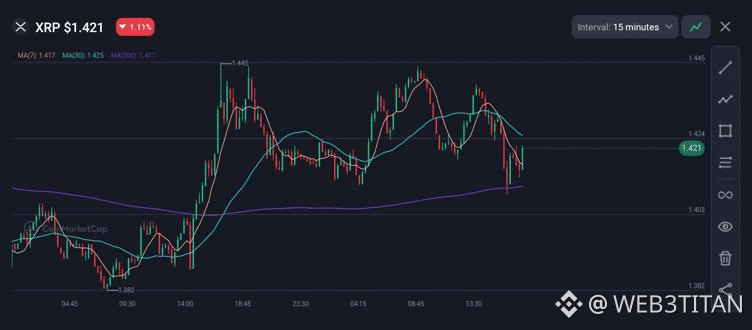
Price is consolidating after the recent volatility.
$XRP is currently trading at $1.421 after a -1.11% move.
Recently, price pushed up to a high of 1.445 before facing selling pressure and pulling back. It is now stabilizing in the mid-range after the move, still holding above the 1.382 low.
Bias: UPTREND (LONG)
Why:
Despite the rejection from 1.445, the broader structure remains higher from the lows. Price is holding the current zone with limited breakdown, keeping the short-term bias constructive as long as support holds.
Entry: $1.410 – $1.425
Stop Loss: $1.385
Take Profits
TP1: $1.450
TP2: $1.480
TP3: $1.510 – $1.550
When the market is moving between different zones, @stonfi is useful for quickly swapping between supported assets without leaving the TON DeFi ecosystem. I also like that there are liquidity pools where users can provide assets and potentially earn a share of swap fees, with additional opportunities available through eligible farms.
$XRP
#BitcoinSurpasses$79K
Price is consolidating after the recent volatility.
$XRP is currently trading at $1.421 after a -1.11% move.
Recently, price pushed up to a high of 1.445 before facing selling pressure and pulling back. It is now stabilizing in the mid-range after the move, still holding above the 1.382 low.
Bias: UPTREND (LONG)
Why:
Despite the rejection from 1.445, the broader structure remains higher from the lows. Price is holding the current zone with limited breakdown, keeping the short-term bias constructive as long as support holds.
Entry: $1.410 – $1.425
Stop Loss: $1.385
Take Profits
TP1: $1.450
TP2: $1.480
TP3: $1.510 – $1.550
When the market is moving between different zones, @STONfi DEX is useful for quickly swapping between supported assets without leaving the TON DeFi ecosystem. I also like that there are liquidity pools where users can provide assets and potentially earn a share of swap fees, with additional opportunities available through eligible farms.
$XRP
#BitcoinSurpasses$79K
$XRP is currently trading at $1.421 after a -1.11% move.
Recently, price pushed up to a high of 1.445 before facing selling pressure and pulling back. It is now stabilizing in the mid-range after the move, still holding above the 1.382 low.
Bias: UPTREND (LONG)
Why:
Despite the rejection from 1.445, the broader structure remains higher from the lows. Price is holding the current zone with limited breakdown, keeping the short-term bias constructive as long as support holds.
Entry: $1.410 – $1.425
Stop Loss: $1.385
Take Profits
TP1: $1.450
TP2: $1.480
TP3: $1.510 – $1.550
When the market is moving between different zones, @STONfi DEX is useful for quickly swapping between supported assets without leaving the TON DeFi ecosystem. I also like that there are liquidity pools where users can provide assets and potentially earn a share of swap fees, with additional opportunities available through eligible farms.
$XRP
#BitcoinSurpasses$79K
1
35
·
--
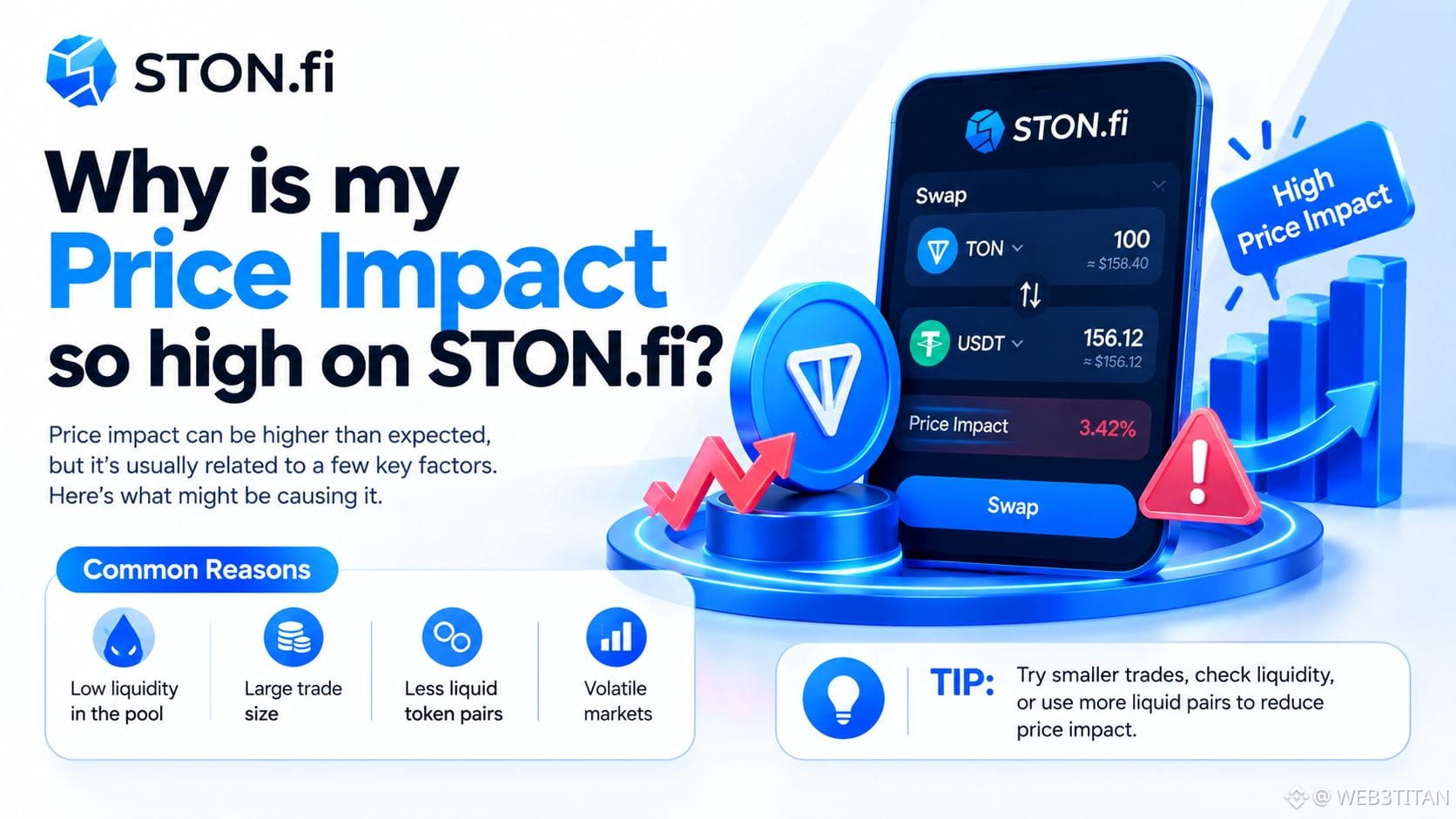
Why Is My Price Impact So High on STONfi?
Seeing a high price impact during a swap can be confusing. Usually, it comes down to the relationship between your trade size and the liquidity available for that route.
CHECK YOUR TRADE SIZE
The first thing to look at is the size of the swap.
A larger trade can consume more of the available liquidity, causing the pool price to move further during execution.
CHECK POOL LIQUIDITY
Pool TVL and token balances also matter.
A pool with limited liquidity may have less capacity to handle larger trades efficiently. An imbalanced pool can also result in less favorable execution for one side of the pair.
WHY ILLIQUID POOLS MATTER
Two pools can support the same token pair but produce different price impacts.
A deeper, more balanced pool generally has more liquidity available for trades, while a shallow pool can experience larger price movements from the same transaction size.
COMPARE THE PREVIEW
Before confirming, you can compare what happens when the trade size is smaller or when another available route is shown.
The goal isn't to automatically choose one option, but to understand how trade size and available liquidity affect the quoted result.
WHAT TO CHECK
Before confirmation, review:
Price impact
Expected output
Liquidity available
Route
Minimum received
MY TAKE
A high price impact isn't necessarily a problem with STONfi itself. It can be a signal that the trade is large relative to the available liquidity.
Understanding that relationship makes the swap preview much more useful and helps you recognize potential execution issues before confirming.
$XRP $PIXEL
#BitcoinSurpasses$79K
Why Is My Price Impact So High on STONfi?
Seeing a high price impact during a swap can be confusing. Usually, it comes down to the relationship between your trade size and the liquidity available for that route.
CHECK YOUR TRADE SIZE
The first thing to look at is the size of the swap.
A larger trade can consume more of the available liquidity, causing the pool price to move further during execution.
CHECK POOL LIQUIDITY
Pool TVL and token balances also matter.
A pool with limited liquidity may have less capacity to handle larger trades efficiently. An imbalanced pool can also result in less favorable execution for one side of the pair.
WHY ILLIQUID POOLS MATTER
Two pools can support the same token pair but produce different price impacts.
A deeper, more balanced pool generally has more liquidity available for trades, while a shallow pool can experience larger price movements from the same transaction size.
COMPARE THE PREVIEW
Before confirming, you can compare what happens when the trade size is smaller or when another available route is shown.
The goal isn't to automatically choose one option, but to understand how trade size and available liquidity affect the quoted result.
WHAT TO CHECK
Before confirmation, review:
Price impact
Expected output
Liquidity available
Route
Minimum received
MY TAKE
A high price impact isn't necessarily a problem with STONfi itself. It can be a signal that the trade is large relative to the available liquidity.
Understanding that relationship makes the swap preview much more useful and helps you recognize potential execution issues before confirming.
$XRP $PIXEL
#BitcoinSurpasses$79K
Seeing a high price impact during a swap can be confusing. Usually, it comes down to the relationship between your trade size and the liquidity available for that route.
CHECK YOUR TRADE SIZE
The first thing to look at is the size of the swap.
A larger trade can consume more of the available liquidity, causing the pool price to move further during execution.
CHECK POOL LIQUIDITY
Pool TVL and token balances also matter.
A pool with limited liquidity may have less capacity to handle larger trades efficiently. An imbalanced pool can also result in less favorable execution for one side of the pair.
WHY ILLIQUID POOLS MATTER
Two pools can support the same token pair but produce different price impacts.
A deeper, more balanced pool generally has more liquidity available for trades, while a shallow pool can experience larger price movements from the same transaction size.
COMPARE THE PREVIEW
Before confirming, you can compare what happens when the trade size is smaller or when another available route is shown.
The goal isn't to automatically choose one option, but to understand how trade size and available liquidity affect the quoted result.
WHAT TO CHECK
Before confirmation, review:
Price impact
Expected output
Liquidity available
Route
Minimum received
MY TAKE
A high price impact isn't necessarily a problem with STONfi itself. It can be a signal that the trade is large relative to the available liquidity.
Understanding that relationship makes the swap preview much more useful and helps you recognize potential execution issues before confirming.
$XRP $PIXEL
#BitcoinSurpasses$79K
1
211
·
--
What Is Price Impact on STONfi?
When making a swap on STONfi, you may notice price impact shown in the swap preview. But what does it actually mean?
WHAT IS PRICE IMPACT?
Price impact is the effect your own trade has on the pool's price.
The larger your trade is compared with the available liquidity, the more the pool price can move while your transaction is being executed.
WHY POOL DEPTH MATTERS
Imagine a pool with limited liquidity.
A small trade may barely affect the pool price. A much larger trade takes a bigger portion of the available liquidity, causing a greater price impact.
That's why two swaps involving the same token pair can have very different price impact percentages.
PRICE IMPACT VS SLIPPAGE
These terms are related but not identical.
Price impact comes from your trade moving the pool price.
Slippage is the difference between the expected price and the actual execution price.
Understanding both helps you evaluate the real cost of a swap.
CHECK BEFORE SWAPPING
The swap preview can show price impact before you confirm the transaction.
If the percentage looks unusually high, it may be worth considering a smaller trade or checking whether another route offers better execution.
MY TAKE
Price impact is one of those details that's easy to overlook.
A small trade relative to pool depth might have minimal impact, while a larger trade can move the price significantly.
Checking it before confirming a swap gives you a clearer picture of what your trade could actually cost.
$GRAM $NEAR
#BitcoinSurpasses$79K
What Is Price Impact on STONfi?
When making a swap on STONfi, you may notice price impact shown in the swap preview. But what does it actually mean?
WHAT IS PRICE IMPACT?
Price impact is the effect your own trade has on the pool's price.
The larger your trade is compared with the available liquidity, the more the pool price can move while your transaction is being executed.
WHY POOL DEPTH MATTERS
Imagine a pool with limited liquidity.
A small trade may barely affect the pool price. A much larger trade takes a bigger portion of the available liquidity, causing a greater price impact.
That's why two swaps involving the same token pair can have very different price impact percentages.
PRICE IMPACT VS SLIPPAGE
These terms are related but not identical.
Price impact comes from your trade moving the pool price.
Slippage is the difference between the expected price and the actual execution price.
Understanding both helps you evaluate the real cost of a swap.
CHECK BEFORE SWAPPING
The swap preview can show price impact before you confirm the transaction.
If the percentage looks unusually high, it may be worth considering a smaller trade or checking whether another route offers better execution.
MY TAKE
Price impact is one of those details that's easy to overlook.
A small trade relative to pool depth might have minimal impact, while a larger trade can move the price significantly.
Checking it before confirming a swap gives you a clearer picture of what your trade could actually cost.
$GRAM $NEAR
#BitcoinSurpasses$79K
When making a swap on STONfi, you may notice price impact shown in the swap preview. But what does it actually mean?
WHAT IS PRICE IMPACT?
Price impact is the effect your own trade has on the pool's price.
The larger your trade is compared with the available liquidity, the more the pool price can move while your transaction is being executed.
WHY POOL DEPTH MATTERS
Imagine a pool with limited liquidity.
A small trade may barely affect the pool price. A much larger trade takes a bigger portion of the available liquidity, causing a greater price impact.
That's why two swaps involving the same token pair can have very different price impact percentages.
PRICE IMPACT VS SLIPPAGE
These terms are related but not identical.
Price impact comes from your trade moving the pool price.
Slippage is the difference between the expected price and the actual execution price.
Understanding both helps you evaluate the real cost of a swap.
CHECK BEFORE SWAPPING
The swap preview can show price impact before you confirm the transaction.
If the percentage looks unusually high, it may be worth considering a smaller trade or checking whether another route offers better execution.
MY TAKE
Price impact is one of those details that's easy to overlook.
A small trade relative to pool depth might have minimal impact, while a larger trade can move the price significantly.
Checking it before confirming a swap gives you a clearer picture of what your trade could actually cost.
$GRAM $NEAR
#BitcoinSurpasses$79K
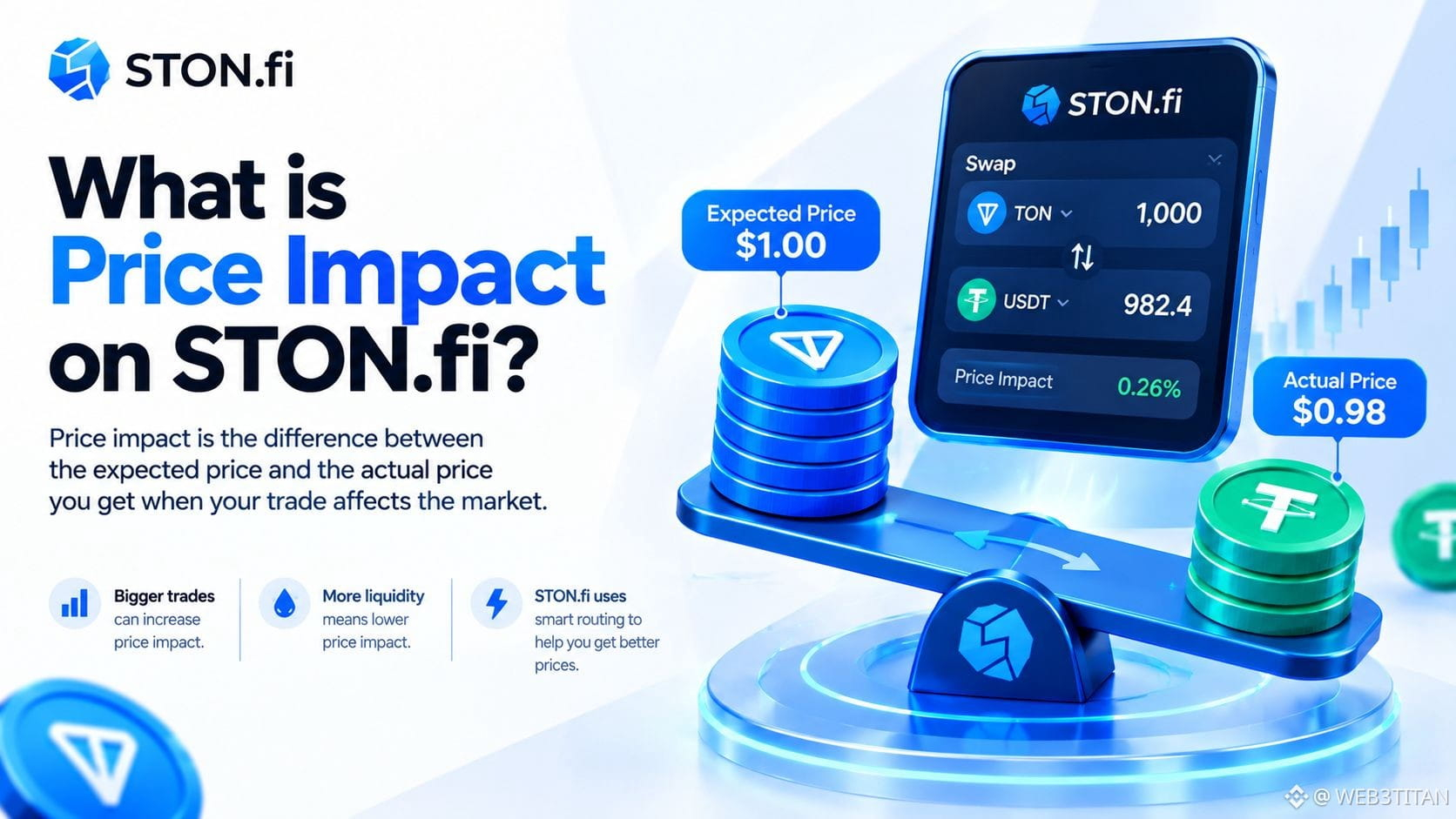
1
150
·
--
Cross Chain Swap vs Bridge: What’s the Difference?
Moving assets between blockchains can happen in different ways. Two common approaches are bridges and cross chain swaps, but they don't work exactly the same way.
WHAT IS A BRIDGE?
A bridge is designed to move an asset from one blockchain to another.
Depending on the bridge architecture, the original asset may be locked or held while a corresponding wrapped or bridged version is created on the destination chain.
WHAT IS A CROSS CHAIN SWAP?
A cross chain swap lets you exchange an asset on one network for another asset on a different network.
Instead of simply moving the same asset, the destination side can provide a different native or supported asset.
For example, you could swap an asset on TON for an asset on another network.
THE KEY DIFFERENCES
Bridge: Move an asset between networks, often involving locking and representing it on the destination.
Cross chain swap: Exchange one asset for another across different networks.
The two models can also differ in custody assumptions, route complexity, fees, and how failed transactions or refunds are handled.
WHERE OMNISTON FITS
Omniston focuses on cross chain execution and liquidity aggregation. It can coordinate routes and liquidity sources to help users exchange assets across supported networks.
That doesn't make bridges useless.
Bridges remain useful when the goal is specifically to transfer an asset between networks, while cross chain swaps can be more convenient when you want a different asset on the destination chain.
MY TAKE
The better option depends on what you're trying to accomplish.
If you need to move the same asset, a bridge may make sense. If you want to exchange one asset for another across networks, a cross chain swap can offer a different approach.
Understanding the architecture first makes it easier to choose the right tool.
$GRAM $SOPH
#SaudiHaltsSouthernEnergySitesAfterAttacks
Cross Chain Swap vs Bridge: What’s the Difference?
Moving assets between blockchains can happen in different ways. Two common approaches are bridges and cross chain swaps, but they don't work exactly the same way.
WHAT IS A BRIDGE?
A bridge is designed to move an asset from one blockchain to another.
Depending on the bridge architecture, the original asset may be locked or held while a corresponding wrapped or bridged version is created on the destination chain.
WHAT IS A CROSS CHAIN SWAP?
A cross chain swap lets you exchange an asset on one network for another asset on a different network.
Instead of simply moving the same asset, the destination side can provide a different native or supported asset.
For example, you could swap an asset on TON for an asset on another network.
THE KEY DIFFERENCES
Bridge: Move an asset between networks, often involving locking and representing it on the destination.
Cross chain swap: Exchange one asset for another across different networks.
The two models can also differ in custody assumptions, route complexity, fees, and how failed transactions or refunds are handled.
WHERE OMNISTON FITS
Omniston focuses on cross chain execution and liquidity aggregation. It can coordinate routes and liquidity sources to help users exchange assets across supported networks.
That doesn't make bridges useless.
Bridges remain useful when the goal is specifically to transfer an asset between networks, while cross chain swaps can be more convenient when you want a different asset on the destination chain.
MY TAKE
The better option depends on what you're trying to accomplish.
If you need to move the same asset, a bridge may make sense. If you want to exchange one asset for another across networks, a cross chain swap can offer a different approach.
Understanding the architecture first makes it easier to choose the right tool.
$GRAM $SOPH
#SaudiHaltsSouthernEnergySitesAfterAttacks
Moving assets between blockchains can happen in different ways. Two common approaches are bridges and cross chain swaps, but they don't work exactly the same way.
WHAT IS A BRIDGE?
A bridge is designed to move an asset from one blockchain to another.
Depending on the bridge architecture, the original asset may be locked or held while a corresponding wrapped or bridged version is created on the destination chain.
WHAT IS A CROSS CHAIN SWAP?
A cross chain swap lets you exchange an asset on one network for another asset on a different network.
Instead of simply moving the same asset, the destination side can provide a different native or supported asset.
For example, you could swap an asset on TON for an asset on another network.
THE KEY DIFFERENCES
Bridge: Move an asset between networks, often involving locking and representing it on the destination.
Cross chain swap: Exchange one asset for another across different networks.
The two models can also differ in custody assumptions, route complexity, fees, and how failed transactions or refunds are handled.
WHERE OMNISTON FITS
Omniston focuses on cross chain execution and liquidity aggregation. It can coordinate routes and liquidity sources to help users exchange assets across supported networks.
That doesn't make bridges useless.
Bridges remain useful when the goal is specifically to transfer an asset between networks, while cross chain swaps can be more convenient when you want a different asset on the destination chain.
MY TAKE
The better option depends on what you're trying to accomplish.
If you need to move the same asset, a bridge may make sense. If you want to exchange one asset for another across networks, a cross chain swap can offer a different approach.
Understanding the architecture first makes it easier to choose the right tool.
$GRAM $SOPH
#SaudiHaltsSouthernEnergySitesAfterAttacks
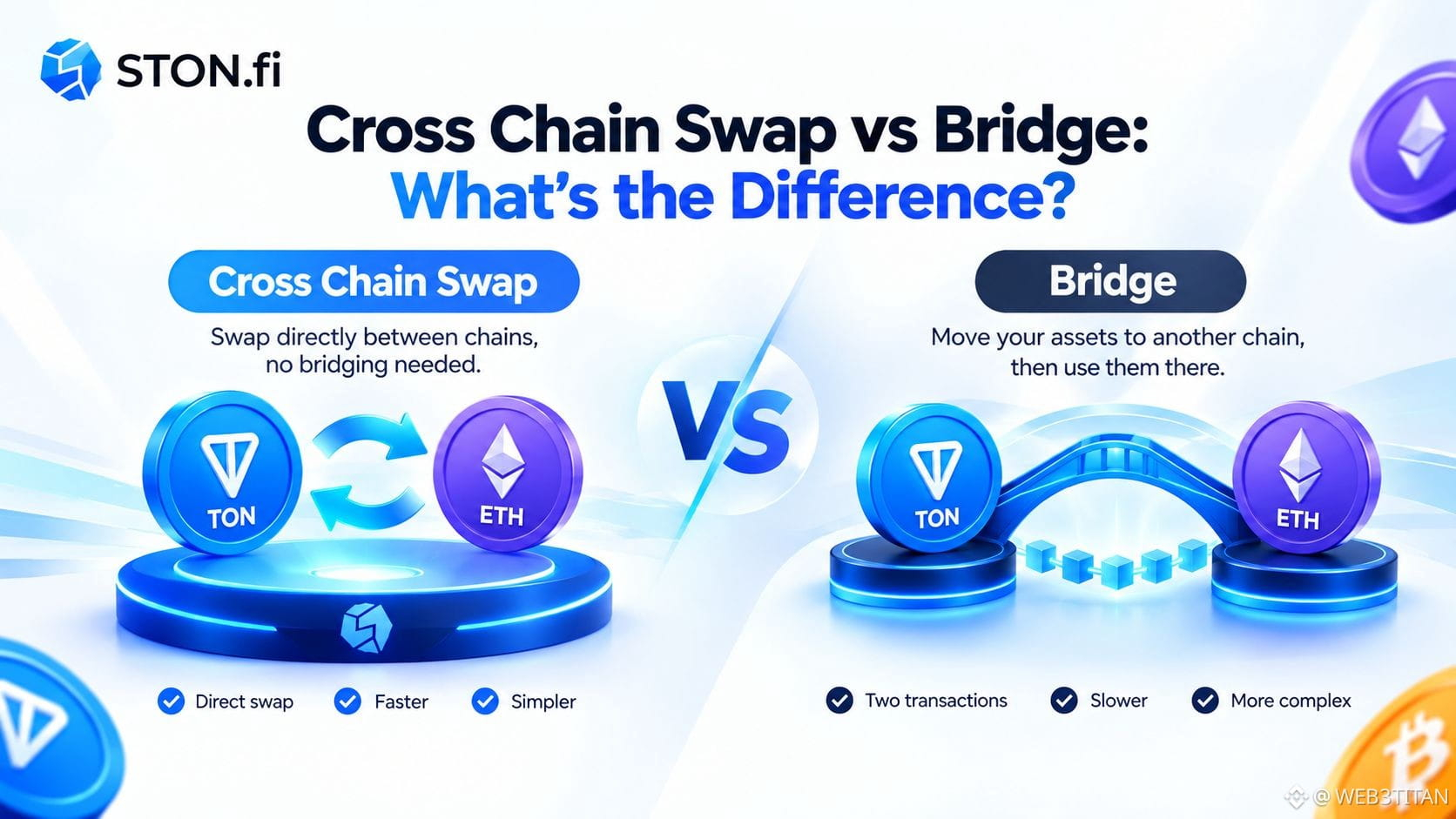
1
47
ເຂົ້າສູ່ລະບົບເພື່ອສຳຫຼວດເນື້ອຫາເພີ່ມເຕີມ
ເຂົ້າຮ່ວມກຸ່ມຜູ້ໃຊ້ຄຣິບໂຕທົ່ວໂລກໃນ Binance Square.
⚡️ ໄດ້ຮັບຂໍ້ມູນຫຼ້າສຸດ ແລະ ທີ່ມີປະໂຫຍດກ່ຽວກັບຄຣິບໂຕ.
💬 ໄດ້ຮັບຄວາມໄວ້ວາງໃຈຈາກຕະຫຼາດແລກປ່ຽນຄຣິບໂຕທີ່ໃຫຍ່ທີ່ສຸດໃນໂລກ.
👍 ຄົ້ນຫາຂໍ້ມູນເຊີງເລິກທີ່ແທ້ຈາກນັກສ້າງທີ່ໄດ້ຮັບການຢືນຢັນ.
ອີເມວ / ເບີໂທລະສັບ
ຫົວຂໍ້ທີ່ກໍາລັງນິຍົມ
SECProposesCryptoCustodyRules
271 views
31 ກຳລັງສົນທະນາ
🚨 SEC PROPOSES NEW CRYPTO CUSTODY RULES 🇺🇸🔐
The U.S. Securities and Exchange Commission has proposed a new framework for how investment advisers and regulated funds can custody crypto assets.
📌 The proposal would allow self-custody in certain circumstances, particularly when no qualified custodian is available.
📌 State-chartered trust companies could also qualify as crypto custodians under specific conditions.
📌 The framework includes safeguards around private keys, cybersecurity, asset segregation and oversight.
📌 The proposal is not final yet. A 60-day public comment period will begin after publication in the Federal Register.
💡 Why it matters:
Clearer custody rules could give investment advisers and regulated funds a defined regulatory pathway for holding digital assets, potentially expanding institutional access to crypto.
⚠️ This is a proposed rule, not an immediate change to existing requirements. Crypto remains highly volatile. DYOR and manage risk.
What do you think about the SEC's new crypto custody framework? 👇
#Bitcoin #BTC #Ethereum #CryptoNews #SECProposesCryptoCustodyRules
md-rana-sikdar-1232
·0 ຖືກໃຈ
·21 views
SECApproves3xLongCryptoCommodityETPs
1,094 views
77 ກຳລັງສົນທະນາ
G7PlansToReleaseUpTo100MBarrelsOilDiesel
2,657 views
129 ກຳລັງສົນທະນາ