
Trading Turtle
545 ໂພສ

Trading Turtle
ລາຍງານ
ບລັອກຜູ້ໃຊ້
Crypto trader sharing real trades, ideas, and lessons from the markets. Experienced in systematic strategies and building automated tools to stay disciplined.
ຜູ້ຊື້ຂາຍຊົ່ວຄາວ
1.2 ປີ
63 ກໍາລັງຕິດຕາມ
25 ຜູ້ຕິດຕາມ
51 Liked
ໂພສ
ທັງໝົດ
ວົງຢືມ
ວີດີໂອ
#Ethereum #PriceAction
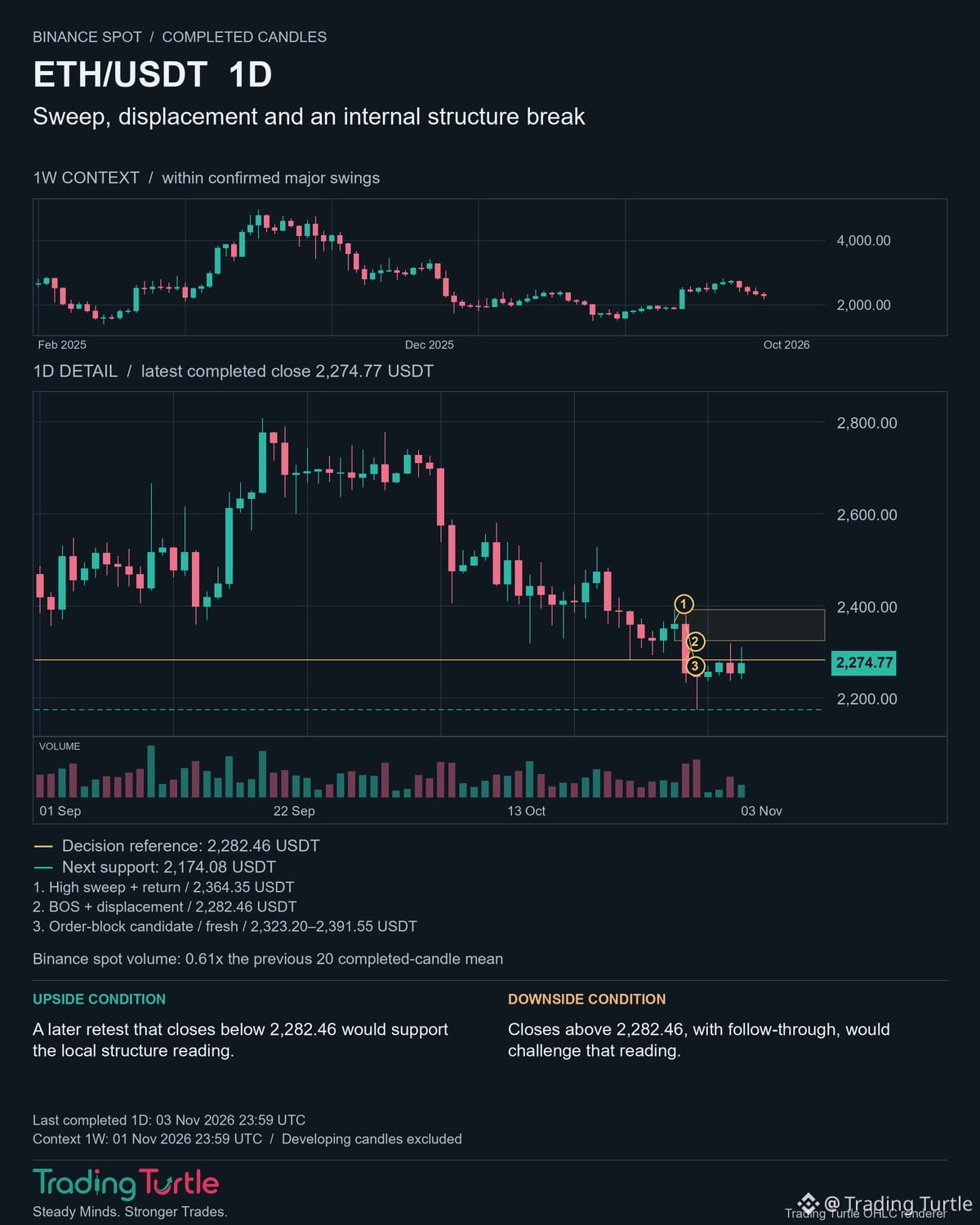
$ETH/$USDT 1D | Sweep, displacement and an internal structure break
1D price swept above 2,364.35 $USDT and closed back across it.
A later displacement candle closed below the confirmed internal swing at 2,282.46.
1W context: The broader confirmed swings show lower highs and lower lows.
Context close: 2,275.31 $USDT.
A 1D development does not alone establish a 1W reversal.
Support: 2,174.08 $USDT.
Resistance: 2,282.46 $USDT.
Order-block candidate: 2,323.2–2,391.55 $USDT; fresh.
Formation was confirmed at 29 Oct 2026 23:59 UTC.
Current stage: a later retest closed on the supporting side; zone fresh
A later retest that closes below 2,282.46 would support the local structure reading.
Closes above 2,282.46, with follow-through, would challenge that reading.
Binance spot volume: 0.61× the preceding 20 completed candles’ mean.
Participation was below that baseline.
Liquidity references are inferred from price; these candles do not reveal stop orders or institutional intent.
Last completed 1D: 03 Nov 2026 23:59 UTC.
#Ethereum #PriceAction
$ETH /$USDT 1D | Sweep, displacement and an internal structure break
1D price swept above 2,364.35 $USDT and closed back across it.
A later displacement candle closed below the confirmed internal swing at 2,282.46.
1W context: The broader confirmed swings show lower highs and lower lows.
Context close: 2,275.31 $USDT.
A 1D development does not alone establish a 1W reversal.
Support: 2,174.08 $USDT.
Resistance: 2,282.46 $USDT.
Order-block candidate: 2,323.2–2,391.55 $USDT; fresh.
Formation was confirmed at 29 Oct 2026 23:59 UTC.
Current stage: a later retest closed on the supporting side; zone fresh
A later retest that closes below 2,282.46 would support the local structure reading.
Closes above 2,282.46, with follow-through, would challenge that reading.
Binance spot volume: 0.61× the preceding 20 completed candles’ mean.
Participation was below that baseline.
Liquidity references are inferred from price; these candles do not reveal stop orders or institutional intent.
Last completed 1D: 03 Nov 2026 23:59 UTC.
57
Something interesting is happening in financial markets. 🥸
The US CFTC has opened the door for perpetual futures linked to individual stocks to trade on qualifying US-regulated exchanges.
Perpetual futures have largely been associated with crypto trading.
Now, this derivative structure is moving further into traditional finance.
But new trading instruments don't automatically mean better trading opportunities.
Funding rates, liquidity, leverage and risk management still matter.
Would you be interested in trading stock perpetuals, or do you prefer traditional stock trading?

74
#Crypto #PriceAction
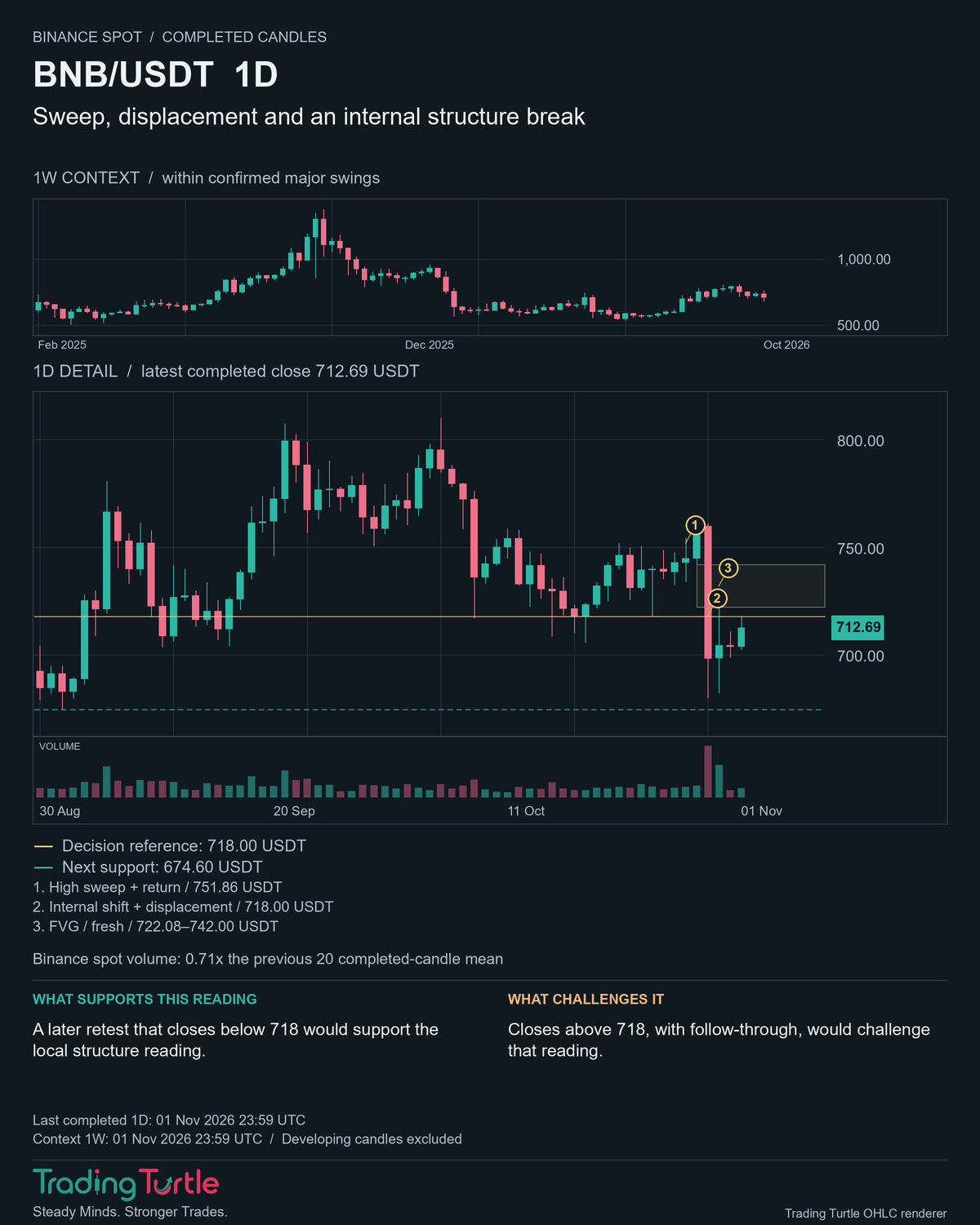
$BNB/$USDT 1D | Sweep, displacement and an internal structure break
1D price swept above 751.86 $USDT and closed back across it.
A later displacement candle closed below the confirmed internal swing at 718.
1W context: The broader confirmed swings show lower highs and lower lows.
Context close: 712.69 $USDT.
A 1D development does not alone establish a 1W reversal.
Support: 674.6 $USDT.
Resistance: 719.99 $USDT.
Fair value gap (FVG): 722.08–742 $USDT; fresh.
Formation was confirmed at 30 Oct 2026 23:59 UTC.
Current stage: a later retest closed on the supporting side; zone fresh
A later retest that closes below 718 would support the local structure reading.
Closes above 718, with follow-through, would challenge that reading.
Binance spot volume: 0.71× the preceding 20 completed candles’ mean.
Participation was below that baseline.
Liquidity references are inferred from price; these candles do not reveal stop orders or institutional intent.
Last completed 1D: 01 Nov 2026 23:59 UTC.
#Crypto #PriceAction
$BNB /$USDT 1D | Sweep, displacement and an internal structure break
1D price swept above 751.86 $USDT and closed back across it.
A later displacement candle closed below the confirmed internal swing at 718.
1W context: The broader confirmed swings show lower highs and lower lows.
Context close: 712.69 $USDT.
A 1D development does not alone establish a 1W reversal.
Support: 674.6 $USDT.
Resistance: 719.99 $USDT.
Fair value gap (FVG): 722.08–742 $USDT; fresh.
Formation was confirmed at 30 Oct 2026 23:59 UTC.
Current stage: a later retest closed on the supporting side; zone fresh
A later retest that closes below 718 would support the local structure reading.
Closes above 718, with follow-through, would challenge that reading.
Binance spot volume: 0.71× the preceding 20 completed candles’ mean.
Participation was below that baseline.
Liquidity references are inferred from price; these candles do not reveal stop orders or institutional intent.
Last completed 1D: 01 Nov 2026 23:59 UTC.
73
#TradingEducation
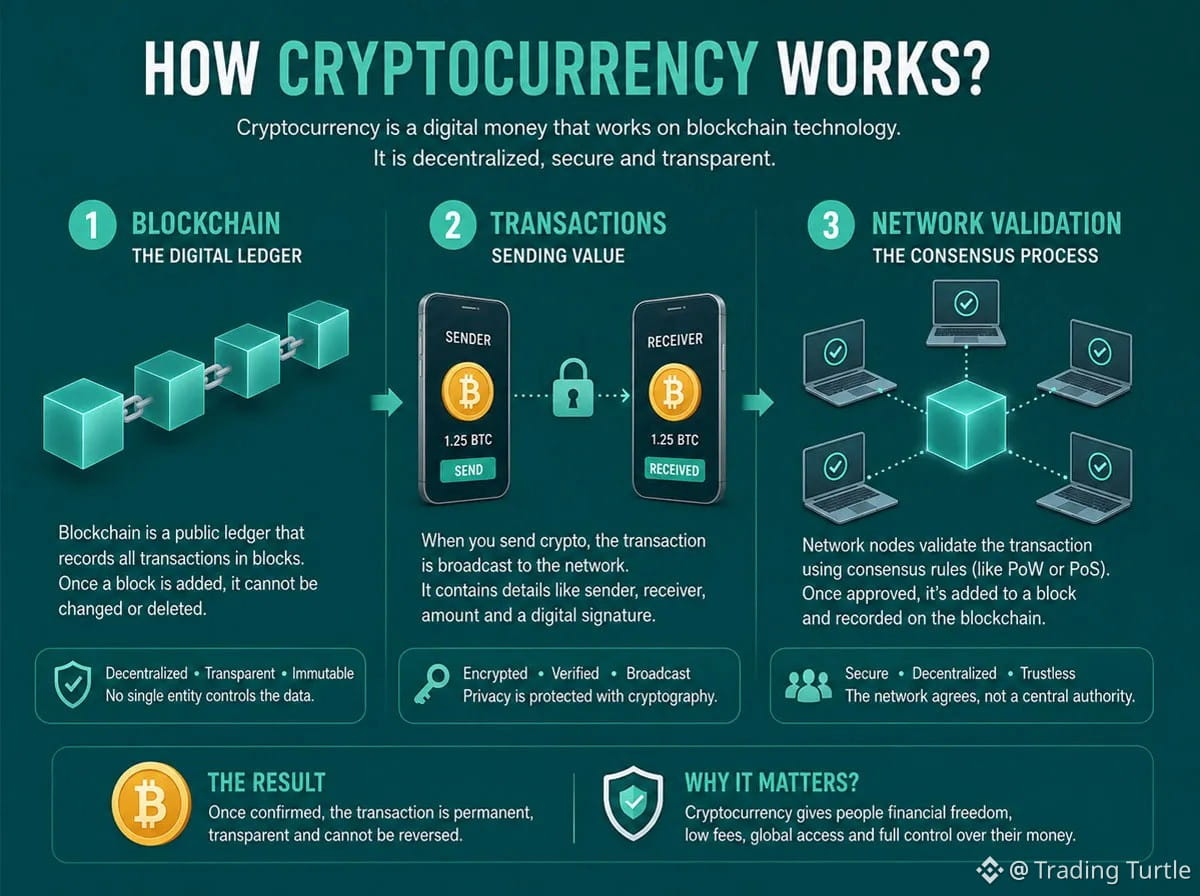
Scope: This note explains the fundamental distinction between a traditional bank ledger and a cryptocurrency shared ledger for readers interested in digital assets.
A bank’s ledger is a single, private record that only the institution can modify.
In contrast, many crypto networks keep a shared ledger duplicated across many nodes; every participant holds the same copy and consensus rules decide any update.
When a user sends crypto, the wallet produces a digital signature.
The network validates that signature and, once approved, all copies of the ledger are updated simultaneously.
Quiz – From the source article: What does a wallet generate to prove the sender’s authority?
Answer: a digital signature, because the article states the wallet signs the transaction and the network checks that signature before acceptance.
Limitation: The explanation covers generic blockchain principles and does not address network‑specific nuances such as proof‑of‑stake validator selection. $BTC $ETH
79
#Ethereum #PriceAction
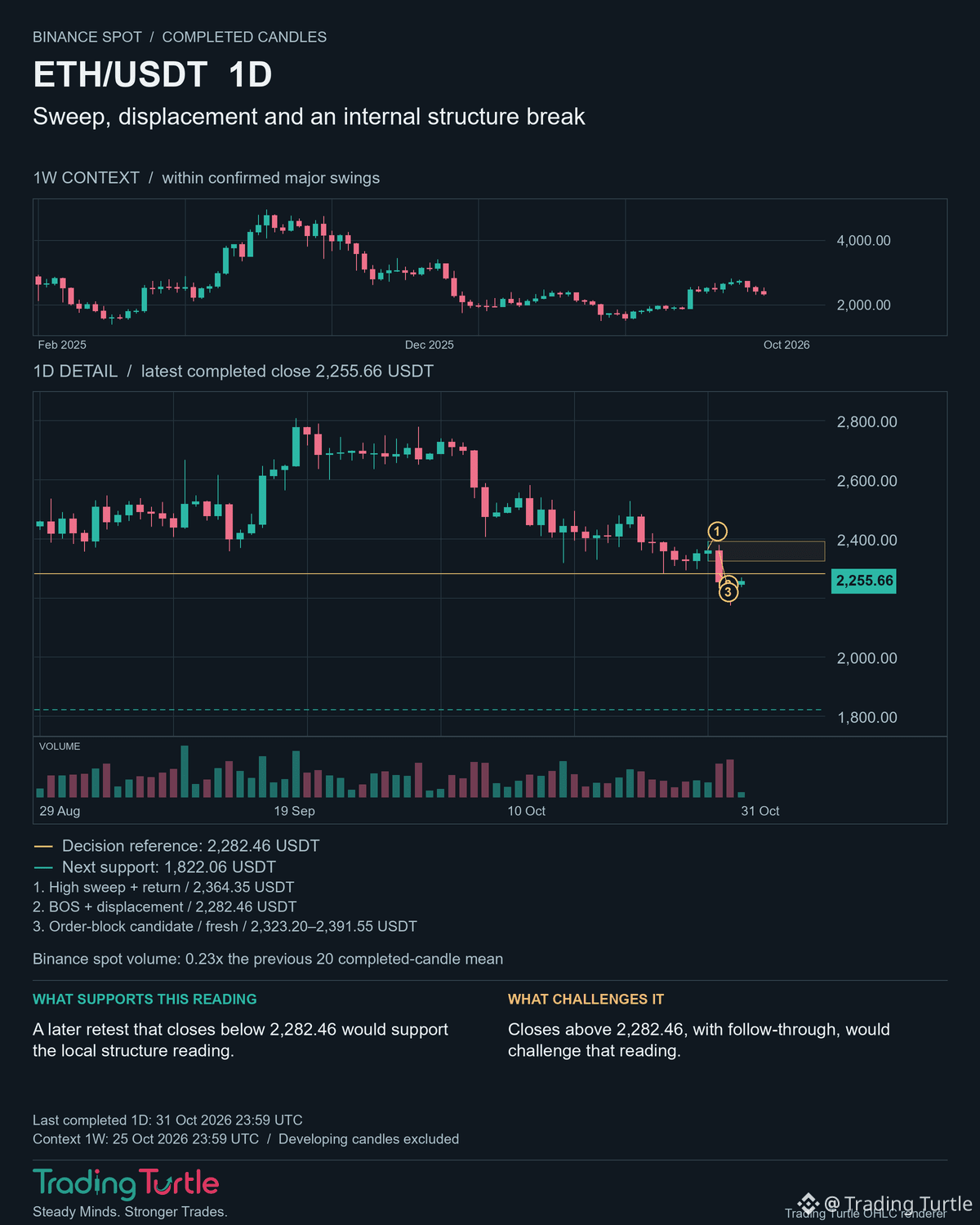
$ETH/$USDT 1D | Sweep, displacement and an internal structure break
1D price swept above 2,364.35 $USDT and closed back across it.
A later displacement candle closed below the confirmed internal swing at 2,282.46.
1W context: The broader confirmed swings show lower highs and lower lows.
Context close: 2,329.87 $USDT.
A 1D development does not alone establish a 1W reversal.
Support: 1,822.06 $USDT.
Resistance: 2,282.46 $USDT.
Order-block candidate: 2,323.2–2,391.55 $USDT; fresh.
Formation was confirmed at 29 Oct 2026 23:59 UTC.
Current stage: a later supporting retest has not been observed; zone fresh
A later retest that closes below 2,282.46 would support the local structure reading.
Closes above 2,282.46, with follow-through, would challenge that reading.
Binance spot volume: 0.23× the preceding 20 completed candles’ mean.
Participation was below that baseline.
Liquidity references are inferred from price; these candles do not reveal stop orders or institutional intent.
Last completed 1D: 31 Oct 2026 23:59 UTC.
#Ethereum #PriceAction
$ETH /$USDT 1D | Sweep, displacement and an internal structure break
1D price swept above 2,364.35 $USDT and closed back across it.
A later displacement candle closed below the confirmed internal swing at 2,282.46.
1W context: The broader confirmed swings show lower highs and lower lows.
Context close: 2,329.87 $USDT.
A 1D development does not alone establish a 1W reversal.
Support: 1,822.06 $USDT.
Resistance: 2,282.46 $USDT.
Order-block candidate: 2,323.2–2,391.55 $USDT; fresh.
Formation was confirmed at 29 Oct 2026 23:59 UTC.
Current stage: a later supporting retest has not been observed; zone fresh
A later retest that closes below 2,282.46 would support the local structure reading.
Closes above 2,282.46, with follow-through, would challenge that reading.
Binance spot volume: 0.23× the preceding 20 completed candles’ mean.
Participation was below that baseline.
Liquidity references are inferred from price; these candles do not reveal stop orders or institutional intent.
Last completed 1D: 31 Oct 2026 23:59 UTC.
104
#CryptoNews #Crypto
Bitcoin ($BTC) Core issued a security update addressing an undo‑file overflow vulnerability.
The bug affected 32‑bit Windows nodes and those using FAT32 storage, leading to crashes during block reorganizations.
The patch converts file position tracking to 64‑bit integers, removing the overflow risk.
Users of the impacted configurations should upgrade to the latest releases (29.5, 30.4, 31.2, 32.1) to ensure continued operation.
#CryptoNews #Crypto
Bitcoin ($BTC ) Core issued a security update addressing an undo‑file overflow vulnerability.
The bug affected 32‑bit Windows nodes and those using FAT32 storage, leading to crashes during block reorganizations.
The patch converts file position tracking to 64‑bit integers, removing the overflow risk.
Users of the impacted configurations should upgrade to the latest releases (29.5, 30.4, 31.2, 32.1) to ensure continued operation.
60
#Crypto #PriceAction
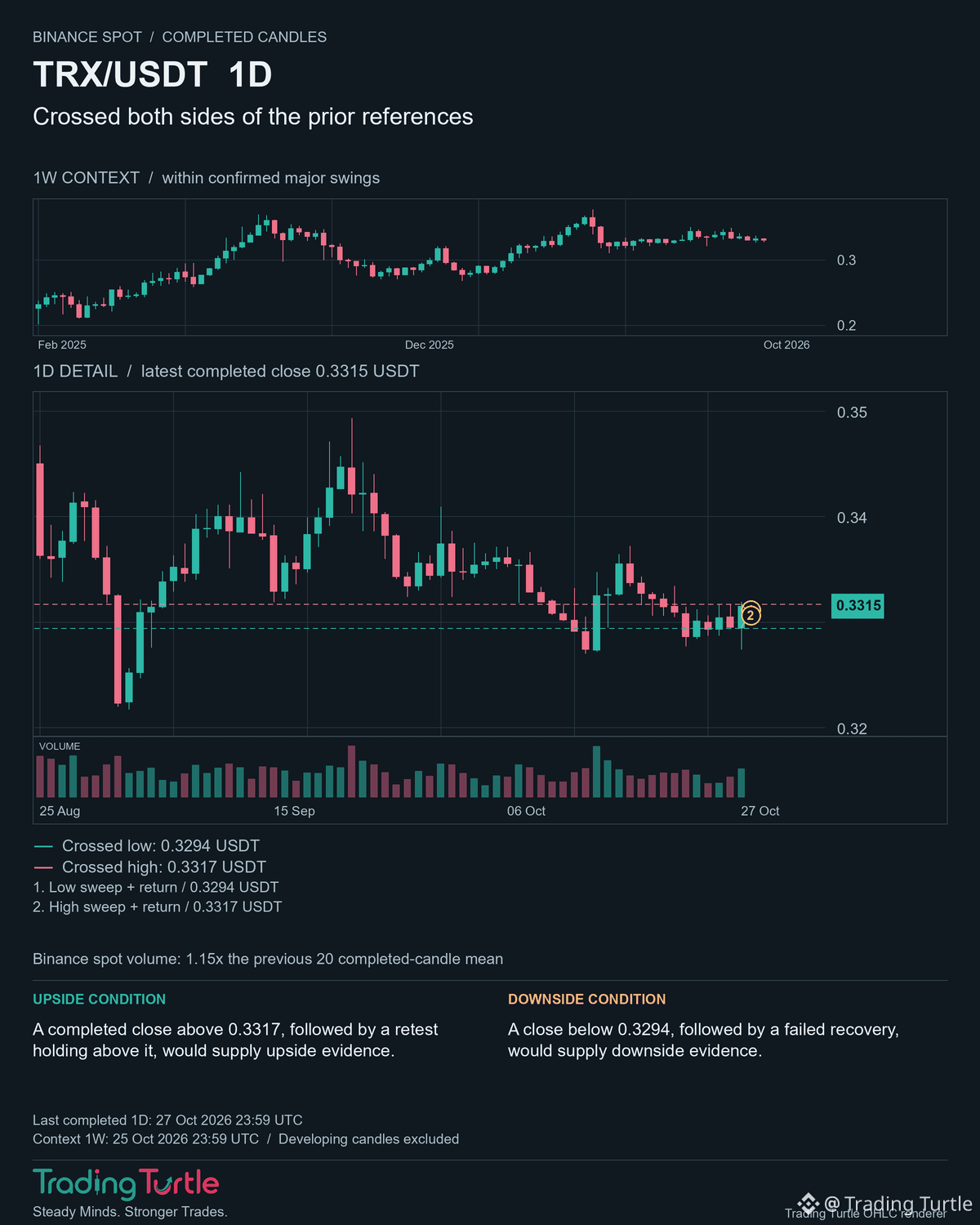
$TRX/$USDT 1D | Crossed both sides of the prior references
The latest 1D candle traded below 0.3294 and above 0.3317 $USDT, then closed between them at 0.3315.
1W context: The broader confirmed swings show mixed swing sequence.
Context close: 0.3304 $USDT.
A 1D development does not alone establish a 1W reversal.
Support: 0.327 $USDT.
Resistance: 0.3324 $USDT.
Current stage: both sides crossed; no one-direction sweep bias established
A completed close above 0.3317, followed by a retest holding above it, would supply upside evidence.
A close below 0.3294, followed by a failed recovery, would supply downside evidence.
Binance spot volume: 1.15× the preceding 20 completed candles’ mean.
This is not unusually elevated participation.
Liquidity references are inferred from price; these candles do not reveal stop orders or institutional intent.
Last completed 1D: 27 Oct 2026 23:59 UTC.
#Crypto #PriceAction
$TRX /$USDT 1D | Crossed both sides of the prior references
The latest 1D candle traded below 0.3294 and above 0.3317 $USDT, then closed between them at 0.3315.
1W context: The broader confirmed swings show mixed swing sequence.
Context close: 0.3304 $USDT.
A 1D development does not alone establish a 1W reversal.
Support: 0.327 $USDT.
Resistance: 0.3324 $USDT.
Current stage: both sides crossed; no one-direction sweep bias established
A completed close above 0.3317, followed by a retest holding above it, would supply upside evidence.
A close below 0.3294, followed by a failed recovery, would supply downside evidence.
Binance spot volume: 1.15× the preceding 20 completed candles’ mean.
This is not unusually elevated participation.
Liquidity references are inferred from price; these candles do not reveal stop orders or institutional intent.
Last completed 1D: 27 Oct 2026 23:59 UTC.
50
#TradingEducation
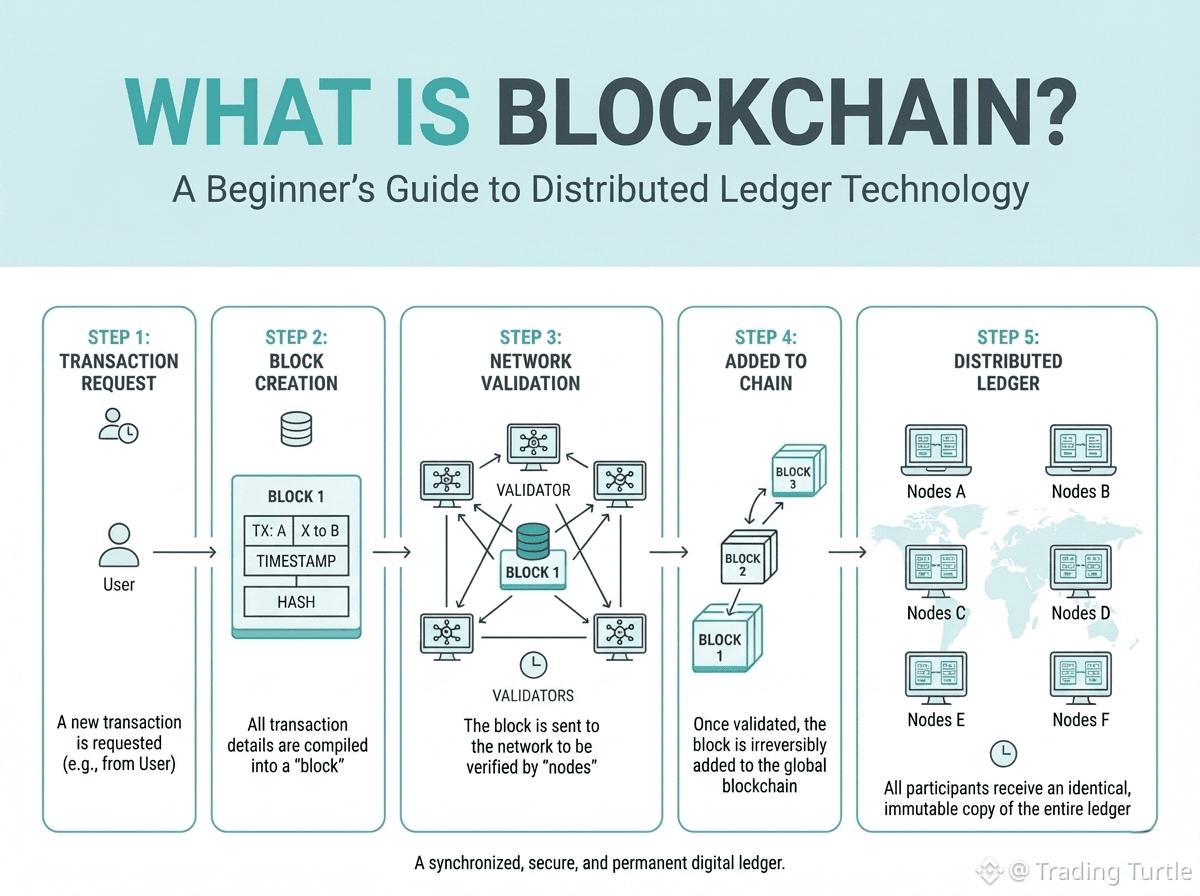
Crypto‑Reader Briefing – Understanding the Core Distinction of Blockchain
Scope: This note explains the fundamental difference between a blockchain ledger and a traditional centralised database, drawing on the educational article “What Is Blockchain?
Meaning, Technology and Uses” from Trading Turtle.
It is intended for readers seeking conceptual clarity, not for investment advice.
Key points
• Decentralisation – A blockchain stores copies of the ledger on many independent nodes, whereas a conventional database resides on a single server or controlled cluster.
• Consensus‑driven updates – New blocks are added only after the network reaches agreement (proof‑of‑work, proof‑of‑stake, etc.), while a centralised system can be altered by its administrator at any time.
• Cryptographic linking – Each block contains a hash of the previous block, creating a chain that becomes increasingly difficult to tamper with as more blocks are added.
Implication for crypto users: Because the record is tamper‑evident, assets transferred on a blockchain (e.g., $BTC, $ETH) benefit from higher integrity compared with off‑chain ledgers that rely on a single authority.
Limitation: The explanation is technical and does not address regulatory, security‑risk, or market‑price considerations.
Always conduct separate due‑diligence before any transaction.
#TradingEducation
Crypto‑Reader Briefing – Understanding the Core Distinction of Blockchain
Scope: This note explains the fundamental difference between a blockchain ledger and a traditional centralised database, drawing on the educational article “What Is Blockchain?
Meaning, Technology and Uses” from Trading Turtle.
It is intended for readers seeking conceptual clarity, not for investment advice.
Key points
• Decentralisation – A blockchain stores copies of the ledger on many independent nodes, whereas a conventional database resides on a single server or controlled cluster.
• Consensus‑driven updates – New blocks are added only after the network reaches agreement (proof‑of‑work, proof‑of‑stake, etc.), while a centralised system can be altered by its administrator at any time.
• Cryptographic linking – Each block contains a hash of the previous block, creating a chain that becomes increasingly difficult to tamper with as more blocks are added.
Implication for crypto users: Because the record is tamper‑evident, assets transferred on a blockchain (e.g., $BTC , $ETH ) benefit from higher integrity compared with off‑chain ledgers that rely on a single authority.
Limitation: The explanation is technical and does not address regulatory, security‑risk, or market‑price considerations.
Always conduct separate due‑diligence before any transaction.
45
#CryptoNews #Crypto
Bithumb reported an intrusion into its internal employee mobile system, isolated from the trading platform.
Personal information was accessed, yet no cryptocurrency assets were compromised, and trading operations continue as usual.
#CryptoNews #Crypto
Bithumb reported an intrusion into its internal employee mobile system, isolated from the trading platform.
Personal information was accessed, yet no cryptocurrency assets were compromised, and trading operations continue as usual.
Bithumb reported an intrusion into its internal employee mobile system, isolated from the trading platform.
Personal information was accessed, yet no cryptocurrency assets were compromised, and trading operations continue as usual.
54
#CryptoNews #Crypto
Bithumb reported an external breach of its internal employee mobile system, resulting in personal data theft.
The compromised system operates separately from the trading platform, ensuring that customer crypto assets remain inaccessible through this intrusion.
No cryptocurrency funds have been reported lost as the exchange works with Korean regulators to assess the incident.
74
#CryptoNews #Crypto
Keystone is destroying 18,835 unsold hardware wallets after a breach revealed 25,964 buyer records and a key that could allow counterfeit devices to pass authenticity checks.
Devices shipped before Oct 20 remain safe if they pass authentication; newer units will receive a refreshed key and data retention policies are being tightened.
34
#Bitcoin #PriceAction
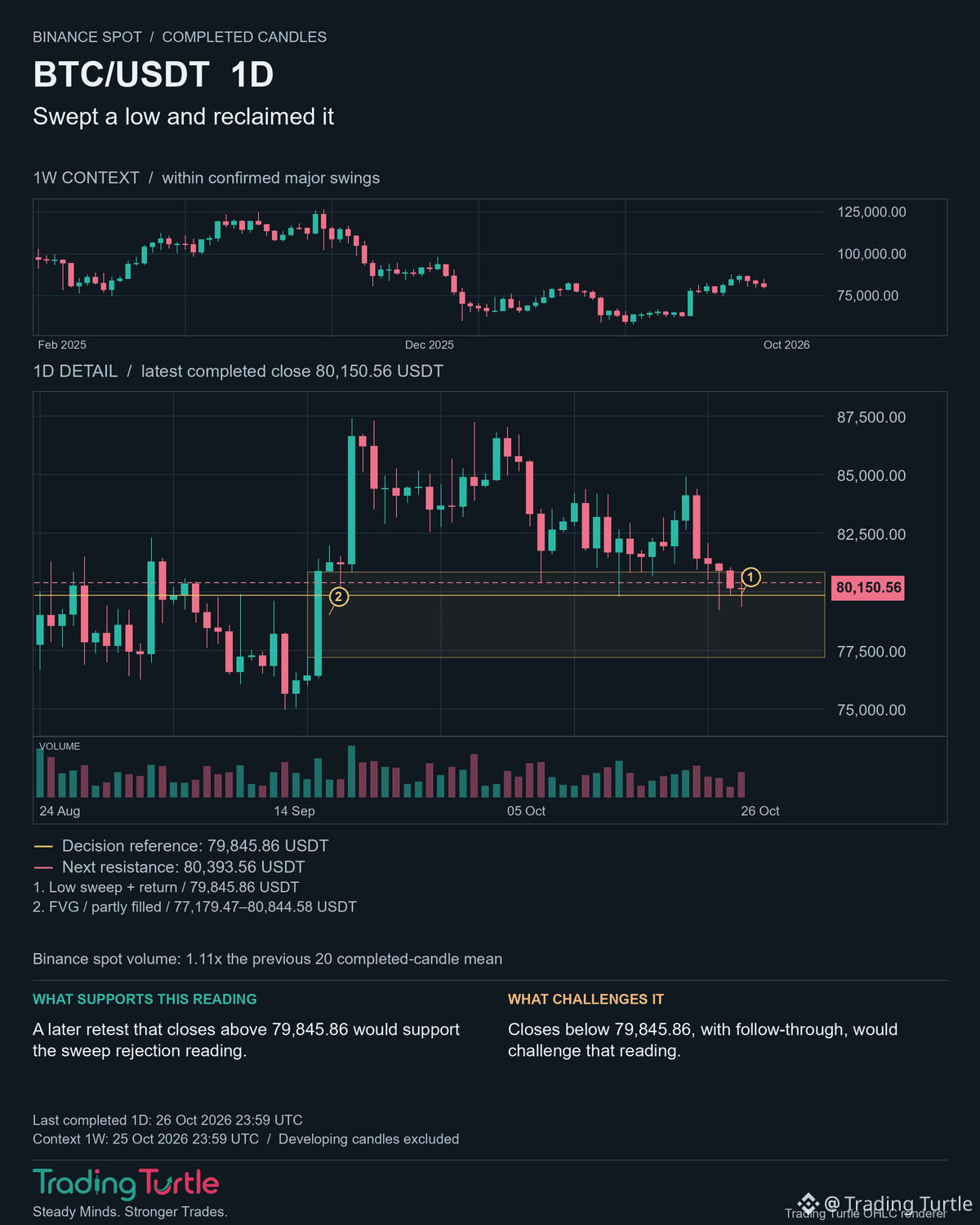
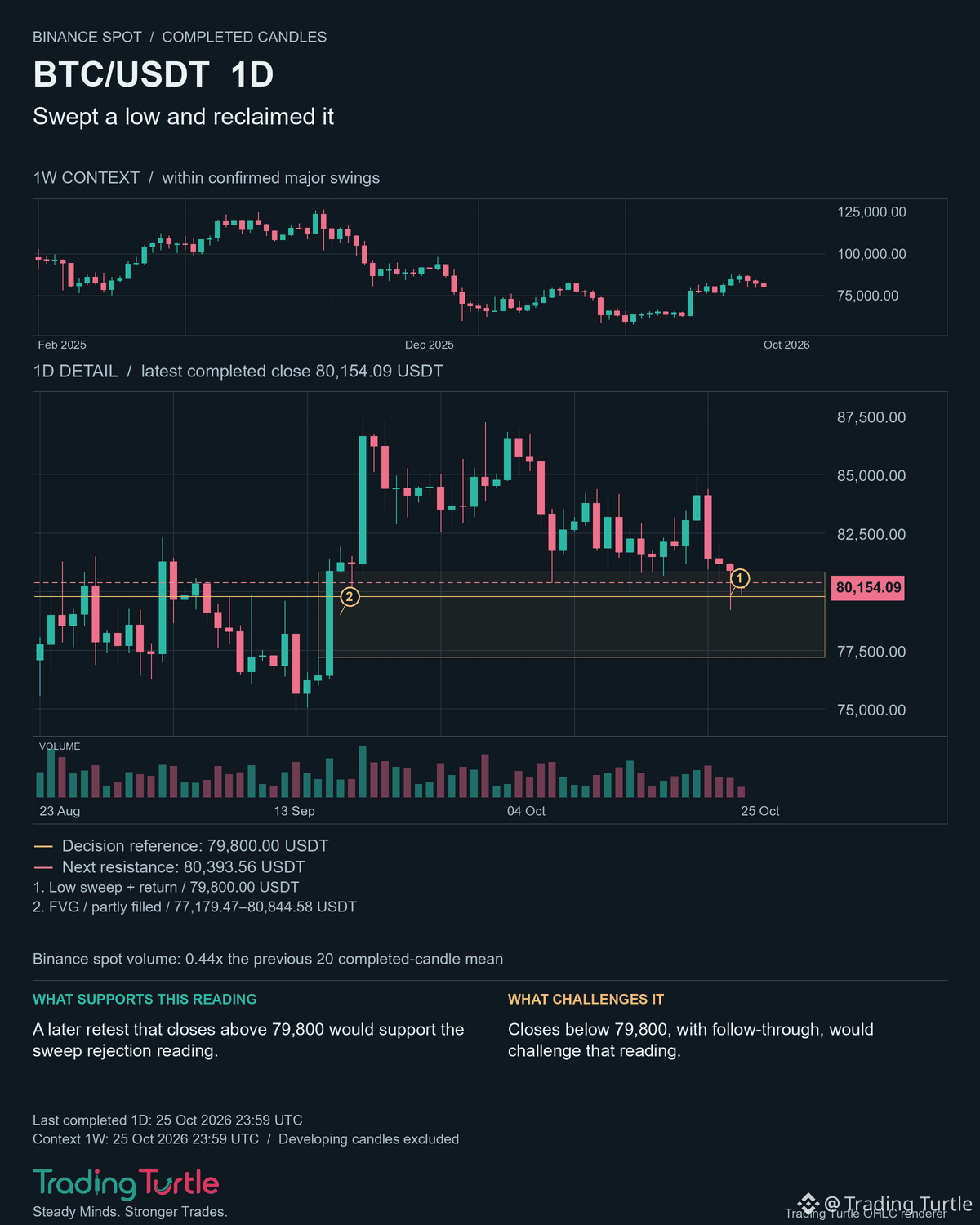
$BTC/$USDT 1D | Swept a low and reclaimed it
At 26 Oct 2026 23:59 UTC, the 1D candle traded below the previous day low at 79,845.86 $USDT and closed back across it.
Latest completed close: 80,150.56.
1W context: The broader confirmed swings show lower highs and lower lows.
Context close: 80,154.09 $USDT.
A 1D development does not alone establish a 1W reversal.
Support: 79,800 $USDT.
Resistance: 80,393.56 $USDT.
Fair value gap (FVG): 77,179.47–80,844.58 $USDT; partly filled.
Formation was confirmed at 19 Sep 2026 23:59 UTC.
It has already been revisited.
Current stage: a later supporting retest has not been observed; zone partly filled
A later retest that closes above 79,845.86 would support the sweep rejection reading.
Closes below 79,845.86, with follow-through, would challenge that reading.
Binance spot volume: 1.11× the preceding 20 completed candles’ mean.
This is not unusually elevated participation.
Liquidity references are inferred from price; these candles do not reveal stop orders or institutional intent.
Last completed 1D: 26 Oct 2026 23:59 UTC.
#Bitcoin #PriceAction
$BTC /$USDT 1D | Swept a low and reclaimed it
At 26 Oct 2026 23:59 UTC, the 1D candle traded below the previous day low at 79,845.86 $USDT and closed back across it.
Latest completed close: 80,150.56.
1W context: The broader confirmed swings show lower highs and lower lows.
Context close: 80,154.09 $USDT.
A 1D development does not alone establish a 1W reversal.
Support: 79,800 $USDT.
Resistance: 80,393.56 $USDT.
Fair value gap (FVG): 77,179.47–80,844.58 $USDT; partly filled.
Formation was confirmed at 19 Sep 2026 23:59 UTC.
It has already been revisited.
Current stage: a later supporting retest has not been observed; zone partly filled
A later retest that closes above 79,845.86 would support the sweep rejection reading.
Closes below 79,845.86, with follow-through, would challenge that reading.
Binance spot volume: 1.11× the preceding 20 completed candles’ mean.
This is not unusually elevated participation.
Liquidity references are inferred from price; these candles do not reveal stop orders or institutional intent.
Last completed 1D: 26 Oct 2026 23:59 UTC.
46
#CryptoNews #Crypto
Galaxy Digital identifies Bitcoin ($BTC)’s rise above its 50‑week moving average as the start of an accumulation phase.
The firm highlights reduced speculative exposure and increased U.S. debt as key factors, and notes spot Bitcoin ETFs added 87,000 $BTC after the June low.
#CryptoNews #Crypto
Galaxy Digital identifies Bitcoin ($BTC )’s rise above its 50‑week moving average as the start of an accumulation phase.
The firm highlights reduced speculative exposure and increased U.S. debt as key factors, and notes spot Bitcoin ETFs added 87,000 $BTC after the June low.
Galaxy Digital identifies Bitcoin ($BTC )’s rise above its 50‑week moving average as the start of an accumulation phase.
The firm highlights reduced speculative exposure and increased U.S. debt as key factors, and notes spot Bitcoin ETFs added 87,000 $BTC after the June low.
61
#CryptoNews #Crypto
Polymarket expands into gold and silver prediction markets with short‑duration contracts settled via Chainlink ($LINK).
The offering runs on US and international platforms, excludes Saturday trading, and marks the first non‑crypto commodity product.
#CryptoNews #Crypto
Polymarket expands into gold and silver prediction markets with short‑duration contracts settled via Chainlink ($LINK ).
The offering runs on US and international platforms, excludes Saturday trading, and marks the first non‑crypto commodity product.
Polymarket expands into gold and silver prediction markets with short‑duration contracts settled via Chainlink ($LINK ).
The offering runs on US and international platforms, excludes Saturday trading, and marks the first non‑crypto commodity product.
437
#CryptoNews #Crypto
Microsoft announced voluntary exits for about 60,000 workers, the largest program of its kind, reflecting ongoing tech sector cost cuts.
Anthropic filed its IPO prospectus, reporting $16.3 billion in first‑half revenue and a transition to positive operating cash flow, indicating a significant capital shift toward AI that may intersect with blockchain initiatives.
45
#Bitcoin #PriceAction
$BTC/$USDT 1D | Swept a low and reclaimed it
At 24 Oct 2026 23:59 UTC, the 1D candle traded below the previous week low at 79,800 $USDT and closed back across it.
Latest completed close: 80,154.09.
1W context: The broader confirmed swings show lower highs and lower lows.
Context close: 80,154.09 $USDT.
A 1D development does not alone establish a 1W reversal.
Support: 79,800 $USDT.
Resistance: 80,393.56 $USDT.
Fair value gap (FVG): 77,179.47–80,844.58 $USDT; partly filled.
Formation was confirmed at 19 Sep 2026 23:59 UTC.
It has already been revisited.
Current stage: a later retest closed on the supporting side; zone partly filled
A later retest that closes above 79,800 would support the sweep rejection reading.
Closes below 79,800, with follow-through, would challenge that reading.
Binance spot volume: 0.44× the preceding 20 completed candles’ mean.
Participation was below that baseline.
Liquidity references are inferred from price; these candles do not reveal stop orders or institutional intent.
Last completed 1D: 25 Oct 2026 23:59 UTC.
#Bitcoin #PriceAction
$BTC /$USDT 1D | Swept a low and reclaimed it
At 24 Oct 2026 23:59 UTC, the 1D candle traded below the previous week low at 79,800 $USDT and closed back across it.
Latest completed close: 80,154.09.
1W context: The broader confirmed swings show lower highs and lower lows.
Context close: 80,154.09 $USDT.
A 1D development does not alone establish a 1W reversal.
Support: 79,800 $USDT.
Resistance: 80,393.56 $USDT.
Fair value gap (FVG): 77,179.47–80,844.58 $USDT; partly filled.
Formation was confirmed at 19 Sep 2026 23:59 UTC.
It has already been revisited.
Current stage: a later retest closed on the supporting side; zone partly filled
A later retest that closes above 79,800 would support the sweep rejection reading.
Closes below 79,800, with follow-through, would challenge that reading.
Binance spot volume: 0.44× the preceding 20 completed candles’ mean.
Participation was below that baseline.
Liquidity references are inferred from price; these candles do not reveal stop orders or institutional intent.
Last completed 1D: 25 Oct 2026 23:59 UTC.
81
#CryptoNews #Crypto
Crypto markets this week are influenced by three central‑bank policy announcements (Fed, ECB, BOJ) and earnings releases from Coinbase, Galaxy Digital, Robinhood and related firms.
Traders will watch officials' statements and company results for cues on digital‑asset direction.
#CryptoNews #Crypto
Crypto markets this week are influenced by three central‑bank policy announcements (Fed, ECB, BOJ) and earnings releases from Coinbase, Galaxy Digital, Robinhood and related firms.
Traders will watch officials' statements and company results for cues on digital‑asset direction.
Crypto markets this week are influenced by three central‑bank policy announcements (Fed, ECB, BOJ) and earnings releases from Coinbase, Galaxy Digital, Robinhood and related firms.
Traders will watch officials' statements and company results for cues on digital‑asset direction.
66
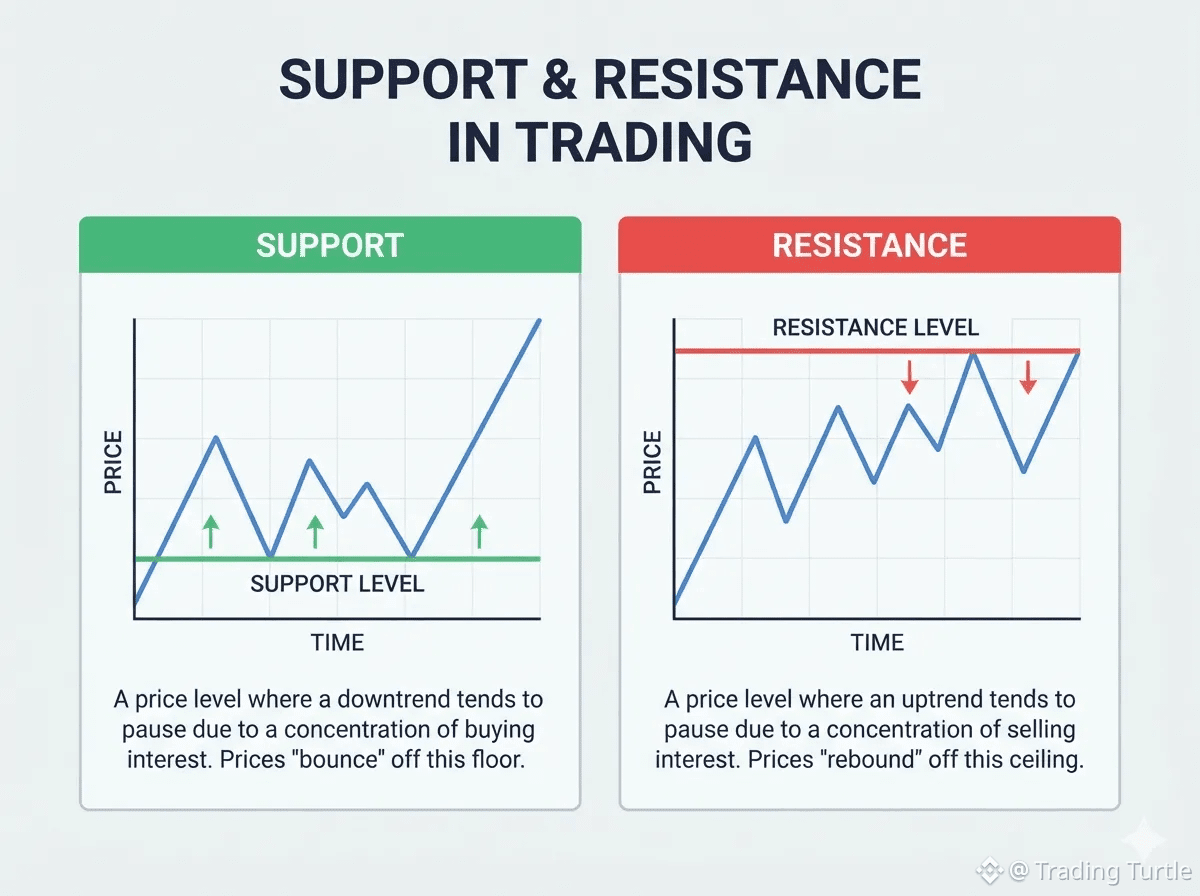
#SupportResistance #PriceAction
A prior support area gives you a reference. A touch gives you arrival. The close and the following reaction give you different evidence. Keep the area fixed while you test the reading.
Price touches a support area and closes below it. Which description preserves the evidence: “support held” or “price closed through the area”?
Answer: “Price closed through the area.” That observation challenges a simple holding-support reading. It still does not predict the next candle.
Multiple past reactions do not guarantee another. The chosen area and timeframe must be stated.
50
#CryptoNews #Crypto
KuCoin announced that the deposit service for Atlas Navi (NAVI) is temporarily suspended, effective 23 Oct 2026, because of essential maintenance. The suspension is limited to NAVI deposits; withdrawals, trading of other pairs and all other platform features continue to work. KuCoin indicated it will not publish a separate follow‑up notice with a restoration schedule, so users must monitor the original announcement for any update. This limitation may affect users planning to fund NAVI positions on KuCoin until the service is restored.
KuCoin announced that the deposit service for Atlas Navi (NAVI) is temporarily suspended, effective 23 Oct 2026, because of essential maintenance. The suspension is limited to NAVI deposits; withdrawals, trading of other pairs and all other platform features continue to work. KuCoin indicated it will not publish a separate follow‑up notice with a restoration schedule, so users must monitor the original announcement for any update. This limitation may affect users planning to fund NAVI positions on KuCoin until the service is restored.
62
ເຂົ້າສູ່ລະບົບເພື່ອສຳຫຼວດເນື້ອຫາເພີ່ມເຕີມ
ເຂົ້າຮ່ວມກຸ່ມຜູ້ໃຊ້ຄຣິບໂຕທົ່ວໂລກໃນ Binance Square.
⚡️ ໄດ້ຮັບຂໍ້ມູນຫຼ້າສຸດ ແລະ ທີ່ມີປະໂຫຍດກ່ຽວກັບຄຣິບໂຕ.
💬 ໄດ້ຮັບຄວາມໄວ້ວາງໃຈຈາກຕະຫຼາດແລກປ່ຽນຄຣິບໂຕທີ່ໃຫຍ່ທີ່ສຸດໃນໂລກ.
👍 ຄົ້ນຫາຂໍ້ມູນເຊີງເລິກທີ່ແທ້ຈາກນັກສ້າງທີ່ໄດ້ຮັບການຢືນຢັນ.
ອີເມວ / ເບີໂທລະສັບ
ຫົວຂໍ້ທີ່ກໍາລັງນິຍົມ
BTCRebounds80K
75,979 ຄັ້ງທີ່ເບິ່ງ
772 ກຳລັງສົນທະນາ
BITCOIN UPDATE I’M STILL BEARISH, AND HERE’S WHY! 🚨⚠️
As you all witnessed, BTC bounced back from the $75,700 area and touched $81K. First, the market trapped long traders, and then it trapped short traders.
I’m still bearish. First of all, as everyone knows, Democrats won today’s US midterm elections, and in my view, this outcome is bearish for the market.
The market can remain volatile in the short term and trap as many traders as it wants, but that doesn’t change the overall market outlook.
There are several important upcoming events, including US Non Farm Payrolls (November 6), US CPI Inflation (November 10), US PPI (November 13), US Retail Sales (November 17), FOMC Meeting Minutes (November 18), US PCE Inflation (November 25), Federal Reserve interest rate expectations, the US Dollar Index (DXY), Treasury Yields, Nasdaq performance, Bitcoin ETF flows, and ongoing( Iran ) Israel geopolitical developments. All of these could have a significant impact on Bitcoin and the overall crypto market.
But don’t get too carried away by Bitcoin’s recent movement. Technically speaking, there hasn’t been any major bullish move yet. Yesterday, BTC was trading between $80K and $82K, and even today, it’s still around the same range.
If you want to turn bullish, that’s entirely your choice.
In my previous post, I clearly explained that BTC had technical support in the $75K / $76K zone, and the price bounced from that support and made its way back towards $80K. But this wasn’t something I had failed to mention before. In fact, I repeatedly mentioned in my posts that BTC could move towards $80K, $81K, or even $82K.
Despite that, I’m still bearish.
And I don’t have just one reason to support my bearish outlook. I have several reasons, which I’ve already explained in my previous posts.
For now, I’ll continue to wait for BTC to drop below $74K, which I believe could happen very soon. In my view, such a correction is also necessary for the market.
Anyone looking for crypto guidance just let me know.
#BTCRebounds80K
Strategic Adviser
·30 ຖືກໃຈ
·35k ຄັ້ງທີ່ເບິ່ງ
Binance98PercentReplenished
43,676 ຄັ້ງທີ່ເບິ່ງ
594 ກຳລັງສົນທະນາ
USMidterms-WhatAreMarketsExpecting?
359,538 ຄັ້ງທີ່ເບິ່ງ
2,122 ກຳລັງສົນທະນາ