
_Jason
1.5k ໂພສ

_Jason
Crypto Insights & Market Updates 🌐 Web3 Enthusiast
286 ກໍາລັງຕິດຕາມ
80 ຜູ້ຕິດຕາມ
488 Liked
ໂພສ
ທັງໝົດ
ວົງຢືມ
#dusk $DUSK @Dusk
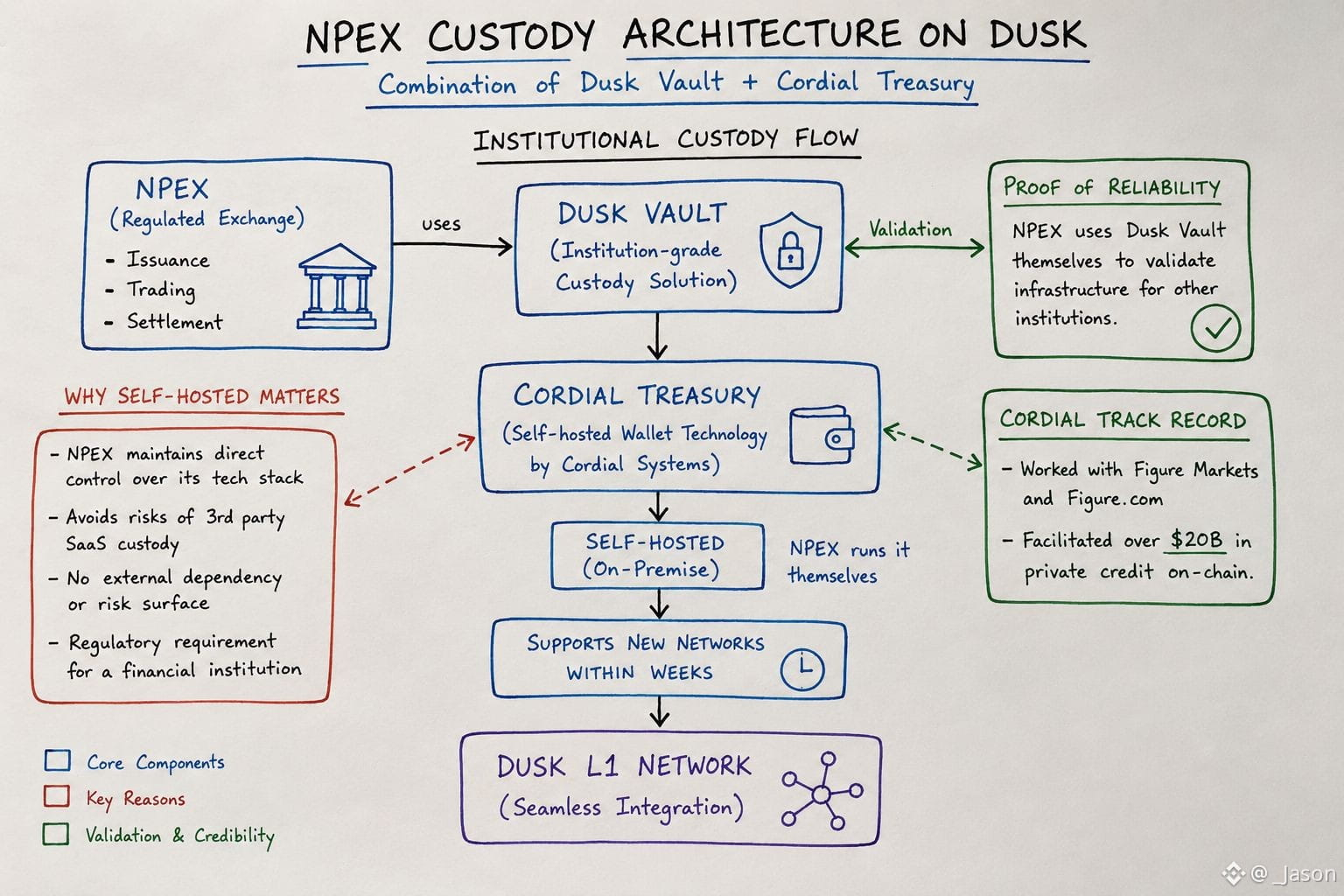
found a piece of the dusk stack this week that hadnt come up yet in anything ive covered so far - custody, specifically how NPEX actually holds and controls the digital assets involved, rather then just how trading or issuance works.
the answer is a combination of two things - Dusk Vault, described as dusk's institution grade custody solution, and Cordial Treasury, a self hosted wallet technology built by Cordial Systems that dusk partnered with specifically for this.
whats notable is why self hosted mattered so much here specifically. NPEX, being a regulated financial institution, prioritizes maintaining direct control over its own technology stack, and explicitly wants to avoid the risks that come with third party SaaS custody solutions. thats a real institutional constraint, not a preference - handing custody infrastructure over to some external saas provider introduces a dependency and risk surface a regulated exchange generally doesnt want.
cordial treasury solves that by being self hosted and on premises, meaning NPEX runs it themselves rather then relying on someone else's hosted service. cordial specifically is described as capable of adding support for new networks within weeks, which is what made a smooth integration with dusk's L1 possible on a reasonable timeline.
worth noting cordial isnt some unproven vendor either - theyve worked with figure markets and figure.com, which has facilitated the origination of over $20 billion in private credit on chain. thats a meaningful existing track record to be bringing into a regulated exchange integration.
and NPEX here isnt just a client using this custody setup, its also positioned as validating it - using dusk vault themselves is presented as proof of the infrastructure's reliability and security for other institutions considering the same setup.
#dusk @Dusk $DUSK
found a piece of the dusk stack this week that hadnt come up yet in anything ive covered so far - custody, specifically how NPEX actually holds and controls the digital assets involved, rather then just how trading or issuance works.
the answer is a combination of two things - Dusk Vault, described as dusk's institution grade custody solution, and Cordial Treasury, a self hosted wallet technology built by Cordial Systems that dusk partnered with specifically for this.
whats notable is why self hosted mattered so much here specifically. NPEX, being a regulated financial institution, prioritizes maintaining direct control over its own technology stack, and explicitly wants to avoid the risks that come with third party SaaS custody solutions. thats a real institutional constraint, not a preference - handing custody infrastructure over to some external saas provider introduces a dependency and risk surface a regulated exchange generally doesnt want.
cordial treasury solves that by being self hosted and on premises, meaning NPEX runs it themselves rather then relying on someone else's hosted service. cordial specifically is described as capable of adding support for new networks within weeks, which is what made a smooth integration with dusk's L1 possible on a reasonable timeline.
worth noting cordial isnt some unproven vendor either - theyve worked with figure markets and figure.com, which has facilitated the origination of over $20 billion in private credit on chain. thats a meaningful existing track record to be bringing into a regulated exchange integration.
and NPEX here isnt just a client using this custody setup, its also positioned as validating it - using dusk vault themselves is presented as proof of the infrastructure's reliability and security for other institutions considering the same setup.
#dusk @Dusk $DUSK
#dusk $DUSK @Dusk last topic ive got queued this week, and it ties a lot of the earlier posts together - the actual division of labor between DuskDS, DuskEVM, and the bridge. ive referenced all three individually over the past two weeks without ever laying them out side by side as three separately named responsibilities.
DuskDS is consensus, settlement, and data availability. this is the base layer doing the heavy lifting i covered back on day one - the thing DuskEVM transactions ultimately settle against, the source of truth for finality.
DuskEVM is ethereum compatible smart contract execution. this is the application layer, where solidity contracts actually run, where the sequencer processes transactions and batches them for publishing back to DuskDS.
the bridge is the third, easy to overlook piece - it moves DUSK and messages between the two environments. without this specifically named as its own component, DUSK used for gas on DuskEVM and DUSK on the dusk L1 would just be two disconnected things, not one asset usable across both environments.
why does splitting these into three named pieces matter instead of just saying "the dusk blockchain" as one thing - because each piece has a genuinely different job and can be reasoned about separately. settlement guarantees live in DuskDS. execution and contract logic live in DuskEVM. asset and message movement between them lives specifically in the bridge. if something goes wrong or youre trying to understand where a specific guarantee actually comes from (is my transaction final, is my contract executing correctly, did my DUSK actually move), you can point to exactly which of the three components is responsible for that specific guarantee, instead of treating the whole stack as one undifferentiated black box.
#dusk @Dusk $DUSK
DuskDS is consensus, settlement, and data availability. this is the base layer doing the heavy lifting i covered back on day one - the thing DuskEVM transactions ultimately settle against, the source of truth for finality.
DuskEVM is ethereum compatible smart contract execution. this is the application layer, where solidity contracts actually run, where the sequencer processes transactions and batches them for publishing back to DuskDS.
the bridge is the third, easy to overlook piece - it moves DUSK and messages between the two environments. without this specifically named as its own component, DUSK used for gas on DuskEVM and DUSK on the dusk L1 would just be two disconnected things, not one asset usable across both environments.
why does splitting these into three named pieces matter instead of just saying "the dusk blockchain" as one thing - because each piece has a genuinely different job and can be reasoned about separately. settlement guarantees live in DuskDS. execution and contract logic live in DuskEVM. asset and message movement between them lives specifically in the bridge. if something goes wrong or youre trying to understand where a specific guarantee actually comes from (is my transaction final, is my contract executing correctly, did my DUSK actually move), you can point to exactly which of the three components is responsible for that specific guarantee, instead of treating the whole stack as one undifferentiated black box.
#dusk @Dusk $DUSK
YES
0%
NO
0%
0 ຄະແນນສຽງ • ປິດລົງຄະແນນສຽງ
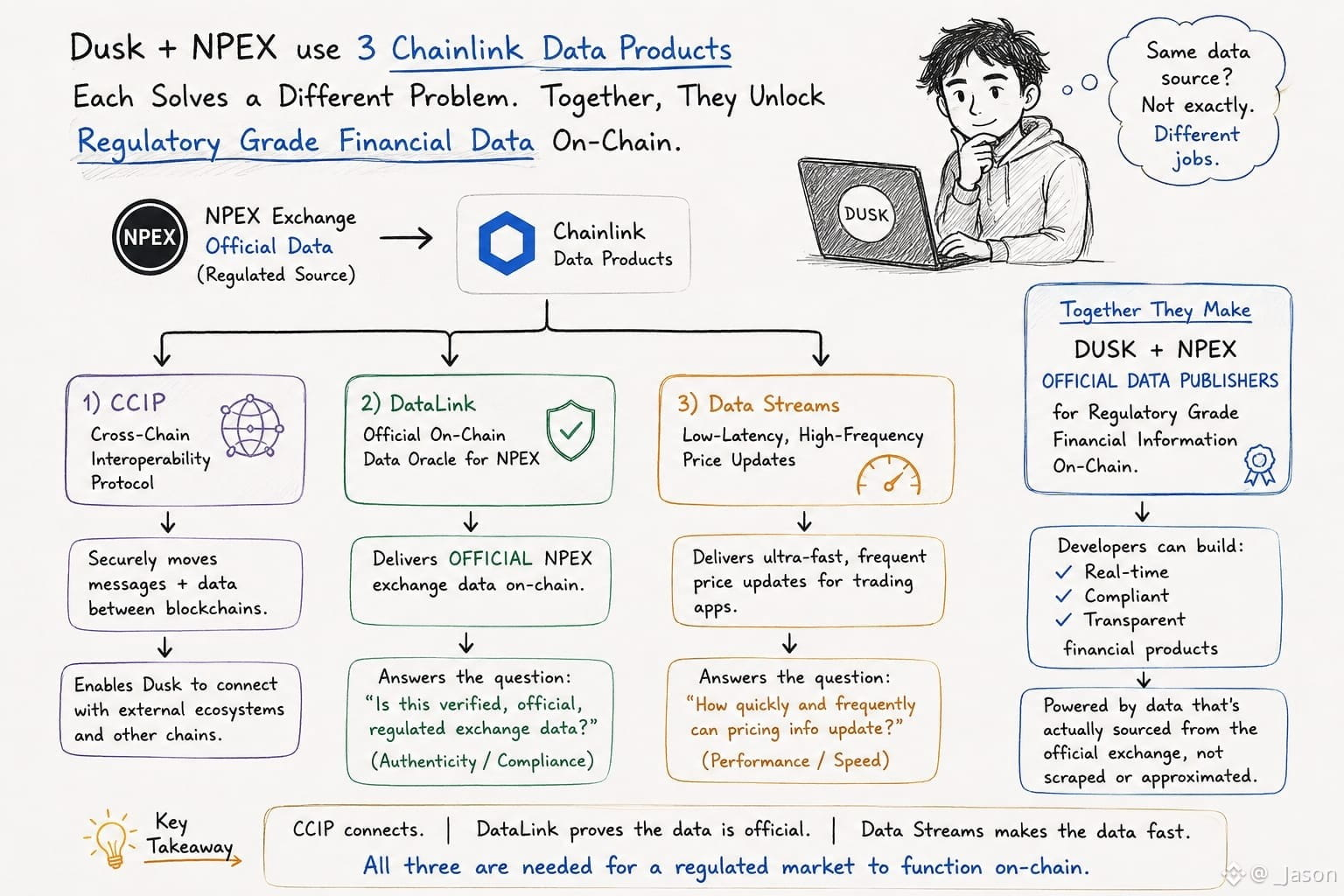
#dusk @Dusk follow up to yesterdays CCIP post, because i noticed dusk actually adopted two separate chainlink data products alongside CCIP, DataLink and Data Streams, and i almost lumped them together as "the same price feed thing" before realizing they solve different problems.
DataLink is specifically what delivers official NPEX exchange data directly onto the blockchain. its described as serving as the exclusive on chain data oracle for the platform — meaning this isnt generic aggregated market data from somewhere, its NPEX's own regulated exchange data, brought on chain through one specific official channel.
Data Streams is the other piece, and its job is different — low latency, high frequency price updates, specifically built to support compliant, high performance defi and institutional trading applications. this is the "how fast can price info actually move" layer, rather then the "whose data is this and is it official" layer that DataLink handles.
why have both instead of one generic feed — because they're answering two different questions. DataLink answers "is this verified, official, regulated exchange data" (a compliance/authenticity question). Data Streams answers "how quickly and frequently can that pricing information update for active trading use" (a performance question). a regulated market genuinely needs both answered well, sourcing that's provably legitimate, and speed thats good enough for real trading, not just one or the other.
together these make dusk and NPEX what's specifically called official data publishers for regulatory grade financial information on chain. for developers that means you can build real time, compliant, transparent financial products powered by data thats actually sourced from the official exchange, not scraped or approximated from somewhere else.
$DUSK
DataLink is specifically what delivers official NPEX exchange data directly onto the blockchain. its described as serving as the exclusive on chain data oracle for the platform — meaning this isnt generic aggregated market data from somewhere, its NPEX's own regulated exchange data, brought on chain through one specific official channel.
Data Streams is the other piece, and its job is different — low latency, high frequency price updates, specifically built to support compliant, high performance defi and institutional trading applications. this is the "how fast can price info actually move" layer, rather then the "whose data is this and is it official" layer that DataLink handles.
why have both instead of one generic feed — because they're answering two different questions. DataLink answers "is this verified, official, regulated exchange data" (a compliance/authenticity question). Data Streams answers "how quickly and frequently can that pricing information update for active trading use" (a performance question). a regulated market genuinely needs both answered well, sourcing that's provably legitimate, and speed thats good enough for real trading, not just one or the other.
together these make dusk and NPEX what's specifically called official data publishers for regulatory grade financial information on chain. for developers that means you can build real time, compliant, transparent financial products powered by data thats actually sourced from the official exchange, not scraped or approximated from somewhere else.
$DUSK
#dusk $DUSK @Dusk
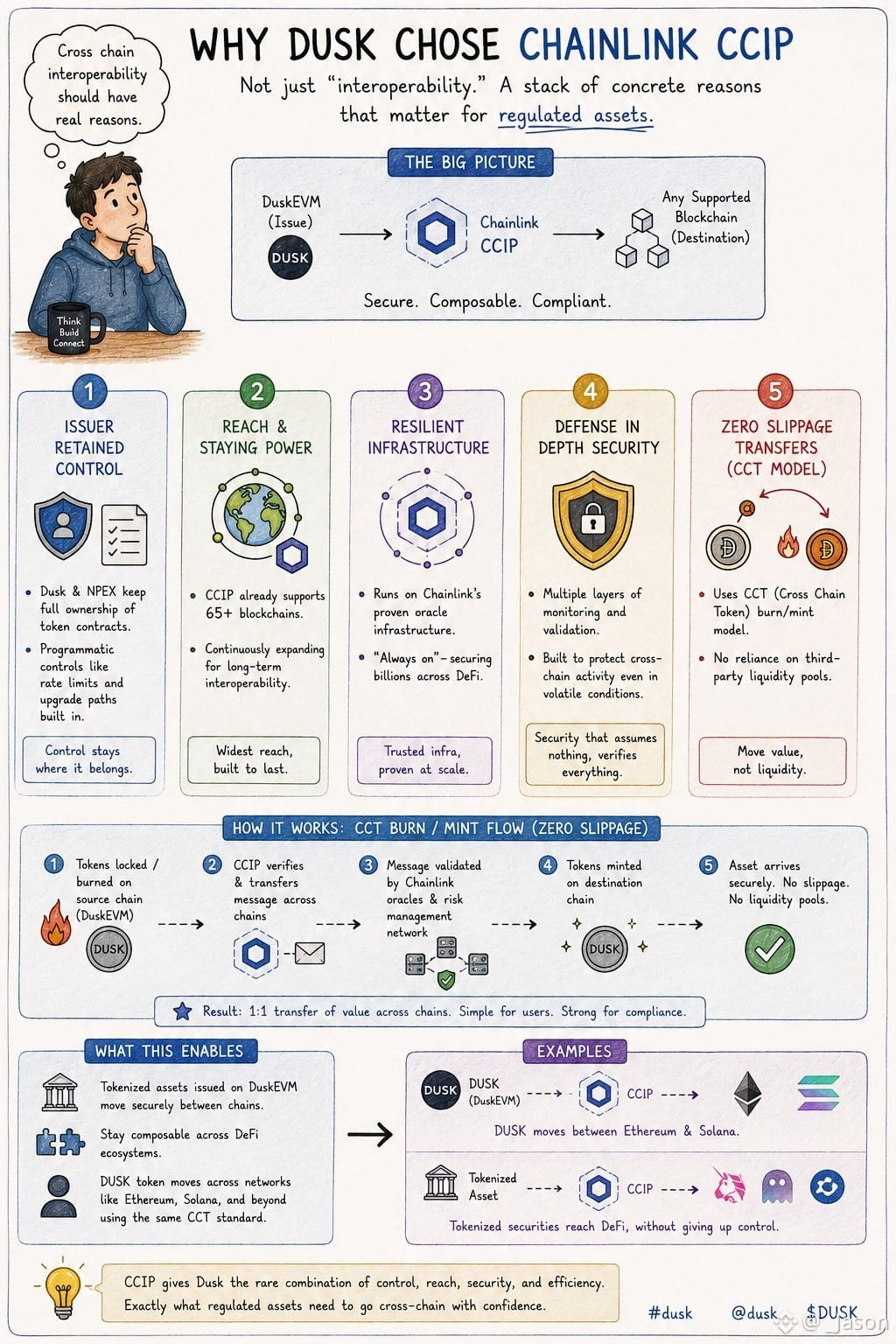
"cross chain interoperability" gets thrown around so much as a phrase that it basically stops meaning anything specific, so today i wanted to actually look at why dusk picked chainlink CCIP by name instead of just accepting the buzzword.
turns out there were several concrete reasons actually given, not just a vague gesture at "interoperability is good."
first — issuer retained control. dusk and NPEX keep full ownership of their token contracts under CCIP, with programmatic controls like rate limits and upgrade paths built in. thats meaningfully different from handing control over to some external bridge mechanism.
second — reach and staying power. CCIP already supports 65+ blockchains and keeps expanding, which matters for long term interoperability without needing to compromise issuer control to get that reach.
third — CCIP runs on the same resilient oracle infrastructure thats already securing billions across defi, described as "always on," so its not some new unproven infra being trusted with regulated assets for the first time.
fourth — defense in depth security, meaning multiple layers of monitoring and validation protecting cross chain activity,even during volatile market conditions specifically, which matters more for regulated securities then it would for a random defi token.
fifth, and this one is a specific mechanism not just a principle — zero slippage transfers via the CCT (cross chain token) burn/mint model,which removes dependence on third party liquidity pools entirely for moving tokens across chains.
practically what this enables —tokenized assets issued on DuskEVM can move securely between chains and stay composable across defi ecosystems,and DUSK itself can move between networks like ethereum and solana using that same CCT standard.
so the actual answer to "why chainlink" wasnt one reason,it was a stack of specific technical and governance reasons that happen to matter more when the assets involved are regulated securities rather then speculative tokens.
#dusk $DUSK
@Dusk
"cross chain interoperability" gets thrown around so much as a phrase that it basically stops meaning anything specific, so today i wanted to actually look at why dusk picked chainlink CCIP by name instead of just accepting the buzzword.
turns out there were several concrete reasons actually given, not just a vague gesture at "interoperability is good."
first — issuer retained control. dusk and NPEX keep full ownership of their token contracts under CCIP, with programmatic controls like rate limits and upgrade paths built in. thats meaningfully different from handing control over to some external bridge mechanism.
second — reach and staying power. CCIP already supports 65+ blockchains and keeps expanding, which matters for long term interoperability without needing to compromise issuer control to get that reach.
third — CCIP runs on the same resilient oracle infrastructure thats already securing billions across defi, described as "always on," so its not some new unproven infra being trusted with regulated assets for the first time.
fourth — defense in depth security, meaning multiple layers of monitoring and validation protecting cross chain activity,even during volatile market conditions specifically, which matters more for regulated securities then it would for a random defi token.
fifth, and this one is a specific mechanism not just a principle — zero slippage transfers via the CCT (cross chain token) burn/mint model,which removes dependence on third party liquidity pools entirely for moving tokens across chains.
practically what this enables —tokenized assets issued on DuskEVM can move securely between chains and stay composable across defi ecosystems,and DUSK itself can move between networks like ethereum and solana using that same CCT standard.
so the actual answer to "why chainlink" wasnt one reason,it was a stack of specific technical and governance reasons that happen to matter more when the assets involved are regulated securities rather then speculative tokens.
#dusk $DUSK
@Dusk
#dusk @Dusk kept seeing "NPEX partnership" referenced as a headline fact without much substance behind it, so today i actually went and looked at what NPEX is and what this partnership specifically established.
NPEX is a real regulated stock exchange operating in the Netherlands, licensed as a Multilateral Trading Facility (MTF), supervised by the Netherlands Authority for the Financial Markets (AFM). this isnt some crypto native entity dipping a toe into defi, its an existing piece of traditional financial infrastructure. the scale is concrete too — over €200 million in financing facilitated for 100+ SMEs, and a network of 17,500+ active investors already using it.
what the partnership actually established, per dusk, is europe's first blockchain powered security exchange — meaning NPEX uses dusk to issue, trade, and tokenize regulated financial instruments, rather then dusk trying to convince NPEX's existing users to migrate somewhere new.
theres a framing from dusk's ceo about this that i think is actually a useful mental model, an analogy comparing it to a bookstore — other RWA protocols are described as seeking space on the shelves (trying to get assets listed on their chain), while dusk is instead becoming the structure that houses the entire collection. meaning the play isnt "convince NPEX to list assets on dusk as one option among many," its "become the underlying infrastructure NPEX itself runs on."
thats a meaningfully different business model then most rwa projects i've seen, most are trying to attract assets/listings directly. this is closer to embedding at the infrastructure layer of an exchange thats already regulated and already has real investor volume, rather then building a new marketplace from scratch and hoping liquidity shows up.
$DUSK
NPEX is a real regulated stock exchange operating in the Netherlands, licensed as a Multilateral Trading Facility (MTF), supervised by the Netherlands Authority for the Financial Markets (AFM). this isnt some crypto native entity dipping a toe into defi, its an existing piece of traditional financial infrastructure. the scale is concrete too — over €200 million in financing facilitated for 100+ SMEs, and a network of 17,500+ active investors already using it.
what the partnership actually established, per dusk, is europe's first blockchain powered security exchange — meaning NPEX uses dusk to issue, trade, and tokenize regulated financial instruments, rather then dusk trying to convince NPEX's existing users to migrate somewhere new.
theres a framing from dusk's ceo about this that i think is actually a useful mental model, an analogy comparing it to a bookstore — other RWA protocols are described as seeking space on the shelves (trying to get assets listed on their chain), while dusk is instead becoming the structure that houses the entire collection. meaning the play isnt "convince NPEX to list assets on dusk as one option among many," its "become the underlying infrastructure NPEX itself runs on."
thats a meaningfully different business model then most rwa projects i've seen, most are trying to attract assets/listings directly. this is closer to embedding at the infrastructure layer of an exchange thats already regulated and already has real investor volume, rather then building a new marketplace from scratch and hoping liquidity shows up.
$DUSK
agree
0%
not agree
0%
0 ຄະແນນສຽງ • ປິດລົງຄະແນນສຽງ
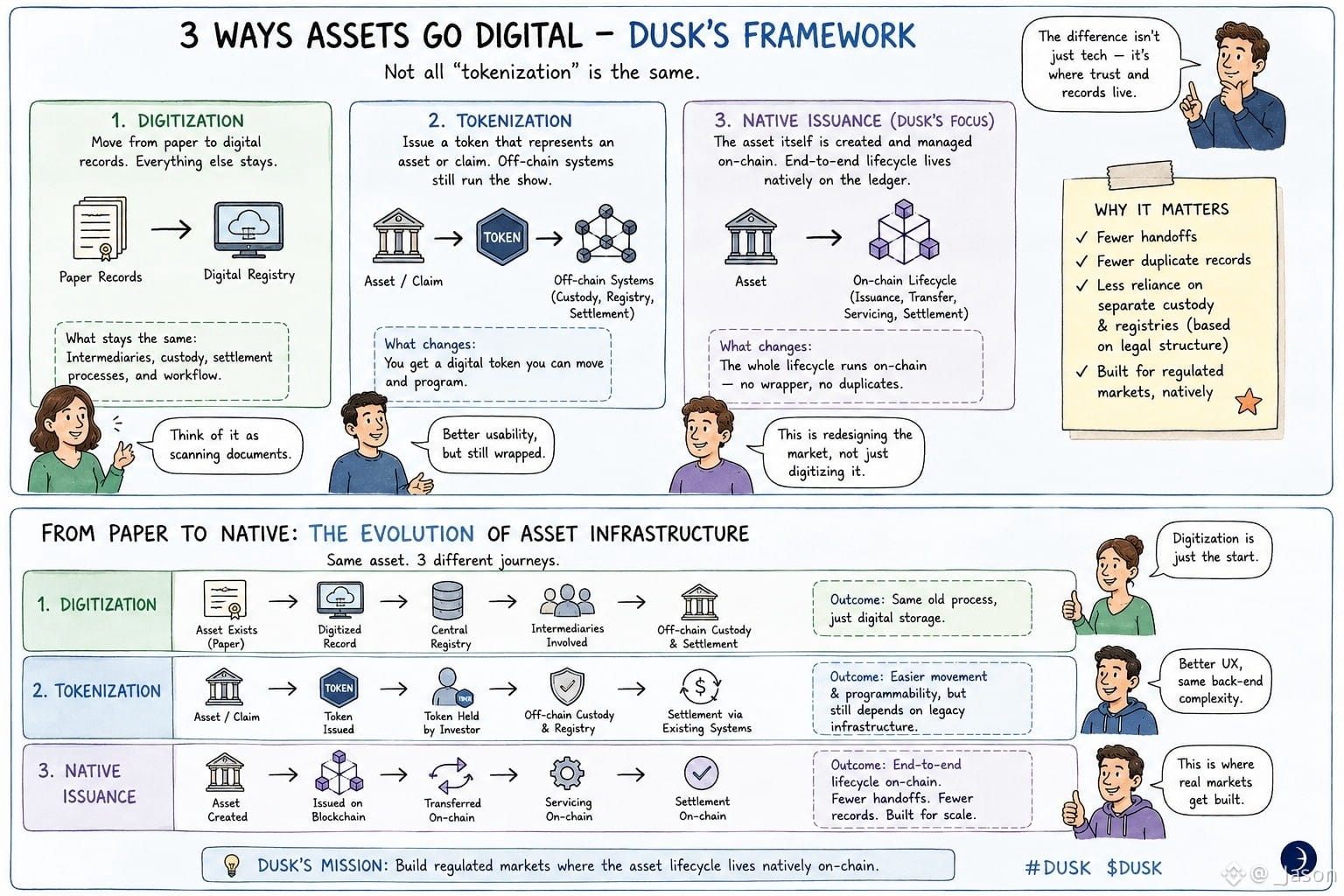
#dusk @Dusk wanted to slow down today on a word that gets used pretty loosely across the whole rwa space — "tokenization." dusk actually breaks this into three distinct things, and once i saw them laid out separately it made a lot of the vague marketing language elsewhere click into place.
first is digitization. this is just moving an assets recordkeeping from paper or manual processes into digital systems, think dematerialized securities sitting in a central registry. the asset lifecycle and intermediaries usually stay exactly the same, only the storage medium changed.
second is tokenization, the term everyone actually means when they say "tokenization" loosely. this is issuing a token that represents an asset, or a claim on one. the token can be programmable and easier to plug into apps, but regulated assets under this model often still rely on existing custody, registry, and settlement processes happening off chain. the token is a wrapper, not a replacement for the underlying system of record.
third, and this is the one dusk actually positions itself around, is native issuance. this means the asset itself is created and managed on chain — issuance, transfers, servicing, and settlement can all happen around the ledger directly, instead of using a token as a wrapper around some separate off chain system.
why the distinction actually matters practically — native issuance is described as reducing reliance on separate custody and registry layers (depending on legal structure), and can reduce handoffs between issuance, transfer, servicing, and settlement, since fewer duplicated records exist when the whole workflow lives natively on chain. tokenization alone doesnt get you that, youre still often reconciling between the token and the real underlying asset sitting somewhere else.
so when dusk talks about regulated markets, its not really talking about wrapping assets in tokens, its aiming at the deeper version where the asset lifecycle itself is redesigned around on chain workflows from the start.
$DUSK
first is digitization. this is just moving an assets recordkeeping from paper or manual processes into digital systems, think dematerialized securities sitting in a central registry. the asset lifecycle and intermediaries usually stay exactly the same, only the storage medium changed.
second is tokenization, the term everyone actually means when they say "tokenization" loosely. this is issuing a token that represents an asset, or a claim on one. the token can be programmable and easier to plug into apps, but regulated assets under this model often still rely on existing custody, registry, and settlement processes happening off chain. the token is a wrapper, not a replacement for the underlying system of record.
third, and this is the one dusk actually positions itself around, is native issuance. this means the asset itself is created and managed on chain — issuance, transfers, servicing, and settlement can all happen around the ledger directly, instead of using a token as a wrapper around some separate off chain system.
why the distinction actually matters practically — native issuance is described as reducing reliance on separate custody and registry layers (depending on legal structure), and can reduce handoffs between issuance, transfer, servicing, and settlement, since fewer duplicated records exist when the whole workflow lives natively on chain. tokenization alone doesnt get you that, youre still often reconciling between the token and the real underlying asset sitting somewhere else.
so when dusk talks about regulated markets, its not really talking about wrapping assets in tokens, its aiming at the deeper version where the asset lifecycle itself is redesigned around on chain workflows from the start.
$DUSK
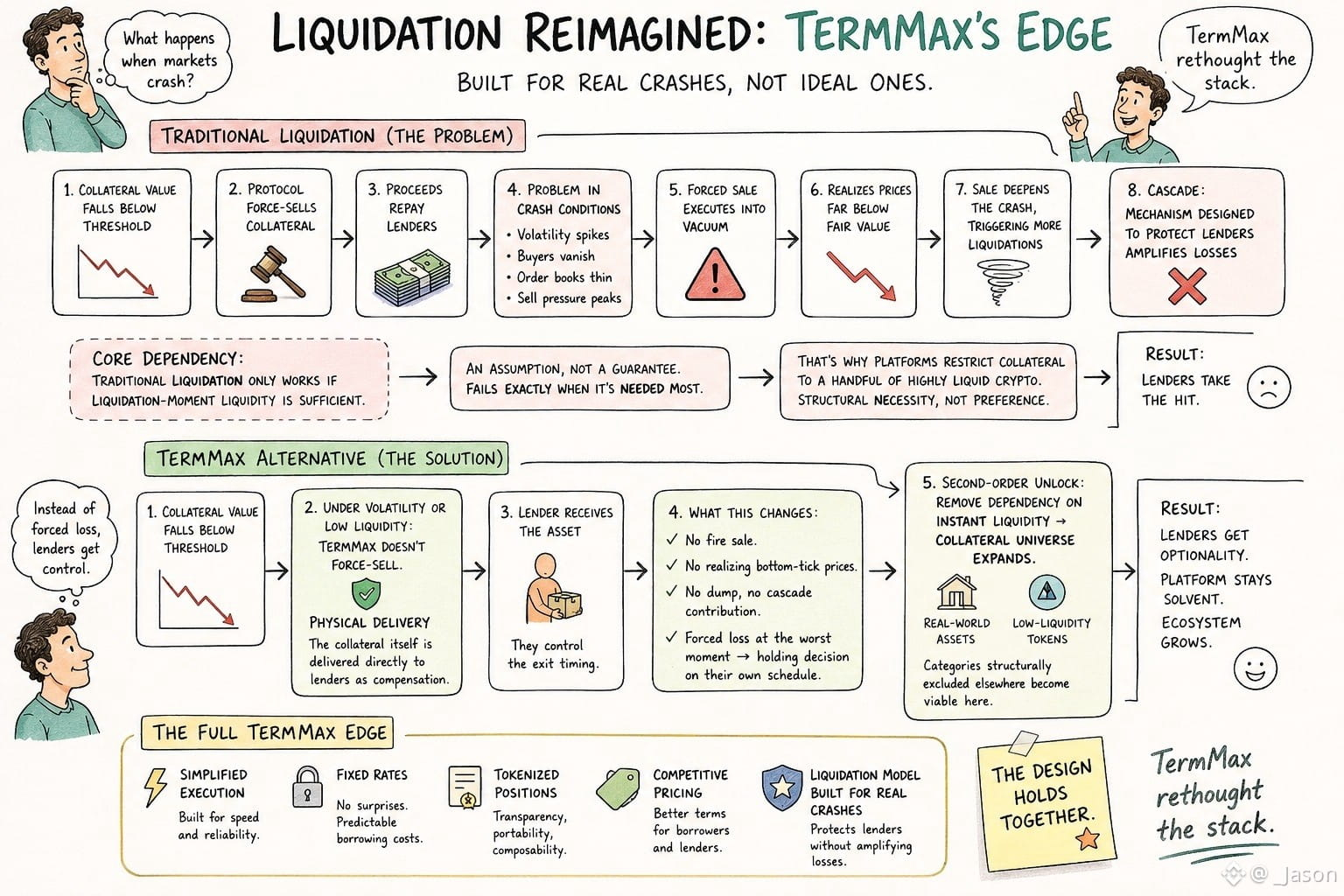
#termmax @TermMax Let's examine the failure mode nobody stress-tests until it's too late: liquidation under thin liquidity.
Standard mechanism, step by step. Collateral value falls below threshold. Protocol force-sells collateral on the open market. Proceeds repay lenders. On paper, clean. Now add real crash conditions: volatility spiking, buyers vanishing, order books thinning precisely when sell pressure peaks. The forced sale executes into that vacuum, realizing prices far below fair value. Worse, the sale itself deepens the crash, triggering further liquidations. A cascade. The mechanism designed to protect lenders becomes the amplifier of their losses.
Quantify the core dependency and the flaw is obvious: traditional liquidation only works if liquidation-moment liquidity is sufficient. That's an assumption, not a guarantee, and it fails exactly when it's needed most. This is also why conventional platforms restrict collateral to a handful of highly liquid cryptocurrencies. Not preference. Structural necessity. Their entire solvency model depends on being able to dump collateral fast.
Now, TermMax's alternative, told plainly: physical delivery.
Under significant volatility or low liquidity, TermMax doesn't force-sell. The collateral itself is delivered directly to lenders as compensation. Trace what this changes. No fire sale, so no realizing bottom-tick prices. No dump, so no cascade contribution. The lender receives the asset and controls the exit timing, converting a forced loss at the worst moment into a holding decision on their own schedule.
And the second-order unlock is the bigger story: remove the dependency on instant liquidity, and the collateral universe expands. Real-world assets. Low-liquidity tokens. Categories structurally excluded elsewhere become viable here.
Full series in one line: simplified execution, fixed rates, tokenized positions, competitive pricing, and a liquidation model built for actual crashes rather than ideal ones. The design holds together.
That's the whole analysis. TermMax rethought the stack.
Standard mechanism, step by step. Collateral value falls below threshold. Protocol force-sells collateral on the open market. Proceeds repay lenders. On paper, clean. Now add real crash conditions: volatility spiking, buyers vanishing, order books thinning precisely when sell pressure peaks. The forced sale executes into that vacuum, realizing prices far below fair value. Worse, the sale itself deepens the crash, triggering further liquidations. A cascade. The mechanism designed to protect lenders becomes the amplifier of their losses.
Quantify the core dependency and the flaw is obvious: traditional liquidation only works if liquidation-moment liquidity is sufficient. That's an assumption, not a guarantee, and it fails exactly when it's needed most. This is also why conventional platforms restrict collateral to a handful of highly liquid cryptocurrencies. Not preference. Structural necessity. Their entire solvency model depends on being able to dump collateral fast.
Now, TermMax's alternative, told plainly: physical delivery.
Under significant volatility or low liquidity, TermMax doesn't force-sell. The collateral itself is delivered directly to lenders as compensation. Trace what this changes. No fire sale, so no realizing bottom-tick prices. No dump, so no cascade contribution. The lender receives the asset and controls the exit timing, converting a forced loss at the worst moment into a holding decision on their own schedule.
And the second-order unlock is the bigger story: remove the dependency on instant liquidity, and the collateral universe expands. Real-world assets. Low-liquidity tokens. Categories structurally excluded elsewhere become viable here.
Full series in one line: simplified execution, fixed rates, tokenized positions, competitive pricing, and a liquidation model built for actual crashes rather than ideal ones. The design holds together.
That's the whole analysis. TermMax rethought the stack.
#termmax @TermMax Bro, quick story. There are two shops in my area.
Shop one: fixed price board, no discussion. You ask the guy, "yaar, thoda kam karo," and he points at the board like it's a court order. Whatever's written is final. Shop two: the proper bazaar. Ten sellers, same items, different prices. You walk, you compare, you bargain, you WIN. Where do you shop? Exactly. Everyone knows the answer.
Now here's the thing nobody tells you: most DeFi platforms are shop one.
Your borrowing rate, your lending rate, all of it comes from one mathematical formula called an AMM curve. The formula announces the number and that's it. Board price, final, no discussion. And the ugly part? That formula doesn't even track the real market properly. It just calculates what it was set up to calculate. So you end up accepting rates that no actual human would offer you, because there's no actual human on the other side. Just math with an attitude.
TermMax turned shop one into the full bazaar, and let me tell you exactly how.
On TermMax, market makers set what's called range orders. Simple meaning: each market maker puts up their own stall. "I'll lend at this rate, in this range, these terms." Another one offers something different. A third one, something else. TermMax collects ALL these offers in one place. So when you come to borrow or lend, you're not staring at one board. You're walking through a whole bazaar of rates, and you pick whichever deal suits YOU.
And because these market makers are competing for your business, the rates stay honest. Competition, bro. Oldest trick in the book, and it still works better than any formula.
One price is an order. Many prices is a market. Simple as that.
Tomorrow, last day, and it's the heaviest one: what TermMax does when the market fully crashes. You don't want to miss it. Chai ready. See you.
Shop one: fixed price board, no discussion. You ask the guy, "yaar, thoda kam karo," and he points at the board like it's a court order. Whatever's written is final. Shop two: the proper bazaar. Ten sellers, same items, different prices. You walk, you compare, you bargain, you WIN. Where do you shop? Exactly. Everyone knows the answer.
Now here's the thing nobody tells you: most DeFi platforms are shop one.
Your borrowing rate, your lending rate, all of it comes from one mathematical formula called an AMM curve. The formula announces the number and that's it. Board price, final, no discussion. And the ugly part? That formula doesn't even track the real market properly. It just calculates what it was set up to calculate. So you end up accepting rates that no actual human would offer you, because there's no actual human on the other side. Just math with an attitude.
TermMax turned shop one into the full bazaar, and let me tell you exactly how.
On TermMax, market makers set what's called range orders. Simple meaning: each market maker puts up their own stall. "I'll lend at this rate, in this range, these terms." Another one offers something different. A third one, something else. TermMax collects ALL these offers in one place. So when you come to borrow or lend, you're not staring at one board. You're walking through a whole bazaar of rates, and you pick whichever deal suits YOU.
And because these market makers are competing for your business, the rates stay honest. Competition, bro. Oldest trick in the book, and it still works better than any formula.
One price is an order. Many prices is a market. Simple as that.
Tomorrow, last day, and it's the heaviest one: what TermMax does when the market fully crashes. You don't want to miss it. Chai ready. See you.
long
50%
short
50%
2 ຄະແນນສຽງ • ປິດລົງຄະແນນສຽງ
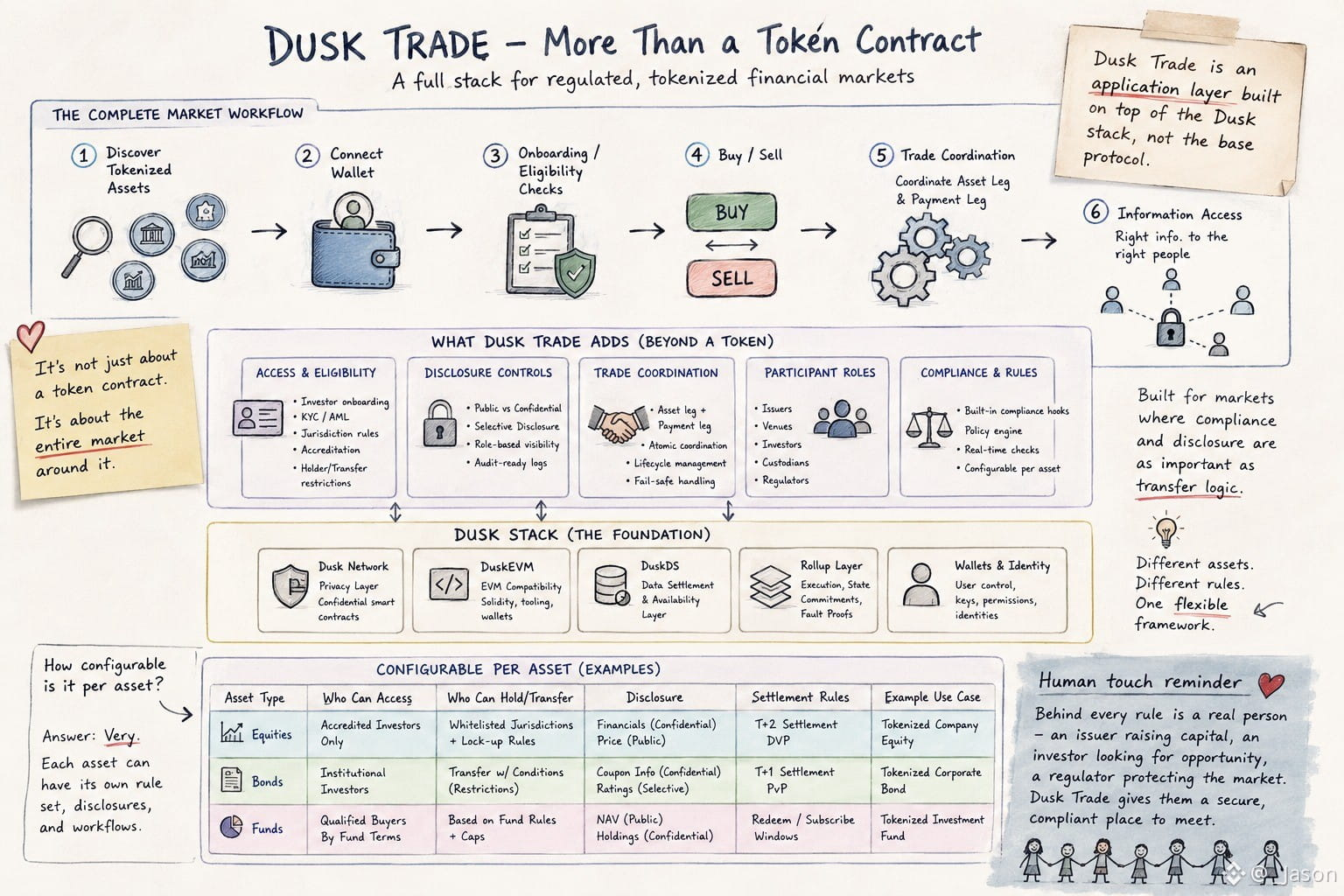
#dusk @Dusk took a step back from the cryptography stuff this week and looked at Dusk Trade specifically, because i think its easy to assume "tokenized asset platform" just means "a token contract exists somewhere," and thats really not what Dusk Trade actually is.
Dusk Trade sits above the base protocol as an application layer — its explicitly not the base protocol itself, its described as a product layer that uses the dusk stack underneath it. what it actually covers is a full set of workflows: discovering tokenized financial assets, connecting a wallet, completing onboarding or eligibility checks, buying or selling, coordinating the asset leg and payment leg of a trade, and exposing the right information to issuers, venues, investors, or other authorized parties.
that last part is where i think the real point is being made. for regulated assets specifically, the hard part is almost never the token contract in isolation — its the complete market workflow around it. who can access the asset, who can hold or transfer it, whats public vs confidential, what can be selectively disclosed, how payment and asset settlement actually get coordinated together, and how issuers/venues/investors all interact inside the same environment without stepping on each others requirements.
so Dusk Trade isnt "another dex frontend," its specifically built for markets where eligibility and disclosure logic has to exist around the asset, not just transfer logic. a generic token contract has none of that built in by default, you'd be building all of it yourself from scratch for every single regulated asset if the underlying stack didnt already provide it.
what im still trying to nail down — how configurable this eligibility/disclosure layer actually is per asset, since different regulated instruments (equities vs bonds vs funds) presumably have pretty different compliance requirements attached to them.
$DUSK
Dusk Trade sits above the base protocol as an application layer — its explicitly not the base protocol itself, its described as a product layer that uses the dusk stack underneath it. what it actually covers is a full set of workflows: discovering tokenized financial assets, connecting a wallet, completing onboarding or eligibility checks, buying or selling, coordinating the asset leg and payment leg of a trade, and exposing the right information to issuers, venues, investors, or other authorized parties.
that last part is where i think the real point is being made. for regulated assets specifically, the hard part is almost never the token contract in isolation — its the complete market workflow around it. who can access the asset, who can hold or transfer it, whats public vs confidential, what can be selectively disclosed, how payment and asset settlement actually get coordinated together, and how issuers/venues/investors all interact inside the same environment without stepping on each others requirements.
so Dusk Trade isnt "another dex frontend," its specifically built for markets where eligibility and disclosure logic has to exist around the asset, not just transfer logic. a generic token contract has none of that built in by default, you'd be building all of it yourself from scratch for every single regulated asset if the underlying stack didnt already provide it.
what im still trying to nail down — how configurable this eligibility/disclosure layer actually is per asset, since different regulated instruments (equities vs bonds vs funds) presumably have pretty different compliance requirements attached to them.
$DUSK
#dusk @Dusk
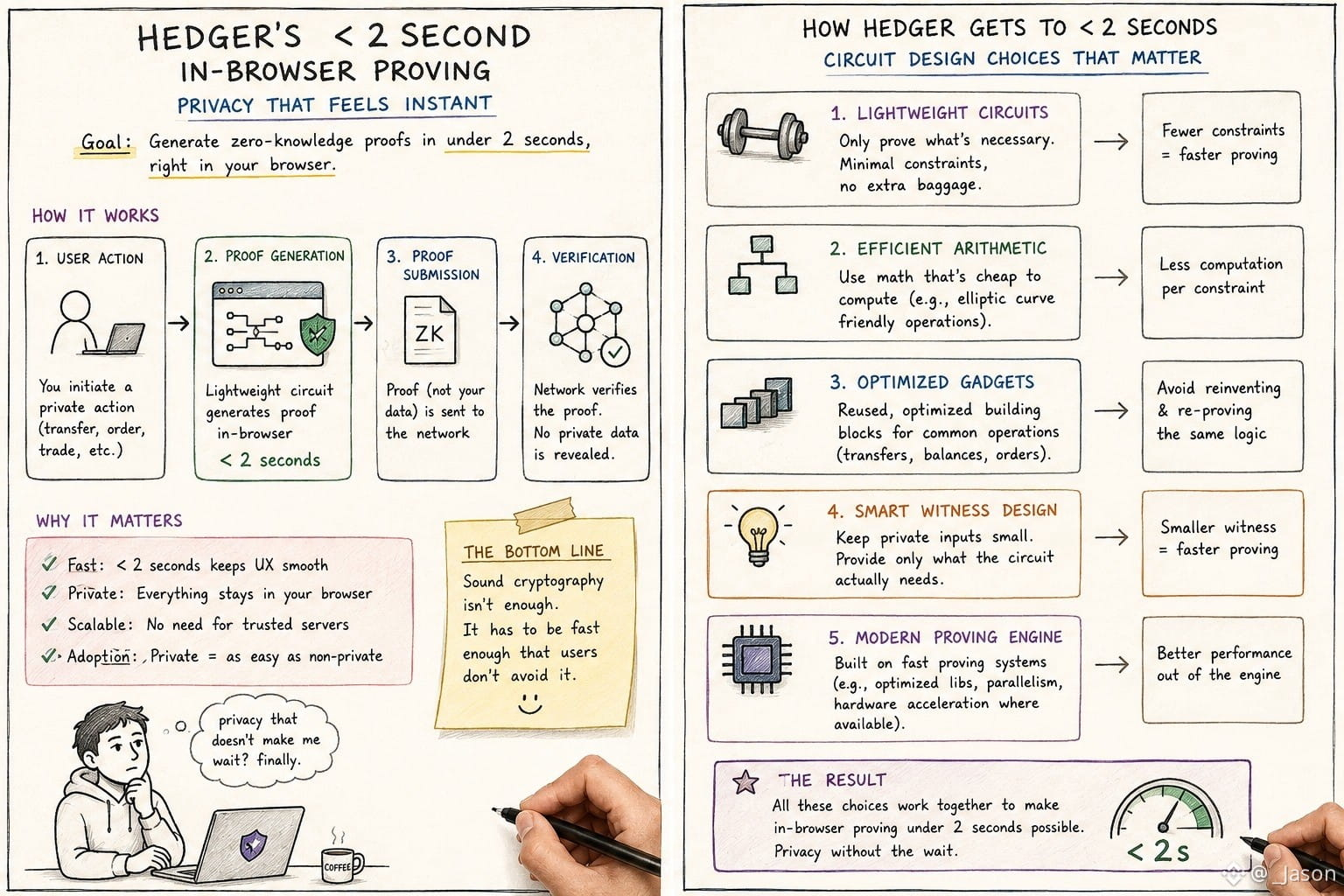
been circling around Hedger all week without actually stopping on one specific number that i think matters more then people give it credit for — proving time. specifically, fast in-browser proving, under 2 seconds, client side.
quick context for why this number even matters. privacy tech built on zero knowledge proofs has historically had a real usability problem generating a proof can be computationally heavy, and if that means waiting a long time (or needing a beefy server to do it for you) every single time you want to do something private, thats a dealbreaker for actual adoption, no matter how sound the cryptography underneath is. "technically private but practically unusable" has killed plenty of otherwise solid privacy systems.
Hedger specifically targets this with lightweight circuits that allow client side proof generation in under 2 seconds. client side here matters as much as the speed does — this isnt a proof getting generated on some server and sent back to you, its happening directly in your own browser. that has real implications for trust too, you arent handing off the underlying private inputs to a third party server just to get a proof computed.
why this actually connects to everything else ive covered this week — obfuscated order books, confidential transfers, all of it depends on proofs being generated fast enough that using the private version of a workflow doesnt feel meaningfully slower then the non private version. a 2 second (or less) browser side proof is what makes "privacy by default" feel realistic instead of "privacy as a slow, annoying opt in."
described plainly as enabling a seamless user experience at scale, which i think is the actual point being made here — the cryptography being sound is necessary but not sufficient, it also has to be fast enough that people dont route around it out of impatience.
$DUSK
been circling around Hedger all week without actually stopping on one specific number that i think matters more then people give it credit for — proving time. specifically, fast in-browser proving, under 2 seconds, client side.
quick context for why this number even matters. privacy tech built on zero knowledge proofs has historically had a real usability problem generating a proof can be computationally heavy, and if that means waiting a long time (or needing a beefy server to do it for you) every single time you want to do something private, thats a dealbreaker for actual adoption, no matter how sound the cryptography underneath is. "technically private but practically unusable" has killed plenty of otherwise solid privacy systems.
Hedger specifically targets this with lightweight circuits that allow client side proof generation in under 2 seconds. client side here matters as much as the speed does — this isnt a proof getting generated on some server and sent back to you, its happening directly in your own browser. that has real implications for trust too, you arent handing off the underlying private inputs to a third party server just to get a proof computed.
why this actually connects to everything else ive covered this week — obfuscated order books, confidential transfers, all of it depends on proofs being generated fast enough that using the private version of a workflow doesnt feel meaningfully slower then the non private version. a 2 second (or less) browser side proof is what makes "privacy by default" feel realistic instead of "privacy as a slow, annoying opt in."
described plainly as enabling a seamless user experience at scale, which i think is the actual point being made here — the cryptography being sound is necessary but not sufficient, it also has to be fast enough that people dont route around it out of impatience.
$DUSK
#termmax @TermMax
Bro, you know what a biryani packet is? The masala one. Somebody's dadi spent 50 years perfecting that spice mix, and now the whole recipe sits in one packet. You don't need the 50 years. You need one packet and basic sense.
Hold that thought, because TermMax did the same thing to DeFi. Twice.
Two tokens: FT and GT. Let me break them down like a friend, not a whitepaper.
FT is the Fixed-Rate Token, and it's basically lending in packet form. Old way: deposit somewhere, watch the floating rate like a hawk, stress daily. FT way: you hold one token that already contains everything, fixed return, fixed term, done deal at maturity. Buy it, keep it, redeem it. That's the whole job. No watching, no guessing what you'll earn. The token knows. It's written inside.
Now GT, the Gearing Token, this one's the heavyweight. Remember Day 1? The looping nightmare, borrow here, swap there, deposit, repeat, ten transactions, three protocols, one headache? GT stuffs that ENTIRE leveraged position into a single token. The collateral, the borrowed amount, the leverage, everything packed inside. You make one trade, and boom, you're holding a full strategy that used to take an evening and half your sanity.
One trade, bro. ONE.
And here's the part that actually matters for people like us: when the whole strategy is just a token, you can enter with one click and exit with one click. No dismantling ten positions in reverse order at midnight. You always know exactly what you own, because what you own is one thing.
The complicated stuff didn't vanish, it just moved inside the packet. Dadi's recipe, remember?
Tomorrow: how TermMax lets you actually CHOOSE your rate instead of accepting whatever the machine says. That one's spicy. Chai ready. See you.
Bro, you know what a biryani packet is? The masala one. Somebody's dadi spent 50 years perfecting that spice mix, and now the whole recipe sits in one packet. You don't need the 50 years. You need one packet and basic sense.
Hold that thought, because TermMax did the same thing to DeFi. Twice.
Two tokens: FT and GT. Let me break them down like a friend, not a whitepaper.
FT is the Fixed-Rate Token, and it's basically lending in packet form. Old way: deposit somewhere, watch the floating rate like a hawk, stress daily. FT way: you hold one token that already contains everything, fixed return, fixed term, done deal at maturity. Buy it, keep it, redeem it. That's the whole job. No watching, no guessing what you'll earn. The token knows. It's written inside.
Now GT, the Gearing Token, this one's the heavyweight. Remember Day 1? The looping nightmare, borrow here, swap there, deposit, repeat, ten transactions, three protocols, one headache? GT stuffs that ENTIRE leveraged position into a single token. The collateral, the borrowed amount, the leverage, everything packed inside. You make one trade, and boom, you're holding a full strategy that used to take an evening and half your sanity.
One trade, bro. ONE.
And here's the part that actually matters for people like us: when the whole strategy is just a token, you can enter with one click and exit with one click. No dismantling ten positions in reverse order at midnight. You always know exactly what you own, because what you own is one thing.
The complicated stuff didn't vanish, it just moved inside the packet. Dadi's recipe, remember?
Tomorrow: how TermMax lets you actually CHOOSE your rate instead of accepting whatever the machine says. That one's spicy. Chai ready. See you.
long
100%
short
0%
1 ຄະແນນສຽງ • ປິດລົງຄະແນນສຽງ
Bro, imagine this. You rent a flat, agree on 30k a month, shake hands, move in. Then next month the landlord knocks: "It's 55k now." Month after: "80k, market conditions yaar." You'd lose your mind, right? You'd say this is madness, nobody can live like this.
Congratulations. That's exactly how borrowing works in most of DeFi.
Floating interest rates, they call it. Sounds harmless, almost gentle. Floating. Like a boat. But what it actually means is the rate you borrowed at today has zero loyalty to you tomorrow. I've seen people open a leveraged position at 4%, feel like geniuses for two weeks, then watch the rate triple during a market panic and eat every rupee of their profit. And nobody warned them, because nobody could. That's the whole problem. Even the protocol doesn't know tomorrow's rate.
How do you plan anything like that? Short answer: you don't. You just watch your phone all day like it owes you money.
This is why TermMax's fixed rates genuinely impressed me. No drama, no gimmick, just a simple deal: you borrow at a fixed rate for a fixed term, and that rate is locked. Locked means locked. The cost you see on day one is the cost on the last day. Lending side, same thing. You know your exact return before you even click. You can literally do the math on a napkin: cost this much, earn this much, profit is this much. Done.
That's how normal finance has worked forever, by the way. Fixed home loans, fixed deposits. DeFi just forgot the basics while chasing fancy stuff.
TermMax remembered.
Tomorrow I'm explaining the two tokens running this whole show behind the scenes, FT and GT. Sounds technical, I'll make it simple, promise. Chai ready. See you.
#termmax @TermMax
Congratulations. That's exactly how borrowing works in most of DeFi.
Floating interest rates, they call it. Sounds harmless, almost gentle. Floating. Like a boat. But what it actually means is the rate you borrowed at today has zero loyalty to you tomorrow. I've seen people open a leveraged position at 4%, feel like geniuses for two weeks, then watch the rate triple during a market panic and eat every rupee of their profit. And nobody warned them, because nobody could. That's the whole problem. Even the protocol doesn't know tomorrow's rate.
How do you plan anything like that? Short answer: you don't. You just watch your phone all day like it owes you money.
This is why TermMax's fixed rates genuinely impressed me. No drama, no gimmick, just a simple deal: you borrow at a fixed rate for a fixed term, and that rate is locked. Locked means locked. The cost you see on day one is the cost on the last day. Lending side, same thing. You know your exact return before you even click. You can literally do the math on a napkin: cost this much, earn this much, profit is this much. Done.
That's how normal finance has worked forever, by the way. Fixed home loans, fixed deposits. DeFi just forgot the basics while chasing fancy stuff.
TermMax remembered.
Tomorrow I'm explaining the two tokens running this whole show behind the scenes, FT and GT. Sounds technical, I'll make it simple, promise. Chai ready. See you.
#termmax @TermMax
Yes
100%
No
0%
1 ຄະແນນສຽງ • ປິດລົງຄະແນນສຽງ
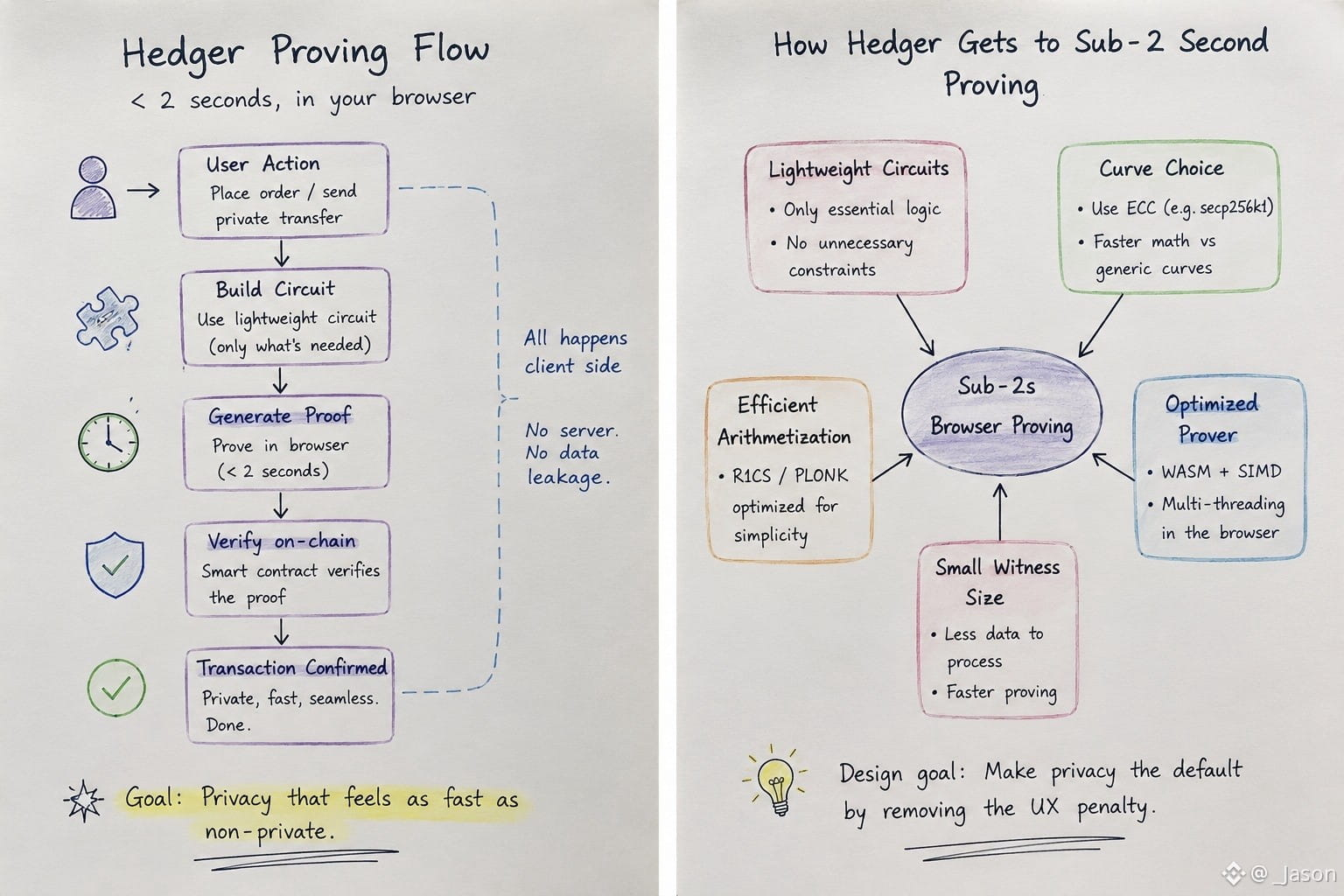
been circling around Hedger all week without actually stopping on one specific number that i think matters more then people give it credit for– proving time. specifically, fast in-browser proving, under 2 seconds, client side.
quick context for why this number even matters. privacy tech built on zero knowledge proofs has historically had a real usability problem -generating a proof can be computationally heavy, and if that means waiting a long time (or needing a beefy server to do it for you) every single time you want to do something private, thats a dealbreaker for actual adoption, no matter how sound the cryptography underneath is. "technically private but practically unusable" has killed plenty of otherwise solid privacy systems.
Hedger specifically targets this with lightweight circuits that allow client side proof generation in under 2 seconds. client side here matters as much as the speed does – this isnt a proof getting generated on some server and sent back to you, its happening directly in your own browser. that has real implications for trust too, you arent handing off the underlying private inputs to a third party server just to get a proof computed.
why this actually connects to everything else ive covered this week - obfuscated order books, confidential transfers, all of it depends on proofs being generated fast enough that using the private version of a workflow doesnt feel meaningfully slower then the non private version. a 2 second (or less) browser side proof is what makes "privacy by default" feel realistic instead of "privacy as a slow, annoying opt in."
described plainly as enabling a seamless user experience at scale, which i think is the actual point being made here - the cryptography being sound is necessary but not sufficient, it also has to be fast enough that people dont route around it out of impatience.
curious what circuit design choices actually get you from "typical zk proving time" down to sub 2 second, thats a meaningful gap from what i understand of proving times elsewhere.
#dusk @Dusk $DUSK
quick context for why this number even matters. privacy tech built on zero knowledge proofs has historically had a real usability problem -generating a proof can be computationally heavy, and if that means waiting a long time (or needing a beefy server to do it for you) every single time you want to do something private, thats a dealbreaker for actual adoption, no matter how sound the cryptography underneath is. "technically private but practically unusable" has killed plenty of otherwise solid privacy systems.
Hedger specifically targets this with lightweight circuits that allow client side proof generation in under 2 seconds. client side here matters as much as the speed does – this isnt a proof getting generated on some server and sent back to you, its happening directly in your own browser. that has real implications for trust too, you arent handing off the underlying private inputs to a third party server just to get a proof computed.
why this actually connects to everything else ive covered this week - obfuscated order books, confidential transfers, all of it depends on proofs being generated fast enough that using the private version of a workflow doesnt feel meaningfully slower then the non private version. a 2 second (or less) browser side proof is what makes "privacy by default" feel realistic instead of "privacy as a slow, annoying opt in."
described plainly as enabling a seamless user experience at scale, which i think is the actual point being made here - the cryptography being sound is necessary but not sufficient, it also has to be fast enough that people dont route around it out of impatience.
curious what circuit design choices actually get you from "typical zk proving time" down to sub 2 second, thats a meaningful gap from what i understand of proving times elsewhere.
#dusk @Dusk $DUSK
#dusk $DUSK @Dusk
today i wanted to understand a specific phrase i saw attached to Hedger "obfuscated order books" because on its own that sounds almost contradictory, isnt the whole point of an order book that people can see it?
turns out the "obfuscated" part isnt about hiding that trading is happening, its about hiding intent and exposure specifically, and the reasoning is pretty institutional in nature once you think about who this actually matters for.
if your a large institutional trader and you place a sizeable order on a fully visible order book, other participants can see it and react before your order even fills front running, or just general market participants adjusting behavior because they now know your position or intent. thats a real cost for institutions moving meaningful size, and its described plainly as a critical feature for institutional trading that prevents market manipulation and protects participants from revealing intent or exposure.
this is where Hedger comes back in from the last two days the confidential asset ownership and transfers piece (holdings, amounts, balances staying encrypted end to end) is what actually makes obfuscated order books technically possible in the first place. you cant obfuscate an order book meaningfully if the underlying balances and transfers backing those orders are fully visible on chain.
worth being precise on where this actually stands right now tho the docs describe Hedger as laying the ground for the upcoming deployment of obfuscated order books, so this reads as foundational infrastructure being in place rather then the order book feature itself being live today.
what im curious to see next is what the actual obfuscated order book product looks like once it does ship, and whether the privacy there is opt in per order or a default behavior across the board.
#dusk @Dusk $DUSK
today i wanted to understand a specific phrase i saw attached to Hedger "obfuscated order books" because on its own that sounds almost contradictory, isnt the whole point of an order book that people can see it?
turns out the "obfuscated" part isnt about hiding that trading is happening, its about hiding intent and exposure specifically, and the reasoning is pretty institutional in nature once you think about who this actually matters for.
if your a large institutional trader and you place a sizeable order on a fully visible order book, other participants can see it and react before your order even fills front running, or just general market participants adjusting behavior because they now know your position or intent. thats a real cost for institutions moving meaningful size, and its described plainly as a critical feature for institutional trading that prevents market manipulation and protects participants from revealing intent or exposure.
this is where Hedger comes back in from the last two days the confidential asset ownership and transfers piece (holdings, amounts, balances staying encrypted end to end) is what actually makes obfuscated order books technically possible in the first place. you cant obfuscate an order book meaningfully if the underlying balances and transfers backing those orders are fully visible on chain.
worth being precise on where this actually stands right now tho the docs describe Hedger as laying the ground for the upcoming deployment of obfuscated order books, so this reads as foundational infrastructure being in place rather then the order book feature itself being live today.
what im curious to see next is what the actual obfuscated order book product looks like once it does ship, and whether the privacy there is opt in per order or a default behavior across the board.
#dusk @Dusk $DUSK
long
67%
short
33%
3 ຄະແນນສຽງ • ປິດລົງຄະແນນສຽງ
ການຊື້ຂາຍ 30D $DUSK 41.9 USDT
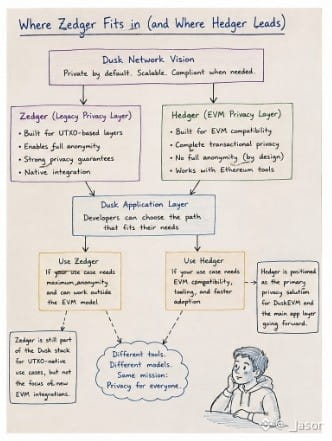
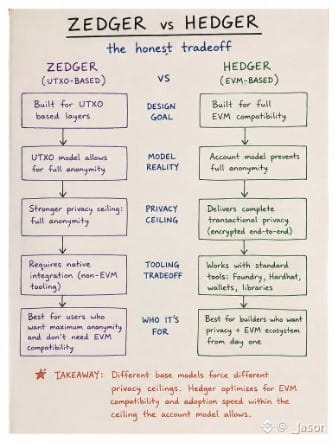
follow up to yesterday, because i noticed Hedger keeps getting compared to something called Zedger and i didnt actually understand the difference until today — turns out its a genuinely honest tradeoff, not just "new thing replaces old thing."
Zedger was built specifically for UTXO based layers. that model lends itself naturally to full anonymity, since utxos dont carry the same persistent identity that an account does across transactions.
Hedger is different by necessity, not by choice really — its built for full EVM compatibility, which means working within an account based model. and the account based model just doesnt allow for the same full anonymity that a utxo system like Zedger can offer. thats stated pretty directly rather then glossed over, which i respect — the EVM's account based model prevents full anonymity, a capability Zedger still has.
so whats the tradeoff actually buying you then, if you give up full anonymity? Hedger still delivers complete transactional privacy (holdings, amounts, balances staying encrypted end to end), it just does so while integrating directly with standard ethereum tooling — foundry, hardhat, the usual wallets and libraries. its described as scalable, auditable, and easy to adopt from day one, specifically because it doesnt require abandoning the evm tooling ecosystem to get there.
so the actual comparison isnt "Hedger is strictly better then Zedger," its "different base models force different privacy ceilings, and Hedger optimizes for evm compatibility and adoption speed within the ceiling the account model allows, rather then chasing full anonymity at the cost of that compatibility."
curious whether zedger is still active anywhere in the dusk stack, or if its more of a predecessor thats being phased out as duskevm becomes the primary application layer.
#dusk @Dusk $DUSK
Zedger was built specifically for UTXO based layers. that model lends itself naturally to full anonymity, since utxos dont carry the same persistent identity that an account does across transactions.
Hedger is different by necessity, not by choice really — its built for full EVM compatibility, which means working within an account based model. and the account based model just doesnt allow for the same full anonymity that a utxo system like Zedger can offer. thats stated pretty directly rather then glossed over, which i respect — the EVM's account based model prevents full anonymity, a capability Zedger still has.
so whats the tradeoff actually buying you then, if you give up full anonymity? Hedger still delivers complete transactional privacy (holdings, amounts, balances staying encrypted end to end), it just does so while integrating directly with standard ethereum tooling — foundry, hardhat, the usual wallets and libraries. its described as scalable, auditable, and easy to adopt from day one, specifically because it doesnt require abandoning the evm tooling ecosystem to get there.
so the actual comparison isnt "Hedger is strictly better then Zedger," its "different base models force different privacy ceilings, and Hedger optimizes for evm compatibility and adoption speed within the ceiling the account model allows, rather then chasing full anonymity at the cost of that compatibility."
curious whether zedger is still active anywhere in the dusk stack, or if its more of a predecessor thats being phased out as duskevm becomes the primary application layer.
#dusk @Dusk $DUSK
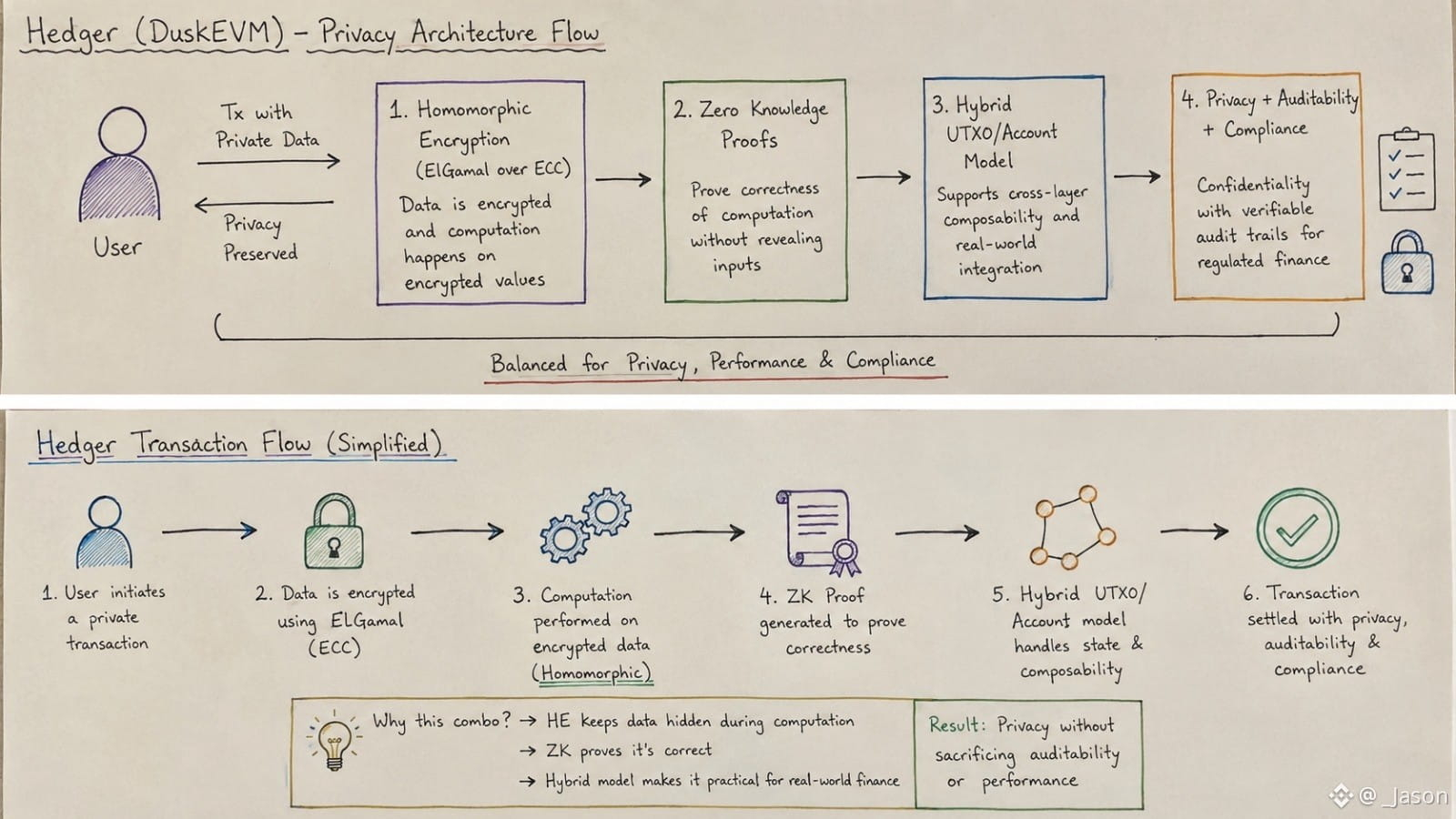
wanted to actually understand Hedger properly today instead of just knowing it as "dusk's privacy thing for duskevm," because the cryptography behind it is more layered then i expected going in.
most defi privacy systems i know of lean on zero knowledge proofs alone - prove a computation was done correctly without revealing the inputs, thats the whole toolkit. Hedger doesnt stop there, it combines multiple techniques together instead of picking just one.
first piece is homomorphic encryption, specifically based on ElGamal over ECC. what this actually gets you is the ability to perform computation directly on encrypted values, without ever needing to decrypt them first to do the math. thats different from "prove the math was correct after the fact," its closer to "do the math while the numbers stay hidden the entire time."
second piece is still zero knowledge proofs, layered on top - these prove correctness of computations without disclosing the underlying inputs, same general purpose as always, just working alongside the homomorphic layer instead of carrying everything alone.
third piece is a hybrid utxo/account model, which is what supports cross layer composability and lets this integrate cleanly with real world financial systems instead of being locked into one transaction model shape.
why go through the trouble of combining three things instead of just using zk like everyone else – the framing i saw was balancing privacy, performance, and compliance simultaneously, not just privacy in isolation. regulated financial applications need auditability alongside confidentiality, and layering multiple cryptographic techniques together is apparently how you get both without one undermining the other.
still want to understand better - does combining these techniques add meaningful computational overhead compared to a pure zk approach, or is the performance cost roughly comparable in practice.
#dusk @Dusk $DUSK
most defi privacy systems i know of lean on zero knowledge proofs alone - prove a computation was done correctly without revealing the inputs, thats the whole toolkit. Hedger doesnt stop there, it combines multiple techniques together instead of picking just one.
first piece is homomorphic encryption, specifically based on ElGamal over ECC. what this actually gets you is the ability to perform computation directly on encrypted values, without ever needing to decrypt them first to do the math. thats different from "prove the math was correct after the fact," its closer to "do the math while the numbers stay hidden the entire time."
second piece is still zero knowledge proofs, layered on top - these prove correctness of computations without disclosing the underlying inputs, same general purpose as always, just working alongside the homomorphic layer instead of carrying everything alone.
third piece is a hybrid utxo/account model, which is what supports cross layer composability and lets this integrate cleanly with real world financial systems instead of being locked into one transaction model shape.
why go through the trouble of combining three things instead of just using zk like everyone else – the framing i saw was balancing privacy, performance, and compliance simultaneously, not just privacy in isolation. regulated financial applications need auditability alongside confidentiality, and layering multiple cryptographic techniques together is apparently how you get both without one undermining the other.
still want to understand better - does combining these techniques add meaningful computational overhead compared to a pure zk approach, or is the performance cost roughly comparable in practice.
#dusk @Dusk $DUSK
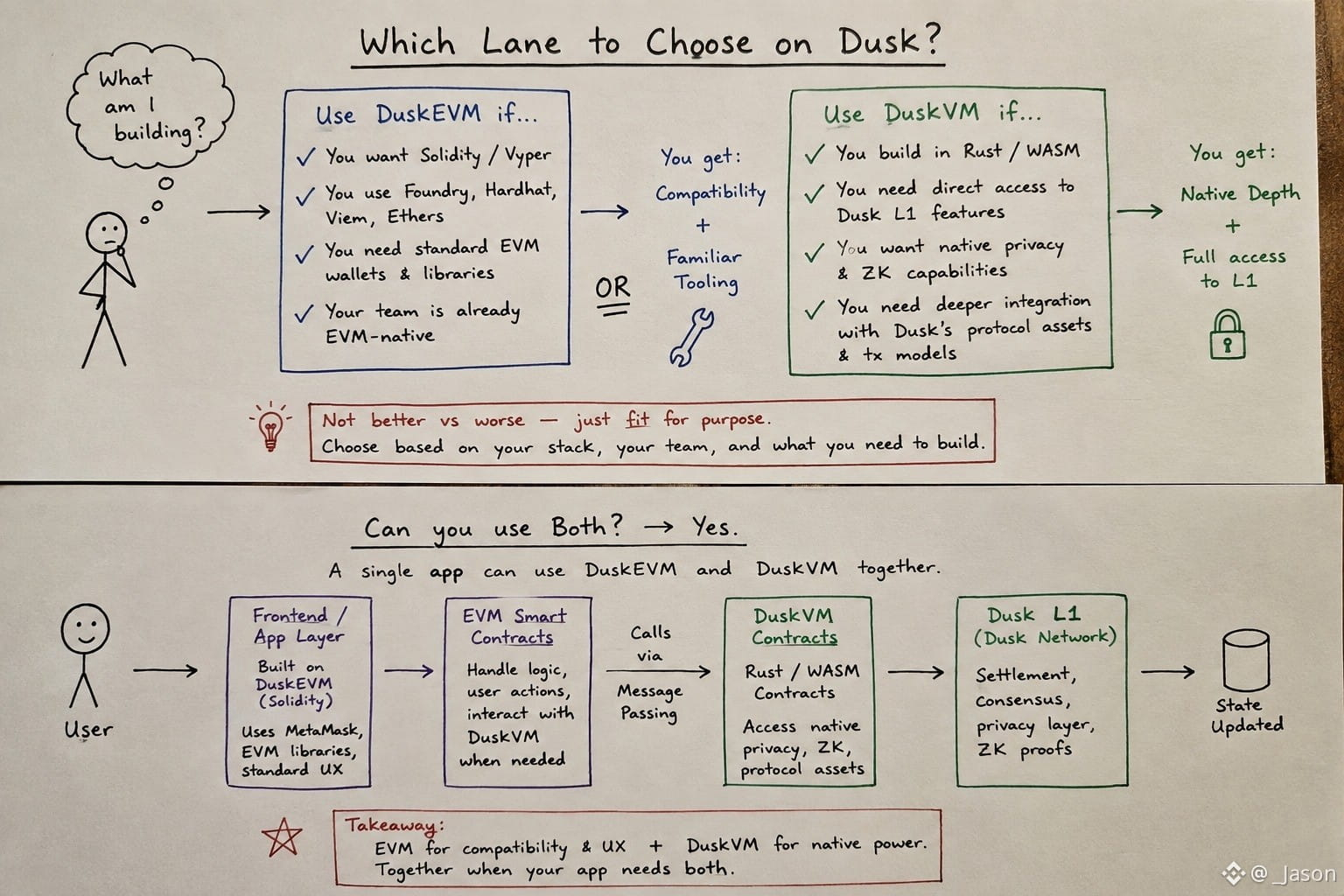
question that came up for me after yesterdays post - if your building on dusk, how do you actually decide between DuskEVM and DuskVM, since both get mentioned as options and its not immediately obvious which ones "the right one."
turns out its not a better-vs-worse situation at all, its purely fit for purpose, and the criteria are pretty clean once you lay them out.
DuskEVM is the pick if you want solidity or vyper, want to use foundry/hardhat/viem/ethers, or just want standard EVM wallets and existing ethereum libraries to work without modification. basically – if your team already knows the EVM stack and wants to bring that knowledge over directly, this is the lane.
DuskVM is the other option, and its for rust/wasm contracts specifically. the distinction that matters here isnt just "different language" tho, its that DuskVM contracts execute directly on the Dusk L1 itself, and can integrate closely with duskds's native transaction models, protocol assets, privacy features, and zero knowledge capabilities. so if your building something that needs to touch dusk's privacy or zk stack directly rather then through an evm compatible layer, DuskVM is where that access actually lives.
so the actual mental model i landed on - DuskEVM trades some depth of L1 integration for full compatibility with tooling teams already know. DuskVM trades that familiarity for tighter, more native access to what makes dusk's L1 itself distinct. neither one is the "advanced" or "basic" option, theyre just solving for different constraints depending on what your building and what your team already knows.
one thing im curious about still – can a single application realistically use both, like an evm facing frontend built on DuskEVM that still needs to touch something DuskVM-native underneath, or is that not really a supported pattern in practice.
#dusk $DUSK
@Dusk
turns out its not a better-vs-worse situation at all, its purely fit for purpose, and the criteria are pretty clean once you lay them out.
DuskEVM is the pick if you want solidity or vyper, want to use foundry/hardhat/viem/ethers, or just want standard EVM wallets and existing ethereum libraries to work without modification. basically – if your team already knows the EVM stack and wants to bring that knowledge over directly, this is the lane.
DuskVM is the other option, and its for rust/wasm contracts specifically. the distinction that matters here isnt just "different language" tho, its that DuskVM contracts execute directly on the Dusk L1 itself, and can integrate closely with duskds's native transaction models, protocol assets, privacy features, and zero knowledge capabilities. so if your building something that needs to touch dusk's privacy or zk stack directly rather then through an evm compatible layer, DuskVM is where that access actually lives.
so the actual mental model i landed on - DuskEVM trades some depth of L1 integration for full compatibility with tooling teams already know. DuskVM trades that familiarity for tighter, more native access to what makes dusk's L1 itself distinct. neither one is the "advanced" or "basic" option, theyre just solving for different constraints depending on what your building and what your team already knows.
one thing im curious about still – can a single application realistically use both, like an evm facing frontend built on DuskEVM that still needs to touch something DuskVM-native underneath, or is that not really a supported pattern in practice.
#dusk $DUSK
@Dusk
spent today going through how DuskEVM actually processes a transaction end to end, because i kept seeing "rollup" mentioned without the actual mechanics spelled out, so figured id trace it myself.
it starts when you submit a transaction to the DuskEVM sequencer - this is the part thats familiar if youve touched any other rollup, standard solidity/evm tx, nothing exotic yet. from there the execution layer includes it in an L2 block. so far this is just normal rollup stuff happening fast on the execution side.
wheres it gets more interesting is the next two steps. the batcher takes that transaction data and publishes it to DuskDS – this is dusk's actual consensus, settlement, and data availability layer, the thing doing the heavy lifting underneath. then state commitments and fault proofs are what actually connect the resulting DuskEVM state back to DuskDS settlement.
the part i think matters most practically - inclusion and settlement are explicitly different stages here, not the same thing wearing two names. your tx getting included in an L2 block happens fast, but that not the same as it being settled. and the docs are pretty direct about this: if your building something that moves value between DuskEVM and the Dusk L1, you should be checking actual protocol or wallet status, not just assuming something is final because some amount of time passed.
thats a distinction i think a lot of people skip past when they hear "fast rollup" and assume speed alone implies finality. it doesnt, at least not by itself.
still want to dig into what the actual typical gap looks like between inclusion and full settlement in practice, the docs describe the stages but not concrete timing.
#dusk @Dusk $DUSK
it starts when you submit a transaction to the DuskEVM sequencer - this is the part thats familiar if youve touched any other rollup, standard solidity/evm tx, nothing exotic yet. from there the execution layer includes it in an L2 block. so far this is just normal rollup stuff happening fast on the execution side.
wheres it gets more interesting is the next two steps. the batcher takes that transaction data and publishes it to DuskDS – this is dusk's actual consensus, settlement, and data availability layer, the thing doing the heavy lifting underneath. then state commitments and fault proofs are what actually connect the resulting DuskEVM state back to DuskDS settlement.
the part i think matters most practically - inclusion and settlement are explicitly different stages here, not the same thing wearing two names. your tx getting included in an L2 block happens fast, but that not the same as it being settled. and the docs are pretty direct about this: if your building something that moves value between DuskEVM and the Dusk L1, you should be checking actual protocol or wallet status, not just assuming something is final because some amount of time passed.
thats a distinction i think a lot of people skip past when they hear "fast rollup" and assume speed alone implies finality. it doesnt, at least not by itself.
still want to dig into what the actual typical gap looks like between inclusion and full settlement in practice, the docs describe the stages but not concrete timing.
#dusk @Dusk $DUSK
YES
0%
NO
0%
0 ຄະແນນສຽງ • ປິດລົງຄະແນນສຽງ
last angle i had queued up this week, and its one i think is actually important for being fair to the tradeoffs here – how does TBV compare to DLCs (discreet log contracts), since thats an older and simpler bitcoin collateral model that a lot of people already know about.
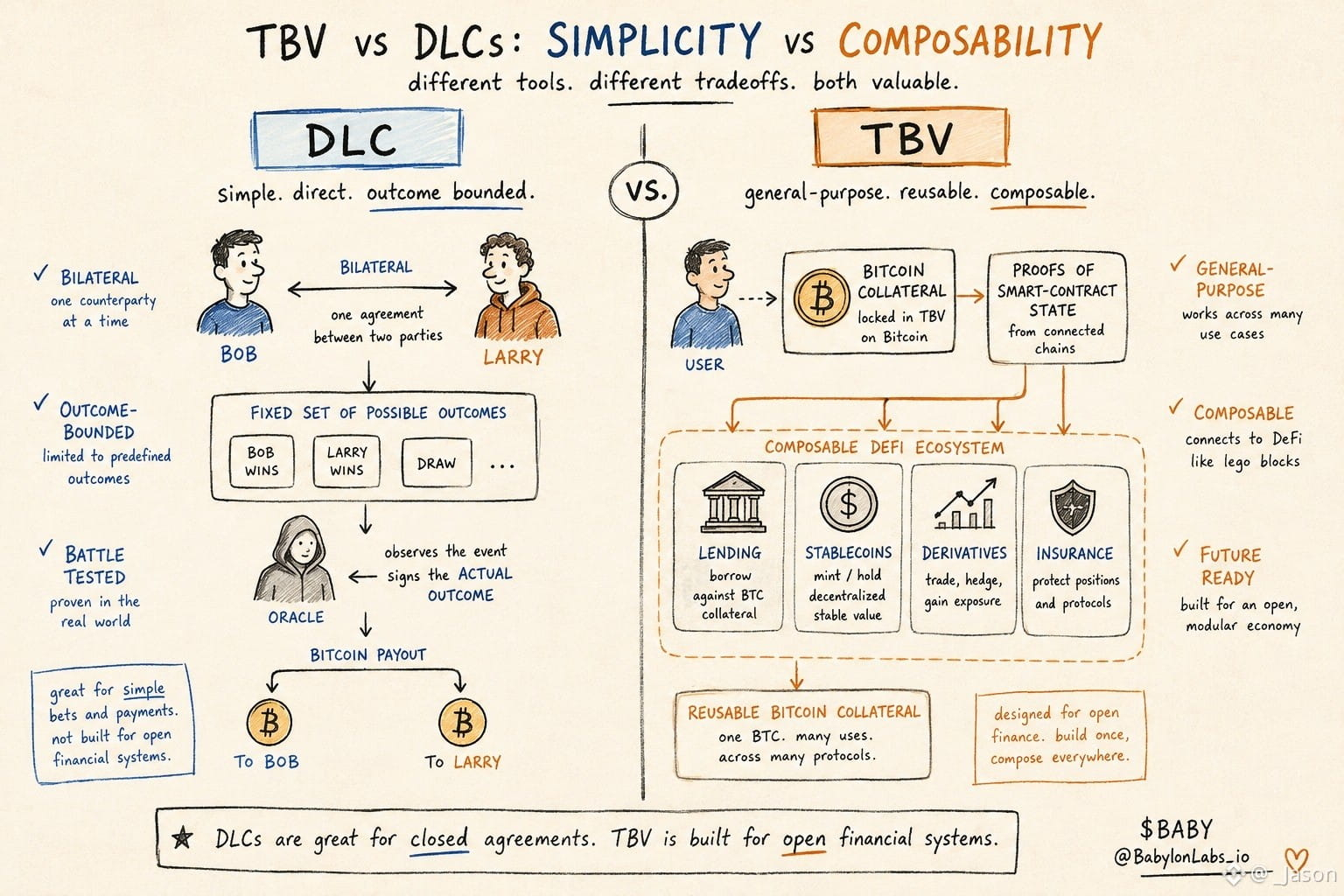
a DLC at its core is a two party contract. bob and larry agree in advance on a set of possible outcomes, an oracle later signs whichever outcome actually happened, and that signature is what determines how a pre-agreed bitcoin payout gets split between them. its been around a while, its relatively simple to reason about, and its genuinely battle tested compared to something like TBV which is still moving through testnet.
so wheres the actual difference in what each one can do. a DLC is fundamentally bilateral and outcome-bounded – its bob and larry, agreeing to a fixed set of outcomes decided upfront. it works great for things shaped like "did event X happen, yes or no, pay out accordingly." what it doesnt really do is general purpose programmability, or letting the same bitcoin serve as collateral across multiple different applications without renegotiating a brand new contract each time.
TBV is going for something structurally different - collateral thats usable across a broader defi surface (lending today, stablecoins/derivatives/insurance mentioned as future directions), verified through proofs of actual smart contract state rather then a fixed pre-agreed outcome set between two named parties.
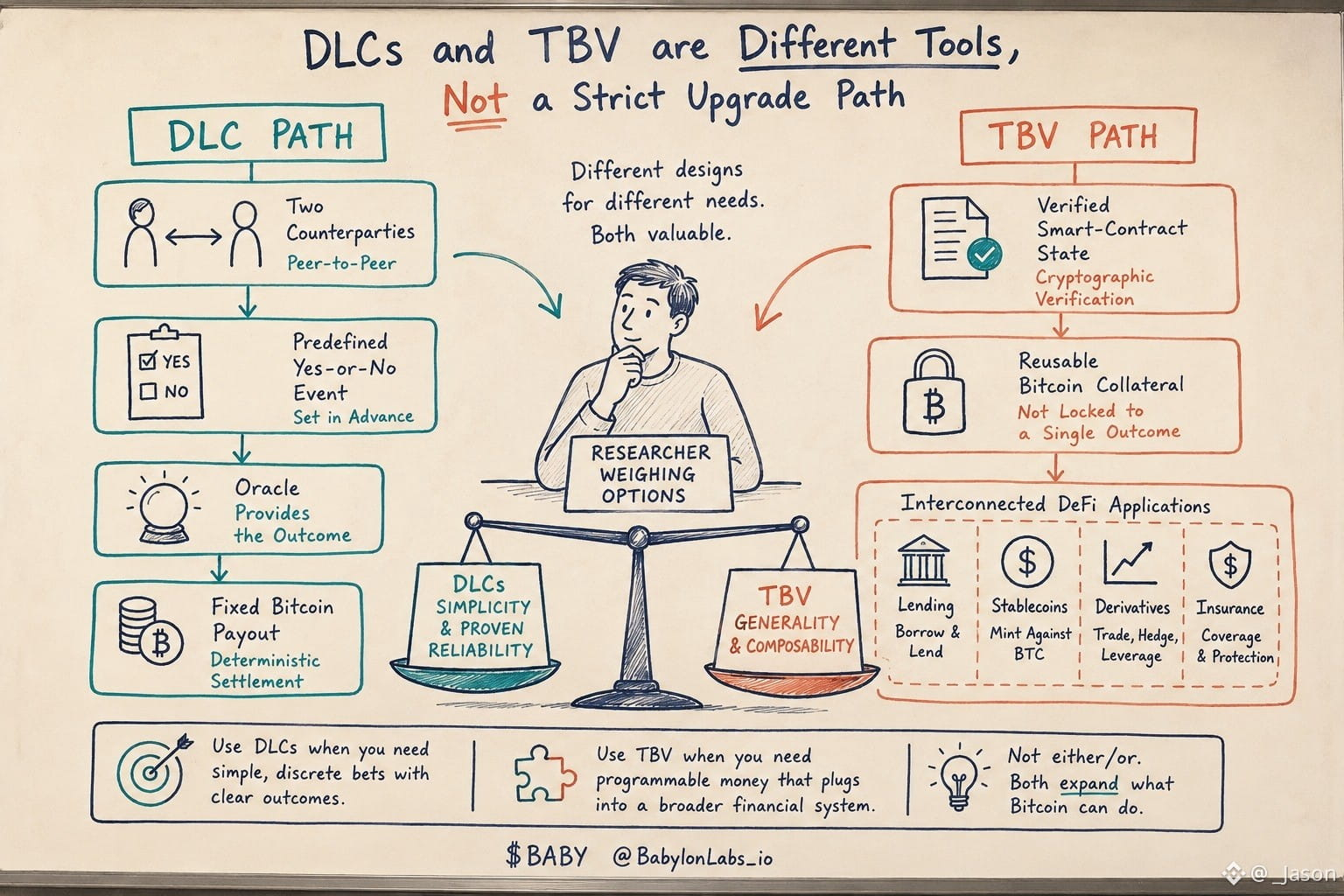
im trying to be honest here rather then just pitching TBV as strictly better - DLCs being simpler and more proven is a real advantage, especially for something narrowly bilateral. TBV is trading some of that simplicity for generality and defi composability. different tools shaped for different problems, not a strict upgrade path from one to the other.
thats the full set of angles i had lined up from the docs and whitepaper this week.
#baby $BABY
-@BabylonLabs_io
a DLC at its core is a two party contract. bob and larry agree in advance on a set of possible outcomes, an oracle later signs whichever outcome actually happened, and that signature is what determines how a pre-agreed bitcoin payout gets split between them. its been around a while, its relatively simple to reason about, and its genuinely battle tested compared to something like TBV which is still moving through testnet.
so wheres the actual difference in what each one can do. a DLC is fundamentally bilateral and outcome-bounded – its bob and larry, agreeing to a fixed set of outcomes decided upfront. it works great for things shaped like "did event X happen, yes or no, pay out accordingly." what it doesnt really do is general purpose programmability, or letting the same bitcoin serve as collateral across multiple different applications without renegotiating a brand new contract each time.
TBV is going for something structurally different - collateral thats usable across a broader defi surface (lending today, stablecoins/derivatives/insurance mentioned as future directions), verified through proofs of actual smart contract state rather then a fixed pre-agreed outcome set between two named parties.
im trying to be honest here rather then just pitching TBV as strictly better - DLCs being simpler and more proven is a real advantage, especially for something narrowly bilateral. TBV is trading some of that simplicity for generality and defi composability. different tools shaped for different problems, not a strict upgrade path from one to the other.
thats the full set of angles i had lined up from the docs and whitepaper this week.
#baby $BABY
-@BabylonLabs_io
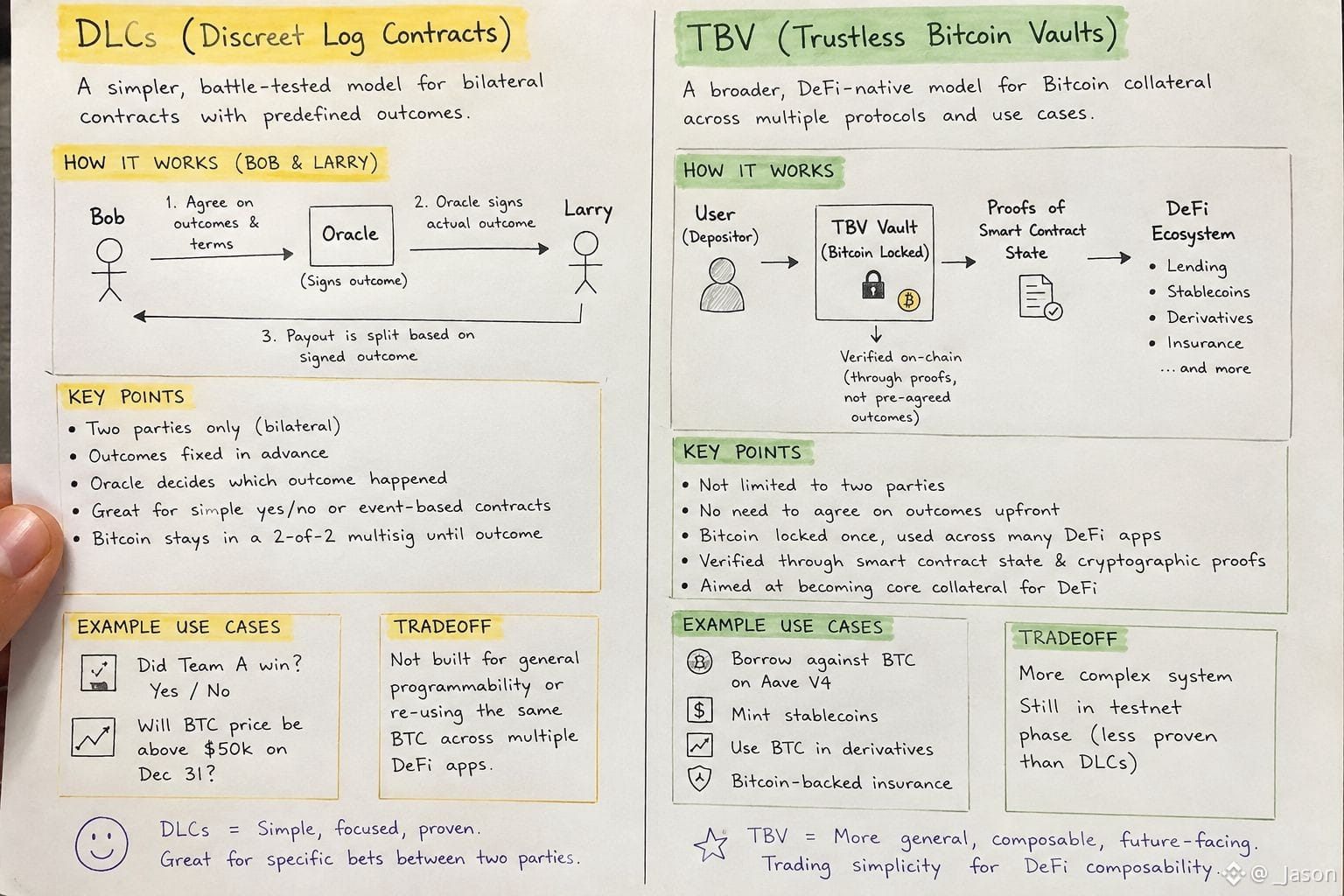
last angle i had queued up this week, and its one i think is actually important for being fair to the tradeoffs here - how does TBV compare to DLCs (discreet log contracts), since thats an older and simpler bitcoin collateral model that a lot of people already know about.
a DLC at its core is a two party contract. bob and larry agree in advance on a set of possible outcomes, an oracle later signs whichever outcome actually happened, and that signature is what determines how a pre-agreed bitcoin payout gets split between them. its been around a while, its relatively simple to reason about, and its genuinely battle tested compared to something like TBV which is still moving through testnet.
so wheres the actual difference in what each one can do. a DLC is fundamentally bilateral and outcome-bounded - its bob and larry, agreeing to a fixed set of outcomes decided upfront. it works great for things shaped like "did event X happen, yes or no, pay out accordingly." what it doesnt really do is general purpose programmability, or letting the same bitcoin serve as collateral across multiple different applications without renegotiating a brand new contract each time.
TBV is going for something structurally different - collateral thats usable across a broader defi surface (lending today, stablecoins/derivatives/insurance mentioned as future directions), verified through proofs of actual smart contract state rather then a fixed pre-agreed outcome set between two named parties.
im trying to be honest here rather then just pitching TBV as strictly better - DLCs being simpler and more proven is a real advantage, especially for something narrowly bilateral. TBV is trading some of that simplicity for generality and defi composability. different tools shaped for different problems, not a strict upgrade path from one to the other.
thats the full set of angles i had lined up from the docs and whitepaper this week.
#baby $BABY
@BabylonLabs_io
a DLC at its core is a two party contract. bob and larry agree in advance on a set of possible outcomes, an oracle later signs whichever outcome actually happened, and that signature is what determines how a pre-agreed bitcoin payout gets split between them. its been around a while, its relatively simple to reason about, and its genuinely battle tested compared to something like TBV which is still moving through testnet.
so wheres the actual difference in what each one can do. a DLC is fundamentally bilateral and outcome-bounded - its bob and larry, agreeing to a fixed set of outcomes decided upfront. it works great for things shaped like "did event X happen, yes or no, pay out accordingly." what it doesnt really do is general purpose programmability, or letting the same bitcoin serve as collateral across multiple different applications without renegotiating a brand new contract each time.
TBV is going for something structurally different - collateral thats usable across a broader defi surface (lending today, stablecoins/derivatives/insurance mentioned as future directions), verified through proofs of actual smart contract state rather then a fixed pre-agreed outcome set between two named parties.
im trying to be honest here rather then just pitching TBV as strictly better - DLCs being simpler and more proven is a real advantage, especially for something narrowly bilateral. TBV is trading some of that simplicity for generality and defi composability. different tools shaped for different problems, not a strict upgrade path from one to the other.
thats the full set of angles i had lined up from the docs and whitepaper this week.
#baby $BABY
@BabylonLabs_io
ເຂົ້າສູ່ລະບົບເພື່ອສຳຫຼວດເນື້ອຫາເພີ່ມເຕີມ