
Lavender⁰⁰¹
3.1k ໂພສ

Lavender⁰⁰¹
ລາຍງານ
ບລັອກຜູ້ໃຊ້
Learning | Crypto Content Creator | Web3 believer 💛 💎 📈
ເປີດການຊື້ຂາຍ
ຜູ້ຊື້ຂາຍປະຈໍາ
4.8 ເດືອນ
221 ກໍາລັງຕິດຕາມ
2.5K+ ຜູ້ຕິດຕາມ
1.9K+ Liked
ໂພສ
Portfolio
·
--
#dusk $DUSK @Dusk_Foundation A small table in Dusk’s wallet security notes made the word password feel misleading the browser extension uses PBKDF2-SHA-256 at 900,000 iterations, while the native route is described as Stronghold plus Argon2 and OS-level encrypted storage.
So the same password does not necessarily buy the same cracking resistance. Yet DUSK’s public material does not disclose enough native Argon2 detail memory cost, iteration count and parallelism to calculate how much harder an offline attack really is. Memory-hard is a design label, not a measured advantage.
There is another problem. Encryption at rest protects a locked vault. After unlock, the extension keeps the mnemonic in the JavaScript heap, clears it on lock or timeout, but cannot guarantee zeroization. A weak password can shrink the first defence malware, a hostile extension or a compromised device can step around it entirely.
That changes how I judge DUSK self-custody: password strength versus actual attack surface, not Argon2 versus PBKDF2 as brand names.
I would like DUSK to publish the full native KDF parameters, benchmark equal passwords across devices, and report how long key material remains exposed. Until then, saying DUSK uses Argon2 answers which tool exists, not how much protection users truly receive.
{future}(DUSKUSDT)
#dusk $DUSK @Dusk A small table in Dusk’s wallet security notes made the word password feel misleading the browser extension uses PBKDF2-SHA-256 at 900,000 iterations, while the native route is described as Stronghold plus Argon2 and OS-level encrypted storage.
So the same password does not necessarily buy the same cracking resistance. Yet DUSK’s public material does not disclose enough native Argon2 detail memory cost, iteration count and parallelism to calculate how much harder an offline attack really is. Memory-hard is a design label, not a measured advantage.
There is another problem. Encryption at rest protects a locked vault. After unlock, the extension keeps the mnemonic in the JavaScript heap, clears it on lock or timeout, but cannot guarantee zeroization. A weak password can shrink the first defence malware, a hostile extension or a compromised device can step around it entirely.
That changes how I judge DUSK self-custody: password strength versus actual attack surface, not Argon2 versus PBKDF2 as brand names.
I would like DUSK to publish the full native KDF parameters, benchmark equal passwords across devices, and report how long key material remains exposed. Until then, saying DUSK uses Argon2 answers which tool exists, not how much protection users truly receive.
So the same password does not necessarily buy the same cracking resistance. Yet DUSK’s public material does not disclose enough native Argon2 detail memory cost, iteration count and parallelism to calculate how much harder an offline attack really is. Memory-hard is a design label, not a measured advantage.
There is another problem. Encryption at rest protects a locked vault. After unlock, the extension keeps the mnemonic in the JavaScript heap, clears it on lock or timeout, but cannot guarantee zeroization. A weak password can shrink the first defence malware, a hostile extension or a compromised device can step around it entirely.
That changes how I judge DUSK self-custody: password strength versus actual attack surface, not Argon2 versus PBKDF2 as brand names.
I would like DUSK to publish the full native KDF parameters, benchmark equal passwords across devices, and report how long key material remains exposed. Until then, saying DUSK uses Argon2 answers which tool exists, not how much protection users truly receive.
8
10
10.9k
·
--
#dusk $DUSK @Dusk_Foundation I got stuck comparing two Dusk accounts funded within minutes. One transferred immediately the other sat untouched and never appeared again.
That gap may reveal more than account growth. Useful cohorts are wallets reaching a first action, returning within seven days, and doing more than circular transfers between related clusters.
For DUSK, I’d separate transfer-only users from contract users, then track activation time, stranded balances, retention, top-decile flows and public balance dispersion. Distribution can look healthier while the same capital keeps looping. Bit awkward, but important.
Provisioners deserve the same test reward volatility by stake size, the share earning nothing over 24 hours, missed-vote rates, 99% uptime coverage, the 1,000–2,000 DUSK bucket and stake HHI. Then remove the top three provisioners from committee simulations. Does finality still hold?
What most people miss is that count is not resilience. Rising stake after above-average rewards may be yield-chasing, while one dominant Rusk implementation leaves every operator exposed to the same client failure.
DUSK may reward visible activity while depending on a narrower core of real users and reliable stake. If both groups look wider than they are, decentralization becomes a presentation layer.
I’m watching the distributions, not the totals.
{future}(DUSKUSDT)
#dusk $DUSK @Dusk I got stuck comparing two Dusk accounts funded within minutes. One transferred immediately the other sat untouched and never appeared again.
That gap may reveal more than account growth. Useful cohorts are wallets reaching a first action, returning within seven days, and doing more than circular transfers between related clusters.
For DUSK, I’d separate transfer-only users from contract users, then track activation time, stranded balances, retention, top-decile flows and public balance dispersion. Distribution can look healthier while the same capital keeps looping. Bit awkward, but important.
Provisioners deserve the same test reward volatility by stake size, the share earning nothing over 24 hours, missed-vote rates, 99% uptime coverage, the 1,000–2,000 DUSK bucket and stake HHI. Then remove the top three provisioners from committee simulations. Does finality still hold?
What most people miss is that count is not resilience. Rising stake after above-average rewards may be yield-chasing, while one dominant Rusk implementation leaves every operator exposed to the same client failure.
DUSK may reward visible activity while depending on a narrower core of real users and reliable stake. If both groups look wider than they are, decentralization becomes a presentation layer.
I’m watching the distributions, not the totals.
That gap may reveal more than account growth. Useful cohorts are wallets reaching a first action, returning within seven days, and doing more than circular transfers between related clusters.
For DUSK, I’d separate transfer-only users from contract users, then track activation time, stranded balances, retention, top-decile flows and public balance dispersion. Distribution can look healthier while the same capital keeps looping. Bit awkward, but important.
Provisioners deserve the same test reward volatility by stake size, the share earning nothing over 24 hours, missed-vote rates, 99% uptime coverage, the 1,000–2,000 DUSK bucket and stake HHI. Then remove the top three provisioners from committee simulations. Does finality still hold?
What most people miss is that count is not resilience. Rising stake after above-average rewards may be yield-chasing, while one dominant Rusk implementation leaves every operator exposed to the same client failure.
DUSK may reward visible activity while depending on a narrower core of real users and reliable stake. If both groups look wider than they are, decentralization becomes a presentation layer.
I’m watching the distributions, not the totals.
6
11
6.5k
·
--
ຢືນຢັນແລ້ວ
#dusk $DUSK @Dusk_Foundation I was checking DUSK’s bridge math and one number bothered me more than the headline volume: how much supply is actually still sitting on ERC20 and BEP20 after mainnet migration?
That is the maturity test I care about.
If €10M moves out and €10M comes back, the bridge can report €20M of gross activity while net migration is zero. Movement is not migration. Volume is not completion.
I would rather track migration velocity each week, the percentage of legacy DUSK still outside mainnet, and the “dust ratio” left behind after users request migration. Those numbers would show whether the network is consolidating or just circulating.
The fixed bridge fee exposes another wrinkle. A 1 DUSK fee on 10 tokens is 10%. On 10,000 tokens it is 0.01%. Same infrastructure, completely different user economics.
And even after a mainnet bridge transfer is final, destination delivery can still depend on an external processing step. That matters more than it sounds.
The deeper question is similar for RWAs: €300M wrapped on-chain is not equivalent to €300M issued natively on-chain. One mirrors legacy infrastructure; the other replaces part of it.
I’m watching DUSK for migration completion, not bridge motion.
{future}(DUSKUSDT)
#dusk $DUSK @Dusk I was checking DUSK’s bridge math and one number bothered me more than the headline volume: how much supply is actually still sitting on ERC20 and BEP20 after mainnet migration?
That is the maturity test I care about.
If €10M moves out and €10M comes back, the bridge can report €20M of gross activity while net migration is zero. Movement is not migration. Volume is not completion.
I would rather track migration velocity each week, the percentage of legacy DUSK still outside mainnet, and the “dust ratio” left behind after users request migration. Those numbers would show whether the network is consolidating or just circulating.
The fixed bridge fee exposes another wrinkle. A 1 DUSK fee on 10 tokens is 10%. On 10,000 tokens it is 0.01%. Same infrastructure, completely different user economics.
And even after a mainnet bridge transfer is final, destination delivery can still depend on an external processing step. That matters more than it sounds.
The deeper question is similar for RWAs: €300M wrapped on-chain is not equivalent to €300M issued natively on-chain. One mirrors legacy infrastructure; the other replaces part of it.
I’m watching DUSK for migration completion, not bridge motion.
That is the maturity test I care about.
If €10M moves out and €10M comes back, the bridge can report €20M of gross activity while net migration is zero. Movement is not migration. Volume is not completion.
I would rather track migration velocity each week, the percentage of legacy DUSK still outside mainnet, and the “dust ratio” left behind after users request migration. Those numbers would show whether the network is consolidating or just circulating.
The fixed bridge fee exposes another wrinkle. A 1 DUSK fee on 10 tokens is 10%. On 10,000 tokens it is 0.01%. Same infrastructure, completely different user economics.
And even after a mainnet bridge transfer is final, destination delivery can still depend on an external processing step. That matters more than it sounds.
The deeper question is similar for RWAs: €300M wrapped on-chain is not equivalent to €300M issued natively on-chain. One mirrors legacy infrastructure; the other replaces part of it.
I’m watching DUSK for migration completion, not bridge motion.
15
20
17.6k
·
--
#dusk $DUSK @Dusk_Foundation The market was moving sideways tonight, and I was half-reading DUSK documentation when I caught myself staring at the same question for too long: how much of DUSK’s activity is actually happening through its privacy layer?
It’s easy to look at Moonlight and Phoenix as two transaction models and stop there. But that misses the interesting part. If privacy is genuinely useful, I’d expect to see users choosing it, not just the protocol supporting it.
So I’d track the split across 24H, 7D, 30D and 90D: Moonlight share, Phoenix share, active users, transactions per user, and then follow the same accounts from their first Moonlight transaction to their first Phoenix transaction.
That changes the question completely.
Privacy adoption isn’t proven by having a private transaction model..
it’s proven when users voluntarily migrate into it and stay there.
I’d also measure median migration time and D7/D30/D90 Phoenix retention. A spike in Phoenix transactions could mean experimentation. Persistent repeat usage would mean something stronger.
There’s a second layer I’d watch: contract calls versus basic transfers. If application interactions and privacy activity both rise, DUSK may be showing deeper usage rather than simple transaction growth.
I don’t know yet what the numbers would reveal. That’s exactly why I’d rather measure behavior than repeat the privacy narrative.
And the documentation tab is still open......
{future}(DUSKUSDT)
#dusk $DUSK @Dusk The market was moving sideways tonight, and I was half-reading DUSK documentation when I caught myself staring at the same question for too long: how much of DUSK’s activity is actually happening through its privacy layer?
It’s easy to look at Moonlight and Phoenix as two transaction models and stop there. But that misses the interesting part. If privacy is genuinely useful, I’d expect to see users choosing it, not just the protocol supporting it.
So I’d track the split across 24H, 7D, 30D and 90D: Moonlight share, Phoenix share, active users, transactions per user, and then follow the same accounts from their first Moonlight transaction to their first Phoenix transaction.
That changes the question completely.
Privacy adoption isn’t proven by having a private transaction model..
it’s proven when users voluntarily migrate into it and stay there.
I’d also measure median migration time and D7/D30/D90 Phoenix retention. A spike in Phoenix transactions could mean experimentation. Persistent repeat usage would mean something stronger.
There’s a second layer I’d watch: contract calls versus basic transfers. If application interactions and privacy activity both rise, DUSK may be showing deeper usage rather than simple transaction growth.
I don’t know yet what the numbers would reveal. That’s exactly why I’d rather measure behavior than repeat the privacy narrative.
And the documentation tab is still open......
It’s easy to look at Moonlight and Phoenix as two transaction models and stop there. But that misses the interesting part. If privacy is genuinely useful, I’d expect to see users choosing it, not just the protocol supporting it.
So I’d track the split across 24H, 7D, 30D and 90D: Moonlight share, Phoenix share, active users, transactions per user, and then follow the same accounts from their first Moonlight transaction to their first Phoenix transaction.
That changes the question completely.
Privacy adoption isn’t proven by having a private transaction model..
it’s proven when users voluntarily migrate into it and stay there.
I’d also measure median migration time and D7/D30/D90 Phoenix retention. A spike in Phoenix transactions could mean experimentation. Persistent repeat usage would mean something stronger.
There’s a second layer I’d watch: contract calls versus basic transfers. If application interactions and privacy activity both rise, DUSK may be showing deeper usage rather than simple transaction growth.
I don’t know yet what the numbers would reveal. That’s exactly why I’d rather measure behavior than repeat the privacy narrative.
And the documentation tab is still open......
7
16
11.9k
·
--
ເປັນຄວາມຈິງບາງສ່ວນ
#dusk $DUSK @Dusk_Foundation DUSK Network Staking Concentration Drift: How Much Does Top-10 Share Change per 100 Epochs?
The market was barely moving tonight, so I ended up staring at DUSK’s provisioner table instead of the chart. I kept seeing “200+ active provisioners” and initially read that as a decentralization signal.
Then something did not line up.
A validator count tells me how many participants exist. It does not tell me how much consensus weight the largest ones control. Dusk’s staking rewards are probabilistic and depend partly on active stake, while the protocol sets no maximum stake. That makes concentration drift worth measuring, not assuming.
The current community-explorer snapshot puts roughly 25.8% of active stake in the ten largest provisioners. But one snapshot cannot tell me whether DUSK is decentralizing or slowly clustering.
That is the distinction: node count measures participation; stake drift measures power.
I would track Top-10 active-stake share every 100 epochs, then compare the change with new stake, unstaking, pool growth, slashing and reward compounding.
Maybe the distribution stays healthy. I genuinely cannot answer that yet.
The chart is still quiet. The provisioner table now looks much more interesting.
{future}(DUSKUSDT)
#dusk $DUSK @Dusk DUSK Network Staking Concentration Drift: How Much Does Top-10 Share Change per 100 Epochs?
The market was barely moving tonight, so I ended up staring at DUSK’s provisioner table instead of the chart. I kept seeing “200+ active provisioners” and initially read that as a decentralization signal.
Then something did not line up.
A validator count tells me how many participants exist. It does not tell me how much consensus weight the largest ones control. Dusk’s staking rewards are probabilistic and depend partly on active stake, while the protocol sets no maximum stake. That makes concentration drift worth measuring, not assuming.
The current community-explorer snapshot puts roughly 25.8% of active stake in the ten largest provisioners. But one snapshot cannot tell me whether DUSK is decentralizing or slowly clustering.
That is the distinction: node count measures participation; stake drift measures power.
I would track Top-10 active-stake share every 100 epochs, then compare the change with new stake, unstaking, pool growth, slashing and reward compounding.
Maybe the distribution stays healthy. I genuinely cannot answer that yet.
The chart is still quiet. The provisioner table now looks much more interesting.
The market was barely moving tonight, so I ended up staring at DUSK’s provisioner table instead of the chart. I kept seeing “200+ active provisioners” and initially read that as a decentralization signal.
Then something did not line up.
A validator count tells me how many participants exist. It does not tell me how much consensus weight the largest ones control. Dusk’s staking rewards are probabilistic and depend partly on active stake, while the protocol sets no maximum stake. That makes concentration drift worth measuring, not assuming.
The current community-explorer snapshot puts roughly 25.8% of active stake in the ten largest provisioners. But one snapshot cannot tell me whether DUSK is decentralizing or slowly clustering.
That is the distinction: node count measures participation; stake drift measures power.
I would track Top-10 active-stake share every 100 epochs, then compare the change with new stake, unstaking, pool growth, slashing and reward compounding.
Maybe the distribution stays healthy. I genuinely cannot answer that yet.
The chart is still quiet. The provisioner table now looks much more interesting.
15
20
10k
·
--
#dusk $DUSK @Dusk_Foundation Last night I was comparing DUSK burn data and noticed something slightly annoying: the ratio changed depending on where I started the 24-hour window.
That sounds like a small accounting detail. It isn’t.
A midnight-to-midnight calendar day can show one burn story, while a rolling 24-hour window starting six hours later can show another. If one short DUSK burn spike sits near the cutoff, shifting the window can either capture most of it or split it across two periods.
So peak burn ratio alone tells me less than I first thought.
What matters more is whether the burn rate holds up over time. I’d look at how long DUSK stays above a useful burn-to-reward level, how much the ratio moves between rolling windows, and whether the bigger burn periods keep showing up. A 30% spike for one hour is not the same as 16% spread across most of the day.
This is basically peak activity vs durable system pressure.
I would also watch the standard deviation across multiple rolling windows. If 24 different start times produce wildly different ratios, DUSK burning may still be event-driven rather than structurally stable.
The uncomfortable question is simple: are we measuring genuine token destruction pressure, or just choosing a window that makes the latest burn event look important?
{future}(DUSKUSDT)
#dusk $DUSK @Dusk Last night I was comparing DUSK burn data and noticed something slightly annoying: the ratio changed depending on where I started the 24-hour window.
That sounds like a small accounting detail. It isn’t.
A midnight-to-midnight calendar day can show one burn story, while a rolling 24-hour window starting six hours later can show another. If one short DUSK burn spike sits near the cutoff, shifting the window can either capture most of it or split it across two periods.
So peak burn ratio alone tells me less than I first thought.
What matters more is whether the burn rate holds up over time. I’d look at how long DUSK stays above a useful burn-to-reward level, how much the ratio moves between rolling windows, and whether the bigger burn periods keep showing up. A 30% spike for one hour is not the same as 16% spread across most of the day.
This is basically peak activity vs durable system pressure.
I would also watch the standard deviation across multiple rolling windows. If 24 different start times produce wildly different ratios, DUSK burning may still be event-driven rather than structurally stable.
The uncomfortable question is simple: are we measuring genuine token destruction pressure, or just choosing a window that makes the latest burn event look important?
That sounds like a small accounting detail. It isn’t.
A midnight-to-midnight calendar day can show one burn story, while a rolling 24-hour window starting six hours later can show another. If one short DUSK burn spike sits near the cutoff, shifting the window can either capture most of it or split it across two periods.
So peak burn ratio alone tells me less than I first thought.
What matters more is whether the burn rate holds up over time. I’d look at how long DUSK stays above a useful burn-to-reward level, how much the ratio moves between rolling windows, and whether the bigger burn periods keep showing up. A 30% spike for one hour is not the same as 16% spread across most of the day.
This is basically peak activity vs durable system pressure.
I would also watch the standard deviation across multiple rolling windows. If 24 different start times produce wildly different ratios, DUSK burning may still be event-driven rather than structurally stable.
The uncomfortable question is simple: are we measuring genuine token destruction pressure, or just choosing a window that makes the latest burn event look important?
30
24
10.2k
·
--
#dusk $DUSK @Dusk_Foundation While checking a DUSK provisioner’s reward history, I noticed something I had treated too casually committed stake and useful consensus stake are not the same number.
That gap matters because staking quality can change the economic result even when the emission schedule looks predictable. If capital is offline, locked, concentrated, or constantly moving, headline participation can overstate how much security DUSK is actually buying.
I’d rather track capital efficiency: active stake divided by total DUSK committed. Then pair it with churn inflows plus outflows relative to average active stake and retention after 30, 90 and 365 days.
The comparison is simple: activity shows how much capital entered staking; quality shows how much stayed productive.
Ownership concentration is only half the picture. Infrastructure HHI could remain high even with many wallets if the same hosting providers sit underneath them.
Exchange float versus active stake matters too: how much consensus capital could become liquid under stress?
What I’m still unsure about is duration. Ten percent offline for ten minutes is different from ten percent offline for ten hours.
For DUSK scarcity and staking quality may not always improve together. That tension is what I’d watch.
{future}(DUSKUSDT)
#dusk $DUSK @Dusk While checking a DUSK provisioner’s reward history, I noticed something I had treated too casually committed stake and useful consensus stake are not the same number.
That gap matters because staking quality can change the economic result even when the emission schedule looks predictable. If capital is offline, locked, concentrated, or constantly moving, headline participation can overstate how much security DUSK is actually buying.
I’d rather track capital efficiency: active stake divided by total DUSK committed. Then pair it with churn inflows plus outflows relative to average active stake and retention after 30, 90 and 365 days.
The comparison is simple: activity shows how much capital entered staking; quality shows how much stayed productive.
Ownership concentration is only half the picture. Infrastructure HHI could remain high even with many wallets if the same hosting providers sit underneath them.
Exchange float versus active stake matters too: how much consensus capital could become liquid under stress?
What I’m still unsure about is duration. Ten percent offline for ten minutes is different from ten percent offline for ten hours.
For DUSK scarcity and staking quality may not always improve together. That tension is what I’d watch.
That gap matters because staking quality can change the economic result even when the emission schedule looks predictable. If capital is offline, locked, concentrated, or constantly moving, headline participation can overstate how much security DUSK is actually buying.
I’d rather track capital efficiency: active stake divided by total DUSK committed. Then pair it with churn inflows plus outflows relative to average active stake and retention after 30, 90 and 365 days.
The comparison is simple: activity shows how much capital entered staking; quality shows how much stayed productive.
Ownership concentration is only half the picture. Infrastructure HHI could remain high even with many wallets if the same hosting providers sit underneath them.
Exchange float versus active stake matters too: how much consensus capital could become liquid under stress?
What I’m still unsure about is duration. Ten percent offline for ten minutes is different from ten percent offline for ten hours.
For DUSK scarcity and staking quality may not always improve together. That tension is what I’d watch.
29
23
4k
·
--
#dusk $DUSK @Dusk_Foundation While looking at DUSK’s confidential-security model, I kept getting stuck on a boring number: a 20-year security could live through roughly ten major software cycles if the stack materially changes every two years.
That is not just a migration problem. It is an ownership-continuity problem.
Imagine 50,000 private positions going through a share split. The easy claim is every balance was updated. The harder standard is stronger: total ownership before must equal total ownership after, with every holder preserved, without exposing who owns what.
The same pressure shows up in dividends. 20,000 holders paid quarterly means 80,000 entitlement events a year. DUSK cannot rely on public visibility the way a transparent ledger can. It needs global correctness without holder-level disclosure.
That distinction matters for DUSK because privacy moves trust from everyone can inspect it toward everyone can verify the proof.
And I think people underestimate the second layer: the token can work perfectly while the underlying security or MMF still fails economically. Onchain failure rate and asset failure rate are not the same risk.
My core concern is simple after the fifth migration, can DUSK still prove continuity as cleanly as it did on day one?
{future}(DUSKUSDT)
#dusk $DUSK @Dusk While looking at DUSK’s confidential-security model, I kept getting stuck on a boring number: a 20-year security could live through roughly ten major software cycles if the stack materially changes every two years.
That is not just a migration problem. It is an ownership-continuity problem.
Imagine 50,000 private positions going through a share split. The easy claim is every balance was updated. The harder standard is stronger: total ownership before must equal total ownership after, with every holder preserved, without exposing who owns what.
The same pressure shows up in dividends. 20,000 holders paid quarterly means 80,000 entitlement events a year. DUSK cannot rely on public visibility the way a transparent ledger can. It needs global correctness without holder-level disclosure.
That distinction matters for DUSK because privacy moves trust from everyone can inspect it toward everyone can verify the proof.
And I think people underestimate the second layer: the token can work perfectly while the underlying security or MMF still fails economically. Onchain failure rate and asset failure rate are not the same risk.
My core concern is simple after the fifth migration, can DUSK still prove continuity as cleanly as it did on day one?
That is not just a migration problem. It is an ownership-continuity problem.
Imagine 50,000 private positions going through a share split. The easy claim is every balance was updated. The harder standard is stronger: total ownership before must equal total ownership after, with every holder preserved, without exposing who owns what.
The same pressure shows up in dividends. 20,000 holders paid quarterly means 80,000 entitlement events a year. DUSK cannot rely on public visibility the way a transparent ledger can. It needs global correctness without holder-level disclosure.
That distinction matters for DUSK because privacy moves trust from everyone can inspect it toward everyone can verify the proof.
And I think people underestimate the second layer: the token can work perfectly while the underlying security or MMF still fails economically. Onchain failure rate and asset failure rate are not the same risk.
My core concern is simple after the fifth migration, can DUSK still prove continuity as cleanly as it did on day one?
30
24
4.2k
·
--
#dusk $DUSK @Dusk_Foundation While checking where DUSK actually sits inside a tokenized-security settlement, I kept coming back to one awkward split the asset can be native, while the cash leg may still depend on another system.
That matters more than it first looks.
Putting the security on DUSK can clean up ownership, transfer history and compliance state. But if payment still settles through a bank or legacy ledger, someone still has to reconcile two records, two timestamps and potentially two definitions of “final.”
Asset finality is not the same as settlement finality.
The harder case is sequencing. Can cash become irrevocable while the final transfer-restriction check is still unresolved? Or should compliance certainty come first, even if that leaves the payment leg waiting?
For DUSK, native asset issuance solves one record problem. Native or tokenized cash could solve the second by putting both legs inside the same settlement environment, reducing the timing gap between delivery and payment.
But “on-chain” alone does not remove every risk. Atomic execution still depends on compliance logic, cash quality and redemption certainty.
I am watching whether DUSK reduces reconciliation itself, or just moves the asset side ahead while the payment side stays old.
{future}(DUSKUSDT)
#dusk $DUSK @Dusk While checking where DUSK actually sits inside a tokenized-security settlement, I kept coming back to one awkward split the asset can be native, while the cash leg may still depend on another system.
That matters more than it first looks.
Putting the security on DUSK can clean up ownership, transfer history and compliance state. But if payment still settles through a bank or legacy ledger, someone still has to reconcile two records, two timestamps and potentially two definitions of “final.”
Asset finality is not the same as settlement finality.
The harder case is sequencing. Can cash become irrevocable while the final transfer-restriction check is still unresolved? Or should compliance certainty come first, even if that leaves the payment leg waiting?
For DUSK, native asset issuance solves one record problem. Native or tokenized cash could solve the second by putting both legs inside the same settlement environment, reducing the timing gap between delivery and payment.
But “on-chain” alone does not remove every risk. Atomic execution still depends on compliance logic, cash quality and redemption certainty.
I am watching whether DUSK reduces reconciliation itself, or just moves the asset side ahead while the payment side stays old.
That matters more than it first looks.
Putting the security on DUSK can clean up ownership, transfer history and compliance state. But if payment still settles through a bank or legacy ledger, someone still has to reconcile two records, two timestamps and potentially two definitions of “final.”
Asset finality is not the same as settlement finality.
The harder case is sequencing. Can cash become irrevocable while the final transfer-restriction check is still unresolved? Or should compliance certainty come first, even if that leaves the payment leg waiting?
For DUSK, native asset issuance solves one record problem. Native or tokenized cash could solve the second by putting both legs inside the same settlement environment, reducing the timing gap between delivery and payment.
But “on-chain” alone does not remove every risk. Atomic execution still depends on compliance logic, cash quality and redemption certainty.
I am watching whether DUSK reduces reconciliation itself, or just moves the asset side ahead while the payment side stays old.
81
52
20.1k
·
--
I kept getting stuck on one small question while tracing how a tokenized security would actually move through DUSK after the token changes wallets, which record legally decides who owns the asset?
That sounds basic, but wrapper tokenization can hide a lot of infrastructure underneath. You may have one DUSK token while custody records, shareholder registers and settlement books still live in three separate systems.
So the token moves fast. The workflow, maybe not.
This is where I think people confuse on-chain transfer with ownership transfer. A blockchain can finalize a transaction in roughly seconds, while reconciliation, custody updates, eligibility checks and asset servicing may continue elsewhere for hours, days, or years.
For DUSK, settlement integration may matter more than issuance volume itself.
The comparison I care about is simple: token supply vs settlement quality. Ten thousand issued tokens tell me almost nothing if trades still require multiple reconciliations afterward. Settlement failures per 10,000 trades would tell me much more.
The harder question is whether DUSK becomes the actual source of truth, or just another synchronized record sitting beside legacy ones.
Fast finality is useful. But reducing the number of records that must agree, that feels like the deeper test.
@Dusk_Foundation #dusk $DUSK
I kept getting stuck on one small question while tracing how a tokenized security would actually move through DUSK after the token changes wallets, which record legally decides who owns the asset?
That sounds basic, but wrapper tokenization can hide a lot of infrastructure underneath. You may have one DUSK token while custody records, shareholder registers and settlement books still live in three separate systems.
So the token moves fast. The workflow, maybe not.
This is where I think people confuse on-chain transfer with ownership transfer. A blockchain can finalize a transaction in roughly seconds, while reconciliation, custody updates, eligibility checks and asset servicing may continue elsewhere for hours, days, or years.
For DUSK, settlement integration may matter more than issuance volume itself.
The comparison I care about is simple: token supply vs settlement quality. Ten thousand issued tokens tell me almost nothing if trades still require multiple reconciliations afterward. Settlement failures per 10,000 trades would tell me much more.
The harder question is whether DUSK becomes the actual source of truth, or just another synchronized record sitting beside legacy ones.
Fast finality is useful. But reducing the number of records that must agree, that feels like the deeper test.
@Dusk #dusk $DUSK
That sounds basic, but wrapper tokenization can hide a lot of infrastructure underneath. You may have one DUSK token while custody records, shareholder registers and settlement books still live in three separate systems.
So the token moves fast. The workflow, maybe not.
This is where I think people confuse on-chain transfer with ownership transfer. A blockchain can finalize a transaction in roughly seconds, while reconciliation, custody updates, eligibility checks and asset servicing may continue elsewhere for hours, days, or years.
For DUSK, settlement integration may matter more than issuance volume itself.
The comparison I care about is simple: token supply vs settlement quality. Ten thousand issued tokens tell me almost nothing if trades still require multiple reconciliations afterward. Settlement failures per 10,000 trades would tell me much more.
The harder question is whether DUSK becomes the actual source of truth, or just another synchronized record sitting beside legacy ones.
Fast finality is useful. But reducing the number of records that must agree, that feels like the deeper test.
@Dusk #dusk $DUSK
34
29
8.3k
·
--
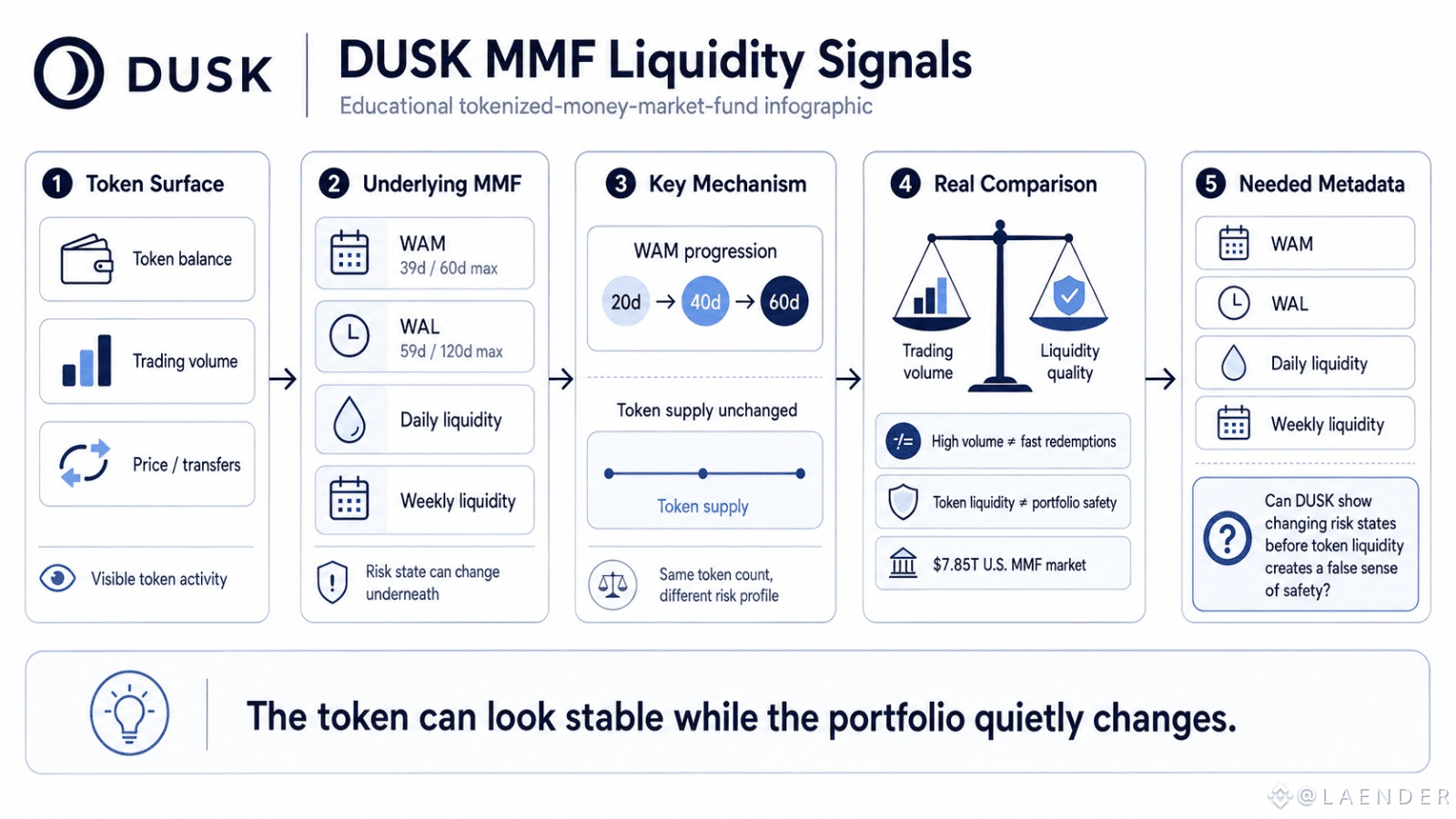
In my review of MMF liquidity metrics with token trading activity, I noticed something easy to miss: the token balance can stay flat while the portfolio underneath quietly becomes riskier.
A prime MMF might sit around a 39-day WAM against a 60-day limit, with WAL near 59 days against a 120-day ceiling. If WAM moves from 20 to 40 to 60 days, DUSK token supply does not need to change at all. The risk state does.
That is why I think liquidity quality vs trading volume is the better comparison here.
For DUSK a heavily traded MMF token could still represent a portfolio moving closer to its duration or liquidity constraints. High secondary volume says users can trade the token. It says much less about how quickly the underlying fund can meet redemptions.
This matters in a market holding roughly $7.85T in U.S. MMF assets. Cash-like tokenization has a different pressure profile from ordinary bond tokenization.
What I would want from DUSK is compact on-chain risk metadata: WAM, WAL, daily liquidity and weekly liquidity, without exposing every portfolio position.
The uncomfortable question is whether DUSK can make those changing risk states visible before token liquidity gives users a false sense of safety.
{future}(DUSKUSDT)
@Dusk_Foundation #dusk $DUSK
In my review of MMF liquidity metrics with token trading activity, I noticed something easy to miss: the token balance can stay flat while the portfolio underneath quietly becomes riskier.
A prime MMF might sit around a 39-day WAM against a 60-day limit, with WAL near 59 days against a 120-day ceiling. If WAM moves from 20 to 40 to 60 days, DUSK token supply does not need to change at all. The risk state does.
That is why I think liquidity quality vs trading volume is the better comparison here.
For DUSK a heavily traded MMF token could still represent a portfolio moving closer to its duration or liquidity constraints. High secondary volume says users can trade the token. It says much less about how quickly the underlying fund can meet redemptions.
This matters in a market holding roughly $7.85T in U.S. MMF assets. Cash-like tokenization has a different pressure profile from ordinary bond tokenization.
What I would want from DUSK is compact on-chain risk metadata: WAM, WAL, daily liquidity and weekly liquidity, without exposing every portfolio position.
The uncomfortable question is whether DUSK can make those changing risk states visible before token liquidity gives users a false sense of safety.
@Dusk #dusk $DUSK
A prime MMF might sit around a 39-day WAM against a 60-day limit, with WAL near 59 days against a 120-day ceiling. If WAM moves from 20 to 40 to 60 days, DUSK token supply does not need to change at all. The risk state does.
That is why I think liquidity quality vs trading volume is the better comparison here.
For DUSK a heavily traded MMF token could still represent a portfolio moving closer to its duration or liquidity constraints. High secondary volume says users can trade the token. It says much less about how quickly the underlying fund can meet redemptions.
This matters in a market holding roughly $7.85T in U.S. MMF assets. Cash-like tokenization has a different pressure profile from ordinary bond tokenization.
What I would want from DUSK is compact on-chain risk metadata: WAM, WAL, daily liquidity and weekly liquidity, without exposing every portfolio position.
The uncomfortable question is whether DUSK can make those changing risk states visible before token liquidity gives users a false sense of safety.
@Dusk #dusk $DUSK
49
31
14.4k
·
--
ຢືນຢັນແລ້ວ
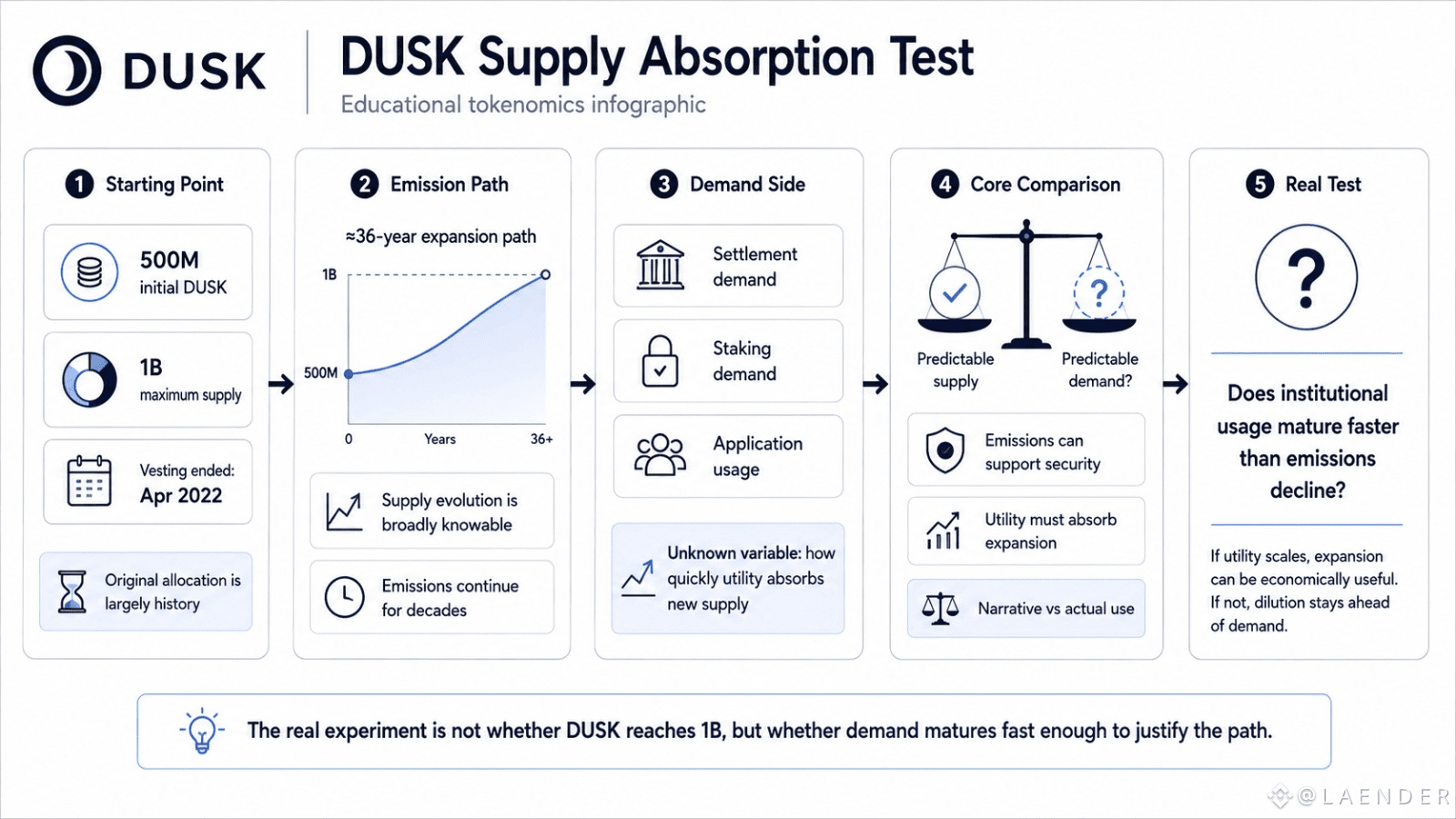
I kept staring at DUSK’s supply curve and realized the obvious number, 1 billion maximum supply, is probably the least interesting part.
The harder part is how the second 500 million gets absorbed.
The original allocation is largely history. Vesting ended in 2022. But DUSK emissions keep expanding supply over a much longer period, turning the next few decades into a demand test rather than a vesting story.
That changes what I watch.
Are new tokens being absorbed because DUSK is gaining real utility, or because existing holders are simply accepting dilution? Does institutional activity grow faster than emissions fall? And if usage arrives early, does token demand actually scale with it?
Some supply expansion is normal. Networks need validator incentives, security budgets and time to mature. I would not treat every new token as economic weakness.
But predictable supply does not equal predictable demand.
That is the uncomfortable part. DUSK holders can roughly model how supply evolves. Nobody can model with the same confidence how quickly settlement demand, staking demand and application usage will grow.
For me, that is the real 36-year experiment: not whether DUSK reaches 1 billion tokens, but whether utility matures fast enough to make that expansion economically useful.
{future}(DUSKUSDT)
@Dusk_Foundation #dusk $DUSK
I kept staring at DUSK’s supply curve and realized the obvious number, 1 billion maximum supply, is probably the least interesting part.
The harder part is how the second 500 million gets absorbed.
The original allocation is largely history. Vesting ended in 2022. But DUSK emissions keep expanding supply over a much longer period, turning the next few decades into a demand test rather than a vesting story.
That changes what I watch.
Are new tokens being absorbed because DUSK is gaining real utility, or because existing holders are simply accepting dilution? Does institutional activity grow faster than emissions fall? And if usage arrives early, does token demand actually scale with it?
Some supply expansion is normal. Networks need validator incentives, security budgets and time to mature. I would not treat every new token as economic weakness.
But predictable supply does not equal predictable demand.
That is the uncomfortable part. DUSK holders can roughly model how supply evolves. Nobody can model with the same confidence how quickly settlement demand, staking demand and application usage will grow.
For me, that is the real 36-year experiment: not whether DUSK reaches 1 billion tokens, but whether utility matures fast enough to make that expansion economically useful.
@Dusk #dusk $DUSK
The harder part is how the second 500 million gets absorbed.
The original allocation is largely history. Vesting ended in 2022. But DUSK emissions keep expanding supply over a much longer period, turning the next few decades into a demand test rather than a vesting story.
That changes what I watch.
Are new tokens being absorbed because DUSK is gaining real utility, or because existing holders are simply accepting dilution? Does institutional activity grow faster than emissions fall? And if usage arrives early, does token demand actually scale with it?
Some supply expansion is normal. Networks need validator incentives, security budgets and time to mature. I would not treat every new token as economic weakness.
But predictable supply does not equal predictable demand.
That is the uncomfortable part. DUSK holders can roughly model how supply evolves. Nobody can model with the same confidence how quickly settlement demand, staking demand and application usage will grow.
For me, that is the real 36-year experiment: not whether DUSK reaches 1 billion tokens, but whether utility matures fast enough to make that expansion economically useful.
@Dusk #dusk $DUSK
75
34
13k
·
--
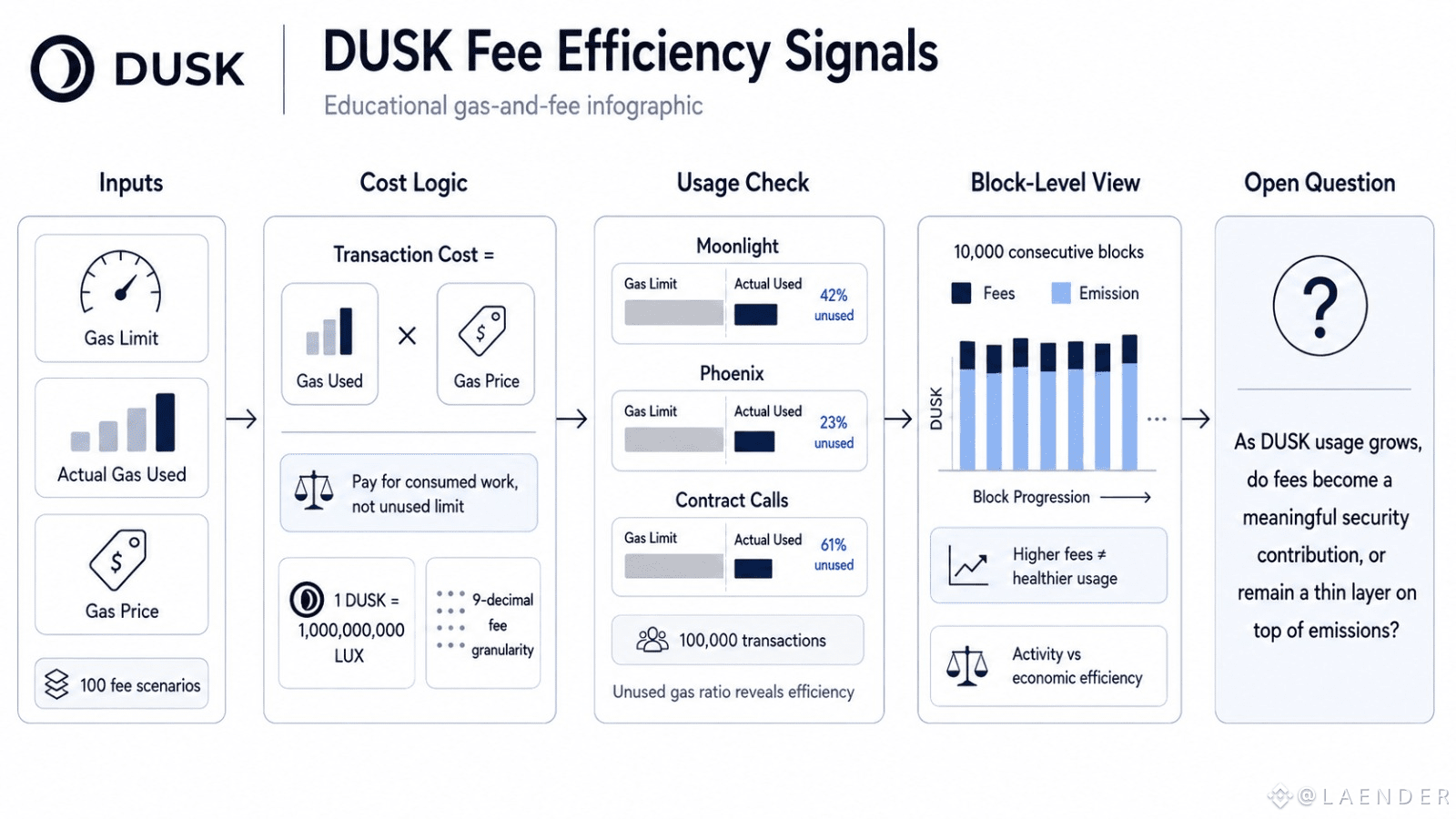
While digging into fee math on DUSK, I noticed the headline gas price tells me almost nothing unless I pair it with actual gas used.
That becomes clearer across 100 fee scenarios. A transaction can carry a generous gas limit, yet pay only for the work it really consumes. So the useful metric is not limit alone, but actual gas used × gas price, then the unused-gas ratio around it.
DUSK also gets interesting at the smallest unit. With 1 DUSK split into 1 billion LUX, fees can move at 9-decimal precision. That sounds minor, but granularity matters when thousands of low-cost transactions start stacking up.
What I would watch is Moonlight vs
Phoenix vs contract calls across 100,000 transactions. If one type consistently reserves far more gas than it uses, that is a quiet efficiency signal.
People may also overread fee revenue. A block earning more from fees does not automatically mean healthier usage if most rewards still come from emission.
For DUSK, the real comparison is protocol activity vs economic efficiency.
My doubt is simple: as DUSK usage grows, do fees become a meaningful security contribution, or just a thin layer sitting on top of emissions?
@Dusk_Foundation #dusk $DUSK
{future}(DUSKUSDT)
While digging into fee math on DUSK, I noticed the headline gas price tells me almost nothing unless I pair it with actual gas used.
That becomes clearer across 100 fee scenarios. A transaction can carry a generous gas limit, yet pay only for the work it really consumes. So the useful metric is not limit alone, but actual gas used × gas price, then the unused-gas ratio around it.
DUSK also gets interesting at the smallest unit. With 1 DUSK split into 1 billion LUX, fees can move at 9-decimal precision. That sounds minor, but granularity matters when thousands of low-cost transactions start stacking up.
What I would watch is Moonlight vs
Phoenix vs contract calls across 100,000 transactions. If one type consistently reserves far more gas than it uses, that is a quiet efficiency signal.
People may also overread fee revenue. A block earning more from fees does not automatically mean healthier usage if most rewards still come from emission.
For DUSK, the real comparison is protocol activity vs economic efficiency.
My doubt is simple: as DUSK usage grows, do fees become a meaningful security contribution, or just a thin layer sitting on top of emissions?
@Dusk #dusk $DUSK
That becomes clearer across 100 fee scenarios. A transaction can carry a generous gas limit, yet pay only for the work it really consumes. So the useful metric is not limit alone, but actual gas used × gas price, then the unused-gas ratio around it.
DUSK also gets interesting at the smallest unit. With 1 DUSK split into 1 billion LUX, fees can move at 9-decimal precision. That sounds minor, but granularity matters when thousands of low-cost transactions start stacking up.
What I would watch is Moonlight vs
Phoenix vs contract calls across 100,000 transactions. If one type consistently reserves far more gas than it uses, that is a quiet efficiency signal.
People may also overread fee revenue. A block earning more from fees does not automatically mean healthier usage if most rewards still come from emission.
For DUSK, the real comparison is protocol activity vs economic efficiency.
My doubt is simple: as DUSK usage grows, do fees become a meaningful security contribution, or just a thin layer sitting on top of emissions?
@Dusk #dusk $DUSK
23
26
10.7k
·
--
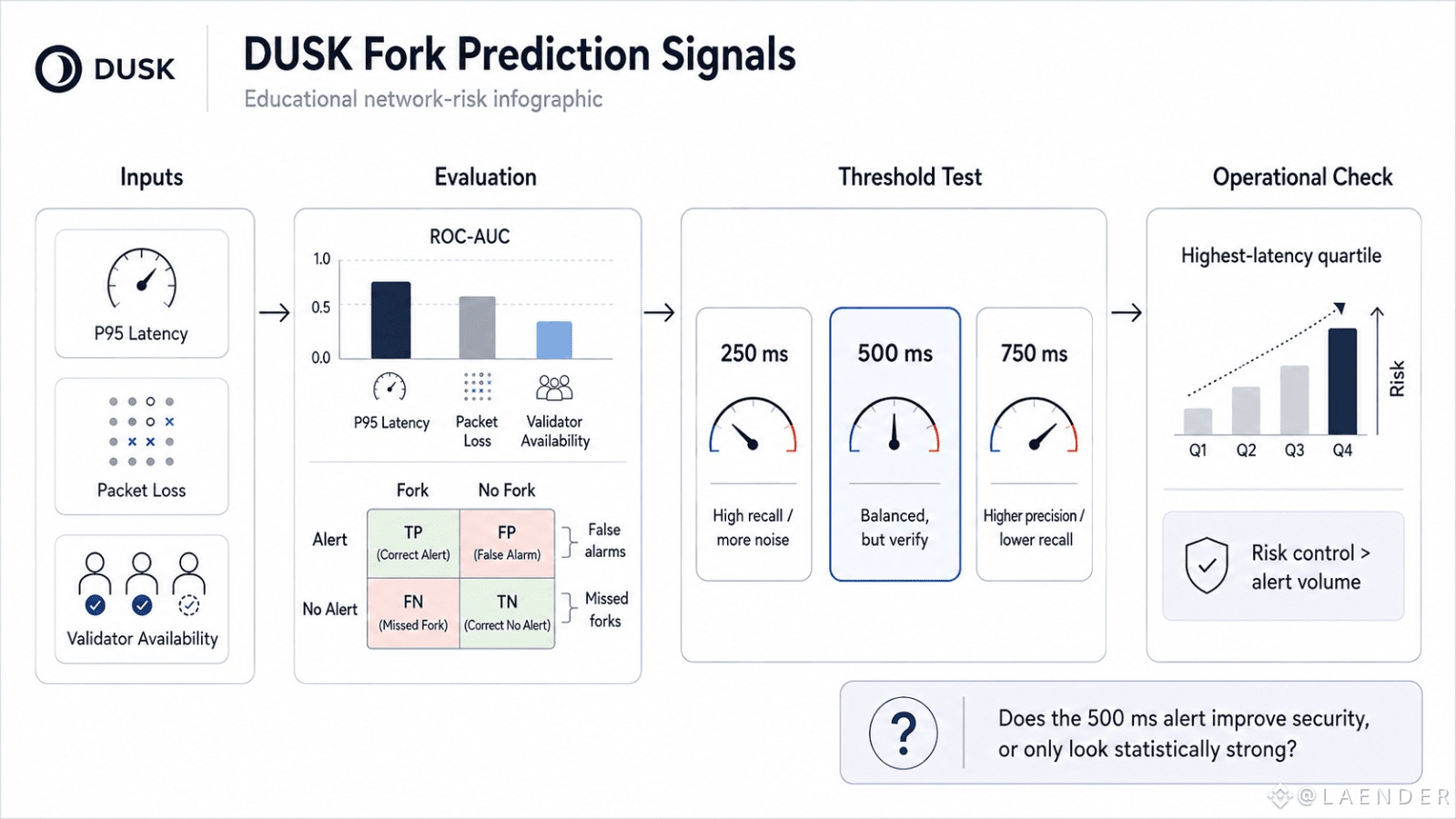
I observed something while sorting DUSK fork tests by P95 network delay the 500 ms alert looked useful until I checked what it was actually catching.
A threshold can sound precise and still be a weak predictor.
For DUSK Network, I would not judge latency alone. ROC-AUC across P95 delay, packet loss, and validator availability matters because each signal may separate fork and non-fork rounds differently. Then the confusion matrix shows the part AUC can hide false alarms, missed forks, and how often a high-risk round was actually harmless.
The 250 ms threshold may catch more fork events but flood the system with noise. At 750 ms, precision may improve while recall collapses. The 500 ms line sits between them, but “balanced” is not automatically useful.
What matters for DUSK is risk control vs alert volume, not latency vs no latency.
I would also watch fork-risk lift in the highest-latency quartile. If that group does not show a meaningful concentration of forks, latency may be correlated but operationally weak.
My quiet doubt is simple does DUSK token security improve because the alert looks statistically good, or only when it catches the rare events that actually matter?
{future}(DUSKUSDT)
@Dusk_Foundation #dusk $DUSK
I observed something while sorting DUSK fork tests by P95 network delay the 500 ms alert looked useful until I checked what it was actually catching.
A threshold can sound precise and still be a weak predictor.
For DUSK Network, I would not judge latency alone. ROC-AUC across P95 delay, packet loss, and validator availability matters because each signal may separate fork and non-fork rounds differently. Then the confusion matrix shows the part AUC can hide false alarms, missed forks, and how often a high-risk round was actually harmless.
The 250 ms threshold may catch more fork events but flood the system with noise. At 750 ms, precision may improve while recall collapses. The 500 ms line sits between them, but “balanced” is not automatically useful.
What matters for DUSK is risk control vs alert volume, not latency vs no latency.
I would also watch fork-risk lift in the highest-latency quartile. If that group does not show a meaningful concentration of forks, latency may be correlated but operationally weak.
My quiet doubt is simple does DUSK token security improve because the alert looks statistically good, or only when it catches the rare events that actually matter?
@Dusk #dusk $DUSK
A threshold can sound precise and still be a weak predictor.
For DUSK Network, I would not judge latency alone. ROC-AUC across P95 delay, packet loss, and validator availability matters because each signal may separate fork and non-fork rounds differently. Then the confusion matrix shows the part AUC can hide false alarms, missed forks, and how often a high-risk round was actually harmless.
The 250 ms threshold may catch more fork events but flood the system with noise. At 750 ms, precision may improve while recall collapses. The 500 ms line sits between them, but “balanced” is not automatically useful.
What matters for DUSK is risk control vs alert volume, not latency vs no latency.
I would also watch fork-risk lift in the highest-latency quartile. If that group does not show a meaningful concentration of forks, latency may be correlated but operationally weak.
My quiet doubt is simple does DUSK token security improve because the alert looks statistically good, or only when it catches the rare events that actually matter?
@Dusk #dusk $DUSK
26
17
1k
·
--
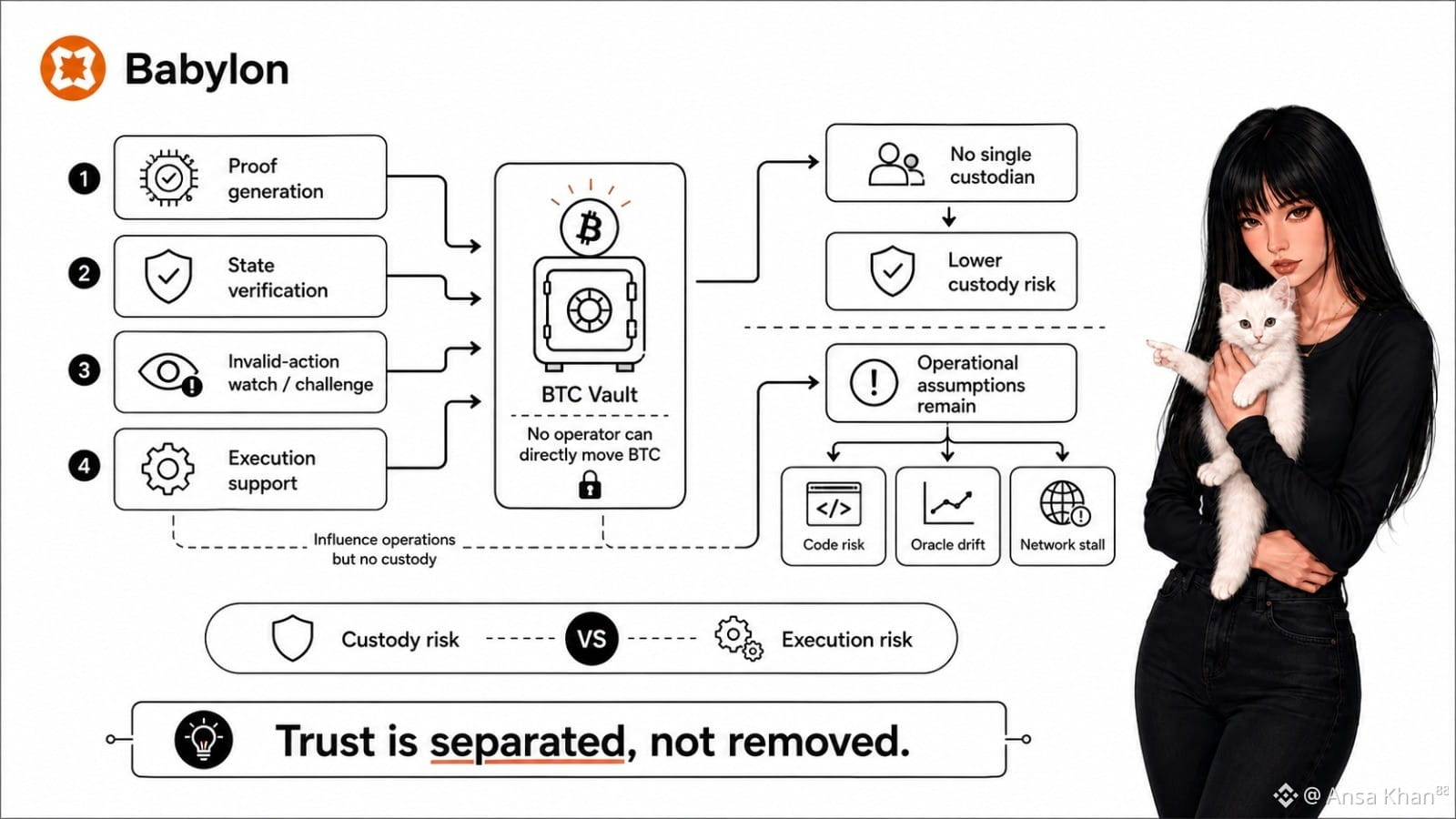
I noticed Babylon’s trust model from the custody question first: which operator can actually move the BTC?
The obvious answer is none of the four groups. But that is only the surface point.
The hidden behavior is how Babylon divides influence. One group generates proofs, another verifies state, another watches for invalid actions, and another supports execution. Zero groups own the asset, yet all four still matter operationally. Trust is not gone. It is narrowed, separated, and made easier to challenge.
That distinction matters for BABY because custody risk and execution risk are not the same. Replacing one powerful custodian with four constrained roles reduces the chance of a human approval becoming a loss event. Still, code can fail.
Oracles can drift. Networks can stall.
Some dependence is normal. A live system needs actors, infrastructure, and coordination.
The real test is technical promise vs operational resilience. Can an incorrect proof be challenged before it changes economic reality?
Can Babylon remain safe when one operator group is delayed, misconfigured, or offline? And who notices first when assumptions begin stacking?
I see the design strength. I am still watching whether BABY limits actor power under stress, not only on paper.
{future}(BABYUSDT)
@babylonlabs_io #baby $BABY
I noticed Babylon’s trust model from the custody question first: which operator can actually move the BTC?
The obvious answer is none of the four groups. But that is only the surface point.
The hidden behavior is how Babylon divides influence. One group generates proofs, another verifies state, another watches for invalid actions, and another supports execution. Zero groups own the asset, yet all four still matter operationally. Trust is not gone. It is narrowed, separated, and made easier to challenge.
That distinction matters for BABY because custody risk and execution risk are not the same. Replacing one powerful custodian with four constrained roles reduces the chance of a human approval becoming a loss event. Still, code can fail.
Oracles can drift. Networks can stall.
Some dependence is normal. A live system needs actors, infrastructure, and coordination.
The real test is technical promise vs operational resilience. Can an incorrect proof be challenged before it changes economic reality?
Can Babylon remain safe when one operator group is delayed, misconfigured, or offline? And who notices first when assumptions begin stacking?
I see the design strength. I am still watching whether BABY limits actor power under stress, not only on paper.
@BabylonLabs_io #baby $BABY
The obvious answer is none of the four groups. But that is only the surface point.
The hidden behavior is how Babylon divides influence. One group generates proofs, another verifies state, another watches for invalid actions, and another supports execution. Zero groups own the asset, yet all four still matter operationally. Trust is not gone. It is narrowed, separated, and made easier to challenge.
That distinction matters for BABY because custody risk and execution risk are not the same. Replacing one powerful custodian with four constrained roles reduces the chance of a human approval becoming a loss event. Still, code can fail.
Oracles can drift. Networks can stall.
Some dependence is normal. A live system needs actors, infrastructure, and coordination.
The real test is technical promise vs operational resilience. Can an incorrect proof be challenged before it changes economic reality?
Can Babylon remain safe when one operator group is delayed, misconfigured, or offline? And who notices first when assumptions begin stacking?
I see the design strength. I am still watching whether BABY limits actor power under stress, not only on paper.
@BabylonLabs_io #baby $BABY
72
56
8.8k
·
--
ຢືນຢັນແລ້ວ
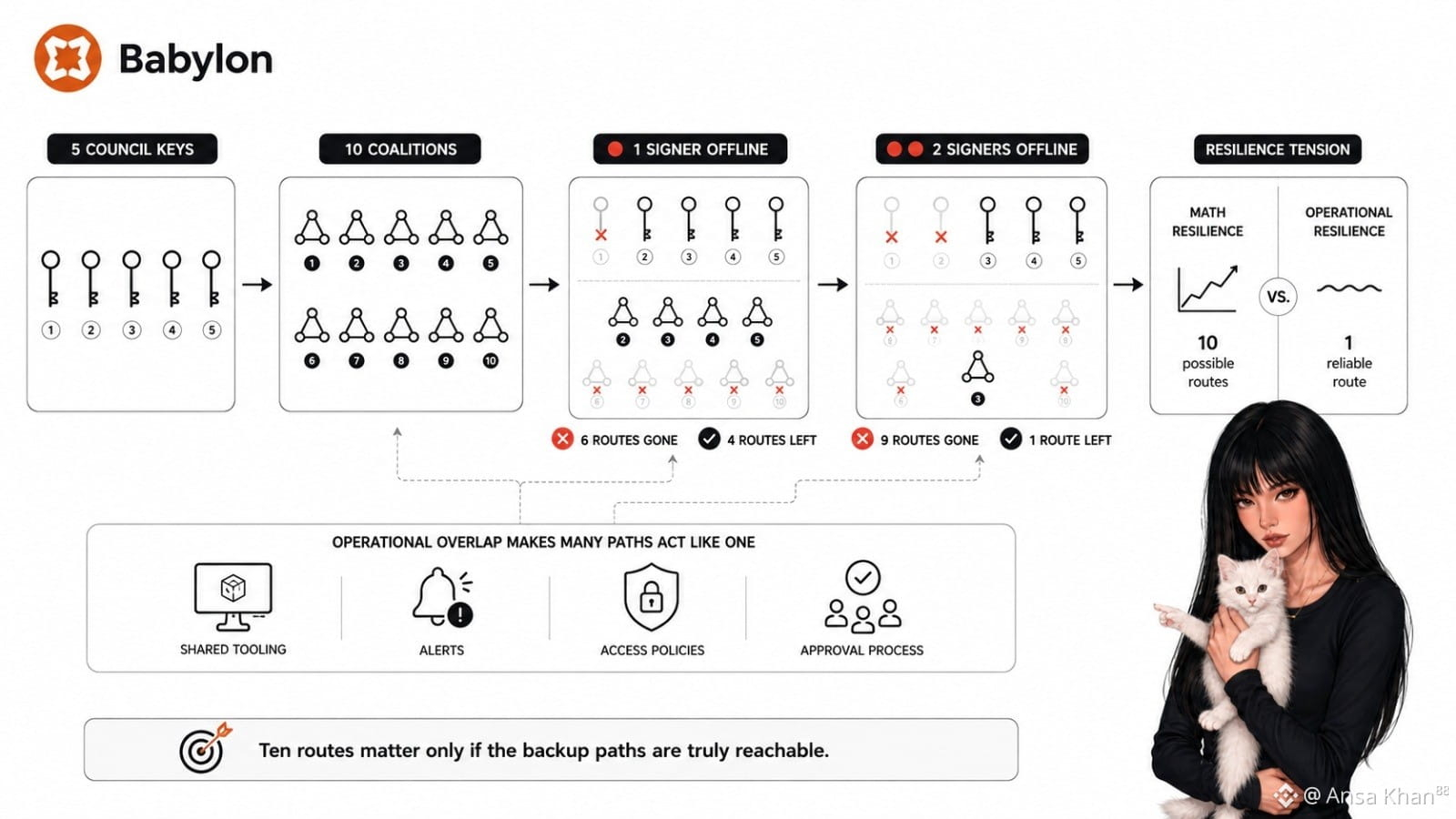
I saw Babylon’s 3-of-5 council from the headline number: ten signing coalitions. Then I removed one key, and six routes disappeared.
The obvious point is that quorum still works. Four combinations remain. That is not the real issue.
The hidden behavior is whether BABY operators can switch among those four routes when one signer is offline. If the same people, tooling, alerts, access policies, or approval process sit behind every coalition, ten mathematical paths may still behave like one operational path.
A second offline key makes this sharper. Four remaining coalitions collapse to one. Babylon is still technically live, yes, but there is no route diversity left. One more failure becomes irreversible.
Some concentration is normal. Small councils are easier to coordinate, and emergency signing cannot be endlessly complex.
The real test is mathematical resilience vs operational resilience.
Are alternate coalitions pre-authorized, tested, and reachable under pressure? Can BABY rotate signers before an incident becomes a governance freeze? Or do operators discover the backup path only when they already need it?
I do not read one outage as system failure. Still, Babylon’s ten routes matter only if they are genuinely independent before the emergency starts.
{future}(BABYUSDT)
@babylonlabs_io #baby $BABY
I saw Babylon’s 3-of-5 council from the headline number: ten signing coalitions. Then I removed one key, and six routes disappeared.
The obvious point is that quorum still works. Four combinations remain. That is not the real issue.
The hidden behavior is whether BABY operators can switch among those four routes when one signer is offline. If the same people, tooling, alerts, access policies, or approval process sit behind every coalition, ten mathematical paths may still behave like one operational path.
A second offline key makes this sharper. Four remaining coalitions collapse to one. Babylon is still technically live, yes, but there is no route diversity left. One more failure becomes irreversible.
Some concentration is normal. Small councils are easier to coordinate, and emergency signing cannot be endlessly complex.
The real test is mathematical resilience vs operational resilience.
Are alternate coalitions pre-authorized, tested, and reachable under pressure? Can BABY rotate signers before an incident becomes a governance freeze? Or do operators discover the backup path only when they already need it?
I do not read one outage as system failure. Still, Babylon’s ten routes matter only if they are genuinely independent before the emergency starts.
@BabylonLabs_io #baby $BABY
The obvious point is that quorum still works. Four combinations remain. That is not the real issue.
The hidden behavior is whether BABY operators can switch among those four routes when one signer is offline. If the same people, tooling, alerts, access policies, or approval process sit behind every coalition, ten mathematical paths may still behave like one operational path.
A second offline key makes this sharper. Four remaining coalitions collapse to one. Babylon is still technically live, yes, but there is no route diversity left. One more failure becomes irreversible.
Some concentration is normal. Small councils are easier to coordinate, and emergency signing cannot be endlessly complex.
The real test is mathematical resilience vs operational resilience.
Are alternate coalitions pre-authorized, tested, and reachable under pressure? Can BABY rotate signers before an incident becomes a governance freeze? Or do operators discover the backup path only when they already need it?
I do not read one outage as system failure. Still, Babylon’s ten routes matter only if they are genuinely independent before the emergency starts.
@BabylonLabs_io #baby $BABY
26
26
4.3k
·
--
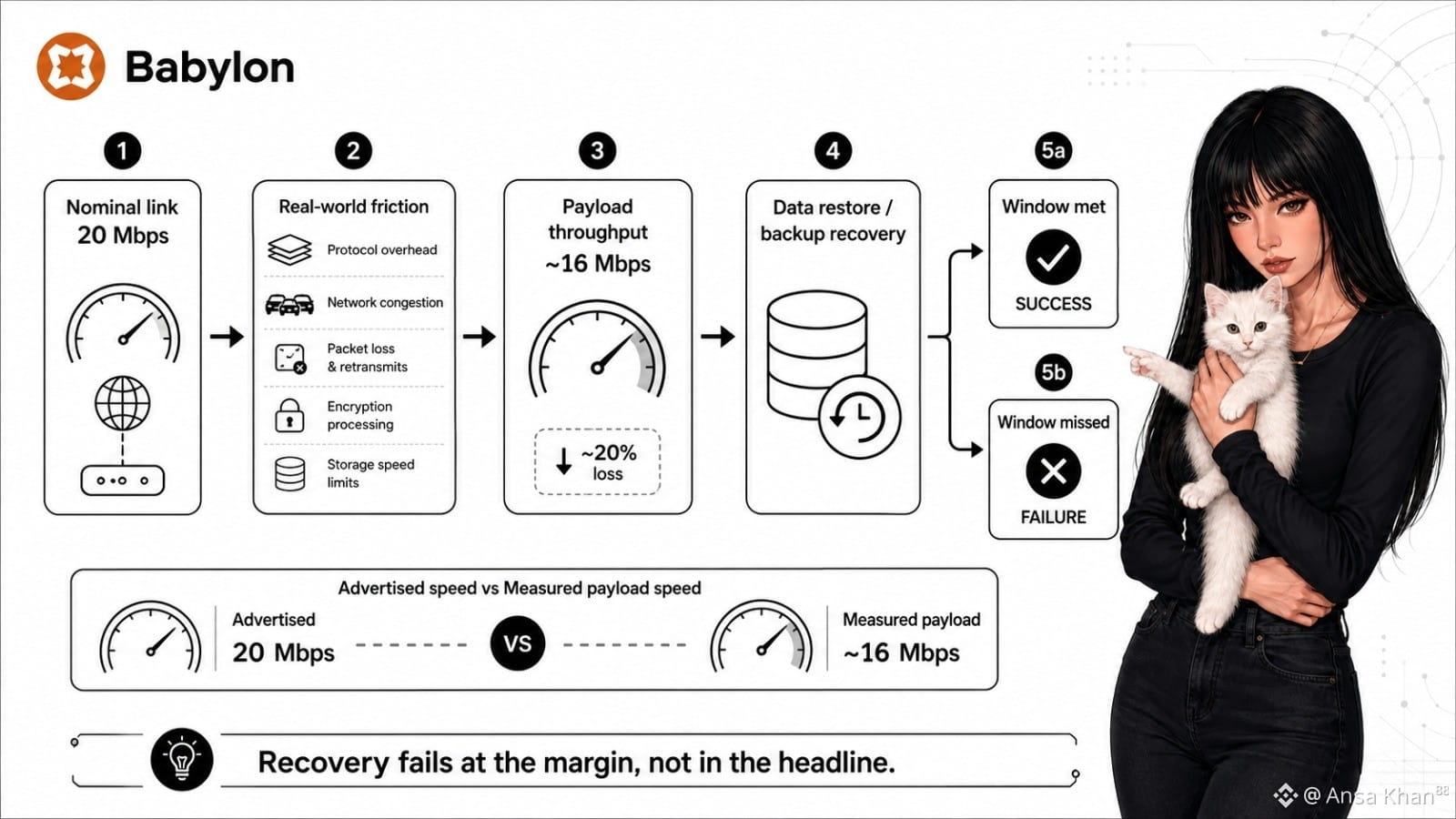
I first noticed Babylon’s recovery risk while timing a backup against a nominal 20 Mbps connection.
The obvious point is that 20 Mbps sounds workable. But headline bandwidth is weak. Once protocol overhead, congestion, packet loss, encryption, and storage speed enter the path, a 20% reduction leaves only about 16 Mbps of payload throughput.
That changes behavior.
BABY may look resilient on paper, yet operators still have to restore data inside a fixed window. Do they test actual recovery speed, or only record the internet plan? Can the system tolerate a slower route, a busy link, or a retry after failure?
Some efficiency loss is normal. No network runs at its advertised maximum all the time.
The real test is technical promise vs operator experience. Babylon succeeds only if recovery assumptions use measured payload throughput, not ideal service rates. Otherwise the protocol can miss its window without any obvious hardware failure. The connection works, just not fast enough.
I’m not reading 20 Mbps as impossible. Still, BABY’s resilience depends on whether Babylon designs for ordinary network friction rather than unusually clean conditions.
That is the part I keep watching, because recovery fails at the margin, not in the headline.
@babylonlabs_io #baby $BABY
I first noticed Babylon’s recovery risk while timing a backup against a nominal 20 Mbps connection.
The obvious point is that 20 Mbps sounds workable. But headline bandwidth is weak. Once protocol overhead, congestion, packet loss, encryption, and storage speed enter the path, a 20% reduction leaves only about 16 Mbps of payload throughput.
That changes behavior.
BABY may look resilient on paper, yet operators still have to restore data inside a fixed window. Do they test actual recovery speed, or only record the internet plan? Can the system tolerate a slower route, a busy link, or a retry after failure?
Some efficiency loss is normal. No network runs at its advertised maximum all the time.
The real test is technical promise vs operator experience. Babylon succeeds only if recovery assumptions use measured payload throughput, not ideal service rates. Otherwise the protocol can miss its window without any obvious hardware failure. The connection works, just not fast enough.
I’m not reading 20 Mbps as impossible. Still, BABY’s resilience depends on whether Babylon designs for ordinary network friction rather than unusually clean conditions.
That is the part I keep watching, because recovery fails at the margin, not in the headline.
@BabylonLabs_io #baby $BABY
The obvious point is that 20 Mbps sounds workable. But headline bandwidth is weak. Once protocol overhead, congestion, packet loss, encryption, and storage speed enter the path, a 20% reduction leaves only about 16 Mbps of payload throughput.
That changes behavior.
BABY may look resilient on paper, yet operators still have to restore data inside a fixed window. Do they test actual recovery speed, or only record the internet plan? Can the system tolerate a slower route, a busy link, or a retry after failure?
Some efficiency loss is normal. No network runs at its advertised maximum all the time.
The real test is technical promise vs operator experience. Babylon succeeds only if recovery assumptions use measured payload throughput, not ideal service rates. Otherwise the protocol can miss its window without any obvious hardware failure. The connection works, just not fast enough.
I’m not reading 20 Mbps as impossible. Still, BABY’s resilience depends on whether Babylon designs for ordinary network friction rather than unusually clean conditions.
That is the part I keep watching, because recovery fails at the margin, not in the headline.
@BabylonLabs_io #baby $BABY
53
40
3.5k
·
--
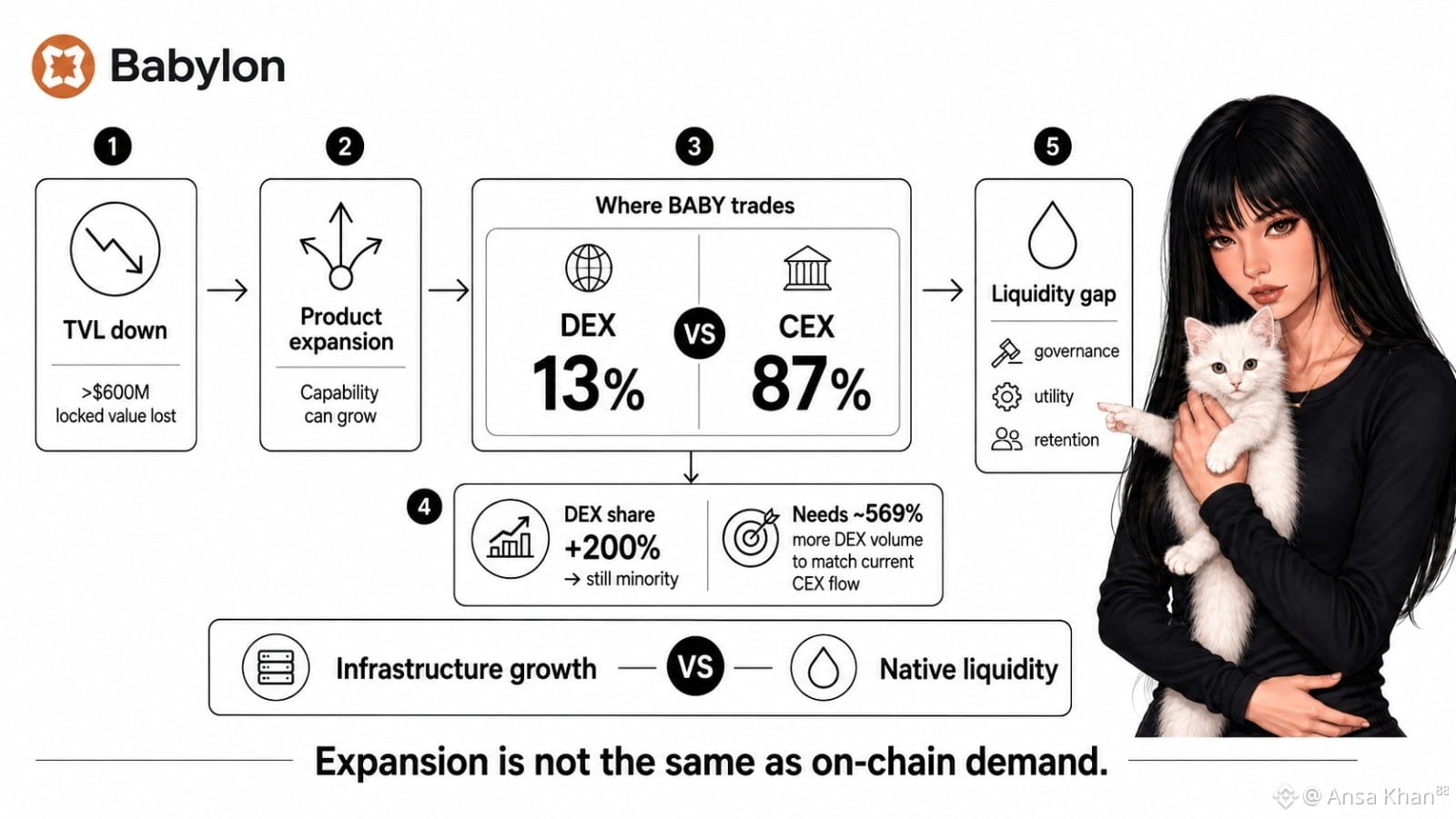
I noticed Babylon’s liquidity problem after putting its locked value beside the token’s actual trading paths.
The obvious point is that losing more than $600 million in locked value looks alarming. But that number alone is weak. Product expansion can continue while TVL contracts, because technical capability is not immediate demand.
The harder signal is where BABY price discovery happens.
DEXs handle only about 13% of BABY volume, while centralized venues control the other 87%. Even a 200% rise in DEX share would still leave most activity on centralized rails. Matching current centralized flow would require roughly 569% more DEX volume, assuming CEX activity does not fall.
Some weakness here is normal. On-chain liquidity often develops slower than listings, integrations, and product announcements.
But what is the real test? Can Babylon turn protocol usage into deeper native liquidity, or will the token remain dependent on external order books while the ecosystem expands elsewhere?
That matters because governance, utility, and user retention become harder to trust when the token’s main market sits outside the system it is meant to support.
I’m not reading contraction as failure. Still, infrastructure power without on-chain demand is a gap Babylon has not closed yet.
{future}(BABYUSDT)
@babylonlabs_io $BABY #baby
I noticed Babylon’s liquidity problem after putting its locked value beside the token’s actual trading paths.
The obvious point is that losing more than $600 million in locked value looks alarming. But that number alone is weak. Product expansion can continue while TVL contracts, because technical capability is not immediate demand.
The harder signal is where BABY price discovery happens.
DEXs handle only about 13% of BABY volume, while centralized venues control the other 87%. Even a 200% rise in DEX share would still leave most activity on centralized rails. Matching current centralized flow would require roughly 569% more DEX volume, assuming CEX activity does not fall.
Some weakness here is normal. On-chain liquidity often develops slower than listings, integrations, and product announcements.
But what is the real test? Can Babylon turn protocol usage into deeper native liquidity, or will the token remain dependent on external order books while the ecosystem expands elsewhere?
That matters because governance, utility, and user retention become harder to trust when the token’s main market sits outside the system it is meant to support.
I’m not reading contraction as failure. Still, infrastructure power without on-chain demand is a gap Babylon has not closed yet.
@BabylonLabs_io $BABY #baby
The obvious point is that losing more than $600 million in locked value looks alarming. But that number alone is weak. Product expansion can continue while TVL contracts, because technical capability is not immediate demand.
The harder signal is where BABY price discovery happens.
DEXs handle only about 13% of BABY volume, while centralized venues control the other 87%. Even a 200% rise in DEX share would still leave most activity on centralized rails. Matching current centralized flow would require roughly 569% more DEX volume, assuming CEX activity does not fall.
Some weakness here is normal. On-chain liquidity often develops slower than listings, integrations, and product announcements.
But what is the real test? Can Babylon turn protocol usage into deeper native liquidity, or will the token remain dependent on external order books while the ecosystem expands elsewhere?
That matters because governance, utility, and user retention become harder to trust when the token’s main market sits outside the system it is meant to support.
I’m not reading contraction as failure. Still, infrastructure power without on-chain demand is a gap Babylon has not closed yet.
@BabylonLabs_io $BABY #baby
92
43
15.7k
·
--
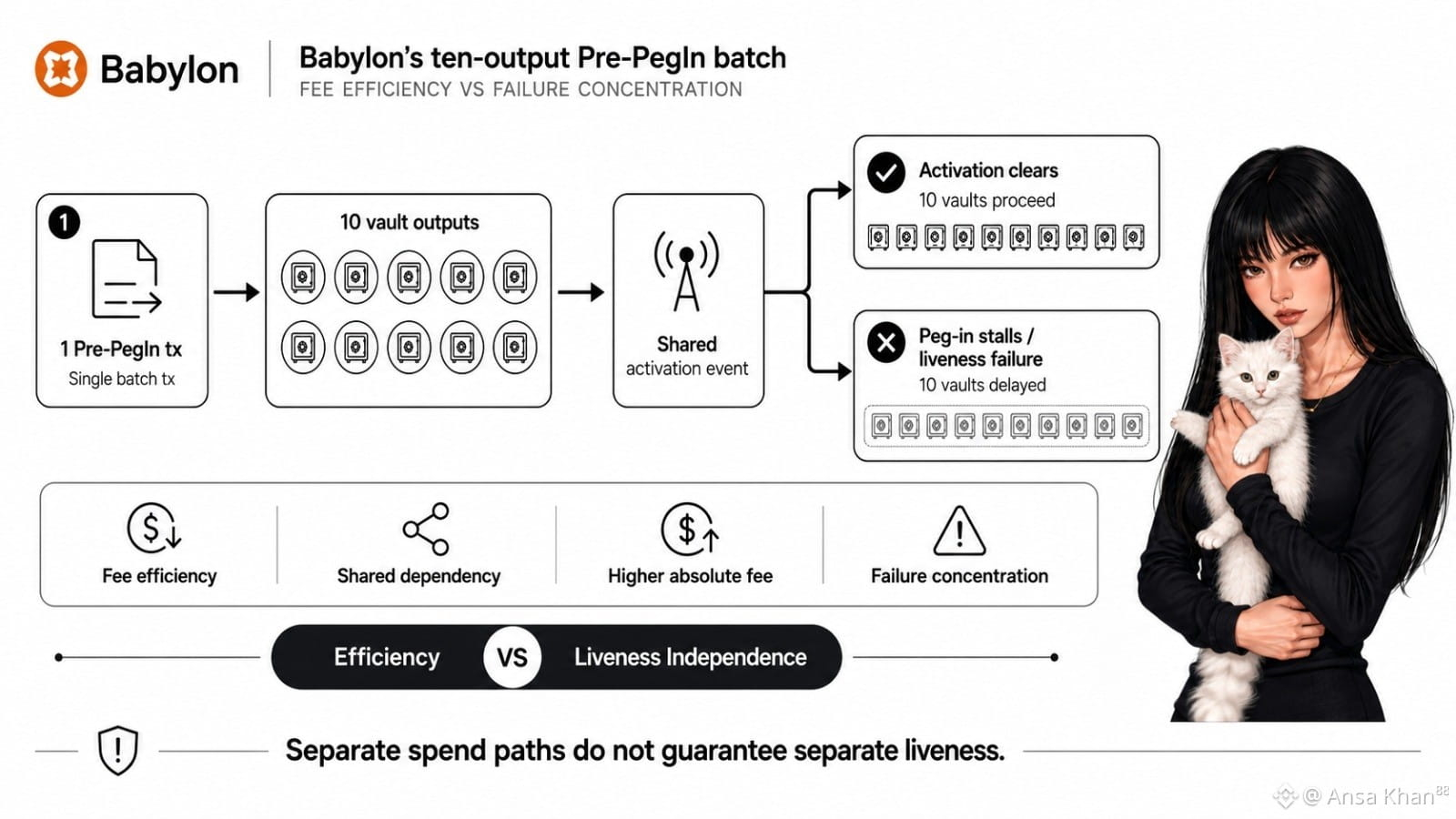
I saw Babylon’s ten-output Pre-PegIn batch from fee efficiency first. One transaction carrying ten vault outputs looked cleaner, cheaper, and easier to scale.
That was the obvious reading, probably the weaker one.
The real issue appears after broadcast. Each output may keep its own Bitcoin spend path, but all ten still depend on one activation event clearing on time. If that peg-in stalls, BABY does not face one delayed vault. It can face ten users waiting behind the same liveness failure.
Some shared dependency is normal. Batching exists because repeating entry overhead ten times wastes block space and raises per-vault cost. The efficiency is real.
But the test is behavior under delay. Can Babylon isolate recovery per output, or does one transaction-level problem hold the whole batch together? Who reacts when the deadline starts shrinking? Does the larger absolute fee tied to one transaction make rebroadcast more painful?
This is fee efficiency vs failure concentration.
BABY succeeds if batching lowers entry cost without turning one operational mistake into a ten-vault queue. I’m still watching one uncomfortable point: separate spend paths do not guarantee separate liveness.
Babylon may save space here. The harder question is whether it preserves independence.
{future}(BABYUSDT)
@babylonlabs_io #baby $BABY
I saw Babylon’s ten-output Pre-PegIn batch from fee efficiency first. One transaction carrying ten vault outputs looked cleaner, cheaper, and easier to scale.
That was the obvious reading, probably the weaker one.
The real issue appears after broadcast. Each output may keep its own Bitcoin spend path, but all ten still depend on one activation event clearing on time. If that peg-in stalls, BABY does not face one delayed vault. It can face ten users waiting behind the same liveness failure.
Some shared dependency is normal. Batching exists because repeating entry overhead ten times wastes block space and raises per-vault cost. The efficiency is real.
But the test is behavior under delay. Can Babylon isolate recovery per output, or does one transaction-level problem hold the whole batch together? Who reacts when the deadline starts shrinking? Does the larger absolute fee tied to one transaction make rebroadcast more painful?
This is fee efficiency vs failure concentration.
BABY succeeds if batching lowers entry cost without turning one operational mistake into a ten-vault queue. I’m still watching one uncomfortable point: separate spend paths do not guarantee separate liveness.
Babylon may save space here. The harder question is whether it preserves independence.
@BabylonLabs_io #baby $BABY
That was the obvious reading, probably the weaker one.
The real issue appears after broadcast. Each output may keep its own Bitcoin spend path, but all ten still depend on one activation event clearing on time. If that peg-in stalls, BABY does not face one delayed vault. It can face ten users waiting behind the same liveness failure.
Some shared dependency is normal. Batching exists because repeating entry overhead ten times wastes block space and raises per-vault cost. The efficiency is real.
But the test is behavior under delay. Can Babylon isolate recovery per output, or does one transaction-level problem hold the whole batch together? Who reacts when the deadline starts shrinking? Does the larger absolute fee tied to one transaction make rebroadcast more painful?
This is fee efficiency vs failure concentration.
BABY succeeds if batching lowers entry cost without turning one operational mistake into a ten-vault queue. I’m still watching one uncomfortable point: separate spend paths do not guarantee separate liveness.
Babylon may save space here. The harder question is whether it preserves independence.
@BabylonLabs_io #baby $BABY
68
54
10.9k
·
--
ເປັນຄວາມຈິງບາງສ່ວນ
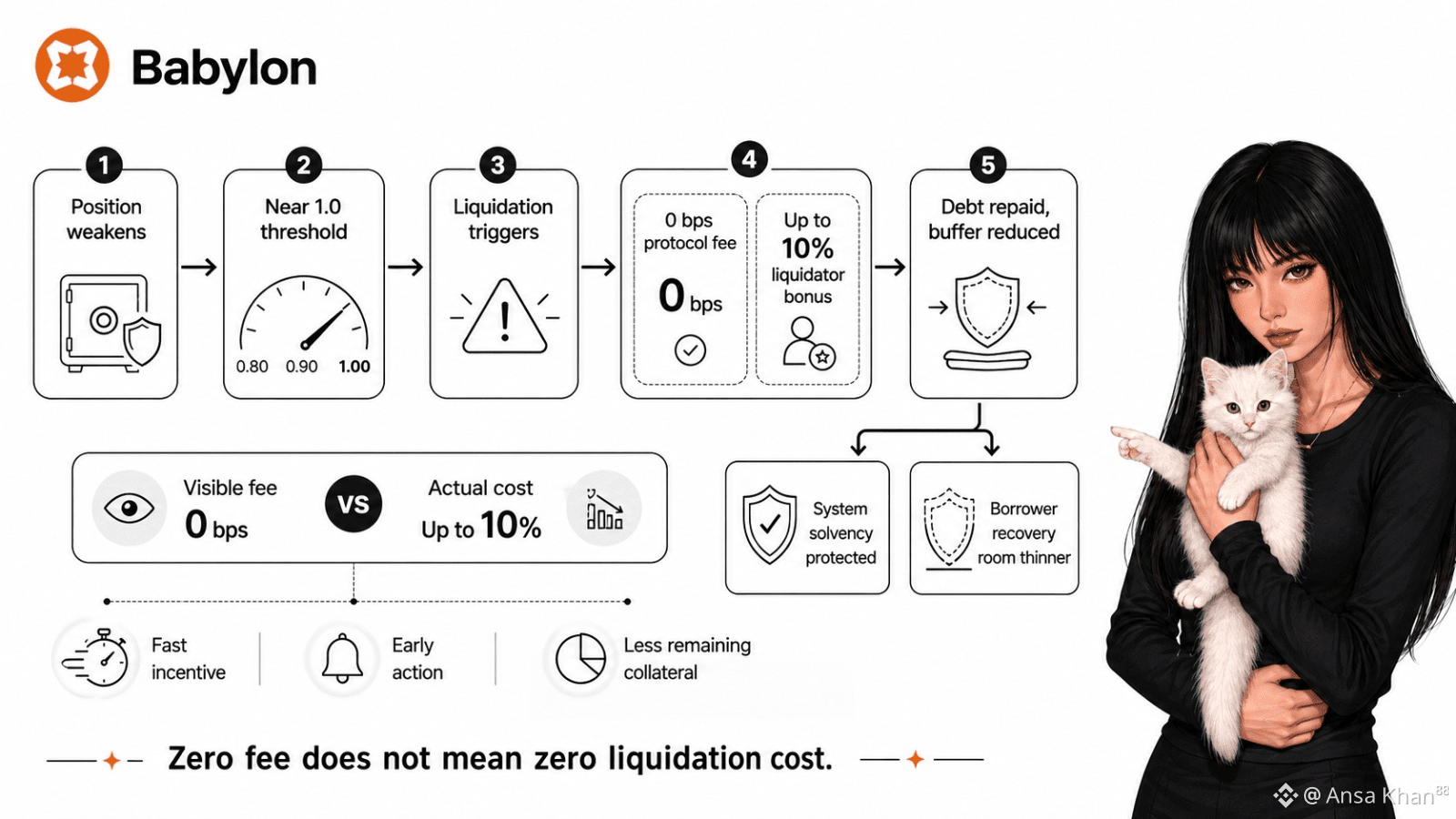
My initial take on Babylon’s liquidation design from the zero-basis-point fee. It looked borrower-friendly and unusually clean.
But that is the obvious metric, and it hides the transfer.
A borrower may pay no protocol fee, yet value still leaves the position through the liquidator bonus. Near the 1.0 threshold, Babylon can apply the full 10% incentive instead of waiting for deeper insolvency. So “zero fee” is not zero cost. It is fee visibility vs actual economic loss.
That trade-off is understandable. Liquidators need enough incentive to act quickly when collateral coverage is thin and timing matters. Weak incentives can leave bad debt sitting longer. Some cost is normal.
Still, behavior matters more than the label. Does BABY protect solvency by acting early, or does the 10% bonus consume too much collateral before the borrower has meaningful recovery room? After debt repayment and incentive costs, how much buffer is actually left?
Most people will watch whether liquidation clears the debt. I’m watching what remains afterward.
Babylon succeeds if early liquidation preserves system strength without making borrowers absorb a hidden penalty disguised by zero protocol fees. My doubt is simple a clean fee line can still produce a rough user outcome.
{future}(BABYUSDT)
@babylonlabs_io #baby $BABY
My initial take on Babylon’s liquidation design from the zero-basis-point fee. It looked borrower-friendly and unusually clean.
But that is the obvious metric, and it hides the transfer.
A borrower may pay no protocol fee, yet value still leaves the position through the liquidator bonus. Near the 1.0 threshold, Babylon can apply the full 10% incentive instead of waiting for deeper insolvency. So “zero fee” is not zero cost. It is fee visibility vs actual economic loss.
That trade-off is understandable. Liquidators need enough incentive to act quickly when collateral coverage is thin and timing matters. Weak incentives can leave bad debt sitting longer. Some cost is normal.
Still, behavior matters more than the label. Does BABY protect solvency by acting early, or does the 10% bonus consume too much collateral before the borrower has meaningful recovery room? After debt repayment and incentive costs, how much buffer is actually left?
Most people will watch whether liquidation clears the debt. I’m watching what remains afterward.
Babylon succeeds if early liquidation preserves system strength without making borrowers absorb a hidden penalty disguised by zero protocol fees. My doubt is simple a clean fee line can still produce a rough user outcome.
@BabylonLabs_io #baby $BABY
But that is the obvious metric, and it hides the transfer.
A borrower may pay no protocol fee, yet value still leaves the position through the liquidator bonus. Near the 1.0 threshold, Babylon can apply the full 10% incentive instead of waiting for deeper insolvency. So “zero fee” is not zero cost. It is fee visibility vs actual economic loss.
That trade-off is understandable. Liquidators need enough incentive to act quickly when collateral coverage is thin and timing matters. Weak incentives can leave bad debt sitting longer. Some cost is normal.
Still, behavior matters more than the label. Does BABY protect solvency by acting early, or does the 10% bonus consume too much collateral before the borrower has meaningful recovery room? After debt repayment and incentive costs, how much buffer is actually left?
Most people will watch whether liquidation clears the debt. I’m watching what remains afterward.
Babylon succeeds if early liquidation preserves system strength without making borrowers absorb a hidden penalty disguised by zero protocol fees. My doubt is simple a clean fee line can still produce a rough user outcome.
@BabylonLabs_io #baby $BABY
59
41
5.9k
ເຂົ້າສູ່ລະບົບເພື່ອສຳຫຼວດເນື້ອຫາເພີ່ມເຕີມ
ເຂົ້າຮ່ວມກຸ່ມຜູ້ໃຊ້ຄຣິບໂຕທົ່ວໂລກໃນ Binance Square.
⚡️ ໄດ້ຮັບຂໍ້ມູນຫຼ້າສຸດ ແລະ ທີ່ມີປະໂຫຍດກ່ຽວກັບຄຣິບໂຕ.
💬 ໄດ້ຮັບຄວາມໄວ້ວາງໃຈຈາກຕະຫຼາດແລກປ່ຽນຄຣິບໂຕທີ່ໃຫຍ່ທີ່ສຸດໃນໂລກ.
👍 ຄົ້ນຫາຂໍ້ມູນເຊີງເລິກທີ່ແທ້ຈາກນັກສ້າງທີ່ໄດ້ຮັບການຢືນຢັນ.
ອີເມວ / ເບີໂທລະສັບ
ຫົວຂໍ້ທີ່ກໍາລັງນິຍົມ
HotCPIDecemberHikePriced
6,390 ຄັ້ງທີ່ເບິ່ງ
291 ກຳລັງສົນທະນາ
CPI Market Watch | US CPI Rises 0.4% in October, Hotter Than 0.3% Forecast
Binance News
·10 ຖືກໃຈ
·15.6k ຄັ້ງທີ່ເບິ່ງ
AnthropicRejectsIPODelayValuationinQuestion
136,537 ຄັ້ງທີ່ເບິ່ງ
1,299 ກຳລັງສົນທະນາ
NvidiaInvestigatesAfterHuang’sAffairApology
383,451 ຄັ້ງທີ່ເບິ່ງ
2,769 ກຳລັງສົນທະນາ