

Rokyo
870 ໂພສ

Rokyo
ລາຍງານ
ບລັອກຜູ້ໃຊ້
ເປີດການຊື້ຂາຍ

ຜູ້ຖື BNB
ຜູ້ຊື້ຂາຍປະຈໍາ
5.5 ປີ
122 ກໍາລັງຕິດຕາມ
124 ຜູ້ຕິດຕາມ
1.0K+ Liked
ໂພສ
Portfolio
·
--
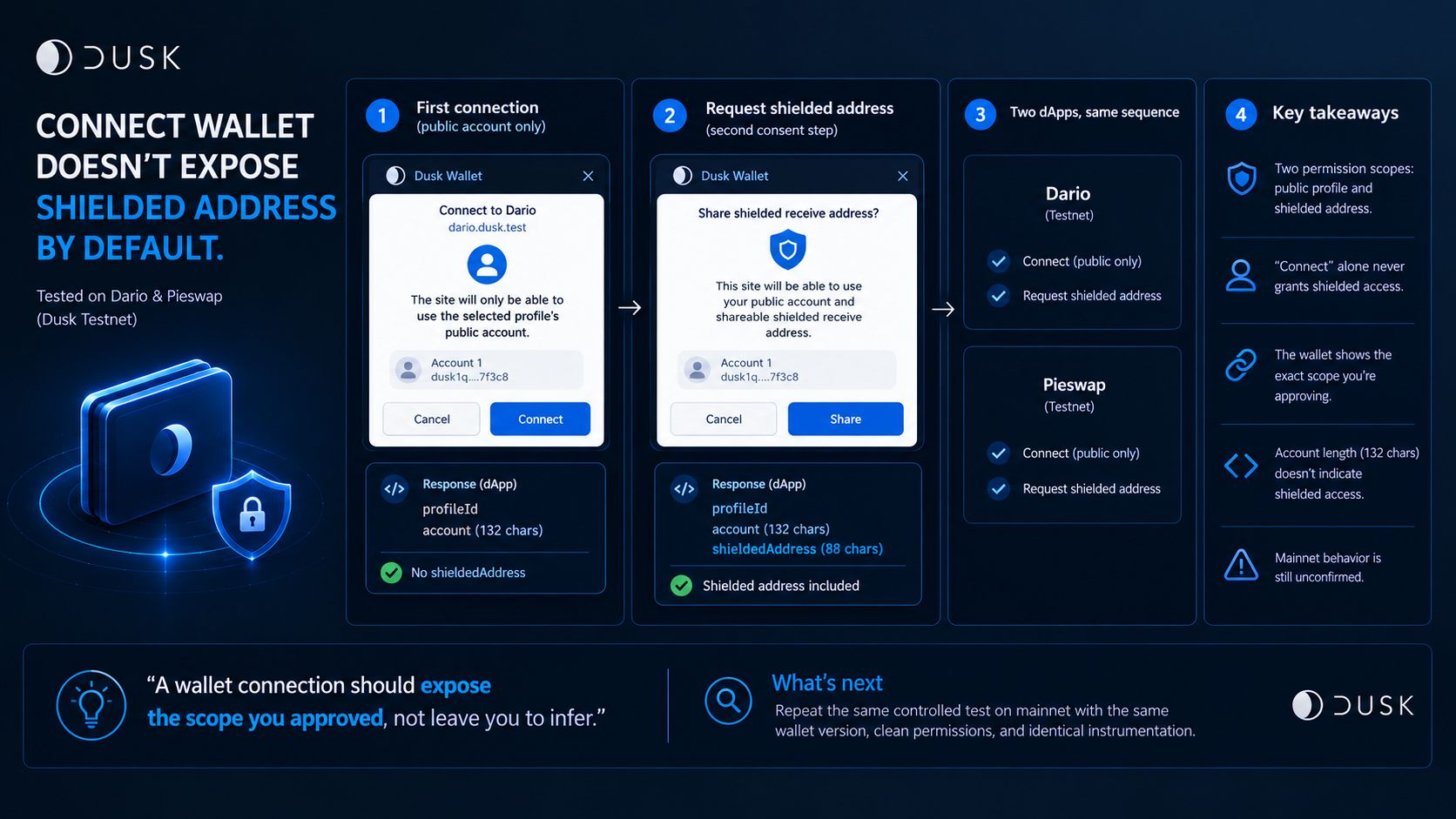
I wanted to know what "Connect Wallet" actually gives a dApp access to, so I tested the real flow on Dario and Pieswap on Dusk testnet. On both, the first connection returned only the profile ID and public account. The popup was explicit: "The site will only be able to use the selected profile's public account." Only when I requested the shielded receive address did a second consent step appear, and only then did the response include shieldedAddress. The popup changed too, naming the "shareable shielded receive address." Both integrations showed the same sequence.
Here's the flip: I was treating "Connect Wallet" as one permission event. It isn't. The controlled test separated public-account access from sharing the shielded receive address at the point of consent.
That separation puts part of the minimum-disclosure boundary in the wallet's consent flow, not entirely on the user to manage. In both tests, clicking "Connect" alone never granted the shielded-address scope; a dApp had to cross a separate consent step to get it.
I also got one thing wrong while investigating. I thought the 132-character account string might hint at shielded access. It doesn't. Both dApps returned the same account format on baseline, while shieldedAddress stayed absent until the explicit request.
There's still one unresolved question. An earlier Dario mainnet session behaved differently, but I haven't reproduced it under the same controlled conditions, so I'm not calling it a leak. I can only say the public-only permission boundary held across the two testnet integrations I checked, not that it is guaranteed across every environment.
"A wallet connection should expose the scope you approved, not leave you to infer it."
What I'd want to see next: the same controlled test on mainnet with the same wallet version, clean permissions, and identical instrumentation, to see whether the boundary holds across environments.
#dusk $DUSK @Dusk_Foundation
I wanted to know what "Connect Wallet" actually gives a dApp access to, so I tested the real flow on Dario and Pieswap on Dusk testnet. On both, the first connection returned only the profile ID and public account. The popup was explicit: "The site will only be able to use the selected profile's public account." Only when I requested the shielded receive address did a second consent step appear, and only then did the response include shieldedAddress. The popup changed too, naming the "shareable shielded receive address." Both integrations showed the same sequence.
Here's the flip: I was treating "Connect Wallet" as one permission event. It isn't. The controlled test separated public-account access from sharing the shielded receive address at the point of consent.
That separation puts part of the minimum-disclosure boundary in the wallet's consent flow, not entirely on the user to manage. In both tests, clicking "Connect" alone never granted the shielded-address scope; a dApp had to cross a separate consent step to get it.
I also got one thing wrong while investigating. I thought the 132-character account string might hint at shielded access. It doesn't. Both dApps returned the same account format on baseline, while shieldedAddress stayed absent until the explicit request.
There's still one unresolved question. An earlier Dario mainnet session behaved differently, but I haven't reproduced it under the same controlled conditions, so I'm not calling it a leak. I can only say the public-only permission boundary held across the two testnet integrations I checked, not that it is guaranteed across every environment.
"A wallet connection should expose the scope you approved, not leave you to infer it."
What I'd want to see next: the same controlled test on mainnet with the same wallet version, clean permissions, and identical instrumentation, to see whether the boundary holds across environments.
#dusk $DUSK @Dusk
Here's the flip: I was treating "Connect Wallet" as one permission event. It isn't. The controlled test separated public-account access from sharing the shielded receive address at the point of consent.
That separation puts part of the minimum-disclosure boundary in the wallet's consent flow, not entirely on the user to manage. In both tests, clicking "Connect" alone never granted the shielded-address scope; a dApp had to cross a separate consent step to get it.
I also got one thing wrong while investigating. I thought the 132-character account string might hint at shielded access. It doesn't. Both dApps returned the same account format on baseline, while shieldedAddress stayed absent until the explicit request.
There's still one unresolved question. An earlier Dario mainnet session behaved differently, but I haven't reproduced it under the same controlled conditions, so I'm not calling it a leak. I can only say the public-only permission boundary held across the two testnet integrations I checked, not that it is guaranteed across every environment.
"A wallet connection should expose the scope you approved, not leave you to infer it."
What I'd want to see next: the same controlled test on mainnet with the same wallet version, clean permissions, and identical instrumentation, to see whether the boundary holds across environments.
#dusk $DUSK @Dusk
1
2
95
·
--
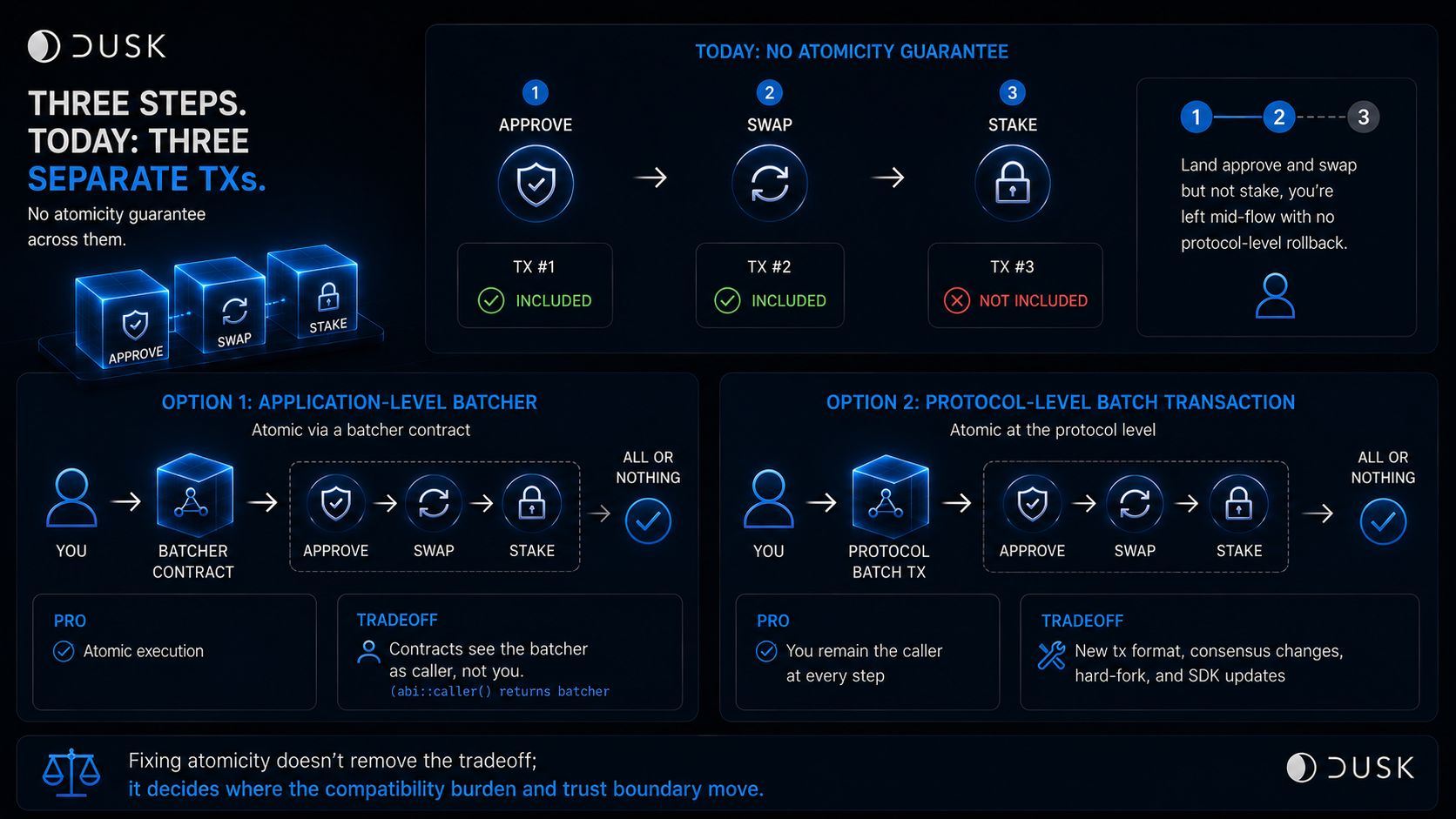
I assumed that if I wanted to do three things on-chain, approve, swap, then stake, the chain would treat that as one thing happening or not happening at all. An open issue in Dusk's own Rusk repository says that's not how it works today.
A Dusk transaction today carries a single optional operation: one contract call, one deploy, or one memo, with one value, one recipient, one nonce, one signature. So approve, swap, and stake become three separate transactions, each independently included or dropped. Dusk's issue states it plainly: there is no atomicity guarantee across them. Land approve and swap but not stake, and you're left mid-flow with no protocol-level rollback.
The problem isn't only that multi-step flows can stop halfway. Fixing that changes who has to absorb the compatibility cost.
A batcher contract makes the whole sequence atomic, because a failed sub-call reverts the outer transaction. But a target contract checking who's calling it directly would see the batcher, not you, unless that contract is already written to look past the immediate caller. A protocol-level batch transaction keeps you as the caller at every step, but it doesn't ship without a new transaction format, consensus changes, a hard-fork, and every wallet SDK catching up.
Adding batching doesn't remove the tradeoff. It decides whether the compatibility burden sits in application authorization or in the protocol stack.
"Fixing atomicity doesn't remove the tradeoff; it decides where the compatibility burden and trust boundary move."
What I'd actually want to watch: whether Dusk chooses the application-level batcher or the protocol-level transaction, and what existing authorization assumptions that choice forces developers to change.
#dusk $DUSK @Dusk_Foundation
I assumed that if I wanted to do three things on-chain, approve, swap, then stake, the chain would treat that as one thing happening or not happening at all. An open issue in Dusk's own Rusk repository says that's not how it works today.
A Dusk transaction today carries a single optional operation: one contract call, one deploy, or one memo, with one value, one recipient, one nonce, one signature. So approve, swap, and stake become three separate transactions, each independently included or dropped. Dusk's issue states it plainly: there is no atomicity guarantee across them. Land approve and swap but not stake, and you're left mid-flow with no protocol-level rollback.
The problem isn't only that multi-step flows can stop halfway. Fixing that changes who has to absorb the compatibility cost.
A batcher contract makes the whole sequence atomic, because a failed sub-call reverts the outer transaction. But a target contract checking who's calling it directly would see the batcher, not you, unless that contract is already written to look past the immediate caller. A protocol-level batch transaction keeps you as the caller at every step, but it doesn't ship without a new transaction format, consensus changes, a hard-fork, and every wallet SDK catching up.
Adding batching doesn't remove the tradeoff. It decides whether the compatibility burden sits in application authorization or in the protocol stack.
"Fixing atomicity doesn't remove the tradeoff; it decides where the compatibility burden and trust boundary move."
What I'd actually want to watch: whether Dusk chooses the application-level batcher or the protocol-level transaction, and what existing authorization assumptions that choice forces developers to change.
#dusk $DUSK @Dusk
A Dusk transaction today carries a single optional operation: one contract call, one deploy, or one memo, with one value, one recipient, one nonce, one signature. So approve, swap, and stake become three separate transactions, each independently included or dropped. Dusk's issue states it plainly: there is no atomicity guarantee across them. Land approve and swap but not stake, and you're left mid-flow with no protocol-level rollback.
The problem isn't only that multi-step flows can stop halfway. Fixing that changes who has to absorb the compatibility cost.
A batcher contract makes the whole sequence atomic, because a failed sub-call reverts the outer transaction. But a target contract checking who's calling it directly would see the batcher, not you, unless that contract is already written to look past the immediate caller. A protocol-level batch transaction keeps you as the caller at every step, but it doesn't ship without a new transaction format, consensus changes, a hard-fork, and every wallet SDK catching up.
Adding batching doesn't remove the tradeoff. It decides whether the compatibility burden sits in application authorization or in the protocol stack.
"Fixing atomicity doesn't remove the tradeoff; it decides where the compatibility burden and trust boundary move."
What I'd actually want to watch: whether Dusk chooses the application-level batcher or the protocol-level transaction, and what existing authorization assumptions that choice forces developers to change.
#dusk $DUSK @Dusk
1
2
94
·
--
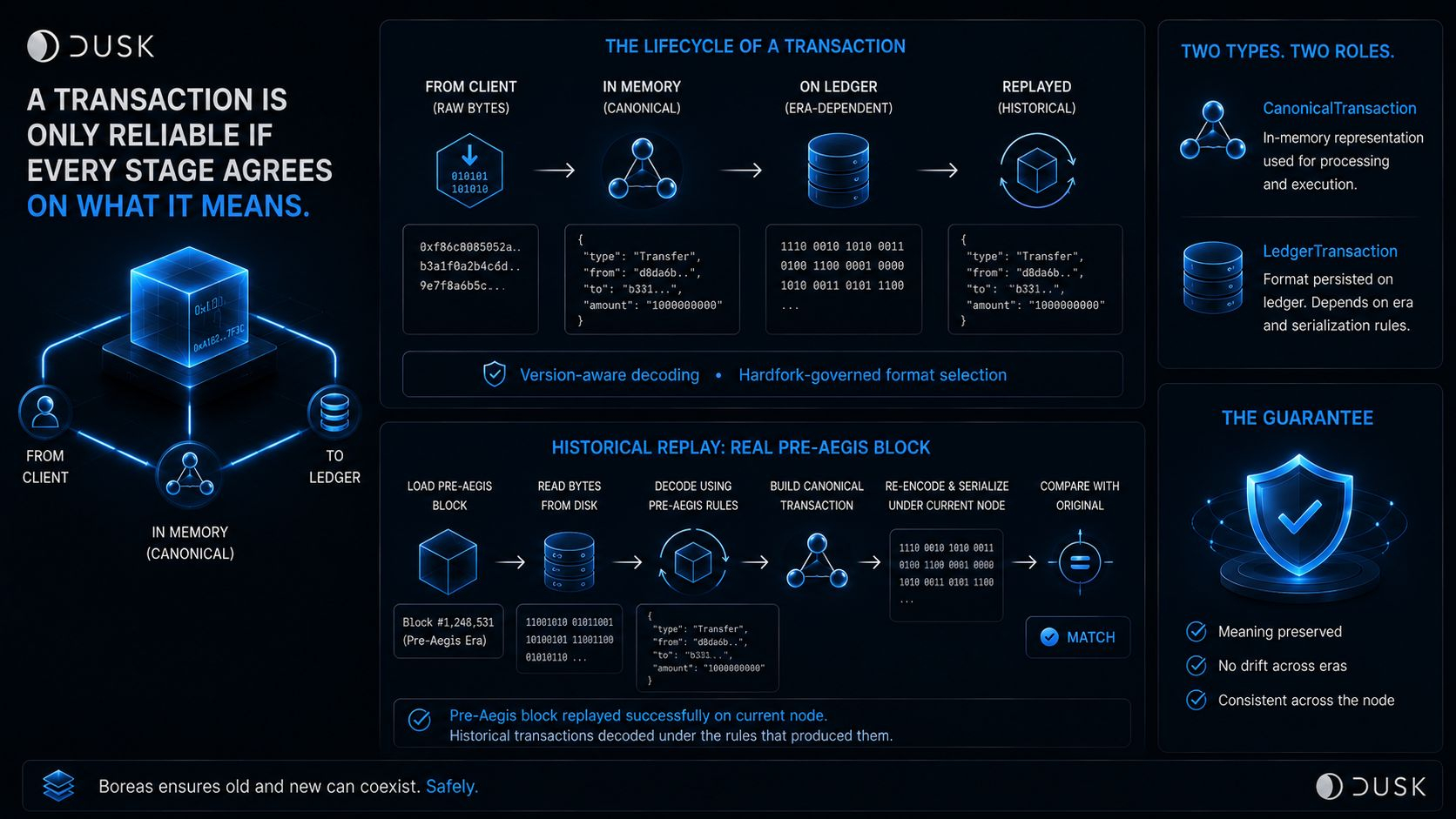
I assumed a transaction's meaning was fixed the moment its bytes existed: decode it once, get the same answer everywhere. Dusk's own Rusk changelog for the Boreas upgrade treats that as something that has to be engineered, not assumed.
Boreas added version-aware transaction decoding tied to a specific hardfork, plus hardfork-governed format selection for how old blocks get replayed. The codebase now has two explicitly separate types, CanonicalTransaction and LedgerTransaction, splitting the in-memory representation of a transaction from the format it's actually persisted in on the ledger. There's even a dedicated regression test just for decoding pre-Aegis-era transactions correctly during block serialization.
That only becomes necessary once transaction decoding has to account for different protocol eras and processing stages: fresh off the wire from a client, sitting in memory as a canonical object, replayed from a block that predates the current rules.
Which means a protocol upgrade isn't safe just because new transactions work under the new rules. It's only safe if those new rules don't silently break the ability to correctly replay old ledger state under the rules that produced it. That is the class of version-mismatch failure the historical-replay compatibility and hardfork-gated decoding are designed to prevent.
"A transaction is only reliable if every stage that touches it agrees on what it means."
What I'd actually want to see: a real pre-Aegis block replayed on a current node without changing how its historical transactions are decoded under the applicable rules, not just a passing regression test in isolation.
#dusk $DUSK @Dusk_Foundation
I assumed a transaction's meaning was fixed the moment its bytes existed: decode it once, get the same answer everywhere. Dusk's own Rusk changelog for the Boreas upgrade treats that as something that has to be engineered, not assumed.
Boreas added version-aware transaction decoding tied to a specific hardfork, plus hardfork-governed format selection for how old blocks get replayed. The codebase now has two explicitly separate types, CanonicalTransaction and LedgerTransaction, splitting the in-memory representation of a transaction from the format it's actually persisted in on the ledger. There's even a dedicated regression test just for decoding pre-Aegis-era transactions correctly during block serialization.
That only becomes necessary once transaction decoding has to account for different protocol eras and processing stages: fresh off the wire from a client, sitting in memory as a canonical object, replayed from a block that predates the current rules.
Which means a protocol upgrade isn't safe just because new transactions work under the new rules. It's only safe if those new rules don't silently break the ability to correctly replay old ledger state under the rules that produced it. That is the class of version-mismatch failure the historical-replay compatibility and hardfork-gated decoding are designed to prevent.
"A transaction is only reliable if every stage that touches it agrees on what it means."
What I'd actually want to see: a real pre-Aegis block replayed on a current node without changing how its historical transactions are decoded under the applicable rules, not just a passing regression test in isolation.
#dusk $DUSK @Dusk
Boreas added version-aware transaction decoding tied to a specific hardfork, plus hardfork-governed format selection for how old blocks get replayed. The codebase now has two explicitly separate types, CanonicalTransaction and LedgerTransaction, splitting the in-memory representation of a transaction from the format it's actually persisted in on the ledger. There's even a dedicated regression test just for decoding pre-Aegis-era transactions correctly during block serialization.
That only becomes necessary once transaction decoding has to account for different protocol eras and processing stages: fresh off the wire from a client, sitting in memory as a canonical object, replayed from a block that predates the current rules.
Which means a protocol upgrade isn't safe just because new transactions work under the new rules. It's only safe if those new rules don't silently break the ability to correctly replay old ledger state under the rules that produced it. That is the class of version-mismatch failure the historical-replay compatibility and hardfork-gated decoding are designed to prevent.
"A transaction is only reliable if every stage that touches it agrees on what it means."
What I'd actually want to see: a real pre-Aegis block replayed on a current node without changing how its historical transactions are decoded under the applicable rules, not just a passing regression test in isolation.
#dusk $DUSK @Dusk
7
3
84
·
--
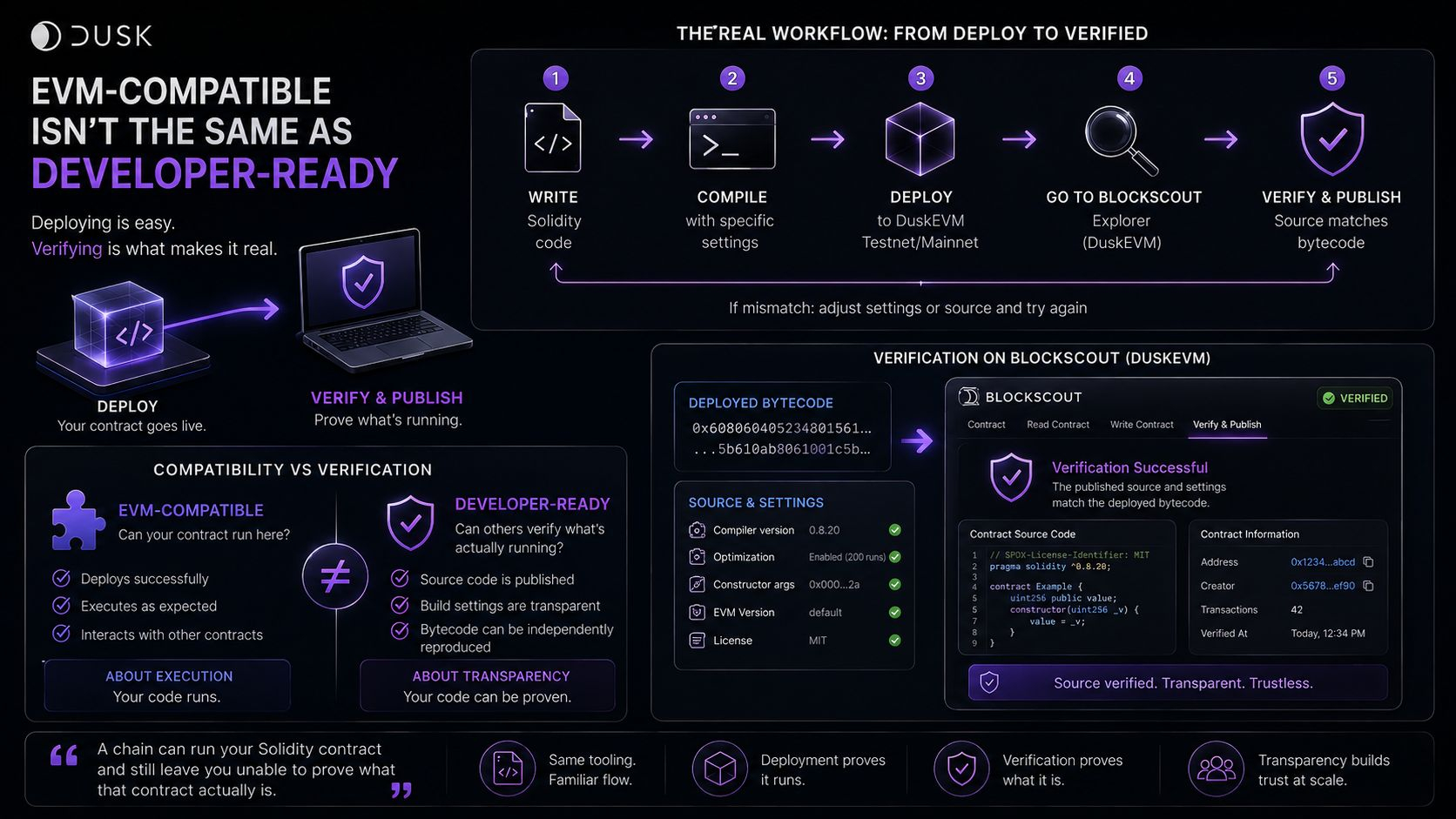
I assumed "DuskEVM supports Solidity" meant developers could show up with existing Ethereum tooling and be done. Dusk's own quickstart docs quietly add a step most people skip past: verifying the source.
Deploying is the easy part. DuskEVM uses Blockscout as its explorer, and getting a contract verified there, "Verify & Publish", means the relevant build settings, compiler version, optimizer configuration, source files, constructor arguments, have to reproduce the bytecode that's actually deployed.
That's a different bar than EVM compatibility. Deployment proves the code can run. Verification lets someone else check what's actually running. A contract can be deployed and functioning while still being unverified, leaving anyone else unable to independently check whether the published source actually matches what's live.
Which means "EVM-compatible" and "developer-ready" aren't quite the same claim. One is about whether your code runs here. The other is about whether an auditor, an institution, or a user can actually confirm what's running matches what's claimed.
"A chain can run your Solidity contract and still leave you unable to prove what that contract actually is."
What I'd want to see next: whether a contract deployed through the standard Solidity/Hardhat path can be reliably verified against its deployed bytecode, rather than merely deployed successfully.
#dusk $DUSK @Dusk_Foundation
I assumed "DuskEVM supports Solidity" meant developers could show up with existing Ethereum tooling and be done. Dusk's own quickstart docs quietly add a step most people skip past: verifying the source.
Deploying is the easy part. DuskEVM uses Blockscout as its explorer, and getting a contract verified there, "Verify & Publish", means the relevant build settings, compiler version, optimizer configuration, source files, constructor arguments, have to reproduce the bytecode that's actually deployed.
That's a different bar than EVM compatibility. Deployment proves the code can run. Verification lets someone else check what's actually running. A contract can be deployed and functioning while still being unverified, leaving anyone else unable to independently check whether the published source actually matches what's live.
Which means "EVM-compatible" and "developer-ready" aren't quite the same claim. One is about whether your code runs here. The other is about whether an auditor, an institution, or a user can actually confirm what's running matches what's claimed.
"A chain can run your Solidity contract and still leave you unable to prove what that contract actually is."
What I'd want to see next: whether a contract deployed through the standard Solidity/Hardhat path can be reliably verified against its deployed bytecode, rather than merely deployed successfully.
#dusk $DUSK @Dusk
Deploying is the easy part. DuskEVM uses Blockscout as its explorer, and getting a contract verified there, "Verify & Publish", means the relevant build settings, compiler version, optimizer configuration, source files, constructor arguments, have to reproduce the bytecode that's actually deployed.
That's a different bar than EVM compatibility. Deployment proves the code can run. Verification lets someone else check what's actually running. A contract can be deployed and functioning while still being unverified, leaving anyone else unable to independently check whether the published source actually matches what's live.
Which means "EVM-compatible" and "developer-ready" aren't quite the same claim. One is about whether your code runs here. The other is about whether an auditor, an institution, or a user can actually confirm what's running matches what's claimed.
"A chain can run your Solidity contract and still leave you unable to prove what that contract actually is."
What I'd want to see next: whether a contract deployed through the standard Solidity/Hardhat path can be reliably verified against its deployed bytecode, rather than merely deployed successfully.
#dusk $DUSK @Dusk
9
5
86
·
--
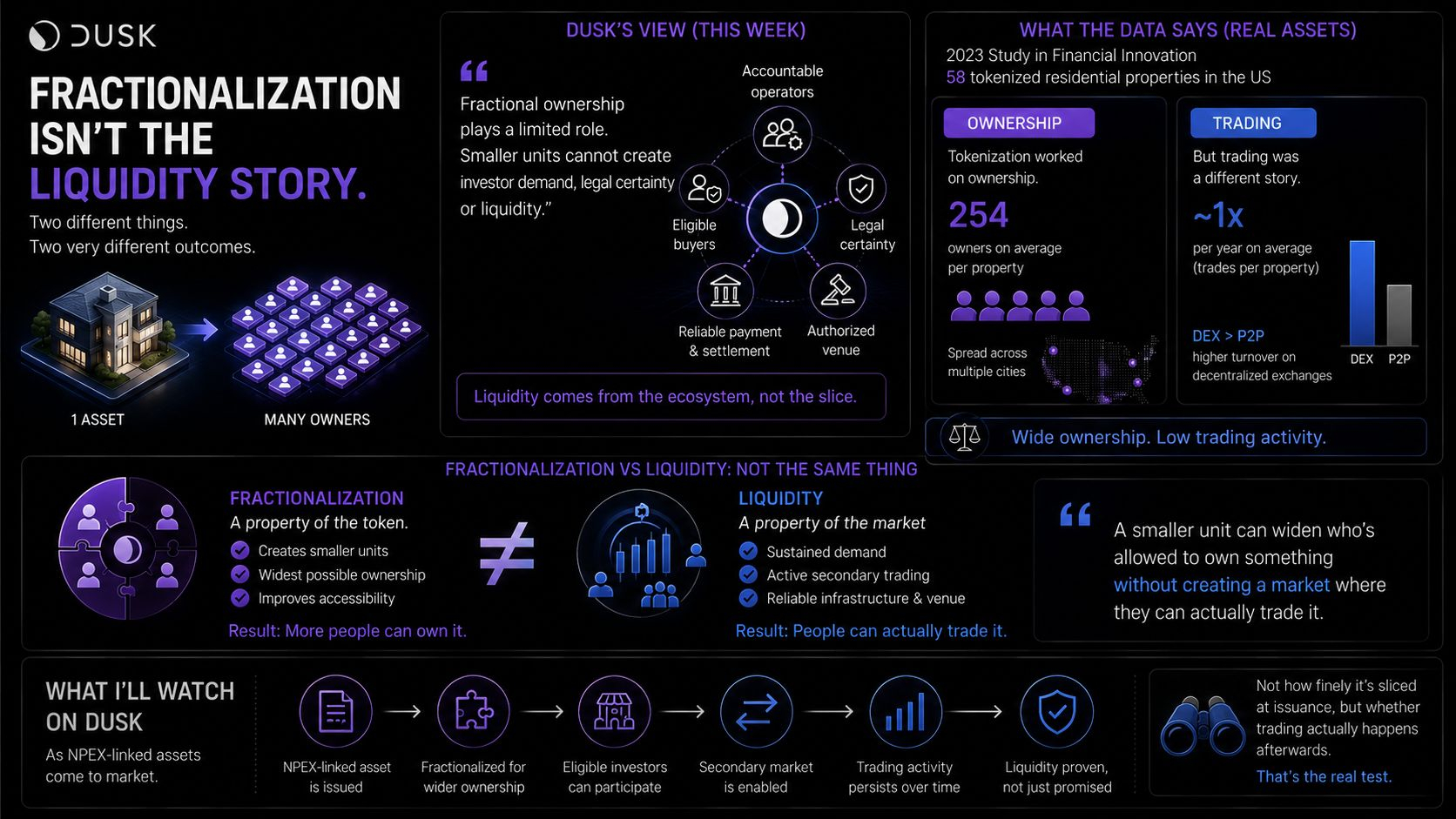
I assumed fractionalization was most of the liquidity story: split an asset into smaller pieces, and the pool of potential owners gets wider. Dusk's own writing on tokenization for SMEs, published this week, says that's a limited part of the picture, and an independent academic study of real tokenized assets shows why the gap matters.
Dusk says it plainly: "fractional ownership plays a limited role. Smaller units cannot create investor demand, legal certainty or liquidity." The value, they argue, comes from connecting the security to accountable operators, eligible buyers, reliable payment and settlement, and an authorized venue, not from how finely it's sliced.
A 2023 study published in Financial Innovation tested something close to this against real 58 tokenized residential properties in the US. On ownership, the results were clear: the average property had 254 separate owners. But on trading, the picture was different. Ownership changed hands about once a year on average, with properties on decentralized exchanges turning over more often than those traded peer-to-peer, though the yearly baseline stayed low either way.
Which means the two claims people conflate, "this asset is fractionalized" and "this asset is liquid," are actually describing two different things. Fractionalization is a property of the token. Liquidity is a property of the market around it.
"A smaller unit can widen who's allowed to own something without creating a market where they can actually trade it."
What I'd watch as NPEX-linked assets come onto Dusk: not how finely they're fractionalized at issuance, but whether secondary trading actually persists after that, the same gap the 58-property study found between wide ownership and active trading.
#dusk $DUSK @Dusk_Foundation
I assumed fractionalization was most of the liquidity story: split an asset into smaller pieces, and the pool of potential owners gets wider. Dusk's own writing on tokenization for SMEs, published this week, says that's a limited part of the picture, and an independent academic study of real tokenized assets shows why the gap matters.
Dusk says it plainly: "fractional ownership plays a limited role. Smaller units cannot create investor demand, legal certainty or liquidity." The value, they argue, comes from connecting the security to accountable operators, eligible buyers, reliable payment and settlement, and an authorized venue, not from how finely it's sliced.
A 2023 study published in Financial Innovation tested something close to this against real 58 tokenized residential properties in the US. On ownership, the results were clear: the average property had 254 separate owners. But on trading, the picture was different. Ownership changed hands about once a year on average, with properties on decentralized exchanges turning over more often than those traded peer-to-peer, though the yearly baseline stayed low either way.
Which means the two claims people conflate, "this asset is fractionalized" and "this asset is liquid," are actually describing two different things. Fractionalization is a property of the token. Liquidity is a property of the market around it.
"A smaller unit can widen who's allowed to own something without creating a market where they can actually trade it."
What I'd watch as NPEX-linked assets come onto Dusk: not how finely they're fractionalized at issuance, but whether secondary trading actually persists after that, the same gap the 58-property study found between wide ownership and active trading.
#dusk $DUSK @Dusk
Dusk says it plainly: "fractional ownership plays a limited role. Smaller units cannot create investor demand, legal certainty or liquidity." The value, they argue, comes from connecting the security to accountable operators, eligible buyers, reliable payment and settlement, and an authorized venue, not from how finely it's sliced.
A 2023 study published in Financial Innovation tested something close to this against real 58 tokenized residential properties in the US. On ownership, the results were clear: the average property had 254 separate owners. But on trading, the picture was different. Ownership changed hands about once a year on average, with properties on decentralized exchanges turning over more often than those traded peer-to-peer, though the yearly baseline stayed low either way.
Which means the two claims people conflate, "this asset is fractionalized" and "this asset is liquid," are actually describing two different things. Fractionalization is a property of the token. Liquidity is a property of the market around it.
"A smaller unit can widen who's allowed to own something without creating a market where they can actually trade it."
What I'd watch as NPEX-linked assets come onto Dusk: not how finely they're fractionalized at issuance, but whether secondary trading actually persists after that, the same gap the 58-property study found between wide ownership and active trading.
#dusk $DUSK @Dusk
2
2
79
·
--
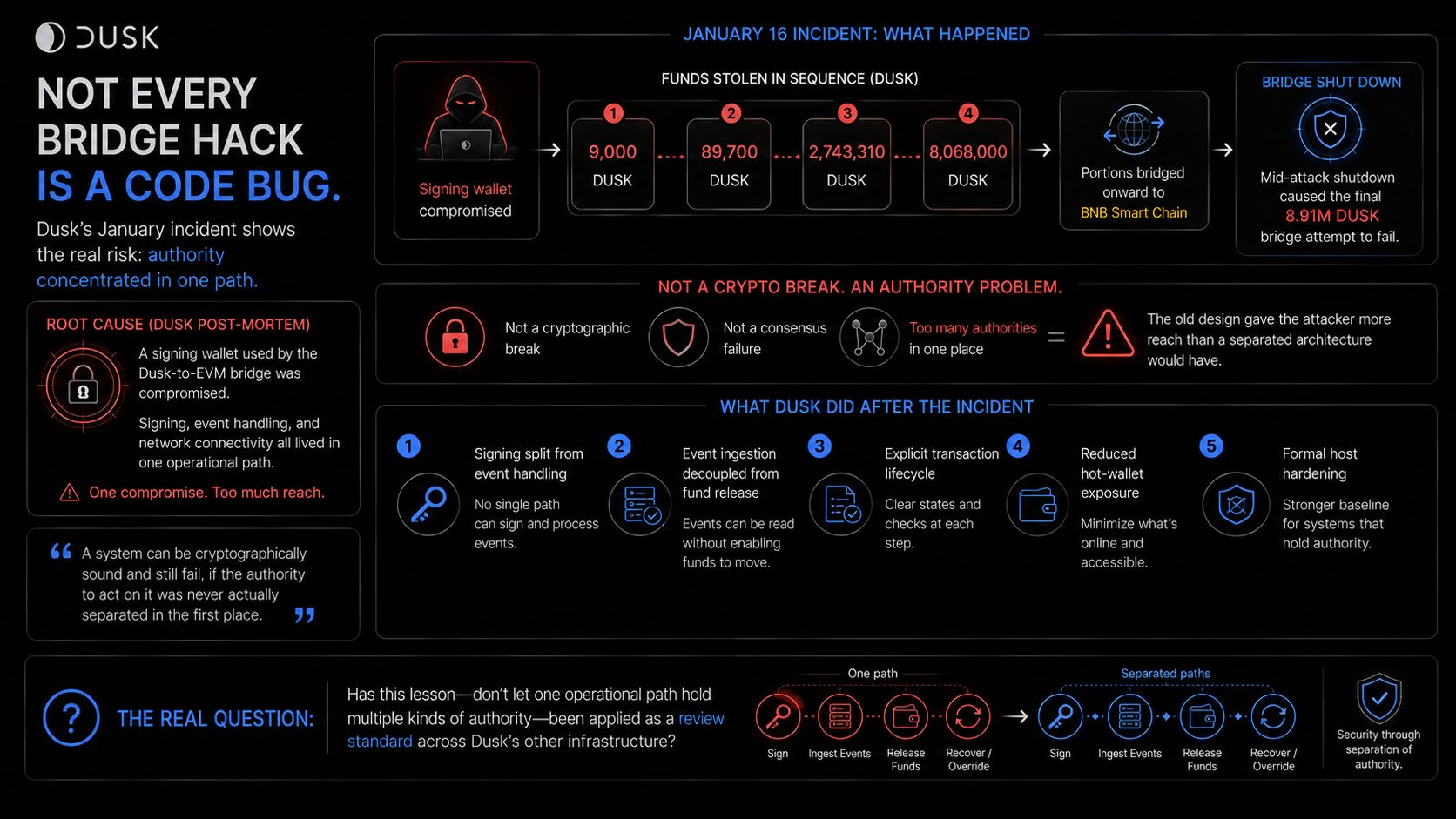
I assumed a bridge hack meant someone found a bug in the code, a flaw in the cryptography, something a security audit missed. Dusk's own post-mortem on its January bridge incident describes something else.
On January 16, an attacker compromised a signing wallet used by the Dusk-to-EVM bridge, moving funds directly on Dusk before routing part of it onward to BNB Smart Chain. Dusk shut the bridge down mid-attack, which is what caused a final, roughly 8.9 million DUSK transfer attempt to fail.
This was not a consensus failure or a protocol exploit. Dusk says the direct cause was key compromise, and that the old design let the signing wallet, event handling, and network connectivity all operate inside one path. The weakness was concentrated operational authority, not weak cryptography.
The redesign that followed comes down to one sentence buried in the post-mortem: "ingestion is no longer equivalent to spending." Seeing that an event happened and having the authority to release funds because of it used to be the same step. Now they're not. Event ingestion gets checkpointed and queued as a job; a separate, explicit process actually moves funds against it.
"A protocol can work as designed while the operational layer around it gives one compromised path too much authority."
What I'd actually want to see: confirmation that the redesigned bridge actually keeps event ingestion and fund release on separate paths in practice, not just in the post-mortem's description of the new architecture.
#dusk $DUSK @Dusk_Foundation
I assumed a bridge hack meant someone found a bug in the code, a flaw in the cryptography, something a security audit missed. Dusk's own post-mortem on its January bridge incident describes something else.
On January 16, an attacker compromised a signing wallet used by the Dusk-to-EVM bridge, moving funds directly on Dusk before routing part of it onward to BNB Smart Chain. Dusk shut the bridge down mid-attack, which is what caused a final, roughly 8.9 million DUSK transfer attempt to fail.
This was not a consensus failure or a protocol exploit. Dusk says the direct cause was key compromise, and that the old design let the signing wallet, event handling, and network connectivity all operate inside one path. The weakness was concentrated operational authority, not weak cryptography.
The redesign that followed comes down to one sentence buried in the post-mortem: "ingestion is no longer equivalent to spending." Seeing that an event happened and having the authority to release funds because of it used to be the same step. Now they're not. Event ingestion gets checkpointed and queued as a job; a separate, explicit process actually moves funds against it.
"A protocol can work as designed while the operational layer around it gives one compromised path too much authority."
What I'd actually want to see: confirmation that the redesigned bridge actually keeps event ingestion and fund release on separate paths in practice, not just in the post-mortem's description of the new architecture.
#dusk $DUSK @Dusk
On January 16, an attacker compromised a signing wallet used by the Dusk-to-EVM bridge, moving funds directly on Dusk before routing part of it onward to BNB Smart Chain. Dusk shut the bridge down mid-attack, which is what caused a final, roughly 8.9 million DUSK transfer attempt to fail.
This was not a consensus failure or a protocol exploit. Dusk says the direct cause was key compromise, and that the old design let the signing wallet, event handling, and network connectivity all operate inside one path. The weakness was concentrated operational authority, not weak cryptography.
The redesign that followed comes down to one sentence buried in the post-mortem: "ingestion is no longer equivalent to spending." Seeing that an event happened and having the authority to release funds because of it used to be the same step. Now they're not. Event ingestion gets checkpointed and queued as a job; a separate, explicit process actually moves funds against it.
"A protocol can work as designed while the operational layer around it gives one compromised path too much authority."
What I'd actually want to see: confirmation that the redesigned bridge actually keeps event ingestion and fund release on separate paths in practice, not just in the post-mortem's description of the new architecture.
#dusk $DUSK @Dusk
6
4
11.5k
·
--
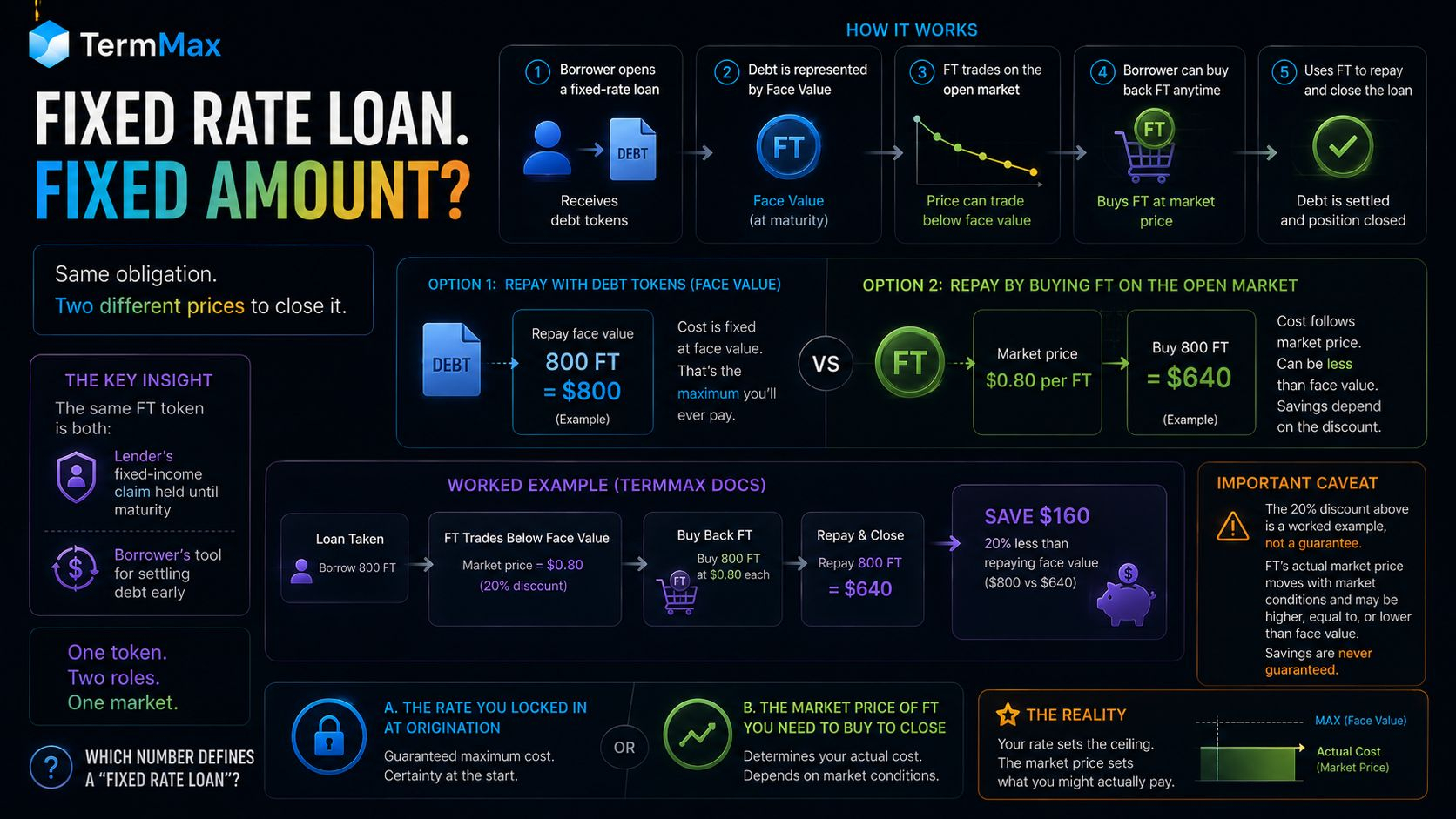
I assumed a fixed-rate loan on TermMax meant one number: whatever you borrowed, that's the fixed amount you eventually hand back. That's not the whole picture.
Here's the mechanic. When a borrower takes a loan, they receive debt tokens and can repay by returning that exact face value. But TermMax also lets them buy back FT, the token representing that same debt, from the open market instead. FT can trade below face value before maturity, and TermMax's worked example illustrates how that can lower the repayment cost. In that example, a borrower who owes 800 FT can buy them back at $0.80 each and settle the debt for $640, instead of repaying $800 directly. Same obligation, two different prices to close it.
That's not a rounding difference. It's a 20% gap between the contractual repayment amount and what closing the position can actually cost, depending on where FT happens to be trading that day.
Here's what that reveals: the same FT token is simultaneously the lender's fixed-income claim held until maturity, and the borrower's tool for settling debt early. The debt isn't a number that sits still between origination and maturity. It can have a market price before maturity, and that market price can move independently of the rate quoted at origination.
One caveat worth naming: TermMax's own documentation uses this 20% figure as a worked example, not a guaranteed market condition. FT's actual discount moves with market conditions and won't always be that wide.
So which number should actually define a "fixed-rate loan": the rate you locked in at origination, or the market price of the instrument you'd need to buy to close it?
#termmax @termmax
I assumed a fixed-rate loan on TermMax meant one number: whatever you borrowed, that's the fixed amount you eventually hand back. That's not the whole picture.
Here's the mechanic. When a borrower takes a loan, they receive debt tokens and can repay by returning that exact face value. But TermMax also lets them buy back FT, the token representing that same debt, from the open market instead. FT can trade below face value before maturity, and TermMax's worked example illustrates how that can lower the repayment cost. In that example, a borrower who owes 800 FT can buy them back at $0.80 each and settle the debt for $640, instead of repaying $800 directly. Same obligation, two different prices to close it.
That's not a rounding difference. It's a 20% gap between the contractual repayment amount and what closing the position can actually cost, depending on where FT happens to be trading that day.
Here's what that reveals: the same FT token is simultaneously the lender's fixed-income claim held until maturity, and the borrower's tool for settling debt early. The debt isn't a number that sits still between origination and maturity. It can have a market price before maturity, and that market price can move independently of the rate quoted at origination.
One caveat worth naming: TermMax's own documentation uses this 20% figure as a worked example, not a guaranteed market condition. FT's actual discount moves with market conditions and won't always be that wide.
So which number should actually define a "fixed-rate loan": the rate you locked in at origination, or the market price of the instrument you'd need to buy to close it?
#termmax @TermMax
Here's the mechanic. When a borrower takes a loan, they receive debt tokens and can repay by returning that exact face value. But TermMax also lets them buy back FT, the token representing that same debt, from the open market instead. FT can trade below face value before maturity, and TermMax's worked example illustrates how that can lower the repayment cost. In that example, a borrower who owes 800 FT can buy them back at $0.80 each and settle the debt for $640, instead of repaying $800 directly. Same obligation, two different prices to close it.
That's not a rounding difference. It's a 20% gap between the contractual repayment amount and what closing the position can actually cost, depending on where FT happens to be trading that day.
Here's what that reveals: the same FT token is simultaneously the lender's fixed-income claim held until maturity, and the borrower's tool for settling debt early. The debt isn't a number that sits still between origination and maturity. It can have a market price before maturity, and that market price can move independently of the rate quoted at origination.
One caveat worth naming: TermMax's own documentation uses this 20% figure as a worked example, not a guaranteed market condition. FT's actual discount moves with market conditions and won't always be that wide.
So which number should actually define a "fixed-rate loan": the rate you locked in at origination, or the market price of the instrument you'd need to buy to close it?
#termmax @TermMax
6
3
7.6k
·
--
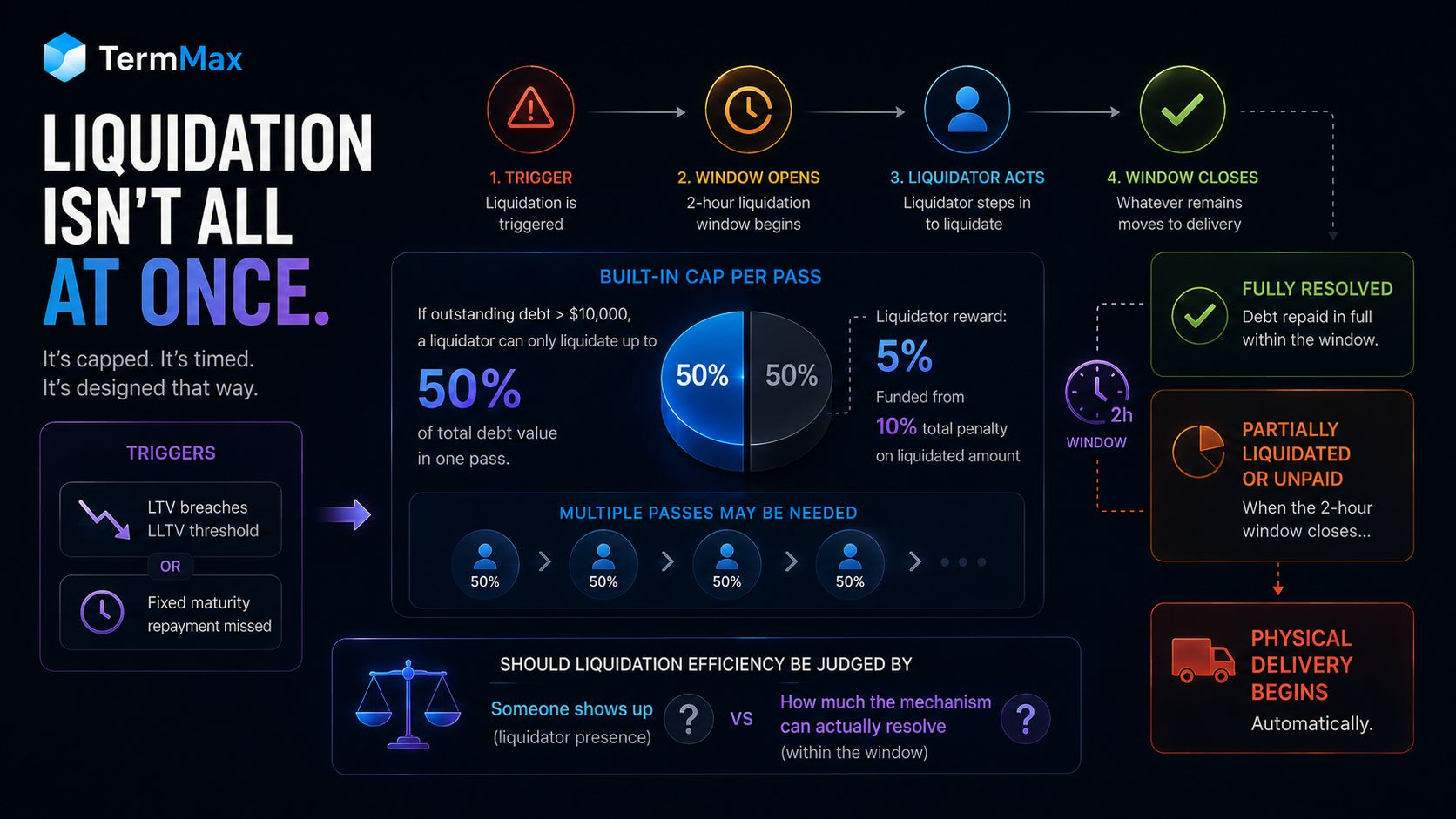
I assumed "liquidated" on TermMax meant a position was simply cleared once a liquidator stepped in. That's not quite how it works for larger positions.
Liquidation triggers when a loan's LTV breaches the LLTV threshold, or when a borrower misses the fixed maturity repayment, opening a two-hour liquidation window. But there's a cap built into the mechanism itself: if outstanding debt exceeds $10,000, a liquidator can only liquidate up to 50% of the total debt value in that pass.
So for a large enough position, the constraint isn't necessarily whether a liquidator wants to act. The protocol itself won't let any single liquidation clear the whole thing.
That changes what "partially liquidated" means. It's not necessarily evidence that liquidation demand was too thin or the market moved too fast. It can be an expected consequence of the mechanism itself. And if the loan is still unpaid or only partially liquidated when that two-hour window closes, physical delivery begins automatically.
The size of a position doesn't just affect how much is at risk. It can affect whether the liquidation process can fully resolve the position within its available window.
So should liquidation efficiency be judged by whether a liquidator shows up, or by how much of the position the mechanism can actually resolve before the window closes?
#termmax @termmax
I assumed "liquidated" on TermMax meant a position was simply cleared once a liquidator stepped in. That's not quite how it works for larger positions.
Liquidation triggers when a loan's LTV breaches the LLTV threshold, or when a borrower misses the fixed maturity repayment, opening a two-hour liquidation window. But there's a cap built into the mechanism itself: if outstanding debt exceeds $10,000, a liquidator can only liquidate up to 50% of the total debt value in that pass.
So for a large enough position, the constraint isn't necessarily whether a liquidator wants to act. The protocol itself won't let any single liquidation clear the whole thing.
That changes what "partially liquidated" means. It's not necessarily evidence that liquidation demand was too thin or the market moved too fast. It can be an expected consequence of the mechanism itself. And if the loan is still unpaid or only partially liquidated when that two-hour window closes, physical delivery begins automatically.
The size of a position doesn't just affect how much is at risk. It can affect whether the liquidation process can fully resolve the position within its available window.
So should liquidation efficiency be judged by whether a liquidator shows up, or by how much of the position the mechanism can actually resolve before the window closes?
#termmax @TermMax
Liquidation triggers when a loan's LTV breaches the LLTV threshold, or when a borrower misses the fixed maturity repayment, opening a two-hour liquidation window. But there's a cap built into the mechanism itself: if outstanding debt exceeds $10,000, a liquidator can only liquidate up to 50% of the total debt value in that pass.
So for a large enough position, the constraint isn't necessarily whether a liquidator wants to act. The protocol itself won't let any single liquidation clear the whole thing.
That changes what "partially liquidated" means. It's not necessarily evidence that liquidation demand was too thin or the market moved too fast. It can be an expected consequence of the mechanism itself. And if the loan is still unpaid or only partially liquidated when that two-hour window closes, physical delivery begins automatically.
The size of a position doesn't just affect how much is at risk. It can affect whether the liquidation process can fully resolve the position within its available window.
So should liquidation efficiency be judged by whether a liquidator shows up, or by how much of the position the mechanism can actually resolve before the window closes?
#termmax @TermMax
10
6
44
·
--
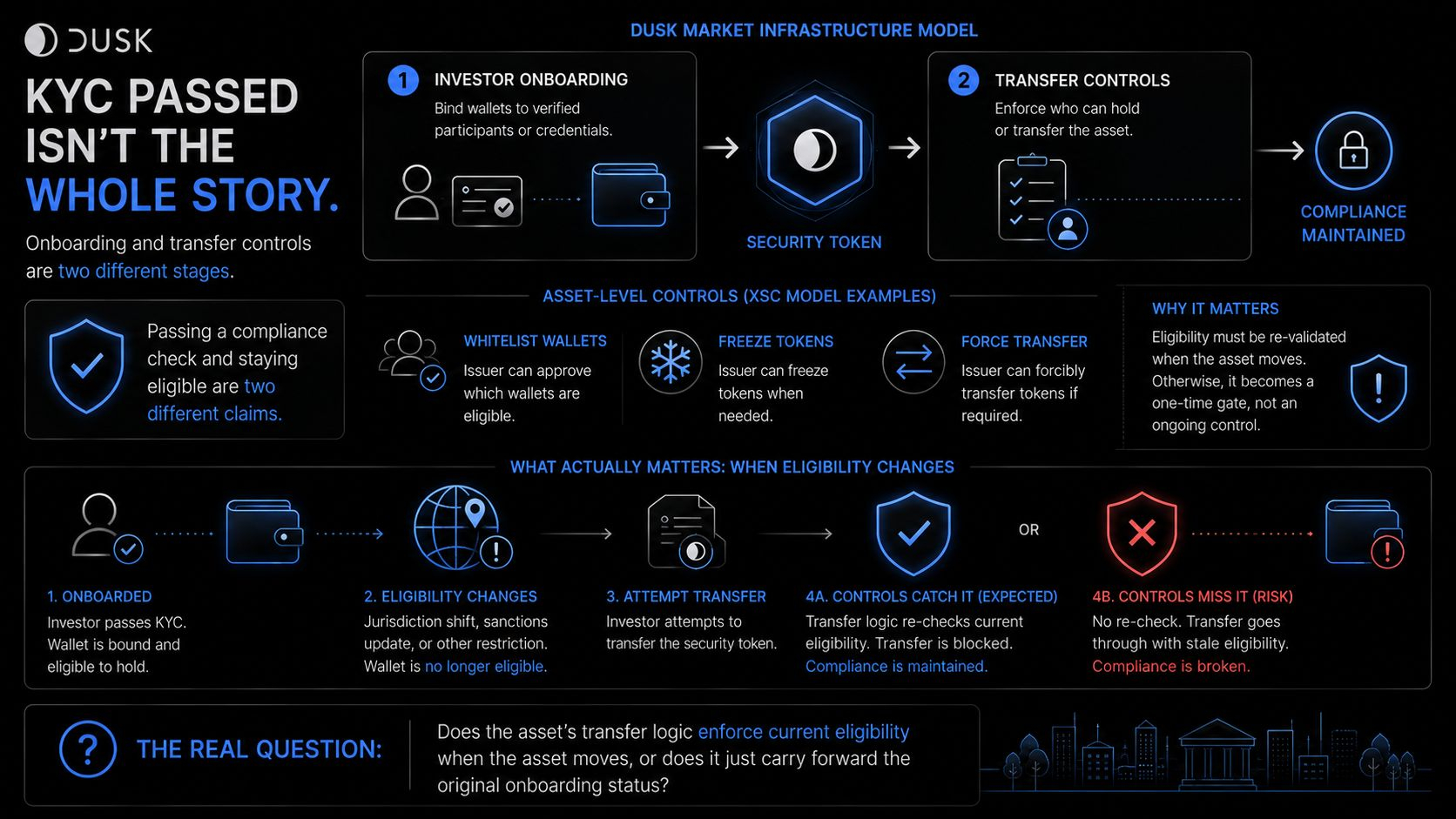
KYC answers who qualified at onboarding. Transfer controls answer who is still eligible when the asset moves. Dusk's own market-infrastructure model treats those as separate stages, and that gap is the interesting part.
Dusk lists investor onboarding, "bind wallets to verified participants or credentials," separately from transfer controls, "enforce who can hold or transfer the asset." One establishes an initial eligibility state. The other is what makes that state enforceable when the asset actually moves.
The older XSC material goes further than onboarding: issuers can whitelist wallets and retain asset-level controls such as freezing or force-transfer. That matters because eligibility isn't only established once. It has to remain enforceable after the initial decision.
Which means "KYC passed" and "eligible to hold this asset" are two different claims that can quietly diverge. A wallet can stay verified in the identity sense while no longer being the kind of holder this specific asset is allowed to have. Compliance enforcement doesn't end at onboarding, it has to continue into the asset's transfer lifecycle.
"Passing a compliance check and staying eligible are two different claims."
That changes the actual evaluation question. Not "does this asset have eligibility checks." The real question is whether the current eligibility state is enforced when the asset moves, or whether the original onboarding status simply carries forward.
What I'd actually want to see: a wallet whose eligibility changes after onboarding, say a jurisdiction shift, while it still holds the asset, then an attempted transfer, and whether the asset's transfer logic catches that change.
#dusk $DUSK @Dusk_Foundation
KYC answers who qualified at onboarding. Transfer controls answer who is still eligible when the asset moves. Dusk's own market-infrastructure model treats those as separate stages, and that gap is the interesting part.
Dusk lists investor onboarding, "bind wallets to verified participants or credentials," separately from transfer controls, "enforce who can hold or transfer the asset." One establishes an initial eligibility state. The other is what makes that state enforceable when the asset actually moves.
The older XSC material goes further than onboarding: issuers can whitelist wallets and retain asset-level controls such as freezing or force-transfer. That matters because eligibility isn't only established once. It has to remain enforceable after the initial decision.
Which means "KYC passed" and "eligible to hold this asset" are two different claims that can quietly diverge. A wallet can stay verified in the identity sense while no longer being the kind of holder this specific asset is allowed to have. Compliance enforcement doesn't end at onboarding, it has to continue into the asset's transfer lifecycle.
"Passing a compliance check and staying eligible are two different claims."
That changes the actual evaluation question. Not "does this asset have eligibility checks." The real question is whether the current eligibility state is enforced when the asset moves, or whether the original onboarding status simply carries forward.
What I'd actually want to see: a wallet whose eligibility changes after onboarding, say a jurisdiction shift, while it still holds the asset, then an attempted transfer, and whether the asset's transfer logic catches that change.
#dusk $DUSK @Dusk
Dusk lists investor onboarding, "bind wallets to verified participants or credentials," separately from transfer controls, "enforce who can hold or transfer the asset." One establishes an initial eligibility state. The other is what makes that state enforceable when the asset actually moves.
The older XSC material goes further than onboarding: issuers can whitelist wallets and retain asset-level controls such as freezing or force-transfer. That matters because eligibility isn't only established once. It has to remain enforceable after the initial decision.
Which means "KYC passed" and "eligible to hold this asset" are two different claims that can quietly diverge. A wallet can stay verified in the identity sense while no longer being the kind of holder this specific asset is allowed to have. Compliance enforcement doesn't end at onboarding, it has to continue into the asset's transfer lifecycle.
"Passing a compliance check and staying eligible are two different claims."
That changes the actual evaluation question. Not "does this asset have eligibility checks." The real question is whether the current eligibility state is enforced when the asset moves, or whether the original onboarding status simply carries forward.
What I'd actually want to see: a wallet whose eligibility changes after onboarding, say a jurisdiction shift, while it still holds the asset, then an attempted transfer, and whether the asset's transfer logic catches that change.
#dusk $DUSK @Dusk
26
8
102
·
--
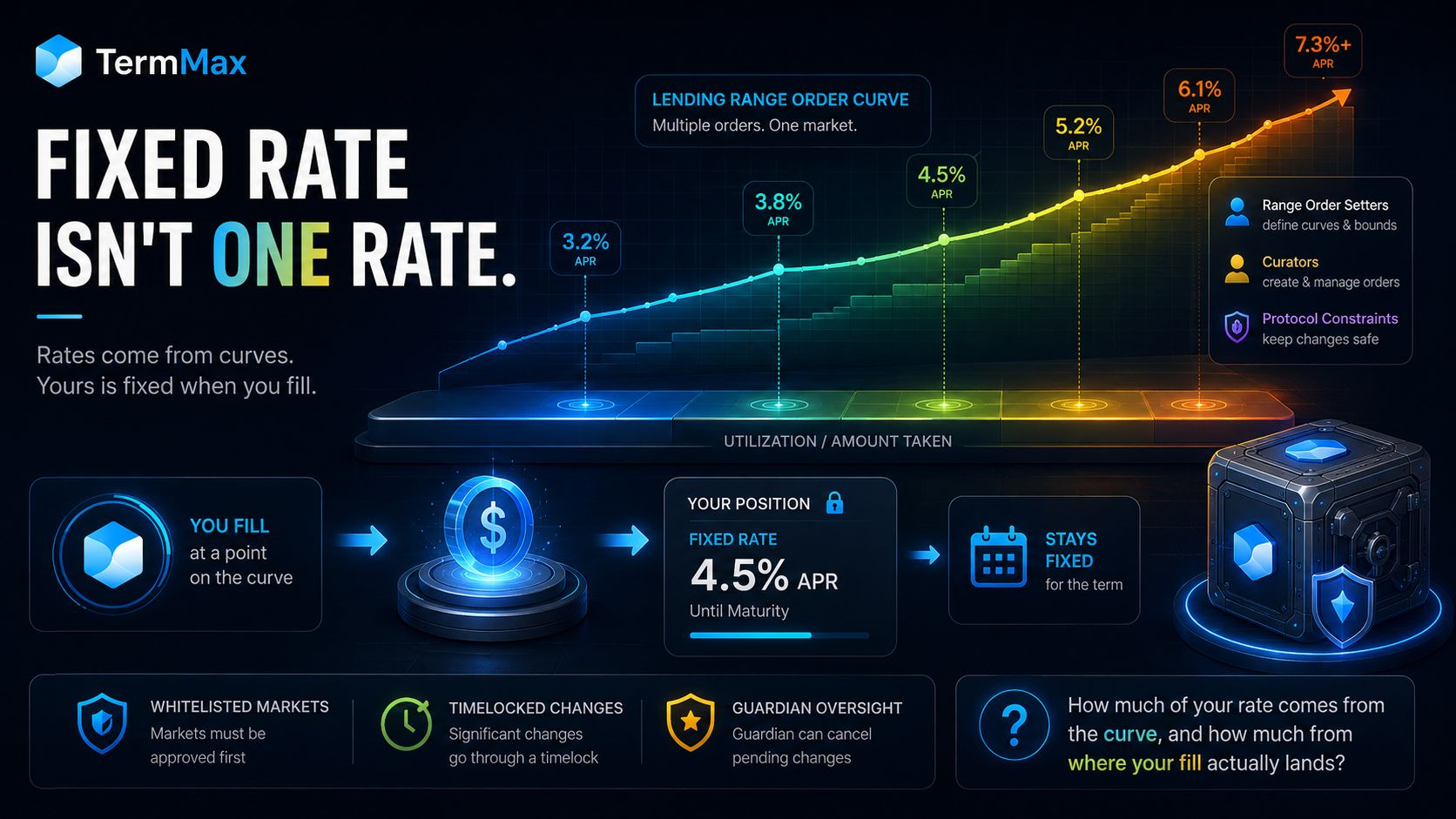
I assumed a "fixed-rate market" meant one rate: you know the number before you transact, full stop. Looking closer at how TermMax actually prices a loan, that assumption doesn't hold.
Rates aren't quoted as a single number. They're defined through curves. In a Lending Range Order, the curve can start at a lower rate and step higher as more of the order gets filled, similar to an AMM moving through different price levels instead of offering one price. A market can hold multiple range orders at once, so different participants can fill at different points on the curve.
That's the distinction I was missing: the market doesn't have one fixed rate. Each executed position gets a fixed rate determined by where its fill lands on the curve. Once filled, that rate remains fixed for the term.
The curve isn't arbitrary at runtime either. Curator actions sit inside protocol constraints like whitelisted markets and timelocked changes.
So when TermMax calls it a "fixed-rate market," the interesting question isn't simply what's the fixed rate? It's how much of that rate is determined by the curve, and how much by where your liquidity actually gets filled?
#termmax @termmax
I assumed a "fixed-rate market" meant one rate: you know the number before you transact, full stop. Looking closer at how TermMax actually prices a loan, that assumption doesn't hold.
Rates aren't quoted as a single number. They're defined through curves. In a Lending Range Order, the curve can start at a lower rate and step higher as more of the order gets filled, similar to an AMM moving through different price levels instead of offering one price. A market can hold multiple range orders at once, so different participants can fill at different points on the curve.
That's the distinction I was missing: the market doesn't have one fixed rate. Each executed position gets a fixed rate determined by where its fill lands on the curve. Once filled, that rate remains fixed for the term.
The curve isn't arbitrary at runtime either. Curator actions sit inside protocol constraints like whitelisted markets and timelocked changes.
So when TermMax calls it a "fixed-rate market," the interesting question isn't simply what's the fixed rate? It's how much of that rate is determined by the curve, and how much by where your liquidity actually gets filled?
#termmax @TermMax
Rates aren't quoted as a single number. They're defined through curves. In a Lending Range Order, the curve can start at a lower rate and step higher as more of the order gets filled, similar to an AMM moving through different price levels instead of offering one price. A market can hold multiple range orders at once, so different participants can fill at different points on the curve.
That's the distinction I was missing: the market doesn't have one fixed rate. Each executed position gets a fixed rate determined by where its fill lands on the curve. Once filled, that rate remains fixed for the term.
The curve isn't arbitrary at runtime either. Curator actions sit inside protocol constraints like whitelisted markets and timelocked changes.
So when TermMax calls it a "fixed-rate market," the interesting question isn't simply what's the fixed rate? It's how much of that rate is determined by the curve, and how much by where your liquidity actually gets filled?
#termmax @TermMax
51
14
8.3k
·
--
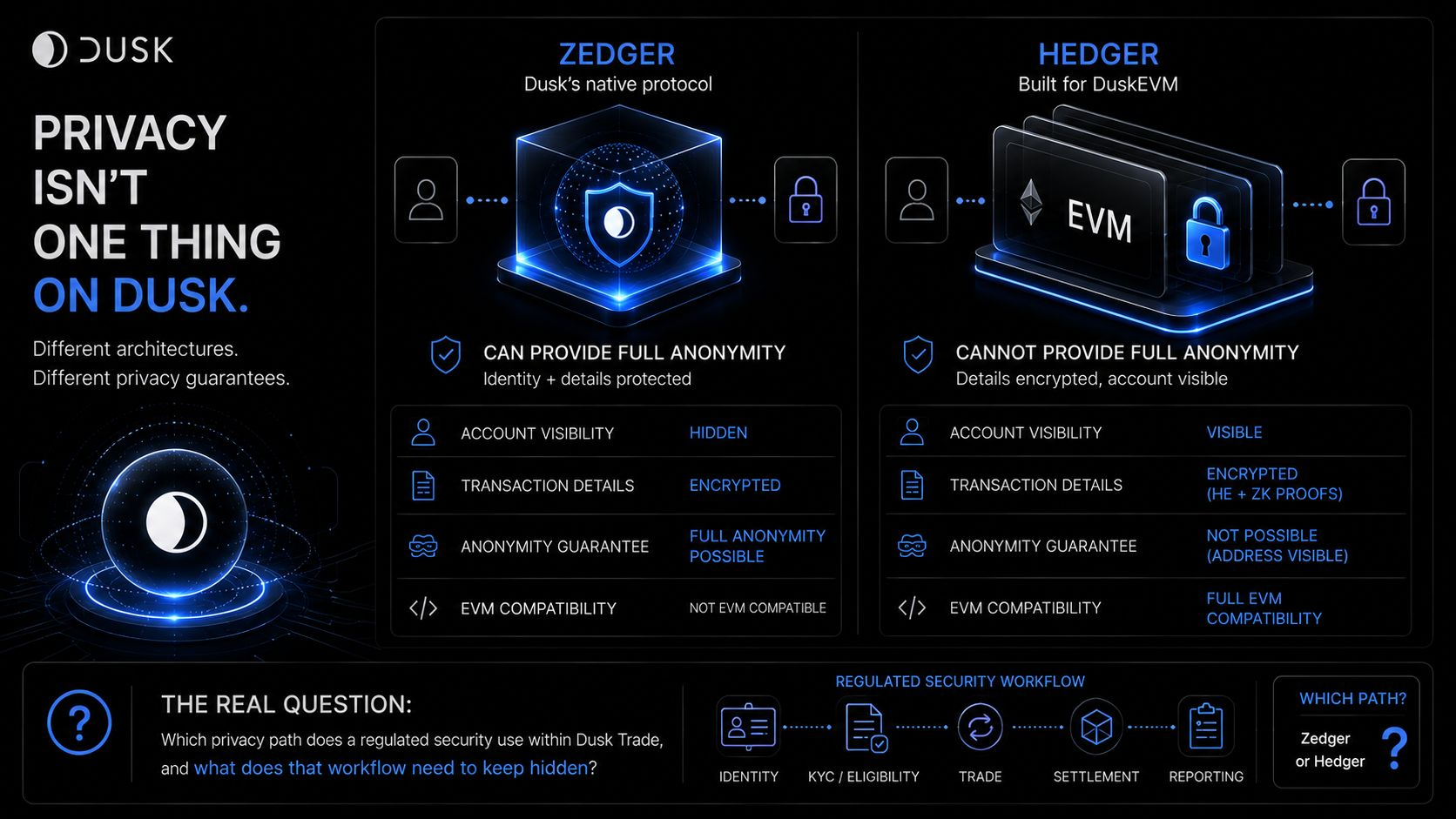
Ask most people evaluating a privacy chain whether it's private, and they'll check a box: yes or no. For Dusk, that's the wrong question, and Dusk's own writeup on Hedger shows why.
Zedger, Dusk's native privacy-preserving protocol, can provide full anonymity. Hedger, built for DuskEVM, can't. Dusk says it plainly: the EVM's account-based model prevents full anonymity, while Hedger keeps transaction details encrypted using homomorphic encryption and zero-knowledge proofs without offering that same full-anonymity guarantee.
That's not a bug Dusk is hiding. It's the trade-off the architecture makes explicit: EVM compatibility comes with a different privacy guarantee than Zedger's full anonymity.
Here's what actually changes when that trade-off gets made. The important difference isn't simply whether transaction details are encrypted. It's the anonymity guarantee. Use the Zedger path and full anonymity is available. Use the EVM-compatible Hedger path and the same guarantee isn't. Same brand, same word "confidential," different guarantee underneath.
That changes what the actual question should be for anyone evaluating this. Not "does Dusk support confidential transactions." Both paths support private transaction flows, but they don't provide the same anonymity guarantee. The real question is whether the guarantee a regulated asset gets actually matches what its workflow needs in the first place.
"Privacy that keeps transaction details confidential and privacy that provides full anonymity are two different guarantees, even when a project ships both under the same word."
What I'd actually want to see: which privacy path a regulated security actually uses within Dusk Trade, and what that workflow requires the path to keep hidden.
#dusk $DUSK @Dusk_Foundation
Ask most people evaluating a privacy chain whether it's private, and they'll check a box: yes or no. For Dusk, that's the wrong question, and Dusk's own writeup on Hedger shows why.
Zedger, Dusk's native privacy-preserving protocol, can provide full anonymity. Hedger, built for DuskEVM, can't. Dusk says it plainly: the EVM's account-based model prevents full anonymity, while Hedger keeps transaction details encrypted using homomorphic encryption and zero-knowledge proofs without offering that same full-anonymity guarantee.
That's not a bug Dusk is hiding. It's the trade-off the architecture makes explicit: EVM compatibility comes with a different privacy guarantee than Zedger's full anonymity.
Here's what actually changes when that trade-off gets made. The important difference isn't simply whether transaction details are encrypted. It's the anonymity guarantee. Use the Zedger path and full anonymity is available. Use the EVM-compatible Hedger path and the same guarantee isn't. Same brand, same word "confidential," different guarantee underneath.
That changes what the actual question should be for anyone evaluating this. Not "does Dusk support confidential transactions." Both paths support private transaction flows, but they don't provide the same anonymity guarantee. The real question is whether the guarantee a regulated asset gets actually matches what its workflow needs in the first place.
"Privacy that keeps transaction details confidential and privacy that provides full anonymity are two different guarantees, even when a project ships both under the same word."
What I'd actually want to see: which privacy path a regulated security actually uses within Dusk Trade, and what that workflow requires the path to keep hidden.
#dusk $DUSK @Dusk
Zedger, Dusk's native privacy-preserving protocol, can provide full anonymity. Hedger, built for DuskEVM, can't. Dusk says it plainly: the EVM's account-based model prevents full anonymity, while Hedger keeps transaction details encrypted using homomorphic encryption and zero-knowledge proofs without offering that same full-anonymity guarantee.
That's not a bug Dusk is hiding. It's the trade-off the architecture makes explicit: EVM compatibility comes with a different privacy guarantee than Zedger's full anonymity.
Here's what actually changes when that trade-off gets made. The important difference isn't simply whether transaction details are encrypted. It's the anonymity guarantee. Use the Zedger path and full anonymity is available. Use the EVM-compatible Hedger path and the same guarantee isn't. Same brand, same word "confidential," different guarantee underneath.
That changes what the actual question should be for anyone evaluating this. Not "does Dusk support confidential transactions." Both paths support private transaction flows, but they don't provide the same anonymity guarantee. The real question is whether the guarantee a regulated asset gets actually matches what its workflow needs in the first place.
"Privacy that keeps transaction details confidential and privacy that provides full anonymity are two different guarantees, even when a project ships both under the same word."
What I'd actually want to see: which privacy path a regulated security actually uses within Dusk Trade, and what that workflow requires the path to keep hidden.
#dusk $DUSK @Dusk
10
1
80
·
--
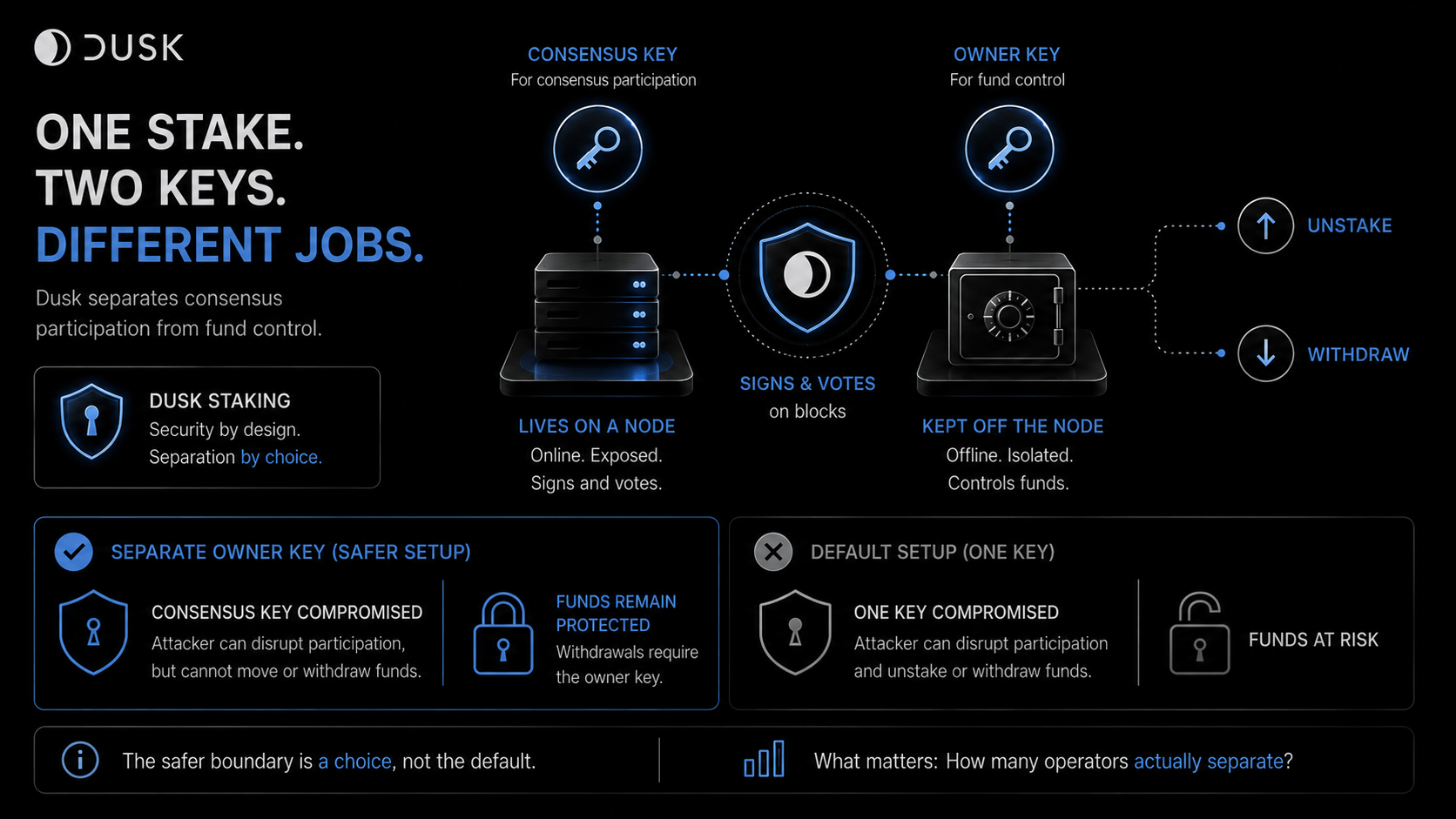
I assumed staking on a PoS chain meant one key controlling one thing: put DUSK in, get rewards out, same key handles it end to end.
Dusk's own operator docs split that in two.
The consensus key is the key a node uses to sign and vote in consensus. It has to live on an internet-connected node and participate as the validator operates. The owner key is separate: it's the key that can unstake or withdraw funds, and the docs say it doesn't need to touch the node at all.
The security benefit isn't simply that there are two keys. It's that the authority to participate in consensus and the authority to withdraw funds don't have to live in the same place. If the consensus key gets compromised because the server it's on gets breached, an attacker can interfere with consensus participation, but they still can't unstake or withdraw the stake. That authority never lived on the machine that's exposed to the internet in the first place. Which means the real security question isn't just how much is staked. It's where the authority to withdraw it actually sits relative to the machine that's exposed to attackers.
But there's a catch the docs don't hide: this separation isn't the default. If you stake without specifying a separate owner, the consensus key automatically becomes the owner too, one key, one boundary, back to the model I originally assumed. The safer setup is a choice an operator has to actively make, not something the protocol forces on them.
"A security boundary that has to be opted into is a different guarantee than one built into the default path, even when both are technically available."
What I'd actually want to know: how many active provisioners run with a separate owner key versus the default, because that would tell me whether the stronger boundary is actually being adopted, rather than merely being available.
#dusk $DUSK @Dusk_Foundation
I assumed staking on a PoS chain meant one key controlling one thing: put DUSK in, get rewards out, same key handles it end to end.
Dusk's own operator docs split that in two.
The consensus key is the key a node uses to sign and vote in consensus. It has to live on an internet-connected node and participate as the validator operates. The owner key is separate: it's the key that can unstake or withdraw funds, and the docs say it doesn't need to touch the node at all.
The security benefit isn't simply that there are two keys. It's that the authority to participate in consensus and the authority to withdraw funds don't have to live in the same place. If the consensus key gets compromised because the server it's on gets breached, an attacker can interfere with consensus participation, but they still can't unstake or withdraw the stake. That authority never lived on the machine that's exposed to the internet in the first place. Which means the real security question isn't just how much is staked. It's where the authority to withdraw it actually sits relative to the machine that's exposed to attackers.
But there's a catch the docs don't hide: this separation isn't the default. If you stake without specifying a separate owner, the consensus key automatically becomes the owner too, one key, one boundary, back to the model I originally assumed. The safer setup is a choice an operator has to actively make, not something the protocol forces on them.
"A security boundary that has to be opted into is a different guarantee than one built into the default path, even when both are technically available."
What I'd actually want to know: how many active provisioners run with a separate owner key versus the default, because that would tell me whether the stronger boundary is actually being adopted, rather than merely being available.
#dusk $DUSK @Dusk
Dusk's own operator docs split that in two.
The consensus key is the key a node uses to sign and vote in consensus. It has to live on an internet-connected node and participate as the validator operates. The owner key is separate: it's the key that can unstake or withdraw funds, and the docs say it doesn't need to touch the node at all.
The security benefit isn't simply that there are two keys. It's that the authority to participate in consensus and the authority to withdraw funds don't have to live in the same place. If the consensus key gets compromised because the server it's on gets breached, an attacker can interfere with consensus participation, but they still can't unstake or withdraw the stake. That authority never lived on the machine that's exposed to the internet in the first place. Which means the real security question isn't just how much is staked. It's where the authority to withdraw it actually sits relative to the machine that's exposed to attackers.
But there's a catch the docs don't hide: this separation isn't the default. If you stake without specifying a separate owner, the consensus key automatically becomes the owner too, one key, one boundary, back to the model I originally assumed. The safer setup is a choice an operator has to actively make, not something the protocol forces on them.
"A security boundary that has to be opted into is a different guarantee than one built into the default path, even when both are technically available."
What I'd actually want to know: how many active provisioners run with a separate owner key versus the default, because that would tell me whether the stronger boundary is actually being adopted, rather than merely being available.
#dusk $DUSK @Dusk
4
3
62
·
--
I assumed a locked fixed-term position meant exactly that: locked, full stop, until maturity. Then I found TermMax's Smart Unwind and assumed it simply solved that. It doesn't work the way I expected.
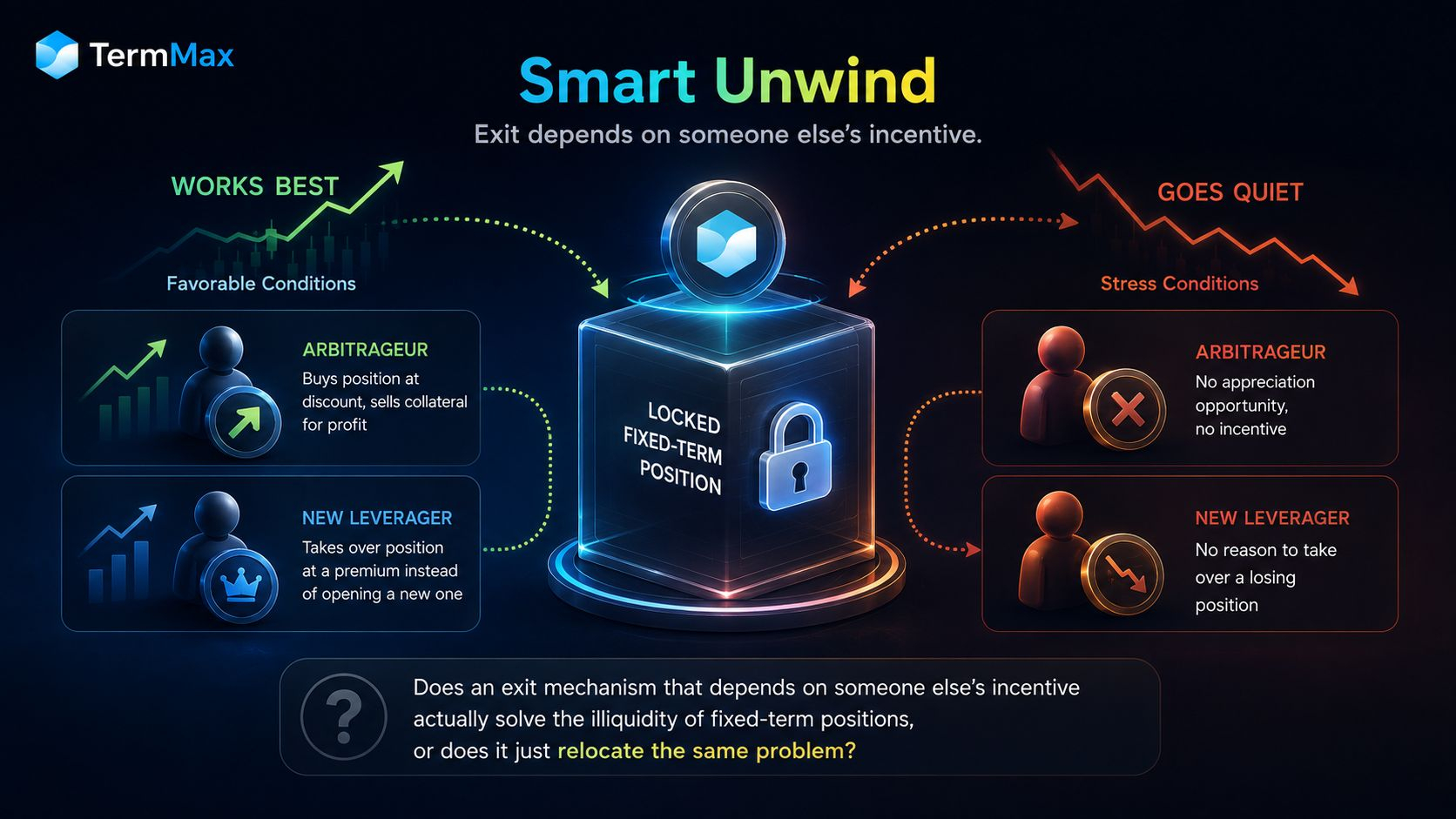
Smart Unwind doesn't pull exit liquidity from a pool. It works by making your position attractive enough that someone else wants to take it off your hands. A leverager sets a target APR or price. If the collateral appreciates enough, an arbitrageur buys the position at that fixed price and sells the collateral on the open market for a profit. If borrowing rates rise, a new leverager may take over the position at a premium instead of opening a fresh one.
So the protocol isn't guaranteeing the exit. The exit depends on someone else finding the trade attractive enough to take.
That's the part I hadn't considered: the conditions where a leverager most wants out, a falling collateral price or a stressed market, could plausibly be the conditions where an arbitrageur has no appreciation to capture and a new leverager has no reason to take over a losing position. The mechanism may work best exactly when you'd least need it, and go quiet exactly when you would.
Smart Unwind also isn't live yet, so none of this is observed behavior yet; it's only what the design implies.
Does an exit mechanism that depends on someone else's incentive actually solve the illiquidity of fixed-term positions, or does it just relocate the same problem to whoever needs to be found on the other side?
#termmax @termmax
I assumed a locked fixed-term position meant exactly that: locked, full stop, until maturity. Then I found TermMax's Smart Unwind and assumed it simply solved that. It doesn't work the way I expected.
Smart Unwind doesn't pull exit liquidity from a pool. It works by making your position attractive enough that someone else wants to take it off your hands. A leverager sets a target APR or price. If the collateral appreciates enough, an arbitrageur buys the position at that fixed price and sells the collateral on the open market for a profit. If borrowing rates rise, a new leverager may take over the position at a premium instead of opening a fresh one.
So the protocol isn't guaranteeing the exit. The exit depends on someone else finding the trade attractive enough to take.
That's the part I hadn't considered: the conditions where a leverager most wants out, a falling collateral price or a stressed market, could plausibly be the conditions where an arbitrageur has no appreciation to capture and a new leverager has no reason to take over a losing position. The mechanism may work best exactly when you'd least need it, and go quiet exactly when you would.
Smart Unwind also isn't live yet, so none of this is observed behavior yet; it's only what the design implies.
Does an exit mechanism that depends on someone else's incentive actually solve the illiquidity of fixed-term positions, or does it just relocate the same problem to whoever needs to be found on the other side?
#termmax @TermMax
Smart Unwind doesn't pull exit liquidity from a pool. It works by making your position attractive enough that someone else wants to take it off your hands. A leverager sets a target APR or price. If the collateral appreciates enough, an arbitrageur buys the position at that fixed price and sells the collateral on the open market for a profit. If borrowing rates rise, a new leverager may take over the position at a premium instead of opening a fresh one.
So the protocol isn't guaranteeing the exit. The exit depends on someone else finding the trade attractive enough to take.
That's the part I hadn't considered: the conditions where a leverager most wants out, a falling collateral price or a stressed market, could plausibly be the conditions where an arbitrageur has no appreciation to capture and a new leverager has no reason to take over a losing position. The mechanism may work best exactly when you'd least need it, and go quiet exactly when you would.
Smart Unwind also isn't live yet, so none of this is observed behavior yet; it's only what the design implies.
Does an exit mechanism that depends on someone else's incentive actually solve the illiquidity of fixed-term positions, or does it just relocate the same problem to whoever needs to be found on the other side?
#termmax @TermMax
4
2
70
·
--
I looked past TermMax's "fixed-rate lending" label to see what's actually happening underneath.
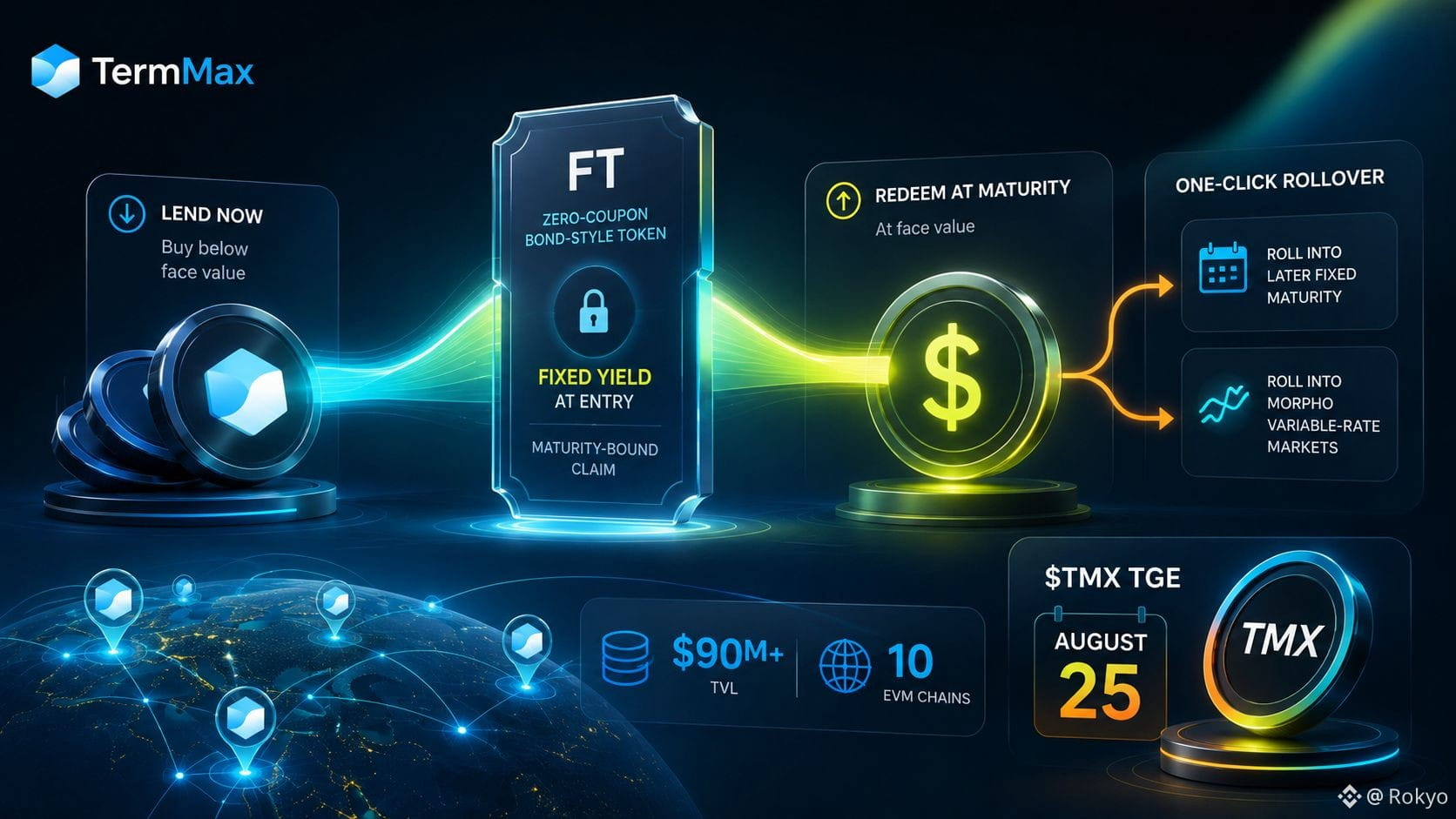
The primitive looks less like a lending pool with a fixed APY and more like an onchain fixed-income market. Its FT is a zero-coupon bond-style token: lenders buy it below face value and redeem it at par at maturity, with yield fixed at entry. That changes how I think about the product: the fixed rate isn't just a parameter on a lending pool. It's embedded in a maturity-bound claim.
In January, the same fixed-rate model extended beyond crypto-native collateral into tokenized securities, launching fixed-rate borrowing against Ondo Global Markets' tokenized stocks.
A fixed rate removes rate uncertainty for the term. It doesn't remove the need to refinance when the term ends. TermMax already has one-click rollover, into a later fixed maturity or into Morpho's variable-rate markets, so the protocol has explicitly designed for that refinancing step. What's documented well is the architecture; what's scarce is data on how that path performs when many positions need to roll at once under stress.
With $90M+ TVL across 10 EVM chains and the $TMX TGE set for August 25, that's the part I'd watch next.
#termmax @termmax
I looked past TermMax's "fixed-rate lending" label to see what's actually happening underneath.
The primitive looks less like a lending pool with a fixed APY and more like an onchain fixed-income market. Its FT is a zero-coupon bond-style token: lenders buy it below face value and redeem it at par at maturity, with yield fixed at entry. That changes how I think about the product: the fixed rate isn't just a parameter on a lending pool. It's embedded in a maturity-bound claim.
In January, the same fixed-rate model extended beyond crypto-native collateral into tokenized securities, launching fixed-rate borrowing against Ondo Global Markets' tokenized stocks.
A fixed rate removes rate uncertainty for the term. It doesn't remove the need to refinance when the term ends. TermMax already has one-click rollover, into a later fixed maturity or into Morpho's variable-rate markets, so the protocol has explicitly designed for that refinancing step. What's documented well is the architecture; what's scarce is data on how that path performs when many positions need to roll at once under stress.
With $90M+ TVL across 10 EVM chains and the $TMX TGE set for August 25, that's the part I'd watch next.
#termmax @TermMax
The primitive looks less like a lending pool with a fixed APY and more like an onchain fixed-income market. Its FT is a zero-coupon bond-style token: lenders buy it below face value and redeem it at par at maturity, with yield fixed at entry. That changes how I think about the product: the fixed rate isn't just a parameter on a lending pool. It's embedded in a maturity-bound claim.
In January, the same fixed-rate model extended beyond crypto-native collateral into tokenized securities, launching fixed-rate borrowing against Ondo Global Markets' tokenized stocks.
A fixed rate removes rate uncertainty for the term. It doesn't remove the need to refinance when the term ends. TermMax already has one-click rollover, into a later fixed maturity or into Morpho's variable-rate markets, so the protocol has explicitly designed for that refinancing step. What's documented well is the architecture; what's scarce is data on how that path performs when many positions need to roll at once under stress.
With $90M+ TVL across 10 EVM chains and the $TMX TGE set for August 25, that's the part I'd watch next.
#termmax @TermMax
2
1
101
·
--
I expected the "eligibility checks" behind Dusk Trade to be something built specifically for trading. A compliance module bolted onto the exchange layer, the way most brokers build KYC into the platform itself.
That's not what's underneath it.
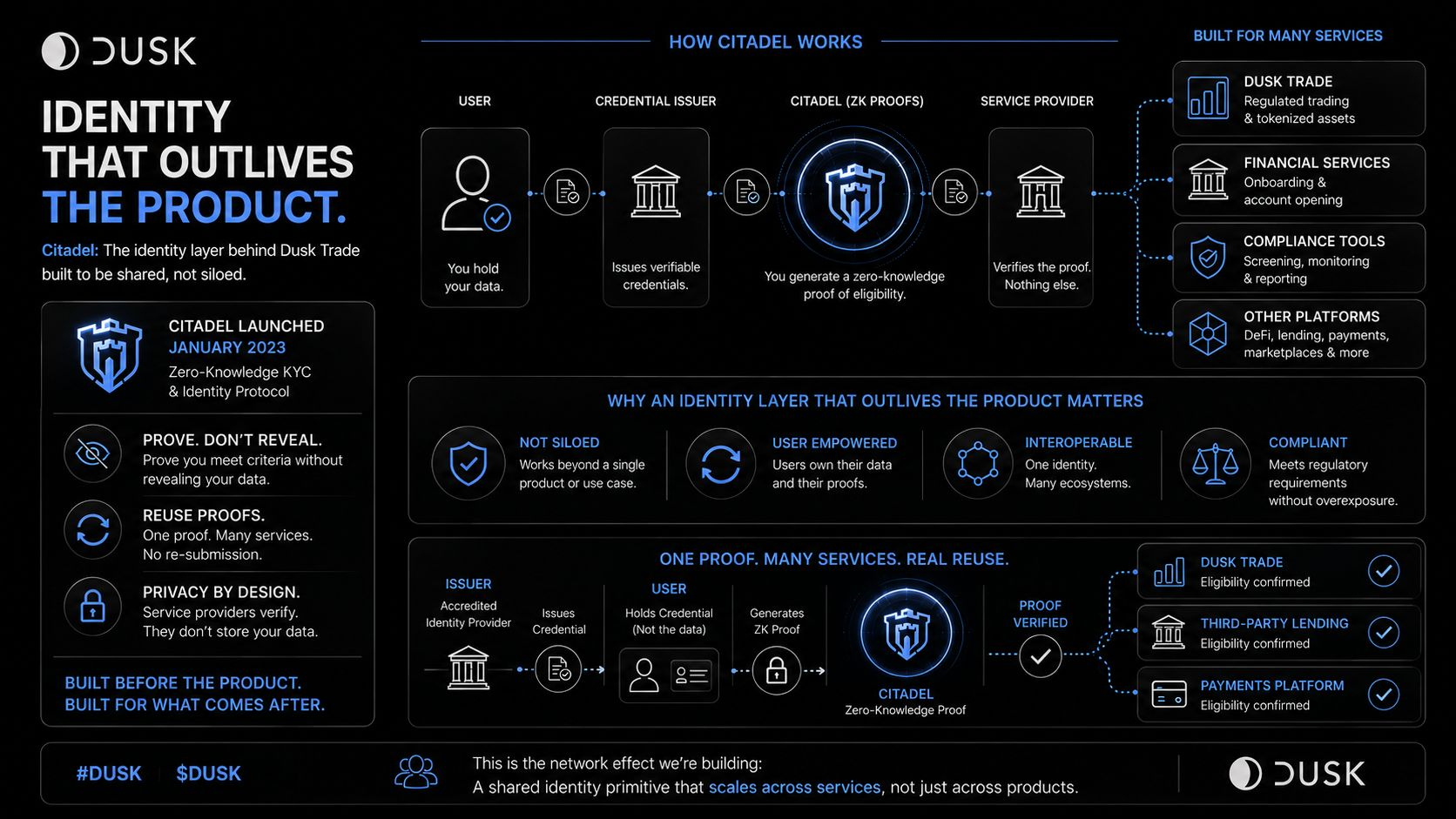
The identity layer Dusk Trade relies on is called Citadel, and it didn't start as a trading feature. Dusk launched it in January 2023 as a zero-knowledge KYC/identity protocol: prove you hold a valid credential without revealing what's in it, then reuse that proof across services instead of re-submitting your data every time.
That timing changes how I read "eligibility checks" in the docs. It looks less like bespoke compliance built for one product and more like an identity primitive that predates the product using it.
The interesting part is that Citadel was designed for service providers beyond a single trading workflow. Dusk described it as an identity layer that companies could tap into to verify whether someone meets their criteria without taking custody of all the underlying identity data.
"An eligibility check built for one product and an identity layer built to outlive the product are two different kinds of infrastructure, even when users experience both as 'proving who you are.'"
What I'd actually want to see: one credential proven through Citadel and accepted by another service provider outside Dusk Trade, the evidence that turns "shared identity primitive" from an architectural description into demonstrated cross-service reuse.
#dusk $DUSK @Dusk_Foundation
I expected the "eligibility checks" behind Dusk Trade to be something built specifically for trading. A compliance module bolted onto the exchange layer, the way most brokers build KYC into the platform itself.
That's not what's underneath it.
The identity layer Dusk Trade relies on is called Citadel, and it didn't start as a trading feature. Dusk launched it in January 2023 as a zero-knowledge KYC/identity protocol: prove you hold a valid credential without revealing what's in it, then reuse that proof across services instead of re-submitting your data every time.
That timing changes how I read "eligibility checks" in the docs. It looks less like bespoke compliance built for one product and more like an identity primitive that predates the product using it.
The interesting part is that Citadel was designed for service providers beyond a single trading workflow. Dusk described it as an identity layer that companies could tap into to verify whether someone meets their criteria without taking custody of all the underlying identity data.
"An eligibility check built for one product and an identity layer built to outlive the product are two different kinds of infrastructure, even when users experience both as 'proving who you are.'"
What I'd actually want to see: one credential proven through Citadel and accepted by another service provider outside Dusk Trade, the evidence that turns "shared identity primitive" from an architectural description into demonstrated cross-service reuse.
#dusk $DUSK @Dusk
That's not what's underneath it.
The identity layer Dusk Trade relies on is called Citadel, and it didn't start as a trading feature. Dusk launched it in January 2023 as a zero-knowledge KYC/identity protocol: prove you hold a valid credential without revealing what's in it, then reuse that proof across services instead of re-submitting your data every time.
That timing changes how I read "eligibility checks" in the docs. It looks less like bespoke compliance built for one product and more like an identity primitive that predates the product using it.
The interesting part is that Citadel was designed for service providers beyond a single trading workflow. Dusk described it as an identity layer that companies could tap into to verify whether someone meets their criteria without taking custody of all the underlying identity data.
"An eligibility check built for one product and an identity layer built to outlive the product are two different kinds of infrastructure, even when users experience both as 'proving who you are.'"
What I'd actually want to see: one credential proven through Citadel and accepted by another service provider outside Dusk Trade, the evidence that turns "shared identity primitive" from an architectural description into demonstrated cross-service reuse.
#dusk $DUSK @Dusk
3
1
88
·
--
I expected "Dusk partners with Chainlink" to mean the usual pitch. A bridge. Tokens moving across chains. The standard interoperability story every project eventually announces.
That's part of it, but it's the smaller part.
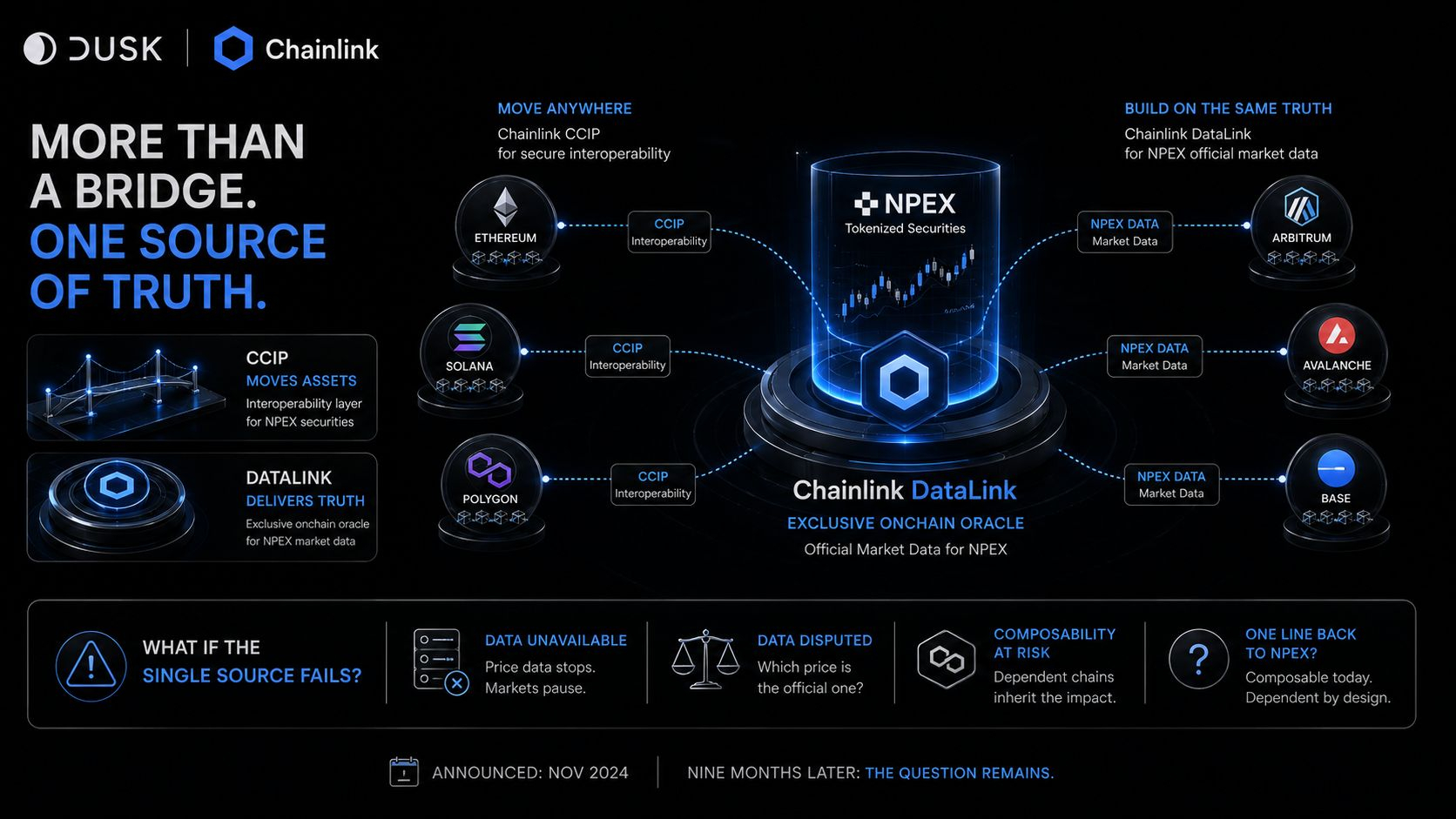
Announced back in November, the deal pairs Chainlink CCIP as the interoperability layer for NPEX's tokenized securities with something easy to skim past: Chainlink DataLink becoming the exclusive onchain data oracle for NPEX. Not one of several price feeds. The exclusive one. The same agreement also lets DUSK itself move natively between Ethereum and Solana through Chainlink's CCT standard, so the token gets the bridge story too.
Nine months on, that's the part worth separating out. CCIP lets an asset move across ecosystems. DataLink delivers the NPEX market data the receiving system can rely on. One is about reach. The other is about who gets to be believed. Any chain consuming that NPEX data is building on the same official market-data source.
I don't think that's automatically a flaw. Regulated markets already depend on authoritative market-data sources. But it does mean cross-chain composability here isn't completely neutral infrastructure. It's composability built around an exclusive source for NPEX's official market data, wherever that data eventually gets read.
"Being able to move an asset across chains and being the exclusive source for its official market data are two different kinds of power, even when one deal grants both."
What I'd actually want to know nine months in: what happens on the other chains if that exclusive NPEX data source becomes unavailable or disputed, and whether "composable" quietly means "dependent on one exclusive line back to NPEX."
#dusk $DUSK @Dusk_Foundation
I expected "Dusk partners with Chainlink" to mean the usual pitch. A bridge. Tokens moving across chains. The standard interoperability story every project eventually announces.
That's part of it, but it's the smaller part.
Announced back in November, the deal pairs Chainlink CCIP as the interoperability layer for NPEX's tokenized securities with something easy to skim past: Chainlink DataLink becoming the exclusive onchain data oracle for NPEX. Not one of several price feeds. The exclusive one. The same agreement also lets DUSK itself move natively between Ethereum and Solana through Chainlink's CCT standard, so the token gets the bridge story too.
Nine months on, that's the part worth separating out. CCIP lets an asset move across ecosystems. DataLink delivers the NPEX market data the receiving system can rely on. One is about reach. The other is about who gets to be believed. Any chain consuming that NPEX data is building on the same official market-data source.
I don't think that's automatically a flaw. Regulated markets already depend on authoritative market-data sources. But it does mean cross-chain composability here isn't completely neutral infrastructure. It's composability built around an exclusive source for NPEX's official market data, wherever that data eventually gets read.
"Being able to move an asset across chains and being the exclusive source for its official market data are two different kinds of power, even when one deal grants both."
What I'd actually want to know nine months in: what happens on the other chains if that exclusive NPEX data source becomes unavailable or disputed, and whether "composable" quietly means "dependent on one exclusive line back to NPEX."
#dusk $DUSK @Dusk
That's part of it, but it's the smaller part.
Announced back in November, the deal pairs Chainlink CCIP as the interoperability layer for NPEX's tokenized securities with something easy to skim past: Chainlink DataLink becoming the exclusive onchain data oracle for NPEX. Not one of several price feeds. The exclusive one. The same agreement also lets DUSK itself move natively between Ethereum and Solana through Chainlink's CCT standard, so the token gets the bridge story too.
Nine months on, that's the part worth separating out. CCIP lets an asset move across ecosystems. DataLink delivers the NPEX market data the receiving system can rely on. One is about reach. The other is about who gets to be believed. Any chain consuming that NPEX data is building on the same official market-data source.
I don't think that's automatically a flaw. Regulated markets already depend on authoritative market-data sources. But it does mean cross-chain composability here isn't completely neutral infrastructure. It's composability built around an exclusive source for NPEX's official market data, wherever that data eventually gets read.
"Being able to move an asset across chains and being the exclusive source for its official market data are two different kinds of power, even when one deal grants both."
What I'd actually want to know nine months in: what happens on the other chains if that exclusive NPEX data source becomes unavailable or disputed, and whether "composable" quietly means "dependent on one exclusive line back to NPEX."
#dusk $DUSK @Dusk
1
111
·
--
I used to think tokenization and native issuance were basically two ways of putting an asset onchain. Dusk's own comparison page changed that framing. They're not two degrees of the same thing. They're two different architectures entirely.
By Dusk's own definition, tokenization issues a token representing an asset or a claim on it, while the underlying asset can stay tied to whatever custody, registry, and settlement processes were already running off-chain. The token is a representation, not the underlying asset itself. Native issuance removes that layer: the asset exists on-chain as itself, and its lifecycle, being issued, transferred, serviced, settled, doesn't need a separate record somewhere else to point back to.
The catch is that a token can still depend on another system remaining the real source of truth. If that off-chain registry lags or breaks, the token's guarantee is only as strong as the reconciliation behind it.
Here's where it gets conditional. Dusk's own comparison says native issuance can reduce reliance on separate custody and registry layers, "depending on the legal structure." That qualifier is doing most of the work in this thesis. The efficiency case doesn't come from the technology existing. It depends on the legal structure actually letting the on-chain record carry that weight, instead of remaining just another copy of the real one.
"A token that represents an asset and an asset that exists as the token are two different promises, even when both get sold as tokenization."
What I'd actually want to see before calling this real: one regulated security where the authoritative record lives onchain, not a settlement layer running alongside a registry that still has the final say.
#dusk $DUSK @Dusk_Foundation
I used to think tokenization and native issuance were basically two ways of putting an asset onchain. Dusk's own comparison page changed that framing. They're not two degrees of the same thing. They're two different architectures entirely.
By Dusk's own definition, tokenization issues a token representing an asset or a claim on it, while the underlying asset can stay tied to whatever custody, registry, and settlement processes were already running off-chain. The token is a representation, not the underlying asset itself. Native issuance removes that layer: the asset exists on-chain as itself, and its lifecycle, being issued, transferred, serviced, settled, doesn't need a separate record somewhere else to point back to.
The catch is that a token can still depend on another system remaining the real source of truth. If that off-chain registry lags or breaks, the token's guarantee is only as strong as the reconciliation behind it.
Here's where it gets conditional. Dusk's own comparison says native issuance can reduce reliance on separate custody and registry layers, "depending on the legal structure." That qualifier is doing most of the work in this thesis. The efficiency case doesn't come from the technology existing. It depends on the legal structure actually letting the on-chain record carry that weight, instead of remaining just another copy of the real one.
"A token that represents an asset and an asset that exists as the token are two different promises, even when both get sold as tokenization."
What I'd actually want to see before calling this real: one regulated security where the authoritative record lives onchain, not a settlement layer running alongside a registry that still has the final say.
#dusk $DUSK @Dusk
By Dusk's own definition, tokenization issues a token representing an asset or a claim on it, while the underlying asset can stay tied to whatever custody, registry, and settlement processes were already running off-chain. The token is a representation, not the underlying asset itself. Native issuance removes that layer: the asset exists on-chain as itself, and its lifecycle, being issued, transferred, serviced, settled, doesn't need a separate record somewhere else to point back to.
The catch is that a token can still depend on another system remaining the real source of truth. If that off-chain registry lags or breaks, the token's guarantee is only as strong as the reconciliation behind it.
Here's where it gets conditional. Dusk's own comparison says native issuance can reduce reliance on separate custody and registry layers, "depending on the legal structure." That qualifier is doing most of the work in this thesis. The efficiency case doesn't come from the technology existing. It depends on the legal structure actually letting the on-chain record carry that weight, instead of remaining just another copy of the real one.
"A token that represents an asset and an asset that exists as the token are two different promises, even when both get sold as tokenization."
What I'd actually want to see before calling this real: one regulated security where the authoritative record lives onchain, not a settlement layer running alongside a registry that still has the final say.
#dusk $DUSK @Dusk
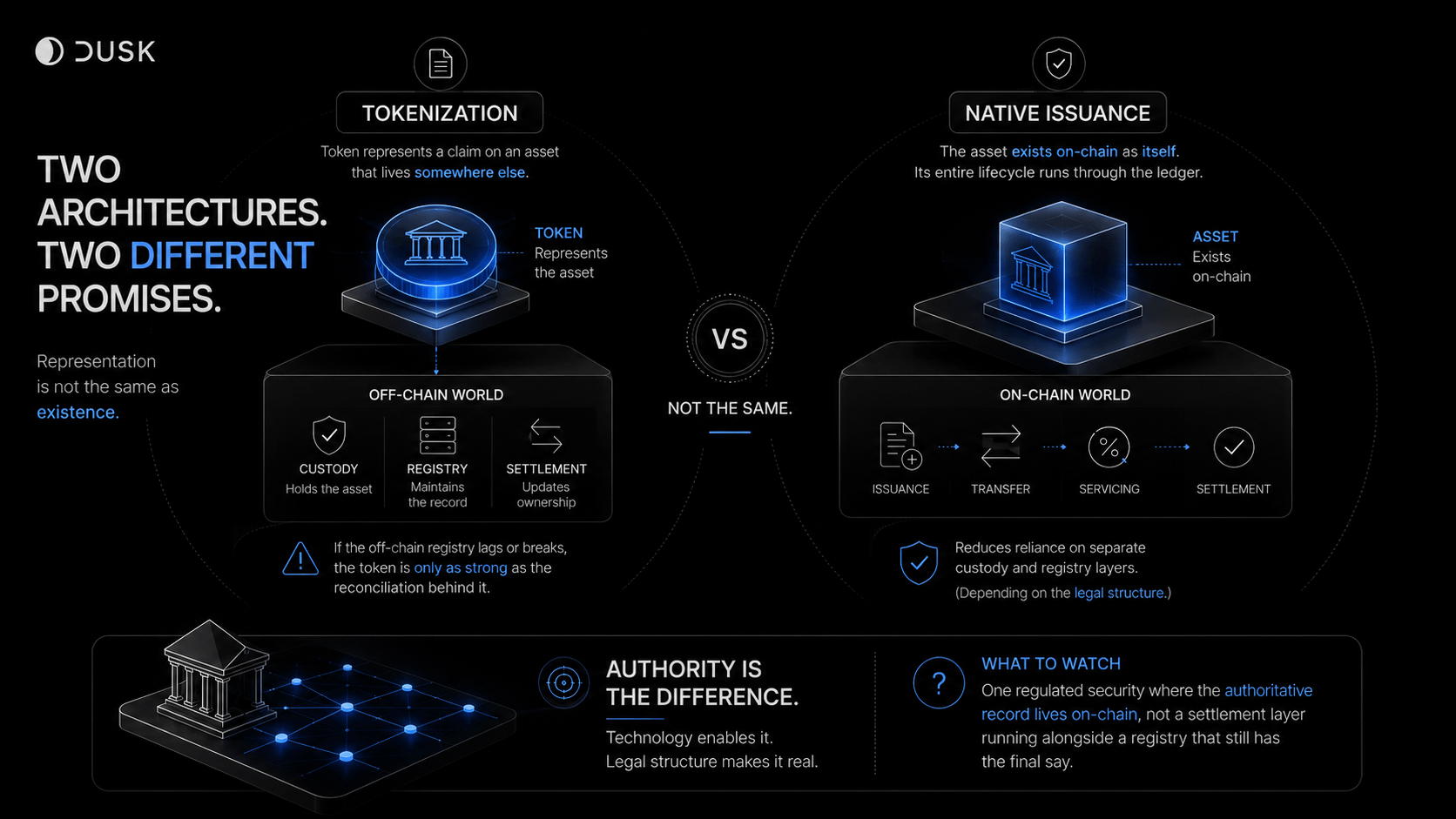
5
1
81
·
--
I found myself staring at DuskEVM's testnet explorer, and the number that jumps out, 845,113 transactions against 282 wallet addresses, is almost the wrong one to focus on. That's roughly 3,000 transactions per address, a ratio that says less about adoption than the headline suggests.
The two most recent transactions both showed Value 0 DUSK: fees paid, no native value moved. The latest feed was tagged as an L1→L2 deposit. Not proof of what the other 845K look like, but enough to make me stop reading this as one number. What the explorer is actually showing first is network activity: the chain processing transactions. Whether any of it is economic activity, value actually changing hands for a reason, is a separate question the transaction count can't answer on its own.
That distinction matters because Dusk is ultimately positioning this infrastructure for regulated financial assets, which is exactly what Dusk's plan to bring €300M of NPEX assets onchain would eventually need to prove out. A busy chain and a chain carrying real settlement volume can produce an identical-looking stats page.
"Network activity is not the same claim as financial activity, even when both surface as one number on an explorer."
What I'd actually watch as the signal that this shifts from network activity to financial usage: how much of it represents actual economic value settled, once NPEX gives us something real to check it against.
#dusk $DUSK @Dusk_Foundation
I found myself staring at DuskEVM's testnet explorer, and the number that jumps out, 845,113 transactions against 282 wallet addresses, is almost the wrong one to focus on. That's roughly 3,000 transactions per address, a ratio that says less about adoption than the headline suggests.
The two most recent transactions both showed Value 0 DUSK: fees paid, no native value moved. The latest feed was tagged as an L1→L2 deposit. Not proof of what the other 845K look like, but enough to make me stop reading this as one number. What the explorer is actually showing first is network activity: the chain processing transactions. Whether any of it is economic activity, value actually changing hands for a reason, is a separate question the transaction count can't answer on its own.
That distinction matters because Dusk is ultimately positioning this infrastructure for regulated financial assets, which is exactly what Dusk's plan to bring €300M of NPEX assets onchain would eventually need to prove out. A busy chain and a chain carrying real settlement volume can produce an identical-looking stats page.
"Network activity is not the same claim as financial activity, even when both surface as one number on an explorer."
What I'd actually watch as the signal that this shifts from network activity to financial usage: how much of it represents actual economic value settled, once NPEX gives us something real to check it against.
#dusk $DUSK @Dusk
The two most recent transactions both showed Value 0 DUSK: fees paid, no native value moved. The latest feed was tagged as an L1→L2 deposit. Not proof of what the other 845K look like, but enough to make me stop reading this as one number. What the explorer is actually showing first is network activity: the chain processing transactions. Whether any of it is economic activity, value actually changing hands for a reason, is a separate question the transaction count can't answer on its own.
That distinction matters because Dusk is ultimately positioning this infrastructure for regulated financial assets, which is exactly what Dusk's plan to bring €300M of NPEX assets onchain would eventually need to prove out. A busy chain and a chain carrying real settlement volume can produce an identical-looking stats page.
"Network activity is not the same claim as financial activity, even when both surface as one number on an explorer."
What I'd actually watch as the signal that this shifts from network activity to financial usage: how much of it represents actual economic value settled, once NPEX gives us something real to check it against.
#dusk $DUSK @Dusk
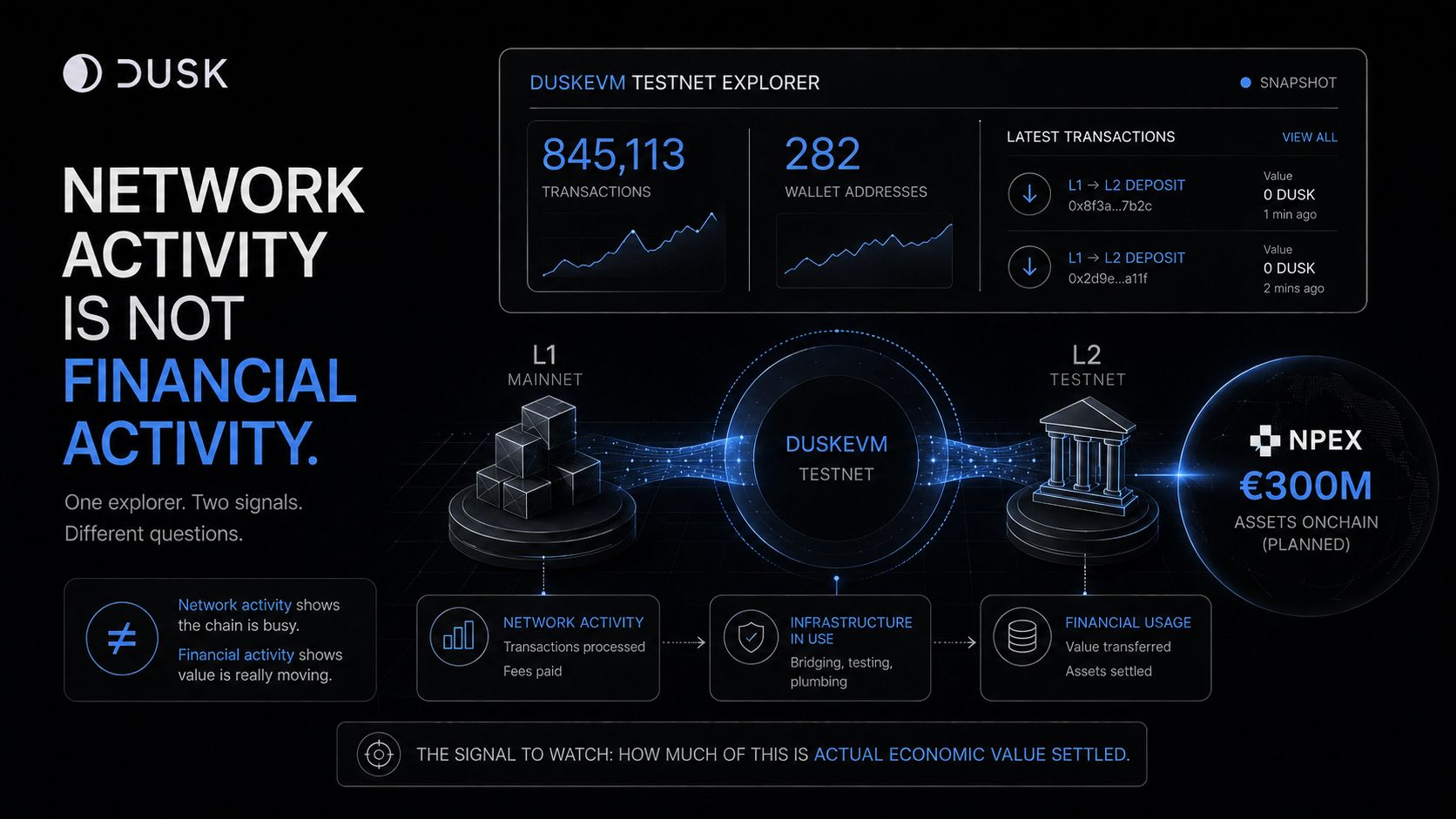
4
2
118
·
--
ຢືນຢັນແລ້ວ
Dusk's own writeup on Hedger puts client-side proof generation at under 2 seconds. Read that twice before it landed. That's fast enough that "confidential has to be slower" stopped feeling like a safe assumption. Went digging into what's actually being proved that fast. DuskEVM's public testnet has been live since December, and a few days ago the Dusk Foundation opened it up for Solidity and Hardhat testing — that's the update I was actually reading about. The line that stopped me: eligibility is checked before access or transfer. I initially thought that was the interesting compliance part. Left it open in one tab while I got coffee, came back, reread it, and realized it wasn't. Dusk says participant data, balances and transfer amounts can remain encrypted. That's the part that actually caught me — the gap between proving you're allowed in and exposing what you're carrying once you are. The eligibility step checks out in the docs — it's clearly defined, not just a vague compliance claim. I still couldn't find a concrete example of what an authorized reviewer actually sees when that audit path is used. Checked the docs twice. A few days into this Solidity/Hardhat opening, curious whether that example shows up as things mature, or whether "auditable" just stays the word nobody has to demonstrate yet — here or on any chain making the same claim.
#dusk $DUSK @Dusk_Foundation
Dusk's own writeup on Hedger puts client-side proof generation at under 2 seconds. Read that twice before it landed. That's fast enough that "confidential has to be slower" stopped feeling like a safe assumption. Went digging into what's actually being proved that fast. DuskEVM's public testnet has been live since December, and a few days ago the Dusk Foundation opened it up for Solidity and Hardhat testing — that's the update I was actually reading about. The line that stopped me: eligibility is checked before access or transfer. I initially thought that was the interesting compliance part. Left it open in one tab while I got coffee, came back, reread it, and realized it wasn't. Dusk says participant data, balances and transfer amounts can remain encrypted. That's the part that actually caught me — the gap between proving you're allowed in and exposing what you're carrying once you are. The eligibility step checks out in the docs — it's clearly defined, not just a vague compliance claim. I still couldn't find a concrete example of what an authorized reviewer actually sees when that audit path is used. Checked the docs twice. A few days into this Solidity/Hardhat opening, curious whether that example shows up as things mature, or whether "auditable" just stays the word nobody has to demonstrate yet — here or on any chain making the same claim.
#dusk $DUSK @Dusk
#dusk $DUSK @Dusk
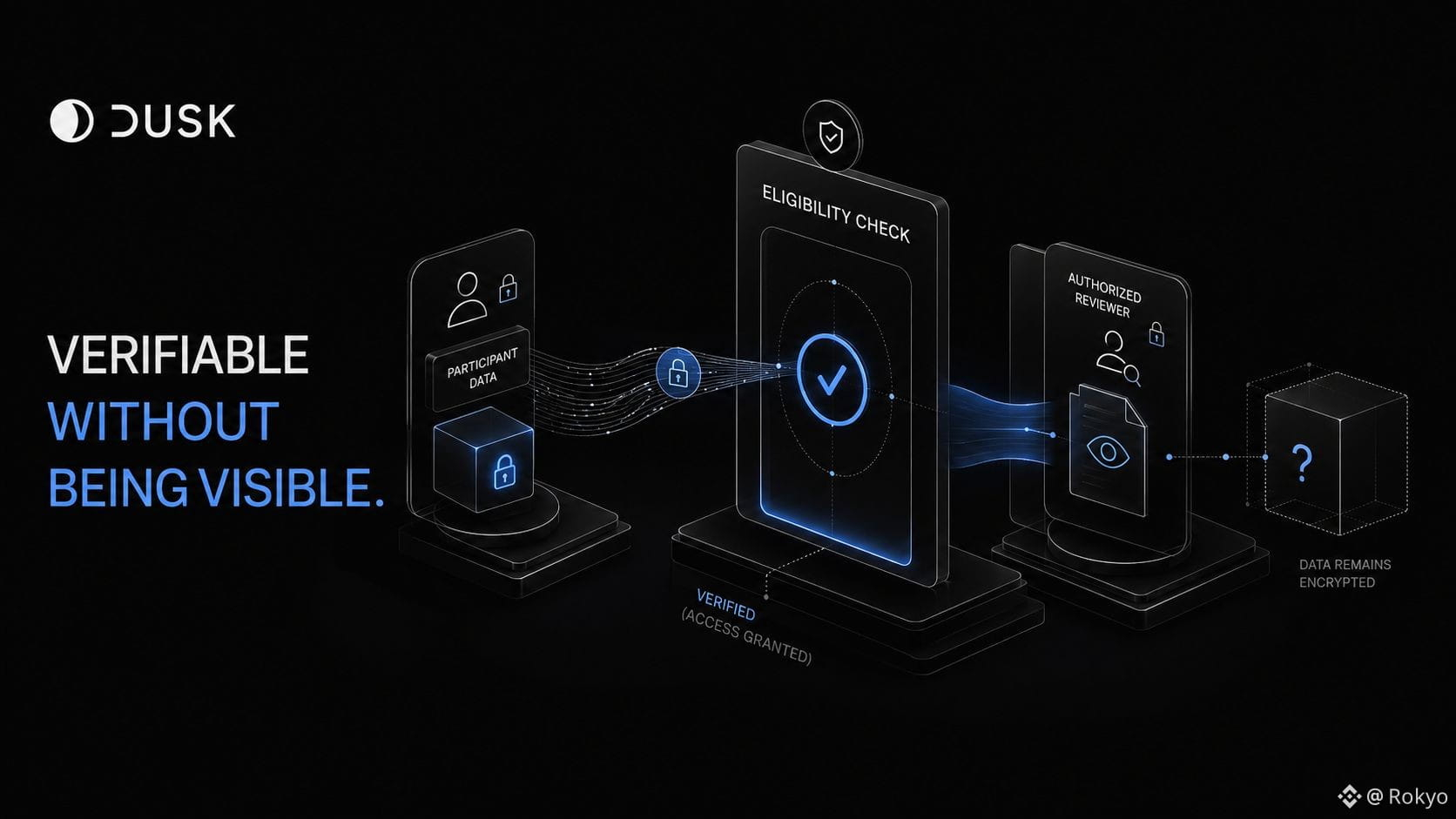
1
102
·
--
Pulled up BABY's chart tonight just to check how many days were left before the unlock, and the countdown wasn't the thing that stood out.
August 10. Five days out. 136.11M tokens, about $1.43M, 1.2% of supply, going mostly to team, advisors, and early-round investors — same numbers anyone tracking this already knows.
What I hadn't actually looked at was the seven days before it.
BABY's down about 10.3% this week. Price sitting around $0.0105, market cap near $45M, underperforming the broader crypto market, which is basically flat over the same stretch.
My first read was, fine, must be unlock-related selling starting early.
Might not be. Could be broader market conditions that have nothing to do with August 10. I don't have a way to separate "people front-running the unlock" from "BABY just having a bad week alongside everything else."
Either way, the tokens landing in those wallets on August 10 arrive into a price that's already down 10% from where it sat a week ago.
Whoever sold this week sold into that drop. Whoever receives the unlock sells into whatever's left after it.
Different sides of the same five days, absorbing different halves of the move.
I don't know if that pattern holds this time. Nothing I've read breaks down how much of past Babylon unlocks were priced in beforehand versus reacted to after.
If the price already moved before the unlock happened, what does the unlock day itself still reveal?
@babylonlabs_io #baby $BABY
Pulled up BABY's chart tonight just to check how many days were left before the unlock, and the countdown wasn't the thing that stood out.
August 10. Five days out. 136.11M tokens, about $1.43M, 1.2% of supply, going mostly to team, advisors, and early-round investors — same numbers anyone tracking this already knows.
What I hadn't actually looked at was the seven days before it.
BABY's down about 10.3% this week. Price sitting around $0.0105, market cap near $45M, underperforming the broader crypto market, which is basically flat over the same stretch.
My first read was, fine, must be unlock-related selling starting early.
Might not be. Could be broader market conditions that have nothing to do with August 10. I don't have a way to separate "people front-running the unlock" from "BABY just having a bad week alongside everything else."
Either way, the tokens landing in those wallets on August 10 arrive into a price that's already down 10% from where it sat a week ago.
Whoever sold this week sold into that drop. Whoever receives the unlock sells into whatever's left after it.
Different sides of the same five days, absorbing different halves of the move.
I don't know if that pattern holds this time. Nothing I've read breaks down how much of past Babylon unlocks were priced in beforehand versus reacted to after.
If the price already moved before the unlock happened, what does the unlock day itself still reveal?
@BabylonLabs_io #baby $BABY
August 10. Five days out. 136.11M tokens, about $1.43M, 1.2% of supply, going mostly to team, advisors, and early-round investors — same numbers anyone tracking this already knows.
What I hadn't actually looked at was the seven days before it.
BABY's down about 10.3% this week. Price sitting around $0.0105, market cap near $45M, underperforming the broader crypto market, which is basically flat over the same stretch.
My first read was, fine, must be unlock-related selling starting early.
Might not be. Could be broader market conditions that have nothing to do with August 10. I don't have a way to separate "people front-running the unlock" from "BABY just having a bad week alongside everything else."
Either way, the tokens landing in those wallets on August 10 arrive into a price that's already down 10% from where it sat a week ago.
Whoever sold this week sold into that drop. Whoever receives the unlock sells into whatever's left after it.
Different sides of the same five days, absorbing different halves of the move.
I don't know if that pattern holds this time. Nothing I've read breaks down how much of past Babylon unlocks were priced in beforehand versus reacted to after.
If the price already moved before the unlock happened, what does the unlock day itself still reveal?
@BabylonLabs_io #baby $BABY
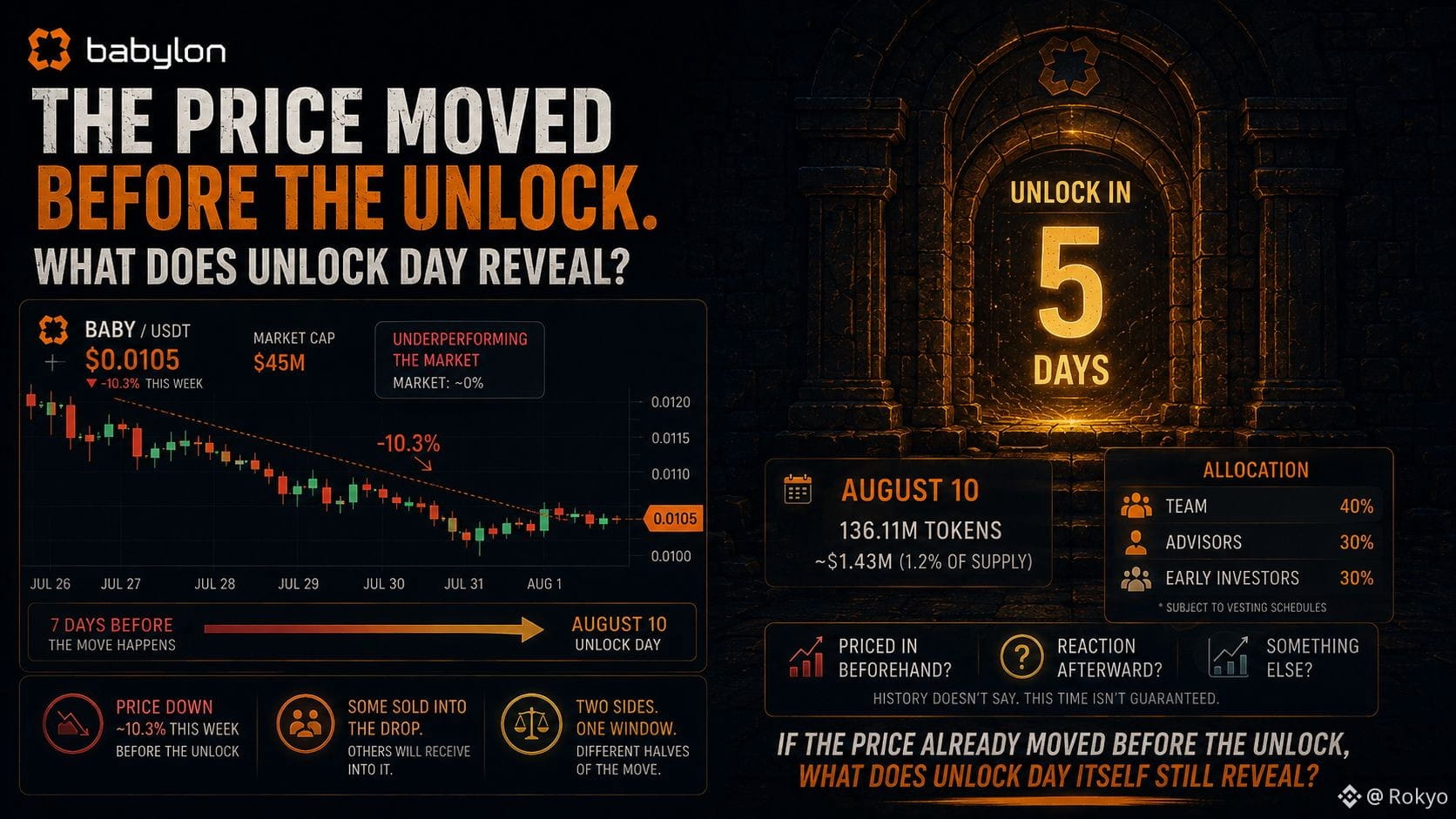
2
2
53
ເຂົ້າສູ່ລະບົບເພື່ອສຳຫຼວດເນື້ອຫາເພີ່ມເຕີມ
ເຂົ້າຮ່ວມກຸ່ມຜູ້ໃຊ້ຄຣິບໂຕທົ່ວໂລກໃນ Binance Square.
⚡️ ໄດ້ຮັບຂໍ້ມູນຫຼ້າສຸດ ແລະ ທີ່ມີປະໂຫຍດກ່ຽວກັບຄຣິບໂຕ.
💬 ໄດ້ຮັບຄວາມໄວ້ວາງໃຈຈາກຕະຫຼາດແລກປ່ຽນຄຣິບໂຕທີ່ໃຫຍ່ທີ່ສຸດໃນໂລກ.
👍 ຄົ້ນຫາຂໍ້ມູນເຊີງເລິກທີ່ແທ້ຈາກນັກສ້າງທີ່ໄດ້ຮັບການຢືນຢັນ.
ອີເມວ / ເບີໂທລະສັບ
ຫົວຂໍ້ທີ່ກໍາລັງນິຍົມ
CircleMints500MUSDCOnSolana
99,479 views
2,139 ກຳລັງສົນທະນາ
#circlemints500musdconsolana
🚨 $500M USDC MINTED ON SOLANA! 💵🔥
Circle Treasury just minted 500M USDC on Solana, pushing total global supply to $75.2B! 📈✨
💡 Quick Reality Check:
🔹 Minting = Fresh Inventory Creation (Not instant buying power!🛒
🔹 Real Trigger = Capital Deployment into DeFi, Exchanges & Pools! 🌐🚀
🎯 Coins to Watch:
⚡ $SOL — Network activity is booming, and fresh liquidity continues to drive ecosystem growth!
💎 $RARE — A high-volatility altcoin that reacts fast to fresh market liquidity and sentiment!🪐
💥 Are you accumulating now or waiting for full capital deployment? Drop your thoughts below! 👇✨
#CircleMints500MUSDCOnSolana
#PolymarketBankFailureBetsDrawFDICConcern
#BlackRockBuildsTokenizedPortfoliosForOndo
#BitwiseFilesToListNEARETFOnNYSEArca
Hifza Rubab
·4 ຖືກໃຈ
·4.5k views
PolymarketBankFailureBetsDrawFDICConcern
98,054 views
1,889 ກຳລັງສົນທະນາ
BlackRockBuildsTokenizedPortfoliosForOndo
91,870 views
1,346 ກຳລັງສົນທະນາ