
Rittikd
31 ໂພສ

Rittikd
ລາຍງານ
ບລັອກຜູ້ໃຊ້
Publisher of The Rittik Report.
https://x.com/rittikd
3 ກໍາລັງຕິດຕາມ
2 ຜູ້ຕິດຕາມ
1 Liked
ໂພສ
·
--
The night gave me a better structure but not a better trend. Bitcoin broke through the $64,050 ceiling that capped it all Tuesday afternoon, used Nvidia's beat to reach $65,199, and then defended the old ceiling twice, at about $64,035 in the 9:00 PM EST hour and $64,095 this morning. That is a real improvement. But the rally stopped below the $65,315 weekly close for a fourth time, IBIT went back to selling $210 million a day, the two biggest Ether dip buyers appear to be done, the Binance hackers moved a second $140 million batch of Ether and MARA is still moving coins out. Under the price, the build-out kept going: DBS made USDC a 24/7 bank product in Asia, Tether funded a payments network, Bitwise filed for a Zcash ETF and a $500 million tokenized Anthropic campaign filled in hours, which also shows where speculative money wants to be.
For the US session, my Bitcoin support is $64,035 to $64,095, the overnight lows on Tuesday's old ceiling, then $63,870, last night's post-close low, $63,770, then $63,377 to $63,257, Tuesday's retest and low, and $61,950, Saturday night's low, with the long cluster between $59,500 and $62,200 and the bid wall near $60,000 below it. Resistance is $64,890, the Asia high, then $65,199, the overnight high, and $65,315 to $65,383, the weekly close and Tuesday's high. A daily close above $65,383 would end the run of rejections, while losing $64,000 would put the afternoon lows back in play. For Ether, support is $1,795, the overnight lows, then $1,790, $1,765 and $1,749, Tuesday's low. Resistance is $1,818, the Asia high, then $1,834, the overnight high, and the $1,835 to $1,842 band. I stay defensive but less so than last night. I watch the 8:30 AM EST housing data, the 1:00 PM EST bond auction, the 2:00 PM EST Fed minutes and Wednesday's ETF flows tonight. These are my analytical levels, not forecasts, and nothing here is financial advice.
For the US session, my Bitcoin support is $64,035 to $64,095, the overnight lows on Tuesday's old ceiling, then $63,870, last night's post-close low, $63,770, then $63,377 to $63,257, Tuesday's retest and low, and $61,950, Saturday night's low, with the long cluster between $59,500 and $62,200 and the bid wall near $60,000 below it. Resistance is $64,890, the Asia high, then $65,199, the overnight high, and $65,315 to $65,383, the weekly close and Tuesday's high. A daily close above $65,383 would end the run of rejections, while losing $64,000 would put the afternoon lows back in play. For Ether, support is $1,795, the overnight lows, then $1,790, $1,765 and $1,749, Tuesday's low. Resistance is $1,818, the Asia high, then $1,834, the overnight high, and the $1,835 to $1,842 band. I stay defensive but less so than last night. I watch the 8:30 AM EST housing data, the 1:00 PM EST bond auction, the 2:00 PM EST Fed minutes and Wednesday's ETF flows tonight. These are my analytical levels, not forecasts, and nothing here is financial advice.

38
·
--
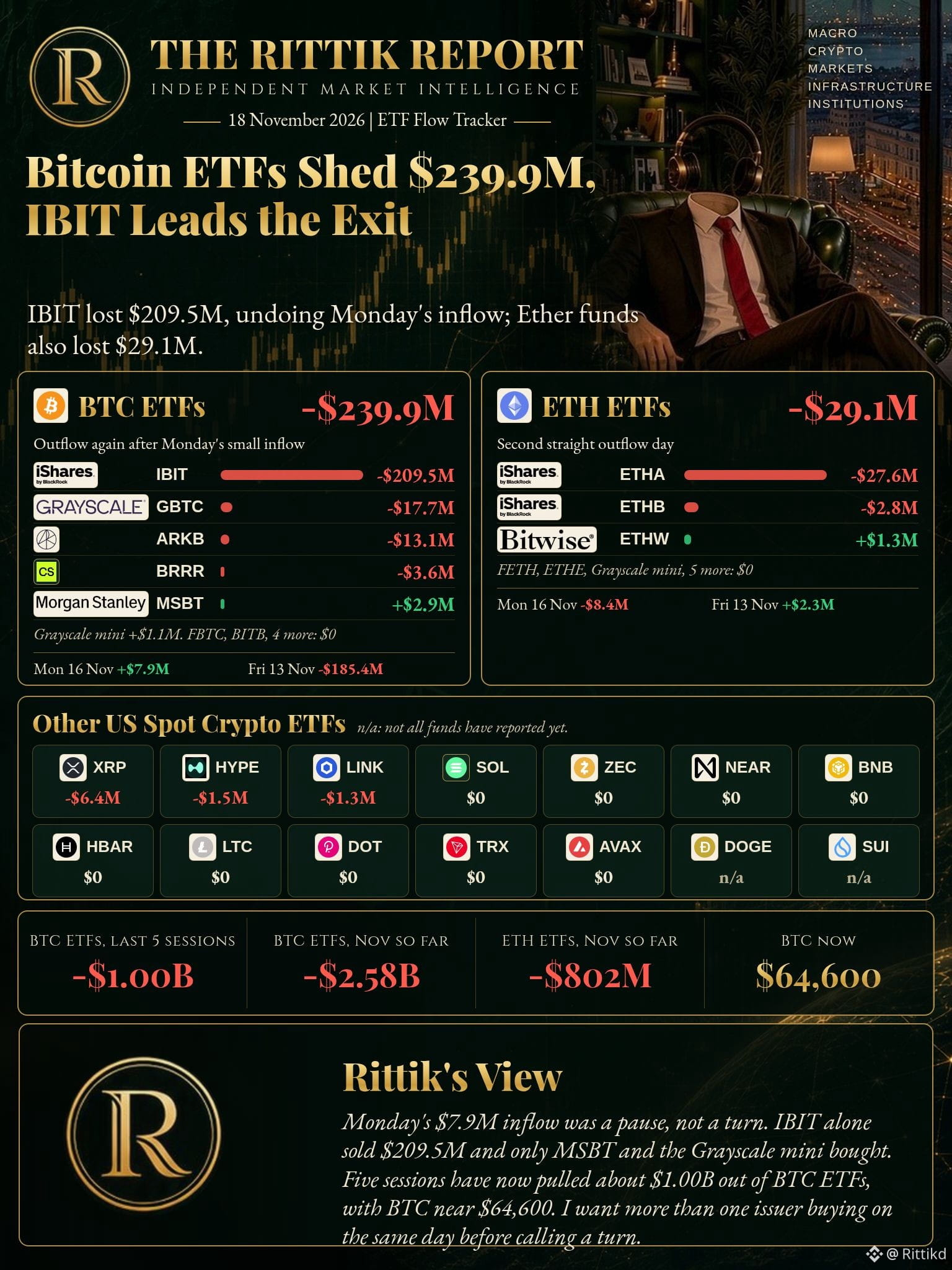
The Rittik Report | US spot crypto ETF flows for Tuesday 17 November
BTC ETFs: -$239.9M, back to outflows after Monday's +$7.9M, which was the only inflow in the last nine sessions. IBIT led the exit with -$209.5M, its biggest outflow since 11 Nov. GBTC (-$17.7M), ARKB (-$13.1M) and BRRR (-$3.6M) also sold. MSBT (+$2.9M) and the Grayscale BTC mini (+$1.1M) were the only buyers. FBTC, BITB and four others were flat.
ETH ETFs: -$29.1M, a second straight outflow day. ETHA (-$27.6M) and ETHB (-$2.8M) sold, ETHW added +$1.3M. Every other ETH fund was flat at $0.
XRP: -$6.4M
HYPE: -$1.5M
LINK: -$1.3M
SOL: $0
ZEC: $0
NEAR: $0
BNB: $0
HBAR: $0
LTC: $0
DOT: $0
TRX: $0
AVAX: $0
DOGE: n/a (not all funds reported yet)
SUI: n/a (not all funds reported yet)
The last five sessions have taken about $1.00B out of BTC ETFs, and November is now about -$2.58B. ETH ETFs are down about $802M for the month.
BTC is around $64,600. One small green day against that much selling was never going to change the picture, and Tuesday showed it: IBIT alone sold more than the whole of Monday's inflow many times over. I am watching for a day where more than one issuer is buying at once, and for IBIT to stop leading the outflows. Until then I read these flows as sellers still in control.
81
·
--
The third failure at the $65,315 weekly close was followed by a fast break of every morning support, and Bitcoin spent the rest of the day making higher lows under a $64,000 to $64,050 ceiling. Positioning reset: longs closed and funding stayed calm, so there is no forced selling left from today, but there is also no new demand. Ether's 3% recovery from $1,749 was the one bright spot. Under the price, the build-out continued at a high level: the World Bank chose USDC for a payments test, Brevan Howard and Abu Dhabi's funds showed size and patience in IBIT, Coinbase completed its 50-state lending rollout, Anchorage and Kalshi linked bank custody to margin, and Alpaca passed $10 billion in tokenization volume. The policy signals were mixed: Waller backs tokenization but on central bank rails, Democratic senators want tighter tokenized stock rules, and the CFTC froze Kalshi's Trump contracts. Crypto equities fell much harder than Bitcoin.
For the Asia session and Wednesday, my Bitcoin support is $63,770, this afternoon's last higher low, then $63,580, then $63,377 to $63,257, the retest and today's low, then $61,950, Saturday night's low, with the long cluster between $59,500 and $62,200 below it and $58,500, the June low, behind that. Resistance is $64,050, this afternoon's ceiling, tested four times, then $64,420, the 11:05 AM EST bounce high, $64,750 to $64,815, this morning's edition price and Monday's daily close, and $65,315, the weekly close, with $65,383, today's high, just above it. A close above $64,050 would turn the afternoon into a base, while a daily close below $62,000 brings the long cluster into play. For Ether, support is $1,790, this afternoon's last low, then $1,765, the retest low, $1,749, today's low, and $1,709. Resistance is $1,807, this afternoon's high, then $1,832, the opening high, and the $1,835 to $1,842 band. I stay defensive. I watch Nvidia's results and Asia's reaction to them, Tuesday's ETF flows tonight, any further moves around the Strait of Hormuz and the Fed minutes at 2:00 PM EST on Wednesday.
THESE ARE NOT FINANCIAL ADVICE.

352
·
--
The first hour of the US market gave me a mixed but slightly better picture than Monday. Bitcoin built a higher low before the open, rose while the Nasdaq fell and absorbed both a strong spending print and one of the most hawkish Fed speeches of the cycle. But the open spike was a squeeze, with open interest falling, and it failed at the $65,315 weekly close for the third time in a day, while Ether is still capped below $1,835. Crypto equities are trading with tech, not with the coins. Under the price, the build-out continued: Coinbase moved trading into ChatGPT, Goldman doubled its Bitcoin fund exposure, banks moved tokenized dollars around the clock and Kalshi showed its surveillance data. The weak spots are also clear: stablecoin supply is down about $16 billion in a month, Ethereum's next upgrade is stuck, and trader tooling on perps venues keeps leaking keys.
For the rest of the US session, my Bitcoin support is $64,460, the post-open low, then $64,000 to $64,080, this morning's lows, then $63,725, Sunday's early low, with $61,950 behind it. Resistance is $65,100, the pre-open and late-morning high, then $65,315, the weekly close, $65,385, the opening high, and $65,475, last night's high, with $66,100 above that. A close above $65,315 would finally turn the relative strength into a reclaim, while a break of $64,000 puts $63,725 and then the $62,000 area back in play. For Ether, support is $1,795, the post-open low, then $1,784 to $1,785, this morning's and Monday's lows, then $1,772 and $1,709. Resistance is $1,832, the opening high, then the $1,835 to $1,842 band and $1,865, Monday's high. I stay defensive, but less so than this morning. I watch the CFTC hearing at 3:00 PM EST, Nvidia's results after the 4:00 PM EST close and whether IBIT's Monday inflow repeats in tonight's flow data. These are my analytical levels, not forecasts, and nothing here is financial advice.
For the rest of the US session, my Bitcoin support is $64,460, the post-open low, then $64,000 to $64,080, this morning's lows, then $63,725, Sunday's early low, with $61,950 behind it. Resistance is $65,100, the pre-open and late-morning high, then $65,315, the weekly close, $65,385, the opening high, and $65,475, last night's high, with $66,100 above that. A close above $65,315 would finally turn the relative strength into a reclaim, while a break of $64,000 puts $63,725 and then the $62,000 area back in play. For Ether, support is $1,795, the post-open low, then $1,784 to $1,785, this morning's and Monday's lows, then $1,772 and $1,709. Resistance is $1,832, the opening high, then the $1,835 to $1,842 band and $1,865, Monday's high. I stay defensive, but less so than this morning. I watch the CFTC hearing at 3:00 PM EST, Nvidia's results after the 4:00 PM EST close and whether IBIT's Monday inflow repeats in tonight's flow data. These are my analytical levels, not forecasts, and nothing here is financial advice.

330
·
--
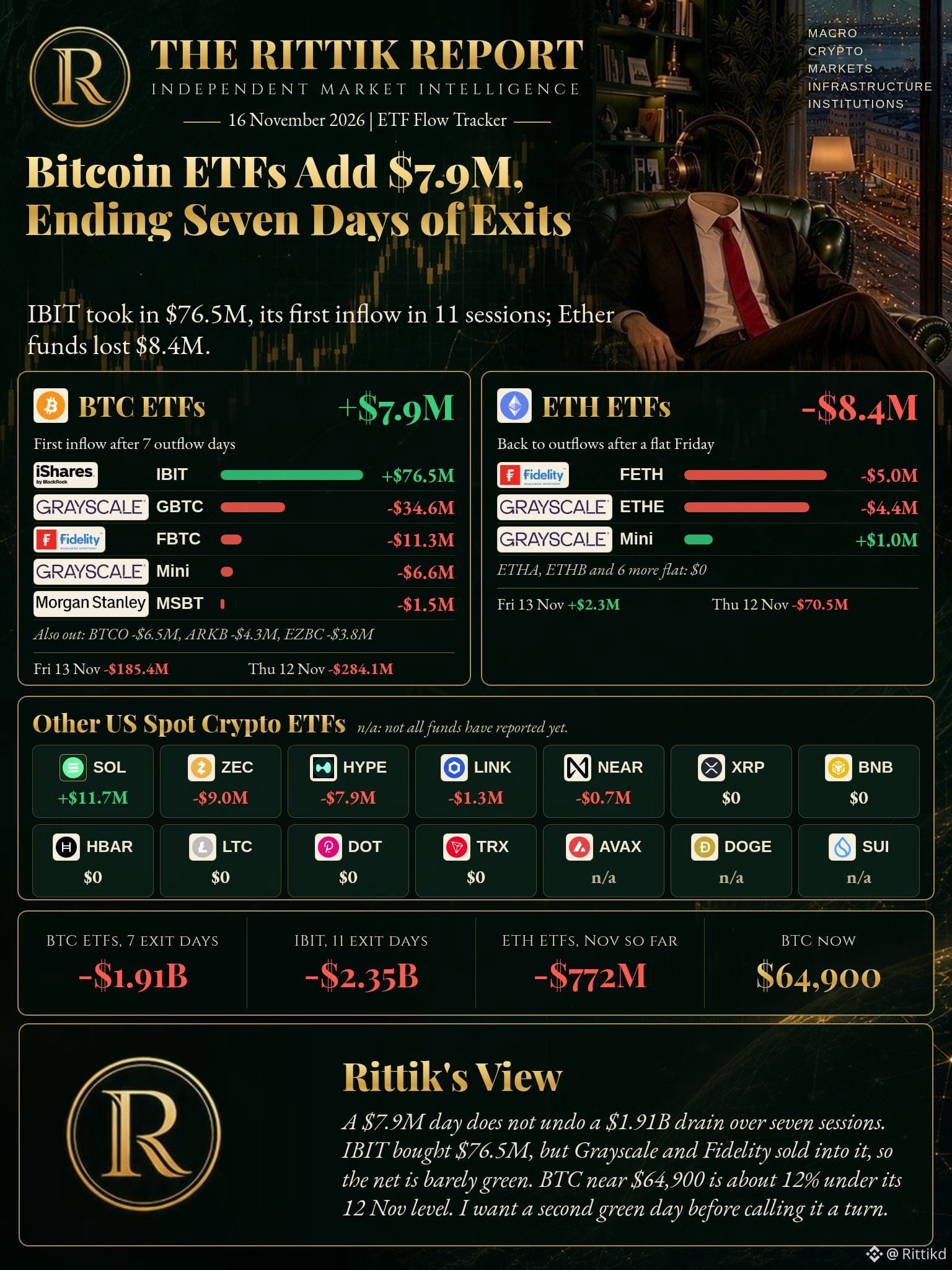
The Rittik Report | US spot crypto ETF flows for Monday 16 November
BTC ETFs: +$7.9M, the first inflow after seven outflow days. IBIT took in +$76.5M, its first inflow after eleven straight outflow sessions. Every other fund that moved sold: GBTC (-$34.6M), FBTC (-$11.3M), the Grayscale BTC mini (-$6.6M), BTCO (-$6.5M), ARKB (-$4.3M), EZBC (-$3.8M) and MSBT (-$1.5M). BITB and three others were flat.
ETH ETFs: -$8.4M after a flat Friday. FETH (-$5.0M) and ETHE (-$4.4M) sold, the Grayscale ETH mini added +$1.0M. ETHA and ETHB were flat at $0.
SOL: +$11.7M (BSOL +$10.8M, VSOL +$0.9M)
ZEC: -$9.0M
HYPE: -$7.9M
LINK: -$1.3M
NEAR: -$0.7M
XRP: $0
BNB: $0
HBAR: $0
LTC: $0
DOT: $0
TRX: $0
AVAX: n/a (not all funds reported yet)
DOGE: n/a (not all funds reported yet)
SUI: n/a (not all funds reported yet)
The seven outflow days from 5 Nov to 13 Nov took about $1.91B out of BTC ETFs, and IBIT alone lost about $2.35B over its eleven sessions out. ETH ETFs are down about $772M so far in November.
BTC is around $64,900, about 12% below where it traded on 12 Nov. A $7.9M day is a pause in the selling, not a reversal, and it is mostly IBIT offsetting sellers elsewhere. I want a second green day, with more than one issuer buying, before calling it a turn.
185
·
--
The overnight session gave back Monday afternoon's progress. Bitcoin tested the $65,315 weekly close after the bell, failed, and drifted to about $64,080 by the European open, while Ether was rejected again at $1,842 and lost $1,800. Positioning tells the same story: open interest climbed while price fell and funding stayed flat, so fresh shorts replaced the large short book that Abraxas closed. Holders realized their biggest loss since July, and the Binance hackers started moving their Ether. Yet the structural news was some of the best of the month. The CFTC licensed a blockchain-built perps exchange onshore, Wells Fargo's clients emerged as the largest Bitcoin ETF holders, 22 asset managers committed tokenized funds to Solana and ETF selling outside IBIT slowed to about $69 million. The building continues. The buying does not, yet.
For the US session, my Bitcoin support is $64,030 to $64,080, Monday's post-open low and this morning's low, then $63,830 and $63,725, Monday's and Sunday's lows, with $61,950 behind them. Resistance is $64,815, Monday's daily close, then $65,150, the Asia bounce high, $65,315, the weekly close, and $65,475, last night's high. A close back above $65,315 would turn this into a range with an upward bias, while a break of $63,725 puts the $62,000 area in play. For Ether, support is $1,785 to $1,788, Monday's low and this morning's low, then $1,772 and $1,709. Resistance is $1,808, then $1,818, last night's edition level, and $1,835 to $1,842, the band that has capped every bounce since Sunday. I stay defensive. I watch the 8:30 AM EST retail sales print, whether IBIT's Monday flow confirms, the 3:00 PM EST CFTC hearing and Nvidia's results after the close. These are my analytical levels, not forecasts, and nothing here is financial advice.
For the US session, my Bitcoin support is $64,030 to $64,080, Monday's post-open low and this morning's low, then $63,830 and $63,725, Monday's and Sunday's lows, with $61,950 behind them. Resistance is $64,815, Monday's daily close, then $65,150, the Asia bounce high, $65,315, the weekly close, and $65,475, last night's high. A close back above $65,315 would turn this into a range with an upward bias, while a break of $63,725 puts the $62,000 area in play. For Ether, support is $1,785 to $1,788, Monday's low and this morning's low, then $1,772 and $1,709. Resistance is $1,808, then $1,818, last night's edition level, and $1,835 to $1,842, the band that has capped every bounce since Sunday. I stay defensive. I watch the 8:30 AM EST retail sales print, whether IBIT's Monday flow confirms, the 3:00 PM EST CFTC hearing and Nvidia's results after the close. These are my analytical levels, not forecasts, and nothing here is financial advice.

198
·
--
The afternoon gave me the first divergence I have been waiting for. The Nasdaq extended its loss to about 2.5% on Nvidia's leadership crisis, but Bitcoin held the $64,030 area near its post-open low, built higher lows all afternoon and gained about 1.4% from this morning's edition. I am careful not to overread it. The bounce came with new leverage on-chain, a large short book being closed and positive funding, not with visible spot demand, and both Bitcoin and Ether failed below their weekly closes. Crypto stocks are still catching down to Friday's prices, and Hammack's comments kept a December hike alive. Under the price, the build-out continued: ICE moved into crypto-backed lending custody, the largest banks showed bigger Bitcoin ETF stakes, tokenized shares became collateral on Solana and prediction markets moved into a memecoin app. The day's security stories, Lighter's leaked keys and Trezor's shipping leak, came from the edges of the system, not its core.
For the Asia session and Tuesday, my Bitcoin support is $64,640, this afternoon's pullback low, then $64,030, the post-open low that held twice, then $63,830, this morning's low, and $63,725, Sunday's early low, with $61,950 behind it. Resistance is $65,160, this afternoon's high, then $65,315, the weekly close, $65,630, today's high, and $66,100. A close above $65,315 would turn today's divergence into a reclaim, while a break of $63,725 puts the $62,000 area back in play. For Ether, support is $1,808, this afternoon's pullback low, then $1,801, the post-edition low, then $1,785, today's low, and $1,772 and $1,709 behind it. Resistance is $1,835, the weekly close and this afternoon's high, then $1,842 and $1,865, today's high. I stay defensive but less so than this morning. I watch Monday's ETF flows this evening, Asia's reaction to the Nvidia news, the 8:30 AM EST retail sales report, the CFTC hearing at 3:00 PM EST and Nvidia's earnings after Tuesday's close. These are my analytical levels, not forecasts, and nothing here is financial advice.
For the Asia session and Tuesday, my Bitcoin support is $64,640, this afternoon's pullback low, then $64,030, the post-open low that held twice, then $63,830, this morning's low, and $63,725, Sunday's early low, with $61,950 behind it. Resistance is $65,160, this afternoon's high, then $65,315, the weekly close, $65,630, today's high, and $66,100. A close above $65,315 would turn today's divergence into a reclaim, while a break of $63,725 puts the $62,000 area back in play. For Ether, support is $1,808, this afternoon's pullback low, then $1,801, the post-edition low, then $1,785, today's low, and $1,772 and $1,709 behind it. Resistance is $1,835, the weekly close and this afternoon's high, then $1,842 and $1,865, today's high. I stay defensive but less so than this morning. I watch Monday's ETF flows this evening, Asia's reaction to the Nvidia news, the 8:30 AM EST retail sales report, the CFTC hearing at 3:00 PM EST and Nvidia's earnings after Tuesday's close. These are my analytical levels, not forecasts, and nothing here is financial advice.

493
·
--
The first hour of teh US market gave a clean read of where buyers and sellers stand. A weak factory print and lower yields sparked a short squeeze that pushed Bitcoin back above its $65,315 weekly close at the open, but the reclaim failed within ten minutes, and the Nasdaq's slide to a 2% loss pulled Bitcoin back to the $64,000 area. Open interest fell into the spike, which tells me shorts covered rather than new buyers arrived, and Bitcoin funding has turned positive again at the lows. Crypto stocks absorbed the weekend in one session with drops of about 5% to 8%, and stablecoin supply shrank by about $4 billion last week. The building continued: Coinbase and Broadridge proposed tokenized shareholder rights, ICE said the NYSE's venue is ready for Solana tokens and Zelle tested confidential stablecoin payments. But the treasury bid is thin, with Strategy spending most of its raise on buying back preferred stock.
For the rest of the US session, my Bitcoin support is $64,035, the post-open low, then $63,830, this morning's low, $63,725, Sunday's early low, and $61,950, Saturday night's low. Resistance is $64,420, the 9:30 AM EST opening print, then $65,315, the weekly close, and $65,630, today's high, with $66,100 above that. A close back above $65,315 would turn the open's spike into a reclaim, while a break of $63,725 opens the way back to $62,000. For Ether, support is $1,800, then $1,785, this morning's low, then $1,772 and $1,709. Resistance is $1,823, then $1,835, the weekly close, and $1,865, today's high. I stay defensive. I watch Warsh at 12:00 PM EST, whether the Nasdaq stabilizes into the close and Monday's ETF flows this evening. These are my analytical levels, not forecasts, and nothing here is financial advice.
For the rest of the US session, my Bitcoin support is $64,035, the post-open low, then $63,830, this morning's low, $63,725, Sunday's early low, and $61,950, Saturday night's low. Resistance is $64,420, the 9:30 AM EST opening print, then $65,315, the weekly close, and $65,630, today's high, with $66,100 above that. A close back above $65,315 would turn the open's spike into a reclaim, while a break of $63,725 opens the way back to $62,000. For Ether, support is $1,800, then $1,785, this morning's low, then $1,772 and $1,709. Resistance is $1,823, then $1,835, the weekly close, and $1,865, today's high. I stay defensive. I watch Warsh at 12:00 PM EST, whether the Nasdaq stabilizes into the close and Monday's ETF flows this evening. These are my analytical levels, not forecasts, and nothing here is financial advice.

112
·
--
The overnight session confirmed what the weekly close suggested. Bitcoin finished a sixth straight losing week at $65,315, then lost Sunday afternoon's low as Asia sold anything tied to AI. The derivatives tone shifted a little: open interest rose as price fell, Ether funding went negative again and a closely followed trader flipped from long to a $64.8 million short. That is fresh shorting, not forced selling, and it can cut both ways. Under the price, the institutional build-out kept going, with JPMorgan and DBS settling tokenized dollars on weekends, two central banks proving cross-ledger FX settlement, Solana dropping its beta label and Ethereum's roadmap getting sharper. The demand side is still the weak link: $1.065 billion of Bitcoin ETF outflows last week, flat stablecoin supply and whales sending Bitcoin to exchanges.
For the US session, my Bitcoin support is $64,055, this morning's low, then $63,725, the early Sunday low, and $61,950, Saturday night's low. Resistance is $64,230, the broken Sunday afternoon low, then $65,315, the weekly close, and $65,480, the overnight high, with $66,100 above that. A move back above $65,315 would undo the overnight damage, while a break of $63,725 would put the $62,000 area back in play. For Ether, support is $1,790, this morning's low, then $1,772 and $1,709. Resistance is $1,802, then $1,835, the weekly close, and $1,842, the overnight high. I stay defensive. I watch the 8:30 AM EST Empire print, Warsh at 12:00 PM EST, any Strategy filing before the open and Monday's ETF flows this evening. These are my analytical levels, not forecasts, and nothing here is financial advice.
For the US session, my Bitcoin support is $64,055, this morning's low, then $63,725, the early Sunday low, and $61,950, Saturday night's low. Resistance is $64,230, the broken Sunday afternoon low, then $65,315, the weekly close, and $65,480, the overnight high, with $66,100 above that. A move back above $65,315 would undo the overnight damage, while a break of $63,725 would put the $62,000 area back in play. For Ether, support is $1,790, this morning's low, then $1,772 and $1,709. Resistance is $1,802, then $1,835, the weekly close, and $1,842, the overnight high. I stay defensive. I watch the 8:30 AM EST Empire print, Warsh at 12:00 PM EST, any Strategy filing before the open and Monday's ETF flows this evening. These are my analytical levels, not forecasts, and nothing here is financial advice.

130
·
--
The Sunday afternoon did not deliver the second leg down I was worried about this morning, but it did not deliver a recovery either. Bitcoin broke $64,400 by $168, found buyers at $64,232 and worked back to about $65,000, while Ether held above its morning low and Ether funding turned positive. Open interest is still falling and funding is flat, so leverage is leaving the market rather than adding fuel. The demand side is unchanged: there is no ETF print until Monday evening, and stablecoin supply has gone nowhere despite fresh USDC mints. Under the price, the build-out kept going, from private balances in a major Solana wallet to sovereign tokenized bond pilots, while Luxor's confirmation and stUSDT's shutdown showed the operational and product clean-up still under way.
For the 7:00 PM EST weekly close and the Asia session, my Bitcoin support is $64,230, this afternoon's low, then $63,725, the early Sunday low, and $61,950, Saturday night's low, with a large 40x long's $62,140 liquidation level just above it. Resistance is $65,170, this afternoon's high, then $65,770, this morning's high, and $66,100, the overnight high. The week will almost certainly close as a sixth straight loss. A close below $64,230 would put it at the lows going into Nvidia week, while a close above $65,770 would show buyers defended the level. For Ether, support is $1,802, this afternoon's low, then $1,793 and $1,772, the early Sunday low, with $1,709 behind it. Resistance is $1,833, then $1,845 and $1,917. I stay defensive. I watch the 6:00 PM EST futures and oil reopen, the weekly close, Monday's Strategy filing and ETF flows, Nvidia on Tuesday and the Fed minutes on Wednesday. These are my analytical levels, not forecasts, and nothing here is financial advice.
For the 7:00 PM EST weekly close and the Asia session, my Bitcoin support is $64,230, this afternoon's low, then $63,725, the early Sunday low, and $61,950, Saturday night's low, with a large 40x long's $62,140 liquidation level just above it. Resistance is $65,170, this afternoon's high, then $65,770, this morning's high, and $66,100, the overnight high. The week will almost certainly close as a sixth straight loss. A close below $64,230 would put it at the lows going into Nvidia week, while a close above $65,770 would show buyers defended the level. For Ether, support is $1,802, this afternoon's low, then $1,793 and $1,772, the early Sunday low, with $1,709 behind it. Resistance is $1,833, then $1,845 and $1,917. I stay defensive. I watch the 6:00 PM EST futures and oil reopen, the weekly close, Monday's Strategy filing and ETF flows, Nvidia on Tuesday and the Fed minutes on Wednesday. These are my analytical levels, not forecasts, and nothing here is financial advice.

300
·
--
The Sunday US morning did not build on the overnight bounce. Bitcoin topped near $65,770 at 8:20 AM EST, slipped to about $64,400 within the hour and sits near $64,680, while Ether gave up $1,800 briefly before steadying near $1,810. Funding is flat and Friday's options book is stacked far above the market, so the next move depends on spot flow, and spot flow is still weak: there is no ETF print until Monday evening and stablecoin supply has gone nowhere today, with USDT near $175.3 billion and USDC near $69.2 billion. The signals I take seriously are mixed. Saylor and Strive are leaning in, a large 40x long has its liquidation level just above Saturday's low, and a well-known Asian bull has gone flat. Under the price, the work went on, from Aave's security upgrade and Binance's withdrawal deadline to Breakpoint opening in London, while the hashrate hijack and Proxima's post-mortem showed the operational gaps that remain.
For tonight's 7:00 PM EST weekly close and Monday, my Bitcoin support is $64,400, this morning's low, then $63,700, the early Sunday low, and $61,950, Saturday night's low, with the 40x long's $62,140 liquidation level just above it. Resistance is $65,770, this morning's high, then $66,100, the overnight high, and $68,840, Friday's US-session close. A weekly close above $66,100 would show buyers defended the week. A break below $64,400 brings $63,700 and then the $61,950 to $62,140 pocket back quickly. For Ether, support is $1,793, then $1,770 and $1,709. Resistance is $1,840, then $1,857 and $1,917. I stay defensive. I watch the 6:00 PM EST equity and oil reopen, the weekly close, Monday's Strategy filing and ETF flows, then Nvidia on Tuesday and the SEC hearing on Thursday. These are my analytical levels, not forecasts, and nothing here is financial advice
For tonight's 7:00 PM EST weekly close and Monday, my Bitcoin support is $64,400, this morning's low, then $63,700, the early Sunday low, and $61,950, Saturday night's low, with the 40x long's $62,140 liquidation level just above it. Resistance is $65,770, this morning's high, then $66,100, the overnight high, and $68,840, Friday's US-session close. A weekly close above $66,100 would show buyers defended the week. A break below $64,400 brings $63,700 and then the $61,950 to $62,140 pocket back quickly. For Ether, support is $1,793, then $1,770 and $1,709. Resistance is $1,840, then $1,857 and $1,917. I stay defensive. I watch the 6:00 PM EST equity and oil reopen, the weekly close, Monday's Strategy filing and ETF flows, then Nvidia on Tuesday and the SEC hearing on Thursday. These are my analytical levels, not forecasts, and nothing here is financial advice

72
·
--
The market deteriorated materially again today. $BTC broke through the $66K support area and traded toward $62K, approximately $2B of leveraged positions were liquidated, $XRP fell below $0.90 and DeFi TVL moved toward $70B.
Institutional flows remain equally weak. Bitcoin ETFs have now suffered two consecutive billion-dollar negative weeks, $ETH ETFs recorded a seventh consecutive weekly outflow and weakness has spread across most of the broader crypto ETF complex.
The liquidity picture is therefore still difficult. Stablecoin capitalization remains below recent levels, stablecoin lending deposits have been contracting and falling collateral values are now producing measurable DeFi liquidations.
At the same time, the structural development of crypto infrastructure continues moving in the opposite direction. DTCC is preparing Solana tokenization connectivity, Kazakhstan is moving toward tokenized sovereign debt, central banks are testing DLT-based FX settlement and regulated institutions are building new custody and securities infrastructure.
I remain defensive on the immediate market but increasingly constructive on the infrastructure being built underneath it. The contradiction is becoming clearer: crypto prices and liquidity are deteriorating while institutional integration continues advancing. For the near-term market view to improve, I need to see Bitcoin recover lost support alongside sustained ETF inflows, expanding stablecoin liquidity and evidence that deleveraging is ending rather than simply pausing between liquidation waves.

98
·
--
The post-midterm dump is one of the most consistent patterns in Bitcoin, and we are inside that window right now.
The US holds midterm elections every four years: 2014, 2018, 2022. In all three of those years, Bitcoin made its bear market bottom, usually a few weeks after the vote.
2014: bottom 71 days after the election.
2018: bottom 39 days after.
2022: bottom 13 days after, on 21 November at about $15,400.
One year after those bottoms, Bitcoin was 122% higher from the 2018 low and 126% higher from the 2022 low.
This year's midterms were on 3 November. We are in exactly the same window.
There is a second pattern I am watching. On 12 June, SpaceX listed in the largest IPO ever, about $75 billion. In the 50 days before it, Bitcoin fell about 19%. Nineteen days after the listing, on 1 July, Bitcoin made this year's low of $57,800, then recovered. 100 days after the IPO it was about 28% above its IPO-day price. Most of the selling came before the listing.
Anthropic's IPO, the second largest ever, is due next week. In the 50 days before it, Bitcoin has fallen 22%. A listing that big pulls a lot of liquidity out of the market, and once it is done, that money starts to come back.
Neither pattern is a guarantee. In 2022 Bitcoin fell 78% from the top. This time it is down about 51%. Every cycle is different, so I don't rely on this alone, but it gives some confidence if you are buying.

1
426
·
--
$BTC $ETH and $SOL levels after the weekend flush 📊
About $1.94 billion of positions were liquidated in the last 24 hours, and about 86% of them were longs. The fear and greed index is at 10.
When Bitcoin is below its 200-week average and fear and greed drops toward single digits, that has historically been one of the best times to buy spot. Very few people have the nerve to buy here.
Bitcoin
Resistance: $65,000 to $65,800, being tested now. A daily close above it opens the 200-week line at $67,800, then $68,000.
Support: $62,000, today's low. A daily close below it opens $60,000 to $61,000, the mining cost zone. A daily close below $60,000 opens the way to $57,800.
Ether, near $1,800 (Saturday's close was the lowest since 9 July)
Resistance: $1,850 to $1,950, where the August rally started.
Support: $1,700. A daily close below it opens $1,500 to $1,550, the June lows.
Solana, near $71
Resistance: $74 to $78.
Support: $67 to $68, today's low. A daily close below $67 opens $60 to $64, this year's lows.
Wicks mean nothing. I wait for daily and weekly closes. The weekly candle closes tonight at 7 PM EST, and that should give some weekly clarity.
A bottom isn't confirmed until price keeps closing above it and the market moves sideways. Right now it is falling like a knife, so I would not take longs here. Even if a bounce comes, expect sideways movement on at least the 4-hour chart before any recovery. V-shaped recoveries are rare, so don't lose money chasing one.
These are levels, not advice.

104
·
--
This morning Bitcoin fell to $62,000, its lowest level since 13 July. Saturday's daily close was $64,150, the lowest close since 16 August. Meanwhile the cost of mining one Bitcoin is around $61,000.
Bitcoin was only about 6% above what it costs to mine one.
Why does mining cost matter for price? Miners spend on electricity to run their machines. When price gets close to that cost, their profit almost disappears. If it costs a miner $60,000 to mine one Bitcoin and price drops to $55,000, it is cheaper to buy Bitcoin on the market than to mine it. That buying supports price. This is why bottoms have mostly formed around the cost of mining.
Electricity alone now runs close to $61,000 per coin, with price near $65,000. Add the cost of the machines and the real cost is even higher.
You can see the stress in the network. Total hashrate is down about 17% since 26 October. Some miners have switched their machines off because mining is no longer profitable.
What happened last time? In 2022 the bottom came on 21 November at about $15,400. Mining cost estimates then sat between roughly $13,000 and $17,700, so the bottom formed right in the break-even zone.
One thing to be clear on: mining cost is not a floor. Price has gone below it many times. What it gives me is an anchor for where major buying makes sense.
Is $61,000 where this market finally finds buyers?

104
·
--

ບົດຄວາມ
Bitcoin's Price Tells You What Happened. Liquidity Tells You What Might Happen Next.One of the biggest mistakes I see in crypto markets is treating price appreciation as confirmation that market conditions have improved.
Bitcoin can rally while underlying liquidity deteriorates. Ethereum can outperform Bitcoin temporarily without attracting sustained capital. And the broader crypto market can appear bullish while much of the movement is being driven by leveraged positioning rather than genuine spot demand.
This is why I look beyond price charts when assessing the market.
There are five things I pay particular attention to:
1. Capital Flows
Is fresh capital entering the market, or is existing capital simply rotating between assets?
ETF flows, stablecoin issuance, exchange activity and institutional positioning help answer this question. But none should be interpreted in isolation. One strong day of ETF inflows does not establish a sustained trend.
2. Market Structure
Is the price movement supported by spot buying, or are derivatives driving the action?
Rising open interest, aggressive funding rates and concentrated leveraged positions can make a rally increasingly fragile. A market supported by genuine buying is structurally different from one dependent on short liquidations.
3. Macroeconomic Conditions
Crypto does not operate independently of global financial conditions.
Federal Reserve policy, Treasury yields, dollar strength and liquidity conditions influence how much risk investors are willing to hold.
A technically attractive Bitcoin setup can still face considerable pressure when financial conditions tighten.
4. Participation Across the Market
A Bitcoin rally accompanied by improving market breadth, sustained volume and healthier participation across major assets carries different implications from a rally concentrated in a handful of cryptocurrencies.
I want to understand whether strength is expanding or becoming increasingly concentrated.
5. What Would Prove the Analysis Wrong?
This is probably the most important part.
Every market thesis should have conditions that confirm it, weaken it or invalidate it.
Without those conditions, analysis becomes an opinion that can be endlessly adjusted to justify whatever happens next.
I publish The Rittik Report, an independent research publication covering cryptocurrency, market structure, institutional capital flows, DeFi and the macroeconomic environment.
My approach is straightforward: examine the evidence, understand the risks, establish a market thesis and return to evaluate whether that thesis held up.
I'll be bringing that research and analysis to Binance Square, with particular attention to $BTC, $ETH and the capital flows shaping the broader digital-asset market.
A rising market is not necessarily a strengthening market. Understanding the difference is where useful analysis begins.
Rittik Das
The Rittik Report | Independent Market Intelligence
Bitcoin's Price Tells You What Happened. Liquidity Tells You What Might Happen Next.
One of the biggest mistakes I see in crypto markets is treating price appreciation as confirmation that market conditions have improved.
Bitcoin can rally while underlying liquidity deteriorates. Ethereum can outperform Bitcoin temporarily without attracting sustained capital. And the broader crypto market can appear bullish while much of the movement is being driven by leveraged positioning rather than genuine spot demand.
This is why I look beyond price charts when assessing the market.
There are five things I pay particular attention to:
1. Capital Flows
Is fresh capital entering the market, or is existing capital simply rotating between assets?
ETF flows, stablecoin issuance, exchange activity and institutional positioning help answer this question. But none should be interpreted in isolation. One strong day of ETF inflows does not establish a sustained trend.
2. Market Structure
Is the price movement supported by spot buying, or are derivatives driving the action?
Rising open interest, aggressive funding rates and concentrated leveraged positions can make a rally increasingly fragile. A market supported by genuine buying is structurally different from one dependent on short liquidations.
3. Macroeconomic Conditions
Crypto does not operate independently of global financial conditions.
Federal Reserve policy, Treasury yields, dollar strength and liquidity conditions influence how much risk investors are willing to hold.
A technically attractive Bitcoin setup can still face considerable pressure when financial conditions tighten.
4. Participation Across the Market
A Bitcoin rally accompanied by improving market breadth, sustained volume and healthier participation across major assets carries different implications from a rally concentrated in a handful of cryptocurrencies.
I want to understand whether strength is expanding or becoming increasingly concentrated.
5. What Would Prove the Analysis Wrong?
This is probably the most important part.
Every market thesis should have conditions that confirm it, weaken it or invalidate it.
Without those conditions, analysis becomes an opinion that can be endlessly adjusted to justify whatever happens next.
I publish The Rittik Report, an independent research publication covering cryptocurrency, market structure, institutional capital flows, DeFi and the macroeconomic environment.
My approach is straightforward: examine the evidence, understand the risks, establish a market thesis and return to evaluate whether that thesis held up.
I'll be bringing that research and analysis to Binance Square, with particular attention to $BTC, $ETH and the capital flows shaping the broader digital-asset market.
A rising market is not necessarily a strengthening market. Understanding the difference is where useful analysis begins.
Rittik Das
The Rittik Report | Independent Market Intelligence
174
·
--
If you missed buying bitcoin at $60,000, another chance in here.
Don’t chase the bottom, chase the DCA Range.
Remember - Downside is limited, upside is unlimited.
Plan it right.
If you missed buying bitcoin at $60,000, another chance in here.
Don’t chase the bottom, chase the DCA Range.
Remember - Downside is limited, upside is unlimited.
Plan it right.
Don’t chase the bottom, chase the DCA Range.
Remember - Downside is limited, upside is unlimited.
Plan it right.
47
·
--
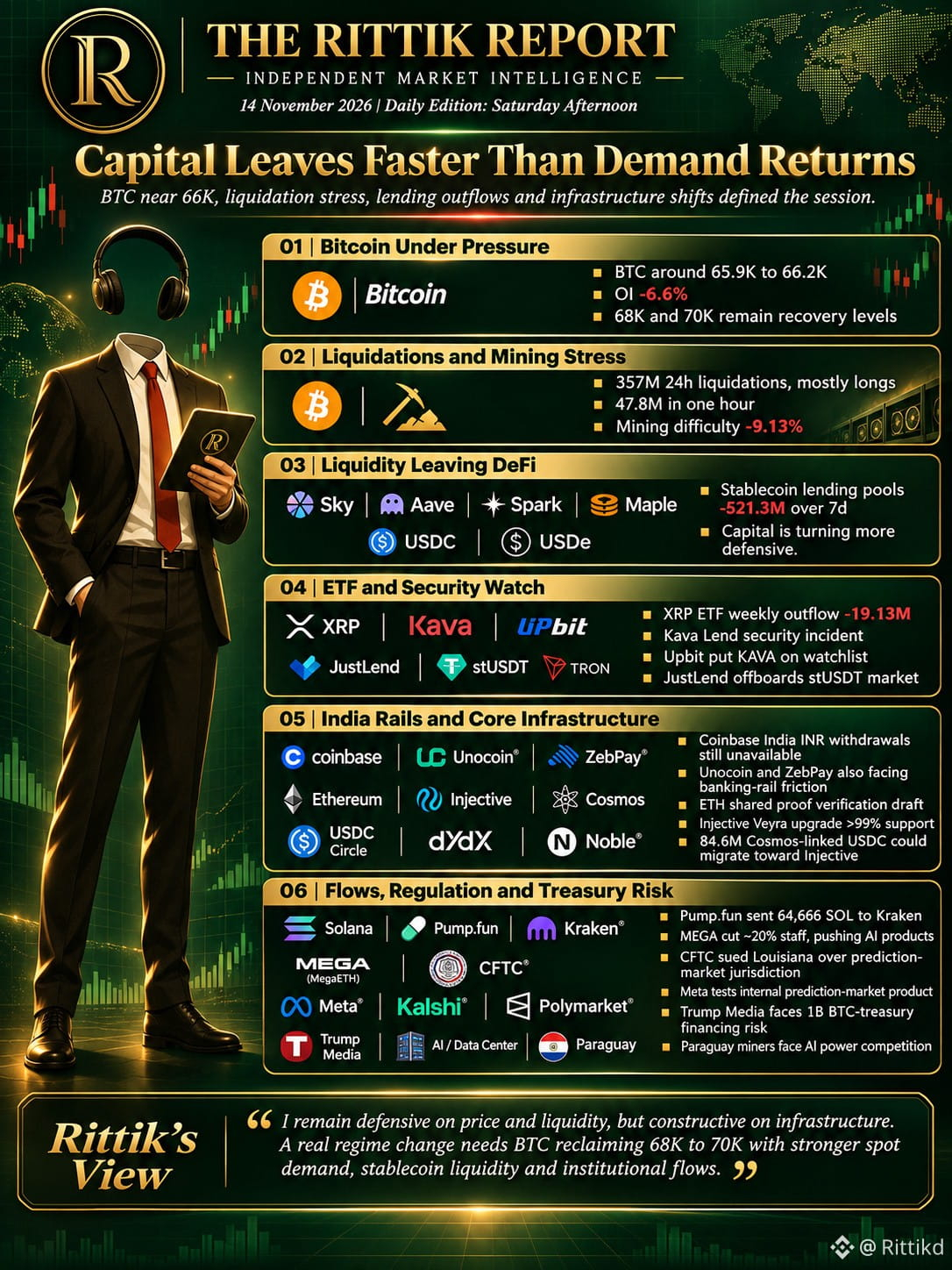
The market remains under pressure despite substantial deleveraging. $BTC has moved toward $66K, leveraged longs are still being liquidated and stablecoin lending markets lost more than $500M over seven days.
The weakness is also beginning to appear beyond trading markets. Bitcoin mining difficulty fell 9.13%, $XRP ETF flows remained negative and corporate balance sheets with large crypto exposure are becoming more sensitive to falling asset prices.
At the same time, the infrastructure side of the industry continues progressing. Ethereum development remains active, Injective is positioning itself for a larger role in Cosmos stablecoin settlement, prediction markets are moving deeper into mainstream technology and regulatory structures, and DeFi protocols continue adjusting risk and product architecture.
I remain defensive on price and liquidity, but constructive on infrastructure. The immediate market problem is still that capital is leaving faster than durable demand is returning. I would need to see Bitcoin reclaim $68K-$70K alongside improving spot demand, stablecoin liquidity and institutional flows before treating a rebound as a meaningful change in the market regime.
273
·
--
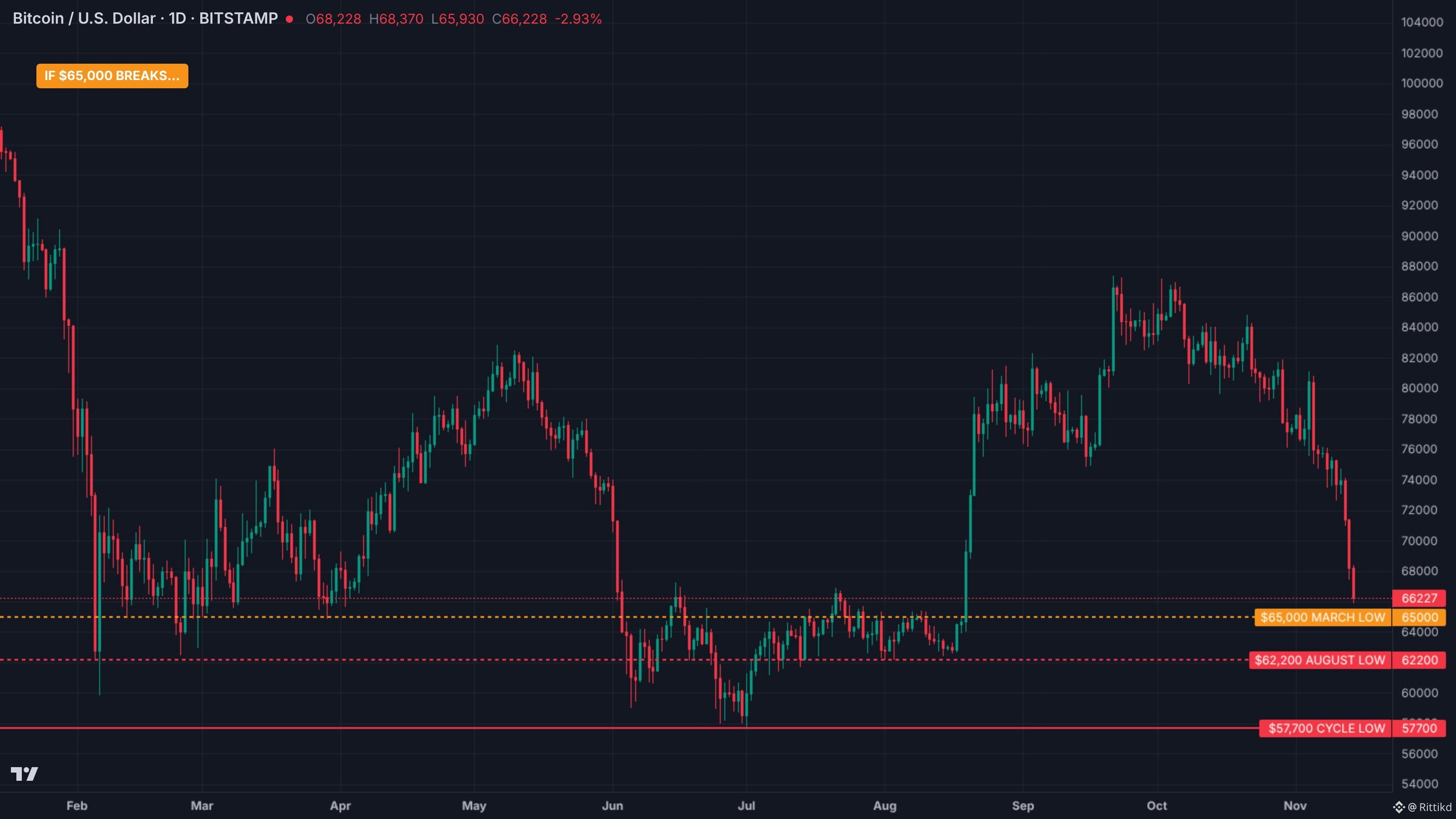
IF $BTC LOSES $65,000…
There's not much until $62,200, the August low.
Below that: $57,700, the cycle low from July.
Bitcoin just lost $66,000. $66,200 right now.
$65,000 is the line.
IF $BTC LOSES $65,000…
There's not much until $62,200, the August low.
Below that: $57,700, the cycle low from July.
Bitcoin just lost $66,000. $66,200 right now.
$65,000 is the line.
There's not much until $62,200, the August low.
Below that: $57,700, the cycle low from July.
Bitcoin just lost $66,000. $66,200 right now.
$65,000 is the line.
141
·
--
The market weakened further overnight. Bitcoin lost the $68K area, ETF outflows extended to seven sessions, stablecoin capitalization fell below $285B and DeFi TVL moved toward $74B.
The macro environment remains equally difficult. Fed officials continue signaling tighter policy, while inflation remains the dominant policy concern.
At the same time, Binance is restoring withdrawals, Coinbase has moved deeper into federally regulated custody and DeFi governance continues improving its risk controls.
I remain defensive on price but constructive on infrastructure. The immediate market problem is still liquidity: stablecoins are contracting, institutional flows remain negative and Bitcoin has lost another support level. I would need to see BTC reclaim $68K-$70K alongside improving ETF and stablecoin flows before treating any rebound as more than relief.
93
ເຂົ້າສູ່ລະບົບເພື່ອສຳຫຼວດເນື້ອຫາເພີ່ມເຕີມ
ເຂົ້າຮ່ວມກຸ່ມຜູ້ໃຊ້ຄຣິບໂຕທົ່ວໂລກໃນ Binance Square.
⚡️ ໄດ້ຮັບຂໍ້ມູນຫຼ້າສຸດ ແລະ ທີ່ມີປະໂຫຍດກ່ຽວກັບຄຣິບໂຕ.
💬 ໄດ້ຮັບຄວາມໄວ້ວາງໃຈຈາກຕະຫຼາດແລກປ່ຽນຄຣິບໂຕທີ່ໃຫຍ່ທີ່ສຸດໃນໂລກ.
👍 ຄົ້ນຫາຂໍ້ມູນເຊີງເລິກທີ່ແທ້ຈາກນັກສ້າງທີ່ໄດ້ຮັບການຢືນຢັນ.
ອີເມວ / ເບີໂທລະສັບ
ຫົວຂໍ້ທີ່ກໍາລັງນິຍົມ
NvidiaBeatsEstimatesWith$130BQ4Outlook
13,812 ຄັ້ງທີ່ເບິ່ງ
172 ກຳລັງສົນທະນາ
Nvidia Beats With $115.8 Billion in Revenue, Guides to $130 Billion and Adds $150 Billion Buyback
Binance News
·49 ຖືກໃຈ
·41.6k ຄັ້ງທີ່ເບິ່ງ
AnthropicIPOPriceCouldExceed$80
19,191 ຄັ້ງທີ່ເບິ່ງ
151 ກຳລັງສົນທະນາ
CanNvidia’sDataCenterGrowthContinue?
57,304 ຄັ້ງທີ່ເບິ່ງ
761 ກຳລັງສົນທະນາ