

Selena_09
4.4k ໂພສ

Selena_09
ລາຍງານ
ບລັອກຜູ້ໃຊ້
461 ກໍາລັງຕິດຕາມ
1.0K+ ຜູ້ຕິດຕາມ
3.8K+ Liked
ໂພສ
ທັງໝົດ
ວົງຢືມ
ວີດີໂອ
·
--
Quá thế nhỉ $EVAA bật mạnh quá, $AIN còn chưa kịp hạ nhiệt thì tới EVAA và $BEAT lại tiếp tục leo, nay sóng sánh êm quá cũng được ít lộc kk, đợi ngày mai lại soi tiếp, giờ thì nghỉ ngơi thui ae
Quá thế nhỉ $EVAA bật mạnh quá, $AIN còn chưa kịp hạ nhiệt thì tới EVAA và $BEAT lại tiếp tục leo, nay sóng sánh êm quá cũng được ít lộc kk, đợi ngày mai lại soi tiếp, giờ thì nghỉ ngơi thui ae
274
·
--
Nến này về âm phủ gặp diêm vương luôn hay sao mà khiếp quá vậy $BULLA , chia 3 luôn rồi, long short đến khổ với nó thôi, top trên mình thấy $APR $BTW đang leo ác quá, chắc canh thử 1 lệnh trước khi ngủ xem số đỏ không
Nến này về âm phủ gặp diêm vương luôn hay sao mà khiếp quá vậy $BULLA , chia 3 luôn rồi, long short đến khổ với nó thôi, top trên mình thấy $APR $BTW đang leo ác quá, chắc canh thử 1 lệnh trước khi ngủ xem số đỏ không
1
583
·
--
Phải thế này xem nào, con tướng $AIN $HAEDAL tiếp tục phá đỉnh, em $BTW ngày mong đêm ngóng cuối cùng cũng gần x2, mình lãi được 1 đoạn, thôi tạm biệt em ấy tại đây thôi
Phải thế này xem nào, con tướng $AIN $HAEDAL tiếp tục phá đỉnh, em $BTW ngày mong đêm ngóng cuối cùng cũng gần x2, mình lãi được 1 đoạn, thôi tạm biệt em ấy tại đây thôi
1
434
·
--
Ơ kìa, $Q sập hầm rồi mà $AIN vẫn pumb láo, con này tính lên nữa hay sao nhỉ, đang 1 cây đỏ lòm thì quay 360 độ lên đỉnh mới luôn, $GRVT nay cũng hồi đẹp quá
Ơ kìa, $Q sập hầm rồi mà $AIN vẫn pumb láo, con này tính lên nữa hay sao nhỉ, đang 1 cây đỏ lòm thì quay 360 độ lên đỉnh mới luôn, $GRVT nay cũng hồi đẹp quá
2
832
·
--
Hoa mắt với $BEAT , ăn uống xong mở máy ra đã thấy em nó leo 30-40%, thế này thì lại phải canh short em nó tiếp rồi, $BTW leo lên lại 1.5u sau đợt giảm hôm trước, $IRYS đi bụi luôn rồi
Hoa mắt với $BEAT , ăn uống xong mở máy ra đã thấy em nó leo 30-40%, thế này thì lại phải canh short em nó tiếp rồi, $BTW leo lên lại 1.5u sau đợt giảm hôm trước, $IRYS đi bụi luôn rồi
1
859
·
--
Thôi xong ai short $AIN lại gồng to tay rồi, sáng gồng $Q , chiều gồng AIN có khi nào tối lại gồng $TAG không???
Thôi xong ai short $AIN lại gồng to tay rồi, sáng gồng $Q , chiều gồng AIN có khi nào tối lại gồng $TAG không???
2
455
·
--
Quá trời rồi đó $Q , đúng kiểu leo cho đã rồi xả 1 mạch luôn, tới giờ $CAP $HUMA roài, cẩn thận là kill tiếp quá
Quá trời rồi đó $Q , đúng kiểu leo cho đã rồi xả 1 mạch luôn, tới giờ $CAP $HUMA roài, cẩn thận là kill tiếp quá
1
425
·
--
Nay $Q như hồi sinh vậy bữa sập chán rồi nay ngoi lên úp vòng mới à, mỗi gậy cứ kéo vài chục % ai đua nổi ? $AIN $$TAG vẫn chưa tụt mà Q đã chia 2 so với sáng rồi
Nay $Q như hồi sinh vậy bữa sập chán rồi nay ngoi lên úp vòng mới à, mỗi gậy cứ kéo vài chục % ai đua nổi ? $AIN $$TAG vẫn chưa tụt mà Q đã chia 2 so với sáng rồi
557
·
--
Chịu rồi, canh chi $AIN cho mệt, nó leo x4 rồi, thấy $BEAT cũng leo ác, con $Q thả gậy về rồi, rụng sớm zị
Chịu rồi, canh chi $AIN cho mệt, nó leo x4 rồi, thấy $BEAT cũng leo ác, con $Q thả gậy về rồi, rụng sớm zị
1
671
·
--
Gậy này của $Q hơi đau à nha, q gậy vài chục % luôn á.
Sáng giờ thấy $BEAT cung tăng lại mà $龙虾 vẫn chưa thấy gì, bữa chót đu 1 ít rồi
Gậy này của $Q hơi đau à nha, q gậy vài chục % luôn á.
Sáng giờ thấy $BEAT cung tăng lại mà $龙虾 vẫn chưa thấy gì, bữa chót đu 1 ít rồi
Sáng giờ thấy $BEAT cung tăng lại mà $龙虾 vẫn chưa thấy gì, bữa chót đu 1 ít rồi
233
·
--
Này thì gồng $AIN , bữa giờ nó cứ đẩy lên x lần cho gồng, bao giờ tới $BTW $IRYS ???
Này thì gồng $AIN , bữa giờ nó cứ đẩy lên x lần cho gồng, bao giờ tới $BTW $IRYS ???
1
1.5k
·
--
Ôi trời đây là $AIN X2 chứ còn gì nữa, mình thấy $BEAT và $BULLA cũng leo lại, con BEAT đêm qua sập lẹ quá không kịp làm gì luôn
Ôi trời đây là $AIN X2 chứ còn gì nữa, mình thấy $BEAT và $BULLA cũng leo lại, con BEAT đêm qua sập lẹ quá không kịp làm gì luôn
2
1.2k
·
--
Cả $Q $JCT còn nào cũng đẩy vượt qua đỉnh cũ hôm trước, nay thấy cả $SOON cũng leo, con nào cũng bay mà HEMI cứ nằm im chưa nhúc nhích
Cả $Q $JCT còn nào cũng đẩy vượt qua đỉnh cũ hôm trước, nay thấy cả $SOON cũng leo, con nào cũng bay mà HEMI cứ nằm im chưa nhúc nhích
1
908
·
--
Trời ạ, chơi alt cap bé cỡ như $$Q $DOOD hay $TAG không đau tim cũng thành đau tim thôi à, quay xe liên tục kẻ khóc người cười :) có lời không chốt tội lỗi thật sự
Trời ạ, chơi alt cap bé cỡ như $$Q $DOOD hay $TAG không đau tim cũng thành đau tim thôi à, quay xe liên tục kẻ khóc người cười :) có lời không chốt tội lỗi thật sự
1
1.6k
·
--

11
·
--
Điên rồ thật, quay đi quay lại $Q vượt luôn đỉnh hôm trước lên hơn 0.22u, short khó thở thật đó, $JCT $AGT cũng đang tăng trở lại rồi, soon nào
Điên rồ thật, quay đi quay lại $Q vượt luôn đỉnh hôm trước lên hơn 0.22u, short khó thở thật đó, $JCT $AGT cũng đang tăng trở lại rồi, soon nào
2
1.3k
·
--
Trời ơi mới ngủ dậy nhìn $Q tưởng hoa mắt, sao mà nó x4 được trong đêm luôn vậy, bịp thực sự, $BULLA $AIN cũng tăng khiếp luôn, thị trường này luôn có những bất ngờ mà, ai short Q đêm qua không ???? toang thật
Trời ơi mới ngủ dậy nhìn $Q tưởng hoa mắt, sao mà nó x4 được trong đêm luôn vậy, bịp thực sự, $BULLA $AIN cũng tăng khiếp luôn, thị trường này luôn có những bất ngờ mà, ai short Q đêm qua không ???? toang thật
3
3
1.2k
·
--
Ái chà đêm rồi mà $Q bật tăng 50%, đứng thứ 2 trên top tăng giá sau $BULLA . liệu $AGT có làm điều tương tự không???
Ái chà đêm rồi mà $Q bật tăng 50%, đứng thứ 2 trên top tăng giá sau $BULLA . liệu $AGT có làm điều tương tự không???
2
646
·
--
Choáng thật, Ăn được ít $BULLA tưởng thơm rồi, ai dè lại non choẹt tiếp. giờ canh tiếp $BEAT $DOOD , cay cú con BULLA thật
Choáng thật, Ăn được ít $BULLA tưởng thơm rồi, ai dè lại non choẹt tiếp. giờ canh tiếp $BEAT $DOOD , cay cú con BULLA thật
1
1.1k
·
--
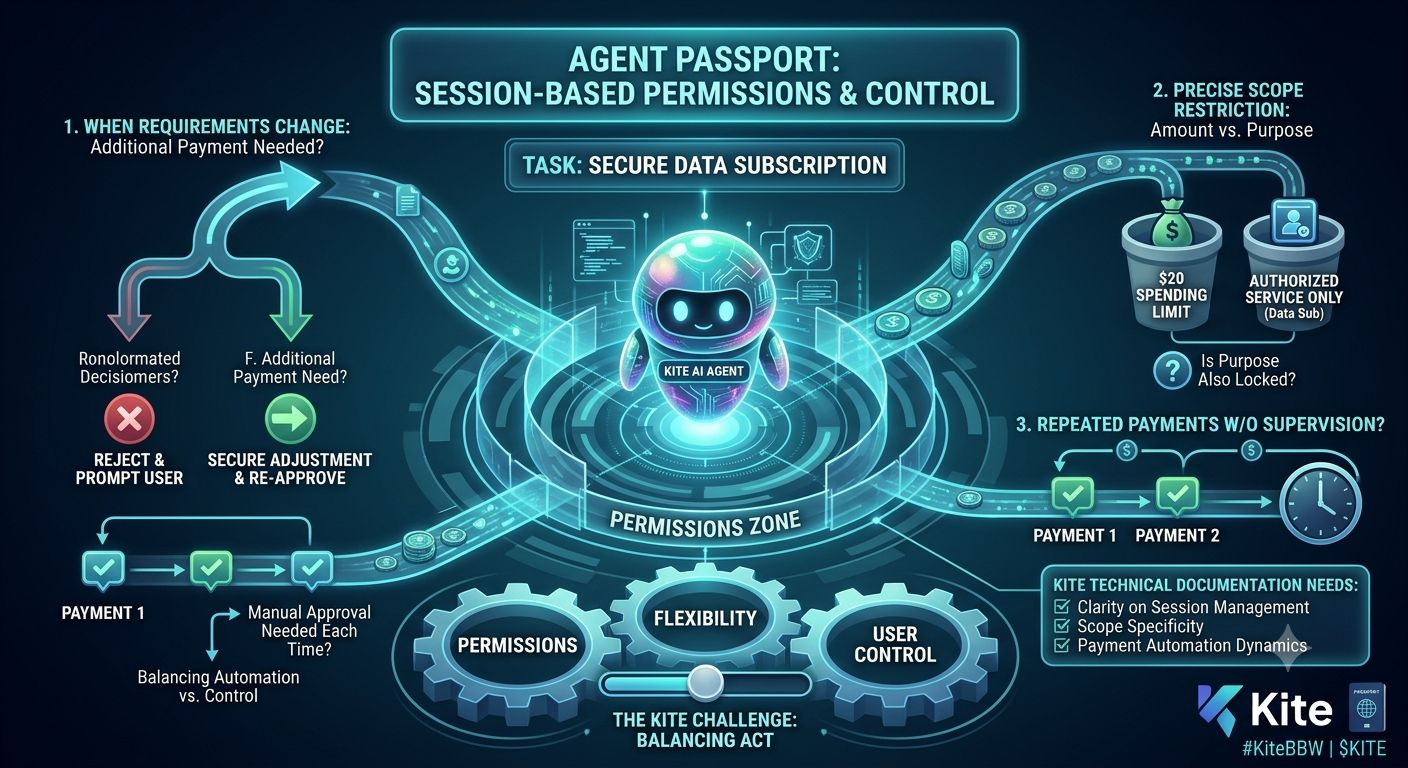
There’s a scenario I think is worth exploring with Kite: when an AI agent is authorized to make payments, how can we ensure that its permissions remain aligned with the task it was given?
What stands out to me about Agent Passport is its session-based approach to permissions, with predefined limits tied to the user’s passkey. This creates a clearer boundary for what an agent can do instead of giving it unrestricted access.
But I want to look deeper into three questions.
First, how are session limits managed when requirements change? If an agent needs to make an additional payment that wasn’t anticipated, will the system reject it, ask the user to approve it again, or allow the permissions to be adjusted? The answer directly affects the balance between automation and user control.
Second, how precisely does Agent Passport restrict the scope of authorization? Limiting the amount of money an agent can spend is one thing, but restricting what that money can be used for is equally important. If an agent is authorized to spend $20 on a specific service, could that permission be used for a different transaction as long as it stays within the spending limit? This needs to be clarified to assess the actual level of protection.
Third, what happens when an agent needs to make repeated payments without direct human supervision? If every session requires manual approval, automation becomes limited. On the other hand, if permissions remain active for too long or can be expanded too easily, the benefits of initially restricting access may gradually diminish.
To me, this is the core challenge for Kite: not simply authorizing AI agents to make payments, but balancing three essential factors: permissions, flexibility, and user control.
I’d like to see Kite’s technical documentation explain more clearly how Agent Passport handles these scenarios, rather than judging the product solely by its concept of session-based authorization.
In your view, should Kite prioritize spending limits, transaction-purpose restrictions, or a combination of both?
#KiteBBW $KITE
1
48
ເຂົ້າສູ່ລະບົບເພື່ອສຳຫຼວດເນື້ອຫາເພີ່ມເຕີມ
ເຂົ້າຮ່ວມກຸ່ມຜູ້ໃຊ້ຄຣິບໂຕທົ່ວໂລກໃນ Binance Square.
⚡️ ໄດ້ຮັບຂໍ້ມູນຫຼ້າສຸດ ແລະ ທີ່ມີປະໂຫຍດກ່ຽວກັບຄຣິບໂຕ.
💬 ໄດ້ຮັບຄວາມໄວ້ວາງໃຈຈາກຕະຫຼາດແລກປ່ຽນຄຣິບໂຕທີ່ໃຫຍ່ທີ່ສຸດໃນໂລກ.
👍 ຄົ້ນຫາຂໍ້ມູນເຊີງເລິກທີ່ແທ້ຈາກນັກສ້າງທີ່ໄດ້ຮັບການຢືນຢັນ.
ອີເມວ / ເບີໂທລະສັບ
ຫົວຂໍ້ທີ່ກໍາລັງນິຍົມ
CanMicrosoftDeliverOnAI
29,960 ຄັ້ງທີ່ເບິ່ງ
487 ກຳລັງສົນທະນາ
Earnings Season Session 3: Will Google & Microsoft Beat Earnings Expectations?
Binance Square Official
·42 ຖືກໃຈ
·11.3k ຄັ້ງທີ່ເບິ່ງ
CanGoogleDefindItsCore
15,490 ຄັ້ງທີ່ເບິ່ງ
382 ກຳລັງສົນທະນາ
FOMCWatch
9M ຄັ້ງທີ່ເບິ່ງ
27,628 ກຳລັງສົນທະນາ