

Glassnode
263 ໂພສ

Glassnode
 Square Verified+
ລາຍງານ
ບລັອກຜູ້ໃຊ້
World leading onchain & financial metrics, charts, data & insights for Bitcoin & digital assets.
1 ກໍາລັງຕິດຕາມ
1.9K+ ຜູ້ຕິດຕາມ
843 Liked
ໂພສ
·
--
ບົດຄວາມ
Fasanara Digital + Glassnode: Q4 2026 Institutional Market PerspectivesThe year since our last edition was a bear market in price and in little else. Bitcoin fell from its all-time high last October while equities set records, capital left the network, and volumes and volatility fell to cycle lows. Stablecoin settlement, the number of tokenized-equity holders and perpetual futures on traditional assets kept growing through the same months. Then August turned the market with a short squeeze, and the data since points to more than short covering.
In our latest Digital Asset Report, written with Fasanara Digital, we read that turn layer by layer: the macro backdrop, on-chain capital, spot and order-book liquidity, derivatives, traditional assets moving onto crypto rails, adoption and institutional allocators. Glassnode's on-chain and market data sit behind most of the charts, and Fasanara Digital's own order-book capture and trading-volume data sit behind the liquidity and TradFi pages. The report closes on the levels and signals that would confirm the recovery.
Two of the charts below come from the report's new section, TradFi on Crypto Rails, because that is where trading grew while crypto volumes fell. Perpetual futures on stocks, indices, gold and oil barely traded on crypto exchanges last autumn, and they are now a large part of perpetual trading on the major venues.
The full report is freely available for download in PDF format.
Download report PDF Crypto volume is still a fraction of the US equity tape
The largest crypto exchanges together traded less than the stocks listed on any one of the three large US listing venues. The crypto figure is a floor, because several big venues are not in it.
In July 2026 the five largest crypto exchanges traded $2.28tn, about 11% of the $20.5tn that changed hands in US equities. Data Source: Fasanara Digital. Perpetuals on traditional assets now rival Bitcoin on Hyperliquid
On Hyperliquid, anyone can launch a perpetual market on any asset with a price feed. Those markets first traded more than the venue's own Bitcoin perpetual in April.
On Hyperliquid, perpetual futures on equities, indices and commodities now trade more than four fifths as much as the venue's own Bitcoin book. Data Source: Hyperliquid, Glassnode. Bitcoin is back above its on-chain cost bases
The squeeze lifted price back above the average cost of every coin, of the coins that still move, and of the newest buyers. Trading above all three marks a healthy bull market, and the report names the level that decides whether it holds.
Bitcoin trades above all three of its major on-chain cost bases again, after regaining them in the August squeeze. What else the report covers
The macro backdrop and the August squeeze: rising US debt costs, the Treasury's buybacks of long-dated bonds, Bitcoin's new link to gold, and the liquidation levels the rally cleared.
On-chain capital: Realized Cap flows, volatility, the wealth held by new investors and Glassnode's cycle indicators.
Liquidity and derivatives: order-book depth across venues, futures and options open interest, funding, liquidations and the volatility smile.
TradFi on crypto rails: perpetual futures on stocks, gold and oil across the major venues, and the race between venues to list traditional assets.
Adoption and allocators: stablecoin supply and settlement, tokenized equities, ETF flows and digital asset treasuries.
To explore the data and insights, download the full analysis in PDF format.
Download report PDF
Disclaimer: This report does not provide any investment advice. All data is provided for information and educational purposes only. No investment decision shall be based on the information provided here and you are solely responsible for your own investment decisions. We urge users to exercise caution and discretion when utilizing these metrics. Glassnode shall not be held responsible for any discrepancies or potential inaccuracies.
Follow us on X for timely market updates and analysis
Join our Telegram channel
For on-chain metrics, dashboards, and alerts, visit Glassnode Studio
Fasanara Digital + Glassnode: Q4 2026 Institutional Market Perspectives
The year since our last edition was a bear market in price and in little else. Bitcoin fell from its all-time high last October while equities set records, capital left the network, and volumes and volatility fell to cycle lows. Stablecoin settlement, the number of tokenized-equity holders and perpetual futures on traditional assets kept growing through the same months. Then August turned the market with a short squeeze, and the data since points to more than short covering.
In our latest Digital Asset Report, written with Fasanara Digital, we read that turn layer by layer: the macro backdrop, on-chain capital, spot and order-book liquidity, derivatives, traditional assets moving onto crypto rails, adoption and institutional allocators. Glassnode's on-chain and market data sit behind most of the charts, and Fasanara Digital's own order-book capture and trading-volume data sit behind the liquidity and TradFi pages. The report closes on the levels and signals that would confirm the recovery.
Two of the charts below come from the report's new section, TradFi on Crypto Rails, because that is where trading grew while crypto volumes fell. Perpetual futures on stocks, indices, gold and oil barely traded on crypto exchanges last autumn, and they are now a large part of perpetual trading on the major venues.
The full report is freely available for download in PDF format.
Download report PDF Crypto volume is still a fraction of the US equity tape
The largest crypto exchanges together traded less than the stocks listed on any one of the three large US listing venues. The crypto figure is a floor, because several big venues are not in it.
In July 2026 the five largest crypto exchanges traded $2.28tn, about 11% of the $20.5tn that changed hands in US equities. Data Source: Fasanara Digital. Perpetuals on traditional assets now rival Bitcoin on Hyperliquid
On Hyperliquid, anyone can launch a perpetual market on any asset with a price feed. Those markets first traded more than the venue's own Bitcoin perpetual in April.
On Hyperliquid, perpetual futures on equities, indices and commodities now trade more than four fifths as much as the venue's own Bitcoin book. Data Source: Hyperliquid, Glassnode. Bitcoin is back above its on-chain cost bases
The squeeze lifted price back above the average cost of every coin, of the coins that still move, and of the newest buyers. Trading above all three marks a healthy bull market, and the report names the level that decides whether it holds.
Bitcoin trades above all three of its major on-chain cost bases again, after regaining them in the August squeeze. What else the report covers
The macro backdrop and the August squeeze: rising US debt costs, the Treasury's buybacks of long-dated bonds, Bitcoin's new link to gold, and the liquidation levels the rally cleared.
On-chain capital: Realized Cap flows, volatility, the wealth held by new investors and Glassnode's cycle indicators.
Liquidity and derivatives: order-book depth across venues, futures and options open interest, funding, liquidations and the volatility smile.
TradFi on crypto rails: perpetual futures on stocks, gold and oil across the major venues, and the race between venues to list traditional assets.
Adoption and allocators: stablecoin supply and settlement, tokenized equities, ETF flows and digital asset treasuries.
To explore the data and insights, download the full analysis in PDF format.
Download report PDF
Disclaimer: This report does not provide any investment advice. All data is provided for information and educational purposes only. No investment decision shall be based on the information provided here and you are solely responsible for your own investment decisions. We urge users to exercise caution and discretion when utilizing these metrics. Glassnode shall not be held responsible for any discrepancies or potential inaccuracies.
Follow us on X for timely market updates and analysis
Join our Telegram channel
For on-chain metrics, dashboards, and alerts, visit Glassnode Studio
In our latest Digital Asset Report, written with Fasanara Digital, we read that turn layer by layer: the macro backdrop, on-chain capital, spot and order-book liquidity, derivatives, traditional assets moving onto crypto rails, adoption and institutional allocators. Glassnode's on-chain and market data sit behind most of the charts, and Fasanara Digital's own order-book capture and trading-volume data sit behind the liquidity and TradFi pages. The report closes on the levels and signals that would confirm the recovery.
Two of the charts below come from the report's new section, TradFi on Crypto Rails, because that is where trading grew while crypto volumes fell. Perpetual futures on stocks, indices, gold and oil barely traded on crypto exchanges last autumn, and they are now a large part of perpetual trading on the major venues.
The full report is freely available for download in PDF format.
Download report PDF Crypto volume is still a fraction of the US equity tape
The largest crypto exchanges together traded less than the stocks listed on any one of the three large US listing venues. The crypto figure is a floor, because several big venues are not in it.
In July 2026 the five largest crypto exchanges traded $2.28tn, about 11% of the $20.5tn that changed hands in US equities. Data Source: Fasanara Digital. Perpetuals on traditional assets now rival Bitcoin on Hyperliquid
On Hyperliquid, anyone can launch a perpetual market on any asset with a price feed. Those markets first traded more than the venue's own Bitcoin perpetual in April.
On Hyperliquid, perpetual futures on equities, indices and commodities now trade more than four fifths as much as the venue's own Bitcoin book. Data Source: Hyperliquid, Glassnode. Bitcoin is back above its on-chain cost bases
The squeeze lifted price back above the average cost of every coin, of the coins that still move, and of the newest buyers. Trading above all three marks a healthy bull market, and the report names the level that decides whether it holds.
Bitcoin trades above all three of its major on-chain cost bases again, after regaining them in the August squeeze. What else the report covers
The macro backdrop and the August squeeze: rising US debt costs, the Treasury's buybacks of long-dated bonds, Bitcoin's new link to gold, and the liquidation levels the rally cleared.
On-chain capital: Realized Cap flows, volatility, the wealth held by new investors and Glassnode's cycle indicators.
Liquidity and derivatives: order-book depth across venues, futures and options open interest, funding, liquidations and the volatility smile.
TradFi on crypto rails: perpetual futures on stocks, gold and oil across the major venues, and the race between venues to list traditional assets.
Adoption and allocators: stablecoin supply and settlement, tokenized equities, ETF flows and digital asset treasuries.
To explore the data and insights, download the full analysis in PDF format.
Download report PDF
Disclaimer: This report does not provide any investment advice. All data is provided for information and educational purposes only. No investment decision shall be based on the information provided here and you are solely responsible for your own investment decisions. We urge users to exercise caution and discretion when utilizing these metrics. Glassnode shall not be held responsible for any discrepancies or potential inaccuracies.
Follow us on X for timely market updates and analysis
Join our Telegram channel
For on-chain metrics, dashboards, and alerts, visit Glassnode Studio
92
·
--
ບົດຄວາມ
Coinbase + Glassnode: Charting Crypto Q4 2026Bitcoin moved from a bottoming process into an early recovery in the third quarter, even as the Fed resumed tightening and long-term Treasury yields climbed. The Q4 2026 edition of Charting Crypto, our quarterly report with Coinbase Institutional, reads that recovery in three passes: the macro backdrop and fund flows, bitcoin's on-chain and derivatives data, and Ethereum's market and network activity. Its outlook for the quarter is constructive, with reasons for near-term caution. The charts combine Glassnode on-chain data with market and macro data through the end of September.
The full report is freely available for download in PDF format.
Download report PDF Sentiment has recovered without becoming stretched
Net unrealized profit/loss (NUPL), a measure of the paper profit or loss held across the bitcoin supply, climbed back into the Optimism/Anxiety band during the quarter and remains well below the Belief/Denial threshold.
BTC Entity-Adjusted Net Unrealized Profit / Loss (NUPL) Long-term holders largely held through the rally
Supply dormant for more than a year kept growing as bitcoin rallied, while the rally drew recently moved coins back into circulation as newer participants returned.
BTC Dormant vs Active Supply A dense band of supply sits just above spot
A new support and resistance heatmap shows the zone that capped the September highs, heavier cost-basis supply just above it, and several overlapping layers of support below spot.
BTC Support & Resistance What else the report covers
The topline view for the quarter, and the factors that would change it
The macro backdrop: bitcoin's correlations with gold, equities, the dollar and Treasury yields
Spot ETF flows and stablecoin liquidity
A new indicator map that screens hundreds of on-chain and macro series for their link to bitcoin's returns over the following month
Valuation, miner revenue and derivatives positioning
Ethereum: sentiment, supply, ETF flows, DeFi and L2 activity
To explore the data and insights, download the full analysis in PDF format.
Download report PDF
Disclaimer: This report does not provide any investment advice. All data is provided for information and educational purposes only. No investment decision shall be based on the information provided here and you are solely responsible for your own investment decisions. We urge users to exercise caution and discretion when utilizing these metrics. Glassnode shall not be held responsible for any discrepancies or potential inaccuracies.
Follow us on X for timely market updates and analysis
Join our Telegram channel
For on-chain metrics, dashboards, and alerts, visit Glassnode Studio
Coinbase + Glassnode: Charting Crypto Q4 2026
Bitcoin moved from a bottoming process into an early recovery in the third quarter, even as the Fed resumed tightening and long-term Treasury yields climbed. The Q4 2026 edition of Charting Crypto, our quarterly report with Coinbase Institutional, reads that recovery in three passes: the macro backdrop and fund flows, bitcoin's on-chain and derivatives data, and Ethereum's market and network activity. Its outlook for the quarter is constructive, with reasons for near-term caution. The charts combine Glassnode on-chain data with market and macro data through the end of September.
The full report is freely available for download in PDF format.
Download report PDF Sentiment has recovered without becoming stretched
Net unrealized profit/loss (NUPL), a measure of the paper profit or loss held across the bitcoin supply, climbed back into the Optimism/Anxiety band during the quarter and remains well below the Belief/Denial threshold.
BTC Entity-Adjusted Net Unrealized Profit / Loss (NUPL) Long-term holders largely held through the rally
Supply dormant for more than a year kept growing as bitcoin rallied, while the rally drew recently moved coins back into circulation as newer participants returned.
BTC Dormant vs Active Supply A dense band of supply sits just above spot
A new support and resistance heatmap shows the zone that capped the September highs, heavier cost-basis supply just above it, and several overlapping layers of support below spot.
BTC Support & Resistance What else the report covers
The topline view for the quarter, and the factors that would change it
The macro backdrop: bitcoin's correlations with gold, equities, the dollar and Treasury yields
Spot ETF flows and stablecoin liquidity
A new indicator map that screens hundreds of on-chain and macro series for their link to bitcoin's returns over the following month
Valuation, miner revenue and derivatives positioning
Ethereum: sentiment, supply, ETF flows, DeFi and L2 activity
To explore the data and insights, download the full analysis in PDF format.
Download report PDF
Disclaimer: This report does not provide any investment advice. All data is provided for information and educational purposes only. No investment decision shall be based on the information provided here and you are solely responsible for your own investment decisions. We urge users to exercise caution and discretion when utilizing these metrics. Glassnode shall not be held responsible for any discrepancies or potential inaccuracies.
Follow us on X for timely market updates and analysis
Join our Telegram channel
For on-chain metrics, dashboards, and alerts, visit Glassnode Studio
The full report is freely available for download in PDF format.
Download report PDF Sentiment has recovered without becoming stretched
Net unrealized profit/loss (NUPL), a measure of the paper profit or loss held across the bitcoin supply, climbed back into the Optimism/Anxiety band during the quarter and remains well below the Belief/Denial threshold.
BTC Entity-Adjusted Net Unrealized Profit / Loss (NUPL) Long-term holders largely held through the rally
Supply dormant for more than a year kept growing as bitcoin rallied, while the rally drew recently moved coins back into circulation as newer participants returned.
BTC Dormant vs Active Supply A dense band of supply sits just above spot
A new support and resistance heatmap shows the zone that capped the September highs, heavier cost-basis supply just above it, and several overlapping layers of support below spot.
BTC Support & Resistance What else the report covers
The topline view for the quarter, and the factors that would change it
The macro backdrop: bitcoin's correlations with gold, equities, the dollar and Treasury yields
Spot ETF flows and stablecoin liquidity
A new indicator map that screens hundreds of on-chain and macro series for their link to bitcoin's returns over the following month
Valuation, miner revenue and derivatives positioning
Ethereum: sentiment, supply, ETF flows, DeFi and L2 activity
To explore the data and insights, download the full analysis in PDF format.
Download report PDF
Disclaimer: This report does not provide any investment advice. All data is provided for information and educational purposes only. No investment decision shall be based on the information provided here and you are solely responsible for your own investment decisions. We urge users to exercise caution and discretion when utilizing these metrics. Glassnode shall not be held responsible for any discrepancies or potential inaccuracies.
Follow us on X for timely market updates and analysis
Join our Telegram channel
For on-chain metrics, dashboards, and alerts, visit Glassnode Studio
254
·
--
ບົດຄວາມ
Pricing Out the HikeTwo weeks after the Fed raised rates, markets expected another hike in October. This week that expectation was priced out. Fed officials said they were in no hurry to raise rates again, inflation came in soft, and the September jobs report was weak. By Friday afternoon, futures put the odds of an October hike at 22%, down from 66% on Monday. Bitcoin gained about 1% over the same stretch. The week's biggest wave of forced buying came overnight before the jobs report, when short sellers were squeezed out of their positions.
The odds of an October hike fell from 66% to 22%. The biggest drops came after a Fed speech and a soft inflation report; the jobs report added a smaller step.
The US added 29,000 jobs in September, against 84,000 expected. Over three months, hiring runs at about 51,000 a month, under a third of its 2010s pace.
Short-term Treasury yields fell, long-term yields rose, and the yield curve steepened back to where it stood before the Fed's September hike.
Futures positions built up into the jobs report. The week's biggest short squeeze came 8 hours before the release. After the release, Bitcoin slipped and long positions were liquidated.
Options traders were paying for upside before the Fed's September meeting but not before this report. Implied volatility fell after the release, as it has after most jobs reports since 2024.
The Fed Talked the Odds Down
Fed funds futures put the chance of a quarter-point hike at the October 28 meeting at 66% on Monday. By Friday afternoon it was 22%.
The odds fell in steps, and each step lines up with an event on the chart. Weak consumer confidence and job openings figures on Tuesday barely moved them. Later that day, New York Fed President John Williams said that after the September hike there was "no need for urgency" and the Fed had time to gather more information before moving again. The odds dropped from 66% to 50% within 2 hours. On Wednesday, core PCE inflation, the Fed's preferred gauge, came in softer than expected and took off another 10 percentage points, even though GDP data released at the same time was stronger. On Thursday, a mixed ISM factory survey and Fed Vice Chair Philip Jefferson, who said the Fed may need more time and more data before its next step, pushed the odds lower again. A hotter euro-area inflation report on Friday morning barely registered.
Bitcoin's first reaction to each drop was up, but the moves were small or did not last. It rose 0.4% in the half hour after Williams spoke. It jumped after the PCE release and gave the gain back within 3 hours. On Thursday afternoon it climbed back above its Monday level as the odds slid. Overnight into Friday it rose another 2.1%, while the odds barely moved.
Each drop in the hike odds lines up with a Fed speech or a soft data release. Bitcoin's reactions to them were small or short-lived. Hike odds: our own calculation from fed funds futures prices, measured from the effective federal funds rate (EFFR). The EFFR is subject to the Terms of Use posted at newyorkfed.org. The New York Fed is not responsible for publication of the EFFR by Glassnode, does not sanction or endorse any particular republication, and has no liability for your use. A Weak Report in a Long Slowdown
The September jobs report showed 29,000 new jobs, against 84,000 expected in a Dow Jones survey of economists. The unemployment rate rose to 4.2%, and the figures for July and August were revised down.
Because the single print tends to be noisy, the 3-month average is the better guide. It stands at about 51,000 jobs a month, under a third of the 2010s average of 183,000. The zoomed panel shows how the slowdown built up: hiring nearly stalled in 2025, at about 10,000 a month, and has recovered only part of the way this year.
Slow hiring gives the Fed a reason to leave rates unchanged, because a higher rate would put more pressure on a job market that is already cooling. Inflation points the other way: core PCE prices are up 3.0% over the past year, above the Fed's 2% target, and that argues for another hike. This week, traders moved their bets toward the Fed leaving rates unchanged in October.
At about 51,000 jobs a month, US hiring runs under a third of its 2010s pace. Source: BLS, retrieved on October 2, 2026. BLS.gov cannot vouch for the data or analyses derived from these data after the data have been retrieved from BLS.gov. Short Yields Fell, Long Yields Rose
The 2-year Treasury yield tracks what traders expect from the Fed; the 10-year also prices longer-run risks such as inflation and government debt. The gap between them measures the slope of the yield curve: normally positive, it was inverted from mid-2022 to late 2024, after the Fed's fast hikes.
Around the Fed's September hike, the 2-year rose faster than the 10-year and the curve flattened, with the gap narrowing from about 40 basis points (bp) to 20 bp. This week it steepened back as the 2-year fell on fading hike bets and the 10-year rose, widening the gap to 42 bp.
A curve that steepens because short-term yields fall usually means traders expect fewer rate hikes ahead. Long-term borrowing costs did not ease, though: the 10-year yield stood near 5.2% on Friday.
The gap between the 10-year and 2-year yields is back to 42 bp, after it narrowed to 20 bp in September. Live Chart Leverage Built Up Into the Report
In the 24 hours before the release, open interest rose by $2.1B, partly because Bitcoin itself rose about 3%; counted in coins, positions still grew about 2.5%. Funding stayed positive but below its usual baseline, so longs were not crowding in.
Open interest kept rising for about an hour after the release, then fell by $1.5B as Bitcoin slid. That is more than half of what traders had added since midday on Thursday.
Open interest rose into the report and fell back as Bitcoin slid after it. Live Chart Shorts Were Squeezed Before the Report, Longs After It
Shorts made up about 60% of this week's liquidations. The biggest burst came at 04:20 UTC on Friday, 8 hours before the jobs report, when $50M of shorts were liquidated in 10 minutes. No data was due at that hour. The jobs report itself set off a much smaller squeeze.
After the release hour, the roles reversed: $11M of longs were liquidated as Bitcoin slid, against $2M of shorts. By 15:40 UTC, Bitcoin was more than 1% below its level just before the release.
Shorts were squeezed overnight before the report; longs were liquidated in the slide after it. Live Chart Options Did Not Price the Jobs Report
When traders expect a big event within days, 1-week implied volatility tends to rise above 1-month, as in the shaded areas. Before the FOMC decision on September 16, it stayed above for all 48 hours, and the premium was gone within a day of the decision. The second spike, on September 21, came with a sudden price move: Bitcoin rose 2.7% in an hour, and short-dated volatility jumped with it.
Before the jobs report, the 1-week line stayed below the 1-month line for all 48 hours. Options traders did not expect payrolls to move Bitcoin much.
Short-dated options carried a premium before the Fed's decision and after the September 21 jump, but not before payrolls. Live Chart Volatility Fades After the Release
This chart lines up 32 jobs reports since 2024, each measured as the change in 1-week implied volatility from the last hourly reading before the release. The band covers the middle half of the reports and the line is their median; the band pinches at the release because every report starts at zero there.
The median is flat through the day before the release and falls through the day after. Implied volatility fell after 23 of the 32 reports. On other Fridays it also drifts lower over the same hours, by about half as much, so part of the drop is a normal Friday pattern. The extra drop on jobs days is too small to call reliable.
This report saw the same drop, only faster: within 3 hours, implied volatility had fallen as much as the median report does in a full day.
Implied volatility fell after 23 of 32 jobs reports since 2024; this time it fell faster than usual. Live Chart October 14 Is the Next Test
An October hike is still possible. Futures still price 22% odds for October and about 24 bp of hikes by December, close to one quarter-point move. The next big input is the September CPI report on October 14. A core CPI reading above forecast would make an October hike more likely again; a reading at or below forecast would keep the next expected hike in December.
Data through 15:40 UTC on October 2, 2026 for 10-minute series, and 15:00 UTC for hourly series and the hike odds. Jobs data from the BLS, current vintage, seasonally adjusted.
Disclaimer: This report does not provide any investment advice. All data is provided for informational and educational purposes only. No investment decision shall be based on the information provided here, and you are solely responsible for your own investment decisions.
Pricing Out the Hike
Two weeks after the Fed raised rates, markets expected another hike in October. This week that expectation was priced out. Fed officials said they were in no hurry to raise rates again, inflation came in soft, and the September jobs report was weak. By Friday afternoon, futures put the odds of an October hike at 22%, down from 66% on Monday. Bitcoin gained about 1% over the same stretch. The week's biggest wave of forced buying came overnight before the jobs report, when short sellers were squeezed out of their positions.
The odds of an October hike fell from 66% to 22%. The biggest drops came after a Fed speech and a soft inflation report; the jobs report added a smaller step.
The US added 29,000 jobs in September, against 84,000 expected. Over three months, hiring runs at about 51,000 a month, under a third of its 2010s pace.
Short-term Treasury yields fell, long-term yields rose, and the yield curve steepened back to where it stood before the Fed's September hike.
Futures positions built up into the jobs report. The week's biggest short squeeze came 8 hours before the release. After the release, Bitcoin slipped and long positions were liquidated.
Options traders were paying for upside before the Fed's September meeting but not before this report. Implied volatility fell after the release, as it has after most jobs reports since 2024.
The Fed Talked the Odds Down
Fed funds futures put the chance of a quarter-point hike at the October 28 meeting at 66% on Monday. By Friday afternoon it was 22%.
The odds fell in steps, and each step lines up with an event on the chart. Weak consumer confidence and job openings figures on Tuesday barely moved them. Later that day, New York Fed President John Williams said that after the September hike there was "no need for urgency" and the Fed had time to gather more information before moving again. The odds dropped from 66% to 50% within 2 hours. On Wednesday, core PCE inflation, the Fed's preferred gauge, came in softer than expected and took off another 10 percentage points, even though GDP data released at the same time was stronger. On Thursday, a mixed ISM factory survey and Fed Vice Chair Philip Jefferson, who said the Fed may need more time and more data before its next step, pushed the odds lower again. A hotter euro-area inflation report on Friday morning barely registered.
Bitcoin's first reaction to each drop was up, but the moves were small or did not last. It rose 0.4% in the half hour after Williams spoke. It jumped after the PCE release and gave the gain back within 3 hours. On Thursday afternoon it climbed back above its Monday level as the odds slid. Overnight into Friday it rose another 2.1%, while the odds barely moved.
Each drop in the hike odds lines up with a Fed speech or a soft data release. Bitcoin's reactions to them were small or short-lived. Hike odds: our own calculation from fed funds futures prices, measured from the effective federal funds rate (EFFR). The EFFR is subject to the Terms of Use posted at newyorkfed.org. The New York Fed is not responsible for publication of the EFFR by Glassnode, does not sanction or endorse any particular republication, and has no liability for your use. A Weak Report in a Long Slowdown
The September jobs report showed 29,000 new jobs, against 84,000 expected in a Dow Jones survey of economists. The unemployment rate rose to 4.2%, and the figures for July and August were revised down.
Because the single print tends to be noisy, the 3-month average is the better guide. It stands at about 51,000 jobs a month, under a third of the 2010s average of 183,000. The zoomed panel shows how the slowdown built up: hiring nearly stalled in 2025, at about 10,000 a month, and has recovered only part of the way this year.
Slow hiring gives the Fed a reason to leave rates unchanged, because a higher rate would put more pressure on a job market that is already cooling. Inflation points the other way: core PCE prices are up 3.0% over the past year, above the Fed's 2% target, and that argues for another hike. This week, traders moved their bets toward the Fed leaving rates unchanged in October.
At about 51,000 jobs a month, US hiring runs under a third of its 2010s pace. Source: BLS, retrieved on October 2, 2026. BLS.gov cannot vouch for the data or analyses derived from these data after the data have been retrieved from BLS.gov. Short Yields Fell, Long Yields Rose
The 2-year Treasury yield tracks what traders expect from the Fed; the 10-year also prices longer-run risks such as inflation and government debt. The gap between them measures the slope of the yield curve: normally positive, it was inverted from mid-2022 to late 2024, after the Fed's fast hikes.
Around the Fed's September hike, the 2-year rose faster than the 10-year and the curve flattened, with the gap narrowing from about 40 basis points (bp) to 20 bp. This week it steepened back as the 2-year fell on fading hike bets and the 10-year rose, widening the gap to 42 bp.
A curve that steepens because short-term yields fall usually means traders expect fewer rate hikes ahead. Long-term borrowing costs did not ease, though: the 10-year yield stood near 5.2% on Friday.
The gap between the 10-year and 2-year yields is back to 42 bp, after it narrowed to 20 bp in September. Live Chart Leverage Built Up Into the Report
In the 24 hours before the release, open interest rose by $2.1B, partly because Bitcoin itself rose about 3%; counted in coins, positions still grew about 2.5%. Funding stayed positive but below its usual baseline, so longs were not crowding in.
Open interest kept rising for about an hour after the release, then fell by $1.5B as Bitcoin slid. That is more than half of what traders had added since midday on Thursday.
Open interest rose into the report and fell back as Bitcoin slid after it. Live Chart Shorts Were Squeezed Before the Report, Longs After It
Shorts made up about 60% of this week's liquidations. The biggest burst came at 04:20 UTC on Friday, 8 hours before the jobs report, when $50M of shorts were liquidated in 10 minutes. No data was due at that hour. The jobs report itself set off a much smaller squeeze.
After the release hour, the roles reversed: $11M of longs were liquidated as Bitcoin slid, against $2M of shorts. By 15:40 UTC, Bitcoin was more than 1% below its level just before the release.
Shorts were squeezed overnight before the report; longs were liquidated in the slide after it. Live Chart Options Did Not Price the Jobs Report
When traders expect a big event within days, 1-week implied volatility tends to rise above 1-month, as in the shaded areas. Before the FOMC decision on September 16, it stayed above for all 48 hours, and the premium was gone within a day of the decision. The second spike, on September 21, came with a sudden price move: Bitcoin rose 2.7% in an hour, and short-dated volatility jumped with it.
Before the jobs report, the 1-week line stayed below the 1-month line for all 48 hours. Options traders did not expect payrolls to move Bitcoin much.
Short-dated options carried a premium before the Fed's decision and after the September 21 jump, but not before payrolls. Live Chart Volatility Fades After the Release
This chart lines up 32 jobs reports since 2024, each measured as the change in 1-week implied volatility from the last hourly reading before the release. The band covers the middle half of the reports and the line is their median; the band pinches at the release because every report starts at zero there.
The median is flat through the day before the release and falls through the day after. Implied volatility fell after 23 of the 32 reports. On other Fridays it also drifts lower over the same hours, by about half as much, so part of the drop is a normal Friday pattern. The extra drop on jobs days is too small to call reliable.
This report saw the same drop, only faster: within 3 hours, implied volatility had fallen as much as the median report does in a full day.
Implied volatility fell after 23 of 32 jobs reports since 2024; this time it fell faster than usual. Live Chart October 14 Is the Next Test
An October hike is still possible. Futures still price 22% odds for October and about 24 bp of hikes by December, close to one quarter-point move. The next big input is the September CPI report on October 14. A core CPI reading above forecast would make an October hike more likely again; a reading at or below forecast would keep the next expected hike in December.
Data through 15:40 UTC on October 2, 2026 for 10-minute series, and 15:00 UTC for hourly series and the hike odds. Jobs data from the BLS, current vintage, seasonally adjusted.
Disclaimer: This report does not provide any investment advice. All data is provided for informational and educational purposes only. No investment decision shall be based on the information provided here, and you are solely responsible for your own investment decisions.
The odds of an October hike fell from 66% to 22%. The biggest drops came after a Fed speech and a soft inflation report; the jobs report added a smaller step.
The US added 29,000 jobs in September, against 84,000 expected. Over three months, hiring runs at about 51,000 a month, under a third of its 2010s pace.
Short-term Treasury yields fell, long-term yields rose, and the yield curve steepened back to where it stood before the Fed's September hike.
Futures positions built up into the jobs report. The week's biggest short squeeze came 8 hours before the release. After the release, Bitcoin slipped and long positions were liquidated.
Options traders were paying for upside before the Fed's September meeting but not before this report. Implied volatility fell after the release, as it has after most jobs reports since 2024.
The Fed Talked the Odds Down
Fed funds futures put the chance of a quarter-point hike at the October 28 meeting at 66% on Monday. By Friday afternoon it was 22%.
The odds fell in steps, and each step lines up with an event on the chart. Weak consumer confidence and job openings figures on Tuesday barely moved them. Later that day, New York Fed President John Williams said that after the September hike there was "no need for urgency" and the Fed had time to gather more information before moving again. The odds dropped from 66% to 50% within 2 hours. On Wednesday, core PCE inflation, the Fed's preferred gauge, came in softer than expected and took off another 10 percentage points, even though GDP data released at the same time was stronger. On Thursday, a mixed ISM factory survey and Fed Vice Chair Philip Jefferson, who said the Fed may need more time and more data before its next step, pushed the odds lower again. A hotter euro-area inflation report on Friday morning barely registered.
Bitcoin's first reaction to each drop was up, but the moves were small or did not last. It rose 0.4% in the half hour after Williams spoke. It jumped after the PCE release and gave the gain back within 3 hours. On Thursday afternoon it climbed back above its Monday level as the odds slid. Overnight into Friday it rose another 2.1%, while the odds barely moved.
Each drop in the hike odds lines up with a Fed speech or a soft data release. Bitcoin's reactions to them were small or short-lived. Hike odds: our own calculation from fed funds futures prices, measured from the effective federal funds rate (EFFR). The EFFR is subject to the Terms of Use posted at newyorkfed.org. The New York Fed is not responsible for publication of the EFFR by Glassnode, does not sanction or endorse any particular republication, and has no liability for your use. A Weak Report in a Long Slowdown
The September jobs report showed 29,000 new jobs, against 84,000 expected in a Dow Jones survey of economists. The unemployment rate rose to 4.2%, and the figures for July and August were revised down.
Because the single print tends to be noisy, the 3-month average is the better guide. It stands at about 51,000 jobs a month, under a third of the 2010s average of 183,000. The zoomed panel shows how the slowdown built up: hiring nearly stalled in 2025, at about 10,000 a month, and has recovered only part of the way this year.
Slow hiring gives the Fed a reason to leave rates unchanged, because a higher rate would put more pressure on a job market that is already cooling. Inflation points the other way: core PCE prices are up 3.0% over the past year, above the Fed's 2% target, and that argues for another hike. This week, traders moved their bets toward the Fed leaving rates unchanged in October.
At about 51,000 jobs a month, US hiring runs under a third of its 2010s pace. Source: BLS, retrieved on October 2, 2026. BLS.gov cannot vouch for the data or analyses derived from these data after the data have been retrieved from BLS.gov. Short Yields Fell, Long Yields Rose
The 2-year Treasury yield tracks what traders expect from the Fed; the 10-year also prices longer-run risks such as inflation and government debt. The gap between them measures the slope of the yield curve: normally positive, it was inverted from mid-2022 to late 2024, after the Fed's fast hikes.
Around the Fed's September hike, the 2-year rose faster than the 10-year and the curve flattened, with the gap narrowing from about 40 basis points (bp) to 20 bp. This week it steepened back as the 2-year fell on fading hike bets and the 10-year rose, widening the gap to 42 bp.
A curve that steepens because short-term yields fall usually means traders expect fewer rate hikes ahead. Long-term borrowing costs did not ease, though: the 10-year yield stood near 5.2% on Friday.
The gap between the 10-year and 2-year yields is back to 42 bp, after it narrowed to 20 bp in September. Live Chart Leverage Built Up Into the Report
In the 24 hours before the release, open interest rose by $2.1B, partly because Bitcoin itself rose about 3%; counted in coins, positions still grew about 2.5%. Funding stayed positive but below its usual baseline, so longs were not crowding in.
Open interest kept rising for about an hour after the release, then fell by $1.5B as Bitcoin slid. That is more than half of what traders had added since midday on Thursday.
Open interest rose into the report and fell back as Bitcoin slid after it. Live Chart Shorts Were Squeezed Before the Report, Longs After It
Shorts made up about 60% of this week's liquidations. The biggest burst came at 04:20 UTC on Friday, 8 hours before the jobs report, when $50M of shorts were liquidated in 10 minutes. No data was due at that hour. The jobs report itself set off a much smaller squeeze.
After the release hour, the roles reversed: $11M of longs were liquidated as Bitcoin slid, against $2M of shorts. By 15:40 UTC, Bitcoin was more than 1% below its level just before the release.
Shorts were squeezed overnight before the report; longs were liquidated in the slide after it. Live Chart Options Did Not Price the Jobs Report
When traders expect a big event within days, 1-week implied volatility tends to rise above 1-month, as in the shaded areas. Before the FOMC decision on September 16, it stayed above for all 48 hours, and the premium was gone within a day of the decision. The second spike, on September 21, came with a sudden price move: Bitcoin rose 2.7% in an hour, and short-dated volatility jumped with it.
Before the jobs report, the 1-week line stayed below the 1-month line for all 48 hours. Options traders did not expect payrolls to move Bitcoin much.
Short-dated options carried a premium before the Fed's decision and after the September 21 jump, but not before payrolls. Live Chart Volatility Fades After the Release
This chart lines up 32 jobs reports since 2024, each measured as the change in 1-week implied volatility from the last hourly reading before the release. The band covers the middle half of the reports and the line is their median; the band pinches at the release because every report starts at zero there.
The median is flat through the day before the release and falls through the day after. Implied volatility fell after 23 of the 32 reports. On other Fridays it also drifts lower over the same hours, by about half as much, so part of the drop is a normal Friday pattern. The extra drop on jobs days is too small to call reliable.
This report saw the same drop, only faster: within 3 hours, implied volatility had fallen as much as the median report does in a full day.
Implied volatility fell after 23 of 32 jobs reports since 2024; this time it fell faster than usual. Live Chart October 14 Is the Next Test
An October hike is still possible. Futures still price 22% odds for October and about 24 bp of hikes by December, close to one quarter-point move. The next big input is the September CPI report on October 14. A core CPI reading above forecast would make an October hike more likely again; a reading at or below forecast would keep the next expected hike in December.
Data through 15:40 UTC on October 2, 2026 for 10-minute series, and 15:00 UTC for hourly series and the hike odds. Jobs data from the BLS, current vintage, seasonally adjusted.
Disclaimer: This report does not provide any investment advice. All data is provided for informational and educational purposes only. No investment decision shall be based on the information provided here, and you are solely responsible for your own investment decisions.
189
·
--
ບົດຄວາມ
Glassnode Alpha LabCrypto investors have access to more data than ever. On-chain activity, exchange flows, derivatives positioning, spot markets, order books and network fundamentals can each reveal a different part of the market.
That breadth is one of Glassnode’s greatest strengths. It can also create a difficult first question: Where should I start?
When a catalogue contains thousands of metrics, finding the small set that matters for a specific investment decision can become a research project of its own. Experienced quantitative teams can build pipelines to test combinations, transformations and thresholds. For many investors, however, moving from a chart in Studio to a systematic decision rule still requires too much time, code and specialist knowledge.
We built Glassnode Alpha Lab to close that gap.
TRY GLASSNODE ALPHA LAB
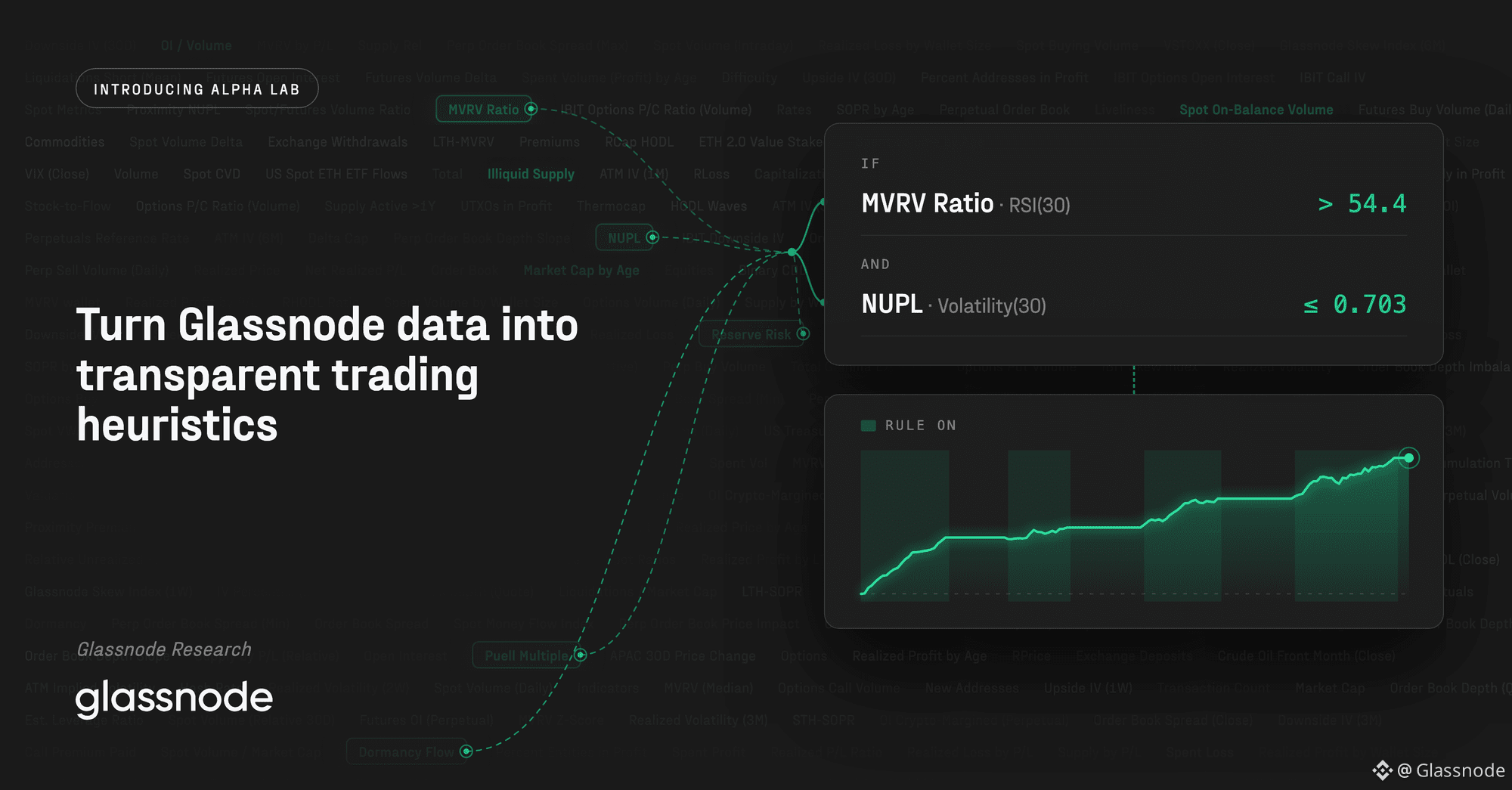
Alpha Lab is a quantitative research platform that searches Glassnode’s data for simple, human-readable trading heuristics. Tell the application what you want to identify, choose the market data you want to investigate, and the research engine tests which combinations have historically been most useful.
The goal is straightforward: turn a large metric universe into a focused set of ideas that an investor can understand, challenge and incorporate into their own research process.
Start with the investment question
Which Glassnode metrics have historically helped identify good buying opportunities in Bitcoin?
From there, the user chooses the metrics the platform should explore, from on-chain and spot data to futures, options and order-book signals, and decides what the search should prioritize. This could be stronger risk-adjusted returns, measured through the Sharpe ratio, or greater absolute performance.
The question sets the asset and the objective; the labeling defines the truth. Every day in the available history is marked as a good buying opportunity or not, based on what the market actually did next. Each selected metric is then expanded into many transformed versions of itself, and the task becomes a simple statistical one: which of those readings were present on the good days and absent on the rest?
Decision trees are built to answer exactly that: every branch is a threshold that separates the good days from the rest. Hundreds are grown together, with an optimizer continually adjusting how they are built. Every attempt is scored the way a trader would score it: on how the resulting strategy would have performed.
The engine then extracts the strongest findings as heuristics rather than returning a black-box prediction. Because each tree is kept deliberately shallow, every path through it that ends in a "yes" is already a concise rule: one or two metric conditions describing a zone where good days clustered. Each zone is then judged on how often it was right and on how much history it rests on.
A result might take the form of:
“When this transformed metric is below X, and this transformed metric is above Y, this is the prime area to improve risk-adjusted return on BTC”
Each rule is accompanied by the evidence needed to evaluate it, including historical return, Sharpe ratio, maximum drawdown, hit rate, trading frequency and an equity curve. Users can compare the rule with the underlying asset, inspect different time horizons and see whether its conditions are firing on the latest available data. It helps surface promising relationships while keeping the underlying logic visible.
Three ways to research
Different investors want different levels of control. The product provides three ways into the same research engine.
Easy mode: Go from a question to ranked heuristics
Easy mode is designed for speed and accessibility. Choose an asset, select whether you want to investigate buying or short opportunities, pick the metrics to scan and set the search effort. Alpha Lab runs the workflow above in the background and returns the most promising rules as readable signal cards — viewable as metric pairs or decomposed into single-metric rules, and filterable to an investor's preferences, for example drawdown, risk-adjusted return, hit rate or a particular evaluation period.
The workflow is iterative by design. Users can refine the metric set, rerun the search and compare the new results with previous attempts. That turns a one-off screen into a structured discovery loop: form a hypothesis, test it, learn from the result and narrow the search.
Advanced mode: Inspect every step
Advanced mode exposes all the steps behind the search. Users can control the feature space by selecting both the source metrics and the transformations applied to them, including z-scores, RSI, moving averages, volatility and percentile-based features. Transformation windows can be adjusted to test how the same underlying metric behaves across different horizons.
They can also define what the model should learn. The research application includes default labelling for long and short opportunities, but users can paint custom zones directly onto the price history.
This opens the door to more specific questions:
Which metrics have historically characterized local bottoms?
What tends to appear near market tops?
Which features are associated with a volatility regime or a parabolic move?
Once the search is complete, Advanced mode shows the path from model to rule. Users can compare machine-learning models, inspect feature influence, review the full heuristic table and analyze individual rules in detail.
The platform also supports stress-testing of heuristic. If a result only works at one exact threshold or lookback window, that is a warning sign. A more credible relationship should remain reasonably stable when nearby parameters change.
Alpha Lab makes that sensitivity visible, helping researchers distinguish a potentially durable pattern from a finely tuned historical accident.
Agents mode: Put Autoresearch to work
Some research questions are better treated as a loop than as a single query.
Through Alpha Lab’s MCP server, compatible AI agents can access the same metric catalogue and optimization engine as the human interface.
An investor can give an agent a research objective, such as exploring groups of metrics until it finds a rule that improves risk-adjusted performance relative to a benchmark and let it run, evaluate and refine successive searches.
This is a natural use case for agentic research. The objective can be defined, the outcome can be measured, and every candidate can be checked against a consistent evaluation framework.
The agent handles the repetition; the investor retains control of the question, assumptions and final judgment. The strongest findings can then be handed back to the visual interface for deeper inspection or saved into a working catalogue.
From discovery to a living catalogue
Alpha Lab’s Catalogue contains strategies that have already been identified and saved by the Glassnode team. Users can browse by asset, direction and risk or performance characteristics, then study how a rule behaved across its full history, out-of-sample period and live window after it was catalogued.
Investors can also save relevant findings to My Catalogue, creating a focused research universe for their own team.
Over time, that working set becomes more than a list of backtests. The platform can surface rules whose recent behavior has weakened, flag overlapping strategies, and help identify gaps in coverage. It also benefits from a Lindy effect: the longer a strategy continues to perform in a live trading environment, on data it has never seen before, the greater the confidence that its behavior is robust rather than a product of overfitting.
The Market Pulse provides another view of the same research base. It aggregates which catalogued long and short rules are currently active, offering a compact read of how the selected body of evidence is leaning—while preserving the ability to inspect the individual rules behind that view.
Together, these features connect discovery with ongoing monitoring. The question shifts from “Did this work historically?” to “Is it still behaving as expected?”
A research process built on sound methodology
Alpha Lab follows robust quantitative-research practices designed to reduce overfitting and test whether a result generalizes beyond the data used to discover it. The methodology builds on proprietary research workflows developed at Glassnode for the Bitcoin Sharpe Signal, informed by more than three years of live track record.
The search is a random forest run over a fixed budget of trials. Tree depth stays capped at two, which limits complexity and keeps each rule readable as two conditions.
Validation runs in three stages. Walk-forward validation trains models on earlier data and evaluates them on later periods, preserving the chronological order of the market.
An out-of-sample holdout reserves the most recent 20% of history, excluded from the search and used only for independent evaluation. Once a rule is catalogued, live evaluation tracks it on newly arriving data that could not have influenced its selection.
Reported performance is net: return and Sharpe ratio both include slippage assumptions.
Together, shallow models, walk-forward analysis, out-of-sample testing, parameter-sensitivity checks and live monitoring help distinguish potentially stable relationships from overfitted historical results. They do not guarantee future performance, but they provide a more disciplined foundation for evaluating each heuristic.
Who Alpha Lab is for
Alpha Lab is built for investors who believe Glassnode data can strengthen their process but want a faster path from exploration to evidence.
For discretionary investors, the product can reveal which metrics and thresholds deserve attention before a market decision.
For quantitative researchers, it provides a configurable environment for feature discovery, model comparison and robustness testing.
For teams experimenting with AI agents, the platform offers a measurable autoresearch loop grounded in the same data and evaluation framework used by the human interface.
The modes are different, but the purpose is the same: make Glassnode’s data easier to turn into research that is focused, transparent and actionable.
Join the beta
Glassnode Alpha Lab is currently available in beta to a limited group of clients. We are looking for research teams and investors who want to test the product against real workflows and help shape what comes next.
If you would like early access, speak with your Glassnode representative or contact the team to join the beta.
Alpha Lab is a research product. Its outputs are based on historical data and do not constitute investment advice or a guarantee of future performance.
Glassnode Alpha Lab
Crypto investors have access to more data than ever. On-chain activity, exchange flows, derivatives positioning, spot markets, order books and network fundamentals can each reveal a different part of the market.
That breadth is one of Glassnode’s greatest strengths. It can also create a difficult first question: Where should I start?
When a catalogue contains thousands of metrics, finding the small set that matters for a specific investment decision can become a research project of its own. Experienced quantitative teams can build pipelines to test combinations, transformations and thresholds. For many investors, however, moving from a chart in Studio to a systematic decision rule still requires too much time, code and specialist knowledge.
We built Glassnode Alpha Lab to close that gap.
TRY GLASSNODE ALPHA LAB
Alpha Lab is a quantitative research platform that searches Glassnode’s data for simple, human-readable trading heuristics. Tell the application what you want to identify, choose the market data you want to investigate, and the research engine tests which combinations have historically been most useful.
The goal is straightforward: turn a large metric universe into a focused set of ideas that an investor can understand, challenge and incorporate into their own research process.
Start with the investment question
Which Glassnode metrics have historically helped identify good buying opportunities in Bitcoin?
From there, the user chooses the metrics the platform should explore, from on-chain and spot data to futures, options and order-book signals, and decides what the search should prioritize. This could be stronger risk-adjusted returns, measured through the Sharpe ratio, or greater absolute performance.
The question sets the asset and the objective; the labeling defines the truth. Every day in the available history is marked as a good buying opportunity or not, based on what the market actually did next. Each selected metric is then expanded into many transformed versions of itself, and the task becomes a simple statistical one: which of those readings were present on the good days and absent on the rest?
Decision trees are built to answer exactly that: every branch is a threshold that separates the good days from the rest. Hundreds are grown together, with an optimizer continually adjusting how they are built. Every attempt is scored the way a trader would score it: on how the resulting strategy would have performed.
The engine then extracts the strongest findings as heuristics rather than returning a black-box prediction. Because each tree is kept deliberately shallow, every path through it that ends in a "yes" is already a concise rule: one or two metric conditions describing a zone where good days clustered. Each zone is then judged on how often it was right and on how much history it rests on.
A result might take the form of:
“When this transformed metric is below X, and this transformed metric is above Y, this is the prime area to improve risk-adjusted return on BTC”
Each rule is accompanied by the evidence needed to evaluate it, including historical return, Sharpe ratio, maximum drawdown, hit rate, trading frequency and an equity curve. Users can compare the rule with the underlying asset, inspect different time horizons and see whether its conditions are firing on the latest available data. It helps surface promising relationships while keeping the underlying logic visible.
Three ways to research
Different investors want different levels of control. The product provides three ways into the same research engine.
Easy mode: Go from a question to ranked heuristics
Easy mode is designed for speed and accessibility. Choose an asset, select whether you want to investigate buying or short opportunities, pick the metrics to scan and set the search effort. Alpha Lab runs the workflow above in the background and returns the most promising rules as readable signal cards — viewable as metric pairs or decomposed into single-metric rules, and filterable to an investor's preferences, for example drawdown, risk-adjusted return, hit rate or a particular evaluation period.
The workflow is iterative by design. Users can refine the metric set, rerun the search and compare the new results with previous attempts. That turns a one-off screen into a structured discovery loop: form a hypothesis, test it, learn from the result and narrow the search.
Advanced mode: Inspect every step
Advanced mode exposes all the steps behind the search. Users can control the feature space by selecting both the source metrics and the transformations applied to them, including z-scores, RSI, moving averages, volatility and percentile-based features. Transformation windows can be adjusted to test how the same underlying metric behaves across different horizons.
They can also define what the model should learn. The research application includes default labelling for long and short opportunities, but users can paint custom zones directly onto the price history.
This opens the door to more specific questions:
Which metrics have historically characterized local bottoms?
What tends to appear near market tops?
Which features are associated with a volatility regime or a parabolic move?
Once the search is complete, Advanced mode shows the path from model to rule. Users can compare machine-learning models, inspect feature influence, review the full heuristic table and analyze individual rules in detail.
The platform also supports stress-testing of heuristic. If a result only works at one exact threshold or lookback window, that is a warning sign. A more credible relationship should remain reasonably stable when nearby parameters change.
Alpha Lab makes that sensitivity visible, helping researchers distinguish a potentially durable pattern from a finely tuned historical accident.
Agents mode: Put Autoresearch to work
Some research questions are better treated as a loop than as a single query.
Through Alpha Lab’s MCP server, compatible AI agents can access the same metric catalogue and optimization engine as the human interface.
An investor can give an agent a research objective, such as exploring groups of metrics until it finds a rule that improves risk-adjusted performance relative to a benchmark and let it run, evaluate and refine successive searches.
This is a natural use case for agentic research. The objective can be defined, the outcome can be measured, and every candidate can be checked against a consistent evaluation framework.
The agent handles the repetition; the investor retains control of the question, assumptions and final judgment. The strongest findings can then be handed back to the visual interface for deeper inspection or saved into a working catalogue.
From discovery to a living catalogue
Alpha Lab’s Catalogue contains strategies that have already been identified and saved by the Glassnode team. Users can browse by asset, direction and risk or performance characteristics, then study how a rule behaved across its full history, out-of-sample period and live window after it was catalogued.
Investors can also save relevant findings to My Catalogue, creating a focused research universe for their own team.
Over time, that working set becomes more than a list of backtests. The platform can surface rules whose recent behavior has weakened, flag overlapping strategies, and help identify gaps in coverage. It also benefits from a Lindy effect: the longer a strategy continues to perform in a live trading environment, on data it has never seen before, the greater the confidence that its behavior is robust rather than a product of overfitting.
The Market Pulse provides another view of the same research base. It aggregates which catalogued long and short rules are currently active, offering a compact read of how the selected body of evidence is leaning—while preserving the ability to inspect the individual rules behind that view.
Together, these features connect discovery with ongoing monitoring. The question shifts from “Did this work historically?” to “Is it still behaving as expected?”
A research process built on sound methodology
Alpha Lab follows robust quantitative-research practices designed to reduce overfitting and test whether a result generalizes beyond the data used to discover it. The methodology builds on proprietary research workflows developed at Glassnode for the Bitcoin Sharpe Signal, informed by more than three years of live track record.
The search is a random forest run over a fixed budget of trials. Tree depth stays capped at two, which limits complexity and keeps each rule readable as two conditions.
Validation runs in three stages. Walk-forward validation trains models on earlier data and evaluates them on later periods, preserving the chronological order of the market.
An out-of-sample holdout reserves the most recent 20% of history, excluded from the search and used only for independent evaluation. Once a rule is catalogued, live evaluation tracks it on newly arriving data that could not have influenced its selection.
Reported performance is net: return and Sharpe ratio both include slippage assumptions.
Together, shallow models, walk-forward analysis, out-of-sample testing, parameter-sensitivity checks and live monitoring help distinguish potentially stable relationships from overfitted historical results. They do not guarantee future performance, but they provide a more disciplined foundation for evaluating each heuristic.
Who Alpha Lab is for
Alpha Lab is built for investors who believe Glassnode data can strengthen their process but want a faster path from exploration to evidence.
For discretionary investors, the product can reveal which metrics and thresholds deserve attention before a market decision.
For quantitative researchers, it provides a configurable environment for feature discovery, model comparison and robustness testing.
For teams experimenting with AI agents, the platform offers a measurable autoresearch loop grounded in the same data and evaluation framework used by the human interface.
The modes are different, but the purpose is the same: make Glassnode’s data easier to turn into research that is focused, transparent and actionable.
Join the beta
Glassnode Alpha Lab is currently available in beta to a limited group of clients. We are looking for research teams and investors who want to test the product against real workflows and help shape what comes next.
If you would like early access, speak with your Glassnode representative or contact the team to join the beta.
Alpha Lab is a research product. Its outputs are based on historical data and do not constitute investment advice or a guarantee of future performance.
That breadth is one of Glassnode’s greatest strengths. It can also create a difficult first question: Where should I start?
When a catalogue contains thousands of metrics, finding the small set that matters for a specific investment decision can become a research project of its own. Experienced quantitative teams can build pipelines to test combinations, transformations and thresholds. For many investors, however, moving from a chart in Studio to a systematic decision rule still requires too much time, code and specialist knowledge.
We built Glassnode Alpha Lab to close that gap.
TRY GLASSNODE ALPHA LAB
Alpha Lab is a quantitative research platform that searches Glassnode’s data for simple, human-readable trading heuristics. Tell the application what you want to identify, choose the market data you want to investigate, and the research engine tests which combinations have historically been most useful.
The goal is straightforward: turn a large metric universe into a focused set of ideas that an investor can understand, challenge and incorporate into their own research process.
Start with the investment question
Which Glassnode metrics have historically helped identify good buying opportunities in Bitcoin?
From there, the user chooses the metrics the platform should explore, from on-chain and spot data to futures, options and order-book signals, and decides what the search should prioritize. This could be stronger risk-adjusted returns, measured through the Sharpe ratio, or greater absolute performance.
The question sets the asset and the objective; the labeling defines the truth. Every day in the available history is marked as a good buying opportunity or not, based on what the market actually did next. Each selected metric is then expanded into many transformed versions of itself, and the task becomes a simple statistical one: which of those readings were present on the good days and absent on the rest?
Decision trees are built to answer exactly that: every branch is a threshold that separates the good days from the rest. Hundreds are grown together, with an optimizer continually adjusting how they are built. Every attempt is scored the way a trader would score it: on how the resulting strategy would have performed.
The engine then extracts the strongest findings as heuristics rather than returning a black-box prediction. Because each tree is kept deliberately shallow, every path through it that ends in a "yes" is already a concise rule: one or two metric conditions describing a zone where good days clustered. Each zone is then judged on how often it was right and on how much history it rests on.
A result might take the form of:
“When this transformed metric is below X, and this transformed metric is above Y, this is the prime area to improve risk-adjusted return on BTC”
Each rule is accompanied by the evidence needed to evaluate it, including historical return, Sharpe ratio, maximum drawdown, hit rate, trading frequency and an equity curve. Users can compare the rule with the underlying asset, inspect different time horizons and see whether its conditions are firing on the latest available data. It helps surface promising relationships while keeping the underlying logic visible.
Three ways to research
Different investors want different levels of control. The product provides three ways into the same research engine.
Easy mode: Go from a question to ranked heuristics
Easy mode is designed for speed and accessibility. Choose an asset, select whether you want to investigate buying or short opportunities, pick the metrics to scan and set the search effort. Alpha Lab runs the workflow above in the background and returns the most promising rules as readable signal cards — viewable as metric pairs or decomposed into single-metric rules, and filterable to an investor's preferences, for example drawdown, risk-adjusted return, hit rate or a particular evaluation period.
The workflow is iterative by design. Users can refine the metric set, rerun the search and compare the new results with previous attempts. That turns a one-off screen into a structured discovery loop: form a hypothesis, test it, learn from the result and narrow the search.
Advanced mode: Inspect every step
Advanced mode exposes all the steps behind the search. Users can control the feature space by selecting both the source metrics and the transformations applied to them, including z-scores, RSI, moving averages, volatility and percentile-based features. Transformation windows can be adjusted to test how the same underlying metric behaves across different horizons.
They can also define what the model should learn. The research application includes default labelling for long and short opportunities, but users can paint custom zones directly onto the price history.
This opens the door to more specific questions:
Which metrics have historically characterized local bottoms?
What tends to appear near market tops?
Which features are associated with a volatility regime or a parabolic move?
Once the search is complete, Advanced mode shows the path from model to rule. Users can compare machine-learning models, inspect feature influence, review the full heuristic table and analyze individual rules in detail.
The platform also supports stress-testing of heuristic. If a result only works at one exact threshold or lookback window, that is a warning sign. A more credible relationship should remain reasonably stable when nearby parameters change.
Alpha Lab makes that sensitivity visible, helping researchers distinguish a potentially durable pattern from a finely tuned historical accident.
Agents mode: Put Autoresearch to work
Some research questions are better treated as a loop than as a single query.
Through Alpha Lab’s MCP server, compatible AI agents can access the same metric catalogue and optimization engine as the human interface.
An investor can give an agent a research objective, such as exploring groups of metrics until it finds a rule that improves risk-adjusted performance relative to a benchmark and let it run, evaluate and refine successive searches.
This is a natural use case for agentic research. The objective can be defined, the outcome can be measured, and every candidate can be checked against a consistent evaluation framework.
The agent handles the repetition; the investor retains control of the question, assumptions and final judgment. The strongest findings can then be handed back to the visual interface for deeper inspection or saved into a working catalogue.
From discovery to a living catalogue
Alpha Lab’s Catalogue contains strategies that have already been identified and saved by the Glassnode team. Users can browse by asset, direction and risk or performance characteristics, then study how a rule behaved across its full history, out-of-sample period and live window after it was catalogued.
Investors can also save relevant findings to My Catalogue, creating a focused research universe for their own team.
Over time, that working set becomes more than a list of backtests. The platform can surface rules whose recent behavior has weakened, flag overlapping strategies, and help identify gaps in coverage. It also benefits from a Lindy effect: the longer a strategy continues to perform in a live trading environment, on data it has never seen before, the greater the confidence that its behavior is robust rather than a product of overfitting.
The Market Pulse provides another view of the same research base. It aggregates which catalogued long and short rules are currently active, offering a compact read of how the selected body of evidence is leaning—while preserving the ability to inspect the individual rules behind that view.
Together, these features connect discovery with ongoing monitoring. The question shifts from “Did this work historically?” to “Is it still behaving as expected?”
A research process built on sound methodology
Alpha Lab follows robust quantitative-research practices designed to reduce overfitting and test whether a result generalizes beyond the data used to discover it. The methodology builds on proprietary research workflows developed at Glassnode for the Bitcoin Sharpe Signal, informed by more than three years of live track record.
The search is a random forest run over a fixed budget of trials. Tree depth stays capped at two, which limits complexity and keeps each rule readable as two conditions.
Validation runs in three stages. Walk-forward validation trains models on earlier data and evaluates them on later periods, preserving the chronological order of the market.
An out-of-sample holdout reserves the most recent 20% of history, excluded from the search and used only for independent evaluation. Once a rule is catalogued, live evaluation tracks it on newly arriving data that could not have influenced its selection.
Reported performance is net: return and Sharpe ratio both include slippage assumptions.
Together, shallow models, walk-forward analysis, out-of-sample testing, parameter-sensitivity checks and live monitoring help distinguish potentially stable relationships from overfitted historical results. They do not guarantee future performance, but they provide a more disciplined foundation for evaluating each heuristic.
Who Alpha Lab is for
Alpha Lab is built for investors who believe Glassnode data can strengthen their process but want a faster path from exploration to evidence.
For discretionary investors, the product can reveal which metrics and thresholds deserve attention before a market decision.
For quantitative researchers, it provides a configurable environment for feature discovery, model comparison and robustness testing.
For teams experimenting with AI agents, the platform offers a measurable autoresearch loop grounded in the same data and evaluation framework used by the human interface.
The modes are different, but the purpose is the same: make Glassnode’s data easier to turn into research that is focused, transparent and actionable.
Join the beta
Glassnode Alpha Lab is currently available in beta to a limited group of clients. We are looking for research teams and investors who want to test the product against real workflows and help shape what comes next.
If you would like early access, speak with your Glassnode representative or contact the team to join the beta.
Alpha Lab is a research product. Its outputs are based on historical data and do not constitute investment advice or a guarantee of future performance.
185
·
--
ບົດຄວາມ
Bybit + Glassnode: the State of Crypto DerivativesThe crypto derivatives landscape has changed shape. On the crypto-native venues, options went from a sideshow to nearly half of notional open interest, and dated futures all but disappeared. In our joint report with Bybit, we analyzed this change in three passes: the whole market, the venues within it, and the conditions the new structure is pricing. Every chart draws on Glassnode's derivatives and market data across the exchanges we track.
Three charts from the report carry the story.
The full report is freely available for download in PDF format.
Download report PDF The options book grew through two full cycles
Seven years, two full cycles, and the climb barely paused for the bear market.
Seven years of options open interest, and the climb barely paused for the bear market Options took the share that dated futures gave up
Dated futures faded from the crypto-native venues, perpetuals absorbed their leverage, and options took the share they left over.
On open interest, options went from a quarter of crypto-native Bitcoin derivatives to nearly half Each venue's traders keep different hours
Hour by hour, the profile shows when the traders on each venue are actually active. Each exchange has a distinct profile.
Four venues, one week, hour by hour, each against its own flat clock What else the report covers
How the market carries leverage: the collateral behind it moved from coin to stable value.
The venue map for options, perpetuals and tokenised gold, every venue compared the same way.
Bybit's own book: its options franchise, its Ether and metals complexes, and a trading week that runs around the clock.
What volatility costs: the implied volatility surface, and options priced against the volatility the market delivered.
Five days in August: how the sharpest week of the drawdown traded in open interest, skew and the curve.
To explore the data and insights, download the full analysis in PDF format.
Download report PDF
Disclaimer: This report does not provide any investment advice. All data is provided for information and educational purposes only. No investment decision shall be based on the information provided here and you are solely responsible for your own investment decisions. We urge users to exercise caution and discretion when utilizing these metrics. Glassnode shall not be held responsible for any discrepancies or potential inaccuracies.
Follow us on X for timely market updates and analysis
Join our Telegram channel
For on-chain metrics, dashboards, and alerts, visit Glassnode Studio
Bybit + Glassnode: the State of Crypto Derivatives
The crypto derivatives landscape has changed shape. On the crypto-native venues, options went from a sideshow to nearly half of notional open interest, and dated futures all but disappeared. In our joint report with Bybit, we analyzed this change in three passes: the whole market, the venues within it, and the conditions the new structure is pricing. Every chart draws on Glassnode's derivatives and market data across the exchanges we track.
Three charts from the report carry the story.
The full report is freely available for download in PDF format.
Download report PDF The options book grew through two full cycles
Seven years, two full cycles, and the climb barely paused for the bear market.
Seven years of options open interest, and the climb barely paused for the bear market Options took the share that dated futures gave up
Dated futures faded from the crypto-native venues, perpetuals absorbed their leverage, and options took the share they left over.
On open interest, options went from a quarter of crypto-native Bitcoin derivatives to nearly half Each venue's traders keep different hours
Hour by hour, the profile shows when the traders on each venue are actually active. Each exchange has a distinct profile.
Four venues, one week, hour by hour, each against its own flat clock What else the report covers
How the market carries leverage: the collateral behind it moved from coin to stable value.
The venue map for options, perpetuals and tokenised gold, every venue compared the same way.
Bybit's own book: its options franchise, its Ether and metals complexes, and a trading week that runs around the clock.
What volatility costs: the implied volatility surface, and options priced against the volatility the market delivered.
Five days in August: how the sharpest week of the drawdown traded in open interest, skew and the curve.
To explore the data and insights, download the full analysis in PDF format.
Download report PDF
Disclaimer: This report does not provide any investment advice. All data is provided for information and educational purposes only. No investment decision shall be based on the information provided here and you are solely responsible for your own investment decisions. We urge users to exercise caution and discretion when utilizing these metrics. Glassnode shall not be held responsible for any discrepancies or potential inaccuracies.
Follow us on X for timely market updates and analysis
Join our Telegram channel
For on-chain metrics, dashboards, and alerts, visit Glassnode Studio
Three charts from the report carry the story.
The full report is freely available for download in PDF format.
Download report PDF The options book grew through two full cycles
Seven years, two full cycles, and the climb barely paused for the bear market.
Seven years of options open interest, and the climb barely paused for the bear market Options took the share that dated futures gave up
Dated futures faded from the crypto-native venues, perpetuals absorbed their leverage, and options took the share they left over.
On open interest, options went from a quarter of crypto-native Bitcoin derivatives to nearly half Each venue's traders keep different hours
Hour by hour, the profile shows when the traders on each venue are actually active. Each exchange has a distinct profile.
Four venues, one week, hour by hour, each against its own flat clock What else the report covers
How the market carries leverage: the collateral behind it moved from coin to stable value.
The venue map for options, perpetuals and tokenised gold, every venue compared the same way.
Bybit's own book: its options franchise, its Ether and metals complexes, and a trading week that runs around the clock.
What volatility costs: the implied volatility surface, and options priced against the volatility the market delivered.
Five days in August: how the sharpest week of the drawdown traded in open interest, skew and the curve.
To explore the data and insights, download the full analysis in PDF format.
Download report PDF
Disclaimer: This report does not provide any investment advice. All data is provided for information and educational purposes only. No investment decision shall be based on the information provided here and you are solely responsible for your own investment decisions. We urge users to exercise caution and discretion when utilizing these metrics. Glassnode shall not be held responsible for any discrepancies or potential inaccuracies.
Follow us on X for timely market updates and analysis
Join our Telegram channel
For on-chain metrics, dashboards, and alerts, visit Glassnode Studio
112
·
--
ບົດຄວາມ
Market Compass: the Dollar Takes It BackThe Market Compass reads the whole crypto market in one view: seven lenses, one composite score, updated every day. This article is the latest snapshot.
Access now (Advanced & Professional)
New to the Market Compass? Learn more here.
The full report for this edition is freely available in PDF format.
Download PDF version The State of the Market
The Composite fell three points to 23/100 (Defensive), two below its level of a week ago and five below a month ago. Macro dropped eight points on the week to 31/100 and crossed back into Restrictive as the dollar index returned to its 200-day average, so three weeks of macro repair were given back in a single session. On-Chain Fundamentals rose to 52, the best of this run, while Capital Flows, Cycle Position and Investor Behaviour all held exactly where they were. One lens moved and it moved the whole board.
Under the headline, two charts carry this edition's story: how broadly the market ran in late August, and who used the bounce to sell.
The Whole Field Ran at Once
In late August the whole field of assets ran up together, the largest burst of cross-asset gains this year, with the Altcoin Season Index back at 75 and mid caps leading the thirty-day table. Broad, simultaneous rallies of this kind have often marked risk zones rather than the start of a durable advance. The burst has already faded: the median seven-day return across assets is back near zero, and the index has touched and lost the altseason line once already.
View in the Market Compass Both Cohorts Took Profit on the Bounce
Bitcoin bounced to trade near a 47% premium to its realized price, and the holders behind it used the bounce to sell. Realized flow flipped from mostly loss to mostly profit over the past three weeks, split about evenly between long- and short-term holders, while the loss side of the chart thinned to a fraction of the flow. The Realized Profit/Loss Ratio set another run high at 2.63. Profit-taking this one-sided is what the chart showed through the 2024 and 2025 advances, and the roll-off the cycle lens expects has not started yet.
What flips it: the dollar closing above its 200-day average would confirm Macro's reversal and take the composite lower, while Investor Behaviour finally turning up would offset it.
View in the Market Compass
This article is a point-in-time snapshot. If you want the live picture and how it shifts day by day, the full dashboard with the daily analyst read is available to Glassnode Advanced and Professional members. Open the Market Compass to see where the market stands right now, or learn more about the Market Compass.
Disclaimer: This report does not provide any investment advice. All data is provided for informational and educational purposes only. No investment decision shall be based on the information provided here, and you are solely responsible for your own investment decisions.
Exchange balances presented are derived from Glassnode’s comprehensive database of address labels, which are amassed through both officially published exchange information and proprietary clustering algorithms. While we strive to ensure the utmost accuracy in representing exchange balances, it is important to note that these figures might not always encapsulate the entirety of an exchange’s reserves, particularly when exchanges refrain from disclosing their official addresses. We urge users to exercise caution and discretion when utilizing these metrics. Glassnode shall not be held responsible for any discrepancies or potential inaccuracies.
Market Compass: the Dollar Takes It Back
The Market Compass reads the whole crypto market in one view: seven lenses, one composite score, updated every day. This article is the latest snapshot.
Access now (Advanced & Professional)
New to the Market Compass? Learn more here.
The full report for this edition is freely available in PDF format.
Download PDF version The State of the Market
The Composite fell three points to 23/100 (Defensive), two below its level of a week ago and five below a month ago. Macro dropped eight points on the week to 31/100 and crossed back into Restrictive as the dollar index returned to its 200-day average, so three weeks of macro repair were given back in a single session. On-Chain Fundamentals rose to 52, the best of this run, while Capital Flows, Cycle Position and Investor Behaviour all held exactly where they were. One lens moved and it moved the whole board.
Under the headline, two charts carry this edition's story: how broadly the market ran in late August, and who used the bounce to sell.
The Whole Field Ran at Once
In late August the whole field of assets ran up together, the largest burst of cross-asset gains this year, with the Altcoin Season Index back at 75 and mid caps leading the thirty-day table. Broad, simultaneous rallies of this kind have often marked risk zones rather than the start of a durable advance. The burst has already faded: the median seven-day return across assets is back near zero, and the index has touched and lost the altseason line once already.
View in the Market Compass Both Cohorts Took Profit on the Bounce
Bitcoin bounced to trade near a 47% premium to its realized price, and the holders behind it used the bounce to sell. Realized flow flipped from mostly loss to mostly profit over the past three weeks, split about evenly between long- and short-term holders, while the loss side of the chart thinned to a fraction of the flow. The Realized Profit/Loss Ratio set another run high at 2.63. Profit-taking this one-sided is what the chart showed through the 2024 and 2025 advances, and the roll-off the cycle lens expects has not started yet.
What flips it: the dollar closing above its 200-day average would confirm Macro's reversal and take the composite lower, while Investor Behaviour finally turning up would offset it.
View in the Market Compass
This article is a point-in-time snapshot. If you want the live picture and how it shifts day by day, the full dashboard with the daily analyst read is available to Glassnode Advanced and Professional members. Open the Market Compass to see where the market stands right now, or learn more about the Market Compass.
Disclaimer: This report does not provide any investment advice. All data is provided for informational and educational purposes only. No investment decision shall be based on the information provided here, and you are solely responsible for your own investment decisions.
Exchange balances presented are derived from Glassnode’s comprehensive database of address labels, which are amassed through both officially published exchange information and proprietary clustering algorithms. While we strive to ensure the utmost accuracy in representing exchange balances, it is important to note that these figures might not always encapsulate the entirety of an exchange’s reserves, particularly when exchanges refrain from disclosing their official addresses. We urge users to exercise caution and discretion when utilizing these metrics. Glassnode shall not be held responsible for any discrepancies or potential inaccuracies.
Access now (Advanced & Professional)
New to the Market Compass? Learn more here.
The full report for this edition is freely available in PDF format.
Download PDF version The State of the Market
The Composite fell three points to 23/100 (Defensive), two below its level of a week ago and five below a month ago. Macro dropped eight points on the week to 31/100 and crossed back into Restrictive as the dollar index returned to its 200-day average, so three weeks of macro repair were given back in a single session. On-Chain Fundamentals rose to 52, the best of this run, while Capital Flows, Cycle Position and Investor Behaviour all held exactly where they were. One lens moved and it moved the whole board.
Under the headline, two charts carry this edition's story: how broadly the market ran in late August, and who used the bounce to sell.
The Whole Field Ran at Once
In late August the whole field of assets ran up together, the largest burst of cross-asset gains this year, with the Altcoin Season Index back at 75 and mid caps leading the thirty-day table. Broad, simultaneous rallies of this kind have often marked risk zones rather than the start of a durable advance. The burst has already faded: the median seven-day return across assets is back near zero, and the index has touched and lost the altseason line once already.
View in the Market Compass Both Cohorts Took Profit on the Bounce
Bitcoin bounced to trade near a 47% premium to its realized price, and the holders behind it used the bounce to sell. Realized flow flipped from mostly loss to mostly profit over the past three weeks, split about evenly between long- and short-term holders, while the loss side of the chart thinned to a fraction of the flow. The Realized Profit/Loss Ratio set another run high at 2.63. Profit-taking this one-sided is what the chart showed through the 2024 and 2025 advances, and the roll-off the cycle lens expects has not started yet.
What flips it: the dollar closing above its 200-day average would confirm Macro's reversal and take the composite lower, while Investor Behaviour finally turning up would offset it.
View in the Market Compass
This article is a point-in-time snapshot. If you want the live picture and how it shifts day by day, the full dashboard with the daily analyst read is available to Glassnode Advanced and Professional members. Open the Market Compass to see where the market stands right now, or learn more about the Market Compass.
Disclaimer: This report does not provide any investment advice. All data is provided for informational and educational purposes only. No investment decision shall be based on the information provided here, and you are solely responsible for your own investment decisions.
Exchange balances presented are derived from Glassnode’s comprehensive database of address labels, which are amassed through both officially published exchange information and proprietary clustering algorithms. While we strive to ensure the utmost accuracy in representing exchange balances, it is important to note that these figures might not always encapsulate the entirety of an exchange’s reserves, particularly when exchanges refrain from disclosing their official addresses. We urge users to exercise caution and discretion when utilizing these metrics. Glassnode shall not be held responsible for any discrepancies or potential inaccuracies.
138
·
--
ບົດຄວາມ
Doubt At the BoundariesExecutive Summary
The relief rally initiated by the August short squeeze carried spot into the $80K region before encountering expected overhead resistance.
When price retested May levels, on-chain supply in profit was higher at 68% compared to 65% previously, reflecting summer redistribution and creating heavier potential sell pressure.
Spot Bitcoin ETFs absorbed $290M per day at their peak, but secondary turnover remained quiet near $3B per day, typical of news-driven impulses that lack sustained velocity.
The macro backdrop reasserted pressure as the US 10-Year Treasury yield climbed to 4.8%, erasing the entire Treasury buyback relief within eight trading sessions.
Short-term options skew has rolled over as market sentiment cooled from euphoria, while the September 25 quarter-end expiry forms a $14B open interest barrier.
Ready to get ahead of markets and sharpen your foresight? Try Glassnode. Sign up or talk to sales.
Explore the Market Compass Squeeze Aftermath Rejection Below the Wall
In the previous edition, we noted that while the August 19 short squeeze cleared substantial leverage, the advance was running directly into dense overhead structure. That dynamic materialized over the past week. After pushing above $80K on August 27, price met steady supply and turned lower toward $76K, triggering a sequence of long liquidations.
The futures liquidation heatmap demonstrates the bilateral structure bracketing price. While the upward impulse consumed short orders in its path, it stopped short of the dense cluster of short liquidations situated between $83K and $86K. Below spot, the move left behind an intact band of long liquidation fuel between $60K and $63K. Price now trades between these two boundaries.
Live Chart On-Chain Supply The Profit Overhang
A subtle friction facing this recovery appears in the distribution of network profitability. When Bitcoin traded near $78K in May, roughly 65% of supply was held in profit. When spot returned to the identical level in late August, the share of supply in profit climbed to 68%.
This shift reflects summer accumulation that reset the Short-Term Holder Cost Basis near $71K. Identical nominal prices now activate a larger volume of profitable coins, creating an expanded pool of latent sell-side liquidity when spot tests prior highs.
Live Chart Defined Range Boundaries
Combining on-chain cost basis models with the coin distribution profile establishes clear structural bands.
Below current spot, the summer consolidation provides a firm accumulation floor between $62K and $65K. Overhead, the market confronts heavy Long-Term Holder supply between $83K and $86K. Spot remains contained between these two zones.
Live Chart Institutional Rails Muted Turnover
US spot Bitcoin ETFs absorbed steady capital through the rally, lifting their seven-day average intake to $290M per day.
Secondary trading activity, however, told a quieter story. Daily ETF trading volume held near $3B per day, far below the activity that accompanied earlier expansionary phases. Inflows driven by discrete policy headlines that lack broader market velocity often coincide with local inflection points that retrace once the immediate catalyst clears.
Live Chart Macro Backdrop Sovereign Yields Rebound
The broader macroeconomic environment has quickly resumed its restrictive stance. Following the Treasury buyback announcement on August 19, which temporarily pulled the US 10-Year yield down toward 4.6%, yields sharply reversed course.
Over the subsequent eight trading sessions, the 10-Year yield climbed back to 4.8%, printing fresh cycle highs. The rapid reversal indicates that sovereign debt pressures remain the primary driver of global discount rates.
Live Chart Transient Equity Decorrelation
During the initial impulse, Bitcoin decoupled briefly from traditional equities as US stock indices traded flat.
The rolling 30-session correlation between Bitcoin and the S&P 500 fell toward zero. Historically, sudden decorrelations during sovereign bond selloffs have tended to be short-lived phenomena marking local exhaustion rather than structural regime shifts.
Live Chart Derivatives and Expiries Sentiment Cools from Euphoria
Options markets capture the rapid psychological rotation of the past fortnight. The 7-day 25-delta skew index spiked sharply during the squeeze as market participants chased upside calls, before rapidly mean-reverting back toward neutral as resistance held.
Longer-dated 180-day skew remained steady throughout the move, showing that while short-term enthusiasm has cooled, structural demand for long-term optionality remains intact.
Live Chart The September Expiry Barrier
The forward options landscape is dominated by the September 25 quarter-end expiration, which represents roughly $14B in open interest across Deribit and IBIT.
With substantial open interest clustered at strikes above $80K, the approaching quarter-end expiry represents a significant volatility and positioning anchor for the weeks ahead.
Live Chart Conclusion
The relief rally that followed the August short squeeze has stalled beneath the $83K-$86K supply band. With network profitability sitting higher at comparable prices, sovereign bond yields setting fresh cycle highs, and options markets resetting back to neutral, the market remains bounded within its established range. Until the overhead ceiling is absorbed, the structural floor between $62K and $65K defines the primary downside reference.
Disclaimer: This report does not provide any investment advice. All data is provided for informational and educational purposes only. No investment decision shall be based on the information provided here, and you are solely responsible for your own investment decisions.
Exchange balances presented are derived from Glassnode’s comprehensive database of address labels, which are amassed through both officially published exchange information and proprietary clustering algorithms. While we strive to ensure the utmost accuracy in representing exchange balances, it is important to note that these figures might not always encapsulate the entirety of an exchange’s reserves, particularly when exchanges refrain from disclosing their official addresses. We urge users to exercise caution and discretion when utilizing these metrics. Glassnode shall not be held responsible for any discrepancies or potential inaccuracies.
Doubt At the Boundaries
Executive Summary
The relief rally initiated by the August short squeeze carried spot into the $80K region before encountering expected overhead resistance.
When price retested May levels, on-chain supply in profit was higher at 68% compared to 65% previously, reflecting summer redistribution and creating heavier potential sell pressure.
Spot Bitcoin ETFs absorbed $290M per day at their peak, but secondary turnover remained quiet near $3B per day, typical of news-driven impulses that lack sustained velocity.
The macro backdrop reasserted pressure as the US 10-Year Treasury yield climbed to 4.8%, erasing the entire Treasury buyback relief within eight trading sessions.
Short-term options skew has rolled over as market sentiment cooled from euphoria, while the September 25 quarter-end expiry forms a $14B open interest barrier.
Ready to get ahead of markets and sharpen your foresight? Try Glassnode. Sign up or talk to sales.
Explore the Market Compass Squeeze Aftermath Rejection Below the Wall
In the previous edition, we noted that while the August 19 short squeeze cleared substantial leverage, the advance was running directly into dense overhead structure. That dynamic materialized over the past week. After pushing above $80K on August 27, price met steady supply and turned lower toward $76K, triggering a sequence of long liquidations.
The futures liquidation heatmap demonstrates the bilateral structure bracketing price. While the upward impulse consumed short orders in its path, it stopped short of the dense cluster of short liquidations situated between $83K and $86K. Below spot, the move left behind an intact band of long liquidation fuel between $60K and $63K. Price now trades between these two boundaries.
Live Chart On-Chain Supply The Profit Overhang
A subtle friction facing this recovery appears in the distribution of network profitability. When Bitcoin traded near $78K in May, roughly 65% of supply was held in profit. When spot returned to the identical level in late August, the share of supply in profit climbed to 68%.
This shift reflects summer accumulation that reset the Short-Term Holder Cost Basis near $71K. Identical nominal prices now activate a larger volume of profitable coins, creating an expanded pool of latent sell-side liquidity when spot tests prior highs.
Live Chart Defined Range Boundaries
Combining on-chain cost basis models with the coin distribution profile establishes clear structural bands.
Below current spot, the summer consolidation provides a firm accumulation floor between $62K and $65K. Overhead, the market confronts heavy Long-Term Holder supply between $83K and $86K. Spot remains contained between these two zones.
Live Chart Institutional Rails Muted Turnover
US spot Bitcoin ETFs absorbed steady capital through the rally, lifting their seven-day average intake to $290M per day.
Secondary trading activity, however, told a quieter story. Daily ETF trading volume held near $3B per day, far below the activity that accompanied earlier expansionary phases. Inflows driven by discrete policy headlines that lack broader market velocity often coincide with local inflection points that retrace once the immediate catalyst clears.
Live Chart Macro Backdrop Sovereign Yields Rebound
The broader macroeconomic environment has quickly resumed its restrictive stance. Following the Treasury buyback announcement on August 19, which temporarily pulled the US 10-Year yield down toward 4.6%, yields sharply reversed course.
Over the subsequent eight trading sessions, the 10-Year yield climbed back to 4.8%, printing fresh cycle highs. The rapid reversal indicates that sovereign debt pressures remain the primary driver of global discount rates.
Live Chart Transient Equity Decorrelation
During the initial impulse, Bitcoin decoupled briefly from traditional equities as US stock indices traded flat.
The rolling 30-session correlation between Bitcoin and the S&P 500 fell toward zero. Historically, sudden decorrelations during sovereign bond selloffs have tended to be short-lived phenomena marking local exhaustion rather than structural regime shifts.
Live Chart Derivatives and Expiries Sentiment Cools from Euphoria
Options markets capture the rapid psychological rotation of the past fortnight. The 7-day 25-delta skew index spiked sharply during the squeeze as market participants chased upside calls, before rapidly mean-reverting back toward neutral as resistance held.
Longer-dated 180-day skew remained steady throughout the move, showing that while short-term enthusiasm has cooled, structural demand for long-term optionality remains intact.
Live Chart The September Expiry Barrier
The forward options landscape is dominated by the September 25 quarter-end expiration, which represents roughly $14B in open interest across Deribit and IBIT.
With substantial open interest clustered at strikes above $80K, the approaching quarter-end expiry represents a significant volatility and positioning anchor for the weeks ahead.
Live Chart Conclusion
The relief rally that followed the August short squeeze has stalled beneath the $83K-$86K supply band. With network profitability sitting higher at comparable prices, sovereign bond yields setting fresh cycle highs, and options markets resetting back to neutral, the market remains bounded within its established range. Until the overhead ceiling is absorbed, the structural floor between $62K and $65K defines the primary downside reference.
Disclaimer: This report does not provide any investment advice. All data is provided for informational and educational purposes only. No investment decision shall be based on the information provided here, and you are solely responsible for your own investment decisions.
Exchange balances presented are derived from Glassnode’s comprehensive database of address labels, which are amassed through both officially published exchange information and proprietary clustering algorithms. While we strive to ensure the utmost accuracy in representing exchange balances, it is important to note that these figures might not always encapsulate the entirety of an exchange’s reserves, particularly when exchanges refrain from disclosing their official addresses. We urge users to exercise caution and discretion when utilizing these metrics. Glassnode shall not be held responsible for any discrepancies or potential inaccuracies.
The relief rally initiated by the August short squeeze carried spot into the $80K region before encountering expected overhead resistance.
When price retested May levels, on-chain supply in profit was higher at 68% compared to 65% previously, reflecting summer redistribution and creating heavier potential sell pressure.
Spot Bitcoin ETFs absorbed $290M per day at their peak, but secondary turnover remained quiet near $3B per day, typical of news-driven impulses that lack sustained velocity.
The macro backdrop reasserted pressure as the US 10-Year Treasury yield climbed to 4.8%, erasing the entire Treasury buyback relief within eight trading sessions.
Short-term options skew has rolled over as market sentiment cooled from euphoria, while the September 25 quarter-end expiry forms a $14B open interest barrier.
Ready to get ahead of markets and sharpen your foresight? Try Glassnode. Sign up or talk to sales.
Explore the Market Compass Squeeze Aftermath Rejection Below the Wall
In the previous edition, we noted that while the August 19 short squeeze cleared substantial leverage, the advance was running directly into dense overhead structure. That dynamic materialized over the past week. After pushing above $80K on August 27, price met steady supply and turned lower toward $76K, triggering a sequence of long liquidations.
The futures liquidation heatmap demonstrates the bilateral structure bracketing price. While the upward impulse consumed short orders in its path, it stopped short of the dense cluster of short liquidations situated between $83K and $86K. Below spot, the move left behind an intact band of long liquidation fuel between $60K and $63K. Price now trades between these two boundaries.
Live Chart On-Chain Supply The Profit Overhang
A subtle friction facing this recovery appears in the distribution of network profitability. When Bitcoin traded near $78K in May, roughly 65% of supply was held in profit. When spot returned to the identical level in late August, the share of supply in profit climbed to 68%.
This shift reflects summer accumulation that reset the Short-Term Holder Cost Basis near $71K. Identical nominal prices now activate a larger volume of profitable coins, creating an expanded pool of latent sell-side liquidity when spot tests prior highs.
Live Chart Defined Range Boundaries
Combining on-chain cost basis models with the coin distribution profile establishes clear structural bands.
Below current spot, the summer consolidation provides a firm accumulation floor between $62K and $65K. Overhead, the market confronts heavy Long-Term Holder supply between $83K and $86K. Spot remains contained between these two zones.
Live Chart Institutional Rails Muted Turnover
US spot Bitcoin ETFs absorbed steady capital through the rally, lifting their seven-day average intake to $290M per day.
Secondary trading activity, however, told a quieter story. Daily ETF trading volume held near $3B per day, far below the activity that accompanied earlier expansionary phases. Inflows driven by discrete policy headlines that lack broader market velocity often coincide with local inflection points that retrace once the immediate catalyst clears.
Live Chart Macro Backdrop Sovereign Yields Rebound
The broader macroeconomic environment has quickly resumed its restrictive stance. Following the Treasury buyback announcement on August 19, which temporarily pulled the US 10-Year yield down toward 4.6%, yields sharply reversed course.
Over the subsequent eight trading sessions, the 10-Year yield climbed back to 4.8%, printing fresh cycle highs. The rapid reversal indicates that sovereign debt pressures remain the primary driver of global discount rates.
Live Chart Transient Equity Decorrelation
During the initial impulse, Bitcoin decoupled briefly from traditional equities as US stock indices traded flat.
The rolling 30-session correlation between Bitcoin and the S&P 500 fell toward zero. Historically, sudden decorrelations during sovereign bond selloffs have tended to be short-lived phenomena marking local exhaustion rather than structural regime shifts.
Live Chart Derivatives and Expiries Sentiment Cools from Euphoria
Options markets capture the rapid psychological rotation of the past fortnight. The 7-day 25-delta skew index spiked sharply during the squeeze as market participants chased upside calls, before rapidly mean-reverting back toward neutral as resistance held.
Longer-dated 180-day skew remained steady throughout the move, showing that while short-term enthusiasm has cooled, structural demand for long-term optionality remains intact.
Live Chart The September Expiry Barrier
The forward options landscape is dominated by the September 25 quarter-end expiration, which represents roughly $14B in open interest across Deribit and IBIT.
With substantial open interest clustered at strikes above $80K, the approaching quarter-end expiry represents a significant volatility and positioning anchor for the weeks ahead.
Live Chart Conclusion
The relief rally that followed the August short squeeze has stalled beneath the $83K-$86K supply band. With network profitability sitting higher at comparable prices, sovereign bond yields setting fresh cycle highs, and options markets resetting back to neutral, the market remains bounded within its established range. Until the overhead ceiling is absorbed, the structural floor between $62K and $65K defines the primary downside reference.
Disclaimer: This report does not provide any investment advice. All data is provided for informational and educational purposes only. No investment decision shall be based on the information provided here, and you are solely responsible for your own investment decisions.
Exchange balances presented are derived from Glassnode’s comprehensive database of address labels, which are amassed through both officially published exchange information and proprietary clustering algorithms. While we strive to ensure the utmost accuracy in representing exchange balances, it is important to note that these figures might not always encapsulate the entirety of an exchange’s reserves, particularly when exchanges refrain from disclosing their official addresses. We urge users to exercise caution and discretion when utilizing these metrics. Glassnode shall not be held responsible for any discrepancies or potential inaccuracies.
211
·
--
ບົດຄວາມ
Ark Invest + Glassnode: the Decentralization SpectrumWhere does a blockchain really sit between decentralized and centralized? The two labels are often treated as binary alternatives, but the reality is more nuanced: every design choice — from block size to staking model — places a network somewhere along a spectrum, and every position on that spectrum comes with tradeoffs.
The Decentralization Spectrum is a new joint report by ARK Invest and Glassnode. It examines the three largest blockchain networks — Bitcoin, Ethereum, and Solana — through four design features: auditability, security, governance, and ownership. It then quantifies each network's position with a six-dimension scoring framework built on data from Glassnode and a wide range of network sources.
📄 Download the full report. One Spectrum, Four Design Features
Decentralized and centralized architectures weight the four design features very differently. A fully auditable network lets anyone verify the ledger by running a full node. Distributed consensus raises the real-world cost of coordination an adversary must bear. Community-driven governance precludes unilateral upgrades, and widely dispersed ownership prevents any insider group from dominating decision making. Averaging the report's six dimension scores places the Big Three in a clear order:
Source: ARK Investment Management LLC and Glassnode, 2026 Who Really Controls Block Production?
Security ultimately asks a simple question: how many independent parties would need to collude to alter the ledger? The report measures the concentration of hash rate and stake, the capital required to acquire 1% of each network, exit fluidity, and client diversity. Some of the findings will surprise: Bitcoin and Ethereum cross their critical control thresholds with just three entities each, while Solana requires 19 — though pools and delegation nuance that picture considerably. And while a Bitcoin miner can exit a 1% position in roughly 30 seconds by switching off hardware, unstaking the equivalent on Ethereum can take weeks under stress.
Source: ARK Investment Management LLC and Glassnode, 2026 Source: ARK Investment Management LLC and Glassnode, 2026 The Geography of Decentralization
Where infrastructure physically lives shapes how resilient a network is against coordinated coercion. Bitcoin's node footprint is the most evenly spread — and 63% of its nodes operate behind Tor. Ethereum leans on cloud providers, with AWS alone hosting roughly 20% of its nodes. Solana runs essentially all of its infrastructure in data centers, by design. The report maps regions, hosting environments, and provider concentration for all three networks.
Source: ARK Investment Management LLC and Glassnode, 2026 Six Dimensions, One Scorecard
The quantitative core of the report scores each network across six dimensions: ownership distribution, exit fluidity, network verification overhead, critical resilience threshold, blockchain reconstruction overhead, and geographic & provider resilience. No network leads on every dimension. Bitcoin scores strongest on auditability, ownership distribution, and geographic resilience; Ethereum balances the middle ground; Solana trades decentralization for performance and coordination speed. A full methodology appendix documents the math behind every score.
Source: ARK Investment Management LLC and Glassnode, 2026 Read the Full Report
Different use cases tolerate different risk profiles — a high-throughput payment network and a settlement layer for high-value institutional assets sit at different points of the spectrum on purpose. The full report walks through every design feature and all six quantitative dimensions, including node economics, governance case studies from Bitcoin's SegWit to Solana's SIMD-228, and supply distribution data for all three networks.
📄 Download the full report.
Disclaimer: This report does not provide any investment advice. All data is provided for information and educational purposes only. No investment decision shall be based on the information provided here and you are solely responsible for your own investment decisions.
Join our Telegram channel
Follow us and reach out on Twitter
For digital asset metrics and dashboards visit Glassnode Studio
Ark Invest + Glassnode: the Decentralization Spectrum
Where does a blockchain really sit between decentralized and centralized? The two labels are often treated as binary alternatives, but the reality is more nuanced: every design choice — from block size to staking model — places a network somewhere along a spectrum, and every position on that spectrum comes with tradeoffs.
The Decentralization Spectrum is a new joint report by ARK Invest and Glassnode. It examines the three largest blockchain networks — Bitcoin, Ethereum, and Solana — through four design features: auditability, security, governance, and ownership. It then quantifies each network's position with a six-dimension scoring framework built on data from Glassnode and a wide range of network sources.
📄 Download the full report. One Spectrum, Four Design Features
Decentralized and centralized architectures weight the four design features very differently. A fully auditable network lets anyone verify the ledger by running a full node. Distributed consensus raises the real-world cost of coordination an adversary must bear. Community-driven governance precludes unilateral upgrades, and widely dispersed ownership prevents any insider group from dominating decision making. Averaging the report's six dimension scores places the Big Three in a clear order:
Source: ARK Investment Management LLC and Glassnode, 2026 Who Really Controls Block Production?
Security ultimately asks a simple question: how many independent parties would need to collude to alter the ledger? The report measures the concentration of hash rate and stake, the capital required to acquire 1% of each network, exit fluidity, and client diversity. Some of the findings will surprise: Bitcoin and Ethereum cross their critical control thresholds with just three entities each, while Solana requires 19 — though pools and delegation nuance that picture considerably. And while a Bitcoin miner can exit a 1% position in roughly 30 seconds by switching off hardware, unstaking the equivalent on Ethereum can take weeks under stress.
Source: ARK Investment Management LLC and Glassnode, 2026 Source: ARK Investment Management LLC and Glassnode, 2026 The Geography of Decentralization
Where infrastructure physically lives shapes how resilient a network is against coordinated coercion. Bitcoin's node footprint is the most evenly spread — and 63% of its nodes operate behind Tor. Ethereum leans on cloud providers, with AWS alone hosting roughly 20% of its nodes. Solana runs essentially all of its infrastructure in data centers, by design. The report maps regions, hosting environments, and provider concentration for all three networks.
Source: ARK Investment Management LLC and Glassnode, 2026 Six Dimensions, One Scorecard
The quantitative core of the report scores each network across six dimensions: ownership distribution, exit fluidity, network verification overhead, critical resilience threshold, blockchain reconstruction overhead, and geographic & provider resilience. No network leads on every dimension. Bitcoin scores strongest on auditability, ownership distribution, and geographic resilience; Ethereum balances the middle ground; Solana trades decentralization for performance and coordination speed. A full methodology appendix documents the math behind every score.
Source: ARK Investment Management LLC and Glassnode, 2026 Read the Full Report
Different use cases tolerate different risk profiles — a high-throughput payment network and a settlement layer for high-value institutional assets sit at different points of the spectrum on purpose. The full report walks through every design feature and all six quantitative dimensions, including node economics, governance case studies from Bitcoin's SegWit to Solana's SIMD-228, and supply distribution data for all three networks.
📄 Download the full report.
Disclaimer: This report does not provide any investment advice. All data is provided for information and educational purposes only. No investment decision shall be based on the information provided here and you are solely responsible for your own investment decisions.
Join our Telegram channel
Follow us and reach out on Twitter
For digital asset metrics and dashboards visit Glassnode Studio
The Decentralization Spectrum is a new joint report by ARK Invest and Glassnode. It examines the three largest blockchain networks — Bitcoin, Ethereum, and Solana — through four design features: auditability, security, governance, and ownership. It then quantifies each network's position with a six-dimension scoring framework built on data from Glassnode and a wide range of network sources.
📄 Download the full report. One Spectrum, Four Design Features
Decentralized and centralized architectures weight the four design features very differently. A fully auditable network lets anyone verify the ledger by running a full node. Distributed consensus raises the real-world cost of coordination an adversary must bear. Community-driven governance precludes unilateral upgrades, and widely dispersed ownership prevents any insider group from dominating decision making. Averaging the report's six dimension scores places the Big Three in a clear order:
Source: ARK Investment Management LLC and Glassnode, 2026 Who Really Controls Block Production?
Security ultimately asks a simple question: how many independent parties would need to collude to alter the ledger? The report measures the concentration of hash rate and stake, the capital required to acquire 1% of each network, exit fluidity, and client diversity. Some of the findings will surprise: Bitcoin and Ethereum cross their critical control thresholds with just three entities each, while Solana requires 19 — though pools and delegation nuance that picture considerably. And while a Bitcoin miner can exit a 1% position in roughly 30 seconds by switching off hardware, unstaking the equivalent on Ethereum can take weeks under stress.
Source: ARK Investment Management LLC and Glassnode, 2026 Source: ARK Investment Management LLC and Glassnode, 2026 The Geography of Decentralization
Where infrastructure physically lives shapes how resilient a network is against coordinated coercion. Bitcoin's node footprint is the most evenly spread — and 63% of its nodes operate behind Tor. Ethereum leans on cloud providers, with AWS alone hosting roughly 20% of its nodes. Solana runs essentially all of its infrastructure in data centers, by design. The report maps regions, hosting environments, and provider concentration for all three networks.
Source: ARK Investment Management LLC and Glassnode, 2026 Six Dimensions, One Scorecard
The quantitative core of the report scores each network across six dimensions: ownership distribution, exit fluidity, network verification overhead, critical resilience threshold, blockchain reconstruction overhead, and geographic & provider resilience. No network leads on every dimension. Bitcoin scores strongest on auditability, ownership distribution, and geographic resilience; Ethereum balances the middle ground; Solana trades decentralization for performance and coordination speed. A full methodology appendix documents the math behind every score.
Source: ARK Investment Management LLC and Glassnode, 2026 Read the Full Report
Different use cases tolerate different risk profiles — a high-throughput payment network and a settlement layer for high-value institutional assets sit at different points of the spectrum on purpose. The full report walks through every design feature and all six quantitative dimensions, including node economics, governance case studies from Bitcoin's SegWit to Solana's SIMD-228, and supply distribution data for all three networks.
📄 Download the full report.
Disclaimer: This report does not provide any investment advice. All data is provided for information and educational purposes only. No investment decision shall be based on the information provided here and you are solely responsible for your own investment decisions.
Join our Telegram channel
Follow us and reach out on Twitter
For digital asset metrics and dashboards visit Glassnode Studio
212
·
--
ບົດຄວາມ
Market Compass: the Dollar Does the LiftingThe Market Compass reads the whole crypto market in one view: seven lenses, one composite score, updated every day. This article is the monthly snapshot.
Access now (Advanced & Professional)
New to the Market Compass? Learn more here.
The full report for this edition is freely available in PDF format.
Download PDF version The State of the Market
The Composite prints 25/100 (Defensive), up from 21 a week ago and 22 a month back, and has now held out of Risk-Off for eight straight sessions. The lift is small but genuine, and it has one engine: Macro, the heaviest weight on the score, firming from 13 to 23 over the month as the dollar's long slide holds.
Underneath, the setup is cheap valuation into calm option pricing. Spot near $63.9k holds a premium over the average coin's cost basis near $52.8k, realized profit-and-loss sits just above break-even at 1.05, and option-implied volatility has only just ticked up to near 36 off its two-year floor.
The tell is the passive bid. US spot ETF flows held near net creation of +$95M a day, an eighth straight positive session, while the share of recent buyers in profit climbed above 43% even as spot eased. A fresh dollar break below its 200-day average with that bid intact would carry the read toward Balanced; a dollar bounce extending or an ETF relapse would stall it back toward Risk-Off.
View in the Market Compass New: The Cycle Position Board
This edition debuts the Cycle Position Board, a new set of indicators that tracks confluence across 45 of our best Bitcoin metrics. Each indicator is scored 0 to 100 inside its own four-year history, so 100 always reads overheated and 0 washed out, and the whole board condenses into a single composite median.
Historically, the blue stretches, where most of the board reads cold at once, have been great spots to accumulate, while deep red marked the overheated phases that ended each cycle. Today the board sits in the cool half of its range: a washed-out tape steadily building a base.
The board is available now in the Market Compass, our latest product to help you understand the market.
View in the Market Compass View in the Market Compass
This article is a point-in-time snapshot. If you want the live picture and how it shifts day by day, the full dashboard with the daily analyst read is available to Glassnode Advanced and Professional members. Open the Market Compass to see where the market stands right now, or learn more about the Market Compass.
Disclaimer: This report does not provide any investment advice. All data is provided for informational and educational purposes only. No investment decision shall be based on the information provided here, and you are solely responsible for your own investment decisions.
Exchange balances presented are derived from Glassnode’s comprehensive database of address labels, which are amassed through both officially published exchange information and proprietary clustering algorithms. While we strive to ensure the utmost accuracy in representing exchange balances, it is important to note that these figures might not always encapsulate the entirety of an exchange’s reserves, particularly when exchanges refrain from disclosing their official addresses. We urge users to exercise caution and discretion when utilizing these metrics. Glassnode shall not be held responsible for any discrepancies or potential inaccuracies.
Market Compass: the Dollar Does the Lifting
The Market Compass reads the whole crypto market in one view: seven lenses, one composite score, updated every day. This article is the monthly snapshot.
Access now (Advanced & Professional)
New to the Market Compass? Learn more here.
The full report for this edition is freely available in PDF format.
Download PDF version The State of the Market
The Composite prints 25/100 (Defensive), up from 21 a week ago and 22 a month back, and has now held out of Risk-Off for eight straight sessions. The lift is small but genuine, and it has one engine: Macro, the heaviest weight on the score, firming from 13 to 23 over the month as the dollar's long slide holds.
Underneath, the setup is cheap valuation into calm option pricing. Spot near $63.9k holds a premium over the average coin's cost basis near $52.8k, realized profit-and-loss sits just above break-even at 1.05, and option-implied volatility has only just ticked up to near 36 off its two-year floor.
The tell is the passive bid. US spot ETF flows held near net creation of +$95M a day, an eighth straight positive session, while the share of recent buyers in profit climbed above 43% even as spot eased. A fresh dollar break below its 200-day average with that bid intact would carry the read toward Balanced; a dollar bounce extending or an ETF relapse would stall it back toward Risk-Off.
View in the Market Compass New: The Cycle Position Board
This edition debuts the Cycle Position Board, a new set of indicators that tracks confluence across 45 of our best Bitcoin metrics. Each indicator is scored 0 to 100 inside its own four-year history, so 100 always reads overheated and 0 washed out, and the whole board condenses into a single composite median.
Historically, the blue stretches, where most of the board reads cold at once, have been great spots to accumulate, while deep red marked the overheated phases that ended each cycle. Today the board sits in the cool half of its range: a washed-out tape steadily building a base.
The board is available now in the Market Compass, our latest product to help you understand the market.
View in the Market Compass View in the Market Compass
This article is a point-in-time snapshot. If you want the live picture and how it shifts day by day, the full dashboard with the daily analyst read is available to Glassnode Advanced and Professional members. Open the Market Compass to see where the market stands right now, or learn more about the Market Compass.
Disclaimer: This report does not provide any investment advice. All data is provided for informational and educational purposes only. No investment decision shall be based on the information provided here, and you are solely responsible for your own investment decisions.
Exchange balances presented are derived from Glassnode’s comprehensive database of address labels, which are amassed through both officially published exchange information and proprietary clustering algorithms. While we strive to ensure the utmost accuracy in representing exchange balances, it is important to note that these figures might not always encapsulate the entirety of an exchange’s reserves, particularly when exchanges refrain from disclosing their official addresses. We urge users to exercise caution and discretion when utilizing these metrics. Glassnode shall not be held responsible for any discrepancies or potential inaccuracies.
Access now (Advanced & Professional)
New to the Market Compass? Learn more here.
The full report for this edition is freely available in PDF format.
Download PDF version The State of the Market
The Composite prints 25/100 (Defensive), up from 21 a week ago and 22 a month back, and has now held out of Risk-Off for eight straight sessions. The lift is small but genuine, and it has one engine: Macro, the heaviest weight on the score, firming from 13 to 23 over the month as the dollar's long slide holds.
Underneath, the setup is cheap valuation into calm option pricing. Spot near $63.9k holds a premium over the average coin's cost basis near $52.8k, realized profit-and-loss sits just above break-even at 1.05, and option-implied volatility has only just ticked up to near 36 off its two-year floor.
The tell is the passive bid. US spot ETF flows held near net creation of +$95M a day, an eighth straight positive session, while the share of recent buyers in profit climbed above 43% even as spot eased. A fresh dollar break below its 200-day average with that bid intact would carry the read toward Balanced; a dollar bounce extending or an ETF relapse would stall it back toward Risk-Off.
View in the Market Compass New: The Cycle Position Board
This edition debuts the Cycle Position Board, a new set of indicators that tracks confluence across 45 of our best Bitcoin metrics. Each indicator is scored 0 to 100 inside its own four-year history, so 100 always reads overheated and 0 washed out, and the whole board condenses into a single composite median.
Historically, the blue stretches, where most of the board reads cold at once, have been great spots to accumulate, while deep red marked the overheated phases that ended each cycle. Today the board sits in the cool half of its range: a washed-out tape steadily building a base.
The board is available now in the Market Compass, our latest product to help you understand the market.
View in the Market Compass View in the Market Compass
This article is a point-in-time snapshot. If you want the live picture and how it shifts day by day, the full dashboard with the daily analyst read is available to Glassnode Advanced and Professional members. Open the Market Compass to see where the market stands right now, or learn more about the Market Compass.
Disclaimer: This report does not provide any investment advice. All data is provided for informational and educational purposes only. No investment decision shall be based on the information provided here, and you are solely responsible for your own investment decisions.
Exchange balances presented are derived from Glassnode’s comprehensive database of address labels, which are amassed through both officially published exchange information and proprietary clustering algorithms. While we strive to ensure the utmost accuracy in representing exchange balances, it is important to note that these figures might not always encapsulate the entirety of an exchange’s reserves, particularly when exchanges refrain from disclosing their official addresses. We urge users to exercise caution and discretion when utilizing these metrics. Glassnode shall not be held responsible for any discrepancies or potential inaccuracies.
298
·
--
ບົດຄວາມ
Agentic Payments: Glassnode Data for Your AI AgentUntil now, getting professional on-chain data into an AI assistant meant the full enterprise ritual: create an account, pick a plan, generate an API key, paste it into a config file, and hope you got the scopes right. For an AI agent it is a wall, because agents can't easily sign up for things.
Glassnode's data catalog now supports x402, an open payment standard created by Coinbase and now governed by the x402 Foundation under the Linux Foundation. When a request hits a paid endpoint, the server replies with a price; the agent pays it in USDC and receives the data. No account, no key, no invoice. One metric costs five cents.
The result is that anyone with an AI agent and a few dollars of USDC can pull the same data that powers Glassnode Studio, by asking for it in plain English. We use Claude in this walkthrough, but any agent interface that supports MCP works the same way. Here is the entire flow, exactly as it runs.
Both paths, from setup to paid data, in about a minute.
Path A: Have a Coinbase account? One sentence
With Coinbase for Agents, your agent pays in USDC straight from your Coinbase account balance. No separate wallet, no funding step. Open a fresh session in your agent and type:
Install Coinbase for Agents so you can pay for things straight from my Coinbase account.
Glassnode is a launch integration: the catalog ships inside Coinbase for Agents, so your agent already knows what data exists and what it costs.
Path B: No Coinbase account? Use Base MCP
If you don't have a Coinbase account but have some USDC lying around, Base MCP does the same job from a Base Account, a free onchain wallet anyone can create:
Install Base MCP so you can pay for things with USDC on my behalf.
Add a few dollars of USDC to the account from any wallet or exchange. Everything from here on works identically on either path.
Start querying data
Get me MVRV and the BTC price from Glassnode and pay with USDC.
The agent finds the endpoints, pays five cents per metric, and answers with a receipt:
Without exporting a CSV, digging out an API key, or writing a single line of code, the data went from Glassnode's servers into the conversation for 10 cents, and from now on this is the only step needed.
A real question: where is the bottom?
Beyond querying a single value, the user can ask the agent any question. The agent then reaches for whichever metric the question needs. A more difficult question might be:
Where is the bottom for BTC?
The agent pays another 5 cents for the entity-adjusted URPD, the distribution of Bitcoin's supply by the price at which each coin last moved, and answers the question based on the data:
“There is no single bottom line; there is a key zone. Roughly 881K BTC have their cost basis at ~$64K, the densest band on the entire ledger, and price is trading just beneath it. A sustained reclaim of that level would turn the supply above back into support under the market. Lose it decisively, and the book thins fast until the Realized Price at $52.8K, the average price paid across every coin.”
That is a real, actionable insight, autonomously purchased and interpreted by your agent.
Zooming out: are altcoins being accumulated?
The same mechanics scale from one metric to a whole-market scan. A more broad, cross-asset question might be:
Are altcoins being accumulated or distributed?
The agent sweeps price and exchange-balance data across the 254 most liquid assets, paying per call as it goes, and settles it with one verdict: distribution, not alt season.
“More altcoins are seeing coins arrive on exchanges than leave (breadth - 26.6) while the median token fell -6.4% and even BTC slipped -3.0%. That pattern is distribution into weakness: de-risking, not accumulation. Correlation is low (0.16), so the selling is name by name rather than one macro wave, and the 10-90 spread of 30 points says a few names are still bucking the tide”
A question that used to mean an hour of coding has now become one sentence, answered from live data across the whole liquid crypto market.
One protocol, any agent
Nothing in this flow is tied to one assistant. x402 is an open protocol: any client that can hold USDC can pay any server that speaks it, whether that client is a chat assistant, a trading bot, or a script in a cron job. Glassnode publishes its catalog as a machine-readable skill file, so agents can discover what exists and what it costs without a human reading docs.
Pricing is flat: $0.05 per metric call and $0.01 per metadata call, paid in USDC on Base at request time, covering a trailing two-week window. No tiers, no seats, no minimum commitment.
This is also the first time Glassnode data has been purchasable by software, for software, with no human in the signup loop. The next generation of trading agents, research assistants, and market monitors will not carry API keys; they will carry wallets.
Get started
Give your agent a way to pay. Either path works:
Coinbase for Agents (have a Coinbase account): "Install Coinbase for Agents so you can pay for things straight from my Coinbase account.”
Base MCP (no Coinbase account): "Install Base MCP so you can pay for things with USDC on my behalf," then add a few dollars of USDC to your Base Account.
Start asking. Try prompts such as:
"Get me MVRV and the BTC price from Glassnode and pay with USDC."
"Where is the bottom for BTC?"
"Are altcoins being accumulated or distributed?"
Browse the full catalog, prices, and integration details in the x402 documentation.
Follow us on X for timely market updates and analysis
Join our Telegram channel for regular market insights
For on-chain metrics, dashboards, and alerts, visit Glassnode Studio
Disclaimer: This article is for informational and educational purposes only and does not constitute investment advice. The conversations shown are illustrative recreations of real sessions: exact agent responses vary with the client, model, and prompt, and the charts shown were rendered from the returned data with Glassnode's charting tools. Always conduct your own due diligence before making investment decisions.
Data shown was fetched on August 1, 2026. Metric prices and catalog in the x402 documentation.
Agentic Payments: Glassnode Data for Your AI Agent
Until now, getting professional on-chain data into an AI assistant meant the full enterprise ritual: create an account, pick a plan, generate an API key, paste it into a config file, and hope you got the scopes right. For an AI agent it is a wall, because agents can't easily sign up for things.
Glassnode's data catalog now supports x402, an open payment standard created by Coinbase and now governed by the x402 Foundation under the Linux Foundation. When a request hits a paid endpoint, the server replies with a price; the agent pays it in USDC and receives the data. No account, no key, no invoice. One metric costs five cents.
The result is that anyone with an AI agent and a few dollars of USDC can pull the same data that powers Glassnode Studio, by asking for it in plain English. We use Claude in this walkthrough, but any agent interface that supports MCP works the same way. Here is the entire flow, exactly as it runs.
Both paths, from setup to paid data, in about a minute.
Path A: Have a Coinbase account? One sentence
With Coinbase for Agents, your agent pays in USDC straight from your Coinbase account balance. No separate wallet, no funding step. Open a fresh session in your agent and type:
Install Coinbase for Agents so you can pay for things straight from my Coinbase account.
Glassnode is a launch integration: the catalog ships inside Coinbase for Agents, so your agent already knows what data exists and what it costs.
Path B: No Coinbase account? Use Base MCP
If you don't have a Coinbase account but have some USDC lying around, Base MCP does the same job from a Base Account, a free onchain wallet anyone can create:
Install Base MCP so you can pay for things with USDC on my behalf.
Add a few dollars of USDC to the account from any wallet or exchange. Everything from here on works identically on either path.
Start querying data
Get me MVRV and the BTC price from Glassnode and pay with USDC.
The agent finds the endpoints, pays five cents per metric, and answers with a receipt:
Without exporting a CSV, digging out an API key, or writing a single line of code, the data went from Glassnode's servers into the conversation for 10 cents, and from now on this is the only step needed.
A real question: where is the bottom?
Beyond querying a single value, the user can ask the agent any question. The agent then reaches for whichever metric the question needs. A more difficult question might be:
Where is the bottom for BTC?
The agent pays another 5 cents for the entity-adjusted URPD, the distribution of Bitcoin's supply by the price at which each coin last moved, and answers the question based on the data:
“There is no single bottom line; there is a key zone. Roughly 881K BTC have their cost basis at ~$64K, the densest band on the entire ledger, and price is trading just beneath it. A sustained reclaim of that level would turn the supply above back into support under the market. Lose it decisively, and the book thins fast until the Realized Price at $52.8K, the average price paid across every coin.”
That is a real, actionable insight, autonomously purchased and interpreted by your agent.
Zooming out: are altcoins being accumulated?
The same mechanics scale from one metric to a whole-market scan. A more broad, cross-asset question might be:
Are altcoins being accumulated or distributed?
The agent sweeps price and exchange-balance data across the 254 most liquid assets, paying per call as it goes, and settles it with one verdict: distribution, not alt season.
“More altcoins are seeing coins arrive on exchanges than leave (breadth - 26.6) while the median token fell -6.4% and even BTC slipped -3.0%. That pattern is distribution into weakness: de-risking, not accumulation. Correlation is low (0.16), so the selling is name by name rather than one macro wave, and the 10-90 spread of 30 points says a few names are still bucking the tide”
A question that used to mean an hour of coding has now become one sentence, answered from live data across the whole liquid crypto market.
One protocol, any agent
Nothing in this flow is tied to one assistant. x402 is an open protocol: any client that can hold USDC can pay any server that speaks it, whether that client is a chat assistant, a trading bot, or a script in a cron job. Glassnode publishes its catalog as a machine-readable skill file, so agents can discover what exists and what it costs without a human reading docs.
Pricing is flat: $0.05 per metric call and $0.01 per metadata call, paid in USDC on Base at request time, covering a trailing two-week window. No tiers, no seats, no minimum commitment.
This is also the first time Glassnode data has been purchasable by software, for software, with no human in the signup loop. The next generation of trading agents, research assistants, and market monitors will not carry API keys; they will carry wallets.
Get started
Give your agent a way to pay. Either path works:
Coinbase for Agents (have a Coinbase account): "Install Coinbase for Agents so you can pay for things straight from my Coinbase account.”
Base MCP (no Coinbase account): "Install Base MCP so you can pay for things with USDC on my behalf," then add a few dollars of USDC to your Base Account.
Start asking. Try prompts such as:
"Get me MVRV and the BTC price from Glassnode and pay with USDC."
"Where is the bottom for BTC?"
"Are altcoins being accumulated or distributed?"
Browse the full catalog, prices, and integration details in the x402 documentation.
Follow us on X for timely market updates and analysis
Join our Telegram channel for regular market insights
For on-chain metrics, dashboards, and alerts, visit Glassnode Studio
Disclaimer: This article is for informational and educational purposes only and does not constitute investment advice. The conversations shown are illustrative recreations of real sessions: exact agent responses vary with the client, model, and prompt, and the charts shown were rendered from the returned data with Glassnode's charting tools. Always conduct your own due diligence before making investment decisions.
Data shown was fetched on August 1, 2026. Metric prices and catalog in the x402 documentation.
Glassnode's data catalog now supports x402, an open payment standard created by Coinbase and now governed by the x402 Foundation under the Linux Foundation. When a request hits a paid endpoint, the server replies with a price; the agent pays it in USDC and receives the data. No account, no key, no invoice. One metric costs five cents.
The result is that anyone with an AI agent and a few dollars of USDC can pull the same data that powers Glassnode Studio, by asking for it in plain English. We use Claude in this walkthrough, but any agent interface that supports MCP works the same way. Here is the entire flow, exactly as it runs.
Both paths, from setup to paid data, in about a minute.
Path A: Have a Coinbase account? One sentence
With Coinbase for Agents, your agent pays in USDC straight from your Coinbase account balance. No separate wallet, no funding step. Open a fresh session in your agent and type:
Install Coinbase for Agents so you can pay for things straight from my Coinbase account.
Glassnode is a launch integration: the catalog ships inside Coinbase for Agents, so your agent already knows what data exists and what it costs.
Path B: No Coinbase account? Use Base MCP
If you don't have a Coinbase account but have some USDC lying around, Base MCP does the same job from a Base Account, a free onchain wallet anyone can create:
Install Base MCP so you can pay for things with USDC on my behalf.
Add a few dollars of USDC to the account from any wallet or exchange. Everything from here on works identically on either path.
Start querying data
Get me MVRV and the BTC price from Glassnode and pay with USDC.
The agent finds the endpoints, pays five cents per metric, and answers with a receipt:
Without exporting a CSV, digging out an API key, or writing a single line of code, the data went from Glassnode's servers into the conversation for 10 cents, and from now on this is the only step needed.
A real question: where is the bottom?
Beyond querying a single value, the user can ask the agent any question. The agent then reaches for whichever metric the question needs. A more difficult question might be:
Where is the bottom for BTC?
The agent pays another 5 cents for the entity-adjusted URPD, the distribution of Bitcoin's supply by the price at which each coin last moved, and answers the question based on the data:
“There is no single bottom line; there is a key zone. Roughly 881K BTC have their cost basis at ~$64K, the densest band on the entire ledger, and price is trading just beneath it. A sustained reclaim of that level would turn the supply above back into support under the market. Lose it decisively, and the book thins fast until the Realized Price at $52.8K, the average price paid across every coin.”
That is a real, actionable insight, autonomously purchased and interpreted by your agent.
Zooming out: are altcoins being accumulated?
The same mechanics scale from one metric to a whole-market scan. A more broad, cross-asset question might be:
Are altcoins being accumulated or distributed?
The agent sweeps price and exchange-balance data across the 254 most liquid assets, paying per call as it goes, and settles it with one verdict: distribution, not alt season.
“More altcoins are seeing coins arrive on exchanges than leave (breadth - 26.6) while the median token fell -6.4% and even BTC slipped -3.0%. That pattern is distribution into weakness: de-risking, not accumulation. Correlation is low (0.16), so the selling is name by name rather than one macro wave, and the 10-90 spread of 30 points says a few names are still bucking the tide”
A question that used to mean an hour of coding has now become one sentence, answered from live data across the whole liquid crypto market.
One protocol, any agent
Nothing in this flow is tied to one assistant. x402 is an open protocol: any client that can hold USDC can pay any server that speaks it, whether that client is a chat assistant, a trading bot, or a script in a cron job. Glassnode publishes its catalog as a machine-readable skill file, so agents can discover what exists and what it costs without a human reading docs.
Pricing is flat: $0.05 per metric call and $0.01 per metadata call, paid in USDC on Base at request time, covering a trailing two-week window. No tiers, no seats, no minimum commitment.
This is also the first time Glassnode data has been purchasable by software, for software, with no human in the signup loop. The next generation of trading agents, research assistants, and market monitors will not carry API keys; they will carry wallets.
Get started
Give your agent a way to pay. Either path works:
Coinbase for Agents (have a Coinbase account): "Install Coinbase for Agents so you can pay for things straight from my Coinbase account.”
Base MCP (no Coinbase account): "Install Base MCP so you can pay for things with USDC on my behalf," then add a few dollars of USDC to your Base Account.
Start asking. Try prompts such as:
"Get me MVRV and the BTC price from Glassnode and pay with USDC."
"Where is the bottom for BTC?"
"Are altcoins being accumulated or distributed?"
Browse the full catalog, prices, and integration details in the x402 documentation.
Follow us on X for timely market updates and analysis
Join our Telegram channel for regular market insights
For on-chain metrics, dashboards, and alerts, visit Glassnode Studio
Disclaimer: This article is for informational and educational purposes only and does not constitute investment advice. The conversations shown are illustrative recreations of real sessions: exact agent responses vary with the client, model, and prompt, and the charts shown were rendered from the returned data with Glassnode's charting tools. Always conduct your own due diligence before making investment decisions.
Data shown was fetched on August 1, 2026. Metric prices and catalog in the x402 documentation.
172
·
--

ບົດຄວາມ
120

·
--

ບົດຄວາມ
Diversification Beyond Digital AssetsThe current phase of the digital asset market is being defined by a clear on-chain signal. As Bitcoin advanced into the cycle peak in late 2025, Long-Term Holders began distributing into strength – a measurable redistribution of supply from seasoned holders to newer market participants. Active Supply rose to 37% of BTC in Q4 2025, while long-dormant supply declined modestly.
Through the Q1 2026 correction, the picture sharpened further: total crypto market capitalization excluding stablecoins fell by roughly 18%, yet stablecoin supply grew from $308B to $318B. Capital was not leaving crypto markets – it was rotating into cash-like instruments while awaiting clearer signals.
Bitcoin Active Supply by Coin Age (% of Circulating). The expansion of younger cohorts through late 2025 and into 2026 illustrates the redistribution from seasoned holders to newer participants. Source: Glassnode.
This is what wealth-cycle maturation looks like in the data. Early accumulators are realizing significant capital. New cohorts of buyers - institutional, corporate, and increasingly traditional wealth - are stepping into that supply. The result is the most concrete handover of crypto wealth between cohorts the asset class has ever seen, and it is happening at the same moment that private banking infrastructure is finally beginning to engage with digital assets seriously.
Long-Term Holder Net Supply Change (30-Day Rolling). Green bars indicate accumulation; red bars indicate distribution. The 2025 distribution waves represent the largest cohort handover in Bitcoin's history. Source: Glassnode
For private banks and wealth managers, this represents a structural opportunity. The HNIs realizing profit are not exiting the asset class - they are looking to diversify, manage liquidity, and access the full wealth-management stack: equities, fixed income, private markets, lending, succession planning. The dynamic also moves in the other direction. As banks become more open to crypto-native clients, they bring new capital and new buyers into digital assets, deepening the institutional demand base that has already absorbed a record share of Long-Term Holder distributions. The flow runs both ways.
The constraint, however, is operational. Effective movement of wealth between digital assets and the banking system depends on one thing: transparent, auditable wealth provenance.
Compliance is the Operational Layer
Private banks were not originally built for clients whose wealth histories sit primarily on a public ledger. Even sophisticated, fully legitimate crypto-native HNIs routinely encounter onboarding friction, repeated information requests, or extended delays as institutions seek clear visibility into the origin and legitimacy of digital assets. To address this - and to allow value to move in both directions between crypto wealth and traditional finance – Glassnode spun out Cense in 2023.
According to Michiel Hoogenboom, Chief Commercial Officer at Cense, the issue is structural rather than procedural. “This goes beyond compliance inconvenience - it is a wealth management issue. When crypto wealth cannot enter the banking system cleanly, the client remains concentrated in a single asset class and unable to deploy capital as efficiently as the overall wealth profile should allow. The same friction also blocks the reverse flow - banking clients who want to allocate into digital assets cannot do so through their trusted institutions.”
Cense leverages the same on-chain analytics foundations that power Glassnode's institutional market intelligence, applied at the client level. Translated into a wealth-management context, that rigor produces auditable, bank-ready documentation of digital wealth histories, a cleaner entry point into private banking and a credible pathway for traditional capital to move the other way.
Benefits Flow in Both Directions
Once crypto wealth becomes bankable, the advantages compound on both sides.
HNIs gain the ability to diversify beyond digital assets, access broader investment opportunities, manage liquidity across traditional and crypto portfolios, and unlock the operational dimensions of private wealth - lending, structured solutions, succession. Private banks, in turn, gain access to a compliant, high-quality deposit base and a durable channel for long-term AUM growth.
USDT + USDC Circulating Supply. Aggregate stablecoin supply continued to expand through the Q1 2026 correction, evidence that capital was rotating within crypto markets rather than exiting. Source: Glassnode.
The institutional backdrop reinforces the logic. Digital asset markets entered 2026 on firmer footing after last year's deleveraging, with Bitcoin retaining structural leadership. Q2 2026 added nuance: 82% of surveyed institutions now place the market in a bear or late-bear phase, up from 31% in December - yet the rotation into stablecoins and the recovery in BTC derivatives open interest, particularly in perpetuals, point to a rebuilding of risk appetite within the asset class. Institutional allocators are repositioning, not withdrawing.
“Crypto wealth becomes significantly more valuable when it is fully bankable. Once a client has a clean route into private banking, they can diversify beyond crypto, access broader investment opportunities, and manage liquidity across digital and traditional assets. And once banks have a clean route to onboard crypto-native wealth, capital starts moving the other way too.” - Michiel Hoogenboom, Cense
Looking Ahead: Convergent Wealth
The coming years are likely to be defined less by “crypto versus traditional finance” and more by the convergence of the two - a wealth landscape where HNIs hold a mix of crypto, equities, fixed income, private markets, and cash, and where institutions are equipped to move capital fluidly between them.
The on-chain signal is consistent with this view. The redistribution of supply from Long-Term Holders to new participants through 2025 and into 2026 is, in effect, the largest cohort handover in Bitcoin's history. The capital absorbing it is increasingly institutional. The infrastructure connecting it back to the broader wealth-management stack is where the bottleneck still sits.
“Markets will continue to fluctuate,” Hoogenboom concludes, “but the structural advantages of proactive preparation remain. Investors and institutions who invest the time now to build transparent crypto readiness will be best positioned when conditions accelerate again. Some of Europe's most forward-looking banks - including Van Lanschot Kempen, a leading Dutch private bank - are already on this path. That is a vote of confidence not just in Cense, but in the entire crypto ecosystem's transition into mainstream wealth management.”
About Cense
Cense is a Swiss crypto intelligence specialist, founded in 2023 as a spinout of Glassnode. Its first design partner was a Swiss crypto-native financial institution, where the most complex use cases surfaced early. Today, Cense operates as an independent crypto-intelligence partner between digital asset holders and leading retail and private banks, with a focus on compliance, onboarding, and risk intelligence.
Start a conversation with the experts at Cense.
Book your demo
Disclaimer: This report is for informational and educational purposes only. The analysis represents a limited case study with significant constraints and should not be interpreted as investment advice or definitive trading signals. Past performance patterns do not guarantee future results. Always conduct thorough due diligence and consider multiple factors before making investment decisions.
Diversification Beyond Digital Assets
The current phase of the digital asset market is being defined by a clear on-chain signal. As Bitcoin advanced into the cycle peak in late 2025, Long-Term Holders began distributing into strength – a measurable redistribution of supply from seasoned holders to newer market participants. Active Supply rose to 37% of BTC in Q4 2025, while long-dormant supply declined modestly.
Through the Q1 2026 correction, the picture sharpened further: total crypto market capitalization excluding stablecoins fell by roughly 18%, yet stablecoin supply grew from $308B to $318B. Capital was not leaving crypto markets – it was rotating into cash-like instruments while awaiting clearer signals.
Bitcoin Active Supply by Coin Age (% of Circulating). The expansion of younger cohorts through late 2025 and into 2026 illustrates the redistribution from seasoned holders to newer participants. Source: Glassnode.
This is what wealth-cycle maturation looks like in the data. Early accumulators are realizing significant capital. New cohorts of buyers - institutional, corporate, and increasingly traditional wealth - are stepping into that supply. The result is the most concrete handover of crypto wealth between cohorts the asset class has ever seen, and it is happening at the same moment that private banking infrastructure is finally beginning to engage with digital assets seriously.
Long-Term Holder Net Supply Change (30-Day Rolling). Green bars indicate accumulation; red bars indicate distribution. The 2025 distribution waves represent the largest cohort handover in Bitcoin's history. Source: Glassnode
For private banks and wealth managers, this represents a structural opportunity. The HNIs realizing profit are not exiting the asset class - they are looking to diversify, manage liquidity, and access the full wealth-management stack: equities, fixed income, private markets, lending, succession planning. The dynamic also moves in the other direction. As banks become more open to crypto-native clients, they bring new capital and new buyers into digital assets, deepening the institutional demand base that has already absorbed a record share of Long-Term Holder distributions. The flow runs both ways.
The constraint, however, is operational. Effective movement of wealth between digital assets and the banking system depends on one thing: transparent, auditable wealth provenance.
Compliance is the Operational Layer
Private banks were not originally built for clients whose wealth histories sit primarily on a public ledger. Even sophisticated, fully legitimate crypto-native HNIs routinely encounter onboarding friction, repeated information requests, or extended delays as institutions seek clear visibility into the origin and legitimacy of digital assets. To address this - and to allow value to move in both directions between crypto wealth and traditional finance – Glassnode spun out Cense in 2023.
According to Michiel Hoogenboom, Chief Commercial Officer at Cense, the issue is structural rather than procedural. “This goes beyond compliance inconvenience - it is a wealth management issue. When crypto wealth cannot enter the banking system cleanly, the client remains concentrated in a single asset class and unable to deploy capital as efficiently as the overall wealth profile should allow. The same friction also blocks the reverse flow - banking clients who want to allocate into digital assets cannot do so through their trusted institutions.”
Cense leverages the same on-chain analytics foundations that power Glassnode's institutional market intelligence, applied at the client level. Translated into a wealth-management context, that rigor produces auditable, bank-ready documentation of digital wealth histories, a cleaner entry point into private banking and a credible pathway for traditional capital to move the other way.
Benefits Flow in Both Directions
Once crypto wealth becomes bankable, the advantages compound on both sides.
HNIs gain the ability to diversify beyond digital assets, access broader investment opportunities, manage liquidity across traditional and crypto portfolios, and unlock the operational dimensions of private wealth - lending, structured solutions, succession. Private banks, in turn, gain access to a compliant, high-quality deposit base and a durable channel for long-term AUM growth.
USDT + USDC Circulating Supply. Aggregate stablecoin supply continued to expand through the Q1 2026 correction, evidence that capital was rotating within crypto markets rather than exiting. Source: Glassnode.
The institutional backdrop reinforces the logic. Digital asset markets entered 2026 on firmer footing after last year's deleveraging, with Bitcoin retaining structural leadership. Q2 2026 added nuance: 82% of surveyed institutions now place the market in a bear or late-bear phase, up from 31% in December - yet the rotation into stablecoins and the recovery in BTC derivatives open interest, particularly in perpetuals, point to a rebuilding of risk appetite within the asset class. Institutional allocators are repositioning, not withdrawing.
“Crypto wealth becomes significantly more valuable when it is fully bankable. Once a client has a clean route into private banking, they can diversify beyond crypto, access broader investment opportunities, and manage liquidity across digital and traditional assets. And once banks have a clean route to onboard crypto-native wealth, capital starts moving the other way too.” - Michiel Hoogenboom, Cense
Looking Ahead: Convergent Wealth
The coming years are likely to be defined less by “crypto versus traditional finance” and more by the convergence of the two - a wealth landscape where HNIs hold a mix of crypto, equities, fixed income, private markets, and cash, and where institutions are equipped to move capital fluidly between them.
The on-chain signal is consistent with this view. The redistribution of supply from Long-Term Holders to new participants through 2025 and into 2026 is, in effect, the largest cohort handover in Bitcoin's history. The capital absorbing it is increasingly institutional. The infrastructure connecting it back to the broader wealth-management stack is where the bottleneck still sits.
“Markets will continue to fluctuate,” Hoogenboom concludes, “but the structural advantages of proactive preparation remain. Investors and institutions who invest the time now to build transparent crypto readiness will be best positioned when conditions accelerate again. Some of Europe's most forward-looking banks - including Van Lanschot Kempen, a leading Dutch private bank - are already on this path. That is a vote of confidence not just in Cense, but in the entire crypto ecosystem's transition into mainstream wealth management.”
About Cense
Cense is a Swiss crypto intelligence specialist, founded in 2023 as a spinout of Glassnode. Its first design partner was a Swiss crypto-native financial institution, where the most complex use cases surfaced early. Today, Cense operates as an independent crypto-intelligence partner between digital asset holders and leading retail and private banks, with a focus on compliance, onboarding, and risk intelligence.
Start a conversation with the experts at Cense.
Book your demo
Disclaimer: This report is for informational and educational purposes only. The analysis represents a limited case study with significant constraints and should not be interpreted as investment advice or definitive trading signals. Past performance patterns do not guarantee future results. Always conduct thorough due diligence and consider multiple factors before making investment decisions.
Through the Q1 2026 correction, the picture sharpened further: total crypto market capitalization excluding stablecoins fell by roughly 18%, yet stablecoin supply grew from $308B to $318B. Capital was not leaving crypto markets – it was rotating into cash-like instruments while awaiting clearer signals.
Bitcoin Active Supply by Coin Age (% of Circulating). The expansion of younger cohorts through late 2025 and into 2026 illustrates the redistribution from seasoned holders to newer participants. Source: Glassnode.
This is what wealth-cycle maturation looks like in the data. Early accumulators are realizing significant capital. New cohorts of buyers - institutional, corporate, and increasingly traditional wealth - are stepping into that supply. The result is the most concrete handover of crypto wealth between cohorts the asset class has ever seen, and it is happening at the same moment that private banking infrastructure is finally beginning to engage with digital assets seriously.
Long-Term Holder Net Supply Change (30-Day Rolling). Green bars indicate accumulation; red bars indicate distribution. The 2025 distribution waves represent the largest cohort handover in Bitcoin's history. Source: Glassnode
For private banks and wealth managers, this represents a structural opportunity. The HNIs realizing profit are not exiting the asset class - they are looking to diversify, manage liquidity, and access the full wealth-management stack: equities, fixed income, private markets, lending, succession planning. The dynamic also moves in the other direction. As banks become more open to crypto-native clients, they bring new capital and new buyers into digital assets, deepening the institutional demand base that has already absorbed a record share of Long-Term Holder distributions. The flow runs both ways.
The constraint, however, is operational. Effective movement of wealth between digital assets and the banking system depends on one thing: transparent, auditable wealth provenance.
Compliance is the Operational Layer
Private banks were not originally built for clients whose wealth histories sit primarily on a public ledger. Even sophisticated, fully legitimate crypto-native HNIs routinely encounter onboarding friction, repeated information requests, or extended delays as institutions seek clear visibility into the origin and legitimacy of digital assets. To address this - and to allow value to move in both directions between crypto wealth and traditional finance – Glassnode spun out Cense in 2023.
According to Michiel Hoogenboom, Chief Commercial Officer at Cense, the issue is structural rather than procedural. “This goes beyond compliance inconvenience - it is a wealth management issue. When crypto wealth cannot enter the banking system cleanly, the client remains concentrated in a single asset class and unable to deploy capital as efficiently as the overall wealth profile should allow. The same friction also blocks the reverse flow - banking clients who want to allocate into digital assets cannot do so through their trusted institutions.”
Cense leverages the same on-chain analytics foundations that power Glassnode's institutional market intelligence, applied at the client level. Translated into a wealth-management context, that rigor produces auditable, bank-ready documentation of digital wealth histories, a cleaner entry point into private banking and a credible pathway for traditional capital to move the other way.
Benefits Flow in Both Directions
Once crypto wealth becomes bankable, the advantages compound on both sides.
HNIs gain the ability to diversify beyond digital assets, access broader investment opportunities, manage liquidity across traditional and crypto portfolios, and unlock the operational dimensions of private wealth - lending, structured solutions, succession. Private banks, in turn, gain access to a compliant, high-quality deposit base and a durable channel for long-term AUM growth.
USDT + USDC Circulating Supply. Aggregate stablecoin supply continued to expand through the Q1 2026 correction, evidence that capital was rotating within crypto markets rather than exiting. Source: Glassnode.
The institutional backdrop reinforces the logic. Digital asset markets entered 2026 on firmer footing after last year's deleveraging, with Bitcoin retaining structural leadership. Q2 2026 added nuance: 82% of surveyed institutions now place the market in a bear or late-bear phase, up from 31% in December - yet the rotation into stablecoins and the recovery in BTC derivatives open interest, particularly in perpetuals, point to a rebuilding of risk appetite within the asset class. Institutional allocators are repositioning, not withdrawing.
“Crypto wealth becomes significantly more valuable when it is fully bankable. Once a client has a clean route into private banking, they can diversify beyond crypto, access broader investment opportunities, and manage liquidity across digital and traditional assets. And once banks have a clean route to onboard crypto-native wealth, capital starts moving the other way too.” - Michiel Hoogenboom, Cense
Looking Ahead: Convergent Wealth
The coming years are likely to be defined less by “crypto versus traditional finance” and more by the convergence of the two - a wealth landscape where HNIs hold a mix of crypto, equities, fixed income, private markets, and cash, and where institutions are equipped to move capital fluidly between them.
The on-chain signal is consistent with this view. The redistribution of supply from Long-Term Holders to new participants through 2025 and into 2026 is, in effect, the largest cohort handover in Bitcoin's history. The capital absorbing it is increasingly institutional. The infrastructure connecting it back to the broader wealth-management stack is where the bottleneck still sits.
“Markets will continue to fluctuate,” Hoogenboom concludes, “but the structural advantages of proactive preparation remain. Investors and institutions who invest the time now to build transparent crypto readiness will be best positioned when conditions accelerate again. Some of Europe's most forward-looking banks - including Van Lanschot Kempen, a leading Dutch private bank - are already on this path. That is a vote of confidence not just in Cense, but in the entire crypto ecosystem's transition into mainstream wealth management.”
About Cense
Cense is a Swiss crypto intelligence specialist, founded in 2023 as a spinout of Glassnode. Its first design partner was a Swiss crypto-native financial institution, where the most complex use cases surfaced early. Today, Cense operates as an independent crypto-intelligence partner between digital asset holders and leading retail and private banks, with a focus on compliance, onboarding, and risk intelligence.
Start a conversation with the experts at Cense.
Book your demo
Disclaimer: This report is for informational and educational purposes only. The analysis represents a limited case study with significant constraints and should not be interpreted as investment advice or definitive trading signals. Past performance patterns do not guarantee future results. Always conduct thorough due diligence and consider multiple factors before making investment decisions.
82
·
--

ບົດຄວາມ
Diversification Beyond Digital AssetsThe current phase of the digital asset market is being defined by a clear on-chain signal. As Bitcoin advanced into the cycle peak in late 2025, Long-Term Holders began distributing into strength – a measurable redistribution of supply from seasoned holders to newer market participants. Active Supply rose to 37% of BTC in Q4 2025, while long-dormant supply declined modestly.
Through the Q1 2026 correction, the picture sharpened further: total crypto market capitalization excluding stablecoins fell by roughly 18%, yet stablecoin supply grew from $308B to $318B. Capital was not leaving crypto markets – it was rotating into cash-like instruments while awaiting clearer signals.
Bitcoin Active Supply by Coin Age (% of Circulating). The expansion of younger cohorts through late 2025 and into 2026 illustrates the redistribution from seasoned holders to newer participants. Source: Glassnode.
This is what wealth-cycle maturation looks like in the data. Early accumulators are realizing significant capital. New cohorts of buyers - institutional, corporate, and increasingly traditional wealth - are stepping into that supply. The result is the most concrete handover of crypto wealth between cohorts the asset class has ever seen, and it is happening at the same moment that private banking infrastructure is finally beginning to engage with digital assets seriously.
Long-Term Holder Net Supply Change (30-Day Rolling). Green bars indicate accumulation; red bars indicate distribution. The 2025 distribution waves represent the largest cohort handover in Bitcoin's history. Source: Glassnode
For private banks and wealth managers, this represents a structural opportunity. The HNIs realizing profit are not exiting the asset class - they are looking to diversify, manage liquidity, and access the full wealth-management stack: equities, fixed income, private markets, lending, succession planning. The dynamic also moves in the other direction. As banks become more open to crypto-native clients, they bring new capital and new buyers into digital assets, deepening the institutional demand base that has already absorbed a record share of Long-Term Holder distributions. The flow runs both ways.
The constraint, however, is operational. Effective movement of wealth between digital assets and the banking system depends on one thing: transparent, auditable wealth provenance.
Compliance is the Operational Layer
Private banks were not originally built for clients whose wealth histories sit primarily on a public ledger. Even sophisticated, fully legitimate crypto-native HNIs routinely encounter onboarding friction, repeated information requests, or extended delays as institutions seek clear visibility into the origin and legitimacy of digital assets. To address this - and to allow value to move in both directions between crypto wealth and traditional finance – Glassnode spun out Cense in 2023.
According to Michiel Hoogenboom, Chief Commercial Officer at Cense, the issue is structural rather than procedural. “This goes beyond compliance inconvenience - it is a wealth management issue. When crypto wealth cannot enter the banking system cleanly, the client remains concentrated in a single asset class and unable to deploy capital as efficiently as the overall wealth profile should allow. The same friction also blocks the reverse flow - banking clients who want to allocate into digital assets cannot do so through their trusted institutions.”
Cense leverages the same on-chain analytics foundations that power Glassnode's institutional market intelligence, applied at the client level. Translated into a wealth-management context, that rigor produces auditable, bank-ready documentation of digital wealth histories, a cleaner entry point into private banking and a credible pathway for traditional capital to move the other way.
Benefits Flow in Both Directions
Once crypto wealth becomes bankable, the advantages compound on both sides.
HNIs gain the ability to diversify beyond digital assets, access broader investment opportunities, manage liquidity across traditional and crypto portfolios, and unlock the operational dimensions of private wealth - lending, structured solutions, succession. Private banks, in turn, gain access to a compliant, high-quality deposit base and a durable channel for long-term AUM growth.
USDT + USDC Circulating Supply. Aggregate stablecoin supply continued to expand through the Q1 2026 correction, evidence that capital was rotating within crypto markets rather than exiting. Source: Glassnode.
The institutional backdrop reinforces the logic. Digital asset markets entered 2026 on firmer footing after last year's deleveraging, with Bitcoin retaining structural leadership. Q2 2026 added nuance: 82% of surveyed institutions now place the market in a bear or late-bear phase, up from 31% in December - yet the rotation into stablecoins and the recovery in BTC derivatives open interest, particularly in perpetuals, point to a rebuilding of risk appetite within the asset class. Institutional allocators are repositioning, not withdrawing.
“Crypto wealth becomes significantly more valuable when it is fully bankable. Once a client has a clean route into private banking, they can diversify beyond crypto, access broader investment opportunities, and manage liquidity across digital and traditional assets. And once banks have a clean route to onboard crypto-native wealth, capital starts moving the other way too.” - Michiel Hoogenboom, Cense
Looking Ahead: Convergent Wealth
The coming years are likely to be defined less by “crypto versus traditional finance” and more by the convergence of the two - a wealth landscape where HNIs hold a mix of crypto, equities, fixed income, private markets, and cash, and where institutions are equipped to move capital fluidly between them.
The on-chain signal is consistent with this view. The redistribution of supply from Long-Term Holders to new participants through 2025 and into 2026 is, in effect, the largest cohort handover in Bitcoin's history. The capital absorbing it is increasingly institutional. The infrastructure connecting it back to the broader wealth-management stack is where the bottleneck still sits.
“Markets will continue to fluctuate,” Hoogenboom concludes, “but the structural advantages of proactive preparation remain. Investors and institutions who invest the time now to build transparent crypto readiness will be best positioned when conditions accelerate again. Some of Europe's most forward-looking banks - including Van Lanschot Kempen, a leading Dutch private bank - are already on this path. That is a vote of confidence not just in Cense, but in the entire crypto ecosystem's transition into mainstream wealth management.”
About Cense
Cense is a Swiss crypto intelligence specialist, founded in 2023 as a spinout of Glassnode. Its first design partner was a Swiss crypto-native financial institution, where the most complex use cases surfaced early. Today, Cense operates as an independent crypto-intelligence partner between digital asset holders and leading retail and private banks, with a focus on compliance, onboarding, and risk intelligence.
Start a conversation with the experts at Cense.
Book your demo
Disclaimer: This report is for informational and educational purposes only. The analysis represents a limited case study with significant constraints and should not be interpreted as investment advice or definitive trading signals. Past performance patterns do not guarantee future results. Always conduct thorough due diligence and consider multiple factors before making investment decisions.
Diversification Beyond Digital Assets
The current phase of the digital asset market is being defined by a clear on-chain signal. As Bitcoin advanced into the cycle peak in late 2025, Long-Term Holders began distributing into strength – a measurable redistribution of supply from seasoned holders to newer market participants. Active Supply rose to 37% of BTC in Q4 2025, while long-dormant supply declined modestly.
Through the Q1 2026 correction, the picture sharpened further: total crypto market capitalization excluding stablecoins fell by roughly 18%, yet stablecoin supply grew from $308B to $318B. Capital was not leaving crypto markets – it was rotating into cash-like instruments while awaiting clearer signals.
Bitcoin Active Supply by Coin Age (% of Circulating). The expansion of younger cohorts through late 2025 and into 2026 illustrates the redistribution from seasoned holders to newer participants. Source: Glassnode.
This is what wealth-cycle maturation looks like in the data. Early accumulators are realizing significant capital. New cohorts of buyers - institutional, corporate, and increasingly traditional wealth - are stepping into that supply. The result is the most concrete handover of crypto wealth between cohorts the asset class has ever seen, and it is happening at the same moment that private banking infrastructure is finally beginning to engage with digital assets seriously.
Long-Term Holder Net Supply Change (30-Day Rolling). Green bars indicate accumulation; red bars indicate distribution. The 2025 distribution waves represent the largest cohort handover in Bitcoin's history. Source: Glassnode
For private banks and wealth managers, this represents a structural opportunity. The HNIs realizing profit are not exiting the asset class - they are looking to diversify, manage liquidity, and access the full wealth-management stack: equities, fixed income, private markets, lending, succession planning. The dynamic also moves in the other direction. As banks become more open to crypto-native clients, they bring new capital and new buyers into digital assets, deepening the institutional demand base that has already absorbed a record share of Long-Term Holder distributions. The flow runs both ways.
The constraint, however, is operational. Effective movement of wealth between digital assets and the banking system depends on one thing: transparent, auditable wealth provenance.
Compliance is the Operational Layer
Private banks were not originally built for clients whose wealth histories sit primarily on a public ledger. Even sophisticated, fully legitimate crypto-native HNIs routinely encounter onboarding friction, repeated information requests, or extended delays as institutions seek clear visibility into the origin and legitimacy of digital assets. To address this - and to allow value to move in both directions between crypto wealth and traditional finance – Glassnode spun out Cense in 2023.
According to Michiel Hoogenboom, Chief Commercial Officer at Cense, the issue is structural rather than procedural. “This goes beyond compliance inconvenience - it is a wealth management issue. When crypto wealth cannot enter the banking system cleanly, the client remains concentrated in a single asset class and unable to deploy capital as efficiently as the overall wealth profile should allow. The same friction also blocks the reverse flow - banking clients who want to allocate into digital assets cannot do so through their trusted institutions.”
Cense leverages the same on-chain analytics foundations that power Glassnode's institutional market intelligence, applied at the client level. Translated into a wealth-management context, that rigor produces auditable, bank-ready documentation of digital wealth histories, a cleaner entry point into private banking and a credible pathway for traditional capital to move the other way.
Benefits Flow in Both Directions
Once crypto wealth becomes bankable, the advantages compound on both sides.
HNIs gain the ability to diversify beyond digital assets, access broader investment opportunities, manage liquidity across traditional and crypto portfolios, and unlock the operational dimensions of private wealth - lending, structured solutions, succession. Private banks, in turn, gain access to a compliant, high-quality deposit base and a durable channel for long-term AUM growth.
USDT + USDC Circulating Supply. Aggregate stablecoin supply continued to expand through the Q1 2026 correction, evidence that capital was rotating within crypto markets rather than exiting. Source: Glassnode.
The institutional backdrop reinforces the logic. Digital asset markets entered 2026 on firmer footing after last year's deleveraging, with Bitcoin retaining structural leadership. Q2 2026 added nuance: 82% of surveyed institutions now place the market in a bear or late-bear phase, up from 31% in December - yet the rotation into stablecoins and the recovery in BTC derivatives open interest, particularly in perpetuals, point to a rebuilding of risk appetite within the asset class. Institutional allocators are repositioning, not withdrawing.
“Crypto wealth becomes significantly more valuable when it is fully bankable. Once a client has a clean route into private banking, they can diversify beyond crypto, access broader investment opportunities, and manage liquidity across digital and traditional assets. And once banks have a clean route to onboard crypto-native wealth, capital starts moving the other way too.” - Michiel Hoogenboom, Cense
Looking Ahead: Convergent Wealth
The coming years are likely to be defined less by “crypto versus traditional finance” and more by the convergence of the two - a wealth landscape where HNIs hold a mix of crypto, equities, fixed income, private markets, and cash, and where institutions are equipped to move capital fluidly between them.
The on-chain signal is consistent with this view. The redistribution of supply from Long-Term Holders to new participants through 2025 and into 2026 is, in effect, the largest cohort handover in Bitcoin's history. The capital absorbing it is increasingly institutional. The infrastructure connecting it back to the broader wealth-management stack is where the bottleneck still sits.
“Markets will continue to fluctuate,” Hoogenboom concludes, “but the structural advantages of proactive preparation remain. Investors and institutions who invest the time now to build transparent crypto readiness will be best positioned when conditions accelerate again. Some of Europe's most forward-looking banks - including Van Lanschot Kempen, a leading Dutch private bank - are already on this path. That is a vote of confidence not just in Cense, but in the entire crypto ecosystem's transition into mainstream wealth management.”
About Cense
Cense is a Swiss crypto intelligence specialist, founded in 2023 as a spinout of Glassnode. Its first design partner was a Swiss crypto-native financial institution, where the most complex use cases surfaced early. Today, Cense operates as an independent crypto-intelligence partner between digital asset holders and leading retail and private banks, with a focus on compliance, onboarding, and risk intelligence.
Start a conversation with the experts at Cense.
Book your demo
Disclaimer: This report is for informational and educational purposes only. The analysis represents a limited case study with significant constraints and should not be interpreted as investment advice or definitive trading signals. Past performance patterns do not guarantee future results. Always conduct thorough due diligence and consider multiple factors before making investment decisions.
Through the Q1 2026 correction, the picture sharpened further: total crypto market capitalization excluding stablecoins fell by roughly 18%, yet stablecoin supply grew from $308B to $318B. Capital was not leaving crypto markets – it was rotating into cash-like instruments while awaiting clearer signals.
Bitcoin Active Supply by Coin Age (% of Circulating). The expansion of younger cohorts through late 2025 and into 2026 illustrates the redistribution from seasoned holders to newer participants. Source: Glassnode.
This is what wealth-cycle maturation looks like in the data. Early accumulators are realizing significant capital. New cohorts of buyers - institutional, corporate, and increasingly traditional wealth - are stepping into that supply. The result is the most concrete handover of crypto wealth between cohorts the asset class has ever seen, and it is happening at the same moment that private banking infrastructure is finally beginning to engage with digital assets seriously.
Long-Term Holder Net Supply Change (30-Day Rolling). Green bars indicate accumulation; red bars indicate distribution. The 2025 distribution waves represent the largest cohort handover in Bitcoin's history. Source: Glassnode
For private banks and wealth managers, this represents a structural opportunity. The HNIs realizing profit are not exiting the asset class - they are looking to diversify, manage liquidity, and access the full wealth-management stack: equities, fixed income, private markets, lending, succession planning. The dynamic also moves in the other direction. As banks become more open to crypto-native clients, they bring new capital and new buyers into digital assets, deepening the institutional demand base that has already absorbed a record share of Long-Term Holder distributions. The flow runs both ways.
The constraint, however, is operational. Effective movement of wealth between digital assets and the banking system depends on one thing: transparent, auditable wealth provenance.
Compliance is the Operational Layer
Private banks were not originally built for clients whose wealth histories sit primarily on a public ledger. Even sophisticated, fully legitimate crypto-native HNIs routinely encounter onboarding friction, repeated information requests, or extended delays as institutions seek clear visibility into the origin and legitimacy of digital assets. To address this - and to allow value to move in both directions between crypto wealth and traditional finance – Glassnode spun out Cense in 2023.
According to Michiel Hoogenboom, Chief Commercial Officer at Cense, the issue is structural rather than procedural. “This goes beyond compliance inconvenience - it is a wealth management issue. When crypto wealth cannot enter the banking system cleanly, the client remains concentrated in a single asset class and unable to deploy capital as efficiently as the overall wealth profile should allow. The same friction also blocks the reverse flow - banking clients who want to allocate into digital assets cannot do so through their trusted institutions.”
Cense leverages the same on-chain analytics foundations that power Glassnode's institutional market intelligence, applied at the client level. Translated into a wealth-management context, that rigor produces auditable, bank-ready documentation of digital wealth histories, a cleaner entry point into private banking and a credible pathway for traditional capital to move the other way.
Benefits Flow in Both Directions
Once crypto wealth becomes bankable, the advantages compound on both sides.
HNIs gain the ability to diversify beyond digital assets, access broader investment opportunities, manage liquidity across traditional and crypto portfolios, and unlock the operational dimensions of private wealth - lending, structured solutions, succession. Private banks, in turn, gain access to a compliant, high-quality deposit base and a durable channel for long-term AUM growth.
USDT + USDC Circulating Supply. Aggregate stablecoin supply continued to expand through the Q1 2026 correction, evidence that capital was rotating within crypto markets rather than exiting. Source: Glassnode.
The institutional backdrop reinforces the logic. Digital asset markets entered 2026 on firmer footing after last year's deleveraging, with Bitcoin retaining structural leadership. Q2 2026 added nuance: 82% of surveyed institutions now place the market in a bear or late-bear phase, up from 31% in December - yet the rotation into stablecoins and the recovery in BTC derivatives open interest, particularly in perpetuals, point to a rebuilding of risk appetite within the asset class. Institutional allocators are repositioning, not withdrawing.
“Crypto wealth becomes significantly more valuable when it is fully bankable. Once a client has a clean route into private banking, they can diversify beyond crypto, access broader investment opportunities, and manage liquidity across digital and traditional assets. And once banks have a clean route to onboard crypto-native wealth, capital starts moving the other way too.” - Michiel Hoogenboom, Cense
Looking Ahead: Convergent Wealth
The coming years are likely to be defined less by “crypto versus traditional finance” and more by the convergence of the two - a wealth landscape where HNIs hold a mix of crypto, equities, fixed income, private markets, and cash, and where institutions are equipped to move capital fluidly between them.
The on-chain signal is consistent with this view. The redistribution of supply from Long-Term Holders to new participants through 2025 and into 2026 is, in effect, the largest cohort handover in Bitcoin's history. The capital absorbing it is increasingly institutional. The infrastructure connecting it back to the broader wealth-management stack is where the bottleneck still sits.
“Markets will continue to fluctuate,” Hoogenboom concludes, “but the structural advantages of proactive preparation remain. Investors and institutions who invest the time now to build transparent crypto readiness will be best positioned when conditions accelerate again. Some of Europe's most forward-looking banks - including Van Lanschot Kempen, a leading Dutch private bank - are already on this path. That is a vote of confidence not just in Cense, but in the entire crypto ecosystem's transition into mainstream wealth management.”
About Cense
Cense is a Swiss crypto intelligence specialist, founded in 2023 as a spinout of Glassnode. Its first design partner was a Swiss crypto-native financial institution, where the most complex use cases surfaced early. Today, Cense operates as an independent crypto-intelligence partner between digital asset holders and leading retail and private banks, with a focus on compliance, onboarding, and risk intelligence.
Start a conversation with the experts at Cense.
Book your demo
Disclaimer: This report is for informational and educational purposes only. The analysis represents a limited case study with significant constraints and should not be interpreted as investment advice or definitive trading signals. Past performance patterns do not guarantee future results. Always conduct thorough due diligence and consider multiple factors before making investment decisions.
132

·
--

ບົດຄວາມ
207
·
--

ບົດຄວາມ
110
·
--

ບົດຄວາມ
121

·
--
ບົດຄວາມ
Glassnode on Snowflake: Digital Asset Data Delivered Directly to Your WarehouseThe most sophisticated institutional teams don't just need better data. They need it inside the environments where their research and execution workflows already run.
We've launched Glassnode's Snowflake Data Sharing environment, becoming the first provider to bring comprehensive on-chain analytics into the Snowflake ecosystem.
To get started or learn more about Glassnode Data Shares, talk to our product experts.
Request access Access Trusted Digital Asset Data Directly in Your Environment
Snowflake is the data warehouse of choice for institutional finance. But until now, integrating digital asset data into these workflows meant building custom API ingestion pipelines, managing ETL jobs, and reconciling data updates. That's engineering overhead that should be spent on alpha generation.
Our Snowflake integration eliminates all of it. Through Snowflake Marketplace private listings, our data shares deliver the full history of every trusted Glassnode metric directly into your environment.
You query it like any other table in your warehouse, because that's exactly what it is.
What's Included
This is the same data that powers the research workflows of the world's leading crypto-native institutions, now accessible without a single API call.
On-Chain Analytics. Address activity, entity behavior, supply dynamics, exchange flows, miner metrics, and advanced clustering-based insights across Bitcoin, Ethereum, and beyond.
Derivatives. Futures open interest, funding rates, liquidations, plus our recently expanded options suite: premiums, taker flows, combo strategies, implied volatility surfaces, and more.
Spot & Exchange Data. Exchange balances, inflow/outflow dynamics, and venue-level breakdowns showing capital rotation in real time.
ETFs & Corporate Treasuries. Bitcoin and Ethereum ETF flows, AUM dynamics, and corporate treasury holdings.
Multiple Resolutions. 10-minute, hourly, and daily granularity for everything from intraday signals to long-horizon macro research.
Built For The Workflows You Run
Quantitative & Systematic Trading. Query the full depth of on-chain, derivatives, and market data in SQL alongside your proprietary signals. PiT variants for backtesting fidelity. Sub-hourly resolution for intraday signals. No rate limits, no pagination.
Risk & Portfolio Construction. A unified view of exchange concentration, leverage dynamics, ETF flows, and supply overhangs. Native Snowflake delivery means direct integration with existing risk dashboards.
Multi-Strategy & Macro Research. Join Glassnode data with equity, fixed income, and macro datasets already in your warehouse. Same query layer, no middleware.
Fund Operations & Compliance. No bespoke pipelines means less operational risk. Snowflake's access controls and audit logging handle governance out of the box. Point-in-time timestamps provide data lineage for regulatory requirements and internal governance.
Eliminate Look-Ahead Bias from Backtests
For quantitative teams, historical data integrity is non-negotiable. Backtesting on retroactively revised data isn't backtesting. It's overfitting.
Glassnode is the first to offer point-in-time (PiT) blockchain data in Snowflake. PiT metrics are append-only and historically immutable. Each data point reflects exactly what was known when it was computed. No retroactive corrections, no look-ahead bias.
This matters because on-chain data is inherently mutable. Clustering improvements, late-reported exchange data, and refined labeling can all trigger revisions to standard metrics. PiT variants freeze the record, so your backtests reflect the information that was actually available to participants at each point in time. Every PiT data point includes a computed_at timestamp for full auditability.
Getting Started
Whether you're building backtested systematic models, integrating crypto into a cross-asset framework, or standing up institutional-grade risk infrastructure, Glassnode on Snowflake is the fastest path from blockchain data to production.
To request a trial or to learn more about Glassnode Data Shares, reach out to our institutional team at sales@glassnode.com.
The setup for Glassnode on Snowflake
Retrieve your Snowflake account identifier via Snowflake's standard process or a simple SQL query.
Share it with the Glassnode team. We provision access through Snowflake Marketplace private listings.
Accept the listing. After initial replication, the data is live in your warehouse.
Data shares are organized by package (on-chain, market, signals, common, metadata), so you subscribe to what you need. Updates flow automatically.
Alternatively, you can initiate a trial via the Snowflake listing.
ℹ️ Find the full setup documentation in Glassnode docs. Glassnode Delivers the Analytical Depth That Drives Alpha
Coverage alone doesn't differentiate. What sets us apart is analytical depth built over nearly a decade of institutional-grade data engineering.
Proprietary entity adjustment. Our clustering technology identifies real-world entities (exchanges, institutions, long-term holders, miners) rather than raw addresses. Noisy blockchain data becomes actionable intelligence.
Full-stack derivatives. On-chain, futures, options, and spot from a single provider with unified methodology and consistent quality.
Expanding coverage. New chains, instruments, and products get added continuously. Your Snowflake environment reflects every update automatically.
Looking to evaluate the Snowflake integration before speaking with our team? Start a self-serve trial in the Snowflake Marketplace.*
Try for free
*Default historical data during the trial is limited to 14 days and 1h/24h resolutions - contact sales@glassnode.com to request a trial with higher resolution and extended history.
Follow us on X for timely market updates and analysis
Join our Telegram channel for regular market insights
For on-chain metrics, dashboards, and alerts, visit Glassnode Studio
Glassnode on Snowflake: Digital Asset Data Delivered Directly to Your Warehouse
The most sophisticated institutional teams don't just need better data. They need it inside the environments where their research and execution workflows already run.
We've launched Glassnode's Snowflake Data Sharing environment, becoming the first provider to bring comprehensive on-chain analytics into the Snowflake ecosystem.
To get started or learn more about Glassnode Data Shares, talk to our product experts.
Request access Access Trusted Digital Asset Data Directly in Your Environment
Snowflake is the data warehouse of choice for institutional finance. But until now, integrating digital asset data into these workflows meant building custom API ingestion pipelines, managing ETL jobs, and reconciling data updates. That's engineering overhead that should be spent on alpha generation.
Our Snowflake integration eliminates all of it. Through Snowflake Marketplace private listings, our data shares deliver the full history of every trusted Glassnode metric directly into your environment.
You query it like any other table in your warehouse, because that's exactly what it is.
What's Included
This is the same data that powers the research workflows of the world's leading crypto-native institutions, now accessible without a single API call.
On-Chain Analytics. Address activity, entity behavior, supply dynamics, exchange flows, miner metrics, and advanced clustering-based insights across Bitcoin, Ethereum, and beyond.
Derivatives. Futures open interest, funding rates, liquidations, plus our recently expanded options suite: premiums, taker flows, combo strategies, implied volatility surfaces, and more.
Spot & Exchange Data. Exchange balances, inflow/outflow dynamics, and venue-level breakdowns showing capital rotation in real time.
ETFs & Corporate Treasuries. Bitcoin and Ethereum ETF flows, AUM dynamics, and corporate treasury holdings.
Multiple Resolutions. 10-minute, hourly, and daily granularity for everything from intraday signals to long-horizon macro research.
Built For The Workflows You Run
Quantitative & Systematic Trading. Query the full depth of on-chain, derivatives, and market data in SQL alongside your proprietary signals. PiT variants for backtesting fidelity. Sub-hourly resolution for intraday signals. No rate limits, no pagination.
Risk & Portfolio Construction. A unified view of exchange concentration, leverage dynamics, ETF flows, and supply overhangs. Native Snowflake delivery means direct integration with existing risk dashboards.
Multi-Strategy & Macro Research. Join Glassnode data with equity, fixed income, and macro datasets already in your warehouse. Same query layer, no middleware.
Fund Operations & Compliance. No bespoke pipelines means less operational risk. Snowflake's access controls and audit logging handle governance out of the box. Point-in-time timestamps provide data lineage for regulatory requirements and internal governance.
Eliminate Look-Ahead Bias from Backtests
For quantitative teams, historical data integrity is non-negotiable. Backtesting on retroactively revised data isn't backtesting. It's overfitting.
Glassnode is the first to offer point-in-time (PiT) blockchain data in Snowflake. PiT metrics are append-only and historically immutable. Each data point reflects exactly what was known when it was computed. No retroactive corrections, no look-ahead bias.
This matters because on-chain data is inherently mutable. Clustering improvements, late-reported exchange data, and refined labeling can all trigger revisions to standard metrics. PiT variants freeze the record, so your backtests reflect the information that was actually available to participants at each point in time. Every PiT data point includes a computed_at timestamp for full auditability.
Getting Started
Whether you're building backtested systematic models, integrating crypto into a cross-asset framework, or standing up institutional-grade risk infrastructure, Glassnode on Snowflake is the fastest path from blockchain data to production.
To request a trial or to learn more about Glassnode Data Shares, reach out to our institutional team at sales@glassnode.com.
The setup for Glassnode on Snowflake
Retrieve your Snowflake account identifier via Snowflake's standard process or a simple SQL query.
Share it with the Glassnode team. We provision access through Snowflake Marketplace private listings.
Accept the listing. After initial replication, the data is live in your warehouse.
Data shares are organized by package (on-chain, market, signals, common, metadata), so you subscribe to what you need. Updates flow automatically.
Alternatively, you can initiate a trial via the Snowflake listing.
ℹ️ Find the full setup documentation in Glassnode docs. Glassnode Delivers the Analytical Depth That Drives Alpha
Coverage alone doesn't differentiate. What sets us apart is analytical depth built over nearly a decade of institutional-grade data engineering.
Proprietary entity adjustment. Our clustering technology identifies real-world entities (exchanges, institutions, long-term holders, miners) rather than raw addresses. Noisy blockchain data becomes actionable intelligence.
Full-stack derivatives. On-chain, futures, options, and spot from a single provider with unified methodology and consistent quality.
Expanding coverage. New chains, instruments, and products get added continuously. Your Snowflake environment reflects every update automatically.
Looking to evaluate the Snowflake integration before speaking with our team? Start a self-serve trial in the Snowflake Marketplace.*
Try for free
*Default historical data during the trial is limited to 14 days and 1h/24h resolutions - contact sales@glassnode.com to request a trial with higher resolution and extended history.
Follow us on X for timely market updates and analysis
Join our Telegram channel for regular market insights
For on-chain metrics, dashboards, and alerts, visit Glassnode Studio
We've launched Glassnode's Snowflake Data Sharing environment, becoming the first provider to bring comprehensive on-chain analytics into the Snowflake ecosystem.
To get started or learn more about Glassnode Data Shares, talk to our product experts.
Request access Access Trusted Digital Asset Data Directly in Your Environment
Snowflake is the data warehouse of choice for institutional finance. But until now, integrating digital asset data into these workflows meant building custom API ingestion pipelines, managing ETL jobs, and reconciling data updates. That's engineering overhead that should be spent on alpha generation.
Our Snowflake integration eliminates all of it. Through Snowflake Marketplace private listings, our data shares deliver the full history of every trusted Glassnode metric directly into your environment.
You query it like any other table in your warehouse, because that's exactly what it is.
What's Included
This is the same data that powers the research workflows of the world's leading crypto-native institutions, now accessible without a single API call.
On-Chain Analytics. Address activity, entity behavior, supply dynamics, exchange flows, miner metrics, and advanced clustering-based insights across Bitcoin, Ethereum, and beyond.
Derivatives. Futures open interest, funding rates, liquidations, plus our recently expanded options suite: premiums, taker flows, combo strategies, implied volatility surfaces, and more.
Spot & Exchange Data. Exchange balances, inflow/outflow dynamics, and venue-level breakdowns showing capital rotation in real time.
ETFs & Corporate Treasuries. Bitcoin and Ethereum ETF flows, AUM dynamics, and corporate treasury holdings.
Multiple Resolutions. 10-minute, hourly, and daily granularity for everything from intraday signals to long-horizon macro research.
Built For The Workflows You Run
Quantitative & Systematic Trading. Query the full depth of on-chain, derivatives, and market data in SQL alongside your proprietary signals. PiT variants for backtesting fidelity. Sub-hourly resolution for intraday signals. No rate limits, no pagination.
Risk & Portfolio Construction. A unified view of exchange concentration, leverage dynamics, ETF flows, and supply overhangs. Native Snowflake delivery means direct integration with existing risk dashboards.
Multi-Strategy & Macro Research. Join Glassnode data with equity, fixed income, and macro datasets already in your warehouse. Same query layer, no middleware.
Fund Operations & Compliance. No bespoke pipelines means less operational risk. Snowflake's access controls and audit logging handle governance out of the box. Point-in-time timestamps provide data lineage for regulatory requirements and internal governance.
Eliminate Look-Ahead Bias from Backtests
For quantitative teams, historical data integrity is non-negotiable. Backtesting on retroactively revised data isn't backtesting. It's overfitting.
Glassnode is the first to offer point-in-time (PiT) blockchain data in Snowflake. PiT metrics are append-only and historically immutable. Each data point reflects exactly what was known when it was computed. No retroactive corrections, no look-ahead bias.
This matters because on-chain data is inherently mutable. Clustering improvements, late-reported exchange data, and refined labeling can all trigger revisions to standard metrics. PiT variants freeze the record, so your backtests reflect the information that was actually available to participants at each point in time. Every PiT data point includes a computed_at timestamp for full auditability.
Getting Started
Whether you're building backtested systematic models, integrating crypto into a cross-asset framework, or standing up institutional-grade risk infrastructure, Glassnode on Snowflake is the fastest path from blockchain data to production.
To request a trial or to learn more about Glassnode Data Shares, reach out to our institutional team at sales@glassnode.com.
The setup for Glassnode on Snowflake
Retrieve your Snowflake account identifier via Snowflake's standard process or a simple SQL query.
Share it with the Glassnode team. We provision access through Snowflake Marketplace private listings.
Accept the listing. After initial replication, the data is live in your warehouse.
Data shares are organized by package (on-chain, market, signals, common, metadata), so you subscribe to what you need. Updates flow automatically.
Alternatively, you can initiate a trial via the Snowflake listing.
ℹ️ Find the full setup documentation in Glassnode docs. Glassnode Delivers the Analytical Depth That Drives Alpha
Coverage alone doesn't differentiate. What sets us apart is analytical depth built over nearly a decade of institutional-grade data engineering.
Proprietary entity adjustment. Our clustering technology identifies real-world entities (exchanges, institutions, long-term holders, miners) rather than raw addresses. Noisy blockchain data becomes actionable intelligence.
Full-stack derivatives. On-chain, futures, options, and spot from a single provider with unified methodology and consistent quality.
Expanding coverage. New chains, instruments, and products get added continuously. Your Snowflake environment reflects every update automatically.
Looking to evaluate the Snowflake integration before speaking with our team? Start a self-serve trial in the Snowflake Marketplace.*
Try for free
*Default historical data during the trial is limited to 14 days and 1h/24h resolutions - contact sales@glassnode.com to request a trial with higher resolution and extended history.
Follow us on X for timely market updates and analysis
Join our Telegram channel for regular market insights
For on-chain metrics, dashboards, and alerts, visit Glassnode Studio
267
ເຂົ້າສູ່ລະບົບເພື່ອສຳຫຼວດເນື້ອຫາເພີ່ມເຕີມ
ເຂົ້າຮ່ວມກຸ່ມຜູ້ໃຊ້ຄຣິບໂຕທົ່ວໂລກໃນ Binance Square.
⚡️ ໄດ້ຮັບຂໍ້ມູນຫຼ້າສຸດ ແລະ ທີ່ມີປະໂຫຍດກ່ຽວກັບຄຣິບໂຕ.
💬 ໄດ້ຮັບຄວາມໄວ້ວາງໃຈຈາກຕະຫຼາດແລກປ່ຽນຄຣິບໂຕທີ່ໃຫຍ່ທີ່ສຸດໃນໂລກ.
👍 ຄົ້ນຫາຂໍ້ມູນເຊີງເລິກທີ່ແທ້ຈາກນັກສ້າງທີ່ໄດ້ຮັບການຢືນຢັນ.
ອີເມວ / ເບີໂທລະສັບ
ຫົວຂໍ້ທີ່ກໍາລັງນິຍົມ
BinancePick
3.1M ຄັ້ງທີ່ເບິ່ງ
153,320 ກຳລັງສົນທະນາ
Join #EarningsSeason: Predict Earnings on Binance Pick, Share Your Take on Binance Square!
Binance Square Official
·413 ຖືກໃຈ
·343.5k ຄັ້ງທີ່ເບິ່ງ
EarningsSeason
5.3M ຄັ້ງທີ່ເບິ່ງ
26,068 ກຳລັງສົນທະນາ
AnthropicTTMRevenueGrewAbout1200%
36,046 ຄັ້ງທີ່ເບິ່ງ
446 ກຳລັງສົນທະນາ