

CryptonewsCom
11.8k ໂພສ

CryptonewsCom
 Square Verified+
ລາຍງານ
ບລັອກຜູ້ໃຊ້
Latest cryptocurrency news from cryptonews.com
0 ກໍາລັງຕິດຕາມ
3.8K+ ຜູ້ຕິດຕາມ
7.5K+ Liked
ໂພສ
ບົດຄວາມ
Who is Ronald Spektor? New York Coinbase Scam Mastermind That Stole $15.9MEveryone is asking the same question today. ‘Who is Ronald Spektor?’ Spektor, 23, of Sheepshead Bay, Brooklyn, was sentenced on September 23, 2026, by Brooklyn Supreme Court Justice Danny Chun to four to 12 years in prison for orchestrating a Coinbase phishing and social engineering scheme that prosecutors said stole roughly $15.944M from about 100 users.
Spektor pleaded guilty on September 2, 2026, to the entire 31-count indictment, closing out a case the Brooklyn District Attorney’s Office had spent about a year building around one of the more elaborate cryptocurrency theft operations to hit Coinbase’s retail customer base.
COINBASE SCAMMER STEALS $16M, LOSES $6M GAMBLING
Ronald Spektor, 23, has been sentenced to 4–12 years in prison after stealing nearly $16 million from around 100 Coinbase users through social engineering scams.
Prosecutors say he bragged about the thefts on Telegram as… pic.twitter.com/BKaGj6nBHA
— Defraud (@DefraudTG) September 24, 2026
The plea covered first-degree grand larceny, first-degree money laundering, first-degree criminal possession of stolen property and related counts. Prosecutors had pushed for seven to 21 years and objected to the shorter negotiated term, according to the Brooklyn District Attorney’s Office.
The gap between the sought sentence for Ronald Spektor, and the one handed down underscores how plea negotiations can blunt defendants’ theoretical exposure, even in large-scale cryptocurrency theft cases.
Who is Ronald Spektor, and How Did He Pull Off the $16M Coinbase Scam?
According to the Brooklyn District Attorney’s Office, someone claiming to be a Coinbase representative contacted victims and warned that a hacker had compromised their accounts.
Believing they were securing their holdings, users moved cryptocurrency into wallets they thought remained under their sole control but that were allegedly accessible to Spektor, the core mechanic of crypto phishing built on urgency rather than any technical exploit of Coinbase’s systems.
More than 70 of the roughly 100 identified victims were interviewed during the investigation. Reported losses varied widely: a California resident lost more than $1M, a Virginia resident lost more than $900,000, a Pennsylvania victim lost about $53,150, and a Maryland victim lost about $38,750.
Investigators said the stolen assets were subsequently run through swapping and mixing services, gambling platforms and online storefronts before conversion – a laundering pattern similar to what investigators have traced in other high-profile crypto-linked money laundering cases.
Prosecutors tied Spektor to the scheme through transaction records, blockchain analysis, digital forensics and search-warrant evidence, including an alleged link between his home IP address and wallets from which cryptocurrency was stolen.
Investigators seized approximately $105,000 in cash and $400,000 in cryptocurrency from Spektor during the probe, though that figure reflects assets recovered at the time rather than a confirmed final forfeiture order.
Got a Gut Feeling? It Could Pay Out Big on PolymarketDistrict Attorney Speaks, and Coinbase’s Chief Legal Officer Details the Exchange’s Role in Catching SpektorSOURCE: TradingView
Brooklyn District Attorney Eric Gonzalez framed the sentencing as vindication for the office’s Virtual Currency Unit. “Today’s sentencing holds the defendant accountable for a brazen, long-running social engineering scam that amounted to a digital robbery of nearly 100 victims,” Gonzalez said.
“Our Virtual Currency Unit painstakingly pieced together the digital proof that identified the defendant behind this sophisticated scheme, followed the money that he stole, and compiled iron-clad evidence against him. This case should put crypto scammers on notice: we will follow the digital trail wherever it leads and aggressively pursue those responsible.”
Coinbase Chief Legal Officer Paul Grewal said the company helped identify Spektor and the customers he defrauded, provided evidence to support the charges, and assisted law enforcement in tracing and recovering stolen funds, cooperation that speaks to how exchange customer-facing security tooling increasingly factors into prosecutions like this one.
The Brooklyn District Attorney’s Office reiterated the same warning it issued at the time of the original indictment: Coinbase and most legitimate companies will never call customers or ask them to move crypto to a “safe wallet.”
Caller ID, sender names, and lookalike domains can be spoofed, so verify requests only through official in-app support channels, and treat any request pressuring an immediate transfer with extra scrutiny rather than speed.
Earn $50 and Enter $300K Prize Draw on EdgeX
The post Who is Ronald Spektor? New York Coinbase Scam Mastermind That Stole $15.9M appeared first on Cryptonews.
Who is Ronald Spektor? New York Coinbase Scam Mastermind That Stole $15.9M
Everyone is asking the same question today. ‘Who is Ronald Spektor?’ Spektor, 23, of Sheepshead Bay, Brooklyn, was sentenced on September 23, 2026, by Brooklyn Supreme Court Justice Danny Chun to four to 12 years in prison for orchestrating a Coinbase phishing and social engineering scheme that prosecutors said stole roughly $15.944M from about 100 users.
Spektor pleaded guilty on September 2, 2026, to the entire 31-count indictment, closing out a case the Brooklyn District Attorney’s Office had spent about a year building around one of the more elaborate cryptocurrency theft operations to hit Coinbase’s retail customer base.
COINBASE SCAMMER STEALS $16M, LOSES $6M GAMBLING
Ronald Spektor, 23, has been sentenced to 4–12 years in prison after stealing nearly $16 million from around 100 Coinbase users through social engineering scams.
Prosecutors say he bragged about the thefts on Telegram as… pic.twitter.com/BKaGj6nBHA
— Defraud (@DefraudTG) September 24, 2026
The plea covered first-degree grand larceny, first-degree money laundering, first-degree criminal possession of stolen property and related counts. Prosecutors had pushed for seven to 21 years and objected to the shorter negotiated term, according to the Brooklyn District Attorney’s Office.
The gap between the sought sentence for Ronald Spektor, and the one handed down underscores how plea negotiations can blunt defendants’ theoretical exposure, even in large-scale cryptocurrency theft cases.
Who is Ronald Spektor, and How Did He Pull Off the $16M Coinbase Scam?
According to the Brooklyn District Attorney’s Office, someone claiming to be a Coinbase representative contacted victims and warned that a hacker had compromised their accounts.
Believing they were securing their holdings, users moved cryptocurrency into wallets they thought remained under their sole control but that were allegedly accessible to Spektor, the core mechanic of crypto phishing built on urgency rather than any technical exploit of Coinbase’s systems.
More than 70 of the roughly 100 identified victims were interviewed during the investigation. Reported losses varied widely: a California resident lost more than $1M, a Virginia resident lost more than $900,000, a Pennsylvania victim lost about $53,150, and a Maryland victim lost about $38,750.
Investigators said the stolen assets were subsequently run through swapping and mixing services, gambling platforms and online storefronts before conversion – a laundering pattern similar to what investigators have traced in other high-profile crypto-linked money laundering cases.
Prosecutors tied Spektor to the scheme through transaction records, blockchain analysis, digital forensics and search-warrant evidence, including an alleged link between his home IP address and wallets from which cryptocurrency was stolen.
Investigators seized approximately $105,000 in cash and $400,000 in cryptocurrency from Spektor during the probe, though that figure reflects assets recovered at the time rather than a confirmed final forfeiture order.
Got a Gut Feeling? It Could Pay Out Big on PolymarketDistrict Attorney Speaks, and Coinbase’s Chief Legal Officer Details the Exchange’s Role in Catching SpektorSOURCE: TradingView
Brooklyn District Attorney Eric Gonzalez framed the sentencing as vindication for the office’s Virtual Currency Unit. “Today’s sentencing holds the defendant accountable for a brazen, long-running social engineering scam that amounted to a digital robbery of nearly 100 victims,” Gonzalez said.
“Our Virtual Currency Unit painstakingly pieced together the digital proof that identified the defendant behind this sophisticated scheme, followed the money that he stole, and compiled iron-clad evidence against him. This case should put crypto scammers on notice: we will follow the digital trail wherever it leads and aggressively pursue those responsible.”
Coinbase Chief Legal Officer Paul Grewal said the company helped identify Spektor and the customers he defrauded, provided evidence to support the charges, and assisted law enforcement in tracing and recovering stolen funds, cooperation that speaks to how exchange customer-facing security tooling increasingly factors into prosecutions like this one.
The Brooklyn District Attorney’s Office reiterated the same warning it issued at the time of the original indictment: Coinbase and most legitimate companies will never call customers or ask them to move crypto to a “safe wallet.”
Caller ID, sender names, and lookalike domains can be spoofed, so verify requests only through official in-app support channels, and treat any request pressuring an immediate transfer with extra scrutiny rather than speed.
Earn $50 and Enter $300K Prize Draw on EdgeX
The post Who is Ronald Spektor? New York Coinbase Scam Mastermind That Stole $15.9M appeared first on Cryptonews.
Spektor pleaded guilty on September 2, 2026, to the entire 31-count indictment, closing out a case the Brooklyn District Attorney’s Office had spent about a year building around one of the more elaborate cryptocurrency theft operations to hit Coinbase’s retail customer base.
COINBASE SCAMMER STEALS $16M, LOSES $6M GAMBLING
Ronald Spektor, 23, has been sentenced to 4–12 years in prison after stealing nearly $16 million from around 100 Coinbase users through social engineering scams.
Prosecutors say he bragged about the thefts on Telegram as… pic.twitter.com/BKaGj6nBHA
— Defraud (@DefraudTG) September 24, 2026
The plea covered first-degree grand larceny, first-degree money laundering, first-degree criminal possession of stolen property and related counts. Prosecutors had pushed for seven to 21 years and objected to the shorter negotiated term, according to the Brooklyn District Attorney’s Office.
The gap between the sought sentence for Ronald Spektor, and the one handed down underscores how plea negotiations can blunt defendants’ theoretical exposure, even in large-scale cryptocurrency theft cases.
Who is Ronald Spektor, and How Did He Pull Off the $16M Coinbase Scam?
According to the Brooklyn District Attorney’s Office, someone claiming to be a Coinbase representative contacted victims and warned that a hacker had compromised their accounts.
Believing they were securing their holdings, users moved cryptocurrency into wallets they thought remained under their sole control but that were allegedly accessible to Spektor, the core mechanic of crypto phishing built on urgency rather than any technical exploit of Coinbase’s systems.
More than 70 of the roughly 100 identified victims were interviewed during the investigation. Reported losses varied widely: a California resident lost more than $1M, a Virginia resident lost more than $900,000, a Pennsylvania victim lost about $53,150, and a Maryland victim lost about $38,750.
Investigators said the stolen assets were subsequently run through swapping and mixing services, gambling platforms and online storefronts before conversion – a laundering pattern similar to what investigators have traced in other high-profile crypto-linked money laundering cases.
Prosecutors tied Spektor to the scheme through transaction records, blockchain analysis, digital forensics and search-warrant evidence, including an alleged link between his home IP address and wallets from which cryptocurrency was stolen.
Investigators seized approximately $105,000 in cash and $400,000 in cryptocurrency from Spektor during the probe, though that figure reflects assets recovered at the time rather than a confirmed final forfeiture order.
Got a Gut Feeling? It Could Pay Out Big on PolymarketDistrict Attorney Speaks, and Coinbase’s Chief Legal Officer Details the Exchange’s Role in Catching SpektorSOURCE: TradingView
Brooklyn District Attorney Eric Gonzalez framed the sentencing as vindication for the office’s Virtual Currency Unit. “Today’s sentencing holds the defendant accountable for a brazen, long-running social engineering scam that amounted to a digital robbery of nearly 100 victims,” Gonzalez said.
“Our Virtual Currency Unit painstakingly pieced together the digital proof that identified the defendant behind this sophisticated scheme, followed the money that he stole, and compiled iron-clad evidence against him. This case should put crypto scammers on notice: we will follow the digital trail wherever it leads and aggressively pursue those responsible.”
Coinbase Chief Legal Officer Paul Grewal said the company helped identify Spektor and the customers he defrauded, provided evidence to support the charges, and assisted law enforcement in tracing and recovering stolen funds, cooperation that speaks to how exchange customer-facing security tooling increasingly factors into prosecutions like this one.
The Brooklyn District Attorney’s Office reiterated the same warning it issued at the time of the original indictment: Coinbase and most legitimate companies will never call customers or ask them to move crypto to a “safe wallet.”
Caller ID, sender names, and lookalike domains can be spoofed, so verify requests only through official in-app support channels, and treat any request pressuring an immediate transfer with extra scrutiny rather than speed.
Earn $50 and Enter $300K Prize Draw on EdgeX
The post Who is Ronald Spektor? New York Coinbase Scam Mastermind That Stole $15.9M appeared first on Cryptonews.
63

ບົດຄວາມ
Former VC Partner Hsin-Ju Chuang Dies at 37: What We Know So farHsin-Ju Chuang, a former partner at crypto venture capital firm Hack VC, was pronounced dead at age 37 after California Highway Patrol officers responded to a location on southbound Interstate 15 south of Field Road in San Bernardino County on Aug. 24. Authorities have not publicly disclosed a cause of death, and no reporting has established a connection between Chuang’s death and her prior public dispute with the firm.
Chuang was pronounced dead at the scene, per the coroner’s office. The California Highway Patrol had not received a response as of publication. No autopsy findings or manner-of-death determination have been made public yet.
According to her LinkedIn profile, Chuang founded Dystopia Labs and previously served as head of growth at both Stellar and Solana before moving into crypto venture capital. She joined Hack VC as a venture partner in 2021 and was promoted to partner and head of platform in 2025, a role that put her at the center of the firm’s founder-facing operations.
Her background across two major layer-1 ecosystems and her own community-building venture made her a recognizable operator in crypto circles well before her tenure at Hack VC. That visibility is part of why her death and the unresolved dispute preceding it have drawn attention across the industry.
Earn $50 and Enter $300K Prize Draw on EdgeXChuang Posted About Hack VC Dispute One Day Before Her Death
Just one day before her death, Hsin-Ju Chuang published a lengthy post on X discussing her dispute with her former employer, Hack VC. In the post, Chuang said she had rejected a settlement that she described as requiring her to remain silent about her experience at the firm.
Chuang also said she had parted ways with her lawyers and planned to publish what she described as evidence related to her time at Hack VC on Aug. 26. She made several allegations concerning her treatment while working at the firm, including claims involving her employment and health insurance. However, those allegations have not been independently verified.
1/ gm. gm. Name is Hsin-Ju.
I have a dark, kinda tragic personal announcement.
I've decided I'd rather take $0 than accept a settlement that requires me to stay silent about what happened to me. I have since fired my lawyers at @sanfordheisler & will be releasing all the… https://t.co/YqPuc8R3zj
— Hsin-Ju (@hsinju) August 23, 2026
The timing of the post has drawn attention because Chuang was pronounced dead in California the following day, Aug. 24. There is currently no established evidence connecting her X post, the dispute with Hack VC, and her death.
Trade Crypto on Bybit and Get a Chance to Win Our $1,000 USDT AirdropHack VC’s Response to Hsin-Ju Death Amid Unresolved Questions
Hack VC co-founder and managing partner Alexander Pack said the firm was shocked and saddened by Chuang’s death and offered condolences to her family, friends, and others close to her. Pack said the company had not spoken directly with Chuang for more than 10 months and was not aware of the circumstances surrounding her death, asking that people be respectful of those grieving, given the lack of further information.
We are shocked and saddened to learn the news of Hsin-Ju’s passing. Our thoughts are with her family, friends and all those who were close to her.
This is an unimaginable tragedy for many of us who worked alongside Hsin-Ju in this community, and we share the heartbreak and…
— Alexander Pack (@alpackaP) September 23, 2026
The episode has stirred conversation within crypto venture capital about workplace conduct and dispute handling at firms that operate with the informal structures common to early-stage investing. For now, the facts on record remain limited to the confirmed location, date, and Hack VC’s statement, with the cause of death still undisclosed by authorities.
Discover: The Best Token Presales
The post Former VC Partner Hsin-Ju Chuang Dies at 37: What We Know So far appeared first on Cryptonews.
Former VC Partner Hsin-Ju Chuang Dies at 37: What We Know So far
Hsin-Ju Chuang, a former partner at crypto venture capital firm Hack VC, was pronounced dead at age 37 after California Highway Patrol officers responded to a location on southbound Interstate 15 south of Field Road in San Bernardino County on Aug. 24. Authorities have not publicly disclosed a cause of death, and no reporting has established a connection between Chuang’s death and her prior public dispute with the firm.
Chuang was pronounced dead at the scene, per the coroner’s office. The California Highway Patrol had not received a response as of publication. No autopsy findings or manner-of-death determination have been made public yet.
According to her LinkedIn profile, Chuang founded Dystopia Labs and previously served as head of growth at both Stellar and Solana before moving into crypto venture capital. She joined Hack VC as a venture partner in 2021 and was promoted to partner and head of platform in 2025, a role that put her at the center of the firm’s founder-facing operations.
Her background across two major layer-1 ecosystems and her own community-building venture made her a recognizable operator in crypto circles well before her tenure at Hack VC. That visibility is part of why her death and the unresolved dispute preceding it have drawn attention across the industry.
Earn $50 and Enter $300K Prize Draw on EdgeXChuang Posted About Hack VC Dispute One Day Before Her Death
Just one day before her death, Hsin-Ju Chuang published a lengthy post on X discussing her dispute with her former employer, Hack VC. In the post, Chuang said she had rejected a settlement that she described as requiring her to remain silent about her experience at the firm.
Chuang also said she had parted ways with her lawyers and planned to publish what she described as evidence related to her time at Hack VC on Aug. 26. She made several allegations concerning her treatment while working at the firm, including claims involving her employment and health insurance. However, those allegations have not been independently verified.
1/ gm. gm. Name is Hsin-Ju.
I have a dark, kinda tragic personal announcement.
I've decided I'd rather take $0 than accept a settlement that requires me to stay silent about what happened to me. I have since fired my lawyers at @sanfordheisler & will be releasing all the… https://t.co/YqPuc8R3zj
— Hsin-Ju (@hsinju) August 23, 2026
The timing of the post has drawn attention because Chuang was pronounced dead in California the following day, Aug. 24. There is currently no established evidence connecting her X post, the dispute with Hack VC, and her death.
Trade Crypto on Bybit and Get a Chance to Win Our $1,000 USDT AirdropHack VC’s Response to Hsin-Ju Death Amid Unresolved Questions
Hack VC co-founder and managing partner Alexander Pack said the firm was shocked and saddened by Chuang’s death and offered condolences to her family, friends, and others close to her. Pack said the company had not spoken directly with Chuang for more than 10 months and was not aware of the circumstances surrounding her death, asking that people be respectful of those grieving, given the lack of further information.
We are shocked and saddened to learn the news of Hsin-Ju’s passing. Our thoughts are with her family, friends and all those who were close to her.
This is an unimaginable tragedy for many of us who worked alongside Hsin-Ju in this community, and we share the heartbreak and…
— Alexander Pack (@alpackaP) September 23, 2026
The episode has stirred conversation within crypto venture capital about workplace conduct and dispute handling at firms that operate with the informal structures common to early-stage investing. For now, the facts on record remain limited to the confirmed location, date, and Hack VC’s statement, with the cause of death still undisclosed by authorities.
Discover: The Best Token Presales
The post Former VC Partner Hsin-Ju Chuang Dies at 37: What We Know So far appeared first on Cryptonews.
Chuang was pronounced dead at the scene, per the coroner’s office. The California Highway Patrol had not received a response as of publication. No autopsy findings or manner-of-death determination have been made public yet.
According to her LinkedIn profile, Chuang founded Dystopia Labs and previously served as head of growth at both Stellar and Solana before moving into crypto venture capital. She joined Hack VC as a venture partner in 2021 and was promoted to partner and head of platform in 2025, a role that put her at the center of the firm’s founder-facing operations.
Her background across two major layer-1 ecosystems and her own community-building venture made her a recognizable operator in crypto circles well before her tenure at Hack VC. That visibility is part of why her death and the unresolved dispute preceding it have drawn attention across the industry.
Earn $50 and Enter $300K Prize Draw on EdgeXChuang Posted About Hack VC Dispute One Day Before Her Death
Just one day before her death, Hsin-Ju Chuang published a lengthy post on X discussing her dispute with her former employer, Hack VC. In the post, Chuang said she had rejected a settlement that she described as requiring her to remain silent about her experience at the firm.
Chuang also said she had parted ways with her lawyers and planned to publish what she described as evidence related to her time at Hack VC on Aug. 26. She made several allegations concerning her treatment while working at the firm, including claims involving her employment and health insurance. However, those allegations have not been independently verified.
1/ gm. gm. Name is Hsin-Ju.
I have a dark, kinda tragic personal announcement.
I've decided I'd rather take $0 than accept a settlement that requires me to stay silent about what happened to me. I have since fired my lawyers at @sanfordheisler & will be releasing all the… https://t.co/YqPuc8R3zj
— Hsin-Ju (@hsinju) August 23, 2026
The timing of the post has drawn attention because Chuang was pronounced dead in California the following day, Aug. 24. There is currently no established evidence connecting her X post, the dispute with Hack VC, and her death.
Trade Crypto on Bybit and Get a Chance to Win Our $1,000 USDT AirdropHack VC’s Response to Hsin-Ju Death Amid Unresolved Questions
Hack VC co-founder and managing partner Alexander Pack said the firm was shocked and saddened by Chuang’s death and offered condolences to her family, friends, and others close to her. Pack said the company had not spoken directly with Chuang for more than 10 months and was not aware of the circumstances surrounding her death, asking that people be respectful of those grieving, given the lack of further information.
We are shocked and saddened to learn the news of Hsin-Ju’s passing. Our thoughts are with her family, friends and all those who were close to her.
This is an unimaginable tragedy for many of us who worked alongside Hsin-Ju in this community, and we share the heartbreak and…
— Alexander Pack (@alpackaP) September 23, 2026
The episode has stirred conversation within crypto venture capital about workplace conduct and dispute handling at firms that operate with the informal structures common to early-stage investing. For now, the facts on record remain limited to the confirmed location, date, and Hack VC’s statement, with the cause of death still undisclosed by authorities.
Discover: The Best Token Presales
The post Former VC Partner Hsin-Ju Chuang Dies at 37: What We Know So far appeared first on Cryptonews.
9

ບົດຄວາມ
Ethereum Price Prediction: BlackRock Says AI Stablecoin Payments Could Drive ETH DemandEthereum trades at $2,695, down 2.6% over the past 24 hours, with the latest price prediction still shaped by its 10.3% seven-day gain. The move leaves ETH in a choppy short-term range after its recent rally.
There’s a bigger story now that involves machines paying each other without a human anywhere in the loop. BlackRock’s latest research frames stablecoins as the likely settlement rail for “agentic commerce,” AI systems transacting autonomously, and names Ethereum and Circle’s Arc as candidate venues.
Our latest research paper explores the growing connection between AI and digital assets and explains why broad AI adoption may drive new demand, utility and applications across the digital asset economy. https://t.co/z5T88Orble pic.twitter.com/GMxQqTVmUN
— BlackRock (@BlackRock) September 22, 2026
That’s a notable shift in tone: a firm managing trillions in assets is now treating AI-to-AI payments as an investable thesis, not a novelty. The price data shows ETH’s recent strength has not disappeared despite Thursday’s pullback, with the token still up 8.3% over 14 days and 7.1% over 30 days.
Ethereum’s market cap sits near $329 billion, while 24-hour trading volume stands at $16.71 billion. That leaves the AI-payment thesis unfolding against a market where ETH has gained momentum over recent weeks, even as short-term volatility remains elevated.
Earn $50 and Enter $300K Prize Draw on EdgeXEthereum Price Prediction: Can ETH Hold Support and Push Toward $3,000?
Ethereum’s structure currently looks more like post-rally digestion than a clear trend reversal. The $2,542–$2,550 zone, near the 50-week moving average, remains an important support area, with a hold keeping the broader setup intact.
On the upside, $2,672 is the first level to watch after ETH pushed through it during the latest move. A sustained break could shift attention toward $2,805, which recent analysis identifies as the next major breakout level.
Ethereum (ETH)
24h7d30d1yAll time
If buyers maintain control above $2,805, the next targets sit around $2,950–$3,000, followed by the $3,150–$3,250 region. That would put the focus back on whether momentum and institutional flows can support another leg higher. On the downside, losing $2,542–$2,550 would weaken the current structure and bring $2,533 into focus, followed by support around $2,450.
Trade Ethereum on Bybit and Get a Chance to Win Our $1,000 USDT AirdropLiquidChain Targets Early Mover Upside as Ethereum Tests Key Levels
ETH holders riding this bounce have reason to feel validated, but let’s be honest about the math. A move from $2,695 to $3,000 is just around 11%. Solid, not life-changing, and that’s the reality of buying an asset with a market cap already in the hundreds of billions.
Whether AI-agent payment volume actually shows up in Ethereum’s fee revenue is a separate question worth tracking via coverage of stablecoin payment infrastructure before assuming it’s priced in. That gap between narrative and near-term upside is exactly why early-stage infrastructure plays are drawing attention.
The King. ⟁https://t.co/vqvBcdSQYC pic.twitter.com/TDTxXzjhRu
— LiquidChain (@getliquidchain) September 19, 2026
LiquidChain ($LIQUID), a Layer 3 project, is building a unified execution environment that fuses Bitcoin, Ethereum, and Solana liquidity. It is letting developers deploy once and reach all three ecosystems rather than fragmenting across chains.
The presale is priced at just $0.014958 with $970K raised so far. Core features include Single-Step Execution and Verifiable Settlement, aimed at collapsing cross-chain friction into one deploy-once architecture.
Research LiquidChain directly before more capital enters and bumps its price.
Discover: The Best Token Presales
The post Ethereum Price Prediction: BlackRock Says AI Stablecoin Payments Could Drive ETH Demand appeared first on Cryptonews.
Ethereum Price Prediction: BlackRock Says AI Stablecoin Payments Could Drive ETH Demand
Ethereum trades at $2,695, down 2.6% over the past 24 hours, with the latest price prediction still shaped by its 10.3% seven-day gain. The move leaves ETH in a choppy short-term range after its recent rally.
There’s a bigger story now that involves machines paying each other without a human anywhere in the loop. BlackRock’s latest research frames stablecoins as the likely settlement rail for “agentic commerce,” AI systems transacting autonomously, and names Ethereum and Circle’s Arc as candidate venues.
Our latest research paper explores the growing connection between AI and digital assets and explains why broad AI adoption may drive new demand, utility and applications across the digital asset economy. https://t.co/z5T88Orble pic.twitter.com/GMxQqTVmUN
— BlackRock (@BlackRock) September 22, 2026
That’s a notable shift in tone: a firm managing trillions in assets is now treating AI-to-AI payments as an investable thesis, not a novelty. The price data shows ETH’s recent strength has not disappeared despite Thursday’s pullback, with the token still up 8.3% over 14 days and 7.1% over 30 days.
Ethereum’s market cap sits near $329 billion, while 24-hour trading volume stands at $16.71 billion. That leaves the AI-payment thesis unfolding against a market where ETH has gained momentum over recent weeks, even as short-term volatility remains elevated.
Earn $50 and Enter $300K Prize Draw on EdgeXEthereum Price Prediction: Can ETH Hold Support and Push Toward $3,000?
Ethereum’s structure currently looks more like post-rally digestion than a clear trend reversal. The $2,542–$2,550 zone, near the 50-week moving average, remains an important support area, with a hold keeping the broader setup intact.
On the upside, $2,672 is the first level to watch after ETH pushed through it during the latest move. A sustained break could shift attention toward $2,805, which recent analysis identifies as the next major breakout level.
Ethereum (ETH)
24h7d30d1yAll time
If buyers maintain control above $2,805, the next targets sit around $2,950–$3,000, followed by the $3,150–$3,250 region. That would put the focus back on whether momentum and institutional flows can support another leg higher. On the downside, losing $2,542–$2,550 would weaken the current structure and bring $2,533 into focus, followed by support around $2,450.
Trade Ethereum on Bybit and Get a Chance to Win Our $1,000 USDT AirdropLiquidChain Targets Early Mover Upside as Ethereum Tests Key Levels
ETH holders riding this bounce have reason to feel validated, but let’s be honest about the math. A move from $2,695 to $3,000 is just around 11%. Solid, not life-changing, and that’s the reality of buying an asset with a market cap already in the hundreds of billions.
Whether AI-agent payment volume actually shows up in Ethereum’s fee revenue is a separate question worth tracking via coverage of stablecoin payment infrastructure before assuming it’s priced in. That gap between narrative and near-term upside is exactly why early-stage infrastructure plays are drawing attention.
The King. ⟁https://t.co/vqvBcdSQYC pic.twitter.com/TDTxXzjhRu
— LiquidChain (@getliquidchain) September 19, 2026
LiquidChain ($LIQUID), a Layer 3 project, is building a unified execution environment that fuses Bitcoin, Ethereum, and Solana liquidity. It is letting developers deploy once and reach all three ecosystems rather than fragmenting across chains.
The presale is priced at just $0.014958 with $970K raised so far. Core features include Single-Step Execution and Verifiable Settlement, aimed at collapsing cross-chain friction into one deploy-once architecture.
Research LiquidChain directly before more capital enters and bumps its price.
Discover: The Best Token Presales
The post Ethereum Price Prediction: BlackRock Says AI Stablecoin Payments Could Drive ETH Demand appeared first on Cryptonews.
There’s a bigger story now that involves machines paying each other without a human anywhere in the loop. BlackRock’s latest research frames stablecoins as the likely settlement rail for “agentic commerce,” AI systems transacting autonomously, and names Ethereum and Circle’s Arc as candidate venues.
Our latest research paper explores the growing connection between AI and digital assets and explains why broad AI adoption may drive new demand, utility and applications across the digital asset economy. https://t.co/z5T88Orble pic.twitter.com/GMxQqTVmUN
— BlackRock (@BlackRock) September 22, 2026
That’s a notable shift in tone: a firm managing trillions in assets is now treating AI-to-AI payments as an investable thesis, not a novelty. The price data shows ETH’s recent strength has not disappeared despite Thursday’s pullback, with the token still up 8.3% over 14 days and 7.1% over 30 days.
Ethereum’s market cap sits near $329 billion, while 24-hour trading volume stands at $16.71 billion. That leaves the AI-payment thesis unfolding against a market where ETH has gained momentum over recent weeks, even as short-term volatility remains elevated.
Earn $50 and Enter $300K Prize Draw on EdgeXEthereum Price Prediction: Can ETH Hold Support and Push Toward $3,000?
Ethereum’s structure currently looks more like post-rally digestion than a clear trend reversal. The $2,542–$2,550 zone, near the 50-week moving average, remains an important support area, with a hold keeping the broader setup intact.
On the upside, $2,672 is the first level to watch after ETH pushed through it during the latest move. A sustained break could shift attention toward $2,805, which recent analysis identifies as the next major breakout level.
Ethereum (ETH)
24h7d30d1yAll time
If buyers maintain control above $2,805, the next targets sit around $2,950–$3,000, followed by the $3,150–$3,250 region. That would put the focus back on whether momentum and institutional flows can support another leg higher. On the downside, losing $2,542–$2,550 would weaken the current structure and bring $2,533 into focus, followed by support around $2,450.
Trade Ethereum on Bybit and Get a Chance to Win Our $1,000 USDT AirdropLiquidChain Targets Early Mover Upside as Ethereum Tests Key Levels
ETH holders riding this bounce have reason to feel validated, but let’s be honest about the math. A move from $2,695 to $3,000 is just around 11%. Solid, not life-changing, and that’s the reality of buying an asset with a market cap already in the hundreds of billions.
Whether AI-agent payment volume actually shows up in Ethereum’s fee revenue is a separate question worth tracking via coverage of stablecoin payment infrastructure before assuming it’s priced in. That gap between narrative and near-term upside is exactly why early-stage infrastructure plays are drawing attention.
The King. ⟁https://t.co/vqvBcdSQYC pic.twitter.com/TDTxXzjhRu
— LiquidChain (@getliquidchain) September 19, 2026
LiquidChain ($LIQUID), a Layer 3 project, is building a unified execution environment that fuses Bitcoin, Ethereum, and Solana liquidity. It is letting developers deploy once and reach all three ecosystems rather than fragmenting across chains.
The presale is priced at just $0.014958 with $970K raised so far. Core features include Single-Step Execution and Verifiable Settlement, aimed at collapsing cross-chain friction into one deploy-once architecture.
Research LiquidChain directly before more capital enters and bumps its price.
Discover: The Best Token Presales
The post Ethereum Price Prediction: BlackRock Says AI Stablecoin Payments Could Drive ETH Demand appeared first on Cryptonews.
94

ບົດຄວາມ
XRP News: SEC Opens AMM Door for Tokenized Stocks as XRPL Already Has the TechThe latest XRP news is putting the XRP Ledger back in the spotlight after the SEC opened a new path for tokenized stocks to trade through automated market makers. The SEC’s September 17 decision created a temporary exemption for certain blockchain-based venues to facilitate tokenized U.S. stocks through permissioned AMM liquidity pools.
TODAY: The SEC issued an order granting temporary, conditional exemptive relief to Tokenized Securities Venues from the definition of “exchange” in the Exchange Act to trade tokenized NMS stock using innovative permissioned automated market makers and liquidity pools. pic.twitter.com/VDi7Oty2d9
— U.S. Securities and Exchange Commission (@SECGov) September 17, 2026
The decision does not specifically mention XRP, Ripple, or the XRP Ledger. Instead, it establishes a framework for Tokenized Securities Venues, allowing eligible platforms to operate AMM-based markets under certain conditions.
Why could it be bullish for XRP? XRP Ledger already has a native AMM. Its AMM amendment went live on Mainnet in March 2024, giving the network built-in liquidity pools alongside its existing decentralized exchange. That makes the latest SEC decision particularly interesting for the XRP ecosystem.
Earn $50 and Enter $300K Prize Draw on EdgeXSEC Opens AMM Door for Tokenized Stocks
The SEC’s Innovation Exemption provides temporary relief from certain securities rules for Tokenized Securities Venues. These venues can use automated market makers and liquidity pools to bring buyers and sellers of tokenized National Market System stocks together.
The exemption is conditional rather than a blanket approval for tokenized equities across crypto markets. The SEC said participating venues must operate permissioned systems and comply with specific investor protection requirements.
Among those requirements, tokenized stocks must provide holders with the same rights and privileges as the equivalent traditional shares. That includes rights such as dividends and voting.
The framework also gives the original stock issuer an opportunity to object when a third party tokenizes its shares. Trading must also stop when trading in the underlying stock is halted on its primary listing exchange.
For crypto markets, however, the most notable part may be the SEC’s explicit recognition of AMM liquidity pools as part of an onchain securities trading structure.
The SEC said its order also provides conditional relief for certain liquidity providers supplying tokenized stocks to these pools. The exemptions are scheduled to last five years, giving regulators time to observe how the market develops.
That has created a new conversation around blockchain networks that already have native AMM infrastructure.
Discover: The Best Token Presales This Bullrun
XRP News Turns to the XRP Ledger’s Existing AMM
This is where the XRP Ledger enters the discussion. XRPL’s AMM functionality was introduced through the XLS-30 amendment, which became active on Mainnet on March 22, 2024.
Unlike a separate application running above the network, the AMM is integrated into the XRP Ledger’s decentralized exchange. Users can create liquidity pools for asset pairs, provide liquidity, and receive LP tokens representing their positions.
OK.. like and share this for $XRP
Let’s put this SEC tokenised stock trading update in simple terms:
The SEC just let real stocks trade onchain through AMMs.
XRPL already has the AMM, the permissioned DEX and RLUSD sitting there as the cash.
Ripple has been building the…
— SHILL (@ShillRaids) September 17, 2026
The XRPL’s documentation says its DEX can combine order-book liquidity and AMM liquidity when executing trades, allowing transactions to use whichever route provides the better exchange rate. That native design is now more relevant as regulators begin addressing onchain securities markets.
Still, it would be premature to say the SEC has approved tokenized stocks on XRPL. The Innovation Exemption is technology-neutral and establishes requirements for eligible Tokenized Securities Venues rather than approving individual blockchains.
Xrp (XRP)
24h7d30d1yAll time
For XRP holders, the significance is therefore more about infrastructure than an immediate new use case for XRP.
If regulated tokenized equity markets eventually expand onto public blockchains, networks with existing AMM and DEX infrastructure could have an established foundation to build upon. XRPL already has that foundation, while the SEC has now provided a regulatory framework that explicitly contemplates AMM-based trading.
The next question is whether financial firms actually choose public networks such as XRPL for these markets. The SEC has opened the door, but the industry still has to walk through it.
For now, the XRP news story is less about an SEC endorsement of XRP and more about a regulatory development that could make XRPL’s existing AMM architecture increasingly relevant to tokenized assets.
Trade XRP on Bybit and Get a Chance to Win Our $1,000 USDT Airdrop
The post XRP News: SEC Opens AMM Door for Tokenized Stocks as XRPL Already Has the Tech appeared first on Cryptonews.
XRP News: SEC Opens AMM Door for Tokenized Stocks as XRPL Already Has the Tech
The latest XRP news is putting the XRP Ledger back in the spotlight after the SEC opened a new path for tokenized stocks to trade through automated market makers. The SEC’s September 17 decision created a temporary exemption for certain blockchain-based venues to facilitate tokenized U.S. stocks through permissioned AMM liquidity pools.
TODAY: The SEC issued an order granting temporary, conditional exemptive relief to Tokenized Securities Venues from the definition of “exchange” in the Exchange Act to trade tokenized NMS stock using innovative permissioned automated market makers and liquidity pools. pic.twitter.com/VDi7Oty2d9
— U.S. Securities and Exchange Commission (@SECGov) September 17, 2026
The decision does not specifically mention XRP, Ripple, or the XRP Ledger. Instead, it establishes a framework for Tokenized Securities Venues, allowing eligible platforms to operate AMM-based markets under certain conditions.
Why could it be bullish for XRP? XRP Ledger already has a native AMM. Its AMM amendment went live on Mainnet in March 2024, giving the network built-in liquidity pools alongside its existing decentralized exchange. That makes the latest SEC decision particularly interesting for the XRP ecosystem.
Earn $50 and Enter $300K Prize Draw on EdgeXSEC Opens AMM Door for Tokenized Stocks
The SEC’s Innovation Exemption provides temporary relief from certain securities rules for Tokenized Securities Venues. These venues can use automated market makers and liquidity pools to bring buyers and sellers of tokenized National Market System stocks together.
The exemption is conditional rather than a blanket approval for tokenized equities across crypto markets. The SEC said participating venues must operate permissioned systems and comply with specific investor protection requirements.
Among those requirements, tokenized stocks must provide holders with the same rights and privileges as the equivalent traditional shares. That includes rights such as dividends and voting.
The framework also gives the original stock issuer an opportunity to object when a third party tokenizes its shares. Trading must also stop when trading in the underlying stock is halted on its primary listing exchange.
For crypto markets, however, the most notable part may be the SEC’s explicit recognition of AMM liquidity pools as part of an onchain securities trading structure.
The SEC said its order also provides conditional relief for certain liquidity providers supplying tokenized stocks to these pools. The exemptions are scheduled to last five years, giving regulators time to observe how the market develops.
That has created a new conversation around blockchain networks that already have native AMM infrastructure.
Discover: The Best Token Presales This Bullrun
XRP News Turns to the XRP Ledger’s Existing AMM
This is where the XRP Ledger enters the discussion. XRPL’s AMM functionality was introduced through the XLS-30 amendment, which became active on Mainnet on March 22, 2024.
Unlike a separate application running above the network, the AMM is integrated into the XRP Ledger’s decentralized exchange. Users can create liquidity pools for asset pairs, provide liquidity, and receive LP tokens representing their positions.
OK.. like and share this for $XRP
Let’s put this SEC tokenised stock trading update in simple terms:
The SEC just let real stocks trade onchain through AMMs.
XRPL already has the AMM, the permissioned DEX and RLUSD sitting there as the cash.
Ripple has been building the…
— SHILL (@ShillRaids) September 17, 2026
The XRPL’s documentation says its DEX can combine order-book liquidity and AMM liquidity when executing trades, allowing transactions to use whichever route provides the better exchange rate. That native design is now more relevant as regulators begin addressing onchain securities markets.
Still, it would be premature to say the SEC has approved tokenized stocks on XRPL. The Innovation Exemption is technology-neutral and establishes requirements for eligible Tokenized Securities Venues rather than approving individual blockchains.
Xrp (XRP)
24h7d30d1yAll time
For XRP holders, the significance is therefore more about infrastructure than an immediate new use case for XRP.
If regulated tokenized equity markets eventually expand onto public blockchains, networks with existing AMM and DEX infrastructure could have an established foundation to build upon. XRPL already has that foundation, while the SEC has now provided a regulatory framework that explicitly contemplates AMM-based trading.
The next question is whether financial firms actually choose public networks such as XRPL for these markets. The SEC has opened the door, but the industry still has to walk through it.
For now, the XRP news story is less about an SEC endorsement of XRP and more about a regulatory development that could make XRPL’s existing AMM architecture increasingly relevant to tokenized assets.
Trade XRP on Bybit and Get a Chance to Win Our $1,000 USDT Airdrop
The post XRP News: SEC Opens AMM Door for Tokenized Stocks as XRPL Already Has the Tech appeared first on Cryptonews.
TODAY: The SEC issued an order granting temporary, conditional exemptive relief to Tokenized Securities Venues from the definition of “exchange” in the Exchange Act to trade tokenized NMS stock using innovative permissioned automated market makers and liquidity pools. pic.twitter.com/VDi7Oty2d9
— U.S. Securities and Exchange Commission (@SECGov) September 17, 2026
The decision does not specifically mention XRP, Ripple, or the XRP Ledger. Instead, it establishes a framework for Tokenized Securities Venues, allowing eligible platforms to operate AMM-based markets under certain conditions.
Why could it be bullish for XRP? XRP Ledger already has a native AMM. Its AMM amendment went live on Mainnet in March 2024, giving the network built-in liquidity pools alongside its existing decentralized exchange. That makes the latest SEC decision particularly interesting for the XRP ecosystem.
Earn $50 and Enter $300K Prize Draw on EdgeXSEC Opens AMM Door for Tokenized Stocks
The SEC’s Innovation Exemption provides temporary relief from certain securities rules for Tokenized Securities Venues. These venues can use automated market makers and liquidity pools to bring buyers and sellers of tokenized National Market System stocks together.
The exemption is conditional rather than a blanket approval for tokenized equities across crypto markets. The SEC said participating venues must operate permissioned systems and comply with specific investor protection requirements.
Among those requirements, tokenized stocks must provide holders with the same rights and privileges as the equivalent traditional shares. That includes rights such as dividends and voting.
The framework also gives the original stock issuer an opportunity to object when a third party tokenizes its shares. Trading must also stop when trading in the underlying stock is halted on its primary listing exchange.
For crypto markets, however, the most notable part may be the SEC’s explicit recognition of AMM liquidity pools as part of an onchain securities trading structure.
The SEC said its order also provides conditional relief for certain liquidity providers supplying tokenized stocks to these pools. The exemptions are scheduled to last five years, giving regulators time to observe how the market develops.
That has created a new conversation around blockchain networks that already have native AMM infrastructure.
Discover: The Best Token Presales This Bullrun
XRP News Turns to the XRP Ledger’s Existing AMM
This is where the XRP Ledger enters the discussion. XRPL’s AMM functionality was introduced through the XLS-30 amendment, which became active on Mainnet on March 22, 2024.
Unlike a separate application running above the network, the AMM is integrated into the XRP Ledger’s decentralized exchange. Users can create liquidity pools for asset pairs, provide liquidity, and receive LP tokens representing their positions.
OK.. like and share this for $XRP
Let’s put this SEC tokenised stock trading update in simple terms:
The SEC just let real stocks trade onchain through AMMs.
XRPL already has the AMM, the permissioned DEX and RLUSD sitting there as the cash.
Ripple has been building the…
— SHILL (@ShillRaids) September 17, 2026
The XRPL’s documentation says its DEX can combine order-book liquidity and AMM liquidity when executing trades, allowing transactions to use whichever route provides the better exchange rate. That native design is now more relevant as regulators begin addressing onchain securities markets.
Still, it would be premature to say the SEC has approved tokenized stocks on XRPL. The Innovation Exemption is technology-neutral and establishes requirements for eligible Tokenized Securities Venues rather than approving individual blockchains.
Xrp (XRP)
24h7d30d1yAll time
For XRP holders, the significance is therefore more about infrastructure than an immediate new use case for XRP.
If regulated tokenized equity markets eventually expand onto public blockchains, networks with existing AMM and DEX infrastructure could have an established foundation to build upon. XRPL already has that foundation, while the SEC has now provided a regulatory framework that explicitly contemplates AMM-based trading.
The next question is whether financial firms actually choose public networks such as XRPL for these markets. The SEC has opened the door, but the industry still has to walk through it.
For now, the XRP news story is less about an SEC endorsement of XRP and more about a regulatory development that could make XRPL’s existing AMM architecture increasingly relevant to tokenized assets.
Trade XRP on Bybit and Get a Chance to Win Our $1,000 USDT Airdrop
The post XRP News: SEC Opens AMM Door for Tokenized Stocks as XRPL Already Has the Tech appeared first on Cryptonews.
549
ບົດຄວາມ
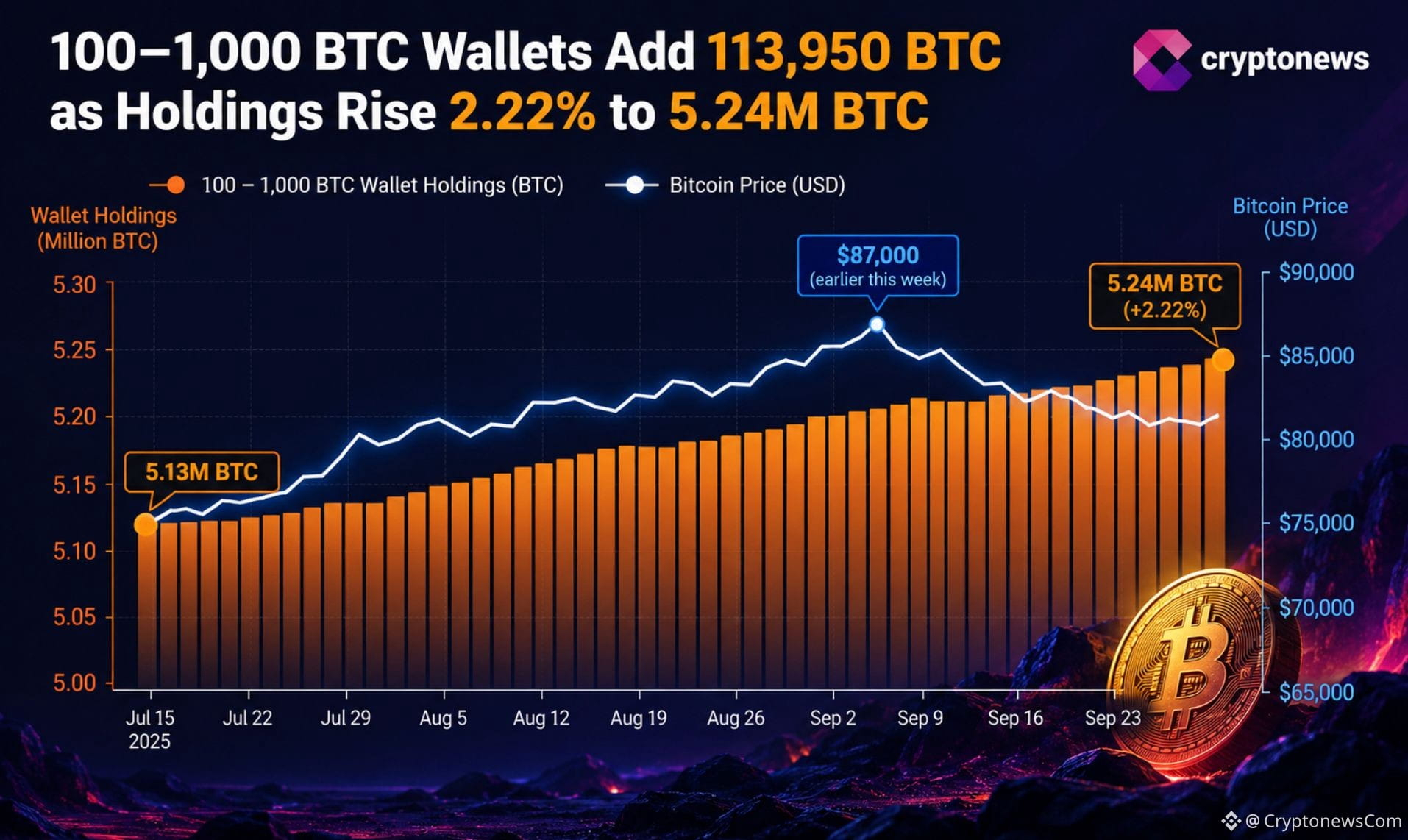
Mid-Sized Bitcoin Wallets Add 113,950 Bitcoin as Price Rally Nears TestWallets holding between 100 and 1,000 BTC have added 113,950 Bitcoin since July 15, lifting their combined holdings 2.22% to 5.24 million BTC, according to Santiment. The accumulation run coincides with Bitcoin price briefly tapping $87,000 earlier this week before retracing and stabilizing near $84,000.
Is this durable demand building a base for a breakout, or is it a squeeze-driven bounce that stalls the moment leverage unwinds?
Not everyone is convinced this move reflects a genuine shift in risk appetite. Trace Finance co-founder Bernardo Brites says that the speed of the recovery was partly a function of a short squeeze, and that the bigger question is where the new money is actually coming from.
“I wouldn’t read this as a broad return of risk appetite. Bitcoin rallying through a rate hike, $100 oil, and elevated yields suggests some investors are treating it as a hedge against inflation, fiscal and geopolitical risk rather than as a bet on easy money,” Brites said.
That framing matters for anyone reading the current resistance structure as a clean technical setup rather than a macro hedge trade layered on top of one.
Santiment has tracked this 100-to-1,000-BTC wallet cohort for five years, and its activity has historically aligned closely with market direction. Periods of heavy accumulation have often preceded or coincided with stronger price moves. The current data shows the cohort continued buying through the recovery, which at minimum indicates the rally isn’t being carried by retail flow alone.
Discover: Best Crypto IPO this September
What Bitcoin Needs to Breach the $88,000-$90,000 Resistance?
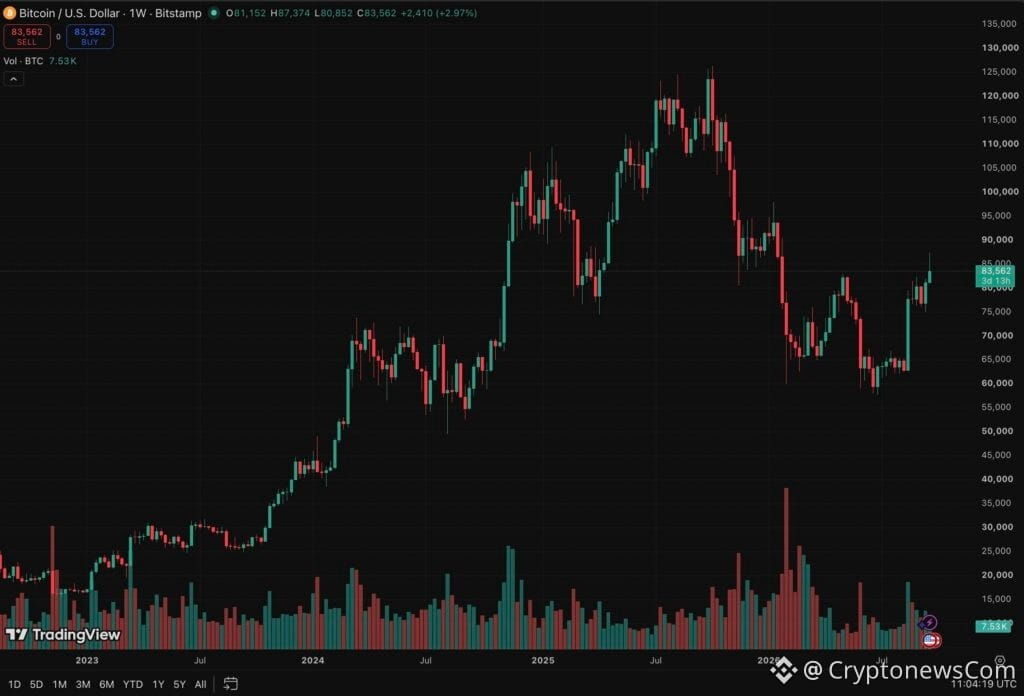
The technical picture underneath the whale and ETF data is straightforward. Bitcoin reclaimed its 365-day moving average near $80,500, a level it last broke back above in March 2023 – a move that preceded a much larger rally at the time. It also cleared the $76,000-$81,000 supply band that had capped price action for weeks.
That $88,000-$90,000 Bitcoin price band matters specifically because of where the coin supply sits, not because of round-number psychology. A large concentration of Bitcoin clustered in that range means sellers are likely to show up in size the closer the price gets to it, which is exactly why the $90,000 target is treated as the next real test.
Trade Bictoin on Bybit and Get a Chance to Win Our $1,000 USDT AirdropETF Demand at the Bitcoin Price Resistance Test
The two-sided framing gives traders a concrete way to read what happens next rather than guessing. A continuation of ETF inflows alongside renewed stablecoin supply growth would, in our view, build a stronger base under the rally as it approaches resistance. A stall in either, particularly a fade in ETF demand while price sits below $88,000, leaves the move vulnerable to giving back gains as leveraged positioning unwinds.
Bitcoin (BTC)
24h7d30d1yAll time
CryptoQuant founder Ki Young Ju has separately argued this cycle is more likely to produce a 3-to-5x rally than a repeat of past 10x blow-offs, citing a maturing market and growing institutional participation as dampeners on extreme volatility.
That view doesn’t confirm where Bitcoin goes after $90,000; it simply lowers the bar for what counts as a strong outcome this cycle, a distinction worth keeping in mind while watching the longer-term structural recovery play out against this specific resistance test.
Earn $50 and Enter $300K Prize Draw on EdgeX
The post Mid-Sized Bitcoin Wallets Add 113,950 Bitcoin as Price Rally Nears Test appeared first on Cryptonews.
Mid-Sized Bitcoin Wallets Add 113,950 Bitcoin as Price Rally Nears Test
Wallets holding between 100 and 1,000 BTC have added 113,950 Bitcoin since July 15, lifting their combined holdings 2.22% to 5.24 million BTC, according to Santiment. The accumulation run coincides with Bitcoin price briefly tapping $87,000 earlier this week before retracing and stabilizing near $84,000.
Is this durable demand building a base for a breakout, or is it a squeeze-driven bounce that stalls the moment leverage unwinds?
Not everyone is convinced this move reflects a genuine shift in risk appetite. Trace Finance co-founder Bernardo Brites says that the speed of the recovery was partly a function of a short squeeze, and that the bigger question is where the new money is actually coming from.
“I wouldn’t read this as a broad return of risk appetite. Bitcoin rallying through a rate hike, $100 oil, and elevated yields suggests some investors are treating it as a hedge against inflation, fiscal and geopolitical risk rather than as a bet on easy money,” Brites said.
That framing matters for anyone reading the current resistance structure as a clean technical setup rather than a macro hedge trade layered on top of one.
Santiment has tracked this 100-to-1,000-BTC wallet cohort for five years, and its activity has historically aligned closely with market direction. Periods of heavy accumulation have often preceded or coincided with stronger price moves. The current data shows the cohort continued buying through the recovery, which at minimum indicates the rally isn’t being carried by retail flow alone.
Discover: Best Crypto IPO this September
What Bitcoin Needs to Breach the $88,000-$90,000 Resistance?
The technical picture underneath the whale and ETF data is straightforward. Bitcoin reclaimed its 365-day moving average near $80,500, a level it last broke back above in March 2023 – a move that preceded a much larger rally at the time. It also cleared the $76,000-$81,000 supply band that had capped price action for weeks.
That $88,000-$90,000 Bitcoin price band matters specifically because of where the coin supply sits, not because of round-number psychology. A large concentration of Bitcoin clustered in that range means sellers are likely to show up in size the closer the price gets to it, which is exactly why the $90,000 target is treated as the next real test.
Trade Bictoin on Bybit and Get a Chance to Win Our $1,000 USDT AirdropETF Demand at the Bitcoin Price Resistance Test
The two-sided framing gives traders a concrete way to read what happens next rather than guessing. A continuation of ETF inflows alongside renewed stablecoin supply growth would, in our view, build a stronger base under the rally as it approaches resistance. A stall in either, particularly a fade in ETF demand while price sits below $88,000, leaves the move vulnerable to giving back gains as leveraged positioning unwinds.
Bitcoin (BTC)
24h7d30d1yAll time
CryptoQuant founder Ki Young Ju has separately argued this cycle is more likely to produce a 3-to-5x rally than a repeat of past 10x blow-offs, citing a maturing market and growing institutional participation as dampeners on extreme volatility.
That view doesn’t confirm where Bitcoin goes after $90,000; it simply lowers the bar for what counts as a strong outcome this cycle, a distinction worth keeping in mind while watching the longer-term structural recovery play out against this specific resistance test.
Earn $50 and Enter $300K Prize Draw on EdgeX
The post Mid-Sized Bitcoin Wallets Add 113,950 Bitcoin as Price Rally Nears Test appeared first on Cryptonews.
Is this durable demand building a base for a breakout, or is it a squeeze-driven bounce that stalls the moment leverage unwinds?
Not everyone is convinced this move reflects a genuine shift in risk appetite. Trace Finance co-founder Bernardo Brites says that the speed of the recovery was partly a function of a short squeeze, and that the bigger question is where the new money is actually coming from.
“I wouldn’t read this as a broad return of risk appetite. Bitcoin rallying through a rate hike, $100 oil, and elevated yields suggests some investors are treating it as a hedge against inflation, fiscal and geopolitical risk rather than as a bet on easy money,” Brites said.
That framing matters for anyone reading the current resistance structure as a clean technical setup rather than a macro hedge trade layered on top of one.
Santiment has tracked this 100-to-1,000-BTC wallet cohort for five years, and its activity has historically aligned closely with market direction. Periods of heavy accumulation have often preceded or coincided with stronger price moves. The current data shows the cohort continued buying through the recovery, which at minimum indicates the rally isn’t being carried by retail flow alone.
Discover: Best Crypto IPO this September
What Bitcoin Needs to Breach the $88,000-$90,000 Resistance?
The technical picture underneath the whale and ETF data is straightforward. Bitcoin reclaimed its 365-day moving average near $80,500, a level it last broke back above in March 2023 – a move that preceded a much larger rally at the time. It also cleared the $76,000-$81,000 supply band that had capped price action for weeks.
That $88,000-$90,000 Bitcoin price band matters specifically because of where the coin supply sits, not because of round-number psychology. A large concentration of Bitcoin clustered in that range means sellers are likely to show up in size the closer the price gets to it, which is exactly why the $90,000 target is treated as the next real test.
Trade Bictoin on Bybit and Get a Chance to Win Our $1,000 USDT AirdropETF Demand at the Bitcoin Price Resistance Test
The two-sided framing gives traders a concrete way to read what happens next rather than guessing. A continuation of ETF inflows alongside renewed stablecoin supply growth would, in our view, build a stronger base under the rally as it approaches resistance. A stall in either, particularly a fade in ETF demand while price sits below $88,000, leaves the move vulnerable to giving back gains as leveraged positioning unwinds.
Bitcoin (BTC)
24h7d30d1yAll time
CryptoQuant founder Ki Young Ju has separately argued this cycle is more likely to produce a 3-to-5x rally than a repeat of past 10x blow-offs, citing a maturing market and growing institutional participation as dampeners on extreme volatility.
That view doesn’t confirm where Bitcoin goes after $90,000; it simply lowers the bar for what counts as a strong outcome this cycle, a distinction worth keeping in mind while watching the longer-term structural recovery play out against this specific resistance test.
Earn $50 and Enter $300K Prize Draw on EdgeX
The post Mid-Sized Bitcoin Wallets Add 113,950 Bitcoin as Price Rally Nears Test appeared first on Cryptonews.
118
ບົດຄວາມ
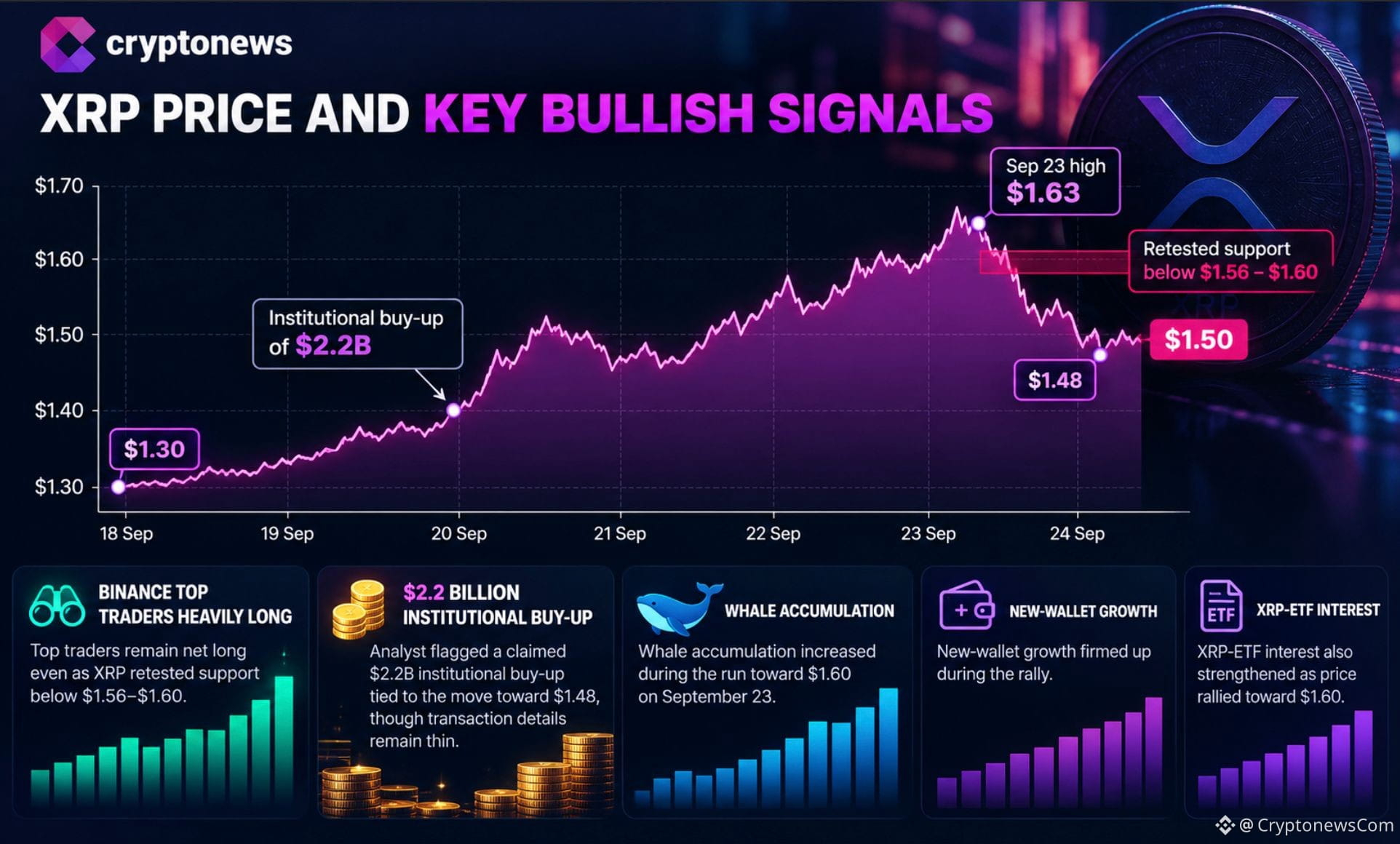
XRP Price Prediction: October is a Weak Month for Ripple, But 3 Metrics Point BullishXRP is trading at $1.50, down 7.6% over the past 24 hours after reaching $1.63 during the period. Despite the pullback and a bearish price prediction, XRP remains up 15.1% over the past seven days, recovering sharply from its recent lows. XRP’s market cap currently stands at roughly $94.1 billion, below the $100 billion mark it briefly approached during the rally.
Binance’s top traders remain heavily long even as XRP retested support below the $1.56–$1.60 zone it broke through earlier in the week. Our analyst flagged a claimed $2.2 billion institutional buy-up tied to the move toward $1.48, though transaction details remain thin. Whale accumulation, new-wallet growth, and XRP-ETF interest all firmed up during the run toward $1.60 on September 23.
The broader tape isn’t helping. Treasury yields hit their highest level since 2007 this week on inflation worries, dragging the Dow, S&P 500, and Nasdaq lower, a risk-off signal that can weigh on crypto alongside token-specific factors.
Discover: Best Crypto IPO this September
XRP Price Prediction: Can Ripple Hit $1.70 This Week?
XRP’s current structure looks like a pullback after a breakout attempt, not a breakdown. Support sits at $1.50–$1.53, with deeper floors at $1.44–$1.45 and $1.35–$1.40 if selling accelerates. The 20-day EMA near $1.4171 is the level bulls need to defend to keep the broader trend intact.
Xrp (XRP)
24h7d30d1yAll time
Bull case: a reclaim and hold above $1.56–$1.60 opens a path to $1.6999 and $1.8111, especially if ETF-related demand and whale accumulation persist into Ripple’s Swell 2026 conference.
Base case: range-bound chop between $1.45 and $1.60 while the market digests macro noise.
Bear case: a close below $1.44 invalidates the near-term bullish structure and puts $1.35–$1.40 back in play.
RSI data and historical rebound patterns suggest the pullback may be shallower than October seasonality implies. See the full RSI breakdown here. Open interest, funding rates, and ETF flow data add further context on whether leverage is set up for a squeeze or a flush.
Trade XRP on Bybit and Get a Chance to Win Our $1,000 USDT AirdropMaxi Doge Targets Early Mover Upside as XRP Tests Key Levels
Holding XRP through the October chop is a defensible position; the three bullish metrics (whale flows, futures positioning, ETF interest) argue the dip gets bought. But at a $90 billion-plus market cap, XRP isn’t delivering 10x moves from here. That kind of asymmetric upside now lives further down the risk curve, in presale-stage tokens still finding their price.
pic.twitter.com/Vg6OpDX6Bq
— MaxiDoge (@MaxiDoge_) August 13, 2026
Enter Maxi Doge ($MAXI), a meme token built entirely around leverage-trading culture. Think a 240-lb canine mascot channeling “1000x leverage” energy, holder-only trading competitions with leaderboard rewards, and a Maxi Fund treasury backing liquidity and partnerships.
The presale has raised $4.8 million at a current price of just $0.000284, with dynamic APY staking live for early holders. The tagline sums up the pitch: never skip leg-day, never skip a pump.
Check the Maxi Doge presale details here.
Earn $50 and Enter $300K Prize Draw on EdgeX
The post XRP Price Prediction: October is a Weak Month for Ripple, But 3 Metrics Point Bullish appeared first on Cryptonews.
XRP Price Prediction: October is a Weak Month for Ripple, But 3 Metrics Point Bullish
XRP is trading at $1.50, down 7.6% over the past 24 hours after reaching $1.63 during the period. Despite the pullback and a bearish price prediction, XRP remains up 15.1% over the past seven days, recovering sharply from its recent lows. XRP’s market cap currently stands at roughly $94.1 billion, below the $100 billion mark it briefly approached during the rally.
Binance’s top traders remain heavily long even as XRP retested support below the $1.56–$1.60 zone it broke through earlier in the week. Our analyst flagged a claimed $2.2 billion institutional buy-up tied to the move toward $1.48, though transaction details remain thin. Whale accumulation, new-wallet growth, and XRP-ETF interest all firmed up during the run toward $1.60 on September 23.
The broader tape isn’t helping. Treasury yields hit their highest level since 2007 this week on inflation worries, dragging the Dow, S&P 500, and Nasdaq lower, a risk-off signal that can weigh on crypto alongside token-specific factors.
Discover: Best Crypto IPO this September
XRP Price Prediction: Can Ripple Hit $1.70 This Week?
XRP’s current structure looks like a pullback after a breakout attempt, not a breakdown. Support sits at $1.50–$1.53, with deeper floors at $1.44–$1.45 and $1.35–$1.40 if selling accelerates. The 20-day EMA near $1.4171 is the level bulls need to defend to keep the broader trend intact.
Xrp (XRP)
24h7d30d1yAll time
Bull case: a reclaim and hold above $1.56–$1.60 opens a path to $1.6999 and $1.8111, especially if ETF-related demand and whale accumulation persist into Ripple’s Swell 2026 conference.
Base case: range-bound chop between $1.45 and $1.60 while the market digests macro noise.
Bear case: a close below $1.44 invalidates the near-term bullish structure and puts $1.35–$1.40 back in play.
RSI data and historical rebound patterns suggest the pullback may be shallower than October seasonality implies. See the full RSI breakdown here. Open interest, funding rates, and ETF flow data add further context on whether leverage is set up for a squeeze or a flush.
Trade XRP on Bybit and Get a Chance to Win Our $1,000 USDT AirdropMaxi Doge Targets Early Mover Upside as XRP Tests Key Levels
Holding XRP through the October chop is a defensible position; the three bullish metrics (whale flows, futures positioning, ETF interest) argue the dip gets bought. But at a $90 billion-plus market cap, XRP isn’t delivering 10x moves from here. That kind of asymmetric upside now lives further down the risk curve, in presale-stage tokens still finding their price.
pic.twitter.com/Vg6OpDX6Bq
— MaxiDoge (@MaxiDoge_) August 13, 2026
Enter Maxi Doge ($MAXI), a meme token built entirely around leverage-trading culture. Think a 240-lb canine mascot channeling “1000x leverage” energy, holder-only trading competitions with leaderboard rewards, and a Maxi Fund treasury backing liquidity and partnerships.
The presale has raised $4.8 million at a current price of just $0.000284, with dynamic APY staking live for early holders. The tagline sums up the pitch: never skip leg-day, never skip a pump.
Check the Maxi Doge presale details here.
Earn $50 and Enter $300K Prize Draw on EdgeX
The post XRP Price Prediction: October is a Weak Month for Ripple, But 3 Metrics Point Bullish appeared first on Cryptonews.
Binance’s top traders remain heavily long even as XRP retested support below the $1.56–$1.60 zone it broke through earlier in the week. Our analyst flagged a claimed $2.2 billion institutional buy-up tied to the move toward $1.48, though transaction details remain thin. Whale accumulation, new-wallet growth, and XRP-ETF interest all firmed up during the run toward $1.60 on September 23.
The broader tape isn’t helping. Treasury yields hit their highest level since 2007 this week on inflation worries, dragging the Dow, S&P 500, and Nasdaq lower, a risk-off signal that can weigh on crypto alongside token-specific factors.
Discover: Best Crypto IPO this September
XRP Price Prediction: Can Ripple Hit $1.70 This Week?
XRP’s current structure looks like a pullback after a breakout attempt, not a breakdown. Support sits at $1.50–$1.53, with deeper floors at $1.44–$1.45 and $1.35–$1.40 if selling accelerates. The 20-day EMA near $1.4171 is the level bulls need to defend to keep the broader trend intact.
Xrp (XRP)
24h7d30d1yAll time
Bull case: a reclaim and hold above $1.56–$1.60 opens a path to $1.6999 and $1.8111, especially if ETF-related demand and whale accumulation persist into Ripple’s Swell 2026 conference.
Base case: range-bound chop between $1.45 and $1.60 while the market digests macro noise.
Bear case: a close below $1.44 invalidates the near-term bullish structure and puts $1.35–$1.40 back in play.
RSI data and historical rebound patterns suggest the pullback may be shallower than October seasonality implies. See the full RSI breakdown here. Open interest, funding rates, and ETF flow data add further context on whether leverage is set up for a squeeze or a flush.
Trade XRP on Bybit and Get a Chance to Win Our $1,000 USDT AirdropMaxi Doge Targets Early Mover Upside as XRP Tests Key Levels
Holding XRP through the October chop is a defensible position; the three bullish metrics (whale flows, futures positioning, ETF interest) argue the dip gets bought. But at a $90 billion-plus market cap, XRP isn’t delivering 10x moves from here. That kind of asymmetric upside now lives further down the risk curve, in presale-stage tokens still finding their price.
pic.twitter.com/Vg6OpDX6Bq
— MaxiDoge (@MaxiDoge_) August 13, 2026
Enter Maxi Doge ($MAXI), a meme token built entirely around leverage-trading culture. Think a 240-lb canine mascot channeling “1000x leverage” energy, holder-only trading competitions with leaderboard rewards, and a Maxi Fund treasury backing liquidity and partnerships.
The presale has raised $4.8 million at a current price of just $0.000284, with dynamic APY staking live for early holders. The tagline sums up the pitch: never skip leg-day, never skip a pump.
Check the Maxi Doge presale details here.
Earn $50 and Enter $300K Prize Draw on EdgeX
The post XRP Price Prediction: October is a Weak Month for Ripple, But 3 Metrics Point Bullish appeared first on Cryptonews.
85
ຢືນຢັນແລ້ວ

ບົດຄວາມ
Bitcoin Price Prediction: StarkWare Discounts Quantum-Safe Solution by 79%Bitcoin price trades near $84,000, down by a huge 3.5% on the day, but the more interesting number this week has nothing to do with its prediction. It’s $67. That’s the new estimated cost to build a quantum-resistant Bitcoin transaction, down from $320 when StarkWare mined the first one on mainnet back in August, a 79% reduction achieved in a single week of open optimization work.
The move came out of the Quantum-Safe Bitcoin Optimization Challenge, a joint effort between StarkWare, Yukon Research, and Eigen Labs. According to the report, they invited developers, researchers, and even AI agents to shrink the GPU-hours needed to construct the transaction.
A post-quantum-secure Bitcoin tx now costs an estimated $67 in GPU compute.
In just ONE WEEK, devs and AI agents cut that cost by 79%, down from $320.
The challenge is still running, with $20,000 in prizes up for grabs for those who can push the cost even lower:… pic.twitter.com/4PvBLrmc4R
— StarkWare (@StarkWareLtd) September 23, 2026
StarkWare’s own dashboard now shows the figure sitting at $66, with the team noting bluntly: “A construction that costs a few hundred dollars per transaction is a demo. One that costs $67 is closer to something a holder with a large unexposed balance might reach for in an emergency.”
This is good news. Quantum risk to Bitcoin has long been theoretical enough to ignore, until the cost of defending against it starts looking like a rounding error next to a whale’s transaction fee. Against that backdrop, Bitcoin’s price action this week tells its own story of consolidation after a sharp round trip.
Discover: The Best Token Presales
Bitcoin Price Prediction: Can BTC Hold $84,000 This Week?
Bitcoin’s pullback to the $84,000–$84,500 zone followed hotter-than-expected PMI data that pushed Treasury yields higher and dented risk appetite across crypto, with total market cap falling 3% in the session. That’s a sharp reversal from the rally that took BTC to roughly $87,500 after U.S. spot ETFs pulled in an estimated $998.95 million in net inflows on September 21.
Bitcoin (BTC)
24h7d30d1yAll time
The $84,000–$84,400 band is now the line in the sand. It overlaps a key Fibonacci retracement zone and the recent breakout shelf. Lose it, and $82,193 followed by $78,571 comes into play. Hold it, and a retest of $86,381, then the $87,400 ceiling, is realistic. Recent technical work flags $90,000–$92,000 as the next real resistance if momentum returns, with $104,433 floated as a stretch target should the recovery extend.
Earn $50 and Enter $300K Prize Draw on EdgeXBitcoin Hyper Targets Early Mover Upside as Bitcoin Tests Key Levels
A rejection near $87,000 followed by a slide back under $85,000 is the kind of chop that tests conviction, not confidence. Bitcoin holding six figures away from $100,000 while yields tighten is a reminder that beta exposure at this size doesn’t move fast.
Bitcoin’s market cap is simply too large for outsized short-term returns, even on good news like a 79% cost cut to quantum defenses. That’s pushed a chunk of trader attention toward earlier-stage infrastructure plays building directly on top of Bitcoin’s base layer.
The city sleeps. $HYPER stays charged. pic.twitter.com/LKBUzZLH39
— Bitcoin Hyper (@BTC_Hyper2) September 22, 2026
Bitcoin Hyper ($HYPER) is positioning itself as the first Bitcoin Layer 2 with SVM integration, aiming to bring Solana-grade execution speed to Bitcoin’s ecosystem without touching its consensus security. The presale has raised more than $33 million to date, with tokens priced at $0.0136867 and staking rewards on offer at a high 30% APY.
Its Decentralized Canonical Bridge targets the slow-transaction, high-fee, zero-programmability problems that have kept Bitcoin’s base chain largely inert for smart contract activity.
Research Bitcoin Hyper directly before the presale window ends.
Trade Bitcoin on Bybit and Get a Chance to Win Our $1,000 USDT Airdrop
The post Bitcoin Price Prediction: StarkWare Discounts Quantum-Safe Solution by 79% appeared first on Cryptonews.
Bitcoin Price Prediction: StarkWare Discounts Quantum-Safe Solution by 79%
Bitcoin price trades near $84,000, down by a huge 3.5% on the day, but the more interesting number this week has nothing to do with its prediction. It’s $67. That’s the new estimated cost to build a quantum-resistant Bitcoin transaction, down from $320 when StarkWare mined the first one on mainnet back in August, a 79% reduction achieved in a single week of open optimization work.
The move came out of the Quantum-Safe Bitcoin Optimization Challenge, a joint effort between StarkWare, Yukon Research, and Eigen Labs. According to the report, they invited developers, researchers, and even AI agents to shrink the GPU-hours needed to construct the transaction.
A post-quantum-secure Bitcoin tx now costs an estimated $67 in GPU compute.
In just ONE WEEK, devs and AI agents cut that cost by 79%, down from $320.
The challenge is still running, with $20,000 in prizes up for grabs for those who can push the cost even lower:… pic.twitter.com/4PvBLrmc4R
— StarkWare (@StarkWareLtd) September 23, 2026
StarkWare’s own dashboard now shows the figure sitting at $66, with the team noting bluntly: “A construction that costs a few hundred dollars per transaction is a demo. One that costs $67 is closer to something a holder with a large unexposed balance might reach for in an emergency.”
This is good news. Quantum risk to Bitcoin has long been theoretical enough to ignore, until the cost of defending against it starts looking like a rounding error next to a whale’s transaction fee. Against that backdrop, Bitcoin’s price action this week tells its own story of consolidation after a sharp round trip.
Discover: The Best Token Presales
Bitcoin Price Prediction: Can BTC Hold $84,000 This Week?
Bitcoin’s pullback to the $84,000–$84,500 zone followed hotter-than-expected PMI data that pushed Treasury yields higher and dented risk appetite across crypto, with total market cap falling 3% in the session. That’s a sharp reversal from the rally that took BTC to roughly $87,500 after U.S. spot ETFs pulled in an estimated $998.95 million in net inflows on September 21.
Bitcoin (BTC)
24h7d30d1yAll time
The $84,000–$84,400 band is now the line in the sand. It overlaps a key Fibonacci retracement zone and the recent breakout shelf. Lose it, and $82,193 followed by $78,571 comes into play. Hold it, and a retest of $86,381, then the $87,400 ceiling, is realistic. Recent technical work flags $90,000–$92,000 as the next real resistance if momentum returns, with $104,433 floated as a stretch target should the recovery extend.
Earn $50 and Enter $300K Prize Draw on EdgeXBitcoin Hyper Targets Early Mover Upside as Bitcoin Tests Key Levels
A rejection near $87,000 followed by a slide back under $85,000 is the kind of chop that tests conviction, not confidence. Bitcoin holding six figures away from $100,000 while yields tighten is a reminder that beta exposure at this size doesn’t move fast.
Bitcoin’s market cap is simply too large for outsized short-term returns, even on good news like a 79% cost cut to quantum defenses. That’s pushed a chunk of trader attention toward earlier-stage infrastructure plays building directly on top of Bitcoin’s base layer.
The city sleeps. $HYPER stays charged. pic.twitter.com/LKBUzZLH39
— Bitcoin Hyper (@BTC_Hyper2) September 22, 2026
Bitcoin Hyper ($HYPER) is positioning itself as the first Bitcoin Layer 2 with SVM integration, aiming to bring Solana-grade execution speed to Bitcoin’s ecosystem without touching its consensus security. The presale has raised more than $33 million to date, with tokens priced at $0.0136867 and staking rewards on offer at a high 30% APY.
Its Decentralized Canonical Bridge targets the slow-transaction, high-fee, zero-programmability problems that have kept Bitcoin’s base chain largely inert for smart contract activity.
Research Bitcoin Hyper directly before the presale window ends.
Trade Bitcoin on Bybit and Get a Chance to Win Our $1,000 USDT Airdrop
The post Bitcoin Price Prediction: StarkWare Discounts Quantum-Safe Solution by 79% appeared first on Cryptonews.
The move came out of the Quantum-Safe Bitcoin Optimization Challenge, a joint effort between StarkWare, Yukon Research, and Eigen Labs. According to the report, they invited developers, researchers, and even AI agents to shrink the GPU-hours needed to construct the transaction.
A post-quantum-secure Bitcoin tx now costs an estimated $67 in GPU compute.
In just ONE WEEK, devs and AI agents cut that cost by 79%, down from $320.
The challenge is still running, with $20,000 in prizes up for grabs for those who can push the cost even lower:… pic.twitter.com/4PvBLrmc4R
— StarkWare (@StarkWareLtd) September 23, 2026
StarkWare’s own dashboard now shows the figure sitting at $66, with the team noting bluntly: “A construction that costs a few hundred dollars per transaction is a demo. One that costs $67 is closer to something a holder with a large unexposed balance might reach for in an emergency.”
This is good news. Quantum risk to Bitcoin has long been theoretical enough to ignore, until the cost of defending against it starts looking like a rounding error next to a whale’s transaction fee. Against that backdrop, Bitcoin’s price action this week tells its own story of consolidation after a sharp round trip.
Discover: The Best Token Presales
Bitcoin Price Prediction: Can BTC Hold $84,000 This Week?
Bitcoin’s pullback to the $84,000–$84,500 zone followed hotter-than-expected PMI data that pushed Treasury yields higher and dented risk appetite across crypto, with total market cap falling 3% in the session. That’s a sharp reversal from the rally that took BTC to roughly $87,500 after U.S. spot ETFs pulled in an estimated $998.95 million in net inflows on September 21.
Bitcoin (BTC)
24h7d30d1yAll time
The $84,000–$84,400 band is now the line in the sand. It overlaps a key Fibonacci retracement zone and the recent breakout shelf. Lose it, and $82,193 followed by $78,571 comes into play. Hold it, and a retest of $86,381, then the $87,400 ceiling, is realistic. Recent technical work flags $90,000–$92,000 as the next real resistance if momentum returns, with $104,433 floated as a stretch target should the recovery extend.
Earn $50 and Enter $300K Prize Draw on EdgeXBitcoin Hyper Targets Early Mover Upside as Bitcoin Tests Key Levels
A rejection near $87,000 followed by a slide back under $85,000 is the kind of chop that tests conviction, not confidence. Bitcoin holding six figures away from $100,000 while yields tighten is a reminder that beta exposure at this size doesn’t move fast.
Bitcoin’s market cap is simply too large for outsized short-term returns, even on good news like a 79% cost cut to quantum defenses. That’s pushed a chunk of trader attention toward earlier-stage infrastructure plays building directly on top of Bitcoin’s base layer.
The city sleeps. $HYPER stays charged. pic.twitter.com/LKBUzZLH39
— Bitcoin Hyper (@BTC_Hyper2) September 22, 2026
Bitcoin Hyper ($HYPER) is positioning itself as the first Bitcoin Layer 2 with SVM integration, aiming to bring Solana-grade execution speed to Bitcoin’s ecosystem without touching its consensus security. The presale has raised more than $33 million to date, with tokens priced at $0.0136867 and staking rewards on offer at a high 30% APY.
Its Decentralized Canonical Bridge targets the slow-transaction, high-fee, zero-programmability problems that have kept Bitcoin’s base chain largely inert for smart contract activity.
Research Bitcoin Hyper directly before the presale window ends.
Trade Bitcoin on Bybit and Get a Chance to Win Our $1,000 USDT Airdrop
The post Bitcoin Price Prediction: StarkWare Discounts Quantum-Safe Solution by 79% appeared first on Cryptonews.
1.2k

ບົດຄວາມ
Who Is Sebastián Marset? Uruguay’s Alleged Cocaine-Mafia Crypto KingpinSebastián Enrique Marset Cabrera, a 35-year-old Uruguayan national, is jailed in Alexandria, Virginia, fighting federal charges of money laundering, high-seas cocaine smuggling, and narco-terrorism as the alleged leader of the Primer Cartel Uruguayo.
U.S. prosecutors say roughly $4 million in cryptocurrency turned up on devices seized after his arrest, a figure that has fueled the “crypto kingpin” framing now attached to his name. The evidence as reported, however, describes crypto as one alleged channel for drug proceeds, not proof that Marset built a crypto-native criminal enterprise.
Who Is Sebastián Marset? What Does the U.S. Case Allege He Did?
The Los Angeles Times reports that Marset allegedly moved cocaine shipments of 10 tons or more from South America toward Europe, with little indication in the available record that any product landed in the United States. That gap is the center of his defense: his lawyers argue in court filings that he is not accused of sending even a gram of cocaine into the country, and that prosecuting him in Virginia stretches federal jurisdiction well past its normal boundaries.
The government’s asserted financial nexus to Virginia is unusually thin for a case of this scale. Prosecutors point to a single $31,800 wire transfer from a bank in Portugal to a bank in China on February 18, 2021, which they say passed through a Bank of America computer server in the state. Marset’s attorneys counter that he took no personal action on that transfer and that evidence suggests it actually routed through Pennsylvania, calling the Virginia link both incidental and unforeseeable.
After the defense noted the charging documents only allege European destinations, prosecutors responded that they would introduce evidence at trial showing cocaine shipments reached the United States. There has been no explanation offered for why Marset has not been separately charged with that alleged conduct, a gap that leaves the jurisdictional fight very much open.
Nearly 1 year ago, the DEA added Sebastián Marset to its Most Wanted Fugitive List. Today, DEA agents escorted Marset to the U.S., where he will now face cocaine trafficking & money laundering charges. @TheJusticeDept
Read more about Sebastián Marset: https://t.co/rtSLyilrXz pic.twitter.com/7OdQhzDK3w
— DEA HQ (@DEAHQ) March 14, 2026
The DEA’s own March 2026 announcement of his transfer into U.S. custody focused on the money laundering conspiracy count, describing a network that allegedly used American financial institutions to move drug proceeds, according to the DEA press release.
Traders watching how prosecutors build cases against alleged trafficking-linked wallets should note that the same scrutiny extends to legitimate platforms handling large transfers. Understanding how exchange security and withdrawal controls factor into regulatory exposure is a relevant context for anyone parsing how a cryptocurrency seizure gets built into a federal indictment.
What the Crypto Evidence Seemingly Does and Does Not Show
Tatiana Marset. Chief of Security of and half sister to Uruguayan drug lord Sebastian Marset has been arrested in Boliva.
Uruguyans can rest a little more soundly knowing this criminal is off the streets pic.twitter.com/IpiSPwMCEs
— Flvco Cruza Fronteras (@flvcovlquimistv) March 31, 2026
Court records cited by the Los Angeles Times link approximately $4 million in cryptocurrency to devices seized when Marset was taken into custody.
That is a material figure in a money laundering case, and it gives prosecutors a digital paper trail that bulk cash generally does not provide. But the reporting frames the crypto holdings as one alleged proceeds channel within a broader financial picture that also includes wire transfers through the traditional banking system.
Nothing in the available primary reporting establishes that Marset operated an exchange, issued a token, ran an investment scheme, or made digital assets the organizing basis of his alleged network.
The distinction matters for how the case gets litigated: crypto money-laundering charges built on device-linked wallets are a fundamentally different evidentiary proposition from charges built on a defendant running crypto infrastructure as the core business.
Investigators seizing device-held holdings are working from what amounts to found evidence, not from dismantling an operational crypto platform.
That said, the case underscores why on-chain activity draws investigative attention regardless of the coin involved.
The same logic that has regulators scrutinizing privacy-focused cryptocurrency activity applies here: digital assets create a traceable record that prosecutors can subpoena, correlate with device data, and present as evidence of alleged proceeds, even when the underlying criminal enterprise has nothing to do with crypto markets themselves. A cryptocurrency seizure is a forensic artifact, not automatically a business model.
An Accusation is Not a Crypto Crime Business Model
Marset disputes the charges entirely. Speaking to the Los Angeles Times from jail in his first interview since his March 2026 arrest, he questioned why he was being held and rejected the premise of the U.S. case against him, telling the paper he does not owe the United States anything and that he never had any interest in the country.
Prosecutors have also alleged, separately from the financial charges, that Marset ordered violence against members of his own organization and directed the assassination of a Paraguayan prosecutor gunned down on his honeymoon, allegations Marset denies.
Those claims, along with his reported partnerships with Brazil’s Primeiro Comando da Capital and Colombia’s Clan del Golfo, remain contested assertions in an active prosecution, not adjudicated findings.
The same caution applies to the circumstances of his capture: his lawyers claim the DEA orchestrated a Bolivian raid to bypass standard extradition after Marset allegedly taunted an agent over WhatsApp, a version of events the government has not confirmed on the record.
None of that changes the narrower point about the crypto allegation specifically: a $4 million holding linked to seized devices supports a charge that crypto carried some portion of alleged drug proceeds. It does not, on the evidence reported so far, support recasting Marset as a figure who built or ran a crypto-centered criminal enterprise.
The post Who Is Sebastián Marset? Uruguay’s Alleged Cocaine-Mafia Crypto Kingpin appeared first on Cryptonews.
Who Is Sebastián Marset? Uruguay’s Alleged Cocaine-Mafia Crypto Kingpin
Sebastián Enrique Marset Cabrera, a 35-year-old Uruguayan national, is jailed in Alexandria, Virginia, fighting federal charges of money laundering, high-seas cocaine smuggling, and narco-terrorism as the alleged leader of the Primer Cartel Uruguayo.
U.S. prosecutors say roughly $4 million in cryptocurrency turned up on devices seized after his arrest, a figure that has fueled the “crypto kingpin” framing now attached to his name. The evidence as reported, however, describes crypto as one alleged channel for drug proceeds, not proof that Marset built a crypto-native criminal enterprise.
Who Is Sebastián Marset? What Does the U.S. Case Allege He Did?
The Los Angeles Times reports that Marset allegedly moved cocaine shipments of 10 tons or more from South America toward Europe, with little indication in the available record that any product landed in the United States. That gap is the center of his defense: his lawyers argue in court filings that he is not accused of sending even a gram of cocaine into the country, and that prosecuting him in Virginia stretches federal jurisdiction well past its normal boundaries.
The government’s asserted financial nexus to Virginia is unusually thin for a case of this scale. Prosecutors point to a single $31,800 wire transfer from a bank in Portugal to a bank in China on February 18, 2021, which they say passed through a Bank of America computer server in the state. Marset’s attorneys counter that he took no personal action on that transfer and that evidence suggests it actually routed through Pennsylvania, calling the Virginia link both incidental and unforeseeable.
After the defense noted the charging documents only allege European destinations, prosecutors responded that they would introduce evidence at trial showing cocaine shipments reached the United States. There has been no explanation offered for why Marset has not been separately charged with that alleged conduct, a gap that leaves the jurisdictional fight very much open.
Nearly 1 year ago, the DEA added Sebastián Marset to its Most Wanted Fugitive List. Today, DEA agents escorted Marset to the U.S., where he will now face cocaine trafficking & money laundering charges. @TheJusticeDept
Read more about Sebastián Marset: https://t.co/rtSLyilrXz pic.twitter.com/7OdQhzDK3w
— DEA HQ (@DEAHQ) March 14, 2026
The DEA’s own March 2026 announcement of his transfer into U.S. custody focused on the money laundering conspiracy count, describing a network that allegedly used American financial institutions to move drug proceeds, according to the DEA press release.
Traders watching how prosecutors build cases against alleged trafficking-linked wallets should note that the same scrutiny extends to legitimate platforms handling large transfers. Understanding how exchange security and withdrawal controls factor into regulatory exposure is a relevant context for anyone parsing how a cryptocurrency seizure gets built into a federal indictment.
What the Crypto Evidence Seemingly Does and Does Not Show
Tatiana Marset. Chief of Security of and half sister to Uruguayan drug lord Sebastian Marset has been arrested in Boliva.
Uruguyans can rest a little more soundly knowing this criminal is off the streets pic.twitter.com/IpiSPwMCEs
— Flvco Cruza Fronteras (@flvcovlquimistv) March 31, 2026
Court records cited by the Los Angeles Times link approximately $4 million in cryptocurrency to devices seized when Marset was taken into custody.
That is a material figure in a money laundering case, and it gives prosecutors a digital paper trail that bulk cash generally does not provide. But the reporting frames the crypto holdings as one alleged proceeds channel within a broader financial picture that also includes wire transfers through the traditional banking system.
Nothing in the available primary reporting establishes that Marset operated an exchange, issued a token, ran an investment scheme, or made digital assets the organizing basis of his alleged network.
The distinction matters for how the case gets litigated: crypto money-laundering charges built on device-linked wallets are a fundamentally different evidentiary proposition from charges built on a defendant running crypto infrastructure as the core business.
Investigators seizing device-held holdings are working from what amounts to found evidence, not from dismantling an operational crypto platform.
That said, the case underscores why on-chain activity draws investigative attention regardless of the coin involved.
The same logic that has regulators scrutinizing privacy-focused cryptocurrency activity applies here: digital assets create a traceable record that prosecutors can subpoena, correlate with device data, and present as evidence of alleged proceeds, even when the underlying criminal enterprise has nothing to do with crypto markets themselves. A cryptocurrency seizure is a forensic artifact, not automatically a business model.
An Accusation is Not a Crypto Crime Business Model
Marset disputes the charges entirely. Speaking to the Los Angeles Times from jail in his first interview since his March 2026 arrest, he questioned why he was being held and rejected the premise of the U.S. case against him, telling the paper he does not owe the United States anything and that he never had any interest in the country.
Prosecutors have also alleged, separately from the financial charges, that Marset ordered violence against members of his own organization and directed the assassination of a Paraguayan prosecutor gunned down on his honeymoon, allegations Marset denies.
Those claims, along with his reported partnerships with Brazil’s Primeiro Comando da Capital and Colombia’s Clan del Golfo, remain contested assertions in an active prosecution, not adjudicated findings.
The same caution applies to the circumstances of his capture: his lawyers claim the DEA orchestrated a Bolivian raid to bypass standard extradition after Marset allegedly taunted an agent over WhatsApp, a version of events the government has not confirmed on the record.
None of that changes the narrower point about the crypto allegation specifically: a $4 million holding linked to seized devices supports a charge that crypto carried some portion of alleged drug proceeds. It does not, on the evidence reported so far, support recasting Marset as a figure who built or ran a crypto-centered criminal enterprise.
The post Who Is Sebastián Marset? Uruguay’s Alleged Cocaine-Mafia Crypto Kingpin appeared first on Cryptonews.
U.S. prosecutors say roughly $4 million in cryptocurrency turned up on devices seized after his arrest, a figure that has fueled the “crypto kingpin” framing now attached to his name. The evidence as reported, however, describes crypto as one alleged channel for drug proceeds, not proof that Marset built a crypto-native criminal enterprise.
Who Is Sebastián Marset? What Does the U.S. Case Allege He Did?
The Los Angeles Times reports that Marset allegedly moved cocaine shipments of 10 tons or more from South America toward Europe, with little indication in the available record that any product landed in the United States. That gap is the center of his defense: his lawyers argue in court filings that he is not accused of sending even a gram of cocaine into the country, and that prosecuting him in Virginia stretches federal jurisdiction well past its normal boundaries.
The government’s asserted financial nexus to Virginia is unusually thin for a case of this scale. Prosecutors point to a single $31,800 wire transfer from a bank in Portugal to a bank in China on February 18, 2021, which they say passed through a Bank of America computer server in the state. Marset’s attorneys counter that he took no personal action on that transfer and that evidence suggests it actually routed through Pennsylvania, calling the Virginia link both incidental and unforeseeable.
After the defense noted the charging documents only allege European destinations, prosecutors responded that they would introduce evidence at trial showing cocaine shipments reached the United States. There has been no explanation offered for why Marset has not been separately charged with that alleged conduct, a gap that leaves the jurisdictional fight very much open.
Nearly 1 year ago, the DEA added Sebastián Marset to its Most Wanted Fugitive List. Today, DEA agents escorted Marset to the U.S., where he will now face cocaine trafficking & money laundering charges. @TheJusticeDept
Read more about Sebastián Marset: https://t.co/rtSLyilrXz pic.twitter.com/7OdQhzDK3w
— DEA HQ (@DEAHQ) March 14, 2026
The DEA’s own March 2026 announcement of his transfer into U.S. custody focused on the money laundering conspiracy count, describing a network that allegedly used American financial institutions to move drug proceeds, according to the DEA press release.
Traders watching how prosecutors build cases against alleged trafficking-linked wallets should note that the same scrutiny extends to legitimate platforms handling large transfers. Understanding how exchange security and withdrawal controls factor into regulatory exposure is a relevant context for anyone parsing how a cryptocurrency seizure gets built into a federal indictment.
What the Crypto Evidence Seemingly Does and Does Not Show
Tatiana Marset. Chief of Security of and half sister to Uruguayan drug lord Sebastian Marset has been arrested in Boliva.
Uruguyans can rest a little more soundly knowing this criminal is off the streets pic.twitter.com/IpiSPwMCEs
— Flvco Cruza Fronteras (@flvcovlquimistv) March 31, 2026
Court records cited by the Los Angeles Times link approximately $4 million in cryptocurrency to devices seized when Marset was taken into custody.
That is a material figure in a money laundering case, and it gives prosecutors a digital paper trail that bulk cash generally does not provide. But the reporting frames the crypto holdings as one alleged proceeds channel within a broader financial picture that also includes wire transfers through the traditional banking system.
Nothing in the available primary reporting establishes that Marset operated an exchange, issued a token, ran an investment scheme, or made digital assets the organizing basis of his alleged network.
The distinction matters for how the case gets litigated: crypto money-laundering charges built on device-linked wallets are a fundamentally different evidentiary proposition from charges built on a defendant running crypto infrastructure as the core business.
Investigators seizing device-held holdings are working from what amounts to found evidence, not from dismantling an operational crypto platform.
That said, the case underscores why on-chain activity draws investigative attention regardless of the coin involved.
The same logic that has regulators scrutinizing privacy-focused cryptocurrency activity applies here: digital assets create a traceable record that prosecutors can subpoena, correlate with device data, and present as evidence of alleged proceeds, even when the underlying criminal enterprise has nothing to do with crypto markets themselves. A cryptocurrency seizure is a forensic artifact, not automatically a business model.
An Accusation is Not a Crypto Crime Business Model
Marset disputes the charges entirely. Speaking to the Los Angeles Times from jail in his first interview since his March 2026 arrest, he questioned why he was being held and rejected the premise of the U.S. case against him, telling the paper he does not owe the United States anything and that he never had any interest in the country.
Prosecutors have also alleged, separately from the financial charges, that Marset ordered violence against members of his own organization and directed the assassination of a Paraguayan prosecutor gunned down on his honeymoon, allegations Marset denies.
Those claims, along with his reported partnerships with Brazil’s Primeiro Comando da Capital and Colombia’s Clan del Golfo, remain contested assertions in an active prosecution, not adjudicated findings.
The same caution applies to the circumstances of his capture: his lawyers claim the DEA orchestrated a Bolivian raid to bypass standard extradition after Marset allegedly taunted an agent over WhatsApp, a version of events the government has not confirmed on the record.
None of that changes the narrower point about the crypto allegation specifically: a $4 million holding linked to seized devices supports a charge that crypto carried some portion of alleged drug proceeds. It does not, on the evidence reported so far, support recasting Marset as a figure who built or ran a crypto-centered criminal enterprise.
The post Who Is Sebastián Marset? Uruguay’s Alleged Cocaine-Mafia Crypto Kingpin appeared first on Cryptonews.
24
ບົດຄວາມ
OpenAI ChatGPT AI Predicts XRP to Hit $8 by 2027, in the Right ConditionsThe Sam Altman-led OpenAI ChatGPT AI predicts that in a blow-off top bull market, XRP could reach $8+ by January 1, 2027. It puts the plausible bull-market range at $4.50–$7.00, with $8+ possible in an extreme altcoin blow-off.
At roughly $1.57 today, $5.50 would represent an approximately +240% gain from current levels. The setup has changed considerably over the past week.
SOURCE: ChatGPT AI Predicts XRP Price
XRP rallied from roughly $1.25 on September 16 to around $1.65 on September 23, posting weekly gains of +22%. Daily trading volume is sitting at $7.2Bn.
More importantly, XRP has moved back above the $1.6–$1.62 resistance area that capped the market in August. Recent technical analysis identified $1.59 as the key breakout level, with the 200-day EMA around $1.57.
ChatGPT AI Predicts Ripple to $8: What Does the Technical Analysis Say About That?
A new buy wall for $XRP has formed around $1.585. pic.twitter.com/BkIW7K4gUH
— CW (@CW8900) September 23, 2026
The first major test is around $1.65–$1.80. XRP has just reached $1.65 this week, while $1.81 represents a significant previous price level identified by prior technical analysis.
If XRP can establish itself above $1.80, the psychological $2.00 level becomes the next obvious target. Above $2, the chart opens up considerably.
The next major historical resistance is around $3.10, corresponding to the 2025 cycle’s closing-high area. XRP’s ultimate 2025 all-time high was approximately $3.65, reached in July 2025.
And $3.65 is the critical level. A decisive break above it would put XRP into a phase of genuine price discovery. At that point, $4, $4.50, $5, and eventually $5.50 become psychological rather than historically established resistance levels.
Historical Price Action Makes that $5.50 Target Interesting
XRP’s history is characterized by extremely large percentage moves during crypto bull markets. The most recent cycle provides the clearest example.
XRP rose from below $1 to a $3.65 peak in July 2025, then fell by almost -73%, reaching about $0.99 in August 2026. That means the current market has already demonstrated both sides of XRP’s characteristic volatility, going from $0.99 to an all-time high of $3.65 and back to $0.99.
The important thing is that the latest recovery has already taken XRP back above $1.50. There is also an interesting historical pattern: analysis of previous XRP crashes found that major drawdowns were followed by very large subsequent rallies.
Got a Gut Feeling? Have Your Say on PolymarketBitcoin Hyper Targets Early Mover Upside as XRP Tests Key Levels
A 45-week-overdue moving average flip is exactly the kind of headline that gets long-term holders nodding along, but at an $81,000 handle, Bitcoin’s percentage upside from here is a different animal than it was at $16,000. Doubling from here adds $1.6 trillion to market cap.
That math is why traders chasing asymmetric returns are increasingly looking one layer down, toward infrastructure being built directly on top of Bitcoin’s network.
Bitcoin Hyper ($HYPER) is positioning itself as the first Bitcoin Layer 2 with full SVM integration. Hyper runs smart contracts at speeds it claims outpace Solana, while settling back to Bitcoin’s base chain for security.
The presale has raised $33M at a current token price of just $0.0136865, with staking rewards offered at a high 30% APY.
Its Decentralized Canonical Bridge aims to solve BTC’s two biggest structural gaps: near-zero programmability and sluggish, expensive transaction throughput.
Gain Access to New Bitcoin Layer 2 Early Here
Discover: The Best Crypto Presales This September
The post OpenAI ChatGPT AI Predicts XRP to Hit $8 by 2027, in the Right Conditions appeared first on Cryptonews.
OpenAI ChatGPT AI Predicts XRP to Hit $8 by 2027, in the Right Conditions
The Sam Altman-led OpenAI ChatGPT AI predicts that in a blow-off top bull market, XRP could reach $8+ by January 1, 2027. It puts the plausible bull-market range at $4.50–$7.00, with $8+ possible in an extreme altcoin blow-off.
At roughly $1.57 today, $5.50 would represent an approximately +240% gain from current levels. The setup has changed considerably over the past week.
SOURCE: ChatGPT AI Predicts XRP Price
XRP rallied from roughly $1.25 on September 16 to around $1.65 on September 23, posting weekly gains of +22%. Daily trading volume is sitting at $7.2Bn.
More importantly, XRP has moved back above the $1.6–$1.62 resistance area that capped the market in August. Recent technical analysis identified $1.59 as the key breakout level, with the 200-day EMA around $1.57.
ChatGPT AI Predicts Ripple to $8: What Does the Technical Analysis Say About That?
A new buy wall for $XRP has formed around $1.585. pic.twitter.com/BkIW7K4gUH
— CW (@CW8900) September 23, 2026
The first major test is around $1.65–$1.80. XRP has just reached $1.65 this week, while $1.81 represents a significant previous price level identified by prior technical analysis.
If XRP can establish itself above $1.80, the psychological $2.00 level becomes the next obvious target. Above $2, the chart opens up considerably.
The next major historical resistance is around $3.10, corresponding to the 2025 cycle’s closing-high area. XRP’s ultimate 2025 all-time high was approximately $3.65, reached in July 2025.
And $3.65 is the critical level. A decisive break above it would put XRP into a phase of genuine price discovery. At that point, $4, $4.50, $5, and eventually $5.50 become psychological rather than historically established resistance levels.
Historical Price Action Makes that $5.50 Target Interesting
XRP’s history is characterized by extremely large percentage moves during crypto bull markets. The most recent cycle provides the clearest example.
XRP rose from below $1 to a $3.65 peak in July 2025, then fell by almost -73%, reaching about $0.99 in August 2026. That means the current market has already demonstrated both sides of XRP’s characteristic volatility, going from $0.99 to an all-time high of $3.65 and back to $0.99.
The important thing is that the latest recovery has already taken XRP back above $1.50. There is also an interesting historical pattern: analysis of previous XRP crashes found that major drawdowns were followed by very large subsequent rallies.
Got a Gut Feeling? Have Your Say on PolymarketBitcoin Hyper Targets Early Mover Upside as XRP Tests Key Levels
A 45-week-overdue moving average flip is exactly the kind of headline that gets long-term holders nodding along, but at an $81,000 handle, Bitcoin’s percentage upside from here is a different animal than it was at $16,000. Doubling from here adds $1.6 trillion to market cap.
That math is why traders chasing asymmetric returns are increasingly looking one layer down, toward infrastructure being built directly on top of Bitcoin’s network.
Bitcoin Hyper ($HYPER) is positioning itself as the first Bitcoin Layer 2 with full SVM integration. Hyper runs smart contracts at speeds it claims outpace Solana, while settling back to Bitcoin’s base chain for security.
The presale has raised $33M at a current token price of just $0.0136865, with staking rewards offered at a high 30% APY.
Its Decentralized Canonical Bridge aims to solve BTC’s two biggest structural gaps: near-zero programmability and sluggish, expensive transaction throughput.
Gain Access to New Bitcoin Layer 2 Early Here
Discover: The Best Crypto Presales This September
The post OpenAI ChatGPT AI Predicts XRP to Hit $8 by 2027, in the Right Conditions appeared first on Cryptonews.
At roughly $1.57 today, $5.50 would represent an approximately +240% gain from current levels. The setup has changed considerably over the past week.
SOURCE: ChatGPT AI Predicts XRP Price
XRP rallied from roughly $1.25 on September 16 to around $1.65 on September 23, posting weekly gains of +22%. Daily trading volume is sitting at $7.2Bn.
More importantly, XRP has moved back above the $1.6–$1.62 resistance area that capped the market in August. Recent technical analysis identified $1.59 as the key breakout level, with the 200-day EMA around $1.57.
ChatGPT AI Predicts Ripple to $8: What Does the Technical Analysis Say About That?
A new buy wall for $XRP has formed around $1.585. pic.twitter.com/BkIW7K4gUH
— CW (@CW8900) September 23, 2026
The first major test is around $1.65–$1.80. XRP has just reached $1.65 this week, while $1.81 represents a significant previous price level identified by prior technical analysis.
If XRP can establish itself above $1.80, the psychological $2.00 level becomes the next obvious target. Above $2, the chart opens up considerably.
The next major historical resistance is around $3.10, corresponding to the 2025 cycle’s closing-high area. XRP’s ultimate 2025 all-time high was approximately $3.65, reached in July 2025.
And $3.65 is the critical level. A decisive break above it would put XRP into a phase of genuine price discovery. At that point, $4, $4.50, $5, and eventually $5.50 become psychological rather than historically established resistance levels.
Historical Price Action Makes that $5.50 Target Interesting
XRP’s history is characterized by extremely large percentage moves during crypto bull markets. The most recent cycle provides the clearest example.
XRP rose from below $1 to a $3.65 peak in July 2025, then fell by almost -73%, reaching about $0.99 in August 2026. That means the current market has already demonstrated both sides of XRP’s characteristic volatility, going from $0.99 to an all-time high of $3.65 and back to $0.99.
The important thing is that the latest recovery has already taken XRP back above $1.50. There is also an interesting historical pattern: analysis of previous XRP crashes found that major drawdowns were followed by very large subsequent rallies.
Got a Gut Feeling? Have Your Say on PolymarketBitcoin Hyper Targets Early Mover Upside as XRP Tests Key Levels
A 45-week-overdue moving average flip is exactly the kind of headline that gets long-term holders nodding along, but at an $81,000 handle, Bitcoin’s percentage upside from here is a different animal than it was at $16,000. Doubling from here adds $1.6 trillion to market cap.
That math is why traders chasing asymmetric returns are increasingly looking one layer down, toward infrastructure being built directly on top of Bitcoin’s network.
Bitcoin Hyper ($HYPER) is positioning itself as the first Bitcoin Layer 2 with full SVM integration. Hyper runs smart contracts at speeds it claims outpace Solana, while settling back to Bitcoin’s base chain for security.
The presale has raised $33M at a current token price of just $0.0136865, with staking rewards offered at a high 30% APY.
Its Decentralized Canonical Bridge aims to solve BTC’s two biggest structural gaps: near-zero programmability and sluggish, expensive transaction throughput.
Gain Access to New Bitcoin Layer 2 Early Here
Discover: The Best Crypto Presales This September
The post OpenAI ChatGPT AI Predicts XRP to Hit $8 by 2027, in the Right Conditions appeared first on Cryptonews.
2
2
2.5k
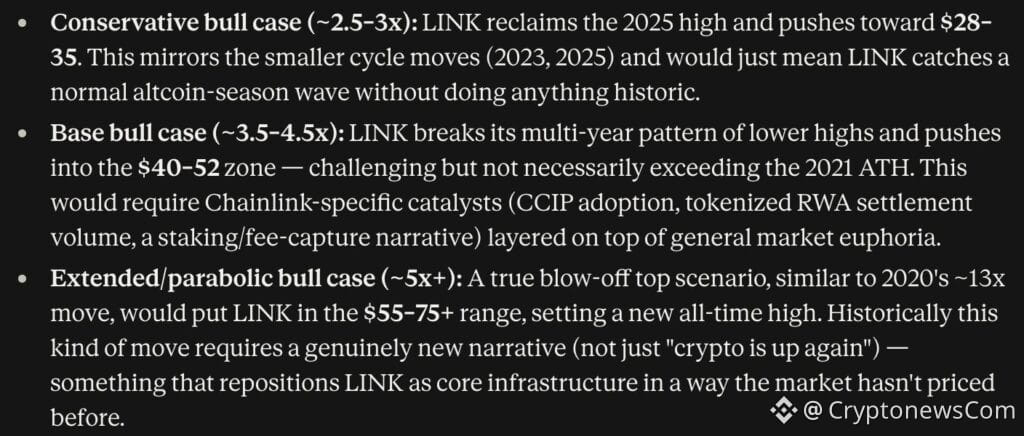
ບົດຄວາມ
Anthropic’s Claude AI Predicts a Wild 2026 Price Target for LINKAnthropic Claude AI predicts that Chainlink (LINK) could hit $75 or higher in 2026 if parabolic bull market conditions align in Q4. LINK is trading just above $12, with a market cap of around $9.5Bn.
2025 opened at $20.00, spiked to $27.68, then broke down hard to a low of $10.19, closing the year around $12.26 (a ~39% annual loss). This was followed by the 2026 YTD range of roughly $7.05–$14.37, meaning LINK is currently sitting in the upper-middle of this year’s range, not near either extreme.
SOURCE: Claude AI Predicts LINK Price
The conservative bull case suggests LINK could reclaim its 2025 high and reach $28–35, a more modest prediction that aligns with past altcoin cycles. The base bull case is that it breaks its multi-year pattern and targets $40–52, needing Chainlink-specific catalysts like CCIP adoption and an overall positive market atmosphere.
Things get really interesting in the extended bull case. Claude AI states that for this, a blow-off top similar to 2020 would need to happen, and if so, it could see LINK in the $55–75+ range.
Does the Technical Picture Support the Claude AI Predicts $75+ LINK?
$LINK testing a big level here at $13.38. A push from the broader market sends us 25% higher to $16.30 at least.
Not a bad r/r imo. pic.twitter.com/9unPWsC9jc
— Perpetual Trading (@PerpTrading) September 21, 2026
LINK is in a longer-term downtrend on the 200-day moving average basis after the 2025 breakdown, but the daily chart has shown tentative bullish structure recently (short-term MAs turning up).
Key resistance sits at $14.37 as the first real ceiling, followed by the psychologically important $17–18 zone (2023 high area), then $27–28 (2025 high, also near the 2022 high).
Key support: $10 is the round-number floor that’s held multiple times this year; below that, $7.05 (2026 low) is the last line of defense before the 2023 lows near $5.
RSI/momentum: Neutral-to-mixed across timeframes, not oversold, not overbought, which is actually a fairly clean base from which a genuine breakout could start if volume returns.
The technical read: LINK needs to reclaim and hold above ~$14.40, then ~$18, to signal that it’s breaking the pattern of lower highs. Until then, it’s range-bound chop.
Earn $50 and Enter $300K Prize Draw on EdgeXLiquidChain Targets Early Mover Upside as LINK Tests Key Levels
Anyone holding LINK since the June lows is sitting on solid gains, and the data validates the position. But here’s the uncomfortable math: at a $9Bn+ market cap, LINK needs enormous capital inflows to deliver the kind of multiples early-stage tokens can post off a fraction of that volume. That’s the gap presale plays are built to fill.
LiquidChain (LIQUID) is a Layer 3 infrastructure project built to fuse Bitcoin, Ethereum, and Solana liquidity into a single execution environment, a “deploy-once” architecture where developers build once and access all three ecosystems rather than fragmenting liquidity across chains.
The presale is priced at $0.014958, and $971,680.17 has been raised so far. Core features include a Unified Liquidity Layer, Single-Step Execution, and Verifiable Settlement.
Gain Special Access to Layer 3 Trading Here
Don’t Miss: The Hottest Meme Coin Opportunities Silently Climbing the Crypto Ranks in September
The post Anthropic’s Claude AI Predicts a Wild 2026 Price Target for LINK appeared first on Cryptonews.
Anthropic’s Claude AI Predicts a Wild 2026 Price Target for LINK
Anthropic Claude AI predicts that Chainlink (LINK) could hit $75 or higher in 2026 if parabolic bull market conditions align in Q4. LINK is trading just above $12, with a market cap of around $9.5Bn.
2025 opened at $20.00, spiked to $27.68, then broke down hard to a low of $10.19, closing the year around $12.26 (a ~39% annual loss). This was followed by the 2026 YTD range of roughly $7.05–$14.37, meaning LINK is currently sitting in the upper-middle of this year’s range, not near either extreme.
SOURCE: Claude AI Predicts LINK Price
The conservative bull case suggests LINK could reclaim its 2025 high and reach $28–35, a more modest prediction that aligns with past altcoin cycles. The base bull case is that it breaks its multi-year pattern and targets $40–52, needing Chainlink-specific catalysts like CCIP adoption and an overall positive market atmosphere.
Things get really interesting in the extended bull case. Claude AI states that for this, a blow-off top similar to 2020 would need to happen, and if so, it could see LINK in the $55–75+ range.
Does the Technical Picture Support the Claude AI Predicts $75+ LINK?
$LINK testing a big level here at $13.38. A push from the broader market sends us 25% higher to $16.30 at least.
Not a bad r/r imo. pic.twitter.com/9unPWsC9jc
— Perpetual Trading (@PerpTrading) September 21, 2026
LINK is in a longer-term downtrend on the 200-day moving average basis after the 2025 breakdown, but the daily chart has shown tentative bullish structure recently (short-term MAs turning up).
Key resistance sits at $14.37 as the first real ceiling, followed by the psychologically important $17–18 zone (2023 high area), then $27–28 (2025 high, also near the 2022 high).
Key support: $10 is the round-number floor that’s held multiple times this year; below that, $7.05 (2026 low) is the last line of defense before the 2023 lows near $5.
RSI/momentum: Neutral-to-mixed across timeframes, not oversold, not overbought, which is actually a fairly clean base from which a genuine breakout could start if volume returns.
The technical read: LINK needs to reclaim and hold above ~$14.40, then ~$18, to signal that it’s breaking the pattern of lower highs. Until then, it’s range-bound chop.
Earn $50 and Enter $300K Prize Draw on EdgeXLiquidChain Targets Early Mover Upside as LINK Tests Key Levels
Anyone holding LINK since the June lows is sitting on solid gains, and the data validates the position. But here’s the uncomfortable math: at a $9Bn+ market cap, LINK needs enormous capital inflows to deliver the kind of multiples early-stage tokens can post off a fraction of that volume. That’s the gap presale plays are built to fill.
LiquidChain (LIQUID) is a Layer 3 infrastructure project built to fuse Bitcoin, Ethereum, and Solana liquidity into a single execution environment, a “deploy-once” architecture where developers build once and access all three ecosystems rather than fragmenting liquidity across chains.
The presale is priced at $0.014958, and $971,680.17 has been raised so far. Core features include a Unified Liquidity Layer, Single-Step Execution, and Verifiable Settlement.
Gain Special Access to Layer 3 Trading Here
Don’t Miss: The Hottest Meme Coin Opportunities Silently Climbing the Crypto Ranks in September
The post Anthropic’s Claude AI Predicts a Wild 2026 Price Target for LINK appeared first on Cryptonews.
2025 opened at $20.00, spiked to $27.68, then broke down hard to a low of $10.19, closing the year around $12.26 (a ~39% annual loss). This was followed by the 2026 YTD range of roughly $7.05–$14.37, meaning LINK is currently sitting in the upper-middle of this year’s range, not near either extreme.
SOURCE: Claude AI Predicts LINK Price
The conservative bull case suggests LINK could reclaim its 2025 high and reach $28–35, a more modest prediction that aligns with past altcoin cycles. The base bull case is that it breaks its multi-year pattern and targets $40–52, needing Chainlink-specific catalysts like CCIP adoption and an overall positive market atmosphere.
Things get really interesting in the extended bull case. Claude AI states that for this, a blow-off top similar to 2020 would need to happen, and if so, it could see LINK in the $55–75+ range.
Does the Technical Picture Support the Claude AI Predicts $75+ LINK?
$LINK testing a big level here at $13.38. A push from the broader market sends us 25% higher to $16.30 at least.
Not a bad r/r imo. pic.twitter.com/9unPWsC9jc
— Perpetual Trading (@PerpTrading) September 21, 2026
LINK is in a longer-term downtrend on the 200-day moving average basis after the 2025 breakdown, but the daily chart has shown tentative bullish structure recently (short-term MAs turning up).
Key resistance sits at $14.37 as the first real ceiling, followed by the psychologically important $17–18 zone (2023 high area), then $27–28 (2025 high, also near the 2022 high).
Key support: $10 is the round-number floor that’s held multiple times this year; below that, $7.05 (2026 low) is the last line of defense before the 2023 lows near $5.
RSI/momentum: Neutral-to-mixed across timeframes, not oversold, not overbought, which is actually a fairly clean base from which a genuine breakout could start if volume returns.
The technical read: LINK needs to reclaim and hold above ~$14.40, then ~$18, to signal that it’s breaking the pattern of lower highs. Until then, it’s range-bound chop.
Earn $50 and Enter $300K Prize Draw on EdgeXLiquidChain Targets Early Mover Upside as LINK Tests Key Levels
Anyone holding LINK since the June lows is sitting on solid gains, and the data validates the position. But here’s the uncomfortable math: at a $9Bn+ market cap, LINK needs enormous capital inflows to deliver the kind of multiples early-stage tokens can post off a fraction of that volume. That’s the gap presale plays are built to fill.
LiquidChain (LIQUID) is a Layer 3 infrastructure project built to fuse Bitcoin, Ethereum, and Solana liquidity into a single execution environment, a “deploy-once” architecture where developers build once and access all three ecosystems rather than fragmenting liquidity across chains.
The presale is priced at $0.014958, and $971,680.17 has been raised so far. Core features include a Unified Liquidity Layer, Single-Step Execution, and Verifiable Settlement.
Gain Special Access to Layer 3 Trading Here
Don’t Miss: The Hottest Meme Coin Opportunities Silently Climbing the Crypto Ranks in September
The post Anthropic’s Claude AI Predicts a Wild 2026 Price Target for LINK appeared first on Cryptonews.
2.1k
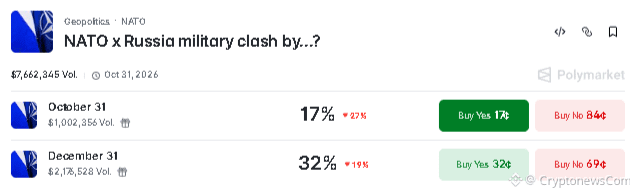
ບົດຄວາມ
Polymarket’s NATO–Russia Clash Alarm Explodes as Spy Chief Warns: ‘Months, Not Years’NATO Russia Prediction Odds: Czech intelligence chief Michal Koudelka has warned that Russia could test NATO through a limited incursion, drone activity, false-flag provocations, or an influence campaign on a timeline measured in months rather than years. That warning has revived interest in Polymarket’s NATO x Russia military clash contract – but the market as supplied concerns a 2025 resolution window, not a live forecast running through the rest of 2026.
Got a Gut Feeling? It Could Pay Out 3.7X on PolymarketKey Takeaways on NATO Russia Prediction Odds
Contract scope: The Polymarket event resolves on whether a military encounter occurred between Russian forces and the forces of a NATO member country during its stated 2025 window – it does not track an invasion scenario or a live 2026 probability.
The warning: European intelligence officials describe possible drones, sabotage, false-flag operations or limited strikes as forms of escalation, while explicitly noting no imminent large-scale attack has been observed.
The gap: A Russian test of NATO’s resolve is a materially different event from a full-scale invasion, and traders pricing geopolitical risk around either scenario need to keep the two apart.
European leaders and NATO military officials have flagged the rising risk of Russian hybrid actions against alliance members, per the primary source reviewed, including drone or missile incidents capable of testing Article 5 commitments.
Polish Prime Minister Donald Tusk is cited among officials warning that limited strikes or false-flag operations remain possible in the coming months as the war in Ukraine grinds on. NATO’s senior generals, for their part, have affirmed regional defense plans and force readiness in response, according to the same material.
Senior commanders describe Vladimir Putin as more risk-tolerant the longer the war continues, but no buildup for direct confrontation with NATO has been observed.
That distinction matters for anyone reading prediction markets as a geopolitical signal: a contract asking whether any military encounter occurred is a far lower bar than one asking whether Russia invaded a NATO member outright.
The same need for close reading applies when considering the Houthi ground-entry market.
Reading the NATO Russia Conflict Contract Correctly
The Polymarket resolution criteria center on whether Russian forces and the forces of a NATO country engaged militarily within that stated period – not whether Russia launched a broader invasion.
That framing echoes a pattern seen across other narrowly defined Polymarket contracts, where wording and resolution windows determine what a price actually reflects, and traders who skip the fine print routinely misread what a given percentage is pricing.
Supplementary reporting from The Guardian and Anadolu Agency provides additional context. The broader hybrid picture officials are watching includes sabotage against critical infrastructure, drone incidents, and influence operations that could affect European support for Ukraine and test alliance cohesion.
NATO’s Article 5 collective-defense clause is the backdrop to all of this, though nothing in the primary source establishes that any specific hybrid incident would automatically trigger it.
That ambiguity is precisely what makes these situations difficult to price on platforms built for binary outcomes, a challenge also visible in how prediction markets have handled other fluid geopolitical standoffs.
What Happens Next?
The contract specifies a 2025 resolution window that does not extend to the current intelligence warnings. Later coverage tied to any fresh Polymarket listing would need its own verified resolution terms rather than an extension of this one.
For now, the conditions worth tracking are concrete: any confirmed military encounter involving Russian and NATO-country forces, and official assessments of hybrid incidents alongside NATO’s ongoing defense planning, force readiness and diplomatic signaling. Until one of those materializes, the story remains a warning about a possible test of the alliance – not confirmation that Moscow is preparing an imminent clash.
Got a Gut Feeling About Russia? It Could Pay Out Big on Polymarket
The post Polymarket’s NATO–Russia Clash Alarm Explodes as Spy Chief Warns: ‘Months, Not Years’ appeared first on Cryptonews.
Polymarket’s NATO–Russia Clash Alarm Explodes as Spy Chief Warns: ‘Months, Not Years’
NATO Russia Prediction Odds: Czech intelligence chief Michal Koudelka has warned that Russia could test NATO through a limited incursion, drone activity, false-flag provocations, or an influence campaign on a timeline measured in months rather than years. That warning has revived interest in Polymarket’s NATO x Russia military clash contract – but the market as supplied concerns a 2025 resolution window, not a live forecast running through the rest of 2026.
Got a Gut Feeling? It Could Pay Out 3.7X on PolymarketKey Takeaways on NATO Russia Prediction Odds
Contract scope: The Polymarket event resolves on whether a military encounter occurred between Russian forces and the forces of a NATO member country during its stated 2025 window – it does not track an invasion scenario or a live 2026 probability.
The warning: European intelligence officials describe possible drones, sabotage, false-flag operations or limited strikes as forms of escalation, while explicitly noting no imminent large-scale attack has been observed.
The gap: A Russian test of NATO’s resolve is a materially different event from a full-scale invasion, and traders pricing geopolitical risk around either scenario need to keep the two apart.
European leaders and NATO military officials have flagged the rising risk of Russian hybrid actions against alliance members, per the primary source reviewed, including drone or missile incidents capable of testing Article 5 commitments.
Polish Prime Minister Donald Tusk is cited among officials warning that limited strikes or false-flag operations remain possible in the coming months as the war in Ukraine grinds on. NATO’s senior generals, for their part, have affirmed regional defense plans and force readiness in response, according to the same material.
Senior commanders describe Vladimir Putin as more risk-tolerant the longer the war continues, but no buildup for direct confrontation with NATO has been observed.
That distinction matters for anyone reading prediction markets as a geopolitical signal: a contract asking whether any military encounter occurred is a far lower bar than one asking whether Russia invaded a NATO member outright.
The same need for close reading applies when considering the Houthi ground-entry market.
Reading the NATO Russia Conflict Contract Correctly
The Polymarket resolution criteria center on whether Russian forces and the forces of a NATO country engaged militarily within that stated period – not whether Russia launched a broader invasion.
That framing echoes a pattern seen across other narrowly defined Polymarket contracts, where wording and resolution windows determine what a price actually reflects, and traders who skip the fine print routinely misread what a given percentage is pricing.
Supplementary reporting from The Guardian and Anadolu Agency provides additional context. The broader hybrid picture officials are watching includes sabotage against critical infrastructure, drone incidents, and influence operations that could affect European support for Ukraine and test alliance cohesion.
NATO’s Article 5 collective-defense clause is the backdrop to all of this, though nothing in the primary source establishes that any specific hybrid incident would automatically trigger it.
That ambiguity is precisely what makes these situations difficult to price on platforms built for binary outcomes, a challenge also visible in how prediction markets have handled other fluid geopolitical standoffs.
What Happens Next?
The contract specifies a 2025 resolution window that does not extend to the current intelligence warnings. Later coverage tied to any fresh Polymarket listing would need its own verified resolution terms rather than an extension of this one.
For now, the conditions worth tracking are concrete: any confirmed military encounter involving Russian and NATO-country forces, and official assessments of hybrid incidents alongside NATO’s ongoing defense planning, force readiness and diplomatic signaling. Until one of those materializes, the story remains a warning about a possible test of the alliance – not confirmation that Moscow is preparing an imminent clash.
Got a Gut Feeling About Russia? It Could Pay Out Big on Polymarket
The post Polymarket’s NATO–Russia Clash Alarm Explodes as Spy Chief Warns: ‘Months, Not Years’ appeared first on Cryptonews.
Got a Gut Feeling? It Could Pay Out 3.7X on PolymarketKey Takeaways on NATO Russia Prediction Odds
Contract scope: The Polymarket event resolves on whether a military encounter occurred between Russian forces and the forces of a NATO member country during its stated 2025 window – it does not track an invasion scenario or a live 2026 probability.
The warning: European intelligence officials describe possible drones, sabotage, false-flag operations or limited strikes as forms of escalation, while explicitly noting no imminent large-scale attack has been observed.
The gap: A Russian test of NATO’s resolve is a materially different event from a full-scale invasion, and traders pricing geopolitical risk around either scenario need to keep the two apart.
European leaders and NATO military officials have flagged the rising risk of Russian hybrid actions against alliance members, per the primary source reviewed, including drone or missile incidents capable of testing Article 5 commitments.
Polish Prime Minister Donald Tusk is cited among officials warning that limited strikes or false-flag operations remain possible in the coming months as the war in Ukraine grinds on. NATO’s senior generals, for their part, have affirmed regional defense plans and force readiness in response, according to the same material.
Senior commanders describe Vladimir Putin as more risk-tolerant the longer the war continues, but no buildup for direct confrontation with NATO has been observed.
That distinction matters for anyone reading prediction markets as a geopolitical signal: a contract asking whether any military encounter occurred is a far lower bar than one asking whether Russia invaded a NATO member outright.
The same need for close reading applies when considering the Houthi ground-entry market.
Reading the NATO Russia Conflict Contract Correctly
The Polymarket resolution criteria center on whether Russian forces and the forces of a NATO country engaged militarily within that stated period – not whether Russia launched a broader invasion.
That framing echoes a pattern seen across other narrowly defined Polymarket contracts, where wording and resolution windows determine what a price actually reflects, and traders who skip the fine print routinely misread what a given percentage is pricing.
Supplementary reporting from The Guardian and Anadolu Agency provides additional context. The broader hybrid picture officials are watching includes sabotage against critical infrastructure, drone incidents, and influence operations that could affect European support for Ukraine and test alliance cohesion.
NATO’s Article 5 collective-defense clause is the backdrop to all of this, though nothing in the primary source establishes that any specific hybrid incident would automatically trigger it.
That ambiguity is precisely what makes these situations difficult to price on platforms built for binary outcomes, a challenge also visible in how prediction markets have handled other fluid geopolitical standoffs.
What Happens Next?
The contract specifies a 2025 resolution window that does not extend to the current intelligence warnings. Later coverage tied to any fresh Polymarket listing would need its own verified resolution terms rather than an extension of this one.
For now, the conditions worth tracking are concrete: any confirmed military encounter involving Russian and NATO-country forces, and official assessments of hybrid incidents alongside NATO’s ongoing defense planning, force readiness and diplomatic signaling. Until one of those materializes, the story remains a warning about a possible test of the alliance – not confirmation that Moscow is preparing an imminent clash.
Got a Gut Feeling About Russia? It Could Pay Out Big on Polymarket
The post Polymarket’s NATO–Russia Clash Alarm Explodes as Spy Chief Warns: ‘Months, Not Years’ appeared first on Cryptonews.
107
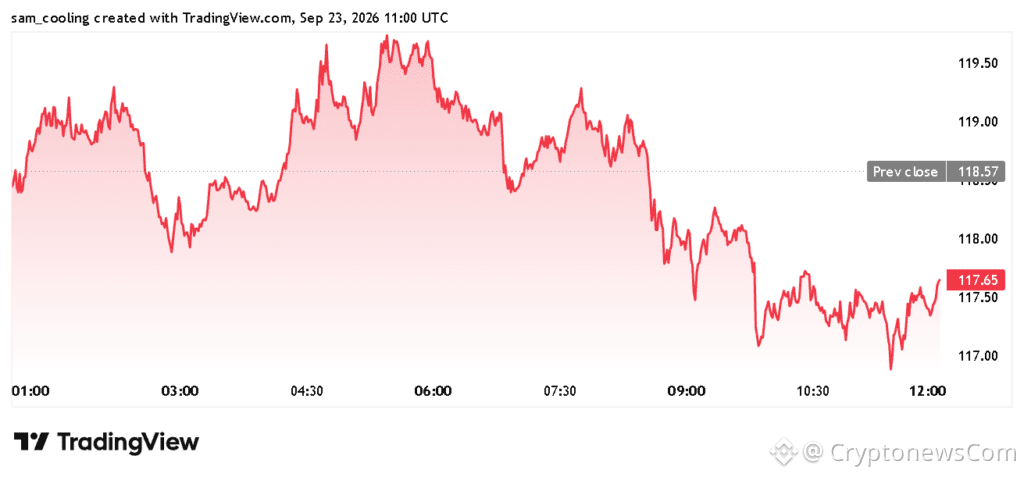
ບົດຄວາມ
Solana Begins Testing on Major Speed Upgrade: SOL Price to $150?Solana (SO) is changing hands near $117, down 0.78% on the day, as the network’s biggest structural overhaul in years quietly clears a critical testing milestone. There’s a number buried in this story that traders chasing the next leg up need to see before they place another order.
Developers have pushed the Alpenglow upgrade to Solana’s public testnet, targeting a reduction in transaction finality from roughly 13 seconds to 0.15 seconds, replacing the current TowerBFT consensus mechanism with a new voting protocol called Votor.
Validators running Agave 4.3 can now test the migration on a live copy of the network without risking real funds, following more than four months of trials on a dedicated test environment.
Anza, the firm maintaining Agave, confirmed the move via its feature-gate tracker, and mainnet activation is currently penciled in for around September 28.
Solana ETF demand remains firm, with $26.1M in net inflows on Sep. 21, lifting tracked cumulative flows to $1.44B. The move follows a 12-week run of weekly inflows showing continued investor interest despite recent market volatility.
Track SOL ETF flows: https://t.co/dzGj0Pj8q6 pic.twitter.com/Pgj0atkVmj
— AskClash (@AskClash) September 23, 2026
The timing matters. Spot Solana ETFs pulled in $26.1 million in net inflows on September 21, and network usage metrics, 23.2 million x402 AI-agent transactions in the trailing four weeks, suggest institutional and application-layer demand are both building into the upgrade window.
Can Solana Price Hit $150 This Week?
SOL USD price is testing the lower edge of a resistance band between $116 and $123.35, a level it needs to clear decisively to open the path toward $137.65 and eventually $144.76.
The four-hour RSI sitting near 71 tells a mixed story: momentum is real, but that reading also flags a market getting stretched, one where a pullback wouldn’t be surprising.
Support sits around $114.67, with a deeper floor near $106.95 if sentiment sours.
(Source – TradingView, SOL USDT)
It is worth flagging buying walls at $123 and $132, with $150 emerging as the consensus upside target if both levels give way.
The base case has SOL grinding against resistance into the September 28 Alpenglow activation, using the catalyst as the trigger for a breakout attempt.
The bear case: a rejection at $120–$123 sends price back to retest $114.67, delaying the $150 conversation.
Watch volume on any resistance test, a low-volume push through $123 would be far less convincing than one backed by real size.
For deeper context on how the upgrade interacts with capacity and adoption trends, see this recent Solana infrastructure update.
LiquidChain Targets Early Mover Upside as Solana Tests Key Levels
Anyone holding SOL from the sub-$100 range is sitting comfortably. But buying in now, chasing a token already up 22.57% over seven days and pressing into resistance, is a different risk calculus entirely, the easy money on this leg has largely been made.
That’s pushing some traders toward earlier-stage plays with more room to run, and cross-chain infrastructure is one of the more active corners of that search right now.
LiquidChain (LIQUID) is building a Layer 3 execution environment designed to fuse Bitcoin, Ethereum, and Solana liquidity into a single unified layer — a “deploy-once, access-all” model for developers tired of fragmenting liquidity across chains.
The presale is priced at $0.014958 per token, with $971,680.17 raised to date. Core features include single-step execution and verifiable settlement, aimed at removing the friction of bridging between ecosystems. As with any presale, there’s no secondary market yet and no guarantee the mainnet delivers on the roadmap, due diligence matters here.
Those tracking the Solana-LiquidChain connection can research LiquidChain further before deciding.
Gain Special Access to Layer 3 Trading HereKey Takeaways
SOL must clear $120–$123.35 resistance to realistically target the $132–$150 zone flagged by analysts.
A rejection at current resistance risks a retest of $114.67 support, or deeper to $106.95 on heavier selling.
LiquidChain’s unified liquidity layer targets BTC, ETH, and Solana interoperability, with presale pricing at $0.014958.
Alpenglow’s mainnet feature-gate activation, expected around September 28, is the next major catalyst for SOL price action.
The post Solana Begins Testing on Major Speed Upgrade: SOL Price to $150? appeared first on Cryptonews.
Solana Begins Testing on Major Speed Upgrade: SOL Price to $150?
Solana (SO) is changing hands near $117, down 0.78% on the day, as the network’s biggest structural overhaul in years quietly clears a critical testing milestone. There’s a number buried in this story that traders chasing the next leg up need to see before they place another order.
Developers have pushed the Alpenglow upgrade to Solana’s public testnet, targeting a reduction in transaction finality from roughly 13 seconds to 0.15 seconds, replacing the current TowerBFT consensus mechanism with a new voting protocol called Votor.
Validators running Agave 4.3 can now test the migration on a live copy of the network without risking real funds, following more than four months of trials on a dedicated test environment.
Anza, the firm maintaining Agave, confirmed the move via its feature-gate tracker, and mainnet activation is currently penciled in for around September 28.
Solana ETF demand remains firm, with $26.1M in net inflows on Sep. 21, lifting tracked cumulative flows to $1.44B. The move follows a 12-week run of weekly inflows showing continued investor interest despite recent market volatility.
Track SOL ETF flows: https://t.co/dzGj0Pj8q6 pic.twitter.com/Pgj0atkVmj
— AskClash (@AskClash) September 23, 2026
The timing matters. Spot Solana ETFs pulled in $26.1 million in net inflows on September 21, and network usage metrics, 23.2 million x402 AI-agent transactions in the trailing four weeks, suggest institutional and application-layer demand are both building into the upgrade window.
Can Solana Price Hit $150 This Week?
SOL USD price is testing the lower edge of a resistance band between $116 and $123.35, a level it needs to clear decisively to open the path toward $137.65 and eventually $144.76.
The four-hour RSI sitting near 71 tells a mixed story: momentum is real, but that reading also flags a market getting stretched, one where a pullback wouldn’t be surprising.
Support sits around $114.67, with a deeper floor near $106.95 if sentiment sours.
(Source – TradingView, SOL USDT)
It is worth flagging buying walls at $123 and $132, with $150 emerging as the consensus upside target if both levels give way.
The base case has SOL grinding against resistance into the September 28 Alpenglow activation, using the catalyst as the trigger for a breakout attempt.
The bear case: a rejection at $120–$123 sends price back to retest $114.67, delaying the $150 conversation.
Watch volume on any resistance test, a low-volume push through $123 would be far less convincing than one backed by real size.
For deeper context on how the upgrade interacts with capacity and adoption trends, see this recent Solana infrastructure update.
LiquidChain Targets Early Mover Upside as Solana Tests Key Levels
Anyone holding SOL from the sub-$100 range is sitting comfortably. But buying in now, chasing a token already up 22.57% over seven days and pressing into resistance, is a different risk calculus entirely, the easy money on this leg has largely been made.
That’s pushing some traders toward earlier-stage plays with more room to run, and cross-chain infrastructure is one of the more active corners of that search right now.
LiquidChain (LIQUID) is building a Layer 3 execution environment designed to fuse Bitcoin, Ethereum, and Solana liquidity into a single unified layer — a “deploy-once, access-all” model for developers tired of fragmenting liquidity across chains.
The presale is priced at $0.014958 per token, with $971,680.17 raised to date. Core features include single-step execution and verifiable settlement, aimed at removing the friction of bridging between ecosystems. As with any presale, there’s no secondary market yet and no guarantee the mainnet delivers on the roadmap, due diligence matters here.
Those tracking the Solana-LiquidChain connection can research LiquidChain further before deciding.
Gain Special Access to Layer 3 Trading HereKey Takeaways
SOL must clear $120–$123.35 resistance to realistically target the $132–$150 zone flagged by analysts.
A rejection at current resistance risks a retest of $114.67 support, or deeper to $106.95 on heavier selling.
LiquidChain’s unified liquidity layer targets BTC, ETH, and Solana interoperability, with presale pricing at $0.014958.
Alpenglow’s mainnet feature-gate activation, expected around September 28, is the next major catalyst for SOL price action.
The post Solana Begins Testing on Major Speed Upgrade: SOL Price to $150? appeared first on Cryptonews.
Developers have pushed the Alpenglow upgrade to Solana’s public testnet, targeting a reduction in transaction finality from roughly 13 seconds to 0.15 seconds, replacing the current TowerBFT consensus mechanism with a new voting protocol called Votor.
Validators running Agave 4.3 can now test the migration on a live copy of the network without risking real funds, following more than four months of trials on a dedicated test environment.
Anza, the firm maintaining Agave, confirmed the move via its feature-gate tracker, and mainnet activation is currently penciled in for around September 28.
Solana ETF demand remains firm, with $26.1M in net inflows on Sep. 21, lifting tracked cumulative flows to $1.44B. The move follows a 12-week run of weekly inflows showing continued investor interest despite recent market volatility.
Track SOL ETF flows: https://t.co/dzGj0Pj8q6 pic.twitter.com/Pgj0atkVmj
— AskClash (@AskClash) September 23, 2026
The timing matters. Spot Solana ETFs pulled in $26.1 million in net inflows on September 21, and network usage metrics, 23.2 million x402 AI-agent transactions in the trailing four weeks, suggest institutional and application-layer demand are both building into the upgrade window.
Can Solana Price Hit $150 This Week?
SOL USD price is testing the lower edge of a resistance band between $116 and $123.35, a level it needs to clear decisively to open the path toward $137.65 and eventually $144.76.
The four-hour RSI sitting near 71 tells a mixed story: momentum is real, but that reading also flags a market getting stretched, one where a pullback wouldn’t be surprising.
Support sits around $114.67, with a deeper floor near $106.95 if sentiment sours.
(Source – TradingView, SOL USDT)
It is worth flagging buying walls at $123 and $132, with $150 emerging as the consensus upside target if both levels give way.
The base case has SOL grinding against resistance into the September 28 Alpenglow activation, using the catalyst as the trigger for a breakout attempt.
The bear case: a rejection at $120–$123 sends price back to retest $114.67, delaying the $150 conversation.
Watch volume on any resistance test, a low-volume push through $123 would be far less convincing than one backed by real size.
For deeper context on how the upgrade interacts with capacity and adoption trends, see this recent Solana infrastructure update.
LiquidChain Targets Early Mover Upside as Solana Tests Key Levels
Anyone holding SOL from the sub-$100 range is sitting comfortably. But buying in now, chasing a token already up 22.57% over seven days and pressing into resistance, is a different risk calculus entirely, the easy money on this leg has largely been made.
That’s pushing some traders toward earlier-stage plays with more room to run, and cross-chain infrastructure is one of the more active corners of that search right now.
LiquidChain (LIQUID) is building a Layer 3 execution environment designed to fuse Bitcoin, Ethereum, and Solana liquidity into a single unified layer — a “deploy-once, access-all” model for developers tired of fragmenting liquidity across chains.
The presale is priced at $0.014958 per token, with $971,680.17 raised to date. Core features include single-step execution and verifiable settlement, aimed at removing the friction of bridging between ecosystems. As with any presale, there’s no secondary market yet and no guarantee the mainnet delivers on the roadmap, due diligence matters here.
Those tracking the Solana-LiquidChain connection can research LiquidChain further before deciding.
Gain Special Access to Layer 3 Trading HereKey Takeaways
SOL must clear $120–$123.35 resistance to realistically target the $132–$150 zone flagged by analysts.
A rejection at current resistance risks a retest of $114.67 support, or deeper to $106.95 on heavier selling.
LiquidChain’s unified liquidity layer targets BTC, ETH, and Solana interoperability, with presale pricing at $0.014958.
Alpenglow’s mainnet feature-gate activation, expected around September 28, is the next major catalyst for SOL price action.
The post Solana Begins Testing on Major Speed Upgrade: SOL Price to $150? appeared first on Cryptonews.
58

ບົດຄວາມ
USDT Dominates, Sun Gives Prize, TRX Lands in Moscow: TRON News RoundupIn the latest TRON news, CoinsBee, a global crypto gift card platform, said USDT on TRON was its most-used onchain payment option over the 90 days ending September 1, 2026, recording roughly 1.8 times as many completed payments as Bitcoin and 1.9 times as many as Ethereum. Meanwhile, in his latest philanthropic move, Justin Sun backed a prize offering up to $1 million for select mathematical and scientific breakthroughs. While looking East, Moscow Exchange’s launch of cash-settled TRX perpetual futures for qualified investors.
USDT on TRON Dominates CoinsBee’s Payment Mix
USDT on TRON is now the most used onchain payment option on @coinsbee, according to the platform’s payment data.
To celebrate, from September 21 through October 5, 2026, CoinsBee will offer eligible users of the CoinsBee mobile app a 2% discount on purchases paid with USDT on… pic.twitter.com/1c8QlL7LNY
— TRON DAO (@trondao) September 21, 2026
According to CoinsBee’s data, USDT on the TRON network (TRC-20) accounted for 16.23% of all payments on the platform in 2026 to date, up from 9.92% in 2025 – a 64% increase in share.
The analysis covers successfully paid and delivered orders from June 4 through September 1, 2026, and draws a clear distinction between payment count and turnover: TRC-20 made up 44.6% of USDT payment transactions but generated 64.5% of USDT turnover, implying a higher average purchase value than other USDT networks on the platform.
CoinsBee operates in more than 180 countries, supports over 200 cryptocurrencies and lists products from more than 5,000 brands, serving over 500,000 customers.
It’s worth being precise about scope here: this is platform-specific payment data from a single gift-card marketplace, not an independently audited ranking of global crypto payment volume.
The relevance for TRON is real regardless – stablecoin payment rails increasingly compete on fee and settlement speed, and TRC-20’s low-cost structure is the mechanism behind both the payment count and the turnover skew.
CoinsBee and TRON DAO are running a joint campaign from September 21 through October 5, 2026, offering eligible app users a 2% discount on purchases paid with USDT on TRON via the code USDT-TRC, capped at one use per user and subject to stated terms.
Crypto’s Biggest Philanthropist Justin Sun Backed a New Mathematics and Science Prize
(Source – The Block)
The Block reported that Justin Sun has established a prize offering up to $1 million for selected mathematical and scientific breakthroughs in Geneva.
The so-called ‘Justin Sun Prize’ aims to incentivize work on successful proofs of 66 mathematical problems, with the research team behind OpenAI awarded the first-ever prize of $ 1M, using mathematical work produced by GPT-6 Astra.
MOEX Opens TRX Crypto Exposure to Qualified Investors
The firmer institutional signal comes from Moscow Exchange, which launched cash-settled perpetual futures on BTC, ETH, SOL, XRP and TRX, including a contract designated TRXUSDF..
The contracts reference USD-denominated MOEX crypto indexes, settle profit and loss in Russian rubles, roll daily and do not deliver the underlying tokens – standard structure for regulated crypto perpetual futures aimed at institutional rather than retail flow. Access is restricted to qualified investors only.
First-tier margin requirements vary meaningfully by asset:
BTC: 22%
ETH: 35%
SOL: 38%
XRP: 43%
TRX: 30%
MOEX cited more than 72,000 qualified investors and cumulative turnover exceeding 600 billion rubles across its existing digital-asset futures business, framing the new perpetuals as an extension of demand already validated in its dated-futures product rather than an opening of spot access.
The post USDT Dominates, Sun Gives Prize, TRX Lands in Moscow: TRON News Roundup appeared first on Cryptonews.
USDT Dominates, Sun Gives Prize, TRX Lands in Moscow: TRON News Roundup
In the latest TRON news, CoinsBee, a global crypto gift card platform, said USDT on TRON was its most-used onchain payment option over the 90 days ending September 1, 2026, recording roughly 1.8 times as many completed payments as Bitcoin and 1.9 times as many as Ethereum. Meanwhile, in his latest philanthropic move, Justin Sun backed a prize offering up to $1 million for select mathematical and scientific breakthroughs. While looking East, Moscow Exchange’s launch of cash-settled TRX perpetual futures for qualified investors.
USDT on TRON Dominates CoinsBee’s Payment Mix
USDT on TRON is now the most used onchain payment option on @coinsbee, according to the platform’s payment data.
To celebrate, from September 21 through October 5, 2026, CoinsBee will offer eligible users of the CoinsBee mobile app a 2% discount on purchases paid with USDT on… pic.twitter.com/1c8QlL7LNY
— TRON DAO (@trondao) September 21, 2026
According to CoinsBee’s data, USDT on the TRON network (TRC-20) accounted for 16.23% of all payments on the platform in 2026 to date, up from 9.92% in 2025 – a 64% increase in share.
The analysis covers successfully paid and delivered orders from June 4 through September 1, 2026, and draws a clear distinction between payment count and turnover: TRC-20 made up 44.6% of USDT payment transactions but generated 64.5% of USDT turnover, implying a higher average purchase value than other USDT networks on the platform.
CoinsBee operates in more than 180 countries, supports over 200 cryptocurrencies and lists products from more than 5,000 brands, serving over 500,000 customers.
It’s worth being precise about scope here: this is platform-specific payment data from a single gift-card marketplace, not an independently audited ranking of global crypto payment volume.
The relevance for TRON is real regardless – stablecoin payment rails increasingly compete on fee and settlement speed, and TRC-20’s low-cost structure is the mechanism behind both the payment count and the turnover skew.
CoinsBee and TRON DAO are running a joint campaign from September 21 through October 5, 2026, offering eligible app users a 2% discount on purchases paid with USDT on TRON via the code USDT-TRC, capped at one use per user and subject to stated terms.
Crypto’s Biggest Philanthropist Justin Sun Backed a New Mathematics and Science Prize
(Source – The Block)
The Block reported that Justin Sun has established a prize offering up to $1 million for selected mathematical and scientific breakthroughs in Geneva.
The so-called ‘Justin Sun Prize’ aims to incentivize work on successful proofs of 66 mathematical problems, with the research team behind OpenAI awarded the first-ever prize of $ 1M, using mathematical work produced by GPT-6 Astra.
MOEX Opens TRX Crypto Exposure to Qualified Investors
The firmer institutional signal comes from Moscow Exchange, which launched cash-settled perpetual futures on BTC, ETH, SOL, XRP and TRX, including a contract designated TRXUSDF..
The contracts reference USD-denominated MOEX crypto indexes, settle profit and loss in Russian rubles, roll daily and do not deliver the underlying tokens – standard structure for regulated crypto perpetual futures aimed at institutional rather than retail flow. Access is restricted to qualified investors only.
First-tier margin requirements vary meaningfully by asset:
BTC: 22%
ETH: 35%
SOL: 38%
XRP: 43%
TRX: 30%
MOEX cited more than 72,000 qualified investors and cumulative turnover exceeding 600 billion rubles across its existing digital-asset futures business, framing the new perpetuals as an extension of demand already validated in its dated-futures product rather than an opening of spot access.
The post USDT Dominates, Sun Gives Prize, TRX Lands in Moscow: TRON News Roundup appeared first on Cryptonews.
USDT on TRON Dominates CoinsBee’s Payment Mix
USDT on TRON is now the most used onchain payment option on @coinsbee, according to the platform’s payment data.
To celebrate, from September 21 through October 5, 2026, CoinsBee will offer eligible users of the CoinsBee mobile app a 2% discount on purchases paid with USDT on… pic.twitter.com/1c8QlL7LNY
— TRON DAO (@trondao) September 21, 2026
According to CoinsBee’s data, USDT on the TRON network (TRC-20) accounted for 16.23% of all payments on the platform in 2026 to date, up from 9.92% in 2025 – a 64% increase in share.
The analysis covers successfully paid and delivered orders from June 4 through September 1, 2026, and draws a clear distinction between payment count and turnover: TRC-20 made up 44.6% of USDT payment transactions but generated 64.5% of USDT turnover, implying a higher average purchase value than other USDT networks on the platform.
CoinsBee operates in more than 180 countries, supports over 200 cryptocurrencies and lists products from more than 5,000 brands, serving over 500,000 customers.
It’s worth being precise about scope here: this is platform-specific payment data from a single gift-card marketplace, not an independently audited ranking of global crypto payment volume.
The relevance for TRON is real regardless – stablecoin payment rails increasingly compete on fee and settlement speed, and TRC-20’s low-cost structure is the mechanism behind both the payment count and the turnover skew.
CoinsBee and TRON DAO are running a joint campaign from September 21 through October 5, 2026, offering eligible app users a 2% discount on purchases paid with USDT on TRON via the code USDT-TRC, capped at one use per user and subject to stated terms.
Crypto’s Biggest Philanthropist Justin Sun Backed a New Mathematics and Science Prize
(Source – The Block)
The Block reported that Justin Sun has established a prize offering up to $1 million for selected mathematical and scientific breakthroughs in Geneva.
The so-called ‘Justin Sun Prize’ aims to incentivize work on successful proofs of 66 mathematical problems, with the research team behind OpenAI awarded the first-ever prize of $ 1M, using mathematical work produced by GPT-6 Astra.
MOEX Opens TRX Crypto Exposure to Qualified Investors
The firmer institutional signal comes from Moscow Exchange, which launched cash-settled perpetual futures on BTC, ETH, SOL, XRP and TRX, including a contract designated TRXUSDF..
The contracts reference USD-denominated MOEX crypto indexes, settle profit and loss in Russian rubles, roll daily and do not deliver the underlying tokens – standard structure for regulated crypto perpetual futures aimed at institutional rather than retail flow. Access is restricted to qualified investors only.
First-tier margin requirements vary meaningfully by asset:
BTC: 22%
ETH: 35%
SOL: 38%
XRP: 43%
TRX: 30%
MOEX cited more than 72,000 qualified investors and cumulative turnover exceeding 600 billion rubles across its existing digital-asset futures business, framing the new perpetuals as an extension of demand already validated in its dated-futures product rather than an opening of spot access.
The post USDT Dominates, Sun Gives Prize, TRX Lands in Moscow: TRON News Roundup appeared first on Cryptonews.
143
XRP Ledger Batch Upgrade Nears Activation, but Demand Is UnclearRipple (XRP) has climbed 22.2% over the past week to $1.58, and that rally now sits directly ahead of a September 29 deadline that will determine whether the XRP Ledger’s revised Batch amendment activates on schedule. As of September 20, 30 of the network’s 35 validators were supporting the upgrade, comfortably inside the required threshold but not yet locked in. The bigger question isn’t whether the code passes a vote; it’s whether a more capable ledger actually creates new demand for XRP itself.
While DC was busy arguing, the ledger kept building.
XRPL Batch is set to go live Sept 29.
Up to 8 transactions.
One atomic shot.
Payments that settle together or not at all.
That is not a tweet.
That is infrastructure.
Spot XRP ETFs already pulled in about $1.7B in… pic.twitter.com/bbVvSLHdrh
— XRPMoonWalk (@XRPMoonWalkK) September 23, 2026
That distinction matters for anyone tracking XRP’s derivatives positioning and open interest reset heading into the deadline, since price action and protocol mechanics are running on separate tracks this week.
What the New XRP Ledger Batch Upgrade Changes
The Batch amendment groups two to eight regular XRP Ledger transactions under a single outer transaction, which then determines how the batch is processed. There are four modes available, and the differences matter for how institutional workflows treat risk on the ledger.
The All or Nothing mode is the one drawing institutional attention. In a securities trade, it ensures the asset transfer and the payment are either both complete or both canceled, removing the scenario where one leg settles, and the other doesn’t. Batch also lets exchanges, wallets, or marketplaces bundle their own fees inside a customer’s transaction, so the fee and the trade settle together.
Why September 29 Is a Conditional Deadline
Activation requires the amendment to hold at least 28 of 35 validator votes – the required 80%-plus support – for 14 consecutive days. With 30 validators onboard as of September 20, the Batch amendment is on track to activate on September 29 at 14:06 UTC, assuming nothing shifts.
That assumption isn’t trivial. Validator operators can change their votes at any point before the deadline, and if support drops below the required margin, the 14-day voting clock resets entirely, pushing activation weeks out.
Two of the current 30 supporters still have room to flip before the window closes, per XRPL’s published amendment rules, which govern how support thresholds and voting periods function across the network.
This isn’t Batch’s first attempt at activation. An earlier version was pulled earlier in 2026 after auditors flagged a flaw that could have allowed unauthorized transactions, though no user funds were ever at risk.
The revised version, released September 14, has since passed three outside reviews before reaching this final stretch of validator voting – the first time Batch has gotten this close since the withdrawal.
A More Capable Ledger Isn’t the Same as New XRP Buyers
Thirty-of-35 validator support puts the amendment on track. It does not make activation certain, and it says nothing about what happens to XRP’s crypto price once the code is live. Batch doesn’t require XRP to function, so bundling settlement into a single atomic operation creates no automatic token demand.
Any lasting effect on XRP depends entirely on whether the asset managers reportedly testing Batch actually route production volume through it, and whether that volume creates liquidity needs the ledger didn’t previously have.
Ripple’s delivery-versus-payment pitch is real infrastructure, but infrastructure and buy-side demand are separate outcomes – a gap explored in coverage of Ripple’s other payment integrations and their market reaction.
It’s also worth noting that XRP’s 22.2% weekly move came alongside Bitcoin’s 13.9% gain over the same stretch.
A broad market rally lifting both assets in tandem doesn’t confirm that Batch anticipation is what’s driving XRP specifically – correlation here isn’t causation, and nothing in the current data isolates Batch as the rally’s driver.
What Could Happen Before and After September 29
If validator support holds above the required threshold through the deadline, Batch activates September 29 at 14:06 UTC and Ripple’s all-or-nothing settlement becomes live functionality rather than a pitch deck feature. If support slips below the margin beforehand, the 14-day countdown restarts and the market gets another delayed timeline to price around.
Beyond the vote itself, the real test starts after activation. If the asset managers and commercial projects Akinyele referenced move actual trades onto the ledger, Batch could make XRP more attractive to institutional settlement flow over time.
If that usage doesn’t materialize, the XRP Ledger ends up more efficient without a corresponding increase in buyers – a technically successful upgrade that leaves the demand question exactly where it started.
Don’t Miss: The Hottest Meme Coin Opportunities Silently Climbing the Crypto Ranks in September
The post XRP Ledger Batch Upgrade Nears Activation, but Demand Is Unclear appeared first on Cryptonews.
XRP Ledger Batch Upgrade Nears Activation, but Demand Is Unclear
Ripple (XRP) has climbed 22.2% over the past week to $1.58, and that rally now sits directly ahead of a September 29 deadline that will determine whether the XRP Ledger’s revised Batch amendment activates on schedule. As of September 20, 30 of the network’s 35 validators were supporting the upgrade, comfortably inside the required threshold but not yet locked in. The bigger question isn’t whether the code passes a vote; it’s whether a more capable ledger actually creates new demand for XRP itself.
While DC was busy arguing, the ledger kept building.
XRPL Batch is set to go live Sept 29.
Up to 8 transactions.
One atomic shot.
Payments that settle together or not at all.
That is not a tweet.
That is infrastructure.
Spot XRP ETFs already pulled in about $1.7B in… pic.twitter.com/bbVvSLHdrh
— XRPMoonWalk (@XRPMoonWalkK) September 23, 2026
That distinction matters for anyone tracking XRP’s derivatives positioning and open interest reset heading into the deadline, since price action and protocol mechanics are running on separate tracks this week.
What the New XRP Ledger Batch Upgrade Changes
The Batch amendment groups two to eight regular XRP Ledger transactions under a single outer transaction, which then determines how the batch is processed. There are four modes available, and the differences matter for how institutional workflows treat risk on the ledger.
The All or Nothing mode is the one drawing institutional attention. In a securities trade, it ensures the asset transfer and the payment are either both complete or both canceled, removing the scenario where one leg settles, and the other doesn’t. Batch also lets exchanges, wallets, or marketplaces bundle their own fees inside a customer’s transaction, so the fee and the trade settle together.
Why September 29 Is a Conditional Deadline
Activation requires the amendment to hold at least 28 of 35 validator votes – the required 80%-plus support – for 14 consecutive days. With 30 validators onboard as of September 20, the Batch amendment is on track to activate on September 29 at 14:06 UTC, assuming nothing shifts.
That assumption isn’t trivial. Validator operators can change their votes at any point before the deadline, and if support drops below the required margin, the 14-day voting clock resets entirely, pushing activation weeks out.
Two of the current 30 supporters still have room to flip before the window closes, per XRPL’s published amendment rules, which govern how support thresholds and voting periods function across the network.
This isn’t Batch’s first attempt at activation. An earlier version was pulled earlier in 2026 after auditors flagged a flaw that could have allowed unauthorized transactions, though no user funds were ever at risk.
The revised version, released September 14, has since passed three outside reviews before reaching this final stretch of validator voting – the first time Batch has gotten this close since the withdrawal.
A More Capable Ledger Isn’t the Same as New XRP Buyers
Thirty-of-35 validator support puts the amendment on track. It does not make activation certain, and it says nothing about what happens to XRP’s crypto price once the code is live. Batch doesn’t require XRP to function, so bundling settlement into a single atomic operation creates no automatic token demand.
Any lasting effect on XRP depends entirely on whether the asset managers reportedly testing Batch actually route production volume through it, and whether that volume creates liquidity needs the ledger didn’t previously have.
Ripple’s delivery-versus-payment pitch is real infrastructure, but infrastructure and buy-side demand are separate outcomes – a gap explored in coverage of Ripple’s other payment integrations and their market reaction.
It’s also worth noting that XRP’s 22.2% weekly move came alongside Bitcoin’s 13.9% gain over the same stretch.
A broad market rally lifting both assets in tandem doesn’t confirm that Batch anticipation is what’s driving XRP specifically – correlation here isn’t causation, and nothing in the current data isolates Batch as the rally’s driver.
What Could Happen Before and After September 29
If validator support holds above the required threshold through the deadline, Batch activates September 29 at 14:06 UTC and Ripple’s all-or-nothing settlement becomes live functionality rather than a pitch deck feature. If support slips below the margin beforehand, the 14-day countdown restarts and the market gets another delayed timeline to price around.
Beyond the vote itself, the real test starts after activation. If the asset managers and commercial projects Akinyele referenced move actual trades onto the ledger, Batch could make XRP more attractive to institutional settlement flow over time.
If that usage doesn’t materialize, the XRP Ledger ends up more efficient without a corresponding increase in buyers – a technically successful upgrade that leaves the demand question exactly where it started.
Don’t Miss: The Hottest Meme Coin Opportunities Silently Climbing the Crypto Ranks in September
The post XRP Ledger Batch Upgrade Nears Activation, but Demand Is Unclear appeared first on Cryptonews.
While DC was busy arguing, the ledger kept building.
XRPL Batch is set to go live Sept 29.
Up to 8 transactions.
One atomic shot.
Payments that settle together or not at all.
That is not a tweet.
That is infrastructure.
Spot XRP ETFs already pulled in about $1.7B in… pic.twitter.com/bbVvSLHdrh
— XRPMoonWalk (@XRPMoonWalkK) September 23, 2026
That distinction matters for anyone tracking XRP’s derivatives positioning and open interest reset heading into the deadline, since price action and protocol mechanics are running on separate tracks this week.
What the New XRP Ledger Batch Upgrade Changes
The Batch amendment groups two to eight regular XRP Ledger transactions under a single outer transaction, which then determines how the batch is processed. There are four modes available, and the differences matter for how institutional workflows treat risk on the ledger.
The All or Nothing mode is the one drawing institutional attention. In a securities trade, it ensures the asset transfer and the payment are either both complete or both canceled, removing the scenario where one leg settles, and the other doesn’t. Batch also lets exchanges, wallets, or marketplaces bundle their own fees inside a customer’s transaction, so the fee and the trade settle together.
Why September 29 Is a Conditional Deadline
Activation requires the amendment to hold at least 28 of 35 validator votes – the required 80%-plus support – for 14 consecutive days. With 30 validators onboard as of September 20, the Batch amendment is on track to activate on September 29 at 14:06 UTC, assuming nothing shifts.
That assumption isn’t trivial. Validator operators can change their votes at any point before the deadline, and if support drops below the required margin, the 14-day voting clock resets entirely, pushing activation weeks out.
Two of the current 30 supporters still have room to flip before the window closes, per XRPL’s published amendment rules, which govern how support thresholds and voting periods function across the network.
This isn’t Batch’s first attempt at activation. An earlier version was pulled earlier in 2026 after auditors flagged a flaw that could have allowed unauthorized transactions, though no user funds were ever at risk.
The revised version, released September 14, has since passed three outside reviews before reaching this final stretch of validator voting – the first time Batch has gotten this close since the withdrawal.
A More Capable Ledger Isn’t the Same as New XRP Buyers
Thirty-of-35 validator support puts the amendment on track. It does not make activation certain, and it says nothing about what happens to XRP’s crypto price once the code is live. Batch doesn’t require XRP to function, so bundling settlement into a single atomic operation creates no automatic token demand.
Any lasting effect on XRP depends entirely on whether the asset managers reportedly testing Batch actually route production volume through it, and whether that volume creates liquidity needs the ledger didn’t previously have.
Ripple’s delivery-versus-payment pitch is real infrastructure, but infrastructure and buy-side demand are separate outcomes – a gap explored in coverage of Ripple’s other payment integrations and their market reaction.
It’s also worth noting that XRP’s 22.2% weekly move came alongside Bitcoin’s 13.9% gain over the same stretch.
A broad market rally lifting both assets in tandem doesn’t confirm that Batch anticipation is what’s driving XRP specifically – correlation here isn’t causation, and nothing in the current data isolates Batch as the rally’s driver.
What Could Happen Before and After September 29
If validator support holds above the required threshold through the deadline, Batch activates September 29 at 14:06 UTC and Ripple’s all-or-nothing settlement becomes live functionality rather than a pitch deck feature. If support slips below the margin beforehand, the 14-day countdown restarts and the market gets another delayed timeline to price around.
Beyond the vote itself, the real test starts after activation. If the asset managers and commercial projects Akinyele referenced move actual trades onto the ledger, Batch could make XRP more attractive to institutional settlement flow over time.
If that usage doesn’t materialize, the XRP Ledger ends up more efficient without a corresponding increase in buyers – a technically successful upgrade that leaves the demand question exactly where it started.
Don’t Miss: The Hottest Meme Coin Opportunities Silently Climbing the Crypto Ranks in September
The post XRP Ledger Batch Upgrade Nears Activation, but Demand Is Unclear appeared first on Cryptonews.
221
ບົດຄວາມ
HYPE’s Rally Has Real Fuel but $100 Is a Critical TestHyperliquid (HYPE) has gained 88% in roughly two months and is sitting just below $100, and Hyperliquid’s open interest just printed a record $8.8 billion. Those two facts are related, but not in the simple way the rally’s biggest fans want to believe.
The move toward the all-time high is backed by real revenue growth and an accelerating buyback program, not pure speculation. But record open interest also means a crowded derivatives book, and a crowded book cuts both ways if HYPE fails to hold above resistance.
Hyperliquid Recovery Meets Reality: Why the $100 Test Is Arriving Now
The timing isn’t random. Bitcoin recovered above $85,000 for the first time since January, and that shift in risk appetite pulled speculative capital back into perpetual markets broadly. Hyperliquid, as the dominant venue for that flow, absorbed a disproportionate share of it.
HYPE printed a September all-time high of $96 on the back of that inflow, extending its two-month gain to 88%. If the uptrend holds, the immediate technical targets sit at $102 and $118 – levels that would confirm a clean breakout rather than a rejection at the psychological ceiling
(Source – TradingView, HYPE USDT)
The macro backdrop matters here, too. Crude oil slipping below $90 would ease inflation pressure and could deepen the broader risk-on trade that’s already lifting crypto – a conditional tailwind, not a guarantee, but one worth watching alongside Bitcoin’s own resistance tests, where leverage has repeatedly amplified moves in both directions.
Hyperliquid Revenue and Buybacks Are Fueling the Rally
Hyperliquid directs most of its generated revenue into HYPE buybacks, the mechanism that actually connects protocol activity to the token price. That mechanism has been running hot.
Average daily revenue rose from about $1.5 million in Q2 to $3 million in Q3 – a straightforward doubling, not the more dramatic multiple sometimes attached to the quarter as a whole.
(Source – TokenTerminal, Hyperliquid Revenue)
The sharper move came mid-August, when daily revenue exceeded $5 million. That spike coincided with weekly buyback spending through the assistance fund jumping from roughly $5 million to $20 million – nearly a fourfold increase in a matter of weeks.
HYPE crossed $80 for the first time during that exact window. The sequencing is the tell: trading activity rose, revenue followed, buyback spending quadrupled, and price broke to a new level shortly after. That’s a demand-and-supply-reduction story, not just a momentum chase
Access Up to 200x Leverage on Bitcoin and Ethereum CFDs on PrimeXBTWhy Record Open Interest Raises the Downside Risk
Open interest measures the notional value of outstanding derivatives positions – not order-book depth, and not a dollar figure that translates one-to-one into potential losses.
At $8.8 billion, Hyperliquid’s OI has now surpassed the level seen at the previous bull-market peak last October, suggesting positioning is more aggressive today than it was at the last major top.
(Source – Coinalyze, Hyperliquid OI)
That matters because a heavily leveraged book amplifies moves in both directions. A breakout above $100 with rising open interest would suggest fresh conviction entering the market. A rejection at resistance, with the same open interest sitting on the books, sets up forced unwinds, where longs get liquidated into a falling market, accelerating the drop.
The $85-$88 range is a potential pullback area if the rally cools from here. That’s not a prediction of collapse – it’s the specific level where the bullish thesis would need to hold if $100 rejects on the first attempt.
What HYPE Needs to Prove Next
The evidence supports two things simultaneously: a genuine activity-driven rally and an elevated derivatives book that raises the stakes of the next move. Both are true. Neither cancels the other out.
Three things will determine which path plays out. Does HYPE clear and hold $100 on volume, or does it stall and roll over? Does open interest keep climbing alongside price, confirming fresh conviction, or does it plateau while price pushes higher, a divergence that often precedes a squeeze? And does the revenue base supporting Hyperliquid’s buyback program stay above the mid-August run rate, or does it fade back toward Q3 averages?
A failure at resistance would put the $85-$88 zone in play, and a crowded $8.8 billion open interest book means that move could happen fast if forced liquidations kick in. That’s a real conditional risk. It is not, based on what’s currently on the table, a confirmed crash – it’s a specific scenario with specific triggers, and traders watching the tape over the next few sessions will know which one they’re in well before the headlines catch up.
The post HYPE’s Rally Has Real Fuel but $100 Is a Critical Test appeared first on Cryptonews.
HYPE’s Rally Has Real Fuel but $100 Is a Critical Test
Hyperliquid (HYPE) has gained 88% in roughly two months and is sitting just below $100, and Hyperliquid’s open interest just printed a record $8.8 billion. Those two facts are related, but not in the simple way the rally’s biggest fans want to believe.
The move toward the all-time high is backed by real revenue growth and an accelerating buyback program, not pure speculation. But record open interest also means a crowded derivatives book, and a crowded book cuts both ways if HYPE fails to hold above resistance.
Hyperliquid Recovery Meets Reality: Why the $100 Test Is Arriving Now
The timing isn’t random. Bitcoin recovered above $85,000 for the first time since January, and that shift in risk appetite pulled speculative capital back into perpetual markets broadly. Hyperliquid, as the dominant venue for that flow, absorbed a disproportionate share of it.
HYPE printed a September all-time high of $96 on the back of that inflow, extending its two-month gain to 88%. If the uptrend holds, the immediate technical targets sit at $102 and $118 – levels that would confirm a clean breakout rather than a rejection at the psychological ceiling
(Source – TradingView, HYPE USDT)
The macro backdrop matters here, too. Crude oil slipping below $90 would ease inflation pressure and could deepen the broader risk-on trade that’s already lifting crypto – a conditional tailwind, not a guarantee, but one worth watching alongside Bitcoin’s own resistance tests, where leverage has repeatedly amplified moves in both directions.
Hyperliquid Revenue and Buybacks Are Fueling the Rally
Hyperliquid directs most of its generated revenue into HYPE buybacks, the mechanism that actually connects protocol activity to the token price. That mechanism has been running hot.
Average daily revenue rose from about $1.5 million in Q2 to $3 million in Q3 – a straightforward doubling, not the more dramatic multiple sometimes attached to the quarter as a whole.
(Source – TokenTerminal, Hyperliquid Revenue)
The sharper move came mid-August, when daily revenue exceeded $5 million. That spike coincided with weekly buyback spending through the assistance fund jumping from roughly $5 million to $20 million – nearly a fourfold increase in a matter of weeks.
HYPE crossed $80 for the first time during that exact window. The sequencing is the tell: trading activity rose, revenue followed, buyback spending quadrupled, and price broke to a new level shortly after. That’s a demand-and-supply-reduction story, not just a momentum chase
Access Up to 200x Leverage on Bitcoin and Ethereum CFDs on PrimeXBTWhy Record Open Interest Raises the Downside Risk
Open interest measures the notional value of outstanding derivatives positions – not order-book depth, and not a dollar figure that translates one-to-one into potential losses.
At $8.8 billion, Hyperliquid’s OI has now surpassed the level seen at the previous bull-market peak last October, suggesting positioning is more aggressive today than it was at the last major top.
(Source – Coinalyze, Hyperliquid OI)
That matters because a heavily leveraged book amplifies moves in both directions. A breakout above $100 with rising open interest would suggest fresh conviction entering the market. A rejection at resistance, with the same open interest sitting on the books, sets up forced unwinds, where longs get liquidated into a falling market, accelerating the drop.
The $85-$88 range is a potential pullback area if the rally cools from here. That’s not a prediction of collapse – it’s the specific level where the bullish thesis would need to hold if $100 rejects on the first attempt.
What HYPE Needs to Prove Next
The evidence supports two things simultaneously: a genuine activity-driven rally and an elevated derivatives book that raises the stakes of the next move. Both are true. Neither cancels the other out.
Three things will determine which path plays out. Does HYPE clear and hold $100 on volume, or does it stall and roll over? Does open interest keep climbing alongside price, confirming fresh conviction, or does it plateau while price pushes higher, a divergence that often precedes a squeeze? And does the revenue base supporting Hyperliquid’s buyback program stay above the mid-August run rate, or does it fade back toward Q3 averages?
A failure at resistance would put the $85-$88 zone in play, and a crowded $8.8 billion open interest book means that move could happen fast if forced liquidations kick in. That’s a real conditional risk. It is not, based on what’s currently on the table, a confirmed crash – it’s a specific scenario with specific triggers, and traders watching the tape over the next few sessions will know which one they’re in well before the headlines catch up.
The post HYPE’s Rally Has Real Fuel but $100 Is a Critical Test appeared first on Cryptonews.
The move toward the all-time high is backed by real revenue growth and an accelerating buyback program, not pure speculation. But record open interest also means a crowded derivatives book, and a crowded book cuts both ways if HYPE fails to hold above resistance.
Hyperliquid Recovery Meets Reality: Why the $100 Test Is Arriving Now
The timing isn’t random. Bitcoin recovered above $85,000 for the first time since January, and that shift in risk appetite pulled speculative capital back into perpetual markets broadly. Hyperliquid, as the dominant venue for that flow, absorbed a disproportionate share of it.
HYPE printed a September all-time high of $96 on the back of that inflow, extending its two-month gain to 88%. If the uptrend holds, the immediate technical targets sit at $102 and $118 – levels that would confirm a clean breakout rather than a rejection at the psychological ceiling
(Source – TradingView, HYPE USDT)
The macro backdrop matters here, too. Crude oil slipping below $90 would ease inflation pressure and could deepen the broader risk-on trade that’s already lifting crypto – a conditional tailwind, not a guarantee, but one worth watching alongside Bitcoin’s own resistance tests, where leverage has repeatedly amplified moves in both directions.
Hyperliquid Revenue and Buybacks Are Fueling the Rally
Hyperliquid directs most of its generated revenue into HYPE buybacks, the mechanism that actually connects protocol activity to the token price. That mechanism has been running hot.
Average daily revenue rose from about $1.5 million in Q2 to $3 million in Q3 – a straightforward doubling, not the more dramatic multiple sometimes attached to the quarter as a whole.
(Source – TokenTerminal, Hyperliquid Revenue)
The sharper move came mid-August, when daily revenue exceeded $5 million. That spike coincided with weekly buyback spending through the assistance fund jumping from roughly $5 million to $20 million – nearly a fourfold increase in a matter of weeks.
HYPE crossed $80 for the first time during that exact window. The sequencing is the tell: trading activity rose, revenue followed, buyback spending quadrupled, and price broke to a new level shortly after. That’s a demand-and-supply-reduction story, not just a momentum chase
Access Up to 200x Leverage on Bitcoin and Ethereum CFDs on PrimeXBTWhy Record Open Interest Raises the Downside Risk
Open interest measures the notional value of outstanding derivatives positions – not order-book depth, and not a dollar figure that translates one-to-one into potential losses.
At $8.8 billion, Hyperliquid’s OI has now surpassed the level seen at the previous bull-market peak last October, suggesting positioning is more aggressive today than it was at the last major top.
(Source – Coinalyze, Hyperliquid OI)
That matters because a heavily leveraged book amplifies moves in both directions. A breakout above $100 with rising open interest would suggest fresh conviction entering the market. A rejection at resistance, with the same open interest sitting on the books, sets up forced unwinds, where longs get liquidated into a falling market, accelerating the drop.
The $85-$88 range is a potential pullback area if the rally cools from here. That’s not a prediction of collapse – it’s the specific level where the bullish thesis would need to hold if $100 rejects on the first attempt.
What HYPE Needs to Prove Next
The evidence supports two things simultaneously: a genuine activity-driven rally and an elevated derivatives book that raises the stakes of the next move. Both are true. Neither cancels the other out.
Three things will determine which path plays out. Does HYPE clear and hold $100 on volume, or does it stall and roll over? Does open interest keep climbing alongside price, confirming fresh conviction, or does it plateau while price pushes higher, a divergence that often precedes a squeeze? And does the revenue base supporting Hyperliquid’s buyback program stay above the mid-August run rate, or does it fade back toward Q3 averages?
A failure at resistance would put the $85-$88 zone in play, and a crowded $8.8 billion open interest book means that move could happen fast if forced liquidations kick in. That’s a real conditional risk. It is not, based on what’s currently on the table, a confirmed crash – it’s a specific scenario with specific triggers, and traders watching the tape over the next few sessions will know which one they’re in well before the headlines catch up.
The post HYPE’s Rally Has Real Fuel but $100 Is a Critical Test appeared first on Cryptonews.
216

ບົດຄວາມ
ETH USD Loses Ground as Ethereum Price Analysis Remains Targeting $3,000 This WeekEthereum Price Prediction, September 23: Ethereum (ETH) trades at $2,735, down a marginal 0.61% over the past 24 hours, a pause, not a reversal, after a week that saw the token gain 15% and reclaim territory it hadn’t touched since October.
US spot ETH ETFs pulled in roughly $270 million on Monday, the largest single-day inflow since October, extending a two-day streak worth $413.8 million that erased the prior three days of outflows.
Yesterday was a strong day for US spot crypto ETFs.$BTC led with $714.75M inflows, while $ETH added another $162.31M.
And the inflows continued across the altcoins, with $ZEC at $32.81M, $SOL at $28.87M and $XRP at $20.02M. pic.twitter.com/Q0vEw5POW0
— Suzzy | DeFi (@SuzzyDefi) September 23, 2026
Treasury firm BitMine Immersion added 12,500 ETH to its stack, building on last week’s 27,562 ETH purchase and pushing total holdings to 5.983 million ETH, worth a jaw-dropping $16.5 billion at time of writing.
Chairman Thomas Lee called Q3’s ETH outperformance “a prelude to a potentially stronger up move” in Q4, citing institutional underweighting of crypto relative to AI stocks this year.
The rally has held despite a Fed rate hike, Houthi advance and a stalled Clarity Act in the Senate, arguably a sign that flows, not headlines, are driving this leg. ETF inflows and resistance levels now matter more to price than regulatory noise.
Ethereum Price Prediction: Can Ethereum Price Hit $3,000 This Week?
ETH USD price is consolidating near the top of its recent range, with the 24-hour band running $2,716.89 to $2,787.96.
Buyers have consistently defended the $2,710–$2,720 zone, the former breakout level that’s now acting as near-term support.
Resistance sits at $2,750–$2,800, a level ETH is actively probing after ETF inflows accelerated.
(Source – TradingView, ETH USD)
Bull case: a clean break above $2,800 opens the door toward $3,000, a target chartist Ali Martinez has flagged from a triangle breakout pattern, with Messari’s base case extending to $3,200–$3,800 by December.
Base case: ETH grinds sideways between $2,700 and $2,800 while the market digests BitMine’s accumulation and awaits the Glamsterdam upgrade’s October 6 testnet launch.
Bear case: a slip below $2,400–$2,405 invalidates the current structure entirely. Prediction markets currently assign just a 38% probability to ETH closing September above $2,750 — a reminder that conviction here is thinner than the chart suggests.
Don’t Miss Out on Our $1,000 USDT Airdrop on ByBitLiquidChain Targets Early Mover Upside as Ethereum Tests Key Levels
Anyone holding ETH since the June lows is sitting on solid gains, and the ETF flow data validates the position. But here’s the uncomfortable math: at a $330 billion-plus market cap, ETH needs enormous capital inflows to deliver the kind of multiples early-stage tokens can post off a fraction of that volume. That’s the gap presale plays are built to fill.
LiquidChain (LIQUID) is a Layer 3 infrastructure project built to fuse Bitcoin, Ethereum, and Solana liquidity into a single execution environment, a “deploy-once” architecture where developers build once and access all three ecosystems rather than fragmenting liquidity across chains.
The presale is priced at $0.014958 with $971,680.17 raised so far. Core features include a Unified Liquidity Layer, Single-Step Execution, and Verifiable Settlement.
Presale tokens carry the standard early-stage risk profile, no live mainnet track record yet, so allocation size should reflect that.
Those curious can research LiquidChain directly at liquidchain.com before the round progresses further.
Gain Special Access to Layer 3 Trading HereKey Takeaways
ETH holds above $2,700 support; a close above $2,800 could open a path toward $3,000 near-term.
A break below $2,400–$2,405 would invalidate the current bullish structure and shift momentum bearish.
LiquidChain’s unified liquidity layer targets cross-chain fragmentation between BTC, ETH, and SOL execution environments.
The Glamsterdam upgrade’s October 6 testnet launch is the next major catalyst for ETH price action.
The post ETH USD Loses Ground as Ethereum Price Analysis Remains Targeting $3,000 This Week appeared first on Cryptonews.
ETH USD Loses Ground as Ethereum Price Analysis Remains Targeting $3,000 This Week
Ethereum Price Prediction, September 23: Ethereum (ETH) trades at $2,735, down a marginal 0.61% over the past 24 hours, a pause, not a reversal, after a week that saw the token gain 15% and reclaim territory it hadn’t touched since October.
US spot ETH ETFs pulled in roughly $270 million on Monday, the largest single-day inflow since October, extending a two-day streak worth $413.8 million that erased the prior three days of outflows.
Yesterday was a strong day for US spot crypto ETFs.$BTC led with $714.75M inflows, while $ETH added another $162.31M.
And the inflows continued across the altcoins, with $ZEC at $32.81M, $SOL at $28.87M and $XRP at $20.02M. pic.twitter.com/Q0vEw5POW0
— Suzzy | DeFi (@SuzzyDefi) September 23, 2026
Treasury firm BitMine Immersion added 12,500 ETH to its stack, building on last week’s 27,562 ETH purchase and pushing total holdings to 5.983 million ETH, worth a jaw-dropping $16.5 billion at time of writing.
Chairman Thomas Lee called Q3’s ETH outperformance “a prelude to a potentially stronger up move” in Q4, citing institutional underweighting of crypto relative to AI stocks this year.
The rally has held despite a Fed rate hike, Houthi advance and a stalled Clarity Act in the Senate, arguably a sign that flows, not headlines, are driving this leg. ETF inflows and resistance levels now matter more to price than regulatory noise.
Ethereum Price Prediction: Can Ethereum Price Hit $3,000 This Week?
ETH USD price is consolidating near the top of its recent range, with the 24-hour band running $2,716.89 to $2,787.96.
Buyers have consistently defended the $2,710–$2,720 zone, the former breakout level that’s now acting as near-term support.
Resistance sits at $2,750–$2,800, a level ETH is actively probing after ETF inflows accelerated.
(Source – TradingView, ETH USD)
Bull case: a clean break above $2,800 opens the door toward $3,000, a target chartist Ali Martinez has flagged from a triangle breakout pattern, with Messari’s base case extending to $3,200–$3,800 by December.
Base case: ETH grinds sideways between $2,700 and $2,800 while the market digests BitMine’s accumulation and awaits the Glamsterdam upgrade’s October 6 testnet launch.
Bear case: a slip below $2,400–$2,405 invalidates the current structure entirely. Prediction markets currently assign just a 38% probability to ETH closing September above $2,750 — a reminder that conviction here is thinner than the chart suggests.
Don’t Miss Out on Our $1,000 USDT Airdrop on ByBitLiquidChain Targets Early Mover Upside as Ethereum Tests Key Levels
Anyone holding ETH since the June lows is sitting on solid gains, and the ETF flow data validates the position. But here’s the uncomfortable math: at a $330 billion-plus market cap, ETH needs enormous capital inflows to deliver the kind of multiples early-stage tokens can post off a fraction of that volume. That’s the gap presale plays are built to fill.
LiquidChain (LIQUID) is a Layer 3 infrastructure project built to fuse Bitcoin, Ethereum, and Solana liquidity into a single execution environment, a “deploy-once” architecture where developers build once and access all three ecosystems rather than fragmenting liquidity across chains.
The presale is priced at $0.014958 with $971,680.17 raised so far. Core features include a Unified Liquidity Layer, Single-Step Execution, and Verifiable Settlement.
Presale tokens carry the standard early-stage risk profile, no live mainnet track record yet, so allocation size should reflect that.
Those curious can research LiquidChain directly at liquidchain.com before the round progresses further.
Gain Special Access to Layer 3 Trading HereKey Takeaways
ETH holds above $2,700 support; a close above $2,800 could open a path toward $3,000 near-term.
A break below $2,400–$2,405 would invalidate the current bullish structure and shift momentum bearish.
LiquidChain’s unified liquidity layer targets cross-chain fragmentation between BTC, ETH, and SOL execution environments.
The Glamsterdam upgrade’s October 6 testnet launch is the next major catalyst for ETH price action.
The post ETH USD Loses Ground as Ethereum Price Analysis Remains Targeting $3,000 This Week appeared first on Cryptonews.
US spot ETH ETFs pulled in roughly $270 million on Monday, the largest single-day inflow since October, extending a two-day streak worth $413.8 million that erased the prior three days of outflows.
Yesterday was a strong day for US spot crypto ETFs.$BTC led with $714.75M inflows, while $ETH added another $162.31M.
And the inflows continued across the altcoins, with $ZEC at $32.81M, $SOL at $28.87M and $XRP at $20.02M. pic.twitter.com/Q0vEw5POW0
— Suzzy | DeFi (@SuzzyDefi) September 23, 2026
Treasury firm BitMine Immersion added 12,500 ETH to its stack, building on last week’s 27,562 ETH purchase and pushing total holdings to 5.983 million ETH, worth a jaw-dropping $16.5 billion at time of writing.
Chairman Thomas Lee called Q3’s ETH outperformance “a prelude to a potentially stronger up move” in Q4, citing institutional underweighting of crypto relative to AI stocks this year.
The rally has held despite a Fed rate hike, Houthi advance and a stalled Clarity Act in the Senate, arguably a sign that flows, not headlines, are driving this leg. ETF inflows and resistance levels now matter more to price than regulatory noise.
Ethereum Price Prediction: Can Ethereum Price Hit $3,000 This Week?
ETH USD price is consolidating near the top of its recent range, with the 24-hour band running $2,716.89 to $2,787.96.
Buyers have consistently defended the $2,710–$2,720 zone, the former breakout level that’s now acting as near-term support.
Resistance sits at $2,750–$2,800, a level ETH is actively probing after ETF inflows accelerated.
(Source – TradingView, ETH USD)
Bull case: a clean break above $2,800 opens the door toward $3,000, a target chartist Ali Martinez has flagged from a triangle breakout pattern, with Messari’s base case extending to $3,200–$3,800 by December.
Base case: ETH grinds sideways between $2,700 and $2,800 while the market digests BitMine’s accumulation and awaits the Glamsterdam upgrade’s October 6 testnet launch.
Bear case: a slip below $2,400–$2,405 invalidates the current structure entirely. Prediction markets currently assign just a 38% probability to ETH closing September above $2,750 — a reminder that conviction here is thinner than the chart suggests.
Don’t Miss Out on Our $1,000 USDT Airdrop on ByBitLiquidChain Targets Early Mover Upside as Ethereum Tests Key Levels
Anyone holding ETH since the June lows is sitting on solid gains, and the ETF flow data validates the position. But here’s the uncomfortable math: at a $330 billion-plus market cap, ETH needs enormous capital inflows to deliver the kind of multiples early-stage tokens can post off a fraction of that volume. That’s the gap presale plays are built to fill.
LiquidChain (LIQUID) is a Layer 3 infrastructure project built to fuse Bitcoin, Ethereum, and Solana liquidity into a single execution environment, a “deploy-once” architecture where developers build once and access all three ecosystems rather than fragmenting liquidity across chains.
The presale is priced at $0.014958 with $971,680.17 raised so far. Core features include a Unified Liquidity Layer, Single-Step Execution, and Verifiable Settlement.
Presale tokens carry the standard early-stage risk profile, no live mainnet track record yet, so allocation size should reflect that.
Those curious can research LiquidChain directly at liquidchain.com before the round progresses further.
Gain Special Access to Layer 3 Trading HereKey Takeaways
ETH holds above $2,700 support; a close above $2,800 could open a path toward $3,000 near-term.
A break below $2,400–$2,405 would invalidate the current bullish structure and shift momentum bearish.
LiquidChain’s unified liquidity layer targets cross-chain fragmentation between BTC, ETH, and SOL execution environments.
The Glamsterdam upgrade’s October 6 testnet launch is the next major catalyst for ETH price action.
The post ETH USD Loses Ground as Ethereum Price Analysis Remains Targeting $3,000 This Week appeared first on Cryptonews.
163
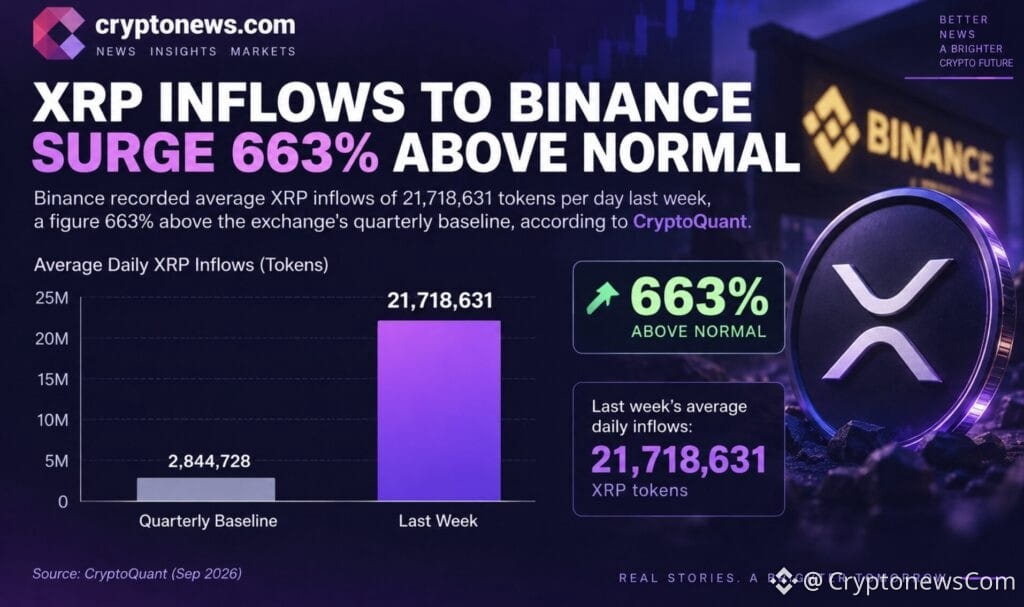
ບົດຄວາມ
Can Ripple Crack $1.80? XRP Price Prediction Says This WeekXRP Price Prediction: Ripple (XRP) trades at $1.59 as of this writing, up 1.6% on the day, with a 24-hour range spanning $1.5577 to $1.6561. Beneath the green candle sits a wrinkle worth flagging before the bulls get too comfortable. There’s a number circulating on-chain that most traders scrolling past the price chart haven’t clocked yet.
Binance’s XRP reserves have climbed to roughly 2.68 billion tokens, the highest balance since June, following a stretch of decline and a slow rebuild.
On-chain trackers noted the deposit surge ran 663% above the quarterly baseline, with withdrawals rising in tandem, a pattern that reads less like panic-selling and more like liquidity churn.
“A rise in reserves does not necessarily mean that XRP holders are preparing for an immediate sell-off,” CryptoQuant wrote in its latest note.
The buildup lands mid-rally, with XRP-specific tailwinds stacking on top: a reported push above $1.64 accompanied by 3,647 new wallets, plus talk of a $2.2 billion institutional flow that remains thin on verifiable detail.
The broader question is whether this liquidity buildup fuels the next leg or sets up a supply overhang.
XRP Price Prediction: Can XRP Price Hit $1.80 This Week?
XRP’s break above the $1.55–$1.56 zone, a level that had capped the token through repeated tests, turned former resistance into a support shelf, and XRP price is now pressing toward the next psychological marker.
Volume around the breakout has been elevated enough to suggest genuine participation rather than a thin-book spike.
(Source – TradingView, XRPUSD)
Bull case: A daily close above $1.65 opens room toward the $1.80 target floating in secondary market commentary — though that figure is speculative, not a consensus call from a named institutional desk.
Base case: Consolidation between $1.55 and $1.65 while the market digests the Evernorth financing news and waits on Nasdaq-related developments.
Bear case: A failure to hold $1.55 support risks a slide back toward $1.48, the level referenced in recent market coverage.
The Evernorth angle deserves a mention here, a reported $30 million convertible note with NH Investment & Securities, earmarked for XRP purchases ahead of a Nasdaq vote. If confirmed, it’s a near-term liquidity catalyst.
For a deeper technical breakdown of these levels, this recent XRP price analysis maps out the bullish and bearish scenarios in more detail, while open interest and funding-rate data add derivatives context worth checking before sizing a position.
Maxi Doge Targets Early Mover Upside as XRP Tests Key Levels
XRP holders riding this move from $1.50 are sitting on solid gains, and fair enough. But here’s the uncomfortable math: at XRP’s market cap, doubling requires tens of billions in fresh capital rotation.
That’s a heavy lift even in a bull cycle. Traders chasing asymmetric upside are increasingly looking further down the risk curve, toward tokens still in price discovery.
That’s the lane Maxi Doge (MAXI) is running in. It’s a meme token built around leverage-trading culture, a 240-lb canine mascot channeling “1000x leverage” energy, with holder-only trading competitions and leaderboard rewards baked into the community layer.
The presale has raised $4,863,455.57 at a current price of $0.000284, with dynamic APY staking live for early participants. A Maxi Fund treasury backs liquidity and partnerships going forward.
The obvious caveat: presale tokens carry outsized risk, and meme-driven price action can reverse as fast as it builds. Those weighing the risk-reward can research Maxi Doge directly before deciding.
Get Ahead of Next Meme Coin Launch HereKey Takeaways
XRP holding above $1.55 support keeps the path toward $1.65–$1.80 intact, contingent on sustained volume.
A close below $1.55 invalidates the breakout and risks a retest of the $1.48 zone.
Rising Binance reserves reflect liquidity buildup, not confirmed sell pressure, per on-chain data.
Evernorth’s $30 million note and its Nasdaq vote outcome stand as the next confirmable catalyst to watch.
The post Can Ripple Crack $1.80? XRP Price Prediction Says This Week appeared first on Cryptonews.
Can Ripple Crack $1.80? XRP Price Prediction Says This Week
XRP Price Prediction: Ripple (XRP) trades at $1.59 as of this writing, up 1.6% on the day, with a 24-hour range spanning $1.5577 to $1.6561. Beneath the green candle sits a wrinkle worth flagging before the bulls get too comfortable. There’s a number circulating on-chain that most traders scrolling past the price chart haven’t clocked yet.
Binance’s XRP reserves have climbed to roughly 2.68 billion tokens, the highest balance since June, following a stretch of decline and a slow rebuild.
On-chain trackers noted the deposit surge ran 663% above the quarterly baseline, with withdrawals rising in tandem, a pattern that reads less like panic-selling and more like liquidity churn.
“A rise in reserves does not necessarily mean that XRP holders are preparing for an immediate sell-off,” CryptoQuant wrote in its latest note.
The buildup lands mid-rally, with XRP-specific tailwinds stacking on top: a reported push above $1.64 accompanied by 3,647 new wallets, plus talk of a $2.2 billion institutional flow that remains thin on verifiable detail.
The broader question is whether this liquidity buildup fuels the next leg or sets up a supply overhang.
XRP Price Prediction: Can XRP Price Hit $1.80 This Week?
XRP’s break above the $1.55–$1.56 zone, a level that had capped the token through repeated tests, turned former resistance into a support shelf, and XRP price is now pressing toward the next psychological marker.
Volume around the breakout has been elevated enough to suggest genuine participation rather than a thin-book spike.
(Source – TradingView, XRPUSD)
Bull case: A daily close above $1.65 opens room toward the $1.80 target floating in secondary market commentary — though that figure is speculative, not a consensus call from a named institutional desk.
Base case: Consolidation between $1.55 and $1.65 while the market digests the Evernorth financing news and waits on Nasdaq-related developments.
Bear case: A failure to hold $1.55 support risks a slide back toward $1.48, the level referenced in recent market coverage.
The Evernorth angle deserves a mention here, a reported $30 million convertible note with NH Investment & Securities, earmarked for XRP purchases ahead of a Nasdaq vote. If confirmed, it’s a near-term liquidity catalyst.
For a deeper technical breakdown of these levels, this recent XRP price analysis maps out the bullish and bearish scenarios in more detail, while open interest and funding-rate data add derivatives context worth checking before sizing a position.
Maxi Doge Targets Early Mover Upside as XRP Tests Key Levels
XRP holders riding this move from $1.50 are sitting on solid gains, and fair enough. But here’s the uncomfortable math: at XRP’s market cap, doubling requires tens of billions in fresh capital rotation.
That’s a heavy lift even in a bull cycle. Traders chasing asymmetric upside are increasingly looking further down the risk curve, toward tokens still in price discovery.
That’s the lane Maxi Doge (MAXI) is running in. It’s a meme token built around leverage-trading culture, a 240-lb canine mascot channeling “1000x leverage” energy, with holder-only trading competitions and leaderboard rewards baked into the community layer.
The presale has raised $4,863,455.57 at a current price of $0.000284, with dynamic APY staking live for early participants. A Maxi Fund treasury backs liquidity and partnerships going forward.
The obvious caveat: presale tokens carry outsized risk, and meme-driven price action can reverse as fast as it builds. Those weighing the risk-reward can research Maxi Doge directly before deciding.
Get Ahead of Next Meme Coin Launch HereKey Takeaways
XRP holding above $1.55 support keeps the path toward $1.65–$1.80 intact, contingent on sustained volume.
A close below $1.55 invalidates the breakout and risks a retest of the $1.48 zone.
Rising Binance reserves reflect liquidity buildup, not confirmed sell pressure, per on-chain data.
Evernorth’s $30 million note and its Nasdaq vote outcome stand as the next confirmable catalyst to watch.
The post Can Ripple Crack $1.80? XRP Price Prediction Says This Week appeared first on Cryptonews.
Binance’s XRP reserves have climbed to roughly 2.68 billion tokens, the highest balance since June, following a stretch of decline and a slow rebuild.
On-chain trackers noted the deposit surge ran 663% above the quarterly baseline, with withdrawals rising in tandem, a pattern that reads less like panic-selling and more like liquidity churn.
“A rise in reserves does not necessarily mean that XRP holders are preparing for an immediate sell-off,” CryptoQuant wrote in its latest note.
The buildup lands mid-rally, with XRP-specific tailwinds stacking on top: a reported push above $1.64 accompanied by 3,647 new wallets, plus talk of a $2.2 billion institutional flow that remains thin on verifiable detail.
The broader question is whether this liquidity buildup fuels the next leg or sets up a supply overhang.
XRP Price Prediction: Can XRP Price Hit $1.80 This Week?
XRP’s break above the $1.55–$1.56 zone, a level that had capped the token through repeated tests, turned former resistance into a support shelf, and XRP price is now pressing toward the next psychological marker.
Volume around the breakout has been elevated enough to suggest genuine participation rather than a thin-book spike.
(Source – TradingView, XRPUSD)
Bull case: A daily close above $1.65 opens room toward the $1.80 target floating in secondary market commentary — though that figure is speculative, not a consensus call from a named institutional desk.
Base case: Consolidation between $1.55 and $1.65 while the market digests the Evernorth financing news and waits on Nasdaq-related developments.
Bear case: A failure to hold $1.55 support risks a slide back toward $1.48, the level referenced in recent market coverage.
The Evernorth angle deserves a mention here, a reported $30 million convertible note with NH Investment & Securities, earmarked for XRP purchases ahead of a Nasdaq vote. If confirmed, it’s a near-term liquidity catalyst.
For a deeper technical breakdown of these levels, this recent XRP price analysis maps out the bullish and bearish scenarios in more detail, while open interest and funding-rate data add derivatives context worth checking before sizing a position.
Maxi Doge Targets Early Mover Upside as XRP Tests Key Levels
XRP holders riding this move from $1.50 are sitting on solid gains, and fair enough. But here’s the uncomfortable math: at XRP’s market cap, doubling requires tens of billions in fresh capital rotation.
That’s a heavy lift even in a bull cycle. Traders chasing asymmetric upside are increasingly looking further down the risk curve, toward tokens still in price discovery.
That’s the lane Maxi Doge (MAXI) is running in. It’s a meme token built around leverage-trading culture, a 240-lb canine mascot channeling “1000x leverage” energy, with holder-only trading competitions and leaderboard rewards baked into the community layer.
The presale has raised $4,863,455.57 at a current price of $0.000284, with dynamic APY staking live for early participants. A Maxi Fund treasury backs liquidity and partnerships going forward.
The obvious caveat: presale tokens carry outsized risk, and meme-driven price action can reverse as fast as it builds. Those weighing the risk-reward can research Maxi Doge directly before deciding.
Get Ahead of Next Meme Coin Launch HereKey Takeaways
XRP holding above $1.55 support keeps the path toward $1.65–$1.80 intact, contingent on sustained volume.
A close below $1.55 invalidates the breakout and risks a retest of the $1.48 zone.
Rising Binance reserves reflect liquidity buildup, not confirmed sell pressure, per on-chain data.
Evernorth’s $30 million note and its Nasdaq vote outcome stand as the next confirmable catalyst to watch.
The post Can Ripple Crack $1.80? XRP Price Prediction Says This Week appeared first on Cryptonews.
2
2
1.3k
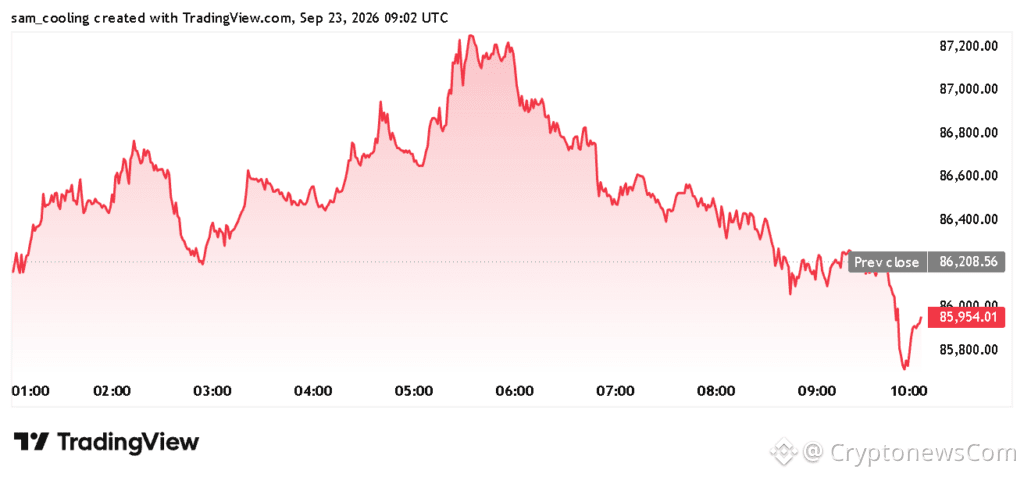
ບົດຄວາມ
Bitcoin Recoils Below $86,000: Is Bitcoin Price Prediction Still Shooting For $90,000?Bitcoin Price Prediction: Bitcoin (BTC) trades at $85,954, down a modest 0.3% on the day, holding the upper band of a rebound that’s had traders debating whether this is a breakout or just another consolidation trap. There’s a specific level being watched right now that could decide which one it is, more on that below.
The setup echoes an older pattern: a similar surprise breakout above $80,000 followed weeks of Fed and Senate-driven volatility, catching short-sellers off guard.
This time, the catalyst basket looks different, U.S.–Iran de-escalation chatter, renewed spot ETF demand, and a reported SEC crypto-custody rule draft, but the mechanics are familiar.
JUST IN:$BTC OPEN INTEREST PUMPED 8.09% IN TOTAL! pic.twitter.com/Gu0QtGN5op
— Seth (@seth_fin) September 22, 2026
Futures open interest across BTC, ETH and SOL jumped 7.6% during the recent rally, while short-term holders moved 47,600 BTC to exchanges, a classic profit-taking signal. Recent analysis flags this exact tension between fresh demand and exit liquidity.
Macro headlines are doing heavy lifting again, and the market’s reaction function hasn’t changed much. Good news gets bought fast, then digested slowly.
Can Bitcoin Price Hit $90,000 This Week?
BTC’s 24-hour range sits between $85,720 and $87,258, a tight band that reflects indecision rather than conviction.
(Source – TradingView, BTC USD)
With an RSI of 75 near $86,550, carrying a bearish-divergence warning, meaning technically overbought territory, the kind that’s preceded pullbacks before. That data matters here.
Immediate resistance sits at $87,300–$88,000, with psychological pressure building at $90,000.
Support holds at $86,000–$86,300 first, then $85,000–$85,300, with structural footing near $82,000–$83,300 if things unravel. Bear-case scenarios put a floor further out near $80,000–$81,500.
Bull case: a close above $88,000 opens a run at $90,000–$95,000.
Base case: continued chop between $85,000 and $88,000 while ETF flows and geopolitical headlines fight for control.
Bear case: a break below $85,000 drags price toward $82,000.
Bernstein’s Chhugani still holds a $150,000 year-end target; Standard Chartered’s Kendrick trimmed his to $100,000, a wide enough gap to say forecasting confidence is low right now.
Full model breakdown here.
Bitcoin Hyper Targets Early Mover Upside as Bitcoin Tests Key Levels
A move from $86,000 to $90,000 is a solid 4-5% swing for existing BTC holders. But at a $1.7 trillion-plus market cap, doubling from here requires an amount of new capital that simply isn’t showing up on any credible timeline.
That mathematical ceiling is why capital increasingly rotates into earlier-stage infrastructure plays chasing asymmetric upside instead.
Bitcoin Hyper (HYPER) is positioning itself as the first Bitcoin Layer 2 with full SVM integration, aiming to execute smart contracts faster than Solana itself while settling back to Bitcoin’s base layer.
The presale has raised $33,153,929.58 at a current token price of $0.0136866, with staking rewards live at launch.
Its Decentralized Canonical Bridge targets one of Bitcoin’s oldest complaints, the lack of native programmability, without compromising base-layer security. Presale tokens carry the standard early-stage risk: no live mainnet yet, so due diligence matters. Research Bitcoin Hyper before allocating.
Gain Access to New Bitcoin Layer 2 Early HereKey Takeaways
BTC holds $86,388, needing a close above $88,000 to realistically challenge $90,000–$95,000 resistance zones.
A break below $85,000 support risks a slide toward $82,000–$83,300, especially with RSI flashing overbought at 75.
Bitcoin Hyper’s SVM-powered Layer 2 targets Bitcoin’s programmability gap, with $33.1M raised in presale funding so far.
Watch U.S.–Iran negotiation updates and SEC custody-rule progress as near-term catalysts for BTC’s next directional move.
The post Bitcoin Recoils Below $86,000: Is Bitcoin Price Prediction Still Shooting For $90,000? appeared first on Cryptonews.
Bitcoin Recoils Below $86,000: Is Bitcoin Price Prediction Still Shooting For $90,000?
Bitcoin Price Prediction: Bitcoin (BTC) trades at $85,954, down a modest 0.3% on the day, holding the upper band of a rebound that’s had traders debating whether this is a breakout or just another consolidation trap. There’s a specific level being watched right now that could decide which one it is, more on that below.
The setup echoes an older pattern: a similar surprise breakout above $80,000 followed weeks of Fed and Senate-driven volatility, catching short-sellers off guard.
This time, the catalyst basket looks different, U.S.–Iran de-escalation chatter, renewed spot ETF demand, and a reported SEC crypto-custody rule draft, but the mechanics are familiar.
JUST IN:$BTC OPEN INTEREST PUMPED 8.09% IN TOTAL! pic.twitter.com/Gu0QtGN5op
— Seth (@seth_fin) September 22, 2026
Futures open interest across BTC, ETH and SOL jumped 7.6% during the recent rally, while short-term holders moved 47,600 BTC to exchanges, a classic profit-taking signal. Recent analysis flags this exact tension between fresh demand and exit liquidity.
Macro headlines are doing heavy lifting again, and the market’s reaction function hasn’t changed much. Good news gets bought fast, then digested slowly.
Can Bitcoin Price Hit $90,000 This Week?
BTC’s 24-hour range sits between $85,720 and $87,258, a tight band that reflects indecision rather than conviction.
(Source – TradingView, BTC USD)
With an RSI of 75 near $86,550, carrying a bearish-divergence warning, meaning technically overbought territory, the kind that’s preceded pullbacks before. That data matters here.
Immediate resistance sits at $87,300–$88,000, with psychological pressure building at $90,000.
Support holds at $86,000–$86,300 first, then $85,000–$85,300, with structural footing near $82,000–$83,300 if things unravel. Bear-case scenarios put a floor further out near $80,000–$81,500.
Bull case: a close above $88,000 opens a run at $90,000–$95,000.
Base case: continued chop between $85,000 and $88,000 while ETF flows and geopolitical headlines fight for control.
Bear case: a break below $85,000 drags price toward $82,000.
Bernstein’s Chhugani still holds a $150,000 year-end target; Standard Chartered’s Kendrick trimmed his to $100,000, a wide enough gap to say forecasting confidence is low right now.
Full model breakdown here.
Bitcoin Hyper Targets Early Mover Upside as Bitcoin Tests Key Levels
A move from $86,000 to $90,000 is a solid 4-5% swing for existing BTC holders. But at a $1.7 trillion-plus market cap, doubling from here requires an amount of new capital that simply isn’t showing up on any credible timeline.
That mathematical ceiling is why capital increasingly rotates into earlier-stage infrastructure plays chasing asymmetric upside instead.
Bitcoin Hyper (HYPER) is positioning itself as the first Bitcoin Layer 2 with full SVM integration, aiming to execute smart contracts faster than Solana itself while settling back to Bitcoin’s base layer.
The presale has raised $33,153,929.58 at a current token price of $0.0136866, with staking rewards live at launch.
Its Decentralized Canonical Bridge targets one of Bitcoin’s oldest complaints, the lack of native programmability, without compromising base-layer security. Presale tokens carry the standard early-stage risk: no live mainnet yet, so due diligence matters. Research Bitcoin Hyper before allocating.
Gain Access to New Bitcoin Layer 2 Early HereKey Takeaways
BTC holds $86,388, needing a close above $88,000 to realistically challenge $90,000–$95,000 resistance zones.
A break below $85,000 support risks a slide toward $82,000–$83,300, especially with RSI flashing overbought at 75.
Bitcoin Hyper’s SVM-powered Layer 2 targets Bitcoin’s programmability gap, with $33.1M raised in presale funding so far.
Watch U.S.–Iran negotiation updates and SEC custody-rule progress as near-term catalysts for BTC’s next directional move.
The post Bitcoin Recoils Below $86,000: Is Bitcoin Price Prediction Still Shooting For $90,000? appeared first on Cryptonews.
The setup echoes an older pattern: a similar surprise breakout above $80,000 followed weeks of Fed and Senate-driven volatility, catching short-sellers off guard.
This time, the catalyst basket looks different, U.S.–Iran de-escalation chatter, renewed spot ETF demand, and a reported SEC crypto-custody rule draft, but the mechanics are familiar.
JUST IN:$BTC OPEN INTEREST PUMPED 8.09% IN TOTAL! pic.twitter.com/Gu0QtGN5op
— Seth (@seth_fin) September 22, 2026
Futures open interest across BTC, ETH and SOL jumped 7.6% during the recent rally, while short-term holders moved 47,600 BTC to exchanges, a classic profit-taking signal. Recent analysis flags this exact tension between fresh demand and exit liquidity.
Macro headlines are doing heavy lifting again, and the market’s reaction function hasn’t changed much. Good news gets bought fast, then digested slowly.
Can Bitcoin Price Hit $90,000 This Week?
BTC’s 24-hour range sits between $85,720 and $87,258, a tight band that reflects indecision rather than conviction.
(Source – TradingView, BTC USD)
With an RSI of 75 near $86,550, carrying a bearish-divergence warning, meaning technically overbought territory, the kind that’s preceded pullbacks before. That data matters here.
Immediate resistance sits at $87,300–$88,000, with psychological pressure building at $90,000.
Support holds at $86,000–$86,300 first, then $85,000–$85,300, with structural footing near $82,000–$83,300 if things unravel. Bear-case scenarios put a floor further out near $80,000–$81,500.
Bull case: a close above $88,000 opens a run at $90,000–$95,000.
Base case: continued chop between $85,000 and $88,000 while ETF flows and geopolitical headlines fight for control.
Bear case: a break below $85,000 drags price toward $82,000.
Bernstein’s Chhugani still holds a $150,000 year-end target; Standard Chartered’s Kendrick trimmed his to $100,000, a wide enough gap to say forecasting confidence is low right now.
Full model breakdown here.
Bitcoin Hyper Targets Early Mover Upside as Bitcoin Tests Key Levels
A move from $86,000 to $90,000 is a solid 4-5% swing for existing BTC holders. But at a $1.7 trillion-plus market cap, doubling from here requires an amount of new capital that simply isn’t showing up on any credible timeline.
That mathematical ceiling is why capital increasingly rotates into earlier-stage infrastructure plays chasing asymmetric upside instead.
Bitcoin Hyper (HYPER) is positioning itself as the first Bitcoin Layer 2 with full SVM integration, aiming to execute smart contracts faster than Solana itself while settling back to Bitcoin’s base layer.
The presale has raised $33,153,929.58 at a current token price of $0.0136866, with staking rewards live at launch.
Its Decentralized Canonical Bridge targets one of Bitcoin’s oldest complaints, the lack of native programmability, without compromising base-layer security. Presale tokens carry the standard early-stage risk: no live mainnet yet, so due diligence matters. Research Bitcoin Hyper before allocating.
Gain Access to New Bitcoin Layer 2 Early HereKey Takeaways
BTC holds $86,388, needing a close above $88,000 to realistically challenge $90,000–$95,000 resistance zones.
A break below $85,000 support risks a slide toward $82,000–$83,300, especially with RSI flashing overbought at 75.
Bitcoin Hyper’s SVM-powered Layer 2 targets Bitcoin’s programmability gap, with $33.1M raised in presale funding so far.
Watch U.S.–Iran negotiation updates and SEC custody-rule progress as near-term catalysts for BTC’s next directional move.
The post Bitcoin Recoils Below $86,000: Is Bitcoin Price Prediction Still Shooting For $90,000? appeared first on Cryptonews.
246
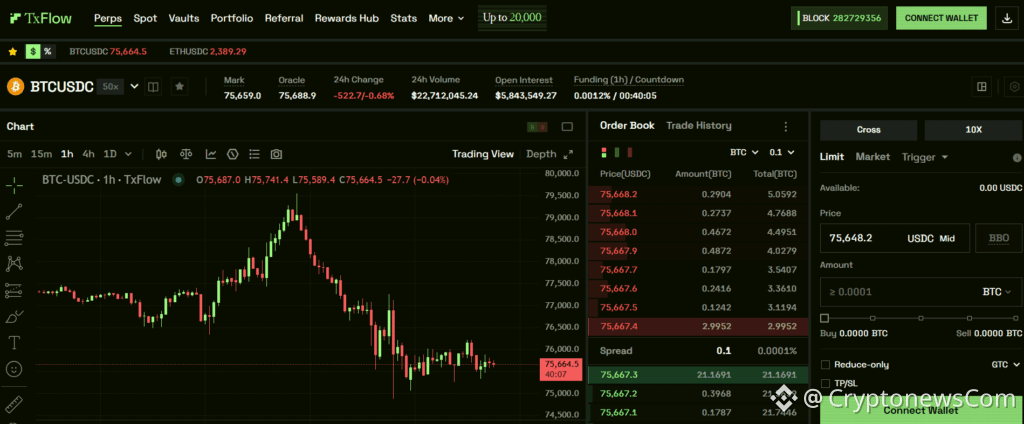
ບົດຄວາມ
TxFlow is The Layer 1 Blockchain Built for On-Chain Finance: Here’s How to Get StartedIn a crypto landscape still dominated by fragmented liquidity, opaque matching engines, and bridges that introduce risk and complexity, a new platform has emerged with a clear ambition: put every part of finance on a single, transparent, high-performance chain. TxFlow is a purpose-built Layer 1 blockchain designed so that markets, liquidity, and applications can connect, compose, and settle on shared on-chain state. Its first major application is TxFlow DEX, a fully on-chain central limit order book (CLOB) for perpetual futures and spot trading, with prediction markets already live as a second “Channel.”
TxFlow aims to deliver CEX-like speed and order-book precision while keeping settlement, matching, and risk management fully verifiable on-chain. No off-chain matching black boxes. No need to bridge assets between isolated apps. And, notably, no venture-capital token allocations; the network is community-owned from genesis. For traders, builders, and anyone tired of choosing between speed and transparency, TxFlow presents itself as infrastructure rather than just another exchange.
In this article, we look at what TxFlow brings to the market and how traders can and get started and make the most of this new platform.
A High-Performance Platform Where Finance Actually Lives On-Chain
The TxFlow L1 is engineered specifically for financial applications. It uses DAG-based parallel execution and a multi-threaded pipeline with a deterministic state machine to target throughput of up to 250,000 transactions per second with one-block finality. Every order placement, cancellation, match, liquidation, and funding-rate update is a public transaction that any node can independently replay. The result is verifiable execution: traders do not have to trust a private sequencer’s internal ledger.
The core trading system, TxCore, sits inside the consensus layer. This allows a genuine price-time priority central limit order book to run natively on-chain rather than relying on an automated market maker or hybrid off-chain matching. Users can place market, limit, stop-loss, take-profit, post-only, and reduce-only orders. Cross-margin and isolated-margin modes are available, with USDC as the sole collateral and settlement asset. Leverage reaches up to 40x on supported markets, which already include major crypto perpetuals and are expanding toward traditional-finance instruments.
Beyond the flagship DEX, TxFlow is structured as a multi-application ecosystem. Applications are organized as “Channels” that share the same on-chain liquidity, settlement, and market data through TIP (TxFlow Improvement Protocol) Liquidity Standards. Spot, perpetuals, and prediction markets already operate as live modules on the same chain. Because they inherit the same settlement layer, there is no need for bridges between them. Protocol Vaults and User Vaults further allow both the protocol and individual users to provide liquidity or deploy strategies. A public blockchain explorer gives real-time visibility into every action.
The practical benefits are straightforward. Traders keep self-custody of their assets while experiencing an interface and execution quality closer to centralized venues. Liquidity is not siloed; new channels can launch and immediately tap into existing depth. Risk management (margin, liquidations, funding) is enforced by the protocol itself rather than by a centralized operator. And because the entire state machine is deterministic and public, anyone can audit the history of fills and balances.
Why TxFlow Stands Out Among Recent Entrants
Most new decentralized exchanges still force a trade-off: either accept an AMM’s capital inefficiency and slippage, or trust an off-chain matching engine that reintroduces the very opacity DeFi was meant to eliminate. TxFlow rejects that compromise. By placing a full CLOB inside a purpose-built Layer 1, it delivers order-book precision with on-chain finality.
Several design choices further differentiate it. First, the network is community-owned from genesis with no investor token allocations — a verifiable on-chain fact rather than a marketing claim. Second, the TIP standards create a composable framework so that future products (additional prediction markets, more TradFi perpetuals, or entirely new Channels) can plug into the same liquidity and settlement layer without reinventing infrastructure. Third, the architecture prioritizes transparency at every layer: matching, clearing, and margin updates occur atomically inside one state machine, eliminating the partial or out-of-sync states that can appear in hybrid systems.
As a relatively recent mainnet entrant, having launched earlier this year, TxFlow has moved quickly from invitation-only access to supporting multiple market modules and mobile apps. Its focus on “all finance” — crypto derivatives today, expanding toward broader markets tomorrow — positions it less as a single-product DEX and more as foundational infrastructure. In a market still recovering from bridge exploits, sequencer failures, and opaque liquidation engines, a chain that treats every fill as a public, replayable transaction is a meaningful shift.
For a further look this new platform, check out our TxFlow review.
How to Get Started with TxFlow
Access to TxFlow mainnet currently requires an Access Code. The process is designed to be straightforward – here’s how to sign up:
Visit the official app at app.txflow.com.
Click Connect. You have two options:
Email login: Enter your email, receive a 6-digit verification code, and log in. Privy automatically creates a blockchain address linked to that email. Alternatively, you can connect via X or Google.
EVM wallet: Connect MetaMask, Rabby, or another standard externally owned account (EOA). Do not use account-abstraction wallets, as they can permanently lock funds.
Click Enable Trading and sign the gas-less transaction that authorizes the account.
Deposit USDC. Supported networks include Arbitrum, Base, Ethereum, Polygon PoS, and Solana. On Arbitrum you can deposit directly through the interface (keep a small amount of ETH for gas, or use the gas-free deposit option if available). For other networks, copy the deposit address shown in the popup and send native USDC from a CEX or wallet. Only native USDC is accepted — avoid bridged or non-native versions.
Once the deposit confirms, your USDC appears in the Portfolio and you are ready to trade. Withdrawals are available from the same interface, with network-dependent fees (for example, 1 USDC via the official Arbitrum bridge, lower amounts on other chains). Always double-check addresses and never share seed phrases or private keys. TxFlow will never DM you first asking for them.
How to Use TxFlow and Get the Most Out of the Platform
After funding, head to the trade interface. Select a perpetual or spot market, choose cross or isolated margin, set your leverage, and place orders just as you would on a professional CEX. The order book is fully on-chain, so you can see depth and recent trades with the knowledge that every fill is publicly verifiable on the explorer.
To maximize the experience:
Start with smaller size while you familiarize yourself with funding rates, liquidation mechanics, and the platform’s risk parameters.
Use the available order types (limit, stop-loss, take-profit, post-only, reduce-only) to manage entries and exits precisely.
Monitor the Portfolio tab for open positions, unrealized PnL, margin usage, and deposit/withdrawal history.
Explore Protocol and User Vaults if you want to provide liquidity or run strategies rather than trade actively.
For prediction markets (via the Probly Channel or similar modules), the same shared liquidity and settlement apply — outcomes settle on-chain without additional bridging.
Download the mobile app from the official site for trading on the go.
Check the official docs (docs.txflow.com) for trading rules, margin tiers, fee schedules, and any ongoing campaigns (for example, fee-credit promotions for early volume).
Fees are competitive: base perpetual maker/taker rates start low and improve with volume-based VIP tiers. Because everything settles on-chain, you can independently verify your own fills and balances rather than relying solely on the platform’s displayed numbers.
TxFlow is still early. Access remains gated by code, markets continue to expand, and the multi-Channel vision is only beginning to unfold. Yet the core proposition is already live: a high-throughput Layer 1 where a real order book, shared liquidity, and full transparency coexist. For traders who want CEX performance without surrendering custody or verifiability, and for builders who want to launch financial applications that inherit existing depth, TxFlow offers a coherent new foundation.
Visit app.txflow.com and explore the chain where all finance is designed to happen on-chain.
The post TxFlow is The Layer 1 Blockchain Built for On-Chain Finance: Here’s How to Get Started appeared first on Cryptonews.
TxFlow is The Layer 1 Blockchain Built for On-Chain Finance: Here’s How to Get Started
In a crypto landscape still dominated by fragmented liquidity, opaque matching engines, and bridges that introduce risk and complexity, a new platform has emerged with a clear ambition: put every part of finance on a single, transparent, high-performance chain. TxFlow is a purpose-built Layer 1 blockchain designed so that markets, liquidity, and applications can connect, compose, and settle on shared on-chain state. Its first major application is TxFlow DEX, a fully on-chain central limit order book (CLOB) for perpetual futures and spot trading, with prediction markets already live as a second “Channel.”
TxFlow aims to deliver CEX-like speed and order-book precision while keeping settlement, matching, and risk management fully verifiable on-chain. No off-chain matching black boxes. No need to bridge assets between isolated apps. And, notably, no venture-capital token allocations; the network is community-owned from genesis. For traders, builders, and anyone tired of choosing between speed and transparency, TxFlow presents itself as infrastructure rather than just another exchange.
In this article, we look at what TxFlow brings to the market and how traders can and get started and make the most of this new platform.
A High-Performance Platform Where Finance Actually Lives On-Chain
The TxFlow L1 is engineered specifically for financial applications. It uses DAG-based parallel execution and a multi-threaded pipeline with a deterministic state machine to target throughput of up to 250,000 transactions per second with one-block finality. Every order placement, cancellation, match, liquidation, and funding-rate update is a public transaction that any node can independently replay. The result is verifiable execution: traders do not have to trust a private sequencer’s internal ledger.
The core trading system, TxCore, sits inside the consensus layer. This allows a genuine price-time priority central limit order book to run natively on-chain rather than relying on an automated market maker or hybrid off-chain matching. Users can place market, limit, stop-loss, take-profit, post-only, and reduce-only orders. Cross-margin and isolated-margin modes are available, with USDC as the sole collateral and settlement asset. Leverage reaches up to 40x on supported markets, which already include major crypto perpetuals and are expanding toward traditional-finance instruments.
Beyond the flagship DEX, TxFlow is structured as a multi-application ecosystem. Applications are organized as “Channels” that share the same on-chain liquidity, settlement, and market data through TIP (TxFlow Improvement Protocol) Liquidity Standards. Spot, perpetuals, and prediction markets already operate as live modules on the same chain. Because they inherit the same settlement layer, there is no need for bridges between them. Protocol Vaults and User Vaults further allow both the protocol and individual users to provide liquidity or deploy strategies. A public blockchain explorer gives real-time visibility into every action.
The practical benefits are straightforward. Traders keep self-custody of their assets while experiencing an interface and execution quality closer to centralized venues. Liquidity is not siloed; new channels can launch and immediately tap into existing depth. Risk management (margin, liquidations, funding) is enforced by the protocol itself rather than by a centralized operator. And because the entire state machine is deterministic and public, anyone can audit the history of fills and balances.
Why TxFlow Stands Out Among Recent Entrants
Most new decentralized exchanges still force a trade-off: either accept an AMM’s capital inefficiency and slippage, or trust an off-chain matching engine that reintroduces the very opacity DeFi was meant to eliminate. TxFlow rejects that compromise. By placing a full CLOB inside a purpose-built Layer 1, it delivers order-book precision with on-chain finality.
Several design choices further differentiate it. First, the network is community-owned from genesis with no investor token allocations — a verifiable on-chain fact rather than a marketing claim. Second, the TIP standards create a composable framework so that future products (additional prediction markets, more TradFi perpetuals, or entirely new Channels) can plug into the same liquidity and settlement layer without reinventing infrastructure. Third, the architecture prioritizes transparency at every layer: matching, clearing, and margin updates occur atomically inside one state machine, eliminating the partial or out-of-sync states that can appear in hybrid systems.
As a relatively recent mainnet entrant, having launched earlier this year, TxFlow has moved quickly from invitation-only access to supporting multiple market modules and mobile apps. Its focus on “all finance” — crypto derivatives today, expanding toward broader markets tomorrow — positions it less as a single-product DEX and more as foundational infrastructure. In a market still recovering from bridge exploits, sequencer failures, and opaque liquidation engines, a chain that treats every fill as a public, replayable transaction is a meaningful shift.
For a further look this new platform, check out our TxFlow review.
How to Get Started with TxFlow
Access to TxFlow mainnet currently requires an Access Code. The process is designed to be straightforward – here’s how to sign up:
Visit the official app at app.txflow.com.
Click Connect. You have two options:
Email login: Enter your email, receive a 6-digit verification code, and log in. Privy automatically creates a blockchain address linked to that email. Alternatively, you can connect via X or Google.
EVM wallet: Connect MetaMask, Rabby, or another standard externally owned account (EOA). Do not use account-abstraction wallets, as they can permanently lock funds.
Click Enable Trading and sign the gas-less transaction that authorizes the account.
Deposit USDC. Supported networks include Arbitrum, Base, Ethereum, Polygon PoS, and Solana. On Arbitrum you can deposit directly through the interface (keep a small amount of ETH for gas, or use the gas-free deposit option if available). For other networks, copy the deposit address shown in the popup and send native USDC from a CEX or wallet. Only native USDC is accepted — avoid bridged or non-native versions.
Once the deposit confirms, your USDC appears in the Portfolio and you are ready to trade. Withdrawals are available from the same interface, with network-dependent fees (for example, 1 USDC via the official Arbitrum bridge, lower amounts on other chains). Always double-check addresses and never share seed phrases or private keys. TxFlow will never DM you first asking for them.
How to Use TxFlow and Get the Most Out of the Platform
After funding, head to the trade interface. Select a perpetual or spot market, choose cross or isolated margin, set your leverage, and place orders just as you would on a professional CEX. The order book is fully on-chain, so you can see depth and recent trades with the knowledge that every fill is publicly verifiable on the explorer.
To maximize the experience:
Start with smaller size while you familiarize yourself with funding rates, liquidation mechanics, and the platform’s risk parameters.
Use the available order types (limit, stop-loss, take-profit, post-only, reduce-only) to manage entries and exits precisely.
Monitor the Portfolio tab for open positions, unrealized PnL, margin usage, and deposit/withdrawal history.
Explore Protocol and User Vaults if you want to provide liquidity or run strategies rather than trade actively.
For prediction markets (via the Probly Channel or similar modules), the same shared liquidity and settlement apply — outcomes settle on-chain without additional bridging.
Download the mobile app from the official site for trading on the go.
Check the official docs (docs.txflow.com) for trading rules, margin tiers, fee schedules, and any ongoing campaigns (for example, fee-credit promotions for early volume).
Fees are competitive: base perpetual maker/taker rates start low and improve with volume-based VIP tiers. Because everything settles on-chain, you can independently verify your own fills and balances rather than relying solely on the platform’s displayed numbers.
TxFlow is still early. Access remains gated by code, markets continue to expand, and the multi-Channel vision is only beginning to unfold. Yet the core proposition is already live: a high-throughput Layer 1 where a real order book, shared liquidity, and full transparency coexist. For traders who want CEX performance without surrendering custody or verifiability, and for builders who want to launch financial applications that inherit existing depth, TxFlow offers a coherent new foundation.
Visit app.txflow.com and explore the chain where all finance is designed to happen on-chain.
The post TxFlow is The Layer 1 Blockchain Built for On-Chain Finance: Here’s How to Get Started appeared first on Cryptonews.
TxFlow aims to deliver CEX-like speed and order-book precision while keeping settlement, matching, and risk management fully verifiable on-chain. No off-chain matching black boxes. No need to bridge assets between isolated apps. And, notably, no venture-capital token allocations; the network is community-owned from genesis. For traders, builders, and anyone tired of choosing between speed and transparency, TxFlow presents itself as infrastructure rather than just another exchange.
In this article, we look at what TxFlow brings to the market and how traders can and get started and make the most of this new platform.
A High-Performance Platform Where Finance Actually Lives On-Chain
The TxFlow L1 is engineered specifically for financial applications. It uses DAG-based parallel execution and a multi-threaded pipeline with a deterministic state machine to target throughput of up to 250,000 transactions per second with one-block finality. Every order placement, cancellation, match, liquidation, and funding-rate update is a public transaction that any node can independently replay. The result is verifiable execution: traders do not have to trust a private sequencer’s internal ledger.
The core trading system, TxCore, sits inside the consensus layer. This allows a genuine price-time priority central limit order book to run natively on-chain rather than relying on an automated market maker or hybrid off-chain matching. Users can place market, limit, stop-loss, take-profit, post-only, and reduce-only orders. Cross-margin and isolated-margin modes are available, with USDC as the sole collateral and settlement asset. Leverage reaches up to 40x on supported markets, which already include major crypto perpetuals and are expanding toward traditional-finance instruments.
Beyond the flagship DEX, TxFlow is structured as a multi-application ecosystem. Applications are organized as “Channels” that share the same on-chain liquidity, settlement, and market data through TIP (TxFlow Improvement Protocol) Liquidity Standards. Spot, perpetuals, and prediction markets already operate as live modules on the same chain. Because they inherit the same settlement layer, there is no need for bridges between them. Protocol Vaults and User Vaults further allow both the protocol and individual users to provide liquidity or deploy strategies. A public blockchain explorer gives real-time visibility into every action.
The practical benefits are straightforward. Traders keep self-custody of their assets while experiencing an interface and execution quality closer to centralized venues. Liquidity is not siloed; new channels can launch and immediately tap into existing depth. Risk management (margin, liquidations, funding) is enforced by the protocol itself rather than by a centralized operator. And because the entire state machine is deterministic and public, anyone can audit the history of fills and balances.
Why TxFlow Stands Out Among Recent Entrants
Most new decentralized exchanges still force a trade-off: either accept an AMM’s capital inefficiency and slippage, or trust an off-chain matching engine that reintroduces the very opacity DeFi was meant to eliminate. TxFlow rejects that compromise. By placing a full CLOB inside a purpose-built Layer 1, it delivers order-book precision with on-chain finality.
Several design choices further differentiate it. First, the network is community-owned from genesis with no investor token allocations — a verifiable on-chain fact rather than a marketing claim. Second, the TIP standards create a composable framework so that future products (additional prediction markets, more TradFi perpetuals, or entirely new Channels) can plug into the same liquidity and settlement layer without reinventing infrastructure. Third, the architecture prioritizes transparency at every layer: matching, clearing, and margin updates occur atomically inside one state machine, eliminating the partial or out-of-sync states that can appear in hybrid systems.
As a relatively recent mainnet entrant, having launched earlier this year, TxFlow has moved quickly from invitation-only access to supporting multiple market modules and mobile apps. Its focus on “all finance” — crypto derivatives today, expanding toward broader markets tomorrow — positions it less as a single-product DEX and more as foundational infrastructure. In a market still recovering from bridge exploits, sequencer failures, and opaque liquidation engines, a chain that treats every fill as a public, replayable transaction is a meaningful shift.
For a further look this new platform, check out our TxFlow review.
How to Get Started with TxFlow
Access to TxFlow mainnet currently requires an Access Code. The process is designed to be straightforward – here’s how to sign up:
Visit the official app at app.txflow.com.
Click Connect. You have two options:
Email login: Enter your email, receive a 6-digit verification code, and log in. Privy automatically creates a blockchain address linked to that email. Alternatively, you can connect via X or Google.
EVM wallet: Connect MetaMask, Rabby, or another standard externally owned account (EOA). Do not use account-abstraction wallets, as they can permanently lock funds.
Click Enable Trading and sign the gas-less transaction that authorizes the account.
Deposit USDC. Supported networks include Arbitrum, Base, Ethereum, Polygon PoS, and Solana. On Arbitrum you can deposit directly through the interface (keep a small amount of ETH for gas, or use the gas-free deposit option if available). For other networks, copy the deposit address shown in the popup and send native USDC from a CEX or wallet. Only native USDC is accepted — avoid bridged or non-native versions.
Once the deposit confirms, your USDC appears in the Portfolio and you are ready to trade. Withdrawals are available from the same interface, with network-dependent fees (for example, 1 USDC via the official Arbitrum bridge, lower amounts on other chains). Always double-check addresses and never share seed phrases or private keys. TxFlow will never DM you first asking for them.
How to Use TxFlow and Get the Most Out of the Platform
After funding, head to the trade interface. Select a perpetual or spot market, choose cross or isolated margin, set your leverage, and place orders just as you would on a professional CEX. The order book is fully on-chain, so you can see depth and recent trades with the knowledge that every fill is publicly verifiable on the explorer.
To maximize the experience:
Start with smaller size while you familiarize yourself with funding rates, liquidation mechanics, and the platform’s risk parameters.
Use the available order types (limit, stop-loss, take-profit, post-only, reduce-only) to manage entries and exits precisely.
Monitor the Portfolio tab for open positions, unrealized PnL, margin usage, and deposit/withdrawal history.
Explore Protocol and User Vaults if you want to provide liquidity or run strategies rather than trade actively.
For prediction markets (via the Probly Channel or similar modules), the same shared liquidity and settlement apply — outcomes settle on-chain without additional bridging.
Download the mobile app from the official site for trading on the go.
Check the official docs (docs.txflow.com) for trading rules, margin tiers, fee schedules, and any ongoing campaigns (for example, fee-credit promotions for early volume).
Fees are competitive: base perpetual maker/taker rates start low and improve with volume-based VIP tiers. Because everything settles on-chain, you can independently verify your own fills and balances rather than relying solely on the platform’s displayed numbers.
TxFlow is still early. Access remains gated by code, markets continue to expand, and the multi-Channel vision is only beginning to unfold. Yet the core proposition is already live: a high-throughput Layer 1 where a real order book, shared liquidity, and full transparency coexist. For traders who want CEX performance without surrendering custody or verifiability, and for builders who want to launch financial applications that inherit existing depth, TxFlow offers a coherent new foundation.
Visit app.txflow.com and explore the chain where all finance is designed to happen on-chain.
The post TxFlow is The Layer 1 Blockchain Built for On-Chain Finance: Here’s How to Get Started appeared first on Cryptonews.
134

ບົດຄວາມ
Microsoft Copilot AI Predicts a Huge Move for Bitcoin by 2027Microsoft Copilot AI predicts that if a full-blown bull market returns in Q4, Bitcoin could hit $180,000 before January 1, 2027. The bullish range is listed at $140,000–$180,000, with a genuine late-cycle blow-off potentially pushing Bitcoin toward $200,000+.
At roughly $85,000, $180,000 would be about a +110% move. The interesting thing about Bitcoin’s current setup is that it has already corrected substantially from its previous cycle high. BTC reached approximately $126,200 on October 6, 2025, before falling sharply during 2026.
SOURCE: Microsoft Copilot AI Predicts Bitcoin Price
Bitcoin has already shown it can produce enormous gains during strong cycles. According to historical annual data, BTC gained about +154% in 2023 and +110% in 2024, and if the current prediction proves true, a similar move could be on the way.
Microsoft Copilot AI Predicts Bitcoin to $180,000 if Specific Conditions Are Met: Does the Technical Analysis Back it Up?
Bitcoin recently broke out of a sequence of lower highs that developed from May onward and reclaimed several key moving averages.
Reuters’ technical analysis identified the $81,781 area as important support, with $86,500 now representing a major resistance level. Above that, the next technical objectives were around $90,000 and $97,867.
CryptoQuant has identified a similar progression. It sees $81,700 as particularly important because it matches Bitcoin’s 365-day moving average. Resistance levels above are around $86,600 and $88,700.
$87,000-$88,000 is the very important level for Bitcoin.
This is the yearly open level, and $BTC is expected to face resistance here.
And if a correction happens, BTC will likely find support around $79,000-$80,000. pic.twitter.com/SMPIZlJnHD
— Ted (@TedPillows) September 22, 2026
The first major test following the breach of $85,000 is the $86K–$88K region. Bitcoin has now pushed through that area, which is important because a sustained breakout would remove one of the largest technical obstacles between the current price and the $100,000 level.
The next major milestone is approximately $98,000. Above that, the market is approaching the $126,200 all-time high, and this is where things get interesting.
Once BTC decisively breaks $126,000, it enters genuine price discovery. Very little historical resistance sits above that level. At that point, psychological targets such as $130K, $140K, and $150K can become magnets for momentum traders and institutional flows.
Make Your BTC Price Prediction With $25 For Free on KalshiBitcoin Hyper Targets Early Mover Upside as Bitcoin Tests Key Levels Near $86,500
A +5% daily pop is fine for whales and those already heavily positioned. However, for anyone watching from the sidelines, chasing BTC into resistance near $86,500 with the Microsoft Copilot AI predicts thesis still unconfirmed, it is still an unpredictable trade.
The upside math at a $1.5 trillion-plus market cap simply moves more slowly than early-stage infrastructure plays, which is where attention is rotating.
Bitcoin Hyper ($HYPER) is positioning itself as the first Bitcoin Layer 2 with full SVM integration. It boasts smart contract execution built for speed that outpaces Solana itself, while settling back to Bitcoin’s base-layer security.
As of today, the presale has raised more than $33.1M at a current token price of just $0.0136864, with staking rewards live at launch at a huge 35% APY.
The pitch: solve Bitcoin’s slow transactions, high fees, and lack of programmability without abandoning what makes BTC trusted in the first place. A Decentralized Canonical Bridge handles BTC transfers natively.
Gain Access to New Bitcoin Layer 2 Early Here
Discover: The Best Token Presales
The post Microsoft Copilot AI Predicts a Huge Move for Bitcoin by 2027 appeared first on Cryptonews.
Microsoft Copilot AI Predicts a Huge Move for Bitcoin by 2027
Microsoft Copilot AI predicts that if a full-blown bull market returns in Q4, Bitcoin could hit $180,000 before January 1, 2027. The bullish range is listed at $140,000–$180,000, with a genuine late-cycle blow-off potentially pushing Bitcoin toward $200,000+.
At roughly $85,000, $180,000 would be about a +110% move. The interesting thing about Bitcoin’s current setup is that it has already corrected substantially from its previous cycle high. BTC reached approximately $126,200 on October 6, 2025, before falling sharply during 2026.
SOURCE: Microsoft Copilot AI Predicts Bitcoin Price
Bitcoin has already shown it can produce enormous gains during strong cycles. According to historical annual data, BTC gained about +154% in 2023 and +110% in 2024, and if the current prediction proves true, a similar move could be on the way.
Microsoft Copilot AI Predicts Bitcoin to $180,000 if Specific Conditions Are Met: Does the Technical Analysis Back it Up?
Bitcoin recently broke out of a sequence of lower highs that developed from May onward and reclaimed several key moving averages.
Reuters’ technical analysis identified the $81,781 area as important support, with $86,500 now representing a major resistance level. Above that, the next technical objectives were around $90,000 and $97,867.
CryptoQuant has identified a similar progression. It sees $81,700 as particularly important because it matches Bitcoin’s 365-day moving average. Resistance levels above are around $86,600 and $88,700.
$87,000-$88,000 is the very important level for Bitcoin.
This is the yearly open level, and $BTC is expected to face resistance here.
And if a correction happens, BTC will likely find support around $79,000-$80,000. pic.twitter.com/SMPIZlJnHD
— Ted (@TedPillows) September 22, 2026
The first major test following the breach of $85,000 is the $86K–$88K region. Bitcoin has now pushed through that area, which is important because a sustained breakout would remove one of the largest technical obstacles between the current price and the $100,000 level.
The next major milestone is approximately $98,000. Above that, the market is approaching the $126,200 all-time high, and this is where things get interesting.
Once BTC decisively breaks $126,000, it enters genuine price discovery. Very little historical resistance sits above that level. At that point, psychological targets such as $130K, $140K, and $150K can become magnets for momentum traders and institutional flows.
Make Your BTC Price Prediction With $25 For Free on KalshiBitcoin Hyper Targets Early Mover Upside as Bitcoin Tests Key Levels Near $86,500
A +5% daily pop is fine for whales and those already heavily positioned. However, for anyone watching from the sidelines, chasing BTC into resistance near $86,500 with the Microsoft Copilot AI predicts thesis still unconfirmed, it is still an unpredictable trade.
The upside math at a $1.5 trillion-plus market cap simply moves more slowly than early-stage infrastructure plays, which is where attention is rotating.
Bitcoin Hyper ($HYPER) is positioning itself as the first Bitcoin Layer 2 with full SVM integration. It boasts smart contract execution built for speed that outpaces Solana itself, while settling back to Bitcoin’s base-layer security.
As of today, the presale has raised more than $33.1M at a current token price of just $0.0136864, with staking rewards live at launch at a huge 35% APY.
The pitch: solve Bitcoin’s slow transactions, high fees, and lack of programmability without abandoning what makes BTC trusted in the first place. A Decentralized Canonical Bridge handles BTC transfers natively.
Gain Access to New Bitcoin Layer 2 Early Here
Discover: The Best Token Presales
The post Microsoft Copilot AI Predicts a Huge Move for Bitcoin by 2027 appeared first on Cryptonews.
At roughly $85,000, $180,000 would be about a +110% move. The interesting thing about Bitcoin’s current setup is that it has already corrected substantially from its previous cycle high. BTC reached approximately $126,200 on October 6, 2025, before falling sharply during 2026.
SOURCE: Microsoft Copilot AI Predicts Bitcoin Price
Bitcoin has already shown it can produce enormous gains during strong cycles. According to historical annual data, BTC gained about +154% in 2023 and +110% in 2024, and if the current prediction proves true, a similar move could be on the way.
Microsoft Copilot AI Predicts Bitcoin to $180,000 if Specific Conditions Are Met: Does the Technical Analysis Back it Up?
Bitcoin recently broke out of a sequence of lower highs that developed from May onward and reclaimed several key moving averages.
Reuters’ technical analysis identified the $81,781 area as important support, with $86,500 now representing a major resistance level. Above that, the next technical objectives were around $90,000 and $97,867.
CryptoQuant has identified a similar progression. It sees $81,700 as particularly important because it matches Bitcoin’s 365-day moving average. Resistance levels above are around $86,600 and $88,700.
$87,000-$88,000 is the very important level for Bitcoin.
This is the yearly open level, and $BTC is expected to face resistance here.
And if a correction happens, BTC will likely find support around $79,000-$80,000. pic.twitter.com/SMPIZlJnHD
— Ted (@TedPillows) September 22, 2026
The first major test following the breach of $85,000 is the $86K–$88K region. Bitcoin has now pushed through that area, which is important because a sustained breakout would remove one of the largest technical obstacles between the current price and the $100,000 level.
The next major milestone is approximately $98,000. Above that, the market is approaching the $126,200 all-time high, and this is where things get interesting.
Once BTC decisively breaks $126,000, it enters genuine price discovery. Very little historical resistance sits above that level. At that point, psychological targets such as $130K, $140K, and $150K can become magnets for momentum traders and institutional flows.
Make Your BTC Price Prediction With $25 For Free on KalshiBitcoin Hyper Targets Early Mover Upside as Bitcoin Tests Key Levels Near $86,500
A +5% daily pop is fine for whales and those already heavily positioned. However, for anyone watching from the sidelines, chasing BTC into resistance near $86,500 with the Microsoft Copilot AI predicts thesis still unconfirmed, it is still an unpredictable trade.
The upside math at a $1.5 trillion-plus market cap simply moves more slowly than early-stage infrastructure plays, which is where attention is rotating.
Bitcoin Hyper ($HYPER) is positioning itself as the first Bitcoin Layer 2 with full SVM integration. It boasts smart contract execution built for speed that outpaces Solana itself, while settling back to Bitcoin’s base-layer security.
As of today, the presale has raised more than $33.1M at a current token price of just $0.0136864, with staking rewards live at launch at a huge 35% APY.
The pitch: solve Bitcoin’s slow transactions, high fees, and lack of programmability without abandoning what makes BTC trusted in the first place. A Decentralized Canonical Bridge handles BTC transfers natively.
Gain Access to New Bitcoin Layer 2 Early Here
Discover: The Best Token Presales
The post Microsoft Copilot AI Predicts a Huge Move for Bitcoin by 2027 appeared first on Cryptonews.
179
ເຂົ້າສູ່ລະບົບເພື່ອສຳຫຼວດເນື້ອຫາເພີ່ມເຕີມ
ເຂົ້າຮ່ວມກຸ່ມຜູ້ໃຊ້ຄຣິບໂຕທົ່ວໂລກໃນ Binance Square.
⚡️ ໄດ້ຮັບຂໍ້ມູນຫຼ້າສຸດ ແລະ ທີ່ມີປະໂຫຍດກ່ຽວກັບຄຣິບໂຕ.
💬 ໄດ້ຮັບຄວາມໄວ້ວາງໃຈຈາກຕະຫຼາດແລກປ່ຽນຄຣິບໂຕທີ່ໃຫຍ່ທີ່ສຸດໃນໂລກ.
👍 ຄົ້ນຫາຂໍ້ມູນເຊີງເລິກທີ່ແທ້ຈາກນັກສ້າງທີ່ໄດ້ຮັບການຢືນຢັນ.
ອີເມວ / ເບີໂທລະສັບ