

COTI_Official
1.3k ໂພສ

COTI_Official
 Square Verified+
ລາຍງານ
ບລັອກຜູ້ໃຊ້
COTI is a fast and light confidentiality layer on Ethereum, powered by the breakthrough cryptographic protocol Garbled Circuits.
0 ກໍາລັງຕິດຕາມ
2.6K+ ຜູ້ຕິດຕາມ
6.2K+ Liked
ໂພສ
ທັງໝົດ
ວີດີໂອ
ເປັນຄວາມຈິງບາງສ່ວນ
COTI at NVIDIA GTC Berlin 2026
COTI is extending its footprint across Europe, with a strong presence at NVIDIA GTC Berlin.
CEO Robbie Vander met with infrastructure leaders, enterprises and financial institutions to explore what comes next for private computation, secure infrastructure and institutional finance onchain.
COTI’s mission is to make private programmable money the global standard. Berlin brought that one step closer, opening new doors across the entire product suite, from Privacy-on-Demand to Interphase.
COTI at NVIDIA GTC Berlin 2026
COTI is extending its footprint across Europe, with a strong presence at NVIDIA GTC Berlin.
CEO Robbie Vander met with infrastructure leaders, enterprises and financial institutions to explore what comes next for private computation, secure infrastructure and institutional finance onchain.
COTI’s mission is to make private programmable money the global standard. Berlin brought that one step closer, opening new doors across the entire product suite, from Privacy-on-Demand to Interphase.
COTI is extending its footprint across Europe, with a strong presence at NVIDIA GTC Berlin.
CEO Robbie Vander met with infrastructure leaders, enterprises and financial institutions to explore what comes next for private computation, secure infrastructure and institutional finance onchain.
COTI’s mission is to make private programmable money the global standard. Berlin brought that one step closer, opening new doors across the entire product suite, from Privacy-on-Demand to Interphase.
1
7
1k
ຢືນຢັນແລ້ວ
COTI Ops Update
Following the last update, the team and the market maker have engaged in constructive discussions and have reached an amicable resolution.
1. Resolution
The team has acquired the market maker's full COTI position. Both parties accepted the terms, and the matter is now closed.
2. Reasoning
A significant allocation sat with a party whose interests had diverged from the project's. Legal processes take months. COTI does not have months to spend on a distraction. Acquiring the position resolves the matter now, in full, and on the team's terms.
3. Team Alignment
The team committed its own capital to the original purchase. That commitment is now substantially larger. Team ownership of COTI is at its highest since the handover, and its incentive is the same as the community's: the success of COTI.
4. Closing Points
With the matter resolved, every hour goes to delivery. Q4 is about the product roadmap and expanding the utility of the COTI token. That's paramount.
COTI Ops Update
Following the last update, the team and the market maker have engaged in constructive discussions and have reached an amicable resolution.
1. Resolution
The team has acquired the market maker's full COTI position. Both parties accepted the terms, and the matter is now closed.
2. Reasoning
A significant allocation sat with a party whose interests had diverged from the project's. Legal processes take months. COTI does not have months to spend on a distraction. Acquiring the position resolves the matter now, in full, and on the team's terms.
3. Team Alignment
The team committed its own capital to the original purchase. That commitment is now substantially larger. Team ownership of COTI is at its highest since the handover, and its incentive is the same as the community's: the success of COTI.
4. Closing Points
With the matter resolved, every hour goes to delivery. Q4 is about the product roadmap and expanding the utility of the COTI token. That's paramount.
Following the last update, the team and the market maker have engaged in constructive discussions and have reached an amicable resolution.
1. Resolution
The team has acquired the market maker's full COTI position. Both parties accepted the terms, and the matter is now closed.
2. Reasoning
A significant allocation sat with a party whose interests had diverged from the project's. Legal processes take months. COTI does not have months to spend on a distraction. Acquiring the position resolves the matter now, in full, and on the team's terms.
3. Team Alignment
The team committed its own capital to the original purchase. That commitment is now substantially larger. Team ownership of COTI is at its highest since the handover, and its incentive is the same as the community's: the success of COTI.
4. Closing Points
With the matter resolved, every hour goes to delivery. Q4 is about the product roadmap and expanding the utility of the COTI token. That's paramount.
2
4
15
3.1k
ເປັນຄວາມຈິງບາງສ່ວນ
X Spaces with new CEO, Robbie Vander Ghinste, and new CMO, Sara Bouchet
Following community questions, Robbie and Sara will host an X Space tomorrow at 10:00 UTC, covering every point the community has raised.
> https://twitter.com/i/spaces/1nGeLMonEznKX
Preliminary Clarifications
1. COTI Foundation
COTI Foundation continues as is. Robbie is setting a new mission for the project, with a bigger emphasis on commercial development.
Sara joins as CMO, with a background in building consumer apps. She will lead the launch of the COTI app and its products.
2. Wider Roadmap
There is no structural change to the project, beyond the change of management. This is necessary to shape the vision beyond a purely technical focus.
Robbie brings a network, and experience, focused on business applications of the technology. Implementation of $COTI is at the heart of this.
3. Timeline
At the centre of Robbie's focus is a new central application, which allows COTI to be spent as a privacy payment rail for everything in day to day life.
The public roadmap, detailing each milestone the new app will bring, will be published tomorrow.
Confidence is earned. Robbie is committed to years of work on the implementation of $COTI as a private, spendable currency, and to letting that work speak for itself.
4. Community Feedback
The Google form below is for the community to submit their key questions to Robbie and Sara, so they can be addressed in the AMA.
https://docs.google.com/forms/d/e/1FAIpQLSfyxn4Y8iEgfNVQfdag_T9DRj2EsG9ZwIhOvBn2OEFuRSf0dg/viewform
We intend to make this recurring, so that concerns are addressed regularly as COTI becomes a commercial implementation of privacy.
X Spaces with new CEO, Robbie Vander Ghinste, and new CMO, Sara Bouchet
Following community questions, Robbie and Sara will host an X Space tomorrow at 10:00 UTC, covering every point the community has raised.
> https://twitter.com/i/spaces/1nGeLMonEznKX
Preliminary Clarifications
1. COTI Foundation
COTI Foundation continues as is. Robbie is setting a new mission for the project, with a bigger emphasis on commercial development.
Sara joins as CMO, with a background in building consumer apps. She will lead the launch of the COTI app and its products.
2. Wider Roadmap
There is no structural change to the project, beyond the change of management. This is necessary to shape the vision beyond a purely technical focus.
Robbie brings a network, and experience, focused on business applications of the technology. Implementation of $COTI is at the heart of this.
3. Timeline
At the centre of Robbie's focus is a new central application, which allows COTI to be spent as a privacy payment rail for everything in day to day life.
The public roadmap, detailing each milestone the new app will bring, will be published tomorrow.
Confidence is earned. Robbie is committed to years of work on the implementation of $COTI as a private, spendable currency, and to letting that work speak for itself.
4. Community Feedback
The Google form below is for the community to submit their key questions to Robbie and Sara, so they can be addressed in the AMA.
https://docs.google.com/forms/d/e/1FAIpQLSfyxn4Y8iEgfNVQfdag_T9DRj2EsG9ZwIhOvBn2OEFuRSf0dg/viewform
We intend to make this recurring, so that concerns are addressed regularly as COTI becomes a commercial implementation of privacy.
Following community questions, Robbie and Sara will host an X Space tomorrow at 10:00 UTC, covering every point the community has raised.
> https://twitter.com/i/spaces/1nGeLMonEznKX
Preliminary Clarifications
1. COTI Foundation
COTI Foundation continues as is. Robbie is setting a new mission for the project, with a bigger emphasis on commercial development.
Sara joins as CMO, with a background in building consumer apps. She will lead the launch of the COTI app and its products.
2. Wider Roadmap
There is no structural change to the project, beyond the change of management. This is necessary to shape the vision beyond a purely technical focus.
Robbie brings a network, and experience, focused on business applications of the technology. Implementation of $COTI is at the heart of this.
3. Timeline
At the centre of Robbie's focus is a new central application, which allows COTI to be spent as a privacy payment rail for everything in day to day life.
The public roadmap, detailing each milestone the new app will bring, will be published tomorrow.
Confidence is earned. Robbie is committed to years of work on the implementation of $COTI as a private, spendable currency, and to letting that work speak for itself.
4. Community Feedback
The Google form below is for the community to submit their key questions to Robbie and Sara, so they can be addressed in the AMA.
https://docs.google.com/forms/d/e/1FAIpQLSfyxn4Y8iEgfNVQfdag_T9DRj2EsG9ZwIhOvBn2OEFuRSf0dg/viewform
We intend to make this recurring, so that concerns are addressed regularly as COTI becomes a commercial implementation of privacy.

2
1
12
4.2k
https://x.com/COTInetwork/status/2100330771386974299
https://x.com/COTInetwork/status/2100330771386974299
2
3
4.1k

ບົດຄວາມ
COTI X Avalanche: Privacy Built for BusinessCOTI is extending Avalanche’s technology stack with general-purpose private computation and a Privacy Portal live on C-Chain.
TL;DR
→ COTI has added its Privacy-on-Demand infrastructure to Avalanche.
→ Avalanche is technology built for business. COTI is privacy built for business.
→ Working together to support institutions, enterprises, and builders bringing assets onchain with compliant privacy.
→ Privacy-on-Demand gives any application on Avalanche access to general-purpose private computation powered by COTI.
→ The Privacy Portal is live on Avalanche C-Chain with one-click private AVAX, and USDC.
→ COTI’s privacy infrastructure can support Avalanche L1s, institutional finance, real-world assets, stablecoin settlement, private DeFi, and payments.
Privacy Built for Business
Institutional finance and enterprise has arrived on Avalanche. Today, those institutions gain access to production-grade onchain privacy.
COTI has extended Avalanche’s technology stack with Privacy-on-Demand, its general-purpose private computation infrastructure. The technology is live on mainnet and can be used by applications, assets, and Avalanche L1s when confidentiality is required.
Avalanche has become the home for serious onchain finance. Enterprises, asset managers, and payment networks are building on it today. What has been missing is a way to keep payment details and sensitive information confidential while still meeting the standards regulators expect. COTI closes that gap. Privacy On: Avalanche.
Why Privacy & Why Now
In June, Avalanche defined itself as enterprise infrastructure and named privacy one of its three core pillars: Private, Compliant, Connected. The institutional momentum behind that statement is measurable.
Visa settles stablecoins on Avalanche, which processes more than $2B in monthly stablecoin volume.
BlackRock BUIDL holds $2.5B on Avalanche and Janus Henderson JTRSY holds $939M. Real-world assets have arrived onchain on Avalanche.
More than 50 Avalanche L1s are live, and every one of them is a candidate for privacy.
All of that activity still settles in public, fully exposing counterparties, balances, settlement details. COTI makes onchain confidentiality a reality for the institutions actively building who need to protect sensitive business logic to scale their assets and operations.
How Privacy-on-Demand Works
Privacy-on-Demand (PoD) is COTI’s answer to a problem every public blockchain shares. A public chain is a glass box: every balance and every transaction inside it is visible to anyone who looks.
COTI PoD allows an application to process private data without that data ever being revealed, not to the public, and not even to the machines performing the computation.
Most importantly, the application or issuer does not have to relocate their contracts or assets to a dedicated privacy network. They can simply run private computation on top of their existing Avalanche assets and applications, meeting users, tokens, and contracts where they are already live, and drawing on COTI’s privacy when it is needed.
General Purpose Privacy
Unlike other privacy networks or solutions that primarily enable private tokens, COTI can power general purpose privacy for tokens, RWAs, NFTs and any other standards or business logic that requires privacy.
How the Privacy Stack Works
Privacy keys: Only holders of privacy keys, similar to private keys, can decrypt and view the data. You decide who holds the keys.
Public chain to private: Tokens and smart contracts can live on AVAX or Avalanche L1, with privacy being delivered upon request.
Private computation: COTI’s private compute environment performs the confidential computation and returns an encrypted result.
Fully programmable: Deploy custom privacy use cases from applications to tokenized assets.
Built for compliance: The option to define selective disclosures for compliance purposes and to meet regulatory requirements.
Highly-scalable: Cost-effective and runs up to 3,000x faster and 250x lighter than alternative privacy solutions.
COTI’s cryptography is powered by Garbled Circuits, COTI’s implementation of multi-party computation (MPC): a method for running a calculation on data that stays encrypted throughout.
COTI Privacy Portal on Avalanche
COTI’s flagship privacy app, the Privacy Portal, is now live on Avalanche C-Chain. The Privacy Portal gives users the ability to turn tokens private in one-click.
Users can now access private AVAX and USDC on Avalanche. Once private, users can hold, send and receive private tokens, while you alone hold the keys.
Get Started on the Privacy Portal
Go to https://privacyportal.app/
Connect your wallet and select the Avalanche network
Enable privacy
Select your token and amount
Make it private
Your private balance is visible only to you. Portal back to public tokens at any time.
What COTI Privacy Brings to Avalanche
COTI privacy is live on Avalanche today.
Privacy Portal. One-click private tokens. Live on Avalanche C-Chain.
Private AVAX and USDC. Any token or stablecoin on Avalanche can gain the same privacy.
Privacy-on-Demand. General-purpose private computation for any Avalanche application, with assets and contracts staying where they are.
AI Tools & MCP. For building private applications, tokens and contracts on Avalanche.
This is the infrastructure now available to institutions, builders, and users on the network.
Privacy Use Cases Avalanche
With that infrastructure in place, here is what it unlocks across the Avalanche ecosystem.
Avalanche L1s: Private tokens and tooling for new and existing L1s, with no need to rebuild the stack.
Institutions & Enterprises: Protect client information, contracts, credentials, and transactions.
Real-World Assets: Confidential RWAs and standards that preserve programmability and transferability.
Private Stablecoins: Private stablecoin payments, settlements, and transfers.
Private Payments & Payroll: Confidential asset transactions and employee payroll.
Private DeFi: Build with private tokens to create DEXs, prediction markets, lending markets, and more.
Why This Matters
Avalanche is leading the industry when it comes to institutional growth and adoption. However, institutions require privacy to protect their IP, client details, deal flow and end-to-end business operations. All while meeting compliance requirements.
COTI is the production-grade privacy that delivers on this. Selective disclosure means data stays private by default and remains auditable when required. This is privacy that passes the audit.
For institutions, it removes the final barrier to bringing real business onchain. For builders, adding privacy becomes as simple as making one request. For the Avalanche ecosystem, privacy becomes native infrastructure, available to any L1, enterprise, or project on demand.
“Avalanche is already the leading chain for institutions. We’re thrilled to offer them the privacy they require, and for COTI to become a privacy layer for the fast-growing Avalanche ecosystem. Together, we’re enabling the world’s business to come onchain and protect what matters.” — Shahaf Bar-Geffen, CEO, COTI.
Start Building with Privacy
Privacy On Avalanche is here. Get started building with privacy by checking our Dev Docs or message the COTI team to discuss your use case.
Private Tokens & Stablecoins on Avalanche→ Try the Privacy Portal: https://privacyportal.app/
Start building with Privacy On Avalanche
→ Learn more: https://pod-avalanche.coti.io
→ Read the developer documentation: https://docs.coti.io/coti-documentation/privacy-on-avalanche
→ See Privacy-on-Demand in action: https://pod.coti.io
Stay COTI
About Avalanche
Avalanche is a high-performance blockchain platform built for institutions, enterprises, and developers, developed by Ava Labs. Its high throughput, fast finality, and customizable L1s make it a leading home for onchain finance and real-world assets.
About COTI:
COTI is the programmable privacy layer for Web3. Built for enterprises, builders, and agents. Powered by high-performance Garbled Circuits and enterprise-grade COTI Nightfall (ZK), COTI enables encrypted computation on any public blockchain. Fast, low-cost, and compliant privacy across DeFi, AI, and beyond.
For COTI updates and to join the conversation, be sure to check out our channels:
Website: https://coti.io/
X: https://twitter.com/COTInetwork
YouTube: https://www.youtube.com/channel/UCl-2YzhaPnouvBtotKuM4DA
Telegram: https://t.me/COTInetwork
Discord: https://discord.gg/coti-foundation
GitHub: https://github.com/coti-io
COTI X Avalanche: Privacy Built for Business
COTI is extending Avalanche’s technology stack with general-purpose private computation and a Privacy Portal live on C-Chain.
TL;DR
→ COTI has added its Privacy-on-Demand infrastructure to Avalanche.
→ Avalanche is technology built for business. COTI is privacy built for business.
→ Working together to support institutions, enterprises, and builders bringing assets onchain with compliant privacy.
→ Privacy-on-Demand gives any application on Avalanche access to general-purpose private computation powered by COTI.
→ The Privacy Portal is live on Avalanche C-Chain with one-click private AVAX, and USDC.
→ COTI’s privacy infrastructure can support Avalanche L1s, institutional finance, real-world assets, stablecoin settlement, private DeFi, and payments.
Privacy Built for Business
Institutional finance and enterprise has arrived on Avalanche. Today, those institutions gain access to production-grade onchain privacy.
COTI has extended Avalanche’s technology stack with Privacy-on-Demand, its general-purpose private computation infrastructure. The technology is live on mainnet and can be used by applications, assets, and Avalanche L1s when confidentiality is required.
Avalanche has become the home for serious onchain finance. Enterprises, asset managers, and payment networks are building on it today. What has been missing is a way to keep payment details and sensitive information confidential while still meeting the standards regulators expect. COTI closes that gap. Privacy On: Avalanche.
Why Privacy & Why Now
In June, Avalanche defined itself as enterprise infrastructure and named privacy one of its three core pillars: Private, Compliant, Connected. The institutional momentum behind that statement is measurable.
Visa settles stablecoins on Avalanche, which processes more than $2B in monthly stablecoin volume.
BlackRock BUIDL holds $2.5B on Avalanche and Janus Henderson JTRSY holds $939M. Real-world assets have arrived onchain on Avalanche.
More than 50 Avalanche L1s are live, and every one of them is a candidate for privacy.
All of that activity still settles in public, fully exposing counterparties, balances, settlement details. COTI makes onchain confidentiality a reality for the institutions actively building who need to protect sensitive business logic to scale their assets and operations.
How Privacy-on-Demand Works
Privacy-on-Demand (PoD) is COTI’s answer to a problem every public blockchain shares. A public chain is a glass box: every balance and every transaction inside it is visible to anyone who looks.
COTI PoD allows an application to process private data without that data ever being revealed, not to the public, and not even to the machines performing the computation.
Most importantly, the application or issuer does not have to relocate their contracts or assets to a dedicated privacy network. They can simply run private computation on top of their existing Avalanche assets and applications, meeting users, tokens, and contracts where they are already live, and drawing on COTI’s privacy when it is needed.
General Purpose Privacy
Unlike other privacy networks or solutions that primarily enable private tokens, COTI can power general purpose privacy for tokens, RWAs, NFTs and any other standards or business logic that requires privacy.
How the Privacy Stack Works
Privacy keys: Only holders of privacy keys, similar to private keys, can decrypt and view the data. You decide who holds the keys.
Public chain to private: Tokens and smart contracts can live on AVAX or Avalanche L1, with privacy being delivered upon request.
Private computation: COTI’s private compute environment performs the confidential computation and returns an encrypted result.
Fully programmable: Deploy custom privacy use cases from applications to tokenized assets.
Built for compliance: The option to define selective disclosures for compliance purposes and to meet regulatory requirements.
Highly-scalable: Cost-effective and runs up to 3,000x faster and 250x lighter than alternative privacy solutions.
COTI’s cryptography is powered by Garbled Circuits, COTI’s implementation of multi-party computation (MPC): a method for running a calculation on data that stays encrypted throughout.
COTI Privacy Portal on Avalanche
COTI’s flagship privacy app, the Privacy Portal, is now live on Avalanche C-Chain. The Privacy Portal gives users the ability to turn tokens private in one-click.
Users can now access private AVAX and USDC on Avalanche. Once private, users can hold, send and receive private tokens, while you alone hold the keys.
Get Started on the Privacy Portal
Go to https://privacyportal.app/
Connect your wallet and select the Avalanche network
Enable privacy
Select your token and amount
Make it private
Your private balance is visible only to you. Portal back to public tokens at any time.
What COTI Privacy Brings to Avalanche
COTI privacy is live on Avalanche today.
Privacy Portal. One-click private tokens. Live on Avalanche C-Chain.
Private AVAX and USDC. Any token or stablecoin on Avalanche can gain the same privacy.
Privacy-on-Demand. General-purpose private computation for any Avalanche application, with assets and contracts staying where they are.
AI Tools & MCP. For building private applications, tokens and contracts on Avalanche.
This is the infrastructure now available to institutions, builders, and users on the network.
Privacy Use Cases Avalanche
With that infrastructure in place, here is what it unlocks across the Avalanche ecosystem.
Avalanche L1s: Private tokens and tooling for new and existing L1s, with no need to rebuild the stack.
Institutions & Enterprises: Protect client information, contracts, credentials, and transactions.
Real-World Assets: Confidential RWAs and standards that preserve programmability and transferability.
Private Stablecoins: Private stablecoin payments, settlements, and transfers.
Private Payments & Payroll: Confidential asset transactions and employee payroll.
Private DeFi: Build with private tokens to create DEXs, prediction markets, lending markets, and more.
Why This Matters
Avalanche is leading the industry when it comes to institutional growth and adoption. However, institutions require privacy to protect their IP, client details, deal flow and end-to-end business operations. All while meeting compliance requirements.
COTI is the production-grade privacy that delivers on this. Selective disclosure means data stays private by default and remains auditable when required. This is privacy that passes the audit.
For institutions, it removes the final barrier to bringing real business onchain. For builders, adding privacy becomes as simple as making one request. For the Avalanche ecosystem, privacy becomes native infrastructure, available to any L1, enterprise, or project on demand.
“Avalanche is already the leading chain for institutions. We’re thrilled to offer them the privacy they require, and for COTI to become a privacy layer for the fast-growing Avalanche ecosystem. Together, we’re enabling the world’s business to come onchain and protect what matters.” — Shahaf Bar-Geffen, CEO, COTI.
Start Building with Privacy
Privacy On Avalanche is here. Get started building with privacy by checking our Dev Docs or message the COTI team to discuss your use case.
Private Tokens & Stablecoins on Avalanche→ Try the Privacy Portal: https://privacyportal.app/
Start building with Privacy On Avalanche
→ Learn more: https://pod-avalanche.coti.io
→ Read the developer documentation: https://docs.coti.io/coti-documentation/privacy-on-avalanche
→ See Privacy-on-Demand in action: https://pod.coti.io
Stay COTI
About Avalanche
Avalanche is a high-performance blockchain platform built for institutions, enterprises, and developers, developed by Ava Labs. Its high throughput, fast finality, and customizable L1s make it a leading home for onchain finance and real-world assets.
About COTI:
COTI is the programmable privacy layer for Web3. Built for enterprises, builders, and agents. Powered by high-performance Garbled Circuits and enterprise-grade COTI Nightfall (ZK), COTI enables encrypted computation on any public blockchain. Fast, low-cost, and compliant privacy across DeFi, AI, and beyond.
For COTI updates and to join the conversation, be sure to check out our channels:
Website: https://coti.io/
X: https://twitter.com/COTInetwork
YouTube: https://www.youtube.com/channel/UCl-2YzhaPnouvBtotKuM4DA
Telegram: https://t.me/COTInetwork
Discord: https://discord.gg/coti-foundation
GitHub: https://github.com/coti-io
TL;DR
→ COTI has added its Privacy-on-Demand infrastructure to Avalanche.
→ Avalanche is technology built for business. COTI is privacy built for business.
→ Working together to support institutions, enterprises, and builders bringing assets onchain with compliant privacy.
→ Privacy-on-Demand gives any application on Avalanche access to general-purpose private computation powered by COTI.
→ The Privacy Portal is live on Avalanche C-Chain with one-click private AVAX, and USDC.
→ COTI’s privacy infrastructure can support Avalanche L1s, institutional finance, real-world assets, stablecoin settlement, private DeFi, and payments.
Privacy Built for Business
Institutional finance and enterprise has arrived on Avalanche. Today, those institutions gain access to production-grade onchain privacy.
COTI has extended Avalanche’s technology stack with Privacy-on-Demand, its general-purpose private computation infrastructure. The technology is live on mainnet and can be used by applications, assets, and Avalanche L1s when confidentiality is required.
Avalanche has become the home for serious onchain finance. Enterprises, asset managers, and payment networks are building on it today. What has been missing is a way to keep payment details and sensitive information confidential while still meeting the standards regulators expect. COTI closes that gap. Privacy On: Avalanche.
Why Privacy & Why Now
In June, Avalanche defined itself as enterprise infrastructure and named privacy one of its three core pillars: Private, Compliant, Connected. The institutional momentum behind that statement is measurable.
Visa settles stablecoins on Avalanche, which processes more than $2B in monthly stablecoin volume.
BlackRock BUIDL holds $2.5B on Avalanche and Janus Henderson JTRSY holds $939M. Real-world assets have arrived onchain on Avalanche.
More than 50 Avalanche L1s are live, and every one of them is a candidate for privacy.
All of that activity still settles in public, fully exposing counterparties, balances, settlement details. COTI makes onchain confidentiality a reality for the institutions actively building who need to protect sensitive business logic to scale their assets and operations.
How Privacy-on-Demand Works
Privacy-on-Demand (PoD) is COTI’s answer to a problem every public blockchain shares. A public chain is a glass box: every balance and every transaction inside it is visible to anyone who looks.
COTI PoD allows an application to process private data without that data ever being revealed, not to the public, and not even to the machines performing the computation.
Most importantly, the application or issuer does not have to relocate their contracts or assets to a dedicated privacy network. They can simply run private computation on top of their existing Avalanche assets and applications, meeting users, tokens, and contracts where they are already live, and drawing on COTI’s privacy when it is needed.
General Purpose Privacy
Unlike other privacy networks or solutions that primarily enable private tokens, COTI can power general purpose privacy for tokens, RWAs, NFTs and any other standards or business logic that requires privacy.
How the Privacy Stack Works
Privacy keys: Only holders of privacy keys, similar to private keys, can decrypt and view the data. You decide who holds the keys.
Public chain to private: Tokens and smart contracts can live on AVAX or Avalanche L1, with privacy being delivered upon request.
Private computation: COTI’s private compute environment performs the confidential computation and returns an encrypted result.
Fully programmable: Deploy custom privacy use cases from applications to tokenized assets.
Built for compliance: The option to define selective disclosures for compliance purposes and to meet regulatory requirements.
Highly-scalable: Cost-effective and runs up to 3,000x faster and 250x lighter than alternative privacy solutions.
COTI’s cryptography is powered by Garbled Circuits, COTI’s implementation of multi-party computation (MPC): a method for running a calculation on data that stays encrypted throughout.
COTI Privacy Portal on Avalanche
COTI’s flagship privacy app, the Privacy Portal, is now live on Avalanche C-Chain. The Privacy Portal gives users the ability to turn tokens private in one-click.
Users can now access private AVAX and USDC on Avalanche. Once private, users can hold, send and receive private tokens, while you alone hold the keys.
Get Started on the Privacy Portal
Go to https://privacyportal.app/
Connect your wallet and select the Avalanche network
Enable privacy
Select your token and amount
Make it private
Your private balance is visible only to you. Portal back to public tokens at any time.
What COTI Privacy Brings to Avalanche
COTI privacy is live on Avalanche today.
Privacy Portal. One-click private tokens. Live on Avalanche C-Chain.
Private AVAX and USDC. Any token or stablecoin on Avalanche can gain the same privacy.
Privacy-on-Demand. General-purpose private computation for any Avalanche application, with assets and contracts staying where they are.
AI Tools & MCP. For building private applications, tokens and contracts on Avalanche.
This is the infrastructure now available to institutions, builders, and users on the network.
Privacy Use Cases Avalanche
With that infrastructure in place, here is what it unlocks across the Avalanche ecosystem.
Avalanche L1s: Private tokens and tooling for new and existing L1s, with no need to rebuild the stack.
Institutions & Enterprises: Protect client information, contracts, credentials, and transactions.
Real-World Assets: Confidential RWAs and standards that preserve programmability and transferability.
Private Stablecoins: Private stablecoin payments, settlements, and transfers.
Private Payments & Payroll: Confidential asset transactions and employee payroll.
Private DeFi: Build with private tokens to create DEXs, prediction markets, lending markets, and more.
Why This Matters
Avalanche is leading the industry when it comes to institutional growth and adoption. However, institutions require privacy to protect their IP, client details, deal flow and end-to-end business operations. All while meeting compliance requirements.
COTI is the production-grade privacy that delivers on this. Selective disclosure means data stays private by default and remains auditable when required. This is privacy that passes the audit.
For institutions, it removes the final barrier to bringing real business onchain. For builders, adding privacy becomes as simple as making one request. For the Avalanche ecosystem, privacy becomes native infrastructure, available to any L1, enterprise, or project on demand.
“Avalanche is already the leading chain for institutions. We’re thrilled to offer them the privacy they require, and for COTI to become a privacy layer for the fast-growing Avalanche ecosystem. Together, we’re enabling the world’s business to come onchain and protect what matters.” — Shahaf Bar-Geffen, CEO, COTI.
Start Building with Privacy
Privacy On Avalanche is here. Get started building with privacy by checking our Dev Docs or message the COTI team to discuss your use case.
Private Tokens & Stablecoins on Avalanche→ Try the Privacy Portal: https://privacyportal.app/
Start building with Privacy On Avalanche
→ Learn more: https://pod-avalanche.coti.io
→ Read the developer documentation: https://docs.coti.io/coti-documentation/privacy-on-avalanche
→ See Privacy-on-Demand in action: https://pod.coti.io
Stay COTI
About Avalanche
Avalanche is a high-performance blockchain platform built for institutions, enterprises, and developers, developed by Ava Labs. Its high throughput, fast finality, and customizable L1s make it a leading home for onchain finance and real-world assets.
About COTI:
COTI is the programmable privacy layer for Web3. Built for enterprises, builders, and agents. Powered by high-performance Garbled Circuits and enterprise-grade COTI Nightfall (ZK), COTI enables encrypted computation on any public blockchain. Fast, low-cost, and compliant privacy across DeFi, AI, and beyond.
For COTI updates and to join the conversation, be sure to check out our channels:
Website: https://coti.io/
X: https://twitter.com/COTInetwork
YouTube: https://www.youtube.com/channel/UCl-2YzhaPnouvBtotKuM4DA
Telegram: https://t.me/COTInetwork
Discord: https://discord.gg/coti-foundation
GitHub: https://github.com/coti-io
1
5
4
3.9k
ຢືນຢັນແລ້ວ
COTI privacy is live on Avalanche 🔺
Introducing Privacy Built for Business on Avalanche
→ Ready for L1s, institutions, and builders
→ Private by default, auditable when required
→ Privacy Portal & private stablecoins now live
Read more 👇
https://cotinetwork.medium.com/coti-x-avalanche-privacy-built-for-business-0110b3897d00
COTI privacy is live on Avalanche 🔺
Introducing Privacy Built for Business on Avalanche
→ Ready for L1s, institutions, and builders
→ Private by default, auditable when required
→ Privacy Portal & private stablecoins now live
Read more 👇
https://cotinetwork.medium.com/coti-x-avalanche-privacy-built-for-business-0110b3897d00
Introducing Privacy Built for Business on Avalanche
→ Ready for L1s, institutions, and builders
→ Private by default, auditable when required
→ Privacy Portal & private stablecoins now live
Read more 👇
https://cotinetwork.medium.com/coti-x-avalanche-privacy-built-for-business-0110b3897d00
2
4
3.1k
ຢືນຢັນແລ້ວ
COTI Operational Notice: Consolidation and New Holding Structure
Further to the pinned operational notice on the V2 to ERC20 conversion: over the coming hours we are completing that move. The remaining Foundation-held V2 tokens will be converted to ERC20 through the COTI bridge, and all Foundation-held ERC20, including previously bridged balances, will be consolidated into the Genesis wallet. This is step one of the updated structure for how COTI is held, which the previous notice referred to.
The consolidated holdings will move from the Genesis wallet into two new main addresses under the updated holding structure. For operational security, that move will be executed as a sequence of roughly ten separate transactions rather than one, which is standard practice for transfers of this size. The sequence will be visible on-chain, and the two main addresses will be published once it completes, together with a full reconciliation against this notice.
What this changes for holders: nothing. Your balances are untouched, no swap or migration is required, and no new COTI is created. These are movements of existing Foundation-held tokens, not new issuance, and the tokenomics in place do not change. The increased bridge limits from the previous notice remain in place.
As before, every movement reconciles against this notice, and everything is verifiable on-chain.
COTI Operational Notice: Consolidation and New Holding Structure
Further to the pinned operational notice on the V2 to ERC20 conversion: over the coming hours we are completing that move. The remaining Foundation-held V2 tokens will be converted to ERC20 through the COTI bridge, and all Foundation-held ERC20, including previously bridged balances, will be consolidated into the Genesis wallet. This is step one of the updated structure for how COTI is held, which the previous notice referred to.
The consolidated holdings will move from the Genesis wallet into two new main addresses under the updated holding structure. For operational security, that move will be executed as a sequence of roughly ten separate transactions rather than one, which is standard practice for transfers of this size. The sequence will be visible on-chain, and the two main addresses will be published once it completes, together with a full reconciliation against this notice.
What this changes for holders: nothing. Your balances are untouched, no swap or migration is required, and no new COTI is created. These are movements of existing Foundation-held tokens, not new issuance, and the tokenomics in place do not change. The increased bridge limits from the previous notice remain in place.
As before, every movement reconciles against this notice, and everything is verifiable on-chain.
Further to the pinned operational notice on the V2 to ERC20 conversion: over the coming hours we are completing that move. The remaining Foundation-held V2 tokens will be converted to ERC20 through the COTI bridge, and all Foundation-held ERC20, including previously bridged balances, will be consolidated into the Genesis wallet. This is step one of the updated structure for how COTI is held, which the previous notice referred to.
The consolidated holdings will move from the Genesis wallet into two new main addresses under the updated holding structure. For operational security, that move will be executed as a sequence of roughly ten separate transactions rather than one, which is standard practice for transfers of this size. The sequence will be visible on-chain, and the two main addresses will be published once it completes, together with a full reconciliation against this notice.
What this changes for holders: nothing. Your balances are untouched, no swap or migration is required, and no new COTI is created. These are movements of existing Foundation-held tokens, not new issuance, and the tokenomics in place do not change. The increased bridge limits from the previous notice remain in place.
As before, every movement reconciles against this notice, and everything is verifiable on-chain.
1
1
1.8k
ຢືນຢັນແລ້ວ
A new episode of Onchain Confidential is live 🎙️
Featuring COTI CEO Shahaf Bar-Geffen 🔹
Banks are building onchain, but cannot operate with their balances, transactions and customer information exposed. Shahaf explains why COTI rebuilt its network around privacy, giving institutions control over what stays private and who gets access.
Presented by COTI. Hosted by Amateo.
Watch now 👇
https://www.youtube.com/watch?v=7dEfdXfaTDE
A new episode of Onchain Confidential is live 🎙️
Featuring COTI CEO Shahaf Bar-Geffen 🔹
Banks are building onchain, but cannot operate with their balances, transactions and customer information exposed. Shahaf explains why COTI rebuilt its network around privacy, giving institutions control over what stays private and who gets access.
Presented by COTI. Hosted by Amateo.
Watch now 👇
https://www.youtube.com/watch?v=7dEfdXfaTDE
Featuring COTI CEO Shahaf Bar-Geffen 🔹
Banks are building onchain, but cannot operate with their balances, transactions and customer information exposed. Shahaf explains why COTI rebuilt its network around privacy, giving institutions control over what stays private and who gets access.
Presented by COTI. Hosted by Amateo.
Watch now 👇
https://www.youtube.com/watch?v=7dEfdXfaTDE
1
3
1.2k
A new episode of Onchain Confidential is live 🎙️
Featuring COTI CEO Shahaf Bar-Geffen 🔹
Banks are building onchain, but cannot operate with their balances, transactions and customer information exposed. Shahaf explains why COTI rebuilt its network around privacy, giving institutions control over what stays private and who gets access.
Presented by COTI. Hosted by Amateo.
Watch now 👇
https://youtu.be/7dEfdXfaTDE?si=fuG3J-YyVJY-6Gt3
A new episode of Onchain Confidential is live 🎙️
Featuring COTI CEO Shahaf Bar-Geffen 🔹
Banks are building onchain, but cannot operate with their balances, transactions and customer information exposed. Shahaf explains why COTI rebuilt its network around privacy, giving institutions control over what stays private and who gets access.
Presented by COTI. Hosted by Amateo.
Watch now 👇
https://youtu.be/7dEfdXfaTDE?si=fuG3J-YyVJY-6Gt3
Featuring COTI CEO Shahaf Bar-Geffen 🔹
Banks are building onchain, but cannot operate with their balances, transactions and customer information exposed. Shahaf explains why COTI rebuilt its network around privacy, giving institutions control over what stays private and who gets access.
Presented by COTI. Hosted by Amateo.
Watch now 👇
https://youtu.be/7dEfdXfaTDE?si=fuG3J-YyVJY-6Gt3
1
1
946
A new episode of Onchain Confidential is live 🎙️
Featuring COTI CEO Shahaf Bar-Geffen 🔹
Banks are building onchain, but cannot operate with their balances, transactions and customer information exposed. Shahaf explains why COTI rebuilt its network around privacy, giving institutions control over what stays private and who gets access.
Presented by COTI. Hosted by Amateo.
Watch now 👇
https://www.youtube.com/watch?v=7dEfdXfaTDE
A new episode of Onchain Confidential is live 🎙️
Featuring COTI CEO Shahaf Bar-Geffen 🔹
Banks are building onchain, but cannot operate with their balances, transactions and customer information exposed. Shahaf explains why COTI rebuilt its network around privacy, giving institutions control over what stays private and who gets access.
Presented by COTI. Hosted by Amateo.
Watch now 👇
https://www.youtube.com/watch?v=7dEfdXfaTDE
Featuring COTI CEO Shahaf Bar-Geffen 🔹
Banks are building onchain, but cannot operate with their balances, transactions and customer information exposed. Shahaf explains why COTI rebuilt its network around privacy, giving institutions control over what stays private and who gets access.
Presented by COTI. Hosted by Amateo.
Watch now 👇
https://www.youtube.com/watch?v=7dEfdXfaTDE
822
ຢືນຢັນແລ້ວ
Flip the Switch: Turn Privacy On 🛡️
Same wallet. Same tokens. Same transfer.
$COTI Private ERC20 encrypts the amount and balances onchain. Only the privacy key holder can read them.
Flip the Switch: Turn Privacy On 🛡️
Same wallet. Same tokens. Same transfer.
$COTI Private ERC20 encrypts the amount and balances onchain. Only the privacy key holder can read them.
Same wallet. Same tokens. Same transfer.
$COTI Private ERC20 encrypts the amount and balances onchain. Only the privacy key holder can read them.
1
843
ຢືນຢັນແລ້ວ
Onchain privacy is more than private tokens.
Real privacy needs general private computation. Most chains can only compute on data they can see.
COTI's Garbled Circuits compute on data the chain never sees. Encrypted in, encrypted out.
That's what unlocks Private DeFi 🛡️
Onchain privacy is more than private tokens.
Real privacy needs general private computation. Most chains can only compute on data they can see.
COTI's Garbled Circuits compute on data the chain never sees. Encrypted in, encrypted out.
That's what unlocks Private DeFi 🛡️
Real privacy needs general private computation. Most chains can only compute on data they can see.
COTI's Garbled Circuits compute on data the chain never sees. Encrypted in, encrypted out.
That's what unlocks Private DeFi 🛡️
1
710
ຢືນຢັນແລ້ວ
Onchain privacy is more than private tokens.
Real privacy needs general private computation. Most chains can only compute on data they can see.
COTI's Garbled Circuits compute on data the chain never sees. Encrypted in, encrypted out.
That's what unlocks Private DeFi 🛡️
Onchain privacy is more than private tokens.
Real privacy needs general private computation. Most chains can only compute on data they can see.
COTI's Garbled Circuits compute on data the chain never sees. Encrypted in, encrypted out.
That's what unlocks Private DeFi 🛡️
Real privacy needs general private computation. Most chains can only compute on data they can see.
COTI's Garbled Circuits compute on data the chain never sees. Encrypted in, encrypted out.
That's what unlocks Private DeFi 🛡️
1
1
756
ຢືນຢັນແລ້ວ
Onchain privacy is more than private tokens.
Real privacy needs general private computation. Most chains can only compute on data they can see.
COTI's Garbled Circuits compute on data the chain never sees. Encrypted in, encrypted out.
That's what unlocks Private DeFi 🛡️
Onchain privacy is more than private tokens.
Real privacy needs general private computation. Most chains can only compute on data they can see.
COTI's Garbled Circuits compute on data the chain never sees. Encrypted in, encrypted out.
That's what unlocks Private DeFi 🛡️
Real privacy needs general private computation. Most chains can only compute on data they can see.
COTI's Garbled Circuits compute on data the chain never sees. Encrypted in, encrypted out.
That's what unlocks Private DeFi 🛡️
1
631
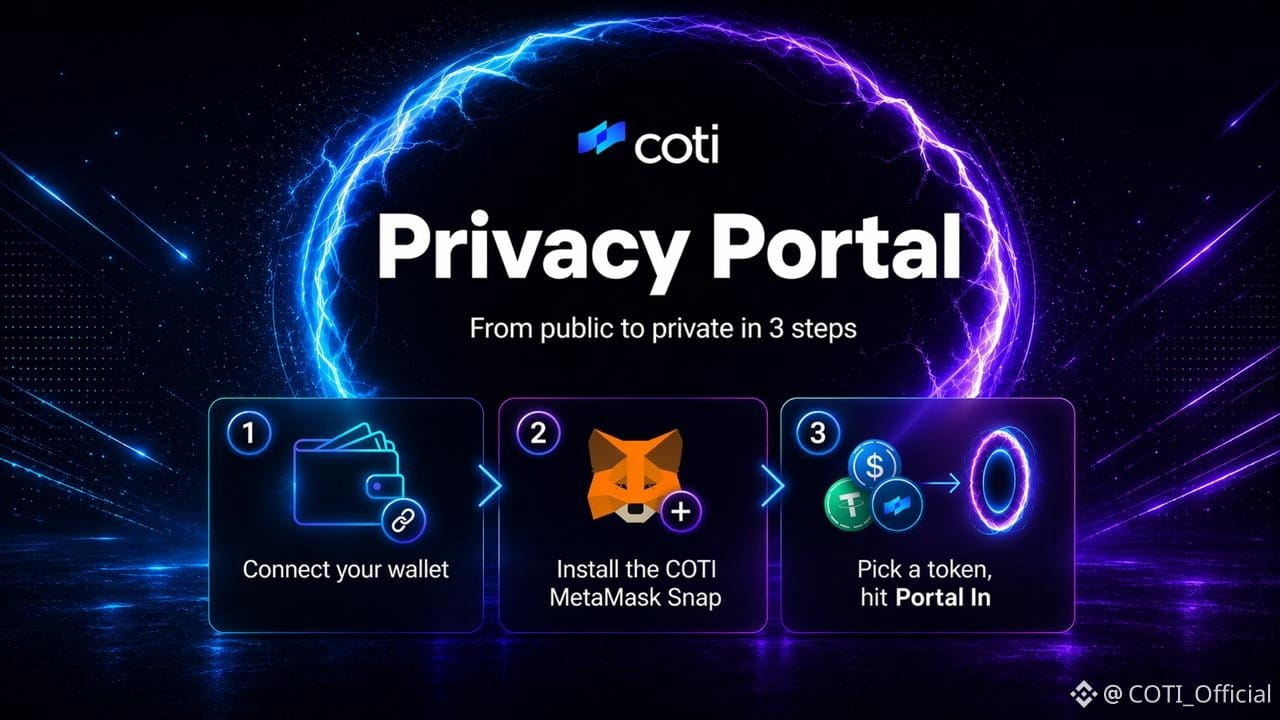
Turn your tokens private in 3-steps.
- Connect your wallet.
- Install the COTI MetaMask Snap.
- Pick a token and Portal In.
That it! Your tokens are encrypted onchain and only visible to you.
Try it 👉 https://privacy.coti.io
Turn your tokens private in 3-steps.
- Connect your wallet.
- Install the COTI MetaMask Snap.
- Pick a token and Portal In.
That it! Your tokens are encrypted onchain and only visible to you.
Try it 👉 https://privacy.coti.io
- Connect your wallet.
- Install the COTI MetaMask Snap.
- Pick a token and Portal In.
That it! Your tokens are encrypted onchain and only visible to you.
Try it 👉 https://privacy.coti.io
1
4
2.5k
ຢືນຢັນແລ້ວ
A new episode of Onchain Confidential is live 🎙️
Featuring special guest Redwan Meslem, Executive Director at the Enterprise Ethereum Alliance 🔹
Get an inside look at how enterprises are building onchain and why selective privacy matters.
Presented by COTI. Hosted by Amateo.
Watch now 👇
https://youtu.be/qNaMSZTyxA4
A new episode of Onchain Confidential is live 🎙️
Featuring special guest Redwan Meslem, Executive Director at the Enterprise Ethereum Alliance 🔹
Get an inside look at how enterprises are building onchain and why selective privacy matters.
Presented by COTI. Hosted by Amateo.
Watch now 👇
https://youtu.be/qNaMSZTyxA4
Featuring special guest Redwan Meslem, Executive Director at the Enterprise Ethereum Alliance 🔹
Get an inside look at how enterprises are building onchain and why selective privacy matters.
Presented by COTI. Hosted by Amateo.
Watch now 👇
https://youtu.be/qNaMSZTyxA4
4
1.1k
ເປັນຄວາມຈິງບາງສ່ວນ
COTI Operational Notice: V2 to ERC20 Conversion
Operational notice: over the coming hours, most of the COTI V2 tokens in the Genesis wallet will be converted to ERC20 through the COTI bridge, which will be returned to the same ETH address.
Why: ERC20 is where the majority of COTI’s liquidity, exchange listings, and integrations currently live, and we are working on a different strategy for how COTI is held across chains.
There is also a practical benefit many of you have been asking about for a long time: bridge limits. Those limits exist because of how supply has been split between the two rails. With the large majority of supply on ERC20, the total daily limit will increase from 7M to 70M, without any limitation on single wallets, as soon as the conversion completes.
What this changes for holders: nothing. Your balances are untouched, no swap or migration is required, and no new COTI is created. This is a conversion of existing foundation-held COTI between networks, not a new issuance, and does not change the tokenomics in place. All movements are visible on-chain and reconcile against this notice.
This change in how tokens are distributed across the two networks does not represent a change in our commitment to COTI V2 or the operation of the network. It is an operational and liquidity-management decision regarding where Foundation-held tokens are maintained.
For full transparency, the destination holding address will be published once the conversion completes. Some of the holdings may later move to cold-storage wallets; if and when that happens, those addresses will be published as well.
COTI Operational Notice: V2 to ERC20 Conversion
Operational notice: over the coming hours, most of the COTI V2 tokens in the Genesis wallet will be converted to ERC20 through the COTI bridge, which will be returned to the same ETH address.
Why: ERC20 is where the majority of COTI’s liquidity, exchange listings, and integrations currently live, and we are working on a different strategy for how COTI is held across chains.
There is also a practical benefit many of you have been asking about for a long time: bridge limits. Those limits exist because of how supply has been split between the two rails. With the large majority of supply on ERC20, the total daily limit will increase from 7M to 70M, without any limitation on single wallets, as soon as the conversion completes.
What this changes for holders: nothing. Your balances are untouched, no swap or migration is required, and no new COTI is created. This is a conversion of existing foundation-held COTI between networks, not a new issuance, and does not change the tokenomics in place. All movements are visible on-chain and reconcile against this notice.
This change in how tokens are distributed across the two networks does not represent a change in our commitment to COTI V2 or the operation of the network. It is an operational and liquidity-management decision regarding where Foundation-held tokens are maintained.
For full transparency, the destination holding address will be published once the conversion completes. Some of the holdings may later move to cold-storage wallets; if and when that happens, those addresses will be published as well.
Operational notice: over the coming hours, most of the COTI V2 tokens in the Genesis wallet will be converted to ERC20 through the COTI bridge, which will be returned to the same ETH address.
Why: ERC20 is where the majority of COTI’s liquidity, exchange listings, and integrations currently live, and we are working on a different strategy for how COTI is held across chains.
There is also a practical benefit many of you have been asking about for a long time: bridge limits. Those limits exist because of how supply has been split between the two rails. With the large majority of supply on ERC20, the total daily limit will increase from 7M to 70M, without any limitation on single wallets, as soon as the conversion completes.
What this changes for holders: nothing. Your balances are untouched, no swap or migration is required, and no new COTI is created. This is a conversion of existing foundation-held COTI between networks, not a new issuance, and does not change the tokenomics in place. All movements are visible on-chain and reconcile against this notice.
This change in how tokens are distributed across the two networks does not represent a change in our commitment to COTI V2 or the operation of the network. It is an operational and liquidity-management decision regarding where Foundation-held tokens are maintained.
For full transparency, the destination holding address will be published once the conversion completes. Some of the holdings may later move to cold-storage wallets; if and when that happens, those addresses will be published as well.
1
1k
Web3 already outsources everything hard.
🌐 Node infra goes to RPC providers
📡 Price data goes to oracles
🌉 Cross-chain messaging goes to bridges
🔐 Privacy goes to COTI
$COTI Privacy-on-Demand handles the private computation for tokens, data and apps.
🔗 https://x.com/COTInetwork/status/2096241566796955810
Web3 already outsources everything hard.
🌐 Node infra goes to RPC providers
📡 Price data goes to oracles
🌉 Cross-chain messaging goes to bridges
🔐 Privacy goes to COTI
$COTI Privacy-on-Demand handles the private computation for tokens, data and apps.
🔗 https://x.com/COTInetwork/status/2096241566796955810
Web3 already outsources everything hard.
🌐 Node infra goes to RPC providers
📡 Price data goes to oracles
🌉 Cross-chain messaging goes to bridges
🔐 Privacy goes to COTI
$COTI Privacy-on-Demand handles the private computation for tokens, data and apps.
🔗 https://x.com/COTInetwork/status/2096241566796955810
2
2
1.1k
How COTI Privacy-on-Demand Works 🛡️
→ Start with your app
→ Kick off a private action
→ Your wallet encrypts the data
→ The native-chain process the TX
→ The Inbox carries it to COTI
→ COTI computes it without revealing the data
→ The answer comes back sealed
→ Only you can reveal the data
You hold the key to your privacy 🔐
🔗 https://x.com/COTInetwork/status/2095122627660591204
How COTI Privacy-on-Demand Works 🛡️
→ Start with your app
→ Kick off a private action
→ Your wallet encrypts the data
→ The native-chain process the TX
→ The Inbox carries it to COTI
→ COTI computes it without revealing the data
→ The answer comes back sealed
→ Only you can reveal the data
You hold the key to your privacy 🔐
🔗 https://x.com/COTInetwork/status/2095122627660591204
How COTI Privacy-on-Demand Works 🛡️
→ Start with your app
→ Kick off a private action
→ Your wallet encrypts the data
→ The native-chain process the TX
→ The Inbox carries it to COTI
→ COTI computes it without revealing the data
→ The answer comes back sealed
→ Only you can reveal the data
You hold the key to your privacy 🔐
🔗 https://x.com/COTInetwork/status/2095122627660591204
4
1.3k

ບົດຄວາມ
Privacy-on-Demand: How Privacy Works Across Chains TL;DR
→ Privacy-on-Demand is an end-to-end encryption privacy service that works across blockchains.
→ Two parts do the work. The Inbox carries sealed requests between the two chains. The MPC executor on COTI computes over the encrypted values without ever revealing them.
→ The app sends data via a transaction, COTI computes it privately, and the answer comes back still encrypted. Only the user can open and reveal the data with their own key.
→ For the chain that integrates it: PoD unlocks privacy for its existing apps, with no migration or new tech stack needed. → For COTI: Every private request, whichever chain it starts on, is processed and fees are paid to COTI.
Privacy: The Choice You Should Never Have Had to Make
Privacy-on-Demand brings COTI privacy natively to any blockchain it’s integrated on. You don’t have to migrate your tech stack or build on a new chain. It is a privacy service the chain or the app you’re already using can call.
COTI Privacy-on-Demand is a cross-chain privacy service that can enable privacy on any chain or app. Essentially, it lets an application keep its accounts, tokens and data on the EVM chain it already runs on, while processing transactions of private tokens and private data, all powered by COTI
A user’s sensitive data is encrypted, sent to COTI for computation, computed there without ever being decrypted, and returned to the original chain as ciphertext that only the user can open.
Crypto already knows the shape of this. No chain builds its own price feeds. When an application needs data it does not have, it calls an oracle, and nobody suggests migrating to another network to get one. Privacy now works the same way: a capability your chain can run and call, rather than an entirely new tech stack you have to integrate.
An oracle fetches external data and hands it over in the clear. Privacy-on-Demand sends encrypted values out, computes over them without ever revealing them, and returns an encrypted result that only the entitled user can open.
Before now, privacy required a complex development effort which could be costly and challenging to solve. Public blockchains are excellent at agreement, auditability, and open participation, and they get weaker the moment an application has to hide something: an amount, personal identifiable information or an input of business logic.
Until now, there were only two options. Keep the sensitive data off-chain and composability weakens, because the rest of Web3 cannot interact with what it cannot see. Or move to a specialized privacy chain, and take on an entirely new development effort, with technical specifications and limitations.
With Privacy-on-Demand, you can use the public chain for coordination and COTI for confidentiality.
A Courier and a Calculator
Picture three rooms and a mail slot: your device, which holds your keys and does the encrypting and decrypting, the public blockchain, where your tokens and contracts live, and COTI’s private compute environment.
The Inbox is the certified courier. It is the only route a private request travels in either direction. It carries the sealed job out, then calls back into your contract when the answer exists. It is also where the trust boundary sits: applications are built to accept a private result only from the Inbox, and the SDK ships an onlyInbox pattern for that check.
The MPC executor is COTI’s private calculator. MPC stands for multi-party computation, computing a shared result without any party revealing its own input. Sealed inputs arrive, COTI’s Garbled Circuits run the operation directly on the encrypted data without ever decrypting it, and out comes ciphertext, an encrypted result.
The components of Privacy-on-Demand, in one line each
Your device or wallet is the client. Holds your privacy keys, encrypts every sensitive input before it leaves your machine, and decrypts the result locally or within your wallet or app if you are entitled to see it.
Your EVM chain, the host chain. Keeps your accounts, tokens and application contracts exactly where they already are, and enforces whatever public rules are in place: permissions, payment, timing.
The Inbox. A matching pair of on-chain messaging contracts, one on your chain and one on COTI, and the only route a private request travels in either direction.
The MPC executor. The COTI-side contract that runs the private logic, computing over encrypted values with Garbled Circuits and returning ciphertext.
PoD-User. The configuration a contract inherits, recording which Inbox, which COTI network and which executor it uses.
PoD-Lib. A Solidity library of ready-made private operations over encrypted values, so a team writes no cryptography to get started.
The Encryption Round Trip
Here is the full private request flow, end to end.
1. You choose an action. Whether it’s to compare two private numbers. Run a private score. Identity check. Approve a payment.
2. Your app encrypts the inputs on your own device. This is the part most people have backwards. The client does the encrypting, before anything leaves your machine, and COTI never receives a plaintext value.
3. You submit an ordinary transaction on your own chain, and your contract checks the public rules first. Permissions, payment, timing.
4. Your contract hands the sealed job to the Inbox as a two-way message: an outbound leg to COTI, and a booked return leg for when the answer exists.
5. COTI’s Inbox passes the job to the MPC executor, which runs the private logic over the encrypted values.
6. The sealed answer travels home. Your contract stores it against a request ID, the tag the answer arrives under, and you decrypt it locally with your own key, if you are entitled to.
Now the sentence that matters most. The result comes back encrypted. Nothing is decrypted on-chain, ever, on either side. Even after completion, plaintext is not magically public. The only place the ciphertext opens is the device of a user entitled to open it.
Five verbs and you have the pattern. Encrypt, send, compute privately, receive sealed, decrypt yourself.
Why a Private Answer Takes a Moment
A normal smart contract call computes and returns inside a single transaction. With Privacy-on-Demand, the private work happens outside your chain’s synchronous execution frame, on a different network. That is two transactions on two chains, not one.
So the lifecycle has three phases. Request, where your contract submits the job through the Inbox and gets a request ID. Wait, where COTI performs the private computation, which may take a few seconds or longer depending on network conditions. And callback, the second transaction, where the Inbox invokes your contract with the encrypted output.
Simply put: send a job, get a sealed reply.
Because each call spends real resources on two networks, the fee funds both legs: the private computation on COTI, and the callback that writes the sealed result back on your chain. This is what privacy crossing two networks costs, and knowing it is the difference between a diagram and an explanation.
What Is Encrypted and What Is Not
COTI encrypts the values and the math over them, not the fact that a transaction happened. The transaction is visible. The number is not.
Everything an explorer shows you stays legible. The amount does not.
What is protected: sensitive values are never stored in plaintext on the orchestrating chain the way an ordinary balance is, the computation over them runs inside COTI’s private execution path rather than in a trace anyone can replay, and users decrypt only what they are entitled to see, with their own privacy key.
What is not protected: this is not full anonymity. Privacy-on-Demand does not hide metadata such as gas costs, timing or which contract was called. This isn’t about anonymity. It’s about selective disclosure.
The boundary is a feature. Auditability is what makes confidentiality usable by a real business: activity can be verified on the public chain while the values inside it stay protected.
What This Means in Practice, for Both Sides
Privacy-on-Demand answers two different questions with one mechanism, depending on which end you stand at.
For the chain that integrates it
Its applications get encrypted computation with no migration, no new chain, and no assets moved. Accounts, tokens, users, liquidity and tooling stay where they are, and nobody is asked to bridge anywhere. It is additive rather than a replacement: the public chain keeps doing what it is excellent at, and gains the one capability it structurally cannot provide on its own. Teams building there do not have to become cryptographers either, because the shipped operations cover a large share of applications outright.
For COTI
Every call consumes resources on two networks, so the fee covers both legs. You pay entirely in your own chain’s native token. That payment is split: one slice funds the callback that writes the result back on your chain, the other funds the private execution on COTI, a leg priced and spent in COTI through oracle conversion.
So every private request, on whichever chain it begins, is work performed and paid for on COTI.
Privacy for every chain, value back to COTI.
What This Makes Possible
Start with a universal business problem. Privacy-on-Demand keeps the sensitive business logic and transaction amounts encrypted, and lets each party decrypt only the data they are programmed to have access to.
On a public chain your transaction and its cost and size is public. Privacy-on-Demand can shield orders from MEV bots and protect traders from being sandwiched, keeping thresholds, order sizes and strategy logic away from front-running. The number stays sealed. Settlement stays on your chain.
On a transparent chain, publishing your contract publishes your business logic. Every rule you encoded is readable, and so is every parameter you tuned. That is exactly right for an AMM, whose whole value is that anyone can verify it. It is a serious problem for anything whose edge is the rule itself: a credit model, an auction mechanism, a pricing curve. Deploy one of those on-chain today and you have published your competitive advantage, formatted for copy and paste.
Privacy-on-Demand changes that trade. A team can deploy its own private program on COTI, one that accepts only encrypted inputs and returns only encrypted outputs, so its data and its inner workings both stay hidden. The host chain still coordinates, still holds the assets, still enforces the public rules. The rule that makes the business work never becomes public.
Until now, a company whose product is its model had two options: keep the model off-chain and give up composability, or put it on-chain and give up the model. That is no longer the choice, and it changes which businesses can use a public blockchain at all.
Where It Runs Today, and Where It Goes Next
COTI’s privacy engine is not a prototype. gcEVM, COTI’s Garbled Circuits implementation, runs in production on COTI mainnet today, powering private tokens, the Privacy Portal and live applications.
Privacy-on-Demand is how that engine reaches beyond COTI, and the first public proof is already running on Ethereum testnet. COTI deployed the Millionaires’ Problem there: two parties learning which of them holds more, with neither revealing a number, computed end to end with no trusted intermediary. It is the benchmark that founded secure multi-party computation more than forty years ago, settled on a public EVM chain, with the private math happening on COTI.
That is the entire pattern working outside COTI for the first time, and it is the same pattern any EVM application will use.
What comes next is reach. Privacy-on-Demand goes multichain through 2026, including major partnerships with leading chains, with COTI operating as the universal privacy layer for Web3: interoperable, composable and chain-agnostic.
A Private Backend that any application or blockchain can call, without asking any of them to move. COTI has set its own measurement standard for it too: cross-chain integrations, users transacting on the network, and applications built with the privacy stack.
The engine is proven. The connection works. What is left is how many chains it reaches.
Privacy-on-Demand FAQ
What is COTI Privacy-on-Demand?
COTI Privacy-on-Demand is a cross-chain privacy service that lets an application keep its accounts, tokens and public logic on the EVM chain it already runs on, while sensitive values and the computation over them are encrypted on the user’s own device, sent to COTI, computed there without ever being decrypted, and returned as ciphertext that only the entitled user can open. It runs on gcEVM, COTI’s Garbled Circuits implementation built with Soda Labs, a form of multi-party computation that computes directly over encrypted data. The pattern in five verbs: encrypt, send, compute privately, receive sealed, decrypt yourself.
Do I have to move my tokens or migrate my app to COTI?
No. Keeping your accounts, tokens, users and liquidity exactly where they already are is the entire point of Privacy-on-Demand. Only the sensitive values, and the computation over them, travel to COTI, and they travel encrypted in both directions.
Is Privacy-on-Demand live?
Two separate things are true here. COTI’s Garbled Circuits implementation, gcEVM, has been live in production on COTI mainnet since March 2025, where it powers private tokens, the Privacy Portal and live applications. Privacy-on-Demand is how that engine reaches other chains, and it is running on Ethereum testnet today, not yet deployed on mainnet.
Which blockchains does Privacy-on-Demand support?
Privacy-on-Demand is chain-agnostic by design and targets EVM-compatible chains, so the host chain is whichever EVM network your application already runs on. It is running on Ethereum testnet today. COTI’s public 2026 goals commit to Privacy-on-Demand going multichain through major partnerships with leading chains, and no partner chain has been announced.
Does Privacy-on-Demand make transactions anonymous?
No. Privacy-on-Demand delivers confidentiality, not anonymity. It encrypts the values and the computation over them, while the transaction itself stays visible on the public chain, and it does not hide metadata such as gas costs, timing or which contract was called.
How is this different from a privacy chain, or from an oracle?
A privacy chain asks you to move: relocating your accounts, tokens, liquidity and users onto a different network, and taking on that network’s custody and regulatory story. Privacy-on-Demand follows the shape of an oracle instead, a capability your chain calls rather than a place it goes. The difference from an oracle is what travels: an oracle fetches external data and hands it over in the clear, while Privacy-on-Demand computes over encrypted values and returns them encrypted.
What can you build with Privacy-on-Demand?
Anything whose values or whose logic should not be public while it settles on a public chain. Typical patterns include private investor allocations where each investor decrypts only their own amount, order and position shielding that keeps size and strategy away from MEV bots, confidential payments and payroll, sealed-bid auctions, credit and identity checks against encrypted data, and confidential voting. A team whose business rule is itself the secret can also deploy its own private program on COTI, one that accepts only encrypted inputs and returns only encrypted outputs.
Privacy Stops Being a Place You Go
Privacy stops being a destination you migrate to and becomes a capability your chain can call.
The mechanism, in one line you can repeat: a courier, a calculator, and an answer that comes home still sealed.
Read the full Privacy-on-Demand documentation at docs.coti.io, and try the Privacy Portal, already running in production, at privacy.coti.io.
Stay COTI.
Official Privacy-on-Demand Resources
These are the canonical sources for Privacy-on-Demand, maintained by COTI.
Privacy-on-Demand documentation: https://docs.coti.io/coti-documentation/privacy-on-demand
Interactive architecture demo: https://pod.coti.io/
Privacy Portal, live in production on COTI: https://privacy.coti.io/
COTI on GitHub: https://github.com/coti-io
About COTI:
COTI is the programmable privacy layer for Web3. Built for enterprises, builders, and agents. Powered by high-performance Garbled Circuits and enterprise-grade COTI Nightfall (ZK), COTI enables encrypted computation on any public blockchain. Fast, low-cost, and compliant privacy across DeFi, AI, and beyond.
For COTI updates and to join the conversation, be sure to check out our channels:
Website: https://coti.io/
X: https://twitter.com/COTInetwork
YouTube: https://www.youtube.com/channel/UCl-2YzhaPnouvBtotKuM4DA
Telegram: https://t.me/COTInetwork
Discord: https://discord.gg/coti-foundation
GitHub: https://github.com/coti-io
Vibe Coders Telegram: https://t.me/+uuPNfRkKiQ03ZTcx
Privacy-on-Demand: How Privacy Works Across Chains
TL;DR
→ Privacy-on-Demand is an end-to-end encryption privacy service that works across blockchains.
→ Two parts do the work. The Inbox carries sealed requests between the two chains. The MPC executor on COTI computes over the encrypted values without ever revealing them.
→ The app sends data via a transaction, COTI computes it privately, and the answer comes back still encrypted. Only the user can open and reveal the data with their own key.
→ For the chain that integrates it: PoD unlocks privacy for its existing apps, with no migration or new tech stack needed. → For COTI: Every private request, whichever chain it starts on, is processed and fees are paid to COTI.
Privacy: The Choice You Should Never Have Had to Make
Privacy-on-Demand brings COTI privacy natively to any blockchain it’s integrated on. You don’t have to migrate your tech stack or build on a new chain. It is a privacy service the chain or the app you’re already using can call.
COTI Privacy-on-Demand is a cross-chain privacy service that can enable privacy on any chain or app. Essentially, it lets an application keep its accounts, tokens and data on the EVM chain it already runs on, while processing transactions of private tokens and private data, all powered by COTI
A user’s sensitive data is encrypted, sent to COTI for computation, computed there without ever being decrypted, and returned to the original chain as ciphertext that only the user can open.
Crypto already knows the shape of this. No chain builds its own price feeds. When an application needs data it does not have, it calls an oracle, and nobody suggests migrating to another network to get one. Privacy now works the same way: a capability your chain can run and call, rather than an entirely new tech stack you have to integrate.
An oracle fetches external data and hands it over in the clear. Privacy-on-Demand sends encrypted values out, computes over them without ever revealing them, and returns an encrypted result that only the entitled user can open.
Before now, privacy required a complex development effort which could be costly and challenging to solve. Public blockchains are excellent at agreement, auditability, and open participation, and they get weaker the moment an application has to hide something: an amount, personal identifiable information or an input of business logic.
Until now, there were only two options. Keep the sensitive data off-chain and composability weakens, because the rest of Web3 cannot interact with what it cannot see. Or move to a specialized privacy chain, and take on an entirely new development effort, with technical specifications and limitations.
With Privacy-on-Demand, you can use the public chain for coordination and COTI for confidentiality.
A Courier and a Calculator
Picture three rooms and a mail slot: your device, which holds your keys and does the encrypting and decrypting, the public blockchain, where your tokens and contracts live, and COTI’s private compute environment.
The Inbox is the certified courier. It is the only route a private request travels in either direction. It carries the sealed job out, then calls back into your contract when the answer exists. It is also where the trust boundary sits: applications are built to accept a private result only from the Inbox, and the SDK ships an onlyInbox pattern for that check.
The MPC executor is COTI’s private calculator. MPC stands for multi-party computation, computing a shared result without any party revealing its own input. Sealed inputs arrive, COTI’s Garbled Circuits run the operation directly on the encrypted data without ever decrypting it, and out comes ciphertext, an encrypted result.
The components of Privacy-on-Demand, in one line each
Your device or wallet is the client. Holds your privacy keys, encrypts every sensitive input before it leaves your machine, and decrypts the result locally or within your wallet or app if you are entitled to see it.
Your EVM chain, the host chain. Keeps your accounts, tokens and application contracts exactly where they already are, and enforces whatever public rules are in place: permissions, payment, timing.
The Inbox. A matching pair of on-chain messaging contracts, one on your chain and one on COTI, and the only route a private request travels in either direction.
The MPC executor. The COTI-side contract that runs the private logic, computing over encrypted values with Garbled Circuits and returning ciphertext.
PoD-User. The configuration a contract inherits, recording which Inbox, which COTI network and which executor it uses.
PoD-Lib. A Solidity library of ready-made private operations over encrypted values, so a team writes no cryptography to get started.
The Encryption Round Trip
Here is the full private request flow, end to end.
1. You choose an action. Whether it’s to compare two private numbers. Run a private score. Identity check. Approve a payment.
2. Your app encrypts the inputs on your own device. This is the part most people have backwards. The client does the encrypting, before anything leaves your machine, and COTI never receives a plaintext value.
3. You submit an ordinary transaction on your own chain, and your contract checks the public rules first. Permissions, payment, timing.
4. Your contract hands the sealed job to the Inbox as a two-way message: an outbound leg to COTI, and a booked return leg for when the answer exists.
5. COTI’s Inbox passes the job to the MPC executor, which runs the private logic over the encrypted values.
6. The sealed answer travels home. Your contract stores it against a request ID, the tag the answer arrives under, and you decrypt it locally with your own key, if you are entitled to.
Now the sentence that matters most. The result comes back encrypted. Nothing is decrypted on-chain, ever, on either side. Even after completion, plaintext is not magically public. The only place the ciphertext opens is the device of a user entitled to open it.
Five verbs and you have the pattern. Encrypt, send, compute privately, receive sealed, decrypt yourself.
Why a Private Answer Takes a Moment
A normal smart contract call computes and returns inside a single transaction. With Privacy-on-Demand, the private work happens outside your chain’s synchronous execution frame, on a different network. That is two transactions on two chains, not one.
So the lifecycle has three phases. Request, where your contract submits the job through the Inbox and gets a request ID. Wait, where COTI performs the private computation, which may take a few seconds or longer depending on network conditions. And callback, the second transaction, where the Inbox invokes your contract with the encrypted output.
Simply put: send a job, get a sealed reply.
Because each call spends real resources on two networks, the fee funds both legs: the private computation on COTI, and the callback that writes the sealed result back on your chain. This is what privacy crossing two networks costs, and knowing it is the difference between a diagram and an explanation.
What Is Encrypted and What Is Not
COTI encrypts the values and the math over them, not the fact that a transaction happened. The transaction is visible. The number is not.
Everything an explorer shows you stays legible. The amount does not.
What is protected: sensitive values are never stored in plaintext on the orchestrating chain the way an ordinary balance is, the computation over them runs inside COTI’s private execution path rather than in a trace anyone can replay, and users decrypt only what they are entitled to see, with their own privacy key.
What is not protected: this is not full anonymity. Privacy-on-Demand does not hide metadata such as gas costs, timing or which contract was called. This isn’t about anonymity. It’s about selective disclosure.
The boundary is a feature. Auditability is what makes confidentiality usable by a real business: activity can be verified on the public chain while the values inside it stay protected.
What This Means in Practice, for Both Sides
Privacy-on-Demand answers two different questions with one mechanism, depending on which end you stand at.
For the chain that integrates it
Its applications get encrypted computation with no migration, no new chain, and no assets moved. Accounts, tokens, users, liquidity and tooling stay where they are, and nobody is asked to bridge anywhere. It is additive rather than a replacement: the public chain keeps doing what it is excellent at, and gains the one capability it structurally cannot provide on its own. Teams building there do not have to become cryptographers either, because the shipped operations cover a large share of applications outright.
For COTI
Every call consumes resources on two networks, so the fee covers both legs. You pay entirely in your own chain’s native token. That payment is split: one slice funds the callback that writes the result back on your chain, the other funds the private execution on COTI, a leg priced and spent in COTI through oracle conversion.
So every private request, on whichever chain it begins, is work performed and paid for on COTI.
Privacy for every chain, value back to COTI.
What This Makes Possible
Start with a universal business problem. Privacy-on-Demand keeps the sensitive business logic and transaction amounts encrypted, and lets each party decrypt only the data they are programmed to have access to.
On a public chain your transaction and its cost and size is public. Privacy-on-Demand can shield orders from MEV bots and protect traders from being sandwiched, keeping thresholds, order sizes and strategy logic away from front-running. The number stays sealed. Settlement stays on your chain.
On a transparent chain, publishing your contract publishes your business logic. Every rule you encoded is readable, and so is every parameter you tuned. That is exactly right for an AMM, whose whole value is that anyone can verify it. It is a serious problem for anything whose edge is the rule itself: a credit model, an auction mechanism, a pricing curve. Deploy one of those on-chain today and you have published your competitive advantage, formatted for copy and paste.
Privacy-on-Demand changes that trade. A team can deploy its own private program on COTI, one that accepts only encrypted inputs and returns only encrypted outputs, so its data and its inner workings both stay hidden. The host chain still coordinates, still holds the assets, still enforces the public rules. The rule that makes the business work never becomes public.
Until now, a company whose product is its model had two options: keep the model off-chain and give up composability, or put it on-chain and give up the model. That is no longer the choice, and it changes which businesses can use a public blockchain at all.
Where It Runs Today, and Where It Goes Next
COTI’s privacy engine is not a prototype. gcEVM, COTI’s Garbled Circuits implementation, runs in production on COTI mainnet today, powering private tokens, the Privacy Portal and live applications.
Privacy-on-Demand is how that engine reaches beyond COTI, and the first public proof is already running on Ethereum testnet. COTI deployed the Millionaires’ Problem there: two parties learning which of them holds more, with neither revealing a number, computed end to end with no trusted intermediary. It is the benchmark that founded secure multi-party computation more than forty years ago, settled on a public EVM chain, with the private math happening on COTI.
That is the entire pattern working outside COTI for the first time, and it is the same pattern any EVM application will use.
What comes next is reach. Privacy-on-Demand goes multichain through 2026, including major partnerships with leading chains, with COTI operating as the universal privacy layer for Web3: interoperable, composable and chain-agnostic.
A Private Backend that any application or blockchain can call, without asking any of them to move. COTI has set its own measurement standard for it too: cross-chain integrations, users transacting on the network, and applications built with the privacy stack.
The engine is proven. The connection works. What is left is how many chains it reaches.
Privacy-on-Demand FAQ
What is COTI Privacy-on-Demand?
COTI Privacy-on-Demand is a cross-chain privacy service that lets an application keep its accounts, tokens and public logic on the EVM chain it already runs on, while sensitive values and the computation over them are encrypted on the user’s own device, sent to COTI, computed there without ever being decrypted, and returned as ciphertext that only the entitled user can open. It runs on gcEVM, COTI’s Garbled Circuits implementation built with Soda Labs, a form of multi-party computation that computes directly over encrypted data. The pattern in five verbs: encrypt, send, compute privately, receive sealed, decrypt yourself.
Do I have to move my tokens or migrate my app to COTI?
No. Keeping your accounts, tokens, users and liquidity exactly where they already are is the entire point of Privacy-on-Demand. Only the sensitive values, and the computation over them, travel to COTI, and they travel encrypted in both directions.
Is Privacy-on-Demand live?
Two separate things are true here. COTI’s Garbled Circuits implementation, gcEVM, has been live in production on COTI mainnet since March 2025, where it powers private tokens, the Privacy Portal and live applications. Privacy-on-Demand is how that engine reaches other chains, and it is running on Ethereum testnet today, not yet deployed on mainnet.
Which blockchains does Privacy-on-Demand support?
Privacy-on-Demand is chain-agnostic by design and targets EVM-compatible chains, so the host chain is whichever EVM network your application already runs on. It is running on Ethereum testnet today. COTI’s public 2026 goals commit to Privacy-on-Demand going multichain through major partnerships with leading chains, and no partner chain has been announced.
Does Privacy-on-Demand make transactions anonymous?
No. Privacy-on-Demand delivers confidentiality, not anonymity. It encrypts the values and the computation over them, while the transaction itself stays visible on the public chain, and it does not hide metadata such as gas costs, timing or which contract was called.
How is this different from a privacy chain, or from an oracle?
A privacy chain asks you to move: relocating your accounts, tokens, liquidity and users onto a different network, and taking on that network’s custody and regulatory story. Privacy-on-Demand follows the shape of an oracle instead, a capability your chain calls rather than a place it goes. The difference from an oracle is what travels: an oracle fetches external data and hands it over in the clear, while Privacy-on-Demand computes over encrypted values and returns them encrypted.
What can you build with Privacy-on-Demand?
Anything whose values or whose logic should not be public while it settles on a public chain. Typical patterns include private investor allocations where each investor decrypts only their own amount, order and position shielding that keeps size and strategy away from MEV bots, confidential payments and payroll, sealed-bid auctions, credit and identity checks against encrypted data, and confidential voting. A team whose business rule is itself the secret can also deploy its own private program on COTI, one that accepts only encrypted inputs and returns only encrypted outputs.
Privacy Stops Being a Place You Go
Privacy stops being a destination you migrate to and becomes a capability your chain can call.
The mechanism, in one line you can repeat: a courier, a calculator, and an answer that comes home still sealed.
Read the full Privacy-on-Demand documentation at docs.coti.io, and try the Privacy Portal, already running in production, at privacy.coti.io.
Stay COTI.
Official Privacy-on-Demand Resources
These are the canonical sources for Privacy-on-Demand, maintained by COTI.
Privacy-on-Demand documentation: https://docs.coti.io/coti-documentation/privacy-on-demand
Interactive architecture demo: https://pod.coti.io/
Privacy Portal, live in production on COTI: https://privacy.coti.io/
COTI on GitHub: https://github.com/coti-io
About COTI:
COTI is the programmable privacy layer for Web3. Built for enterprises, builders, and agents. Powered by high-performance Garbled Circuits and enterprise-grade COTI Nightfall (ZK), COTI enables encrypted computation on any public blockchain. Fast, low-cost, and compliant privacy across DeFi, AI, and beyond.
For COTI updates and to join the conversation, be sure to check out our channels:
Website: https://coti.io/
X: https://twitter.com/COTInetwork
YouTube: https://www.youtube.com/channel/UCl-2YzhaPnouvBtotKuM4DA
Telegram: https://t.me/COTInetwork
Discord: https://discord.gg/coti-foundation
GitHub: https://github.com/coti-io
Vibe Coders Telegram: https://t.me/+uuPNfRkKiQ03ZTcx
→ Privacy-on-Demand is an end-to-end encryption privacy service that works across blockchains.
→ Two parts do the work. The Inbox carries sealed requests between the two chains. The MPC executor on COTI computes over the encrypted values without ever revealing them.
→ The app sends data via a transaction, COTI computes it privately, and the answer comes back still encrypted. Only the user can open and reveal the data with their own key.
→ For the chain that integrates it: PoD unlocks privacy for its existing apps, with no migration or new tech stack needed. → For COTI: Every private request, whichever chain it starts on, is processed and fees are paid to COTI.
Privacy: The Choice You Should Never Have Had to Make
Privacy-on-Demand brings COTI privacy natively to any blockchain it’s integrated on. You don’t have to migrate your tech stack or build on a new chain. It is a privacy service the chain or the app you’re already using can call.
COTI Privacy-on-Demand is a cross-chain privacy service that can enable privacy on any chain or app. Essentially, it lets an application keep its accounts, tokens and data on the EVM chain it already runs on, while processing transactions of private tokens and private data, all powered by COTI
A user’s sensitive data is encrypted, sent to COTI for computation, computed there without ever being decrypted, and returned to the original chain as ciphertext that only the user can open.
Crypto already knows the shape of this. No chain builds its own price feeds. When an application needs data it does not have, it calls an oracle, and nobody suggests migrating to another network to get one. Privacy now works the same way: a capability your chain can run and call, rather than an entirely new tech stack you have to integrate.
An oracle fetches external data and hands it over in the clear. Privacy-on-Demand sends encrypted values out, computes over them without ever revealing them, and returns an encrypted result that only the entitled user can open.
Before now, privacy required a complex development effort which could be costly and challenging to solve. Public blockchains are excellent at agreement, auditability, and open participation, and they get weaker the moment an application has to hide something: an amount, personal identifiable information or an input of business logic.
Until now, there were only two options. Keep the sensitive data off-chain and composability weakens, because the rest of Web3 cannot interact with what it cannot see. Or move to a specialized privacy chain, and take on an entirely new development effort, with technical specifications and limitations.
With Privacy-on-Demand, you can use the public chain for coordination and COTI for confidentiality.
A Courier and a Calculator
Picture three rooms and a mail slot: your device, which holds your keys and does the encrypting and decrypting, the public blockchain, where your tokens and contracts live, and COTI’s private compute environment.
The Inbox is the certified courier. It is the only route a private request travels in either direction. It carries the sealed job out, then calls back into your contract when the answer exists. It is also where the trust boundary sits: applications are built to accept a private result only from the Inbox, and the SDK ships an onlyInbox pattern for that check.
The MPC executor is COTI’s private calculator. MPC stands for multi-party computation, computing a shared result without any party revealing its own input. Sealed inputs arrive, COTI’s Garbled Circuits run the operation directly on the encrypted data without ever decrypting it, and out comes ciphertext, an encrypted result.
The components of Privacy-on-Demand, in one line each
Your device or wallet is the client. Holds your privacy keys, encrypts every sensitive input before it leaves your machine, and decrypts the result locally or within your wallet or app if you are entitled to see it.
Your EVM chain, the host chain. Keeps your accounts, tokens and application contracts exactly where they already are, and enforces whatever public rules are in place: permissions, payment, timing.
The Inbox. A matching pair of on-chain messaging contracts, one on your chain and one on COTI, and the only route a private request travels in either direction.
The MPC executor. The COTI-side contract that runs the private logic, computing over encrypted values with Garbled Circuits and returning ciphertext.
PoD-User. The configuration a contract inherits, recording which Inbox, which COTI network and which executor it uses.
PoD-Lib. A Solidity library of ready-made private operations over encrypted values, so a team writes no cryptography to get started.
The Encryption Round Trip
Here is the full private request flow, end to end.
1. You choose an action. Whether it’s to compare two private numbers. Run a private score. Identity check. Approve a payment.
2. Your app encrypts the inputs on your own device. This is the part most people have backwards. The client does the encrypting, before anything leaves your machine, and COTI never receives a plaintext value.
3. You submit an ordinary transaction on your own chain, and your contract checks the public rules first. Permissions, payment, timing.
4. Your contract hands the sealed job to the Inbox as a two-way message: an outbound leg to COTI, and a booked return leg for when the answer exists.
5. COTI’s Inbox passes the job to the MPC executor, which runs the private logic over the encrypted values.
6. The sealed answer travels home. Your contract stores it against a request ID, the tag the answer arrives under, and you decrypt it locally with your own key, if you are entitled to.
Now the sentence that matters most. The result comes back encrypted. Nothing is decrypted on-chain, ever, on either side. Even after completion, plaintext is not magically public. The only place the ciphertext opens is the device of a user entitled to open it.
Five verbs and you have the pattern. Encrypt, send, compute privately, receive sealed, decrypt yourself.
Why a Private Answer Takes a Moment
A normal smart contract call computes and returns inside a single transaction. With Privacy-on-Demand, the private work happens outside your chain’s synchronous execution frame, on a different network. That is two transactions on two chains, not one.
So the lifecycle has three phases. Request, where your contract submits the job through the Inbox and gets a request ID. Wait, where COTI performs the private computation, which may take a few seconds or longer depending on network conditions. And callback, the second transaction, where the Inbox invokes your contract with the encrypted output.
Simply put: send a job, get a sealed reply.
Because each call spends real resources on two networks, the fee funds both legs: the private computation on COTI, and the callback that writes the sealed result back on your chain. This is what privacy crossing two networks costs, and knowing it is the difference between a diagram and an explanation.
What Is Encrypted and What Is Not
COTI encrypts the values and the math over them, not the fact that a transaction happened. The transaction is visible. The number is not.
Everything an explorer shows you stays legible. The amount does not.
What is protected: sensitive values are never stored in plaintext on the orchestrating chain the way an ordinary balance is, the computation over them runs inside COTI’s private execution path rather than in a trace anyone can replay, and users decrypt only what they are entitled to see, with their own privacy key.
What is not protected: this is not full anonymity. Privacy-on-Demand does not hide metadata such as gas costs, timing or which contract was called. This isn’t about anonymity. It’s about selective disclosure.
The boundary is a feature. Auditability is what makes confidentiality usable by a real business: activity can be verified on the public chain while the values inside it stay protected.
What This Means in Practice, for Both Sides
Privacy-on-Demand answers two different questions with one mechanism, depending on which end you stand at.
For the chain that integrates it
Its applications get encrypted computation with no migration, no new chain, and no assets moved. Accounts, tokens, users, liquidity and tooling stay where they are, and nobody is asked to bridge anywhere. It is additive rather than a replacement: the public chain keeps doing what it is excellent at, and gains the one capability it structurally cannot provide on its own. Teams building there do not have to become cryptographers either, because the shipped operations cover a large share of applications outright.
For COTI
Every call consumes resources on two networks, so the fee covers both legs. You pay entirely in your own chain’s native token. That payment is split: one slice funds the callback that writes the result back on your chain, the other funds the private execution on COTI, a leg priced and spent in COTI through oracle conversion.
So every private request, on whichever chain it begins, is work performed and paid for on COTI.
Privacy for every chain, value back to COTI.
What This Makes Possible
Start with a universal business problem. Privacy-on-Demand keeps the sensitive business logic and transaction amounts encrypted, and lets each party decrypt only the data they are programmed to have access to.
On a public chain your transaction and its cost and size is public. Privacy-on-Demand can shield orders from MEV bots and protect traders from being sandwiched, keeping thresholds, order sizes and strategy logic away from front-running. The number stays sealed. Settlement stays on your chain.
On a transparent chain, publishing your contract publishes your business logic. Every rule you encoded is readable, and so is every parameter you tuned. That is exactly right for an AMM, whose whole value is that anyone can verify it. It is a serious problem for anything whose edge is the rule itself: a credit model, an auction mechanism, a pricing curve. Deploy one of those on-chain today and you have published your competitive advantage, formatted for copy and paste.
Privacy-on-Demand changes that trade. A team can deploy its own private program on COTI, one that accepts only encrypted inputs and returns only encrypted outputs, so its data and its inner workings both stay hidden. The host chain still coordinates, still holds the assets, still enforces the public rules. The rule that makes the business work never becomes public.
Until now, a company whose product is its model had two options: keep the model off-chain and give up composability, or put it on-chain and give up the model. That is no longer the choice, and it changes which businesses can use a public blockchain at all.
Where It Runs Today, and Where It Goes Next
COTI’s privacy engine is not a prototype. gcEVM, COTI’s Garbled Circuits implementation, runs in production on COTI mainnet today, powering private tokens, the Privacy Portal and live applications.
Privacy-on-Demand is how that engine reaches beyond COTI, and the first public proof is already running on Ethereum testnet. COTI deployed the Millionaires’ Problem there: two parties learning which of them holds more, with neither revealing a number, computed end to end with no trusted intermediary. It is the benchmark that founded secure multi-party computation more than forty years ago, settled on a public EVM chain, with the private math happening on COTI.
That is the entire pattern working outside COTI for the first time, and it is the same pattern any EVM application will use.
What comes next is reach. Privacy-on-Demand goes multichain through 2026, including major partnerships with leading chains, with COTI operating as the universal privacy layer for Web3: interoperable, composable and chain-agnostic.
A Private Backend that any application or blockchain can call, without asking any of them to move. COTI has set its own measurement standard for it too: cross-chain integrations, users transacting on the network, and applications built with the privacy stack.
The engine is proven. The connection works. What is left is how many chains it reaches.
Privacy-on-Demand FAQ
What is COTI Privacy-on-Demand?
COTI Privacy-on-Demand is a cross-chain privacy service that lets an application keep its accounts, tokens and public logic on the EVM chain it already runs on, while sensitive values and the computation over them are encrypted on the user’s own device, sent to COTI, computed there without ever being decrypted, and returned as ciphertext that only the entitled user can open. It runs on gcEVM, COTI’s Garbled Circuits implementation built with Soda Labs, a form of multi-party computation that computes directly over encrypted data. The pattern in five verbs: encrypt, send, compute privately, receive sealed, decrypt yourself.
Do I have to move my tokens or migrate my app to COTI?
No. Keeping your accounts, tokens, users and liquidity exactly where they already are is the entire point of Privacy-on-Demand. Only the sensitive values, and the computation over them, travel to COTI, and they travel encrypted in both directions.
Is Privacy-on-Demand live?
Two separate things are true here. COTI’s Garbled Circuits implementation, gcEVM, has been live in production on COTI mainnet since March 2025, where it powers private tokens, the Privacy Portal and live applications. Privacy-on-Demand is how that engine reaches other chains, and it is running on Ethereum testnet today, not yet deployed on mainnet.
Which blockchains does Privacy-on-Demand support?
Privacy-on-Demand is chain-agnostic by design and targets EVM-compatible chains, so the host chain is whichever EVM network your application already runs on. It is running on Ethereum testnet today. COTI’s public 2026 goals commit to Privacy-on-Demand going multichain through major partnerships with leading chains, and no partner chain has been announced.
Does Privacy-on-Demand make transactions anonymous?
No. Privacy-on-Demand delivers confidentiality, not anonymity. It encrypts the values and the computation over them, while the transaction itself stays visible on the public chain, and it does not hide metadata such as gas costs, timing or which contract was called.
How is this different from a privacy chain, or from an oracle?
A privacy chain asks you to move: relocating your accounts, tokens, liquidity and users onto a different network, and taking on that network’s custody and regulatory story. Privacy-on-Demand follows the shape of an oracle instead, a capability your chain calls rather than a place it goes. The difference from an oracle is what travels: an oracle fetches external data and hands it over in the clear, while Privacy-on-Demand computes over encrypted values and returns them encrypted.
What can you build with Privacy-on-Demand?
Anything whose values or whose logic should not be public while it settles on a public chain. Typical patterns include private investor allocations where each investor decrypts only their own amount, order and position shielding that keeps size and strategy away from MEV bots, confidential payments and payroll, sealed-bid auctions, credit and identity checks against encrypted data, and confidential voting. A team whose business rule is itself the secret can also deploy its own private program on COTI, one that accepts only encrypted inputs and returns only encrypted outputs.
Privacy Stops Being a Place You Go
Privacy stops being a destination you migrate to and becomes a capability your chain can call.
The mechanism, in one line you can repeat: a courier, a calculator, and an answer that comes home still sealed.
Read the full Privacy-on-Demand documentation at docs.coti.io, and try the Privacy Portal, already running in production, at privacy.coti.io.
Stay COTI.
Official Privacy-on-Demand Resources
These are the canonical sources for Privacy-on-Demand, maintained by COTI.
Privacy-on-Demand documentation: https://docs.coti.io/coti-documentation/privacy-on-demand
Interactive architecture demo: https://pod.coti.io/
Privacy Portal, live in production on COTI: https://privacy.coti.io/
COTI on GitHub: https://github.com/coti-io
About COTI:
COTI is the programmable privacy layer for Web3. Built for enterprises, builders, and agents. Powered by high-performance Garbled Circuits and enterprise-grade COTI Nightfall (ZK), COTI enables encrypted computation on any public blockchain. Fast, low-cost, and compliant privacy across DeFi, AI, and beyond.
For COTI updates and to join the conversation, be sure to check out our channels:
Website: https://coti.io/
X: https://twitter.com/COTInetwork
YouTube: https://www.youtube.com/channel/UCl-2YzhaPnouvBtotKuM4DA
Telegram: https://t.me/COTInetwork
Discord: https://discord.gg/coti-foundation
GitHub: https://github.com/coti-io
Vibe Coders Telegram: https://t.me/+uuPNfRkKiQ03ZTcx
3
1.4k
ເຂົ້າສູ່ລະບົບເພື່ອສຳຫຼວດເນື້ອຫາເພີ່ມເຕີມ
ເຂົ້າຮ່ວມກຸ່ມຜູ້ໃຊ້ຄຣິບໂຕທົ່ວໂລກໃນ Binance Square.
⚡️ ໄດ້ຮັບຂໍ້ມູນຫຼ້າສຸດ ແລະ ທີ່ມີປະໂຫຍດກ່ຽວກັບຄຣິບໂຕ.
💬 ໄດ້ຮັບຄວາມໄວ້ວາງໃຈຈາກຕະຫຼາດແລກປ່ຽນຄຣິບໂຕທີ່ໃຫຍ່ທີ່ສຸດໃນໂລກ.
👍 ຄົ້ນຫາຂໍ້ມູນເຊີງເລິກທີ່ແທ້ຈາກນັກສ້າງທີ່ໄດ້ຮັບການຢືນຢັນ.
ອີເມວ / ເບີໂທລະສັບ
ຫົວຂໍ້ທີ່ກໍາລັງນິຍົມ
BinancePick
2.7M ຄັ້ງທີ່ເບິ່ງ
144,430 ກຳລັງສົນທະນາ
Join #EarningsSeason: Predict Earnings on Binance Pick, Share Your Take on Binance Square!
Binance Square Official
·402 ຖືກໃຈ
·339.5k ຄັ້ງທີ່ເບິ່ງ
EarningsSeason
5M ຄັ້ງທີ່ເບິ່ງ
24,771 ກຳລັງສົນທະນາ
SouthKoreaReportedlyWeighsFourthCryptoTaxDelay
4,117 ຄັ້ງທີ່ເບິ່ງ
161 ກຳລັງສົນທະນາ