

Cointelegraph
37.4k ໂພສ

Cointelegraph
 Square Verified+
ລາຍງານ
ບລັອກຜູ້ໃຊ້
Cointelegraph covers fintech, blockchain and Bitcoin, bringing you the latest news and analyses on the future of money.
2 ກໍາລັງຕິດຕາມ
186.4K+ ຜູ້ຕິດຕາມ
567.2K+ Liked
1 ຫຼຽນລາງວັນ
ໂພສ
ບົດຄວາມ
BTC price risks $80K loss into FOMC, earnings: Three things to know in Bitcoin this weekBitcoin (BTC) begins the last week of October fighting to hold $80,000 support ahead of a busy week of US macro data and earnings reports.
Key points:
Markets see the Fed holding interest rates in their current 3.75-4% range at its meeting on Wednesday as Brent crude cools to $110 per barrel.
South Korea’s KOSPI Composite Index resumes downside ahead of a major round of US corporate earnings results.
Bitcoin is on track to end October down 4%, copying 2025 performance, as $80,000 support appears weak.
Markets see Fed rate-hike pause with oil still above $100
The US Federal Reserve is in focus for macro analysts this week as it will decide the next move on the federal funds rate on Wednesday. Markets will be watching the rate decision by the Federal Open Market Committee (FOMC), as well as language used by Fed chair Kevin Warsh at the accompanying press conference.
Markets have little doubt over what officials will decide, seeing over 90% odds that rates will stay in their current 3.75-4% range. FedWatch data shows consensus favoring a 0.25% hike at the December FOMC meeting.
Fed target-rate probabilities (screenshot). Source: CME Group
Commenting, economist Robin Brooks argued that such expectations were a gift to Warsh, who would not need to fight external demands to change course.
“After very contentious Fed meetings earlier in 2026, this week’s meeting gets zero interest in markets, which price only 12% odds of a hike. That’s nothing versus how markets tried to push Warsh into hiking back in July. A temporary reprieve for Warsh,” he summarized.
In separate analysis last week, Brooks saw a rate pause as all but inevitable, even amid rising oil prices and growing concerns over military escalation in the Middle East. Brent crude reached $117 per barrel on Friday, its highest level since March 19, before dropping to around $110 on Monday. Even a rise to $125, however, would not force the Fed to change course, he continued.
“The debt crisis in France would escalate sharply, anxiety around all the AI and data center debt would increase and the S&P 500 would tumble. That just isn’t a setting where the Fed is itching to hike,” Brooks wrote.
“If anything, financial conditions would be tightening sharply, so the last thing you’d want to do is hike.”
CFDs on Brent crude oil one-day chart. Source: Cointelegraph/TradingView
On Thursday, new US macro data will be released in the form of the Personal Consumption Expenditures (PCE) index, known as the Fed’s “preferred” inflation gauge. Last month, PCE came in lower than expected at 3.4% year-on-year, but analysts explained that the drop was a result of changes to the way certain index elements are calculated.
KOSPI struggles as markets prepare for US tech earnings
Nerves about prospects for the AI sector continued to pressure equities on Monday ahead of the week’s first Wall Street open.
After attempting to recoup some of its losses late last week, South Korea’s KOSPI Composite Index closed down 1.5% on Monday at 5,469 points. On Friday, the tech-heavy index fell as low as 5,308 points — a level not seen since late July.
KOSPI Composite Index one-day chart. Source: Cointelegraph/TradingView
The low came as a result of significant tech-stock selling as foreign capital sought safety. Last week, stronger-than-expected US earnings reports ultimately failed to lift the mood, with attention instead drawn to Tesla’s reduced Q3 capital expenditure. The Nasdaq Composite Index closed at 25,955 points on Friday, its lowest daily close since Aug. 3.
Nasdaq Composite Index one-day chart. Source: Cointelegraph/TradingView
Speaking to CNBC on Monday, JPMorgan Asset Management’s Raisah Rasid was unfazed by the state of the AI trade.
“It’s really about investors thinking, ‘Look, we’re not rewarding capex anymore; what we are rewarding is return on capital. I think that’s what’s happening with AI,’” she said.
Further Q3 earnings are due out this week, with Microsoft and Alphabet both reporting after the market close on Wednesday, while Amazon and Intel follow on Thursday. In total, around 20% of S&P 500 companies will report during the week, while Thursday also sees the release of US Q3 GDP numbers.
Bitcoin “Uptober” sentiment meets 4% month-to-date losses
Bitcoin is on track to end October down 4% if the monthly candle closes near current levels around $80,000.
BTC/USD one-day chart. Source: Cointelegraph/TradingView
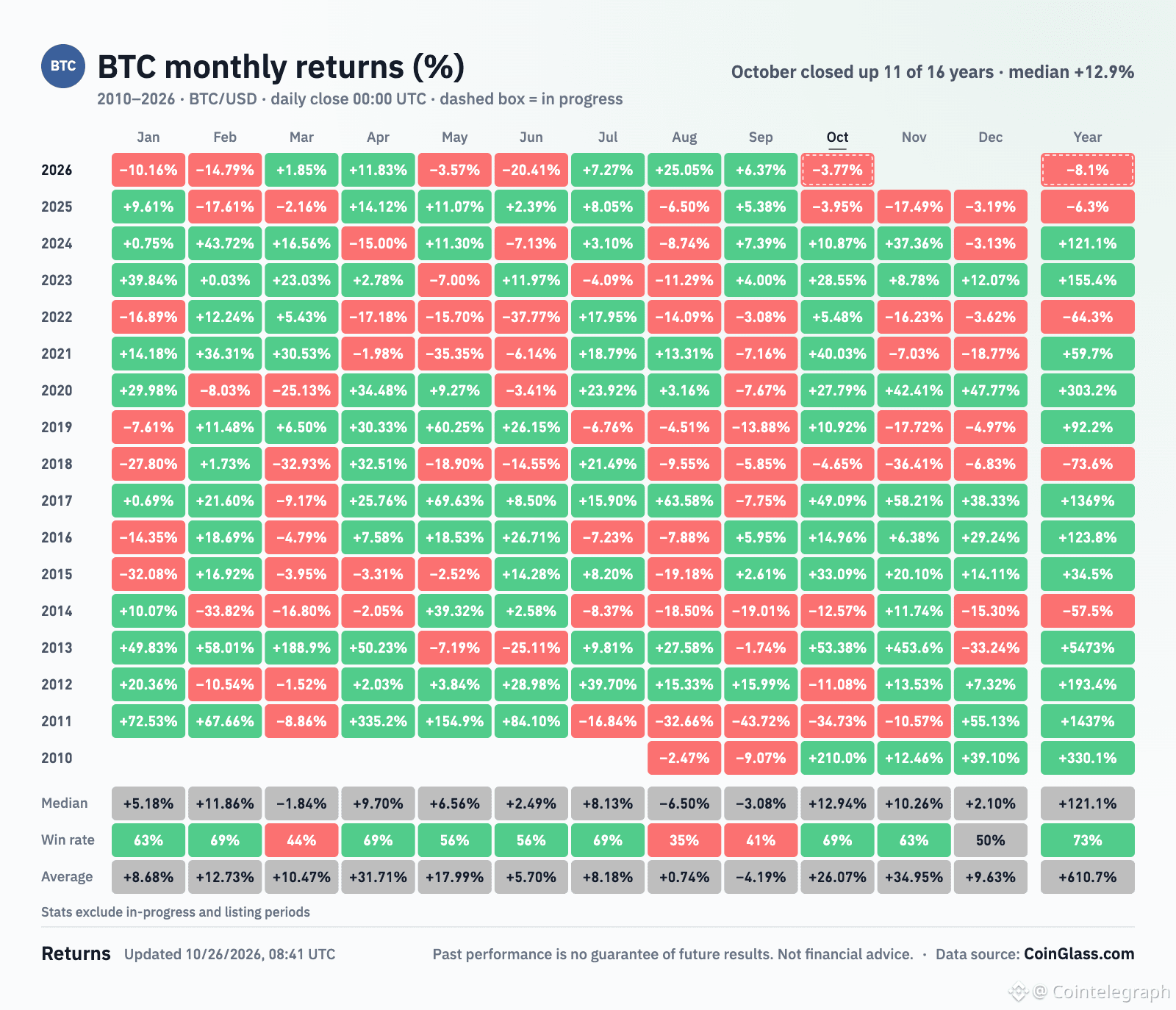
Data from CoinGlass shows that despite average October upside for BTC/USD totaling 26.1% since 2010, earning the nickname ‘Uptober’, both this year and last have bucked the trend. After falling 3.9% in October 2025, Bitcoin went on to lose another 17.5% in November, once more going against historical patterns that have seen average November returns of 35%.
BTC/USD monthly returns. Source: CoinGlass
Almost $150 million of long positions were liquidated over two hours on Saturday as Bitcoin fell to $79,145. The $80,000 level failed to offer support on lower time frames despite its status as a psychological boundary. CoinGlass shows a $73 million wall of bids keeping price above $79,300, with asks centered around $81,000.
BTC liquidation heatmap. Source: CoinGlass
Market participants are increasingly cautious about a rebound under current macro conditions. Benjamin Cowen, founder of crypto analytics platform Into the Cryptoverse, described Bitcoin’s trips to $87,000 in late September and early October as a “fakeout.”
BTC/USD should continue to see weakness through the end of the year, he told X followers on Monday, citing historical precedent and calling for downside pressure around US midterm election years.
As Cointelegraph reported, the resistance zone around $87,000 contains important price points: the 2026 yearly open at $87,490 and 20-month moving average at $87,165.
BTC price risks $80K loss into FOMC, earnings: Three things to know in Bitcoin this week
Bitcoin (BTC) begins the last week of October fighting to hold $80,000 support ahead of a busy week of US macro data and earnings reports.
Key points:
Markets see the Fed holding interest rates in their current 3.75-4% range at its meeting on Wednesday as Brent crude cools to $110 per barrel.
South Korea’s KOSPI Composite Index resumes downside ahead of a major round of US corporate earnings results.
Bitcoin is on track to end October down 4%, copying 2025 performance, as $80,000 support appears weak.
Markets see Fed rate-hike pause with oil still above $100
The US Federal Reserve is in focus for macro analysts this week as it will decide the next move on the federal funds rate on Wednesday. Markets will be watching the rate decision by the Federal Open Market Committee (FOMC), as well as language used by Fed chair Kevin Warsh at the accompanying press conference.
Markets have little doubt over what officials will decide, seeing over 90% odds that rates will stay in their current 3.75-4% range. FedWatch data shows consensus favoring a 0.25% hike at the December FOMC meeting.
Fed target-rate probabilities (screenshot). Source: CME Group
Commenting, economist Robin Brooks argued that such expectations were a gift to Warsh, who would not need to fight external demands to change course.
“After very contentious Fed meetings earlier in 2026, this week’s meeting gets zero interest in markets, which price only 12% odds of a hike. That’s nothing versus how markets tried to push Warsh into hiking back in July. A temporary reprieve for Warsh,” he summarized.
In separate analysis last week, Brooks saw a rate pause as all but inevitable, even amid rising oil prices and growing concerns over military escalation in the Middle East. Brent crude reached $117 per barrel on Friday, its highest level since March 19, before dropping to around $110 on Monday. Even a rise to $125, however, would not force the Fed to change course, he continued.
“The debt crisis in France would escalate sharply, anxiety around all the AI and data center debt would increase and the S&P 500 would tumble. That just isn’t a setting where the Fed is itching to hike,” Brooks wrote.
“If anything, financial conditions would be tightening sharply, so the last thing you’d want to do is hike.”
CFDs on Brent crude oil one-day chart. Source: Cointelegraph/TradingView
On Thursday, new US macro data will be released in the form of the Personal Consumption Expenditures (PCE) index, known as the Fed’s “preferred” inflation gauge. Last month, PCE came in lower than expected at 3.4% year-on-year, but analysts explained that the drop was a result of changes to the way certain index elements are calculated.
KOSPI struggles as markets prepare for US tech earnings
Nerves about prospects for the AI sector continued to pressure equities on Monday ahead of the week’s first Wall Street open.
After attempting to recoup some of its losses late last week, South Korea’s KOSPI Composite Index closed down 1.5% on Monday at 5,469 points. On Friday, the tech-heavy index fell as low as 5,308 points — a level not seen since late July.
KOSPI Composite Index one-day chart. Source: Cointelegraph/TradingView
The low came as a result of significant tech-stock selling as foreign capital sought safety. Last week, stronger-than-expected US earnings reports ultimately failed to lift the mood, with attention instead drawn to Tesla’s reduced Q3 capital expenditure. The Nasdaq Composite Index closed at 25,955 points on Friday, its lowest daily close since Aug. 3.
Nasdaq Composite Index one-day chart. Source: Cointelegraph/TradingView
Speaking to CNBC on Monday, JPMorgan Asset Management’s Raisah Rasid was unfazed by the state of the AI trade.
“It’s really about investors thinking, ‘Look, we’re not rewarding capex anymore; what we are rewarding is return on capital. I think that’s what’s happening with AI,’” she said.
Further Q3 earnings are due out this week, with Microsoft and Alphabet both reporting after the market close on Wednesday, while Amazon and Intel follow on Thursday. In total, around 20% of S&P 500 companies will report during the week, while Thursday also sees the release of US Q3 GDP numbers.
Bitcoin “Uptober” sentiment meets 4% month-to-date losses
Bitcoin is on track to end October down 4% if the monthly candle closes near current levels around $80,000.
BTC/USD one-day chart. Source: Cointelegraph/TradingView
Data from CoinGlass shows that despite average October upside for BTC/USD totaling 26.1% since 2010, earning the nickname ‘Uptober’, both this year and last have bucked the trend. After falling 3.9% in October 2025, Bitcoin went on to lose another 17.5% in November, once more going against historical patterns that have seen average November returns of 35%.
BTC/USD monthly returns. Source: CoinGlass
Almost $150 million of long positions were liquidated over two hours on Saturday as Bitcoin fell to $79,145. The $80,000 level failed to offer support on lower time frames despite its status as a psychological boundary. CoinGlass shows a $73 million wall of bids keeping price above $79,300, with asks centered around $81,000.
BTC liquidation heatmap. Source: CoinGlass
Market participants are increasingly cautious about a rebound under current macro conditions. Benjamin Cowen, founder of crypto analytics platform Into the Cryptoverse, described Bitcoin’s trips to $87,000 in late September and early October as a “fakeout.”
BTC/USD should continue to see weakness through the end of the year, he told X followers on Monday, citing historical precedent and calling for downside pressure around US midterm election years.
As Cointelegraph reported, the resistance zone around $87,000 contains important price points: the 2026 yearly open at $87,490 and 20-month moving average at $87,165.
Key points:
Markets see the Fed holding interest rates in their current 3.75-4% range at its meeting on Wednesday as Brent crude cools to $110 per barrel.
South Korea’s KOSPI Composite Index resumes downside ahead of a major round of US corporate earnings results.
Bitcoin is on track to end October down 4%, copying 2025 performance, as $80,000 support appears weak.
Markets see Fed rate-hike pause with oil still above $100
The US Federal Reserve is in focus for macro analysts this week as it will decide the next move on the federal funds rate on Wednesday. Markets will be watching the rate decision by the Federal Open Market Committee (FOMC), as well as language used by Fed chair Kevin Warsh at the accompanying press conference.
Markets have little doubt over what officials will decide, seeing over 90% odds that rates will stay in their current 3.75-4% range. FedWatch data shows consensus favoring a 0.25% hike at the December FOMC meeting.
Fed target-rate probabilities (screenshot). Source: CME Group
Commenting, economist Robin Brooks argued that such expectations were a gift to Warsh, who would not need to fight external demands to change course.
“After very contentious Fed meetings earlier in 2026, this week’s meeting gets zero interest in markets, which price only 12% odds of a hike. That’s nothing versus how markets tried to push Warsh into hiking back in July. A temporary reprieve for Warsh,” he summarized.
In separate analysis last week, Brooks saw a rate pause as all but inevitable, even amid rising oil prices and growing concerns over military escalation in the Middle East. Brent crude reached $117 per barrel on Friday, its highest level since March 19, before dropping to around $110 on Monday. Even a rise to $125, however, would not force the Fed to change course, he continued.
“The debt crisis in France would escalate sharply, anxiety around all the AI and data center debt would increase and the S&P 500 would tumble. That just isn’t a setting where the Fed is itching to hike,” Brooks wrote.
“If anything, financial conditions would be tightening sharply, so the last thing you’d want to do is hike.”
CFDs on Brent crude oil one-day chart. Source: Cointelegraph/TradingView
On Thursday, new US macro data will be released in the form of the Personal Consumption Expenditures (PCE) index, known as the Fed’s “preferred” inflation gauge. Last month, PCE came in lower than expected at 3.4% year-on-year, but analysts explained that the drop was a result of changes to the way certain index elements are calculated.
KOSPI struggles as markets prepare for US tech earnings
Nerves about prospects for the AI sector continued to pressure equities on Monday ahead of the week’s first Wall Street open.
After attempting to recoup some of its losses late last week, South Korea’s KOSPI Composite Index closed down 1.5% on Monday at 5,469 points. On Friday, the tech-heavy index fell as low as 5,308 points — a level not seen since late July.
KOSPI Composite Index one-day chart. Source: Cointelegraph/TradingView
The low came as a result of significant tech-stock selling as foreign capital sought safety. Last week, stronger-than-expected US earnings reports ultimately failed to lift the mood, with attention instead drawn to Tesla’s reduced Q3 capital expenditure. The Nasdaq Composite Index closed at 25,955 points on Friday, its lowest daily close since Aug. 3.
Nasdaq Composite Index one-day chart. Source: Cointelegraph/TradingView
Speaking to CNBC on Monday, JPMorgan Asset Management’s Raisah Rasid was unfazed by the state of the AI trade.
“It’s really about investors thinking, ‘Look, we’re not rewarding capex anymore; what we are rewarding is return on capital. I think that’s what’s happening with AI,’” she said.
Further Q3 earnings are due out this week, with Microsoft and Alphabet both reporting after the market close on Wednesday, while Amazon and Intel follow on Thursday. In total, around 20% of S&P 500 companies will report during the week, while Thursday also sees the release of US Q3 GDP numbers.
Bitcoin “Uptober” sentiment meets 4% month-to-date losses
Bitcoin is on track to end October down 4% if the monthly candle closes near current levels around $80,000.
BTC/USD one-day chart. Source: Cointelegraph/TradingView
Data from CoinGlass shows that despite average October upside for BTC/USD totaling 26.1% since 2010, earning the nickname ‘Uptober’, both this year and last have bucked the trend. After falling 3.9% in October 2025, Bitcoin went on to lose another 17.5% in November, once more going against historical patterns that have seen average November returns of 35%.
BTC/USD monthly returns. Source: CoinGlass
Almost $150 million of long positions were liquidated over two hours on Saturday as Bitcoin fell to $79,145. The $80,000 level failed to offer support on lower time frames despite its status as a psychological boundary. CoinGlass shows a $73 million wall of bids keeping price above $79,300, with asks centered around $81,000.
BTC liquidation heatmap. Source: CoinGlass
Market participants are increasingly cautious about a rebound under current macro conditions. Benjamin Cowen, founder of crypto analytics platform Into the Cryptoverse, described Bitcoin’s trips to $87,000 in late September and early October as a “fakeout.”
BTC/USD should continue to see weakness through the end of the year, he told X followers on Monday, citing historical precedent and calling for downside pressure around US midterm election years.
As Cointelegraph reported, the resistance zone around $87,000 contains important price points: the 2026 yearly open at $87,490 and 20-month moving average at $87,165.
105
Securitize’s tokenized stock value halves as Circle widens leadThe value of tokenized shares of Securitize (SECZ) have lost more than half their value in less than a month as the gap with market leader Circle (CRCL) widens.
The market capitalization of SECZ tokens fell from a high of $430.4 million on Sept. 28 to $208.6 million by Sunday, according to Token Terminal. The NYSE-traded shares closed Friday down 2.1% at $7.80 apiece, with a market cap of $1.27 billion.
Tokens tracking Circle’s shares have gained about 20% in market value since Sept. 28 to reach $383.6 million, reclaiming the top spot in the $3.3 billion tokenized stock market.
The decline in tokenized SECZ coincided with a sell-off in Securitize’s underlying shares on the NYSE, which erased gains that followed the Oct. 8 launch of its stock trading platform on Solana. Citi downgraded SECZ from Buy to Neutral on Oct. 13 amid concerns about tokenization revenue.
Securitize helps asset managers including BlackRock issue securities on blockchains. The company brought its own common shares onchain alongside its July 2 NYSE listing, becoming the largest tokenized equity at the time.
SECZ remains the largest individual tokenized stock as Circle’s total is spread across products from several issuers. Binance’s CRCLb on BNB Chain leads those offerings at $154.1 million.
Securitize’s tokenized stock value halves as Circle widens lead
The value of tokenized shares of Securitize (SECZ) have lost more than half their value in less than a month as the gap with market leader Circle (CRCL) widens.
The market capitalization of SECZ tokens fell from a high of $430.4 million on Sept. 28 to $208.6 million by Sunday, according to Token Terminal. The NYSE-traded shares closed Friday down 2.1% at $7.80 apiece, with a market cap of $1.27 billion.
Tokens tracking Circle’s shares have gained about 20% in market value since Sept. 28 to reach $383.6 million, reclaiming the top spot in the $3.3 billion tokenized stock market.
The decline in tokenized SECZ coincided with a sell-off in Securitize’s underlying shares on the NYSE, which erased gains that followed the Oct. 8 launch of its stock trading platform on Solana. Citi downgraded SECZ from Buy to Neutral on Oct. 13 amid concerns about tokenization revenue.
Securitize helps asset managers including BlackRock issue securities on blockchains. The company brought its own common shares onchain alongside its July 2 NYSE listing, becoming the largest tokenized equity at the time.
SECZ remains the largest individual tokenized stock as Circle’s total is spread across products from several issuers. Binance’s CRCLb on BNB Chain leads those offerings at $154.1 million.
The market capitalization of SECZ tokens fell from a high of $430.4 million on Sept. 28 to $208.6 million by Sunday, according to Token Terminal. The NYSE-traded shares closed Friday down 2.1% at $7.80 apiece, with a market cap of $1.27 billion.
Tokens tracking Circle’s shares have gained about 20% in market value since Sept. 28 to reach $383.6 million, reclaiming the top spot in the $3.3 billion tokenized stock market.
The decline in tokenized SECZ coincided with a sell-off in Securitize’s underlying shares on the NYSE, which erased gains that followed the Oct. 8 launch of its stock trading platform on Solana. Citi downgraded SECZ from Buy to Neutral on Oct. 13 amid concerns about tokenization revenue.
Securitize helps asset managers including BlackRock issue securities on blockchains. The company brought its own common shares onchain alongside its July 2 NYSE listing, becoming the largest tokenized equity at the time.
SECZ remains the largest individual tokenized stock as Circle’s total is spread across products from several issuers. Binance’s CRCLb on BNB Chain leads those offerings at $154.1 million.
38
Bitcoin ETFs break 2-week outflow streak with $301M comebackUS-listed spot Bitcoin exchange-traded funds (ETFs) attracted around $301 million in net inflows last week, snapping a two-week outflow streak despite heavy withdrawals late in the week.
The funds lost about $228 million the previous week and $680 million the week before. October’s net outflows stood at about $314 million, according to Farside Investors data.
Bitcoin ETFs drew $1.08 billion between Monday and Wednesday as Bitcoin (BTC) climbed to a weekly high of $84,777 on Wednesday, according to CoinGecko. Investors then withdrew about $774 million on Thursday and Friday as BTC retreated toward $80,000.
ETF investors have tended to sell into Bitcoin declines, according to research published Thursday by market maker DWF Labs. The company found net outflows during seven of eight Bitcoin sell-offs of at least 15% since US spot Bitcoin ETFs launched in January 2024.
“ETF investors aren’t the dip buyers people think they are,” DWF said.
At the time of publication, Bitcoin traded at $80,025, down around 3.3% over the past seven days. The Crypto Fear & Greed Index fell to a “Neutral” reading of 50, down from “Greed” at 59 a week earlier.
US spot Ether ETFs recorded a fourth consecutive week of net outflows, shedding about $221 million last week, according to Farside Investors data.
Bitcoin ETFs break 2-week outflow streak with $301M comeback
US-listed spot Bitcoin exchange-traded funds (ETFs) attracted around $301 million in net inflows last week, snapping a two-week outflow streak despite heavy withdrawals late in the week.
The funds lost about $228 million the previous week and $680 million the week before. October’s net outflows stood at about $314 million, according to Farside Investors data.
Bitcoin ETFs drew $1.08 billion between Monday and Wednesday as Bitcoin (BTC) climbed to a weekly high of $84,777 on Wednesday, according to CoinGecko. Investors then withdrew about $774 million on Thursday and Friday as BTC retreated toward $80,000.
ETF investors have tended to sell into Bitcoin declines, according to research published Thursday by market maker DWF Labs. The company found net outflows during seven of eight Bitcoin sell-offs of at least 15% since US spot Bitcoin ETFs launched in January 2024.
“ETF investors aren’t the dip buyers people think they are,” DWF said.
At the time of publication, Bitcoin traded at $80,025, down around 3.3% over the past seven days. The Crypto Fear & Greed Index fell to a “Neutral” reading of 50, down from “Greed” at 59 a week earlier.
US spot Ether ETFs recorded a fourth consecutive week of net outflows, shedding about $221 million last week, according to Farside Investors data.
The funds lost about $228 million the previous week and $680 million the week before. October’s net outflows stood at about $314 million, according to Farside Investors data.
Bitcoin ETFs drew $1.08 billion between Monday and Wednesday as Bitcoin (BTC) climbed to a weekly high of $84,777 on Wednesday, according to CoinGecko. Investors then withdrew about $774 million on Thursday and Friday as BTC retreated toward $80,000.
ETF investors have tended to sell into Bitcoin declines, according to research published Thursday by market maker DWF Labs. The company found net outflows during seven of eight Bitcoin sell-offs of at least 15% since US spot Bitcoin ETFs launched in January 2024.
“ETF investors aren’t the dip buyers people think they are,” DWF said.
At the time of publication, Bitcoin traded at $80,025, down around 3.3% over the past seven days. The Crypto Fear & Greed Index fell to a “Neutral” reading of 50, down from “Greed” at 59 a week earlier.
US spot Ether ETFs recorded a fourth consecutive week of net outflows, shedding about $221 million last week, according to Farside Investors data.
151
Musk warns over 200 AI neoclouds face ‘guppy-level death’Elon Musk warns that over 200 specialist AI cloud providers could fail or consolidate as lenders tighten up their purse strings.
Musk said Sunday on X that lenders had largely stopped providing financing to companies without substantial revenue streams outside AI data centers. He said SpaceX had secured $40 billion in debt financing for GPUs because of its investment-grade status and revenue from its Starlink satellite internet and rocket businesses.
“That means the 200+ neoclouds are going to see guppy-level death and consolidation. Some will make it through, but not many,” he said.
A neocloud is a specialist cloud company that rents out computing power for AI, usually through data centers packed with powerful GPUs.
Musk’s warning follows an October forecast from research firm Gartner that more than 80% of neocloud providers will cease operating independently by 2030, as the industry struggles to generate sufficient returns on massive AI infrastructure investments.
The warnings could also have implications for Bitcoin miners that have pivoted into AI infrastructure. For example, IREN has expanded into AI cloud services, renting computing power to customers, while Core Scientific provides data center hosting for neocloud customers such as CoreWeave.
In its forecast, Gartner said AI providers are expected to spend nearly $1 trillion on infrastructure in 2026 and another $6 trillion between 2027 and 2030, but said there is insufficient revenue to deliver profitable returns on all those investments.
The pressure could be particularly acute for neoclouds, which must earn enough from AI computing services to sustain their operations. Larger cloud companies have more diversified revenue streams that could support AI investment for years, Gartner said.
Even strong market growth may not be enough. Gartner forecasts spending on AI-optimized infrastructure-as-a-service will rise from $66 billion in 2027 to $174 billion in 2030, but said most providers could struggle to recover their investment before the current generation of AI chips is replaced.
SpaceX sees sharp jump in AI revenue
Musk’s comments came days after SpaceX reported that its “Super Intelligence” business generated $7.6 billion in third-quarter revenue, up 830% from a year earlier and accounting for more than half of the company’s $14.6 billion in quarterly sales.
The company attributed the growth to new cloud services agreements, its acquisition of Cursor and increased adoption of its Grok AI model.
Magazine: AI agents help rescue ETH’s Glamsterdam fork, ‘Steal My Bitcoin’ site: Hodler’s Digest
Musk warns over 200 AI neoclouds face ‘guppy-level death’
Elon Musk warns that over 200 specialist AI cloud providers could fail or consolidate as lenders tighten up their purse strings.
Musk said Sunday on X that lenders had largely stopped providing financing to companies without substantial revenue streams outside AI data centers. He said SpaceX had secured $40 billion in debt financing for GPUs because of its investment-grade status and revenue from its Starlink satellite internet and rocket businesses.
“That means the 200+ neoclouds are going to see guppy-level death and consolidation. Some will make it through, but not many,” he said.
A neocloud is a specialist cloud company that rents out computing power for AI, usually through data centers packed with powerful GPUs.
Musk’s warning follows an October forecast from research firm Gartner that more than 80% of neocloud providers will cease operating independently by 2030, as the industry struggles to generate sufficient returns on massive AI infrastructure investments.
The warnings could also have implications for Bitcoin miners that have pivoted into AI infrastructure. For example, IREN has expanded into AI cloud services, renting computing power to customers, while Core Scientific provides data center hosting for neocloud customers such as CoreWeave.
In its forecast, Gartner said AI providers are expected to spend nearly $1 trillion on infrastructure in 2026 and another $6 trillion between 2027 and 2030, but said there is insufficient revenue to deliver profitable returns on all those investments.
The pressure could be particularly acute for neoclouds, which must earn enough from AI computing services to sustain their operations. Larger cloud companies have more diversified revenue streams that could support AI investment for years, Gartner said.
Even strong market growth may not be enough. Gartner forecasts spending on AI-optimized infrastructure-as-a-service will rise from $66 billion in 2027 to $174 billion in 2030, but said most providers could struggle to recover their investment before the current generation of AI chips is replaced.
SpaceX sees sharp jump in AI revenue
Musk’s comments came days after SpaceX reported that its “Super Intelligence” business generated $7.6 billion in third-quarter revenue, up 830% from a year earlier and accounting for more than half of the company’s $14.6 billion in quarterly sales.
The company attributed the growth to new cloud services agreements, its acquisition of Cursor and increased adoption of its Grok AI model.
Magazine: AI agents help rescue ETH’s Glamsterdam fork, ‘Steal My Bitcoin’ site: Hodler’s Digest
Musk said Sunday on X that lenders had largely stopped providing financing to companies without substantial revenue streams outside AI data centers. He said SpaceX had secured $40 billion in debt financing for GPUs because of its investment-grade status and revenue from its Starlink satellite internet and rocket businesses.
“That means the 200+ neoclouds are going to see guppy-level death and consolidation. Some will make it through, but not many,” he said.
A neocloud is a specialist cloud company that rents out computing power for AI, usually through data centers packed with powerful GPUs.
Musk’s warning follows an October forecast from research firm Gartner that more than 80% of neocloud providers will cease operating independently by 2030, as the industry struggles to generate sufficient returns on massive AI infrastructure investments.
The warnings could also have implications for Bitcoin miners that have pivoted into AI infrastructure. For example, IREN has expanded into AI cloud services, renting computing power to customers, while Core Scientific provides data center hosting for neocloud customers such as CoreWeave.
In its forecast, Gartner said AI providers are expected to spend nearly $1 trillion on infrastructure in 2026 and another $6 trillion between 2027 and 2030, but said there is insufficient revenue to deliver profitable returns on all those investments.
The pressure could be particularly acute for neoclouds, which must earn enough from AI computing services to sustain their operations. Larger cloud companies have more diversified revenue streams that could support AI investment for years, Gartner said.
Even strong market growth may not be enough. Gartner forecasts spending on AI-optimized infrastructure-as-a-service will rise from $66 billion in 2027 to $174 billion in 2030, but said most providers could struggle to recover their investment before the current generation of AI chips is replaced.
SpaceX sees sharp jump in AI revenue
Musk’s comments came days after SpaceX reported that its “Super Intelligence” business generated $7.6 billion in third-quarter revenue, up 830% from a year earlier and accounting for more than half of the company’s $14.6 billion in quarterly sales.
The company attributed the growth to new cloud services agreements, its acquisition of Cursor and increased adoption of its Grok AI model.
Magazine: AI agents help rescue ETH’s Glamsterdam fork, ‘Steal My Bitcoin’ site: Hodler’s Digest
150
Hong Kong names Nasdaq-listed Solana Company a strategic enterpriseHong Kong has named Nasdaq-listed Solana Company (HSDT) a strategic enterprise under a government program aimed at attracting businesses that support the city’s economic development.
Solana Company said Thursday that it was among the seventh batch of businesses selected by Hong Kong’s Office for Attracting Strategic Enterprises (OASES) and the only blockchain infrastructure company onboarded by the office in 2026.
Hong Kong’s government confirmed the addition of 18 enterprises to the program last week, bringing its total to 142.
A Solana Company spokesperson told Cointelegraph that the designation gives it a single point of contact across government agencies and regulators, expedited pathways for recruiting overseas talent and introductions to local institutional partners.
Solana Company operates staking and validator infrastructure and advises financial institutions on blockchain adoption. It also holds Solana (SOL) as part of its digital asset treasury strategy.
The company said it plans to establish validator operations in Hong Kong under Pacific Backbone, an initiative to build a low-latency blockchain infrastructure network across the Asia-Pacific region.
Hong Kong names Nasdaq-listed Solana Company a strategic enterprise
Hong Kong has named Nasdaq-listed Solana Company (HSDT) a strategic enterprise under a government program aimed at attracting businesses that support the city’s economic development.
Solana Company said Thursday that it was among the seventh batch of businesses selected by Hong Kong’s Office for Attracting Strategic Enterprises (OASES) and the only blockchain infrastructure company onboarded by the office in 2026.
Hong Kong’s government confirmed the addition of 18 enterprises to the program last week, bringing its total to 142.
A Solana Company spokesperson told Cointelegraph that the designation gives it a single point of contact across government agencies and regulators, expedited pathways for recruiting overseas talent and introductions to local institutional partners.
Solana Company operates staking and validator infrastructure and advises financial institutions on blockchain adoption. It also holds Solana (SOL) as part of its digital asset treasury strategy.
The company said it plans to establish validator operations in Hong Kong under Pacific Backbone, an initiative to build a low-latency blockchain infrastructure network across the Asia-Pacific region.
Solana Company said Thursday that it was among the seventh batch of businesses selected by Hong Kong’s Office for Attracting Strategic Enterprises (OASES) and the only blockchain infrastructure company onboarded by the office in 2026.
Hong Kong’s government confirmed the addition of 18 enterprises to the program last week, bringing its total to 142.
A Solana Company spokesperson told Cointelegraph that the designation gives it a single point of contact across government agencies and regulators, expedited pathways for recruiting overseas talent and introductions to local institutional partners.
Solana Company operates staking and validator infrastructure and advises financial institutions on blockchain adoption. It also holds Solana (SOL) as part of its digital asset treasury strategy.
The company said it plans to establish validator operations in Hong Kong under Pacific Backbone, an initiative to build a low-latency blockchain infrastructure network across the Asia-Pacific region.
316
Keystone says website breach exposed hardware wallet buyers’ addressesCrypto hardware wallet maker Keystone has disclosed a website security breach that exposed customer information to attackers, raising concerns about targeted scams and physical attacks.
Keystone said Saturday that it detected suspicious activity earlier in the week and confirmed Friday, after reviewing API activity with Shopify, that an unauthorized third party had accessed customer shipping information. This included names, contact details, shipping addresses and other order details, such as items bought.
“We’ve blocked access, fixed the vulnerability, opened an investigation, and are emailing affected customers,” said the company.
Keystone warned that the exposed information could be used for targeted phishing attacks. However, security researcher Taylor Monahan also raised concerns that leaking shipping addresses could expose customers to physical attacks and kidnappings.
Blockchain security firm CertiK recorded 52 verified wrench attacks worldwide in the first half of 2026, up 33% from 39 during the same period last year. Such crimes, commonly called “wrench attacks,” involve using physical threats or violence to force cryptocurrency holders to surrender their assets.
“Again, we’re truly sorry to everyone affected,” Keystone said. The company did not disclose how many customers were impacted.
Keystone questioned over promise to delete customer data
The breach has also raised questions about Keystone’s handling of older customer information.
In a 2023 blog post, Keystone said it had reduced its customer data retention period to 180 days following security incidents affecting other hardware wallet manufacturers.
However, some customers said they received breach notifications despite purchasing their devices more than two years ago, raising questions about what information Keystone retained and whether the notifications indicate that older order records were not deleted as promised.
An X user going by “OG DEGEN” said they received a call from a scammer claiming they were law enforcement investigating a fraud case. The user suspected the caller obtained their information through a Keystone order placed in 2024, based on the personal information the caller referred to.
“I think their plan was to convince me that my private keys had been exposed and then send me a phishing link to supposedly reset them,” they wrote on X.
Another X user, trintaetres, also said they received the email notification despite buying the device over two years ago.
Cointelegraph contacted Keystone to ask how customer information from purchases made more than 180 days earlier could have been exposed despite its previously announced retention policy, and how many customers were affected. The company did not respond by publication time.
Magazine: AI agents help rescue ETH’s Glamsterdam fork, ‘Steal My Bitcoin’ site: Hodler’s Digest
Keystone says website breach exposed hardware wallet buyers’ addresses
Crypto hardware wallet maker Keystone has disclosed a website security breach that exposed customer information to attackers, raising concerns about targeted scams and physical attacks.
Keystone said Saturday that it detected suspicious activity earlier in the week and confirmed Friday, after reviewing API activity with Shopify, that an unauthorized third party had accessed customer shipping information. This included names, contact details, shipping addresses and other order details, such as items bought.
“We’ve blocked access, fixed the vulnerability, opened an investigation, and are emailing affected customers,” said the company.
Keystone warned that the exposed information could be used for targeted phishing attacks. However, security researcher Taylor Monahan also raised concerns that leaking shipping addresses could expose customers to physical attacks and kidnappings.
Blockchain security firm CertiK recorded 52 verified wrench attacks worldwide in the first half of 2026, up 33% from 39 during the same period last year. Such crimes, commonly called “wrench attacks,” involve using physical threats or violence to force cryptocurrency holders to surrender their assets.
“Again, we’re truly sorry to everyone affected,” Keystone said. The company did not disclose how many customers were impacted.
Keystone questioned over promise to delete customer data
The breach has also raised questions about Keystone’s handling of older customer information.
In a 2023 blog post, Keystone said it had reduced its customer data retention period to 180 days following security incidents affecting other hardware wallet manufacturers.
However, some customers said they received breach notifications despite purchasing their devices more than two years ago, raising questions about what information Keystone retained and whether the notifications indicate that older order records were not deleted as promised.
An X user going by “OG DEGEN” said they received a call from a scammer claiming they were law enforcement investigating a fraud case. The user suspected the caller obtained their information through a Keystone order placed in 2024, based on the personal information the caller referred to.
“I think their plan was to convince me that my private keys had been exposed and then send me a phishing link to supposedly reset them,” they wrote on X.
Another X user, trintaetres, also said they received the email notification despite buying the device over two years ago.
Cointelegraph contacted Keystone to ask how customer information from purchases made more than 180 days earlier could have been exposed despite its previously announced retention policy, and how many customers were affected. The company did not respond by publication time.
Magazine: AI agents help rescue ETH’s Glamsterdam fork, ‘Steal My Bitcoin’ site: Hodler’s Digest
Keystone said Saturday that it detected suspicious activity earlier in the week and confirmed Friday, after reviewing API activity with Shopify, that an unauthorized third party had accessed customer shipping information. This included names, contact details, shipping addresses and other order details, such as items bought.
“We’ve blocked access, fixed the vulnerability, opened an investigation, and are emailing affected customers,” said the company.
Keystone warned that the exposed information could be used for targeted phishing attacks. However, security researcher Taylor Monahan also raised concerns that leaking shipping addresses could expose customers to physical attacks and kidnappings.
Blockchain security firm CertiK recorded 52 verified wrench attacks worldwide in the first half of 2026, up 33% from 39 during the same period last year. Such crimes, commonly called “wrench attacks,” involve using physical threats or violence to force cryptocurrency holders to surrender their assets.
“Again, we’re truly sorry to everyone affected,” Keystone said. The company did not disclose how many customers were impacted.
Keystone questioned over promise to delete customer data
The breach has also raised questions about Keystone’s handling of older customer information.
In a 2023 blog post, Keystone said it had reduced its customer data retention period to 180 days following security incidents affecting other hardware wallet manufacturers.
However, some customers said they received breach notifications despite purchasing their devices more than two years ago, raising questions about what information Keystone retained and whether the notifications indicate that older order records were not deleted as promised.
An X user going by “OG DEGEN” said they received a call from a scammer claiming they were law enforcement investigating a fraud case. The user suspected the caller obtained their information through a Keystone order placed in 2024, based on the personal information the caller referred to.
“I think their plan was to convince me that my private keys had been exposed and then send me a phishing link to supposedly reset them,” they wrote on X.
Another X user, trintaetres, also said they received the email notification despite buying the device over two years ago.
Cointelegraph contacted Keystone to ask how customer information from purchases made more than 180 days earlier could have been exposed despite its previously announced retention policy, and how many customers were affected. The company did not respond by publication time.
Magazine: AI agents help rescue ETH’s Glamsterdam fork, ‘Steal My Bitcoin’ site: Hodler’s Digest
293
Standard Chartered-led Anchorpoint says it’s not rushing retail stablecoinStandard Chartered-backed stablecoin venture Anchorpoint says it will take a cautious approach to opening its Hong Kong dollar-backed stablecoin to retail users, declining to confirm a launch date after rival HSBC rolled out RedCoin, according to the South China Morning Post.
The venture released its institutional stablecoin product in August and previously indicated a retail offering could arrive as early as the end of 2026.
Anchorpoint CEO Dominic Maffei declined to confirm that timeline at a Friday press conference, saying the company would take a prudent approach.
“We believe it’s important to build the market out in a long-term, sustainable manner,” Maffei said, adding that rushing a launch “does not make sense.”
The update comes after HSBC launched its Hong Kong dollar-backed RedCoin on Friday for the 3.3 million users of its PayMe app.
Anchorpoint grew out of a partnership between Standard Chartered, Animoca Brands and telecommunications provider HKT, which was announced in February 2025, following their joint participation in Hong Kong’s stablecoin issuer sandbox in July 2024.
Animoca’s role is to bring its blockchain expertise and industry network to the venture and help develop uses for the stablecoin across the Web3 ecosystem.
Standard Chartered-led Anchorpoint says it’s not rushing retail stablecoin
Standard Chartered-backed stablecoin venture Anchorpoint says it will take a cautious approach to opening its Hong Kong dollar-backed stablecoin to retail users, declining to confirm a launch date after rival HSBC rolled out RedCoin, according to the South China Morning Post.
The venture released its institutional stablecoin product in August and previously indicated a retail offering could arrive as early as the end of 2026.
Anchorpoint CEO Dominic Maffei declined to confirm that timeline at a Friday press conference, saying the company would take a prudent approach.
“We believe it’s important to build the market out in a long-term, sustainable manner,” Maffei said, adding that rushing a launch “does not make sense.”
The update comes after HSBC launched its Hong Kong dollar-backed RedCoin on Friday for the 3.3 million users of its PayMe app.
Anchorpoint grew out of a partnership between Standard Chartered, Animoca Brands and telecommunications provider HKT, which was announced in February 2025, following their joint participation in Hong Kong’s stablecoin issuer sandbox in July 2024.
Animoca’s role is to bring its blockchain expertise and industry network to the venture and help develop uses for the stablecoin across the Web3 ecosystem.
The venture released its institutional stablecoin product in August and previously indicated a retail offering could arrive as early as the end of 2026.
Anchorpoint CEO Dominic Maffei declined to confirm that timeline at a Friday press conference, saying the company would take a prudent approach.
“We believe it’s important to build the market out in a long-term, sustainable manner,” Maffei said, adding that rushing a launch “does not make sense.”
The update comes after HSBC launched its Hong Kong dollar-backed RedCoin on Friday for the 3.3 million users of its PayMe app.
Anchorpoint grew out of a partnership between Standard Chartered, Animoca Brands and telecommunications provider HKT, which was announced in February 2025, following their joint participation in Hong Kong’s stablecoin issuer sandbox in July 2024.
Animoca’s role is to bring its blockchain expertise and industry network to the venture and help develop uses for the stablecoin across the Web3 ecosystem.
1
395
ECB official sees digital euro as key to protecting EU ‘sovereignty’European Central Bank Executive Board member Piero Cipollone said the digital euro that is set for a pilot next year has the potential to give the bloc “sovereignty” over a payments infrastructure that currently requires dependency on external, non-European third parties.
Cipollone said in an interview with Italy’s Milano Finance published by the central bank on Saturday that because the bloc is critically dependent on third parties, it’s not easy to ensure this smooth functioning. He did not cite specific third parties.
“In recent years Europe has learned that, for some essential services, we cannot rely only on third parties. We saw this with energy and we’re seeing it today with defense. And the same is true for payments,” he said.
The pilot will use real transactions by ECB and national central bank staff. With 36 market operators, including seven from Italy, collaborating on preparations, the ECB is inviting e-commerce and mobile-commerce operators to participate.
“The smooth functioning of payment systems is one of our responsibilities. If we are critically dependent on third parties, it’s not easy to ensure this smooth functioning,” Cipollone said.
To be sure, sovereignty doesn’t mean shutting third parties out, Cipollone said. “It means having the power to choose and knowing that, for an essential service like payments, Europe can also rely on its own strength.”
In an April public lecture held in Latvia, Cipollone said that Europe’s reliance on non-European payment providers creates a strategic vulnerability. He said two-thirds of euro-area card transactions are governed by non-European companies, and that the digital euro could reduce that dependence and provide European-controlled payment infrastructure.
The ECB Governing Council can only decide on issuing a digital euro only after legislative negotiations in Brussels conclude.
“We hope that the regulation will be adopted by the end of the year, enabling the ECB’s Governing Council to issue a formal decision on issuance,” Cipollone told Milano Finance .
Magazine: New DeepSeek ban in US, Swiss-Asia crypto ties deepen: Asia Express
ECB official sees digital euro as key to protecting EU ‘sovereignty’
European Central Bank Executive Board member Piero Cipollone said the digital euro that is set for a pilot next year has the potential to give the bloc “sovereignty” over a payments infrastructure that currently requires dependency on external, non-European third parties.
Cipollone said in an interview with Italy’s Milano Finance published by the central bank on Saturday that because the bloc is critically dependent on third parties, it’s not easy to ensure this smooth functioning. He did not cite specific third parties.
“In recent years Europe has learned that, for some essential services, we cannot rely only on third parties. We saw this with energy and we’re seeing it today with defense. And the same is true for payments,” he said.
The pilot will use real transactions by ECB and national central bank staff. With 36 market operators, including seven from Italy, collaborating on preparations, the ECB is inviting e-commerce and mobile-commerce operators to participate.
“The smooth functioning of payment systems is one of our responsibilities. If we are critically dependent on third parties, it’s not easy to ensure this smooth functioning,” Cipollone said.
To be sure, sovereignty doesn’t mean shutting third parties out, Cipollone said. “It means having the power to choose and knowing that, for an essential service like payments, Europe can also rely on its own strength.”
In an April public lecture held in Latvia, Cipollone said that Europe’s reliance on non-European payment providers creates a strategic vulnerability. He said two-thirds of euro-area card transactions are governed by non-European companies, and that the digital euro could reduce that dependence and provide European-controlled payment infrastructure.
The ECB Governing Council can only decide on issuing a digital euro only after legislative negotiations in Brussels conclude.
“We hope that the regulation will be adopted by the end of the year, enabling the ECB’s Governing Council to issue a formal decision on issuance,” Cipollone told Milano Finance .
Magazine: New DeepSeek ban in US, Swiss-Asia crypto ties deepen: Asia Express
Cipollone said in an interview with Italy’s Milano Finance published by the central bank on Saturday that because the bloc is critically dependent on third parties, it’s not easy to ensure this smooth functioning. He did not cite specific third parties.
“In recent years Europe has learned that, for some essential services, we cannot rely only on third parties. We saw this with energy and we’re seeing it today with defense. And the same is true for payments,” he said.
The pilot will use real transactions by ECB and national central bank staff. With 36 market operators, including seven from Italy, collaborating on preparations, the ECB is inviting e-commerce and mobile-commerce operators to participate.
“The smooth functioning of payment systems is one of our responsibilities. If we are critically dependent on third parties, it’s not easy to ensure this smooth functioning,” Cipollone said.
To be sure, sovereignty doesn’t mean shutting third parties out, Cipollone said. “It means having the power to choose and knowing that, for an essential service like payments, Europe can also rely on its own strength.”
In an April public lecture held in Latvia, Cipollone said that Europe’s reliance on non-European payment providers creates a strategic vulnerability. He said two-thirds of euro-area card transactions are governed by non-European companies, and that the digital euro could reduce that dependence and provide European-controlled payment infrastructure.
The ECB Governing Council can only decide on issuing a digital euro only after legislative negotiations in Brussels conclude.
“We hope that the regulation will be adopted by the end of the year, enabling the ECB’s Governing Council to issue a formal decision on issuance,” Cipollone told Milano Finance .
Magazine: New DeepSeek ban in US, Swiss-Asia crypto ties deepen: Asia Express
411
Netanyahu floats use of blockchain as solution to potential financial sanctionsBlockchain has become an issue in this week’s Israeli elections after Prime Minister Benjamin Netanyahu said Friday that the country could turn to cryptocurrency to avoid strains on the economy from any potential international financial sanctions.
He told a local television interviewer that Israel is exploring the use of blockchain technology and cryptocurrencies as a means of circumventing potential banking sanctions.
“Blockchain is an alternative to sanctions,” the prime minister said in an interview with Israel’s Channel 10 economic network on Friday.
His calling blockchain a “national strategic tool” signals a pivot in the government’s stance on the digital currency industry, from an investment event into part of the country’s economic defense strategy, reported CryptoJungle, Israel’s largest crypto media platform.
A dozen Western countries have announced sanctions targeting goods from Israeli settlements in the West Bank in response to Jewish settler attacks on Palestinians and an increase in settlement construction approved by Netanyahu’s right-wing government. Those sanctions could extend into Israel proper, economists and industry figures told The Times of Israel last month.
Several of the candidates seeking to replace Netanyahu in the Oct. 27 elections, as well as the head of the Bank of Israel, were quick to challenge the prime minister’s statement.
“The BibiCoin vision is a threat to national security,” wrote Yashar party leader Gadi Eisenkot in a Saturday morning X post, using a play on Netanyahu’s nickname. The Bank of Israel in a statement rejected Netanyahu’s proposition, saying that cryptocurrencies “cannot be used as a route for bypassing sanctions.”
Recommended: MoonPay buys crypto security firm Sodot in $100M push into institutional crypto
Sharp reaction on the street and in the media
At Saturday evening’s anti-government rally in Tel Aviv, several onlookers weighed in on Netanyahu’s blockchain statement.
“An economy that runs on the dark web makes us no better than our enemies,” said Aryeh Cohen, holding a sign that said in English “enough Bibi’s B.S.” Another rally attendee who gave only her first name, Pnina, told Cointelegraph “what’s next, the Bank of Israel living ‘neath the law.”
Media critics also lambasted the idea of use of crypto to skirt sanctions.
“The crypto element deserves particular scrutiny. Digital currencies can indeed move value outside some traditional banking channels,” wrote Yediot Ahronot columnist Nadav Eyal in an X post. “But they are not a substitute for a national financial system. They don’t provide credit lines to banks, they don’t replace international capital markets, and they don’t persuade foreign companies to violate sanctions that bar them from doing business with Israel.”
“Crypto & blockchain-based solutions are not the tool for bypassing sanctions,” Ben Samocha, founder of CryptoJungle, told Cointelegraph on Sunday. “As demonstrated by the US Treasury against Iran, blockchain investigation allows tracking illicit funds, blocking their fiat gateway, and even freezing them.” He said that the Israeli economy is not fit to bypass sanctions using crypto.
Magazine: Made an ‘honest’ mistake with crypto taxes? New bill offers way out
Netanyahu floats use of blockchain as solution to potential financial sanctions
Blockchain has become an issue in this week’s Israeli elections after Prime Minister Benjamin Netanyahu said Friday that the country could turn to cryptocurrency to avoid strains on the economy from any potential international financial sanctions.
He told a local television interviewer that Israel is exploring the use of blockchain technology and cryptocurrencies as a means of circumventing potential banking sanctions.
“Blockchain is an alternative to sanctions,” the prime minister said in an interview with Israel’s Channel 10 economic network on Friday.
His calling blockchain a “national strategic tool” signals a pivot in the government’s stance on the digital currency industry, from an investment event into part of the country’s economic defense strategy, reported CryptoJungle, Israel’s largest crypto media platform.
A dozen Western countries have announced sanctions targeting goods from Israeli settlements in the West Bank in response to Jewish settler attacks on Palestinians and an increase in settlement construction approved by Netanyahu’s right-wing government. Those sanctions could extend into Israel proper, economists and industry figures told The Times of Israel last month.
Several of the candidates seeking to replace Netanyahu in the Oct. 27 elections, as well as the head of the Bank of Israel, were quick to challenge the prime minister’s statement.
“The BibiCoin vision is a threat to national security,” wrote Yashar party leader Gadi Eisenkot in a Saturday morning X post, using a play on Netanyahu’s nickname. The Bank of Israel in a statement rejected Netanyahu’s proposition, saying that cryptocurrencies “cannot be used as a route for bypassing sanctions.”
Recommended: MoonPay buys crypto security firm Sodot in $100M push into institutional crypto
Sharp reaction on the street and in the media
At Saturday evening’s anti-government rally in Tel Aviv, several onlookers weighed in on Netanyahu’s blockchain statement.
“An economy that runs on the dark web makes us no better than our enemies,” said Aryeh Cohen, holding a sign that said in English “enough Bibi’s B.S.” Another rally attendee who gave only her first name, Pnina, told Cointelegraph “what’s next, the Bank of Israel living ‘neath the law.”
Media critics also lambasted the idea of use of crypto to skirt sanctions.
“The crypto element deserves particular scrutiny. Digital currencies can indeed move value outside some traditional banking channels,” wrote Yediot Ahronot columnist Nadav Eyal in an X post. “But they are not a substitute for a national financial system. They don’t provide credit lines to banks, they don’t replace international capital markets, and they don’t persuade foreign companies to violate sanctions that bar them from doing business with Israel.”
“Crypto & blockchain-based solutions are not the tool for bypassing sanctions,” Ben Samocha, founder of CryptoJungle, told Cointelegraph on Sunday. “As demonstrated by the US Treasury against Iran, blockchain investigation allows tracking illicit funds, blocking their fiat gateway, and even freezing them.” He said that the Israeli economy is not fit to bypass sanctions using crypto.
Magazine: Made an ‘honest’ mistake with crypto taxes? New bill offers way out
He told a local television interviewer that Israel is exploring the use of blockchain technology and cryptocurrencies as a means of circumventing potential banking sanctions.
“Blockchain is an alternative to sanctions,” the prime minister said in an interview with Israel’s Channel 10 economic network on Friday.
His calling blockchain a “national strategic tool” signals a pivot in the government’s stance on the digital currency industry, from an investment event into part of the country’s economic defense strategy, reported CryptoJungle, Israel’s largest crypto media platform.
A dozen Western countries have announced sanctions targeting goods from Israeli settlements in the West Bank in response to Jewish settler attacks on Palestinians and an increase in settlement construction approved by Netanyahu’s right-wing government. Those sanctions could extend into Israel proper, economists and industry figures told The Times of Israel last month.
Several of the candidates seeking to replace Netanyahu in the Oct. 27 elections, as well as the head of the Bank of Israel, were quick to challenge the prime minister’s statement.
“The BibiCoin vision is a threat to national security,” wrote Yashar party leader Gadi Eisenkot in a Saturday morning X post, using a play on Netanyahu’s nickname. The Bank of Israel in a statement rejected Netanyahu’s proposition, saying that cryptocurrencies “cannot be used as a route for bypassing sanctions.”
Recommended: MoonPay buys crypto security firm Sodot in $100M push into institutional crypto
Sharp reaction on the street and in the media
At Saturday evening’s anti-government rally in Tel Aviv, several onlookers weighed in on Netanyahu’s blockchain statement.
“An economy that runs on the dark web makes us no better than our enemies,” said Aryeh Cohen, holding a sign that said in English “enough Bibi’s B.S.” Another rally attendee who gave only her first name, Pnina, told Cointelegraph “what’s next, the Bank of Israel living ‘neath the law.”
Media critics also lambasted the idea of use of crypto to skirt sanctions.
“The crypto element deserves particular scrutiny. Digital currencies can indeed move value outside some traditional banking channels,” wrote Yediot Ahronot columnist Nadav Eyal in an X post. “But they are not a substitute for a national financial system. They don’t provide credit lines to banks, they don’t replace international capital markets, and they don’t persuade foreign companies to violate sanctions that bar them from doing business with Israel.”
“Crypto & blockchain-based solutions are not the tool for bypassing sanctions,” Ben Samocha, founder of CryptoJungle, told Cointelegraph on Sunday. “As demonstrated by the US Treasury against Iran, blockchain investigation allows tracking illicit funds, blocking their fiat gateway, and even freezing them.” He said that the Israeli economy is not fit to bypass sanctions using crypto.
Magazine: Made an ‘honest’ mistake with crypto taxes? New bill offers way out
1
587
ຢືນຢັນແລ້ວ
Wells Fargo and five others object to OKX-ICE tokenized stock listings: ReportSix more companies have reportedly filed objections to having their stocks listed in tokenized form on the proposed platform as part of a joint venture between cryptocurrency exchange OKX and the New York Stock Exchange’s parent company, the Intercontinental Exchange (ICE).
According to a Friday Reuters report, the proposed stock platform, called OKXICE, had 22 companies total objecting to having their US stock listings tokenized. Among the most recent objections reportedly included Wells Fargo, Arm Holdings and Intuit, adding their names to Microsoft and Google’s parent company Alphabet in the last week.
Notably, 16 of the companies were listed on Nasdaq, while only six of the stocks were available on the NYSE. Nasdaq released guidance for companies considering the US Securities and Exchange Commission (SEC) innovation exemption for trading tokenized stocks in September, noting issuers “must be cautious about their participation,” saying “consequences for liquidity, price discovery, and long-term shareholder value may not become apparent until well after the experiment is underway.”
Speaking to Cointelegraph on Tuesday, OKXICE co-chair and former New York Governor Andrew Cuomo said that company expected there to be more objections in an effort to avoid being the first ones testing the stock model. The venture proposed 62 companies listing tokenized stocks when it filed with the SEC earlier this month.
Cointelegraph reached out to Intuit for comment on the company’s decision to opt-out of the initiative, but did not receive an immediate response. Spokespeople for Wells Fargo and Arm Holdings declined to comment.
Wells Fargo and five others object to OKX-ICE tokenized stock listings: Report
Six more companies have reportedly filed objections to having their stocks listed in tokenized form on the proposed platform as part of a joint venture between cryptocurrency exchange OKX and the New York Stock Exchange’s parent company, the Intercontinental Exchange (ICE).
According to a Friday Reuters report, the proposed stock platform, called OKXICE, had 22 companies total objecting to having their US stock listings tokenized. Among the most recent objections reportedly included Wells Fargo, Arm Holdings and Intuit, adding their names to Microsoft and Google’s parent company Alphabet in the last week.
Notably, 16 of the companies were listed on Nasdaq, while only six of the stocks were available on the NYSE. Nasdaq released guidance for companies considering the US Securities and Exchange Commission (SEC) innovation exemption for trading tokenized stocks in September, noting issuers “must be cautious about their participation,” saying “consequences for liquidity, price discovery, and long-term shareholder value may not become apparent until well after the experiment is underway.”
Speaking to Cointelegraph on Tuesday, OKXICE co-chair and former New York Governor Andrew Cuomo said that company expected there to be more objections in an effort to avoid being the first ones testing the stock model. The venture proposed 62 companies listing tokenized stocks when it filed with the SEC earlier this month.
Cointelegraph reached out to Intuit for comment on the company’s decision to opt-out of the initiative, but did not receive an immediate response. Spokespeople for Wells Fargo and Arm Holdings declined to comment.
According to a Friday Reuters report, the proposed stock platform, called OKXICE, had 22 companies total objecting to having their US stock listings tokenized. Among the most recent objections reportedly included Wells Fargo, Arm Holdings and Intuit, adding their names to Microsoft and Google’s parent company Alphabet in the last week.
Notably, 16 of the companies were listed on Nasdaq, while only six of the stocks were available on the NYSE. Nasdaq released guidance for companies considering the US Securities and Exchange Commission (SEC) innovation exemption for trading tokenized stocks in September, noting issuers “must be cautious about their participation,” saying “consequences for liquidity, price discovery, and long-term shareholder value may not become apparent until well after the experiment is underway.”
Speaking to Cointelegraph on Tuesday, OKXICE co-chair and former New York Governor Andrew Cuomo said that company expected there to be more objections in an effort to avoid being the first ones testing the stock model. The venture proposed 62 companies listing tokenized stocks when it filed with the SEC earlier this month.
Cointelegraph reached out to Intuit for comment on the company’s decision to opt-out of the initiative, but did not receive an immediate response. Spokespeople for Wells Fargo and Arm Holdings declined to comment.
580
IRS plans lower tax disclosure penalties, including for crypto: ForbesThe US Internal Revenue Service (IRS) is preparing to overhaul its voluntary disclosure program, with plans to reduce penalties and accelerate the resolution of tax violations, including those involving cryptocurrencies, according to a Friday report by Forbes.
IRS Criminal Investigation Chief Jarod Koopman said the agency aims to introduce the revised program before December, with a target of resolving cases within 120 days of taxpayers completing the required submission process.
The overhaul would reportedly not establish a separate disclosure process for digital assets. Koopman told attendees at the UCLA Extension Tax Controversy Conference that the IRS would handle digital assets through the same voluntary disclosure procedures used for other forms of tax noncompliance.
The IRS official also indicated that penalties under the revised program would be substantially lower than those currently imposed, although he did not provide specific figures. The agency is considering allowing taxpayers to settle outstanding liabilities through installment plans or offers in compromise.
The proposed changes would mark a shift from the existing process, which can take a year or longer to complete, according to Forbes. The IRS’s current voluntary disclosure program is intended for taxpayers whose willful failure to comply with tax laws could expose them to criminal prosecution, rather than those who made unintentional reporting errors.
Meanwhile, lawmakers are considering a separate voluntary disclosure program aimed at crypto taxpayers, including those who made unintentional reporting errors. Section 502 of the proposed Digital Asset Tax Certainty Act would establish a process for correcting past violations with defined penalties, unlike the IRS’s existing program, which primarily addresses willful tax noncompliance. The bill cleared the House Ways and Means Committee in September.
Magazine: 5 alternatives to Ledger to store your Bitcoin
IRS plans lower tax disclosure penalties, including for crypto: Forbes
The US Internal Revenue Service (IRS) is preparing to overhaul its voluntary disclosure program, with plans to reduce penalties and accelerate the resolution of tax violations, including those involving cryptocurrencies, according to a Friday report by Forbes.
IRS Criminal Investigation Chief Jarod Koopman said the agency aims to introduce the revised program before December, with a target of resolving cases within 120 days of taxpayers completing the required submission process.
The overhaul would reportedly not establish a separate disclosure process for digital assets. Koopman told attendees at the UCLA Extension Tax Controversy Conference that the IRS would handle digital assets through the same voluntary disclosure procedures used for other forms of tax noncompliance.
The IRS official also indicated that penalties under the revised program would be substantially lower than those currently imposed, although he did not provide specific figures. The agency is considering allowing taxpayers to settle outstanding liabilities through installment plans or offers in compromise.
The proposed changes would mark a shift from the existing process, which can take a year or longer to complete, according to Forbes. The IRS’s current voluntary disclosure program is intended for taxpayers whose willful failure to comply with tax laws could expose them to criminal prosecution, rather than those who made unintentional reporting errors.
Meanwhile, lawmakers are considering a separate voluntary disclosure program aimed at crypto taxpayers, including those who made unintentional reporting errors. Section 502 of the proposed Digital Asset Tax Certainty Act would establish a process for correcting past violations with defined penalties, unlike the IRS’s existing program, which primarily addresses willful tax noncompliance. The bill cleared the House Ways and Means Committee in September.
Magazine: 5 alternatives to Ledger to store your Bitcoin
IRS Criminal Investigation Chief Jarod Koopman said the agency aims to introduce the revised program before December, with a target of resolving cases within 120 days of taxpayers completing the required submission process.
The overhaul would reportedly not establish a separate disclosure process for digital assets. Koopman told attendees at the UCLA Extension Tax Controversy Conference that the IRS would handle digital assets through the same voluntary disclosure procedures used for other forms of tax noncompliance.
The IRS official also indicated that penalties under the revised program would be substantially lower than those currently imposed, although he did not provide specific figures. The agency is considering allowing taxpayers to settle outstanding liabilities through installment plans or offers in compromise.
The proposed changes would mark a shift from the existing process, which can take a year or longer to complete, according to Forbes. The IRS’s current voluntary disclosure program is intended for taxpayers whose willful failure to comply with tax laws could expose them to criminal prosecution, rather than those who made unintentional reporting errors.
Meanwhile, lawmakers are considering a separate voluntary disclosure program aimed at crypto taxpayers, including those who made unintentional reporting errors. Section 502 of the proposed Digital Asset Tax Certainty Act would establish a process for correcting past violations with defined penalties, unlike the IRS’s existing program, which primarily addresses willful tax noncompliance. The bill cleared the House Ways and Means Committee in September.
Magazine: 5 alternatives to Ledger to store your Bitcoin
285
ບົດຄວາມ
Initia halts blockchain after exploit reportedly drains over $2.6MInitia halted its layer-1 blockchain and rollups after blockchain sleuths reported an exploit that allowed an attacker to mint tokens without authorization and drain more than $2.6 million in crypto assets.
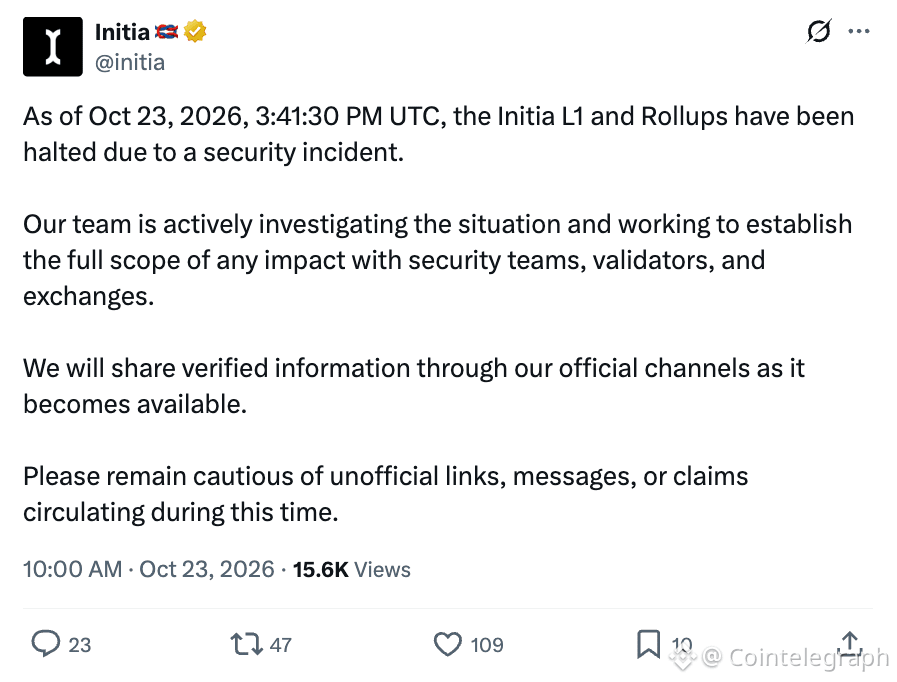
The network was halted at 3:41 p.m. UTC on Friday following a security incident, Initia said in a post on X. The team said it was working with security researchers, validators and exchanges to determine the full extent of the impact.
Blockchain security researcher Spreek first flagged the exploit on Friday, reporting that an attacker had minted tokens without authorization and converted approximately $2.6 million into other assets, with additional funds still being moved.
DeFi platform D2 Finance later reported that the attacker exploited a vulnerability to mint 2 million AUSD tokens without sufficient backing. The attacker then used cross-chain transfers to withdraw approximately 1.4 million AUSD, 105 Ether (ETH) and 1.08 million USDC (USDC) to Ethereum.
The stolen assets were subsequently consolidated into an Ethereum wallet holding approximately 1,135.5 ETH, worth $2.73 million, according to D2 Finance. The firm attributed the exploit to a vulnerability in a Move function that allowed the attacker to create unbacked tokens and exchange them for assets on Ethereum.
Source: Initia
Initia is a layer-1 blockchain designed to support a network of interconnected rollups, known as Minitias. Its native token, INIT, briefly fell to around $0.115 on Friday before rebounding above $0.15, according to CoinGecko data. The token was trading near $0.1496 at the time of writing, an increase of about 14% over the previous 24 hours.
Initia has not publicly confirmed the estimated losses or the precise cause of the exploit, and the extent of the impact on users and the timeline for restoring network operations remain unclear. Cointelegraph was unable to contact Initia for additional comment through its official X account.
Magazine: New DeepSeek ban in US, Swiss-Asia crypto ties deepen: Asia Express
Initia halts blockchain after exploit reportedly drains over $2.6M
Initia halted its layer-1 blockchain and rollups after blockchain sleuths reported an exploit that allowed an attacker to mint tokens without authorization and drain more than $2.6 million in crypto assets.
The network was halted at 3:41 p.m. UTC on Friday following a security incident, Initia said in a post on X. The team said it was working with security researchers, validators and exchanges to determine the full extent of the impact.
Blockchain security researcher Spreek first flagged the exploit on Friday, reporting that an attacker had minted tokens without authorization and converted approximately $2.6 million into other assets, with additional funds still being moved.
DeFi platform D2 Finance later reported that the attacker exploited a vulnerability to mint 2 million AUSD tokens without sufficient backing. The attacker then used cross-chain transfers to withdraw approximately 1.4 million AUSD, 105 Ether (ETH) and 1.08 million USDC (USDC) to Ethereum.
The stolen assets were subsequently consolidated into an Ethereum wallet holding approximately 1,135.5 ETH, worth $2.73 million, according to D2 Finance. The firm attributed the exploit to a vulnerability in a Move function that allowed the attacker to create unbacked tokens and exchange them for assets on Ethereum.
Source: Initia
Initia is a layer-1 blockchain designed to support a network of interconnected rollups, known as Minitias. Its native token, INIT, briefly fell to around $0.115 on Friday before rebounding above $0.15, according to CoinGecko data. The token was trading near $0.1496 at the time of writing, an increase of about 14% over the previous 24 hours.
Initia has not publicly confirmed the estimated losses or the precise cause of the exploit, and the extent of the impact on users and the timeline for restoring network operations remain unclear. Cointelegraph was unable to contact Initia for additional comment through its official X account.
Magazine: New DeepSeek ban in US, Swiss-Asia crypto ties deepen: Asia Express
The network was halted at 3:41 p.m. UTC on Friday following a security incident, Initia said in a post on X. The team said it was working with security researchers, validators and exchanges to determine the full extent of the impact.
Blockchain security researcher Spreek first flagged the exploit on Friday, reporting that an attacker had minted tokens without authorization and converted approximately $2.6 million into other assets, with additional funds still being moved.
DeFi platform D2 Finance later reported that the attacker exploited a vulnerability to mint 2 million AUSD tokens without sufficient backing. The attacker then used cross-chain transfers to withdraw approximately 1.4 million AUSD, 105 Ether (ETH) and 1.08 million USDC (USDC) to Ethereum.
The stolen assets were subsequently consolidated into an Ethereum wallet holding approximately 1,135.5 ETH, worth $2.73 million, according to D2 Finance. The firm attributed the exploit to a vulnerability in a Move function that allowed the attacker to create unbacked tokens and exchange them for assets on Ethereum.
Source: Initia
Initia is a layer-1 blockchain designed to support a network of interconnected rollups, known as Minitias. Its native token, INIT, briefly fell to around $0.115 on Friday before rebounding above $0.15, according to CoinGecko data. The token was trading near $0.1496 at the time of writing, an increase of about 14% over the previous 24 hours.
Initia has not publicly confirmed the estimated losses or the precise cause of the exploit, and the extent of the impact on users and the timeline for restoring network operations remain unclear. Cointelegraph was unable to contact Initia for additional comment through its official X account.
Magazine: New DeepSeek ban in US, Swiss-Asia crypto ties deepen: Asia Express
759
US senator probes Tether after reported deal with ex-Trump crypto adviserSenator Richard Blumenthal has requested information from Tether CEO Paolo Ardoino after a Wall Street Journal report said that the stablecoin issuer had inked a $6.3 million deal with a marketing company co-founded by former White House crypto adviser Bo Hines.
In a Thursday letter to Ardoino, the Connecticut lawmaker said that the Senate Permanent Subcommittee on Investigations demanded “records and information related to contracts, payments, communications, and lobbying” between Tether and Nxum, Hines’ company. The probe into Nxum, Tether and Hines, according to Blumental, was part of what the senator called the Trump administration’s “self-enrichment and self-dealings with cryptocurrency firms.”
“While Hines failed to divest his one-third stake in Nxum [...] he worked closely over encrypted messaging applications with Nxum to coordinate lobbying, advocacy, and browbeating of members of Congress that were opposed to, or had sought changes to, pending stablecoin legislation,” said Blumenthal. “Those messages also reportedly demonstrate that Tether was directly coordinating Nxum’s lobbying efforts on the GENIUS Act which would regulate stablecoins, with CEO Paolo Ardoino demanding that Nxum ‘obliterate’ the legislation’s opponents.”
The lawmaker added:
“The highly unusual terms and nature of Tether’s business relationship with both Nxum and Bo Hines raise alarming ethical and legal concerns, indicating that Tether was likely well aware of the illegality and impropriety of issuing payments to a current White House official with such a direct role in shaping cryptocurrency legislation that was instrumental to its business.”
Hines worked as executive director as President’s Council of Advisers on Digital Assets from January to August 2025, when he left the White House to join Tether as a “strategic adviser.” He later became CEO of Tether US. Harry Jung, another crypto adviser in the Trump administration, left his position in July 2026 and joined Nxum as a managing director in August.
Trump, his family and members of his administration continue to face scrutiny over accusations that they are reaping financial windfalls from crypto policies on laws over which they have control or influence. The president disclosed earning $1.4 billion from investments related to crypto in 2025.
Cointelegraph reached out to Tether for comment on the investigation and report but did not receive an immediate response.
Crypto ties could be a factor in midterm elections
While Blumenthal has limited authority as the Democratic ranking member of the Senate Permanent Subcommittee on Investigations, the results of the 2026 midterm elections could potentially change party control in the House of Representatives and Senate. This could give the Connecticut lawmaker and other Democratic additional authority to conduct investigations into Trump and his administration’s ties to the crypto industry, including those which could present conflicts of interest.
As of Friday, event contracts on prediction market platforms Kalshi and Polymarket favored Democrats retaking majority control of both chambers of Congress in 2027, with 92% and 68% chances on Kalshi for the House and Senate, respectively. US Election Day is on Nov. 3.
Magazine: New DeepSeek ban in US, Swiss-Asia crypto ties deepen: Asia Express
US senator probes Tether after reported deal with ex-Trump crypto adviser
Senator Richard Blumenthal has requested information from Tether CEO Paolo Ardoino after a Wall Street Journal report said that the stablecoin issuer had inked a $6.3 million deal with a marketing company co-founded by former White House crypto adviser Bo Hines.
In a Thursday letter to Ardoino, the Connecticut lawmaker said that the Senate Permanent Subcommittee on Investigations demanded “records and information related to contracts, payments, communications, and lobbying” between Tether and Nxum, Hines’ company. The probe into Nxum, Tether and Hines, according to Blumental, was part of what the senator called the Trump administration’s “self-enrichment and self-dealings with cryptocurrency firms.”
“While Hines failed to divest his one-third stake in Nxum [...] he worked closely over encrypted messaging applications with Nxum to coordinate lobbying, advocacy, and browbeating of members of Congress that were opposed to, or had sought changes to, pending stablecoin legislation,” said Blumenthal. “Those messages also reportedly demonstrate that Tether was directly coordinating Nxum’s lobbying efforts on the GENIUS Act which would regulate stablecoins, with CEO Paolo Ardoino demanding that Nxum ‘obliterate’ the legislation’s opponents.”
The lawmaker added:
“The highly unusual terms and nature of Tether’s business relationship with both Nxum and Bo Hines raise alarming ethical and legal concerns, indicating that Tether was likely well aware of the illegality and impropriety of issuing payments to a current White House official with such a direct role in shaping cryptocurrency legislation that was instrumental to its business.”
Hines worked as executive director as President’s Council of Advisers on Digital Assets from January to August 2025, when he left the White House to join Tether as a “strategic adviser.” He later became CEO of Tether US. Harry Jung, another crypto adviser in the Trump administration, left his position in July 2026 and joined Nxum as a managing director in August.
Trump, his family and members of his administration continue to face scrutiny over accusations that they are reaping financial windfalls from crypto policies on laws over which they have control or influence. The president disclosed earning $1.4 billion from investments related to crypto in 2025.
Cointelegraph reached out to Tether for comment on the investigation and report but did not receive an immediate response.
Crypto ties could be a factor in midterm elections
While Blumenthal has limited authority as the Democratic ranking member of the Senate Permanent Subcommittee on Investigations, the results of the 2026 midterm elections could potentially change party control in the House of Representatives and Senate. This could give the Connecticut lawmaker and other Democratic additional authority to conduct investigations into Trump and his administration’s ties to the crypto industry, including those which could present conflicts of interest.
As of Friday, event contracts on prediction market platforms Kalshi and Polymarket favored Democrats retaking majority control of both chambers of Congress in 2027, with 92% and 68% chances on Kalshi for the House and Senate, respectively. US Election Day is on Nov. 3.
Magazine: New DeepSeek ban in US, Swiss-Asia crypto ties deepen: Asia Express
In a Thursday letter to Ardoino, the Connecticut lawmaker said that the Senate Permanent Subcommittee on Investigations demanded “records and information related to contracts, payments, communications, and lobbying” between Tether and Nxum, Hines’ company. The probe into Nxum, Tether and Hines, according to Blumental, was part of what the senator called the Trump administration’s “self-enrichment and self-dealings with cryptocurrency firms.”
“While Hines failed to divest his one-third stake in Nxum [...] he worked closely over encrypted messaging applications with Nxum to coordinate lobbying, advocacy, and browbeating of members of Congress that were opposed to, or had sought changes to, pending stablecoin legislation,” said Blumenthal. “Those messages also reportedly demonstrate that Tether was directly coordinating Nxum’s lobbying efforts on the GENIUS Act which would regulate stablecoins, with CEO Paolo Ardoino demanding that Nxum ‘obliterate’ the legislation’s opponents.”
The lawmaker added:
“The highly unusual terms and nature of Tether’s business relationship with both Nxum and Bo Hines raise alarming ethical and legal concerns, indicating that Tether was likely well aware of the illegality and impropriety of issuing payments to a current White House official with such a direct role in shaping cryptocurrency legislation that was instrumental to its business.”
Hines worked as executive director as President’s Council of Advisers on Digital Assets from January to August 2025, when he left the White House to join Tether as a “strategic adviser.” He later became CEO of Tether US. Harry Jung, another crypto adviser in the Trump administration, left his position in July 2026 and joined Nxum as a managing director in August.
Trump, his family and members of his administration continue to face scrutiny over accusations that they are reaping financial windfalls from crypto policies on laws over which they have control or influence. The president disclosed earning $1.4 billion from investments related to crypto in 2025.
Cointelegraph reached out to Tether for comment on the investigation and report but did not receive an immediate response.
Crypto ties could be a factor in midterm elections
While Blumenthal has limited authority as the Democratic ranking member of the Senate Permanent Subcommittee on Investigations, the results of the 2026 midterm elections could potentially change party control in the House of Representatives and Senate. This could give the Connecticut lawmaker and other Democratic additional authority to conduct investigations into Trump and his administration’s ties to the crypto industry, including those which could present conflicts of interest.
As of Friday, event contracts on prediction market platforms Kalshi and Polymarket favored Democrats retaking majority control of both chambers of Congress in 2027, with 92% and 68% chances on Kalshi for the House and Senate, respectively. US Election Day is on Nov. 3.
Magazine: New DeepSeek ban in US, Swiss-Asia crypto ties deepen: Asia Express
324
SEC flags tokenization as high-risk area in 2027 market examinationsThe US Securities and Exchange Commission (SEC) has added tokenization to its fiscal 2027 examination priorities, placing tokenized securities alongside quantum computing and extended trading hours among emerging trends it plans to examine.
In its 2027 examination priorities, released Friday, the SEC identified tokenization as an area of focus for examinations of critical market infrastructure. Tokenization was not explicitly mentioned in the agency’s 2026 priorities.
The report addressed the security and reliability of critical market infrastructure, stating:
Examinations under Regulation SCI will focus on emerging trends, including SI [super intelligence, the Trump administration’s term for artificial intelligence], tokenization of securities, extended trading hours, and quantum computing.
The SEC also listed tokenization among the high-risk areas it will examine at clearing agencies, alongside default management, securities lending and operational risks.
Cryptocurrencies, meanwhile, remain absent as a standalone examination priority for the second consecutive year. The SEC last included a dedicated section on crypto assets in its fiscal 2025 priorities.
The new priorities come as traditional financial institutions move further into tokenized securities. Earlier this month, an OKX and Intercontinental Exchange joint venture filed to launch a platform offering tokenized shares in more than 60 US-listed companies.
Magazine: New DeepSeek ban in US, Swiss-Asia crypto ties deepen: Asia Express
SEC flags tokenization as high-risk area in 2027 market examinations
The US Securities and Exchange Commission (SEC) has added tokenization to its fiscal 2027 examination priorities, placing tokenized securities alongside quantum computing and extended trading hours among emerging trends it plans to examine.
In its 2027 examination priorities, released Friday, the SEC identified tokenization as an area of focus for examinations of critical market infrastructure. Tokenization was not explicitly mentioned in the agency’s 2026 priorities.
The report addressed the security and reliability of critical market infrastructure, stating:
Examinations under Regulation SCI will focus on emerging trends, including SI [super intelligence, the Trump administration’s term for artificial intelligence], tokenization of securities, extended trading hours, and quantum computing.
The SEC also listed tokenization among the high-risk areas it will examine at clearing agencies, alongside default management, securities lending and operational risks.
Cryptocurrencies, meanwhile, remain absent as a standalone examination priority for the second consecutive year. The SEC last included a dedicated section on crypto assets in its fiscal 2025 priorities.
The new priorities come as traditional financial institutions move further into tokenized securities. Earlier this month, an OKX and Intercontinental Exchange joint venture filed to launch a platform offering tokenized shares in more than 60 US-listed companies.
Magazine: New DeepSeek ban in US, Swiss-Asia crypto ties deepen: Asia Express
In its 2027 examination priorities, released Friday, the SEC identified tokenization as an area of focus for examinations of critical market infrastructure. Tokenization was not explicitly mentioned in the agency’s 2026 priorities.
The report addressed the security and reliability of critical market infrastructure, stating:
Examinations under Regulation SCI will focus on emerging trends, including SI [super intelligence, the Trump administration’s term for artificial intelligence], tokenization of securities, extended trading hours, and quantum computing.
The SEC also listed tokenization among the high-risk areas it will examine at clearing agencies, alongside default management, securities lending and operational risks.
Cryptocurrencies, meanwhile, remain absent as a standalone examination priority for the second consecutive year. The SEC last included a dedicated section on crypto assets in its fiscal 2025 priorities.
The new priorities come as traditional financial institutions move further into tokenized securities. Earlier this month, an OKX and Intercontinental Exchange joint venture filed to launch a platform offering tokenized shares in more than 60 US-listed companies.
Magazine: New DeepSeek ban in US, Swiss-Asia crypto ties deepen: Asia Express
188
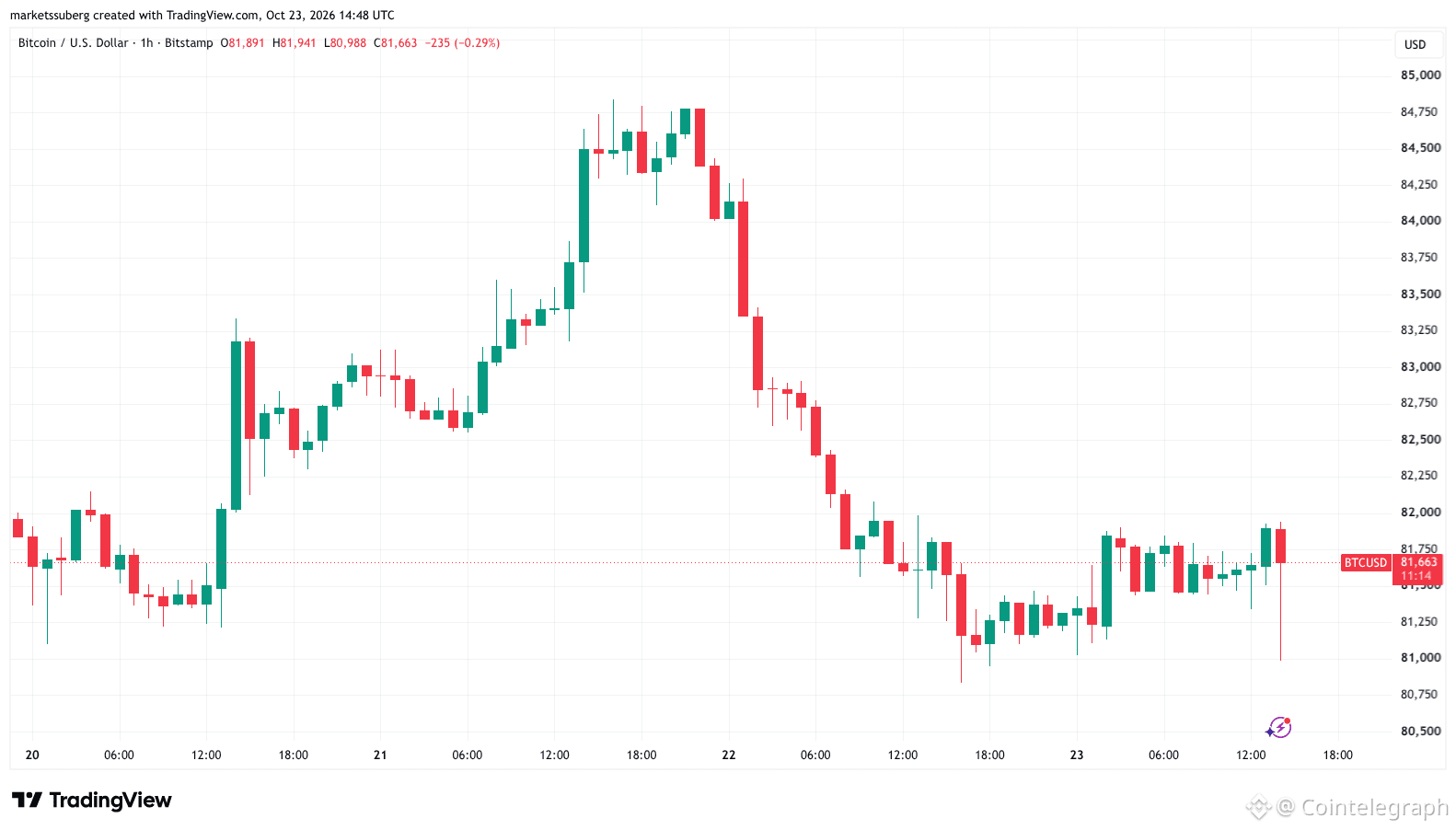
ບົດຄວາມ
Bitcoin seeks support above $81K as Brent crude oil hits highest level since MarchBitcoin (BTC) saw a fresh dip below $81,000 after Friday’s Wall Street open as Brent crude oil set new seven-month highs.
Key points:
Bitcoin briefly dropped below $81,000 at the start of Friday’s US trading session as stocks drifted lower and the US 10-year yield remained below 5%.
Brent crude oil reached $116 per barrel for the first time since March 19 amid Middle East tensions.
BTC price action focused on reclaiming its 50-day simple moving average at $81,781.
US stocks slip, bond yields cool as oil surges
Data from TradingView showed BTC/USD falling to $80,988 before recovering to around $81,600 at the time of writing.
BTC/USD one-hour chart. Source: Cointelegraph/TradingView
US stocks opened lower as AI-sector expenditure woes coincided with a surge in oil prices on the back of tensions around the US-Iran war.
The S&P 500 and tech-heavy Nasdaq Composite Index were down 0.6% and 0.2%, respectively, at the time of writing. The Dow Jones Industrial Average was 1.4% lower.
As traders turned risk-averse, the 10-year US bond yield stayed below 5%, having reached 4.939% on Thursday, their lowest since Sept. 23.
US 10-year bond yield one-day chart. Source: Cointelegraph/TradingView
Concerns that the US may renew military strikes on Iran around the midterm elections sent WTI crude oil past $102 per barrel on Friday. This is the highest level since Sept. 16. Brent crude saw an even sharper rise of nearly 3% to $116 per barrel, a level last seen in mid-March.
CFDs on Brent crude oil one-day chart. Source: Cointelegraph/TradingView
Commenting, economist Robin Brooks noted that prices were rising although oil flows through the Persian Gulf approached pre-war levels for many nations and Saudi Arabia surpassed its pre-war average.
“Since the start of the war, we’ve not seen this kind of decoupling between prices and flows,” he wrote in analysis on the day, seeing markets incorporating a “huge risk premium.”
Persian Gulf oil-transit volumes (screenshot). Source: Robin Brooks on Substack.com
BTC price analysis eyes 50-day trend line
Commenting on low-timeframe BTC price action, Keith Alan, cofounder of crypto trading platform Material Indicators, saw the potential for lower support retests to come.
BTC/USD, he noted, had fallen below its 50-day simple moving average (SMA) at $81,781, with bulls now attempting to reclaim it by the daily close.
“If they fail to do so by tonight’s close, I’m looking for a support test in the $78k - $80k range,” he told X followers.
BTC/USD one-day chart with 50 SMA. Source: Cointelegraph/TradingView
Previously, Cointelegraph reported on substantial BTC price support between $80,000 and $81,500, as this area hosts the aggregate cost basis for investors in the spot Bitcoin exchange-traded funds (ETFs).
Bitcoin seeks support above $81K as Brent crude oil hits highest level since March
Bitcoin (BTC) saw a fresh dip below $81,000 after Friday’s Wall Street open as Brent crude oil set new seven-month highs.
Key points:
Bitcoin briefly dropped below $81,000 at the start of Friday’s US trading session as stocks drifted lower and the US 10-year yield remained below 5%.
Brent crude oil reached $116 per barrel for the first time since March 19 amid Middle East tensions.
BTC price action focused on reclaiming its 50-day simple moving average at $81,781.
US stocks slip, bond yields cool as oil surges
Data from TradingView showed BTC/USD falling to $80,988 before recovering to around $81,600 at the time of writing.
BTC/USD one-hour chart. Source: Cointelegraph/TradingView
US stocks opened lower as AI-sector expenditure woes coincided with a surge in oil prices on the back of tensions around the US-Iran war.
The S&P 500 and tech-heavy Nasdaq Composite Index were down 0.6% and 0.2%, respectively, at the time of writing. The Dow Jones Industrial Average was 1.4% lower.
As traders turned risk-averse, the 10-year US bond yield stayed below 5%, having reached 4.939% on Thursday, their lowest since Sept. 23.
US 10-year bond yield one-day chart. Source: Cointelegraph/TradingView
Concerns that the US may renew military strikes on Iran around the midterm elections sent WTI crude oil past $102 per barrel on Friday. This is the highest level since Sept. 16. Brent crude saw an even sharper rise of nearly 3% to $116 per barrel, a level last seen in mid-March.
CFDs on Brent crude oil one-day chart. Source: Cointelegraph/TradingView
Commenting, economist Robin Brooks noted that prices were rising although oil flows through the Persian Gulf approached pre-war levels for many nations and Saudi Arabia surpassed its pre-war average.
“Since the start of the war, we’ve not seen this kind of decoupling between prices and flows,” he wrote in analysis on the day, seeing markets incorporating a “huge risk premium.”
Persian Gulf oil-transit volumes (screenshot). Source: Robin Brooks on Substack.com
BTC price analysis eyes 50-day trend line
Commenting on low-timeframe BTC price action, Keith Alan, cofounder of crypto trading platform Material Indicators, saw the potential for lower support retests to come.
BTC/USD, he noted, had fallen below its 50-day simple moving average (SMA) at $81,781, with bulls now attempting to reclaim it by the daily close.
“If they fail to do so by tonight’s close, I’m looking for a support test in the $78k - $80k range,” he told X followers.
BTC/USD one-day chart with 50 SMA. Source: Cointelegraph/TradingView
Previously, Cointelegraph reported on substantial BTC price support between $80,000 and $81,500, as this area hosts the aggregate cost basis for investors in the spot Bitcoin exchange-traded funds (ETFs).
Key points:
Bitcoin briefly dropped below $81,000 at the start of Friday’s US trading session as stocks drifted lower and the US 10-year yield remained below 5%.
Brent crude oil reached $116 per barrel for the first time since March 19 amid Middle East tensions.
BTC price action focused on reclaiming its 50-day simple moving average at $81,781.
US stocks slip, bond yields cool as oil surges
Data from TradingView showed BTC/USD falling to $80,988 before recovering to around $81,600 at the time of writing.
BTC/USD one-hour chart. Source: Cointelegraph/TradingView
US stocks opened lower as AI-sector expenditure woes coincided with a surge in oil prices on the back of tensions around the US-Iran war.
The S&P 500 and tech-heavy Nasdaq Composite Index were down 0.6% and 0.2%, respectively, at the time of writing. The Dow Jones Industrial Average was 1.4% lower.
As traders turned risk-averse, the 10-year US bond yield stayed below 5%, having reached 4.939% on Thursday, their lowest since Sept. 23.
US 10-year bond yield one-day chart. Source: Cointelegraph/TradingView
Concerns that the US may renew military strikes on Iran around the midterm elections sent WTI crude oil past $102 per barrel on Friday. This is the highest level since Sept. 16. Brent crude saw an even sharper rise of nearly 3% to $116 per barrel, a level last seen in mid-March.
CFDs on Brent crude oil one-day chart. Source: Cointelegraph/TradingView
Commenting, economist Robin Brooks noted that prices were rising although oil flows through the Persian Gulf approached pre-war levels for many nations and Saudi Arabia surpassed its pre-war average.
“Since the start of the war, we’ve not seen this kind of decoupling between prices and flows,” he wrote in analysis on the day, seeing markets incorporating a “huge risk premium.”
Persian Gulf oil-transit volumes (screenshot). Source: Robin Brooks on Substack.com
BTC price analysis eyes 50-day trend line
Commenting on low-timeframe BTC price action, Keith Alan, cofounder of crypto trading platform Material Indicators, saw the potential for lower support retests to come.
BTC/USD, he noted, had fallen below its 50-day simple moving average (SMA) at $81,781, with bulls now attempting to reclaim it by the daily close.
“If they fail to do so by tonight’s close, I’m looking for a support test in the $78k - $80k range,” he told X followers.
BTC/USD one-day chart with 50 SMA. Source: Cointelegraph/TradingView
Previously, Cointelegraph reported on substantial BTC price support between $80,000 and $81,500, as this area hosts the aggregate cost basis for investors in the spot Bitcoin exchange-traded funds (ETFs).
2
1
561
New York AG seeks $1.37B from NovaTech founders over Ponzi schemeNew York Attorney General Letitia James has asked a court to order defunct crypto and forex trading platform NovaTech’s founders, Cynthia and Eddy Petion, and related companies to pay $1.37 billion over its Ponzi scheme.
The AG is seeking the return of about $1.13 billion in investor funds, plus $232.5 million in interest, according to a Thursday court filing.
The court found the Petions and the companies liable by default in August 2025 after they failed to respond to the lawsuit.
Four people who recruited investors into NovaTech have separately agreed to pay nearly $6 million in settlements intended to benefit victims, according to the AG’s office.
More than 11,000 New Yorkers lost tens of millions of dollars through NovaTech and an earlier crypto mining scheme, AWS Mining, the AG’s office said. The complaint alleged that promoters targeted Haitian and other immigrant communities through prayer groups, social media and WhatsApp, promising high returns and recruitment bonuses.
The filing says that investors deposited about $1.16 billion into NovaTech’s crypto wallets between August 2019 and May 2023. Of that, only about $26 million was deposited with the platform’s trading provider, B2Broker, for trading, according to the attorney general.
The motion separately seeks about $6.15 million, including interest, over AWS Mining.
AWS Mining collapsed in 2019. NovaTech collapsed in 2023, leaving tens of thousands of investors unable to withdraw their funds. James sued NovaTech, AWS Mining and other associated companies in June 2024.
Cointelegraph sought comment from the New York Attorney General’s Office on how any recovered funds would be distributed to victims and what steps could be taken to enforce the judgment, but had not received a response by publication.
New York AG seeks $1.37B from NovaTech founders over Ponzi scheme
New York Attorney General Letitia James has asked a court to order defunct crypto and forex trading platform NovaTech’s founders, Cynthia and Eddy Petion, and related companies to pay $1.37 billion over its Ponzi scheme.
The AG is seeking the return of about $1.13 billion in investor funds, plus $232.5 million in interest, according to a Thursday court filing.
The court found the Petions and the companies liable by default in August 2025 after they failed to respond to the lawsuit.
Four people who recruited investors into NovaTech have separately agreed to pay nearly $6 million in settlements intended to benefit victims, according to the AG’s office.
More than 11,000 New Yorkers lost tens of millions of dollars through NovaTech and an earlier crypto mining scheme, AWS Mining, the AG’s office said. The complaint alleged that promoters targeted Haitian and other immigrant communities through prayer groups, social media and WhatsApp, promising high returns and recruitment bonuses.
The filing says that investors deposited about $1.16 billion into NovaTech’s crypto wallets between August 2019 and May 2023. Of that, only about $26 million was deposited with the platform’s trading provider, B2Broker, for trading, according to the attorney general.
The motion separately seeks about $6.15 million, including interest, over AWS Mining.
AWS Mining collapsed in 2019. NovaTech collapsed in 2023, leaving tens of thousands of investors unable to withdraw their funds. James sued NovaTech, AWS Mining and other associated companies in June 2024.
Cointelegraph sought comment from the New York Attorney General’s Office on how any recovered funds would be distributed to victims and what steps could be taken to enforce the judgment, but had not received a response by publication.
The AG is seeking the return of about $1.13 billion in investor funds, plus $232.5 million in interest, according to a Thursday court filing.
The court found the Petions and the companies liable by default in August 2025 after they failed to respond to the lawsuit.
Four people who recruited investors into NovaTech have separately agreed to pay nearly $6 million in settlements intended to benefit victims, according to the AG’s office.
More than 11,000 New Yorkers lost tens of millions of dollars through NovaTech and an earlier crypto mining scheme, AWS Mining, the AG’s office said. The complaint alleged that promoters targeted Haitian and other immigrant communities through prayer groups, social media and WhatsApp, promising high returns and recruitment bonuses.
The filing says that investors deposited about $1.16 billion into NovaTech’s crypto wallets between August 2019 and May 2023. Of that, only about $26 million was deposited with the platform’s trading provider, B2Broker, for trading, according to the attorney general.
The motion separately seeks about $6.15 million, including interest, over AWS Mining.
AWS Mining collapsed in 2019. NovaTech collapsed in 2023, leaving tens of thousands of investors unable to withdraw their funds. James sued NovaTech, AWS Mining and other associated companies in June 2024.
Cointelegraph sought comment from the New York Attorney General’s Office on how any recovered funds would be distributed to victims and what steps could be taken to enforce the judgment, but had not received a response by publication.
187
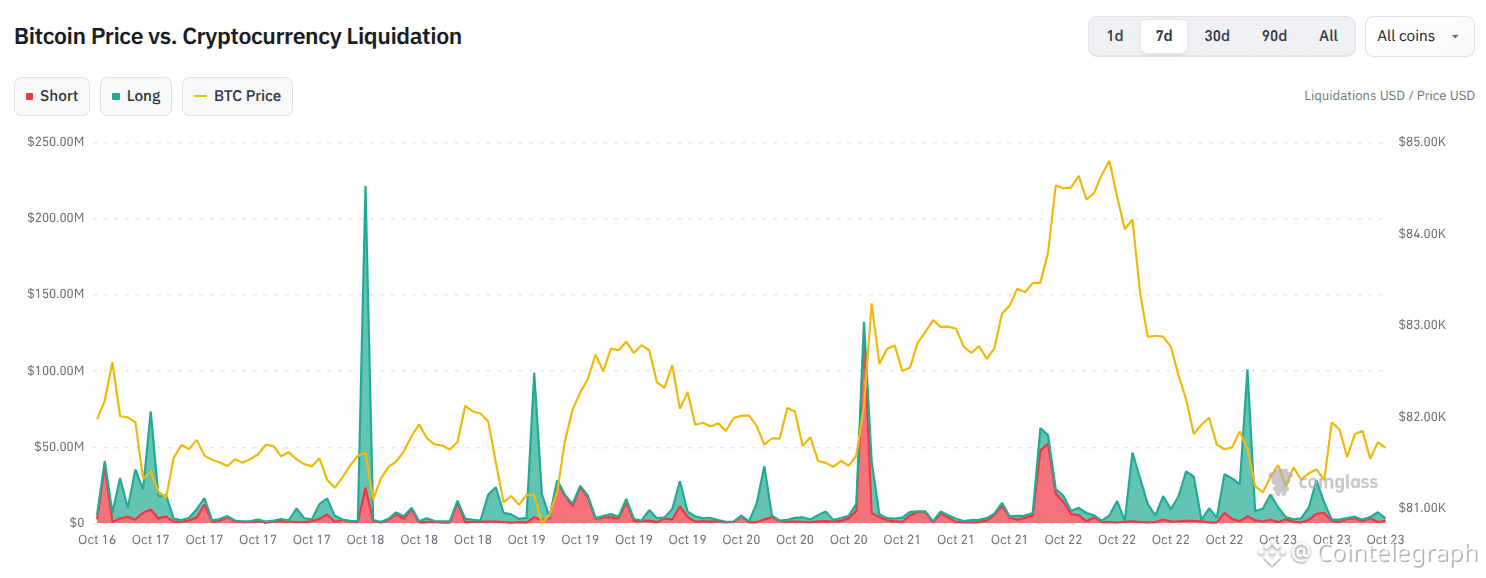
ບົດຄວາມ
Bitcoin consolidates after 3% loss as AI fears stoke fresh stock-market weaknessBitcoin (BTC) ranged below $82,000 into Friday’s Wall Street open as stock markets slid further on AI financing concerns.
Key points:
Bitcoin struggled to rebound after falling more than 3% on Thursday. It briefly dropped below $81,000.
AI infrastructure spending remained a persistent market concern as neocloud infrastructure provider CoreWeave slid to 17-month lows.
Crypto market downside liquidated $280 million worth of long positions in 24 hours, while Bitcoin exchange-traded fund (ETF) outflows hit $635 million.
Analysis warns of AI “credit stress” contagion
Data from TradingView showed BTC/USD stabilizing after shedding 3.2% on Thursday, falling as low as $80,840 on Bitstamp.
BTC/USD one-hour chart. Source: Cointelegraph/TradingView
Market nerves over AI-sector profitability and the cost of insuring large players against default reemerged this week. CoreWeave, a neocloud provider, was among the biggest decliners, down 15.5% week to date at the end of Thursday’s US trading session, its lowest levels since May 2025. A price target downgrade by Bernstein from $74 to $51 contributed to the pressure.
“The spread of credit stress across the neocloud infrastructure sector has triggered broader equity market weakness as institutional investors evaluate capital expenditure commitments and profitability across technology firms dependent on AI infrastructure expansion,” crypto trading company QCP Capital wrote in analysis.
CoreWeave stock one-day chart. Source: Cointelegraph/TradingView
On Friday, fresh downside impacted Asian equities markets. South Korea’s KOSPI Composite Index opened at 5,402 points before dropping as low as 5,305 points, marking its lowest levels since late July. It finished the session 0.3% higher on the day.
KOSPI Composite Index one-day chart. Source: Cointelegraph/TradingView
Speaking to CNBC on Thursday, Nvidia CEO Jensen Huang spoke of a “scarcity of capital” impacting the neocloud buildouts in particular.
“The demand [for] the capital is much greater than the availability of the capital,” he said.
Previously, Cointelegraph reported on lower-than-expected capital expenditure by Tesla despite Q3 earnings broadly conforming to market expectations.
QCP Capital stated that the capex figures “reinforced concerns that elevated financing costs will constrain the pace of artificial intelligence infrastructure buildout and potentially reduce expected return profiles for capital-intensive projects.”
Crypto long liquidations elevated in slide below $81,000
Capital flows into ETF products reacted strongly to the recent price moves within Bitcoin’s local trading range between $80,000 and $87,000.
On Thursday, the US spot Bitcoin ETFs saw net outflows of $635 million, the largest single-day drawdown since late June.
Data from CoinGlass, meanwhile, revealed that traders were caught off guard when BTC/USD returned toward the lower boundary of its range. Cross-crypto liquidations totaled $336 million over 24 hours to noon UTC, including $281 million of long positions.
BTC/USD vs. crypto liquidations (screenshot). Source: CoinGlass
Bitcoin consolidates after 3% loss as AI fears stoke fresh stock-market weakness
Bitcoin (BTC) ranged below $82,000 into Friday’s Wall Street open as stock markets slid further on AI financing concerns.
Key points:
Bitcoin struggled to rebound after falling more than 3% on Thursday. It briefly dropped below $81,000.
AI infrastructure spending remained a persistent market concern as neocloud infrastructure provider CoreWeave slid to 17-month lows.
Crypto market downside liquidated $280 million worth of long positions in 24 hours, while Bitcoin exchange-traded fund (ETF) outflows hit $635 million.
Analysis warns of AI “credit stress” contagion
Data from TradingView showed BTC/USD stabilizing after shedding 3.2% on Thursday, falling as low as $80,840 on Bitstamp.
BTC/USD one-hour chart. Source: Cointelegraph/TradingView
Market nerves over AI-sector profitability and the cost of insuring large players against default reemerged this week. CoreWeave, a neocloud provider, was among the biggest decliners, down 15.5% week to date at the end of Thursday’s US trading session, its lowest levels since May 2025. A price target downgrade by Bernstein from $74 to $51 contributed to the pressure.
“The spread of credit stress across the neocloud infrastructure sector has triggered broader equity market weakness as institutional investors evaluate capital expenditure commitments and profitability across technology firms dependent on AI infrastructure expansion,” crypto trading company QCP Capital wrote in analysis.
CoreWeave stock one-day chart. Source: Cointelegraph/TradingView
On Friday, fresh downside impacted Asian equities markets. South Korea’s KOSPI Composite Index opened at 5,402 points before dropping as low as 5,305 points, marking its lowest levels since late July. It finished the session 0.3% higher on the day.
KOSPI Composite Index one-day chart. Source: Cointelegraph/TradingView
Speaking to CNBC on Thursday, Nvidia CEO Jensen Huang spoke of a “scarcity of capital” impacting the neocloud buildouts in particular.
“The demand [for] the capital is much greater than the availability of the capital,” he said.
Previously, Cointelegraph reported on lower-than-expected capital expenditure by Tesla despite Q3 earnings broadly conforming to market expectations.
QCP Capital stated that the capex figures “reinforced concerns that elevated financing costs will constrain the pace of artificial intelligence infrastructure buildout and potentially reduce expected return profiles for capital-intensive projects.”
Crypto long liquidations elevated in slide below $81,000
Capital flows into ETF products reacted strongly to the recent price moves within Bitcoin’s local trading range between $80,000 and $87,000.
On Thursday, the US spot Bitcoin ETFs saw net outflows of $635 million, the largest single-day drawdown since late June.
Data from CoinGlass, meanwhile, revealed that traders were caught off guard when BTC/USD returned toward the lower boundary of its range. Cross-crypto liquidations totaled $336 million over 24 hours to noon UTC, including $281 million of long positions.
BTC/USD vs. crypto liquidations (screenshot). Source: CoinGlass
Key points:
Bitcoin struggled to rebound after falling more than 3% on Thursday. It briefly dropped below $81,000.
AI infrastructure spending remained a persistent market concern as neocloud infrastructure provider CoreWeave slid to 17-month lows.
Crypto market downside liquidated $280 million worth of long positions in 24 hours, while Bitcoin exchange-traded fund (ETF) outflows hit $635 million.
Analysis warns of AI “credit stress” contagion
Data from TradingView showed BTC/USD stabilizing after shedding 3.2% on Thursday, falling as low as $80,840 on Bitstamp.
BTC/USD one-hour chart. Source: Cointelegraph/TradingView
Market nerves over AI-sector profitability and the cost of insuring large players against default reemerged this week. CoreWeave, a neocloud provider, was among the biggest decliners, down 15.5% week to date at the end of Thursday’s US trading session, its lowest levels since May 2025. A price target downgrade by Bernstein from $74 to $51 contributed to the pressure.
“The spread of credit stress across the neocloud infrastructure sector has triggered broader equity market weakness as institutional investors evaluate capital expenditure commitments and profitability across technology firms dependent on AI infrastructure expansion,” crypto trading company QCP Capital wrote in analysis.
CoreWeave stock one-day chart. Source: Cointelegraph/TradingView
On Friday, fresh downside impacted Asian equities markets. South Korea’s KOSPI Composite Index opened at 5,402 points before dropping as low as 5,305 points, marking its lowest levels since late July. It finished the session 0.3% higher on the day.
KOSPI Composite Index one-day chart. Source: Cointelegraph/TradingView
Speaking to CNBC on Thursday, Nvidia CEO Jensen Huang spoke of a “scarcity of capital” impacting the neocloud buildouts in particular.
“The demand [for] the capital is much greater than the availability of the capital,” he said.
Previously, Cointelegraph reported on lower-than-expected capital expenditure by Tesla despite Q3 earnings broadly conforming to market expectations.
QCP Capital stated that the capex figures “reinforced concerns that elevated financing costs will constrain the pace of artificial intelligence infrastructure buildout and potentially reduce expected return profiles for capital-intensive projects.”
Crypto long liquidations elevated in slide below $81,000
Capital flows into ETF products reacted strongly to the recent price moves within Bitcoin’s local trading range between $80,000 and $87,000.
On Thursday, the US spot Bitcoin ETFs saw net outflows of $635 million, the largest single-day drawdown since late June.
Data from CoinGlass, meanwhile, revealed that traders were caught off guard when BTC/USD returned toward the lower boundary of its range. Cross-crypto liquidations totaled $336 million over 24 hours to noon UTC, including $281 million of long positions.
BTC/USD vs. crypto liquidations (screenshot). Source: CoinGlass
185
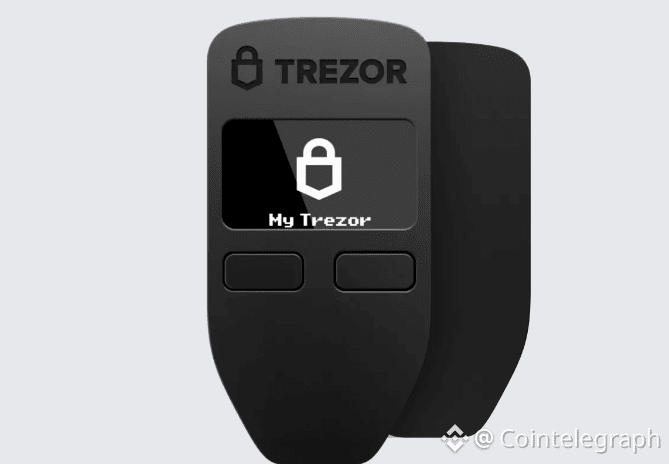
ບົດຄວາມ
Was crypto self-custody ever designed for beginners?Crypto executives are divided over whether self-custody was ever designed for beginners, while approaches such as multisignature wallets and seedless backups come with their own security and usability trade-offs.
“We don’t expect every driver to be a mechanic, and we shouldn’t expect everyone who wants to own their assets to become a security expert,” Safe Labs CEO Rahul Rumalla told Cointelegraph.
Making self-custody easier to use could be critical to Bitcoin’s broader adoption, as the ability to “be your own bank” remains one of its defining features.
Recent incidents involving Ledger and Coldcard have exposed weaknesses in hardware wallets, widely recommended as one of the safest ways to hold crypto because they keep private keys offline.
Implants in some Ledger devices stole recovery phrases, while a Coldcard firmware bug allowed attackers to recreate private keys and steal funds.
Michael Tanguma, CEO of Bitcoin custody provider Onramp, compared Bitcoin custody to personal computers in the 1970s, when users needed technical skills to assemble and operate them.
“Self-custody was never designed with newcomers in mind,” he told Cointelegraph.
He said simpler designs helped computers reach a wider audience and that Bitcoin custody now faces a similar challenge.
Trezor Model One, the world’s first hardware wallet, was released in 2014. Source: Trezor
Rumalla disagreed, saying self-custody was “always meant for everyone” and that “being able to own and control your assets is the whole point of crypto.”
He added that self-custody “does not mean doing everything yourself.”
Multisig improves security, but not without a cost
Multisignature, or multisig, wallets require multiple keys to authorize transactions, but managing them can be difficult for beginners.
“Traditional multisig implementations can introduce additional complexity involving signer coordination, key backups, recovery procedures, and transaction approvals,” Justin Hutzler, chief technology officer of Synergy Network, said.
Single signature versus multisig. Source: BitGo
Multiple approvals also cannot prevent every attack.
Safe Labs’ Rumalla said several signers could still authorize a malicious transaction if they were all deceived by the same compromised interface.
Seedless wallets remove one risk, introduce others
Tangem says its seedless design simplifies self-custody by removing the need to manage a recovery phrase. Users must instead safeguard the physical devices that provide access to their funds.
A private key is generated on one card, with backup copies stored on up to two additional devices. Tangem confirmed to Cointelegraph that losing every device would permanently lock users out of their funds.
The company said it had received no reports of users losing all their cards.
Keeping the cards safe also does not protect users from approving a malicious transaction. Zach Herbert, CEO of rival hardware wallet maker Foundation, said seedless backups can preserve self-custody, but criticized Tangem’s lack of a built-in screen, which leaves users relying on their smartphones to verify transaction details.
“An attacker does not need to extract your private key if they can trick you into authorizing a transaction that empties your wallet,” he said.
Magazine: 5 alternatives to Ledger to store your Bitcoin
Was crypto self-custody ever designed for beginners?
Crypto executives are divided over whether self-custody was ever designed for beginners, while approaches such as multisignature wallets and seedless backups come with their own security and usability trade-offs.
“We don’t expect every driver to be a mechanic, and we shouldn’t expect everyone who wants to own their assets to become a security expert,” Safe Labs CEO Rahul Rumalla told Cointelegraph.
Making self-custody easier to use could be critical to Bitcoin’s broader adoption, as the ability to “be your own bank” remains one of its defining features.
Recent incidents involving Ledger and Coldcard have exposed weaknesses in hardware wallets, widely recommended as one of the safest ways to hold crypto because they keep private keys offline.
Implants in some Ledger devices stole recovery phrases, while a Coldcard firmware bug allowed attackers to recreate private keys and steal funds.
Michael Tanguma, CEO of Bitcoin custody provider Onramp, compared Bitcoin custody to personal computers in the 1970s, when users needed technical skills to assemble and operate them.
“Self-custody was never designed with newcomers in mind,” he told Cointelegraph.
He said simpler designs helped computers reach a wider audience and that Bitcoin custody now faces a similar challenge.
Trezor Model One, the world’s first hardware wallet, was released in 2014. Source: Trezor
Rumalla disagreed, saying self-custody was “always meant for everyone” and that “being able to own and control your assets is the whole point of crypto.”
He added that self-custody “does not mean doing everything yourself.”
Multisig improves security, but not without a cost
Multisignature, or multisig, wallets require multiple keys to authorize transactions, but managing them can be difficult for beginners.
“Traditional multisig implementations can introduce additional complexity involving signer coordination, key backups, recovery procedures, and transaction approvals,” Justin Hutzler, chief technology officer of Synergy Network, said.
Single signature versus multisig. Source: BitGo
Multiple approvals also cannot prevent every attack.
Safe Labs’ Rumalla said several signers could still authorize a malicious transaction if they were all deceived by the same compromised interface.
Seedless wallets remove one risk, introduce others
Tangem says its seedless design simplifies self-custody by removing the need to manage a recovery phrase. Users must instead safeguard the physical devices that provide access to their funds.
A private key is generated on one card, with backup copies stored on up to two additional devices. Tangem confirmed to Cointelegraph that losing every device would permanently lock users out of their funds.
The company said it had received no reports of users losing all their cards.
Keeping the cards safe also does not protect users from approving a malicious transaction. Zach Herbert, CEO of rival hardware wallet maker Foundation, said seedless backups can preserve self-custody, but criticized Tangem’s lack of a built-in screen, which leaves users relying on their smartphones to verify transaction details.
“An attacker does not need to extract your private key if they can trick you into authorizing a transaction that empties your wallet,” he said.
Magazine: 5 alternatives to Ledger to store your Bitcoin
“We don’t expect every driver to be a mechanic, and we shouldn’t expect everyone who wants to own their assets to become a security expert,” Safe Labs CEO Rahul Rumalla told Cointelegraph.
Making self-custody easier to use could be critical to Bitcoin’s broader adoption, as the ability to “be your own bank” remains one of its defining features.
Recent incidents involving Ledger and Coldcard have exposed weaknesses in hardware wallets, widely recommended as one of the safest ways to hold crypto because they keep private keys offline.
Implants in some Ledger devices stole recovery phrases, while a Coldcard firmware bug allowed attackers to recreate private keys and steal funds.
Michael Tanguma, CEO of Bitcoin custody provider Onramp, compared Bitcoin custody to personal computers in the 1970s, when users needed technical skills to assemble and operate them.
“Self-custody was never designed with newcomers in mind,” he told Cointelegraph.
He said simpler designs helped computers reach a wider audience and that Bitcoin custody now faces a similar challenge.
Trezor Model One, the world’s first hardware wallet, was released in 2014. Source: Trezor
Rumalla disagreed, saying self-custody was “always meant for everyone” and that “being able to own and control your assets is the whole point of crypto.”
He added that self-custody “does not mean doing everything yourself.”
Multisig improves security, but not without a cost
Multisignature, or multisig, wallets require multiple keys to authorize transactions, but managing them can be difficult for beginners.
“Traditional multisig implementations can introduce additional complexity involving signer coordination, key backups, recovery procedures, and transaction approvals,” Justin Hutzler, chief technology officer of Synergy Network, said.
Single signature versus multisig. Source: BitGo
Multiple approvals also cannot prevent every attack.
Safe Labs’ Rumalla said several signers could still authorize a malicious transaction if they were all deceived by the same compromised interface.
Seedless wallets remove one risk, introduce others
Tangem says its seedless design simplifies self-custody by removing the need to manage a recovery phrase. Users must instead safeguard the physical devices that provide access to their funds.
A private key is generated on one card, with backup copies stored on up to two additional devices. Tangem confirmed to Cointelegraph that losing every device would permanently lock users out of their funds.
The company said it had received no reports of users losing all their cards.
Keeping the cards safe also does not protect users from approving a malicious transaction. Zach Herbert, CEO of rival hardware wallet maker Foundation, said seedless backups can preserve self-custody, but criticized Tangem’s lack of a built-in screen, which leaves users relying on their smartphones to verify transaction details.
“An attacker does not need to extract your private key if they can trick you into authorizing a transaction that empties your wallet,” he said.
Magazine: 5 alternatives to Ledger to store your Bitcoin
214
Cysic dangles a 10% bounty, hacker pours loot into Tornado CashThe wallet linked to the Cysic bridge exploit sent about $744,000 in cryptocurrencies to Tornado Cash on Friday after the Cysic Foundation offered the attacker a 10% recovery bounty.
The address transferred 300 Ether (ETH) and 30.4 BNB to the crypto mixer, according to blockchain security company PeckShield.
The hacker exploited a bridge vulnerability to mint 10 million Cysic (CYS) tokens on BNB Smart Chain on Saturday. Cysic suspended the bridge and blacklisted the recipient address, freezing about 2.8 million of the newly minted tokens. The foundation said its mainnet and existing assets in user wallets were unaffected.
The following Thursday, the Cysic Foundation offered the hacker a 10% bounty in exchange for returning 275.872 ETH, worth about $665,000, representing roughly 90% of the identified Ether proceeds.
Tornado Cash pools deposits from multiple addresses, making the funds harder to trace. The attacker’s Ethereum wallet held just $45 in ETH at press time, according to Akham data.
Cointelegraph contacted the Cysic Foundation for comment on fund recovery efforts but did not receive a response by publication.
Cysic dangles a 10% bounty, hacker pours loot into Tornado Cash
The wallet linked to the Cysic bridge exploit sent about $744,000 in cryptocurrencies to Tornado Cash on Friday after the Cysic Foundation offered the attacker a 10% recovery bounty.
The address transferred 300 Ether (ETH) and 30.4 BNB to the crypto mixer, according to blockchain security company PeckShield.
The hacker exploited a bridge vulnerability to mint 10 million Cysic (CYS) tokens on BNB Smart Chain on Saturday. Cysic suspended the bridge and blacklisted the recipient address, freezing about 2.8 million of the newly minted tokens. The foundation said its mainnet and existing assets in user wallets were unaffected.
The following Thursday, the Cysic Foundation offered the hacker a 10% bounty in exchange for returning 275.872 ETH, worth about $665,000, representing roughly 90% of the identified Ether proceeds.
Tornado Cash pools deposits from multiple addresses, making the funds harder to trace. The attacker’s Ethereum wallet held just $45 in ETH at press time, according to Akham data.
Cointelegraph contacted the Cysic Foundation for comment on fund recovery efforts but did not receive a response by publication.
The address transferred 300 Ether (ETH) and 30.4 BNB to the crypto mixer, according to blockchain security company PeckShield.
The hacker exploited a bridge vulnerability to mint 10 million Cysic (CYS) tokens on BNB Smart Chain on Saturday. Cysic suspended the bridge and blacklisted the recipient address, freezing about 2.8 million of the newly minted tokens. The foundation said its mainnet and existing assets in user wallets were unaffected.
The following Thursday, the Cysic Foundation offered the hacker a 10% bounty in exchange for returning 275.872 ETH, worth about $665,000, representing roughly 90% of the identified Ether proceeds.
Tornado Cash pools deposits from multiple addresses, making the funds harder to trace. The attacker’s Ethereum wallet held just $45 in ETH at press time, according to Akham data.
Cointelegraph contacted the Cysic Foundation for comment on fund recovery efforts but did not receive a response by publication.
365
Bybit secures first full Dubai license for spot trading servicesCrypto exchange Bybit has secured a full Dubai license for spot trading following its earlier in-principle approval.
Bybit said Thursday that its Dubai entity, Bybit Fintech FZE, received a virtual asset service provider (VASP) license from Dubai’s Virtual Assets Regulatory Authority (VARA) for exchange services, including spot trading.
A Bybit spokesperson told Cointelegraph that the entity’s previous in-principle approval was non-operational and did not permit it to serve customers in Dubai. VARA’s public register lists the new license as active, allowing services to retail, qualified and institutional investors.
The spokesperson said Bybit must still complete VARA’s launch process and meet operational requirements before starting spot trading services. The company did not provide a launch date.
Bybit previously secured a full Virtual Asset Platform Operator license from the United Arab Emirates’ federal regulator, the Securities and Commodities Authority (SCA), in October 2025. However, the exchange’s service restrictions exclude Dubai from the jurisdictions served by its SCA-licensed entity, Bybit Virtual Asset Platform Operator LLC.
The spokesperson declined to comment on how the VARA license differs from the SCA approval or whether the earlier license permitted services in Dubai.
Bybit secures first full Dubai license for spot trading services
Crypto exchange Bybit has secured a full Dubai license for spot trading following its earlier in-principle approval.
Bybit said Thursday that its Dubai entity, Bybit Fintech FZE, received a virtual asset service provider (VASP) license from Dubai’s Virtual Assets Regulatory Authority (VARA) for exchange services, including spot trading.
A Bybit spokesperson told Cointelegraph that the entity’s previous in-principle approval was non-operational and did not permit it to serve customers in Dubai. VARA’s public register lists the new license as active, allowing services to retail, qualified and institutional investors.
The spokesperson said Bybit must still complete VARA’s launch process and meet operational requirements before starting spot trading services. The company did not provide a launch date.
Bybit previously secured a full Virtual Asset Platform Operator license from the United Arab Emirates’ federal regulator, the Securities and Commodities Authority (SCA), in October 2025. However, the exchange’s service restrictions exclude Dubai from the jurisdictions served by its SCA-licensed entity, Bybit Virtual Asset Platform Operator LLC.
The spokesperson declined to comment on how the VARA license differs from the SCA approval or whether the earlier license permitted services in Dubai.
Bybit said Thursday that its Dubai entity, Bybit Fintech FZE, received a virtual asset service provider (VASP) license from Dubai’s Virtual Assets Regulatory Authority (VARA) for exchange services, including spot trading.
A Bybit spokesperson told Cointelegraph that the entity’s previous in-principle approval was non-operational and did not permit it to serve customers in Dubai. VARA’s public register lists the new license as active, allowing services to retail, qualified and institutional investors.
The spokesperson said Bybit must still complete VARA’s launch process and meet operational requirements before starting spot trading services. The company did not provide a launch date.
Bybit previously secured a full Virtual Asset Platform Operator license from the United Arab Emirates’ federal regulator, the Securities and Commodities Authority (SCA), in October 2025. However, the exchange’s service restrictions exclude Dubai from the jurisdictions served by its SCA-licensed entity, Bybit Virtual Asset Platform Operator LLC.
The spokesperson declined to comment on how the VARA license differs from the SCA approval or whether the earlier license permitted services in Dubai.
1
124
ເຂົ້າສູ່ລະບົບເພື່ອສຳຫຼວດເນື້ອຫາເພີ່ມເຕີມ
ເຂົ້າຮ່ວມກຸ່ມຜູ້ໃຊ້ຄຣິບໂຕທົ່ວໂລກໃນ Binance Square.
⚡️ ໄດ້ຮັບຂໍ້ມູນຫຼ້າສຸດ ແລະ ທີ່ມີປະໂຫຍດກ່ຽວກັບຄຣິບໂຕ.
💬 ໄດ້ຮັບຄວາມໄວ້ວາງໃຈຈາກຕະຫຼາດແລກປ່ຽນຄຣິບໂຕທີ່ໃຫຍ່ທີ່ສຸດໃນໂລກ.
👍 ຄົ້ນຫາຂໍ້ມູນເຊີງເລິກທີ່ແທ້ຈາກນັກສ້າງທີ່ໄດ້ຮັບການຢືນຢັນ.
ອີເມວ / ເບີໂທລະສັບ
ຫົວຂໍ້ທີ່ກໍາລັງນິຍົມ
BinancePick
2.7M ຄັ້ງທີ່ເບິ່ງ
142,841 ກຳລັງສົນທະນາ
Join #EarningsSeason: Predict Earnings on Binance Pick, Share Your Take on Binance Square!
Binance Square Official
·402 ຖືກໃຈ
·338.8k ຄັ້ງທີ່ເບິ່ງ
EarningsSeason
5M ຄັ້ງທີ່ເບິ່ງ
24,509 ກຳລັງສົນທະນາ
SouthKoreaReportedlyWeighsFourthCryptoTaxDelay
2 ຄັ້ງທີ່ເບິ່ງ
13 ກຳລັງສົນທະນາ