
Aqsa Web3
430 ໂພສ

Aqsa Web3
56 ກໍາລັງຕິດຕາມ
38 ຜູ້ຕິດຕາມ
252 Liked
ໂພສ
ທັງໝົດ
ວົງຢືມ
ປັກໝຸດ
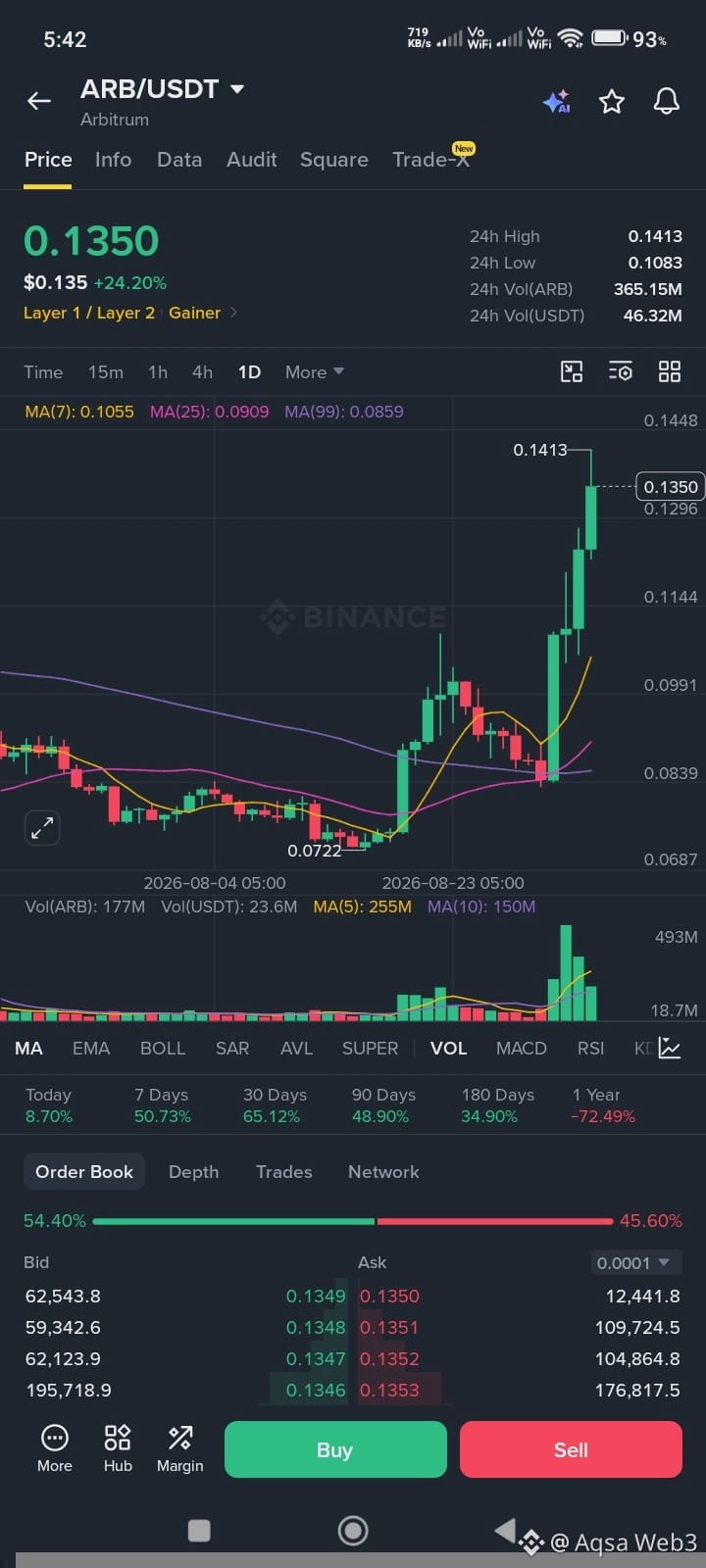
The hardest thing on days like this isn't finding green candles it's stopping yourself from hitting buy at the very top.
Today's board is running hot:
• $MUBARAK
• $ARB
• $CHIP
Most people get trapped doing one of two things right now
Jumping in late right into heavy resistance.
Trying to short the pump and getting wrecked.
Honestly if you missed the initial push chasing a candle that’s already up 25% usually just ends up feeding exit liquidity to early buyers. I’d rather wait for a clean daily retrace to show real support before touching anything.
Are you eyeing an entry on any pullback here or sitting on your hands for now? 👇
#CryptoTrading #BinanceSquare #Altcoins
Today's board is running hot:
• $MUBARAK
• $ARB
• $CHIP
Most people get trapped doing one of two things right now
Jumping in late right into heavy resistance.
Trying to short the pump and getting wrecked.
Honestly if you missed the initial push chasing a candle that’s already up 25% usually just ends up feeding exit liquidity to early buyers. I’d rather wait for a clean daily retrace to show real support before touching anything.
Are you eyeing an entry on any pullback here or sitting on your hands for now? 👇
#CryptoTrading #BinanceSquare #Altcoins
#dusk $DUSK @Dusk I used to think a node caught up to the latest block was basically “fully synced.”
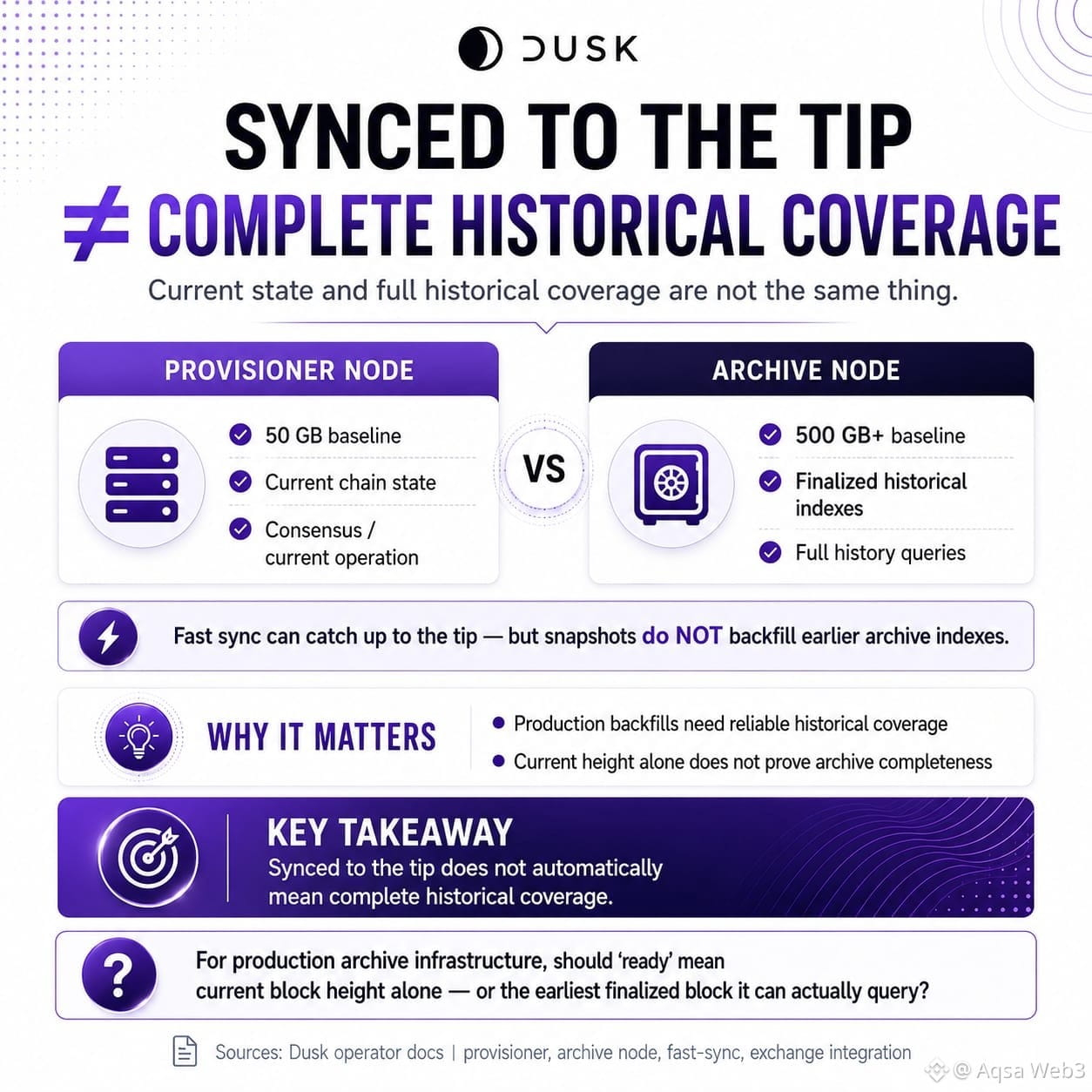
Then Dusk’s operator docs made me separate current state from historical coverage.
The current “Run a provisioner node” guide lists 50 GB of storage. “Run an archive node” starts at 500 GB and adds finalized historical indexes to normal chain state.
The more interesting part is fast sync.
Dusk’s “Fast sync a node” guide says download state restores a published state snapshot so a node can catch up toward the network tip. But it also warns that snapshots do not backfill archive indexes for blocks before the snapshot.
For an archive expected to answer complete history Dusk says to sync from genesis or restore a trusted backup that includes the archive databases.
That changed what “synced” means to me.
Synced to the tip ≠ complete historical coverage.
To be fair provisioners and archives are different node roles with different jobs. Current consensus participation does not require full archive history.
Dusk’s exchange integration docs specifically recommend an Archive Rusk node for finalized Moonlight history and deterministic backfills.
So for production archive infrastructure, should “ready” mean current block height alone or current height plus the earliest finalized block it can actually query?
@Dusk #dusk $DUSK
Then Dusk’s operator docs made me separate current state from historical coverage.
The current “Run a provisioner node” guide lists 50 GB of storage. “Run an archive node” starts at 500 GB and adds finalized historical indexes to normal chain state.
The more interesting part is fast sync.
Dusk’s “Fast sync a node” guide says download state restores a published state snapshot so a node can catch up toward the network tip. But it also warns that snapshots do not backfill archive indexes for blocks before the snapshot.
For an archive expected to answer complete history Dusk says to sync from genesis or restore a trusted backup that includes the archive databases.
That changed what “synced” means to me.
Synced to the tip ≠ complete historical coverage.
To be fair provisioners and archives are different node roles with different jobs. Current consensus participation does not require full archive history.
Dusk’s exchange integration docs specifically recommend an Archive Rusk node for finalized Moonlight history and deterministic backfills.
So for production archive infrastructure, should “ready” mean current block height alone or current height plus the earliest finalized block it can actually query?
@Dusk #dusk $DUSK
ເປັນຄວາມຈິງບາງສ່ວນ
#dusk $DUSK @Dusk I used to read Dusk’s “Atomic Settlement” label as if it also meant a user could bundle any multi step action into one all or nothing transaction.
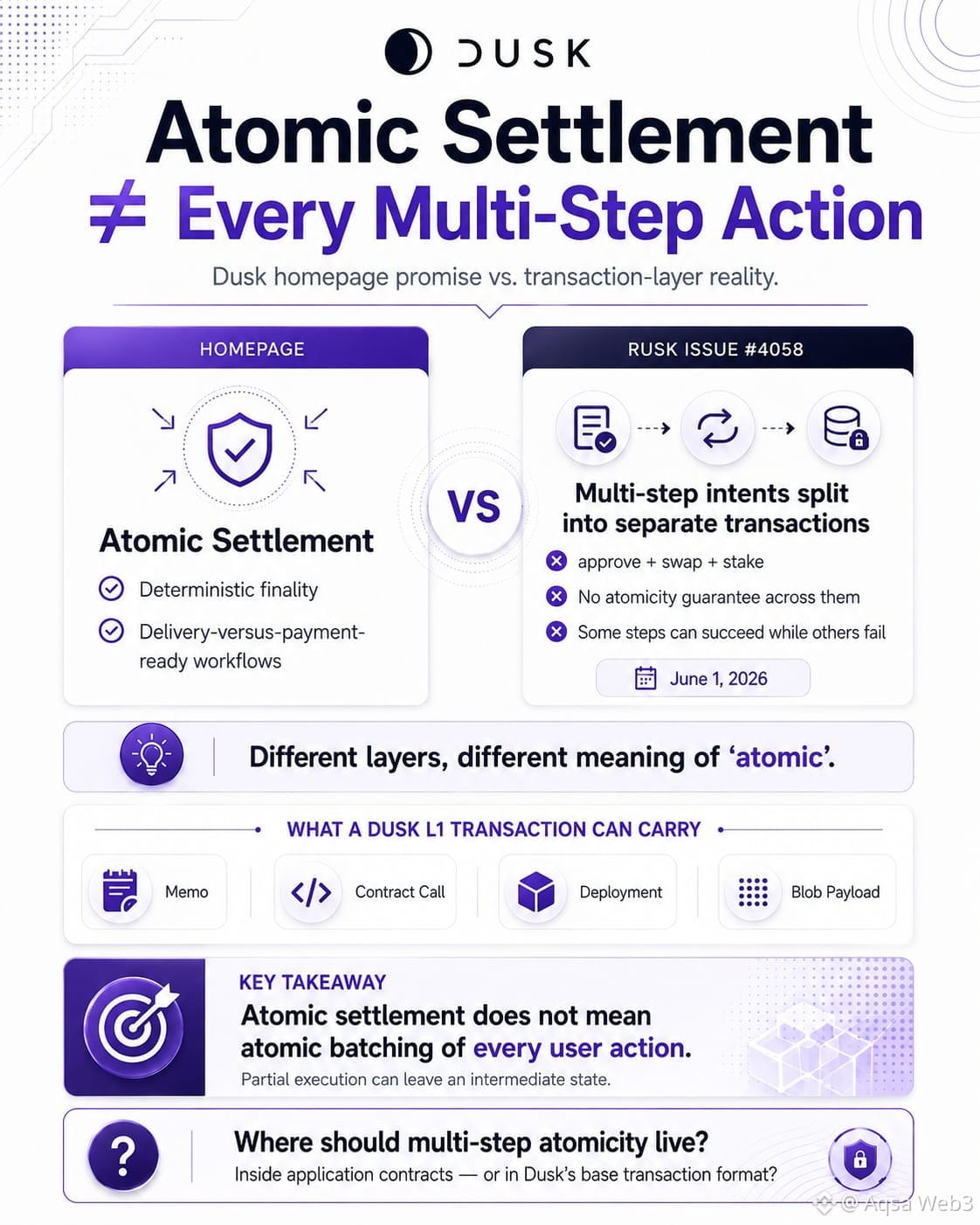
Then I found a distinction in Dusk’s own docs.
The current transaction lifecycle page says a Dusk L1 transaction can carry one of a memo contract call deployment or blob payload.
Open Rusk Issue #4058, filed June 1 2026, makes the consequence explicit multi step intents such as approve + swap + stake must be split into independent transactions with no atomicity guarantee across them. Some steps can succeed while others fail.
At first that sounded like a contradiction.
It isn’t.
Dusk’s homepage uses “Atomic Settlement” specifically for deterministic finality and delivery versus payment ready workflows between assets and payments. Issue #4058 is about batching arbitrary multi-operation user intents at the transaction layer.
That changed how I read the word “atomic.”
Atomic settlement ≠ atomic batching of every user action.
To be fair the limitation is public and the open issue already discusses two possible paths including a batcher contract that would revert sub calls as one unit.
For regulated workflows partial execution can leave an intermediate state.
So should multi step atomicity live inside application contracts or become a native property of Dusk’s transaction format?
@Dusk #dusk $DUSK
Then I found a distinction in Dusk’s own docs.
The current transaction lifecycle page says a Dusk L1 transaction can carry one of a memo contract call deployment or blob payload.
Open Rusk Issue #4058, filed June 1 2026, makes the consequence explicit multi step intents such as approve + swap + stake must be split into independent transactions with no atomicity guarantee across them. Some steps can succeed while others fail.
At first that sounded like a contradiction.
It isn’t.
Dusk’s homepage uses “Atomic Settlement” specifically for deterministic finality and delivery versus payment ready workflows between assets and payments. Issue #4058 is about batching arbitrary multi-operation user intents at the transaction layer.
That changed how I read the word “atomic.”
Atomic settlement ≠ atomic batching of every user action.
To be fair the limitation is public and the open issue already discusses two possible paths including a batcher contract that would revert sub calls as one unit.
For regulated workflows partial execution can leave an intermediate state.
So should multi step atomicity live inside application contracts or become a native property of Dusk’s transaction format?
@Dusk #dusk $DUSK
ຢືນຢັນແລ້ວ
#dusk $DUSK @Dusk I opened DuskEVM’s current reference docs expecting a routine transaction-handling detail.
One line changed how I read its MEV protection.
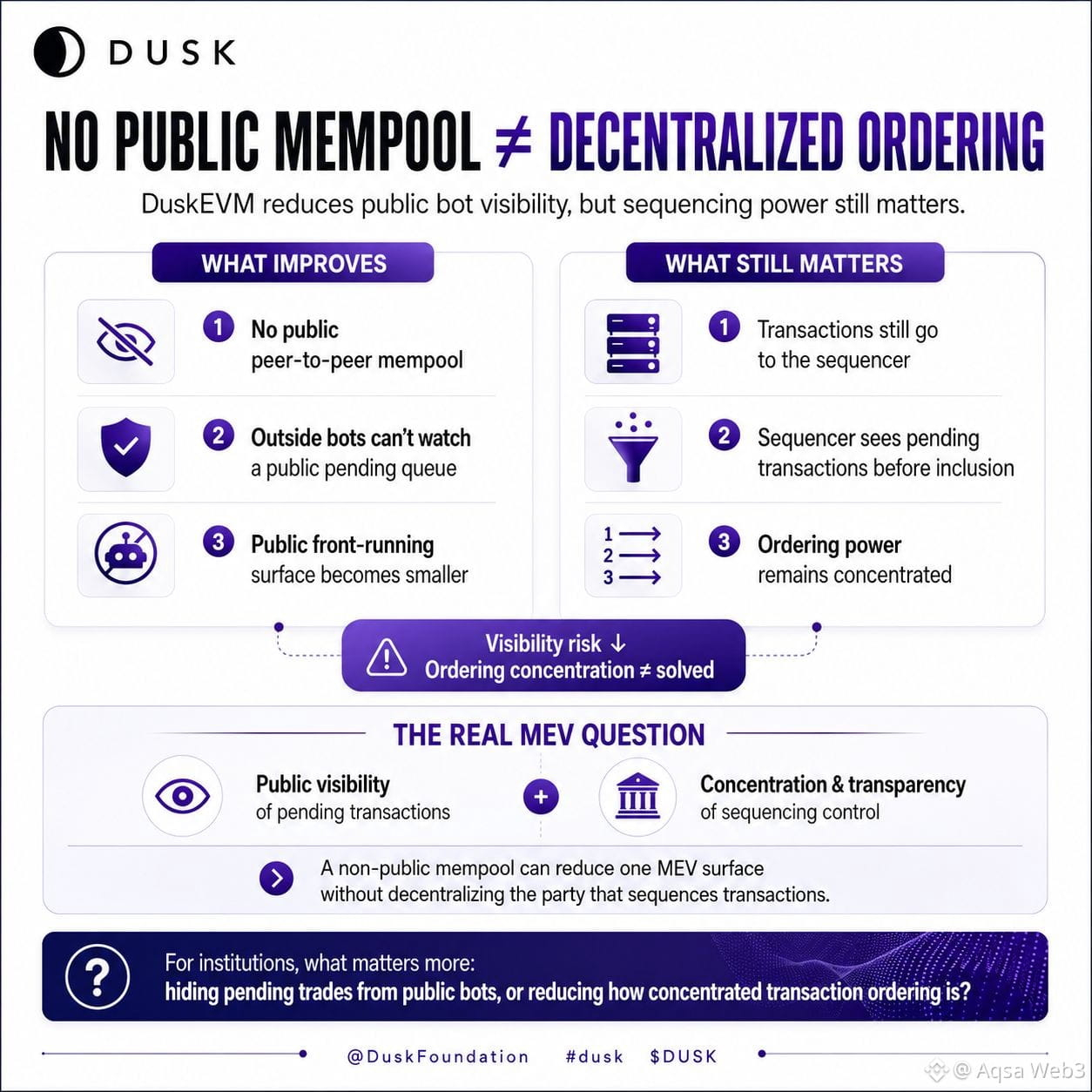
DuskEVM uses centralized sequencing. Transactions are sent to the sequencer instead of being broadcast through a public peer to peer mempool.
That removes a familiar information source for public mempool bots.
An outside bot cannot simply watch a public queue of pending DuskEVM transactions and react to what it sees before inclusion.
That is a real protection.
But it solves transaction visibility not sequencing concentration.
DuskEVM is built on the OP Stack whose standard model keeps the mempool non public and visible to the sequencer.
So the MEV question changes.
Instead of only asking “Can outsiders see my pending trade?” I would also ask Who has privileged pre inclusion visibility and control over sequencing?
That does not mean the sequencer is exploiting that position.
It means non public transaction flow and decentralized ordering are two different properties.
For $DUSK I would track them separately public visibility of pending transactions and the concentration and transparency of sequencing control.
Removing the public mempool can reduce one MEV surface without decentralizing the party that sequences transactions.
For institutions what matters more hiding pending trades from public bots or reducing how concentrated transaction ordering is?
@Dusk #dusk $DUSK
One line changed how I read its MEV protection.
DuskEVM uses centralized sequencing. Transactions are sent to the sequencer instead of being broadcast through a public peer to peer mempool.
That removes a familiar information source for public mempool bots.
An outside bot cannot simply watch a public queue of pending DuskEVM transactions and react to what it sees before inclusion.
That is a real protection.
But it solves transaction visibility not sequencing concentration.
DuskEVM is built on the OP Stack whose standard model keeps the mempool non public and visible to the sequencer.
So the MEV question changes.
Instead of only asking “Can outsiders see my pending trade?” I would also ask Who has privileged pre inclusion visibility and control over sequencing?
That does not mean the sequencer is exploiting that position.
It means non public transaction flow and decentralized ordering are two different properties.
For $DUSK I would track them separately public visibility of pending transactions and the concentration and transparency of sequencing control.
Removing the public mempool can reduce one MEV surface without decentralizing the party that sequences transactions.
For institutions what matters more hiding pending trades from public bots or reducing how concentrated transaction ordering is?
@Dusk #dusk $DUSK
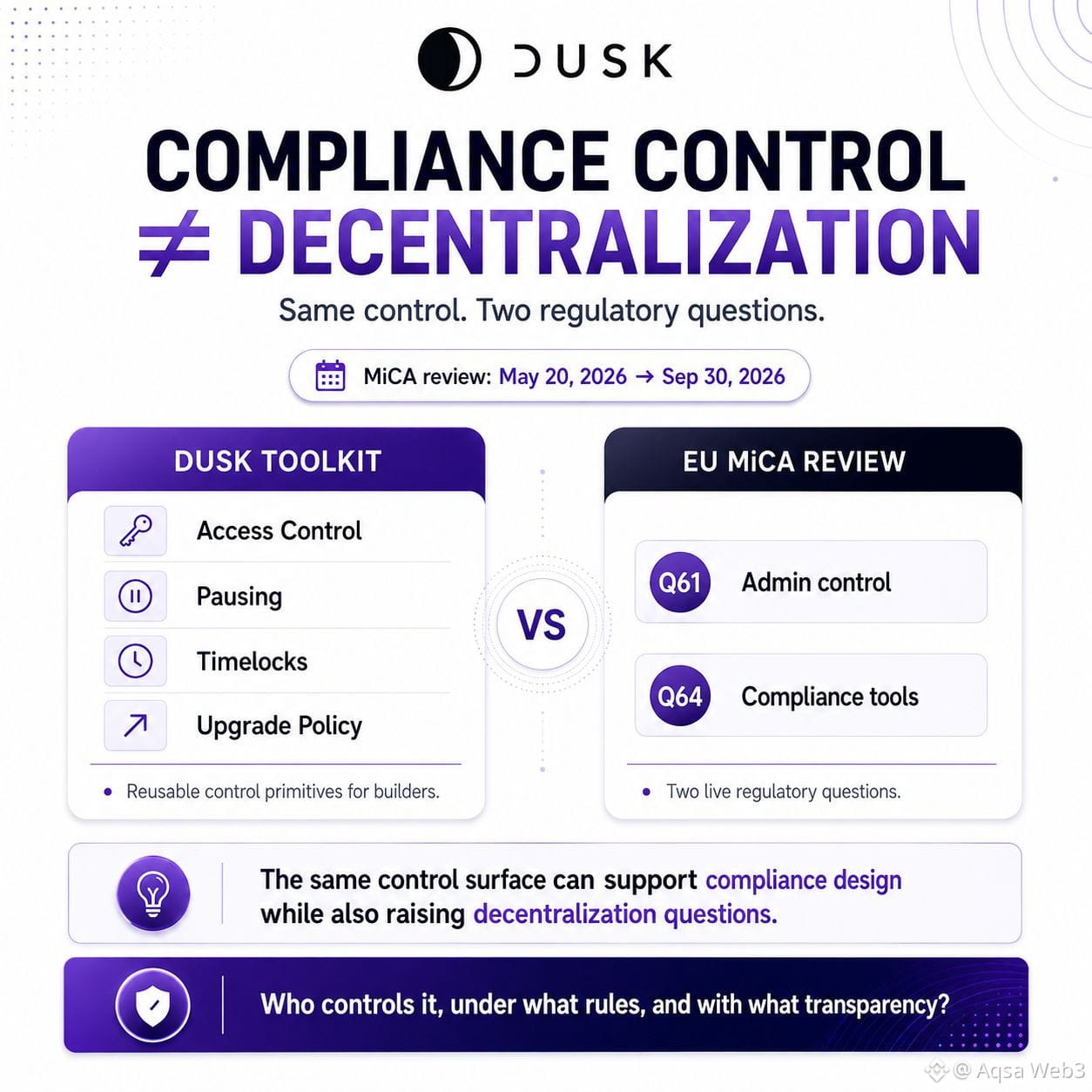
#dusk $DUSK @Dusk I used to think compliance controls and decentralization were mostly separate design questions.
Then I read Dusk’s contract standards beside an EU consultation that is live right now.
The European Commission opened its MiCA review consultation on May 20, 2026, and its live consultation page now shows an extended deadline of September 30.
Dusk’s official contracts repository gives developers reusable primitives for access control tokens pausing timelocks and upgrade policy.
Question 61 looks at control from another direction.
It asks whether an identifiable person or group controlling key DeFi functions for example through admin keys should help determine whether an application is fully decentralized.
Question 64 then asks whether DeFi protocols that are not fully decentralized should integrate specific compliance tools to obtain certification.
Those questions do not classify Dusk nor do they say Dusk’s primitives are those compliance tools.
But they changed how I see the trade off.
More controllability can support compliance oriented design while creating a governance surface regulators may examine when judging decentralization.
To be fair, offering these primitives does not make an application centralized. What matters is how they are used and governed.
For regulated onchain finance, should admin power be judged by whether it exists or by who can exercise it under what rules and with what transparency?
@Dusk #dusk $DUSK
Then I read Dusk’s contract standards beside an EU consultation that is live right now.
The European Commission opened its MiCA review consultation on May 20, 2026, and its live consultation page now shows an extended deadline of September 30.
Dusk’s official contracts repository gives developers reusable primitives for access control tokens pausing timelocks and upgrade policy.
Question 61 looks at control from another direction.
It asks whether an identifiable person or group controlling key DeFi functions for example through admin keys should help determine whether an application is fully decentralized.
Question 64 then asks whether DeFi protocols that are not fully decentralized should integrate specific compliance tools to obtain certification.
Those questions do not classify Dusk nor do they say Dusk’s primitives are those compliance tools.
But they changed how I see the trade off.
More controllability can support compliance oriented design while creating a governance surface regulators may examine when judging decentralization.
To be fair, offering these primitives does not make an application centralized. What matters is how they are used and governed.
For regulated onchain finance, should admin power be judged by whether it exists or by who can exercise it under what rules and with what transparency?
@Dusk #dusk $DUSK
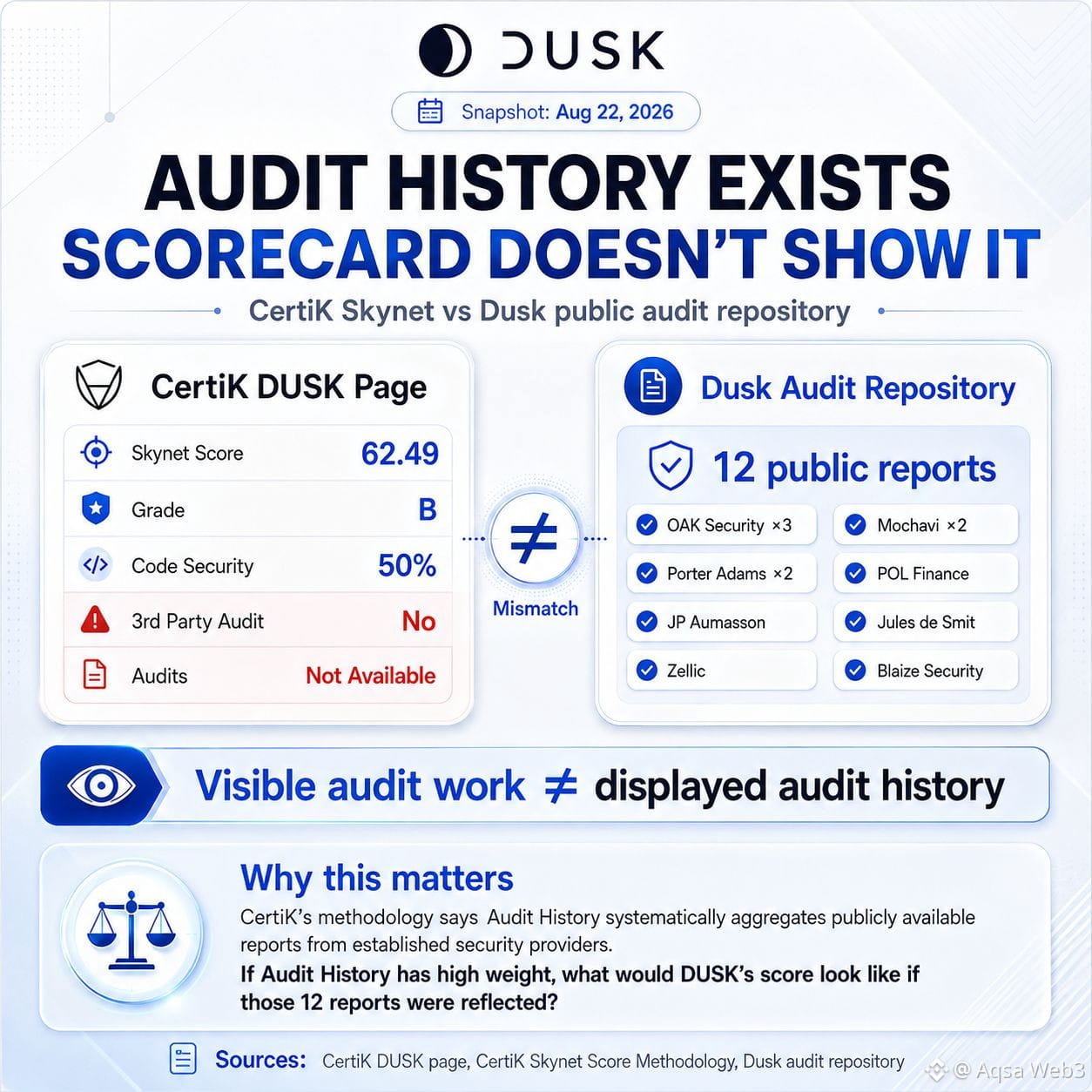
#dusk $DUSK @Dusk I checked CertiK’s Skynet page for DUSK on August 22 expecting its audit history to show up somewhere in the score.
Instead I found a strange mismatch.
DUSK currently shows
Skynet Score: 62.49
Grade: B
Code Security: 50%
3rd Party Audit: No
Audits: Not Available
But Dusk’s official public audit repository currently lists 12 reports.
That includes reviews from OAK Security, JP Aumasson POL Finance Jules de Smit Zellic Porter Adams Blaize Security and Mochavi.
The surprising part is CertiK’s own methodology.
It says Audit History systematically aggregates publicly available reports from established security providers.
So this isn’t simply a case of outside audits being irrelevant to the methodology.
That makes the current “3rd Party Audit No” display difficult to reconcile with Dusk’s public repository.
To be fair, an audit count alone does not prove a protocol is secure, and CertiK’s overall score measures far more than audits.
But “3rd Party Audit No” communicates something much narrower and Dusk’s public audit record does not appear to match it.
The security work is visible.
The scorecard currently isn’t displaying it.
If audit history carries high weight in Code Security, how would DUSK’s score change if those 12 reports were reflected in Skynet’s Audit History?
@Dusk #dusk $DUSK
Instead I found a strange mismatch.
DUSK currently shows
Skynet Score: 62.49
Grade: B
Code Security: 50%
3rd Party Audit: No
Audits: Not Available
But Dusk’s official public audit repository currently lists 12 reports.
That includes reviews from OAK Security, JP Aumasson POL Finance Jules de Smit Zellic Porter Adams Blaize Security and Mochavi.
The surprising part is CertiK’s own methodology.
It says Audit History systematically aggregates publicly available reports from established security providers.
So this isn’t simply a case of outside audits being irrelevant to the methodology.
That makes the current “3rd Party Audit No” display difficult to reconcile with Dusk’s public repository.
To be fair, an audit count alone does not prove a protocol is secure, and CertiK’s overall score measures far more than audits.
But “3rd Party Audit No” communicates something much narrower and Dusk’s public audit record does not appear to match it.
The security work is visible.
The scorecard currently isn’t displaying it.
If audit history carries high weight in Code Security, how would DUSK’s score change if those 12 reports were reflected in Skynet’s Audit History?
@Dusk #dusk $DUSK
ຢືນຢັນແລ້ວ
#termmax @TermMax
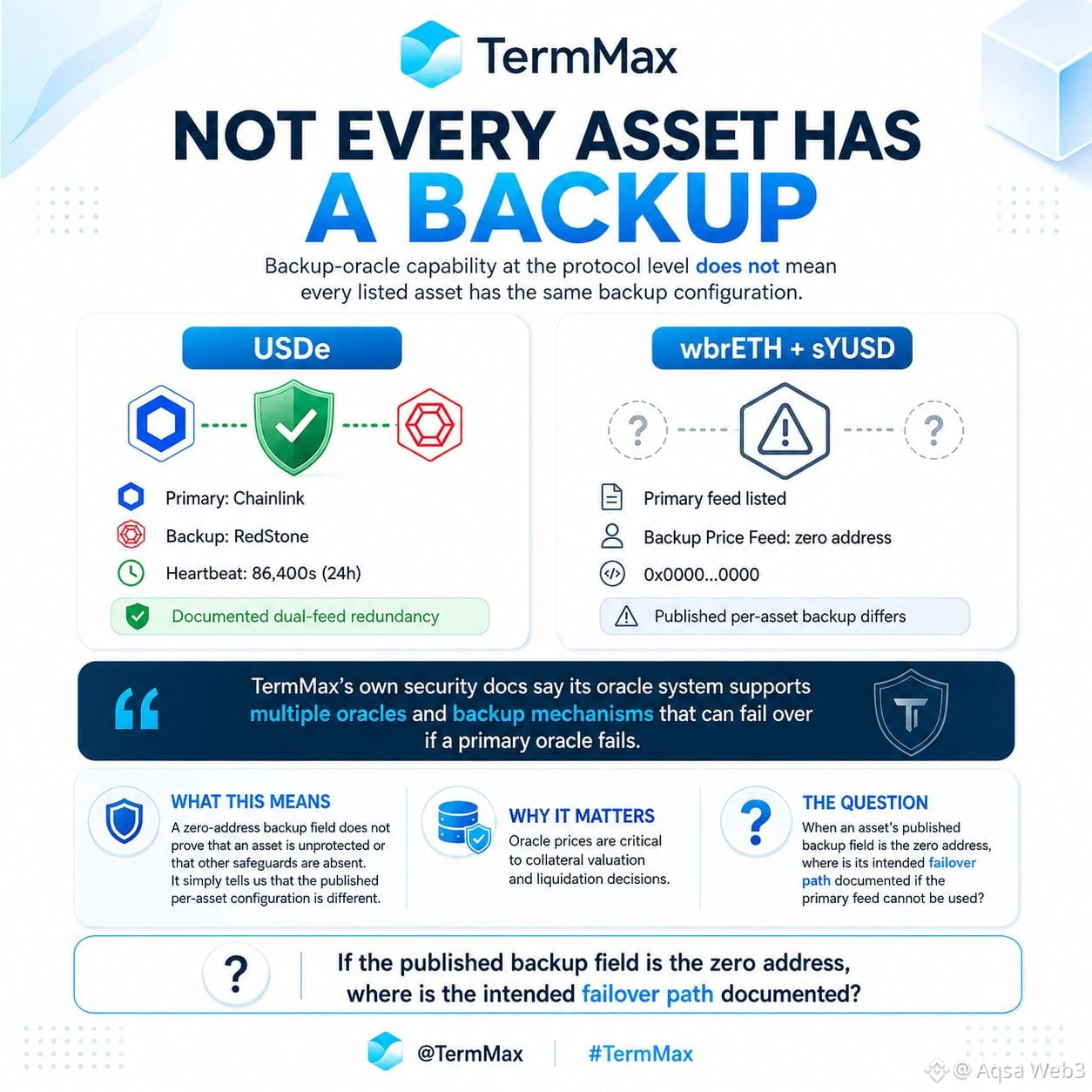
I went into TermMax’s oracle docs assuming “backup oracle support” meant every listed asset had a configured backup.
Then I started opening the individual asset pages.
That assumption didn’t hold.
@TermMax ’s own security docs say its oracle system supports multiple oracles and backup mechanisms that can fail over if a primary oracle fails.
USDe clearly uses that redundancy.
TermMax documents Chainlink as its primary feed, RedStone as its backup, and an 86,400 second (24-hour) heartbeat.
But the setup is not uniform.
On TermMax’s published Ethereum oracle pages wbrETH and sYUSD both list a primary price feed while the published Backup Price Feed is the zero address (0x0000...0000).
That changed how I read oracle redundancy.
Backup oracle capability at the protocol level does not mean every listed asset has the same backup configuration.
To be fair a zero address backup field does not prove that an asset is unprotected or that other safeguards are absent.
It simply tells me that the published per asset configuration is different.
And that matters because TermMax’s own security docs describe oracle prices as critical to collateral valuation and liquidation decisions.
So the question I’m left with is:
When an asset’s published backup field is the zero address, where is its intended failover path documented if the primary feed cannot be used?
@TermMax #TermMax
I went into TermMax’s oracle docs assuming “backup oracle support” meant every listed asset had a configured backup.
Then I started opening the individual asset pages.
That assumption didn’t hold.
@TermMax ’s own security docs say its oracle system supports multiple oracles and backup mechanisms that can fail over if a primary oracle fails.
USDe clearly uses that redundancy.
TermMax documents Chainlink as its primary feed, RedStone as its backup, and an 86,400 second (24-hour) heartbeat.
But the setup is not uniform.
On TermMax’s published Ethereum oracle pages wbrETH and sYUSD both list a primary price feed while the published Backup Price Feed is the zero address (0x0000...0000).
That changed how I read oracle redundancy.
Backup oracle capability at the protocol level does not mean every listed asset has the same backup configuration.
To be fair a zero address backup field does not prove that an asset is unprotected or that other safeguards are absent.
It simply tells me that the published per asset configuration is different.
And that matters because TermMax’s own security docs describe oracle prices as critical to collateral valuation and liquidation decisions.
So the question I’m left with is:
When an asset’s published backup field is the zero address, where is its intended failover path documented if the primary feed cannot be used?
@TermMax #TermMax
ຢືນຢັນແລ້ວ
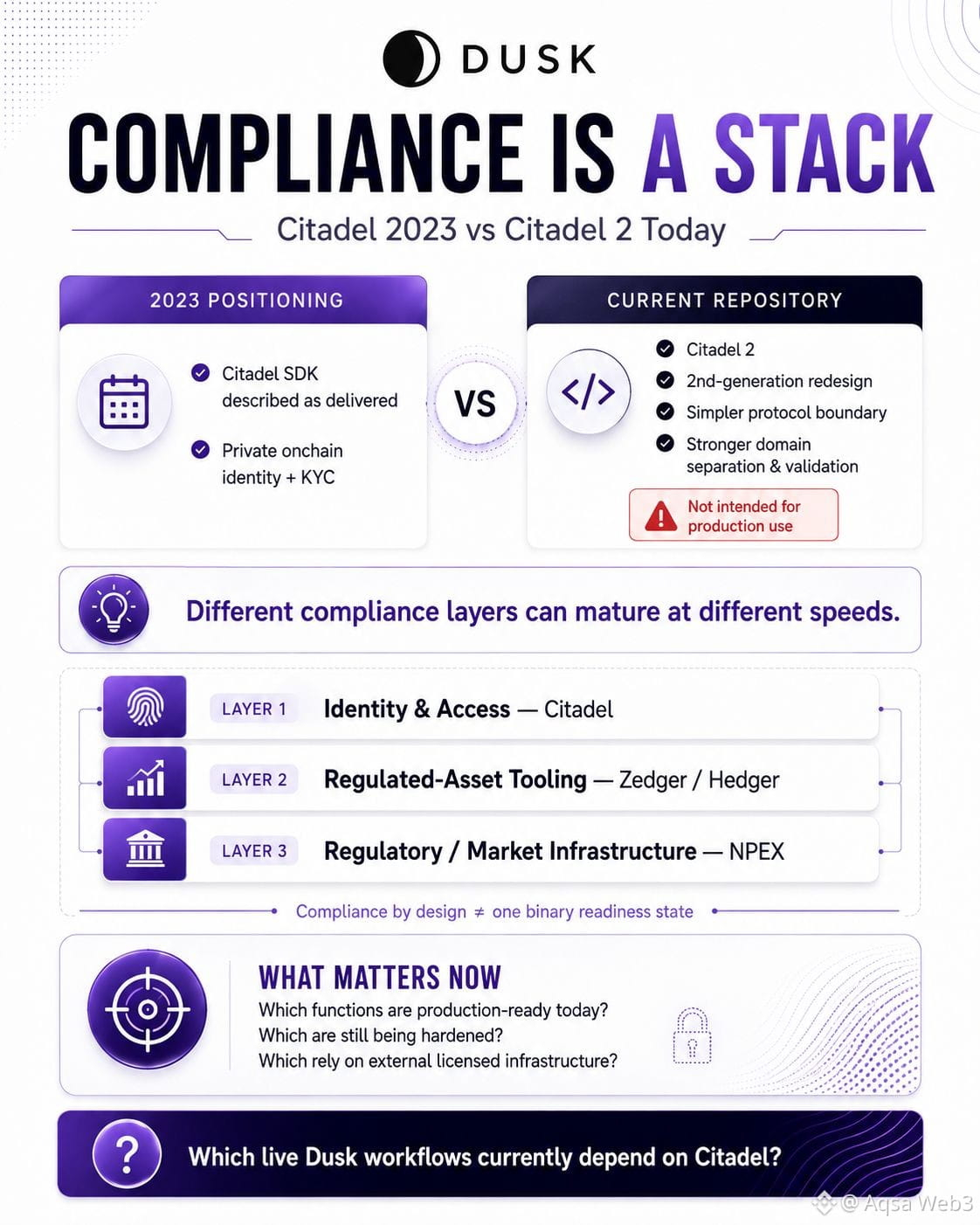
#dusk $DUSK @Dusk I went back to Citadel because Dusk has talked about privacy preserving KYC since 2023, and I expected that part of the compliance stack to be fairly mature by now.
The current repository made me rethink that.
In 2023 @Dusk described the Citadel SDK as a delivered mainnet roadmap component for private, onchain identity and KYC.
Today, the repository is labeled Citadel 2.
Dusk describes it as a second-generation redesign with a simpler protocol boundary, stronger domain separation and validation rules, and a clearer security model.
Then comes the important disclaimer:
the current code has not undergone an exhaustive security review and is not intended for production use.
That is not necessarily a negative.
Rebuilding an identity protocol around a cleaner security model can be more responsible than treating an earlier design as finished.
But it exposes a distinction I think matters.
Compliance by design is a stack not a single readiness state.
Dusk’s current architecture separates identity and access through Citadel from regulated asset tooling such as Zedger/Hedger while partnerships such as NPEX provide another regulatory and market infrastructure layer.
Those pieces do not necessarily mature at the same speed.
So for $DUSK , I would rather know which compliance functions are production-ready today, which are still being hardened, and which depend on external licensed infrastructure.
Citadel 2 may strengthen the long term identity layer.
Which live Dusk workflows currently depend on Citadel and which compliance functions already work without it?
@Dusk
The current repository made me rethink that.
In 2023 @Dusk described the Citadel SDK as a delivered mainnet roadmap component for private, onchain identity and KYC.
Today, the repository is labeled Citadel 2.
Dusk describes it as a second-generation redesign with a simpler protocol boundary, stronger domain separation and validation rules, and a clearer security model.
Then comes the important disclaimer:
the current code has not undergone an exhaustive security review and is not intended for production use.
That is not necessarily a negative.
Rebuilding an identity protocol around a cleaner security model can be more responsible than treating an earlier design as finished.
But it exposes a distinction I think matters.
Compliance by design is a stack not a single readiness state.
Dusk’s current architecture separates identity and access through Citadel from regulated asset tooling such as Zedger/Hedger while partnerships such as NPEX provide another regulatory and market infrastructure layer.
Those pieces do not necessarily mature at the same speed.
So for $DUSK , I would rather know which compliance functions are production-ready today, which are still being hardened, and which depend on external licensed infrastructure.
Citadel 2 may strengthen the long term identity layer.
Which live Dusk workflows currently depend on Citadel and which compliance functions already work without it?
@Dusk
ຢືນຢັນແລ້ວ
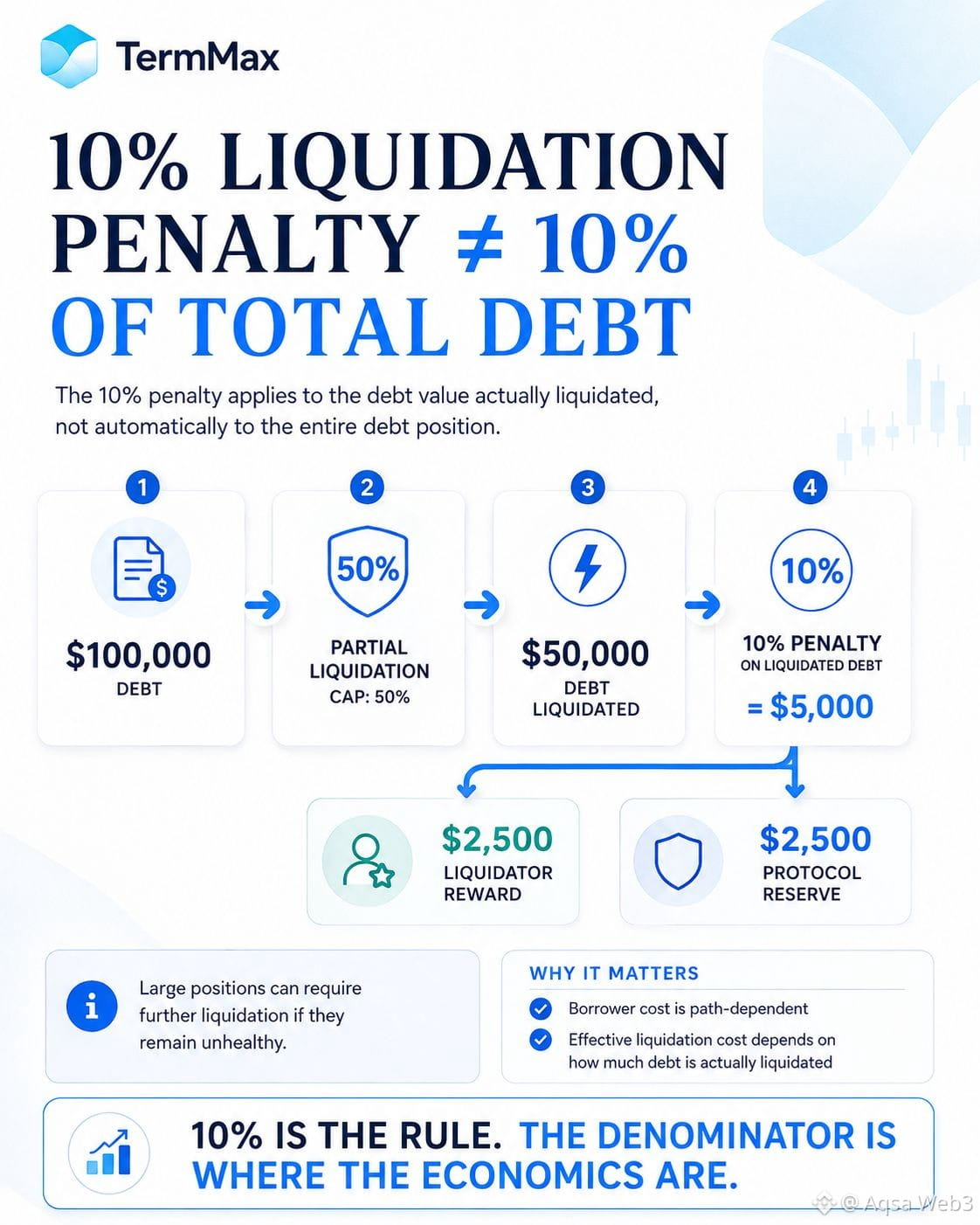
#termmax @TermMax I saw TermMax’s 10% liquidation penalty and initially read it the obvious way
$100,000 of debt could mean a $10,000 liquidation penalty.
Then I checked what the 10% is actually applied to.
According to TermMax’s own docs the penalty is calculated on the debt value that gets liquidated, not automatically on the borrower’s entire outstanding debt.
There is another rule that changes the economics too.
If outstanding debt exceeds $10,000, a single partial liquidation can cover at most 50% of the total debt value.
Take a $100,000 debt position as an example.
If one partial liquidation used the full 50% cap $50,000 of debt would be liquidated.
The 10% penalty on that amount, split 5% to the liquidator and 5% to the protocol reserve, comes to $5,000 total
$2,500 each.
So the headline is 10%.
But in this example, that 10% is applied to half the original debt in a single event not the whole position at once.
That doesn’t make liquidation cheap.
Further rounds can still follow if the position stays unhealthy, and how much collateral actually gets pulled depends on live prices and TermMax’s liquidation formula.
10% is the rate.
The denominator is where the real cost sits.
Does the 50% cap meaningfully soften the hit for large borrowers, or mostly spread the same cost across more liquidation events?
#TermMax $TMX
$100,000 of debt could mean a $10,000 liquidation penalty.
Then I checked what the 10% is actually applied to.
According to TermMax’s own docs the penalty is calculated on the debt value that gets liquidated, not automatically on the borrower’s entire outstanding debt.
There is another rule that changes the economics too.
If outstanding debt exceeds $10,000, a single partial liquidation can cover at most 50% of the total debt value.
Take a $100,000 debt position as an example.
If one partial liquidation used the full 50% cap $50,000 of debt would be liquidated.
The 10% penalty on that amount, split 5% to the liquidator and 5% to the protocol reserve, comes to $5,000 total
$2,500 each.
So the headline is 10%.
But in this example, that 10% is applied to half the original debt in a single event not the whole position at once.
That doesn’t make liquidation cheap.
Further rounds can still follow if the position stays unhealthy, and how much collateral actually gets pulled depends on live prices and TermMax’s liquidation formula.
10% is the rate.
The denominator is where the real cost sits.
Does the 50% cap meaningfully soften the hit for large borrowers, or mostly spread the same cost across more liquidation events?
#TermMax $TMX
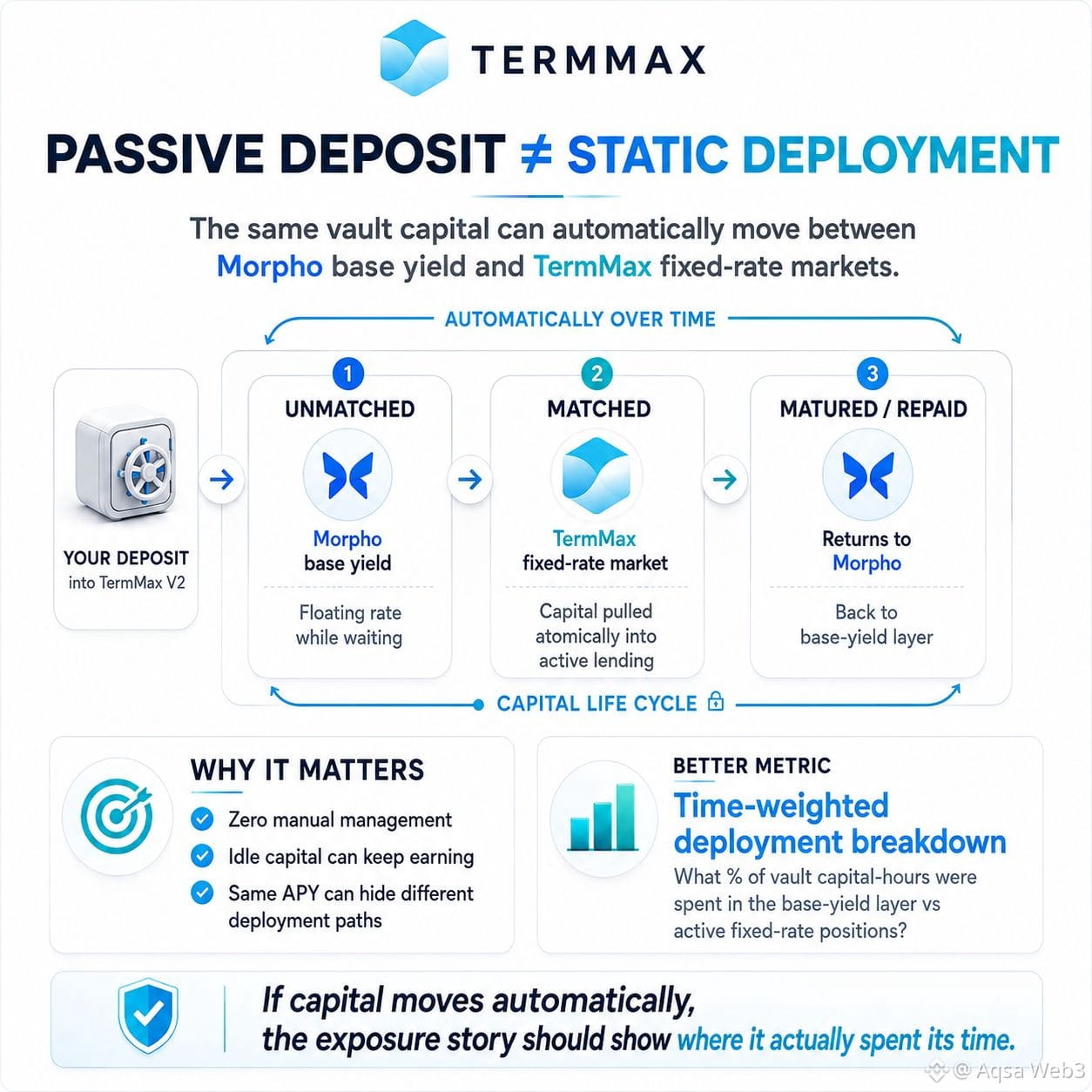
#termmax @TermMax I assumed that once I deposited into a TermMax vault the underlying deployment of my capital stayed basically the same until I withdrew.
Then I looked at how Composable Base Yield actually works.
If a curator selects Morpho as the base yield source unmatched USDC is automatically deployed there and earns a floating rate.
When a borrower fills the TermMax order that same capital is pulled from Morpho atomically and lent into the fixed rate market.
When the position matures or is repaid the capital returns to Morpho.
So the depositor may do nothing, while the underlying deployment of the same vault capital changes over time.
That is the part I find more interesting than the extra yield.
To TermMax’s credit this solves a real V1 problem unmatched capital previously sat idle and dragged on effective APY.
But zero manual management also means the depositor’s exposure is not explained by one static label.
It depends partly on how much time the vault spends unmatched in its base yield source versus matched into TermMax markets.
For $TMX I would want to see a time weighted deployment breakdown what percentage of vault capital hours were spent in the external base yield layer versus active fixed rate positions?
Two vaults could show similar APY while reaching it through very different deployment paths.
If the capital moves automatically, shouldn’t the exposure breakdown show where it actually spent its time?
Then I looked at how Composable Base Yield actually works.
If a curator selects Morpho as the base yield source unmatched USDC is automatically deployed there and earns a floating rate.
When a borrower fills the TermMax order that same capital is pulled from Morpho atomically and lent into the fixed rate market.
When the position matures or is repaid the capital returns to Morpho.
So the depositor may do nothing, while the underlying deployment of the same vault capital changes over time.
That is the part I find more interesting than the extra yield.
To TermMax’s credit this solves a real V1 problem unmatched capital previously sat idle and dragged on effective APY.
But zero manual management also means the depositor’s exposure is not explained by one static label.
It depends partly on how much time the vault spends unmatched in its base yield source versus matched into TermMax markets.
For $TMX I would want to see a time weighted deployment breakdown what percentage of vault capital hours were spent in the external base yield layer versus active fixed rate positions?
Two vaults could show similar APY while reaching it through very different deployment paths.
If the capital moves automatically, shouldn’t the exposure breakdown show where it actually spent its time?
ຢືນຢັນແລ້ວ
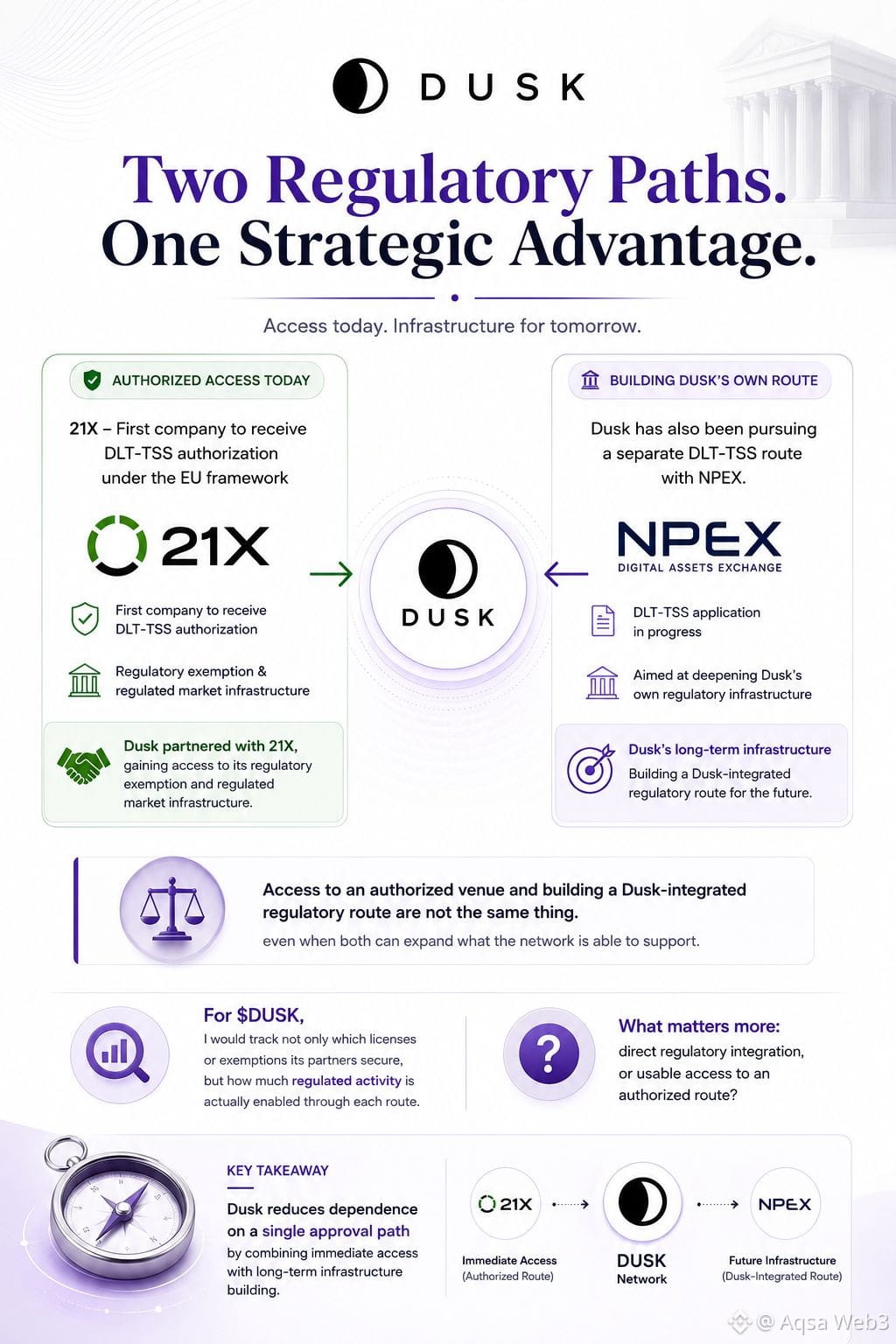
#dusk $DUSK @Dusk I had been reading Dusk’s regulatory strategy as a straight race toward being first.
One of Dusk’s own announcements made me rethink that.
21X became the first company to receive a DLT TSS authorization under the EU framework. Dusk then partnered with 21X, gaining access to its regulatory exemption and regulated market infrastructure.
Dusk has also been pursuing a separate DLT TSS route with NPEX.
That creates an interesting distinction.
Dusk does not need to wait for one regulatory path before building through another.
Access through 21X gives it a route into an already authorized framework while the NPEX path aims to deepen Dusk’s own regulatory infrastructure.
That looks less like losing a regulatory race and more like reducing dependence on a single approval path.
But it also changes how I would measure Dusk’s regulatory progress.
Access to an authorized venue and building a Dusk integrated regulatory route are not the same thing, even when both can expand what the network is able to support.
For $DUSK I would track not only which licenses or exemptions its partners secure, but how much regulated activity is actually enabled through each route.
What matters more direct regulatory integration or usable access to an authorized route?
One of Dusk’s own announcements made me rethink that.
21X became the first company to receive a DLT TSS authorization under the EU framework. Dusk then partnered with 21X, gaining access to its regulatory exemption and regulated market infrastructure.
Dusk has also been pursuing a separate DLT TSS route with NPEX.
That creates an interesting distinction.
Dusk does not need to wait for one regulatory path before building through another.
Access through 21X gives it a route into an already authorized framework while the NPEX path aims to deepen Dusk’s own regulatory infrastructure.
That looks less like losing a regulatory race and more like reducing dependence on a single approval path.
But it also changes how I would measure Dusk’s regulatory progress.
Access to an authorized venue and building a Dusk integrated regulatory route are not the same thing, even when both can expand what the network is able to support.
For $DUSK I would track not only which licenses or exemptions its partners secure, but how much regulated activity is actually enabled through each route.
What matters more direct regulatory integration or usable access to an authorized route?
ຢືນຢັນແລ້ວ
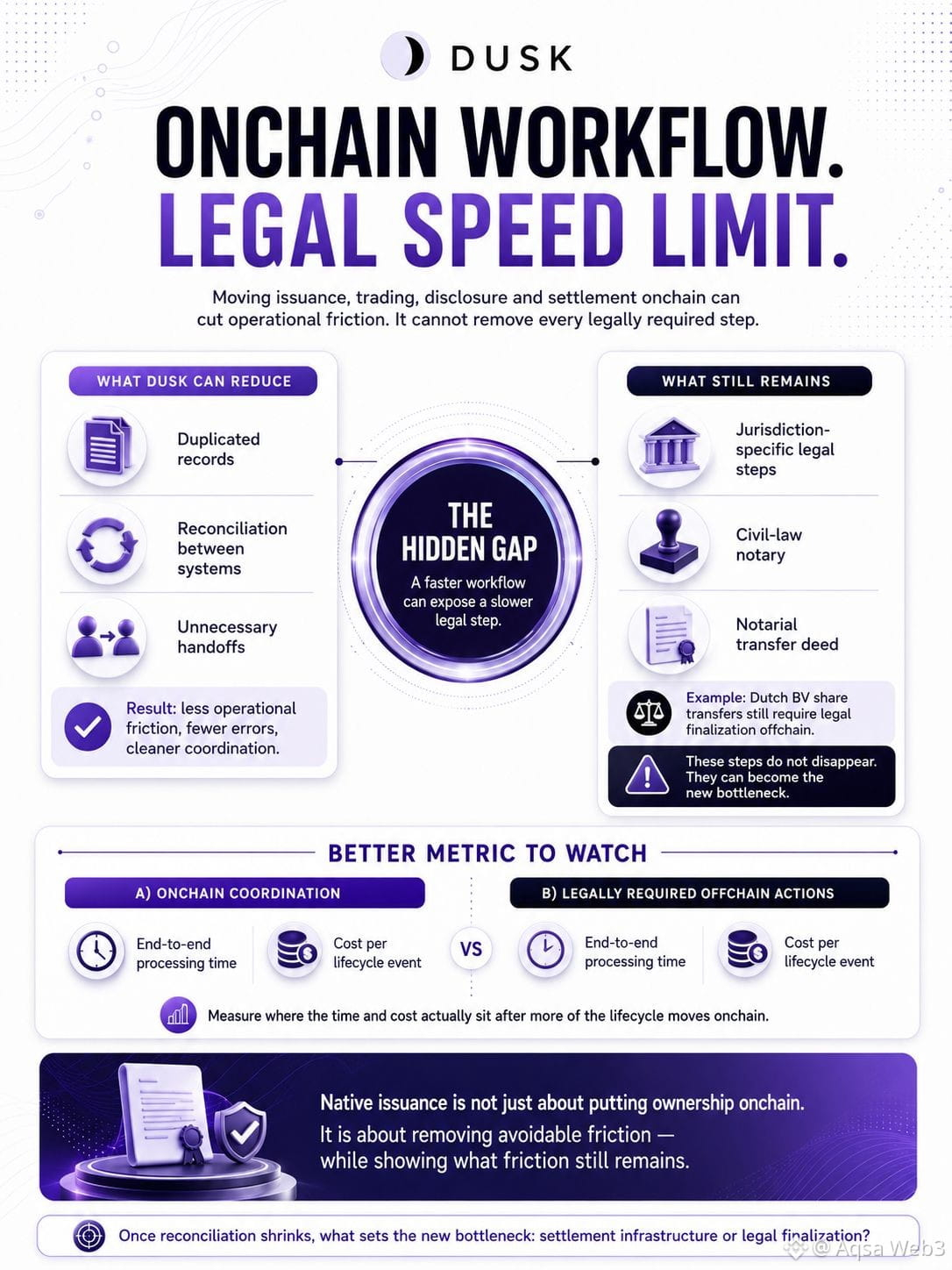
I kept coming back to one question while reading Dusk’s material on NPEX
If more of the market workflow moves onchain what is left setting the speed limit?
@Dusk is working to bring issuance, trading disclosure and settlement into one coordinated onchain workflow.
But it cannot move every legal requirement onchain with them.
For Dutch BV shares, for example ownership transfer still requires a civil-law notary and a legally required notarial transfer deed.
That made me look at the value of native issuance differently.
Dusk can reduce duplicated records, reconciliation and unnecessary handoffs between systems.
But as those technical frictions shrink the legally required steps that remain can become a larger share of the total time and cost of completing a transaction.
So I would not measure progress only by asking how much of the lifecycle has moved onchain.
For $DUSK I would rather track end to end processing time and cost for each lifecycle event split between onchain coordination and legally required offchain actions.
That would show whether Dusk is actually removing the dominant bottleneck or simply making the remaining one easier to see.
A shared ledger can compress operational friction.
It cannot compress every legal requirement with it.
Once reconciliation shrinks what sets the new bottleneck settlement infrastructure or legal finalization?
#dusk
If more of the market workflow moves onchain what is left setting the speed limit?
@Dusk is working to bring issuance, trading disclosure and settlement into one coordinated onchain workflow.
But it cannot move every legal requirement onchain with them.
For Dutch BV shares, for example ownership transfer still requires a civil-law notary and a legally required notarial transfer deed.
That made me look at the value of native issuance differently.
Dusk can reduce duplicated records, reconciliation and unnecessary handoffs between systems.
But as those technical frictions shrink the legally required steps that remain can become a larger share of the total time and cost of completing a transaction.
So I would not measure progress only by asking how much of the lifecycle has moved onchain.
For $DUSK I would rather track end to end processing time and cost for each lifecycle event split between onchain coordination and legally required offchain actions.
That would show whether Dusk is actually removing the dominant bottleneck or simply making the remaining one easier to see.
A shared ledger can compress operational friction.
It cannot compress every legal requirement with it.
Once reconciliation shrinks what sets the new bottleneck settlement infrastructure or legal finalization?
#dusk
ຢືນຢັນແລ້ວ
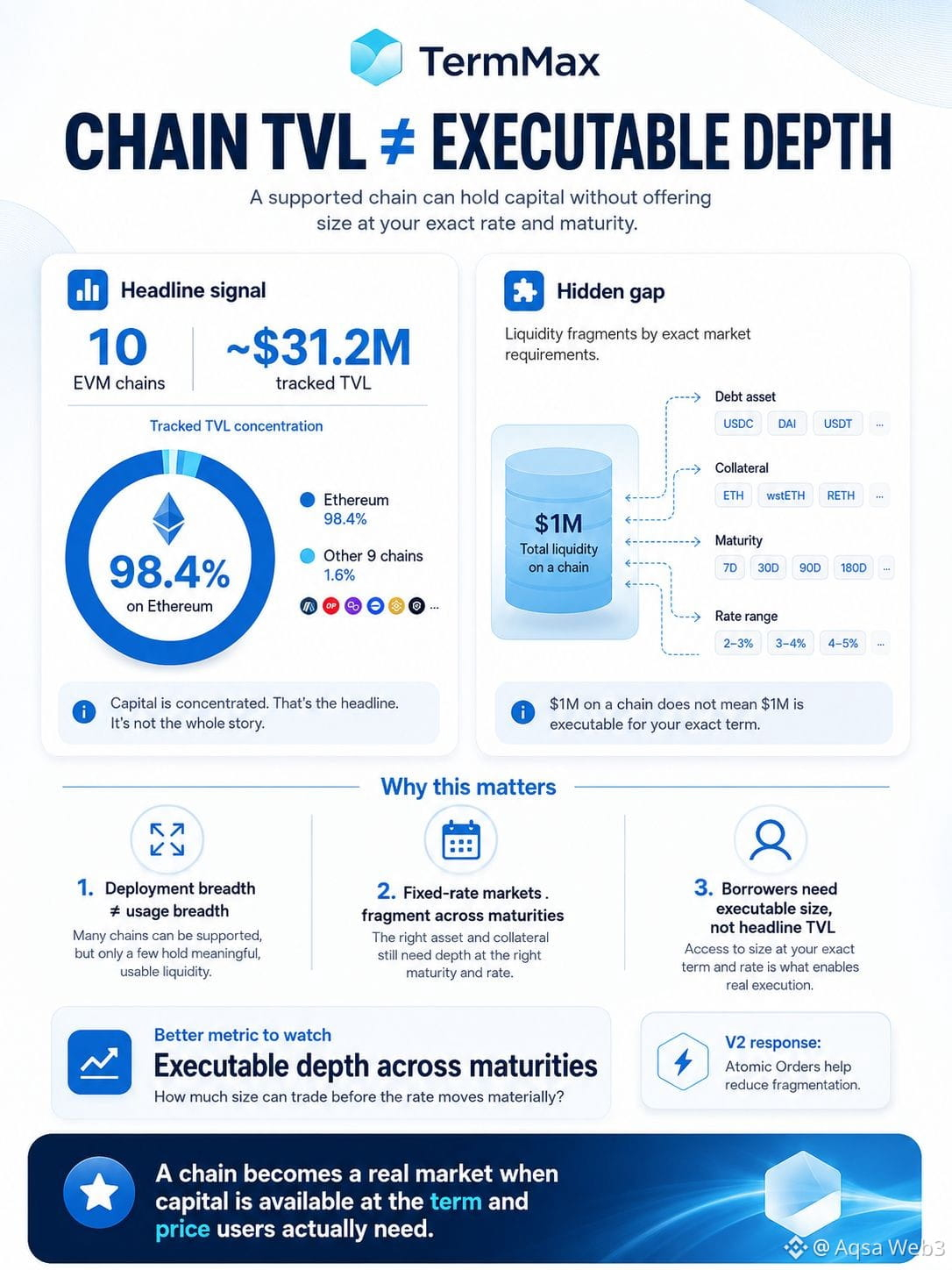
#termmax @TermMax TermMax being live on 10 EVM chains sounds like liquidity is spreading with the protocol. But fixed rate liquidity can fragment even inside a single chain.
@TermMax says it is live on 10 EVM chains while DefiLlama currently tracks 9 of them with real deposits and 98.3% of the $31.25M total sits on Ethereum alone. That already separates deployment from adoption.
But chain TVL still doesn't tell me whether a borrower can actually get the rate and size they want. A TermMax market is defined by a specific debt asset collateral and maturity, with liquidity priced through range orders. So $1M sitting on a chain doesn't mean $1M is executable for your exact term.
TermMax itself identified liquidity fragmentation as a V1 bottleneck. V2's Atomic Orders are designed to make the same vault liquidity available across multiple markets until one order actually consumes it.
That changes the metric I'd watch. Not TVL per chain alone executable depth across maturities how much size can actually trade before the rate moves materially.
A chain can be supported. It can hold capital. But a fixed rate market only becomes useful when that capital is available at the term and price users actually need.
If a chain shows 8 figure TVL but near zero executable depth at your maturity is it really a supported market or just a supported balance sheet?
#TermMax $TMX
@TermMax says it is live on 10 EVM chains while DefiLlama currently tracks 9 of them with real deposits and 98.3% of the $31.25M total sits on Ethereum alone. That already separates deployment from adoption.
But chain TVL still doesn't tell me whether a borrower can actually get the rate and size they want. A TermMax market is defined by a specific debt asset collateral and maturity, with liquidity priced through range orders. So $1M sitting on a chain doesn't mean $1M is executable for your exact term.
TermMax itself identified liquidity fragmentation as a V1 bottleneck. V2's Atomic Orders are designed to make the same vault liquidity available across multiple markets until one order actually consumes it.
That changes the metric I'd watch. Not TVL per chain alone executable depth across maturities how much size can actually trade before the rate moves materially.
A chain can be supported. It can hold capital. But a fixed rate market only becomes useful when that capital is available at the term and price users actually need.
If a chain shows 8 figure TVL but near zero executable depth at your maturity is it really a supported market or just a supported balance sheet?
#TermMax $TMX
ຢືນຢັນແລ້ວ
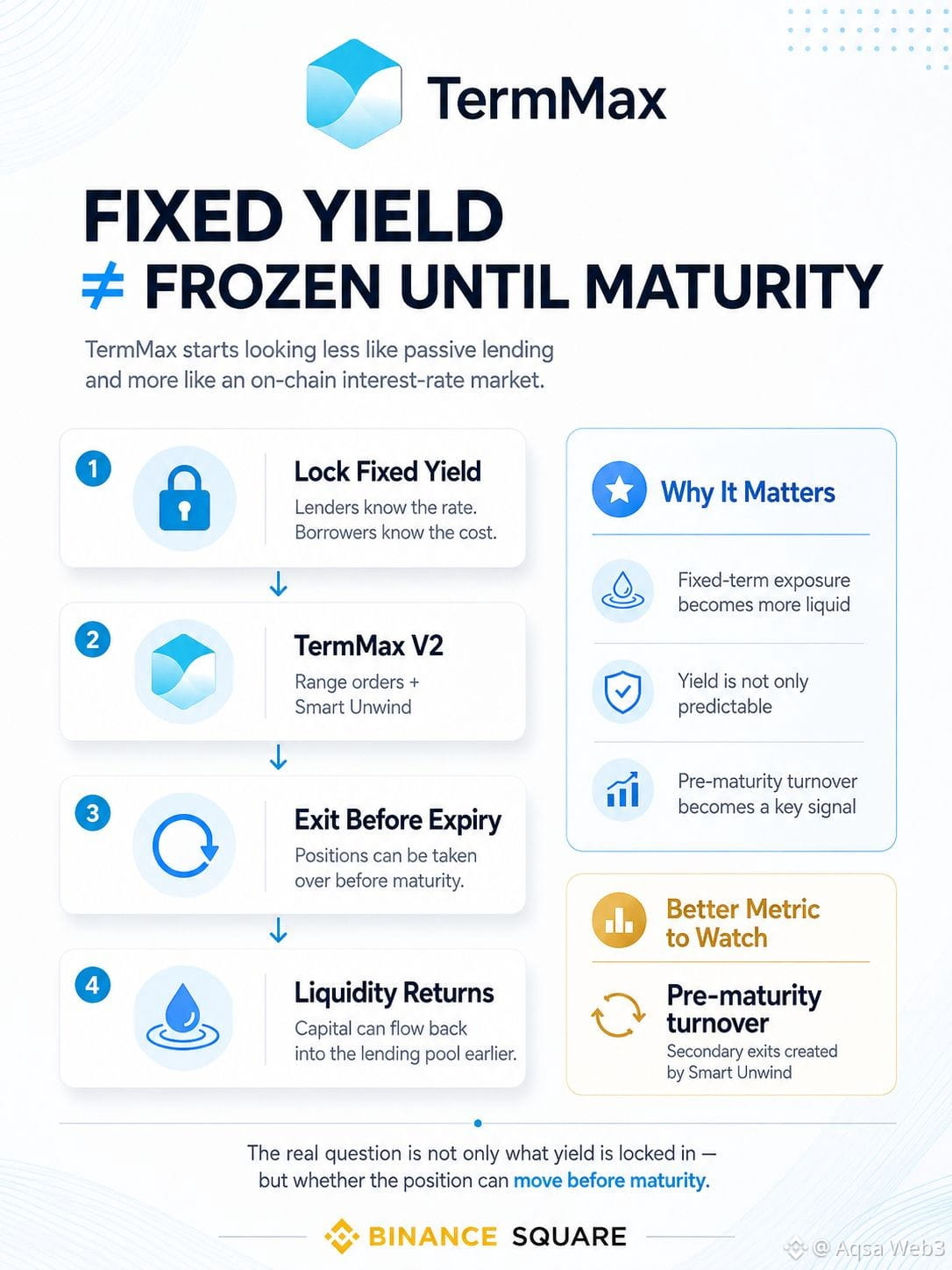
#termmax @TermMax I first looked at TermMax like a normal fixed rate lending market lenders lock yield borrowers lock cost and both wait until maturity.
Then I looked closer at how the market is actually structured.
@TermMax axFi is not just offering fixed rates. Its model is built around an AMM, and its V2 design goes further with Uniswap v3-like range orders plus Smart Unwind which is designed to let positions exit early and turn back into usable liquidity.
That changes the way I think about fixed yield here.
The position is not necessarily something that has to remain economically dormant until maturity.
If another participant is willing to take it over at the right rate or price, Smart Unwind can return the underlying liquidity to the lending pool before the original term ends.
So the edge is not only predictability.
It is the attempt to make fixed term exposure more liquid before expiry.
To me that makes TermMax look less like a passive lending venue and more like an on chain interest rate market.
For $TMX the metric I would watch is not just headline yield, but how much pre maturity turnover Smart Unwind actually creates.
Does fixed yield become more useful when the rate is predictable or when the position no longer has to stay frozen until maturity?
#TermMax
Then I looked closer at how the market is actually structured.
@TermMax axFi is not just offering fixed rates. Its model is built around an AMM, and its V2 design goes further with Uniswap v3-like range orders plus Smart Unwind which is designed to let positions exit early and turn back into usable liquidity.
That changes the way I think about fixed yield here.
The position is not necessarily something that has to remain economically dormant until maturity.
If another participant is willing to take it over at the right rate or price, Smart Unwind can return the underlying liquidity to the lending pool before the original term ends.
So the edge is not only predictability.
It is the attempt to make fixed term exposure more liquid before expiry.
To me that makes TermMax look less like a passive lending venue and more like an on chain interest rate market.
For $TMX the metric I would watch is not just headline yield, but how much pre maturity turnover Smart Unwind actually creates.
Does fixed yield become more useful when the rate is predictable or when the position no longer has to stay frozen until maturity?
#TermMax
ຢືນຢັນແລ້ວ
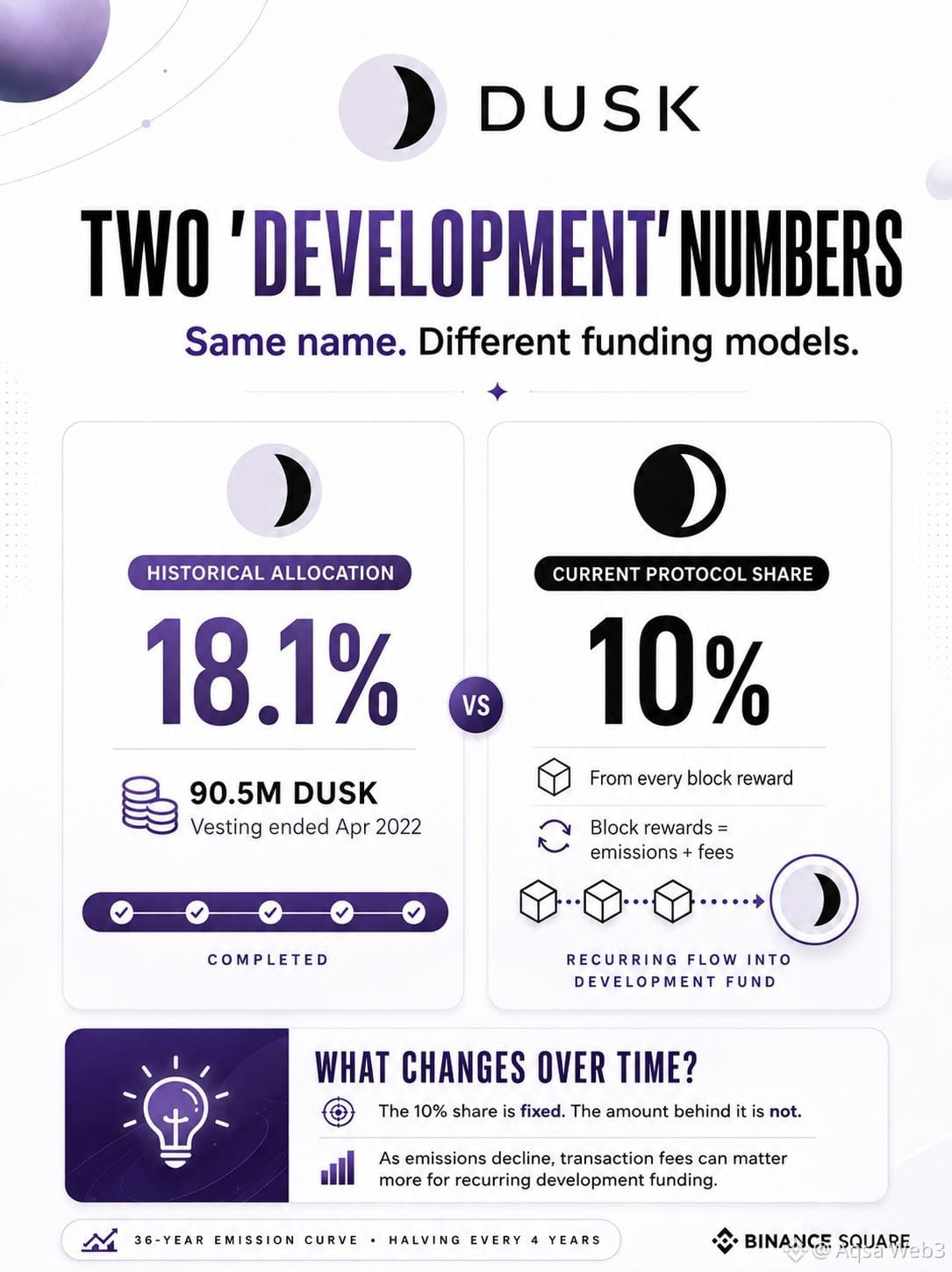
I found two “development” numbers in Dusk’s tokenomics that look related but describe very different funding models.
The historical allocation gave Development 18.1% of the initial supply or 90.5M DUSK. Its vesting period ended in April 2022.
But Dusk’s current protocol also funds development another way.
Each block reward combines newly emitted DUSK with transaction fees, and 10% of that total goes to the Development fund.
That creates a less obvious dependency.
Dusk’s emission curve runs for 36 years and halves every four years. The Development fund’s share is currently fixed at 10%, but the amount behind that percentage is not.
As emissions decline fee activity can become increasingly important to how much recurring development funding the network actually receives.
That is a useful design. @Dusk Foundation is not relying only on a historical allocation whose vesting eventually ended ongoing network economics also contribute to development.
But 10% alone does not tell me whether that funding is growing or shrinking.
For $DUSK I would rather track the actual amount flowing to the Development fund over time split between emissions and fees.
18.1% describes the historical allocation.
10% describes the current protocol share.
The harder question is what happens to that funding as emissions fall do transaction fees grow enough to offset part of the decline?
#dusk
The historical allocation gave Development 18.1% of the initial supply or 90.5M DUSK. Its vesting period ended in April 2022.
But Dusk’s current protocol also funds development another way.
Each block reward combines newly emitted DUSK with transaction fees, and 10% of that total goes to the Development fund.
That creates a less obvious dependency.
Dusk’s emission curve runs for 36 years and halves every four years. The Development fund’s share is currently fixed at 10%, but the amount behind that percentage is not.
As emissions decline fee activity can become increasingly important to how much recurring development funding the network actually receives.
That is a useful design. @Dusk Foundation is not relying only on a historical allocation whose vesting eventually ended ongoing network economics also contribute to development.
But 10% alone does not tell me whether that funding is growing or shrinking.
For $DUSK I would rather track the actual amount flowing to the Development fund over time split between emissions and fees.
18.1% describes the historical allocation.
10% describes the current protocol share.
The harder question is what happens to that funding as emissions fall do transaction fees grow enough to offset part of the decline?
#dusk
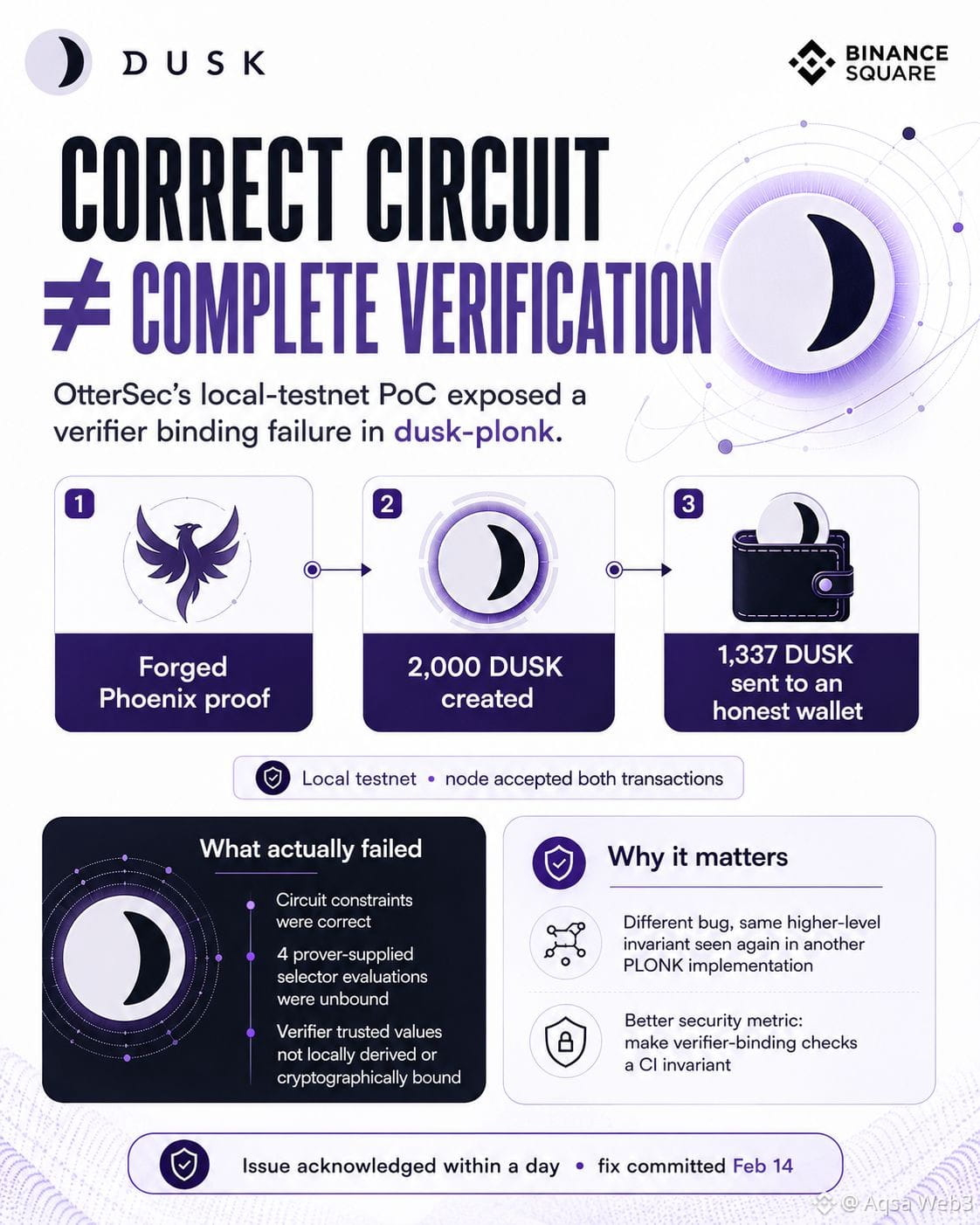
I expected a mint from nothing bug to mean something was wrong with Dusk’s Phoenix circuit.
It wasn’t.
OtterSec found a critical soundness bug in dusk plonk’s verifier. Four prover supplied selector evaluations entered the final verification equation without being cryptographically checked against commitments already in the verifier key.
On a local Dusk testnet OtterSec forged a Phoenix proof and created 2,000 DUSK from nonexistent inputs. It then sent 1,337 DUSK to an honest wallet through a normal transaction and the node mined both. The forgery itself ultimately reduced to a single field division.
To @Dusk Foundation’s credit the issue was acknowledged within a day and the fix was committed on February 14.
What stayed with me is where the failure actually lived.
Phoenix’s circuit constraints were correctly written. The verifier failed to ensure every scalar it trusted was either locally computed or cryptographically bound.
OtterSec later found a similar class of verification failure in Espresso Systems Jellyfish PLONK implementation through a different mechanism.
Different implementations. Different bugs. Same higher level invariant missed.
That makes the better security question surprisingly mechanical.
Is every scalar entering the final verifier equation either locally computed or cryptographically bound?
OtterSec argues this check can be automated in development tooling or CI rather than left entirely to human review.
For $DUSK the important signal is not only that this bug was patched, but whether this class of mistake becomes harder to reintroduce.
Should ZK teams make that invariant part of CI not just an audit checklist?
#dusk $DUSK
It wasn’t.
OtterSec found a critical soundness bug in dusk plonk’s verifier. Four prover supplied selector evaluations entered the final verification equation without being cryptographically checked against commitments already in the verifier key.
On a local Dusk testnet OtterSec forged a Phoenix proof and created 2,000 DUSK from nonexistent inputs. It then sent 1,337 DUSK to an honest wallet through a normal transaction and the node mined both. The forgery itself ultimately reduced to a single field division.
To @Dusk Foundation’s credit the issue was acknowledged within a day and the fix was committed on February 14.
What stayed with me is where the failure actually lived.
Phoenix’s circuit constraints were correctly written. The verifier failed to ensure every scalar it trusted was either locally computed or cryptographically bound.
OtterSec later found a similar class of verification failure in Espresso Systems Jellyfish PLONK implementation through a different mechanism.
Different implementations. Different bugs. Same higher level invariant missed.
That makes the better security question surprisingly mechanical.
Is every scalar entering the final verifier equation either locally computed or cryptographically bound?
OtterSec argues this check can be automated in development tooling or CI rather than left entirely to human review.
For $DUSK the important signal is not only that this bug was patched, but whether this class of mistake becomes harder to reintroduce.
Should ZK teams make that invariant part of CI not just an audit checklist?
#dusk $DUSK
ເປັນຄວາມຈິງບາງສ່ວນ
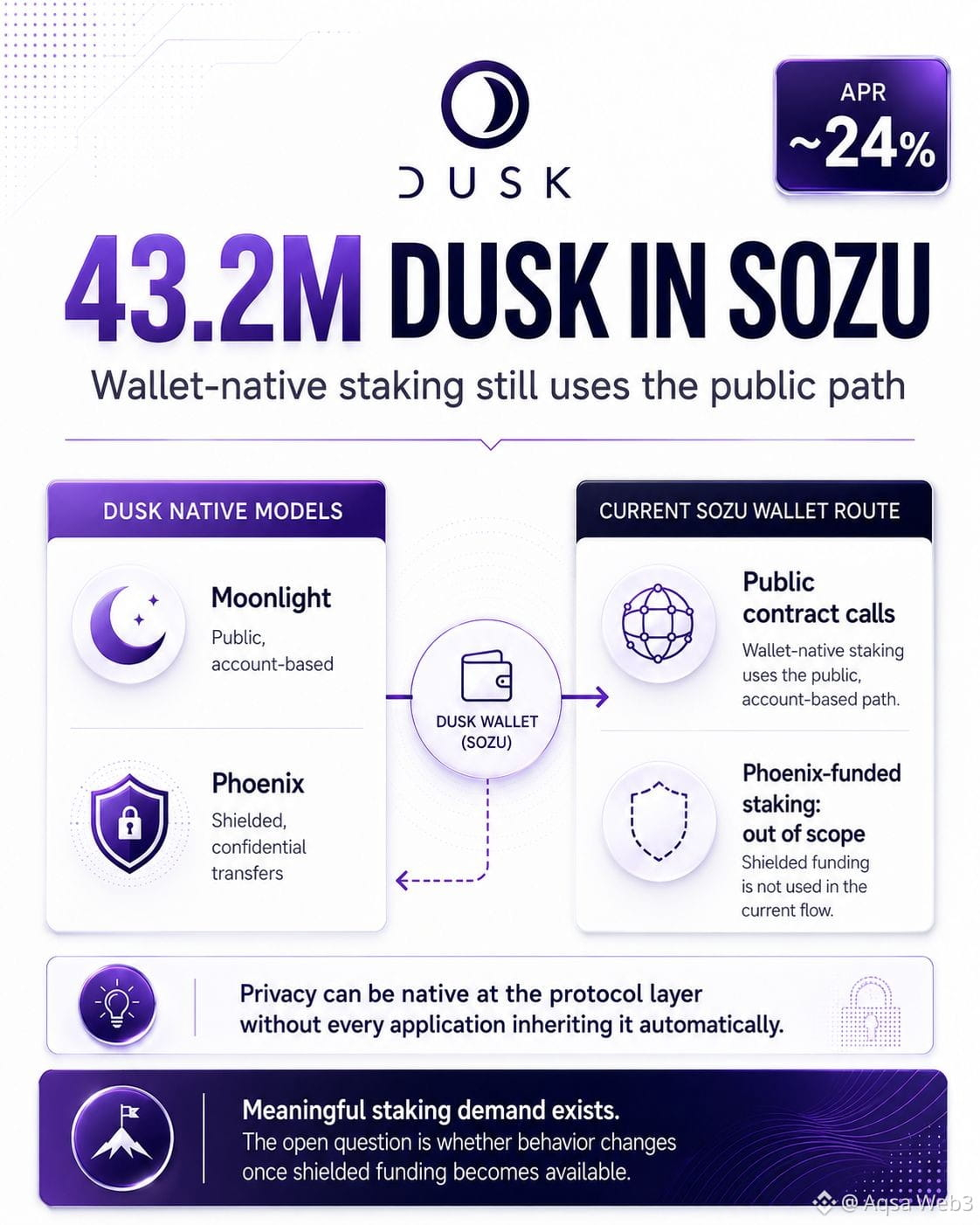
Sozu currently shows 43.2M DUSK in TVL and roughly 24.07% APR on its live site.
Then I noticed something about how that route is funded.
Dusk gives users two native transaction models. Moonlight is public and account based. Phoenix is shielded and designed for confidential transfers using zero knowledge proofs.
Sozu, a staking pool built through Dusk’s stake abstraction system, currently uses public contract calls in Dusk Wallet.
Phoenix funded Sozu staking is explicitly out of scope in the current wallet implementation.
That is not a failure of @Dusk Foundation’s privacy design.
Dusk deliberately supports both transparent and shielded transaction models, while Sozu gives users a simpler way to stake without operating their own provisioner infrastructure.
But 43.2M DUSK already sitting in Sozu makes the distinction worth watching.
Privacy can be native at the protocol layer without automatically carrying into every application built above it.
The current wallet flow is a clear example the shielded path exists on Dusk but this staking route currently uses the public one.
So the metric I would watch next is not TVL alone.
It is whether staking behavior changes if Phoenix funded Sozu actions become supported too.
If privacy is native to $DUSK should wallet native applications merely make it available where supported, or preserve it by default?
#dusk
Then I noticed something about how that route is funded.
Dusk gives users two native transaction models. Moonlight is public and account based. Phoenix is shielded and designed for confidential transfers using zero knowledge proofs.
Sozu, a staking pool built through Dusk’s stake abstraction system, currently uses public contract calls in Dusk Wallet.
Phoenix funded Sozu staking is explicitly out of scope in the current wallet implementation.
That is not a failure of @Dusk Foundation’s privacy design.
Dusk deliberately supports both transparent and shielded transaction models, while Sozu gives users a simpler way to stake without operating their own provisioner infrastructure.
But 43.2M DUSK already sitting in Sozu makes the distinction worth watching.
Privacy can be native at the protocol layer without automatically carrying into every application built above it.
The current wallet flow is a clear example the shielded path exists on Dusk but this staking route currently uses the public one.
So the metric I would watch next is not TVL alone.
It is whether staking behavior changes if Phoenix funded Sozu actions become supported too.
If privacy is native to $DUSK should wallet native applications merely make it available where supported, or preserve it by default?
#dusk
ເປັນຄວາມຈິງບາງສ່ວນ
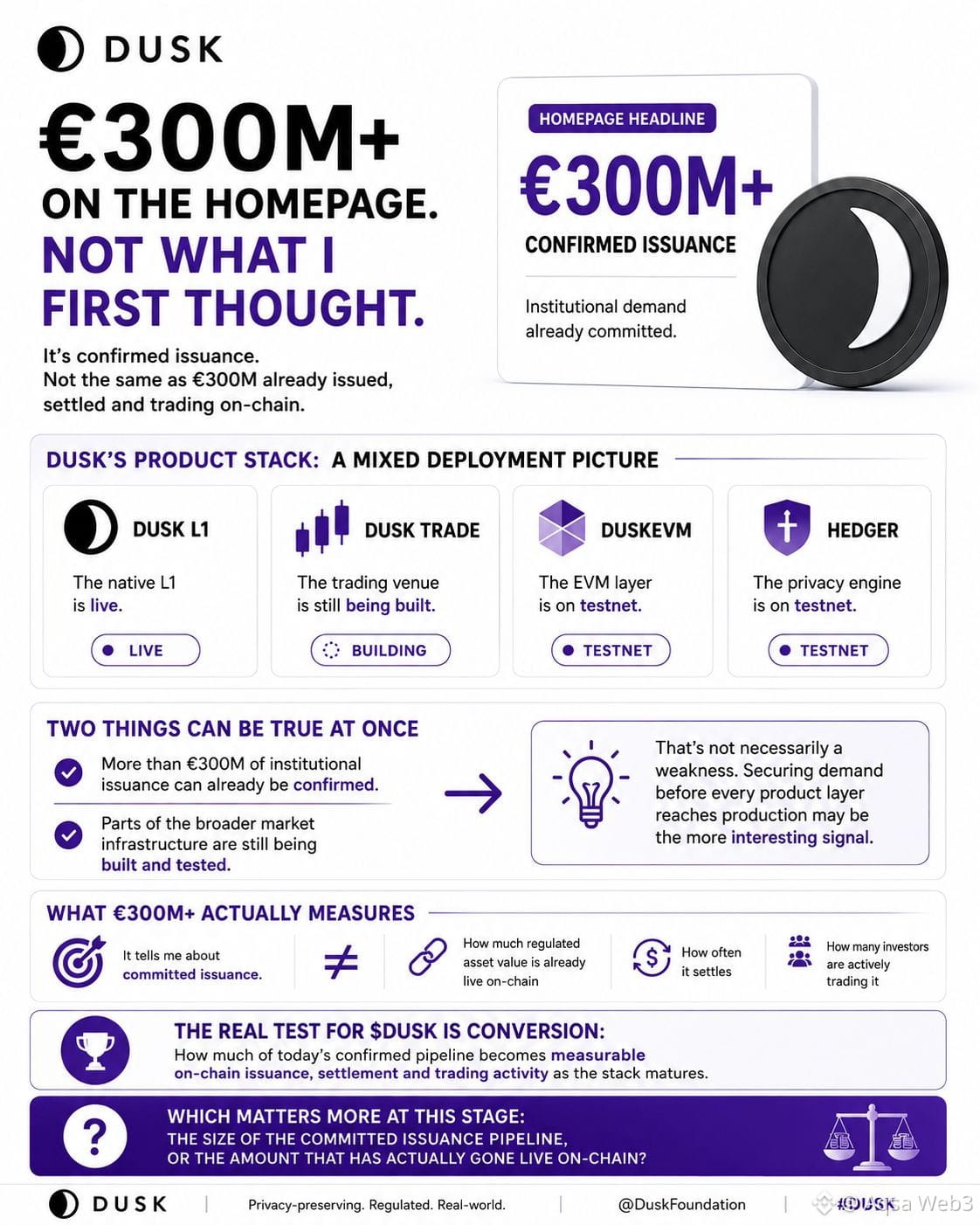
I saw €300M+ on Dusk’s homepage and initially read it like an on chain adoption number.
Then I checked the label.
Confirmed issuance.
Not €300M already issued settled or trading on chain.
That distinction matters because @Dusk Foundation’s own product stack shows a more mixed deployment picture.
The native Dusk L1 is live. But the rest of the stack is still at different stages: Dusk Trade is listed as Building, while DuskEVM and Hedger are both on testnet.
So two things can be true at once:
More than €300M of institutional issuance can already be confirmed while parts of the broader market infrastructure are still being built and tested.
That is not necessarily a weakness. Securing demand before every product layer reaches production may be the more interesting signal.
But it changes what the headline number measures.
€300M+ tells me about committed issuance.
It does not tell me how much regulated asset value is already live on-chain, how often it settles or how many investors are actively trading it.
Those are the numbers that would tell me whether the pipeline is actually converting into adoption.
For $DUSK the real test is conversion how much of today’s confirmed pipeline becomes measurable on chain issuance settlement and trading activity as the stack matures.
#dusk
Which matters more at this stage: the size of the committed issuance pipeline or the amount that has actually gone live on chain?
Then I checked the label.
Confirmed issuance.
Not €300M already issued settled or trading on chain.
That distinction matters because @Dusk Foundation’s own product stack shows a more mixed deployment picture.
The native Dusk L1 is live. But the rest of the stack is still at different stages: Dusk Trade is listed as Building, while DuskEVM and Hedger are both on testnet.
So two things can be true at once:
More than €300M of institutional issuance can already be confirmed while parts of the broader market infrastructure are still being built and tested.
That is not necessarily a weakness. Securing demand before every product layer reaches production may be the more interesting signal.
But it changes what the headline number measures.
€300M+ tells me about committed issuance.
It does not tell me how much regulated asset value is already live on-chain, how often it settles or how many investors are actively trading it.
Those are the numbers that would tell me whether the pipeline is actually converting into adoption.
For $DUSK the real test is conversion how much of today’s confirmed pipeline becomes measurable on chain issuance settlement and trading activity as the stack matures.
#dusk
Which matters more at this stage: the size of the committed issuance pipeline or the amount that has actually gone live on chain?
ຢືນຢັນແລ້ວ
I found two lines in the a16z and Babylon announcements that looked aligned until I placed them side by side.
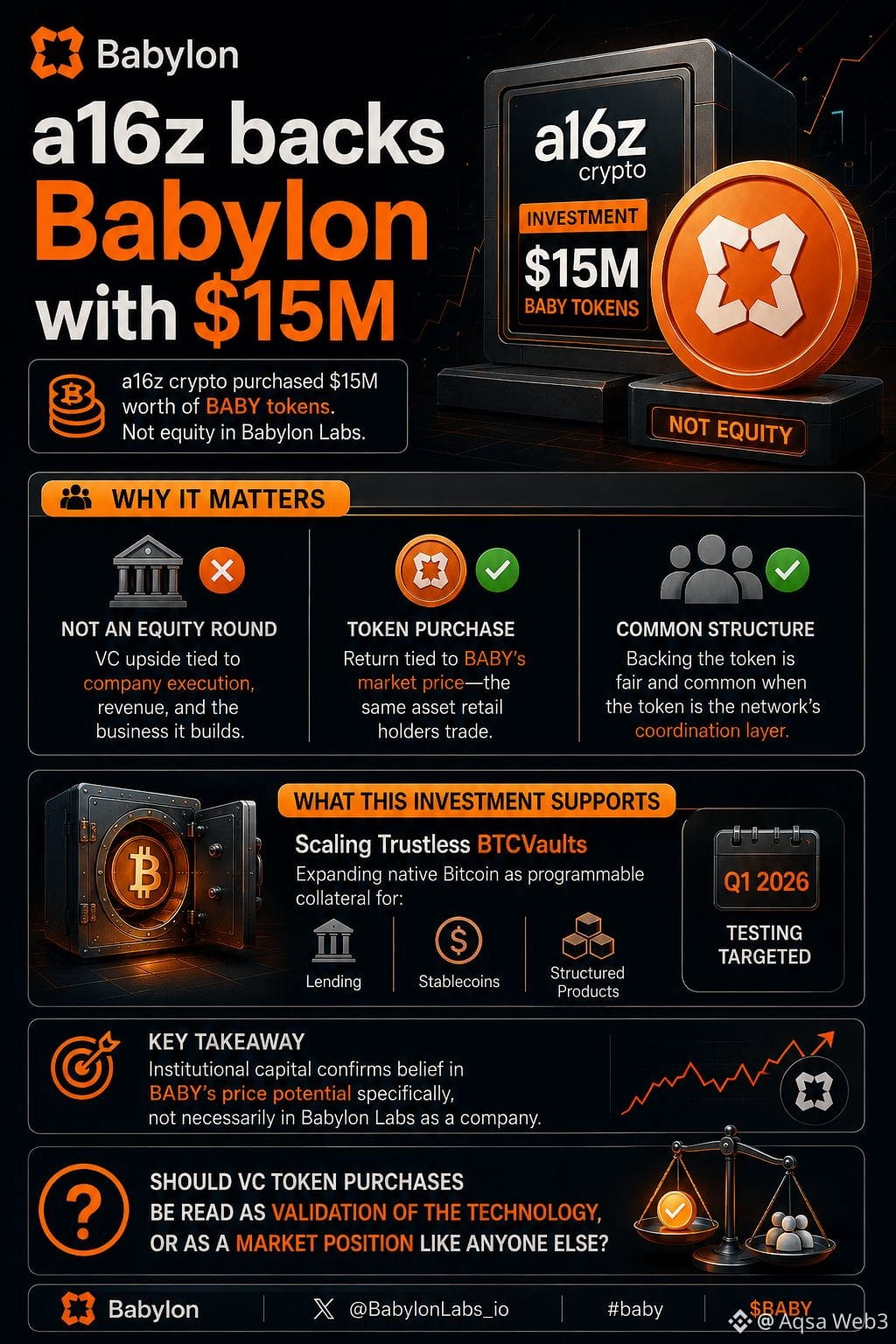
a16z crypto bought $15 million of $BABY while backing the development of @BabylonLabs_io Trustless BTCVaults.
Babylon's own framing was notable too: BTCVaults could create new utility and value capture for BABY, described as something the vault ecosystem will support going forward, not a mechanism already in place today.
That's the real tension.
Institutional capital entered the token before the mechanism linking BTCVault success to BABY value has been fully defined.
That doesn't make the investment weak. It makes it forward looking. a16z's thesis also backed Babylon's founders and broader vision for native Bitcoin collateral.
But token holders should separate two signals: a major investor believes BTCVaults can become important, versus BTCVault growth already creating measurable demand for BABY.
The investment supports the first. The second still depends on economic design that hasn't been completed yet.
Product adoption and token value don't automatically move together. The metric I'd watch isn't how many vaults launch, but what users or applications must actually do with BABY as that activity grows.
A $15 million token purchase confirms conviction.
It doesn't complete the economic link.
Should institutional backing validate today's token utility, or signal confidence that stronger value capture can be designed later?
@BabylonLabs_io #baby $BABY
a16z crypto bought $15 million of $BABY while backing the development of @BabylonLabs_io Trustless BTCVaults.
Babylon's own framing was notable too: BTCVaults could create new utility and value capture for BABY, described as something the vault ecosystem will support going forward, not a mechanism already in place today.
That's the real tension.
Institutional capital entered the token before the mechanism linking BTCVault success to BABY value has been fully defined.
That doesn't make the investment weak. It makes it forward looking. a16z's thesis also backed Babylon's founders and broader vision for native Bitcoin collateral.
But token holders should separate two signals: a major investor believes BTCVaults can become important, versus BTCVault growth already creating measurable demand for BABY.
The investment supports the first. The second still depends on economic design that hasn't been completed yet.
Product adoption and token value don't automatically move together. The metric I'd watch isn't how many vaults launch, but what users or applications must actually do with BABY as that activity grows.
A $15 million token purchase confirms conviction.
It doesn't complete the economic link.
Should institutional backing validate today's token utility, or signal confidence that stronger value capture can be designed later?
@BabylonLabs_io #baby $BABY
I opened @BabylonLabs_io ’s security advisory expecting the weak point to be Bitcoin anchoring or BLS cryptography.
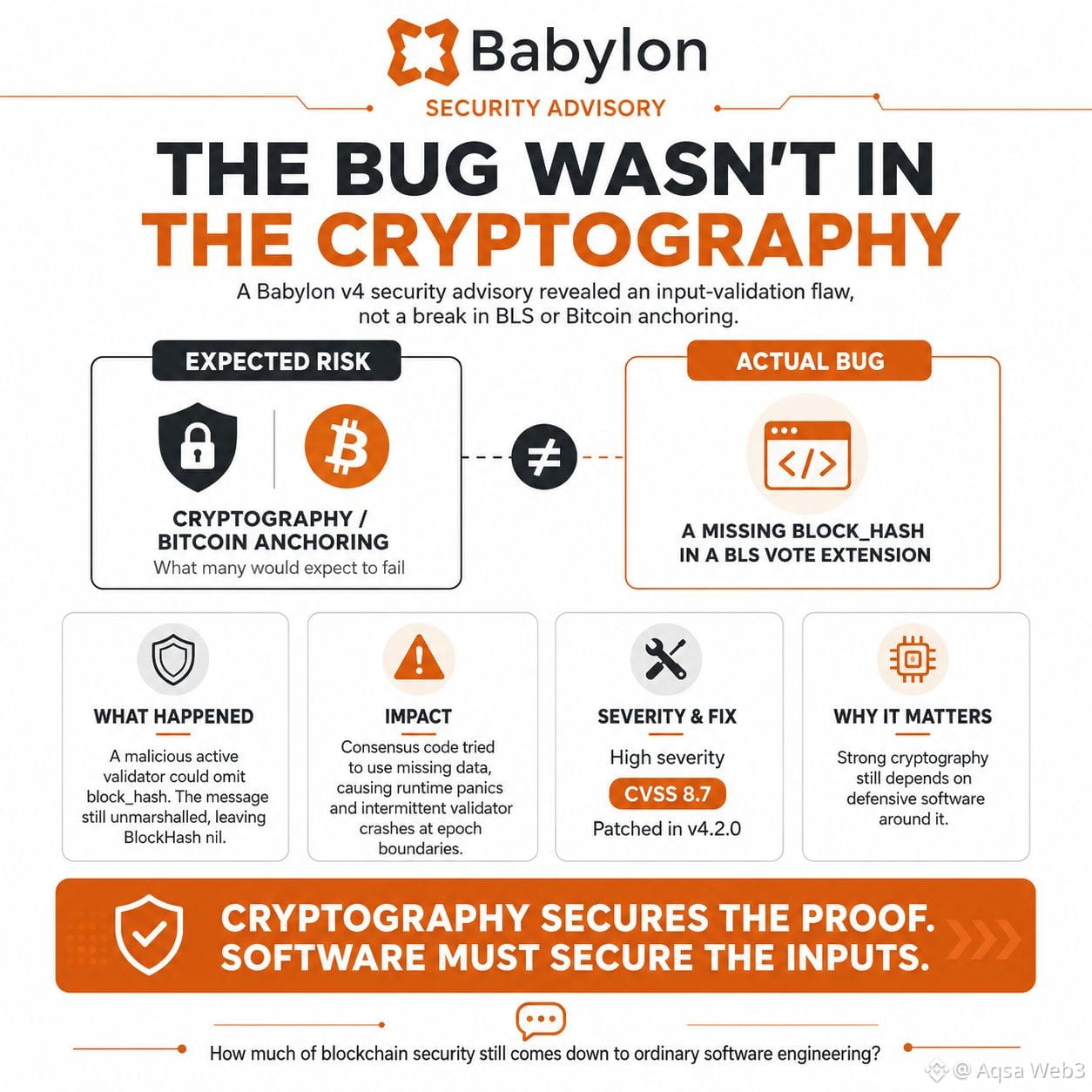
It was a missing field.
At epoch boundaries, validators submit BLS vote extensions identifying the block they are signing. But one required looking field the block hash was not enforced as required at the protocol layer.
A malicious active validator could omit it. Babylon’s code would still accept the message then attempt to process missing data and trigger a runtime panic.
The result was an availability risk. Validators could crash intermittently at epoch boundaries potentially slowing creation of the boundary block.
The vulnerability was rated High, with a CVSS score of 8.7 and was patched in Babylon v4.2.0.
What stayed with me was how ordinary the failure was.
The cryptography did not need to be broken. Bitcoin anchoring did not need to be defeated. A single software assumption was enough to create a consensus critical risk.
That is an important distinction for the $BABY ecosystem.
Blockchains can build stronger cryptographic guarantees, but those guarantees still depend on ordinary software correctly validating every message that reaches them.
The strongest security layer can still be exposed by the simplest unchecked assumption.
How much of blockchain security is really about better cryptography and how much is about writing safer code around it?
#baby
It was a missing field.
At epoch boundaries, validators submit BLS vote extensions identifying the block they are signing. But one required looking field the block hash was not enforced as required at the protocol layer.
A malicious active validator could omit it. Babylon’s code would still accept the message then attempt to process missing data and trigger a runtime panic.
The result was an availability risk. Validators could crash intermittently at epoch boundaries potentially slowing creation of the boundary block.
The vulnerability was rated High, with a CVSS score of 8.7 and was patched in Babylon v4.2.0.
What stayed with me was how ordinary the failure was.
The cryptography did not need to be broken. Bitcoin anchoring did not need to be defeated. A single software assumption was enough to create a consensus critical risk.
That is an important distinction for the $BABY ecosystem.
Blockchains can build stronger cryptographic guarantees, but those guarantees still depend on ordinary software correctly validating every message that reaches them.
The strongest security layer can still be exposed by the simplest unchecked assumption.
How much of blockchain security is really about better cryptography and how much is about writing safer code around it?
#baby
ເຂົ້າສູ່ລະບົບເພື່ອສຳຫຼວດເນື້ອຫາເພີ່ມເຕີມ