

Alex1i9
147 ໂພສ

Alex1i9
ລາຍງານ
ບລັອກຜູ້ໃຊ້
Bull bear whatever - I am Here | #Binance KOL |
0 ກໍາລັງຕິດຕາມ
11 ຜູ້ຕິດຕາມ
16 Liked
ໂພສ
·
--
Your Leveraged Stock Position Is Now A Transferable Object 📈
$PENDLE and $BLUR both proved that a position becomes more useful the moment it is a transferable object. Margin Call is applying that to leverage.
It placed second in the Uniswap track at Bankr's Runtime Agent Week, turning leveraged stock positions into transferable NFTs, with a mainnet deployment the judges verified rather than took on trust.
The primitive underneath is worth separating from the demo.
A leveraged position is normally an account state. It lives inside a venue, it belongs to whoever opened it, and exiting means closing it. Making it a token changes the exit. You can sell the position itself to someone who wants it, at whatever price they will pay, without unwinding anything.
That matters most in exactly the case where unwinding is expensive. A thin book on a real-world asset, wide spreads, and a position you want out of at the moment when selling into the market is the worst available option.
The risk is the one every tokenized position carries. A transferable claim on a leveraged position is only as sound as the liquidation logic behind it, and the buyer inherits the margin call along with the upside.
Verified on mainnet is a meaningful phrase here though. Most hackathon entries in DeFi are a video and a promise.
#DeFi #RWA
Your Leveraged Stock Position Is Now A Transferable Object 📈
$PENDLE and $BLUR both proved that a position becomes more useful the moment it is a transferable object. Margin Call is applying that to leverage.
It placed second in the Uniswap track at Bankr's Runtime Agent Week, turning leveraged stock positions into transferable NFTs, with a mainnet deployment the judges verified rather than took on trust.
The primitive underneath is worth separating from the demo.
A leveraged position is normally an account state. It lives inside a venue, it belongs to whoever opened it, and exiting means closing it. Making it a token changes the exit. You can sell the position itself to someone who wants it, at whatever price they will pay, without unwinding anything.
That matters most in exactly the case where unwinding is expensive. A thin book on a real-world asset, wide spreads, and a position you want out of at the moment when selling into the market is the worst available option.
The risk is the one every tokenized position carries. A transferable claim on a leveraged position is only as sound as the liquidation logic behind it, and the buyer inherits the margin call along with the upside.
Verified on mainnet is a meaningful phrase here though. Most hackathon entries in DeFi are a video and a promise.
#DeFi #RWA
$PENDLE and $BLUR both proved that a position becomes more useful the moment it is a transferable object. Margin Call is applying that to leverage.
It placed second in the Uniswap track at Bankr's Runtime Agent Week, turning leveraged stock positions into transferable NFTs, with a mainnet deployment the judges verified rather than took on trust.
The primitive underneath is worth separating from the demo.
A leveraged position is normally an account state. It lives inside a venue, it belongs to whoever opened it, and exiting means closing it. Making it a token changes the exit. You can sell the position itself to someone who wants it, at whatever price they will pay, without unwinding anything.
That matters most in exactly the case where unwinding is expensive. A thin book on a real-world asset, wide spreads, and a position you want out of at the moment when selling into the market is the worst available option.
The risk is the one every tokenized position carries. A transferable claim on a leveraged position is only as sound as the liquidation logic behind it, and the buyer inherits the margin call along with the upside.
Verified on mainnet is a meaningful phrase here though. Most hackathon entries in DeFi are a video and a promise.
#DeFi #RWA

56
·
--
WallStreetBets Is Watching the SYN Story 👀
$UNI helped take onchain trading from a crypto niche into a much broader market conversation.
$SYN may now be attracting attention from the retail trading audience.
WallStreetBets responded “huge 👀” to Duncan’s update covering SonicStrategy’s SYN purchase, Hypercall’s record options volume and its contribution to Hyperliquid hedging activity.
One reply does not validate the investment thesis.
What it shows is that the story can travel beyond existing SYN holders.
An audience already familiar with options, 0DTE trading and leveraged exposure can immediately understand what Hypercall is building.
#Options #Altcoin Season#
WallStreetBets Is Watching the SYN Story 👀
$UNI helped take onchain trading from a crypto niche into a much broader market conversation.
$SYN may now be attracting attention from the retail trading audience.
WallStreetBets responded “huge 👀” to Duncan’s update covering SonicStrategy’s SYN purchase, Hypercall’s record options volume and its contribution to Hyperliquid hedging activity.
One reply does not validate the investment thesis.
What it shows is that the story can travel beyond existing SYN holders.
An audience already familiar with options, 0DTE trading and leveraged exposure can immediately understand what Hypercall is building.
#Options #Altcoin Season#
$UNI helped take onchain trading from a crypto niche into a much broader market conversation.
$SYN may now be attracting attention from the retail trading audience.
WallStreetBets responded “huge 👀” to Duncan’s update covering SonicStrategy’s SYN purchase, Hypercall’s record options volume and its contribution to Hyperliquid hedging activity.
One reply does not validate the investment thesis.
What it shows is that the story can travel beyond existing SYN holders.
An audience already familiar with options, 0DTE trading and leveraged exposure can immediately understand what Hypercall is building.
#Options #Altcoin Season#
65
·
--
**$SYN Is Testing A Major Fibonacci Support Zone 🎯**
While $ONDO has strengthened the onchain capital-markets narrative, $SYN adds an options-focused angle through Hypercall.
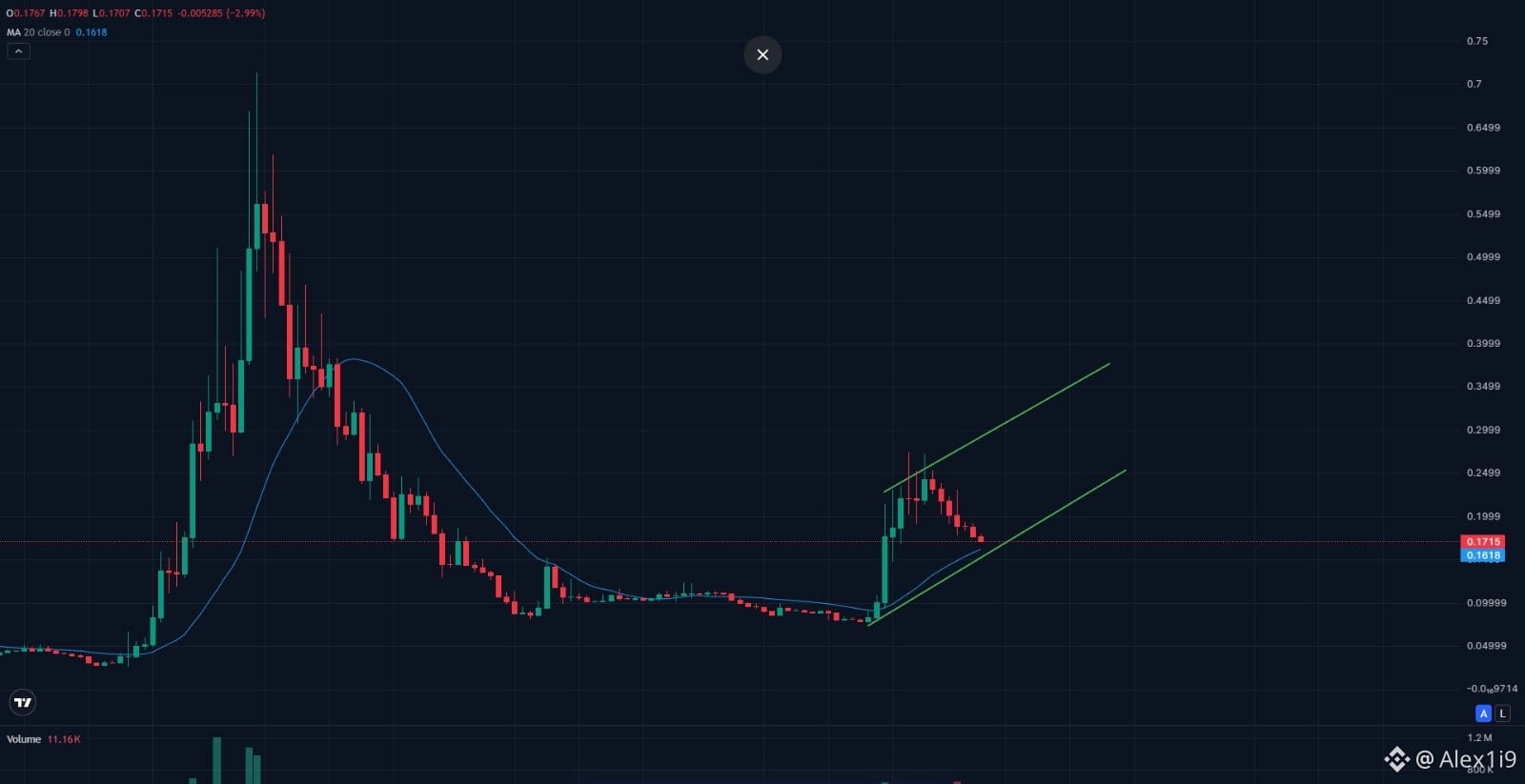
The SYN chart is now testing an important retracement zone after running from approximately $0.078 to $0.273.
The 50% Fibonacci retracement sits around $0.176, while the 61.8% level is near $0.153.
With SYN trading around $0.172, price has entered the zone between those levels where buyers could establish a higher low.
A recovery above $0.176 would provide the first bullish confirmation and place the following levels back into focus:
🎯 $0.190
🎯 $0.208
🎯 $0.220
The broader breakout structure remains intact above the deeper Fibonacci support near $0.153. Reclaiming $0.176 would strengthen the case that the current pullback is turning into accumulation.
#TechnicalAnalysis #Altcoin Season#
**$SYN Is Testing A Major Fibonacci Support Zone 🎯**
While $ONDO has strengthened the onchain capital-markets narrative, $SYN adds an options-focused angle through Hypercall.
The SYN chart is now testing an important retracement zone after running from approximately $0.078 to $0.273.
The 50% Fibonacci retracement sits around $0.176, while the 61.8% level is near $0.153.
With SYN trading around $0.172, price has entered the zone between those levels where buyers could establish a higher low.
A recovery above $0.176 would provide the first bullish confirmation and place the following levels back into focus:
🎯 $0.190
🎯 $0.208
🎯 $0.220
The broader breakout structure remains intact above the deeper Fibonacci support near $0.153. Reclaiming $0.176 would strengthen the case that the current pullback is turning into accumulation.
#TechnicalAnalysis #Altcoin Season#
While $ONDO has strengthened the onchain capital-markets narrative, $SYN adds an options-focused angle through Hypercall.
The SYN chart is now testing an important retracement zone after running from approximately $0.078 to $0.273.
The 50% Fibonacci retracement sits around $0.176, while the 61.8% level is near $0.153.
With SYN trading around $0.172, price has entered the zone between those levels where buyers could establish a higher low.
A recovery above $0.176 would provide the first bullish confirmation and place the following levels back into focus:
🎯 $0.190
🎯 $0.208
🎯 $0.220
The broader breakout structure remains intact above the deeper Fibonacci support near $0.153. Reclaiming $0.176 would strengthen the case that the current pullback is turning into accumulation.
#TechnicalAnalysis #Altcoin Season#
57
·
--
You Don't Need Green Charts To Be Profitable 📉
One of the most useful things about pair trading is that both sides of your trade can be red and your thesis can still play out.
After $ZEC strongly outperformed $XMR in previous weeks, large crypto hacks and exploits have increasingly been followed by spikes in volume moving through Monero, creating a reason to question whether that relationship could start moving the other way.
The trade idea was simple: Long XMR. Short ZEC. And that's exactly what started happening over the weekend.
Both assets lost value, but Monero showed relative strength against Zcash. So the opportunity wasn't dependent on XMR pumping. It only needed XMR to perform better than ZEC.
Pear Protocol lets traders express that second view as a long/short pair in one click, or counter-trade the thesis if they disagree.
Sometimes being right about the relationship matters more than being right about the market.
Trade the pair at app.pear.garden
#Altcoin Season#
You Don't Need Green Charts To Be Profitable 📉
One of the most useful things about pair trading is that both sides of your trade can be red and your thesis can still play out.
After $ZEC strongly outperformed $XMR in previous weeks, large crypto hacks and exploits have increasingly been followed by spikes in volume moving through Monero, creating a reason to question whether that relationship could start moving the other way.
The trade idea was simple: Long XMR. Short ZEC. And that's exactly what started happening over the weekend.
Both assets lost value, but Monero showed relative strength against Zcash. So the opportunity wasn't dependent on XMR pumping. It only needed XMR to perform better than ZEC.
Pear Protocol lets traders express that second view as a long/short pair in one click, or counter-trade the thesis if they disagree.
Sometimes being right about the relationship matters more than being right about the market.
Trade the pair at app.pear.garden
#Altcoin Season#
One of the most useful things about pair trading is that both sides of your trade can be red and your thesis can still play out.
After $ZEC strongly outperformed $XMR in previous weeks, large crypto hacks and exploits have increasingly been followed by spikes in volume moving through Monero, creating a reason to question whether that relationship could start moving the other way.
The trade idea was simple: Long XMR. Short ZEC. And that's exactly what started happening over the weekend.
Both assets lost value, but Monero showed relative strength against Zcash. So the opportunity wasn't dependent on XMR pumping. It only needed XMR to perform better than ZEC.
Pear Protocol lets traders express that second view as a long/short pair in one click, or counter-trade the thesis if they disagree.
Sometimes being right about the relationship matters more than being right about the market.
Trade the pair at app.pear.garden
#Altcoin Season#
49
·
--
Fresh Problems Took AI Scores To 7.5% 🧪
When I look at fundamentals I want numbers that cannot be gamed, and AI has spent two years reporting numbers that can be.
On one widely used coding benchmark frontier models scored in the 70s and 80s, and when the K Prize tested models only on problems filed after its deadline, the winning score was 7.5%.
Every AI project that leans on a leaderboard inherits that gap, including the AI tokens trading on $SOL where a score is the easiest fundamental to quote and the hardest to check.
OpenAI stopped reporting that benchmark in February, citing contamination, which is the polite word for the test ending up in the training data.
It happens because a benchmark has to be published to be used, so the answers get crawled along with everything else, and a model that has already seen the test is grading its memory.
Arcium takes the answer key out of circulation, splitting the reference answers into fragments across a cluster of nodes where no single node holds a readable copy, while the grading still returns the correct score.
That score settles on Solana as an ordinary public transaction, so every result is timestamped and checkable even though the key behind it was never published.
The grading side can run today on Mainnet Alpha, live since February 2 with more than 2.5 million computations, while keeping the questions sealed from the model being tested is Blackthorn's job, and Blackthorn has not shipped yet.
A benchmark that leaks stops measuring anything the moment it gets popular, and my read is that sealed evaluation ends up being one of the more valuable things confidential compute does for AI.
#AI #Solana
Fresh Problems Took AI Scores To 7.5% 🧪
When I look at fundamentals I want numbers that cannot be gamed, and AI has spent two years reporting numbers that can be.
On one widely used coding benchmark frontier models scored in the 70s and 80s, and when the K Prize tested models only on problems filed after its deadline, the winning score was 7.5%.
Every AI project that leans on a leaderboard inherits that gap, including the AI tokens trading on $SOL where a score is the easiest fundamental to quote and the hardest to check.
OpenAI stopped reporting that benchmark in February, citing contamination, which is the polite word for the test ending up in the training data.
It happens because a benchmark has to be published to be used, so the answers get crawled along with everything else, and a model that has already seen the test is grading its memory.
Arcium takes the answer key out of circulation, splitting the reference answers into fragments across a cluster of nodes where no single node holds a readable copy, while the grading still returns the correct score.
That score settles on Solana as an ordinary public transaction, so every result is timestamped and checkable even though the key behind it was never published.
The grading side can run today on Mainnet Alpha, live since February 2 with more than 2.5 million computations, while keeping the questions sealed from the model being tested is Blackthorn's job, and Blackthorn has not shipped yet.
A benchmark that leaks stops measuring anything the moment it gets popular, and my read is that sealed evaluation ends up being one of the more valuable things confidential compute does for AI.
#AI #Solana
When I look at fundamentals I want numbers that cannot be gamed, and AI has spent two years reporting numbers that can be.
On one widely used coding benchmark frontier models scored in the 70s and 80s, and when the K Prize tested models only on problems filed after its deadline, the winning score was 7.5%.
Every AI project that leans on a leaderboard inherits that gap, including the AI tokens trading on $SOL where a score is the easiest fundamental to quote and the hardest to check.
OpenAI stopped reporting that benchmark in February, citing contamination, which is the polite word for the test ending up in the training data.
It happens because a benchmark has to be published to be used, so the answers get crawled along with everything else, and a model that has already seen the test is grading its memory.
Arcium takes the answer key out of circulation, splitting the reference answers into fragments across a cluster of nodes where no single node holds a readable copy, while the grading still returns the correct score.
That score settles on Solana as an ordinary public transaction, so every result is timestamped and checkable even though the key behind it was never published.
The grading side can run today on Mainnet Alpha, live since February 2 with more than 2.5 million computations, while keeping the questions sealed from the model being tested is Blackthorn's job, and Blackthorn has not shipped yet.
A benchmark that leaks stops measuring anything the moment it gets popular, and my read is that sealed evaluation ends up being one of the more valuable things confidential compute does for AI.
#AI #Solana
49
·
--
Onchain Data Isn't Enough 🌐
And neither is offchain data by itself.
That's becoming obvious with RWAs.
A token might tell me exactly how much supply exists onchain.
Cool.
But the asset backing it, its valuation, custody records or other relevant information may live somewhere completely different.
Space and Time can combine onchain and offchain datasets in the same query and produce a proof over the result. Its own RWA example is basically this: compare token supply with offchain asset information and make that relationship verifiable.
That's the bridge I find interesting.
$ONDO represents the asset side of the tokenization wave.
The next infrastructure problem is making sure applications can safely understand what's happening underneath those assets.
Putting TradFi onchain doesn't magically make all TradFi data onchain too.
Someone still has to connect the two worlds.
#Altcoin Season#
Onchain Data Isn't Enough 🌐
And neither is offchain data by itself.
That's becoming obvious with RWAs.
A token might tell me exactly how much supply exists onchain.
Cool.
But the asset backing it, its valuation, custody records or other relevant information may live somewhere completely different.
Space and Time can combine onchain and offchain datasets in the same query and produce a proof over the result. Its own RWA example is basically this: compare token supply with offchain asset information and make that relationship verifiable.
That's the bridge I find interesting.
$ONDO represents the asset side of the tokenization wave.
The next infrastructure problem is making sure applications can safely understand what's happening underneath those assets.
Putting TradFi onchain doesn't magically make all TradFi data onchain too.
Someone still has to connect the two worlds.
#Altcoin Season#
And neither is offchain data by itself.
That's becoming obvious with RWAs.
A token might tell me exactly how much supply exists onchain.
Cool.
But the asset backing it, its valuation, custody records or other relevant information may live somewhere completely different.
Space and Time can combine onchain and offchain datasets in the same query and produce a proof over the result. Its own RWA example is basically this: compare token supply with offchain asset information and make that relationship verifiable.
That's the bridge I find interesting.
$ONDO represents the asset side of the tokenization wave.
The next infrastructure problem is making sure applications can safely understand what's happening underneath those assets.
Putting TradFi onchain doesn't magically make all TradFi data onchain too.
Someone still has to connect the two worlds.
#Altcoin Season#

66
·
--
Privacy coins were only phase one 🔒
For years, $XMR and $ZEC have defined the privacy conversation through confidential transfers. I think their continued relevance shows that financial privacy has never been a temporary crypto narrative.
But the next privacy cycle should extend far beyond moving funds between wallets, as more complex financial products move onchain, public-by-default infrastructure can expose commercially sensitive activity.
That creates a privacy problem for a much wider market than peer-to-peer transfers.
To me, the next phase is about making privacy part of the infrastructure supporting complete financial markets, and Injective has now put a name to that direction with CypherOS.
It will show how privacy can fit alongside the markets and tokenized assets already operating across Injective.
If it delivers, I think Injective can expand the narrative from private money toward private onchain finance.
For me, that is the privacy market shift worth watching next 👀
#Altcoin Season#
Privacy coins were only phase one 🔒
For years, $XMR and $ZEC have defined the privacy conversation through confidential transfers. I think their continued relevance shows that financial privacy has never been a temporary crypto narrative.
But the next privacy cycle should extend far beyond moving funds between wallets, as more complex financial products move onchain, public-by-default infrastructure can expose commercially sensitive activity.
That creates a privacy problem for a much wider market than peer-to-peer transfers.
To me, the next phase is about making privacy part of the infrastructure supporting complete financial markets, and Injective has now put a name to that direction with CypherOS.
It will show how privacy can fit alongside the markets and tokenized assets already operating across Injective.
If it delivers, I think Injective can expand the narrative from private money toward private onchain finance.
For me, that is the privacy market shift worth watching next 👀
#Altcoin Season#
For years, $XMR and $ZEC have defined the privacy conversation through confidential transfers. I think their continued relevance shows that financial privacy has never been a temporary crypto narrative.
But the next privacy cycle should extend far beyond moving funds between wallets, as more complex financial products move onchain, public-by-default infrastructure can expose commercially sensitive activity.
That creates a privacy problem for a much wider market than peer-to-peer transfers.
To me, the next phase is about making privacy part of the infrastructure supporting complete financial markets, and Injective has now put a name to that direction with CypherOS.
It will show how privacy can fit alongside the markets and tokenized assets already operating across Injective.
If it delivers, I think Injective can expand the narrative from private money toward private onchain finance.
For me, that is the privacy market shift worth watching next 👀
#Altcoin Season#

75
·
--
A Public Company Just Bought SYN 👀
$LINK has become a recognized infrastructure asset for the onchain economy. Now $SYN has entered SonicStrategy’s public-company treasury as a bet on onchain derivatives.
The company purchased 500,000 SYN on the open market at an average price near 0.23 USD, investing approximately 115,000 USD.
It described the purchase as its initial treasury investment focused on onchain derivatives.
The timing matters. One day earlier, SonicStrategy proposed raising up to 4.5M USD through a private placement, with up to half payable in digital assets.
The current allocation is small. The signal becomes considerably stronger if the financing is followed by further SYN purchases.
My setup is initial institutional validation now, with confirmation dependent on continued balance-sheet demand.
During Altcoin Season, one purchase creates attention. Accumulation creates a narrative.
#Altcoin Season#
A Public Company Just Bought SYN 👀
$LINK has become a recognized infrastructure asset for the onchain economy. Now $SYN has entered SonicStrategy’s public-company treasury as a bet on onchain derivatives.
The company purchased 500,000 SYN on the open market at an average price near 0.23 USD, investing approximately 115,000 USD.
It described the purchase as its initial treasury investment focused on onchain derivatives.
The timing matters. One day earlier, SonicStrategy proposed raising up to 4.5M USD through a private placement, with up to half payable in digital assets.
The current allocation is small. The signal becomes considerably stronger if the financing is followed by further SYN purchases.
My setup is initial institutional validation now, with confirmation dependent on continued balance-sheet demand.
During Altcoin Season, one purchase creates attention. Accumulation creates a narrative.
#Altcoin Season#
$LINK has become a recognized infrastructure asset for the onchain economy. Now $SYN has entered SonicStrategy’s public-company treasury as a bet on onchain derivatives.
The company purchased 500,000 SYN on the open market at an average price near 0.23 USD, investing approximately 115,000 USD.
It described the purchase as its initial treasury investment focused on onchain derivatives.
The timing matters. One day earlier, SonicStrategy proposed raising up to 4.5M USD through a private placement, with up to half payable in digital assets.
The current allocation is small. The signal becomes considerably stronger if the financing is followed by further SYN purchases.
My setup is initial institutional validation now, with confirmation dependent on continued balance-sheet demand.
During Altcoin Season, one purchase creates attention. Accumulation creates a narrative.
#Altcoin Season#
62
·
--
Some truths don't need an oracle.
$PYTH holders believe markets deserve price data straight from the source, fast and verifiable, no middlemen distorting what's real.
The DeLorean's value was never distorted by a middleman either.
40 years of box office numbers, licensing revenue, and global brand studies, all publicly documented, all verifiable without a feed. $DMC tokenizes IP whose value was never a matter of trust. It was already on the record.
Pyth verifies the price. History already verified this one. ⚡
#Altcoin Season#
Some truths don't need an oracle.
$PYTH holders believe markets deserve price data straight from the source, fast and verifiable, no middlemen distorting what's real.
The DeLorean's value was never distorted by a middleman either.
40 years of box office numbers, licensing revenue, and global brand studies, all publicly documented, all verifiable without a feed. $DMC tokenizes IP whose value was never a matter of trust. It was already on the record.
Pyth verifies the price. History already verified this one. ⚡
#Altcoin Season#
$PYTH holders believe markets deserve price data straight from the source, fast and verifiable, no middlemen distorting what's real.
The DeLorean's value was never distorted by a middleman either.
40 years of box office numbers, licensing revenue, and global brand studies, all publicly documented, all verifiable without a feed. $DMC tokenizes IP whose value was never a matter of trust. It was already on the record.
Pyth verifies the price. History already verified this one. ⚡
#Altcoin Season#

70
·
--
Put SYN’s Chart Beside The Product 📊
$UNI makes a useful DeFi research habit clear. For $SYN I’m applying the same approach, reading the token chart alongside the activity of the underlying protocol.
The two measure different things.
Token trading volume shows activity in the asset. Protocol volume shows usage of the product. A change in one does not automatically establish a change in the other.
Hypercall gives SYN a product story to track, with options markets built on Hyperliquid and instruments extending into equities.
My baseline has three parts.
• SYN price and spot volume over a consistent period
• Hypercall options volume and open interest, where available
• Dated product milestones and changes in market availability
The interesting question is whether product usage develops alongside market attention.
That is how I want to assess the Hypercall thesis as it unfolds.
Each new observation should add something concrete to the case.
#DeFi
Put SYN’s Chart Beside The Product 📊
$UNI makes a useful DeFi research habit clear. For $SYN I’m applying the same approach, reading the token chart alongside the activity of the underlying protocol.
The two measure different things.
Token trading volume shows activity in the asset. Protocol volume shows usage of the product. A change in one does not automatically establish a change in the other.
Hypercall gives SYN a product story to track, with options markets built on Hyperliquid and instruments extending into equities.
My baseline has three parts.
• SYN price and spot volume over a consistent period
• Hypercall options volume and open interest, where available
• Dated product milestones and changes in market availability
The interesting question is whether product usage develops alongside market attention.
That is how I want to assess the Hypercall thesis as it unfolds.
Each new observation should add something concrete to the case.
#DeFi
$UNI makes a useful DeFi research habit clear. For $SYN I’m applying the same approach, reading the token chart alongside the activity of the underlying protocol.
The two measure different things.
Token trading volume shows activity in the asset. Protocol volume shows usage of the product. A change in one does not automatically establish a change in the other.
Hypercall gives SYN a product story to track, with options markets built on Hyperliquid and instruments extending into equities.
My baseline has three parts.
• SYN price and spot volume over a consistent period
• Hypercall options volume and open interest, where available
• Dated product milestones and changes in market availability
The interesting question is whether product usage develops alongside market attention.
That is how I want to assess the Hypercall thesis as it unfolds.
Each new observation should add something concrete to the case.
#DeFi
33
·
--
Why This Crypto App Could Blow Up 👇
The rise of $HYPE exposed a brutal truth about crypto products.
Users reward platforms that concentrate activity instead of sending them across five different interfaces.
Yet mobile crypto still feels like desktop DeFi squeezed onto a smaller screen.
Every extra handoff between wallets, bridges and trading venues kills attention and conversion.
The next dominant consumer product will make chains feel like invisible backend infrastructure. It will carry users from an idea to a live, tradable market without breaking their flow.
That is where I think the next breakout application gets built.
Zora’s latest mobile release moves directly at this opportunity.
Users can now:
• Create Custom Pairs with memes, majors and tokenized stocks
• Trade crosschain across Solana, BNB Chain, Robinhood Chain and Base
• Launch from their phone without returning to a desktop workflow
This changes the shape of the entire product.
Zora is starting to resemble a consumer operating system for onchain markets. Social discovery can flow into creation and trading inside the same interface. That flywheel becomes more
powerful as additional users, assets and chains enter the app.
I think the market is still looking at the old version of Zora while the team aggressively ships a far more ambitious one.
If mobile becomes crypto’s primary battleground, Zora now has a credible shot at owning a serious piece of it.
#Altcoin Season# #Stonk
Why This Crypto App Could Blow Up 👇
The rise of $HYPE exposed a brutal truth about crypto products.
Users reward platforms that concentrate activity instead of sending them across five different interfaces.
Yet mobile crypto still feels like desktop DeFi squeezed onto a smaller screen.
Every extra handoff between wallets, bridges and trading venues kills attention and conversion.
The next dominant consumer product will make chains feel like invisible backend infrastructure. It will carry users from an idea to a live, tradable market without breaking their flow.
That is where I think the next breakout application gets built.
Zora’s latest mobile release moves directly at this opportunity.
Users can now:
• Create Custom Pairs with memes, majors and tokenized stocks
• Trade crosschain across Solana, BNB Chain, Robinhood Chain and Base
• Launch from their phone without returning to a desktop workflow
This changes the shape of the entire product.
Zora is starting to resemble a consumer operating system for onchain markets. Social discovery can flow into creation and trading inside the same interface. That flywheel becomes more
powerful as additional users, assets and chains enter the app.
I think the market is still looking at the old version of Zora while the team aggressively ships a far more ambitious one.
If mobile becomes crypto’s primary battleground, Zora now has a credible shot at owning a serious piece of it.
#Altcoin Season# #Stonk
The rise of $HYPE exposed a brutal truth about crypto products.
Users reward platforms that concentrate activity instead of sending them across five different interfaces.
Yet mobile crypto still feels like desktop DeFi squeezed onto a smaller screen.
Every extra handoff between wallets, bridges and trading venues kills attention and conversion.
The next dominant consumer product will make chains feel like invisible backend infrastructure. It will carry users from an idea to a live, tradable market without breaking their flow.
That is where I think the next breakout application gets built.
Zora’s latest mobile release moves directly at this opportunity.
Users can now:
• Create Custom Pairs with memes, majors and tokenized stocks
• Trade crosschain across Solana, BNB Chain, Robinhood Chain and Base
• Launch from their phone without returning to a desktop workflow
This changes the shape of the entire product.
Zora is starting to resemble a consumer operating system for onchain markets. Social discovery can flow into creation and trading inside the same interface. That flywheel becomes more
powerful as additional users, assets and chains enter the app.
I think the market is still looking at the old version of Zora while the team aggressively ships a far more ambitious one.
If mobile becomes crypto’s primary battleground, Zora now has a credible shot at owning a serious piece of it.
#Altcoin Season# #Stonk
61
·
--
My favourite privacy play that is more than a demo environment 🤖
It is easy to make zero-knowledge technology look impressive when one carefully prepared transaction is doing all the work.
The harder question is what happens when software starts generating transactions continuously.
That matters as autonomous activity grows across networks like $FET , where agents are designed to find each other and transact without waiting for a human to approve every interaction. It doesn’t stop there either, other chains like $TAO are building the rails for agentic environments.
Midnight already has an interesting test environment for this.
Midnight City has autonomous agents generating real transactions and real zero-knowledge proofs on the network. The same activity can then produce different views for the public, auditors and regulators depending on what each party is permitted to see.
That is a much more interesting test of programmable privacy than hiding one transfer.
The application has to keep producing proofs while the agents keep doing things.
Crypto has spent years benchmarking transactions per second.
I think we are going to need another benchmark for this new meta. How much private computation can applications actually sustain once the machines start transacting for us?
#AI #Infrastructure
My favourite privacy play that is more than a demo environment 🤖
It is easy to make zero-knowledge technology look impressive when one carefully prepared transaction is doing all the work.
The harder question is what happens when software starts generating transactions continuously.
That matters as autonomous activity grows across networks like $FET , where agents are designed to find each other and transact without waiting for a human to approve every interaction. It doesn’t stop there either, other chains like $TAO are building the rails for agentic environments.
Midnight already has an interesting test environment for this.
Midnight City has autonomous agents generating real transactions and real zero-knowledge proofs on the network. The same activity can then produce different views for the public, auditors and regulators depending on what each party is permitted to see.
That is a much more interesting test of programmable privacy than hiding one transfer.
The application has to keep producing proofs while the agents keep doing things.
Crypto has spent years benchmarking transactions per second.
I think we are going to need another benchmark for this new meta. How much private computation can applications actually sustain once the machines start transacting for us?
#AI #Infrastructure
It is easy to make zero-knowledge technology look impressive when one carefully prepared transaction is doing all the work.
The harder question is what happens when software starts generating transactions continuously.
That matters as autonomous activity grows across networks like $FET , where agents are designed to find each other and transact without waiting for a human to approve every interaction. It doesn’t stop there either, other chains like $TAO are building the rails for agentic environments.
Midnight already has an interesting test environment for this.
Midnight City has autonomous agents generating real transactions and real zero-knowledge proofs on the network. The same activity can then produce different views for the public, auditors and regulators depending on what each party is permitted to see.
That is a much more interesting test of programmable privacy than hiding one transfer.
The application has to keep producing proofs while the agents keep doing things.
Crypto has spent years benchmarking transactions per second.
I think we are going to need another benchmark for this new meta. How much private computation can applications actually sustain once the machines start transacting for us?
#AI #Infrastructure
62
·
--
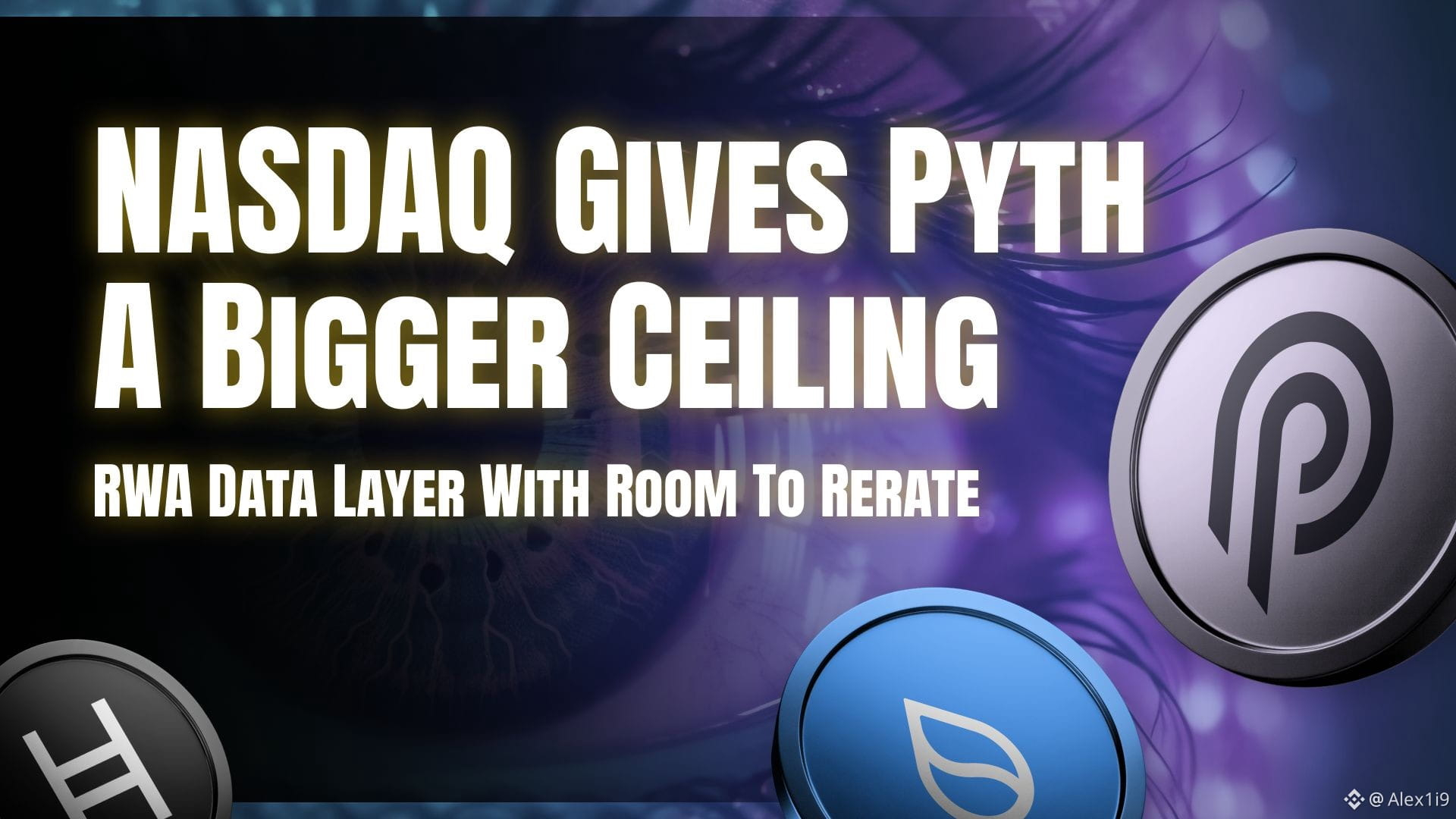
PYTH still has room to rerate ⚡
$SUI has the fast apps, liquidity and consumer UX crowd. $HBAR has enterprise trust, real-world infrastructure and institutional adoption baked into its narrative. Pyth sits underneath the market both audiences eventually need: real financial data moving into software.
Nasdaq Basic through Pyth Data Marketplace makes the ceiling look different.
This is real-time U.S. equity market data covering quotes, trades, best bid and offer, size, last sale, and official open and close reference prices.
For approved clients, Pyth becomes a channel to receive that data after licensing directly with Nasdaq.
Now compare that to where PYTH trades.
Rank #87.
Around $0.065.
Market cap around $516M.
FDV around $656M.
That is not tiny, but it is still nowhere near the size of the opportunity Pyth is chasing if it keeps moving into institutional data distribution, RWA pricing, indices, prediction markets and trading infrastructure.
Pyth has already priced $723.77B in August RWA perp volume.
It has 138+ first-party publishers.
It crossed $10.4M ARR in August.
The token is still being judged like a crypto oracle.
The product is building like a financial market-data layer.
That disconnect is the bullish part 💎
#Altcoin Season# #RWA
PYTH still has room to rerate ⚡
$SUI has the fast apps, liquidity and consumer UX crowd. $HBAR has enterprise trust, real-world infrastructure and institutional adoption baked into its narrative. Pyth sits underneath the market both audiences eventually need: real financial data moving into software.
Nasdaq Basic through Pyth Data Marketplace makes the ceiling look different.
This is real-time U.S. equity market data covering quotes, trades, best bid and offer, size, last sale, and official open and close reference prices.
For approved clients, Pyth becomes a channel to receive that data after licensing directly with Nasdaq.
Now compare that to where PYTH trades.
Rank #87.
Around $0.065.
Market cap around $516M.
FDV around $656M.
That is not tiny, but it is still nowhere near the size of the opportunity Pyth is chasing if it keeps moving into institutional data distribution, RWA pricing, indices, prediction markets and trading infrastructure.
Pyth has already priced $723.77B in August RWA perp volume.
It has 138+ first-party publishers.
It crossed $10.4M ARR in August.
The token is still being judged like a crypto oracle.
The product is building like a financial market-data layer.
That disconnect is the bullish part 💎
#Altcoin Season# #RWA
$SUI has the fast apps, liquidity and consumer UX crowd. $HBAR has enterprise trust, real-world infrastructure and institutional adoption baked into its narrative. Pyth sits underneath the market both audiences eventually need: real financial data moving into software.
Nasdaq Basic through Pyth Data Marketplace makes the ceiling look different.
This is real-time U.S. equity market data covering quotes, trades, best bid and offer, size, last sale, and official open and close reference prices.
For approved clients, Pyth becomes a channel to receive that data after licensing directly with Nasdaq.
Now compare that to where PYTH trades.
Rank #87.
Around $0.065.
Market cap around $516M.
FDV around $656M.
That is not tiny, but it is still nowhere near the size of the opportunity Pyth is chasing if it keeps moving into institutional data distribution, RWA pricing, indices, prediction markets and trading infrastructure.
Pyth has already priced $723.77B in August RWA perp volume.
It has 138+ first-party publishers.
It crossed $10.4M ARR in August.
The token is still being judged like a crypto oracle.
The product is building like a financial market-data layer.
That disconnect is the bullish part 💎
#Altcoin Season# #RWA
36
·
--
Oro still looks too early 🧊
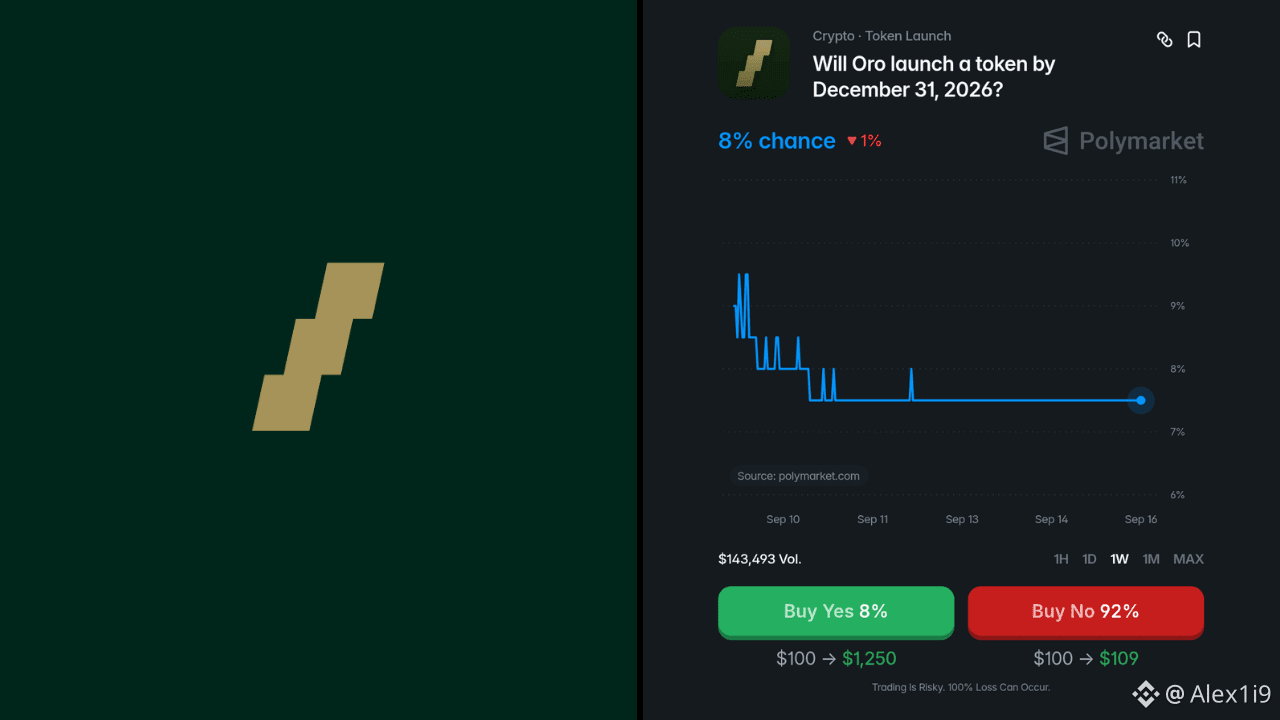
8% Yes with around $143K traded.
I'm staying on No.
This isn't some tiny market where a handful of wallets pushed the probability down. A meaningful amount has already been traded, and the market continues to assign only a very small chance to a token launch before December 31.
I respect that.
There may still be surprises, but at this point the calendar matters.
Every week that passes without a clear path toward launch makes the remaining window smaller.
So instead of forcing another directional $SUI trade, I'd rather take a position on the event itself.
No is my side.
What I like about Polymarket is that even a high-conviction No doesn't have to become a three-month commitment.
If Oro suddenly changes the picture with credible launch information, I can sell before resolution.
That's important.
Prediction markets reward conviction, but they don't require stubbornness.
I can enter when I think the odds are wrong, leave when the facts change and immediately move into another market.
There are always more predictions coming.
#Altcoin Season#
Oro still looks too early 🧊
8% Yes with around $143K traded.
I'm staying on No.
This isn't some tiny market where a handful of wallets pushed the probability down. A meaningful amount has already been traded, and the market continues to assign only a very small chance to a token launch before December 31.
I respect that.
There may still be surprises, but at this point the calendar matters.
Every week that passes without a clear path toward launch makes the remaining window smaller.
So instead of forcing another directional $SUI trade, I'd rather take a position on the event itself.
No is my side.
What I like about Polymarket is that even a high-conviction No doesn't have to become a three-month commitment.
If Oro suddenly changes the picture with credible launch information, I can sell before resolution.
That's important.
Prediction markets reward conviction, but they don't require stubbornness.
I can enter when I think the odds are wrong, leave when the facts change and immediately move into another market.
There are always more predictions coming.
#Altcoin Season#
8% Yes with around $143K traded.
I'm staying on No.
This isn't some tiny market where a handful of wallets pushed the probability down. A meaningful amount has already been traded, and the market continues to assign only a very small chance to a token launch before December 31.
I respect that.
There may still be surprises, but at this point the calendar matters.
Every week that passes without a clear path toward launch makes the remaining window smaller.
So instead of forcing another directional $SUI trade, I'd rather take a position on the event itself.
No is my side.
What I like about Polymarket is that even a high-conviction No doesn't have to become a three-month commitment.
If Oro suddenly changes the picture with credible launch information, I can sell before resolution.
That's important.
Prediction markets reward conviction, but they don't require stubbornness.
I can enter when I think the odds are wrong, leave when the facts change and immediately move into another market.
There are always more predictions coming.
#Altcoin Season#
78
·
--
$39M Proves This Community Participates 🔥
Across DeFi, communities around $HYPE and $SUI keep token economics central to how holders judge long-term participation.
I think the strongest community models are the ones where involvement produces an onchain result anyone can track.
Injective’s Community BuyBack does exactly that through recurring monthly rounds.
Ninjas commit INJ for a pro rata share of collected ecosystem revenue, and every committed INJ is permanently burned when the round closes.
Those rounds have now reached more than $39M in cumulative buyback value.
For me, that figure says more about Injective’s community than follower counts ever could 🥷
#Altcoin Season#
$39M Proves This Community Participates 🔥
Across DeFi, communities around $HYPE and $SUI keep token economics central to how holders judge long-term participation.
I think the strongest community models are the ones where involvement produces an onchain result anyone can track.
Injective’s Community BuyBack does exactly that through recurring monthly rounds.
Ninjas commit INJ for a pro rata share of collected ecosystem revenue, and every committed INJ is permanently burned when the round closes.
Those rounds have now reached more than $39M in cumulative buyback value.
For me, that figure says more about Injective’s community than follower counts ever could 🥷
#Altcoin Season#
Across DeFi, communities around $HYPE and $SUI keep token economics central to how holders judge long-term participation.
I think the strongest community models are the ones where involvement produces an onchain result anyone can track.
Injective’s Community BuyBack does exactly that through recurring monthly rounds.
Ninjas commit INJ for a pro rata share of collected ecosystem revenue, and every committed INJ is permanently burned when the round closes.
Those rounds have now reached more than $39M in cumulative buyback value.
For me, that figure says more about Injective’s community than follower counts ever could 🥷
#Altcoin Season#

67
·
--
Building a real crypto club is hard 👀
Both $APE and $PENGU helped popularize the idea that a crypto community could become a recognizable social identity, but in my view, far fewer have created recurring reasons for their communities to meet in person.
A member label and a private chat can provide access, but they do not automatically create relationships.
A real club needs a physical life too.
The Trump Coin Club is building that side of its identity in the best way possible.
From New York, Mar-a-Lago to Seoul and Singapore next, each destination gives the community another setting in which real relationships can develop.
Those IRL events are becoming the clearest expression of what the Club is trying to build ⚡️
#Macro Insights#
Building a real crypto club is hard 👀
Both $APE and $PENGU helped popularize the idea that a crypto community could become a recognizable social identity, but in my view, far fewer have created recurring reasons for their communities to meet in person.
A member label and a private chat can provide access, but they do not automatically create relationships.
A real club needs a physical life too.
The Trump Coin Club is building that side of its identity in the best way possible.
From New York, Mar-a-Lago to Seoul and Singapore next, each destination gives the community another setting in which real relationships can develop.
Those IRL events are becoming the clearest expression of what the Club is trying to build ⚡️
#Macro Insights#
Both $APE and $PENGU helped popularize the idea that a crypto community could become a recognizable social identity, but in my view, far fewer have created recurring reasons for their communities to meet in person.
A member label and a private chat can provide access, but they do not automatically create relationships.
A real club needs a physical life too.
The Trump Coin Club is building that side of its identity in the best way possible.
From New York, Mar-a-Lago to Seoul and Singapore next, each destination gives the community another setting in which real relationships can develop.
Those IRL events are becoming the clearest expression of what the Club is trying to build ⚡️
#Macro Insights#
75
·
--
$SUI Bulls Just Reclaimed A Key Level 🔥
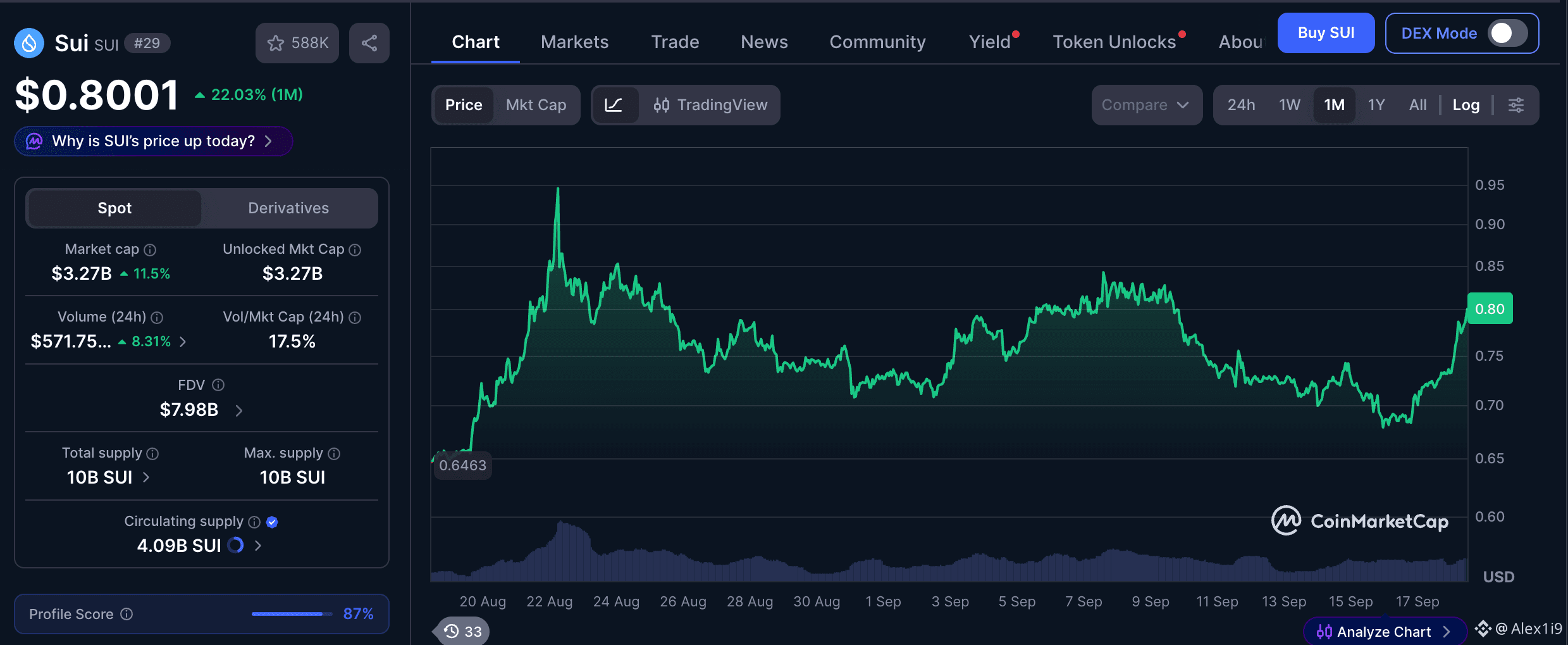
SUI has jumped roughly 8.6% to around $0.78, outperforming the wider market with $489M in daily volume behind the move.
The important level now sits at $0.764.
Holding above it would confirm that buyers have reclaimed the recent Fibonacci support and are willing to defend the bounce.
The first resistance is $0.80.
A decisive daily close above that zone would put $0.85 back in play, where the 200-day moving average becomes the real trend confirmation.
Clear $0.85 and the chart opens towards $0.95, followed by the larger psychological target around $1.04.
I would expect some turbulence before that happens.
Short-term momentum is already stretched, with the hourly RSI recently moving above 75, so a retest of support would be healthy.
The bullish structure survives while $0.764 holds.
If that level fails, $0.73 becomes the next defence before the stronger $0.677 to $0.65 demand zone.
My outlook stays bullish because price has recovered with volume and the market has given us a clean invalidation point.
Hold $0.764, break $0.80 and reclaim $0.85.
That is the route I’m watching towards a return above $1.
#Sui #Altcoin Season#
$SUI Bulls Just Reclaimed A Key Level 🔥
SUI has jumped roughly 8.6% to around $0.78, outperforming the wider market with $489M in daily volume behind the move.
The important level now sits at $0.764.
Holding above it would confirm that buyers have reclaimed the recent Fibonacci support and are willing to defend the bounce.
The first resistance is $0.80.
A decisive daily close above that zone would put $0.85 back in play, where the 200-day moving average becomes the real trend confirmation.
Clear $0.85 and the chart opens towards $0.95, followed by the larger psychological target around $1.04.
I would expect some turbulence before that happens.
Short-term momentum is already stretched, with the hourly RSI recently moving above 75, so a retest of support would be healthy.
The bullish structure survives while $0.764 holds.
If that level fails, $0.73 becomes the next defence before the stronger $0.677 to $0.65 demand zone.
My outlook stays bullish because price has recovered with volume and the market has given us a clean invalidation point.
Hold $0.764, break $0.80 and reclaim $0.85.
That is the route I’m watching towards a return above $1.
#Sui #Altcoin Season#
SUI has jumped roughly 8.6% to around $0.78, outperforming the wider market with $489M in daily volume behind the move.
The important level now sits at $0.764.
Holding above it would confirm that buyers have reclaimed the recent Fibonacci support and are willing to defend the bounce.
The first resistance is $0.80.
A decisive daily close above that zone would put $0.85 back in play, where the 200-day moving average becomes the real trend confirmation.
Clear $0.85 and the chart opens towards $0.95, followed by the larger psychological target around $1.04.
I would expect some turbulence before that happens.
Short-term momentum is already stretched, with the hourly RSI recently moving above 75, so a retest of support would be healthy.
The bullish structure survives while $0.764 holds.
If that level fails, $0.73 becomes the next defence before the stronger $0.677 to $0.65 demand zone.
My outlook stays bullish because price has recovered with volume and the market has given us a clean invalidation point.
Hold $0.764, break $0.80 and reclaim $0.85.
That is the route I’m watching towards a return above $1.
#Sui #Altcoin Season#
79
·
--
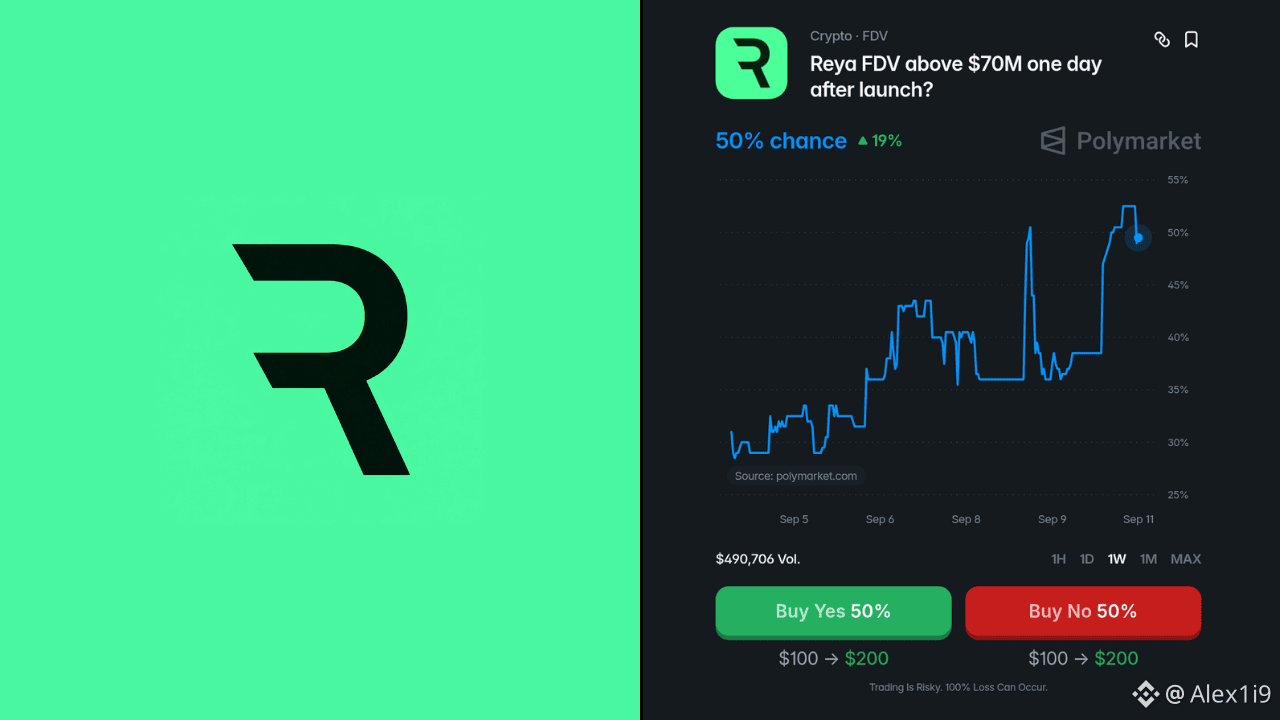
50/50 Is The Opportunity ⚔️
Polymarket has Reya perfectly split.
50% Yes. 50% No.
I know which side I want.
Yes.
The chart is why.
This market started below 30%.
Then traders steadily pushed it through 35%, 40%, and eventually 50%.
There were pullbacks along the way.
Every major one found buyers.
That's very different from a random one-day spike.
It's a week of gradually improving conviction.
And nearly $500K has already traded in the screenshot.
So this isn't some $5K market pretending to have a signal.
$ARB fits the onchain infrastructure side of this thesis.
$HYPE represents how aggressively traders can value crypto-native trading platforms once adoption starts showing.
Polymarket lets me trade that valuation question before launch day settles the argument.
That's the opportunity.
Everyone gets the same 50/50 price.
Only one side gets paid.
I'm taking Yes.
#Altcoin Season#
50/50 Is The Opportunity ⚔️
Polymarket has Reya perfectly split.
50% Yes. 50% No.
I know which side I want.
Yes.
The chart is why.
This market started below 30%.
Then traders steadily pushed it through 35%, 40%, and eventually 50%.
There were pullbacks along the way.
Every major one found buyers.
That's very different from a random one-day spike.
It's a week of gradually improving conviction.
And nearly $500K has already traded in the screenshot.
So this isn't some $5K market pretending to have a signal.
$ARB fits the onchain infrastructure side of this thesis.
$HYPE represents how aggressively traders can value crypto-native trading platforms once adoption starts showing.
Polymarket lets me trade that valuation question before launch day settles the argument.
That's the opportunity.
Everyone gets the same 50/50 price.
Only one side gets paid.
I'm taking Yes.
#Altcoin Season#
Polymarket has Reya perfectly split.
50% Yes. 50% No.
I know which side I want.
Yes.
The chart is why.
This market started below 30%.
Then traders steadily pushed it through 35%, 40%, and eventually 50%.
There were pullbacks along the way.
Every major one found buyers.
That's very different from a random one-day spike.
It's a week of gradually improving conviction.
And nearly $500K has already traded in the screenshot.
So this isn't some $5K market pretending to have a signal.
$ARB fits the onchain infrastructure side of this thesis.
$HYPE represents how aggressively traders can value crypto-native trading platforms once adoption starts showing.
Polymarket lets me trade that valuation question before launch day settles the argument.
That's the opportunity.
Everyone gets the same 50/50 price.
Only one side gets paid.
I'm taking Yes.
#Altcoin Season#
84
·
--
I Check The Exit 🛡️
When someone shows me a DeFi strategy, I usually start at the end.
How do I get out?
That tells me more than staring at the advertised APY.
I want to know what happens when liquidity disappears, collateral weakens or leverage suddenly becomes uncomfortable.
This is one reason Theoriq's risk model interests me.
Positions aren't just selected for return potential.
The framework considers collateral quality, liquidity, concentration and structural risk before capital gets committed.
Monitoring continues afterward rather than treating deployment as the finish line.
That mindset becomes increasingly important as onchain markets get more interconnected.
$AAVE can offer deep lending infrastructure, while $PENDLE can expose entirely different term-yield opportunities.
Both can be useful without carrying identical risks.
That's exactly the point.
A portfolio isn't safer because it contains more positions.
It's safer when someone understands why every position belongs there and what would make them leave.
#Altcoin Season#
I Check The Exit 🛡️
When someone shows me a DeFi strategy, I usually start at the end.
How do I get out?
That tells me more than staring at the advertised APY.
I want to know what happens when liquidity disappears, collateral weakens or leverage suddenly becomes uncomfortable.
This is one reason Theoriq's risk model interests me.
Positions aren't just selected for return potential.
The framework considers collateral quality, liquidity, concentration and structural risk before capital gets committed.
Monitoring continues afterward rather than treating deployment as the finish line.
That mindset becomes increasingly important as onchain markets get more interconnected.
$AAVE can offer deep lending infrastructure, while $PENDLE can expose entirely different term-yield opportunities.
Both can be useful without carrying identical risks.
That's exactly the point.
A portfolio isn't safer because it contains more positions.
It's safer when someone understands why every position belongs there and what would make them leave.
#Altcoin Season#
When someone shows me a DeFi strategy, I usually start at the end.
How do I get out?
That tells me more than staring at the advertised APY.
I want to know what happens when liquidity disappears, collateral weakens or leverage suddenly becomes uncomfortable.
This is one reason Theoriq's risk model interests me.
Positions aren't just selected for return potential.
The framework considers collateral quality, liquidity, concentration and structural risk before capital gets committed.
Monitoring continues afterward rather than treating deployment as the finish line.
That mindset becomes increasingly important as onchain markets get more interconnected.
$AAVE can offer deep lending infrastructure, while $PENDLE can expose entirely different term-yield opportunities.
Both can be useful without carrying identical risks.
That's exactly the point.
A portfolio isn't safer because it contains more positions.
It's safer when someone understands why every position belongs there and what would make them leave.
#Altcoin Season#
69
·
--
Two Major Markets Collide 🧠
The creator economy that once gathered around $IMX now overlaps with the RWA crowd following $SPCX in ways that sounded ridiculous three years ago.
From a distance, those look like completely different crypto cycles.
Up close, they are iterations of the same idea.
Internet culture can become ownable, tradable, and economically valuable to the people creating it.
The companies that survive long enough get to carry lessons from one cycle into the next.
Zora’s journey makes much more sense through that lens.
It began by giving creators an open alternative to traditional NFT marketplaces.
Since then, the product has moved through several expressions of the same underlying thesis.
- Open markets for digital art and media
- Creator and content coins
- Social experiences built around trading
- Custom Pairs connecting new tokens with memes, majors, and tokenized assets
More than 4,000 Custom Pairs have already been created.
Some people see that history as a series of pivots.
I see six years of trying to answer one difficult question.
How should value move through internet culture?
Zora has gone from helping creators sell individual works to letting anyone create an entire market around an idea.
With fresh leadership and a leaner team, the next challenge is turning those accumulated lessons into a product ordinary people actually want to use.
If Zora gets that distribution right, its past may become the strongest argument for its future.
#RWA #Altcoin Season#
Two Major Markets Collide 🧠
The creator economy that once gathered around $IMX now overlaps with the RWA crowd following $SPCX in ways that sounded ridiculous three years ago.
From a distance, those look like completely different crypto cycles.
Up close, they are iterations of the same idea.
Internet culture can become ownable, tradable, and economically valuable to the people creating it.
The companies that survive long enough get to carry lessons from one cycle into the next.
Zora’s journey makes much more sense through that lens.
It began by giving creators an open alternative to traditional NFT marketplaces.
Since then, the product has moved through several expressions of the same underlying thesis.
- Open markets for digital art and media
- Creator and content coins
- Social experiences built around trading
- Custom Pairs connecting new tokens with memes, majors, and tokenized assets
More than 4,000 Custom Pairs have already been created.
Some people see that history as a series of pivots.
I see six years of trying to answer one difficult question.
How should value move through internet culture?
Zora has gone from helping creators sell individual works to letting anyone create an entire market around an idea.
With fresh leadership and a leaner team, the next challenge is turning those accumulated lessons into a product ordinary people actually want to use.
If Zora gets that distribution right, its past may become the strongest argument for its future.
#RWA #Altcoin Season#
The creator economy that once gathered around $IMX now overlaps with the RWA crowd following $SPCX in ways that sounded ridiculous three years ago.
From a distance, those look like completely different crypto cycles.
Up close, they are iterations of the same idea.
Internet culture can become ownable, tradable, and economically valuable to the people creating it.
The companies that survive long enough get to carry lessons from one cycle into the next.
Zora’s journey makes much more sense through that lens.
It began by giving creators an open alternative to traditional NFT marketplaces.
Since then, the product has moved through several expressions of the same underlying thesis.
- Open markets for digital art and media
- Creator and content coins
- Social experiences built around trading
- Custom Pairs connecting new tokens with memes, majors, and tokenized assets
More than 4,000 Custom Pairs have already been created.
Some people see that history as a series of pivots.
I see six years of trying to answer one difficult question.
How should value move through internet culture?
Zora has gone from helping creators sell individual works to letting anyone create an entire market around an idea.
With fresh leadership and a leaner team, the next challenge is turning those accumulated lessons into a product ordinary people actually want to use.
If Zora gets that distribution right, its past may become the strongest argument for its future.
#RWA #Altcoin Season#

66
ເຂົ້າສູ່ລະບົບເພື່ອສຳຫຼວດເນື້ອຫາເພີ່ມເຕີມ
ເຂົ້າຮ່ວມກຸ່ມຜູ້ໃຊ້ຄຣິບໂຕທົ່ວໂລກໃນ Binance Square.
⚡️ ໄດ້ຮັບຂໍ້ມູນຫຼ້າສຸດ ແລະ ທີ່ມີປະໂຫຍດກ່ຽວກັບຄຣິບໂຕ.
💬 ໄດ້ຮັບຄວາມໄວ້ວາງໃຈຈາກຕະຫຼາດແລກປ່ຽນຄຣິບໂຕທີ່ໃຫຍ່ທີ່ສຸດໃນໂລກ.
👍 ຄົ້ນຫາຂໍ້ມູນເຊີງເລິກທີ່ແທ້ຈາກນັກສ້າງທີ່ໄດ້ຮັບການຢືນຢັນ.
ອີເມວ / ເບີໂທລະສັບ
ຫົວຂໍ້ທີ່ກໍາລັງນິຍົມ
ChainlinkLaunchesBankSWIFTLedgerFramework
74 views
15 ກຳລັງສົນທະນາ
🚨 BREAKING: Chainlink x SWIFT — Bank Ledger Framework Launched!
Massive step for tokenized banking!
Chainlink announced on Sept 28 that it will connect bank systems and signing infrastructure to SWIFT's blockchain ledger through its platform.
Key Points:
CRE lets institutions retain transaction signing keys while orchestrating workflows that access SWIFT's shared ledger SWIFT's ledger supports 24/7 tokenized deposit payments while final settlement continues through existing mechanisms Seventeen banks across six continents are preparing live pilots using tokenized deposits Banks include ANZ, HSBC, Citibank, Standard Chartered, and UBS Framework uses self-signing model — keys stay with bank, Chainlink Runtime Environment (CRE) coordinates workflowSWIFT connects more than 11,500 financial institutions across 200 marketsAnnounced at Sibos 2026 alongside CCIP 2.0
This positions Chainlink as the bridge between traditional banks and on-chain payments.
$LINK $XRP $HBAR $ONDO
#Chainlink #SWIFT #LINK #Tokenization #RWA #Banking #earningseason #chainlinklaunchesbankswiftledgerframework
True News
·0 ຖືກໃຈ
·5 views
EarningsSeason
406,148 views
3,088 ກຳລັງສົນທະນາ
SECChairWantsStockMarketsOnChain
2,930 views
120 ກຳລັງສົນທະນາ