
Tellor Re-poster
109 ໂພສ

Tellor Re-poster
Tellor is a decentralized oracle protocol that incentivizes an open and permissionless network of data reporting. Important Links: https://t.co/7ezRcnBLOH
0 ກໍາລັງຕິດຕາມ
89 ຜູ້ຕິດຕາມ
31 Liked
ໂພສ
ທັງໝົດ
ວີດີໂອ
With Tellor, you never have to blindly trust that reporters have the proper incentives to act with integrity. The platform ensures that essential information including stake, slashing tiers, and dispute outcomes remains completely visible on-chain. Because of this open approach, anybody can independently confirm that the financial design functions exactly as intended. This ability to personally verify the underlying economics is what true crypto-economic security looks like in action.

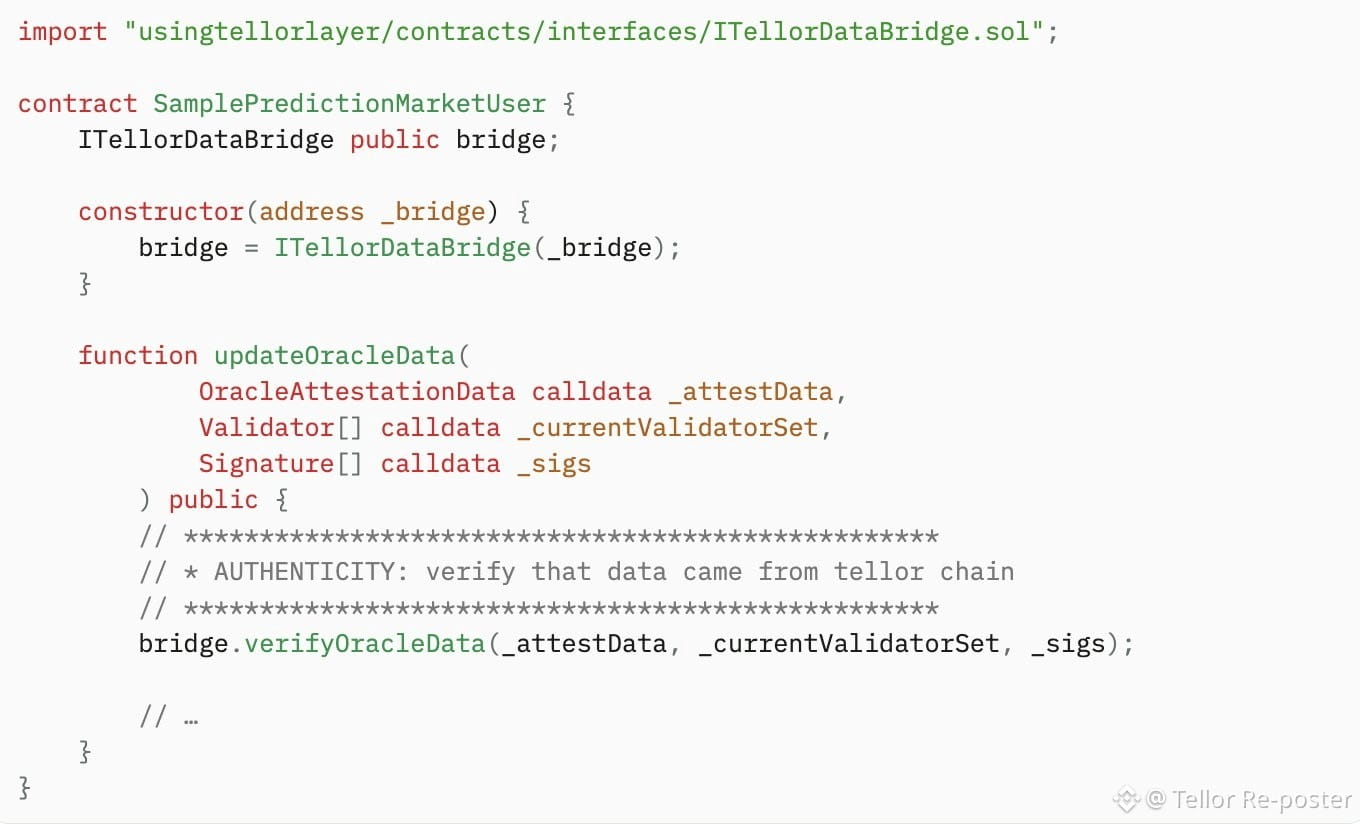
To successfully validate the authenticity of your information, you can use the programming snippet provided below. This example illustrates the exact steps needed to link a smart contract directly to the TellorDataBridge and transmit Tellor data for verification.
If you would like to explore this topic further, please check out the comprehensive documentation available at https://docs.tellor.io/tellor/using-tellor-data/integrating-tellor-data
If you would like to explore this topic further, please check out the comprehensive documentation available at https://docs.tellor.io/tellor/using-tellor-data/integrating-tellor-data
Within the Tellor network, validators serve as essential participants who uphold the consensus and fundamental integrity of the blockchain. The main duties of these contributors involve confirming transactions and defending the network, which ultimately ensures that the entire system operates exactly as it should.
📚 Discover additional information:
https://docs.tellor.io/tellor
📚 Discover additional information:
https://docs.tellor.io/tellor
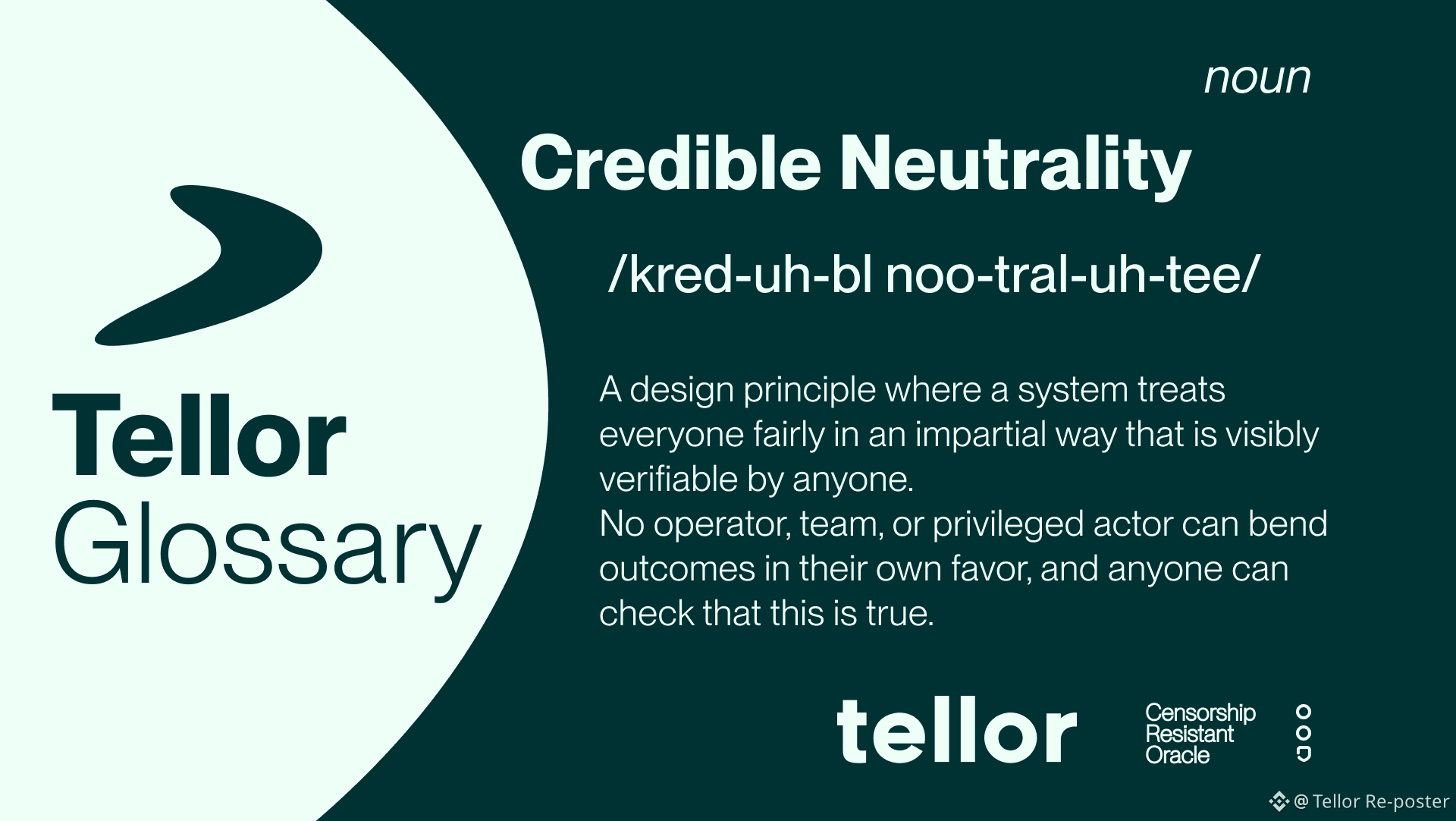
Instead of handing over control of oracle data to an exclusive committee, Tellor guarantees a system that is entirely free of gatekeepers. The core procedures involving data submission, raising disputes, and confirming accuracy remain completely open to the public.
Thanks to this accessible design, absolutely any person is welcome to step up and participate by providing information, questioning submissions, and checking the validity of the data.
Thanks to this accessible design, absolutely any person is welcome to step up and participate by providing information, questioning submissions, and checking the validity of the data.
Operating reporter software is not a requirement if you wish to assist in generating oracle data for Tellor:
To ensure the system remains free of any centralized bottlenecks, every functional position operates in a completely open and permissionless manner. This applies to the roles of requesting, reporting, validating, disputing, selecting, delegating, and relaying. If even a single one of these tasks demanded official approval from the team, it would introduce a restrictive choke point into the network. You are welcome to test and simulate any of these positions prior to actively participating by heading over to https://operator.tellor.io/

To prevent any centralized bottlenecks, the system ensures that every single position is fully open and permissionless. Whether your interest lies in requesting, reporting, validating, disputing, selecting, or relaying, you will never need special authorization from the team to participate. If even one of these functions required official approval, it would introduce a critical choke point into the network. We warmly invite you to simulate and explore your desired position before getting started by visiting https://operator.tellor.io/

Operating as an L1 oracle chain, Tellor equips developers on any blockchain with the ability to retrieve subjective data through the use of robust verification mechanisms.
This article serves as a comprehensive technical summary designed to support developers in navigating the platform. Inside, you will find a clear breakdown of the essential integration steps, an explanation of the necessary verification checks, and a look into specific considerations tailored to typical oracle use cases.
Read more:
https://tellor.io/blog/using-tellor-integration-workflow/
This article serves as a comprehensive technical summary designed to support developers in navigating the platform. Inside, you will find a clear breakdown of the essential integration steps, an explanation of the necessary verification checks, and a look into specific considerations tailored to typical oracle use cases.
Read more:
https://tellor.io/blog/using-tellor-integration-workflow/
When it comes to data availability, Tellor remains completely neutral and never dictates what information is permitted to exist. Our ecosystem is fully open, meaning absolutely anyone is welcome to participate. You have the freedom to ask for specific data, put up a stake to submit a report, challenge an incorrect value, or pass along the final results. To discover exactly how these mechanics operate behind the scenes, please read through our official whitepaper at https://docs.tellor.io/tellor/whitepaper

If you want to see exactly how to integrate Tellor into your own projects, the SampleLayerUser repository is a fantastic resource. It contains a diverse selection of sample code tailored for several different use cases. Within this repository, you will discover practical examples for building Prediction Markets and creating standard Price feeds. The collection also tackles the integration of Slow data, specifically highlighting the CPI that is updated monthly. Beyond these features, the repository offers clear code demonstrating how to go about Reading from another EVM chain, as well as how to configure Tellor as a fallback to a centralized oracle. You can explore all of these materials and begin your development journey by visiting the following link at https://github.com/tellor-io/SampleLayerUser
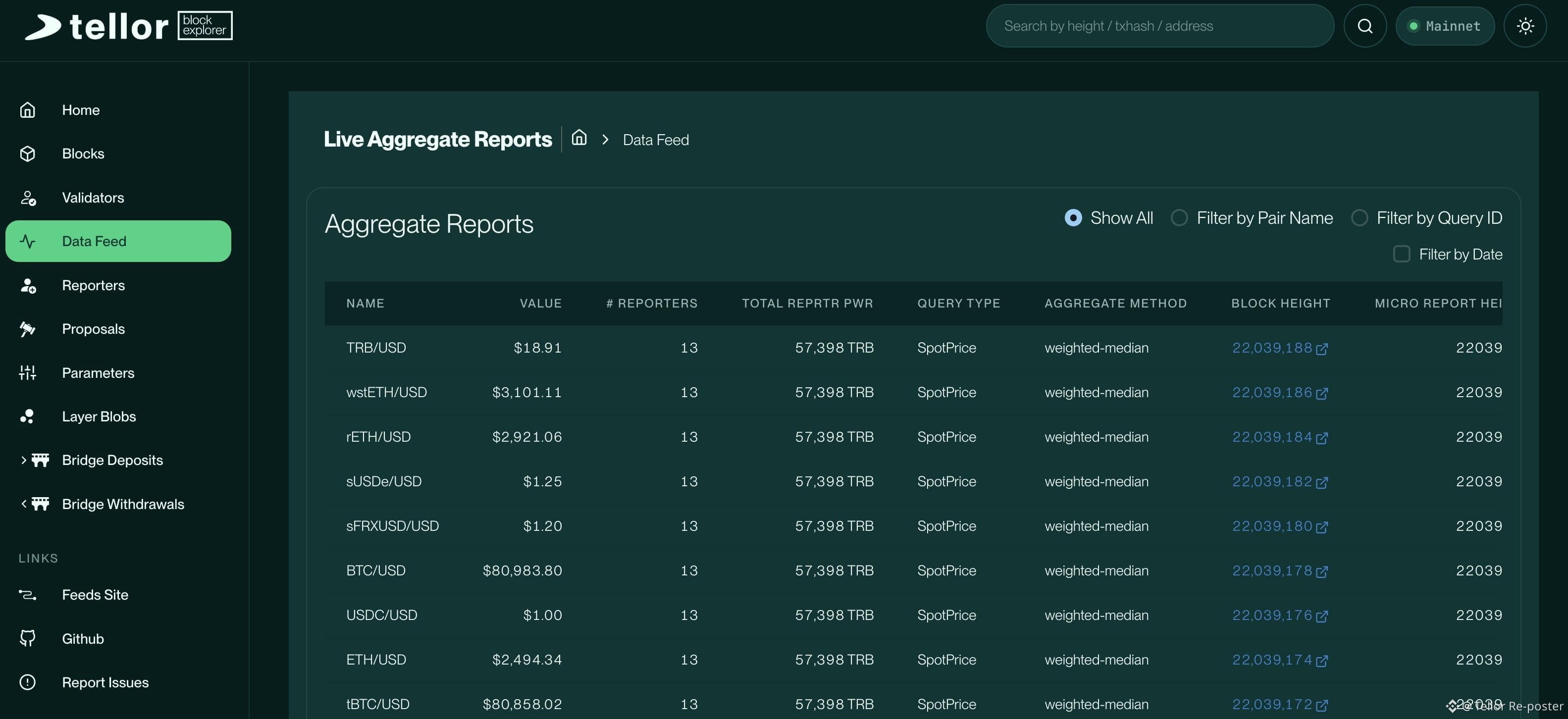
Values are submitted using a continuous rotation of enshrined queries called the cycle list, which ensures that all information stays completely up to date. You can explore the active cycle list feeds that are presently being relayed by visiting https://feeds.tellor.io/

Whenever users interact with a consumer-facing application, Tellor Pull empowers your protocol to retrieve the specific data values it requires right at that very moment. Because the information is cryptographically attested by Tellor, it can be authenticated and implemented instantly during that exact same transaction.
Discover more details by visiting the link below.
https://tellor.io/blog/tellor-pull/
Discover more details by visiting the link below.
https://tellor.io/blog/tellor-pull/
Our latest piece explores the core principles and mathematical models that power the security framework of Tellor. By reading this guide, you will develop a clear grasp of the crypto-economic safeguards currently protecting the network. We also explore the most effective methods for compromising the platform, detailing exactly what these hypothetical exploits entail and the financial expenses required to execute them.
📖 Read more:
https://tellor.io/blog/tellor-security-201/
📖 Read more:
https://tellor.io/blog/tellor-security-201/
Resolving the oracle issue requires much more than just guaranteeing the successful delivery of information. We can actually categorize this challenge into 3 distinct levels.
Level 1 is Integrity, which encompasses the methodology and the overall quality of the data.
Level 2 is Infrastructure, which pertains directly to the oracle protocol.
Level 3 is Integration, which depends on the user completing the implementation properly.
Read more about this subject here:
https://tellor.io/blog/a-three-layered-approach/
Level 1 is Integrity, which encompasses the methodology and the overall quality of the data.
Level 2 is Infrastructure, which pertains directly to the oracle protocol.
Level 3 is Integration, which depends on the user completing the implementation properly.
Read more about this subject here:
https://tellor.io/blog/a-three-layered-approach/
We are currently looking for new node operators to join us. As an open infrastructure built for externally verifiable data, Tellor allows anyone to engage on a completely permissionless basis. By operating a node, you directly contribute to the overall strength of the network.
If you would like to map out your specific configuration, you can access our modeling tool at the following address:
https://operator.tellor.io/
Whenever you are ready to begin the process, all the necessary instructions are available right here:
https://docs.tellor.io/tellor/running-palmito-testnet/public-testnet
If you would like to map out your specific configuration, you can access our modeling tool at the following address:
https://operator.tellor.io/
Whenever you are ready to begin the process, all the necessary instructions are available right here:
https://docs.tellor.io/tellor/running-palmito-testnet/public-testnet

We are pleased to announce that Proposal 32, concerning the v6.1.7 upgrade, is officially active on the Mainnet. Based on our current estimates, the upgrade process is scheduled to occur on Wednesday 9/2 at 9am EST. If you would like to examine the proposal directly, you can access it through the explorer at https://explorer.tellor.io/proposals. Additionally, for an in-depth understanding of this update, we encourage you to review our full article available at https://tellor.io/blog/upgrade-mainnet-v6-1-7/.
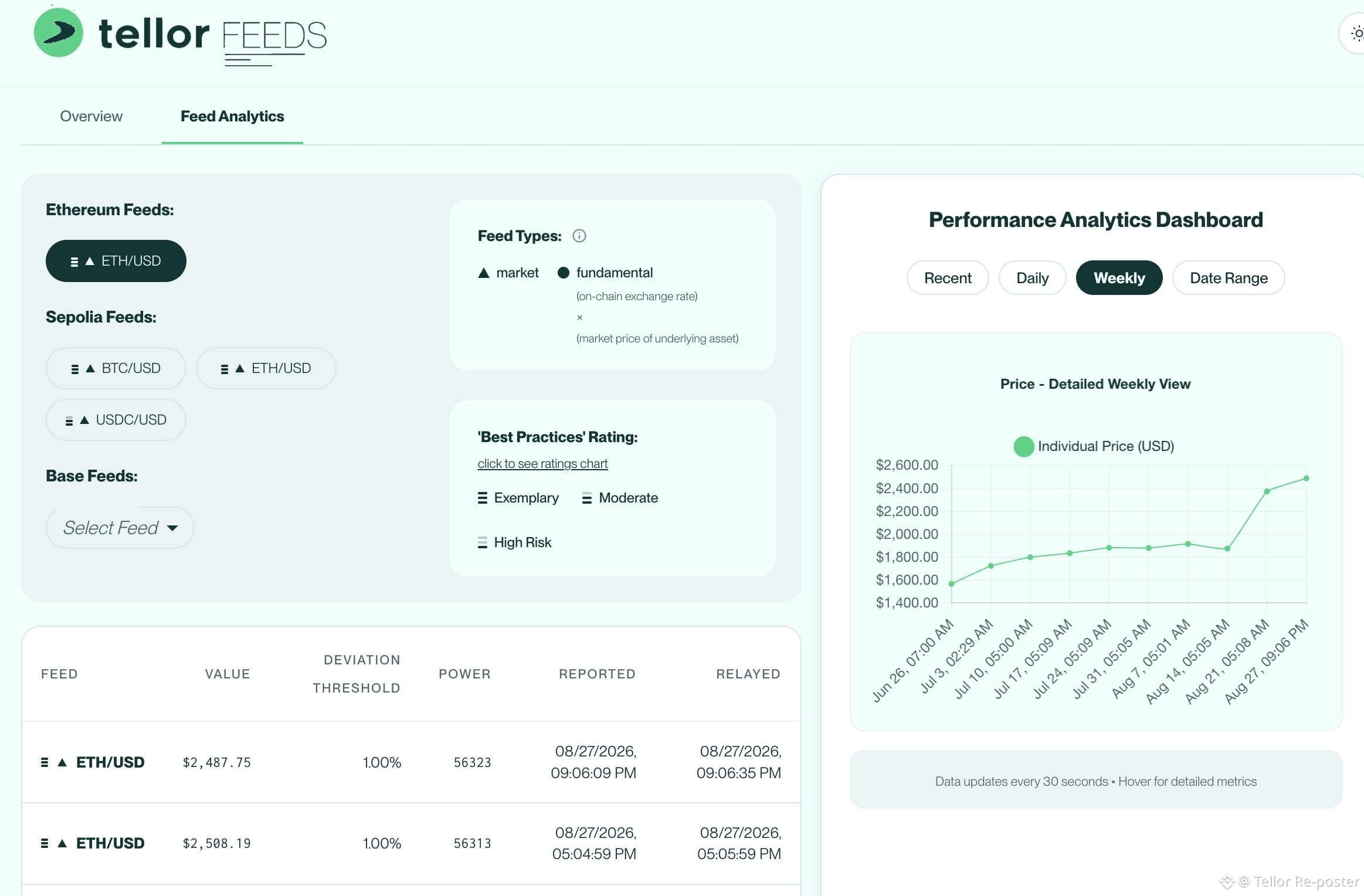
If you need to evaluate the performance of a specific feed, you can easily do so by checking the Feed Analytics tab at http://feeds.tellor.io. On this page, you will see that every feed is given a Best Practices rating derived from its unique configuration. In addition to this score, the tool outlines the deviation threshold, highlights the reporting power backing every submission, and measures the time delay between the initial reporting of a value and its final relay.
Let us be completely clear that we are not dealing with the traditional oracle problem. The challenge at hand does not revolve around the mechanics of how to bring information onto the blockchain. Instead, the true issue is deciding exactly what data needs to be transferred.
Discover the full details by reading the complete article here:
https://tellor.io/blog/long-tail-asset-oracles-for-collateral-in-defi/
Discover the full details by reading the complete article here:
https://tellor.io/blog/long-tail-asset-oracles-for-collateral-in-defi/
ເຂົ້າສູ່ລະບົບເພື່ອສຳຫຼວດເນື້ອຫາເພີ່ມເຕີມ