


The cryptocurrency market has had many prominent periods of bullish activity since its establishment, characterized by substantial price increases and investor excitement. Here is a concise summary:
The Initial Period (2009-2012): Following Bitcoin's inception in 2009, a significant surge in value took place in 2011. During this period, Bitcoin's price soared to $1 for the first time and then to a peak of over $32, demonstrating the immense potential of decentralized digital currencies.
The 2013 Surge: 2013 was marked by two significant bull markets. Bitcoin's price had a significant surge to $266 in April, mostly due to heightened media coverage and growing investor enthusiasm. Subsequently, it had another significant increase, surpassing $1,000, driven by reasons like as the widespread adoption of Bitcoin in China and enhanced market infrastructure.
The phenomenon of 2017: The 2017 bull run was notable for its spectacular nature, with Bitcoin's price surging to over $20,000. This era was distinguished by the frenzy of Initial Coin Offerings (ICOs), extensive attention by mainstream media, and a substantial surge of individual investors.
The 2020-2021 Rally: Bitcoin's surge beyond $60,000 in 2021 can be attributed to a confluence of factors, including institutional investment, abundant liquidity resulting from central banks' extensive money printing in response to COVID-19, and growing interest in decentralized finance (DeFi).
The historical trajectory of the Bitcoin and cryptocurrency market's upward trend.
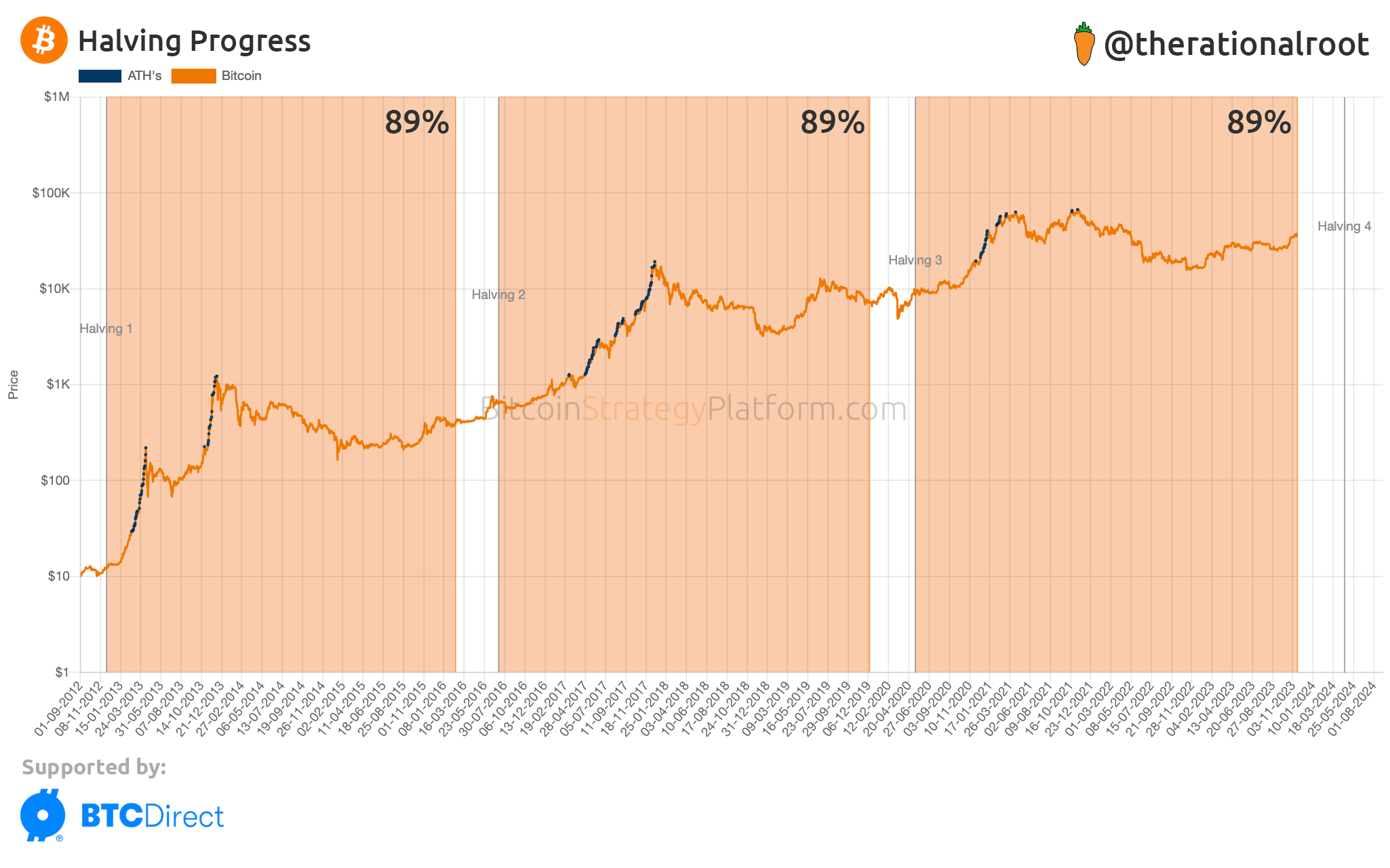
Each of these bull runs has been accompanied by significant declines or bear markets, illustrating the cyclical nature of the bitcoin industry. These time periods have played a vital role in molding the structure of the Bitcoin and cryptocurrency industry.
The 4-Year Cycle Theory: Bitcoin's Impact on the Crypto Bull Market
The impact of Bitcoin on the cryptocurrency bull market is strongly linked to its 4-Year Cycle Theory, primarily driven by the occurrence of halving occurrences in the cryptocurrency. These occurrences, which happen about every four years or every 210,000 blocks, result in a 50% reduction in the Bitcoin mining reward. As a result, the rate at which new bitcoins are generated is decreased.
The halving process is a fundamental part of Bitcoin's architecture, designed to provide scarcity and regulate inflation, akin to the increasing difficulty of extracting a finite natural resource as time progresses. According to the idea, the decrease in supply, while demand remains stable or increases, causes the price of Bitcoin to rise, frequently resulting in a period of bullish market sentiment for Bitcoin and other cryptocurrencies.
Empirical evidence substantiates this hypothesis. For example, after the initial halving in 2012, the price of Bitcoin surged from around $12 to more than $1,100 in the subsequent year. In a similar manner, the halving event in 2016 was followed by a substantial increase in Bitcoin's value, reaching its highest point in late 2017 at about $20,000. The latest halving event in 2020 resulted in significant price increases, culminating in Bitcoin hitting unprecedented peak values in November 2021.
This recurring pattern of post-halving bull runs not only amplifies the value of Bitcoin, but also frequently initiates a widespread surge in the cryptocurrency market. Bitcoin's market dominance and its function as a digital benchmark for gold imply that its price fluctuations have a substantial impact on the overall cryptocurrency market.
Nevertheless, these periods of bullishness are not enduring. Post-halving rises frequently result in corrections, subsequently leading to bear markets. The recurring pattern highlights the speculative character of Bitcoin and the wider cryptocurrency market, emphasizing the need of timing the market and effectively managing risks for investors.