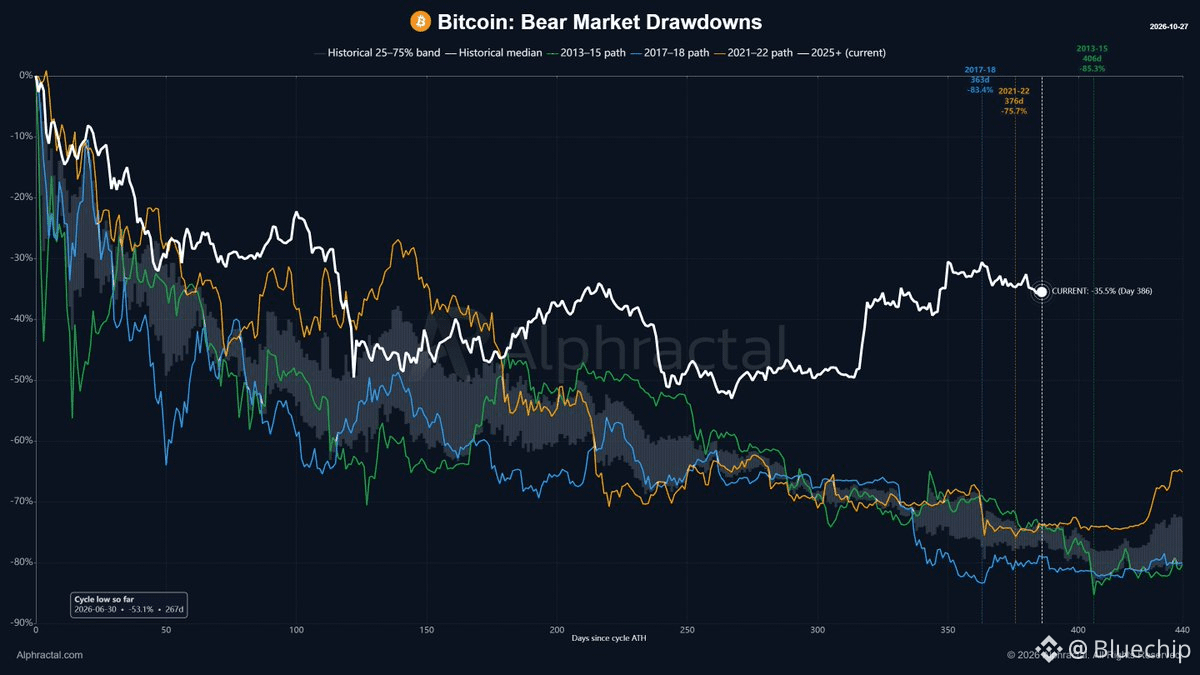

$BTC may be breaking one of the most consistent historical patterns of its bear market cycles!
Historically, Bitcoin's major bear markets have taken approximately one year, or slightly longer, to establish their definitive bottoms.
Let's look at the duration of previous cycles, measured from peak to bottom:
• 2013–2015: 406 days
• 2017–2018: 363 days
• 2021–2022: 376 days
• 2025–2026: 386 days since the peak, so far.
But there are two particularly interesting observations worth highlighting!
1. The bottom may have occurred earlier than expected!
The lowest price recorded in the current cycle occurred on June 30, 2026, just 267 days after the peak.
If that was indeed the definitive bottom, we could be witnessing a significant shift in Bitcoin's historical cycle timing, breaking a pattern observed across the previous three major bear markets.
2. We are still within the historical window for another bottom!
Despite the recovery since June, the current cycle remains within the historical range of 363 to 406 days.
This means Bitcoin could still establish a new low in the coming weeks, particularly within the next 20 days, without necessarily deviating from the timing observed in previous cycles.
This possibility may seem increasingly unlikely to many market participants, but it cannot be ruled out simply because time has passed.
The big question is:
Are we witnessing, for the first time across these major cycles, a significant shift in the timing of Bitcoin's bear market?
Or is it still too early to conclude that a historical pattern has been broken?
Markets don't follow absolute rules. Data reveals patterns, but it never guarantees their repetition.