
Gold, the world’s oldest safe-haven asset, has just witnessed one of its steepest declines in modern history. In just 24 hours, the market value of gold plunged by nearly $2.5 trillion — an amount equivalent to the entire market capitalization of Bitcoin. The drop marks gold’s worst two-day decline since 2013, shaking investor confidence in what was once considered the ultimate hedge against inflation and volatility.
A Rare Event in Market History
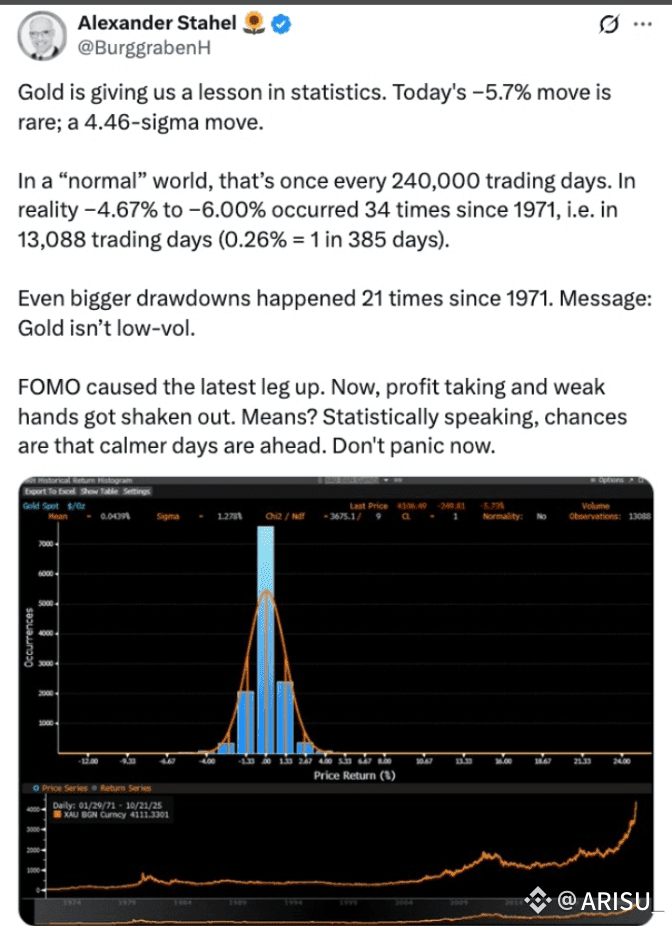
According to data from The Kobeissi Letter, gold’s market value fell around 8% over two trading sessions — a move so rare that it would statistically occur only once every 240,000 trading days. Swiss investor and resource analyst Alexander Stahel described the drop as “a lesson in statistics,” emphasizing that such sharp corrections have happened only 21 times since 1971, when gold was unpegged from the U.S. dollar.
Stahel attributed the crash to a buildup of investor FOMO (fear of missing out) after months of aggressive buying across gold equities, physical gold, and tokenized assets. As demand overheated, the market became unstable. “FOMO caused the latest leg up,” he explained on X (formerly Twitter). “Now, profit-taking and weak hands got shaken out. Statistically, calmer days are ahead.”
Why Gold Crashed So Hard
Analysts believe the dramatic fall was driven by a mix of profit-taking, overheated sentiment, and overextension. After gold’s impressive 60% rally in 2022, investors flooded in to seek protection from inflation and geopolitical uncertainty. However, once the price momentum slowed, large investors began offloading their holdings, triggering a rapid cascade of selling that wiped out trillions in market value.
The correction serves as a reminder that even assets long considered “safe” are not immune to panic or liquidity shocks. Gold’s fall shows that trust and emotion can move markets just as powerfully as data or fundamentals.
Bitcoin Shows Surprising Resilience
While gold’s collapse sent shockwaves through global markets, Bitcoin remained surprisingly stable. Data from Coinbase showed that Bitcoin slipped only 0.8% during the same period, trading near $108,000 after briefly touching $114,000. The contrast between gold’s steep fall and Bitcoin’s resilience reignited debate about the latter’s growing role as a modern store of value.
Veteran trader Peter Brandt highlighted the scale of gold’s loss, noting that the metal’s $2.5 trillion decline was equivalent to 55% of the total cryptocurrency market’s value. In simple terms, gold lost more in a single day than the entire crypto market is worth. For many observers, this moment underscored how far Bitcoin has come — from being seen as a speculative asset to a maturing alternative hedge against market instability.
What This Means for Investors
For investors, gold’s wipeout sends a clear message: no asset is completely safe. While gold’s historical reputation as a store of value remains strong, this event shows that even the most established assets can suffer major shocks when sentiment turns sour. Bitcoin’s calm response to the turmoil, on the other hand, demonstrates how the crypto market is gradually evolving beyond pure speculation.
Investors are now rethinking their strategies — weighing the legacy and trust of gold against the adaptability and innovation that Bitcoin represents. The lines between traditional and digital assets are beginning to blur, creating a new era of mixed safe-havens where stability depends as much on technology and transparency as it does on history.
The Bigger Picture
Experts expect the gold market to stabilize in the coming weeks, viewing this correction as a temporary reset rather than the start of a long-term decline. Still, it has left a psychological mark on investors who once saw gold as unshakable. The incident also adds weight to the idea that Bitcoin, while volatile, may now be emerging as a legitimate hedge in a rapidly changing global economy.
Gold’s $2.5 trillion loss is not just a statistic — it’s a symbol of how quickly confidence can shift in modern markets. In an age where information spreads instantly and narratives move faster than fundamentals, even centuries-old assets can shake, while digital ones quietly begin to prove their resilience.
