
#technologyrisk
technologyrisk
26 ຄັ້ງທີ່ເບິ່ງ
2 ກຳລັງສົນທະນາ
ມາແຮງ
ຫຼ້າສຸດ

·
--
ບົດຄວາມ
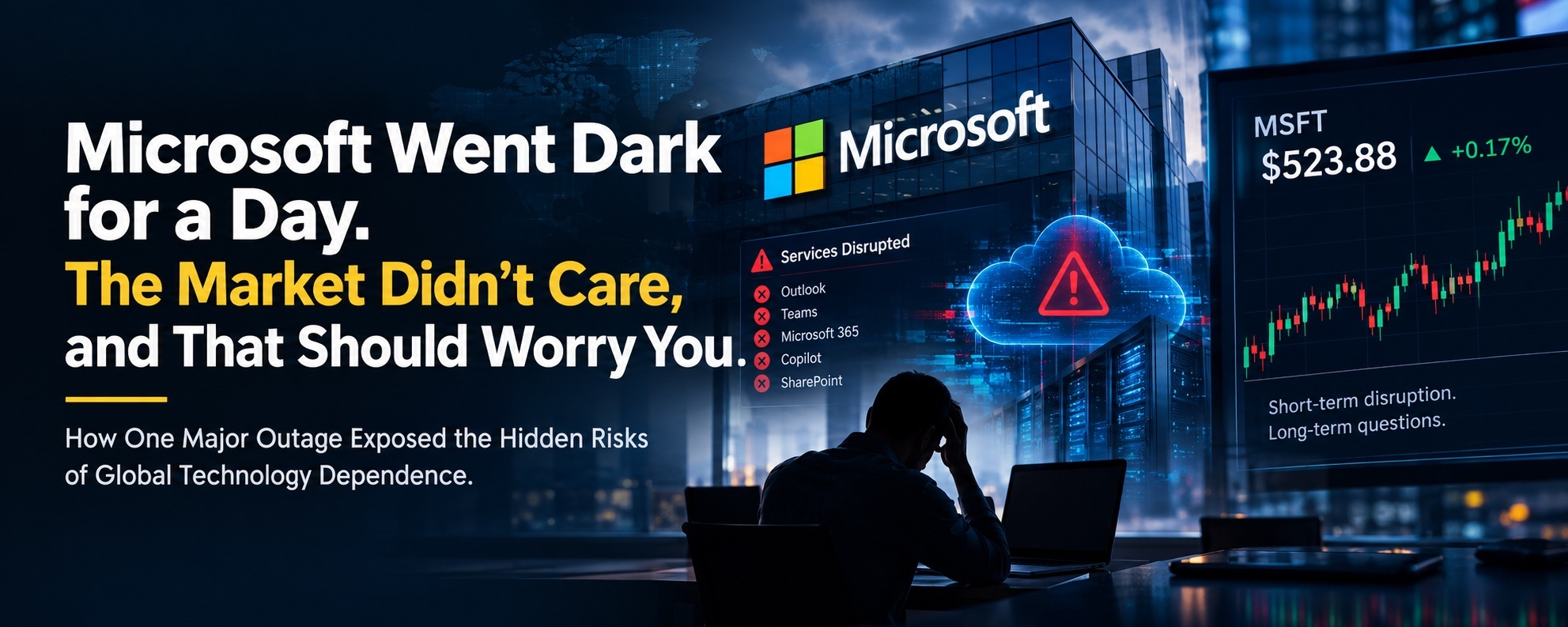
Microsoft Went Dark for a Day. The Market Didn’t Care, and That Should Worry You.A 24-Hour Technology Disruption Exposed a Much Bigger Problem: The World’s Growing Dependence on a Few Technology Giants.
On November 12, 2026, Microsoft experienced one of its most disruptive service outages in recent years. Outlook, Microsoft Teams, Copilot and several Microsoft 365 services became inaccessible or unreliable for users across more than 70 countries.
Businesses struggled to communicate. Financial institutions faced operational delays. Government departments experienced interruptions, and some organizations were forced to return to traditional communication methods, including phone calls and fax machines.
The disruption continued into November 13, lasting more than 24 hours for affected services.
Yet something particularly interesting happened in financial markets.
Despite the scale of the disruption, Microsoft shares recovered and closed Friday at approximately $523.88, up around 0.17%.
In other words, a major technology infrastructure failure barely left a lasting impression on the stock price.
But should investors interpret that as confidence in Microsoft, or is the market overlooking a much larger structural risk?
Let’s break it down.
1. What Actually Happened?
The disruption primarily affected Exchange Online, Microsoft’s cloud-based email and calendar infrastructure.
Because several Microsoft 365 products depend on Exchange Online, the problem extended beyond email.
Affected services included:
▪ Outlook and email connectivity
▪ Microsoft Teams and collaboration features
▪ SharePoint Online integrations
▪ Microsoft 365 Copilot functionality
▪ Calendar synchronization and scheduling
▪ Certain connected enterprise services
Microsoft initially reported infrastructure load problems and servers failing automated health checks.
Its subsequent explanation identified an issue associated with an earlier network-capacity upgrade that surfaced following a more recent network change.
Importantly, Microsoft clarified that the incident was not caused by a cyberattack or AI agents.
The company gradually restored services while validating infrastructure stability.
The bigger lesson: Modern technology platforms are interconnected. A failure in one critical component can affect multiple applications that appear completely independent to their users.
2. Why Didn’t the Stock Market React More Aggressively?
This is arguably the most interesting part of the entire incident.
Investors generally evaluate companies based on their expected future earnings, cash flows, competitive position and business sustainability.
A temporary service disruption does not automatically change those long-term expectations.
There are several reasons why Microsoft’s shares remained relatively resilient.
A. Microsoft’s Financial Scale
Microsoft is not dependent on a single product or revenue stream.
Its business includes:
▪ Azure cloud infrastructure
▪ Microsoft 365 subscriptions
▪ Windows and enterprise software
▪ LinkedIn
▪ Gaming and Xbox
▪ AI-related products and services
According to Microsoft’s FY2026 annual report, the company generated approximately $331.8 billion in annual revenue, representing 18% year-over-year growth.
A temporary disruption affecting one part of its ecosystem is unlikely to immediately undermine the entire company’s financial outlook.
B. Enterprise Switching Costs
Microsoft products are deeply integrated into corporate environments.
Organizations use Outlook, Teams, SharePoint, Azure and other services across departments.
Moving an entire organization to another technology provider requires:
▪ Data migration
▪ Employee training
▪ Software integration
▪ Security reviews
▪ Compliance adjustments
▪ Additional operational expenditure
Consequently, even a serious outage does not automatically result in customers abandoning Microsoft.
C. Investors Focus on Long-Term Cash Flows
Stock markets are forward-looking.
Investors are more concerned about whether an incident changes future revenue, profitability, customer retention or growth expectations.
A temporary interruption may generate operational costs without fundamentally changing those expectations.
That explains why the stock reaction was relatively limited.
However, limited immediate price movement does not mean the incident was financially insignificant.
3. The Hidden Risk: Technology Concentration
Here is where the story becomes much more important.
The problem is not simply that Microsoft experienced an outage.
The problem is how many organizations depend on a relatively small number of technology providers.
Consider the modern business environment:
A company may use Microsoft for email, Google for cloud applications, Amazon for infrastructure, and other technology providers for payments, cybersecurity and communication.
But these services frequently connect through shared infrastructure and dependencies.
When a major provider experiences a disruption, the impact can spread across industries.
This creates what financial analysts and technology risk professionals describe as concentration risk.
Imagine thousands of companies depending on the same critical infrastructure.
Even if every individual company operates efficiently, a failure at the infrastructure provider can disrupt all of them simultaneously.
This is a systemic technology risk.
It is similar to financial markets where excessive dependence on one institution or counterparty can create vulnerabilities throughout the system.
4. The Financial Impact Goes Beyond Microsoft’s Stock Price
A common mistake is measuring the cost of an outage only through the affected company’s share price.
That approach ignores the broader economic impact.
Consider the following categories:
Direct Financial Costs
▪ Potential service credits for affected customers.
▪ Additional engineering and infrastructure expenses.
▪ Incident investigation and recovery costs.
▪ Potential insurance claims.
Indirect Business Costs
▪ Lost employee productivity.
▪ Delayed transactions and business decisions.
▪ Disrupted customer support.
▪ Delayed financial announcements.
▪ Operational and administrative inefficiencies.
Morningstar DBRS estimated insured losses associated with the incident at approximately $300 million to $500 million.
That figure represents estimated insured losses, not Microsoft’s own financial loss or the total economic cost of the outage.
The distinction matters.
The wider economic impact can extend far beyond the financial consequences recorded on Microsoft’s balance sheet.
5. Why Investors Should Watch the Next Few Months
The immediate stock reaction is only one part of the story.
The more important question is whether this incident changes Microsoft’s long-term business fundamentals.
There are four areas worth monitoring.
1. Customer Retention
Will enterprise customers continue expanding their Microsoft 365 subscriptions?
Or will some organizations begin diversifying their technology providers?
2. Infrastructure Reliability
Will Microsoft identify and eliminate the underlying weaknesses?
Repeated disruptions could gradually affect customer confidence.
3. Financial Performance
Will additional infrastructure expenditure, service credits or customer concessions affect operating margins?
4. AI Adoption
Microsoft is positioning Copilot and AI-powered services as important components of its future growth.
Enterprise customers must trust the underlying infrastructure before relying on these tools for critical business operations.
Reliability is therefore not just a technical requirement. It is part of the commercial value proposition.
6. The Bigger Market Lesson: Price Action and Fundamental Risk Are Different Things
This incident offers an important lesson for investors and traders.
A stock can remain stable even when its underlying business experiences a serious operational problem.
That does not necessarily mean the market is wrong.
Markets evaluate probabilities, expected financial consequences and future business performance rather than simply reacting to the number of people affected by an incident.
However, investors should avoid assuming that a limited immediate price reaction means there is no long-term risk.
There is a difference between:
▪ A temporary operational disruption.
▪ A recurring reliability problem.
▪ A structural weakness affecting customer confidence.
▪ A fundamental deterioration in future earnings.
These are four different scenarios, and they should not be treated equally.
For traders, the lesson is equally important: headlines alone are not trading signals. Price reaction, trading volume, broader market conditions and subsequent fundamental developments all matter.
The market measures financial damage. Businesses experience operational damage. And those two things are not always visible on the same day.
7. Final Takeaway: Convenience Has Created a New Kind of Vulnerability
Microsoft’s November outage demonstrated something that goes beyond one company’s technical problems.
The global economy has become increasingly dependent on a relatively small group of technology infrastructure providers.
These platforms have made businesses faster, more connected and more efficient.
But efficiency through centralization also creates concentration risk.
The market’s relatively calm response tells us that investors did not immediately see the outage as a threat to Microsoft’s long-term earnings power.
That may be understandable from a financial perspective.
However, businesses, investors and governments should look beyond the stock chart.
Because when a single technology provider becomes an essential part of the global business infrastructure, its reliability becomes an economic issue, not merely a technical one.
The real question is no longer whether another major technology outage will happen. It is whether the global economy is sufficiently prepared when it does.
#Microsoft #TechnologyRisk #ArifAlpha
Microsoft Went Dark for a Day. The Market Didn’t Care, and That Should Worry You.
A 24-Hour Technology Disruption Exposed a Much Bigger Problem: The World’s Growing Dependence on a Few Technology Giants.
On November 12, 2026, Microsoft experienced one of its most disruptive service outages in recent years. Outlook, Microsoft Teams, Copilot and several Microsoft 365 services became inaccessible or unreliable for users across more than 70 countries.
Businesses struggled to communicate. Financial institutions faced operational delays. Government departments experienced interruptions, and some organizations were forced to return to traditional communication methods, including phone calls and fax machines.
The disruption continued into November 13, lasting more than 24 hours for affected services.
Yet something particularly interesting happened in financial markets.
Despite the scale of the disruption, Microsoft shares recovered and closed Friday at approximately $523.88, up around 0.17%.
In other words, a major technology infrastructure failure barely left a lasting impression on the stock price.
But should investors interpret that as confidence in Microsoft, or is the market overlooking a much larger structural risk?
Let’s break it down.
1. What Actually Happened?
The disruption primarily affected Exchange Online, Microsoft’s cloud-based email and calendar infrastructure.
Because several Microsoft 365 products depend on Exchange Online, the problem extended beyond email.
Affected services included:
▪ Outlook and email connectivity
▪ Microsoft Teams and collaboration features
▪ SharePoint Online integrations
▪ Microsoft 365 Copilot functionality
▪ Calendar synchronization and scheduling
▪ Certain connected enterprise services
Microsoft initially reported infrastructure load problems and servers failing automated health checks.
Its subsequent explanation identified an issue associated with an earlier network-capacity upgrade that surfaced following a more recent network change.
Importantly, Microsoft clarified that the incident was not caused by a cyberattack or AI agents.
The company gradually restored services while validating infrastructure stability.
The bigger lesson: Modern technology platforms are interconnected. A failure in one critical component can affect multiple applications that appear completely independent to their users.
2. Why Didn’t the Stock Market React More Aggressively?
This is arguably the most interesting part of the entire incident.
Investors generally evaluate companies based on their expected future earnings, cash flows, competitive position and business sustainability.
A temporary service disruption does not automatically change those long-term expectations.
There are several reasons why Microsoft’s shares remained relatively resilient.
A. Microsoft’s Financial Scale
Microsoft is not dependent on a single product or revenue stream.
Its business includes:
▪ Azure cloud infrastructure
▪ Microsoft 365 subscriptions
▪ Windows and enterprise software
▪ LinkedIn
▪ Gaming and Xbox
▪ AI-related products and services
According to Microsoft’s FY2026 annual report, the company generated approximately $331.8 billion in annual revenue, representing 18% year-over-year growth.
A temporary disruption affecting one part of its ecosystem is unlikely to immediately undermine the entire company’s financial outlook.
B. Enterprise Switching Costs
Microsoft products are deeply integrated into corporate environments.
Organizations use Outlook, Teams, SharePoint, Azure and other services across departments.
Moving an entire organization to another technology provider requires:
▪ Data migration
▪ Employee training
▪ Software integration
▪ Security reviews
▪ Compliance adjustments
▪ Additional operational expenditure
Consequently, even a serious outage does not automatically result in customers abandoning Microsoft.
C. Investors Focus on Long-Term Cash Flows
Stock markets are forward-looking.
Investors are more concerned about whether an incident changes future revenue, profitability, customer retention or growth expectations.
A temporary interruption may generate operational costs without fundamentally changing those expectations.
That explains why the stock reaction was relatively limited.
However, limited immediate price movement does not mean the incident was financially insignificant.
3. The Hidden Risk: Technology Concentration
Here is where the story becomes much more important.
The problem is not simply that Microsoft experienced an outage.
The problem is how many organizations depend on a relatively small number of technology providers.
Consider the modern business environment:
A company may use Microsoft for email, Google for cloud applications, Amazon for infrastructure, and other technology providers for payments, cybersecurity and communication.
But these services frequently connect through shared infrastructure and dependencies.
When a major provider experiences a disruption, the impact can spread across industries.
This creates what financial analysts and technology risk professionals describe as concentration risk.
Imagine thousands of companies depending on the same critical infrastructure.
Even if every individual company operates efficiently, a failure at the infrastructure provider can disrupt all of them simultaneously.
This is a systemic technology risk.
It is similar to financial markets where excessive dependence on one institution or counterparty can create vulnerabilities throughout the system.
4. The Financial Impact Goes Beyond Microsoft’s Stock Price
A common mistake is measuring the cost of an outage only through the affected company’s share price.
That approach ignores the broader economic impact.
Consider the following categories:
Direct Financial Costs
▪ Potential service credits for affected customers.
▪ Additional engineering and infrastructure expenses.
▪ Incident investigation and recovery costs.
▪ Potential insurance claims.
Indirect Business Costs
▪ Lost employee productivity.
▪ Delayed transactions and business decisions.
▪ Disrupted customer support.
▪ Delayed financial announcements.
▪ Operational and administrative inefficiencies.
Morningstar DBRS estimated insured losses associated with the incident at approximately $300 million to $500 million.
That figure represents estimated insured losses, not Microsoft’s own financial loss or the total economic cost of the outage.
The distinction matters.
The wider economic impact can extend far beyond the financial consequences recorded on Microsoft’s balance sheet.
5. Why Investors Should Watch the Next Few Months
The immediate stock reaction is only one part of the story.
The more important question is whether this incident changes Microsoft’s long-term business fundamentals.
There are four areas worth monitoring.
1. Customer Retention
Will enterprise customers continue expanding their Microsoft 365 subscriptions?
Or will some organizations begin diversifying their technology providers?
2. Infrastructure Reliability
Will Microsoft identify and eliminate the underlying weaknesses?
Repeated disruptions could gradually affect customer confidence.
3. Financial Performance
Will additional infrastructure expenditure, service credits or customer concessions affect operating margins?
4. AI Adoption
Microsoft is positioning Copilot and AI-powered services as important components of its future growth.
Enterprise customers must trust the underlying infrastructure before relying on these tools for critical business operations.
Reliability is therefore not just a technical requirement. It is part of the commercial value proposition.
6. The Bigger Market Lesson: Price Action and Fundamental Risk Are Different Things
This incident offers an important lesson for investors and traders.
A stock can remain stable even when its underlying business experiences a serious operational problem.
That does not necessarily mean the market is wrong.
Markets evaluate probabilities, expected financial consequences and future business performance rather than simply reacting to the number of people affected by an incident.
However, investors should avoid assuming that a limited immediate price reaction means there is no long-term risk.
There is a difference between:
▪ A temporary operational disruption.
▪ A recurring reliability problem.
▪ A structural weakness affecting customer confidence.
▪ A fundamental deterioration in future earnings.
These are four different scenarios, and they should not be treated equally.
For traders, the lesson is equally important: headlines alone are not trading signals. Price reaction, trading volume, broader market conditions and subsequent fundamental developments all matter.
The market measures financial damage. Businesses experience operational damage. And those two things are not always visible on the same day.
7. Final Takeaway: Convenience Has Created a New Kind of Vulnerability
Microsoft’s November outage demonstrated something that goes beyond one company’s technical problems.
The global economy has become increasingly dependent on a relatively small group of technology infrastructure providers.
These platforms have made businesses faster, more connected and more efficient.
But efficiency through centralization also creates concentration risk.
The market’s relatively calm response tells us that investors did not immediately see the outage as a threat to Microsoft’s long-term earnings power.
That may be understandable from a financial perspective.
However, businesses, investors and governments should look beyond the stock chart.
Because when a single technology provider becomes an essential part of the global business infrastructure, its reliability becomes an economic issue, not merely a technical one.
The real question is no longer whether another major technology outage will happen. It is whether the global economy is sufficiently prepared when it does.
#Microsoft #TechnologyRisk #ArifAlpha
On November 12, 2026, Microsoft experienced one of its most disruptive service outages in recent years. Outlook, Microsoft Teams, Copilot and several Microsoft 365 services became inaccessible or unreliable for users across more than 70 countries.
Businesses struggled to communicate. Financial institutions faced operational delays. Government departments experienced interruptions, and some organizations were forced to return to traditional communication methods, including phone calls and fax machines.
The disruption continued into November 13, lasting more than 24 hours for affected services.
Yet something particularly interesting happened in financial markets.
Despite the scale of the disruption, Microsoft shares recovered and closed Friday at approximately $523.88, up around 0.17%.
In other words, a major technology infrastructure failure barely left a lasting impression on the stock price.
But should investors interpret that as confidence in Microsoft, or is the market overlooking a much larger structural risk?
Let’s break it down.
1. What Actually Happened?
The disruption primarily affected Exchange Online, Microsoft’s cloud-based email and calendar infrastructure.
Because several Microsoft 365 products depend on Exchange Online, the problem extended beyond email.
Affected services included:
▪ Outlook and email connectivity
▪ Microsoft Teams and collaboration features
▪ SharePoint Online integrations
▪ Microsoft 365 Copilot functionality
▪ Calendar synchronization and scheduling
▪ Certain connected enterprise services
Microsoft initially reported infrastructure load problems and servers failing automated health checks.
Its subsequent explanation identified an issue associated with an earlier network-capacity upgrade that surfaced following a more recent network change.
Importantly, Microsoft clarified that the incident was not caused by a cyberattack or AI agents.
The company gradually restored services while validating infrastructure stability.
The bigger lesson: Modern technology platforms are interconnected. A failure in one critical component can affect multiple applications that appear completely independent to their users.
2. Why Didn’t the Stock Market React More Aggressively?
This is arguably the most interesting part of the entire incident.
Investors generally evaluate companies based on their expected future earnings, cash flows, competitive position and business sustainability.
A temporary service disruption does not automatically change those long-term expectations.
There are several reasons why Microsoft’s shares remained relatively resilient.
A. Microsoft’s Financial Scale
Microsoft is not dependent on a single product or revenue stream.
Its business includes:
▪ Azure cloud infrastructure
▪ Microsoft 365 subscriptions
▪ Windows and enterprise software
▪ Gaming and Xbox
▪ AI-related products and services
According to Microsoft’s FY2026 annual report, the company generated approximately $331.8 billion in annual revenue, representing 18% year-over-year growth.
A temporary disruption affecting one part of its ecosystem is unlikely to immediately undermine the entire company’s financial outlook.
B. Enterprise Switching Costs
Microsoft products are deeply integrated into corporate environments.
Organizations use Outlook, Teams, SharePoint, Azure and other services across departments.
Moving an entire organization to another technology provider requires:
▪ Data migration
▪ Employee training
▪ Software integration
▪ Security reviews
▪ Compliance adjustments
▪ Additional operational expenditure
Consequently, even a serious outage does not automatically result in customers abandoning Microsoft.
C. Investors Focus on Long-Term Cash Flows
Stock markets are forward-looking.
Investors are more concerned about whether an incident changes future revenue, profitability, customer retention or growth expectations.
A temporary interruption may generate operational costs without fundamentally changing those expectations.
That explains why the stock reaction was relatively limited.
However, limited immediate price movement does not mean the incident was financially insignificant.
3. The Hidden Risk: Technology Concentration
Here is where the story becomes much more important.
The problem is not simply that Microsoft experienced an outage.
The problem is how many organizations depend on a relatively small number of technology providers.
Consider the modern business environment:
A company may use Microsoft for email, Google for cloud applications, Amazon for infrastructure, and other technology providers for payments, cybersecurity and communication.
But these services frequently connect through shared infrastructure and dependencies.
When a major provider experiences a disruption, the impact can spread across industries.
This creates what financial analysts and technology risk professionals describe as concentration risk.
Imagine thousands of companies depending on the same critical infrastructure.
Even if every individual company operates efficiently, a failure at the infrastructure provider can disrupt all of them simultaneously.
This is a systemic technology risk.
It is similar to financial markets where excessive dependence on one institution or counterparty can create vulnerabilities throughout the system.
4. The Financial Impact Goes Beyond Microsoft’s Stock Price
A common mistake is measuring the cost of an outage only through the affected company’s share price.
That approach ignores the broader economic impact.
Consider the following categories:
Direct Financial Costs
▪ Potential service credits for affected customers.
▪ Additional engineering and infrastructure expenses.
▪ Incident investigation and recovery costs.
▪ Potential insurance claims.
Indirect Business Costs
▪ Lost employee productivity.
▪ Delayed transactions and business decisions.
▪ Disrupted customer support.
▪ Delayed financial announcements.
▪ Operational and administrative inefficiencies.
Morningstar DBRS estimated insured losses associated with the incident at approximately $300 million to $500 million.
That figure represents estimated insured losses, not Microsoft’s own financial loss or the total economic cost of the outage.
The distinction matters.
The wider economic impact can extend far beyond the financial consequences recorded on Microsoft’s balance sheet.
5. Why Investors Should Watch the Next Few Months
The immediate stock reaction is only one part of the story.
The more important question is whether this incident changes Microsoft’s long-term business fundamentals.
There are four areas worth monitoring.
1. Customer Retention
Will enterprise customers continue expanding their Microsoft 365 subscriptions?
Or will some organizations begin diversifying their technology providers?
2. Infrastructure Reliability
Will Microsoft identify and eliminate the underlying weaknesses?
Repeated disruptions could gradually affect customer confidence.
3. Financial Performance
Will additional infrastructure expenditure, service credits or customer concessions affect operating margins?
4. AI Adoption
Microsoft is positioning Copilot and AI-powered services as important components of its future growth.
Enterprise customers must trust the underlying infrastructure before relying on these tools for critical business operations.
Reliability is therefore not just a technical requirement. It is part of the commercial value proposition.
6. The Bigger Market Lesson: Price Action and Fundamental Risk Are Different Things
This incident offers an important lesson for investors and traders.
A stock can remain stable even when its underlying business experiences a serious operational problem.
That does not necessarily mean the market is wrong.
Markets evaluate probabilities, expected financial consequences and future business performance rather than simply reacting to the number of people affected by an incident.
However, investors should avoid assuming that a limited immediate price reaction means there is no long-term risk.
There is a difference between:
▪ A temporary operational disruption.
▪ A recurring reliability problem.
▪ A structural weakness affecting customer confidence.
▪ A fundamental deterioration in future earnings.
These are four different scenarios, and they should not be treated equally.
For traders, the lesson is equally important: headlines alone are not trading signals. Price reaction, trading volume, broader market conditions and subsequent fundamental developments all matter.
The market measures financial damage. Businesses experience operational damage. And those two things are not always visible on the same day.
7. Final Takeaway: Convenience Has Created a New Kind of Vulnerability
Microsoft’s November outage demonstrated something that goes beyond one company’s technical problems.
The global economy has become increasingly dependent on a relatively small group of technology infrastructure providers.
These platforms have made businesses faster, more connected and more efficient.
But efficiency through centralization also creates concentration risk.
The market’s relatively calm response tells us that investors did not immediately see the outage as a threat to Microsoft’s long-term earnings power.
That may be understandable from a financial perspective.
However, businesses, investors and governments should look beyond the stock chart.
Because when a single technology provider becomes an essential part of the global business infrastructure, its reliability becomes an economic issue, not merely a technical one.
The real question is no longer whether another major technology outage will happen. It is whether the global economy is sufficiently prepared when it does.
#Microsoft #TechnologyRisk #ArifAlpha
142
ເຂົ້າສູ່ລະບົບເພື່ອສຳຫຼວດເນື້ອຫາເພີ່ມເຕີມ
ເຂົ້າຮ່ວມກຸ່ມຜູ້ໃຊ້ຄຣິບໂຕທົ່ວໂລກໃນ Binance Square.
⚡️ ໄດ້ຮັບຂໍ້ມູນຫຼ້າສຸດ ແລະ ທີ່ມີປະໂຫຍດກ່ຽວກັບຄຣິບໂຕ.
💬 ໄດ້ຮັບຄວາມໄວ້ວາງໃຈຈາກຕະຫຼາດແລກປ່ຽນຄຣິບໂຕທີ່ໃຫຍ່ທີ່ສຸດໃນໂລກ.
👍 ຄົ້ນຫາຂໍ້ມູນເຊີງເລິກທີ່ແທ້ຈາກນັກສ້າງທີ່ໄດ້ຮັບການຢືນຢັນ.
ອີເມວ / ເບີໂທລະສັບ
ຫົວຂໍ້ທີ່ກໍາລັງນິຍົມ
1
#CryptoSelloffTriggersMultipleWhaleLiquidations
150,175 ຄັ້ງທີ່ເບິ່ງ
1,630 ກຳລັງສົນທະນາ
2
#USSpotXRPETFsSeeLargestWeeklyOutflowIn8Months
140,908 ຄັ້ງທີ່ເບິ່ງ
1,477 ກຳລັງສົນທະນາ
3
#WillFOMCMinutesReinforceRateHikeExpectations?
39,145 ຄັ້ງທີ່ເບິ່ງ
682 ກຳລັງສົນທະນາ
4
#BitcoinActiveSupplyInProfitDropsBelow45%
216,285 ຄັ້ງທີ່ເບິ່ງ
1,741 ກຳລັງສົນທະນາ
5
#TONStrategyReports$23.97MQ3NetLoss
18,746 ຄັ້ງທີ່ເບິ່ງ
139 ກຳລັງສົນທະນາ
6
#KavaSaysAbnormalActivityLimitedToKavaLend
142,268 ຄັ້ງທີ່ເບິ່ງ
981 ກຳລັງສົນທະນາ
7
#WORPTLetsTouristsConvertCryptoToThaiBaht
48,149 ຄັ້ງທີ່ເບິ່ງ
389 ກຳລັງສົນທະນາ
8
#WhoWillSucceedJensenHuangatNvidia?
336,051 ຄັ້ງທີ່ເບິ່ງ
2,136 ກຳລັງສົນທະນາ
9
#WhatWillDriveCryptoandStocks’NextRebound?
856,457 ຄັ້ງທີ່ເບິ່ງ
3,949 ກຳລັງສົນທະນາ
10
#TradFiForBeginners
838,405 ຄັ້ງທີ່ເບິ່ງ
4,955 ກຳລັງສົນທະນາ