

#stakingyield
stakingyield
4,896 views
35 ກຳລັງສົນທະນາ
ມາແຮງ
ຫຼ້າສຸດ

·
--
Most crypto investors still think of yield as a DeFi novelty. But validator economics are quietly rewriting what it means to hold a Layer 1 asset long-term.
$ETH stakers earn protocol-level yield — not from a third-party protocol printing tokens, but from the network itself redistributing transaction fees and newly issued ETH. After the Merge, Ethereum burned base fees via EIP-1559, making ETH deflationary during high-activity periods while stakers still earn priority fees. That is a structurally different asset than pre-Merge ETH.
$ADA and $DOT operate under similar logic: validators and nominators earn yield for securing the network, with governance rights baked in. This transforms holding into participating. You are not just sitting on an asset — you are running infrastructure.
What this means for long-term conviction:
— Staking yield creates a natural price floor: rational actors sell less when they earn passive returns
— Supply removed from circulation via staking compresses available float
— Governance participation aligns long-term holders with protocol direction
— Compounding staking rewards amplify position size over multi-year horizons
The shift from speculative holding to yield-bearing infrastructure ownership is one of the most underappreciated structural changes in crypto. Institutions running discounted cash flow models on staking yield are arriving at very different valuations than pure sentiment traders.
Long-term conviction is not just about price targets. It is about understanding what you actually own.
#CryptoInvesting #StakingYield #ValidatorEconomics #LongTermCrypto #Web3Infrastructure
Most crypto investors still think of yield as a DeFi novelty. But validator economics are quietly rewriting what it means to hold a Layer 1 asset long-term.
$ETH stakers earn protocol-level yield — not from a third-party protocol printing tokens, but from the network itself redistributing transaction fees and newly issued ETH. After the Merge, Ethereum burned base fees via EIP-1559, making ETH deflationary during high-activity periods while stakers still earn priority fees. That is a structurally different asset than pre-Merge ETH.
$ADA and $DOT operate under similar logic: validators and nominators earn yield for securing the network, with governance rights baked in. This transforms holding into participating. You are not just sitting on an asset — you are running infrastructure.
What this means for long-term conviction:
— Staking yield creates a natural price floor: rational actors sell less when they earn passive returns
— Supply removed from circulation via staking compresses available float
— Governance participation aligns long-term holders with protocol direction
— Compounding staking rewards amplify position size over multi-year horizons
The shift from speculative holding to yield-bearing infrastructure ownership is one of the most underappreciated structural changes in crypto. Institutions running discounted cash flow models on staking yield are arriving at very different valuations than pure sentiment traders.
Long-term conviction is not just about price targets. It is about understanding what you actually own.
#CryptoInvesting #StakingYield #ValidatorEconomics #LongTermCrypto #Web3Infrastructure
$ETH stakers earn protocol-level yield — not from a third-party protocol printing tokens, but from the network itself redistributing transaction fees and newly issued ETH. After the Merge, Ethereum burned base fees via EIP-1559, making ETH deflationary during high-activity periods while stakers still earn priority fees. That is a structurally different asset than pre-Merge ETH.
$ADA and $DOT operate under similar logic: validators and nominators earn yield for securing the network, with governance rights baked in. This transforms holding into participating. You are not just sitting on an asset — you are running infrastructure.
What this means for long-term conviction:
— Staking yield creates a natural price floor: rational actors sell less when they earn passive returns
— Supply removed from circulation via staking compresses available float
— Governance participation aligns long-term holders with protocol direction
— Compounding staking rewards amplify position size over multi-year horizons
The shift from speculative holding to yield-bearing infrastructure ownership is one of the most underappreciated structural changes in crypto. Institutions running discounted cash flow models on staking yield are arriving at very different valuations than pure sentiment traders.
Long-term conviction is not just about price targets. It is about understanding what you actually own.
#CryptoInvesting #StakingYield #ValidatorEconomics #LongTermCrypto #Web3Infrastructure
121
·
--
Staking Economics: Why APY Is the Wrong Number to Watch
Most people evaluate staking by comparing APY figures. That misses what actually matters.
Staking yield has three components that determine real value: issuance-funded yield (new token inflation diluting non-stakers), fee-funded yield (network revenue distributed to validators), and burn offset (supply destruction reducing the dilution cost of participation).
An 8% APY funded entirely by token issuance may leave you flat or negative in real terms if supply is growing faster than demand. A 4% APY where most yield comes from protocol fee revenue represents genuine economic productivity — the network is earning from real activity.
$ETH post-Pectra sits in a strong position here. Base fee burns compress net issuance while staking yields become increasingly fee-supported during high-activity periods. $BNB quarterly burns work similarly — deflation offsets validator rewards, making the economic security budget more durable over time.
When evaluating any staking position, the right question is: what percentage of yield comes from fees vs. new token issuance? Fee-funded yield compounds into a growing network. Issuance-funded yield is redistribution from future holders to current ones.
That distinction separates genuine compounding from nominal number theater. Most yield dashboards will never show you this split — which is exactly why it remains an edge.
$BTC
#StakingYield #CryptoYield #DeFi #Crypto #BinanceSquare
Staking Economics: Why APY Is the Wrong Number to Watch
Most people evaluate staking by comparing APY figures. That misses what actually matters.
Staking yield has three components that determine real value: issuance-funded yield (new token inflation diluting non-stakers), fee-funded yield (network revenue distributed to validators), and burn offset (supply destruction reducing the dilution cost of participation).
An 8% APY funded entirely by token issuance may leave you flat or negative in real terms if supply is growing faster than demand. A 4% APY where most yield comes from protocol fee revenue represents genuine economic productivity — the network is earning from real activity.
$ETH post-Pectra sits in a strong position here. Base fee burns compress net issuance while staking yields become increasingly fee-supported during high-activity periods. $BNB quarterly burns work similarly — deflation offsets validator rewards, making the economic security budget more durable over time.
When evaluating any staking position, the right question is: what percentage of yield comes from fees vs. new token issuance? Fee-funded yield compounds into a growing network. Issuance-funded yield is redistribution from future holders to current ones.
That distinction separates genuine compounding from nominal number theater. Most yield dashboards will never show you this split — which is exactly why it remains an edge.
$BTC
#StakingYield #CryptoYield #DeFi #Crypto #BinanceSquare
Most people evaluate staking by comparing APY figures. That misses what actually matters.
Staking yield has three components that determine real value: issuance-funded yield (new token inflation diluting non-stakers), fee-funded yield (network revenue distributed to validators), and burn offset (supply destruction reducing the dilution cost of participation).
An 8% APY funded entirely by token issuance may leave you flat or negative in real terms if supply is growing faster than demand. A 4% APY where most yield comes from protocol fee revenue represents genuine economic productivity — the network is earning from real activity.
$ETH post-Pectra sits in a strong position here. Base fee burns compress net issuance while staking yields become increasingly fee-supported during high-activity periods. $BNB quarterly burns work similarly — deflation offsets validator rewards, making the economic security budget more durable over time.
When evaluating any staking position, the right question is: what percentage of yield comes from fees vs. new token issuance? Fee-funded yield compounds into a growing network. Issuance-funded yield is redistribution from future holders to current ones.
That distinction separates genuine compounding from nominal number theater. Most yield dashboards will never show you this split — which is exactly why it remains an edge.
$BTC
#StakingYield #CryptoYield #DeFi #Crypto #BinanceSquare
25

·
--
#BinanceKatanaSeason5vbETHEarnEvent
Active Web3 ecosystem participants are mobilizing rapidly following the official launch of the highly anticipated Binance Katana Season 5 vbETH Earn Event, offering excellent structural yield opportunities. This specialized campaign enables dedicated asset holders to maximize their digital efficiency by deploying liquidity within optimized smart contract staking frameworks. As capital continuously seeks secure, high-yield options during lateral macro market movements, structured ecosystem events like this serve as excellent avenues for organic portfolio growth. Ensuring proper timing and understanding the specific delegation mechanics is essential to securing the highest tier of promotional rewards available. Are you actively participating in this latest earn season to optimize your holdings? 🚀💎 #BinanceKatanaSeason5vbETHEarnEvent #BinanceEarn #StakingYield
{spot}(BNBUSDT)
{future}(BNBUSDT)
#BinanceKatanaSeason5vbETHEarnEvent
Active Web3 ecosystem participants are mobilizing rapidly following the official launch of the highly anticipated Binance Katana Season 5 vbETH Earn Event, offering excellent structural yield opportunities. This specialized campaign enables dedicated asset holders to maximize their digital efficiency by deploying liquidity within optimized smart contract staking frameworks. As capital continuously seeks secure, high-yield options during lateral macro market movements, structured ecosystem events like this serve as excellent avenues for organic portfolio growth. Ensuring proper timing and understanding the specific delegation mechanics is essential to securing the highest tier of promotional rewards available. Are you actively participating in this latest earn season to optimize your holdings? 🚀💎 #BinanceKatanaSeason5vbETHEarnEvent #BinanceEarn #StakingYield
Active Web3 ecosystem participants are mobilizing rapidly following the official launch of the highly anticipated Binance Katana Season 5 vbETH Earn Event, offering excellent structural yield opportunities. This specialized campaign enables dedicated asset holders to maximize their digital efficiency by deploying liquidity within optimized smart contract staking frameworks. As capital continuously seeks secure, high-yield options during lateral macro market movements, structured ecosystem events like this serve as excellent avenues for organic portfolio growth. Ensuring proper timing and understanding the specific delegation mechanics is essential to securing the highest tier of promotional rewards available. Are you actively participating in this latest earn season to optimize your holdings? 🚀💎 #BinanceKatanaSeason5vbETHEarnEvent #BinanceEarn #StakingYield

12
·
--
Institutional Capital Is Chasing Staking Yield
For decades, institutional portfolios were built around one core principle: find reliable yield. Treasuries, investment-grade bonds, dividend equities — all just variations of the same search for predictable income.
Now staking is entering that conversation.
$ETH staking currently offers ~3.5-4% annualized yield, derived from real network fee revenue and validator rewards. For a pension fund comparing that against 10-year Treasuries, the risk-adjusted calculus is starting to look interesting — especially when ETH also carries upside optionality that a bond never will.
$SOL validators are generating some of the highest real-yield figures in the proof-of-stake universe, backed by growing transaction volume and protocol fees. That is yield tied to genuine ecosystem activity, not inflationary emission games.
$BNB holders accessing BNB Chain validator economics get the same proposition: real fee-derived rewards compounding alongside one of the most active smart contract ecosystems outside Ethereum.
What is shifting is not just the yield number. It is the narrative. Crypto is transitioning from a purely speculative asset to a productive asset class. That transition unlocks the next wave of institutional inflows — not just ETFs, but direct validator participation, staking derivatives, and yield-bearing structured products.
The income revolution in crypto is just beginning.
#StakingYield #InstitutionalCrypto #CryptoIncome #BinanceSquare
Institutional Capital Is Chasing Staking Yield
For decades, institutional portfolios were built around one core principle: find reliable yield. Treasuries, investment-grade bonds, dividend equities — all just variations of the same search for predictable income.
Now staking is entering that conversation.
$ETH staking currently offers ~3.5-4% annualized yield, derived from real network fee revenue and validator rewards. For a pension fund comparing that against 10-year Treasuries, the risk-adjusted calculus is starting to look interesting — especially when ETH also carries upside optionality that a bond never will.
$SOL validators are generating some of the highest real-yield figures in the proof-of-stake universe, backed by growing transaction volume and protocol fees. That is yield tied to genuine ecosystem activity, not inflationary emission games.
$BNB holders accessing BNB Chain validator economics get the same proposition: real fee-derived rewards compounding alongside one of the most active smart contract ecosystems outside Ethereum.
What is shifting is not just the yield number. It is the narrative. Crypto is transitioning from a purely speculative asset to a productive asset class. That transition unlocks the next wave of institutional inflows — not just ETFs, but direct validator participation, staking derivatives, and yield-bearing structured products.
The income revolution in crypto is just beginning.
#StakingYield #InstitutionalCrypto #CryptoIncome #BinanceSquare
For decades, institutional portfolios were built around one core principle: find reliable yield. Treasuries, investment-grade bonds, dividend equities — all just variations of the same search for predictable income.
Now staking is entering that conversation.
$ETH staking currently offers ~3.5-4% annualized yield, derived from real network fee revenue and validator rewards. For a pension fund comparing that against 10-year Treasuries, the risk-adjusted calculus is starting to look interesting — especially when ETH also carries upside optionality that a bond never will.
$SOL validators are generating some of the highest real-yield figures in the proof-of-stake universe, backed by growing transaction volume and protocol fees. That is yield tied to genuine ecosystem activity, not inflationary emission games.
$BNB holders accessing BNB Chain validator economics get the same proposition: real fee-derived rewards compounding alongside one of the most active smart contract ecosystems outside Ethereum.
What is shifting is not just the yield number. It is the narrative. Crypto is transitioning from a purely speculative asset to a productive asset class. That transition unlocks the next wave of institutional inflows — not just ETFs, but direct validator participation, staking derivatives, and yield-bearing structured products.
The income revolution in crypto is just beginning.
#StakingYield #InstitutionalCrypto #CryptoIncome #BinanceSquare
128

·
--
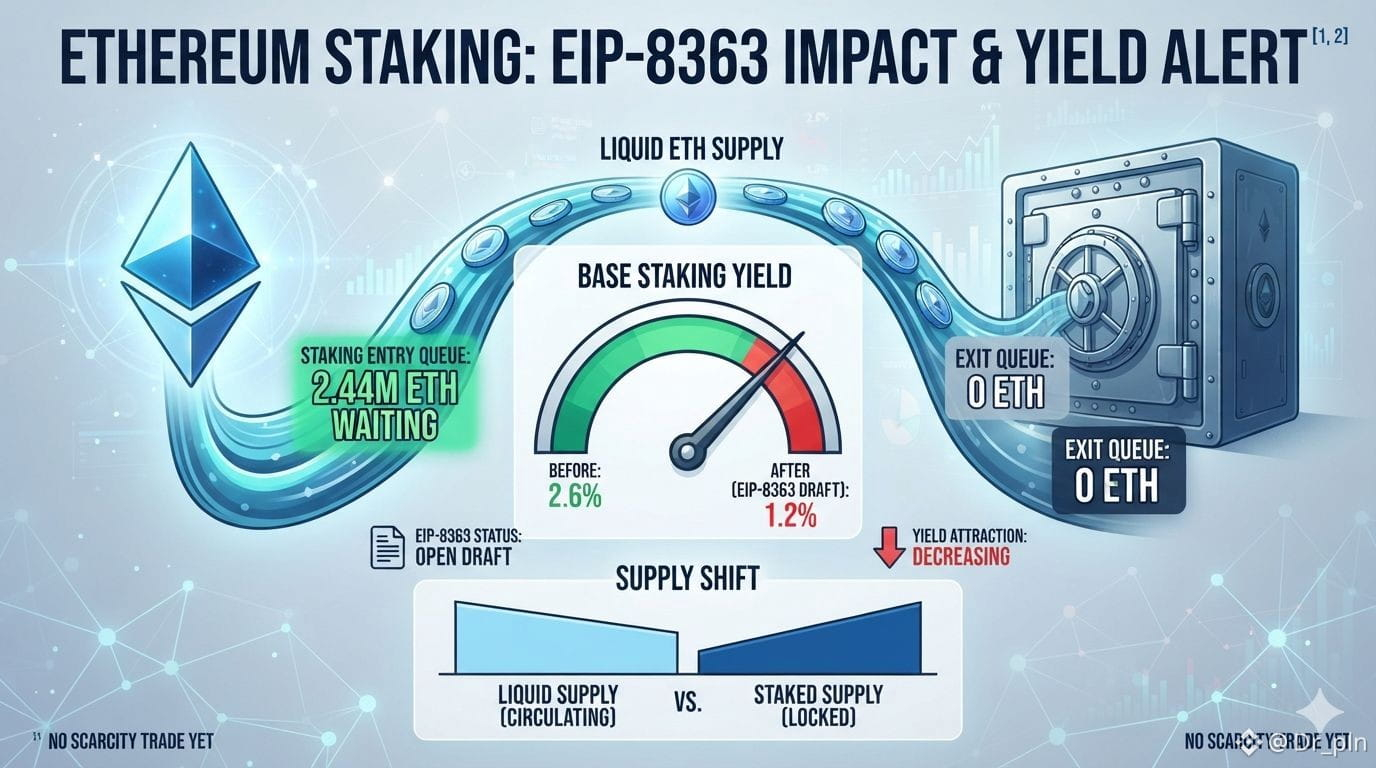
Analisis Anda sangat tepat mengenai dinamika pasar Ethereum saat ini. EIP-8363 masih berstatus draf terbuka, yang berarti perubahan struktural pada ekonomi token belum akan terjadi dalam waktu dekat.
Dengan 2,44 juta ETH di antrean masuk staking dan antrean keluar yang kosong, pasokan cair justru berpindah menjadi pasokan terkunci. Hal ini berpotensi memotong imbal hasil (yield) dasar dari 2,6% menjadi 1,2%, sehingga menurunkan daya tarik insentif staking tradisional secara masif. [1, 2]
$ETH $BNB $USDC
#ETH #StakingYield #ETHBTC
Analisis Anda sangat tepat mengenai dinamika pasar Ethereum saat ini. EIP-8363 masih berstatus draf terbuka, yang berarti perubahan struktural pada ekonomi token belum akan terjadi dalam waktu dekat.
Dengan 2,44 juta ETH di antrean masuk staking dan antrean keluar yang kosong, pasokan cair justru berpindah menjadi pasokan terkunci. Hal ini berpotensi memotong imbal hasil (yield) dasar dari 2,6% menjadi 1,2%, sehingga menurunkan daya tarik insentif staking tradisional secara masif. [1, 2]
$ETH $BNB $USDC
#ETH #StakingYield #ETHBTC
Dengan 2,44 juta ETH di antrean masuk staking dan antrean keluar yang kosong, pasokan cair justru berpindah menjadi pasokan terkunci. Hal ini berpotensi memotong imbal hasil (yield) dasar dari 2,6% menjadi 1,2%, sehingga menurunkan daya tarik insentif staking tradisional secara masif. [1, 2]
$ETH $BNB $USDC
#ETH #StakingYield #ETHBTC
93

$GSOL NOW OFFERS QUARTERLY CASH YIELD — THIS IS A GAME CHANGER 🔥
Grayscale just updated their GSOL fund to distribute staking rewards as actual cash payouts every quarter instead of compounding them into NAV. The gross yield is 6.1% after recent fee cuts — that’s real income for holders.
This is the same structural catalyst that drove interest in Ethereum staking funds. If Solana continues its uptrend, the cash flow could attract institutions looking for yield without selling their position.
Are you holding GSOL or buying the underlying asset directly?
Not financial advice. Always manage your risk.
#GSOL #Solana #StakingYield #CryptoIncome
🔥
$GSOL NOW OFFERS QUARTERLY CASH YIELD — THIS IS A GAME CHANGER 🔥
Grayscale just updated their GSOL fund to distribute staking rewards as actual cash payouts every quarter instead of compounding them into NAV. The gross yield is 6.1% after recent fee cuts — that’s real income for holders.
This is the same structural catalyst that drove interest in Ethereum staking funds. If Solana continues its uptrend, the cash flow could attract institutions looking for yield without selling their position.
Are you holding GSOL or buying the underlying asset directly?
Not financial advice. Always manage your risk.
#GSOL #Solana #StakingYield #CryptoIncome
🔥
Grayscale just updated their GSOL fund to distribute staking rewards as actual cash payouts every quarter instead of compounding them into NAV. The gross yield is 6.1% after recent fee cuts — that’s real income for holders.
This is the same structural catalyst that drove interest in Ethereum staking funds. If Solana continues its uptrend, the cash flow could attract institutions looking for yield without selling their position.
Are you holding GSOL or buying the underlying asset directly?
Not financial advice. Always manage your risk.
#GSOL #Solana #StakingYield #CryptoIncome
🔥
34

·
--
Morning, traders! 🌅 Ethereum is trading around $1,885, up modestly, as a genuinely interesting institutional move made headlines this week — SharpLink, a major Ethereum-focused digital asset treasury company, announced plans to deploy $200 million of ETH through the Lido liquid staking protocol to generate additional yield from its holdings. The company will receive wrapped staked ether (wstETH), custodied by Anchorage Digital, expanding its existing staking and restaking strategy.
This kind of move reflects a broader institutional trend building around Ethereum specifically — Fidelity has also recently signaled plans to add ETH staking with quarterly cash distributions, showing that major asset managers are increasingly treating ETH not just as a speculative asset, but as productive, yield-generating collateral.
With today's softer PPI print nudging Fed rate-pause odds higher, and Jackson Hole still ahead as a key catalyst later this month, ETH's institutional staking narrative could provide a steady undercurrent of demand regardless of short-term price chop. 🔍
$ETH #Ethereum #ETH2026 #StakingYield #CryptoNews #Institutional
Morning, traders! 🌅 Ethereum is trading around $1,885, up modestly, as a genuinely interesting institutional move made headlines this week — SharpLink, a major Ethereum-focused digital asset treasury company, announced plans to deploy $200 million of ETH through the Lido liquid staking protocol to generate additional yield from its holdings. The company will receive wrapped staked ether (wstETH), custodied by Anchorage Digital, expanding its existing staking and restaking strategy.
This kind of move reflects a broader institutional trend building around Ethereum specifically — Fidelity has also recently signaled plans to add ETH staking with quarterly cash distributions, showing that major asset managers are increasingly treating ETH not just as a speculative asset, but as productive, yield-generating collateral.
With today's softer PPI print nudging Fed rate-pause odds higher, and Jackson Hole still ahead as a key catalyst later this month, ETH's institutional staking narrative could provide a steady undercurrent of demand regardless of short-term price chop. 🔍
$ETH #Ethereum #ETH2026 #StakingYield #CryptoNews #Institutional
This kind of move reflects a broader institutional trend building around Ethereum specifically — Fidelity has also recently signaled plans to add ETH staking with quarterly cash distributions, showing that major asset managers are increasingly treating ETH not just as a speculative asset, but as productive, yield-generating collateral.
With today's softer PPI print nudging Fed rate-pause odds higher, and Jackson Hole still ahead as a key catalyst later this month, ETH's institutional staking narrative could provide a steady undercurrent of demand regardless of short-term price chop. 🔍
$ETH #Ethereum #ETH2026 #StakingYield #CryptoNews #Institutional

31
·
--
Validator Economics: The Layer 1 Differentiation That Rarely Gets Discussed
Most L1 comparisons focus on TPS, fees, and ecosystem TVL. But validator economics — the long-term incentive structure keeping networks secure — may matter more than any of these metrics.
$BTC relies entirely on transaction fees to fund security post-halving. Block rewards declining toward near-zero by the mid-2030s is a live, unresolved question for the world's most secure network. Fee revenue alone must carry the weight.
$ETH solved a version of this with EIP-1559 burn and proof-of-stake yields near 3.5–4%. The shift from energy expenditure to capital lockup changes the security model fundamentally — validator returns compound relative to ETH price, not electricity cost.
$BNB operates a hybrid: regular token burns compress supply while a smaller, fast-finality validator set trades decentralization for throughput and lower operational overhead. Security cost efficiency is the design priority.
The takeaway: these aren't just technical differences — they represent distinct long-term bets on where security revenue comes from. As networks mature, validator economics will increasingly drive institutional staking decisions, resilience assessments, and capital allocation frameworks.
Most traders price the narrative. Sophisticated investors price the security model.
Understanding how a network pays its validators is understanding the asset.
#Crypto #Layer1 #ValidatorEconomics #StakingYield #Blockchain
Validator Economics: The Layer 1 Differentiation That Rarely Gets Discussed
Most L1 comparisons focus on TPS, fees, and ecosystem TVL. But validator economics — the long-term incentive structure keeping networks secure — may matter more than any of these metrics.
$BTC relies entirely on transaction fees to fund security post-halving. Block rewards declining toward near-zero by the mid-2030s is a live, unresolved question for the world's most secure network. Fee revenue alone must carry the weight.
$ETH solved a version of this with EIP-1559 burn and proof-of-stake yields near 3.5–4%. The shift from energy expenditure to capital lockup changes the security model fundamentally — validator returns compound relative to ETH price, not electricity cost.
$BNB operates a hybrid: regular token burns compress supply while a smaller, fast-finality validator set trades decentralization for throughput and lower operational overhead. Security cost efficiency is the design priority.
The takeaway: these aren't just technical differences — they represent distinct long-term bets on where security revenue comes from. As networks mature, validator economics will increasingly drive institutional staking decisions, resilience assessments, and capital allocation frameworks.
Most traders price the narrative. Sophisticated investors price the security model.
Understanding how a network pays its validators is understanding the asset.
#Crypto #Layer1 #ValidatorEconomics #StakingYield #Blockchain
Most L1 comparisons focus on TPS, fees, and ecosystem TVL. But validator economics — the long-term incentive structure keeping networks secure — may matter more than any of these metrics.
$BTC relies entirely on transaction fees to fund security post-halving. Block rewards declining toward near-zero by the mid-2030s is a live, unresolved question for the world's most secure network. Fee revenue alone must carry the weight.
$ETH solved a version of this with EIP-1559 burn and proof-of-stake yields near 3.5–4%. The shift from energy expenditure to capital lockup changes the security model fundamentally — validator returns compound relative to ETH price, not electricity cost.
$BNB operates a hybrid: regular token burns compress supply while a smaller, fast-finality validator set trades decentralization for throughput and lower operational overhead. Security cost efficiency is the design priority.
The takeaway: these aren't just technical differences — they represent distinct long-term bets on where security revenue comes from. As networks mature, validator economics will increasingly drive institutional staking decisions, resilience assessments, and capital allocation frameworks.
Most traders price the narrative. Sophisticated investors price the security model.
Understanding how a network pays its validators is understanding the asset.
#Crypto #Layer1 #ValidatorEconomics #StakingYield #Blockchain
41
·
--
TVL-Per-Validator: The L1 Security Efficiency Metric Nobody Talks About
Most Layer 1 comparisons focus on total TVL, transaction throughput, or token price. But there's a ratio that cuts much deeper: TVL per validator — the amount of economic value secured per unit of network consensus.
Here's why it matters:
🔐 Security is only meaningful relative to what it protects. A chain with $50B TVL and 500,000 validators distributes risk very differently than one with the same TVL and 2,000 validators. Concentration shapes attack cost.
⚡ High TVL-per-validator signals capital efficiency, but also potential fragility. Low TVL-per-validator suggests either underutilized security (wasted cost) or emerging growth ahead of its security base.
📊 When you map $ETH, $SOL, and $AVAX against this lens, the picture shifts. Chains that look "smaller" by TVL rank differently when security efficiency is normalized.
🧠 For long-term investors, this ratio tracks whether a network is overbuilding its validator set (diluting staker yield) or undersecuring its economic weight (raising systemic risk).
The best L1 investments aren't just the ones with the most activity today — they're the ones with the most defensible security architecture for the capital they'll attract tomorrow.
Metrics matter. Choose them carefully.
$ETH $SOL $AVAX
#Layer1 #CryptoSecurity #DeFi #StakingYield #CryptoInvesting
TVL-Per-Validator: The L1 Security Efficiency Metric Nobody Talks About
Most Layer 1 comparisons focus on total TVL, transaction throughput, or token price. But there's a ratio that cuts much deeper: TVL per validator — the amount of economic value secured per unit of network consensus.
Here's why it matters:
🔐 Security is only meaningful relative to what it protects. A chain with $50B TVL and 500,000 validators distributes risk very differently than one with the same TVL and 2,000 validators. Concentration shapes attack cost.
⚡ High TVL-per-validator signals capital efficiency, but also potential fragility. Low TVL-per-validator suggests either underutilized security (wasted cost) or emerging growth ahead of its security base.
📊 When you map $ETH , $SOL , and $AVAX against this lens, the picture shifts. Chains that look "smaller" by TVL rank differently when security efficiency is normalized.
🧠 For long-term investors, this ratio tracks whether a network is overbuilding its validator set (diluting staker yield) or undersecuring its economic weight (raising systemic risk).
The best L1 investments aren't just the ones with the most activity today — they're the ones with the most defensible security architecture for the capital they'll attract tomorrow.
Metrics matter. Choose them carefully.
$ETH $SOL $AVAX
#Layer1 #CryptoSecurity #DeFi #StakingYield #CryptoInvesting
Most Layer 1 comparisons focus on total TVL, transaction throughput, or token price. But there's a ratio that cuts much deeper: TVL per validator — the amount of economic value secured per unit of network consensus.
Here's why it matters:
🔐 Security is only meaningful relative to what it protects. A chain with $50B TVL and 500,000 validators distributes risk very differently than one with the same TVL and 2,000 validators. Concentration shapes attack cost.
⚡ High TVL-per-validator signals capital efficiency, but also potential fragility. Low TVL-per-validator suggests either underutilized security (wasted cost) or emerging growth ahead of its security base.
📊 When you map $ETH , $SOL , and $AVAX against this lens, the picture shifts. Chains that look "smaller" by TVL rank differently when security efficiency is normalized.
🧠 For long-term investors, this ratio tracks whether a network is overbuilding its validator set (diluting staker yield) or undersecuring its economic weight (raising systemic risk).
The best L1 investments aren't just the ones with the most activity today — they're the ones with the most defensible security architecture for the capital they'll attract tomorrow.
Metrics matter. Choose them carefully.
$ETH $SOL $AVAX
#Layer1 #CryptoSecurity #DeFi #StakingYield #CryptoInvesting
78
·
--
Corporate treasury teams spent 2024 debating whether to hold $BTC. In 2025 and into 2026, the conversation shifted dramatically — now they ask which assets to diversify into and how to earn yield on those holdings.
This is a structural change in institutional behavior.
The original playbook was simple: treat Bitcoin as digital gold, put 1-5% of reserves in it, move on. But once a BTC position works, the next logical question becomes: what about productive assets? Assets that earn fees, generate protocol revenue, or capture staking rewards?
That is where $ETH enters treasury conversations differently. It is not just a store of value — it is working capital within its ecosystem. Staking returns ~3-4% annually. For a $500M corporate treasury, a 10% crypto allocation earning 3% yield generates $1.5M annually — not trivial.
$BNB adds another layer: fee capture, burn mechanics, and ecosystem utility across the largest CEX by volume. Holding it is not passive.
The institutions quietly accumulating now are not just hodlers. They are building productive balance sheets in crypto, the same way they hold dividend stocks or investment-grade bonds.
The yield layer of crypto is growing up. Watch treasury disclosures over the next four quarters.
$BTC $ETH $BNB
#CryptoTreasury #InstitutionalCrypto #StakingYield #CryptoAdoption #BinanceSquare
Corporate treasury teams spent 2024 debating whether to hold $BTC . In 2025 and into 2026, the conversation shifted dramatically — now they ask which assets to diversify into and how to earn yield on those holdings.
This is a structural change in institutional behavior.
The original playbook was simple: treat Bitcoin as digital gold, put 1-5% of reserves in it, move on. But once a BTC position works, the next logical question becomes: what about productive assets? Assets that earn fees, generate protocol revenue, or capture staking rewards?
That is where $ETH enters treasury conversations differently. It is not just a store of value — it is working capital within its ecosystem. Staking returns ~3-4% annually. For a $500M corporate treasury, a 10% crypto allocation earning 3% yield generates $1.5M annually — not trivial.
$BNB adds another layer: fee capture, burn mechanics, and ecosystem utility across the largest CEX by volume. Holding it is not passive.
The institutions quietly accumulating now are not just hodlers. They are building productive balance sheets in crypto, the same way they hold dividend stocks or investment-grade bonds.
The yield layer of crypto is growing up. Watch treasury disclosures over the next four quarters.
$BTC $ETH $BNB
#CryptoTreasury #InstitutionalCrypto #StakingYield #CryptoAdoption #BinanceSquare
This is a structural change in institutional behavior.
The original playbook was simple: treat Bitcoin as digital gold, put 1-5% of reserves in it, move on. But once a BTC position works, the next logical question becomes: what about productive assets? Assets that earn fees, generate protocol revenue, or capture staking rewards?
That is where $ETH enters treasury conversations differently. It is not just a store of value — it is working capital within its ecosystem. Staking returns ~3-4% annually. For a $500M corporate treasury, a 10% crypto allocation earning 3% yield generates $1.5M annually — not trivial.
$BNB adds another layer: fee capture, burn mechanics, and ecosystem utility across the largest CEX by volume. Holding it is not passive.
The institutions quietly accumulating now are not just hodlers. They are building productive balance sheets in crypto, the same way they hold dividend stocks or investment-grade bonds.
The yield layer of crypto is growing up. Watch treasury disclosures over the next four quarters.
$BTC $ETH $BNB
#CryptoTreasury #InstitutionalCrypto #StakingYield #CryptoAdoption #BinanceSquare
31
ເຂົ້າສູ່ລະບົບເພື່ອສຳຫຼວດເນື້ອຫາເພີ່ມເຕີມ
ເຂົ້າຮ່ວມກຸ່ມຜູ້ໃຊ້ຄຣິບໂຕທົ່ວໂລກໃນ Binance Square.
⚡️ ໄດ້ຮັບຂໍ້ມູນຫຼ້າສຸດ ແລະ ທີ່ມີປະໂຫຍດກ່ຽວກັບຄຣິບໂຕ.
💬 ໄດ້ຮັບຄວາມໄວ້ວາງໃຈຈາກຕະຫຼາດແລກປ່ຽນຄຣິບໂຕທີ່ໃຫຍ່ທີ່ສຸດໃນໂລກ.
👍 ຄົ້ນຫາຂໍ້ມູນເຊີງເລິກທີ່ແທ້ຈາກນັກສ້າງທີ່ໄດ້ຮັບການຢືນຢັນ.
ອີເມວ / ເບີໂທລະສັບ
ຫົວຂໍ້ທີ່ກໍາລັງນິຍົມ
1
#EarningsSeason
183,377 views
1,704 ກຳລັງສົນທະນາ
2
#BitwiseLaunchesFirstSpotNEARETF
4,977 views
201 ກຳລັງສົນທະນາ
3
#USJobOpeningsFallToFiveMonthLow
7,779 views
146 ກຳລັງສົນທະນາ
4
#ECBToTestAIAgentsInDigitalEuroPayments
11,667 views
323 ກຳລັງສົນທະນາ
5
#JapanFSABacksFourthStablecoinTradeSettlementPilot
13,310 views
377 ກຳລັງສົນທະນາ
6
#BitgetHackerFailsToMoveStolenFunds
27,466 views
509 ກຳລັງສົນທະນາ
7
#BitMineETHHoldingsTop6Million
25,159 views
635 ກຳລັງສົນທະນາ
8
#StrategyAdds1666BTCHoldingsReach847666
21,495 views
446 ກຳລັງສົນທະນາ
9
#NvidiaApproves$150BBuyback
4,255 views
67 ກຳລັງສົນທະນາ
10
#OpenAIDelaysGPT6.1OverSafetyIssues
33,671 views
809 ກຳລັງສົນທະນາ